


EN IEC 60909-0:2026
(Main)Short-circuit currents in three-phase AC systems - Part 0: Calculation of currents
General Information
- Abstract
- Status
- Published
- Publication Date
- 17-Sep-2026
- Technical Committee
- CLC/SR 73 - Short-circuit currents
- Drafting Committee
- IEC/TC 73 - IEC_TC_73
- Current Stage
- 6060 - Document made available - Publishing
- Start Date
- 18-Sep-2026
- Due Date
- 29-Dec-2023
- Completion Date
- 18-Sep-2026

Overview
EN IEC 60909-0:2026 - Short-circuit currents in three-phase AC systems - Part 0: Calculation of currents - is a crucial international standard developed by the International Electrotechnical Commission (IEC) and adopted in Europe by CLC. This standard defines methodologies for calculating short-circuit currents in both low-voltage and high-voltage three-phase alternating current (AC) systems operating at 50 Hz or 60 Hz. The accurate determination of maximum and minimum short-circuit currents provides essential input for system design, safety, equipment selection, and protection coordination in electrical power networks.
Applicable to systems up to and including 550 kV, EN IEC 60909-0 is widely recognized for standardizing the procedures and assumptions necessary to achieve reliable, comparable results in power system studies.
Key Topics
- General Calculation Method: Establishes a uniform, practical approach for computing short-circuit currents using equivalent voltage sources at the fault location. Both symmetrical and asymmetrical faults are included.
- Types of Short-circuit Currents: Differentiates between maximum currents (for system and equipment rating) and minimum currents (for protection settings and coordination).
- System Components Modeling: Sets requirements for modeling different electrical elements, such as overhead lines, transformer types, cables, generators, motors (synchronous and asynchronous), power electronic converters, and FACTS/HVDC systems.
- Short-circuit Types Covered:
- Three-phase short circuits (symmetrical)
- Line-to-line (two-phase) short circuits
- Line-to-earth (single-phase) short circuits
- Unbalanced and multiple-fed faults
- Key Parameters and Definitions: Provides clear definitions of critical parameters such as initial short-circuit current, peak current, breaking current, steady-state current, and calculation impedance.
- Calculation Steps:
- Determination of system and component impedances
- Calculation of initial, peak, and steady-state short-circuit currents
- Application to both voltage and current sources within the network
Applications
- System Design and Planning: Essential for engineers and system planners to determine worst-case short-circuit conditions, ensuring reliable operation and appropriate selection of system components such as cables, switchgear, circuit breakers, and transformers.
- Protection Coordination: Provides the foundation for setting relays, circuit breakers, and other protection devices. Accurate minimum current calculations help in grading and tripping sequence arrangements to minimize outage and equipment damage.
- Equipment Specification: Assists manufacturers and operators in specifying the required withstand and interruption capabilities for electrical equipment, based on calculated short-circuit ratings.
- Operational Safety: Ensures that personnel and systems are safeguarded by adhering to proven calculation practices for fault currents, which are critical for planning safe maintenance and operational procedures.
- Network Upgrades and Integration: Facilitates assessment of network modifications or the integration of new technologies, such as converter-based generation or motor drives, by providing consistent methods to analyze their impact on overall short-circuit levels.
Related Standards
- IEC TR 60909-1: Provides factors for short-circuit current calculation.
- IEC TR 60909-2: Details necessary data of electrical equipment for use in calculations.
- IEC 60909-3: Addresses currents during two separate simultaneous earth faults and associated issues.
- IEC TR 60909-4: Offers worked examples to support application of the calculation methodology.
- IEC 60038: Specifies standard system voltages relevant to these calculations.
EN IEC 60909-0:2026 is a foundational reference for electrical engineers, system operators, equipment manufacturers, and technical consultants engaged in short-circuit current calculation, power system design, and protection coordination within three-phase AC networks. By providing a standardized approach, the document ensures safety, efficiency, and interoperability across European and international projects.
Relations
- Effective Date
- 27-Sep-2022
- Refers
IEC 60050-131:2002 - International Electrotechnical Vocabulary (IEV) - Part 131: Circuit theory - Effective Date
- 18-Aug-2026
- Effective Date
- 22-Sep-2026
- Effective Date
- 22-Sep-2026
- Effective Date
- 22-Sep-2026
- Effective Date
- 22-Sep-2026
- Effective Date
- 22-Sep-2026
- Effective Date
- 22-Sep-2026
- Effective Date
- 22-Sep-2026
- Effective Date
- 22-Sep-2026
- Effective Date
- 22-Sep-2026
Get Certified
Connect with accredited certification bodies for this standard

IMQ S.p.A. (Certification)
Italian electrical product certification.

SLG Prüf- und Zertifizierungs GmbH
German testing and certification body.

UL Solutions
Global safety science company with testing, inspection and certification.
Sponsored listings
Frequently Asked Questions
EN IEC 60909-0:2026 is a draft published by CLC. Its full title is "Short-circuit currents in three-phase AC systems - Part 0: Calculation of currents". This standard covers: Short-circuit currents in three-phase AC systems - Part 0: Calculation of currents
Short-circuit currents in three-phase AC systems - Part 0: Calculation of currents
EN IEC 60909-0:2026 is classified under the following ICS (International Classification for Standards) categories: 17.220.01 - Electricity. Magnetism. General aspects; 29.240.20 - Power transmission and distribution lines. The ICS classification helps identify the subject area and facilitates finding related standards.
EN IEC 60909-0:2026 has the following relationships with other standards: It is inter standard links to EN 60909-0:2016, IEC 60050-131:2002, CLC/TS 50654-1:2020, EN 50628:2016, CLC/TS 50654-1:2018, HD 60364-5-54:2011, EN 60027-7:2010, EN 50368:2003, EN 60865-1:2012, EN 60909-3:2010, EN 60519-1:2015. Understanding these relationships helps ensure you are using the most current and applicable version of the standard.
EN IEC 60909-0:2026 is available in PDF format for immediate download after purchase. The document can be added to your cart and obtained through the secure checkout process. Digital delivery ensures instant access to the complete standard document.
Standards Content (Sample)
SLOVENSKI STANDARD
oSIST prEN IEC 60909:2025
01-junij-2025
Kratkostični toki v izmeničnih trifaznih sistemih - 0. del: Računanje tokov
Short-circuit currents in three-phase a.c. systems - Part 0: Calculation of currents
Kurzschlussströme in Drehstromnetzen - Teil 0: Berechnung der Ströme
Courants de court-circuit dans les réseaux triphasés à courant alternatif - Partie 0: Calcul
des courants
Ta slovenski standard je istoveten z: prEN IEC 60909:2025
ICS:
17.220.01 Elektrika. Magnetizem. Electricity. Magnetism.
Splošni vidiki General aspects
29.240.20 Daljnovodi Power transmission and
distribution lines
oSIST prEN IEC 60909:2025 en
2003-01.Slovenski inštitut za standardizacijo. Razmnoževanje celote ali delov tega standarda ni dovoljeno.
oSIST prEN IEC 60909:2025
oSIST prEN IEC 60909:2025
73/220/CDV
COMMITTEE DRAFT FOR VOTE (CDV)
PROJECT NUMBER:
IEC 60909-0 ED3
DATE OF CIRCULATION: CLOSING DATE FOR VOTING:
2025-05-02 2025-07-25
SUPERSEDES DOCUMENTS:
73/192A/RR
IEC TC 73 : SHORT-CIRCUIT CURRENTS
SECRETARIAT: SECRETARY:
Norway Mr Lars Jakob Paulsen
OF INTEREST TO THE FOLLOWING COMMITTEES: HORIZONTAL FUNCTION(S):
TC 8,TC 17,TC 18,TC 64,TC 88,TC 99,TC 121
ASPECTS CONCERNED:
Safety
SUBMITTED FOR CENELEC PARALLEL VOTING NOT SUBMITTED FOR CENELEC PARALLEL VOTING
Attention IEC-CENELEC parallel voting
The attention of IEC National Committees, members of
CENELEC, is drawn to the fact that this Committee Draft
for Vote (CDV) is submitted for parallel voting.
The CENELEC members are invited to vote through the
CENELEC online voting system.
This document is still under study and subject to change. It should not be used for reference purposes.
Recipients of this document are invited to submit, with their comments, notification of any relevant patent rights of which
they are aware and to provide supporting documentation.
Recipients of this document are invited to submit, with their comments, notification of any relevant “In Some Countries”
clauses to be included should this proposal proceed. Recipients are reminded that the CDV stage is the final stage for
submitting ISC clauses. (SEE AC/22/2007 OR NEW GUIDANCE DOC).
TITLE:
Short-circuit currents in three-phase a.c. systems - Part 0: Calculation of currents
PROPOSED STABILITY DATE: 2028
NOTE FROM TC/SC OFFICERS:
Maintenace projects was approved by National Committees and documented in 73/191/RQ
The Secretariat has decided to finish ED 3 within the allocated project time. CDV as the next step is the only
way to achieve this.
Note that MT1 will start work on ED 4 as soon as ED 3 is published. Technical comments outside the scope of
the current ED 3 will be handled in the next revision.
electronic file, to make a copy and to print out the content for the sole purpose of preparing National Committee positions.
You may not copy or "mirror" the file or printed version of the document, or any part of it, for any other purpose without
permission in writing from IEC.
oSIST prEN IEC 60909:2025
2 IEC CDV 60909-0 ED3 © IEC 2025
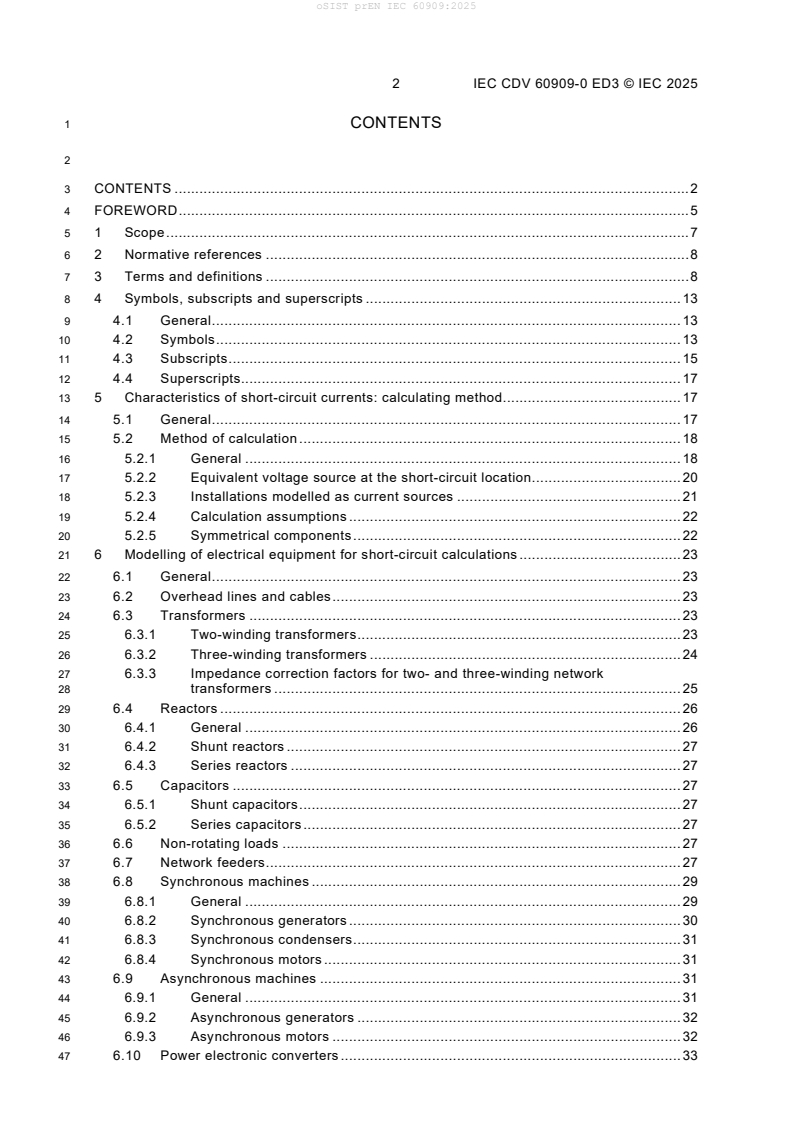
1 CONTENTS
3 CONTENTS . 2
4 FOREWORD . 5
5 1 Scope . 7
6 2 Normative references . 8
7 3 Terms and definitions . 8
8 4 Symbols, subscripts and superscripts . 13
9 4.1 General . 13
10 4.2 Symbols . 13
11 4.3 Subscripts . 15
12 4.4 Superscripts. 17
13 5 Characteristics of short-circuit currents: calculating method. 17
14 5.1 General . 17
15 5.2 Method of calculation . 18
16 5.2.1 General . 18
17 5.2.2 Equivalent voltage source at the short-circuit location. 20
18 5.2.3 Installations modelled as current sources . 21
19 5.2.4 Calculation assumptions . 22
20 5.2.5 Symmetrical components . 22
21 6 Modelling of electrical equipment for short-circuit calculations . 23
22 6.1 General . 23
23 6.2 Overhead lines and cables . 23
24 6.3 Transformers . 23
25 6.3.1 Two-winding transformers . 23
26 6.3.2 Three-winding transformers . 24
27 6.3.3 Impedance correction factors for two- and three-winding network
28 transformers . 25
29 6.4 Reactors . 26
30 6.4.1 General . 26
31 6.4.2 Shunt reactors . 27
32 6.4.3 Series reactors . 27
33 6.5 Capacitors . 27
34 6.5.1 Shunt capacitors . 27
35 6.5.2 Series capacitors . 27
36 6.6 Non-rotating loads . 27
37 6.7 Network feeders . 27
38 6.8 Synchronous machines . 29
39 6.8.1 General . 29
40 6.8.2 Synchronous generators . 30
41 6.8.3 Synchronous condensers . 31
42 6.8.4 Synchronous motors . 31
43 6.9 Asynchronous machines . 31
44 6.9.1 General . 31
45 6.9.2 Asynchronous generators . 32
46 6.9.3 Asynchronous motors . 32
47 6.10 Power electronic converters . 33
oSIST prEN IEC 60909:2025
IEC CDV 60909-0 ED3 © IEC 2025 3
48 6.10.1 Power electronic converters with diodes or with thyristors . 33
49 6.10.2 Power electronic converters with semiconductor devices, that can be
50 turned off, e.g. IGBT . 33
51 6.11 Power station units . 33
52 6.11.1 General . 33
53 6.11.2 Power station units with synchronous generators . 33
54 6.11.3 Power station units with asynchronous generator . 35
55 6.11.4 Power station units with doubly fed asynchronous generator . 35
56 6.11.5 Power station units with full size converter . 36
57 6.12 Power plants . 36
58 6.13 Converter-fed motors . 38
59 6.13.1 Converter-fed motors with grid-side converters using diodes or
60 thyristors . 38
61 6.13.2 Converter-fed motors with grid-side converters using semiconductor
62 devices, that can be turned off, e.g. IGBT . 38
63 6.14 FACTS devices and HVDC transmission systems . 38
64 6.14.1 FACTS devices . 38
65 6.14.2 HVDC transmission systems . 39
66 7 Calculation of initial short-circuit currents . 39
67 7.1 General . 39
68 7.1.1 Maximum short-circuit currents . 42
69 7.1.2 Minimum short-circuit currents . 42
70 7.2 Three-phase short circuit . 43
71 7.3 Line-to-line short circuit . 43
72 7.4 Line-to-line short circuit with earth connection . 44
73 7.5 Line-to-earth short circuit . 45
74 8 Calculation of peak short-circuit currents . 45
75 8.1 Single-fed three-phase short circuit . 45
76 8.2 Multiple-fed three-phase short circuits . 47
77 8.3 Unbalanced short circuits . 48
78 9 Calculation of symmetrical breaking currents . 48
79 9.1 Single-fed three-phase short circuits . 48
80 9.1.1 Symmetrical breaking currents fed by synchronous machines . 48
81 9.1.2 Symmetrical breaking current fed by asynchronous machines. 49
82 9.1.3 Symmetrical breaking current fed by power station units with doubly fed
83 asynchronous generator . 51
84 9.1.4 Symmetrical breaking current fed by power station units with full size
85 converter . 51
86 9.1.5 Symmetrical breaking current fed by network feeders . 51
87 9.2 Multiple-fed three-phase short circuits . 51
88 9.3 Single-fed and multiple-fed unbalanced short circuits . 53
89 10 DC component and unbalanced asymmetrical breaking current . 53
90 11 Calculation of steady-state short-circuit currents . 54
91 11.1 General . 54
92 11.2 Three-phase short circuits . 54
93 11.2.1 Steady-state short-circuit currents single-fed by one synchronous
94 machine or one power station unit with synchronous generator. 54
95 11.2.2 Steady-state short-circuit currents of asynchronous machines . 56
96 11.2.3 Steady-state short-circuit currents of power station units with doubly fed
97 asynchronous generators . 56
oSIST prEN IEC 60909:2025
4 IEC CDV 60909-0 ED3 © IEC 2025
98 11.2.4 Steady-state short-circuit currents of a power station unit with full size
99 converter . 56
100 11.2.5 Steady-state short-circuit currents of a network feeder . 57
101 11.2.6 Steady-state short-circuit currents in case of multiple-fed short circuits . 57
102 11.3 Unbalanced single-fed and multiple-fed short circuits . 57
103 12 Short circuits at the low-voltage side of transformers, if one line conductor is
104 interrupted at the high-voltage side . 58
105 13 Terminal short circuits of asynchronous motors . 59
106 14 Thermal equivalent short-circuit current and Joule integral . 59
107 Annex A (informative) Short-circuit current inside a power station unit with
108 synchronous generator . 63
109 Annex B (normative) Formulas for the calculation of the factors and . 66
m n
110 Bibliography . 67
oSIST prEN IEC 60909:2025
IEC CDV 60909-0 ED3 © IEC 2025 5
113 INTERNATIONAL ELECTROTECHNICAL COMMISSION
114 ____________
116 SHORT-CIRCUIT CURRENTS IN THREE-PHASE AC SYSTEMS
118 Part 0: Calculation of currents
120 FOREWORD
121 1) The International Electrotechnical Commission (IEC) is a worldwide organization for standardization comprising
122 all national electrotechnical committees (IEC National Committees). The object of IEC is to promote international
123 co-operation on all questions concerning standardization in the electrical and electronic fields. To this end and
124 in addition to other activities, IEC publishes International Standards, Technical Specifications, Technical Reports,
125 Publicly Available Specifications (PAS) and Guides (hereafter referred to as “IEC Publication(s)”). Their
126 preparation is entrusted to technical committees; any IEC National Committee interested in the subject dealt with
127 may participate in this preparatory work. International, governmental and non-governmental organizations liaising
128 with the IEC also participate in this preparation. IEC collaborates closely with the International Organization for
129 Standardization (ISO) in accordance with conditions determined by agreement between the two organizations.
130 2) The formal decisions or agreements of IEC on technical matters express, as nearly as possible, an international
131 consensus of opinion on the relevant subjects since each technical committee has representation from all
132 interested IEC National Committees.
133 3) IEC Publications have the form of recommendations for international use and are accepted by IEC National
134 Committees in that sense. While all reasonable efforts are made to ensure that the technical content of IEC
135 Publications is accurate, IEC cannot be held responsible for the way in which they are used or for any
136 misinterpretation by any end user.
137 4) In order to promote international uniformity, IEC National Committees undertake to apply IEC Publications
138 transparently to the maximum extent possible in their national and regional publications. Any divergence between
139 any IEC Publication and the corresponding national or regional publication shall be clearly indicated in the latter.
140 5) IEC itself does not provide any attestation of conformity. Independent certification bodies provide conformity
141 assessment services and, in some areas, access to IEC marks of conformity. IEC is not responsible for any
142 services carried out by independent certification bodies.
143 6) All users should ensure that they have the latest edition of this publication.
144 7) No liability shall attach to IEC or its directors, employees, servants or agents including individual experts and
145 members of its technical committees and IEC National Committees for any personal injury, property damage or
146 other damage of any nature whatsoever, whether direct or indirect, or for costs (including legal fees) and
147 expenses arising out of the publication, use of, or reliance upon, this IEC Publication or any other IEC
148 Publications.
149 8) Attention is drawn to the Normative references cited in this publication. Use of the referenced publications is
150 indispensable for the correct application of this publication.
151 9) IEC draws attention to the possibility that the implementation of this document may involve the use of (a)
152 patent(s). [IEC takes no position concerning the evidence, validity or applicability of any claimed patent rights in
153 respect thereof. As of the date of publication of this document, IEC had not received notice of (a) patent(s), which
154 may be required to implement this document. However, implementers are cautioned that this may not represent
155 the latest information, which may be obtained from the patent database available at https://patents.iec.ch and/or
156 www.iso.org/patents. IEC shall not be held responsible for identifying any or all such patent rights.
157 10) Main aim of the IEC 60909-0 standard is calculation of maximum and minimum short-circuit currents of bolted
158 short circuits (see 5.2.4). Calculation results may serve as input for further evaluations such as calculation of
159 arcing current as described in e.g. IEEE 1584.
160 International Standard IEC 60909-0 has been prepared by IEC technical committee 73: Short-
161 circuit currents. It is an International Standard.
162 This third edition cancels and replaces the second edition published in 2016. This edition
163 constitutes a technical revision.
164 This edition includes the following significant technical changes with respect to the previous
165 edition:
166 a) Restructuring and complementing of the chapters, especially restructuring and updating of
167 chapter 6.
168 b) Restructuring of subscripts
oSIST prEN IEC 60909:2025
6 IEC CDV 60909-0 ED3 © IEC 2025
170 The text of this International standard is based on the following documents:
CDV Report on voting
73/xxx/CDV 73/xxx/RVC
172 Full information on the voting for the approval of this International standard can be found in the
173 report on voting indicated in the above table.
174 The language used for the development of this International standard is English
175 This document was drafted in accordance with ISO/IEC Directives, Part 2, and developed in
176 accordance with ISO/IEC Directives, Part 1 and ISO/IEC Directives, IEC Supplement, available
177 at www.iec.ch/members_experts/refdocs. The main document types developed by IEC are
178 described in greater detail at www.iec.ch/publications.
179 A list of all parts in the IEC 60909 series, published under the general title Short-circuit currents
180 in three-phase a.c. systems, can be found on the IEC website.
181 This part of IEC 60909 is to be read in conjunction with the following International Standards
182 and Technical Reports:
183 – IEC TR 60909-1:2002, Short-circuit currents in three-phase a.c. systems – Part 1: Factors
184 for the calculation of short-circuit currents according to IEC 60909-0
185 – IEC TR 60909-2:2008, Short-circuit currents in three-phase a.c. systems – Part 2: Data of
186 electrical equipment for short-circuit current calculations
187 – IEC 60909-3:2009, Short-circuit currents in three-phase a.c. systems – Part 3: Currents
188 during two separate simultaneous line-to-earth short circuits and partial short-circuit
189 currents flowing through earth
190 – IEC TR 60909-4:2021, Short-circuit currents in three-phase a.c. systems – Part 4: Examples
191 for the calculation of short-circuit currents
192 The committee has decided that the contents of this document will remain unchanged until the
193 stability date indicated on the IEC website under webstore.iec.ch in the data related to the
194 specific document. At this date, the document will be
195 • reconfirmed,
196 • withdrawn,
197 • replaced by a revised edition, or
198 • amended.
oSIST prEN IEC 60909:2025
IEC CDV 60909-0 ED3 © IEC 2025 7
201 SHORT-CIRCUIT CURRENTS IN THREE-PHASE AC SYSTEMS
203 Part 0: Calculation of currents
207 1 Scope
208 This part of IEC 60909 is applicable to the calculation of short-circuit currents
209 • in low-voltage three-phase AC systems, and
210 • in high-voltage three-phase AC systems,
211 operating at a nominal frequency of 50 Hz or 60 Hz.
212 Systems at highest voltages of 550 kV and above with long transmission lines need special
213 consideration.
214 This part of IEC 60909 establishes a general, practicable and concise procedure leading to
215 results which are generally of acceptable accuracy. For this calculation method, an equivalent
216 voltage source at the short-circuit location is introduced. This does not exclude the use of
217 special methods, for example the superposition method, adjusted to particular circumstances,
218 if they give at least the same precision. The superposition method gives the short-circuit current
219 related to the one load flow presupposed. This method, therefore, does not necessarily lead to
220 the maximum resp. minimum short-circuit current.
221 This part of IEC 60909 deals with the calculation of short-circuit currents in the case of balanced
222 or unbalanced short circuits.
223 A single line-to-earth fault occurring in networks with isolated or resonant earthing of the neutral
224 point is beyond the scope of this part of IEC 60909.
225 For currents during two separate simultaneous single-phase line-to-earth short circuits in an
226 isolated neutral system or a resonance earthed neutral system, see IEC 60909-3.
227 Short-circuit currents and short-circuit impedances may also be determined by system tests, by
228 measurement on a network analyser, or numerical simulations with electromagnetic programs.
229 In existing low-voltage systems it is possible to determine the short-circuit impedance on the
230 basis of measurements at the location of the prospective short circuit considered.
231 The calculation of the short-circuit impedance is in general based on the rated data of the
232 electrical equipment and the topological arrangement of the system and has the advantage of
233 being possible both for existing systems and for systems at the planning stage.
234 In general, two types of short-circuit currents, which differ in their magnitude, are considered:
235 • the maximum short-circuit current which determines the capacity or rating of electrical
236 equipment; and
237 • the minimum short-circuit current which can be a basis, for example, for the selection of
238 fuses, for the setting of protective devices, and for checking the run-up of motors.
239 NOTE The current in a three-phase short circuit is assumed to be made simultaneously in all poles. Investigations
240 of non-simultaneous short circuits, which may lead to higher aperiodic components of short-circuit currents, are
241 beyond the scope of this part of IEC 60909.
242 This part of IEC 60909 does not cover short-circuit currents deliberately created under
243 controlled conditions (short-circuit testing stations).
oSIST prEN IEC 60909:2025
8 IEC CDV 60909-0 ED3 © IEC 2025
244 This part of IEC 60909 does not deal with the calculation of short-circuit currents in installations
245 on board ships and aeroplanes.
246 2 Normative references
247 The following documents, in whole or in part, are normatively referenced in this document and
248 are indispensable for its application. For dated references, only the edition cited applies. For
249 undated references, the latest edition of the referenced document (including any amendments)
250 applies.
251 IEC 60038:2009, IEC standard voltages
252 IEC 60050-131, International Electrotechnical Vocabulary – Part 131: Circuit theory (available
253 at: www.electropedia.org)
254 IEC TR 60909-1:2002, Short-circuit currents in three-phase a.c. systems – Part 1: Factors for
255 the calculation of short-circuit currents according to IEC 60909-0
256 IEC TR 60909-2:2008, Short-circuit currents in three-phase a.c. systems – Data of electrical
257 equipment for short-circuit current calculations
258 IEC 60909-3:2009, Short-circuit currents in three-phase a.c. systems – Part 3: Currents during
259 two separate simultaneous line-to-earth short circuits and partial short-circuit currents flowing
260 through earth
261 IEC TR 60909-4:2021, Short-circuit currents in three-phase a.c. systems – Part 4: Examples
262 for the calculation of short-circuit currents
263 3 Terms and definitions
264 For the purposes of this document, the terms and definitions given in IEC 60050-131 and the
265 following apply.
266 ISO and IEC maintain terminology databases for use in standardization at the following
267 addresses:
268 • IEC Electropedia: available at https://www.electropedia.org/
269 • ISO Online browsing platform: available at https://www.iso.org/obp
270 3.1
271 short circuit
272 accidental or intentional conductive path between two or more conductive parts (e.g. three-
273 phase short circuit) forcing the electric potential differences between these conductive parts to
274 be equal or close to zero
275 [SOURCE: IEV 151-12-04 modified - (e.g. three-phase short circuit) added]
277 3.1.1
278 line-to-line short circuit, two-phase short circuit
279 accidental or intentional conductive path between two line conductors with or without earth
280 connection
oSIST prEN IEC 60909:2025
IEC CDV 60909-0 ED3 © IEC 2025 9
281 3.1.2
282 line-to-earth short circuit, single-phase short circuit
283 accidental or intentional conductive path in a solidly earthed neutral system or an impedance
284 earthed neutral system between a line conductor and local earth
285 3.2
286 short-circuit current
287 over-current resulting from a short circuit in an electric system
288 Note 1 to entry: It is necessary to distinguish between the short-circuit current at the short-circuit location and
289 partial short-circuit currents in the network branches (see Figure 2) at any point of the network.
290 3.3
291 prospective short-circuit current
292 current that would flow if the short circuit were replaced by an ideal connection of negligible
293 impedance without any change of the supply
294 Note 1 to entry: The current in a three-phase short circuit is assumed to be made simultaneously in all poles.
295 Investigations of non-simultaneous short circuits, which may lead to higher aperiodic components of short-circuit
296 current, are beyond the scope of this part of IEC 60909.
297 3.4
298 symmetrical short-circuit current
299 rms value of the AC symmetrical component of a prospective short-circuit current (see 3.3), the
300 aperiodic component of current, if any, being neglected
301 3.4.1
302 initial symmetrical short-circuit current
"
303 I
k
304 rms value of the total AC symmetrical components of a prospective short-circuit current (see
305 3.3), applicable at the instant of short circuit if the impedance remains at zero-time value
306 Note 1 to entry: see Figure 1
307 Note 2 to entry: The total initial short-circuit current is the sum of the short-circuit currents, caused by voltage and
308 current sources (see 3.4.2 and 3.4.3).
309 3.4.2
310 initial symmetrical short-circuit current (voltage source)
"
311 I
kVS
312 rms value of the AC symmetrical components of a prospective short-circuit current (see 3.3),
313 caused by a voltage source, applicable at the instant of short circuit if the impedance remains
314 at zero-time value
315 3.4.3
316 initial symmetrical short-circuit current (current source)
"
317 I
kCS
318 rms value of the AC symmetrical components of a prospective short-circuit current (see 3.3),
319 caused by a current source, applicable at the instant of short circuit if the impedance remains
320 at zero-time value
321 3.5
322 initial symmetrical short-circuit power
"
323 S
k
"
324 fictitious value determined as a product of the initial symmetrical short-circuit current I (see
k
""
325 3.4.1), the nominal system voltage U (see 3.12) and the factor 3 : S= 3⋅⋅UI
n k nk
oSIST prEN IEC 60909:2025
10 IEC CDV 60909-0 ED3 © IEC 2025
"
326 Note 1 to entry: The initial symmetrical short-circuit power S is not used for the calculation procedure in this part
k
327 of IEC 60909.
328 3.6
329 decaying (aperiodic) component of short-circuit current or DC component
330 i
DC
331 mean value between the top and bottom envelope of a short-circuit current decaying from an
332 initial value to zero according to Figure 1
333 3.7
334 peak short-circuit current
i
p
336 maximum possible instantaneous value of the prospective short-circuit current
337 Note 1 to entry: see Figure 1
338 Note 2 to entry: Sequential short circuits are not considered.
339 3.8
340 symmetrical short-circuit breaking current
341 I
b
342 rms value of an integral cycle of the symmetrical AC component of the prospective short-circuit
343 current at the instant of contact separation of the first pole to open of a switching device
344 3.9
345 steady-state short-circuit current
346 I
k
347 rms value of the short-circuit current which remains after the decay of the transient phenomena
348 Note 1 to entry: see Figure 1
349 3.10
350 symmetrical locked-rotor current
351 I
LR
352 symmetrical rms current of an asynchronous machine with locked rotor fed with rated voltage
353 U at rated frequency
rA
354 3.11
355 equivalent electric circuit
356 model to describe the behaviour of a circuit by means of a network of ideal elements
357 3.12
358 nominal system voltage
359 U
n
360 voltage (line-to-line) by which a system is designated, and to which certain operating
361 characteristics are referred
362 Note 1 to entry: Values are given in IEC 60038.
363 3.13
364 equivalent voltage source
365 cU /3
n
366 voltage of an ideal source applied at the short-circuit location for calculating the short-circuit
367 current according to 5.2.2
368 Note 1 to entry: This is the only active voltage of the network.
oSIST prEN IEC 60909:2025
IEC CDV 60909-0 ED3 © IEC 2025 11
369 3.14
370 voltage factor
371 c
372 ratio between the equivalent voltage source and the nominal system voltage U divided by 3
n
373 Note 1 to entry: The values are given in Table 1.
374 Note 2 to entry: The introduction of a voltage factor c is necessary for various reasons. These are: voltage variations
375 depending on time and place, changing of transformer taps, neglecting loads and capacitances by calculations
376 according to 5.2.4, the subtransient behaviour of generators and motors.
377 3.15
378 far-from-generator short circuit
379 short circuit during which the magnitude of the symmetrical AC component of the prospective
380 short-circuit current remains essentially constant
381 Note 1 to entry: see Figure 1a
382 3.16
383 near-to-generator short circuit
384 short circuit during which the magnitude of the symmetrical AC component of the prospective
385 short-circuit current decreases
386 Note 1 to entry: see Figure 1b
387 Note 2 to entry: A near-to-generator short circuit can be assumed if at least one synchronous machine contributes
388 a prospective initial symmetrical short-circuit current which is more than twice the machine's rated current, or a short
389 circuit to which asynchronous motors contribute more than 5 % of the initial symmetrical short-circuit current without
390 motors.
391 3.17
392 short-circuit impedances at the short-circuit location F
393 3.17.1
394 positive-sequence short-circuit impedance
Z
(1)
396 impedance of the positive-sequence system as viewed from the
397 short-circuit location
398 Note 1 to entry: See 5.2.5.
399 3.17.2
400 short-circuit impedance
401 Z
k
402 abbreviated expression for the positive-sequence short-circuit
403 impedance Z according to 3.17.1 for the calculation of three-phase short-circuit currents
(1)
404 3.17.3
405 negative-sequence short-circuit impedance
Z
(2)
407 impedance of the negative-sequence system as viewed from the
408 short-circuit location
409 Note 1 to entry: See 5.2.5.
410 3.17.4
411 zero-sequence short-circuit impedance
Z
(0)
413 impedance of the zero-sequence system as viewed from the short-
414 circuit location
oSIST prEN IEC 60909:2025
12 IEC CDV 60909-0 ED3 © IEC 2025
Z
415 Note 1 to entry: It includes three times the neutral-to-earth impedance .
E
416 3.18
417 impedances of electrical equipment
418 3.18.1
419 positive-sequence impedance
420 Z
(1)
421 ratio of the line-to-neutral voltage to the short-circuit current of the
422 corresponding line conductor of electrical equipment when fed by a symmetrical positive-
423 sequence system of voltages
424 Note 1 to entry: See Clause 6 and IEC TR 60909-4.
425 Note 2 to entry: The index of symbol Z may be omitted if there is no possibility of confusion with the negative-
(1)
426 sequence and the zero-sequence impedances.
427 3.18.2
428 negative-sequence impedance
Z
(2)
430 ratio of the line-to-neutral voltage to the short-circuit current of the
431 corresponding line conductor of electrical equipment when fed by a symmetrical negative-
432 sequence system of voltages
433 Note 1 to entry: See Clause 6 and IEC TR 60909-4.
434 3.18.3
435 zero-sequence impedance
Z
(0)
437 ratio of the line-to-earth voltage to the short-circuit current of one line
438 conductor of electrical equipment when fed by an AC voltage source, if the three paralleled line
439 conductors are used for the outgoing current and a fourth line and/or earth as a joint return
440 Note 1 to entry: See Clause 6 and IEC TR 60909-4.
441 3.19
442 subtransient reactance
"
443 X
d
444 effective reactance of a synchronous machine at the moment of short circuit
"
445 Note 1 to entry: For the calculation of short-circuit currents the saturated value of X is taken.
d
446 3.20
447 minimum time delay
t
min
449 shortest time between the beginning of the short-circuit current and the contact separation of
450 the first pole to open of the switching device
451 Note 1 to entry: The time t is the sum of the shortest possible operating time of a protective relay and the shortest
min
452 opening time of a circuit-breaker. It does not take into account adjustable time delays of tripping devices.
453 3.21
454 thermal equivalent short-circuit current
455 I
th
456 the rms value of a current having the same thermal effect and the same duration as the actual
457 short-circuit current, which may contain a DC component and may subside in time
oSIST prEN IEC 60909:2025
IEC CDV 60909-0 ED3 © IEC 2025 13
458 3.22
459 Short-circuit current (current source) of full size converters
460 3.22.1
461 source current for three phase short circuits
I
kPC
463
464 size converter and current regulation in case of three-phase short circuit at the high-voltage
465 side of the step-up transformer
466 3.22.2
467 source current for line-to-line short circuits
I
(1)k2PC
469
470 power station with full size converter and current regulation in case of a line-to-line short circuit
471 or a line-to-line short circuit with earth connection at the high-voltage side of the step-up
472 transformer
473 3.22.3
474 source current for line-to-earth short circuits
475 I
(1)k1PC
476
477 a power station with full size converter and current regulation in case of a line-to-earth short-
478 circuit at the high-voltage side of the step-up transformer
479 3.23
480 impedance of the nodal impedances matrix
Z Z Z
481 , ,
(1)ii (2)ii (0)ii
482 diagonal elements of the positive-sequence, or negative-sequence or zero-
483 sequence nodal impedances matrix for the short-circuit location
i
484 3.24
485 impedance of the nodal impedances matrix
Z
(1)ij
487 elements of the positive-sequence nodal impedances matrix, where is
i
488 the node of the short circuit and j the node where the high-voltage side of a power station unit
489 with full size converter is connected
490 4 Symbols, subscripts and superscripts
491 4.1 General
492 The formulas given in this standard are written without specifying units. The symbols represent
493 physical quantities possessing both numerical values and dimensions that are independent of
494 units, provided a consistent unit system is chosen, for example the international system of units
Z R+ jX
495 (SI). Symbols of complex quantities are underlined, for example .
496 4.2 Symbols
j2π/3
497 a Complex operator ae=
498 Initial value of the DC component i
A
DC
499 Voltage factor
c
500 cU /3 Equivalent voltage source (rms)
n
=
oSIST prEN IEC 60909:2025
14 IEC CDV 60909-0 ED3 © IEC 2025
f
501 Frequency (50 Hz or 60 Hz)
502 f Equivalent frequency to calculate the peak short-circuit current
c
503 I Symmetrical short-circuit breaking current (rms)
b
504 i Aperiodic or DC component of short-circuit current
DC
505 I Steady-state short-circuit current (rms)
k
506 I Steady-state short-circuit current of a generator with compound excitation
kCE
507 I Symmetrical locked-rotor current of an asynchronous generator or motor
LR
i
508 Peak short-circuit current
p
509 I Rated current of electrical equipment
r
510 I Thermal equivalent short-circuit current
th
"
511 I Initial symmetrical short-circuit current (rms)
k
"
512 I Initial symmetrical short-circuit current (rms) caused by current sources
kCS
"
I
513 Initial symmetrical short-circuit current (rms) caused by voltage sources
kVS
514 K Correction factor for impedances
515 Factor for the heat effect of the DC component
m
516 n Factor for the heat effect of the AC component
517 Pair of poles of an asynchronous machine
p
518 p Range of synchronous generator voltage regulation
S
519 P Total loss in transformer windings at rated current
krT
P PS= cos ϕη
520 Rated mechanical power of an asynchronous machine ( ( ) )
rA rA rA rA rA
p
521 Range of transformer voltage adjustment
T
522 q Factor for the calculation of breaking current of asynchronous machines
523 q Nominal cross-section
n
524 r Relative resistance of a transformer at rated transformation ratio in per unit
rT
525 R resp. r Resistance, absolute respectively relative value
526 S Rated apparent power of electrical equipment
r
527 T Duration of the short-circuit current
k
528 t Minimum time delay
min
529 t Rated transformation ratio (tap-changer in main position); t ≥ 1
r r
530 u Rated short-circuit voltage of a transformer in per unit
kr
531 U , U , U Positive-, negative-, zero-sequence voltage
(1) (2) (0)
532 U Highest voltage for equipment, line-to-line (rms)
m
533 U Nominal system voltage, line-to-line (rms)
n
534 U Rated voltage, line-to-line (rms)
r
oSIST prEN IEC 60909:2025
IEC CDV 60909-0 ED3 © IEC 2025 15
" "
535 X resp. X Saturated subtransient reactance of a synchronous machine, direct axis
d q
536 respectively quadrature axis
537 resp. Reactance, absolute respectively relative value
X x
X
538 X resp. Synchronous reactance, direct axis respectively quadrature axis
q
d
539 x Unsaturated synchronous reactance, relative value
d
X
540 Fictitious reactance of a generator with compound excitation in the case of
dCE
541 steady-state short circuit at the terminals (poles)
542 x Saturated synchronous reactance, relative value, reciprocal of the saturated no-
dsat
543 load short-circuit ratio
544 x Relative reactance of a transformer at rated transformation ratio in per unit
rT
545 Z resp. z Impedance, absolute respectively relative value
Z
546 Zero-sequence short-circuit impedance
(0)
547 Z Positive-sequence short-circuit impedance
(1)
Z
548 Negative-sequence short-circuit impedance
(2)
549 Z Short-circuit impedance of a three-phase AC system at the short-circuit location
k
550 ϑ Conductor temperature at the end of the short circuit
e
551 α,β Factors for the calculation of short-circuit currents, if one conductor is interrupted
552 η Efficiency of asynchronous machines
rA
553 Phase angle
ϕ
554 κ Factor for the calculation of the peak short-circuit current
555 λ Factor for the calculation of the steady-state short-circuit current
556 Factor for the calculation of the symmetrical short-circuit breaking current
µ
−4
557 µ Absolute permeability of vacuum, µ 4π×10 H/km
0 0
558 Resistivity
ρ
559 01 Positive-sequence neutral reference
560 02 Negative-sequence neutral reference
561 00 Zero-sequence neutral reference
562 4.3 Subscripts
563 (1) Posit
...