

EN 50341-2-7:2023
(Main)Overhead electrical lines exceeding AC 1 kV - Part -2-7: National Normative Aspects (NNA) for FINLAND (based on EN 50341-1:2012)
General Information
- Abstract
1.1 General (ncpt) FI.1 Application of the standard in Finland In Finland the standard EN 50341-1 (Part 1) can only be applied using this NNA (EN 50341-2-7) containing National Normative Aspects for Finland. The requirements of the standard are applied also for low voltage (below 1 kV AC) overhead lines. The requirements of the structural design are applicable also for DC overhead lines, where the electrical requirements are given in the Project Specification. This standard is applicable for new overhead lines only. (ncpt) FI.2 Application for existing overhead lines Overhead lines complying with the mechanical and electrical requirements of its original date of construction can be operated and maintained, if they do not cause obvious danger. The reparation and overhaul of lines can be done according to the previous requirements. Reparation means that a component which has been damaged is substituted with a similar new one. Overhaul means a wider improvement of the line for extending its lifetime. The basic structure remains same as before. This standard should be used for all modification works on existing lines. In modification works earlier norms and standards may also be used. In that case it shall especially be verified that changes in actions do not have significant impact on the loads of lines. Modification work means e.g. relocation of some supports or an extension to a line when this supplement has been taken into account in the original design, e.g. addition of a circuit or changing of the conductors to existing supports. 1.2 Field of application (ncpt) FI.1 Application to covered conductors and aerial cables The standard includes requirements for the design and construction of overhead lines equipped with covered conductors and aerial cables. Additionally, the requirements of the equipment standards and manufacturers’ instructions shall be followed. (ncpt) FI.2 Application to cables for telecommunication The standard includes requirements for the application of telecommunication cables installed on common supports with electrical lines. (ncpt) FI.3 Installation of other equipment Only equipment belonging to the line (electric or telecommunication line) can be installed on the overhead lines. However, equipment serving communal services or environmental protection like telecommunication equipment, road signs, warning signs or warning balls may also be installed with the permission of the owner of the line. Other equipment than those mentioned above can also be installed on supports equipped with aerial cables with the permission of the owner of the line. If other equipment is installed on the supports, the requirements of safe working practices shall be taken into account. The installation height of equipment meant to be installed and maintained by an ordinary person shall be such that the work can be done without climbing the support and the distances of safe electrical work can be followed (see standard SFS 6002). The additional loads due to other equipment on the line supports shall be taken into account.
- Status
- Published
- Publication Date
- 28-Sep-2023
- Technical Committee
- CLC/TC 11 - Overhead electrical lines exceeding 1 kV a.c. (1,5 kV d.c.)
- Current Stage
- 6060 - Document made available - Publishing
- Start Date
- 29-Sep-2023
- Due Date
- 12-Jan-2026
- Completion Date
- 29-Sep-2023

Overview
EN 50341-2-7:2023 - Overhead electrical lines exceeding AC 1 kV: National Normative Aspects (NNA) for Finland - is the Finnish supplement to EN 50341-1:2012. This NNA is normative in Finland and must be used together with Part 1 when designing and constructing overhead lines. It applies to new overhead lines (including low-voltage lines below 1 kV AC for Finland) and provides Finnish-specific requirements for structural design, safety clearances, earthing and installation practices. Structural design provisions are also applied to DC overhead lines where electrical rules are specified in the project specification.
Key topics and technical requirements
The Finnish NNA addresses national variations and clarifications of EN 50341 topics, including:
- Scope and application: Use for new lines; rules for operation, repair and overhaul of existing lines; modification works must follow this NNA and verify load impacts.
- Covered conductors & aerial cables: Requirements for design and construction of lines with covered conductors and aerial cables; follow equipment standards and manufacturer instructions.
- Telecommunication cables: Rules for telecommunication cables on common supports with power lines.
- Installation of other equipment: Only line-related equipment or owner-approved communal/environmental equipment (road signs, warning balls, telecom) may be mounted on supports; added loads must be considered and safe working practices (see SFS 6002) respected.
- Actions on lines: National provisions for wind, ice, combined loads, temperature effects and load cases.
- Electrical requirements: Minimum air clearances, load cases for clearances, internal/external clearances and crossing conditions.
- Earthing & safety: Design versus permissible touch voltages and transferred potentials.
- Supports, foundations & materials: Guidance for lattice towers, wood poles, guyed structures, foundations and geotechnical design.
- Components & QA: Conductors, earth wires, insulators, hardware, type tests, quality assurance and commissioning checks.
Practical applications and users
This NNA is intended for:
- Design engineers and consultants preparing overhead line designs in Finland (transmission and distribution).
- Utilities and grid operators implementing new overhead lines or performing modification works.
- Contractors, manufacturers and testing labs ensuring compliance with Finnish normative aspects for components and installation.
- Regulators and safety authorities referencing national legal requirements (Electrical Safety Act, Governmental Degree on electrical installations, Traficom decrees).
Using EN 50341-2-7:2023 ensures compliance with Finnish national rules while maintaining alignment with the European framework for overhead electrical lines.
Related standards
- EN 50341-1 (Part 1) - base standard (read in conjunction).
- National regulations referenced: Electrical Safety Act (Sähköturvallisuuslaki 1135/2016), Governmental Degree on electrical installations, and Traficom decrees (e.g., M 43, AGA M3-6).
Relations
- Effective Date
- 18-Jul-2023
Get Certified
Connect with accredited certification bodies for this standard

IMQ S.p.A. (Certification)
Italian electrical product certification.

SLG Prüf- und Zertifizierungs GmbH
German testing and certification body.

UL Solutions
Global safety science company with testing, inspection and certification.
Sponsored listings
Frequently Asked Questions
EN 50341-2-7:2023 is a standard published by CLC. Its full title is "Overhead electrical lines exceeding AC 1 kV - Part -2-7: National Normative Aspects (NNA) for FINLAND (based on EN 50341-1:2012)". This standard covers: 1.1 General (ncpt) FI.1 Application of the standard in Finland In Finland the standard EN 50341-1 (Part 1) can only be applied using this NNA (EN 50341-2-7) containing National Normative Aspects for Finland. The requirements of the standard are applied also for low voltage (below 1 kV AC) overhead lines. The requirements of the structural design are applicable also for DC overhead lines, where the electrical requirements are given in the Project Specification. This standard is applicable for new overhead lines only. (ncpt) FI.2 Application for existing overhead lines Overhead lines complying with the mechanical and electrical requirements of its original date of construction can be operated and maintained, if they do not cause obvious danger. The reparation and overhaul of lines can be done according to the previous requirements. Reparation means that a component which has been damaged is substituted with a similar new one. Overhaul means a wider improvement of the line for extending its lifetime. The basic structure remains same as before. This standard should be used for all modification works on existing lines. In modification works earlier norms and standards may also be used. In that case it shall especially be verified that changes in actions do not have significant impact on the loads of lines. Modification work means e.g. relocation of some supports or an extension to a line when this supplement has been taken into account in the original design, e.g. addition of a circuit or changing of the conductors to existing supports. 1.2 Field of application (ncpt) FI.1 Application to covered conductors and aerial cables The standard includes requirements for the design and construction of overhead lines equipped with covered conductors and aerial cables. Additionally, the requirements of the equipment standards and manufacturers’ instructions shall be followed. (ncpt) FI.2 Application to cables for telecommunication The standard includes requirements for the application of telecommunication cables installed on common supports with electrical lines. (ncpt) FI.3 Installation of other equipment Only equipment belonging to the line (electric or telecommunication line) can be installed on the overhead lines. However, equipment serving communal services or environmental protection like telecommunication equipment, road signs, warning signs or warning balls may also be installed with the permission of the owner of the line. Other equipment than those mentioned above can also be installed on supports equipped with aerial cables with the permission of the owner of the line. If other equipment is installed on the supports, the requirements of safe working practices shall be taken into account. The installation height of equipment meant to be installed and maintained by an ordinary person shall be such that the work can be done without climbing the support and the distances of safe electrical work can be followed (see standard SFS 6002). The additional loads due to other equipment on the line supports shall be taken into account.
1.1 General (ncpt) FI.1 Application of the standard in Finland In Finland the standard EN 50341-1 (Part 1) can only be applied using this NNA (EN 50341-2-7) containing National Normative Aspects for Finland. The requirements of the standard are applied also for low voltage (below 1 kV AC) overhead lines. The requirements of the structural design are applicable also for DC overhead lines, where the electrical requirements are given in the Project Specification. This standard is applicable for new overhead lines only. (ncpt) FI.2 Application for existing overhead lines Overhead lines complying with the mechanical and electrical requirements of its original date of construction can be operated and maintained, if they do not cause obvious danger. The reparation and overhaul of lines can be done according to the previous requirements. Reparation means that a component which has been damaged is substituted with a similar new one. Overhaul means a wider improvement of the line for extending its lifetime. The basic structure remains same as before. This standard should be used for all modification works on existing lines. In modification works earlier norms and standards may also be used. In that case it shall especially be verified that changes in actions do not have significant impact on the loads of lines. Modification work means e.g. relocation of some supports or an extension to a line when this supplement has been taken into account in the original design, e.g. addition of a circuit or changing of the conductors to existing supports. 1.2 Field of application (ncpt) FI.1 Application to covered conductors and aerial cables The standard includes requirements for the design and construction of overhead lines equipped with covered conductors and aerial cables. Additionally, the requirements of the equipment standards and manufacturers’ instructions shall be followed. (ncpt) FI.2 Application to cables for telecommunication The standard includes requirements for the application of telecommunication cables installed on common supports with electrical lines. (ncpt) FI.3 Installation of other equipment Only equipment belonging to the line (electric or telecommunication line) can be installed on the overhead lines. However, equipment serving communal services or environmental protection like telecommunication equipment, road signs, warning signs or warning balls may also be installed with the permission of the owner of the line. Other equipment than those mentioned above can also be installed on supports equipped with aerial cables with the permission of the owner of the line. If other equipment is installed on the supports, the requirements of safe working practices shall be taken into account. The installation height of equipment meant to be installed and maintained by an ordinary person shall be such that the work can be done without climbing the support and the distances of safe electrical work can be followed (see standard SFS 6002). The additional loads due to other equipment on the line supports shall be taken into account.
EN 50341-2-7:2023 is classified under the following ICS (International Classification for Standards) categories: 29.240.20 - Power transmission and distribution lines. The ICS classification helps identify the subject area and facilitates finding related standards.
EN 50341-2-7:2023 has the following relationships with other standards: It is inter standard links to EN 50341-2-7:2015. Understanding these relationships helps ensure you are using the most current and applicable version of the standard.
EN 50341-2-7:2023 is available in PDF format for immediate download after purchase. The document can be added to your cart and obtained through the secure checkout process. Digital delivery ensures instant access to the complete standard document.
Standards Content (Sample)
SLOVENSKI STANDARD
01-januar-2024
Nadomešča:
SIST EN 50341-2-7:2016
Nadzemni električni vodi za izmenične napetosti nad 1 kV - 2-7. del: Nacionalna
normativna določila (NNA) za Finsko (na podlagi EN 50341-1:2012)
Overhead electrical lines exceeding AC 1 kV - Part -2-7: National Normative Aspects
(NNA) for FINLAND (based on EN 50341-1:2012)
Ta slovenski standard je istoveten z: EN 50341-2-7:2023
ICS:
29.240.20 Daljnovodi Power transmission and
distribution lines
2003-01.Slovenski inštitut za standardizacijo. Razmnoževanje celote ali delov tega standarda ni dovoljeno.
EUROPEAN STANDARD EN 50341-2-7
NORME EUROPÉENNE
EUROPÄISCHE NORM September 2023
ICS 29.240.20 Supersedes EN 50341-2-7:2015
English Version
Overhead electrical lines exceeding AC 1 kV - Part -2-7: National
Normative Aspects (NNA) for FINLAND
(based on EN 50341-1:2012)
This European Standard was approved by CENELEC on 2023-08-30.
CENELEC members are the national electrotechnical committees of Austria, Belgium, Bulgaria, Croatia, Cyprus, the Czech Republic,
Denmark, Estonia, Finland, France, Germany, Greece, Hungary, Iceland, Ireland, Italy, Latvia, Lithuania, Luxembourg, Malta, the
Netherlands, Norway, Poland, Portugal, Republic of North Macedonia, Romania, Serbia, Slovakia, Slovenia, Spain, Sweden, Switzerland,
Türkiye and the United Kingdom.
European Committee for Electrotechnical Standardization
Comité Européen de Normalisation Electrotechnique
Europäisches Komitee für Elektrotechnische Normung
CEN-CENELEC Management Centre: Rue de la Science 23, B-1040 Brussels
© 2023 CENELEC All rights of exploitation in any form and by any means reserved worldwide for CENELEC Members.
Ref. No. EN 50341-2-7:2023 E
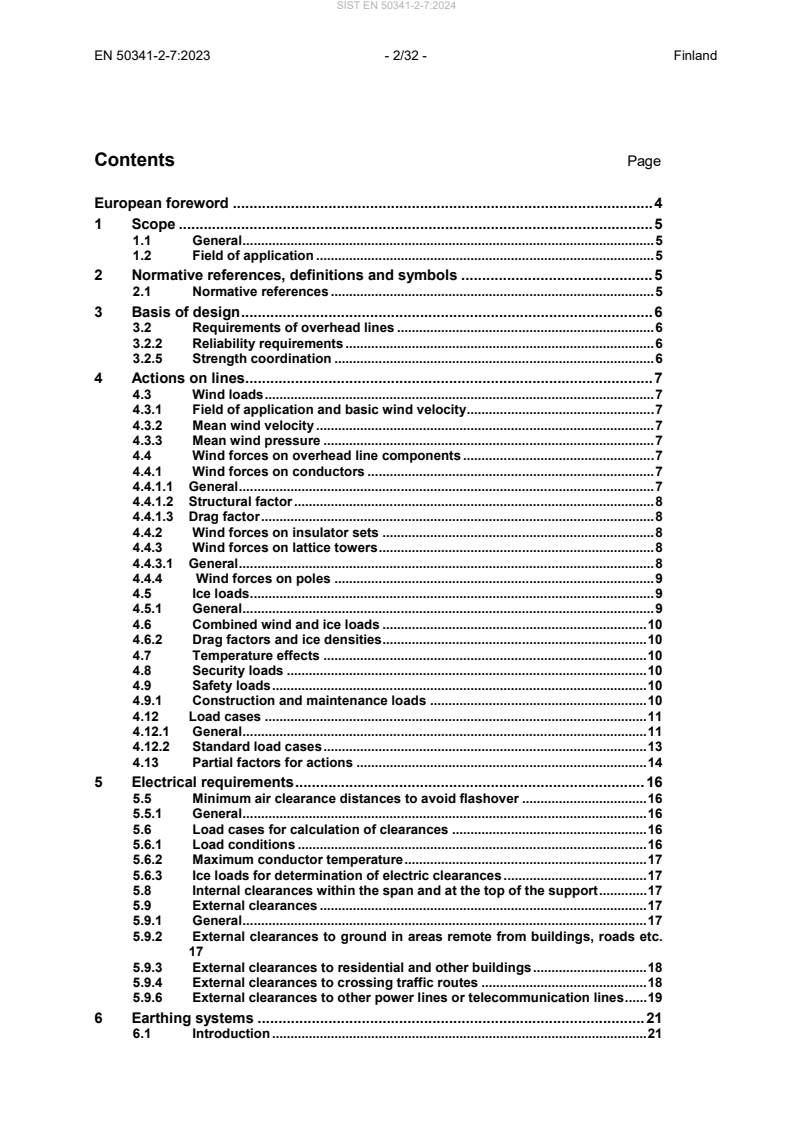
Contents Page
European foreword . 4
1 Scope . 5
1.1 General . 5
1.2 Field of application . 5
2 Normative references, definitions and symbols . 5
2.1 Normative references . 5
3 Basis of design . 6
3.2 Requirements of overhead lines . 6
3.2.2 Reliability requirements . 6
3.2.5 Strength coordination . 6
4 Actions on lines . 7
4.3 Wind loads . 7
4.3.1 Field of application and basic wind velocity . 7
4.3.2 Mean wind velocity . 7
4.3.3 Mean wind pressure . 7
4.4 Wind forces on overhead line components . 7
4.4.1 Wind forces on conductors . 7
4.4.1.1 General . 7
4.4.1.2 Structural factor . 8
4.4.1.3 Drag factor . 8
4.4.2 Wind forces on insulator sets . 8
4.4.3 Wind forces on lattice towers . 8
4.4.3.1 General . 8
4.4.4 Wind forces on poles . 9
4.5 Ice loads . 9
4.5.1 General . 9
4.6 Combined wind and ice loads . 10
4.6.2 Drag factors and ice densities . 10
4.7 Temperature effects . 10
4.8 Security loads . 10
4.9 Safety loads . 10
4.9.1 Construction and maintenance loads . 10
4.12 Load cases . 11
4.12.1 General . 11
4.12.2 Standard load cases . 13
4.13 Partial factors for actions . 14
5 Electrical requirements . 16
5.5 Minimum air clearance distances to avoid flashover . 16
5.5.1 General . 16
5.6 Load cases for calculation of clearances . 16
5.6.1 Load conditions . 16
5.6.2 Maximum conductor temperature . 17
5.6.3 Ice loads for determination of electric clearances . 17
5.8 Internal clearances within the span and at the top of the support . 17
5.9 External clearances . 17
5.9.1 General . 17
5.9.2 External clearances to ground in areas remote from buildings, roads etc.
5.9.3 External clearances to residential and other buildings . 18
5.9.4 External clearances to crossing traffic routes . 18
5.9.6 External clearances to other power lines or telecommunication lines . 19
6 Earthing systems . 21
6.1 Introduction . 21
Finland - 3/32 - EN 50341-2-7:2023
6.1.4 Transferred potentials . 21
6.4 Dimensioning regarding human safety . 21
6.4.3 Design of earthing systems regarding permissible touch voltage . 21
7 Supports . 22
7.3 Lattice steel towers . 22
7.3.1 General . 22
7.3.6 Ultimate limit states . 22
7.3.6.1 General . 22
7.3.6.4 General . 22
7.3.9 Design assisted by testing . 22
7.5 Wood poles . 23
7.5.3 Materials . 23
7.5.5 Ultimate limit states . 23
7.5.5.1 Basis . 23
7.5.5.2 Calculation of internal forces and moments . 23
7.5.5.3 Resistance of wood elements . 23
7.5.5.4 Decay conditions . 23
7.7 Guyed structures . 24
7.7.1 General . 24
7.7.4 Ultimate limit states . 24
7.7.4.1 Basis . 24
7.7.4.3 Second order analysis . 24
7.7.6 Design details for guys . 25
7.10 Maintenance facilities . 25
7.10.3 Safety requirements . 25
8 Foundations . 27
8.1 Introduction . 27
8.2 Basis of geotechnical design . 28
8.2.1 General . 28
8.2.2 Geotechnical design by calculation. 28
8.2.3 Design by prescriptive measures . 29
9 Conductors and earth wires . 30
9.1 Introduction . 30
9.6 General requirements . 30
9.6.2 Partial factor for conductors . 30
10 Insulators . 30
10.2 Standard electrical requirements . 30
10.11 Type test requirements . 31
11 Hardware . 31
11.6 Mechanical requirements . 31
11.8 Material selection and specification . 31
12 Quality assurance, checks and taking-over . 31
Annex J . 32
J.4 Buckling resistance of angles in compression . 32
J.4.3 Slenderness of members . 32
J.4.3.1 General . 32
J.4.4 Secondary bracing members . 32
European foreword
1 The Finnish National Committee (NC) is identified by the following address:
SESKO Electrotechnical Standardization in Finland
Standardization committee SK 11, High Voltage Overhead Lines
Addr. Takomotie 8, 00380 Helsinki, Finland
Tel. +358 50 571 6048
Email asiakaspalvelu@sesko.fi
2 The Finnish NC has prepared this Part 2-7 of EN 50341 listing the Finnish national normative aspects
(NNA), under its sole responsibility, and duly passed it through the CENELEC and CLC/TC 11
procedures.
NOTE The Finnish NC also takes sole responsibility for the technically correct co-ordination of this NNA with
EN 50341-1. It has performed the necessary checks in the frame of quality assurance/control. However, it is
noted that this quality control has been made in the framework of the general responsibility of a standards
committee under the national laws/regulations.
3 This NNA is normative in Finland and informative for other countries.
4 This NNA has to be read in conjunction with Part 1 (EN 50341-1). All clause numbers used in this NNA
correspond to those of Part 1. Specific sub-clauses, which are prefixed "FI", are to be read as
amendments to the relevant text in Part 1. Any necessary clarification regarding the application of this
combined NNA in conjunction with Part 1 shall be referred to the Finnish NC who will, in co-operation
with CLC/TC 11, clarify the requirements.
When no reference is made in this NNA to a specific sub-clause, then Part 1 applies.
5 In the case of "boxed values" defined in Part 1, amended values (if any), which are defined in this NNA,
shall be taken into account in Finland.
However, any boxed value, whether in Part 1 or in this NNA, shall not be amended in the direction of
greater risk in a Project Specification.
6 The national Finnish standards/regulations related to overhead electrical lines exceeding 1 kV AC are
listed in 2.1/FI.1-2.
NOTE All national standards referred to in this NNA will be replaced by the relevant European Standards as
soon as they become available and are declared by the Finnish NC to be applicable and thus reported to the
secretary of CLC/TC 11.
Finland - 5/32 - EN 50341-2-7:2023
1 Scope
1.1 General
(ncpt) FI.1 Application of the standard in Finland
In Finland, the standard EN 50341-1 (Part 1) can only be applied using this NNA (EN 50341-
2-7) containing National Normative Aspects for Finland.
The requirements of the standard are applied also for low voltage (below 1 kV AC) overhead
lines. The requirements of the structural design are applicable also for DC overhead lines,
where the electrical requirements are given in the Project Specification.
This standard is applicable for new overhead lines only.
(ncpt) FI.2 Application for existing overhead lines
Overhead lines complying with the mechanical and electrical requirements of its original date
of construction can be operated and maintained, if they do not cause obvious danger.
The reparation and overhaul of lines can be done according to the previous requirements.
Reparation means that a component which has been damaged is substituted with a similar
new one. Overhaul means a wider improvement of the line for extending its lifetime. The basic
structure remains same as before.
This standard should be used for all modification works on existing lines. In the modification
works, earlier norms and standards may also be used, if allowed by the valid Electrical Safety
Act. In that case it shall especially be verified that changes in actions do not cause significant
increase in the loads of the line. Modification work means e.g. relocation of some supports or
an extension to a line by addition of a circuit or changing of the conductors to existing supports.
1.2 Field of application
(ncpt) FI.1 Application to covered conductors and aerial cables
The standard includes requirements for the design and construction of overhead lines
equipped with covered conductors and aerial cables. Additionally, the requirements of the
equipment standards and manufacturers’ instructions shall be considered.
(ncpt) FI.2 Installation of other equipment
Only equipment belonging to the line (electric or telecommunication line) can be installed on
the overhead line supports. However, equipment serving communal services or environmental
protection like telecommunication equipment, road signs, warning signs or warning balls may
also be installed with the permission of the owner of the line.
With the permission of the owner of the line, also other equipment than those mentioned
above, can be installed on supports of the line equipped with aerial cables.
If other equipment is installed on the supports, the requirements of safe working practices shall
be considered. The installation height of equipment meant to be installed and maintained by
an ordinary person shall be such that the work can be done without climbing the support and
the distances of safe electrical work can be followed (see standard SFS 6002).
The additional loads due to other equipment to the line shall be considered.
2 Normative references, definitions and symbols
2.1 Normative references
(A-dev) FI.1 National normative laws, government regulations
Sähköturvallisuuslaki (1135/2016)
Electrical Safety Act
Valtioneuvoston asetus sähkölaitteistoista (1434/2016)
Governmental Degree on electrical installations
Traficomin määräys M 43 tietoliikenneverkon sähköisestä suojaamisesta
Decree nr M 43 of Traficom on the electrical protection of a telecommunication network
Traficomin määräys AGA M3-6, Lentoesterajoitukset ja lentoesteiden merkitseminen. Aviation
regulation AGA M3-6 of Traficom on the Aviation obstacle limitations and marking of objects.
Traficomin ohje 23/2014 Ilmajohtojen sekä kaapeleiden ja putkijohtojen asettaminen ja
merkitseminen vesialueella.
Publication 23/2014 of Traficom: Installation and marking of overhead lines, cables and
pipelines in waterways.
EN 50341-2-7:2022 - 6/32 - Finland
(ncpt) FI.2 National normative standards
SFS 2662 Ilmajohtotarvikkeet. Puupylväs
Overhead line materials. Wood pole
SFS 5717 Maakaasun siirtoputkiston sijoittaminen suurjännitejohdon tai kytkinlaitoksen
läheisyyteen
Placing of the natural gas transmission pipeline close to a high-voltage line or
substation
SFS 6000 Pienjännitesähköasennukset
Low voltage electrical installations
SFS 6001 Suurjännitesähköasennukset
High voltage electrical installations
SFS 6002 Sähkötyöturvallisuus (perustuu standardiin EN 50110-1/2)
Safety at electrical work (based on standard EN 50110-1/2)
3 Basis of design
3.2 Requirements of overhead lines
3.2.2 Reliability requirements
(ncpt) FI.1 Selection of reliability levels
The minimum reliability levels based on the nominal voltage and importance of the lines are
defined in Table 3.1/FI.1 below. The level shall be given in the Project Specification.
Table 3.1/FI.1 — Reliability levels of overhead lines in Finland
Level Nominal voltage Type of line
U ≤ AC 45 kV Normal lines
n
U > AC 45 kV Temporary or unimportant lines
n
Un ≤ AC 45 kV Special lines
Un > AC 45 kV Normal lines
3 all Important lines, i.e. all 400 kV lines
3.2.5 Strength coordination
(ncpt) FI.1 Angle and tension supports
The partial factors γ for the resistance of the structural elements of angle (line angle ≥ 10
M
degrees), tension and terminal supports shall be multiplied by an additional factor γ = 1,1. This
S
requirement needs not to be applied at construction load cases.
In these cases, when determining the structural design resistance R in the basic design formula
d
Ed < Rd, the design value Xd of a material property shall be calculated from formula:
X = X / (γ γ ) See Clauses 3.6.3 and 3.7.2 of Part 1.
d K M S
This clause shall be applied only for lines with nominal voltages > 45 kV, if not otherwise required
in the Project Specification.
(ncpt) FI.2 Foundations
As the foundation should resist 10 % higher loads than the support, the loads from the support
to foundations shall be multiplied by the factor 1,1. See also Clause 8.1/FI.3.
At angle, tension and terminal supports of lines with nominal voltage > 45 kV the loads shall be
multiplied by an additional factor 1,1. Thus, in these cases the total factor will be 1,21. This
requirement needs not to be applied at construction load cases.
Alternatively, the strength coordination of the foundations can be executed by applying the factors
1,1 and 1,21 to the partial factors of the resistances and properties of materials.
Finland - 7/32 - EN 50341-2-7:2023
4 Actions on lines
4.3 Wind loads
4.3.1 Field of application and basic wind velocity
(snc) FI.1 Basic wind velocity
The basic wind velocity V = 21 m/s is normally applied in all areas of Finland.
b,0
Other basic wind velocity values may be used, if they are based on the local conditions and
reliable statistics. These values shall be given in the Project Specification.
NOTE: Local values are given e.g. in the research report ”Mitoitustuuli Suomessa, 2007” by the Finnish
Meteorological Institute.
4.3.2 Mean wind velocity
(snc) FI.1 Terrain categories
The terrain categories applicable in Finland are specified in Table 4.1/FI.1.
Table 4.1/FI.1 — Terrain categories, roughness length z and terrain factor k
0 r
Terrain
Description z [m] k
0 r
category
0 Open sea, outer archipelago and open coastal areas 0,003 0,180
Sheltered coastal areas, inner archipelago, large lake
I 0,010 0,169
districts and wide agricultural areas
Reference terrain: Area with low vegetation and isolated
II 0,050 0,189
obstacles (trees, buildings)
Variable inland terrain (forests, forest-openings, small fields
II+ 0,095 0,195
and lakes, single buildings or building-groups)
Area with regular vegetation or with isolated obstacles (also
III 0,300 0,214
towns, suburban areas and permanent forests)
NOTE 1 Typical Finnish inland terrain with forests and small hills can be considered as category III. If
the forest works or storms can have impact on this assumption, then category II or II+ should
be applied.
NOTE 2 In mountainous areas category II should be applied, unless otherwise specified in the
Project Specification.
(ncpt) FI.2 Terrain orography
If the slope of a single hill or ridge exceeds 5 % and its height from the level of the surrounding
flat terrain exceeds 10 m, the effect of terrain orography (hill effect) shall be taken into account.
The orography factor c0 for wind speed can be calculated according to SFS-EN 1991-1-4,
Annex A.3.
Alternatively, the hill effect can be taken into account by taking the wind speed at the height
measured from the level of the surrounding flat terrain in the direction of the coming wind.
Additional guidance and requirements on the effects of the topography on the determination
of the wind loads can be given in the Project Specification.
NOTE The terrain category and the local wind velocity may depend on the direction of the wind. If
necessary, meteorological specialists should be consulted in assessing the terrain category, orography
and wind velocity.
4.3.3 Mean wind pressure
(ncpt) FI.1 Effects of temperature and altitude
When calculating the wind pressure, the effect of temperature on the air density shall be
considered. If necessary, also the effect of the site altitude above sea level can be considered.
At the reference condition the temperature is 0 °C and air density 1,292 kg/m at sea level.
4.4 Wind forces on overhead line components
4.4.1 Wind forces on conductors
4.4.1.1 General
(ncpt) FI.1 Effective height of conductor
EN 50341-2-7:2022 - 8/32 - Finland
If not otherwise specified in the Project Specification, the effective height of a conductor in
tension calculations shall be at least the average height of the conductor at the reference
condition within the tension section concerned.
In tower load calculations it shall be at least the average height of the conductor in the swung
position at the span concerned. On a flat terrain the height of the attachment point of the
insulator may be used as a conservative value.
4.4.1.2 Structural factor
(ncpt) FI.1 Span factor
If not otherwise specified in the Project Specification, the section length shall be used as the span
length, when calculating the structural factor for the conductor tension analyses. However, the
span length used in these calculations shall not be longer than 5000 m. The resulting gust wind
load shall not be less than the mean wind load.
When calculating the span factor in the tower load analysis, the actual lengths of the spans
concerned shall be used.
4.4.1.3 Drag factor
(ncpt) FI.1 Drag factor of conductors
In the case of conductors or earth-wires the drag factor shall be taken as 1,0 for each sub-
conductor (Method 1 in Part 1).
In the case of bundled aerial cables, the drag factor shall be taken as 1,2 to be applied to the
average diameter of the cable.
4.4.2 Wind forces on insulator sets
(ncpt) FI.1 Wind load of insulator
The recommended values in Part 1 for height, structural and drag factors shall be used. The wind
load of an insulator set shall be calculated according to Part 1. The projected wind area of the
insulator shall be calculated from:
A = L D sinα
ins ins ins ins
Lins = Effective length of the insulator string
D = Outer diameter of the insulator unit
ins
α = Angle between the directions of the insulator and wind at the loaded position. A
ins
conservative value αins = 90º may also be used.
(ncpt) FI.2 V-insulator set dimensions
The dimensions of a V-insulator set configuration shall be such that the direction of the
resulting force due to the transversal loads from conductors will stay inside the angle between
the two arms of the insulator set in the following service conditions (without partial load factors):
• Extreme wind load (mean wind with 50-year return period)
• Minimum temperature (3-year return period value, see Table 4.7/FI.1)
4.4.3 Wind forces on lattice towers
4.4.3.1 General
(ncpt) FI.1 Calculation method of wind loads
Method 1 (see Part 1) is used in the wind load calculation of vertical body structures with
rectangular cross-section made of angle profiles by dividing the tower into sections (panels). Also
Method 2 can be used here, if not otherwise specified in the Project Specification.
Method 2 (see Part 1) shall be used in the wind load calculation of following lattice structures:
- Cross-arms and extensions (also portal tower bridges)
- Y-sections of Y-towers
- Inclined legs in guyed portal towers
- Structures with triangular cross-sections
- Structures containing different profile shapes (i.e. tubular legs and angle bracings)
- Other lattice structures not mentioned above
(ncpt) FI.2 Structural factors
In Method 1 the structural factor G = 1,0 for tower body and G = 1,0 for cross-arms.
t tc
In Method 2 the structural factor Gm = 1,0 for all members.
Finland - 9/32 - EN 50341-2-7:2023
(ncpt) FI.3 Drag factors
In Method 1, the drag factors are calculated according to Part 1.
In Method 2, an individual drag factor is used for each member depending on the type of the
cross-section of profile and on the type of the structure, which may be either a compact panel-
type sub-structure including shielding effects between members, or spacious sub-structure
without shielding effects between members (see Table 4.4/FI.1).
Table 4.4/FI.1 — Drag factors of single members C
m
Structure type
Cross-section shape
Panel Spacious
structure structure
Circular 1,0 1,2
Flat sided 1,4 2,0
(ncpt) FI.4 Wind forces on ancillaries fixed at the support
Method 2 shall be used in the wind load calculation of ancillaries and devices fixed at the support
when applicable. Possible shielding effects can be considered as well.
If relevant, reference can be made also to standard SFS-EN 1993-3-1:2005 in the calculation of
effective wind areas. Additional instructions can be given in the Project Specification.
4.4.4 Wind forces on poles
(ncpt) FI.1 Calculation of wind loads on poles
Wind loads on poles shall be calculated by dividing the pole into sections (Method 1 in Part 1).
Structural factor shall be G = 1,0.
pol
4.5 Ice loads
4.5.1 General
(snc) FI.1 Icing categories and ice load parameters
The philosophy in defining ice loads is based on ISO 12494. The characteristic ice load on a
conductor depends on the relative altitude, which is defined as the altitude difference between the
conductor and the average level of the surrounding terrain within 10 km from the site. Values for
characteristic ice loads are given in Table 4.5/FI.1.
If higher load values based on long term statistics or experience on the local conditions are
available, they shall be applied and given in the Project Specification. In areas, which are
traditionally prone to heavy precipitation of snow in Finland, higher ice loads than those given in
Table 4.5/FI.1 have been detected based on experience.
(snc) FI.2 Ice loads on conductors
Values of ice load parameters for conductors are given in Table 4.5/FI.1. In icing categories II and
III intermediate values based on the linear interpolation shall be used.
For spans in the same tension section, ice load value based on the uppermost height level of the
spans concerned shall be used in conductor tension calculations. Ice load parameters in icing
category IV should be given for evaluation to meteorological specialists.
Type of the ice on conductors is rime. The density of ice shall be taken as 500 kg/m .
Table 4.5/FI.1 — Conductor ice load
Relative Characteristic
Icing
altitude ice load I
category
[m] [N/m]
I 0 - 50 10
II 50 - 100 10-25
III 100 - 200 25-50
IV > 200 >50
(ncpt) FI.3 Ice loads on structures and insulators
No ice needs to be considered on structures or insulators, if not otherwise specified in the
Project Specification.
EN 50341-2-7:2022 - 10/32 - Finland
4.6 Combined wind and ice loads
4.6.2 Drag factors and ice densities
(ncpt) FI.1 Drag factors of ice-covered conductors
Drag factor of ice-covered conductors is 1,15.
4.7 Temperature effects
(snc) FI.1 Reference condition (EDS-condition)
o
Reference condition is specified as still air condition without ice at the temperature 0 C. The
temperatures in different load conditions are given in Table 4.13/FI.1.
(snc) FI.2 Minimum temperatures
Minimum temperatures T have been calibrated to correspond the region and return period of
min
the reliability level concerned. They are given in Table 4.7/FI.1. The proper region and possible
deviations from the values in the table shall be specified in the Project Specification.
o
Table 4.7/FI.1 — Minimum temperatures T [ C]
min
Reliability level
3-year
Temperature region
value
1 2 3
Southern Finland - 40 - 45 - 50 - 30
Middle Finland - 45 - 50 - 55 - 36
Northern Finland - 50 - 55 - 60 - 42
4.8 Security loads
(ncpt) FI.1 Security loading definition
All conductors are assumed intact. The transversal and vertical forces are the same as those
in the reference condition. It is assumed that the possible hinged dropper is not inclined in the
direction of the line.
The value of the longitudinal security load (acting in the direction of the line) is the force of one
sub-conductor of any one phase conductor or earth wire at the reference condition. The point
of action of the force is the attachment point of the insulator at the structure.
In case of V-insulator sets the longitudinal force shall be evenly distributed between the
attachment points of the strings. In case of V-insulator sets with hinged dropper for the outer
string, the point of action of the longitudinal force component concerned is the outermost
attachment point of the dropper at the cross-arm.
(ncpt) FI.2 Application of security loads on lines with nominal voltage ≤ 45 kV
Security loads need to be applied on lines with nominal voltages ≤ 45 kV only, if required in
the Project Specification.
(ncpt) FI.3 Other longitudinal loads
In other load cases than the security case, the possible longitudinal loads shall be placed in
their correct locations at conductor and insulator attachment points.
Insulators and hinged droppers are assumed to be properly inclined due to the longitudinal
force. This fact together with possible simultaneous transversal load component may cause
significant secondary bending and torsional effects especially on angle supports.
(ncpt) FI.4 Anti-cascading supports
Suspension supports may be assumed to act also as anti-cascading supports, if so specified
in the Project Specification. See the load definitions for anti-cascading supports in Clause
4.12.2/FI.2.
4.9 Safety loads
4.9.1 Construction and maintenance loads
(ncpt) FI.1 Temporary anchoring of conductors at suspension supports
Should conductors be anchored at a suspension support during the stringing process, the slope
of the anchored conductors shall not exceed 25 %. The support shall be designed for extra vertical
loads placed at the fixing points of the conductors on the support. These vertical loads shall be
taken as 1/3 of the design tensions of the conductors in the stringing condition.
Finland - 11/32 - EN 50341-2-7:2023
(ncpt) FI.2 Stringing conditions on tension supports
All relevant stringing conditions shall be considered in the design of tension supports. The
principal stringing cases are shown in Fig. 4.12/FI.1.
Temporary guying can be used at guyed tension supports to relax the effects of unsymmetrical
or unbalanced loads which may take place during the stringing process. The utilization of the
relaxing effect shall not exceed 25 % of the strength in the condition where temporary guys are
not used. The above-mentioned relaxing effects can be considered at self-supporting lattice
towers or steel poles only, if allowed in the Project Specification.
The support shall resist the final design stringing loads at the condition after the completion of the
stringing works with all relevant conductors intact and temporary guys removed. Additional
requirements may be given in the Project Specification.
The use of temporary guying shall be properly documented for possible later detachment of
conductors due to maintenance or dismantling works.
4.12 Load cases
4.12.1 General
(ncpt) FI.1 Conductor sag and tension calculations
Partial load and combination factors shall be applied on loads prior to the conductor tension
analysis.
In calculations the conductor shall be treated as a catenary curve (hyperbolic formula).
Parabola formula can be used for span lengths not exceeding 500 m. The calculations shall
be done using either a non-linear stress-strain curve of the conductor based on the
specification of the conductor manufacturer or using a linear approach based on the initial and
final values of the modulus of elasticity of the conductor.
Normally, the sag and tension calculations shall be done for each load case and each tension
section separately. The calculations shall be based on the reference condition after the over-
stress due to the creep compensation has ceased.
In the tension analysis of phase conductors equipped with suspension insulators, the ruling
span length of the line section concerned is used as the span length. In earth wires and in
phase conductors installed at post insulators, the ruling span shall be taken as equal to the
actual span length.
When calculating conductor tensions in cases with unbalanced ice at suspension supports,
reasonable number of spans on both sides of the support concerned should be considered.
(ncpt) FI.2 Effect of unequal span lengths
Variations in span lengths will cause variation in the conductor tension from span to span and
thus, result in longitudinal loads also at suspension supports. The effect is often significant in
cases, where ice load is present. The shorter the insulator string is, the bigger is the effect of
this variation.
In these cases, the ruling span method may not be used in the tension calculations of
conductors equipped with suspension insulators. Instead, the tensions should be calculated
by using a complete line analysis technique for an entire line section considering the relaxing
effects from the suspension insulators to the conductor tensions in different spans.
More conservative simplified methods can be used as well.
The effects of the longitudinal loads caused by the unequal span lengths shall be considered
in the load cases 2a-f and 3a-b in Table 4.13/FI.1.
NOTE 1 A simplified, but conservative method for lines with suspension insulators, is to use the actual
lengths of the adjacent spans at the support as the ruling span lengths. Then, the relaxing effect of the
tension balancing will be ignored. The same method is used, when calculating earth-wires.
NOTE 2 The effects of the longitudinal loads caused by ice loads may be significant at lines with
suspension insulators in cases, where the length difference of two adjacent spans is > 50 m or if their
length ratio is > 1,5. In icing categories II-IV they may be significant, when the longitudinal load caused
by one conductor is > 5 % of the reference tension of the conductor.
Additional instructions or requirements can be given in the Project Specification.
EN 50341-2-7:2022 - 12/32 - Finland
(ncpt) FI.3 Creep compensation
Due to the creep phenomenon, the conductor will be over-tensioned in the stringing phase.
Nominal reference stress is supposed to be achieved within one year's time from the
installation. Extreme load conditions are not assumed to occur during this time. The correct
stringing tension depends on the type of the conductor.
NOTE In the stringing load cases the over-tensioning can be considered by deducting the
compensation temperature of the conductor concerned to the temperature value in the stringing load
case. Detailed parameters can be acquired from the Project Specification or conductor manufacturer.
Finland - 13/32 - EN 50341-2-7:2023
(ncpt) FI.4 Guying effect of conductors
Guying effect of conductors shall not be considered at security loads in designing supports in
lines of reliability levels 2 and 3. It can be taken into account in other cases, if not otherwise
specified in the Project Specification.
(ncpt) FI.5 Effects of displacements of the support on conductor tensions
If not otherwise specified in the Project Specification, possible relaxing effects caused by the
displacements of the support shall not be considered, when calculating conductor tensions.
These effects may exist especially at terminal supports.
4.12.2 Standard load cases
(ncpt) FI.1 Load case definitions
Load cases, partial load factors and temperatures in each case are specified in Table 4.13/FI.1.
(ncpt) FI.2 Load cases for different support types
The following load cases shall be applied to different support types. See details of the cases in
Table 4.13/FI.1 and figures for stringing case examples for lines with nominal voltage > 45 kV in
Figure 4.12/FI.1. Additional requirements may be given in the Project Specification.
Double circuit tower Single circuit portal tower
Case S1
Case S2
Case S3
Case S4
Case S5 Case S6
Case S1, Stringing with all conductors installed.
Case S2, One-sided stringing with conductors installed only in one span.
Case S3, Unbalanced stringing with conductors installed in one span and partly in the other span.
Case S4, Unbalanced stringing with conductors installed partly in one span.
Cases S5-S6, One-sided stringing of phase conductors.
Figure 4.12/FI.1 — Examples of stringing conditions (Case 4 in Table 4.13/FI.1)
Suspension support
• Case 1a, Extreme wind
• Case 1b, Minimum temperature
• Case 2a, Extreme ice + snow
• Cases 2b-e, Special icing cases (only in icing categories III and IV)
• Case 3a, Extreme ice + nominal wind
• Case 3b, High wind + nominal ice
• Case 4, Temporary construction condition (stringing condition with temporary anchoring
and extra vertical force at each conductor attachment point), see Clause 4.9.1/FI.1.
• Case 5, Security load at any of the conductor attachment points
EN 50341-2-7:2022 - 14/32 - Finland
Tension support
• Cases 1-3 as those at suspension support
• Case 2f, if required in the Project Specification
• Cases 4, Construction loads in all required stringing conditions S1-S6 in the project
concerned with or without an optional temporary guying. The most unfavourable
arrangements for conductors shall be considered in unbalanced conditions.
Anti-cascading support
• Cases 1-3 as at suspension support
• Case 5, Accidental case with all conductors in one span detached (cases S2-S3). For other
conductors, the conductor tensions in the reference condition shall be used. The dynamic
effects are assumed to be covered by the relaxing of the conductor tension.
Terminal support or gantry
• Cases 1-3 as at suspension support
• Cases 4, Construction loads in the required stringing conditions (cases S2, S4-S6).
4.13 Partial factors for actions
(ncpt) FI.1 Load and combination factors
Partial load factors γF and combination factors Ψ for different actions are given in Table 4.13/FI.1.
The following definitions are used:
Extreme wind = 50 years return period wind load based on the basic wind speed value
including effects of gust, terrain, height, altitude and temperature
High wind = Extreme wind load x 0,70.
In special cases the factor 0,45 can be used.
Nominal wind = Extreme wind load x 0,40.
In special cases the factor 0,25 can be used.
Extreme ice load= 50 years return period ice load (= characteristic ice load I50), see Table
4.5.1/FI.1.
Extreme ice+snow = Extreme ice x ΨΙ, where 1,0 < ΨΙ < 3,0 (see Clause 4.13/FI.2).
Special ice load = Extreme ice x ΨΙ, where ΨΙ ≥ 2,0 (see Clause 4.13/FI.2)
...