

EN 60079-2:2014
(Main)Explosive atmospheres - Part 2: Equipment protection by pressurized enclosure "p"
General Information
- Abstract
NEW! IEC 60079-2:2014 is available as IEC Standards+ 60079-2:2014 which contains the International Standard and its Redline version, showing all changes of the technical content compared to the previous edition. IEC 60079-2:2014 contains the specific requirements for the construction and testing of electrical equipment with pressurized enclosures, of type of protection "p", intended for use in explosi ve gas atmospheres or explosive dust atmospheres. It also includes the requirements for pressurized enclosures containing a limited release of a flammable substance. This standard supplements and modifies the general requirements of IEC 60079-0. Where a requirement of this standard conflicts with a requirement of IEC 60079-0, the requirements of this standard take precedence. This standard does not include the requirements for: - pressurized enclosures where the containment system may release air with an oxygen content greater than normal, or oxygen in combination with inert gas where the oxygen is in a proportion greater than 21 %; - pressurized rooms or analyser houses; see IEC 60079-13; - pressurized enclosures used where "explosives" or pyrotechnics are present; - pressurized enclosures used where hybrid mixtures of gas/vapour and combustible dust are present; - pressurized enclosures used where pyrophoric substances such as explosives or propellants containing their own oxidizers are present; - pressurized enclosures with an internal source of release of combustible dust. This sixth edition cancels and replaces the fifth edition published in 2007. This sixth edition cancels and replaces the first edition of IEC 61241-4 published in 2001. This sixth edition constitutes a technical revision. The significance of changes between IEC 60079-2, Edition 6.0, 2014 and IEC 60079-2, Edition 5.0, 2007 are as listed in the foreword of the document. Keywords: electrical equipment with pressurized enclosures, type of protection "p", explosive gas atmospheres, explosive dust atmospheres
- Status
- Published
- Publication Date
- 18-Dec-2014
- Withdrawal Date
- 24-Aug-2017
- Technical Committee
- CLC/TC 31 - Electrical apparatus for explosive atmospheres - General requirements
- Drafting Committee
- IEC/TC 31 - Electrical apparatus for potentially explosive atmospheres
- Current Stage
- 6060 - Document made available - Publishing
- Start Date
- 19-Dec-2014
- Completion Date
- 19-Dec-2014
2014/34/EU - Directive 2014/34/EU Of The European Parliament And Of The Council of 26 February 2014 on the harmonisation of the laws of the Member States relating to equipment and protective systems intended for use in potentially explosive atmospheres (recast)OJ Ref: C, C 126, C 293/52 OJ Date: 08-Apr-2016
94/9/EC - Equipment and protective systems intended for use in potentially explosive atmospheres (ATEX)OJ Ref: C, C 335 OJ Date: 09-Oct-2015



Overview
EN 60079-2:2014 (IEC 60079-2:2014) sets the specific requirements for the design, construction and testing of electrical equipment with pressurized enclosures - type of protection "p" - intended for use in explosive gas atmospheres and explosive dust atmospheres. This sixth edition (2014) supersedes earlier editions and the related IEC 61241-4, supplements the general requirements of IEC/EN 60079-0, and takes precedence where conflicts arise. It also covers pressurized enclosures that contain a limited release of a flammable substance.
EN 60079-2 does not apply to pressurized rooms/analyser houses (see IEC 60079-13), enclosures releasing oxygen-rich gas, enclosures used with explosives/pyrotechnics, hybrid gas/dust mixtures with internal dust sources, or pyrophoric substances.
Key topics and technical requirements
- Scope and terminology: Uses Equipment Protection Level (EPL) terminology and clarifies Level of Protection (e.g., pxb, pyb, pzc) and related definitions (LFL/UFL alignment with IEC 60079-0).
- Construction and testing: Requirements for enclosure strength, sealing, spark/particle barriers, and methods to verify containment performance and maximum operating pressure.
- Pressurization systems: Requirements for pressurizing supplies, independence of supplies for nested enclosures, backup supplies, and evaluation of pressurization systems as associated equipment.
- Purging and filling: Criteria and procedures for purging/filling for gas and combustible dust atmospheres; automated purge control is required for certain protection levels (e.g., "pxb").
- Safety devices and controls: Minimum overpressure detection, fan-failure detection, interlocks on doors/covers, permitted energized equipment, and required warnings and markings (including clarification on Ex [p] and [Ex p] usage).
- Cells and batteries: New/expanded requirements for internal cells and batteries across different protection levels.
- Type testing and verification: Updated test methods (including helium leak alternatives) and guidance for functional and maximum-pressure testing.
Applications and users
Who uses EN 60079-2:
- Equipment manufacturers designing pressurized enclosures for hazardous areas
- Certification bodies and test laboratories performing type testing and conformity assessment
- Design and safety engineers in oil & gas, chemical, pharmaceutical, food processing, and dust-handling industries
- Plant operators and maintenance teams responsible for selection, installation and servicing of Ex p equipment
Practical uses:
- Specifying pressurization systems and control interlocks
- Verifying enclosure integrity for gas or dust hazards
- Ensuring compliance with EU directives via the referenced Annex ZZ conformity guidance
Related standards
- IEC/EN 60079-0 (General requirements)
- IEC 60079-1, -5, -6, -7, -11, -13, -18, -20-1, -26, -28 (other Ex protection types and guidance)
- IEC 60529 (IP code) and IEC 60664-1 (insulation coordination)
EN 60079-2 is essential for safe, compliant design and testing of pressurized enclosure solutions in explosive atmospheres.
Relations
- Replaces
EN 60079-2:2007 - Explosive atmospheres - Part 2: Equipment protection by pressurized enclosure "p" - Effective Date
- 29-Jan-2023
- Effective Date
- 29-Jan-2023
- Effective Date
- 22-Sep-2026
- Effective Date
- 25-Aug-2026
- Effective Date
- 20-Feb-2026
- Effective Date
- 20-Feb-2026
- Refers
IEC 60050-851:2008 - International Electrotechnical Vocabulary (IEV) - Part 851: Electric welding - Effective Date
- 20-Feb-2026
- Refers
IEC 60050-551:1998 - International Electrotechnical Vocabulary (IEV) - Part 551: Power electronics - Effective Date
- 20-Feb-2026
- Refers
IEC 60050-351:2013 - International Electrotechnical Vocabulary (IEV) - Part 351: Control technology - Effective Date
- 20-Feb-2026
- Refers
IEC 60050-192:2015 - International Electrotechnical Vocabulary (IEV) - Part 192: Dependability - Effective Date
- 20-Feb-2026
- Effective Date
- 20-Feb-2026
- Effective Date
- 20-Feb-2026
- Effective Date
- 20-Feb-2026
- Effective Date
- 10-Feb-2026
- Effective Date
- 10-Feb-2026
Get Certified
Connect with accredited certification bodies for this standard

IMQ S.p.A. (Certification)
Italian electrical product certification.

SLG Prüf- und Zertifizierungs GmbH
German testing and certification body.

UL Solutions
Global safety science company with testing, inspection and certification.
Sponsored listings
Frequently Asked Questions
EN 60079-2:2014 is a standard published by CLC. Its full title is "Explosive atmospheres - Part 2: Equipment protection by pressurized enclosure "p"". This standard covers: NEW! IEC 60079-2:2014 is available as IEC Standards+ 60079-2:2014 which contains the International Standard and its Redline version, showing all changes of the technical content compared to the previous edition. IEC 60079-2:2014 contains the specific requirements for the construction and testing of electrical equipment with pressurized enclosures, of type of protection "p", intended for use in explosi ve gas atmospheres or explosive dust atmospheres. It also includes the requirements for pressurized enclosures containing a limited release of a flammable substance. This standard supplements and modifies the general requirements of IEC 60079-0. Where a requirement of this standard conflicts with a requirement of IEC 60079-0, the requirements of this standard take precedence. This standard does not include the requirements for: - pressurized enclosures where the containment system may release air with an oxygen content greater than normal, or oxygen in combination with inert gas where the oxygen is in a proportion greater than 21 %; - pressurized rooms or analyser houses; see IEC 60079-13; - pressurized enclosures used where "explosives" or pyrotechnics are present; - pressurized enclosures used where hybrid mixtures of gas/vapour and combustible dust are present; - pressurized enclosures used where pyrophoric substances such as explosives or propellants containing their own oxidizers are present; - pressurized enclosures with an internal source of release of combustible dust. This sixth edition cancels and replaces the fifth edition published in 2007. This sixth edition cancels and replaces the first edition of IEC 61241-4 published in 2001. This sixth edition constitutes a technical revision. The significance of changes between IEC 60079-2, Edition 6.0, 2014 and IEC 60079-2, Edition 5.0, 2007 are as listed in the foreword of the document. Keywords: electrical equipment with pressurized enclosures, type of protection "p", explosive gas atmospheres, explosive dust atmospheres
NEW! IEC 60079-2:2014 is available as IEC Standards+ 60079-2:2014 which contains the International Standard and its Redline version, showing all changes of the technical content compared to the previous edition. IEC 60079-2:2014 contains the specific requirements for the construction and testing of electrical equipment with pressurized enclosures, of type of protection "p", intended for use in explosi ve gas atmospheres or explosive dust atmospheres. It also includes the requirements for pressurized enclosures containing a limited release of a flammable substance. This standard supplements and modifies the general requirements of IEC 60079-0. Where a requirement of this standard conflicts with a requirement of IEC 60079-0, the requirements of this standard take precedence. This standard does not include the requirements for: - pressurized enclosures where the containment system may release air with an oxygen content greater than normal, or oxygen in combination with inert gas where the oxygen is in a proportion greater than 21 %; - pressurized rooms or analyser houses; see IEC 60079-13; - pressurized enclosures used where "explosives" or pyrotechnics are present; - pressurized enclosures used where hybrid mixtures of gas/vapour and combustible dust are present; - pressurized enclosures used where pyrophoric substances such as explosives or propellants containing their own oxidizers are present; - pressurized enclosures with an internal source of release of combustible dust. This sixth edition cancels and replaces the fifth edition published in 2007. This sixth edition cancels and replaces the first edition of IEC 61241-4 published in 2001. This sixth edition constitutes a technical revision. The significance of changes between IEC 60079-2, Edition 6.0, 2014 and IEC 60079-2, Edition 5.0, 2007 are as listed in the foreword of the document. Keywords: electrical equipment with pressurized enclosures, type of protection "p", explosive gas atmospheres, explosive dust atmospheres
EN 60079-2:2014 is classified under the following ICS (International Classification for Standards) categories: 29.260.20 - Electrical apparatus for explosive atmospheres. The ICS classification helps identify the subject area and facilitates finding related standards.
EN 60079-2:2014 has the following relationships with other standards: It is inter standard links to EN 60079-2:2007, EN 61241-4:2006, EN IEC 60127-4:2026, EN IEC 60127-7:2026, IEC 60050-581:2008, IEC 60050-713:1998, IEC 60050-851:2008, IEC 60050-551:1998, IEC 60050-351:2013, IEC 60050-192:2015, IEC 60050-806:1996, IEC 60050-802:2011, IEC 60050-471:2007, IEC 60050-807:1998, IEC 60050-617:2009. Understanding these relationships helps ensure you are using the most current and applicable version of the standard.
EN 60079-2:2014 is associated with the following European legislation: EU Directives/Regulations: 2008/68/EC, 2014/34/EU, 94/9/EC. When a standard is cited in the Official Journal of the European Union, products manufactured in conformity with it benefit from a presumption of conformity with the essential requirements of the corresponding EU directive or regulation.
EN 60079-2:2014 is available in PDF format for immediate download after purchase. The document can be added to your cart and obtained through the secure checkout process. Digital delivery ensures instant access to the complete standard document.
Standards Content (Sample)
2003-01.Slovenski inštitut za standardizacijo. Razmnoževanje celote ali delov tega standarda ni dovoljeno.Explosionsgefährdete Bereiche - Teil 2: Geräteschutz durch Überdruckkapselung “ p“ (IEC 60079-2:2014)Atmosphères explosives - Partie 2: Protection du matériel par enveloppe à surpression interne "p" (IEC 60079-2:2014)Explosive atmospheres - Part 2: Equipment protection by pressurized enclosure "p" (IEC 60079-2:2014)29.260.20Electrical apparatus for explosive atmospheresICS:Ta slovenski standard je istoveten z:EN 60079-2:2014SIST EN 60079-2:2015en01-april-2015SIST EN 60079-2:2015SLOVENSKI
STANDARDSIST EN 61241-4:2007SIST EN 60079-2:20081DGRPHãþD
EUROPEAN STANDARD NORME EUROPÉENNE EUROPÄISCHE NORM
EN 60079-2
December 2014 ICS 29.260.20
Supersedes
EN 60079-2:2007, EN 61241-4:2006
English Version
Explosive atmospheres - Part 2: Equipment protection by pressurized enclosure "p" (IEC 60079-2:2014)
Atmosphères explosives - Partie 2: Protection du matériel par enveloppe à surpression interne "p" (IEC 60079-2:2014)
Explosionsgefährdete Bereiche - Teil 2: Geräteschutz durch Überdruckkapselung "p" (IEC 60079-2:2014) This European Standard was approved by CENELEC on 2014-08-25. CENELEC members are bound to comply with the CEN/CENELEC Internal Regulations which stipulate the conditions for giving this European Standard the status of a national standard without any alteration. Up-to-date lists and bibliographical references concerning such national standards may be obtained on application to the CEN-CENELEC Management Centre or to any CENELEC member.
This European Standard exists in three official versions (English, French, German). A version in any other language made by translation under the responsibility of a CENELEC member into its own language and notified to the CEN-CENELEC Management Centre has the same status as the official versions. CENELEC members are the national electrotechnical committees of Austria, Belgium, Bulgaria, Croatia, Cyprus, the Czech Republic, Denmark, Estonia, Finland, Former Yugoslav Republic of Macedonia, France, Germany, Greece, Hungary, Iceland, Ireland, Italy, Latvia, Lithuania, Luxembourg, Malta, the Netherlands, Norway, Poland, Portugal, Romania, Slovakia, Slovenia, Spain, Sweden, Switzerland, Turkey and the United Kingdom. European Committee for Electrotechnical Standardization
Comité Européen de Normalisation Electrotechnique Europäisches Komitee für Elektrotechnische Normung CEN-CENELEC Management Centre: Avenue Marnix 17,
B-1000 Brussels © 2014 CENELEC All rights of exploitation in any form and by any means reserved worldwide for CENELEC Members.
Ref. No. EN 60079-2:2014 E SIST EN 60079-2:2015
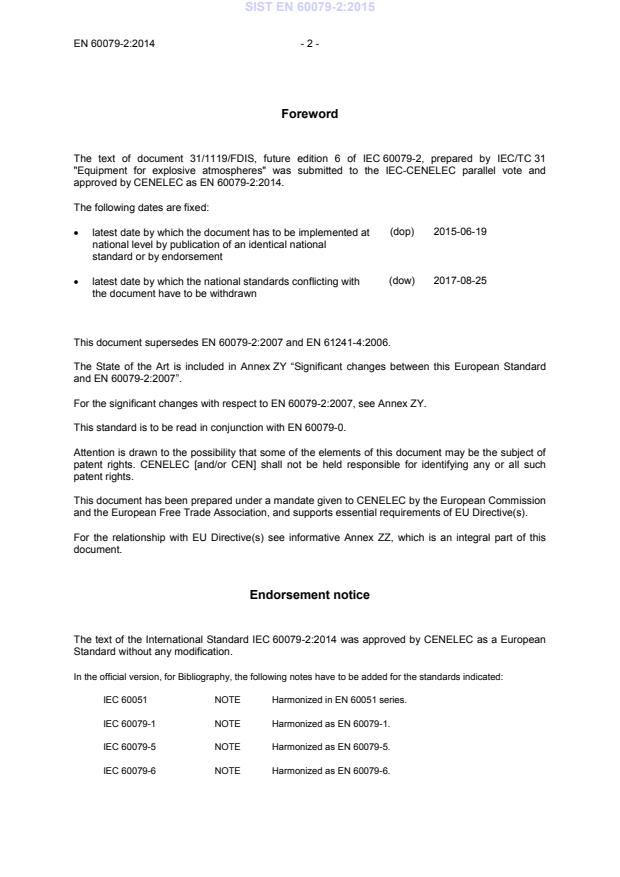
This document supersedes EN 60079-2:2007 and EN 61241-4:2006. The State of the Art is included in Annex ZY “Significant changes between this European Standard and EN 60079-2:2007”. For the significant changes with respect to EN 60079-2:2007, see Annex ZY. This standard is to be read in conjunction with EN 60079-0. Attention is drawn to the possibility that some of the elements of this document may be the subject of patent rights. CENELEC [and/or CEN] shall not be held responsible for identifying any or all such patent rights. This document has been prepared under a mandate given to CENELEC by the European Commission and the European Free Trade Association, and supports essential requirements of EU Directive(s). For the relationship with EU Directive(s) see informative Annex ZZ, which is an integral part of this document. Endorsement notice The text of the International Standard IEC 60079-2:2014 was approved by CENELEC as a European Standard without any modification. In the official version, for Bibliography, the following notes have to be added for the standards indicated: IEC 60051 NOTE Harmonized in EN 60051 series. IEC 60079-1 NOTE Harmonized as EN 60079-1. IEC 60079-5 NOTE Harmonized as EN 60079-5. IEC 60079-6 NOTE Harmonized as EN 60079-6. SIST EN 60079-2:2015
- 3 - EN 60079-2:2014 IEC 60079-7 NOTE Harmonized as EN 60079-7. IEC 60079-13 NOTE Harmonized as EN 60079-13. IEC 60079-18 NOTE Harmonized as EN 60079-18. IEC 60079-20-1 NOTE Harmonized as EN 60079-20-1. IEC 60079-26 NOTE Harmonized as EN 60079-26. IEC 60079-28 NOTE Harmonized as EN 60079-28. IEC 61511 NOTE Harmonized in EN 61511 series.
Normative references to international publications with their corresponding European publications The following documents, in whole or in part, are normatively referenced in this document and are indispensable for its application. For dated references, only the edition cited applies. For undated references, the latest edition of the referenced document (including any amendments) applies. NOTE 1 When an International Publication has been modified by common modifications, indicated by (mod), the relevant EN/HD applies. NOTE 2 Up-to-date information on the latest versions of the European Standards listed in this annex is available here: www.cenelec.eu.
Publication Year Title EN/HD Year IEC 60034-5 -
Rotating electrical machines - Part 5: Degrees of protection provided by the integral design of rotating electrical machines (IP code) - Classification EN 60034-5 -
IEC 60050 series
International Electrotechnical Vocabulary
- - IEC 60079-0
-
Explosive atmospheres - Part 0: Equipment - General requirements EN 60079-0 -
IEC 60079-11 -
Explosive atmospheres - Part 11: Equipment protection by intrinsic safety "i" EN 60079-11 -
IEC 60079-15 -
Explosive atmospheres - Part 15: Equipment protection by type of protection "n" EN 60079-15 -
IEC 60112 -
Method for the determination of the proof and the comparative tracking indices of solid insulating materials EN 60112 -
IEC 60127 series
Miniature fuses
EN 60127 series
IEC 60529 -
Degrees of protection provided by enclosures (IP Code) EN 60529 -
IEC 60664-1 -
Insulation coordination for equipment within low-voltage systems - Part 1: Principles, requirements and tests EN 60664-1 -
- 5 - EN 60079-2:2014 Annex ZZ (informative)
Coverage of Essential Requirements of EU Directives This European Standard has been prepared under a mandate given to CENELEC by the European Commission and the European Free Trade Association and within its scope the standard covers only the following essential requirements out of those given in Annex II of the EU Directive 94/9/EC: – ER 1.0.1 to ER 1.0.6; – ER 1.2.1, ER 1.2.2 (partly), ER 1.2.3, ER 1.2.4 (partly), ER 1.2.6 to ER 1.2.8; – ER 1.3.1, ER 1.3.5; – ER 1.4.1 (partly); – ER 1.5.1 to ER 1.5.8; – ER 1.6.2 (partly), ER 1.6.3 to ER 1.6.5; – ER 2.0.2.1, ER 2.0.2.2; – ER 2.2.1, ER 2.2.1.1 to ER 2.2.1.3; – ER 2.2.2.1 to 2.2.2.4; – ER 2.3.1, ER 2.3.1.1, ER 2.3.1.2; – ER 2.3.2.1 to 2.3.2.3. Compliance with this standard provides one means of conformity with the specified essential requirements of the Directive[s] concerned. WARNING: Other requirements and other EU Directives may be applicable to the products falling within the scope of this standard. SIST EN 60079-2:2015
Significant changes between this European Standard and EN 60079-2:2007 This European Standard supersedes EN 60079-2:2007. The significant changes with respect to EN 60079-2:2007 are as listed below. Table ZY.1
Type Changes Clause Minor and editorial changes Extension Major technical changes Scope
Expanded to include combustible dust 1
X
Protective Gas
Replaced “apparatus” with “equipment” 3
Protective Gas
Revised to show that purging is not required for explosive dust atmospheres 3.16 X
Level of Protection “pxb”
Term and definitions revised to reflect EPL and level of protection 3.21 X
Level of Protection “pyb”
Term and definitions revised to reflect EPL and level of protection 3.22 X
Level of Protection “pzc”
Term and definitions revised to reflect EPL and level of protection 3.23 X
Lower Flammable Limit
Term and definition revised to agree with 60079-0 3.26 X
Upper Flammable Limit
Term and definition revised to agree with 60079-0 3.27 X
Table 1 – Determination of protection level
Revised to use EPL terminology Table 1 X
Table 2 – Design Criteria based upon level of protection
Revised to use EPL terminology Table 2 X
Enclosure
Requirements relaxed for specific designs 5.1
X
Group II and Group III pressurized enclosures
Text revised to use EPL terminology 5.3.3 X
Group II and Group III Level of Protection “pxb”
Added that warning also applies for explosive dust atmospheres 5.3.5
X
- 7 - EN 60079-2:2014
Type Changes Clause Minor and editorial changes Extension Major technical changes Group II and Group III door and cover warning
Added that warning also applies for explosive dust atmospheres 5.3.6
X
Group II and Group III door and cover warning
Revised warning from atmosphere “may be present” to “is present” 5.3.6 X
Mechanical Strength
Removed reference to 60079-0 by clause number for “X” condition 5.4 X
Spark and particle barriers
Removed reference to 60079-0 by clause number for “X” condition 5.9 X
Cells and batteries
Added requirements for cells and batteries 5.10
C1 For Level of Protection “pxb” or Level of Protection “pyb”
Revised Table to use terminology consistent with EPLs 6.2 X
Suitability of safety devices for hazardous area
Word “explosion” changed to “ignition” to reflect UFL/LFL terms 7.1 X
Integrity of safety devices
Added requirement for detecting fan failure 7.2
C2 Table 3 – Safety devices based upon Level of Protection
Revised column labels to use Level of Protection terminology Table 3 X
Provider of safety devices
Remove reference to 60079-0 by clause number for “X” condition 7.3 X
Pressurization System evaluated as associated equipment
Added requirements for pressurization systems 7.4
C3 Sequence diagram for Level of Protection “pxb”
Revised text to use Level of Protection terminology 7.5 X
Group I and Group II purging automated for Level of Protection “pxb”
Revised text to use Level of Protection terminology 7.7 X
Group I and Group II purging automated for Level of Protection “pxb”
Added text specifying that for “pxb”, control must be automated 7.7
C4 Group I or Group II – purging criteria
Revised text to use Level of Protection terminology 7.8 X
Group
III – cleaning
Added text for cleaning enclosures used in explosive dust atmospheres 7.9
X
Safety devices to detect minimum overpressure
Add word “minimum” to clause title to be consistent with text 7.11 X
Type Changes Clause Minor and editorial changes Extension Major technical changes Safety devices to detect minimum overpressure
Revised text to use Level of Protection terminology 7.11 d) X
Value of minimum overpressure
Added word “minimum” to clause title to be consistent with text 7.12 X
Value of minimum overpressure
Revised text to use Level of Protection terminology 7.12 X
Value of minimum overpressure
Added text to reflect a note in Annex C 7.12
X
Pressurizing multiple enclosures
Revised text to use Level of Protection terminology 7.13 X
Safety devices on doors and covers
Revised text to use Level of Protection terminology 7.14 X
Equipment that may remain energized
Revised text to use EPL and level of protection terminology 7.15 X
Equipment permitted within Level of Protection “pyb”
Revised text to use EPL and level of protection terminology 7.16 X
Group I and Group II Filling procedure
Allow filling in a hazardous location if tested as non-hazardous 8.4
X
Group III Filling Procedure
Added static pressurization filling procedure for combustible dust 8.5
X
Safety devices
Revised text to use Level of Protection terminology 8.6
Equipment that may remain energized
Revised text to use EPL terminology 8.7 X
Overpressure
Removed reference to 60079-0 by clause number 8.8 X
Backup supply
Added requirements for a backup supply of protective gas 9.1
C5 Independent supplies
Provided requirements for independence of pressurization 9.2
C6 Release Conditions
Removed reference to 60079-0 by clause number for “X” condition 11.1.2 X
Containment system with a limited release
Removed reference to 60079-0 by clause number for “X” condition 12.3 X
13.3.3
Limited release of a gas or vapour
Revised text to reflect UFL/LFL terms 13.3.3 X
Ignition-capable equipment
Revised text to use Level of Protection terminology 14 X
Type verification and tests
Edition 5 clauses 16.1 to 16.7 moved to Edition 6 clauses 16.2 to 16.8 16 X
- 9 - EN 60079-2:2014
Type Changes Clause Minor and editorial changes Extension Major technical changes Determining the maximum overpressure rating
Added requirements to determine maximum overpressure 16.1
C7 Maximum overpressure test
Moved Maximum overpressure test to 16.2 16.2
C7 Maximum overpressure test
Moved Maximum overpressure test to 16.2 16.3.2
X
Tests for an infallible containment system
Clarify the rating used for the test 16.7.1
C8 Tests for an infallible containment system
Modified test for infallible containment 16.7.2
C9 bdition 5 − serifying ability of the pressurized enclosure to limit internal pressure
Eliminated test 16.8
C7 Functional test
Clarified that applies only to safety devices provided with enclosures 17.1 X
Tests for an infallible containment system
Waived helium leak tests for liquid systems 17.3
X
Supplementary marking
Allowed continued use of type of protection marking 18.3
Pressurization systems
Clarified use of Ex [p] and [Ex p] marking 18.6 X
Warnings required in other clauses
Added table number 18.7 X
Warnings required in other clauses
Added warning from 7.9 18.7
X
Warnings required in other clauses
Added warnings from Annex G and Annex H 18.7
C1 Instructions
Added requirements for Group III 19
X
Edition 5 Annex G –
Infallibility test for containment system
Deleted and replaced Annex G X
Edition 5 Annex H –
Introduction of an alternative risk assessment method encompassing “equipment protection levels”
Deleted and replaced Annex H X
Annex G –
Internal Cells and Batteries for Level of Protection “pxb” and Level of Protection “pyb”
Added requirements for cells and Batteries
X
Annex H –
Internal Cells and Batteries for Level of Protection “pzc”
Added requirements for cells and Batteries
X
– decrease of technical requirements
– minor technical change
– editorial corrections
These are changes that modify requirements in an editorial or a minor technical way. They include changes of the wording to clarify technical requirements without any technical change, or a reduction in level of existing requirement. extension
addition of technical options These are changes that add new or modify existing technical requirements, in a way that new options are given, but without increasing requirements for equipment that was fully compliant with the previous standard. Therefore, these will not have to be considered for products in conformity with the preceding edition. major technical changes
– addition of technical requirements – increase of
technical requirements These are changes to technical requirements (addition, increase of the level or removal) made in a way that a product in conformity with the preceding edition will not always be able to fulfil the requirements given in the later edition. These changes have to be considered for products in conformity with the preceding edition. For these changes, additional information is provided in clause B) below. NOTE These changes represent current technological knowledge. However, these changes should not normally have an influence on equipment already placed on the market. B) Information about the background of ‘major technical changes’ C1 – Added annexes with requirements for using cells and batteries.
C2 –
Added requirement that fan failure cannot be based upon loss of power to the fan. C3 – Added requirements for equipment evaluated as a pressurization system to provide uniformity in the testing of such equipment.
C4 – Although, in Edition 5, the title of clause 7.6 stated automated purging, the word automated was not in the requirement.
It is intended that all “pxb” equipment have an automated purging system to prevent energizing of ignition capable circuits until the purge cycle has been properly completed.
This requires verifying that the flow is at least the minimum required for the purge time as well as verifying that the minimum overpressure exists within the enclosure.
C5 – If a backup supply of protective gas is provided, then both the primary and the backup supply needs to be capable of maintaining the required pressurization.
- 11 - EN 60079-2:2014 C6 – If a pressurized enclosure is used within a larger pressurized enclosure the protective gas supplies need to be independent.
C7 – The previous text in 16.1 of Edition 5, assumed that the enclosures had a maximum overpressure rating, but this is rarely the case. Some test houses relied upon the test in 16.8 to determine the maximum overpressure. Various methods were used to simulate regulator failure such as removing the regulator, but this also removed the orifices that would limit the flow. Based upon test house experience, the danger of flying fragments from the enclosure is acceptably small as either the enclosure or the gaskets will deform to relieve the internal pressure. A decision was taken to eliminate the overpressure test based upon the failed regulator. In addition, the definition of maximum overpressure is now based upon the value obtained when the pressurized enclosure is operated within its ratings. This maximum overpressure will generally occur when the equipment is in rapid purge mode with the maximum rated pressure applied to the inlet of the regulator. The Edition 5 text of 16.1 was modified and moved to 16.2.
C8 – The term overpressure in most cases implies operation outside of the normal ratings. Text was clarified to use the term “maximum operating pressure” rather than maximum internal overpressure. Test was 16.6.1 in Edition 5.
C9 –
The test was modified to use helium leak detection rather than rely on maintaining a vacuum since this would depend upon the capability of the vacuum system. Test was 16.6.2 in Edition 5.
IEC 60079-2 Edition 6.0 2014-07 INTERNATIONAL STANDARD NORME INTERNATIONALE Explosive atmospheres –
Part 2: Equipment protection by pressurized enclosure "p"
Atmosphères explosives –
Partie 2: Protection du matériel par enveloppe à surpression interne "p"
INTERNATIONAL ELECTROTECHNICAL COMMISSION COMMISSION ELECTROTECHNIQUE INTERNATIONALE XB ICS 29.260.20 PRICE CODE CODE PRIX ISBN 978-2-8322-1746-7
– 2 – IEC 60079-2:2014 © 2014 CONTENTS FOREWORD . 7 INTRODUCTION . 14 1 Scope . 15 2 Normative references . 15 3 Terms and definitions . 16 4 Protection levels . 18 5 Constructional requirements for pressurized enclosures . 21 5.1 Enclosure . 21 5.2 Materials . 21 5.3 Doors and covers . 21 5.3.1 Group I pressurized enclosures . 21 5.3.2 Group I pressurized enclosures with static pressurization . 21 5.3.3 Group II and Group III pressurized enclosures . 21 5.3.4 Group II and Group III pressurized enclosures with static pressurization . 22 5.3.5 Group II and Group III Level of Protection “pxb” . 22 5.3.6 Group II and Group III Door and Cover warning . 22 5.4 Mechanical strength . 22 5.5 Group I and Group II Apertures, partitions, compartments and internal components . 22 5.6 Apertures for Static Pressurization . 23 5.7 Insulating materials for Group I equipment . 23 5.8 Sealing . 23 5.9 Spark and particle barriers . 23 5.10 Cells and batteries . 24 6 Temperature limits . 24 6.1 General . 24 6.2 For Level of Protection “pxb” or Level of Protection “pyb” . 24 6.3 For Level of Protection “pzc” . 24 7 Safety provisions and safety devices (except for static pressurization) . 24 7.1 Suitability of safety devices for hazardous area . 24 7.2 Integrity of safety devices . 24 7.3 Provider of safety devices . 25 7.4 Pressurization System evaluated as associated equipment . 25 7.4.1 Pressurization systems for Level of Protection ”pzc”. . 25 7.4.2 Pressurization systems for Level of Protection ”pyb”. . 26 7.4.3 Pressurization systems for Level of Protection ”pxb”. . 26 7.5 Sequence diagram for Level of Protection “pxb” . 26 7.6 Ratings for safety devices . 26 7.7 Group I and Group II Purging automated for Level of Protection “pxb” . 26 7.8 Group I or Group II − Purging criteria . 27 7.9 Group III – Cleaning . 27 7.10 Requirements when a minimum flow rate required . 27 7.11 Safety devices to detect minimum overpressure . 27 7.12 Value of minimum overpressure . 28 7.13 Pressurizing multiple enclosures . 29 7.14 Safety devices on doors and covers . 29 SIST EN 60079-2:2015
IEC 60079-2:2014 © 2014 – 3 –7.15 Equipment that may remain energized . 29 7.16 Equipment permitted within Level of Protection “pyb” . 29 8 Safety provisions and safety devices for static pressurization . 30 8.1 Suitability of safety devices for hazardous area . 30 8.2 Protective gas . 30 8.3 Internal sources of release . 30 8.4 Group I and Group II Filling procedure . 30 8.5 Group III Filling Procedure . 30 8.6 Safety devices . 30 8.7 Equipment that may remain energized . 30 8.8 Overpressure . 30 9 Supply of protective gas . 31 9.1 Backup supply . 31 9.2 Independent supplies . 31 9.3 Type of gas . 31 9.4 Temperature . 31 10 Pressurized equipment with an internal source of release . 31 11 Release conditions . 31 11.1 No release . 31 11.2 Limited release of a gas or vapour . 32 11.3 Limited release of a liquid . 32 12 Design requirements for the containment system . 32 12.1 General design requirements . 32 12.2 Infallible containment system . 32 12.3 Containment system with a limited release . 33 13 Protective gas and pressurizing techniques when there is an internal source of release . 33 13.1 General . 33 13.2 Pressurization with leakage compensation . 34 13.2.1 No release . 34 13.2.2 Limited release of a gas or liquid . 34 13.3 Pressurization with dilution . 34 13.3.1 General . 34 13.3.2 No release . 34 13.3.3 Limited release of a gas or vapour . 35 13.3.4 Limited release of a liquid . 35 14 Ignition-capable equipment . 35 15 Internal hot surfaces . 35 16 Type verification and tests . 36 16.1 Determining the maximum overpressure rating . 36 16.2 Maximum overpressure test . 36 16.3 Leakage test . 36 16.3.1 Other than static pressurization . 36 16.3.2 Static pressurization . 36 16.4 Purging test for pressurized enclosures with no internal source of release
and filling procedure test for static pressurization . 37 16.4.1 General . 37 16.4.2 Pressurized enclosure where the protective gas is air . 37 SIST EN 60079-2:2015
– 4 – IEC 60079-2:2014 © 2014 16.4.3 Pressurized enclosure where the protective gas is inert . 37 16.4.4 Pressurized enclosure where the protective gas may be either air or an inert gas with a density equal to air ±10 % . 37 16.4.5 Filling procedure test for a pressurized enclosure protected by static pressurization . 37 16.5 Purging and dilution tests for a pressurized enclosure with an internal source of release . 37 16.5.1 Test gas . 37 16.5.2 Pressurized enclosure where the flammable substance has less than 2 % (V/V) oxygen and the protective gas is inert . 38 16.5.3 Pressurized enclosure with pressurization by continuous flow, containment system with less than 21 % (V/V) oxygen and the protective gas is inert . 38 16.5.4 Pressurized enclosure where the flammable substance is not a liquid, pressurization by continuous flow and the protective gas is air . 39 16.6 Verification of minimum overpressure . 39 16.7 Tests for an infallible containment system . 40 16.7.1 Overpressure test . 40 16.7.2 Infallibility test . 40 16.8 Overpressure test for a containment system with a limited release . 40 17 Routine tests . 40 17.1 Functional test . 40 17.2 Leakage test . 40 17.3 Tests for an infallible containment system . 40 17.4 Test for a containment system with a limited release . 40 18 Marking . 40 18.1 General . 40 18.2 Identifying as pressurized . 41 18.3 Supplementary marking . 41 18.4 Internal source of release . 41 18.5 Static pressurization . 41 18.6 Pressurization systems . 41 18.7 Warnings required in other clauses . 42 18.8 Overpressure limited by user . 42 18.9 Inert gas . 42 19 Instructions . 43 Annex A (normative)
Purging and dilution tests . 44 A.1 General . 44 A.2 Criteria for compliance where the protective gas is air . 44 A.3 Criteria for compliance where the protective gas is inert . 44 Annex B (informative)
Examples of functional sequence diagram . 45 Annex C (informative)
Examples of the changes in pressure in ducts and enclosures . 47 Annex D (informative)
Information to be provided to the user . 52 D.1 General . 52 D.2 Ducting of protective gas . 52 D.2.1 Location of inlet . 52 D.2.2 Ducting between pressurized enclosure and inlet . 52 D.2.3 Outlets for protective gas . 52 D.2.4 Additional purge time to account for ducting . 53 SIST EN 60079-2:2015
IEC 60079-2:2014 © 2014 – 5 –D.2.5 Temperature of protective gas at the inlet . 53 D.3 Power for protective gas supply . 53 D.4 Static pressurization . 53 D.5 Enclosures with a containment system . 53 D.6 Enclosure maximum overpressure . 53 Annex E (normative)
Classification of the type of release within enclosures . 54 E.1 General . 54 E.2 No normal release, no abnormal release . 54 E.3 No normal release, limited abnormal release. 54 E.4 Limited normal release . 54 Annex F (informative)
Examples for the use of the dilution area concept . 55 Annex G (normative)
Internal Cells and Batteries for Level of Protection
“pxb” and Level of Protection “pyb” . 57 G.1 General Requirements . 57 G.1.1 General . 57 G.1.2 Accepted Electrochemical Systems . 57 G.1.3 Secondary cells and secondary batteries . 57 G.1.4 Mechanical Protection . 57 G.2 Electrical Protection by energy limiting circuits. . 58 G.2.1 Assessing as energy limited . 58 G.2.2 Protective Components . 58 G.2.3 Preventing excessive gas pressure . 58 G.3 Additional requirements for Primary batteries . 59 G.3.1 Prevention of reverse charging. . 59 G.3.2 Prevention of accidental charging of primary batteries . 59 G.4 Additional requirements for secondary batteries . 60 G.4.1 Charging of secondary batteries inside the pressurized housing . 60 G.5 Specific requirements for Inherently Safe (IhS) cells and batteries . 60 G.6 Equipment located inside a pressurized enclosure connected to a battery which is also located inside the pressurized enclosure and not disconnected in the event of loss of pressurization . 61 G.6.1 General . 61 G.6.2 Circuit Isolation . 61 G.6.3 Intrinsically safe battery or inherently safe battery used with “Ex” equipment. 61 G.6.4 Intrinsically Safe or Inherently Safe battery with non-"Ex" equipment. . 61 G.7 Supplementary marking and constructional requirements for pressurized enclosures containing one or more cells or batteries . 63 G.7.1 General . 63 G.7.2 Battery removal warning . 63 G.7.3 Batteries requiring routine maintenance . 63 G.8 Type tests . 63 G.8.1 Voltage . 63 G.8.2 Short circuit test for an Inherently Safe Cell or Battery . 63 G.8.3 Full load test for other than Inherently safe batteries . 63 Annex H (normative)
Internal Cells and Batteries for
Level of Protection “pzc” . 64 H.1 General Requirements . 64 H.1.1 General . 64 H.1.2 Accepted Electrochemical Systems . 64 SIST EN 60079-2:2015
– 6 – IEC 60079-2:2014 © 2014 H.1.3 Secondary cells and secondary batteries . 64 H.1.4 Mechanical Protection . 64 H.2 Equipment located inside a pressurized enclosure connected to a battery which is also located inside the pressurized enclosure and is not disconnected when power is removed from the enclosure. . 65 H.3 Supplementary marking and constructional requirements for pressurized enclosures containing one or more cells or batteries . 65 H.3.1 General . 65 H.3.2 Battery removal warning . 65 H.3.3 Batteries requiring routine maintenance . 65 Bibliography . 66
Figure B.1 – State diagram of a leakage-compensation
purge control system . 45 Figure C.1 – Protective gas outlet . 48 Figure C.2 – Pressurized enclosures with leakage compensation, enclosures without moving parts . 49 Figure C.3 – Pressurized enclosures with leakage compensation,
rotating electrical machine with an internal cooling fan . 50 Figure C.4 – Pressurized enclosure with a leakage compensation, rotating electrical machine with an external cooling fan . 51 Figure F.1 – Diagram showing the use of the dilution area
concept to simplify the purge and dilution test requirements . 55 Figure F.2 – Diagram showing the use of the infallible containment system
concept to simplify the purging and dilution requirements around ICE . 56 Figure F.3 – Diagram showing the use of internal partitions around the potential source of release to simplify the purging and dilution requirements around ICE located outside the partitions . 56 Figure G.1 – Reverse charging protection . 59 Figure G.2 – Accidental charging protection . 59
Table 1 – Determination of protection level . 19 Table 2 – Design criteria based upon level of protection . 20 Table 3
...