

prEN IEC 63058:2025
(Main)Switchgear and controlgear and their assemblies for low voltage - Environmental aspects
- Status
- Not Published
- Publication Date
- 03-Mar-2027
- Technical Committee
- CLC/SR 121 - Switchgear and controlgear and their assemblies for low voltage
- Current Stage
- 4060 - Enquiry results established and sent to TC, SR, BTTF - Enquiry
- Start Date
- 12-Dec-2025
- Completion Date
- 12-Dec-2025

Overview
prEN IEC 63058:2025 (Committee Draft for Vote, IEC TC 121) addresses environmental aspects of low-voltage switchgear and controlgear (SG&CG) and their assemblies. The document provides a framework for environmentally conscious design, life cycle assessment (LCA) practice rules (PSR), material declaration and end-of-life (EoL) information to support product developers, manufacturers, specifiers and LCA practitioners.
This standard promotes a "cradle to grave" perspective and aligns environmental reporting and data exchange models with the needs of industry stakeholders.
Key Topics
- Product classification and description: Defines families of low-voltage SG&CG and classification of assemblies to ensure consistent environmental assessment.
- Environmentally conscious design: Guidance on inputs, outputs, and qualitative/quantitative assessment across product life stages to reduce environmental impact.
- Material efficiency & circular economy: Strategies for reducing virgin material use, reuse of components, recycling and extending product useful life through durability, repair, upgrading and refurbishing.
- Life Cycle Assessment (LCA) PSR: Rules for functional units, cut-off rules, system boundaries and default scenarios tailored to low-voltage SG&CG and assemblies.
- Material declaration: Requirements and reporting templates for substance and material information to support compliance and transparency.
- End-of-life (EoL) information: End-of-life treatment scenarios and calculation workflows for recoverability and recyclability rates.
- Environmental information exchange: Data model and XML-like examples for consistent transfer of material, efficiency and impact data.
Applications
prEN IEC 63058:2025 is designed to be used by:
- Manufacturers and product designers seeking to integrate environmental criteria into product development and to document material and EoL data.
- LCA practitioners needing harmonized PSR, functional units and default scenarios for SG&CG LCA modelling.
- Procurement and sustainability teams who require verified environmental information and impact indicators for supplier evaluation and green purchasing.
- Regulators and conformity bodies aiming to align product standards with circular economy and reporting requirements.
Practical benefits include clearer LCA boundary setting, consistent material declarations, improved recyclability metrics and better alignment between product standards and environmental performance.
Related Standards
- IEC 63058 ED1 (project number referenced in the draft) and related IEC TC 121 product standards
- Standards and guidance on LCA methodology (referenced annexes give a brief LCA introduction and use of impact indicators)
- Interoperability references for building-level LCA and busbar trunking system assessment (informative annexes)
For implementation, consult the full prEN IEC 63058:2025 text and accompanying annexes for PSR parameters, data models and example declarations to ensure compliant environmental assessment and reporting.
Get Certified
Connect with accredited certification bodies for this standard

BSI Group
BSI (British Standards Institution) is the business standards company that helps organizations make excellence a habit.

Bureau Veritas
Bureau Veritas is a world leader in laboratory testing, inspection and certification services.

DNV
DNV is an independent assurance and risk management provider.
Sponsored listings
Frequently Asked Questions
prEN IEC 63058:2025 is a draft published by CLC. Its full title is "Switchgear and controlgear and their assemblies for low voltage - Environmental aspects". This standard covers: Switchgear and controlgear and their assemblies for low voltage - Environmental aspects
Switchgear and controlgear and their assemblies for low voltage - Environmental aspects
prEN IEC 63058:2025 is classified under the following ICS (International Classification for Standards) categories: 13.020.01 - Environment and environmental protection in general; 29.130.20 - Low voltage switchgear and controlgear. The ICS classification helps identify the subject area and facilitates finding related standards.
prEN IEC 63058:2025 is available in PDF format for immediate download after purchase. The document can be added to your cart and obtained through the secure checkout process. Digital delivery ensures instant access to the complete standard document.
Standards Content (Sample)
SLOVENSKI STANDARD
01-november-2025
Stikalne in krmilne naprave ter njihovi sestavi za uporabo pri nizki napetosti -
Okoljski vidiki
Switchgear and controlgear and their assemblies for low voltage - Environmental aspects
Appareillages et ensembles d’appareillages basse tension - Aspects liés à
l’environnement
Ta slovenski standard je istoveten z: prEN IEC 63058:2025
ICS:
13.020.01 Okolje in varstvo okolja na Environment and
splošno environmental protection in
general
29.130.20 Nizkonapetostne stikalne in Low voltage switchgear and
krmilne naprave controlgear
2003-01.Slovenski inštitut za standardizacijo. Razmnoževanje celote ali delov tega standarda ni dovoljeno.
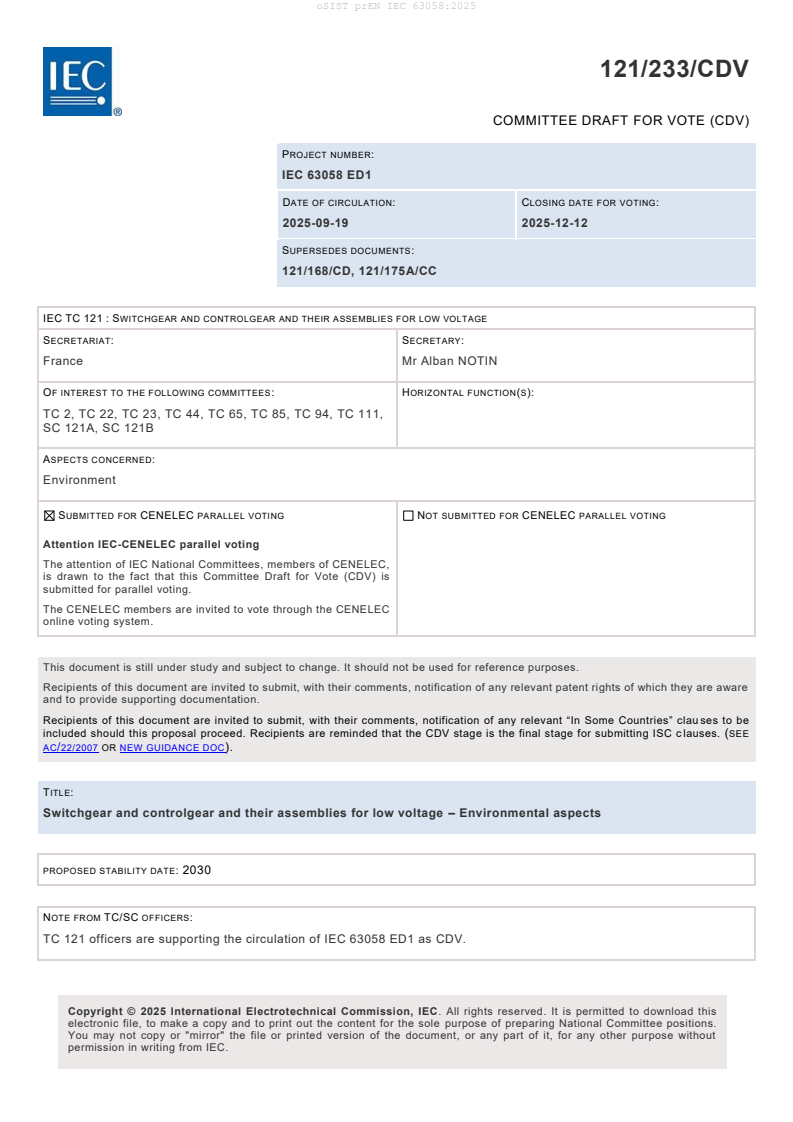
121/233/CDV
COMMITTEE DRAFT FOR VOTE (CDV)
PROJECT NUMBER:
IEC 63058 ED1
DATE OF CIRCULATION: CLOSING DATE FOR VOTING:
2025-09-19 2025-12-12
SUPERSEDES DOCUMENTS:
121/168/CD, 121/175A/CC
IEC TC 121 : SWITCHGEAR AND CONTROLGEAR AND THEIR ASSEMBLIES FOR LOW VOLTAGE
SECRETARIAT: SECRETARY:
France Mr Alban NOTIN
OF INTEREST TO THE FOLLOWING COMMITTEES: HORIZONTAL FUNCTION(S):
TC 2, TC 22, TC 23, TC 44, TC 65, TC 85, TC 94, TC 111,
SC 121A, SC 121B
ASPECTS CONCERNED:
Environment
SUBMITTED FOR CENELEC PARALLEL VOTING NOT SUBMITTED FOR CENELEC PARALLEL VOTING
Attention IEC-CENELEC parallel voting
The attention of IEC National Committees, members of CENELEC,
is drawn to the fact that this Committee Draft for Vote (CDV) is
submitted for parallel voting.
The CENELEC members are invited to vote through the CENELEC
online voting system.
This document is still under study and subject to change. It should not be used for reference purposes.
Recipients of this document are invited to submit, with their comments, notification of any relevant patent rights of which they are aware
and to provide supporting documentation.
Recipients of this document are invited to submit, with their comments, notification of any relevant “In Some Countries” clau ses to be
included should this proposal proceed. Recipients are reminded that the CDV stage is the final stage for submitting ISC c lauses. (SEE
AC/22/2007 OR NEW GUIDANCE DOC).
TITLE:
Switchgear and controlgear and their assemblies for low voltage – Environmental aspects
PROPOSED STABILITY DATE: 2030
NOTE FROM TC/SC OFFICERS:
TC 121 officers are supporting the circulation of IEC 63058 ED1 as CDV.
electronic file, to make a copy and to print out the content for the sole purpose of preparing National Committee positions.
You may not copy or "mirror" the file or printed version of the document, or any part of it, for any other purpose without
permission in writing from IEC.
IEC CDV 63058 © IEC 2025
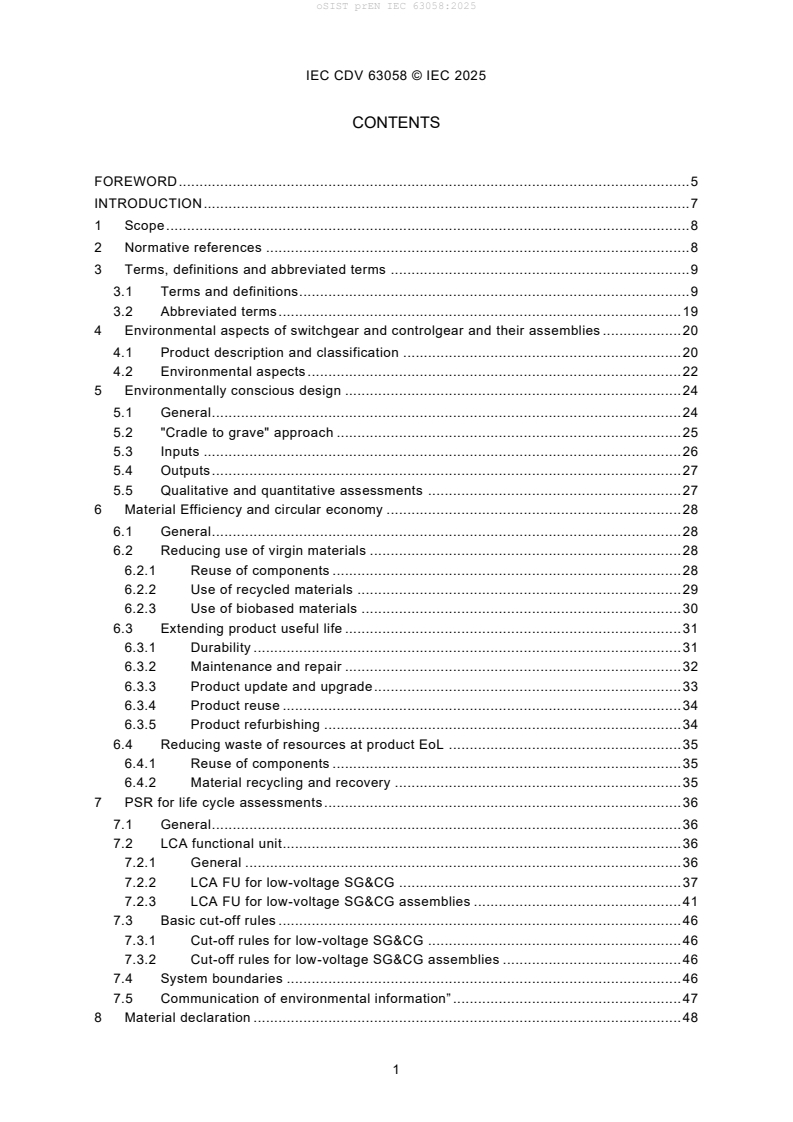
CONTENTS
FOREWORD . 5
INTRODUCTION . 7
1 Scope . 8
2 Normative references . 8
3 Terms, definitions and abbreviated terms . 9
3.1 Terms and definitions. 9
3.2 Abbreviated terms . 19
4 Environmental aspects of switchgear and controlgear and their assemblies . 20
4.1 Product description and classification . 20
4.2 Environmental aspects . 22
5 Environmentally conscious design . 24
5.1 General . 24
5.2 "Cradle to grave" approach . 25
5.3 Inputs . 26
5.4 Outputs . 27
5.5 Qualitative and quantitative assessments . 27
6 Material Efficiency and circular economy . 28
6.1 General . 28
6.2 Reducing use of virgin materials . 28
6.2.1 Reuse of components . 28
6.2.2 Use of recycled materials . 29
6.2.3 Use of biobased materials . 30
6.3 Extending product useful life . 31
6.3.1 Durability . 31
6.3.2 Maintenance and repair . 32
6.3.3 Product update and upgrade . 33
6.3.4 Product reuse . 34
6.3.5 Product refurbishing . 34
6.4 Reducing waste of resources at product EoL . 35
6.4.1 Reuse of components . 35
6.4.2 Material recycling and recovery . 35
7 PSR for life cycle assessments . 36
7.1 General . 36
7.2 LCA functional unit. 36
7.2.1 General . 36
7.2.2 LCA FU for low-voltage SG&CG . 37
7.2.3 LCA FU for low-voltage SG&CG assemblies . 41
7.3 Basic cut-off rules . 46
7.3.1 Cut-off rules for low-voltage SG&CG . 46
7.3.2 Cut-off rules for low-voltage SG&CG assemblies . 46
7.4 System boundaries . 46
7.5 Communication of environmental information” . 47
8 Material declaration . 48
IEC CDV 63058 © IEC 2025
8.1 General . 48
8.2 Additional reporting requirements . 48
8.3 Information provision . 49
9 EoL information . 49
9.1 General . 49
9.2 End-of-life treatment scenario . 49
9.3 Calculation of recoverability and recyclability rate . 51
9.4 Calculation workflow of recoverability and recyclability rates . 51
9.5 Information provision . 52
Annex A (informative) Environmental aspects in environmentally conscious design . 53
A.1 General . 53
A.2 Inputs and outputs to be considered . 53
A.2.1 General . 53
A.2.2 Inputs . 53
A.2.3 Outputs . 53
A.3 Tools for including environmental impacts in product design and
development . 54
Annex B (normative) PSR parameters and default scenarios for LCA . 56
B.1 Common aspects . 56
B.1.1 General . 56
B.1.2 Manufacturing . 56
B.1.3 Distribution . 56
B.1.4 Installation and de-installation . 56
B.1.5 Use. 56
B.2 PSR parameters and default scenarios for low-voltage SG&CG . 57
B.2.1 General . 57
B.2.2 Use scenarios for switchgear and controlgear . 57
B.3 PSR parameters and default scenarios for assemblies . 59
B.3.1 General . 59
B.3.2 Manufacturing phase of assemblies . 59
B.3.3 Use phase of assemblies . 59
Annex C (normative) LCA of low-voltage SC&CG and their assemblies through use of
standard impact indicators . 62
C.1 General . 62
C.2 Calculation rules . 62
C.3 Explanations for large mean deviations in standard life cycle indicators . 63
C.4 Standard life cycle impact indicators for low-voltage SG&CG . 63
C.5 Recommendations for use of LCA impact indicators . 64
Annex D (informative) Example of material declaration . 65
Annex E (informative) Brief introduction to life cycle assessment . 70
E.1 General . 70
E.2 Definition of the goal and scope of the LCA . 70
E.3 Inventory analysis . 70
E.4 Impact assessment . 71
E.5 Interpretation . 71
Annex F (normative) Environmental information for information exchange . 73
IEC CDV 63058 © IEC 2025
F.1 Introduction . 73
F.2 Object . 73
F.3 Data modelling . 73
F.4 General class structure . 73
F.5 Data model composition . 75
F.5.1 Material declaration . 75
F.5.2 Material efficiency. 76
F.5.3 Environmental impact . 77
F.5.4 Environmental properties . 77
Annex G (normative) Carbon footprint data of SG&CG and their assemblies for
assessment at system-level . 81
Annex H (informative) Correlation with Building LCA . 82
Annex I (informative) LCA of busbar trunking systems (busways) . 85
I.1 Introduction . 85
I.2 Definition of the procedure . 85
I.3 Evaluation of the specific impact of the busbar trunking run . 85
Bibliography . 88
Figure 1 – Overview of the defined product families of low-voltage SG&CG . 21
Figure 2 – Classification of low-voltage SG&CG assemblies . 22
Figure 3 – ECD considering upstream and downstream product information . 23
Figure 4 – Conceptual relationship between provisions in product standards and the
environmental impacts associated with the product during its life cycle . 26
Figure 5 – life stages of a product according to the circular economy approach . 28
Figure 6 – Extended product useful life . 31
Figure 7 – Typical scheme of the life cycle stages and unit processes for a product
(from IEC 63366) . 47
Figure D.1 – Main and business information (graphical representation of the XML
code) . 66
Figure D.2 – Product information (graphical representation of the XML code) . 67
Figure D.3 – Declarable substances information (graphical representation of the XML
code) . 68
Figure D.4 – Material classes information (graphical representation of the XML code) . 69
Figure H.1 – Standard family for interoperability with Building LCA . 82
Figure H.2 – Life cycle stages and corresponding modules as defined in EN 15804 . 83
Figure H.3 – Link between material efficiency aspects and modules in EN 15804 . 84
Figure I.4 – reference design for evaluating the impact of the busbar trunking run . 86
Figure I.5 – evaluation of the run length . 87
Table 1 – Overview of the standard structure, the content and the corresponding
clauses . 23
Table 2 – LCA FU for low-voltage SG&CG . 37
Table 3 – LCA FU for low-voltage SG&CG assemblies . 41
Table 4 – Further explanation of the generic EoL treatment scenario . 50
Table B.1 – Default use scenarios for switchgear and controlgear . 58
IEC CDV 63058 © IEC 2025
Table B.2 – Use scenarios for calculating impacts of assemblies . 59
Table B.3 – Default load conditions for typical circuits in assemblies . 60
Table C.1 – Standard life cycle impact indicators for low-voltage SG&CG . 63
Table D.1 – Main and business information (tabular form) . 65
Table D.2 – Product information (tabular form). 66
Table D.3 – Declarable substances information (tabular form) . 67
Table D.4 – Material classes information (tabular form) . 69
Table F.1 – Class structure . 74
Table F.2 – Material declaration . 75
Table F.3 – Material efficiency . 76
Table F.4 – Environmental impact . 77
Table F.5 – List of Environmental properties . 77
Table F.6 – Value lists of Environmental properties . 80
Table H.1 – Life cycle information - Relation between life cycle stages in this document
and EN 15804 modules . 83
Table H.2 – Additional indications for Use stage . 84
IEC CDV 63058 © IEC 2025
INTERNATIONAL ELECTROTECHNICAL COMMISSION
____________
SWITCHGEAR AND CONTROLGEAR AND
THEIR ASSEMBLIES FOR LOW VOLTAGE –
Environmental aspects
FOREWORD
1) The International Electrotechnical Commission (IEC) is a worldwide organization for standardization comprising
all national electrotechnical committees (IEC National Committees). The object of IEC is to promote international
co-operation on all questions concerning standardization in the electrical and electronic fields. To this end and
in addition to other activities, IEC publishes International Standards, Technical Specifications, Technical Reports,
Publicly Available Specifications (PAS) and Guides (hereafter referred to as "IEC Publication(s)"). Their
preparation is entrusted to technical committees; any IEC National Committee interested in the subject dealt with
may participate in this preparatory work. International, governmental and non-governmental organizations liaising
with the IEC also participate in this preparation. IEC collaborates closely with the International Organization for
Standardization (ISO) in accordance with conditions determined by agreement between the two organizations.
2) The formal decisions or agreements of IEC on technical matters express, as nearly as possible, an international
consensus of opinion on the relevant subjects since each technical committee has representation from all
interested IEC National Committees.
3) IEC Publications have the form of recommendations for international use and are accepted by IEC National
Committees in that sense. While all reasonable efforts are made to ensure that the technical content of IEC
Publications is accurate, IEC cannot be held responsible for the way in which they are used or for any
misinterpretation by any end user.
4) In order to promote international uniformity, IEC National Committees undertake to apply IEC Publications
transparently to the maximum extent possible in their national and regional publications. Any divergence between
any IEC Publication and the corresponding national or regional publication shall be clearly indicated in the latter.
5) IEC itself does not provide any attestation of conformity. Independent certification bodies provide conformity
assessment services and, in some areas, access to IEC marks of conformity. IEC is not responsible for any
services carried out by independent certification bodies.
6) All users should ensure that they have the latest edition of this publication.
7) No liability shall attach to IEC or its directors, employees, servants or agents including individual experts and
members of its technical committees and IEC National Committees for any personal injury, property damage or
other damage of any nature whatsoever, whether direct or indirect, or for costs (including legal fees) and
expenses arising out of the publication, use of, or reliance upon, this IEC Publication or any other IEC
Publications.
8) Attention is drawn to the Normative references cited in this publication. Use of the referenced publications is
indispensable for the correct application of this publication.
9) Attention is drawn to the possibility that some of the elements of this IEC Publication may be the subject of patent
rights. IEC shall not be held responsible for identifying any or all such patent rights.
International Standard IEC 63058 has been prepared by IEC technical committee 121:
Switchgear and controlgear and their assemblies for low voltage.
This edition cancels and replaces the technical specification published in 2021.
This edition includes the following significant technical changes with respect to the previous
technical specification:
– new definitions relevant for material efficiency (3.1.47 to 3.1.68),
– new Section 6 on material efficiency,
– extended coverage of assemblies in IEC 61439 standards
– new Annex F - Environmental information for information exchange,
– new Annex G - Assessment of carbon footprint for switchgear and controlgear,
IEC CDV 63058 © IEC 2025
– new Annex H - Correlation with Building LCA,
– new Annex I - LCA of busbar trunking systems (busways).
The text of this International Standard is based on the following documents:
FDIS Report on voting
121/xxx/FDIS 121/xxx/RVD
Full information on the voting for its approval can be found in the report on voting indicated in
the above table.
The language used for the development of this International Standard is English.
This document was drafted in accordance with ISO/IEC Directives, Part 2, and developed in
accordance with ISO/IEC Directives, Part 1 and ISO/IEC Directives, IEC Supplement, available
at www.iec.ch/members_experts/refdocs. The main document types developed by IEC are
described in greater detail at www.iec.ch/standardsdev/publications.
The committee has decided that the contents of this document will remain unchanged until the
stability date indicated on the IEC website under webstore.iec.ch in the data related to the
specific document. At this date, the document will be
– reconfirmed,
– withdrawn,
– replaced by a revised edition, or
– amended.
IMPORTANT – The 'colour inside' logo on the cover page of this publication indicates that it
contains colours which are considered to be useful for the correct understanding of its
contents. Users should therefore print this document using a colour printer.
IEC CDV 63058 © IEC 2025
1 INTRODUCTION
2 Increasingly, there is a focus on preserving the natural environment for the good of future
3 generations. For this to be achieved, efficient use of energy and materials throughout the life
4 cycle of every product and process to conserve world's finite natural resources is essential. In
5 addition, release of substances and materials that might be harmful for the environment or
6 induce climatic changes are to be avoided or minimized. From conception to end-of-life of a
7 product, the environmental impact of all the relevant processes should be considered, including
8 how materials are disposed of or recovered for future use.
9 In order to contribute to conserving natural resources, manufacturers of low-voltage switchgear
10 and controlgear and their assemblies should ensure an environmentally conscious design
11 (ECD) involving:
12 – phasing-out or minimizing use of hazardous substances or materials;
13 – efficient use of energy and materials in the manufacture of products;
14 – ensuring the lowest practical energy consumption by the products while they are in use;
15 – at the end of product life, the possibility of recycling materials for future use, and sorting
16 hazardous components requiring a specific treatment.
17 Declarations and ECD are increasingly required and in some instances mandated. These can
18 take several forms, for example, Type II or Type III environmental declaration, material
19 declaration (MD). In some business, Green Public Procurement (GPP) is applicable and/or ECD
20 is part of the ISO 14001 certification. Some countries and regions are also actively pushing for
21 environmental conservation, for example, the European Union through the Ecodesign for
22 Sustainable Product Development Regulation and China through the Ecodesign Initiative.
23 Systematic demands for ECD will be required by most, if not all customers, in the medium term.
24 Assessing the environmental impact of low-voltage switchgear and controlgear and their
25 assemblies is part of an ECD process. ECD requires the identification, measurement and
26 reporting of particular impacts. IEC 62430 describes the basic principles of ECD, with the goal
27 of reducing the potential environmental impacts of products.
28 Generally, the environmental impact of low-voltage switchgear and controlgear and their
29 assemblies is very low compared with that of the overall system into which they are incorporated
30 and the processes to which they contribute. The lifetime impact of processes such as the air -
31 conditioning of a building, the manufacture of steel or shipping far exceed that of the
32 manufacture and use of any associated low-voltage switchgear and controlgear.
33 Even though low-voltage switchgear and controlgear and their assemblies have a relatively
34 minor impact on the environment, there is a market need for appropriate methods for managing
35 these environmental matters. A simplified means of estimating the environmental impacts is
36 required together with readily available data to make the stakeholders, for example contractor's,
37 installer's and end user's, task of assessing environmental impacts at system level easier.
38 Specific rules for assessing the environmental impacts and providing appropriate data for low-
39 voltage switchgear and controlgear and their assemblies are among the purposes of this
40 document. These rules establish a common evaluation scheme of their environmental impacts
41 in terms of characterized impact indicators (e.g. CO -equivalents, ozone depletion) over their
42 whole life cycle.
IEC CDV 63058 © IEC 2025
43 SWITCHGEAR AND CONTROLGEAR AND
44 THEIR ASSEMBLIES FOR LOW VOLTAGE –
46 Environmental aspects
50 1 Scope
51 This document provides methods and process for manufacturers of low-voltage switchgear and
52 controlgear and their assemblies in evaluating and improving the environmental impact of their
53 products, and in enabling effective communication using common references for environmental
54 information throughout to the full life cycle.
55 This document provides:
56 – guidance on the process and general aspects to implement environmentally-conscious
57 product design principles, as given in IEC 62430, essential for low-voltage switchgear and
58 controlgear and their assemblies;
59 – the Product Specific Rules (PSR) for Life Cycle Assessment (LCA) to be used for
60 environmental declarations, according to ISO 14025 and ISO 14021, and for quantitative
61 ECD;
62 – standard environmental impact data derived from case studies and a means of using them,
63 to allow assessment of impacts at a system level, where specific data for a device is missing;
64 – common rules for communicating information about the presence of regulated substances
65 and the materials contained in the product, according to IEC 62474 and IEC 82474 ;
66 – rules and guidance on communicating information about the end-of-life treatment of the
67 product;
68 – guidance and examples for addressing circular economy and material efficiency;
69 – preferred communication rules of environmental information, including a data model .
70 This document does not provide:
71 – The general methods and the process to execute the LCA, provided by ISO 14040 and ISO
72 14044;
73 – format and content of environmental product declarations, that are addressed in ISO 14025
74 and ISO 14021 standards.
75 2 Normative references
76 The following documents are referred to in the text in such a way that some or all of their content
77 constitutes requirements of this document. For dated references, only the edition cited applies.
78 For undated references, the latest edition of the referenced document (including any
79 amendments) applies.
80 IEC 60050-904, International Electrotechnical Vocabulary (IEV) – Part 904: Environmental
81 standardization for electrical and electronic products and systems (available at
82 www.electropedia.org)
83 IEC 61439-1:2020, Low-voltage switchgear and controlgear assemblies – Part 1: General rules
—————————
The transition from IEC 62474 to IEC 82474 will be addressed in future revisions
IEC CDV 63058 © IEC 2025
84 IEC 62430:2019, Environmentally conscious design (ECD) – Principles, requirements and
85 guidance
86 IEC 62474:2018, Material declaration for products of and for the electrotechnical industry
87 IEC 62474-DB , Material declaration for products of and for the electrotechnical industry
88 (available at http://std.iec.ch/iec62474)
89 IEC TR 62635:2012, Guidelines for end-of-life information provided by manufacturers and
90 recyclers and for recyclability rate calculation of electrical and electronic equipment
91 IEC TR 63482:2024, Maintenance of low voltage switchgear and controlgear and their
92 assemblies
93 IEC 82474-1:2025, Material declaration – Part 1: General requirements
94 ISO 14006, Environmental management systems – Guidelines for incorporating ecodesign
95 ISO 14021:2016, Environmental labels and declarations – Self-declared environmental claims
96 (Type II environmental labelling)
97 ISO 14025:2006, Environmental labels and declarations – Type III environmental declarations
98 – Principles and procedures
99 ISO 14040:2006, Environmental management – Life cycle assessment – Principles and
100 framework
101 ISO 14044:2006, Environmental management – Life cycle assessment – Requirements and
102 guidelines
103 ISO 14044:2006/AMD1:2017
104 ISO 14044:2006/AMD2:2020
105 ISO 14045:2012, Environmental management – Eco-efficiency assessment of product systems
106 – Principles, requirements and guidelines
107 ISO 14067:2018, Greenhouse gases — Carbon footprint of products — Requirements and
108 guidelines for quantification
109 EN 45558:2019, General method to declare the use of critical raw materials in energy-related
110 products
111 IEC 63366:2025, Product category rules for life cycle assessments of electrical and electronic
112 products and systems
113 Reference Life Cycle Data System (ILCD) Handbook, Recommendations for Life Cycle Impact
114 Assessment in the European context. First edition November 2011. EUR 24571
115 3 Terms, definitions and abbreviated terms
116 3.1 Terms and definitions
117 For the purposes of this document, the terms and definitions given in IEC 60050-904 and the
118 following apply.
119 ISO and IEC maintain terminological databases for use in standardization at the following
120 addresses:
121 – ISO Online browsing platform: available at http://www.iso.org/obp
—————————
"DB" refers to the IEC on-line database.
IEC CDV 63058 © IEC 2025
122 – IEC Electropedia: available at http://www.electropedia.org/
123 3.1.1
124 low-voltage switchgear and controlgear assembly
125 assembly
126 combination of one or more low-voltage switching devices together with associated control,
127 measuring, signalling, protective, regulating equipment, with all the internal electrical and
128 mechanical interconnections and structural parts, as defined by the original manufacturer,
129 which can be assembled in accordance with the original manufacturer’s instructions
130 Note 1 to entry: Throughout this document, the term assembly(s) is used for a low-voltage switchgear and
131 controlgear assembly(s)
132 Note 2 to entry: The term “switching device” includes mechanical switching devices and semiconductor switching
133 devices, e.g. soft starters, semiconductor relays, frequency converters. The auxiliary circuits may also include
134 electro-mechanical devices, e.g. control relays, terminal blocks, and electronic devices, e.g. electronic motor control
135 devices, electronic measurement and protection devices, bus communication, programmable logic controller
136 systems.
137 [SOURCE: IEC 61439-1:2020, 3.1.1]
138 3.1.2
139 declarable substance group
140 group of substances included in the IEC 62474-DB at the date the material declaration is made
141 Note 1 to entry: Substance group is multiple CAS # (for example Lead compounds).
142 3.1.3
143 disposal
144 final disposal
145 operation that does not lead to the recovery of product, parts, materials or energy
146 [SOURCE: IEV, 193-04-28]
147 3.1.4
148 end-of-life
149 end of life (deprecated),
150 EoL
151 life cycle stage of a product starting when it is
152 removed from its use stage until the product has either its life extended or is handed over for
153 recovery
154 [SOURCE: IEV 193-05-07, modified – note 1 and 2 removed]
155 3.1.5
156 end-of-life treatment
157 operation covering all activities starting when end-of-life products are handed over for recovery
158 or are discarded and waste is handed over for recovery or final disposal
159 Note 1 to entry: End-of-life treatment includes collection and logistics.
160 Note 2 to entry: End-of-life products can be handed over for recovery through e.g. a take-back program on request
161 of or managed by the manufacturer.
162 [SOURCE: IEC/FIDS 60050-193:2025, IEV 193-04-03, modified — Note 3 and figure to entry
163 has been removed]
164 3.1.6
165 energy recovery
166 production of useful energy through direct and controlled combustion or other processing of
167 waste
168 Note 1 to entry: Waste incinerators producing hot water, steam and/or electricity are common means for energy
169 recovery.
170 [SOURCE: IEC 60050-904:2014, 904-04-03]
IEC CDV 63058 © IEC 2025
171 3.1.7
172 environment
173 surroundings in which a product or system exists, including air, water, land, natural resources,
174 flora, fauna, humans and their interrelation
175 [SOURCE: IEC 60050-904:2014, 904-01-01]
176 3.1.8
177 environmental aspect
178 element of an organization's activities or products that can interact with the environment
179 Note 1 to entry: A significant environmental aspect has or can have a significant environmental impact.
180 [SOURCE: IEC 60050-904:2014, 904-01-02]
181 3.1.9
182 environmental claim
183 statement, symbol or graphic that indicates an environmental aspect of a product, a component
184 or packaging
185 Note 1 to entry: An environmental claim may be made on product or packaging labels, through product literature,
186 technical bulletins, advertising, publicity, telemarketing, as well as through digital or electronic media such as the
187 Internet.
188 [SOURCE: ISO 14021:2016, 3.1.4]
189 3.1.10
190 environmentally conscious design
191 systematic approach which considers environmental aspects in the design and development
192 with the aim to reduce adverse environmental impacts throughout the life cycle of a product
193 Note 1 to entry: Other terminology used worldwide with the same meaning includes ecodesign, design for
194 environment (DFE), green design and environmentally sustainable design.
195 [SOURCE: IEC 62430:2019, 3.1.1, modified – Abbreviated term "ECD" and Note 2 to entry
196 deleted.]
197 3.1.11
198 environmental declaration program
199 voluntary program for the development and use of Type III environmental declarations, based
200 on a set of operating rules (program instructions)
201 [SOURCE: ISO 14025:2006, 3.3, modified – "Type III" removed from the term and "(program
202 instructions)" added to the definition.]
203 3.1.12
204 environmental impact
205 change to the environment, whether adverse or beneficial, wholly or partly resulting from
206 environmental aspects
207 [SOURCE: IEC 60050-904:2014, 904-01-03]
208 3.1.13
209 environmental declaration
210 claim which indicates the environmental aspects of a product or a service
211 Note 1 to entry: An environmental label or declaration may take the form of a statement, symbol or graphic on a
212 product or package label, in product literature, in technical bulletins, in advertising or in publicity, amongst other
213 things.
214 3.1.14
215 Type II environmental declaration
216 environmental declaration providing self-declared environmental claims according to
217 ISO 14021:2016
IEC CDV 63058 © IEC 2025
218 3.1.15
219 Type III environmental declaration
220 environmental declaration providing quantified environmental data using predetermined
221 parameters and, where relevant, additional environmental information
222 Note 1 to entry: For a Type III declaration, an environmental declaration program is used, including program
223 instructions and product category rules. The predetermined parameters are based on ISO 14040 and ISO 14044.
224 Note 2 to entry: The additional environmental information may be quantitative or qualitative.
225 [SOURCE: ISO 14025:2006, 3.2, modified – Note 1 to entry modified.]
226 3.1.16
227 environmental management system
228 part of the management system used to manage environmental aspects, fulfil compliance
229 obligations, and address risks and opportunities
230 [SOURCE: ISO 14001:2015, 3.1.2]
231 3.1.17
232 LCA functional unit
233 quantified performance of a product system for use as a reference unit
234 [SOURCE: ISO 14040:2006, 3.20, modified – Addition of "LCA" in term.]
235 3.1.18
236 standard data
237 secondary data applicable to a homogeneous product family as resulting from a study
238 3.1.19
239 specific data
240 data directly collected, measured or estimated for a specific product
241 3.1.20
242 hazardous substance
243 substance that can adversely impact the environment with immediate or retarded effect
244 3.1.21
245 homogeneous product family
246 subgroup of a product family where the environmental aspects can reasonably be expected to
247 be similar and therefore scalable over the group through a function of certain parameter, for
248 example electrical ratings or weight
249 3.1.22
250 LCA report
251 accompanying document to the life cycle assessment, used as a complement to the
252 environmental declaration giving further detailed information about the inputs, outputs, used
253 LCI-data and assumptions in regard to this standard
254 Note 1 to entry: This LCA report has to be kept for justification purposes in terms of environmental declaration
255 verification or market surveillance
256 3.1.23
257 life cycle
258 consecutive and interlinked stages of a product system, from raw material acquisition or
259 generation from natural resources to the final disposal
260 [SOURCE: ISO 14040:2006, 3.1]
261 3.1.24
262 life cycle assessment
263 compilation and evaluation of the inputs, outputs and the potential environmental impacts of a
264 product system throughout its life cycle
IEC CDV 63058 © IEC 2025
265 [SOURCE: ISO 14040:2006, 3.2, modified – Abbreviated term "LCA" deleted.]
266 3.1.25
267 life cycle inventory
268 inventory of flows from and to nature for a product system
269 Note 1 to entry: Inventory flows include inputs of water, energy, and raw materials, and releases to air, land, and
270 water.
271 Note 2 to entry: LCI according to the ILCD Guidelines are available in the Life Cycle Data Network (LCDN).
272 3.1.26
273 life cycle stage
274 element of a life cycle
275 EXAMPLE Raw material acquisition and production, manufacturing, packaging and distribution, installation and use,
276 maintenance and upgrading, and end-of-life.
277 Note 1 to entry: The phrase "life cycle phase" is sometimes used interchangeably with "life cycle stage".
278 3.1.27
279 material
280 substance or mixture of substances within a product or product part
281 [SOURCE: IEC 62474:2018, 3.15]
282 3.1.28
283 material class
284 defined classification of materials that are established in the referenced IEC 62474 database
285 for purposes of inventorying aspects of a product, such that no two classes contain the same
286 materials
287 [SOURCE: IEC 62474:2018, 3.16, modified – Deletion of the note to entry.]
288 3.1.29
289 organization
290 person or group of people that has its own functions with responsi
...