

EN 50706:2022
(Main)Household and similar electrical appliances - Particular requirements for electrically operated commercial rotary ironers
General Information
- Abstract
This clause of Part 1 is replaced by the following: This document deals with the safety of electrically operated commercial rotary ironers, intended to be used by trained users in e.g. hotels hospitals, factories, in light industry and on farms. It also covers rotary ironers which are declared for commercial use in areas open to the public and operated by lay persons e.g. in laundrettes and communal laundry rooms. Their rated voltage being not more than 250 V for single phase and 480 V for others. This document also covers electrically operated commercial rotary ironers making use of other energy sources. It does not cover requirements for these other energy sources for heating purposes. However, the influence of these other energy sources on the machine is covered. As far as is practicable, this document deals with the common hazards presented by appliances that are encountered by all persons in household and similar environments. However, in general, it does not take into account - children playing with the appliance, - the use of the appliance by children, It is recognized that very vulnerable people may have needs beyond the level addressed in this document. Products covered by this document do not create a noise hazard, therefore no specific provisions concerning noise are given. NOTE 101 Attention is drawn to the fact that - for electrically operated commercial rotary ironers intended to be used in vehicles or on board ships or aircraft, additional requirements can be necessary; - in many countries additional requirements are specified by the national health authorities, the national authorities responsible for the protection of labour and similar authorities. This document does not apply to - industrial flatwork ironers having a surface contact area ≥ 1,20 m2, feeders and folders (EN ISO 10472 5); - appliances intended to be used in locations where special conditions prevail, such as the presence of a corrosive or explosive atmosphere (dust, vapour or gas); For the purpose of this document, the term "appliance" as used in Part 1 is read as "electrically operated commercial rotary ironers".
- Status
- Published
- Publication Date
- 18-Aug-2022
- Technical Committee
- CLC/TC 61 - Safety of household and similar electrical appliances
- Drafting Committee
- CLC/TC 61 - Safety of household and similar electrical appliances
- Current Stage
- 6060 - Document made available - Publishing
- Start Date
- 19-Aug-2022
- Due Date
- 18-Aug-2021
- Completion Date
- 19-Aug-2022


Overview
EN 50706:2022 (CLC) is the European product-family safety standard for electrically operated commercial rotary ironers. Read in conjunction with EN 60335-1, it defines safety requirements for rotary ironers used by trained operators (hotels, hospitals, factories, farms) and those declared for commercial public use (laundrettes, communal laundry rooms). The standard covers electrical, mechanical and thermal hazards for appliances up to 250 V single‑phase (480 V for other supplies) and also addresses machines that use other energy sources (while not specifying heating-source requirements).
Key topics and technical requirements
- Scope & exclusions: Applies to commercial rotary ironers (padded roller + heated surface). Excludes industrial flatwork ironers with contact area ≥ 1.20 m2 (see EN ISO 10472-5) and appliances for corrosive or explosive atmospheres. Does not take children’s play or child operation into account.
- Normative references: EN 60335-1 (Part 1), EN 62233, EN ISO 13857, EN 60068-2-75, ISO 1817, EN 61010-1, among others.
- Electrical safety: Protection against access to live parts, leakage current and electric strength (including at operating temperature), transient overvoltages, moisture resistance and supply connection rules.
- Heating & energy sources: Requirements for safety of electrically heated elements; influence of other energy sources on machine safety is addressed.
- Mechanical & thermal hazards: Stability, mechanical strength, guards, starting controls for motor-operated appliances, and measures to avoid accidental contact with hot or rotating parts.
- Marking & instructions: Mandatory manufacturer name/address, model/type, serial/production year, appliance designation, maximum steam pressure/temperature (if applicable), lamp power marking and compressed-air pressure marking; user instructions including special guidance for appliances used in public areas.
- Components & testing: Internal wiring, components, overload protection, endurance, abnormal operation, resistance to heat/fire and rusting. Annexes include software evaluation and ageing tests for elastomeric parts.
Applications and who uses this standard
- Manufacturers and designers of commercial rotary ironers - to design and certify safe products for hotels, laundrettes, hospitals and laundries.
- Test laboratories and conformity assessment bodies - for safety testing and CE marking compliance.
- Purchasing/specification teams in hospitality and healthcare - to specify compliant equipment.
- Regulators and safety engineers - to assess workplace safety and conformity with national rules (note: additional national health/labour requirements may apply).
Related standards
- EN 60335-1 (general household appliance safety)
- EN ISO 10472-5 (industrial flatwork ironers - exclusion)
- EN 62233, EN ISO 13857, EN 60068-2-75, ISO 1817, EN 61010-1
Keywords: EN 50706:2022, commercial rotary ironers, electrical safety, CLC, EN 60335-1, laundrettes, marking and instructions.
Relations
- Effective Date
- 10-Feb-2026
- Effective Date
- 09-Feb-2026
- Refers
EN 4855-02:2020 - Aerospace series - ECO efficiency of catering equipment - Part 02: Oven equipment - Effective Date
- 09-Feb-2026
- Effective Date
- 03-Feb-2026
- Effective Date
- 03-Feb-2026
- Effective Date
- 03-Feb-2026
Frequently Asked Questions
EN 50706:2022 is a standard published by CLC. Its full title is "Household and similar electrical appliances - Particular requirements for electrically operated commercial rotary ironers". This standard covers: This clause of Part 1 is replaced by the following: This document deals with the safety of electrically operated commercial rotary ironers, intended to be used by trained users in e.g. hotels hospitals, factories, in light industry and on farms. It also covers rotary ironers which are declared for commercial use in areas open to the public and operated by lay persons e.g. in laundrettes and communal laundry rooms. Their rated voltage being not more than 250 V for single phase and 480 V for others. This document also covers electrically operated commercial rotary ironers making use of other energy sources. It does not cover requirements for these other energy sources for heating purposes. However, the influence of these other energy sources on the machine is covered. As far as is practicable, this document deals with the common hazards presented by appliances that are encountered by all persons in household and similar environments. However, in general, it does not take into account - children playing with the appliance, - the use of the appliance by children, It is recognized that very vulnerable people may have needs beyond the level addressed in this document. Products covered by this document do not create a noise hazard, therefore no specific provisions concerning noise are given. NOTE 101 Attention is drawn to the fact that - for electrically operated commercial rotary ironers intended to be used in vehicles or on board ships or aircraft, additional requirements can be necessary; - in many countries additional requirements are specified by the national health authorities, the national authorities responsible for the protection of labour and similar authorities. This document does not apply to - industrial flatwork ironers having a surface contact area ≥ 1,20 m2, feeders and folders (EN ISO 10472 5); - appliances intended to be used in locations where special conditions prevail, such as the presence of a corrosive or explosive atmosphere (dust, vapour or gas); For the purpose of this document, the term "appliance" as used in Part 1 is read as "electrically operated commercial rotary ironers".
This clause of Part 1 is replaced by the following: This document deals with the safety of electrically operated commercial rotary ironers, intended to be used by trained users in e.g. hotels hospitals, factories, in light industry and on farms. It also covers rotary ironers which are declared for commercial use in areas open to the public and operated by lay persons e.g. in laundrettes and communal laundry rooms. Their rated voltage being not more than 250 V for single phase and 480 V for others. This document also covers electrically operated commercial rotary ironers making use of other energy sources. It does not cover requirements for these other energy sources for heating purposes. However, the influence of these other energy sources on the machine is covered. As far as is practicable, this document deals with the common hazards presented by appliances that are encountered by all persons in household and similar environments. However, in general, it does not take into account - children playing with the appliance, - the use of the appliance by children, It is recognized that very vulnerable people may have needs beyond the level addressed in this document. Products covered by this document do not create a noise hazard, therefore no specific provisions concerning noise are given. NOTE 101 Attention is drawn to the fact that - for electrically operated commercial rotary ironers intended to be used in vehicles or on board ships or aircraft, additional requirements can be necessary; - in many countries additional requirements are specified by the national health authorities, the national authorities responsible for the protection of labour and similar authorities. This document does not apply to - industrial flatwork ironers having a surface contact area ≥ 1,20 m2, feeders and folders (EN ISO 10472 5); - appliances intended to be used in locations where special conditions prevail, such as the presence of a corrosive or explosive atmosphere (dust, vapour or gas); For the purpose of this document, the term "appliance" as used in Part 1 is read as "electrically operated commercial rotary ironers".
EN 50706:2022 is classified under the following ICS (International Classification for Standards) categories: 97.060 - Laundry appliances. The ICS classification helps identify the subject area and facilitates finding related standards.
EN 50706:2022 has the following relationships with other standards: It is inter standard links to ISO 1817:2015, EN ISO 13857:2019, EN 4855-02:2020, EN 60068-2-75:2014, EN 61010-1:2010, EN 62233:2008. Understanding these relationships helps ensure you are using the most current and applicable version of the standard.
EN 50706:2022 is associated with the following European legislation: EU Directives/Regulations: 2006/42/EC; Standardization Mandates: M/396. When a standard is cited in the Official Journal of the European Union, products manufactured in conformity with it benefit from a presumption of conformity with the essential requirements of the corresponding EU directive or regulation.
EN 50706:2022 is available in PDF format for immediate download after purchase. The document can be added to your cart and obtained through the secure checkout process. Digital delivery ensures instant access to the complete standard document.
Standards Content (Sample)
SLOVENSKI STANDARD
01-november-2022
Varnost gospodinjskih in podobnih električnih aparatov - Posebne zahteve za
komercialne električne rotacijske likalnike
Household and similar electrical appliances - Particular requirements for electrical
operated commercial rotary ironers
Appareils électrodomestiques et analogues - Exigences particulières pour les
repasseuses rotatives électriques à usage
Ta slovenski standard je istoveten z: EN 50706:2022
ICS:
97.060 Aparati za nego perila Laundry appliances
2003-01.Slovenski inštitut za standardizacijo. Razmnoževanje celote ali delov tega standarda ni dovoljeno.
EUROPEAN STANDARD EN 50706
NORME EUROPÉENNE
EUROPÄISCHE NORM August 2022
ICS 97.060
English Version
Household and similar electrical appliances - Particular
requirements for electrically operated commercial rotary ironers
Appareils électrodomestiques et analogues - Exigences Sicherheit elektrischer Geräte für den Hausgebrauch und
particulières pour les repasseuses rotatives électriques à ähnliche Zwecke - Besondere Anforderungen für elektrische
usage collectif Bügelmaschinen für den gewerblichen Gebrauch
This European Standard was approved by CENELEC on 2021-08-30. CENELEC members are bound to comply with the CEN/CENELEC
Internal Regulations which stipulate the conditions for giving this European Standard the status of a national standard without any alteration.
Up-to-date lists and bibliographical references concerning such national standards may be obtained on application to the CEN-CENELEC
Management Centre or to any CENELEC member.
This European Standard exists in three official versions (English, French, German). A version in any other language made by translation
under the responsibility of a CENELEC member into its own language and notified to the CEN-CENELEC Management Centre has the
same status as the official versions.
CENELEC members are the national electrotechnical committees of Austria, Belgium, Bulgaria, Croatia, Cyprus, the Czech Republic,
Denmark, Estonia, Finland, France, Germany, Greece, Hungary, Iceland, Ireland, Italy, Latvia, Lithuania, Luxembourg, Malta, the
Netherlands, Norway, Poland, Portugal, Republic of North Macedonia, Romania, Serbia, Slovakia, Slovenia, Spain, Sweden, Switzerland,
Turkey and the United Kingdom.
European Committee for Electrotechnical Standardization
Comité Européen de Normalisation Electrotechnique
Europäisches Komitee für Elektrotechnische Normung
CEN-CENELEC Management Centre: Rue de la Science 23, B-1040 Brussels
© 2022 CENELEC All rights of exploitation in any form and by any means reserved worldwide for CENELEC Members.
Ref. No. EN 50706:2022 E
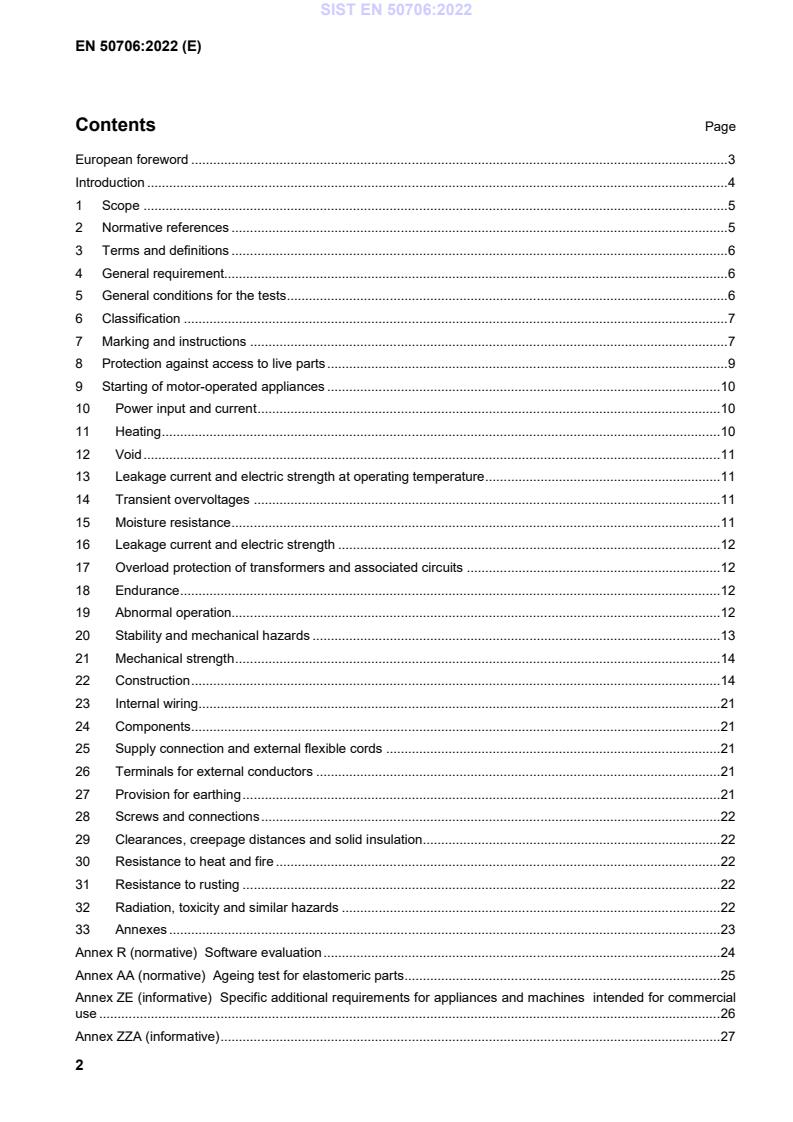
Contents Page
European foreword . 3
Introduction . 4
1 Scope . 5
2 Normative references . 5
3 Terms and definitions . 6
4 General requirement. 6
5 General conditions for the tests . 6
6 Classification . 7
7 Marking and instructions . 7
8 Protection against access to live parts . 9
9 Starting of motor-operated appliances . 10
10 Power input and current . 10
11 Heating . 10
12 Void . 11
13 Leakage current and electric strength at operating temperature . 11
14 Transient overvoltages . 11
15 Moisture resistance . 11
16 Leakage current and electric strength . 12
17 Overload protection of transformers and associated circuits . 12
18 Endurance . 12
19 Abnormal operation. 12
20 Stability and mechanical hazards . 13
21 Mechanical strength . 14
22 Construction . 14
23 Internal wiring . 21
24 Components . 21
25 Supply connection and external flexible cords . 21
26 Terminals for external conductors . 21
27 Provision for earthing . 21
28 Screws and connections . 22
29 Clearances, creepage distances and solid insulation. 22
30 Resistance to heat and fire . 22
31 Resistance to rusting . 22
32 Radiation, toxicity and similar hazards . 22
33 Annexes . 23
Annex R (normative) Software evaluation . 24
Annex AA (normative) Ageing test for elastomeric parts . 25
Annex ZE (informative) Specific additional requirements for appliances and machines intended for commercial
use . 26
Annex ZZA (informative) . 27
European foreword
This document (EN 50706:2022) has been prepared by CLC/TC 61, “Safety of household and similar electrical
appliances”.
The following dates are fixed:
• latest date by which this document has to be implemented at (dop) 2023-02-19
national level by publication of an identical national standard
or by endorsement
• latest date by which the national standards conflicting with this (dow) 2025-08-19
document have to be withdrawn
Attention is drawn to the possibility that some of the elements of this document may be the subject of patent rights.
CENELEC shall not be held responsible for identifying any or all such patent rights.
This document has been prepared under a Standardization Request given to CENELEC by the European
Commission and the European Free Trade Association.
Any feedback and questions on this document should be directed to the users’ national committee. A complete
listing of these bodies can be found on the CENELEC website.
Introduction
Addition:
+A2:2019+A15:2021+A16:2022, which is referred to in this text as “Part 1”. This document supplements or
modifies the corresponding clauses and subclauses of the standards of Part 1.
NOTE The following numbering system is used:
— subclauses, tables and figures that are numbered starting from 101 are additional to those in Part 1;
— unless notes are in a new subclause or involve notes in Part 1, they are numbered starting from 101, including those in a
replaced clause or subclause;
— additional annexes are lettered AA, BB, etc.
This document is a product family standard dealing with the safety of commercial electric rotary ironers and
takes precedence over horizontal and generic standards covering the same subject.
This document recognizes the level of protection against hazards such as electrical, mechanical, thermal, fire and
radiation of commercial electric rotary ironers when operated as in normal use taking into account the
manufacturer's instructions. It also covers any reasonably foreseeable misuse of the machinery and takes into
account the way in which electromagnetic phenomena can affect the safe operation of commercial electric rotary
ironers.
A commercial electric rotary ironers that complies with the text of this standard will not necessarily be considered
to comply with the safety principles of the standard if, when examined and tested, it is found to have other features
that impair the level of safety covered by these requirements.
This document takes into account the requirements of HD 60364 as far as possible so that there is compatibility
with the wiring rules when the machinery is connected to the supply mains. However, national wiring rules may
differ.
This document applies in conjunction with the latest edition of EN 60335-1 and its amendments, which is referred
to in this text as “Part 1”. This standard supplements or modifies the corresponding clauses of Part 1 as indicated
in the text.
1 Scope
This clause of Part 1 is replaced by the following:
This document deals with the safety of electrically operated commercial rotary ironers, intended to be used by
trained users in e.g. hotels hospitals, factories, in light industry and on farms. It also covers rotary ironers which
are declared for commercial use in areas open to the public and operated by lay persons e.g. in laundrettes and
communal laundry rooms. Their rated voltage being not more than 250 V for single phase and 480 V for others.
This document also covers electrically operated commercial rotary ironers making use of other energy sources.
It does not cover requirements for these other energy sources for heating purposes. However, the influence of
these other energy sources on the machine is covered.
As far as is practicable, this document deals with the common hazards presented by appliances that are
encountered by all persons in household and similar environments.
However, in general, it does not take into account
— children playing with the appliance,
— the use of the appliance by children,
It is recognized that very vulnerable people may have needs beyond the level addressed in this document.
Products covered by this document do not create a noise hazard, therefore no specific provisions concerning
noise are given.
NOTE 101 Attention is drawn to the fact that
— for electrically operated commercial rotary ironers intended to be used in vehicles or on board ships or aircraft, additional
requirements can be necessary;
— in many countries additional requirements are specified by the national health authorities, the national authorities
responsible for the protection of labour and similar authorities.
This document does not apply to
— industrial flatwork ironers having a surface contact area ≥ 1,20 m , feeders and folders (EN ISO 10472-5);
— appliances intended to be used in locations where special conditions prevail, such as the presence of a
corrosive or explosive atmosphere (dust, vapour or gas);
For the purpose of this document, the term “appliance” as used in Part 1 is read as “electrically operated
commercial rotary ironers”.
2 Normative references
This clause of Part 1 is applicable except as follows:
EN 62233:2008, Measurement methods for electromagnetic fields of household appliances and similar apparatus
with regard to human exposure
EN ISO 13857:2019, Safety of machinery – Safety distances to prevent hazard zones being reached by upper
and lower limbs
EN 60068-2-75, Environmental testing - Part 2-75: Tests - Test Eh: Hammer tests
ISO 1817, Rubber, vulcanized or thermoplastic — Determination of the effect of liquids
EN 61010-1:2010, Safety requirements for electrical equipment for measurement, control, and laboratory use -
Part 1: General requirements
3 Terms and definitions
This clause of Part 1 is applicable except as follows.
Replacement
3.1.9
normal operation
appliances are operated without laundry and with the pressing surfaces in contact with each other at maximum
temperature and roller speed settings until steady state conditions are reached
Note 1 to entry: The roller cover is not removed.
3.1.101
rotary ironer
appliance in which the laundry is supported by one padded roller that is rotated by a motor and a heated surface
that can be brought into contact with the laundry
3.1.102
guard
part of the appliance specifically designed to provide protection by means of a physical barrier
3.1.103
operator
person or persons installing, operating, adjusting, maintaining, cleaning, repairing or moving appliances
Note 1 to entry: Example is the location where the operator loads the appliance.
3.1.104
area open to the public
area in which the general public including children can enter
Note 1 to entry: Examples are laundrettes, communal laundry rooms.
3.Z.7
use of the appliance
Replace the “NOTE Z1” by “VOID”
4 General requirement
This clause of Part 1 is applicable except as follows:
Replace the first paragraph by the following:
Appliances shall be constructed so that they function safely so as to cause no danger to persons or surroundings
during normal use, even in the event of carelessness, and during installation, adjusting, maintenance, cleaning,
repairing or transportation.
5 General conditions for the tests
This clause of Part 1 is applicable.
As impacted by EN 61010-1:2010/A1:2019.
6 Classification
6.1 Modification:
Appliances shall be of class I.
7 Marking and instructions
This clause of Part 1 is applicable except as follows.
7.1 Modification:
Replace the fourth and fifth dashed items by:
— business name, and full address of the manufacturer and, where applicable, his authorized representative,
— model or type reference, serial number if any and production year,
NOTE 1 Production year is the year when the production process is completed. The production year can be a part of the
serial number.
Add the following new dashed items:
— designation of the appliance,
The designation may be a combination of letters and/or numbers and shall enable to identify the appliance
as specified in the instructions.
— the maximum permissible steam supply pressure, in kilopascals (kPa), unless this is indicated in the
instruction sheet,
— the maximum permissible steam supply temperature in degrees Celsius, unless this is indicated in the
instruction sheet.
Addition:
Appliances shall be marked on or near lamp holders with the maximum power input of replaceable illumination
lamps as follows:
lamp max. . W
The word “lamp” may be replaced by symbol IEC 60417-5012 (2002-10).
Appliances intended to be supplied with compressed air shall be marked with the maximum air pressure in MPa.
7.10 Addition:
If the off position is only indicated by letters, the word “off” shall be used.
7.12 Replace the first sentence in the requirement with the following:
Instructions shall be provided with the appliance so that the appliance can be used safely.
Replace the 4th and 5th paragraph by the following:
The instructions for appliances that can be used in areas open to the public shall include the substance of the
following:
This appliance may be used by persons with reduced physical, sensory or mental capabilities or lack of experience
and knowledge if they have been given supervision or instruction concerning use of the appliance in a safe way
and understand the hazards involved. Hazards which may occur arising from putting hands accidentally on hot
surfaces, rotating parts, the application of unsuitable objects to be ironed and similar actions.
Addition:
The instructions for use shall contain at least the following information:
— the business name and full address of the manufacturer and, where applicable, his authorized representative;
— model or type reference of the appliance as marked on the appliance itself, except for the serial number;
— the designation of the appliance together with its explanation in case it is given by a combination of letters
and/or numbers;
The designation shall enable the identification of the appliance as specified in the instructions.
— the general description of the appliances, when needed due to the complexity of the appliance;
— specific precautions if required during installation, operation, adjusting, user maintenance, cleaning, repairing
or moving;
— when needed drawings, diagrams, descriptions and explanations necessary for the safe use, user
maintenance and repair of the appliance and for checking its correct function;
— information regarding putting into service, safe operation, handling, transportation, storage of the appliance
taking into account its weight and, if necessary, instructions for the training of operators;
— instructions to enable adjustment and maintenance to be carried out safely, including the protective measures
that should be taken during these operations;
— the possible reasonably foreseeable misuse and, whenever relevant, a warning against the effects it may
have on the safe use of the appliance.
The manufacturer shall declare if the appliance is also intended to be used in areas open to the public. If the
appliance is not suitable for use in areas open to the public the instruction shall include the substance of the
following warning:
CAUTION This appliance shall not be installed where the public has access.
The front cover of the instructions shall include the substance of the following warning:
CAUTION Read the instructions before using the appliance.
This wording may be replaced by symbols 0434 and 0790 of ISO 7000.
If symbols ISO 7000-0434 and ISO 7000-0790 are used, their meaning shall be explained.
The words ‘Original instructions’ shall appear on the language version(s) verified by the manufacturer or by the
authorized representative.
When a translation of the original instructions has been provided by a person introducing the appliance on the
market; the meaning of the sentence ‘Translation of the original instructions’ has to appear in the relevant
instructions delivered with the appliance.
The instructions needed for maintenance/service to be done by specialized personnel, mandated by the
manufacturer or the authorized representative, and may be supplied in only one Community language which the
specialized personnel understand.
The instructions shall indicate the type and frequency of inspections and maintenance required for safe operation
including the preventive maintenance measures.
Addition:
The instructions shall include the substance of the following:
— the appliance shall be switched off when not in use.
— how the roller cover is to be replaced
— the ironed laundry shall cool down before packing or stacking it.
— that hot laundry could self-ignite and cause a fire.
— that only materials declared as suitable for ironing shall be ironed.
The instructions for appliances in which steam is generated under pressure shall state that the filling cap shall not
be removed during use. Instructions for the safe refilling of the water reservoir shall be given.
Add the following new subclauses:
7.12.101
Specific instructions shall be given, when necessary as follows:
— on use, transportation, assembly, dismantling when out of service, testing or foreseeable breakdowns, if
these operations have consequences on stability of the appliance in order to avoid overturning, falling or
uncontrolled movements of the appliance or of its component parts. The instructions needed for the safe
transportation of the packed appliance, should be stated on the package or should be delivered together with
the package.
NOTE General rules on schedules concerning transportation requirements and tests can be found in EN ISO 4180.
— on how to maintain adequate mechanical stability when in use, during transportation, assembly, dismantling,
scrapping and any other action involving the appliance;
— on the operating method to be followed in the event of accident or breakdown; if a blockage is likely to occur
the operating method to safely unblock the appliance;
Compliance is checked by inspection.
7.12.102
The instructions shall include information that the A-weighted sound pressure level is below 70 dB (A).
7.12.103
The instructions shall include a warning that the appliance shall be disconnected from its power source during
service and when replacing parts and, if that the removal of the plug is foreseen, it shall be clearly indicated that
the removal of the plug has to be such that an operator can check from any of the points to which he has access
that the plug remains removed.
If this is not possible, due to the construction of the appliance or its installation, a disconnection with a locking
system in the isolated position shall be provided.
Compliance is checked by inspection.
8 Protection against access to live parts
This clause of Part 1 is applicable except as follows:
8.1.1 Addition:
For appliances not intended to be installed in areas open to the public replace the third paragraph by the
following:
Test probe B of IEC 61032 is applied without appreciable force, the appliance being in every possible position,
except that appliances normally used on the floor and having a mass exceeding 40 kg are not tilted. Through
openings, the test probe is applied to any depth that the probe will permit and is rotated or angled before, during
and after insertion to any position. If the opening does not allow the entry of the probe, the force on the probe in
the straight position is increased to 20 N when probe B is used. If the probe then enters the opening, the test is
repeated with the probe in the angled position.
9 Starting of motor-operated appliances
This clause of Part 1 is not applicable.
10 Power input and current
This clause of Part 1 is applicable.
11 Heating
This clause of Part 1 is applicable except as follows.
11.3 Addition:
Temperature rises of the flat accessible surfaces are measured using the probe of Figure 101. The probe is
applied with a force of 4 N ± 1 N to the surface in such a way that the best possible contact between the probe
and the surface is ensured.
Any measuring instrument giving the same results as the probe may be used.
11.4 Addition:
If the temperature rise limits are exceeded in appliances incorporating motors, transformers or electronic
circuits, and the power input is lower than the rated power input, the test is repeated with the appliance supplied
at 1,06 times rated voltage.
11.6 Replacement:
Combined appliances are operated as heating appliances.
11.7 Addition:
Appliances are operated until steady conditions are established.
11.8 Addition:
The temperature rise limits of motors, transformers and components of electronic circuits, including parts directly
influenced by them, may be exceeded when the appliance is operated at 1,15 times rated power input.
Modification:
Replace the first paragraph of Part 1 by the following:
“During the test, the temperature rises are monitored continuously and shall not exceed the values shown in
Table 3 and Table 101 in accordance with 11.101.”
In Table 3 the row “external enclosure of motor-operated appliances, except handles held in normal use” is not
applicable.
Table 101 — Maximum normal temperature rises
a
Surface Temperature rise
K
External surfaces of appliances that can be External surfaces of other
installed in an area open to the public appliances
Front surfaces situated Other surfaces
not more than 850 mm
above the floor after
installation
Bare metal 38 42 48
b
Coated metal 42 49 59
Glass and ceramic 51 56 65
Plastic and plastic 58 62 74
c
coating > 0,4 mm
a
When the thickness of plastic coating does not exceed 0,4 mm, the temperature rise limits of coated metal or glass and
ceramic apply.
b
Metal is considered coated when a coating having a minimum thickness of 90 µm made by enamel or non-substantially
plastic coating is used.
c
The temperature rise limit applies also for plastic material having a metal finish of thickness less than 0,1 mm.
Add the following new subclause:
11.101 Temperature rises are not measured:
— on the underside of appliances intended to be used on a floor
— on the rear surface of appliances which, according to the instructions, shall be placed against a wall
— on surfaces inaccessible to a 75 mm diameter probe having a hemispherical end applied with a force not
...