

prEN IEC 60688:2021
(Main)Electrical measuring transducers for converting AC and DC electrical quantities to analogue or digital signals
General Information
- Abstract
IEC 60688:2021 is available as IEC 60688:2021 RLV which contains the International Standard and its Redline version, showing all changes of the technical content compared to the previous edition.IEC 60688:2021 applies to transducers with electrical inputs and outputs for making measurements of AC or DC electrical quantities. The output signal can be in the form of an analogue direct current, an analog direct voltage or in digital form. This document applies to measuring transducers used for converting electrical quantities such as – current, – voltage, – active power, – reactive power, – power factor, – phase angle, – frequency, – harmonics or total harmonic distortion, and – apparent power to an output signal. This document is not applicable for – instrument transformers that complies with IEC 61869 (all parts), – transmitters for use in industrial process application that complies with IEC 60770 (all parts), and – performance measuring and monitoring devices (PMD) that comply with IEC 61557 12:2018. Within the measuring range, the output signal is a function of the measurand. An auxiliary supply can be needed. This document applies a) if the nominal frequency of the input(s) lies between 0 Hz and 1 500 Hz, b) to the electrical measuring transducer if it is part of a system for the measurement of a non-electrical quantity, and if it otherwise falls within the scope of this document, and c) to transducers for use in a variety of applications such as telemetry and process control and in one of a number of defined environments. This document is intended: – to specify the terminology and definitions relating to transducers whose main application is in industry, – to unify the test methods used in evaluating transducer performance, and – to specify accuracy limits and output values for transducers. IEC 60688:2021 cancels and replaces the third edition published in 2012. This edition constitutes a technical revision. This edition includes the following significant technical changes with respect to the previous edition: a) updating normative references; b) additional requirements for specific transducers used for LV monitoring applications; c) creation of interface coding to ease selection by the end-user.
- Status
- Not Published
- Publication Date
- 22-Aug-2022
- Drafting Committee
- IEC/TC 85 - IEC_TC_85
- Current Stage
- 5098 - Decision to drop project - Standstill maintained / released - Formal Approval
- Start Date
- 29-Feb-2024
- Completion Date
- 25-Aug-2026

Overview
The prEN IEC 60688:2021 standard, developed by the CLC, focuses on electrical measuring transducers designed to convert AC and DC electrical quantities into analogue or digital signals. This standard serves as a comprehensive guideline covering transducers with electrical inputs and outputs used for precise measurement of a broad range of electrical parameters. It includes test methods, performance requirements, and accuracy limits necessary for reliable and standardized measurement across industrial, telemetric, and process control applications.
This 2021 edition supersedes the third edition from 2012, incorporating significant technical revisions such as updated normative references, new requirements for low-voltage (LV) monitoring transducers, and the introduction of interface coding to improve usability and selection.
Key Topics
Scope and Applicability
prEN IEC 60688:2021 applies to transducers converting electrical quantities-such as current, voltage, active and reactive power, power factor, phase angle, frequency, harmonics, total harmonic distortion, and apparent power-into measurable analogue or digital outputs.Exclusions
The standard excludes instrument transformers compliant with IEC 61869, industrial process transmitters under IEC 60770, and performance measuring and monitoring devices (PMD) covered by IEC 61557-12:2018.Output Types
Output signals are specified to be analogue direct current, analogue direct voltage, or digital forms, ensuring compatibility with a wide array of instrumentation systems.Measurement Range and Frequency
It covers transducers for input nominal frequencies from 0 Hz to 1,500 Hz, ensuring broad applicability including DC measurements.Technical Requirements
The document defines architectural guidelines, safety specs (clearance, creepage distances), EMC immunity and emission standards, auxiliary supply parameters, output transfer functions, and response times.Accuracy and Testing
A unified framework for accuracy classes, intrinsic errors, stability, and variations under influence quantities (temperature, frequency, power factor, and others) is outlined. Detailed test procedures ensure performance reliability across environmental and operating conditions.
Applications
prEN IEC 60688:2021 is vital for industries requiring precise electrical measurements and signal conversion for automation, monitoring, and control including:
Power Generation and Distribution
Monitoring active power, reactive power, frequency, and harmonics for grid stability and power quality.Industrial Process Control
Integration of transducers in telemetry systems and process instrumentation to convert electrical parameters into actionable signals.Building and LV Monitoring Systems
Application of updated requirements for low-voltage transducers supports efficient energy management and safety compliance.Research and Development
Standardized testing and classification methods aid in designing and calibrating new transducer models meeting global quality standards.
Related Standards
IEC 61869 – Instrument transformers for electrical measurement, providing complementary requirements where IEC 60688 does not apply.
IEC 60770 – Transmitters for industrial process applications, applicable to devices outside the scope of IEC 60688.
IEC 61557-12:2018 – Performance measuring and monitoring devices (PMD) focusing on electrical safety and quality monitoring.
EMC Directives & Standards – The standard references electromagnetic compatibility requirements crucial for interference immunity and emission compliance.
Keywords: electrical measuring transducers, AC/DC electrical quantities, analogue digital signals, IEC 60688, electrical measurement standard, power measurement transducers, harmonics measurement, electrical signal conversion, accuracy limits, EMC testing transducers, industrial measurement equipment, LV monitoring applications.
Relations
- Effective Date
- 03-Feb-2026
- Referred By
EN IEC 60255-1:2023 - Measuring relays and protection equipment - Part 1: Common requirements - Effective Date
- 03-Feb-2026
- Effective Date
- 03-Feb-2026
- Effective Date
- 03-Feb-2026
- Effective Date
- 13-Feb-2024
- Effective Date
- 22-Dec-2020
Get Certified
Connect with accredited certification bodies for this standard

BSMI (Bureau of Standards, Metrology and Inspection)
Taiwan's standards and inspection authority.
Sponsored listings
Frequently Asked Questions
prEN IEC 60688:2021 is a draft published by CLC. Its full title is "Electrical measuring transducers for converting AC and DC electrical quantities to analogue or digital signals". This standard covers: IEC 60688:2021 is available as IEC 60688:2021 RLV which contains the International Standard and its Redline version, showing all changes of the technical content compared to the previous edition.IEC 60688:2021 applies to transducers with electrical inputs and outputs for making measurements of AC or DC electrical quantities. The output signal can be in the form of an analogue direct current, an analog direct voltage or in digital form. This document applies to measuring transducers used for converting electrical quantities such as – current, – voltage, – active power, – reactive power, – power factor, – phase angle, – frequency, – harmonics or total harmonic distortion, and – apparent power to an output signal. This document is not applicable for – instrument transformers that complies with IEC 61869 (all parts), – transmitters for use in industrial process application that complies with IEC 60770 (all parts), and – performance measuring and monitoring devices (PMD) that comply with IEC 61557 12:2018. Within the measuring range, the output signal is a function of the measurand. An auxiliary supply can be needed. This document applies a) if the nominal frequency of the input(s) lies between 0 Hz and 1 500 Hz, b) to the electrical measuring transducer if it is part of a system for the measurement of a non-electrical quantity, and if it otherwise falls within the scope of this document, and c) to transducers for use in a variety of applications such as telemetry and process control and in one of a number of defined environments. This document is intended: – to specify the terminology and definitions relating to transducers whose main application is in industry, – to unify the test methods used in evaluating transducer performance, and – to specify accuracy limits and output values for transducers. IEC 60688:2021 cancels and replaces the third edition published in 2012. This edition constitutes a technical revision. This edition includes the following significant technical changes with respect to the previous edition: a) updating normative references; b) additional requirements for specific transducers used for LV monitoring applications; c) creation of interface coding to ease selection by the end-user.
IEC 60688:2021 is available as IEC 60688:2021 RLV which contains the International Standard and its Redline version, showing all changes of the technical content compared to the previous edition.IEC 60688:2021 applies to transducers with electrical inputs and outputs for making measurements of AC or DC electrical quantities. The output signal can be in the form of an analogue direct current, an analog direct voltage or in digital form. This document applies to measuring transducers used for converting electrical quantities such as – current, – voltage, – active power, – reactive power, – power factor, – phase angle, – frequency, – harmonics or total harmonic distortion, and – apparent power to an output signal. This document is not applicable for – instrument transformers that complies with IEC 61869 (all parts), – transmitters for use in industrial process application that complies with IEC 60770 (all parts), and – performance measuring and monitoring devices (PMD) that comply with IEC 61557 12:2018. Within the measuring range, the output signal is a function of the measurand. An auxiliary supply can be needed. This document applies a) if the nominal frequency of the input(s) lies between 0 Hz and 1 500 Hz, b) to the electrical measuring transducer if it is part of a system for the measurement of a non-electrical quantity, and if it otherwise falls within the scope of this document, and c) to transducers for use in a variety of applications such as telemetry and process control and in one of a number of defined environments. This document is intended: – to specify the terminology and definitions relating to transducers whose main application is in industry, – to unify the test methods used in evaluating transducer performance, and – to specify accuracy limits and output values for transducers. IEC 60688:2021 cancels and replaces the third edition published in 2012. This edition constitutes a technical revision. This edition includes the following significant technical changes with respect to the previous edition: a) updating normative references; b) additional requirements for specific transducers used for LV monitoring applications; c) creation of interface coding to ease selection by the end-user.
prEN IEC 60688:2021 is classified under the following ICS (International Classification for Standards) categories: 17.220.20 - Measurement of electrical and magnetic quantities. The ICS classification helps identify the subject area and facilitates finding related standards.
prEN IEC 60688:2021 has the following relationships with other standards: It is inter standard links to EN IEC 61400-12-1:2022, EN IEC 60255-1:2023, EN IEC 61400-12-2:2022, EN IEC 61400-12-6:2022, EN IEC 60688:2024, EN 60688:2013. Understanding these relationships helps ensure you are using the most current and applicable version of the standard.
prEN IEC 60688:2021 is associated with the following European legislation: EU Directives/Regulations: 2014/30/EU, 2014/35/EU; Standardization Mandates: M/511, M/552. When a standard is cited in the Official Journal of the European Union, products manufactured in conformity with it benefit from a presumption of conformity with the essential requirements of the corresponding EU directive or regulation.
prEN IEC 60688:2021 is available in PDF format for immediate download after purchase. The document can be added to your cart and obtained through the secure checkout process. Digital delivery ensures instant access to the complete standard document.
Standards Content (Sample)
SLOVENSKI STANDARD
01-april-2021
Električni merilni pretvorniki za pretvarjanje izmeničnih in enosmernih električnih
veličin v analogne ali digitalne signale
Electrical measuring transducers for converting AC and DC electrical quantities to
analogue or digital signals
Transducteurs électriques de mesure convertissant les grandeurs électriques
alternatives ou continues en signaux analogiques ou numériques
Ta slovenski standard je istoveten z: prEN IEC 60688:2021
ICS:
17.220.20 Merjenje električnih in Measurement of electrical
magnetnih veličin and magnetic quantities
2003-01.Slovenski inštitut za standardizacijo. Razmnoževanje celote ali delov tega standarda ni dovoljeno.
85/748/CDV
COMMITTEE DRAFT FOR VOTE (CDV)
PROJECT NUMBER:
IEC 60688 ED4
DATE OF CIRCULATION: CLOSING DATE FOR VOTING:
2021-01-29 2021-04-23
SUPERSEDES DOCUMENTS:
IEC TC 85 : MEASURING EQUIPMENT FOR ELECTRICAL AND ELECTROMAGNETIC QUANTITIES
SECRETARIAT: SECRETARY:
China Ms Guiju HAN
OF INTEREST TO THE FOLLOWING COMMITTEES: PROPOSED HORIZONTAL STANDARD:
TC 13,SC 23K,TC 38,TC 66
Other TC/SCs are requested to indicate their interest, if any,
in this CDV to the secretary.
FUNCTIONS CONCERNED:
EMC ENVIRONMENT QUALITY ASSURANCE SAFETY
SUBMITTED FOR CENELEC PARALLEL VOTING NOT SUBMITTED FOR CENELEC PARALLEL VOTING
Attention IEC-CENELEC parallel voting
The attention of IEC National Committees, members of
CENELEC, is drawn to the fact that this Committee Draft
for Vote (CDV) is submitted for parallel voting.
The CENELEC members are invited to vote through the
CENELEC online voting system.
This document is still under study and subject to change. It should not be used for reference purposes.
Recipients of this document are invited to submit, with their comments, notification of any relevant patent rights of
which they are aware and to provide supporting documentation.
TITLE:
Electrical measuring transducers for converting AC and DC electrical quantities to analogue or digital
signals
PROPOSED STABILITY DATE: 2023
NOTE FROM TC/SC OFFICERS:
electronic file, to make a copy and to print out the content for the sole purpose of preparing National Committee positions.
You may not copy or "mirror" the file or printed version of the document, or any part of it, for any other purpose without
permission in writing from IEC.
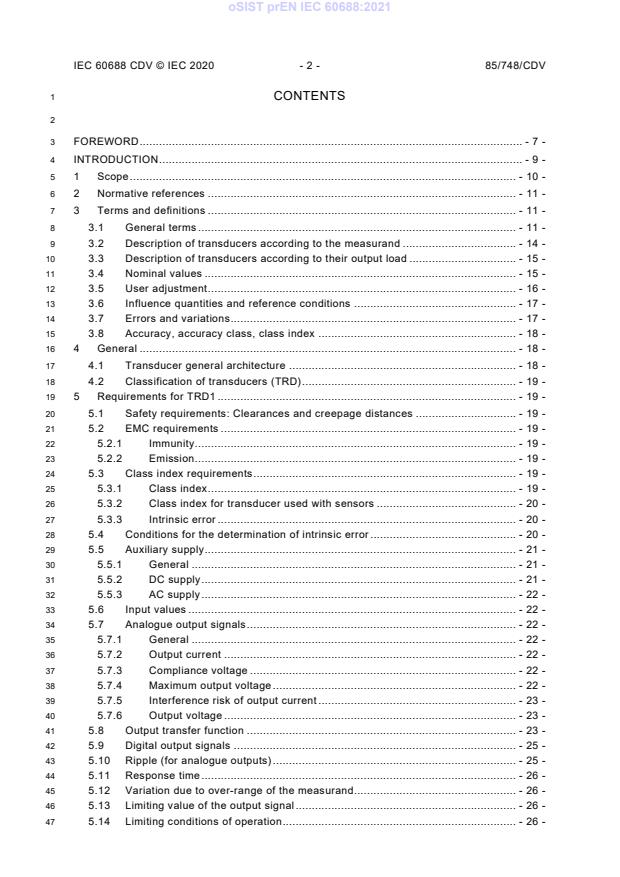
IEC 60688 CDV © IEC 2020 - 2 - 85/748/CDV
1 CONTENTS
3 FOREWORD . - 7 -
4 INTRODUCTION . - 9 -
5 1 Scope . - 10 -
6 2 Normative references . - 11 -
7 3 Terms and definitions . - 11 -
8 3.1 General terms . - 11 -
9 3.2 Description of transducers according to the measurand . - 14 -
10 3.3 Description of transducers according to their output load . - 15 -
11 3.4 Nominal values . - 15 -
12 3.5 User adjustment . - 16 -
13 3.6 Influence quantities and reference conditions . - 17 -
14 3.7 Errors and variations . - 17 -
15 3.8 Accuracy, accuracy class, class index . - 18 -
16 4 General . - 18 -
17 4.1 Transducer general architecture . - 18 -
18 4.2 Classification of transducers (TRD) . - 19 -
19 5 Requirements for TRD1 . - 19 -
20 5.1 Safety requirements: Clearances and creepage distances . - 19 -
21 5.2 EMC requirements . - 19 -
22 5.2.1 Immunity . - 19 -
23 5.2.2 Emission . - 19 -
24 5.3 Class index requirements . - 19 -
25 5.3.1 Class index . - 19 -
26 5.3.2 Class index for transducer used with sensors . - 20 -
27 5.3.3 Intrinsic error . - 20 -
28 5.4 Conditions for the determination of intrinsic error . - 20 -
29 5.5 Auxiliary supply . - 21 -
30 5.5.1 General . - 21 -
31 5.5.2 DC supply . - 21 -
32 5.5.3 AC supply . - 22 -
33 5.6 Input values . - 22 -
34 5.7 Analogue output signals . - 22 -
35 5.7.1 General . - 22 -
36 5.7.2 Output current . - 22 -
37 5.7.3 Compliance voltage . - 22 -
38 5.7.4 Maximum output voltage . - 22 -
39 5.7.5 Interference risk of output current . - 23 -
40 5.7.6 Output voltage . - 23 -
41 5.8 Output transfer function . - 23 -
42 5.9 Digital output signals . - 25 -
43 5.10 Ripple (for analogue outputs) . - 25 -
44 5.11 Response time . - 26 -
45 5.12 Variation due to over-range of the measurand. - 26 -
46 5.13 Limiting value of the output signal . - 26 -
47 5.14 Limiting conditions of operation . - 26 -
IEC 60688 CDV © IEC 2020 - 3 - 85/748/CDV
48 5.15 Limits of the measuring range . - 26 -
49 5.16 Limiting conditions for storage and transport . - 26 -
50 5.17 Sealing . - 26 -
51 5.18 Stability . - 27 -
52 6 Tests for TRD1 . - 27 -
53 6.1 General . - 27 -
54 6.1.1 Determination of variations . - 27 -
55 6.1.2 Environmental conditions . - 27 -
56 6.1.3 Computations . - 27 -
57 6.2 Variations due to auxiliary supply voltage . - 28 -
58 6.2.1 Application. - 28 -
59 6.2.2 Procedure . - 28 -
60 6.2.3 Computation . - 28 -
61 6.2.4 Permissible variations . - 28 -
62 6.3 Variations due to auxiliary supply frequency . - 28 -
63 6.3.1 Application. - 28 -
64 6.3.2 Procedure . - 28 -
65 6.3.3 Computation . - 29 -
66 6.3.4 Permissible variations . - 29 -
67 6.4 Variations due to ambient temperature . - 29 -
68 6.4.1 Application. - 29 -
69 6.4.2 Procedure . - 29 -
70 6.4.3 Computation . - 29 -
71 6.4.4 Permissible variations . - 29 -
72 6.5 Variations due to the frequency of the input quantity(ies) . - 29 -
73 6.5.1 Application. - 29 -
74 6.5.2 Procedure . - 29 -
75 6.5.3 Computation . - 30 -
76 6.5.4 Permissible variations . - 30 -
77 6.6 Variations due to the input voltage . - 30 -
78 6.6.1 Application. - 30 -
79 6.6.2 Procedure . - 30 -
80 6.6.3 Computation . - 30 -
81 6.6.4 Permissible variations . - 30 -
82 6.7 Variations due to the input current . - 30 -
83 6.7.1 Application. - 30 -
84 6.7.2 Procedure . - 30 -
85 6.7.3 Computation . - 31 -
86 6.7.4 Permissible variations . - 31 -
87 6.8 Variations due to power factor . - 31 -
88 6.8.1 Application. - 31 -
89 6.8.2 Procedure . - 31 -
90 6.8.3 Computation . - 31 -
91 6.8.4 Permissible variations . - 31 -
92 6.9 Variation due to output load . - 32 -
93 6.9.1 Application. - 32 -
94 6.9.2 Procedure . - 32 -
95 6.9.3 Computation . - 32 -
96 6.9.4 Permissible variations . - 32 -
IEC 60688 CDV © IEC 2020 - 4 - 85/748/CDV
97 6.10 Variations due to distortion of the input quantity(ies) . - 32 -
98 6.10.1 Application. - 32 -
99 6.10.2 Procedure . - 32 -
100 6.10.3 Computation . - 32 -
101 6.10.4 Permissible variations . - 33 -
102 6.11 Variation due to magnetic field of external origin . - 33 -
103 6.11.1 Application. - 33 -
104 6.11.2 Procedure . - 33 -
105 6.11.3 Computation . - 33 -
106 6.11.4 Permissible variations . - 33 -
107 6.12 Variation due to unbalanced currents . - 33 -
108 6.12.1 Application. - 33 -
109 6.12.2 Procedure . - 33 -
110 6.12.3 Computation . - 34 -
111 6.12.4 Permissible variations . - 34 -
112 6.13 Variation due to interaction between measuring elements . - 34 -
113 6.13.1 Application. - 34 -
114 6.13.2 Procedure . - 34 -
115 6.13.3 Computation . - 34 -
116 6.13.4 Permissible variations . - 34 -
117 6.14 Variation due to self-heating . - 34 -
118 6.14.1 Application. - 34 -
119 6.14.2 Method . - 34 -
120 6.14.3 Computation . - 34 -
121 6.14.4 Permissible variations . - 35 -
122 6.15 Variation due to continuous operation . - 35 -
123 6.15.1 Application. - 35 -
124 6.15.2 Procedure . - 35 -
125 6.15.3 Computation . - 35 -
126 6.15.4 Permissible variation . - 35 -
127 6.16 Variation due to common mode interference . - 35 -
128 6.16.1 Application. - 35 -
129 6.16.2 Procedure . - 35 -
130 6.16.3 Computation . - 35 -
131 6.16.4 Permissible variations . - 35 -
132 6.17 Variation due to series mode interference . - 35 -
133 6.17.1 Application. - 35 -
134 6.17.2 Procedure . - 35 -
135 6.17.3 Computation . - 36 -
136 6.17.4 Permissible variations . - 36 -
137 6.17.5 Permissible excessive inputs . - 36 -
138 6.17.6 Continuous excessive inputs. - 36 -
139 6.17.7 Excessive inputs of short duration . - 36 -
140 6.18 Voltage test, insulation tests and other safety requirements . - 36 -
141 6.19 Impulse voltage tests . - 36 -
142 6.20 High frequency disturbance test . - 37 -
143 6.21 Test for temperature rise . - 37 -
144 6.22 Other tests . - 37 -
145 7 Marking and information for TRD1 . - 37 -
IEC 60688 CDV © IEC 2020 - 5 - 85/748/CDV
146 7.1 Marking on the case . - 37 -
147 7.2 Markings relating to the reference conditions and nominal ranges of use for
148 transducers . - 38 -
149 7.3 Identification of connections and terminals . - 38 -
150 7.4 Information to be given in a separate document . - 39 -
151 Annex A (normative) Requirements for TRD2 . - 40 -
152 Annex B (normative) Interface coding . - 64 -
153 Annex C (Informative) Anti-aliasing requirements. - 71 -
154 Annex D (informative) Requirements for the measurement of harmonics and low
155 frequencies. - 73 -
156 Annex E (normative) Markings terminals of TRD2 . - 75 -
157 Annex F (informative) Guidance related to cables, busbars and bare conductors within
158 an installation . - 77 -
159 Annex G (informative) Guidance related to Overvoltage Categories and Measurement
160 Categories . - 78 -
161 Bibliography . - 81 -
163 Figure 1 – Transducer (TRD) architecture . - 19 -
164 Figure 2 – Transfer function curve A . - 23 -
165 Figure 3 – Transfer function curve B . - 24 -
166 Figure 4 – Transfer function curve C . - 24 -
167 Figure 5 – Transfer function curve D . - 24 -
168 Figure 6 – Transfer function curve E . - 25 -
169 Figure A.1 – Relationship between ambient air temperature and relative humidity . - 44 -
170 Figure A.2 – Accuracy limits of a TRD2-IDC . - 51 -
171 Figure A.3 – Measurement of the step response time . - 57 -
172 Figure A.4 – Temperature cycle accuracy test . - 59 -
173 Figure C.1 – Digital data acquisition system example. - 71 -
174 Figure C.2 – Frequency response mask for metering accuracy class 1 (f = 60 Hz, f =
r s
175 4 800 Hz) . - 72 -
177 Table 1 – Functional classification of Transducers with minimal required functions . - 19 -
178 Table 1 – Relationship between the limits of intrinsic error, expressed as a percentage
179 of the fiducial value, and the class index . - 19 -
180 Table 2 – Pre-conditioning . - 20 -
181 Table 3 – Reference conditions of the influence quantities and tolerances or testing
182 purposes . - 20 -
183 Table 4 – Reference conditions relative to the measurand . - 21 -
184 Table 5 – Usage groups . - 27 -
185 Table 6 – Examples of marking relating to the reference conditions and nominal range
186 of use for temperature . - 38 -
187 Table 7 – Symbols for marking transducers . - 39 -
188 Table A.1 – Rated burden for TRD2 with an AC or DC voltage output, or a frequency
189 output . - 42 -
190 Table A.2 – Rated burden for TRD2 with an AC or DC current output. - 42 -
191 Table A.3 – Rated temperatures for TRD2 . - 43 -
IEC 60688 CDV © IEC 2020 - 6 - 85/748/CDV
192 Table A.4 – Rated humidity classes . - 43 -
193 Table A.5 – Definition of ports . - 47 -
194 Table A.6 – Performance criteria for EMC immunity tests . - 48 -
195 Table A.7 – RJ45 connector pinout . - 49 -
196 Table A.8 – Limits for error and phase error for TRD2-IAC . - 49 -
197 Table A.9 – Limits of ratio error for TRD2-IDC . - 50 -
198 Table A.10 – Limits of ratio error for TRD2-UAC . - 51 -
199 Table A.11 – Limits of ratio error for TRD2-UDC . - 52 -
200 Table A.12 – Burden values for basic accuracy tests . - 55 -
201 Table B.1 – Coding of interface connection . - 64 -
202 Table B.2 –Rated AC RMS voltage output . - 65 -
203 Table B.3 –Rated DC voltage output . - 65 -
204 Table B.4 – Rated range of DC voltage output . - 65 -
205 Table B.5 –Rated AC RMS current output less than 1A . - 65 -
206 Table B.6 –Rated range of DC current output . - 66 -
207 Table B.7 – Rated frequency output . - 66 -
208 Table B.8 – Rated pulse density output . - 66 -
209 Table B.9 – Coding of power supply for transducers supplied from measuring
210 instrument via the connector . - 67 -
211 Table B.10 – Coding of external power supply for transducers . - 67 -
212 Table B.11 – Coding of transfer function curves for transducers . - 67 -
213 Table B.12 – Interface full coding for output of transducers . - 67 -
214 Table B.13 – Examples of interface codes and most common interface codes . - 68 -
215 Table C.1 – Anti-aliasing filter . - 71 -
216 Table D.1 – Limits of error for harmonics - Accuracy classes . - 73 -
217 Table D.2 – Limits of error for harmonics - Accuracy class extensions WB1 and WB2 . - 74 -
218 Table E.1 – Marking of terminals for TRD2 monitoring current . - 75 -
219 Table E.2 – Marking of terminals for TRD2 monitoring voltage . - 76 -
IEC 60688 CDV © IEC 2020 - 7 - 85/748/CDV
221 INTERNATIONAL ELECTROTECHNICAL COMMISSION
222 ____________
224 ELECTRICAL MEASURING TRANSDUCERS FOR CONVERTING AC AND DC
225 ELECTRICAL QUANTITIES TO ANALOGUE OR DIGITAL SIGNALS
227 FOREWORD
228 1) The International Electrotechnical Commission (IEC) is a worldwide organization for standardization comprising
229 all national electrotechnical committees (IEC National Committees). The object of IEC is to promote
230 international co-operation on all questions concerning standardization in the electrical and electronic fields. To
231 this end and in addition to other activities, IEC publishes International Standards, Technical Specifications,
232 Technical Reports, Publicly Available Specifications (PAS) and Guides (hereafter referred to as “IEC
233 Publication(s)”). Their preparation is entrusted to technical committees; any IEC National Committee interested
234 in the subject dealt with may participate in this preparatory work. International, governmental and non-
235 governmental organizations liaising with the IEC also participate in this preparation. IEC collaborates closely
236 with the International Organization for Standardization (ISO) in accordance with conditions determined by
237 agreement between the two organizations.
238 2) The formal decisions or agreements of IEC on technical matters express, as nearly as possible, an international
239 consensus of opinion on the relevant subjects since each technical committee has representation from all
240 interested IEC National Committees.
241 3) IEC Publications have the form of recommendations for international use and are accepted by IEC National
242 Committees in that sense. While all reasonable efforts are made to ensure that the technical content of IEC
243 Publications is accurate, IEC cannot be held responsible for the way in which they are used or for any
244 misinterpretation by any end user.
245 4) In order to promote international uniformity, IEC National Committees undertake to apply IEC Publications
246 transparently to the maximum extent possible in their national and regional publications. Any divergence
247 between any IEC Publication and the corresponding national or regional publication shall be clearly indicated in
248 the latter.
249 5) IEC itself does not provide any attestation of conformity. Independent certification bodies provide conformity
250 assessment services and, in some areas, access to IEC marks of conformity. IEC is not responsible for any
251 services carried out by independent certification bodies.
252 6) All users should ensure that they have the latest edition of this publication.
253 7) No liability shall attach to IEC or its directors, employees, servants or agents including individual experts and
254 members of its technical committees and IEC National Committees for any personal injury, property damage or
255 other damage of any nature whatsoever, whether direct or indirect, or for costs (including legal fees) and
256 expenses arising out of the publication, use of, or reliance upon, this IEC Publication or any other IEC
257 Publications.
258 8) Attention is drawn to the Normative references cited in this publication. Use of the referenced publications is
259 indispensable for the correct application of this publication.
260 9) Attention is drawn to the possibility that some of the elements of this IEC Publication may be the subject of
261 patent rights. IEC shall not be held responsible for identifying any or all such patent rights.
262 International Standard 60688 has been prepared by IEC technical committee 85: Measuring
263 equipment for basic electrical quantities.
264 This fourth edition cancels and replaces the third edition published in 2012. It constitutes a
265 technical revision
266 This edition includes the following significant technical changes with respect to the previous
267 edition:
268 – updating normative references;
269 –
270 – additional requirements for specific transducers used for LV monitoring applications
271 – creation of interface coding to ease selection by the end-user
273 The text of this standard is based on the following documents:
FDIS Report on voting
IEC 60688 CDV © IEC 2020 - 8 - 85/748/CDV
85/XX/FDIS 85/XX/RVD
275 Full information on the voting for the approval of this standard can be found in the report on
276 voting indicated in the above table.
277 This publication has been drafted in accordance with the ISO/IEC Directives, Part 2.
278 In this standard, the following print types are used:
279 − requirements and definitions: in roman type;
280 − NOTES: in smaller roman type;
281 – compliance: in italic type.
282 The committee has decided that the contents of this publication will remain unchanged until
283 the stability date indicated on the IEC web site under "http://webstore.iec.ch" in the data
284 related to the specific publication. At this date, the publication will be
285 • reconfirmed,
286 • withdrawn,
287 • replaced by a revised edition, or
288 • amended.
290 The National Committees are requested to note that for this publication the stability date is
291 2023
292 THIS TEXT IS INCLUDED FOR THE INFORMATION OF THE NATIONAL COMMITTEES AND WILL BE
293 DELETED AT THE PUBLICATION STAGE.
IEC 60688 CDV © IEC 2020 - 9 - 85/748/CDV
296 INTRODUCTION
297 New transducers can now be equipped with microprocessors that utilise digital data
298 processing, communication methods and auxiliary sensors. This makes them more complex
299 than conventional analogue transducers and gives them considerable added value.
300 The class index system of classification used in this standard is based upon the IEC 60051
301 series: Direct acting indicating analogue electrical measuring instruments and their
302 accessories. Under this system, the permitted variations of the output signal due to varying
303 influence quantities – ambient temperature, voltage, frequency, etc., – are implicit in the clas-
304 sification.
305 For those unfamiliar with the class index system, a word of warning is necessary. If, for
306 example, a transducer is classified as Class 1, it does not mean that the error under practical
307 conditions of use will be within ±1 % of the actual value of the output or ±1 % of the full output
308 value. It means that the error should not exceed ±1 % of the fiducial value under closely
309 specified conditions. If the influence quantities are varied between the limits specified by the
310 nominal ranges of use, a variation of amount comparable with the value of the class index
311 may be incurred for each influence quantity.
312 The permissible error of a transducer under working conditions is the sum of the permissible
313 intrinsic error and of the permissible variations due to each of the influence quantities.
314 However, the actual error is likely to be much smaller because not all of the influence
315 quantities are likely to be simultaneously at their most unfavourable values and some of the
316 variations may cancel one another. It is important that these facts be taken into consideration
317 when specifying transducers for a particular purpose.
318 Furthermore, some of the terms used in this standard are different from those used in
319 IEC 60051 due to the fundamental differences between indicating instruments and measuring
320 transducers.
321 All statements of performance are related to the output which is governed by two basic terms:
322 – "the nominal value", which may have a positive or a negative sign or both;
323 – "the span", which is the range of values of the output signal from maximum positive to
324 maximum negative, if appropriate.
IEC 60688 CDV © IEC 2020 - 10 - 85/748/CDV
326 ELECTRICAL MEASURING TRANSDUCERS FOR CONVERTING AC AND DC
327 ELECTRICAL QUANTITIES TO ANALOGUE OR DIGITAL SIGNALS
331 1 Scope
332 This International Standard applies to transducers with electrical inputs and outputs for
333 making measurements of AC or DC electrical quantities. The output signal may be in the form
334 of an analogue direct current, an analog direct voltage or in digital form. In this case, that part
335 of the transducer utilized for communication purposes will need to be compatible with the
336 external system.
337 This standard applies to measuring transducers used for converting following electrical
338 quantities such as:
339 – current,
340 – voltage,
341 – active power,
342 – reactive power,
343 – power factor,
344 – phase angle,
345 – frequency,
346 – harmonics or total harmonic distortion,
347 – apparent power
348 to an output signal.
349 This standard is not applicable for:
350 – instrument transformers that complies with IEC 61869 series;
351 – transmitters for use in industrial process application that complies with IEC 60770 series.;
352 – performance measuring and monitoring devices (PMD) that comply with IEC 61557-12.
353 Within the measuring range, the output signal is a function of the measurand. An auxiliary
354 supply may be needed.
355 This standard applies:
356 a) if the nominal frequency of the input(s) lies between 0 Hz and 1 500 Hz;
357 b) if a measuring transducer is part of a system for the measurement of a non-electrical
358 quantity, this standard may be applied to the electrical measuring transducer, if it
359 otherwise falls within the scope of this standard;
360 c) to transducers for use in a variety of applications such as telemetry and process control
361 and in one of a number of defined environments.
362 This International Standard is intended:
363 – to specify the terminology and definitions relating to transducers whose main application is
364 in industry;
365 – to unify the test methods used in evaluating transducer performance;
366 – to specify accuracy limits and output values for transducers.
IEC 60688 CDV © IEC 2020 - 11 - 85/748/CDV
367 2 Normative references
368 The following referenced documents are indispensable for the application of this document.
369 For dated references, only the edition cited applies. For undated references, the latest edition
370 of the referenced document (including any amendments) applies.
371 IEC 60051-1:1997, Direct acting indicating analogue electrical measuring instruments and
372 their accessories – Part 1: Definitions and general requirements common to all parts
373 IEC 60068-2-6, Environmental testing – Part 2-6: Tests – Test Fc: Vibration (sinusoidal)
374 IEC 60068-2-27, Environmental testing – Part 2-27: Tests – Test Ea and guidance: Shock
375 IEC 60255-151, Measuring relays and protection equipment – Part 151: Functional
376 requirements for over/under current protection
377 IEC 61010 (all parts), Safety requirements for electrical equipment for measurement, control
378 and laboratory use
379 IEC 61010-1:2010, Safety requirements for electrical equipment for measurement, control and
380 laboratory use – Part 1: General requirements
381 IEC 61010-1:2010/AMD1:2016
382 IEC 61010-2-030:2017, Safety requirements for electrical equipment for measurement,
383 control, and laboratory use – Part 30 Special requirements for testing and measuring circuits
384 IEC 61326-1:2020, Electrical equipment for measurement, control and laboratory use – EMC
385 requirements – Part 1: General requirements
386 IEC 61557-12, Electrical safety in low voltage distribution systems up to 1 000 V AC and 1
387 500 V DC. – Equipment for testing, measuring or monitoring of protective measures – Part 12:
388 Performance measuring and monitoring devices (PMD)
389 3 Terms and definitions
390 For the purpose of this document the following terms and definitions apply:
391 3.1 General terms
392 3.1.1
393 (electrical measuring) transducer
394 TRD
395 device for converting an AC or DC measurand to a direct or alternative current, a direct or
396 alternative voltage or a digital signal for measurement purposes
397 3.1.2
398 (electrical measuring) transducer type 1
399 TRD1
400 conventional transducer
401 NOTE – Transducers type 1 are using conventional interface outputs and are generally single-function devices
402 3.1.3
403 (electrical measuring) transducer type 2
404 TRD2
405 single-function transducer used in LV monitoring applications
406 NOTE – Transducers type 2 are using specific interface outputs and are generally more accurate
407 3.1.4
408 single-function device
409 device performing the measurement of a single electrical quantity (e.g. current, power factor,
410 THD, …) in a single form (e.g. RMS or peak or average, …) but not both
IEC 60688 CDV © IEC 2020 - 12 - 85/748/CDV
411 3.1.5
412 analogue transducer
413 device for converting an AC or DC. measurand to a direct or alternative current, a direct or
414 alternative voltage for measurement purposes
415 3.1.6
416 digital transducer
417 device for converting an AC or DC. measurand to a digital signal for measurement purposes
418 3.1.7
419 auxiliary supply
420 AC or DC electrical supply, other than the measurand, which is necessary for the correct
421 operation of the transducer
422 3.1.8
423 auxiliary circuit
424 circuit which is usually energized by the auxiliary supply.
425 NOTE The auxiliary circuit is sometimes energized by one of the input quantities.
426 3.1.9
427 transducer with offset zero (live zero)
428 transducer that gives a predetermined output signal other than zero when the measurand is
429 zero
430 3.1.10
431 transducer with suppressed zero
432 transducer for which zero output signal corresponds to a measurand greater than zero
433 3.1.11
434 total distortion factor
435 ratio of the r.m.s. value of the total distortion content to the the r.m.s. value of an alternating quantity
436 NOTE – The total distortion factor depends on the choice of the fundamental component. If it is not clear from the
437 context which one is used an indication should be given.
438 3.1.12
439 output load (for analogue signals only)
440 total resistance of the circuits and apparatus connected externally across the output terminals
441 of the transducer
442 3.1.13
443 ripple content (of an analogue output signal)
444 with steady-state input conditions, the ratio of the peak-to-peak value of the fluctuating
445 component of an analogue output signal, expressed in percentage, to the fiducial value
446 3.1.14
447 output signal
448 an analogue or digital representation of the measurand
449 3.1.15
450 output power
451 power at the transducer output terminals
452 3.1.16
453 output current (voltage) (for analogue signals only)
454 current (voltage) produced by the transducer which is an analogue function of th
...