

prEN IEC 62909-3:2023
(Main)Bi-directional grid connected power converters - Part 3: EMC requirements and test methods
General Information
- Abstract
- Status
- Not Published
- Publication Date
- 23-Sep-2024
- Technical Committee
- CLC/TC 22X - Power electronics
- Drafting Committee
- IEC/SC 22E - IEC_SC_22E
- Current Stage
- 4098 - Decision to drop project - Standstill maintained / released - Enquiry
- Start Date
- 15-Oct-2025
- Completion Date
- 25-Aug-2026

Overview
prEN IEC 62909-3:2023 defines the electromagnetic compatibility (EMC) requirements and test methods for bi-directional grid-connected power converters (GCPCs), as specified by the CLC and IEC. GCPCs are critical in modern energy systems, enabling efficient two-way power flow between the AC grid and multiple DC sources or storage devices, such as batteries or other energy resources. Ensuring EMC compliance minimizes the risks of interference with other electrical equipment and contributes to safe, reliable operation in both residential and non-residential environments.
This part of the standard builds upon the general requirements (IEC 62909-1) and interface-specific requirements for distributed energy resources (IEC 62909-2), providing detailed guidance for EMC testing, immunity, and emission standards specifically tailored to GCPC installations.
Key Topics
Scope and Applicability:
- Applies to GCPCs with two or more DC ports, with system voltages up to 1,000 V AC or 1,500 V DC.
- May also cover special cases with only one DC port where no other product standard is available.
- Excludes uninterruptible power supplies (UPS), power converters for photovoltaic systems as covered by IEC 62920, and battery charging systems for electric vehicles (EVs) under IEC 61851-21-2.
EMC Immunity Requirements:
- Specifies immunity against common disturbances such as electrostatic discharge (ESD), radiated and conducted radio-frequency fields, voltage dips and interruptions, surges, harmonics, and electrical fast transients.
- Includes test methods and minimum performance criteria based on established IEC and CISPR standards.
EMC Emission Requirements:
- Sets limits for conducted and radiated emissions, ensuring that GCPCs do not exceed specified disturbance levels on various ports (AC, DC, signal/control, enclosure).
- Covers both low-frequency (conducted) and high-frequency (radiated) emissions.
Test Setups and Conditions:
- Recommends standard test configurations and operational states that reflect real-world GCPC use.
- Addresses setups for both emission and immunity tests across equipment ports and in various installation environments.
Classification of GCPCs:
- Introduces classes and provides guidance for determining applicable requirements based on installation type and connected equipment.
Applications
prEN IEC 62909-3:2023 is vital for manufacturers, system integrators, and certification bodies working with:
- Residential and Commercial Energy Storage:
GCPCs facilitate optimal integration of renewable generation (like solar PV) and energy storage systems, ensuring grid stability and efficient energy use. - Smart Grids and Distributed Energy Resources:
The EMC requirements ensure reliable operation in environments with multiple, networked energy resources. - Electric Vehicle Infrastructure:
While EV-specific converters are excluded, the standard supports compatibility in installations with multi-port converters that may interface indirectly with EV infrastructure. - Industrial and Light-Industrial Power Systems:
Provides necessary guidance for robust installation and operation in challenging electromagnetic environments.
Adhering to these EMC requirements is essential for complying with regulatory frameworks, minimizing disruption risks, and ensuring user safety.
Related Standards
Key standards referenced and related to prEN IEC 62909-3:2023 include:
- IEC 62909-1: General requirements for GCPCs.
- IEC 62909-2: Requirements for interface of GCPC and distributed energy resources.
- IEC 61000 Series:
- 61000-2-2, 61000-2-4: EMC environment and compatibility levels.
- 61000-3-X: Limits for harmonic current emissions and voltage fluctuations.
- 61000-4-X: EMC testing and measurement techniques (ESD, surges, voltage dips, etc.).
- IEC 61800-3: EMC requirements and test methods specific to adjustable speed drive systems.
- IEC 62920: EMC requirements for power conversion equipment in photovoltaic systems.
- CISPR 11, CISPR 32: Limits and methods for measuring radio-frequency disturbance.
In summary, prEN IEC 62909-3:2023 provides clear criteria for EMC compliance of bi-directional grid-connected power converters, supporting the safe and efficient rollout of modern, interconnected power systems in line with international best practices.
Get Certified
Connect with accredited certification bodies for this standard

IMQ S.p.A. (Certification)
Italian electrical product certification.

SLG Prüf- und Zertifizierungs GmbH
German testing and certification body.

UL Solutions
Global safety science company with testing, inspection and certification.
Sponsored listings
Frequently Asked Questions
prEN IEC 62909-3:2023 is a draft published by CLC. Its full title is "Bi-directional grid connected power converters - Part 3: EMC requirements and test methods". This standard covers: Bi-directional grid connected power converters - Part 3: EMC requirements and test methods
Bi-directional grid connected power converters - Part 3: EMC requirements and test methods
prEN IEC 62909-3:2023 is classified under the following ICS (International Classification for Standards) categories: 29.200 - Rectifiers. Convertors. Stabilized power supply; 33.100.01 - Electromagnetic compatibility in general. The ICS classification helps identify the subject area and facilitates finding related standards.
prEN IEC 62909-3:2023 is available in PDF format for immediate download after purchase. The document can be added to your cart and obtained through the secure checkout process. Digital delivery ensures instant access to the complete standard document.
Standards Content (Sample)
SLOVENSKI STANDARD
01-maj-2023
Dvosmerni omrežni elektroenergetski pretvorniki - 3. del: Zahteve EMC in
preskusne metode
Bi-directional grid connected power converters - Part 3: EMC requirements and test
methods
Convertisseurs de puissance connectés aux réseaux bidirectionnels - Partie 3:
Exigences CEM et méthodes d’essai
Ta slovenski standard je istoveten z: prEN IEC 62909-3:2023
ICS:
29.200 Usmerniki. Pretvorniki. Rectifiers. Convertors.
Stabilizirano električno Stabilized power supply
napajanje
33.100.01 Elektromagnetna združljivost Electromagnetic compatibility
na splošno in general
2003-01.Slovenski inštitut za standardizacijo. Razmnoževanje celote ali delov tega standarda ni dovoljeno.
22E/247/CDV
COMMITTEE DRAFT FOR VOTE (CDV)
PROJECT NUMBER:
IEC 62909-3 ED1
DATE OF CIRCULATION: CLOSING DATE FOR VOTING:
2023-03-03 2023-05-26
SUPERSEDES DOCUMENTS:
22E/229/CD, 22E/246/CC
IEC SC 22E : STABILIZED POWER SUPPLIES
SECRETARIAT: SECRETARY:
Germany Mr Clemens Klemm
OF INTEREST TO THE FOLLOWING COMMITTEES: PROPOSED HORIZONTAL STANDARD:
TC 64,TC 69,TC 77,TC 82,TC 120,CIS/B
Other TC/SCs are requested to indicate their interest,
if any, in this CDV to the secretary.
FUNCTIONS CONCERNED:
EMC ENVIRONMENT QUALITY ASSURANCE SAFETY
SUBMITTED FOR CENELEC PARALLEL VOTING NOT SUBMITTED FOR CENELEC PARALLEL VOTING
Attention IEC-CENELEC parallel voting
The attention of IEC National Committees, members of
CENELEC, is drawn to the fact that this Committee
Draft for Vote (CDV) is submitted for parallel voting.
The CENELEC members are invited to vote through the
CENELEC online voting system.
This document is still under study and subject to change. It should not be used for reference purposes.
Recipients of this document are invited to submit, with their comments, notification of
• any relevant patent rights of which they are aware and to provide supporting documentation,
• any relevant “in some countries” clauses to be included should this proposal proceed. Recipients are
reminded that the enquiry stage is the final stage for submitting "in some countries" clauses. See
AC/22/2007.
TITLE:
Bi-directional grid connected power converters - Part 3: EMC requirements and test methods
PROPOSED STABILITY DATE: 2026
NOTE FROM TC/SC OFFICERS:
download this electronic file, to make a copy and to print out the content for the sole purpose of preparing
National Committee positions. You may not copy or "mirror" the file or printed version of the document, or any
part of it, for any other purpose without permission in writing from IEC.
IEC CDV 62909-3 © IEC 2023 – 2 – 22E/247/CDV
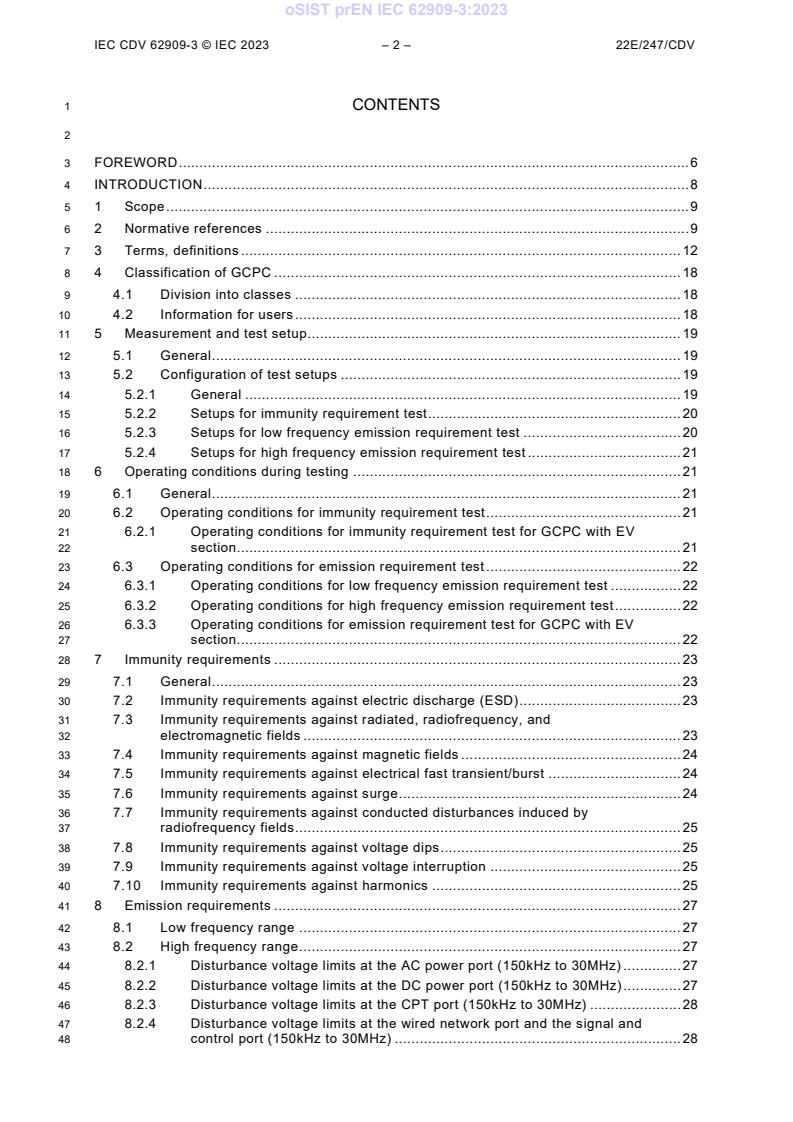
1 CONTENTS
3 FOREWORD . 6
4 INTRODUCTION . 8
5 1 Scope . 9
6 2 Normative references . 9
7 3 Terms, definitions . 12
8 4 Classification of GCPC . 18
9 4.1 Division into classes . 18
10 4.2 Information for users . 18
11 5 Measurement and test setup . 19
12 5.1 General . 19
13 5.2 Configuration of test setups . 19
14 5.2.1 General . 19
15 5.2.2 Setups for immunity requirement test . 20
16 5.2.3 Setups for low frequency emission requirement test . 20
17 5.2.4 Setups for high frequency emission requirement test . 21
18 6 Operating conditions during testing . 21
19 6.1 General . 21
20 6.2 Operating conditions for immunity requirement test . 21
21 6.2.1 Operating conditions for immunity requirement test for GCPC with EV
22 section . 21
23 6.3 Operating conditions for emission requirement test . 22
24 6.3.1 Operating conditions for low frequency emission requirement test . 22
25 6.3.2 Operating conditions for high frequency emission requirement test . 22
26 6.3.3 Operating conditions for emission requirement test for GCPC with EV
27 section . 22
28 7 Immunity requirements . 23
29 7.1 General . 23
30 7.2 Immunity requirements against electric discharge (ESD) . 23
31 7.3 Immunity requirements against radiated, radiofrequency, and
32 electromagnetic fields . 23
33 7.4 Immunity requirements against magnetic fields . 24
34 7.5 Immunity requirements against electrical fast transient/burst . 24
35 7.6 Immunity requirements against surge . 24
36 7.7 Immunity requirements against conducted disturbances induced by
37 radiofrequency fields . 25
38 7.8 Immunity requirements against voltage dips . 25
39 7.9 Immunity requirements against voltage interruption . 25
40 7.10 Immunity requirements against harmonics . 25
41 8 Emission requirements . 27
42 8.1 Low frequency range . 27
43 8.2 High frequency range . 27
44 8.2.1 Disturbance voltage limits at the AC power port (150kHz to 30MHz) . 27
45 8.2.2 Disturbance voltage limits at the DC power port (150kHz to 30MHz) . 27
46 8.2.3 Disturbance voltage limits at the CPT port (150kHz to 30MHz) . 28
47 8.2.4 Disturbance voltage limits at the wired network port and the signal and
48 control port (150kHz to 30MHz) . 28
IEC CDV 62909-3 © IEC 2023 – 3 – 22E/247/CDV
49 8.2.5 Radiated emission limits at Enclosure port (above 30 MHz) . 28
50 9 Test results and test report . 29
51 Annex A (informative) Examples of GCPC . 30
52 A.1 General . 30
53 A.2 Examples of GCPC within the scope of IEC62909-3 . 30
54 A.3 Examples of GCPC where other standards apply . 32
55 Annex B (informative) Overview of Requirements . 33
56 B.1 General . 33
57 B.2 Immunity requirements . 33
58 B.3 Conducted emission requirements . 33
59 B.4 Radiated emission requirements . 34
60 Annex C (informative) Immunity requirements comparison between the referenced
61 standards . 35
62 Annex D (informative) Emission limits requirements of the referenced standards . 41
63 D.1 General . 41
64 D.2 Limits for harmonic current emissions (equipment input current ≤16 A per
65 phase) . 41
66 D.3 Limitation of voltage changes, voltage fluctuations and flicker in public low-
67 voltage supply systems, for equipment with rated current ≤ 16 A per phase
68 and not subject to conditional connection . 43
69 D.4 Limitation of voltage changes, voltage fluctuations and flicker in public low-
70 voltage supply systems – Equipment with rated current ≤75 A and subject to
71 conditional connection . 43
72 D.5 Limits for conducted disturbances . 43
73 D.6 CPT port (150 kHz to 30 MHz) . 46
74 D.7 Disturbance voltage limits at the wired network port and the signal and
75 control port (150kHz to 30MHz) . 46
76 D.8 Radiated emission limits at Enclosure port (above 30 MHz) . 47
77 D.8.1 GCPC with the EV section . 47
78 D.8.2 GCPC without the EV section . 49
79 Bibliography . 51
81 Figure 1 – Example of ports . 14
82 Figure 2 – Examples of installation of GCPC . 18
83 Figure A.1 – Multiport GCPC with Battery, PV and CPT ports . 30
84 Figure A.2 – Multiport GCPC with Battery and CPT ports . 30
85 Figure A.3 – Multiport GCPC with multiple CPT ports . 31
86 Figure A.4 – Multiport GCPC with Battery and CPT ports which is a product system
87 variant of the GCPC in Figure A.2 but cannot connect to EV . 31
88 Figure A.5 – Multiport GCPC with Battery and CPT ports which is a product system
89 variant of the GCPC in Figure A.2 but cannot connect to EV and without DC/DC
90 converter for EV . 31
91 Figure A.6 – Equipment in scope of IEC62920: Multiport GCPC with PV and battery
92 ports . 32
93 Figure A.7 – Equipment in scope of IEC 61851-21-2: GCPC with a CPT port . 32
94 Figure B.1 – Overview on port related immunity requirements . 33
95 Figure B.2 – Overview on port related conducted emission . 33
96 Figure B.3 – Overview on radiated emission . 34
IEC CDV 62909-3 © IEC 2023 – 4 – 22E/247/CDV
98 Table 1 – Alphabetical list of terms . 12
99 Table 2 – Immunity requirements against electrostatic discharge (ESD) . 23
100 Table 3 – Immunity requirements against radiated, radiofrequency, and
101 electromagnetic fields . 23
102 Table 4 – Immunity requirements against magnetic fields . 24
103 Table 5 – Immunity requirements against electrical fast transient/burst . 24
104 Table 6 – Immunity requirements against surge . 24
105 Table 7 – Immunity requirements against conducted disturbances induced by
106 radiofrequency fields. 25
107 Table 8 – Immunity requirements against voltage dips . 25
108 Table 9 – Immunity requirements against voltage interruption . 25
109 Table 10 – Immunity requirements against harmonics . 26
110 Table 11 – References for evaluation of low frequency (LF) phenomena . 27
111 Table 12 –Disturbance voltage limits equipment for AC power input port. . 27
112 Table 13 – Disturbance voltage limits equipment for DC power port. . 27
113 Table 14 – Disturbance voltage limits equipment for CPT port. . 28
114 Table 15 – Disturbance voltage limits equipment for the wired network port and the
115 signal and control port. . 28
116 Table 16 – Requirements for radiated emissions . 28
117 Table C.1 – Comparison of immunity requirements for enclosure port on the GCPC of
118 Class B . 35
119 Table C.2 – Comparison of immunity requirements for AC power port on the GCPC of
120 Class B . 35
121 Table C.3 – Comparison of immunity requirements for DC power port and CPT port on
122 the GCPC of Class B . 36
123 Table C.4 – Comparison of immunity requirements for signal and control (wired
124 network) port on the GCPC of Class B . 37
125 Table C.5 – Comparison of immunity requirements for enclosure port on the GCPC of
126 Class A . 37
127 Table C.6 – Comparison of immunity requirements for AC power port on the GCPC of
128 Class A . 38
129 Table C.7 – Comparison of immunity requirements for DC power port and CPT port on
130 the GCPC of Class A . 39
131 Table C.8 – Comparison of immunity requirements for signal and control (wired
132 network) port on the GCPC of Class A . 39
133 Table C.9 –Minimum immunity requirements for total harmonic distortion on power
134 ports of low voltage . 40
135 Table D.1 – Class A equipment as defined by IEC 61000-2-2 . 41
136 Table D.2 – Current emission limits for equipment other than balanced three-phase
137 equipment . 41
138 Table D.3 – Current emission limits for balanced three-phase equipment. 42
139 Table D.4 – Current emission limits for balanced three-phase equipment under
140 specified conditions (a, b, c) . 42
141 Table D.5 – Current emission limits for balanced three-phase equipment under
142 specified conditions (d, e, f) . 43
143 Table D.6 – Disturbance voltage limits for Class A group 1 equipment measured on a
144 test site (a.c. mains power port) . 43
145 Table D.7 – Limits for conducted disturbances of Class A group 1 equipment measured
146 on a test site (d.c. power port) . 44
IEC CDV 62909-3 © IEC 2023 – 5 – 22E/247/CDV
147 Table D.8 – Disturbance voltage limits for Class B group 1 equipment measured on a
148 test site (a.c. mains power port) . 45
149 Table D.9 – Disturbance voltage limits for Class B group 1 equipment measured on a
150 test site (d.c. power port) . 45
151 Table D.10 – Applicability of measurements at d.c. power ports . 45
152 Table D.11 – Disturbance voltage limits for Class A equipment for AC CPT port . 46
153 Table D.12 – Disturbance voltage limits for Class B equipment for AC CPT port . 46
154 Table D.13 – Disturbance voltage limits for DC CPT port . 46
155 Table D.14 – Limits of conducted common mode (asymmetric mode) disturbance at the
156 wired port for Class A GCPC. 46
157 Table D.15 – Limits of conducted common mode (asymmetric mode) disturbance at the
158 wired port for Class B GCPC. 47
159 Table D.16 – Required highest frequency for radiated measurement. 47
160 Table D.17 – Requirements for radiated emissions at frequencies up to 1 GHz for
161 Class A GCPC with the EV section . 47
162 Table D.18 – Requirements for radiated emissions at frequencies above 1 GHz for
163 Class A GCPC with the EV section . 48
164 Table D.19 – Requirements for radiated emissions at frequencies up to 1 GHz for
165 Class B GCPC with the EV section . 48
166 Table D.20 – Requirements for radiated emissions at frequencies above 1 GHz for
167 Class B GCPC with the EV section . 48
168 Table D.21 – Electromagnetic radiation disturbance limits for Class A GCPC without
169 the EV section measured on a test site . 49
170 Table D.22 – Electromagnetic radiation disturbance limits for Class B GCPC without
171 the EV section measured on a test site . 50
IEC CDV 62909-3 © IEC 2023 – 6 – 22E/247/CDV
175 INTERNATIONAL ELECTROTECHNICAL COMMISSION
176 ____________
178 BI-DIRECTIONAL GRID CONNECTED POWER CONVERTERS –
180 Part 3: EMC requirements and test methods
183 FOREWORD
184 1) The International Electrotechnical Commission (IEC) is a worldwide organization for standardization comprising
185 all national electrotechnical committees (IEC National Committees). The object of IEC is to promote international
186 co-operation on all questions concerning standardization in the electrical and electronic fields. To this end and
187 in addition to other activities, IEC publishes International Standards, Technical Specifications, Technical Reports,
188 Publicly Available Specifications (PAS) and Guides (hereafter referred to as “IEC Publication(s)”). Their
189 preparation is entrusted to technical committees; any IEC National Committee interested in the subject dealt with
190 may participate in this preparatory work. International, governmental and non-governmental organizations liaising
191 with the IEC also participate in this preparation. IEC collaborates closely with the International Organization for
192 Standardization (ISO) in accordance with conditions determined by agreement between the two organizations.
193 2) The formal decisions or agreements of IEC on technical matters express, as nearly as possible, an international
194 consensus of opinion on the relevant subjects since each technical committee has representation from all
195 interested IEC National Committees.
196 3) IEC Publications have the form of recommendations for international use and are accepted by IEC National
197 Committees in that sense. While all reasonable efforts are made to ensure that the technical content of IEC
198 Publications is accurate, IEC cannot be held responsible for the way in which they are used or for any
199 misinterpretation by any end user.
200 4) In order to promote international uniformity, IEC National Committees undertake to apply IEC Publications
201 transparently to the maximum extent possible in their national and regional publications. Any divergence between
202 any IEC Publication and the corresponding national or regional publication shall be clearly indicated in the latter.
203 5) IEC itself does not provide any attestation of conformity. Independent certification bodies provide conformity
204 assessment services and, in some areas, access to IEC marks of conformity. IEC is not responsible for any
205 services carried out by independent certification bodies.
206 6) All users should ensure that they have the latest edition of this publication.
207 7) No liability shall attach to IEC or its directors, employees, servants or agents including individual experts and
208 members of its technical committees and IEC National Committees for any personal injury, property damage or
209 other damage of any nature whatsoever, whether direct or indirect, or for costs (including legal fees) and
210 expenses arising out of the publication, use of, or reliance upon, this IEC Publication or any other IEC
211 Publications.
212 8) Attention is drawn to the Normative references cited in this publication. Use of the referenced publications is
213 indispensable for the correct application of this publication.
214 9) Attention is drawn to the possibility that some of the elements of this IEC Publication may be the subject of patent
215 rights. IEC shall not be held responsible for identifying any or all such patent rights.
216 International Standard IEC 62909-3 has been prepared by subcommittee 22E: Stabilized power
217 supplies, of IEC technical committee 22: Power electronic systems and equipment.
218 The text of this International Standard is based on the following documents:
FDIS Report on voting
22E/XX/FDIS 22E/XX/RVD
219 Full information on the voting for the approval of this International Standard can be found in the
220 report on voting indicated in the above table.
221 Editors note The description above must be adequately modified.
222 This document has been drafted in accordance with the ISO/IEC Directives, Part 2.
223 The committee has decided that the contents of this document will remain unchanged until the
224 stability date indicated on the IEC website under "http://webstore.iec.ch" in the data related to
225 the specific document. At this date, the document will be
IEC CDV 62909-3 © IEC 2023 – 7 – 22E/247/CDV
226 • reconfirmed,
227 • withdrawn,
228 • replaced by a revised edition, or
229 • amended.
231 The National Committees are requested to note that for this document the stability date
232 is 20XX.
233 THIS TEXT IS INCLUDED FOR THE INFORMATION OF THE NATIONAL COMMITTEES AND WILL BE DELETED
234 AT THE PUBLICATION STAGE.
IEC CDV 62909-3 © IEC 2023 – 8 – 22E/247/CDV
236 INTRODUCTION
237 In order to optimize power consumption, for example, within the home power management, it is
238 necessary to optimally combine electricity generation with rechargeable energy storage. This
239 optimization is accomplished, in part, by providing an efficient transfer between DC and AC
240 electricity to accommodate storage batteries. IEC 62909 standards describe a bidirectional grid-
241 connected power converter (GCPC) efficiently connected for example to sources of power
242 generation and energy storage.
243 IEC 62909-1 defines common general requirements, independent from the special
244 characteristics of individual applications. IEC 62909-2 defines the additional requirements
245 necessary for interfacing particular types of distributed energy resources to a GCPC. IEC
246 62909-3 presents the EMC requirements for GCPC.
247 GCPCs can be connected to multiple kinds of distributed energy resources. While there are
248 EMC requirements for power electronic converters for single distributed energy resources, for
249 example solar systems or battery storage systems, those requirements are in some cases
250 different from each other. Hence, it is necessary to clarify which requirements should be applied
251 to the various types of GCPCs.
IEC CDV 62909-3 © IEC 2023 – 9 – 22E/247/CDV
253 BI-DIRECTIONAL GRID CONNECTED POWER CONVERTERS –
255 Part 3: EMC requirements and test methods
259 1 Scope
260 This part of IEC 62909 specifies electromagnetic immunity and emission requirements of bi-
261 directional grid-connected power converters (GCPCs) consiting of a grid-side inverter with two
262 or more DC ports on the application side with system voltages not exceeding 1 000 V AC or 1
263 500 V DC.
265 This document may also be used for special cases of GCPCs with only one DC port, where:
266 - GCPC with multiple physical DC ports is used in an application requiring only one DC port, or
267 - no dedicated product standard for such a single DC port GCPC is available.
269 This document considers GCPCs in both residential and non-residential environments.
271 This document does not cover:
272 - uninterruptible power supply (UPS) systems, which fall under the scope of IEC 62040 (all parts).
273 - power conversion equipment covered by IEC 62920, i.e. GCPCs for use in photovoltaic power
274 systems with or without DC-coupled electrical energy storage devices
275 - power converters to charge batteries within electric vehicles (EVs) which fall under the scope of
276 IEC 61851-21-2
278 NOTE 1 Annex A provides examples of GCPCs covered and not covered by this document.
279 NOTE 2 The Power Converter Subsystem (PCSS) for use in Electrical Energy Storage Systems (EESS) will be
280 referenced in a future publication of IEC 63285. In that case, that PCSS will be added to the bulleted items above.
281 2 Normative references
282 The following documents are referred to in the text in such a way that some or all of their content
283 constitutes requirements of this document. For dated references, only the edition cited applies.
284 For undated references, the latest edition of the referenced document (including any
285 amendments) applies.
286 IEC 61000-2-2:2002+AMD1:2017+AMD2:2018, Electromagnetic compatibility (EMC) -
287 Environment - Compatibility levels for low-frequency conducted disturbances and signalling in
288 public low-voltage power supply systems
289 IEC 61000-2-4:2002, Electromagnetic compatibility (EMC) - Environment - Compatibility levels
290 for low-frequency conducted disturbances and signalling in public low-voltage power supply
291 systems
292 IEC 61000-3-2:2020, Electromagnetic compatibility (EMC) – Part 3-2: Limits – Limits for
293 harmonic current emissions (equipment with input current ≤ 16 A per phase)
294 IEC 61000-3-3:2021, Electromagnetic compatibility (EMC) – Part 3-3: Limits – Limitation of
295 voltage changes, voltage fluctuations and flicker in public low-voltage supply systems, of
296 equipment with rated current ≤ 16 A per phase and not subject to conditional connection
297 IEC TR 61000-3-6:2008, Electromagnetic compatibility (EMC) – Part 3-6: Limits – Assessment
298 of emission limits for the connection of distorting installations to MV, HV and EHV power
299 systems
IEC CDV 62909-3 © IEC 2023 – 10 – 22E/247/CDV
300 IEC 61000-3-11:2017, Electromagnetic compatibility (EMC) - Part 3-11: Limits - Limitation of
301 voltage changes, voltage fluctuations and flicker in public low-voltage supply systems -
302 Equipment with rated current ≤ 75 A and subject to conditional connection
303 IEC 61000-3-12:2021, Electromagnetic compatibility (EMC) - Part 3-12: Limits - Limits for
304 harmonic currents produced by equipment connected to public low-voltage systems with input
305 current >16 A and ≤ 75 A per phase
306 IEC 61000-4-2:2008, Electromagnetic compatibility (EMC) – Part 4-2: Testing and
307 measurement techniques – Electrostatic discharge immunity test
308 IEC 61000-4-3:2020, Electromagnetic compatibility (EMC) – Part 4-3: Testing and
309 measurement techniques – Radiated, radio-frequency, electromagnetic field immunity test
310 IEC 61000-4-4:2012, Electromagnetic compatibility (EMC) – Part 4-4: Testing and
311 measurement techniques – Electrical fast transient/burst immunity test
312 IEC 61000-4-5:2017, Electromagnetic compatibility (EMC) – Part 4-5: Testing and
313 measurement techniques – Surge immunity test
314 IEC 61000-4-6:2013, Electromagnetic compatibility (EMC) – Part 4-6: Testing and
315 measurement techniques – Immunity to conducted disturbances, induced by radio-frequency
316 fields
317 IEC 61000-4-7:2009, Electromagnetic compatibility (EMC) – Part 4-7: Testing and
318 measurement techniques – General guide on harmonics and interharmonics measurements and
319 instrumentation, for power supply systems and equipment connected thereto
320 IEC 61000-4-11:2020, Electromagnetic compatibility (EMC) – Part 4-11: Testing and
321 measurement techniques – Voltage dips, short interruptions and voltage variations immunity
322 tests
323 IEC 61000-4-34:2009, Electromagnetic compatibility (EMC) – Part 4-34: Testing and
324 measurement techniques – Voltage dips, short interruptions and voltage variations immunity
325 tests for equipment with input current more than 16 A per phase
326 IEC 61000-6-1:2016, Electromagnetic compatibility (EMC) - Part 6-1: Generic standards -
327 Immunity standard for residential, commercial and light-industrial environments
328 IEC 61000-6-2:2016, Electromagnetic compatibility (EMC) - Part 6-2: Generic standards -
329 Immunity standard for industrial environments
330 IEC 61800-3:2017, Adjustable speed electrical power drive systems - Part 3: EMC requirements
331 and specific test methods
332 IEC 61851-21-2:2018, Electric vehicle conductive charging system - Part 21-2: Electric vehicle
333 requirements for conductive connection to an AC/DC supply – EMC requirements for off board
334 electric vehicle charging systems
335 IEC 62909-1:2017, BI-DIRECTIONAL GRID CONNECTED POWER CONVERTERS – Part 1:
336 General requirements
337 IEC 62909-2:2019, BI-DIRECTIONAL GRID CONNECTED POWER CONVERTERS – Part 2:
338 Interface of GCPC and distributed energy resources
339 IEC 62920:2021, Photovoltaic power generating systems – EMC requirements and test methods
340 for power conversion equipment
341 IEC/TR 61000-3-14, Electromagnetic compatibility (EMC) – Part 3-14: Assessment of emission
342 limits for harmonics, interharmonics, voltage fluctuations and unbalance for the connection of
343 disturbing installations to LV power systems
344 CISPR 11:2019, Industrial, scientific and medical equipment - Radio-frequency disturbance
345 characteristics - Limits and methods of measurement
IEC CDV 62909-3 © IEC 2023 – 11 – 22E/247/CDV
346 CISPR 16-1-2:2017, Specification for radio disturbance and immunity measuring apparatus and
347 methods – Part 1-2: Radio disturbance and immunity measuring apparatus – Coupling devices
348 for conducted disturbance measurements
349 CISPR 16-1-4:2020, Specification for radio disturbance and immunity measuring apparatus and
350 methods – Part 1-4: Radio disturbance and immunity measuring apparatus – Antennas and test
351 sites for radiated disturbance measurements
352 CISPR 32:2019, Electromagnetic compatibility of multimedia equipment – Emission
353 requirements
IEC CDV 62909-3 © IEC 2023 – 12 – 22E/247/CDV
356 3 Terms, definitions
357 For the purposes of this document, the following terms and definitions apply.
358 ISO and IEC maintain terminological databases for use in standardization at the following
359 addresses:
360 • IEC Electropedia: available at http://www.electropedia.org/
361 • ISO Online browsing platform: available at http://www.iso.org/obp
362 Table 1 provides an alphabetical cross-reference listing of terms.
363 Table 1 – Alphabetical list of terms
Term Term Term
Term Term Term
number number number
AC mains power port 3.9 electric vehicle 3.7 photovoltaic 3.21
AE 3.2 electric road vehicle 3.7 PV 3.21
AMN 3.22 EV 3.7
associated 3.2 EV section 3.8 residential location 3.3
equipment
artificial DC network 3.23
artificial mains 3.22 GCPC 3.1 signal and control port 3.13
network
auxiliary AC power 3.10 grid-connected power 3.1 signal and control port 3.13
port converter
auxiliary DC power 3.12
port
high power electronic 3.19 wired network port 3.14
systems and equipment
bi-directional grid- 3.1
connected power
converter
conductive power 3.15 LV 3.20
transfer port
CPT port 3.15 low voltage 3.20
DC artificial network 3.23
DC power port 3.11 PLC 3.16
DC/DC converter 3.17 PLT 3.16
DC-AN 3.23 port 3.4
distributed energy 3.18 port,
resources electromagnetic
compatibility>
powerline 3.16
communication
enclosure port 3.6 powerline technology 3.16
366 3.1
367 bi-directional grid-connected power converter
368 grid-connected power converter
369 GCPC
370 power converter with multiple DC ports connected to an a.c. mains power distribution network
371 or other a.c. mains installation and used in a power generating system
372 Note 1 to entry: in special cases GCPCs can have only one DC power port.
IEC CDV 62909-3 © IEC 2023 – 13 – 22E/247/CDV
373 Note 2 to entry: for bi-directional GCPCs the energy flow can be from AC to DC or DC to AC.
374 [SOURCE: CISPR 11:2015/AMD2:2019, 3.11, modified – addition of the words “with multiple
375 DC ports” and the note has been added.]
377 3.2
378 associated equipment
379 AE
380 equipment needed to verify the functionality, to help exercise the EUT, and / or monitoring
381 [SOURCE: IEC 61851-21-2:2018, 3.1, modified - A word " exercise" have been replaced by "
382 verify the functionality, to help exercise the EUT "]
384 3.3
385 residential location
386 area of land designated for domestic dwellings where the mains power within these locations is
387 directly connected to the low-voltage public mains network
389 Note 1 to entry: Examples of residential locations are: houses, apartments, farm buildings housing people.
390 Note 2 to entry: A dwelling can be a single building, separate building or a separate section of a larger building.
391 Note 3 to entry: Within these locations it is expected to operate a radio receiver within a distance of 10 m from the
392 equipment.
393 Note 4 to entry: Domestic dwellings are places for one or more people to live.
394 [SOURCE: IEC 61000-6-3:2020, 3.1.14]
395 3.4
396 port
397 access to a device or network where electromagnetic energy or signals may be supplied or received
398 or where the device or network variables may be observed or measured
399 [SOURCE: IEV 131-12-60]
401 3.5
402 port,
403 particular interface of the GCPC with the external electromagnetic environment
404 Note 1 to entry: See Figure 1 for examples of ports.
406 [SOURCE: IEC 61000-6-3:2020, 3.1.1, modified - A word "specified apparatus" have been
407 replaced by "GCPC" and Figure 1 has been replaced.]
IEC CDV 62909-3 © IEC 2023 – 14 – 22E/247/CDV
410 Figure 1 – Example of ports
412 3.6
413 enclosure port
414 physical boundary of the GCPC product which electromagnetic fields may radiate through or
415 impinge on
416 [SOURCE: IEC 61000-6-3:2020, 3.1.2, modified – A word "apparatus" have been replaced by
417 "GCPC".]
419 3.7
420 electric vehicle
421 electric road vehicle
422 EV
423 any vehicle propelled by an electric motor drawing current from a rechargeable storage battery
424 or from other portable energy storage devices (rechargeable, using energy from a source off
425 the vehicle such as a residential or public electric service), which is manufactured primarily for
426 use on public streets, roads or highways
427 [SOURCE: IEC 60364-7-722:2018, 722.3.1 modified – The note has been deleted.]
429 3.8
430 EV section
431 the part of a GCPC between internal system DC bus and the CPT port
432 this section has EV conductive charging function.
433 [SOURCE: IEC 62909-2:2019, 3.118 modified – A word "the DC-connection interface and an
434 EV DC-port interface" have been replaced by "internal system DC bus and the CPT port".]
IEC CDV 62909-3 © IEC 2023 – 15 – 22E/247/CDV
436 3.9
437 AC mains power port
438 port used to connect to a public low voltage AC mains power distribution network or other low
439 voltage AC mains installation
440 [SOURCE: IEC 62920:2017, 3.6]
442 3.10
443 auxiliary AC power port
444 additional AC power port for purposes other than feeding in AC power
445 [SOURCE: IEC 62920:2017, 3.7]
447 3.11
448 DC power port
449 port used to connect to a low voltage d.c. power generating system or energy storage, or to
450 another source/load
451 [SOURCE: CISPR 11:2015/AMD2:2019, 3.7, modified – the note has been delated.]
453 3.12
454 auxiliary DC power port
455 additional DC power port for purposes other than supplying DC power for the DC to AC
456 conversion
457 [SOURCE: IEC 62920:2017, 3.9]
459 3.13
460 signal/control port
461 signal and control port
462 port intended for the interconnection of components of GCPC, or between GCPC and local
463 auxiliary equipment, and used in accordance with relevant functional specifications
464 Note to entry: Examples include, but is not limited to, RS-232, Universal Serial Bus (USB), High-Definition Multimedia
465 Interface(HDMI), IEEE standard 1394 (“Fire Wire”), Controller Area Network (CAN), Power Line Communication
466 (PLC) and control pilot.
467 [SOURCE: IEC 62920:2017, 3.10, modified – The term "PCE" has been replaced by "GCPC"
468 and the note has been replaced and Note 1 has been replaced.]
470 3.14
471 wired network port
472 port for the connection of communication intended to interconnect widely dispersed systems by
473 direct connection to a single-user or multi-user network
474 Note 1 to entry: Examples of communication through the network include voice, data and signalling transfers.
475 Note 2 to entry: Examples of these networks include CATV, PSTN, ISDN, xDSL, LAN and similar.
476 Note 3 to entry: These ports may support screened or unscreened cables and may also carry AC or DC power where
477 this is an integral part of the telecommunication specification.
IEC CDV 62909-3 © IEC 2023 – 16 – 22E/247/CDV
478 Note 4 to entry: A port generally intended for interconnection of components of a system under test (e.g. RS-232,
479 RS-485, field buses in the scope of IEC 61158, IEEE Standard 1284 (parallel printer), Universal Serial Bus (USB),
480 IEEE Standard 1394 (“Fire Wire”), etc.) and used in accordance with its functional specifications (e.g. for the
481 maximum length of cable connected to it), is not considered to be a wired network port.
482 Note 5 to entry: In many product standards, this port was defined as a telecommunications or network port.
483 [SOURCE: CISPR 32:2015, 3.1.30, modified – The term "EUT" have been replaced by "GCPC"
484 and the note has been replaced.]
486 3.15
487 conductive power transfer port
488 CPT port
489 power output port of charging equipment for electric vehicles serving conductive power transfer
490 (CPT) of LV AC or DC electrical energy to the secondary device of the charging system (i.e. to
...