


prEN IEC 63550-4:2025
(Main)Semiconductor devices - Neuromorphic devices - Part 4: Evaluation method of asymmetry in memristor devices
General Information
- Abstract
- Status
- Not Published
- Publication Date
- 04-Apr-2027
- Technical Committee
- CLC/TC 47X - Semiconductor devices and trusted chips
- Current Stage
- 4060 - Enquiry results established and sent to TC, SR, BTTF - Enquiry
- Start Date
- 28-Nov-2025
- Completion Date
- 28-Nov-2025

Overview
The prEN IEC 63550-4:2025 standard, titled "Semiconductor devices - Neuromorphic devices - Part 4: Evaluation method of asymmetry in memristor devices", is a new international standard prepared by the International Electrotechnical Commission (IEC). It provides a comprehensive methodology for evaluating the asymmetry characteristics of memristor devices, crucial components in neuromorphic semiconductor technologies.
This standard addresses the unique challenge of characterizing imbalanced switching behavior in memristors. Unlike traditional linearity assessments, asymmetry evaluation requires specialized test methods to accurately capture device performance metrics such as cycle-to-cycle variation and device-to-device variation.
Key highlights include:
- Applicable for all two-terminal neuromorphic memristor devices, regardless of their physical mechanisms.
- Standardized test setups involving semiconductor parameter analyzers and probe stations.
- Detailed procedures for test execution, data acquisition, and evaluation.
Key Topics
Asymmetry in Memristor Devices
The standard defines asymmetry as a critical parameter influencing the stability and reliability of memristors used in neuromorphic computing. Assessing asymmetry helps identify imbalanced potentiation and depression switching characteristics that affect device performance.
Test Apparatus and Environment
The standard specifies requirements for test equipment:
- Semiconductor Parameter Analyzer capable of producing voltage pulses >10 V and frequencies >100 MHz with high precision.
- Probe Station featuring precision stages for accurate device positioning, minimal leakage currents, and low impedance characteristics.
- Controlled test environment with temperature (-10℃ to 40℃), humidity (40% to 70% RH), and atmospheric pressure (96 kPa to 106 kPa) to ensure consistent testing conditions.
Test Process and Evaluation Method
The standard outlines a structured test flow:
- Devices under test (DUTs) are prepared and, if necessary, subjected to a ‘forming’ step.
- Multiple devices (M) and multiple test cycles (C) per device are supported.
- Each cycle involves applying sequences of potentiation and depression operations, with conductance and resistance recorded after each operation.
- The evaluation includes calculating asymmetry, cycle-to-cycle variation (σ_c2c), and device-to-device variation (σ_d2d).
Data is processed to plot conductance changes versus switching operations, enabling the extraction of asymmetry metrics through defined nonlinearity models.
Applications
The standard supports a broad range of practical applications in the fast-evolving field of neuromorphic engineering:
- Neuromorphic Computing: Accurate evaluation of memristor asymmetry enhances the design of neural circuits that mimic brain synapses.
- Memory Devices: Understanding and managing switching asymmetry aids in development of reliable memristor-based memory elements.
- Semiconductor Device Testing: Provides a consistent, repeatable method for assessing memristor devices to ensure quality and performance uniformity.
- Research & Development: A valuable reference for researchers exploring novel memristor materials and architectures.
Overall, this standard helps semiconductor manufacturers, device engineers, and test laboratories establish reliable characterization procedures, thus accelerating innovation and commercialization of neuromorphic semiconductor devices.
Related Standards
prEN IEC 63550-4:2025 is part of the broader IEC 63550 series that addresses various aspects of semiconductor and neuromorphic devices. Relevant complementary standards include:
- IEC 63550-1: General requirements and terminology for neuromorphic devices.
- IEC 63550-2 & -3: Characterization and measurement methods for memristor linearity and endurance.
- Related IEC and ISO testing and measurement standards for semiconductor parameter analyzers and test environments.
Compliance with these related standards ensures an integrated approach to semiconductor device testing, meeting international benchmarking and quality assurance norms.
By adopting the prEN IEC 63550-4:2025 standard, industry stakeholders will benefit from harmonized evaluation methods of memristor asymmetry, fostering advancements in high-performance neuromorphic computing applications.
Frequently Asked Questions
prEN IEC 63550-4:2025 is a draft published by CLC. Its full title is "Semiconductor devices - Neuromorphic devices - Part 4: Evaluation method of asymmetry in memristor devices". This standard covers: Semiconductor devices - Neuromorphic devices - Part 4: Evaluation method of asymmetry in memristor devices
Semiconductor devices - Neuromorphic devices - Part 4: Evaluation method of asymmetry in memristor devices
prEN IEC 63550-4:2025 is classified under the following ICS (International Classification for Standards) categories: 31.080.99 - Other semiconductor devices. The ICS classification helps identify the subject area and facilitates finding related standards.
prEN IEC 63550-4:2025 is available in PDF format for immediate download after purchase. The document can be added to your cart and obtained through the secure checkout process. Digital delivery ensures instant access to the complete standard document.
Standards Content (Sample)
SLOVENSKI STANDARD
01-november-2025
Polprevodniški elementi - Nevromorfne naprave - 4. del: Metoda ocenjevanja
asimetrije v memristorskih napravah
Semiconductor devices - Neuromorphic devices - Part 4: Evaluation method of
asymmetry in memristor devices
Dispositifs à semiconducteurs - Dispositifs neuromorphiques - Partie 4: Méthode
d’évaluation de l’asymétrie des dispositifs à memristance
Ta slovenski standard je istoveten z: prEN IEC 63550-4:2025
ICS:
31.080.99 Drugi polprevodniški elementi Other semiconductor devices
2003-01.Slovenski inštitut za standardizacijo. Razmnoževanje celote ali delov tega standarda ni dovoljeno.
47/2940/CDV
COMMITTEE DRAFT FOR VOTE (CDV)
PROJECT NUMBER:
IEC 63550-4 ED1
DATE OF CIRCULATION: CLOSING DATE FOR VOTING:
2025-09-05 2025-11-28
SUPERSEDES DOCUMENTS:
47/2874/CD, 47/2928/CC
IEC TC 47 : SEMICONDUCTOR DEVICES
SECRETARIAT: SECRETARY:
Korea, Republic of Mr Cheolung Cha
OF INTEREST TO THE FOLLOWING COMMITTEES: HORIZONTAL FUNCTION(S):
ASPECTS CONCERNED:
SUBMITTED FOR CENELEC PARALLEL VOTING NOT SUBMITTED FOR CENELEC PARALLEL VOTING
Attention IEC-CENELEC parallel voting
The attention of IEC National Committees, members of
CENELEC, is drawn to the fact that this Committee Draft
for Vote (CDV) is submitted for parallel voting.
The CENELEC members are invited to vote through the
CENELEC online voting system.
This document is still under study and subject to change. It should not be used for reference purposes.
Recipients of this document are invited to submit, with their comments, notification of any relevant patent rights of
which they are aware and to provide supporting documentation.
Recipients of this document are invited to submit, with their comments, notification of any relevant “In Some
Countries” clauses to be included should this proposal proceed. Recipients are reminded that the CDV stage is
the final stage for submitting ISC clauses. (SEE AC/22/2007 OR NEW GUIDANCE DOC).
TITLE:
Semiconductor devices - Neuromorphic devices - Part 4: Evaluation method of asymmetry in
memristor devices
PROPOSED STABILITY DATE: 2029
NOTE FROM TC/SC OFFICERS:
download this electronic file, to make a copy and to print out the content for the sole purpose of preparing National
Committee positions. You may not copy or "mirror" the file or printed version of the document, or any part of it, for
any other purpose without permission in writing from IEC.
IEC CDV 63550-4 © IEC 2025
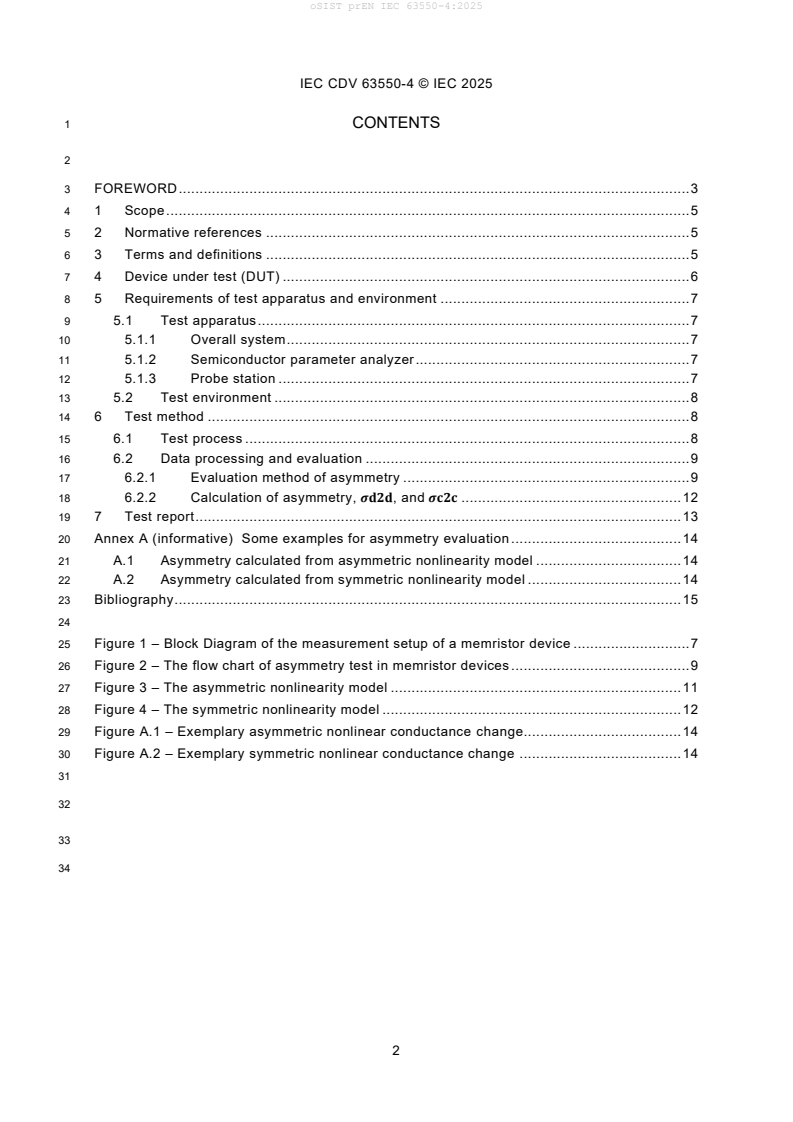
1 CONTENTS
3 FOREWORD . 3
4 1 Scope . 5
5 2 Normative references . 5
6 3 Terms and definitions . 5
7 4 Device under test (DUT) . 6
8 5 Requirements of test apparatus and environment . 7
9 5.1 Test apparatus . 7
10 5.1.1 Overall system . 7
11 5.1.2 Semiconductor parameter analyzer . 7
12 5.1.3 Probe station . 7
13 5.2 Test environment . 8
14 6 Test method . 8
15 6.1 Test process . 8
16 6.2 Data processing and evaluation . 9
17 6.2.1 Evaluation method of asymmetry . 9
18 6.2.2 Calculation of asymmetry, 𝝈𝐝𝟐𝐝, and 𝝈𝐜𝟐𝐜 . 12
19 7 Test report . 13
20 Annex A (informative) Some examples for asymmetry evaluation . 14
21 A.1 Asymmetry calculated from asymmetric nonlinearity model . 14
22 A.2 Asymmetry calculated from symmetric nonlinearity model . 14
23 Bibliography . 15
25 Figure 1 – Block Diagram of the measurement setup of a memristor device . 7
26 Figure 2 – The flow chart of asymmetry test in memristor devices . 9
27 Figure 3 – The asymmetric nonlinearity model . 11
28 Figure 4 – The symmetric nonlinearity model . 12
29 Figure A.1 – Exemplary asymmetric nonlinear conductance change. 14
30 Figure A.2 – Exemplary symmetric nonlinear conductance change . 14
IEC CDV 63550-4 © IEC 2025
35 INTERNATIONAL ELECTROTECHNICAL COMMISSION
36 ____________
38 Semiconductor devices - Neuromorphic devices -
40 Part 4: Evaluation method of asymmetry in memristor devices
42 FOREWORD
43 1) The International Electrotechnical Commission (IEC) is a worldwide organization for standardization comprising
44 all national electrotechnical committees (IEC National Committees). The object of IEC is to promote international
45 co-operation on all questions concerning standardization in the electrical and electronic fields. To this end and
46 in addition to other activities, IEC publishes International Standards, Technical Specifications, Technical Reports,
47 Publicly Available Specifications (PAS) and Guides (hereafter referred to as “IEC Publication(s)”). Their
48 preparation is entrusted to technical committees; any IEC National Committee interested in the subject dealt with
49 may participate in this preparatory work. International, governmental and non-governmental organizations liaising
50 with the IEC also participate in this preparation. IEC collaborates closely with the International Organization for
51 Standardization (ISO) in accordance with conditions determined by agreement between the two organizations.
52 2) The formal decisions or agreements of IEC on technical matters express, as nearly as possible, an international
53 consensus of opinion on the relevant subjects since each technical committee has representation from all
54 interested IEC National Committees.
55 3) IEC Publications have the form of recommendations for international use and are accepted by IEC National
56 Committees in that sense. While all reasonable efforts are made to ensure that the technical content of IEC
57 Publications is accurate, IEC cannot be held responsible for the way in which they are used or for any
58 misinterpretation by any end user.
59 4) In order to promote international uniformity, IEC National Committees undertake to apply IEC Publications
60 transparently to the maximum extent possible in their national and regional publications. Any divergence between
61 any IEC Publication and the corresponding national or regional publication shall be clearly indicated in the latter.
62 5) IEC itself does not provide any attestation of conformity. Independent certification bodies provide conformity
63 assessment services and, in some areas, access to IEC marks of conformity. IEC is not responsible for any
64 services carried out by independent certification bodies.
65 6) All users should ensure that they have the latest edition of this publication.
66 7) No liability shall attach to IEC or its directors, employees, servants or agents including individual experts and
67 members of its technical committees and IEC National Committees for any personal injury, property damage or
68 other damage of any nature whatsoever, whether direct or indirect, or for costs (including legal fees) and
69 expenses arising out of the publication, use of, or reliance upon, this IEC Publication or any other IEC
70 Publications.
71 8) Attention is drawn to the Normative references cited in this publication. Use of the referenced publications is
72 indispensable for the correct application of this publication.
73 9) IEC draws attention to the possibility that the implementation of this document may involve the use of (a)
74 patent(s). IEC takes no position concerning the evidence, validity or applicability of any claimed patent rights in
75 respect thereof. As of the date of publication of this document, IEC had not received notice of (a) patent(s), which
76 may be required to implement this document. However, implementers are cautioned that this may not represent
77 the latest information, which may be obtained from the patent database available at https://patents.iec.ch shall
78 not be held responsible for identifying any or all such patent rights.
79 IEC 63550-4 has been prepared by IEC technical subcommittee 47: Semiconductor devices. It
80 is an International Standard.
81 The text of this International Standard is based on the following documents:
NP Report on voting
47/2813/NP 47/2837/RVN
83 Full information on the voting for its approval can be found in the report on voting indicated in
84 the above table.
85 The language used for the development of this International Standard is English.
IEC CDV 63550-4 © IEC 2025
86 This document was drafted in accordance with ISO/IEC Directives, Part 2, and developed in
87 accordance with ISO/IEC Directives, Part 1 and ISO/IEC Directives, IEC Supplement available
88 at www.iec.ch/members_experts/refdocs. The main document types developed by IEC are
89 described in greater detail at www.iec.ch/publications.
90 A list of all parts in the IEC 63550 series, published under the general title Semiconductor
91 devices – Neuromorphic devices, can be found on the IEC website.
92 The committee has decided that the contents of this document will remain unchanged until the
93 stability date indicated on the IEC website under webstore.iec.ch in the data related to the
94 specific document. At this date, the document will be
95 • reconfirmed,
96 • withdrawn,
97 • replaced by a revised edition, or
98 • amended.
IEC CDV 63550-4 © IEC 2025
101 Semiconductor devices - Neuromorphic devices -
103 Part 4: Evaluation method of asymmetry in memristor devices
105 1 Scope
106 This part of IEC 63550-4 focuses on evaluating asymmetry characteristics, which play a crucial
107 role in memristors handling of imbalanced switching behaviours in neuromorphic operations,
108 requiring distinct characterization methods apart from linearity assessments. The test methods
109 of asymmetry in this international standard include asymmetry, cycle-to-cycle variation (𝜎 ) of
c2c
110 asymmetry and device-to-device variation (𝜎 ) of asymmetry. This document applies to all
d2d
111 two-terminal neuromorphic memristor devices, regardless of the underlying mechanism.
112 2 Normative references
113 There are no normative references in this document.
114 3 Terms and definitions
115 For the purpose of this document, the following terms and definitions apply.
116 ISO and IEC maintain terminological databases for use in standardization at the following
117 addresses:
118 • IEC Electropedia: available at http://www.electropedia.org/
119 • ISO Online browsing platform: available at http://www.iso.org/obp
120 3.1
121 pre-synaptic voltage
122 Vpre
123 bias applied to the pre-synaptic terminal of the memristor devices.
124 3.2
125 post-synaptic voltage
126 Vpost
127 bias applied to the post-synaptic terminal of the memristor devices
128 3.3
129 memristor
130 nonlinear two-terminal electrical component that limits or regulate the flow of electrical current
131 in a circuit and remembers the amount of charge that has previously flowed through it
132 3.4
133 forming voltage
134 Vform
135 high voltage applied across the active layer to induce defects within the active layer to form a
136 filament or conduction path initially.
137 3.5
138 memristor programming voltage
139 V
p
140 voltage applied to the pre-synaptic terminal of memristor to change its resistance state.
IEC CDV 63550-4 © IEC 2025
141 3.6
142 set voltage
143 Vset
144 bias applied to switch a memristor to a low resistance state.
145 3.7
146 reset voltage
147 V
reset
148 bias applied to switch a memristor to a high resistance state.
149 3.8
150 step voltage
151 V
step
152 step size of voltage increments during gradual voltage application.
153 3.9
154 read voltage
155 Vread
156 specific voltage for measuring the resistance of memristor.
157 3.10
158 read current
159 Iread
160 specific current value at VRead of memristor.
161 3.11
162 resistance of memristor
163 R
read
164 resistance value at VRead, defined by the following formula.
𝑽
𝐫𝐞𝐚𝐝
165 𝑹 =
𝐑𝐞𝐚𝐝
𝑰
𝐫𝐞𝐚𝐝
...