

EN 50736:2025
(Main)Railway application - Communication, signalling and processing system - Test requirements for signalling and telecommunication equipment
General Information
- Abstract
This document applies to railway signalling and telecommunication trackside equipment. This document does not cover signalling and telecommunication equipment mounted in vehicles; these are covered by EN 50155:2021. This document covers the type testing phases of the equipment for signal and telecommunication (S&T) systems (including power supply systems belonging to S&T), in order to ensure compliance with specified requirements already defined in the customer specifications or by the involved parties. In particular this document intends to define test requirements with related performance / acceptance criteria, considering only the environmental conditions stated by the EN 50125-3:2003, and considering the severities of the environmental parameters herein defined. Safety considerations are not covered by this document.
- Status
- Published
- Publication Date
- 04-Dec-2025
- Technical Committee
- CLC/TC 9X - Electrical and electronic applications for railways
- Drafting Committee
- CLC/SC 9XA - Communications, signalling and processing systems
- Current Stage
- 6060 - Document made available - Publishing
- Start Date
- 05-Dec-2025
- Due Date
- 25-Jun-2025
- Completion Date
- 05-Dec-2025

Overview
EN 50736:2025 (EN 50736:2025) is a European standard for railway trackside signalling and telecommunication (S&T) equipment. It defines the type testing requirements and related performance/acceptance criteria used to verify that trackside S&T devices meet environmental and functional expectations. The standard applies only to trackside equipment (not vehicle-mounted equipment, which is covered by EN 50155:2021) and bases environmental severities on EN 50125-3:2003. Safety aspects are explicitly not covered.
Key technical topics and requirements
The standard sets out structured test regimes and documentation for type approval. Major technical topics include:
- Relation between environmental conditions and test requirements - aligning test selection with specified environmental severities.
- Insulation and electrical tests - insulation resistance, impulse, and voltage withstand tests.
- Climatic tests - temperature (dry heat, cold), humidity (damp heat), and solar radiation (simulated and solar dry heat).
- Mechanical environmental tests - vibration (initial response, fatigue), shock and external mechanical impacts.
- Ingress protection tests - protection against water, dust and sand ingress (IP-related assessments).
- Electromagnetic compatibility (EMC) and surge tests to verify immunity and emissions performance.
- Protection against dust, sand, rain, snow, hail, ice and other environmental agents (informative analysis in Annex A).
- Documentation requirements: type test specification, type test report and a type test compliance summary sheet (see Clause 6 and Annex B).
Performance criteria, visual inspection and performance testing steps are defined so manufacturers and test labs can evaluate compliance.
Practical applications and who uses this standard
SIST EN 50736 is used for:
- Manufacturers of trackside signalling and telecommunication equipment verifying design robustness.
- Test laboratories conducting type tests for environmental, EMC and mechanical performance.
- System integrators and infrastructure owners (rail operators, procurement teams) specifying acceptance criteria in contracts.
- Certification bodies and compliance engineers preparing type test reports for product approval and deployment.
Typical uses: design verification, factory acceptance testing, type approval for deployment in signaling systems and procurement compliance.
Related standards
- EN 50125-3:2003 - environmental conditions for railway equipment (basis for test severities).
- EN 50155:2021 - railway applications - electronic equipment on rolling stock (vehicle-mounted equipment).
- CENELEC framework and national transposition via SIST (Slovenian Institute for Standardization).
Keywords: railway signalling, telecommunication equipment, trackside equipment, type testing, EN 50736, environmental tests, EMC, vibration, ingress protection, EN 50125-3.
Relations
- Effective Date
- 03-Feb-2026
- Effective Date
- 03-Feb-2026
- Effective Date
- 03-Feb-2026
- Effective Date
- 03-Feb-2026
- Effective Date
- 03-Feb-2026
- Effective Date
- 03-Feb-2026
- Effective Date
- 03-Feb-2026
- Effective Date
- 03-Feb-2026
- Effective Date
- 03-Feb-2026
- Effective Date
- 03-Feb-2026
- Effective Date
- 03-Feb-2026
- Effective Date
- 03-Feb-2026
Get Certified
Connect with accredited certification bodies for this standard

IRIS Certification (UNIFE)
International Railway Industry Standard certification.

TÜV SÜD Rail GmbH
TÜV SÜD railway certification services.

Bureau Veritas Railway Certification
Railway and transportation certification.
Sponsored listings
Frequently Asked Questions
EN 50736:2025 is a standard published by CLC. Its full title is "Railway application - Communication, signalling and processing system - Test requirements for signalling and telecommunication equipment". This standard covers: This document applies to railway signalling and telecommunication trackside equipment. This document does not cover signalling and telecommunication equipment mounted in vehicles; these are covered by EN 50155:2021. This document covers the type testing phases of the equipment for signal and telecommunication (S&T) systems (including power supply systems belonging to S&T), in order to ensure compliance with specified requirements already defined in the customer specifications or by the involved parties. In particular this document intends to define test requirements with related performance / acceptance criteria, considering only the environmental conditions stated by the EN 50125-3:2003, and considering the severities of the environmental parameters herein defined. Safety considerations are not covered by this document.
This document applies to railway signalling and telecommunication trackside equipment. This document does not cover signalling and telecommunication equipment mounted in vehicles; these are covered by EN 50155:2021. This document covers the type testing phases of the equipment for signal and telecommunication (S&T) systems (including power supply systems belonging to S&T), in order to ensure compliance with specified requirements already defined in the customer specifications or by the involved parties. In particular this document intends to define test requirements with related performance / acceptance criteria, considering only the environmental conditions stated by the EN 50125-3:2003, and considering the severities of the environmental parameters herein defined. Safety considerations are not covered by this document.
EN 50736:2025 is classified under the following ICS (International Classification for Standards) categories: 45.060.01 - Railway rolling stock in general. The ICS classification helps identify the subject area and facilitates finding related standards.
EN 50736:2025 has the following relationships with other standards: It is inter standard links to EN 60068-2-75:2014, EN 61180:2016, EN 50121-4:2016, EN 60068-2-47:2005, EN IEC 60068-2-5:2018, EN 50125-3:2003, EN IEC 60068-2-2:2025, EN 50124-1:2017, EN 62262:2002, EN 60529:1991, EN 60068-2-64:2008, EN 60068-2-27:2009. Understanding these relationships helps ensure you are using the most current and applicable version of the standard.
EN 50736:2025 is available in PDF format for immediate download after purchase. The document can be added to your cart and obtained through the secure checkout process. Digital delivery ensures instant access to the complete standard document.
Standards Content (Sample)
SLOVENSKI STANDARD
01-februar-2026
Železniške naprave - Komunikacijski, signalni in procesni sistemi - Preskusne
zahteve za signalizacijo in telekomunikacijsko opremo
Railway application - Communication, signalling and processing system - Test
requirements for signalling and telecommunication equipment
Bahnanwendungen - Telekommunikationstechnik, Signaltechnik und
Datenverarbeitungssysteme - Prüfanforderungen für Signal- und
Telekommunikationsgeräte
Applications ferroviaires - Systèmes de signalisation, de télécommunication et de
traitement - Exigences de test pour les équipements de signalisation et de
télécommunication
Ta slovenski standard je istoveten z: EN 50736:2025
ICS:
45.060.01 Železniška vozila na splošno Railway rolling stock in
general
2003-01.Slovenski inštitut za standardizacijo. Razmnoževanje celote ali delov tega standarda ni dovoljeno.
EUROPEAN STANDARD EN 50736
NORME EUROPÉENNE
EUROPÄISCHE NORM December 2025
ICS 45.060.01
English Version
Railway application - Communication, signalling and processing
system - Test requirements for signalling and telecommunication
equipment
Applications ferroviaires - Systèmes de signalisation, de Bahnanwendungen - Telekommunikationstechnik,
télécommunication et de traitement - Exigences de test Signaltechnik und Datenverarbeitungssysteme -
pour les équipements de signalisation et de Prüfanforderungen für Signal- und
télécommunication Telekommunikationsgeräte
This European Standard was approved by CENELEC on 2025-11-10. CENELEC members are bound to comply with the CEN/CENELEC
Internal Regulations which stipulate the conditions for giving this European Standard the status of a national standard without any alteration.
Up-to-date lists and bibliographical references concerning such national standards may be obtained on application to the CEN-CENELEC
Management Centre or to any CENELEC member.
This European Standard exists in three official versions (English, French, German). A version in any other language made by translation
under the responsibility of a CENELEC member into its own language and notified to the CEN-CENELEC Management Centre has the
same status as the official versions.
CENELEC members are the national electrotechnical committees of Austria, Belgium, Bulgaria, Croatia, Cyprus, the Czech Republic,
Denmark, Estonia, Finland, France, Germany, Greece, Hungary, Iceland, Ireland, Italy, Latvia, Lithuania, Luxembourg, Malta, the
Netherlands, Norway, Poland, Portugal, Republic of North Macedonia, Romania, Serbia, Slovakia, Slovenia, Spain, Sweden, Switzerland,
Türkiye and the United Kingdom.
European Committee for Electrotechnical Standardization
Comité Européen de Normalisation Electrotechnique
Europäisches Komitee für Elektrotechnische Normung
CEN-CENELEC Management Centre: Rue de la Science 23, B-1040 Brussels
© 2025 CENELEC All rights of exploitation in any form and by any means reserved worldwide for CENELEC Members.
Ref. No. EN 50736:2025 E
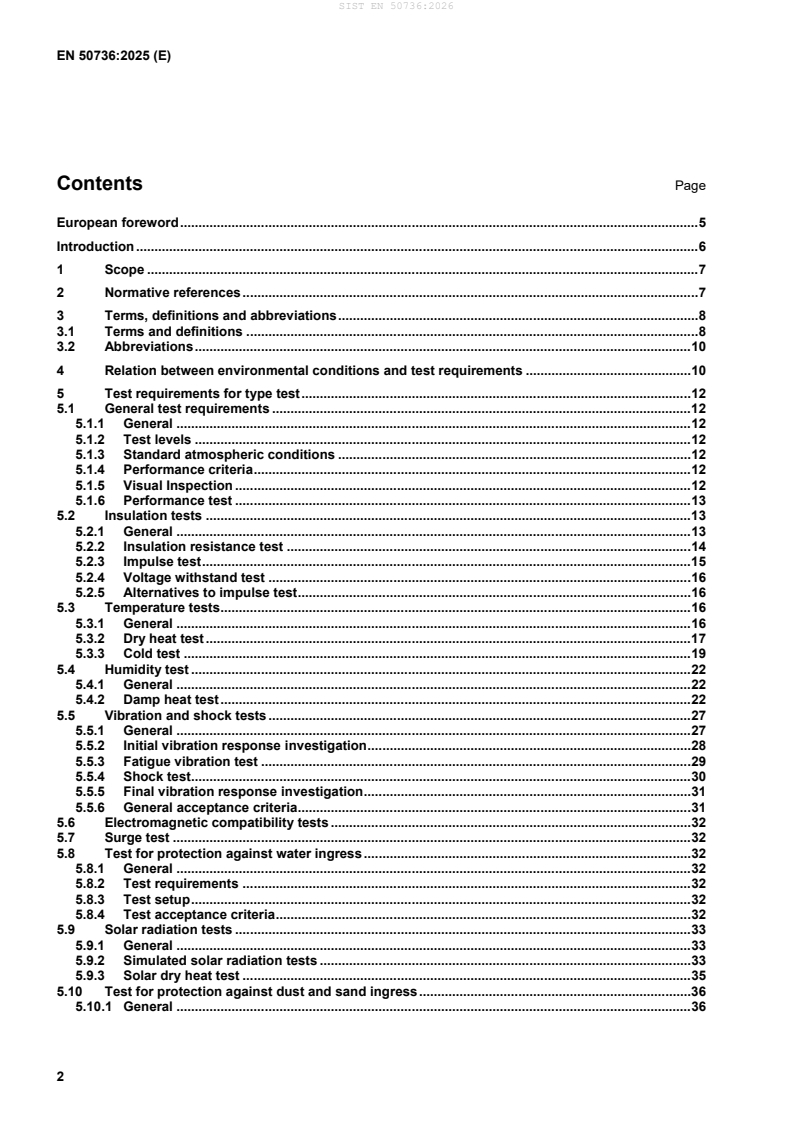
Contents Page
European foreword . 5
Introduction . 6
1 Scope . 7
2 Normative references . 7
3 Terms, definitions and abbreviations . 8
3.1 Terms and definitions . 8
3.2 Abbreviations . 10
4 Relation between environmental conditions and test requirements . 10
5 Test requirements for type test . 12
5.1 General test requirements . 12
5.1.1 General . 12
5.1.2 Test levels . 12
5.1.3 Standard atmospheric conditions . 12
5.1.4 Performance criteria . 12
5.1.5 Visual Inspection . 12
5.1.6 Performance test . 13
5.2 Insulation tests . 13
5.2.1 General . 13
5.2.2 Insulation resistance test . 14
5.2.3 Impulse test . 15
5.2.4 Voltage withstand test . 16
5.2.5 Alternatives to impulse test . 16
5.3 Temperature tests . 16
5.3.1 General . 16
5.3.2 Dry heat test . 17
5.3.3 Cold test . 19
5.4 Humidity test . 22
5.4.1 General . 22
5.4.2 Damp heat test . 22
5.5 Vibration and shock tests . 27
5.5.1 General . 27
5.5.2 Initial vibration response investigation . 28
5.5.3 Fatigue vibration test . 29
5.5.4 Shock test . 30
5.5.5 Final vibration response investigation . 31
5.5.6 General acceptance criteria . 31
5.6 Electromagnetic compatibility tests . 32
5.7 Surge test . 32
5.8 Test for protection against water ingress . 32
5.8.1 General . 32
5.8.2 Test requirements . 32
5.8.3 Test setup . 32
5.8.4 Test acceptance criteria . 32
5.9 Solar radiation tests . 33
5.9.1 General . 33
5.9.2 Simulated solar radiation tests . 33
5.9.3 Solar dry heat test . 35
5.10 Test for protection against dust and sand ingress . 36
5.10.1 General . 36
5.10.2 Test requirements . 36
5.10.3 Test setup. 37
5.10.4 Test acceptance criteria . 37
5.11 Test for protection against external mechanical impacts . 37
5.11.1 General . 37
5.11.2 Test requirements . 38
5.11.3 Test setup. 38
5.11.4 Test acceptance criteria . 38
6 Documentation . 39
6.1 General . 39
6.2 Type test specification . 39
6.3 Type test report . 39
6.4 Type test compliance summary sheet . 40
Annex A (informative) Analysis of the environmental conditions . 41
A.1 General . 41
A.2 Pressure . 41
Altitude . 41
Pulse pressure . 42
A.3 Temperature . 43
A.4 Humidity . 43
A.5 Wind . 45
A.6 Rain . 45
A.7 Snow and hail . 46
Snow . 46
Hail . 46
A.8 Ice . 47
A.9 Solar radiation . 47
A.10 Lightning . 48
A.11 Pollution . 48
General . 48
Chemically and biologically active substances . 48
Mechanically active substances . 49
A.12 Fire protection . 50
A.13 Vibrations and shocks . 50
A.14 Electromagnetic compatibility . 50
A.15 Power supply . 50
Annex B (informative) Type test specification . 52
B.1 General . 52
B.2 Type test specification clauses . 52
Introduction. 52
Terms, definition and abbreviation . 52
Reference documents . 52
General description . 52
Equipment under test . 53
Installation environment . 53
Ports identification . 54
Performance test . 57
Visual inspection . 58
Correlation between performance test and the performance criteria . 58
Summary of all type tests to be performed on the EUT . 59
Insulation tests . 61
EMC tests . 61
Climatic tests . 62
Vibration and shock tests . 62
Tests for protection against external agents . 62
Tests for protection against external mechanical impacts . 63
Power supply tests . 63
Additional tests . 63
Annex C (informative) Supplementary tests (not mandatory) . 64
C.1 General . 64
C.2 Storage and transport temperature tests . 64
General . 64
Test setup . 64
Test requirements . 64
Test acceptance criteria . 66
C.3 Shock tests for transversal and longitudinal axes . 67
Annex D (informative) Tests selection guideline . 68
D.1 General . 68
D.2 Definition of equipment installation conditions . 68
D.3 Equipment for installation in weather protected areas . 69
D.4 Equipment for installation in areas not weather protected . 70
Annex E (informative) Examples for type test compliance summary sheet . 72
E.1 General . 72
E.2 Example 1 . 72
E.3 Example 2 . 73
Annex F (informative) Risk related to faults of the overhead contact line . 76
Bibliography . 77
European foreword
This document (EN 50736:2025) has been prepared by CLC/SC 9XA “Communication, signalling and
processing systems” of CLC/TC 9X “Electrical and electronic applications for railways”.
The following dates are fixed:
• latest date by which this document has to be (dop) 2026-12-31
implemented at national level by publication of
an identical national standard or by
endorsement
• latest date by which the national standards (dow) 2028-12-31
conflicting with this document have to be
withdrawn
This document has been prepared according to Decision 57/5 taken during the SC 9XA meeting.
Attention is drawn to the possibility that some of the elements of this document may be the subject of patent
rights. CENELEC shall not be held responsible for identifying any or all such patent rights.
Any feedback and questions on this document should be directed to the users’ national committee. A complete
listing of these bodies can be found on the CENELEC website.
Introduction
The environmental conditions for signalling and telecommunication equipment are specified by
EN 50125-3:2003, without defining test requirements and their related performance/acceptance criteria.
This document contains test requirements and performance/acceptance criteria for most of the mentioned
environmental conditions likely to be experienced in the railway applications and published in EN 50125-3:2003.
Furthermore, it clearly indicates for which environmental conditions no test methods are known and therefore
no meaningful test requirements can be defined.
Test requirements for the type test defined in this document consider the severity of the environmental
parameters provided for by EN 50125-3:2003, but those test requirements remain applicable even if the severity
levels requested by the customer differ.
This document has been prepared in the form of a Product Standard.
Where possible, direct references are given to other existing standards to obtain a high degree of acceptance
and to reduce additional effort for testing.
1 Scope
This document applies to railway signalling and telecommunication trackside equipment.
This document does not cover signalling and telecommunication equipment mounted in vehicles; these are
covered by EN 50155:2021.
This document covers the type testing phases of the equipment for signal and telecommunication (S&T)
systems (including power supply systems belonging to S&T), in order to ensure compliance with specified
requirements already defined in the customer specifications or by the involved parties.
In particular this document intends to define test requirements with related performance / acceptance criteria,
considering only the environmental conditions stated by the EN 50125-3:2003, and considering the severities
of the environmental parameters herein defined.
Safety considerations are not covered by this document.
2 Normative references
The following documents are referred to in the text in such a way that some or all of their content constitutes
requirements of this document. For dated references, only the edition cited applies. For undated references, the
latest edition of the referenced document (including any amendments) applies.
EN 50121-4, Railway applications - Electromagnetic compatibility - Part 4: Emission and immunity of the
signalling and telecommunications apparatus
EN 50124-1:2017, Railway applications - Insulation coordination - Part 1: Basic requirements - Clearances and
creepage distances for all electrical and electronic equipment
EN 50125-3:2003, Railway applications - Environmental conditions for equipment - Part 3: Equipment for
signalling and telecommunications
EN 60068-2-2, Environmental testing - Part 2-2: Tests - Test B: Dry heat (IEC 60068-2-2)
EN IEC 60068-2-5:2018, Environmental testing - Part 2-5: Tests - Test S: Simulated solar radiation at ground
level and guidance for solar radiation testing and weathering
EN 60068-2-27, Environmental testing - Part 2-27: Tests - Test Ea and guidance: Shock (IEC 60068-2-27)
EN 60068-2-47, Environmental testing - Part 2-47: Tests - Mounting of specimens for vibration, impact and
similar dynamic tests (IEC 60068-2-47)
EN 60068-2-64:2008, Environmental testing - Part 2: Tests - Test Fh: Vibration, broadband random and
guidance (IEC 60068-2-64:2008)
EN 60068-2-75, Environmental testing - Part 2-75: Tests - Test Eh: Hammer test (IEC 60068-2-75)
EN 60529, Degrees of protection provided by enclosures (IP Code) (IEC 60529)
EN 61180:2016, High-voltage test techniques for low-voltage equipment - Definitions, test and procedure
requirements, test equipment (IEC 61180:2016)
EN 62262, Degrees of protection provided by enclosures for electrical equipment against external mechanical
impacts (IK code) (IEC 62262)
As impacted by EN 50125-3:2003/corrigendum May 2010.
As impacted by EN 60068-2-64:2008/A1:2019.
3 Terms, definitions and abbreviations
3.1 Terms and definitions
For the purposes of this document, the terms and definitions given in EN 50124-1:2017, EN 60068-2-64:2008
and the following apply.
ISO and IEC maintain terminology databases for use in standardization at the following addresses:
— ISO Online browsing platform: available at https://www.iso.org/obp/
— IEC Electropedia: available at https://www.electropedia.org/
3.1.1
enclosure
case, housing, or other part to protect the equipment against certain external influences
Note 1 to entry: The enclosure can offer protection to personnel, e.g. from electric shock.
Note 2 to entry: In this document insulating compound (e.g. potting, encapsulation and vacuum impregnation) used to protect
the equipment against external influences is considered as enclosure.
3.1.2
environmental conditions
physical, chemical, electric and biological conditions external to the equipment to
which it is subjected in service
[SOURCE: IEC 60050-821:2017, 821-01-53]
3.1.3
environmental factor
physical, chemical or biological influence which, either singly or in combination with other influences, produces
an environmental condition (e.g. heat, vibration)
[SOURCE: EN 60721-1:1995, 3.2]
3.1.4
environmental parameter
one or more physical, chemical or biological properties characterizing an environmental factor (e.g. temperature,
acceleration)
Note 1 to entry: For example, the environmental factor vibration is characterized by the parameters: type of vibration
(sinusoidal, random), acceleration and frequency.
[SOURCE: EN 60721-1:1995, 3.3, modified – The second part of the definition was moved to Note 1 to entry]
3.1.5
equipment
single apparatus or set of devices or apparatuses, or the set of main devices of an installation, or all devices
necessary to perform a specific task
EXAMPLES A power transformer, the equipment of a substation, measuring equipment.
[SOURCE: IEC 60050-151:2001, 151-11-25]
3.1.6
operating temperature
temperature range in which the equipment is operating as specified
Note 1 to entry: Outside of the operating temperature range there can be temporary or permanent degradation of the
equipment performances.
3.1.7
performance
characteristics defining the ability of an equipment to achieve the intended functions
[SOURCE: IEC 60050-311:2001, 311-06-11, modified – “measuring instrument” has been replaced with
“equipment”]
3.1.8
port
particular interface of the specified apparatus with the
external environment
EXAMPLES AC power port, DC power port, I/O (input/output) port, earth port.
[SOURCE: IEC 60050-821:2017, 821-11-37]
3.1.9
resonance frequency
frequency at which resonance exists and the acceleration measured in the response point
is more than three times respect the acceleration measured in the reference point
3.1.10
severity of environmental parameter
value of each quantity, characterizing the environmental parameter
EXAMPLE The severity of sinusoidal vibration is defined by values of the acceleration (in m/s ) and frequency (in Hz).
[SOURCE: EN 60721-1:1995, 3.4]
3.1.11
specified requirement
need or expectation that is stated
Note 1 to entry: Specified requirements can be stated in normative documents such as regulations, standards and technical
specifications.
Note 2 to entry: When the severity of an environmental parameter is chosen considering the environment intended for the
installation of the equipment, this becomes a specified requirement. This is the target that the equipment has to fulfil.
Specified requirements can be defined by generic or product standards. When suitable specifications or standards do not
exist, considering the environment intended for the installation of the equipment, customer or supplier can define
requirements in their specification (e.g. the value of the environmental high temperature to which equipment can operate
has to be 70 °C.).
[SOURCE: IEC 60050-902:2013, 902-02-01, modified – The Note 2 to entry has been added]
3.1.12
system
set of interrelated elements considered in a defined context as a whole and separated from their environment
[SOURCE: IEC 60050-351:2013, 351-42-08, modified – The Notes to entry have been omitted]
3.1.13
test fixture
apparatus to fix the equipment on the test device during testing
[SOURCE: ISO 19594:2017, 3.7, modified – “specimen” has been replaced with “equipment”]
3.1.14
test requirement
prescriptions to be used during the tests
Note 1 to entry: These prescriptions are usually defined in generic or product standards. These prescriptions, that regulate
the parameters not properly defined by the basic standards, are necessary to make the test effective to ensure that the
specified requirements are met.
Note 2 to entry: E.g. the duration of the dry heat test has to be 10 h.
3.1.15
test procedure
set of instructions in order to obtain a test result
Note 1 to entry: Test procedures are usually defined in basic standards (e.g. the test procedures for dry heat test are
described in EN 60068-2-2).
3.1.16
type test
conformity test made on one or more items representative of the production
[SOURCE: IEC 60050-581:2008, 581-21-08]
3.2 Abbreviations
For the purposes of this document, the following abbreviations apply.
AC Alternating Current
ASD Acceleration Spectral Density
CCZ Current Collector Zone
DC Direct Current
EMC Electro Magnetic Compatibility
EUT Equipment Under Test
I/O Input / Output
IP Ingress Protection
OCLZ Overhead Contact Line Zone
PBA Printed Board Assembly
PCB Printed Circuit Board
RMS Root Mean Square
SPD Surge Protection Device
4 Relation between environmental conditions and test requirements
Clause 4 defines the relation between environmental conditions and the test requirements for type test.
Informative Annex A is added for a better understanding of the document. It shows the analysis of the
environmental conditions defined in EN 50125-3:2003 and their influence on the functioning of the EUT, and
also the relation with the test requirements for type tests defined in this document.
Table 1 shows the relationship between the environmental conditions considered by EN 50125-3:2003, the
preparatory and additional information reported in Annex A, and the test requirements defined in this document.
The structure of Table 1, and also of the informative Annex A, has been deliberately left the same as
EN 50125-3:2003, to allow a better readability of the document, even if for some environmental conditions no
test requirements have been defined.
Table 1 — List of environmental conditions and related test requirements
Preparatory
and
Test requirements subclause
Environmental Subclause in
additional
condition EN 50125-3:2003
in this document
information
in Annex A
Pressure 4.2 A.2 5.2 Insulation tests
Temperature 4.3 A.3 5.3 Temperature tests
Humidity 4.4 A.4 5.4 Humidity test
Wind 4.5 A.5 No test requirements defined in this document
5.4 Humidity test
Rain 4.6 A.6
5.8 Test for protection against water ingress
5.4 Humidity test
Snow and Hail 4.7 A.7
5.11 Test for protection against external
mechanical impacts
Ice 4.8 A.8 5.4 Humidity test
Solar Radiation 4.9 A.9 5.9 Solar radiation tests
5.2 Insulation tests
Lightning 4.10 A.10
5.7 Surge test
5.2 Insulation tests
5.10 Test for protection against dust and sand
Pollution 4.11 A.11 ingress
5.11 Test for protection against external
mechanical impacts
Fire Protection 4.12 A.12 No test requirements defined in this document
Vibrations and
4.13 A.13 5.5 Vibration and shock tests
Shocks
Electromagnetic
4.14 A.14 5.6 Electromagnetic compatibility tests
compatibility
a
Power supplies 4.15 A.15
No test requirements defined in this document
a
Power supply systems are in the scope of this document and type tests defined in Clause 5 apply. Power supplies
itself are not an environmental condition hence no test requirements are given. See Annex A, Clause A.15 for further
information.
As previously explained, Table 1 relates each environmental condition with the relevant tests requirements
defined in this document; this is to allow to the user of this document, considering the environmental conditions
to be taken into account, to identify which tests shall be performed to the equipment. Due to this approach and
the structure of Table 1, some test requirements have been repeated on several rows, because the tested
characteristics are related to different environmental conditions.
To directly identify which tests shall be performed on an equipment for a complete execution of the type tests,
in order to take into account all environmental conditions stated in EN 50125-3:2003 for which test requirements
have been defined in this document, informative Annex D provides a guide.
5 Test requirements for type test
5.1 General test requirements
5.1.1 General
Equipment used for type tests shall be a serial product or an exemplary representative of the final manufactured
product.
5.1.2 Test levels
EN 50125-3:2003 specifies the environmental conditions, with the related severity of environmental parameters,
encountered within Europe for railway signalling and telecommunication trackside equipment.
The test levels defined in this document are derived from the severity of the environmental parameters defined
in EN 50125-3:2003.
5.1.3 Standard atmospheric conditions
As defined in EN 60068-1:2014, 4.3, the standard range of atmospheric conditions for carrying out
measurements and tests are (inclusive values):
Temperature: 15 °C to 35 °C
Relative humidity: from 25 % to 75 %
Air pressure: 86 kPa to 106 kPa
These standard atmospheric conditions shall be maintained during the execution of all tests defined in this
document, unless specifically defined in the respective basic standard. If it is impracticable to carry out
measurements in standard atmospheric conditions, a note stating the actual conditions shall be added to the
test report.
5.1.4 Performance criteria
5.1.4.1 General
The expected performance (i.e. the equipment is functioning as specified), from the equipment under test, shall
be specified for all operational conditions.
No damage to any connected equipment is allowed when the equipment does not operate as intended during
or after the test.
5.1.4.2 Performance criterion A
The EUT shall continue to operate as intended. No change of operational state is allowed. No loss or
unintentional change in stored data shall occur.
5.1.4.3 Performance criterion B
Degradation of the performance below the level described in criterion A is permitted, provided the EUT self-
recovers to the condition established prior to the application of the test. No loss of stored data are allowed.
5.1.4.4 Performance criterion C
Degradation of performance as described in criteria A and B is permitted provided that the EUT self-recovers to
the condition established prior to the application of the test within a maximum defined time, or can be restored
after the test by the operator.
5.1.5 Visual Inspection
The visual inspection verifies the mechanical, dimensional and appearance conformance of the equipment with
the requirements defined by the manufacturer in its specifications.
5.1.6 Performance test
The performance test verifies that the functional requirements of the equipment are met; consists of a
comprehensive series of measurements of the functional characteristics to verify that the equipment operates
as specified.
The performance test shall be well defined in the type test specification.
5.2 Insulation tests
5.2.1 General
The insulation tests herein defined are based on the provisions of EN 50124-1:2017, using the same
terminology and acronyms.
The insulation tests, defined below, verify that the design of the equipment (mounted components, metal
connections and enclosures, routing of printed circuit board tracks and wire) meets the requirements for galvanic
isolation necessary for proper operation in the railway environment.
The tests should be carried out on fully assembled equipment and no alteration of the original settings is
permitted (e.g. component removal). If components have to be removed during the tests, that specific test
configuration shall be agreed between the involved parties and defined in the type test specification.
The manufacturer shall define in the type test specifications the maximum altitude at which the equipment can
operate and all ports interfacing the EUT with other equipment or in general with the railway signalling and
telecommunication system. For each port shall be defined, in accordance with EN 50124-1:2017:
— nominal voltage U ;
n
— rated insulation voltage U ;
Nm
— rated impulse voltage U ;
Ni
— insulation type (see EN 50124-1:2017, 3.6).
Earth connection, if present, and the enclosure of the equipment shall be considered as ports in order to verify
the insulation barrier. For these ports the information written above (U , U , etc.) cannot be defined.
n Nm
Ports related to the same equipotential section (see EN 50124-1:2017, 3.3) shall be considered as a single port
for the scope of these tests and all their terminals shall be short-circuited together during all the insulation tests
(e.g. metallic enclosure connected to the earth connection, and the earth port shall be considered as a single
port). In these cases, the U of the port is the highest U of the ports directly connected to the same
Ni Ni
equipotential section.
EXAMPLE If an equipment has two ports connected to the same equipotential section, and the two ports have different
values of rated impulse voltage U , the rated impulse voltage U of the equipotential section (therefore of the single port
Ni Ni
for the scope of these tests) is the highest U considering the two ports.
Ni
The insulation tests consist in four parts that shall be done in sequence:
— initial insulation resistance test (see 5.2.2);
— impulse test (see 5.2.3);
— voltage withstand test (see 5.2.4);
— final insulation resistance test (see 5.2.2).
Impulse test (5.2.3) and voltage withstand test (5.2.4) may be replaced by a single test with the test requirements
defined in 5.2.5.
During the tests the equipment shall be switched OFF. After the insulation tests the equipment shall work as
intended and within its specified limits. All measured values shall be recorded in the test report.
Tests shall be performed for all isolated ports of the EUT in order to verify the isolation with the other ports.
NOTE If the insulation type from the port under test to the other ports is the same (all with basic insulation or all with
reinforced insulation), the other ports, which are not subjected to test, can be connected together and to the reference of
the test instrument in order to reduce the number of the tests. With this strategy it is possible to verify multiple insulations
during the same test.
If an equipment has an insulating enclosure, this shall be covered with a metal foil in contact with the insulating
surface so that it can be electrically connected for the purpose of the insulation tests.
The insulation tests specified in 5.2 do not consider the fault conditions of the overhead contact line or current
collector, and the consequent risk related to the hazardous transferred potentials, as these are beyond the
scope of EN 50124-1:2017. This topic is treated by EN 50122-1:2022 and information is given in informative
Annex F.
5.2.2 Insulation resistance test
5.2.2.1 General
The insulation resistance test shall be carried out at DC 500 V, with a tolerance of ±10 % if U defined for the
Ni
port is more, or equal, than 0,8 kV, otherwise at DC 250 V, with a tolerance of ±10 %, between each isolated
port and all the other ports connected together and to the reference of the test instrument.
The test shall be performed by connecting the test generator directly to the two measuring points without
interposing networks or coupling devices.
The test voltage shall be applied for at least 5 s to have a stabilized value of the insulation resistance. The
resistance values measured, for each port, shall be recorded in the test report.
Any suitable test equipment can be used. The measuring device shall be capable of determining the insulation
resistance with an overall accuracy of at least ±10 %.
AC voltage components, possibly present in the DC output voltage of the test equipmen
...