

EN IEC 61800-3:2023
(Main)Adjustable speed electrical power drive systems - Part 3: EMC requirements and specific test methods for PDS and machine tools
General Information
- Abstract
IEC 61800-3:2022 specifies electromagnetic compatibility (EMC) requirements for adjustable speed power drive systems (PDSs) and machine tools (MTs). A PDS is an AC or DC motor drive including an electronic converter. Requirements are stated for AC and DC PDSs and MTs with input and/or output voltages (line-to-line voltage), up to 35 kV AC RMS. This document applies to equipment of all power ratings. As a product EMC standard, this document can be used for the assessment of PDS and MT. It can also be used for the assessment of complete drive modules (CDM) or basic drive modules (BDM). Traction applications and electric vehicles are excluded. Equipment which is defined as group 2 in CISPR 11:2015 is excluded. This document does not give requirements for the electrical machine which converts power between the electrical and mechanical forms within the PDS. Requirements for rotating electrical machines are covered by the IEC 60034 series. In this document, the term "motor" is used to describe the electrical machine, whether rotary or linear, and regardless of the direction of power flow. This document is applicable to BDMs, CDMs, PDSs and MTs with or without radio function. However, this document does not specify any radio transmission and reception requirements. This document defines the minimum requirements for emission and immunity in the frequency range from 0 Hz to 400 GHz. Tests are not required in frequency ranges where no requirements are specified. This fourth edition cancels and replaces the third edition published in 2017. This edition constitutes a technical revision. This edition includes the following significant technical changes with respect to the previous edition:
extension of the scope to machine tools with one or more embedded PDS;
extension of the frequency range for radiated immunity tests to 6 GHz;
general updates in the normative part and the informative annexes.
- Status
- Published
- Publication Date
- 19-Oct-2023
- Technical Committee
- CLC/TC 22X - Power electronics
- Drafting Committee
- IEC/SC 22G - IEC_SC_22G
- Current Stage
- 6060 - Document made available - Publishing
- Start Date
- 20-Oct-2023
- Completion Date
- 20-Oct-2023

Overview
EN IEC 61800-3:2023 (IEC 61800-3:2022 adopted as a European standard) sets the electromagnetic compatibility (EMC) requirements and specific test methods for adjustable speed electrical power drive systems (PDS) and machine tools (MT). It applies to AC and DC motor drives (including electronic converters) and to complete or basic drive modules (CDM, BDM) with input/output voltages up to 35 kV AC RMS and to equipment of all power ratings. The fourth edition replaces the 2017 edition and broadens scope to include machine tools with embedded PDS and extends radiated immunity testing up to 6 GHz while defining emission and immunity requirements across 0 Hz to 400 GHz.
Key topics and requirements
- Scope & applicability
- Applies to PDS, BDM, CDM and MTs (with or without radio function); does not cover traction applications or electric vehicles, nor equipment classified as Group 2 in CISPR 11.
- Electrical machines (motors/rotating machines) are excluded - covered by IEC 60034 series.
- EMC boundaries
- Minimum emission and immunity requirements from 0 Hz to 400 GHz; tests not required where no requirements specified.
- Radiated immunity tests extended to 6 GHz in this edition.
- Technical topics covered
- Low-frequency emissions and immunity: harmonics, interharmonics, voltage fluctuations and flicker, common-mode harmonic emissions.
- Immunity to mains disturbances: voltage dips, short interruptions, frequency variations, and magnetic field effects.
- High-frequency emissions and immunity: conducted and radiated disturbance tests, measurement-site requirements, and port/interface definitions.
- Test methods and reporting: conditions, performance (acceptance) criteria, documentation for users.
- Normative references
- Integrates established EMC test standards (IEC/EN 61000 series, CISPR 11/16, etc.) for measurement and assessment.
Applications - who uses this standard
- Drive and converter manufacturers ensuring product EMC compliance.
- Machine tool and OEM builders integrating embedded PDS into MTs.
- EMC test laboratories performing standardized emission and immunity testing.
- System integrators, compliance officers, and certification bodies assessing PDS and complete drive modules.
- Design engineers applying EMC design principles for industrial drives and automation systems.
Practical value
- Provides a harmonized framework for demonstrating EMC performance of adjustable speed drives and machine tools.
- Helps reduce interference risks in industrial plants, improve product acceptance, and support regulatory conformity and market access in countries adopting EN IEC 61800-3:2023.
Related standards
- IEC/EN 61000 series (EMC test methods and limits), CISPR 11, IEC 60034 (rotating electrical machines), plus referenced measurement apparatus standards (CISPR/IEC 16 series).
Relations
- Effective Date
- 21-May-2019
- Effective Date
- 03-Feb-2026
- Effective Date
- 03-Feb-2026
- Effective Date
- 03-Feb-2026
- Effective Date
- 03-Feb-2026
- Effective Date
- 03-Feb-2026
- Effective Date
- 03-Feb-2026
- Effective Date
- 03-Feb-2026
- Effective Date
- 03-Feb-2026
- Effective Date
- 03-Feb-2026
- Effective Date
- 03-Feb-2026
- Effective Date
- 03-Feb-2026
- Effective Date
- 03-Feb-2026
- Effective Date
- 03-Feb-2026
- Effective Date
- 03-Feb-2026
Get Certified
Connect with accredited certification bodies for this standard

IMQ S.p.A. (Certification)
Italian electrical product certification.

SLG Prüf- und Zertifizierungs GmbH
German testing and certification body.

UL Solutions
Global safety science company with testing, inspection and certification.
Sponsored listings
Frequently Asked Questions
EN IEC 61800-3:2023 is a standard published by CLC. Its full title is "Adjustable speed electrical power drive systems - Part 3: EMC requirements and specific test methods for PDS and machine tools". This standard covers: IEC 61800-3:2022 specifies electromagnetic compatibility (EMC) requirements for adjustable speed power drive systems (PDSs) and machine tools (MTs). A PDS is an AC or DC motor drive including an electronic converter. Requirements are stated for AC and DC PDSs and MTs with input and/or output voltages (line-to-line voltage), up to 35 kV AC RMS. This document applies to equipment of all power ratings. As a product EMC standard, this document can be used for the assessment of PDS and MT. It can also be used for the assessment of complete drive modules (CDM) or basic drive modules (BDM). Traction applications and electric vehicles are excluded. Equipment which is defined as group 2 in CISPR 11:2015 is excluded. This document does not give requirements for the electrical machine which converts power between the electrical and mechanical forms within the PDS. Requirements for rotating electrical machines are covered by the IEC 60034 series. In this document, the term "motor" is used to describe the electrical machine, whether rotary or linear, and regardless of the direction of power flow. This document is applicable to BDMs, CDMs, PDSs and MTs with or without radio function. However, this document does not specify any radio transmission and reception requirements. This document defines the minimum requirements for emission and immunity in the frequency range from 0 Hz to 400 GHz. Tests are not required in frequency ranges where no requirements are specified. This fourth edition cancels and replaces the third edition published in 2017. This edition constitutes a technical revision. This edition includes the following significant technical changes with respect to the previous edition: extension of the scope to machine tools with one or more embedded PDS; extension of the frequency range for radiated immunity tests to 6 GHz; general updates in the normative part and the informative annexes.
IEC 61800-3:2022 specifies electromagnetic compatibility (EMC) requirements for adjustable speed power drive systems (PDSs) and machine tools (MTs). A PDS is an AC or DC motor drive including an electronic converter. Requirements are stated for AC and DC PDSs and MTs with input and/or output voltages (line-to-line voltage), up to 35 kV AC RMS. This document applies to equipment of all power ratings. As a product EMC standard, this document can be used for the assessment of PDS and MT. It can also be used for the assessment of complete drive modules (CDM) or basic drive modules (BDM). Traction applications and electric vehicles are excluded. Equipment which is defined as group 2 in CISPR 11:2015 is excluded. This document does not give requirements for the electrical machine which converts power between the electrical and mechanical forms within the PDS. Requirements for rotating electrical machines are covered by the IEC 60034 series. In this document, the term "motor" is used to describe the electrical machine, whether rotary or linear, and regardless of the direction of power flow. This document is applicable to BDMs, CDMs, PDSs and MTs with or without radio function. However, this document does not specify any radio transmission and reception requirements. This document defines the minimum requirements for emission and immunity in the frequency range from 0 Hz to 400 GHz. Tests are not required in frequency ranges where no requirements are specified. This fourth edition cancels and replaces the third edition published in 2017. This edition constitutes a technical revision. This edition includes the following significant technical changes with respect to the previous edition: extension of the scope to machine tools with one or more embedded PDS; extension of the frequency range for radiated immunity tests to 6 GHz; general updates in the normative part and the informative annexes.
EN IEC 61800-3:2023 is classified under the following ICS (International Classification for Standards) categories: 29.200 - Rectifiers. Convertors. Stabilized power supply; 33.100 - Electromagnetic compatibility (EMC); 33.100.01 - Electromagnetic compatibility in general. The ICS classification helps identify the subject area and facilitates finding related standards.
EN IEC 61800-3:2023 has the following relationships with other standards: It is inter standard links to EN IEC 61800-3:2018, EN 61000-4-4:2012, EN 55011:2016/A2:2021, EN 61000-4-34:2007, EN 61000-4-28:2000/A2:2009, EN 61000-4-13:2002/A2:2016, EN 55011:2016, EN 61000-3-3:2013/A1:2019, EN 61000-3-3:2013, EN 61000-3-12:2011, EN IEC 55016-1-4:2019/A1:2020, EN 55032:2015, EN 55016-1-2:2014/A1:2018, EN 61000-4-13:2002/A1:2009, EN IEC 61000-3-2:2019. Understanding these relationships helps ensure you are using the most current and applicable version of the standard.
EN IEC 61800-3:2023 is associated with the following European legislation: EU Directives/Regulations: 2014/30/EU; Standardization Mandates: M/552. When a standard is cited in the Official Journal of the European Union, products manufactured in conformity with it benefit from a presumption of conformity with the essential requirements of the corresponding EU directive or regulation.
EN IEC 61800-3:2023 is available in PDF format for immediate download after purchase. The document can be added to your cart and obtained through the secure checkout process. Digital delivery ensures instant access to the complete standard document.
Standards Content (Sample)
SLOVENSKI STANDARD
01-april-2024
Električni pogonski sistemi z nastavljivo hitrostjo - 3. del: Zahteve za
elektromagnetno združljivost in posebne preskusne metode za PDS in strojna
orodja (IEC 61800-3:2022)
Adjustable speed electrical power drive systems - Part 3: EMC requirements and specific
test methods for PDS and machine tools (IEC 61800-3:2022)
Drehzahlveränderbare elektrische Antriebssysteme – Teil 3: EMV-Anforderungen
einschließlich spezieller Prüfverfahren für Antriebssysteme und Werkzeugmaschinen mit
darin enthaltenen Antriebssystemen (IEC 61800-3:2022)
Entraînements électriques de puissance à vitesse variable - Partie 3: Exigences de CEM
et méthodes d’essai spécifiques pour les PDS et machines-outils (IEC 61800-3:2022)
Ta slovenski standard je istoveten z: EN IEC 61800-3:2023
ICS:
29.200 Usmerniki. Pretvorniki. Rectifiers. Convertors.
Stabilizirano električno Stabilized power supply
napajanje
33.100.01 Elektromagnetna združljivost Electromagnetic compatibility
na splošno in general
2003-01.Slovenski inštitut za standardizacijo. Razmnoževanje celote ali delov tega standarda ni dovoljeno.
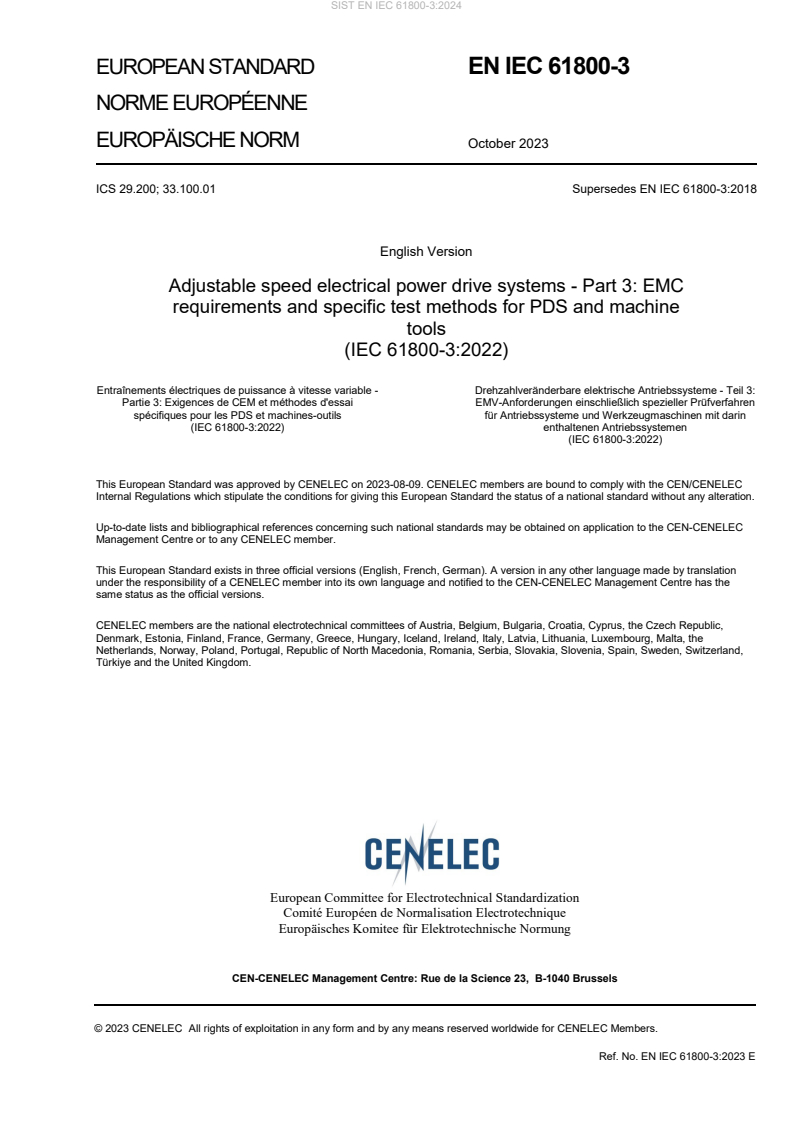
EUROPEAN STANDARD EN IEC 61800-3
NORME EUROPÉENNE
EUROPÄISCHE NORM October 2023
ICS 29.200; 33.100.01 Supersedes EN IEC 61800-3:2018
English Version
Adjustable speed electrical power drive systems - Part 3: EMC
requirements and specific test methods for PDS and machine
tools
(IEC 61800-3:2022)
Entraînements électriques de puissance à vitesse variable - Drehzahlveränderbare elektrische Antriebssysteme - Teil 3:
Partie 3: Exigences de CEM et méthodes d'essai EMV-Anforderungen einschließlich spezieller Prüfverfahren
spécifiques pour les PDS et machines-outils für Antriebssysteme und Werkzeugmaschinen mit darin
(IEC 61800-3:2022) enthaltenen Antriebssystemen
(IEC 61800-3:2022)
This European Standard was approved by CENELEC on 2023-08-09. CENELEC members are bound to comply with the CEN/CENELEC
Internal Regulations which stipulate the conditions for giving this European Standard the status of a national standard without any alteration.
Up-to-date lists and bibliographical references concerning such national standards may be obtained on application to the CEN-CENELEC
Management Centre or to any CENELEC member.
This European Standard exists in three official versions (English, French, German). A version in any other language made by translation
under the responsibility of a CENELEC member into its own language and notified to the CEN-CENELEC Management Centre has the
same status as the official versions.
CENELEC members are the national electrotechnical committees of Austria, Belgium, Bulgaria, Croatia, Cyprus, the Czech Republic,
Denmark, Estonia, Finland, France, Germany, Greece, Hungary, Iceland, Ireland, Italy, Latvia, Lithuania, Luxembourg, Malta, the
Netherlands, Norway, Poland, Portugal, Republic of North Macedonia, Romania, Serbia, Slovakia, Slovenia, Spain, Sweden, Switzerland,
Türkiye and the United Kingdom.
European Committee for Electrotechnical Standardization
Comité Européen de Normalisation Electrotechnique
Europäisches Komitee für Elektrotechnische Normung
CEN-CENELEC Management Centre: Rue de la Science 23, B-1040 Brussels
© 2023 CENELEC All rights of exploitation in any form and by any means reserved worldwide for CENELEC Members.
Ref. No. EN IEC 61800-3:2023 E
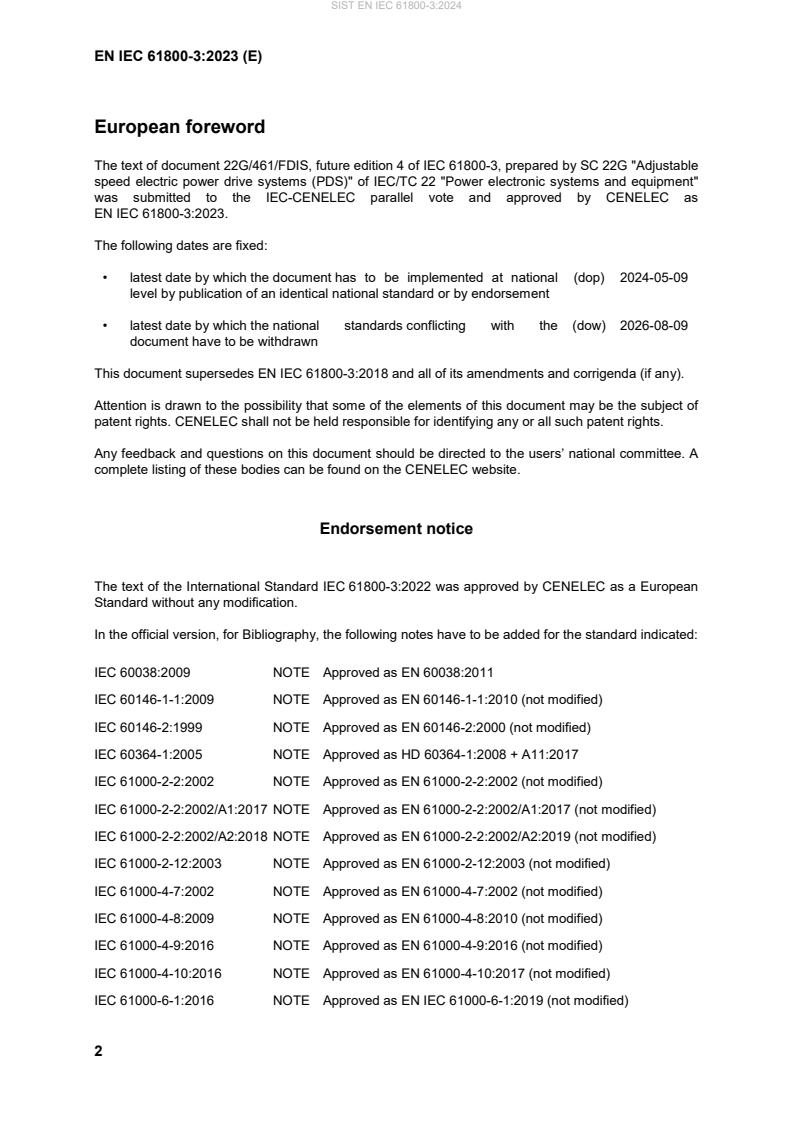
European foreword
The text of document 22G/461/FDIS, future edition 4 of IEC 61800-3, prepared by SC 22G "Adjustable
speed electric power drive systems (PDS)" of IEC/TC 22 "Power electronic systems and equipment"
was submitted to the IEC-CENELEC parallel vote and approved by CENELEC as
The following dates are fixed:
• latest date by which the document has to be implemented at national (dop) 2024-05-09
level by publication of an identical national standard or by endorsement
• latest date by which the national standards conflicting with the (dow) 2026-08-09
document have to be withdrawn
This document supersedes EN IEC 61800-3:2018 and all of its amendments and corrigenda (if any).
Attention is drawn to the possibility that some of the elements of this document may be the subject of
patent rights. CENELEC shall not be held responsible for identifying any or all such patent rights.
Any feedback and questions on this document should be directed to the users’ national committee. A
complete listing of these bodies can be found on the CENELEC website.
Endorsement notice
The text of the International Standard IEC 61800-3:2022 was approved by CENELEC as a European
Standard without any modification.
In the official version, for Bibliography, the following notes have to be added for the standard indicated:
IEC 60038:2009 NOTE Approved as EN 60038:2011
IEC 60146-1-1:2009 NOTE Approved as EN 60146-1-1:2010 (not modified)
IEC 60146-2:1999 NOTE Approved as EN 60146-2:2000 (not modified)
IEC 60364-1:2005 NOTE Approved as HD 60364-1:2008 + A11:2017
IEC 61000-2-2:2002 NOTE Approved as EN 61000-2-2:2002 (not modified)
IEC 61000-2-2:2002/A1:2017 NOTE Approved as EN 61000-2-2:2002/A1:2017 (not modified)
IEC 61000-2-2:2002/A2:2018 NOTE Approved as EN 61000-2-2:2002/A2:2019 (not modified)
IEC 61000-2-12:2003 NOTE Approved as EN 61000-2-12:2003 (not modified)
IEC 61000-4-7:2002 NOTE Approved as EN 61000-4-7:2002 (not modified)
IEC 61000-4-8:2009 NOTE Approved as EN 61000-4-8:2010 (not modified)
IEC 61000-4-9:2016 NOTE Approved as EN 61000-4-9:2016 (not modified)
IEC 61000-4-10:2016 NOTE Approved as EN 61000-4-10:2017 (not modified)
IEC 61000-6-1:2016 NOTE Approved as EN IEC 61000-6-1:2019 (not modified)
IEC 61000-6-2:2016 NOTE Approved as EN IEC 61000-6-2:2019 (not modified)
IEC 61000-6-3:2020 NOTE Approved as EN IEC 61000-6-3:2021 (not modified)
IEC 61000-6-4:2018 NOTE Approved as EN IEC 61000-6-4:2019 (not modified)
IEC 61000-6-5:2015 NOTE Approved as EN 61000-6-5:2015 (not modified)
IEC 61000-6-8:2020 NOTE Approved as EN IEC 61000-6-8:2020 (not modified)
IEC 61140:2016 NOTE Approved as EN 61140:2016 (not modified)
IEC 61557-8:2014 NOTE Approved as EN 61557-8:2015 (not modified)
Approved as EN IEC 61400-21-1:2019 (not modified)
IEC 61400-21-1:2019 NOTE
+ A11:2020
IEC 61557-9:2014 NOTE Approved as EN 61557-9:2015 (not modified)
IEC 61800-1:2021 NOTE Approved as EN IEC 61800-1:2021 (not modified)
IEC 61800-2:2021 NOTE Approved as EN IEC 61800-2:2021 (not modified)
IEC 61800-5-1:2007 NOTE Approved as EN 61800-5-1:2007 (not modified) + A11:2021
IEC 61800-5-1:2007/A1:2016 NOTE Approved as EN 61800-5-1:2007/A1:2017 (not modified)
CISPR 14-1:2020 NOTE Approved as EN IEC 55014-1:2021 (not modified)
CISPR 16-2-1:2014 NOTE Approved as EN 55016-2-1:2014 (not modified)
CISPR 16-2-1:2014/A1:2017 NOTE Approved as EN 55016-2-1:2014/A1:2017 (not modified)
CISPR 16-2-3:2016 NOTE Approved as EN 55016-2-3:2017 (not modified)
CISPR 16-2-3:2016/A1:2019 NOTE Approved as EN 55016-2-3:2017/A1:2019 (not modified)
IEC 60146-1-1:2009 NOTE Approved as EN 60146-1-1:2010 (not modified)
1 2
CISPR 11:— NOTE Approved as EN 55011:—
Under preparation. Stage at the time of publication: CISPR/NFDIS 11:2022.
Under preparation. Stage at the time of publication: prEN 55011:2023.
Annex ZA
(normative)
Normative references to international publications
with their corresponding European publications
The following documents are referred to in the text in such a way that some or all of their content
constitutes requirements of this document. For dated references, only the edition cited applies. For
undated references, the latest edition of the referenced document (including any amendments)
applies.
NOTE 1 Where an International Publication has been modified by common modifications, indicated by (mod),
the relevant EN/HD applies.
NOTE 2 Up-to-date information on the latest versions of the European Standards listed in this annex is available
here: www.cencenelec.eu.
Publication Year Title EN/HD Year
IEC 61000-2-4 2002 Electromagnetic compatibility (EMC) - Part 2-4: EN 61000-2-4 2002
Environment - Compatibility levels in industrial
plants for low-frequency conducted
disturbances
IEC 61000-3-2 2018 Electromagnetic compatibility (EMC) - Part 3-2: EN IEC 61000-3-2 2019
Limits - Limits for harmonic current emissions
(equipment input current ≤ 16 A per phase)
+ A1 2020 + A1 2021
IEC 61000-3-3 2013 Electromagnetic compatibility (EMC) - Part 3-3: EN 61000-3-3 2013
Limits - Limitation of voltage changes, voltage
fluctuations and flicker in public low-voltage
supply systems, for equipment with rated
current ≤ 16 A per phase and not subject to
conditional connection
+ A1 2017 + A1 2019
+ A2 2021 + A2 2021
IEC 61000-3-11 2017 Electromagnetic compatibility (EMC) - Part 3- EN IEC 61000-3-11 2019
11: Limits - Limitation of voltage changes,
voltage fluctuations and flicker in public low-
voltage supply systems - Equipment with rated
current ≤ 75 A and subject to conditional
connection
IEC 61000-3-12 2011 Electromagnetic compatibility (EMC) - Part 3- EN 61000-3-12 2011
12: Limits - Limits for harmonic currents
produced by equipment connected to public
low-voltage systems with input current >16 A
and ≤ 75 A per phase
+ A1 2021 - -
IEC 61000-4-2 2008 Electromagnetic compatibility (EMC) - Part 4-2: EN 61000-4-2 2009
Testing and measurement techniques -
Electrostatic discharge immunity test
Publication Year Title EN/HD Year
IEC 61000-4-3 2020 Electromagnetic compatibility (EMC) - Part 4-3 EN IEC 61000-4-3 2020
: Testing and measurement techniques -
Radiated, radio-frequency, electromagnetic
field immunity test
IEC 61000-4-4 2012 Electromagnetic compatibility (EMC) - Part 4-4: EN 61000-4-4 2012
Testing and measurement techniques -
Electrical fast transient/burst immunity test
IEC 61000-4-5 2014 Electromagnetic compatibility (EMC) - Part 4-5: EN 61000-4-5 2014
Testing and measurement techniques - Surge
immunity test
+ A1 2017 + A1 2017
IEC 61000-4-6 2013 Electromagnetic compatibility (EMC) - Part 4-6: EN 61000-4-6 2014
Testing and measurement techniques -
Immunity to conducted disturbances, induced
by radio-frequency fields
IEC 61000-4-11 2020 Electromagnetic compatibility (EMC) - Part 4- EN IEC 61000-4-11 2020
11: Testing and measurement techniques -
Voltage dips, short interruptions and voltage
variations immunity tests for equipment with
input current up to 16 A per phase
IEC 61000-4-13 2002 Electromagnetic compatibility (EMC) - Part 4- EN 61000-4-13 2002
13: Testing and measurement techniques -
Harmonics and interharmonics including mains
signalling at a.c. power port, low frequency
immunity tests
+ A1 2009 + A1 2009
+ A2 2015 + A2 2016
IEC 61000-4-28 1999 Electromagnetic compatibility (EMC) - Part 4- EN 61000-4-28 2000
28: Testing and measurement techniques -
Variation of power frequency, immunity test
+ A1 2001 + A1 2004
+ A2 2009 + A2 2009
IEC 61000-4-34 2005 Electromagnetic compatibility (EMC) - Part 4- EN 61000-4-34 2007
34: Testing and measurement techniques -
Voltage dips, short interruptions and voltage
variations immunity tests for equipment with
input current more than 16 A per phase
+ A1 2009 + A1 2009
CISPR 11 (mod) 2015 Industrial, scientific and medical equipment - EN 55011 2016
Radio-frequency disturbance characteristics -
Limits and methods of measurement
+ A1 2016 + A1 2017
- - + A11 2020
+ A2 2019 + A2 2021
Publication Year Title EN/HD Year
CISPR 16-1-2 2014 Specification for radio disturbance and EN 55016-1-2 2014
immunity measuring apparatus and methods -
Part 1-2: Radio disturbance and immunity
measuring apparatus - Coupling devices for
conducted disturbance measurements
+ A1 2017 + A1 2018
CISPR 16-1-4 2019 Specification for radio disturbance and EN IEC 55016-1-4 2019
immunity measuring apparatus and methods -
Part 1-4: Radio disturbance and immunity
measuring apparatus - Antennas and test sites
for radiated disturbance measurements
+ A1 2020 + A1 2020
CISPR 32 2015 Electromagnetic compatibility of multimedia EN 55032 2015
equipment - Emission requirements
+ A1 2019 + A1 2020
- - + A11 2020
IEC 61800-3 ®
Edition 4.0 2022-11
INTERNATIONAL
STANDARD
NORME
INTERNATIONALE
colour
inside
Adjustable speed electrical power drive systems –
Part 3: EMC requirements and specific test methods for PDS and machine tools
Entraînements électriques de puissance à vitesse variable –
Partie 3: Exigences de CEM et méthodes d’essai spécifiques pour les PDS et
machines-outils
INTERNATIONAL
ELECTROTECHNICAL
COMMISSION
COMMISSION
ELECTROTECHNIQUE
INTERNATIONALE
ICS 29.200; 33.100.01 ISBN 978-2-8322-6059-3
– 2 – IEC 61800-3:2022 © IEC 2022
CONTENTS
FOREWORD . 7
1 Scope . 9
2 Normative references . 10
3 Terms and definitions . 11
3.1 Content of the power drive system (PDS) and its installation . 12
3.2 Content of the machine tool (MT) and its installation . 13
3.3 Locations and equipment categories . 14
3.4 Ports and interfaces . 15
3.5 Components of the PDS . 19
3.6 Test-related definitions . 20
3.7 Phenomena-related definitions . 21
4 Common requirements. 25
4.1 General conditions . 25
4.2 Tests . 26
4.2.1 Conditions . 26
4.2.2 Test report . 27
4.3 Documentation for the user . 27
5 Immunity requirements . 27
5.1 General conditions . 27
5.1.1 Performance (acceptance) criteria . 27
5.1.2 Conditions during the test . 29
5.2 Basic immunity requirements – Low-frequency (< 150 kHz) disturbances . 30
5.2.1 Harmonics . 30
5.2.2 Voltage dips and short interruptions . 32
5.2.3 Frequency variations . 34
5.2.4 Supply influences – Magnetic fields . 35
5.3 Basic immunity requirements – High-frequency (≥ 150 kHz) disturbances . 36
5.3.1 Conditions . 36
5.3.2 Residential, commercial and light industrial environment . 36
5.3.3 Industrial environment . 37
5.4 Application of immunity requirements – Alternative verification methods . 39
5.4.1 General . 39
5.4.2 Simulation and calculation of harmonics . 40
5.4.3 Alternative verification methods for voltage dips and short interruptions . 40
5.4.4 Frequency variations . 40
5.4.5 Immunity against electromagnetic fields by subcomponents testing . 40
6 Emission. 41
6.1 General emission requirements . 41
6.2 General emission requirements for MT . 41
6.3 Basic low-frequency (< 150 kHz) emission limits . 41
6.3.1 Harmonics and interharmonics . 41
6.3.2 Voltage fluctuations and flicker . 42
6.3.3 Emissions in the frequency range from 2 kHz to 150 kHz . 43
6.3.4 Common mode harmonic emission (low-frequency common mode
voltage) . 43
6.4 Conditions related to high-frequency (≥ 150 kHz) emission measurement . 43
6.4.1 General requirements for measurements on a test site . 43
IEC 61800-3:2022 © IEC 2022 – 3 –
6.4.2 Application of emission limits above 1 GHz . 50
6.4.3 Connection requirements . 50
6.4.4 Measurements requirements when a standard setup is not used . 50
6.5 Basic high-frequency emission limits . 51
6.5.1 EUT of categories C1 and C2 . 51
6.5.2 EUT of category C3 . 53
6.6 Engineering practice . 54
6.6.1 EUT of category C4 . 54
6.6.2 General conditions . 55
6.6.3 Filtering in IT power supply systems . 55
6.6.4 Limits outside the boundary of an installation, for an EUT of category
C4 – Example of propagation of disturbances . 56
Annex A (informative) EMC techniques . 59
A.1 Application of PDSs and EMC . 59
A.2 Load conditions regarding high-frequency phenomena . 59
A.2.1 Load conditions during emission tests . 59
A.2.2 Load conditions during immunity tests . 60
A.2.3 Load test . 60
A.3 Immunity to electromagnetic fields . 60
A.3.1 Immunity to power frequency magnetic fields . 60
A.3.2 Immunity to high frequency conducted disturbances . 60
A.3.3 Immunity to high frequency fields . 61
A.4 High-frequency emission measurement techniques . 62
A.4.1 Impedance/artificial mains network (AMN) . 62
A.4.2 Performing high-frequency in-situ emission tests . 64
A.4.3 Established experience with high power EUTs . 64
Annex B (informative) Low-frequency phenomena . 65
B.1 Commutation notches . 65
B.1.1 Evaluation conditions . 65
B.1.2 Occurrence – Description . 65
B.1.3 Calculation . 68
B.1.4 Recommendations regarding commutation notches . 69
B.2 Definitions related to harmonics and interharmonics . 70
B.2.1 General discussion . 70
B.2.2 Conditions of application. 71
B.3 Application of harmonic emission standards . 75
B.3.1 General . 75
B.3.2 Public networks . 75
B.3.3 Summation methods for harmonics in an installation – Practical rules . 80
B.4 Installation rules – Assessment of harmonic compatibility . 82
B.4.1 Low power industrial three-phase system . 82
B.4.2 Large industrial system . 85
B.4.3 Interharmonics and voltages or currents at higher frequencies . 87
B.5 Voltage unbalance . 87
B.5.1 Origin . 87
B.5.2 Definition and assessment . 88
B.5.3 Effect on BDM/CDM/PDS/MTs . 90
B.6 Voltage dips – Voltage fluctuations . 90
B.6.1 Voltage dips . 90
– 4 – IEC 61800-3:2022 © IEC 2022
B.6.2 Voltage fluctuation . 92
Annex C (informative) Reactive power compensation – Filtering . 93
C.1 Installation . 93
C.1.1 Usual operation . 93
C.1.2 Power definitions under distorted conditions . 93
C.1.3 Practical solutions . 94
C.1.4 Reactive power compensation . 95
C.1.5 Filtering methods . 99
C.2 Reactive power and harmonics . 101
C.2.1 Usual installation mitigation methods . 101
C.2.2 Other solutions . 103
Annex D (informative) Considerations on high-frequency emission . 107
D.1 User guidelines . 107
D.1.1 Expected emission of BDM/CDM/PDS/MTs . 107
D.1.2 Guidelines . 109
D.2 Safety and RFI-filtering in power supply systems . 111
D.2.1 Safety and leakage currents . 111
D.2.2 Safety and RFI-filtering in power supply systems isolated from earth . 111
Annex E (informative) EMC analysis and EMC plan for EUTs of category C4 . 113
E.1 General – System EMC analysis applied to EUTs . 113
E.1.1 Electromagnetic environment . 113
E.1.2 System EMC analysis techniques . 114
E.2 Example of EMC plan . 116
E.2.1 Project data and description . 116
E.2.2 Electromagnetic environment analysis . 116
E.2.3 EMC analysis. 117
E.2.4 Establishment of installation rules . 118
E.2.5 Formal result and maintenance . 119
E.3 Example of supplement to EMC plan for particular application . 120
E.3.1 Electromagnetic environment complementary analysis . 120
E.3.2 EMC analysis. 121
Bibliography . 123
Figure 1 – Content of the PDS and its installation . 12
Figure 2 – Content of the MT and its installation . 13
Figure 3 – Internal interfaces of the PDS and examples of ports . 17
Figure 4 – Internal interfaces of the MT and examples for ports . 17
Figure 5 – Power interfaces of a PDS with common DC link . 18
Figure 6 – Power interfaces with common input transformer . 19
Figure 7 – Example for a typical cable arrangement for measurements in 3 m
separation distance, for a table-top or wall-mounted equipment, top view . 46
Figure 8 – Example for a typical cable arrangement for measurements in 3 m
separation distance for a table-top or wall-mounted equipment, side view . 47
Figure 9 – Example for a typical test set up for measurement of conducted and/or
radiated disturbances from a floor-standing PDS, 3D view . 48
Figure 10 – Typical arrangement for measurement of radiated disturbances from an MT
(top view) . 49
Figure 11 – Propagation of disturbances . 56
IEC 61800-3:2022 © IEC 2022 – 5 –
Figure 12 – Propagation of disturbances in installation with an EUT rated > 1 000 V. 57
Figure B.1 – Typical waveform of commutation notches – Distinction from non-
repetitive transient . 66
Figure B.2 – PCC, IPC, installation current ratio and R . 73
SI
Figure B.3 – PCC, IPC, installation current ratio and R . 74
SC
Figure B.4 – Assessment of the harmonic emission of an EUT . 77
Figure B.5 – Test set-up with mechanical load . 78
Figure B.6 – Test set-up with electrical load replacing the loaded motor . 78
Figure B.7 – Test set-up with resistive load . 79
Figure B.8 – Assessment of harmonic emission where EUT is used (apparatus,
systems or installations) . 84
Figure C.1 – Reactive power compensation . 96
Figure C.2 – Simplified diagram of an industrial network . 98
Figure C.3 – Impedance versus frequency of the simplified network . 98
Figure C.4 – Example of passive filter battery . 100
Figure C.5 – Example of inadequate solution in reactive power compensation . 102
Figure C.6 – VSI PWM active filter topologies . 104
Figure C.7 – Boost mode converter . 104
Figure C.8 – Front-end inverter system . 105
Figure D.1 – Conducted emission of various unfiltered EUTs . 108
Figure D.2 – Expected radiated emission of EUT up to rated voltage 400 V – Peak
values normalised at 10 m . 109
Figure D.3 – Safety and filtering. 112
Figure E.1 – Interaction between systems and EM environment . 113
Figure E.2 – Zone concept . 114
Figure E.3 – Example of drive . 115
Table 1 – Criteria to prove the acceptance of a BDM, CDM or PDS against
electromagnetic disturbances . 28
Table 2 – Criteria to prove the acceptance of an MT against electromagnetic
disturbances . 29
Table 3 – Minimum immunity requirements for individual harmonic orders on AC power
ports of low voltage EUT . 31
Table 4 – Minimum immunity requirements for harmonics on AC main power ports of
EUTs of rated voltage above 1 000 V . 32
Table 5 – Minimum immunity requirements for voltage dips and short interruptions on
AC power ports of low voltage EUTs . 32
Table 6 – Minimum immunity requirements for dips and short interruptions on AC main
power ports of rated voltage above 1 000 V of EUTs . 33
Table 7 – Minimum immunity requirements for dips and short interruptions on low
voltage AC auxiliary power ports of EUTs . 34
Table 8 – Minimum immunity requirements for frequency variations on AC power ports
of low voltage EUTs . 34
Table 9 – Minimum immunity requirements for frequency variations on AC main power
ports of rated voltage above 1 000 V of EUTs . 35
Table 10 – Minimum immunity requirements for frequency variations on auxiliary AC
low voltage power ports of EUTs . 35
– 6 – IEC 61800-3:2022 © IEC 2022
Table 11 – Minimum immunity requirements for EUTs intended for use in a residential,
commercial or light industrial location . 36
Table 12 – Minimum immunity requirements for EUTs intended for use in an industrial
location . 38
Table 13 – Approach to type-test assessment of different MT configurations . 41
Table 14 – Required highest frequency for radiated measurement . 50
Table 15 – Limits for mains terminal disturbance voltage in the frequency band
150 kHz to 30 MHz – Categories C1 and C2 . 51
Table 16 – Limits for electromagnetic radiation disturbance in the frequency band
30 MHz to 6 000 MHz – Categories C1 and C2 . 52
Table 17 – Limits of disturbance voltage on the power interface in a residential,
commercial or light industrial location . 52
Table 18 – Limits for mains terminal disturbance voltage in the frequency band
150 kHz to 30 MHz – Category C3 . 53
Table 19 – Limits for electromagnetic radiation disturbance in the frequency band
30 MHz to 6 000 MHz – Category C3 . 54
Table 20 – Limits for propagated disturbance voltage ("outside" in a residential
location) . 57
Table 21 – Limits for propagated disturbance voltage ("outside" in a non-residential
location) . 57
Table 22 – Limits for propagated electromagnetic disturbance above 30 MHz . 58
Table 23 – Limits for electromagnetic disturbance below 30 MHz . 58
Table B.1 – Maximum allowable depth of commutation notches at the PC . 69
Table B.2 – Recommended immunity requirements for commutation notches on power
ports of EUTs . 70
Table B.3 – Harmonic current emission requirements relative to the total current of the
agreed power at the PCC or IPC . 86
Table E.1 – EM interaction between subsystems and environment . 115
Table E.2 – Frequency analysis . 122
IEC 61800-3:2022 © IEC 2022 – 7 –
INTERNATIONAL ELECTROTECHNICAL COMMISSION
____________
ADJUSTABLE SPEED ELECTRICAL
POWER DRIVE SYSTEMS –
Part 3: EMC requirements and specific test methods
for PDS and machine tools
FOREWORD
1) The International Electrotechnical Commission (IEC) is a worldwide organization for standardization comprising
all national electrotechnical committees (IEC National Committees). The object of IEC is to promote international
co-operation on all questions concerning standardization in the electrical and electronic fields. To this end and
in addition to other activities, IEC publishes International Standards, Technical Specifications, Technical Reports,
Publicly Available Specifications (PAS) and Guides (hereafter referred to as "IEC Publication(s)"). Their
preparation is entrusted to technical committees; any IEC National Committee interested in the subject dealt with
may participate in this preparatory work. International, governmental and non-governmental organizations liaising
with the IEC also participate in this preparation. IEC collaborates closely with the International Organization for
Standardization (ISO) in accordance with conditions determined by agreement between the two organizations.
2) The formal decisions or agreements of IEC on technical matters express, as nearly as possible, an international
consensus of opinion on the relevant subjects since each technical committee has representation from all
interested IEC National Committees.
3) IEC Publications have the form of recommendations for international use and are accepted by IEC National
Committees in that sense. While all reasonable efforts are made to ensure that the technical content of IEC
Publications is accurate, IEC cannot be held responsible for the way in which they are used or for any
misinterpretation by any end user.
4) In order to promote international uniformity, IEC National Committees undertake to apply IEC Publications
transparently to the maximum extent possible in their national and regional publications. Any divergence between
any IEC Publication and the corresponding national or regional publication shall be clearly indicated in the latter.
5) IEC itself does not provide any attestation of conformity. Independent certification bodies provide conformity
assessment services and, in some areas, access to IEC marks of conformity. IEC is not responsible for any
services carried out by independent certification bodies.
6) All users should ensure that they have the latest edition of this publication.
7) No liability shall attach to IEC or its directors, employees, servants or agents including individual experts and
members of its technical committees and IEC National Committees for any personal injury, property damage or
other damage of any nature whatsoever, whether direct or indirect, or for costs (including legal fees) and
expenses arising out of the publication, use of, or reliance upon, this IEC Publication or any other IEC
Publications.
8) Attention is drawn to the Normative references cited in this publication. Use of the referenced publications is
indispensable for the correct application of this publication.
9) Attention is drawn to the possibility that some of the elements of this IEC Publication may be the subject of patent
rights. IEC shall not be held responsible for identifying any or all such patent rights.
IEC 61800-3 has been prepared by subcommittee 22G: Adjustable speed electric power drive
systems (PDS), of IEC technical committee 22: Power electronic systems and equipment. It is
an International Standard.
It has the status of a product EMC standard in accordance with IEC Guide 107.
This fourth edition cancels and replaces the third edition published in 2017. This edition
constitutes a technical revision.
This edition includes the following significant technical changes with respect to the previous
edition:
a) extension of the scope to machine tools with one or more embedded PDS;
b) extension of the frequency range for radiated immunity tests to 6 GHz;
c) general updates in the normative part and the informative annexes.
– 8 – IEC 61800-3:2022 © IEC 2022
The text of this International Standard is based on the following documents:
Draft Report on voting
22G/461/FDIS 22G/466/RVD
Full information on the voting for its approval can be found in the report on voting indicated in
the above table.
The language used for the development of this International Standard is English.
This document was drafted in accordance with ISO/IEC Directives, Part 2, and developed in
accordance with ISO/IEC Directives, Part 1 and ISO/IEC Directives, IEC Supplement, available
at www.iec.ch/members_experts/refdocs. The main document types developed by IEC are
described in greater detail at www.iec.ch/publications.
A list of all parts in the IEC 61800 series, published under the general title Adjustable speed
electrical power drive systems, can be found on the IEC website.
The committee has decided that the contents of this document will remain unchanged until the
stability date indicated on the IEC website under https://webstore.iec.ch in the data related to
the specific document. At this date, the document will be
• reconfirmed,
• withdrawn,
• replaced by a revised edition, or
• amended.
IMPORTANT – The "colour inside" logo on the cover page of this document indicates that it
contains colours which are considered to be useful for the correct understanding of its
contents. Users should therefore print this document using a colour printer.
IEC 61800-3:2022 © IEC 2022 – 9 –
ADJUSTABLE SPEED ELECTRICAL
POWER DRIVE SYSTEMS –
Part 3: EMC requirements and specific test methods
for PDS and machine tools
1 Scope
This part of IEC 61800 specifies electromagnetic compatibility (EMC) requi
...