

prEN 50288-7
(Main)Multi-element metallic cables used in analogue and digital communication and control - Part 7: Sectional specification for instrumentation and control cables
General Information
- Abstract
This document covers multi-element metallic cables suitable for connecting instruments and control systems for analogue or digital signal transmission used in industrial processes carried out in commercial and industrial premises including cables that could be specified for use in Automated Infrastructure Management applications. They could be screened and optionally incorporate armouring and/or moisture or environmental protection layers. The cables are expected to have a mechanically robust construction and electrical transmission handling properties. The electrical, mechanical, transmission and environmental performance characteristics of the cables, related to their reference test methods are detailed in this specification. This sectional specification is to be read in conjunction with EN 50288-1:2013, which contains the essential provisions for its application. Cables covered by this document have maximum rated voltages U0 of 90 V AC, 300 V AC or 500 V AC. Multi-element cables for use in analogue, digital and control circuits are not designed to be used for power supply or to be connected directly to mains electricity supply or other low impedance sources. NOTE These cables are expected to be installed in accordance with the applicable local and national regulations. According to Annex 1 of mandate M/443 EN, depending upon the installation and application these cables might not necessarily fall under the regulation of EN 50575:2014+ A1:2016. Cables intended to have circuit integrity under fire conditions are covered by EN 50288-7-1. Thermocouple extension and compensating cables are covered by EN 50288-7-2.
- Status
- Not Published
- Technical Committee
- CLC/TC 46X - Communication cables
- Drafting Committee
- CLC/SC 46XC - Multicore, Multipair and Quad Data communication cables
- Current Stage
- 1000 - Registration for evaluation of IEC RD, Vila Notification, concrete work of CLC member / TC - Evaluation of concrete proposal
- Start Date
- 20-Oct-2022
- Completion Date
- 25-Aug-2026

Overview
The prEN 50288-7 standard, developed by the CLC (European Committee for Electrotechnical Standardization), provides a sectional specification for multi-element metallic cables designed for instrumentation and control applications. These cables are suitable for analogue and digital signal transmission within industrial and commercial environments. They support reliable connection of instruments and control systems used in complex industrial processes, including applications within automated infrastructure management.
This standard is essential for manufacturers, designers, and users of instrumentation and control cables, ensuring the cables meet robust mechanical and electrical performance criteria, including environmental resistance.
Key Topics
Cable Types and Construction
prEN 50288-7 specifies cables that may include screening, armouring, and moisture/environmental protection layers, providing mechanical robustness and enhanced electrical transmission properties.Voltage Ratings and Usage
The cables are rated for maximum voltages of 90 V AC, 300 V AC, or 500 V AC and are not designed for direct connection to mains electricity or low impedance power sources.Materials and Insulation
Insulation materials include PVC, polyethylene, polypropylene, cross-linked polyethylene, halogen-free flame retardant compounds, and silicone rubber (under consideration). The insulation thickness and concentricity requirements ensure reliable performance and safety.Performance Requirements
The standard details test methods and performance criteria covering electrical, mechanical, transmission, environmental, and fire resistance characteristics. It also addresses the importance of circuit integrity under fire conditions.Installation and Compliance
These cables must be installed per applicable local and national regulations. The standard supplements EN 50288-1:2013, which contains generic specifications essential for application, and it may interface with regulations like EN 50575:2014 depending on installation specifics.
Applications
Industrial Process Control
Connecting control systems and instrumentation within commercial and industrial premises with reliable analogue or digital signal transmission.Automated Infrastructure Management (AIM)
The specification accommodates cables suited for AIM systems, where signal integrity and environmental protection are critical.Fire-Resistant Circuits
Subsets of cables in this standard ensure circuit integrity during fire events for safety-critical control and instrumentation circuits.Harsh Environmental Conditions
Equipped with armouring and moisture protection layers, these cables are suitable for demanding environments requiring mechanical robustness and protection against chemical or environmental factors.
Related Standards
EN 50288-1:2013
Generic specification for multi-element metallic cables, forming the foundational provisions required alongside prEN 50288-7.EN 50575:2014 + A1:2016
Regulates construction products in the EU; certain prEN 50288-7 cables may fall outside this regulation depending on installation.EN 50288-7-1 and EN 50288-7-2
Cover cables designed for circuit integrity under fire and thermocouple extension/compensating cables, respectively.EN 60228
Defines conductor classes and resistance requirements, critical for conductor specifications in instrumentation cables.EN 50290 Series
Specifies cable materials and insulation standards relevant to the requirements of prEN 50288-7.IEC 60332 and IEC 60331 Series
Details fire test methods ensuring cables meet flame propagation and circuit integrity criteria.
Practical Value
Adoption of prEN 50288-7 helps ensure that instrumentation and control cables used in industrial applications meet stringent European standards for safety, reliability, and performance. The specification supports manufacturers and users to:
- Design cables that withstand mechanical stress, environmental challenges, and electrical demands.
- Comply with legal safety requirements and harmonize installation practices across Europe.
- Enhance process control reliability through improved cable screening and protection.
- Select appropriate cable types with confidence based on thorough testing protocols.
This standard is a critical reference point for engineers, product developers, and procurement teams tasked with ensuring integrity and performance in analogue and digital instrumentation wiring solutions.
Relations
- Effective Date
- 08-Nov-2022
Get Certified
Connect with accredited certification bodies for this standard

ANCE
Mexican certification and testing association.

Intertek Slovenia
Intertek testing, inspection, and certification services in Slovenia.

LNE (Laboratoire National de Métrologie et d'Essais)
French national laboratory for metrology and testing.
Sponsored listings
Frequently Asked Questions
prEN 50288-7 is a draft published by CLC. Its full title is "Multi-element metallic cables used in analogue and digital communication and control - Part 7: Sectional specification for instrumentation and control cables". This standard covers: This document covers multi-element metallic cables suitable for connecting instruments and control systems for analogue or digital signal transmission used in industrial processes carried out in commercial and industrial premises including cables that could be specified for use in Automated Infrastructure Management applications. They could be screened and optionally incorporate armouring and/or moisture or environmental protection layers. The cables are expected to have a mechanically robust construction and electrical transmission handling properties. The electrical, mechanical, transmission and environmental performance characteristics of the cables, related to their reference test methods are detailed in this specification. This sectional specification is to be read in conjunction with EN 50288-1:2013, which contains the essential provisions for its application. Cables covered by this document have maximum rated voltages U0 of 90 V AC, 300 V AC or 500 V AC. Multi-element cables for use in analogue, digital and control circuits are not designed to be used for power supply or to be connected directly to mains electricity supply or other low impedance sources. NOTE These cables are expected to be installed in accordance with the applicable local and national regulations. According to Annex 1 of mandate M/443 EN, depending upon the installation and application these cables might not necessarily fall under the regulation of EN 50575:2014+ A1:2016. Cables intended to have circuit integrity under fire conditions are covered by EN 50288-7-1. Thermocouple extension and compensating cables are covered by EN 50288-7-2.
This document covers multi-element metallic cables suitable for connecting instruments and control systems for analogue or digital signal transmission used in industrial processes carried out in commercial and industrial premises including cables that could be specified for use in Automated Infrastructure Management applications. They could be screened and optionally incorporate armouring and/or moisture or environmental protection layers. The cables are expected to have a mechanically robust construction and electrical transmission handling properties. The electrical, mechanical, transmission and environmental performance characteristics of the cables, related to their reference test methods are detailed in this specification. This sectional specification is to be read in conjunction with EN 50288-1:2013, which contains the essential provisions for its application. Cables covered by this document have maximum rated voltages U0 of 90 V AC, 300 V AC or 500 V AC. Multi-element cables for use in analogue, digital and control circuits are not designed to be used for power supply or to be connected directly to mains electricity supply or other low impedance sources. NOTE These cables are expected to be installed in accordance with the applicable local and national regulations. According to Annex 1 of mandate M/443 EN, depending upon the installation and application these cables might not necessarily fall under the regulation of EN 50575:2014+ A1:2016. Cables intended to have circuit integrity under fire conditions are covered by EN 50288-7-1. Thermocouple extension and compensating cables are covered by EN 50288-7-2.
prEN 50288-7 is classified under the following ICS (International Classification for Standards) categories: 33.120.10 - Coaxial cables. Waveguides. The ICS classification helps identify the subject area and facilitates finding related standards.
prEN 50288-7 has the following relationships with other standards: It is inter standard links to EN 50288-7:2005. Understanding these relationships helps ensure you are using the most current and applicable version of the standard.
prEN 50288-7 is associated with the following European legislation: EU Directives/Regulations: 2014/35/EU; Standardization Mandates: M/511. When a standard is cited in the Official Journal of the European Union, products manufactured in conformity with it benefit from a presumption of conformity with the essential requirements of the corresponding EU directive or regulation.
prEN 50288-7 is available in PDF format for immediate download after purchase. The document can be added to your cart and obtained through the secure checkout process. Digital delivery ensures instant access to the complete standard document.
Standards Content (Sample)
SLOVENSKI STANDARD
01-februar-2021
Večelementni kovinski kabli za analogne in digitalne komunikacije in krmiljenje - 7.
del: Področna specifikacija za instrumentne in krmilne kable
Multi-element metallic cables used in analogue and digital communication and control -
Part 7: Sectional specification for instrumentation and control cables
Mehradrige metallische Daten- und Kontrollkabel für analoge und digitale Übertragung -
Teil 7: Rahmenspezifikation für Instrumenten- und Kontrollkabel
Câbles métalliques à éléments multiples utilisés pour les transmissions et les
commandes analogiques et numériques - Partie 7: Spécification intermédiaire pour les
câbles d’instrumentation et de contrôle
Ta slovenski standard je istoveten z: prEN 50288-7
ICS:
33.120.20 Žice in simetrični kabli Wires and symmetrical
cables
2003-01.Slovenski inštitut za standardizacijo. Razmnoževanje celote ali delov tega standarda ni dovoljeno.
EUROPEAN STANDARD DRAFT
NORME EUROPÉENNE
EUROPÄISCHE NORM
December 2020
ICS 33.120.10 Will supersede EN 50288-7:2005 and all of its
amendments and corrigenda (if any)
English Version
Multi-element metallic cables used in analogue and digital
communication and control - Part 7: Sectional specification for
instrumentation and control cables
Câbles métalliques à éléments multiples utilisés pour les Mehradrige metallische Daten- und Kontrollkabel für
transmissions et les commandes analogiques et analoge und digitale Übertragung - Teil 7:
numériques - Partie 7: Spécification intermédiaire pour les Rahmenspezifikation für Instrumenten- und Kontrollkabel
câbles d'instrumentation et de contrôle
This draft European Standard is submitted to CENELEC members for enquiry.
Deadline for CENELEC: 2021-02-26.
It has been drawn up by CLC/SC 46XC.
If this draft becomes a European Standard, CENELEC members are bound to comply with the CEN/CENELEC Internal Regulations which
stipulate the conditions for giving this European Standard the status of a national standard without any alteration.
This draft European Standard was established by CENELEC in three official versions (English, French, German).
A version in any other language made by translation under the responsibility of a CENELEC member into its own language and notified to
the CEN-CENELEC Management Centre has the same status as the official versions.
CENELEC members are the national electrotechnical committees of Austria, Belgium, Bulgaria, Croatia, Cyprus, the Czech Republic,
Denmark, Estonia, Finland, France, Germany, Greece, Hungary, Iceland, Ireland, Italy, Latvia, Lithuania, Luxembourg, Malta, the
Netherlands, Norway, Poland, Portugal, Republic of North Macedonia, Romania, Serbia, Slovakia, Slovenia, Spain, Sweden, Switzerland,
Turkey and the United Kingdom.
Recipients of this draft are invited to submit, with their comments, notification of any relevant patent rights of which they are aware and to
provide supporting documentation.
Warning : This document is not a European Standard. It is distributed for review and comments. It is subject to change without notice and
shall not be referred to as a European Standard.
European Committee for Electrotechnical Standardization
Comité Européen de Normalisation Electrotechnique
Europäisches Komitee für Elektrotechnische Normung
CEN-CENELEC Management Centre: Rue de la Science 23, B-1040 Brussels
© 2020 CENELEC All rights of exploitation in any form and by any means reserved worldwide for CENELEC Members.
Project: 67768 Ref. No. prEN 50288-7 E
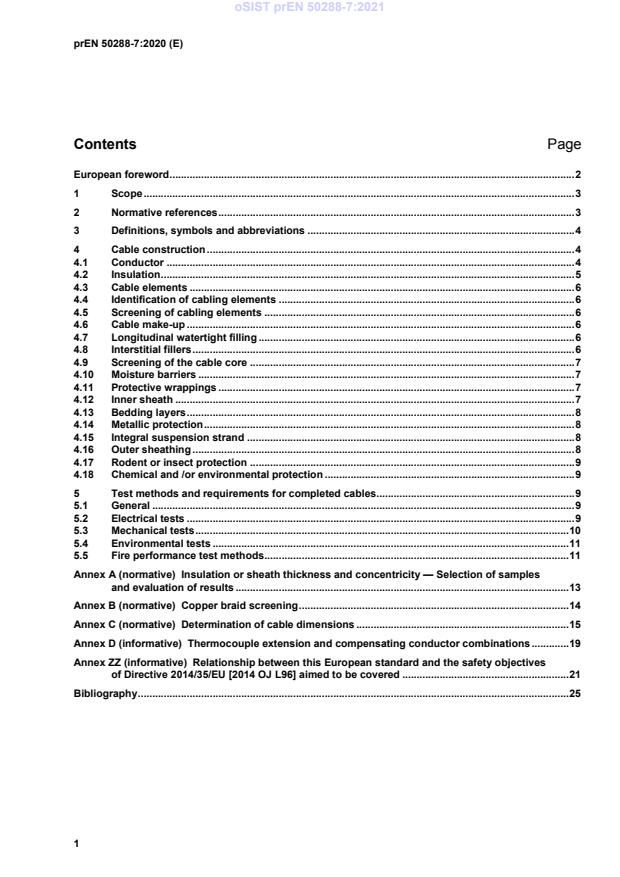
Contents Page
European foreword . 2
1 Scope . 3
2 Normative references . 3
3 Definitions, symbols and abbreviations . 4
4 Cable construction . 4
4.1 Conductor . 4
4.2 Insulation . 5
4.3 Cable elements . 6
4.4 Identification of cabling elements . 6
4.5 Screening of cabling elements . 6
4.6 Cable make-up . 6
4.7 Longitudinal watertight filling . 6
4.8 Interstitial fillers . 6
4.9 Screening of the cable core . 7
4.10 Moisture barriers . 7
4.11 Protective wrappings . 7
4.12 Inner sheath . 7
4.13 Bedding layers . 8
4.14 Metallic protection . 8
4.15 Integral suspension strand . 8
4.16 Outer sheathing . 8
4.17 Rodent or insect protection . 9
4.18 Chemical and /or environmental protection . 9
5 Test methods and requirements for completed cables. 9
5.1 General . 9
5.2 Electrical tests . 9
5.3 Mechanical tests . 10
5.4 Environmental tests . 11
5.5 Fire performance test methods . 11
Annex A (normative) Insulation or sheath thickness and concentricity — Selection of samples
and evaluation of results . 13
Annex B (normative) Copper braid screening . 14
Annex C (normative) Determination of cable dimensions . 15
Annex D (informative) Thermocouple extension and compensating conductor combinations . 19
Annex ZZ (informative) Relationship between this European standard and the safety objectives
of Directive 2014/35/EU [2014 OJ L96] aimed to be covered . 21
Bibliography . 25
European foreword
This document (prEN 50288-7:2020) has been prepared by SC46XC, “Multicore, multipair and quad data
communication cables”, of Technical Committee CENELEC TC 46X, “Communication cables”.
This document is currently submitted to the Enquiry.
The following dates are proposed:
• latest date by which the existence of this (doa) dor + 6 months
document has to be announced at national
level
• latest date by which this document has to be (dop) dor + 12 months
implemented at national level by publication of
an identical national standard or by
endorsement
• latest date by which the national standards (dow) dor + 36 months
conflicting with this document have to be (to be confirmed or
withdrawn modified when voting)
This document will supersede EN 50288-7:2005 and all of its amendments and corrigenda (if any).
This document has been prepared under a mandate given to CENELEC by the European Commission and the
European Free Trade Association, and supports essential requirements of EU Directive(s).
For the relationship with EU Directive(s) see informative Annex ZZ, which is an integral part of this document.
This document is to be read in conjunction with EN 50288-1, which contains the essential provisions for its
application.
LVD additions highlighted
1 Scope
This document covers multi-element cables suitable for connecting instruments and control systems for
analogue or digital signal transmission used in industrial processes carried out in commercial and industrial
premises including cables that could be specified for use in Automated Infrastructure Management applications.
They could be screened and optionally incorporate armouring and/or moisture or environmental protection
layers.
The cables are expected to have a mechanically robust construction and electrical transmission handling
properties. The electrical, mechanical, transmission and environmental performance characteristics of the
cables, related to their reference test methods are detailed in this specification.
Cables covered by this document have maximum rated voltages of 300 V or 500 V a.c.
Multi-element cables for use in analogue, digital and control circuits are not designed to be used for power
supply or to be connected directly to mains electricity supply or other low impedance sources.
NOTE These cables are expected to be installed in accordance with the applicable local and national regulations.
According to Annex 1 of mandate M/443 EN, depending upon the installation and application these cables might
not necessarily fall under the regulation of EN 50575.
Cables intended to have circuit integrity in a fire are covered by this document.
There could be occasions when cables are required to have higher operating temperature ratings than those
provided by using materials specified by the EN 50290 series. Suitable alternative materials are under
consideration.
2 Normative references
The following documents are referred to in the text in such a way that some or all of their content constitutes
requirements of this document. For dated references, only the edition cited applies. For undated references, the
latest edition of the referenced document (including any amendments) applies.
EN 10218-1, Steel wire and wire products - General - Part 1: Test methods
EN 10244-2, Steel wire and wire products - Non-ferrous metallic coatings on steel wire - Part 2: Zinc or zinc
alloy coatings
EN 10257-1, Zinc or zinc alloy coated non-alloy steel wire for armouring either power cables or
telecommunication cables - Part 1: Land cables
EN 50200, Method of test for resistance to fire of unprotected small cables for use in emergency circuits
EN 50288-1:2013, Multi-element metallic cables used in analogue and digital communication and control - Part
1: Generic specification
EN 50289 (series), Communication cables — Specifications for test methods
EN 50290 (series), Communication cables
EN 50307, Lead and lead alloys - Lead and lead alloy sheaths and sleeves of electric cables
EN 50362, Method of test for resistance to fire of larger unprotected power and control cables for use in
emergency circuits
EN 60228, Conductors of insulated cables (IEC 60228)
EN 60332-1-2, Tests on electric and optical fibre cables under fire conditions - Part 1-2: Test for vertical flame
propagation for a single insulated wire or cable - Procedure for 1 kW pre-mixed flame (IEC 60332-1-2)
EN 60332-3, (series), Tests on electric and optical fibre cables under fire conditions (IEC 60332-3 series)
EN 60584-1, Thermocouples - Part 1: EMF specifications and tolerances (IEC 60584-1)
EN 60584-3, Thermocouples - Part 3: Extension and compensating cables - Tolerances and identification
system (IEC 60584-3)
EN 60708, Low-frequency cables with polyolefin insulation and moisture barrier polyolefin sheath (IEC 60708)
EN 60754-1, Test on gases evolved during combustion of materials from cables - Part 1: Determination of the
halogen acid gas content (IEC 60754-1)
EN 60754-2, Test on gases evolved during combustion of materials from cables - Part 2: Determination of acidity
(by pH measurement) and conductivity (IEC 60754-2)
EN 60811-201, Electric and optical fibre cables - Test methods for non-metallic materials - Part 201: General
tests - Measurement of insulation thickness (IEC 60811-201)
EN 60811-202, Electric and optical fibre cables - Test methods for non-metallic materials - Part 202: General
tests - Measurement of thickness of non-metallic sheath (IEC 60811-202)
EN 61034-2, Measurement of smoke density of cables burning under defined conditions - Part 2: Test procedure
and requirements (IEC 61034-2)
IEC 60189-2, Low-frequency cables and wires with PVC insulation and PVC sheath — Part 2: Cables in pairs,
triples, quads and quintuples for inside installations
IEC 60331-1, Tests for electric cables under fire conditions — Circuit integrity — Part 1: Test method for fire
with shock at a temperature of at least 830°C for cables of rated voltage up to and including 0,6/1,0 kV and with
an overall diameter exceeding 20 mm
IEC 60331-2, Tests for electric cables under fire conditions — Circuit integrity — Part 2: Test method for fire
with shock at a temperature of at least 830°C for cables of rated voltage up to and including 0,6/1,0 kV and with
an overall diameter not exceeding 20mm
IEC 60331-21, Tests for electric cables under fire conditions — Circuit integrity — Part 21: Procedures and
requirements — Cables of rated voltage up to and including 0,6/1,0 kV
3 Definitions, symbols and abbreviations
For the purposes of this document, the terms and definitions given in EN 50288-1 apply.
ISO and IEC maintain terminological databases for use in standardization at the following addresses:
— IEC Electropedia: available at http://www.electropedia.org/
— ISO Online browsing platform: available at https://www.iso.org/obp
4 Cable construction
4.1 Conductor
Conductors shall be solid, stranded or flexible plain or metal coated copper in accordance with Class 1, 2 or 5
2 2
of EN 60228 in the range of 0,5 mm to 2,5 mm . For multi-core cables the maximum conductor resistance
shall be as EN 60228, and for finished multi-pair, multi-triple and multi-quad cables the maximum resistance of
EN 60228 shall be increased by 2 %.
Conductor joints shall be as EN 50288-1.
Stranded and flexible conductors shall consist of wires circular in cross section assembled, without insulation
between them, by concentric stranding or by bunching.
Conductors for thermocouple extension and compensating cables as described in Annex D shall be solid,
stranded or flexible. The materials shall comply with EN 60584-3.
When the installed length of cable results in a high conductor resistance, larger conductor sizes can be used.
Additional conductor wrapping of mineral tape(s) may be applied for circuit integrity in a fire. The thickness of
such mineral tape(s) shall not be included in the thickness of the insulation.
Designing the cable, consideration should be paid to the maximum admissible current stated in the detail
specification. It is assumed that the raise of temperature of the inner conductor when submitted to the maximum
current under nominal ambient conditions does not affect the mechanical properties of the cable. i.e. the
temperature rise due to the current is below the continuous maximum permitted temperature of the dielectric
and the sheath material.
All cables covered by this document may be subjected to voltages greater than 50 V AC or 75 V DC according
to the relevant sectional or detail specification.
In this case, care and attention shall be paid to the requirements of the “Principle Elements of the Safety
Objectives for Electrical Equipment Designed for Use within Certain Voltage Limits (LVD - 2014/35/EU)” by the
sectional or detail specification. Relevant sectional or detail specifications shall include a respective Annex ZZ.
However, cables covered by this document are not intended for direct connection to the mains electricity supply
or other low impedance sources.
4.2 Insulation
The insulating material shall be selected from those listed below. It shall be applied to comply with the
requirements of EN 50288-1.
PVC EN 50290-2-21
Polyethylene EN 50290-2-23
Polypropylene EN 50290-2-25
Halogen free flame retardant compound EN 50290-2-26
Cross-linked polyethylene EN 50290-2-29
Silicone rubber insulation Material specification is
under consideration
The minimum thickness at any point of the insulation shall not be less than the value given in Table 1, for the
specified voltage rating, and the concentricity shall not fall below 75 % when measured using the procedure in
Annex A.
There could be occasions when cables are required to have higher operating temperature ratings than those
provided by using materials specified by the EN 50290 series. Suitable alternative materials are under
consideration.
Table 1 — Minimum insulation thickness
Conductor size Minimum thickness
2 mm
mm
Voltage rating
300 V 500 V
0,5 0,26 0,44
0,75 0,26 0,44
1,0 0,26 0,44
Conductor size Minimum thickness
2 mm
mm
Voltage rating
300 V 500 V
1,3 0,35 0,44
1,5 0,35 0,44
2,5 - 0,53
4.3 Cable elements
Cable elements shall be in accordance with EN 50288-1:2013, 4.3.
The lay length of a pair, triple or quad shall not exceed 100 mm for cables with conductor cross-
2 2
section ≤ 1,5 mm , nor 150 mm for cables with conductor cross-section 2,5 mm .
4.4 Identification of cabling elements
Unless otherwise specified e.g. by means of numbered cores or tapes, the coding for identification shall be as
given in IEC 60189-2 or EN 60708, as appropriate. The colours shall meet the requirements of
EN 50288-1:2013, 4.4.
Coloured or numbered non-hygroscopic binder tapes may be applied over screened cabling elements (see 4.5)
as identification.
4.5 Screening of cabling elements
When screening of individual cable elements is specified, it shall be selected from those listed below and applied
in accordance with EN 50288-1:2013, 4.5:
a) a plain or coated metal braid with a minimum filling factor of 0,6 when calculated in accordance with
Annex B;
b) a combination of a foil, and a plain or coated metal braid with a minimum filling factor of 0,3 when calculated
in accordance with Annex B. The use of a drain wire is optional when this type of screen is applied;
c) a foil applied with a minimum overlap of 20 % and with a drain wire in direct contact with the metallic side
of the foil.
Metal braid wire diameters are given in Table B.1.
4.6 Cable make-up
The cable elements shall be assembled together in concentric layers or in unit construction to form the cable
core.
The cable core assembly shall be protected by wrappings of non-hygroscopic tape.
Successive layers may be separated from each other by interlayer binders of non-hygroscopic tape.
4.7 Longitudinal watertight filling
When a longitudinal watertight filling is specified, it shall be selected from the methods given in
EN 50288-1:2013, 4.7.
4.8 Interstitial fillers
When fillers are used they shall meet the requirements of EN 50288-1:2013, 4.8.
4.9 Screening of the cable core
The cable core shall be protected with a protective layer as described in 4.11 or 4.13 when it is covered with a
screen.
When screening of the cable core is specified, it shall be selected from those listed below, and applied in
accordance with EN 50288-1:2013, 4.9:
a) a plain or coated metal braid with a minimum filling factor of 0,6 when calculated in accordance with
Annex B;
b) a combination of a foil, and a plain or coated metal braid with a minimum filling factor of 0,3 when calculated
in accordance with Annex B. The use of a drain wire is optional when this type of screen is applied;
c) a foil applied with a minimum overlap of 20 % and with a drain wire in direct contact with the metallic side
of the foil.
Metal braid wire diameters are given in Table B.1.
Screening over the cable core may also be in the form of a laminated sheath (moisture barrier as 4.10 or multi-
layer sheath as 4.18. b).
4.10 Moisture barriers
When a moisture barrier is specified it shall be applied to meet the requirements of EN 50288-1:2013, 4.10 for
a laminated sheath, consisting of a longitudinal overlapped metallic tape, bonded within the overlapping and to
the inner surface of an extruded sheath. The tape shall coated on one or two sides where in the case of one
side coating a tinned copper drain wire shall be applied in direct contact with the metallic surface of the tape.
The thickness of the metallic part of the tape shall be at least 0,15 mm.
4.11 Protective wrappings
A wrapping layer may be applied under a sheath.
A wrapping layer may be applied under a metallic protection layer.
The wrapping layer shall be of a material compatible with the cable components with which it is in contact.
4.12 Inner sheath
When an additional inner sheath is applied under a metallic sheath (4.14) and may be applied under a lead
sheath (4.18), it shall be selected from the materials listed below. It shall comply with the requirements of
EN 50288-1:
a) PVC to EN 50290-2-22;
b) Polyethylene to EN 50290-2-24;
c) Halogen free flame retardant compound to EN 50290-2-27.
The nominal thickness shall be calculated in accordance with Table C.1.
The nominal thickness (ISRt) shall be calculated in accordance with the following formula:
IS = 0,04 x D + 0,7 mm (min 0,8 mm)
Rt
The minimum thickness at any point shall not fall below the nominal value by more than 15 % + 0,1 mm.
There could be occasions when cables are required to have higher operating temperature ratings than those
provided by using materials specified by the EN 50290 series. Suitable alternative materials are under
consideration.
4.13 Bedding layers
A bedding layer shall be applied between a lead sheath and a metallic protection. This layer may be extruded
(materials as in 4.12) or comprise helically applied tape or tapes.
The bedding layer shall be extruded when gland diameter requirements are specified.
The nominal thick
...