

EN 50317:2025
(Main)Railway applications - Current collection systems - Requirements for and validation of measurements of the dynamic interaction between pantograph and overhead contact line
General Information
- Abstract
This document specifies the functional requirements for output and accuracy of measurements of the dynamic interaction between pantograph and overhead contact line.
- Status
- Published
- Publication Date
- 18-Dec-2025
- Technical Committee
- CLC/TC 9X - Electrical and electronic applications for railways
- Current Stage
- 6060 - Document made available - Publishing
- Start Date
- 19-Dec-2025
- Due Date
- 25-Jun-2025
- Completion Date
- 19-Dec-2025

Overview
EN 50317:2025 - Railway applications - Current collection systems - Requirements for and validation of measurements of the dynamic interaction between pantograph and overhead contact line. This CLC / CENELEC standard specifies functional requirements for output, accuracy and validation of measurements that quantify the dynamic interaction between a pantograph head and the overhead contact line (catenary). The standard defines terms, measurement conditions, correction methods and reporting requirements used when testing instrumented pantographs and contact lines.
Key topics and technical requirements
- Scope & definitions: formal definitions for pantograph head, contact point, contact force, cord force, mean contact/cord force, aerodynamic and inertia correction forces, arcing and related measurement terms (thresholds, reference distance, control section).
- Measurement types covered:
- Cord force (tethered tests) - procedures and required test conditions to assess mean cord force without contact with the wire.
- Contact force - instrumentation, dynamic laboratory validation, measurement parameters, and required corrections (aerodynamic and inertia) to derive accurate contact-force time histories.
- Displacement - vertical contact point displacement, uplift at supports, and other OCL displacement measurements including timing for pantograph lowering.
- Arcing detection - detector placement, sensitivity curves, calibration, threshold setting, and reporting of percentage of arcing.
- Accuracy & validation: requirements for measurement output, statistical parameters (mean, standard deviation, F ± 3σ), transfer function magnitude and dynamic excitation tests of instrumented pantographs.
- Control section & reporting: definition of representative measuring lengths (control sections), minimum conditions to record during tests and detailed measurement-result formats.
Practical applications and users
Who uses EN 50317:2025:
- Rolling-stock manufacturers and pantograph designers validating pantograph performance.
- Infrastructure managers and OCL engineers assessing contact system compatibility and wear.
- Test laboratories performing dynamic pantograph–catenary tests and instrument calibration.
- Regulatory bodies and certification teams ensuring compliance with current collection system safety and interoperability requirements.
Practical uses:
- Validating instrumented pantographs and their transfer functions in dynamic lab tests.
- Producing repeatable, comparable contact-force and arcing data for design verification, acceptance tests and troubleshooting.
- Supporting simulation validation (linked with EN 50318) and ensuring reliable current collection at line speeds.
Related standards
- EN 50318:2018 (validation of simulation of pantograph–OCL interaction)
- EN 50206‑1:2010 (pantograph characteristics and tests)
- EN 50119:2020 (fixed installations - overhead contact lines)
Relevant SEO keywords: EN 50317, pantograph, overhead contact line, dynamic interaction, pantograph contact force measurement, arcing measurement, instrumented pantograph, current collection systems, CENELEC.
Relations
- Effective Date
- 14-Feb-2023
- Effective Date
- 14-Feb-2023
- Effective Date
- 14-Feb-2023
- Effective Date
- 03-Feb-2026
- Effective Date
- 03-Feb-2026
- Effective Date
- 09-Feb-2026
- Effective Date
- 09-Feb-2026
- Effective Date
- 03-Feb-2026
Get Certified
Connect with accredited certification bodies for this standard

IMQ S.p.A. (Certification)
Italian electrical product certification.

IRIS Certification (UNIFE)
International Railway Industry Standard certification.

SLG Prüf- und Zertifizierungs GmbH
German testing and certification body.
Sponsored listings
Frequently Asked Questions
EN 50317:2025 is a standard published by CLC. Its full title is "Railway applications - Current collection systems - Requirements for and validation of measurements of the dynamic interaction between pantograph and overhead contact line". This standard covers: This document specifies the functional requirements for output and accuracy of measurements of the dynamic interaction between pantograph and overhead contact line.
This document specifies the functional requirements for output and accuracy of measurements of the dynamic interaction between pantograph and overhead contact line.
EN 50317:2025 is classified under the following ICS (International Classification for Standards) categories: 29.280 - Electric traction equipment; 45.060.10 - Tractive stock. The ICS classification helps identify the subject area and facilitates finding related standards.
EN 50317:2025 has the following relationships with other standards: It is inter standard links to EN 50317:2012/AC:2012, EN 50317:2012, EN 50317:2012/A1:2022, EN 50318:2018, EN 50318:2018/A1:2022, EN 14033-2:2017, EN 15746-1:2020, EN 50119:2009. Understanding these relationships helps ensure you are using the most current and applicable version of the standard.
EN 50317:2025 is associated with the following European legislation: EU Directives/Regulations: 2016/797/EU; Standardization Mandates: M/483, M/591. When a standard is cited in the Official Journal of the European Union, products manufactured in conformity with it benefit from a presumption of conformity with the essential requirements of the corresponding EU directive or regulation.
EN 50317:2025 is available in PDF format for immediate download after purchase. The document can be added to your cart and obtained through the secure checkout process. Digital delivery ensures instant access to the complete standard document.
Standards Content (Sample)
SLOVENSKI STANDARD
01-marec-2026
Nadomešča:
SIST EN 50317:2012
SIST EN 50317:2012/AC:2013
Železniške naprave - Sistemi za odjem toka - Zahteve in veljavnost meritev
medsebojnih dinamičnih vplivov med odjemnikom toka in kontaktnim vodnikom
Railway applications - Current collection systems - Requirements for and validation of
measurements of the dynamic interaction between pantograph and overhead contact line
Bahnanwendungen - Stromabnahmesysteme - Anforderungen und Validierung von
Messungen des dynamischen Zusammenwirkens zwischen Stromabnehmer und
Oberleitung
Applications ferroviaires - Systèmes de captage de courant - Prescriptions et validation
des mesures de l'interaction dynamique entre le pantographe et la caténaire
Ta slovenski standard je istoveten z: EN 50317:2025
ICS:
29.280 Električna vlečna oprema Electric traction equipment
45.060.10 Vlečna vozila Tractive stock
2003-01.Slovenski inštitut za standardizacijo. Razmnoževanje celote ali delov tega standarda ni dovoljeno.
EUROPEAN STANDARD EN 50317
NORME EUROPÉENNE
EUROPÄISCHE NORM December 2025
ICS 29.280; 45.060.10 Supersedes EN 50317:2012; EN 50317:2012/AC:2012;
EN 50317:2012/A1:2022
English Version
Railway applications - Current collection systems -
Requirements for and validation of measurements of the
dynamic interaction between pantograph and overhead contact
line
Applications ferroviaires - Systèmes de captage de courant Bahnanwendungen - Stromabnahmesysteme -
- Prescriptions et validation des mesures de l'interaction Anforderungen und Validierung von Messungen des
dynamique entre le pantographe et la caténaire dynamischen Zusammenwirkens zwischen Stromabnehmer
und Oberleitung
This European Standard was approved by CENELEC on 2025-12-08. CENELEC members are bound to comply with the CEN/CENELEC
Internal Regulations which stipulate the conditions for giving this European Standard the status of a national standard without any alteration.
Up-to-date lists and bibliographical references concerning such national standards may be obtained on application to the CEN-CENELEC
Management Centre or to any CENELEC member.
This European Standard exists in three official versions (English, French, German). A version in any other language made by translation
under the responsibility of a CENELEC member into its own language and notified to the CEN-CENELEC Management Centre has the
same status as the official versions.
CENELEC members are the national electrotechnical committees of Austria, Belgium, Bulgaria, Croatia, Cyprus, the Czech Republic,
Denmark, Estonia, Finland, France, Germany, Greece, Hungary, Iceland, Ireland, Italy, Latvia, Lithuania, Luxembourg, Malta, the
Netherlands, Norway, Poland, Portugal, Republic of North Macedonia, Romania, Serbia, Slovakia, Slovenia, Spain, Sweden, Switzerland,
Türkiye and the United Kingdom.
European Committee for Electrotechnical Standardization
Comité Européen de Normalisation Electrotechnique
Europäisches Komitee für Elektrotechnische Normung
CEN-CENELEC Management Centre: Rue de la Science 23, B-1040 Brussels
© 2025 CENELEC All rights of exploitation in any form and by any means reserved worldwide for CENELEC Members.
Ref. No. EN 50317:2025 E
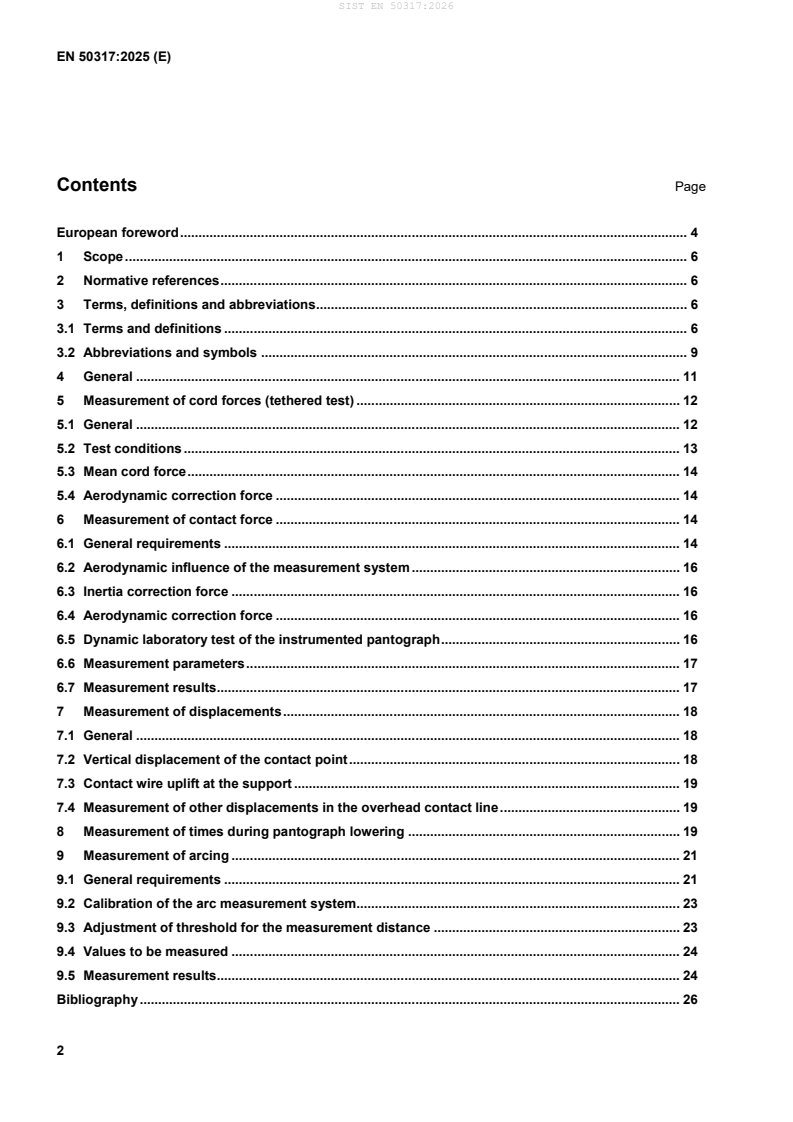
Contents Page
European foreword . 4
1 Scope . 6
2 Normative references . 6
3 Terms, definitions and abbreviations . 6
3.1 Terms and definitions . 6
3.2 Abbreviations and symbols . 9
4 General . 11
5 Measurement of cord forces (tethered test) . 12
5.1 General . 12
5.2 Test conditions . 13
5.3 Mean cord force . 14
5.4 Aerodynamic correction force . 14
6 Measurement of contact force . 14
6.1 General requirements . 14
6.2 Aerodynamic influence of the measurement system . 16
6.3 Inertia correction force . 16
6.4 Aerodynamic correction force . 16
6.5 Dynamic laboratory test of the instrumented pantograph . 16
6.6 Measurement parameters . 17
6.7 Measurement results . 17
7 Measurement of displacements . 18
7.1 General . 18
7.2 Vertical displacement of the contact point . 18
7.3 Contact wire uplift at the support . 19
7.4 Measurement of other displacements in the overhead contact line . 19
8 Measurement of times during pantograph lowering . 19
9 Measurement of arcing . 21
9.1 General requirements . 21
9.2 Calibration of the arc measurement system. 23
9.3 Adjustment of threshold for the measurement distance . 23
9.4 Values to be measured . 24
9.5 Measurement results . 24
Bibliography . 26
Figures
Figure 1 — Cord test . 13
Figure 2 — Contact force measurement . 15
Figure 3 — Times for pantograph lowering process . 21
Figure 4 — Detector location . 23
Tables
Table 1 — Minimum conditions recorded for measurements . 12
European foreword
This document (EN 50317:2025) has been prepared by CLC/SC 9XC, “Electric supply and earthing systems for
public transport equipment and ancillary apparatus (Fixed installations)”, of CLC/TC 9X, “Electrical and
electronic applications for railways”.
The following dates are fixed:
• latest date by which this document has to be (dop) 2026-12-31
implemented at national level by publication of
an identical national standard or by
endorsement
• latest date by which the national standards (dow) 2028-12-31
conflicting with this document have to be
withdrawn
This document supersedes EN 50317:2012 and all of its amendments and corrigenda (if any).
— changed definitions for “collector head” replaced by “pantograph head” (3.1);
— changed definitions for “total mean uplift force” replaced by “mean cord force” (3.1);
— new definition “expansion length” (3.1);
— changed definitions “arcing” (3.1);
— added definition for “nominal voltage” (3.1);
— new definition “reference threshold”, “measurement threshold” and “reference distance” (3.1);
— updated abbreviation lists (now 3.2);
— minimum conditions recorded for measurements (Clause 4);
— more detailed explanation of measurement of cord forces (Clause 5);
— measurement of contact force (Clause 6);
— updated requirements for definitions of requirements;
— aerodynamic influence, Inertia correction force, Aerodynamic correction force;
— definition of Dynamic laboratory test of the instrumented pantograph;
— updated requirements for of measurement results, control section possible acceptable exceptions;
— measurement of displacement (Clause 7);
— uplift at the support how to achieve representative results;
— measurement of times during pantograph lowering (Clause 8);
— measurement of arcing (Clause 9);
— removed wavelength 323 nm – 329 nm;
— reference threshold values from note to normative;
— more detailed definition of control section and possible acceptable exceptions;
— more detailed definition of Adjustment of threshold for the measurement distance.
Attention is drawn to the possibility that some of the elements of this document may be the subject of patent
rights. CENELEC shall not be held responsible for identifying any or all such patent rights.
This document has been prepared under a standardization request addressed to CENELEC by the European
Commission. The Standing Committee of the EFTA States subsequently approves these requests for its
Member States.
Any feedback and questions on this document should be directed to the users’ national committee. A complete
listing of these bodies can be found on the CENELEC website.
1 Scope
This document specifies the functional requirements for output and accuracy of measurements of the dynamic
interaction between pantograph and overhead contact line.
2 Normative references
The following documents are referred to in the text in such a way that some or all of their content constitutes
requirements of this document. For dated references, only the edition cited applies. For undated references, the
latest edition of the referenced document (including any amendments) applies.
EN 50318:2018, Railway applications - Current collection systems - Validation of simulation of the dynamic
interaction between pantograph and overhead contact line
EN 50206-1:2010, Railway applications - Rolling stock - Pantographs: Characteristics and tests - Part 1:
Pantographs for main line vehicles
3 Terms, definitions and abbreviations
3.1 Terms and definitions
For the purposes of this document, the following terms and definitions apply.
ISO and IEC maintain terminology databases for use in standardization at the following addresses:
— ISO Online browsing platform: available at https://www.iso.org/obp
— IEC Electropedia: available at https://www.electropedia.org/
3.1.1
pantograph
apparatus for collecting current from one or more contact wires, formed of a hinged device designed to allow
vertical movement of the pantograph head
[SOURCE: IEC 60050-811:2017, 811-32-02]
3.1.2
pantograph head
pantograph pan
part of the pantograph comprising the contact strips and their mountings, horns and possibly a suspension
[SOURCE: IEC 60050-811:2017, 811-32-05]
3.1.3
contact point
point of mechanical contact between a contact strip and a contact wire
3.1.4
contact force
vertical force applied by the pantograph to the contact wire(s)
As impacted by EN 50318:2018/A1:2022.
Note 1 to entry: The contact force is the sum of forces of all contact points of a pantograph.
Note 2 to entry: The contact force is measured perpendicular to the contact plane.
3.1.5
mean contact force
F
m,c
statistical mean value of the contact force
Note 1 to entry F is formed by the static, dynamic and aerodynamic components of the pantograph contact force.
m,c
Note 2 to entry This mean value can be assessed by simulation or measurement over a specified time or distance.
3.1.6
static contact force
F
stat
vertical force exerted upward by the pantograph head on the overhead contact line at standstill
3.1.7
aerodynamic force
F
aero
additional vertical force applied by the pantograph as a result of air flow around the pantograph assembly,
depending upon speed
3.1.8
aerodynamic correction force
F
corr,aero
difference between the sum of cord forces and the sum of sensors forces, depending upon speed
3.1.9
inertia correction force
inertia of mass between force sensors and the contact point
3.1.10
standard deviation of contact force
σ
square root of the sum of the square errors divided by the number of output values minus 1
3.1.11
statistical minimum
value of contact force represented by F – 3 σ
m,c
3.1.12
statistical maximum
value of contact force represented by F + 3 σ
m,c
3.1.13
cord force
F
cord
measured force in a cord restraining a contact strip at a defined height
3.1.14
mean cord force
sum of all the mean values of the measured cord force at the pantograph head, the latter not touching the
contact line, equal to the sum of the static force and the aerodynamic force cause by the air at the considered
speed for a given height of contact points
3.1.15
transfer function magnitude
magnitude of the ratio between the measured and applied forces of the pantograph and instrumentation
determined by a dynamic excitation of the pantograph, at the pantograph head for a range of frequencies
3.1.16
tension length
length of a flexible overhead contact line between two terminating points
[SOURCE: IEC 60050-811:2017, 811-33-61, modified – “flexible” has been added]
3.1.17
expansion length
length of a rigid overhead contact line between two terminating points or
expansion joints (dilatation joint)
3.1.18
expansion joint
dilatation joint
joint connecting two expansion length of a rigid overhead contact line
3.1.19
control section
part of the total measuring length where the statistical evaluation is done
3.1.20
pantograph current
value of current that flows through the pantograph
3.1.21
arcing
arc
luminous discharge of electricity across an insulating medium, usually accompanied by the partial volatilization
of the electrodes
Note 1 to entry: A complete sinusoidal current half-cycle is not considered to be an arcing half-cycle.
[SOURCE: IEC 60050-442:1998/AMD3:2019, 442-05-65, modified, “arcing” used as preferred term]
3.1.22
sensitivity curve
relationship between the power density of the arc in µW/cm and the response of the detector in volts within the
spectral range of interest
3.1.23
nominal current
value of current that flows through one pantograph for nominal power of a tested train at the nominal voltage of
the traction power supply system
3.1.24
nominal voltage
value of the voltage by which the electrical installation or part of the electrical
installation is designated and identified
[SOURCE: IEC 60050-826:2022, 826-11-01]
3.1.25
electrical clearance
minimum distance in air permitted between fixed structures and parts energized at contact
line voltage
Note 1 to entry: The distance in air is used to provide functional insulation or basic insulation.
[SOURCE: IEC 60050-811:2017, 811-09-05]
3.1.26
threshold
x
surface power density generated by the smallest arc that can be detected at measurement distance
3.1.27
reference threshold
x
ref
surface power density generated by the smallest arc that can be detected at reference distance
3.1.28
distance
d
measure between arc detector and light source (contact strip, at operation height)
3.1.29
reference distance
d
ref
distance between arc detector and light source chosen to set the reference
threshold
3.1.30
percentage of arcing
NQ
proportion of time with arcing in relation to total time for the control section when the pantograph current is
higher than 30 % of the nominal current
3.1.31
cord
restraint connecting the pantograph head to a load cell fitted to the static pantograph frame or vehicle roof, used
to measure the total dynamic uplift force, including aerodynamic uplift, at the pantograph head
3.1.32
pantograph dropping device
device intended to lower the pantograph automatically if it is damaged
Note 1 to entry: The damage can include the contact strip and pantograph head, and other parts of the pantograph.
[SOURCE: IEC 60050-811:2017, 811-32-22]
3.2 Abbreviations and symbols
For the purposes of this document, the following abbreviations and symbols apply.
a acceleration measured in acceleration sensor i
Sensor,i
AC alternating current
ADD pantograph dropping device
d measurement distance between arc detector and light source (contact strip, at operation
height)
d reference distance between arc detector and light source
ref
DC direct current
F aerodynamic force (F – F )
aero m,cord stat
F magnitude of force applied to pantograph head at frequency f measured independently from
applied,i i
the pantograph measurement system
F contact force
c
F cord force (sum of F )
cord cord,i
F cord force of cord i of an arrangement of cords
cord,i
arithmetic mean cord force of cord i of an arrangement of cords
F
cord,i
F aerodynamic correction force (F – F ), 5.4
corr,aero cord Sensors
F mean contact force
m,c
F mean cord force
m,cord
F magnitude of force measured with the pantograph measurement system at frequency f
measured,i i
F measured force in sensor i
Sensor,i
F sum of Fsensor,
i
Sensors
F static contact force
stat
f minimum frequency
f actual frequency
i
f maximum frequency
n
J accuracy of the transfer function
m mass between contact point and force sensors (see 6.3)
above
n number of test frequencies
n number of acceleration sensors
a
n number of cord force sensors
c
n number of contact force sensors
f
NQ percentage of arcing
OCL Overhead Contact Line
t duration of arcs taken into account
arc
t total time for the control section with pantograph current higher than 30 % of the nominal
total
current per pantograph
t1 – t4 Timepoints in pantograph lowering measurement
v speed
x threshold (x) is the surface power density generated by the smallest arc that can be detected at
measurement distance
x reference threshold is the surface power density generated by the smallest arc detected at
ref
reference distance
σ standard deviation of contact force
4 General
The measurement of the interaction of the overhead contact line and the pantograph is intended to prove the
quality of the current collection system. Results of measurements of different current collection systems shall
be comparable, to assess systems on the lines of the European railway network on an equal basis.
NOTE 1 Measured values are also required for validation of simulation programs and other measurement systems.
To check the performance capability of the current collection system at least the following data shall be
measured:
— the contact wire uplift at the support as the pantograph passes for flexible overhead contact line;
and either
— the mean contact force and standard deviation of contact force;
or
— the mean contact force and percentage of arcing;
or
— the mean cord force and percentage of arcing.
NOTE 2 The limit for the mean contact force is given by EN 50367:2020, Tables 6 and 7. The mean contact force can
be proven by contact force measurement or by cord test.
In addition to the measured values, the operating conditions, the environmental conditions and test configuration
during the measurement shall be recorded in the test report.
NOTE 3 Typical operating conditions are train speed, location (information about the test section), etc.
NOTE 4 Typical environmental conditions are precipitation, ice, temperature, wind speed and direction, fog, etc.
NOTE 5 Typical test configurations are parameters and arrangement of pantographs including their orientation, type of
overhead contact system etc.
Table 1 provides the minimum conditions that shall be noted in the test report.
Table 1 — Minimum conditions recorded for measurements
Cord test Contact force Measurement of Measurement of
measurement displacement arcing
Train speed X X X X
General location X X X X
Continuous For OCL For OCL
location assessment assessment
Environmental X X X X
conditions
NOTE General location as information about geographic location, line of the test run, tunnel and open
sections etc. Continuous location is the tracked position of a moving vehicle using GPS, inertial sensors, or other
location-based technologies.
Additionally, the following parameters shall be noted in the test report:
— type and configuration of pantograph;
— type, wear and mass of the contact strips;
— aerofoil configuration;
— active control system parameters of the pantograph for rolling stock certification measurements, if an
...