

EN 50342-6:2025
(Main)Lead-acid starter batteries - Part 6: Batteries for micro-cycle applications
General Information
- Abstract
This document is applicable to lead-acid batteries with a nominal voltage of 12 V, used primarily as power source for the starting of internal combustion engines (ICE), lighting and also for auxiliary equipment of ICE vehicles. These batteries are commonly called "starter batteries". Batteries with a nominal voltage of 6 V are also included in the scope of this document. All referenced voltages need to be divided by two for 6 V batteries. The batteries under the scope of this document are used for micro-cycle applications in vehicles which can also be called Start-Stop (or Stop-Start, idling-stop system, micro-hybrid or idle-stop-and-go) applications. In cars with this special capability, the internal combustion engine is switched off during a complete vehicle stop, during idling with low speed or during idling without the need of supporting the vehicle movement by the internal combustion engine. During the phases in which the engine is switched off, most of the electric and electronic components of the car need to be supplied by the battery without support of the alternator. In addition, in most cases an additional regenerative braking (recuperation or regeneration of braking energy) function is installed. The batteries under these applications are stressed in a completely different way compared to classical starter batteries. Aside of these additional properties, those batteries need to crank the ICE and support the lighting and also auxiliary functions in a standard operating mode with support of the alternator when the internal combustion engine is switched on. All batteries under this scope need to fulfil basic functions, which are tested under application of EN 50342 1:2015. This document is applicable to batteries for the following purposes: - Lead-acid batteries of the dimensions according to EN 50342 2 for vehicles with the capability to automatically switch off the ICE during vehicle operation either in standstill or moving (“Start-Stop”); - Lead-acid batteries of the dimensions according to EN 50342 2 for vehicles with Start-Stop applications with the capability to recover braking energy or energy from other sources. This document is not applicable to batteries for purposes other than mentioned above, but it is applicable to EFB delivered in dry-charged conditions according to EN 50342 1:2015, Clause 7. NOTE The applicability of this document also for batteries according to EN 50342 4 is under consideration.
- Status
- Published
- Publication Date
- 31-Jul-2025
- Technical Committee
- CLC/TC 21X - Secondary cells and batteries
- Drafting Committee
- CLC/TC 21X - Secondary cells and batteries
- Current Stage
- 6060 - Document made available - Publishing
- Start Date
- 01-Aug-2025
- Due Date
- 11-Dec-2024
- Completion Date
- 01-Aug-2025

Overview
EN 50342-6:2025 - "Lead-acid starter batteries - Part 6: Batteries for micro-cycle applications" (CLC/CENELEC) defines test methods, performance levels and marking for 12 V (and 6 V-equivalent) lead‑acid starter batteries designed for Start‑Stop / micro‑hybrid vehicle use. It covers batteries that must both crank internal combustion engines (ICE) and repeatedly supply vehicle electrical systems while the engine is switched off (including vehicles with regenerative braking). The standard supplements EN 50342-1 (general requirements) and is part of the EN 50342 starter battery family.
Key topics and technical requirements
Scope and applicability
- Applies to 12 V (and 6 V when voltages divided by two) lead‑acid starter batteries for Start‑Stop / micro‑cycle applications, including energy recuperation systems.
- EFB delivered dry‑charged per EN 50342-1:2015 Clause 7 are included; applicability to heavy‑vehicle batteries (EN 50342-4) is under consideration.
Core test methods
- Micro‑hybrid test (MHT) - improved MHT replaces earlier version; verifies performance under repeated micro‑cycle stresses representative of Start‑Stop usage.
- Dynamic Charge Acceptance (DCA) - measures a battery’s ability to accept charge pulses (important for regenerative braking and rapid recharging during short engine‑on intervals).
- Endurance cycling tests - endurance at 17.5% DoD and 50% DoD (including deep discharge procedures) to assess cycle life under micro‑hybrid duty.
- Tests are executed in a water bath at 40 °C (changed from 25 °C in earlier editions), with updated cycle counts and rest times (notable: total cycles increased to 16 000).
Performance levels and marking
- Defines DCA performance levels (including a new “D” level) and micro‑cycle performance classes (M1…M3).
- Requires battery marking with micro‑cycling performance and optional Start‑Stop logo per Annex B.
- Batteries must also meet EN 50342‑1 basic function tests.
Test equipment & procedure details
- Specifies measurement equipment capability, sampling, syntax of test descriptions, and detailed test sequences (see clauses 6–9 and annexes).
Applications and users
Who uses this standard
- Battery manufacturers and designers developing lead‑acid starter batteries for Start‑Stop vehicles.
- Automotive OEMs specifying battery performance for micro‑hybrid systems.
- Independent test laboratories and certification bodies performing EN 50342‑6 compliance testing.
- Fleet operators, remanufacturers, and suppliers evaluating battery suitability for Start‑Stop and regenerative‑braking vehicles.
Practical value
- Ensures batteries reliably crank engines and accept rapid charges during frequent stop/start cycles.
- Supports product differentiation by DCA and micro‑cycle performance classes, aiding OEM selection and consumer labelling.
- Facilitates regulatory and market compliance across CENELEC member countries.
Related standards
- EN 50342-1:2015 - General requirements and test methods (normative reference)
- EN 50342-2 - Battery dimensions and terminal marking
- EN 50342-4, EN 50342-7 and other parts of the EN 50342 series
- Relevant EU rules such as the Battery Directive 2006/66/EC (labelling and end‑of‑life considerations)
Keywords: EN 50342-6:2025, Lead‑acid starter batteries, micro‑cycle, Start‑Stop, micro‑hybrid, dynamic charge acceptance (DCA), micro‑hybrid test (MHT), battery testing, EN 50342.
Relations
- Replaces
EN 50342-6:2015 - Lead-acid starter batteries - Part 6: Batteries for Micro-Cycle Applications - Effective Date
- 04-Feb-2025
- Effective Date
- 13-Jun-2023
- Refers
EN 50342-1:2015 - Lead-acid starter batteries - Part 1: General requirements and methods of test - Effective Date
- 03-Feb-2026
- Effective Date
- 09-Feb-2026
- Effective Date
- 09-Feb-2026
Get Certified
Connect with accredited certification bodies for this standard

IMQ S.p.A. (Certification)
Italian electrical product certification.

SLG Prüf- und Zertifizierungs GmbH
German testing and certification body.

UL Solutions
Global safety science company with testing, inspection and certification.
Sponsored listings
Frequently Asked Questions
EN 50342-6:2025 is a standard published by CLC. Its full title is "Lead-acid starter batteries - Part 6: Batteries for micro-cycle applications". This standard covers: This document is applicable to lead-acid batteries with a nominal voltage of 12 V, used primarily as power source for the starting of internal combustion engines (ICE), lighting and also for auxiliary equipment of ICE vehicles. These batteries are commonly called "starter batteries". Batteries with a nominal voltage of 6 V are also included in the scope of this document. All referenced voltages need to be divided by two for 6 V batteries. The batteries under the scope of this document are used for micro-cycle applications in vehicles which can also be called Start-Stop (or Stop-Start, idling-stop system, micro-hybrid or idle-stop-and-go) applications. In cars with this special capability, the internal combustion engine is switched off during a complete vehicle stop, during idling with low speed or during idling without the need of supporting the vehicle movement by the internal combustion engine. During the phases in which the engine is switched off, most of the electric and electronic components of the car need to be supplied by the battery without support of the alternator. In addition, in most cases an additional regenerative braking (recuperation or regeneration of braking energy) function is installed. The batteries under these applications are stressed in a completely different way compared to classical starter batteries. Aside of these additional properties, those batteries need to crank the ICE and support the lighting and also auxiliary functions in a standard operating mode with support of the alternator when the internal combustion engine is switched on. All batteries under this scope need to fulfil basic functions, which are tested under application of EN 50342 1:2015. This document is applicable to batteries for the following purposes: - Lead-acid batteries of the dimensions according to EN 50342 2 for vehicles with the capability to automatically switch off the ICE during vehicle operation either in standstill or moving (“Start-Stop”); - Lead-acid batteries of the dimensions according to EN 50342 2 for vehicles with Start-Stop applications with the capability to recover braking energy or energy from other sources. This document is not applicable to batteries for purposes other than mentioned above, but it is applicable to EFB delivered in dry-charged conditions according to EN 50342 1:2015, Clause 7. NOTE The applicability of this document also for batteries according to EN 50342 4 is under consideration.
This document is applicable to lead-acid batteries with a nominal voltage of 12 V, used primarily as power source for the starting of internal combustion engines (ICE), lighting and also for auxiliary equipment of ICE vehicles. These batteries are commonly called "starter batteries". Batteries with a nominal voltage of 6 V are also included in the scope of this document. All referenced voltages need to be divided by two for 6 V batteries. The batteries under the scope of this document are used for micro-cycle applications in vehicles which can also be called Start-Stop (or Stop-Start, idling-stop system, micro-hybrid or idle-stop-and-go) applications. In cars with this special capability, the internal combustion engine is switched off during a complete vehicle stop, during idling with low speed or during idling without the need of supporting the vehicle movement by the internal combustion engine. During the phases in which the engine is switched off, most of the electric and electronic components of the car need to be supplied by the battery without support of the alternator. In addition, in most cases an additional regenerative braking (recuperation or regeneration of braking energy) function is installed. The batteries under these applications are stressed in a completely different way compared to classical starter batteries. Aside of these additional properties, those batteries need to crank the ICE and support the lighting and also auxiliary functions in a standard operating mode with support of the alternator when the internal combustion engine is switched on. All batteries under this scope need to fulfil basic functions, which are tested under application of EN 50342 1:2015. This document is applicable to batteries for the following purposes: - Lead-acid batteries of the dimensions according to EN 50342 2 for vehicles with the capability to automatically switch off the ICE during vehicle operation either in standstill or moving (“Start-Stop”); - Lead-acid batteries of the dimensions according to EN 50342 2 for vehicles with Start-Stop applications with the capability to recover braking energy or energy from other sources. This document is not applicable to batteries for purposes other than mentioned above, but it is applicable to EFB delivered in dry-charged conditions according to EN 50342 1:2015, Clause 7. NOTE The applicability of this document also for batteries according to EN 50342 4 is under consideration.
EN 50342-6:2025 is classified under the following ICS (International Classification for Standards) categories: 29.220.20 - Acid secondary cells and batteries. The ICS classification helps identify the subject area and facilitates finding related standards.
EN 50342-6:2025 has the following relationships with other standards: It is inter standard links to EN 50342-6:2015, EN 50342-6:2015/A1:2018, EN 50342-1:2015, EN 14972-1:2020+A1:2025, EN 14972-1:2020. Understanding these relationships helps ensure you are using the most current and applicable version of the standard.
EN 50342-6:2025 is available in PDF format for immediate download after purchase. The document can be added to your cart and obtained through the secure checkout process. Digital delivery ensures instant access to the complete standard document.
Standards Content (Sample)
SLOVENSKI STANDARD
01-oktober-2025
Nadomešča:
SIST EN 50342-6:2016
SIST EN 50342-6:2016/A1:2019
Svinčeno-kislinske zaganjalne baterije - 6. del: Baterije za mikrociklične aplikacije
Lead-acid starter batteries - Part 6: Batteries for micro-cycle applications
Blei-Akkumulatoren-Starterbatterien - Teil 6 : Batterien für Mikrozyklen-Anwendungen
Batteries d'accumulateurs de démarrage au plomb - Partie 6: Batteries pour applications
micro-cycles
Ta slovenski standard je istoveten z: EN 50342-6:2025
ICS:
29.220.20 Kislinski sekundarni členi in Acid secondary cells and
baterije batteries
2003-01.Slovenski inštitut za standardizacijo. Razmnoževanje celote ali delov tega standarda ni dovoljeno.
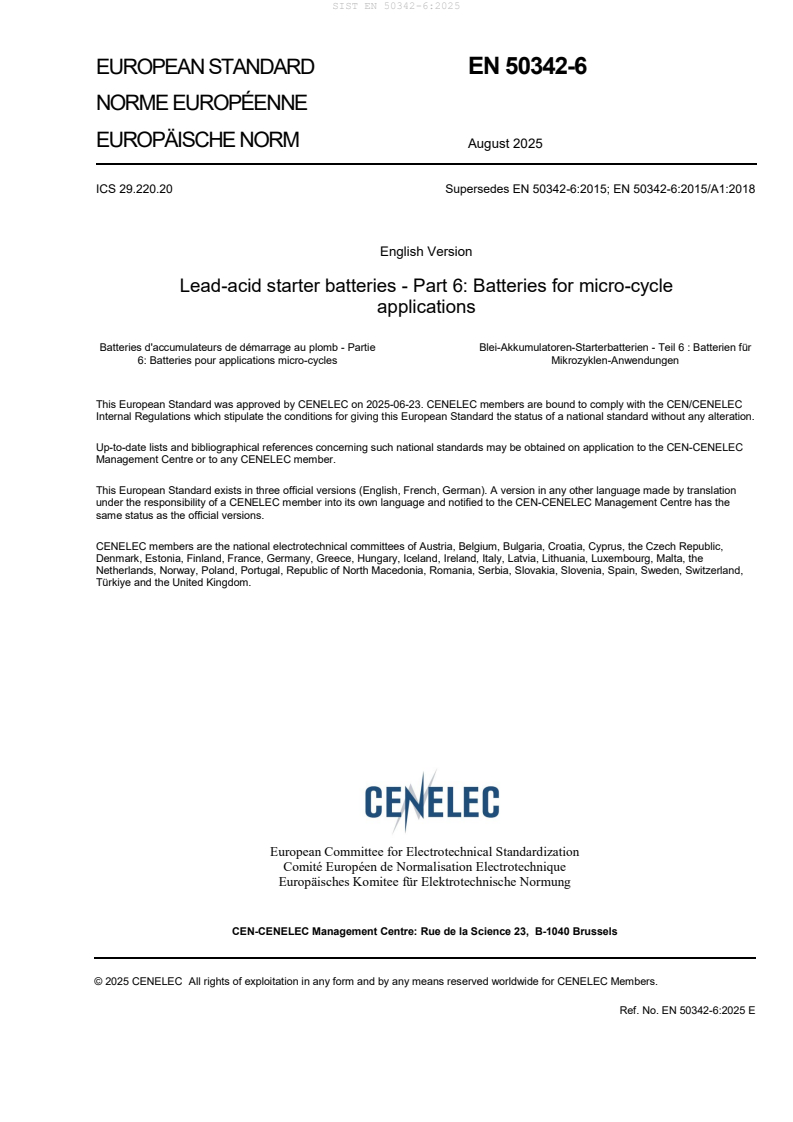
EUROPEAN STANDARD EN 50342-6
NORME EUROPÉENNE
EUROPÄISCHE NORM August 2025
ICS 29.220.20 Supersedes EN 50342-6:2015; EN 50342-6:2015/A1:2018
English Version
Lead-acid starter batteries - Part 6: Batteries for micro-cycle
applications
Batteries d'accumulateurs de démarrage au plomb - Partie Blei-Akkumulatoren-Starterbatterien - Teil 6 : Batterien für
6: Batteries pour applications micro-cycles Mikrozyklen-Anwendungen
This European Standard was approved by CENELEC on 2025-06-23. CENELEC members are bound to comply with the CEN/CENELEC
Internal Regulations which stipulate the conditions for giving this European Standard the status of a national standard without any alteration.
Up-to-date lists and bibliographical references concerning such national standards may be obtained on application to the CEN-CENELEC
Management Centre or to any CENELEC member.
This European Standard exists in three official versions (English, French, German). A version in any other language made by translation
under the responsibility of a CENELEC member into its own language and notified to the CEN-CENELEC Management Centre has the
same status as the official versions.
CENELEC members are the national electrotechnical committees of Austria, Belgium, Bulgaria, Croatia, Cyprus, the Czech Republic,
Denmark, Estonia, Finland, France, Germany, Greece, Hungary, Iceland, Ireland, Italy, Latvia, Lithuania, Luxembourg, Malta, the
Netherlands, Norway, Poland, Portugal, Republic of North Macedonia, Romania, Serbia, Slovakia, Slovenia, Spain, Sweden, Switzerland,
Türkiye and the United Kingdom.
European Committee for Electrotechnical Standardization
Comité Européen de Normalisation Electrotechnique
Europäisches Komitee für Elektrotechnische Normung
CEN-CENELEC Management Centre: Rue de la Science 23, B-1040 Brussels
© 2025 CENELEC All rights of exploitation in any form and by any means reserved worldwide for CENELEC Members.
Ref. No. EN 50342-6:2025 E
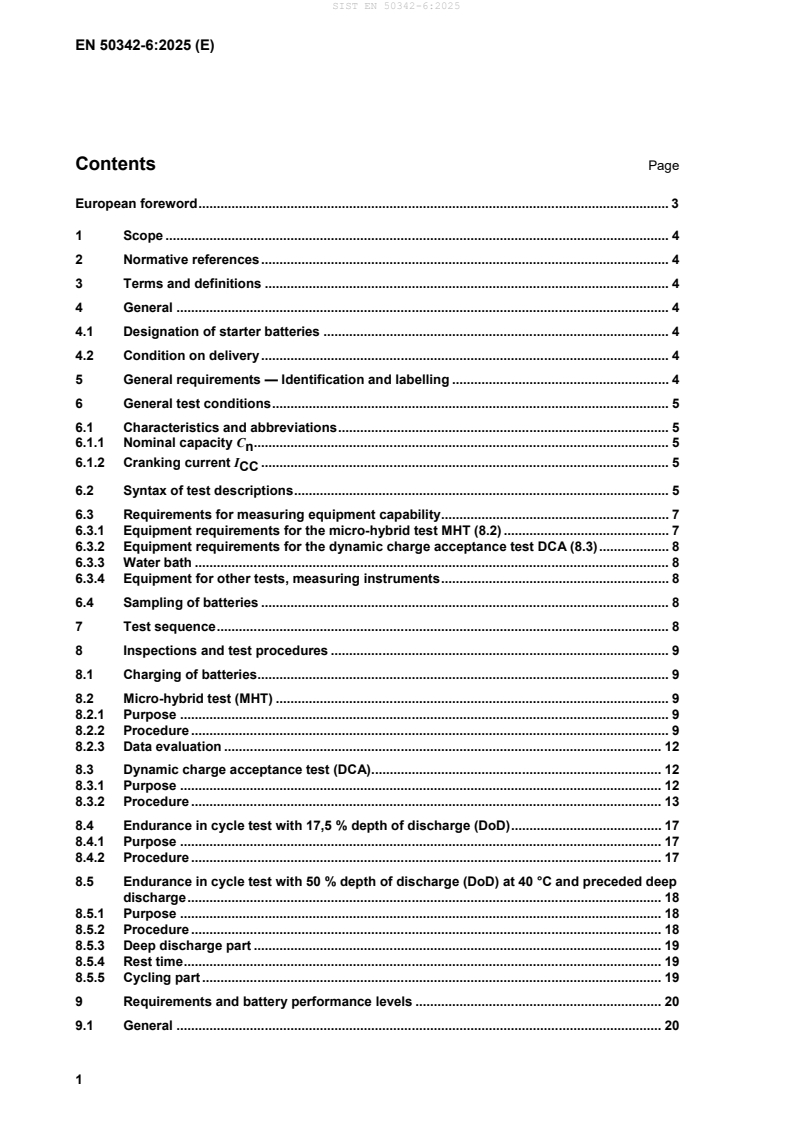
Contents Page
European foreword . 3
1 Scope . 4
2 Normative references . 4
3 Terms and definitions . 4
4 General . 4
4.1 Designation of starter batteries . 4
4.2 Condition on delivery . 4
5 General requirements — Identification and labelling . 4
6 General test conditions . 5
6.1 Characteristics and abbreviations . 5
6.1.1 Nominal capacity C . 5
n
6.1.2 Cranking current I . 5
CC
6.2 Syntax of test descriptions . 5
6.3 Requirements for measuring equipment capability . 7
6.3.1 Equipment requirements for the micro-hybrid test MHT (8.2) . 7
6.3.2 Equipment requirements for the dynamic charge acceptance test DCA (8.3) . 8
6.3.3 Water bath . 8
6.3.4 Equipment for other tests, measuring instruments . 8
6.4 Sampling of batteries . 8
7 Test sequence . 8
8 Inspections and test procedures . 9
8.1 Charging of batteries. 9
8.2 Micro-hybrid test (MHT) . 9
8.2.1 Purpose . 9
8.2.2 Procedure . 9
8.2.3 Data evaluation . 12
8.3 Dynamic charge acceptance test (DCA). 12
8.3.1 Purpose . 12
8.3.2 Procedure . 13
8.4 Endurance in cycle test with 17,5 % depth of discharge (DoD) . 17
8.4.1 Purpose . 17
8.4.2 Procedure . 17
8.5 Endurance in cycle test with 50 % depth of discharge (DoD) at 40 °C and preceded deep
discharge . 18
8.5.1 Purpose . 18
8.5.2 Procedure . 18
8.5.3 Deep discharge part . 19
8.5.4 Rest time . 19
8.5.5 Cycling part . 19
9 Requirements and battery performance levels . 20
9.1 General . 20
9.2 Tests to be passed (no performance differentiation) . 20
9.3 Tests determining the DCA performance level . 21
9.4 Tests determining the micro-cycle performance level . 22
Annex A (informative) Flow charts of DCA test procedure, 8.3. 23
Annex B (normative) Marking / Labelling of batteries . 27
Bibliography . 28
Tables
Table 1 — Test steps . 5
Table 2 — Description of columns . 6
Table 3 — Acronyms and symbols . 7
Table 4 — Equipment requirements for the micro-hybrid test MHT . 7
Table 5 — Equipment requirements for the dynamic charge acceptance test DCA . 8
Table 6 — Test sequence . 9
Table 7 — Test sequence MHT V2 . 10
Table 8 — DCA – Pre-cycling . 13
Table 9 — DCA – Charge Acceptance qDCA procedure . 14
Table 10 — DCA – The DCA procedure . 15
pp
Table 11 — DCA – The DCR part . 16
ss
Table 12 — Endurance 17,5 % DoD – Cycling units . 18
Table 13 — Endurance 50 % DoD – Deep discharge part. 19
Table 14 — Endurance 50 % DoD – Cycling part . 20
Table 15 — Requirements of tests to be passed . 21
Table 16 — Requirements levels DCA performance . 21
Table 17 — Requirements of tests determining the micro-cycle performance level M1…M3 . 22
Figures
Figure 1 — Subphases of the DCRss part . 17
Figure B.1 — Optional Start-Stop logo . 27
European foreword
This document (EN 50342-6:2025) has been prepared by CLC/TC 21X “Secondary cells and batteries”.
The following dates are fixed:
• latest date by which this document has to be (dop) 2026-08-31
implemented at national level by publication of
an identical national standard or by
endorsement
• latest date by which the national standards (dow) 2028-08-31
conflicting with this document have to be
withdrawn
This document supersedes EN 50342-6:2015 and all of its amendments and corrigenda (if any).
TC21X working group 3 has been agreed to implement an improved version of Micro-hybrid test (MHT). This
test replaces the version of EN 50342-6:2015.
— change of test temperature from 25 °C to 40 °C for entire test procedure including initials, cycling and
check-up;
— change from 100 cycles to 200 cycles each test block;
— change of rest time between blocks from 12 h to 3 h;
— change of total number of cycles from 8000 to 16000;
— a new performance level “D” for dynamic charge acceptance (DCA) with two steps has been introduced
and some minor errors have been corrected.
EN 50342, Lead-acid starter batteries, is currently composed of the following parts:
— Part 1: General requirements and methods of test;
— Part 2: Dimensions of batteries and marking of terminals;
— Part 3: Terminal system for batteries with 36 V nominal voltage;
— Part 4: Dimensions of batteries for heavy vehicles;
— Part 5: Properties of battery housings and handles;
— Part 6: Batteries for Micro-Cycle Applications [the present document];
— Part 7: General requirements and methods of tests for motorcycle batteries.
Attention is drawn to the possibility that some of the elements of this document may be the subject of patent
rights. CENELEC shall not be held responsible for identifying any or all such patent rights.
Any feedback and questions on this document should be directed to the users’ national committee. A complete
listing of these bodies can be found on the CENELEC website.
As amended by EN 50342-6:2015/A1:2018.
1 Scope
This document is applicable to lead-acid batteries with a nominal voltage of 12 V, used primarily as power
source for the starting of internal combustion engines (ICE), lighting and also for auxiliary equipment of ICE
vehicles. These batteries are commonly called “starter batteries”. Batteries with a nominal voltage of 6 V are
also included in the scope of this document. All referenced voltages need to be divided by two for 6 V batteries.
The batteries under the scope of this document are used for micro-cycle applications in vehicles which can
also be called Start-Stop (or Stop-Start, idling-stop system, micro-hybrid or idle-stop-and-go) applications. In
cars with this special capability, the internal combustion engine is switched off during a complete vehicle stop,
during idling with low speed or during idling without the need of supporting the vehicle movement by the internal
combustion engine. During the phases in which the engine is switched off, most of the electric and electronic
components of the car need to be supplied by the battery without support of the alternator. In addition, in most
cases an additional regenerative braking (recuperation or regeneration of braking energy) function is installed.
The batteries under these applications are stressed in a completely different way compared to classical starter
batteries. Aside of these additional properties, those batteries need to crank the ICE and support the lighting
and also auxiliary functions in a standard operating mode with support of the alternator when the internal
combustion engine is switched on. All batteries under this scope need to fulfil basic functions, which are tested
under application of EN 50342-1:2015.
This document is applicable to batteries for the following purposes:
— Lead-acid batteries of the dimensions according to EN 50342-2 for vehicles with the capability to
automatically switch off the ICE during vehicle operation either in standstill or moving (“Start-Stop”);
— Lead-acid batteries of the dimensions according to EN 50342-2 for vehicles with Start-Stop applications
with the capability to recover braking energy or energy from other sources.
This document is not applicable to batteries for purposes other than mentioned above, but it is applicable to
EFB delivered in dry-charged conditions according to EN 50342-1:2015, Clause 7.
NOTE The applicability of this document also for batteries according to EN 50342-4 is under consideration.
2 Normative references
The following documents are referred to in the text in such a way that some or all of their content constitutes
requirements of this document. For dated references, only the edition cited applies. For undated references,
the latest edition of the referenced document (including any amendments) applies.
EN 50342-1:2015 , Lead-acid starter batteries - Part 1: General requirements and methods of test
3 Terms and definitions
No terms and definitions are listed in this document.
4 General
4.1 Designation of starter batteries
Regarding the designation of starter batteries, refer to EN 50342-1:2015, 3.2.
4.2 Condition on delivery
Regarding the condition on delivery, refer to EN 50342-1:2015, 3.3.
5 General requirements — Identification and labelling
For detailed information about measurement and labelling EN 50342-1 shall be used.
As impacted by EN 50342-1:2015/A1:2018 and EN 50342-1:2015/A2:2021.
In addition to the mandatory information defined in EN 50342-1:2015, 4.1 and Annexes A and C, the battery
shall be marked with the micro-cycling performance level according to this document (8.3).
For better identification and comparison of batteries under the scope of this document, a special marking
specified in Annex B shall be used by the battery manufacturer.
NOTE Within the European community, legal demands can exist for the identification of the batteries. Furthermore,
the regulations of the Battery Directive 2006/66/EC and the amendment 2008/12/EC or their equivalent national laws are
applicable.
6 General test conditions
6.1 Characteristics and abbreviations
6.1.1 Nominal capacity C
n
Refer to EN 50342-1:2015, 3.4.2.
6.1.2 Cranking current I
CC
Refer to EN 50342-1:2015, 3.4.1.
6.2 Syntax of test descriptions
The test description is given in tabular form. All test steps shall be carried out in a water bath according to
6.3.3 at the given temperature, if not stated otherwise.
The following definitions and abbreviations are used:
Test steps:
Table 1 — Test steps
Abbreviation Test step Description
CHA Charge Battery to be charged with given parameters
DCH Discharge Battery to be discharged with given parameters
No charging or discharging but measurement of voltage as required. If the
PAU Pause
battery is connected to the test unit, there shall be no quiescent current.
RPT Repeat Instruction to repeat certain steps several times
Decision point leading to different actions dependent on the value of the
CAS Case of
reference variable
Description of columns:
Table 2 — Description of columns
Column text Description
Structure General explanation of test block
N° Numbering of individual test steps
Definition of test phase of individual step according to Table 1.
NOTE All steps in each table are numbered subsequently starting at “10” The next
table of the same section starts at “20”, etc.
Example:
10 Action 1 20 Action 1
Step
11 Action 2 21 Action 2
12 Action 3 22 Action 3
23 Action 4
T Duration of the individual step in days [d], hours [h] or seconds [s]
Voltage in Volts to be maintained during the step.
In case of a “CHA” phase, this is the constant charging voltage to be given by the
U [V] rectifier.
In case of a “DCH” phase, this is a cut off criteria at which the phase shall be stopped
for the defined current.
Current in Ampere to be maintained during the step.
In case of a “CHA” phase, this is a current limitation for this step.
I [A]
In case of a “DCH” phase this is the constant discharge current to be given by the
rectifier
Description Explanation of individual test step
Data acquisition
Recommended data acquisition frequency
frequency
Result of
measurement of Final result of the individual test step to be reported
each step
Acronyms and symbols are stated in Table 3.
Table 3 — Acronyms and symbols
Acronym Acronym
Description Description
or Symbol or Symbol
Average charge current in DCA test
C I
Effective capacity [Ah]
e c
after charge history [A]
Average charge current in DCA test
C I
Nominal capacity [Ah]
n d
after discharge history [A]
Average charge current in DCA test
C I
Recharged capacity [Ah]
rch r
during regenerative braking [A]
Depth of discharge [% of C ] Q
DoD Charged capacity [Ah]
n CHA
Q
EOS End of step Discharged capacity [Ah]
DCH
Calculated dynamic internal
I R
Charge current [A]
CHA dyn
resistance [Ω]
I
Discharge current for cranking [A]
CC
Weighted normalized dynamic
Reserve capacity (discharge with a
charge acceptance, measured in
I
RC fixed current of 25 A to U = 10,5 V),
DCA
A per Ah nominal capacity C
n
used in DCA test, subsection 8.3
[A/Ah]
I t
Discharge current [A] Discharge time [s]
DCH DCH
Nominal discharge current [A]
I U
Charging voltage [V]
n c
I [A] = C [Ah] / 20 [h]
n n
6.3 Requirements for measuring equipment capability
6.3.1 Equipment requirements for the micro-hybrid test MHT (8.2)
Table 4 — Equipment requirements for the micro-hybrid test MHT
Sampling Sampling
Parameter Range Accuracy
rate precision
U
14…16 V ±0,04 V 10 ms ±0,01 V
CHA
±0,5 % of upper
I
0…100 A 10 ms ±0,1 %
CHA
range value
Q
- - 10 ms ±1 mAh
CHA
U
6.14 V ±0,04 V 10 ms ±0,01 V
DCH
0.300 A with
±0,5 % of upper
I
300 A t ≥ 1s every minute, 10 ms ±0,1 %
DCH
DCH
range value
transition time < 0,01 s
Q
10 ms ±1 mAh
DCH
6.3.2 Equipment requirements for the dynamic charge acceptance test DCA (8.3)
Table 5 — Equipment requirements for the dynamic charge acceptance test DCA
Sampling
Parameter Range Accuracy Sampling rate
precision
U
14…18 V ±0,04 V 200 ms ±0,01 V
CHA
I
0…200 A ±0,5 % 200 ms ±0,1 %
CHA
Q
- - 10 ms ±1 mAh
CHA
U
6.14 V ±0,04 V 200 ms ±0,01 V
DCH
I
0.100 A ±0,5 % 200 ms ±0,1 %
DCH
Q
10 ms ±1 mAh
DCH
Computer controlled unit needed with the ability to use integrated charge balance (e.g. Q and Q ) for
CHA DCH
terminating discharge steps. The software shall be able to output the information in the format of standard
table calculation programs or special software to output tables or graphs.
6.3.3 Water bath
Refer to EN 50342-1:2015, 5.3.2.
6.3.4 Equipment for other tests, measuring instruments
Refer to EN 50342-1:2015, 5.3.1.
6.4 Sampling of batteries
Refer to EN 50342-1:2015, 5.1.
7 Test sequence
The test sequence is shown in Table 6.
The total number of 4 batteries shall be tested according to the test sequence of Table 6. The requirements of
C capacity check and cranking performance test shall be fulfilled according to the requirements defined in
e
EN 50342-1.
For batteries using any kind of mixing elements testing on shakers might be considered.
In addition, more batteries shall be tested according to EN 50342-1:2015, 5.4. Refer to the test sequence given
there, with one exception:
— Test battery sample No. 4 undergoes a 50 % DoD test with preceding discharge. This test replaces the
endurance cycling test defined in EN 50342-1:2015, 5.4, battery sample No. 1, which may be omitted.
Table 6 — Test sequence
No. Test sequence Test procedure Sample No.
1 2 3 4
1 Initial charge prior to test EN 50342-6:2025, 7.1 ✓ ✓ ✓
Capacity check C
2 EN 50342-1:2015, 6.1
✓ ✓
e
3 Cranking performance test EN 50342-1:2015, 6.2 ✓
Capacity check C
4 EN 50342-1:2015, 6.1
✓
e
5 Cranking performance test EN 50342-1:2015, 6.2 ✓
Capacity check C
6 EN 50342-1:2015, 6.1
✓
e
7 MHT (micro-hybrid test) EN 50342-6:2025, 7.2 ✓
8 DCA test EN 50342-6:2025, 8.3 ✓
9 Endurance test 17,5 % DoD EN 50342-6:2025, 8.4 ✓
10 Deep discharge 7 d EN 50342-6:2025, 7.5.3 ✓
11 Rest time 1 to 4 days EN 50342-6:2025, 7.5.4 ✓
Capacity check C
12 EN 50342-1:2015, 6.1
✓
e
13 Cranking performance test EN 50342-1:2015, 6.2 ✓
14 Endurance test 50 % DoD EN 50342-6:2025, 7.5.5 ✓
High current discharge test,
15 EN 50342-1:2015, 6.3 ✓
low T
Capacity check C
16 EN 50342-1:2015, 6.1 ✓
e
8 Inspections and test procedures
8.1 Charging of batteries
All tests shall commence with fully charged batteries. Refer to EN 50342-1:2015, 5.2.
8.2 Micro-hybrid test (MHT)
8.2.1 Purpose
This test checks the ability of a battery to provide the power to restart the engine after frequent stop phases,
its ability to recover state of charge afterwards and the aging effects due to shallow pulse loads.
8.2.2 Procedure
8.2.2.1 General
During the entire test procedure, the battery shall be placed into a water bath, according to EN 50342-1:2015
5.3.2. The water bath temperature is 40 ± 2 °C.
The whole test procedure including initials is given in Table 7. It shall be carried out without any additional
pauses or interruptions.
Table 7 — Test sequence MHT V2
Structure N° Step t U I Description T Result of
measurement
V A °C
U 5·I Q
01 CHA 16 h Charge 40
c n CHA
Initial
I C
02 DCH > 10,5 Capacity check 40
n e@40°C
tests
U 5·I Q
03 CHA 24 h Charge 40
c n CHA
10 PAU 3 h Relaxation 40 U(3 h)
Set
Discharge to
battery
85 %
C / 20 h Q
11 DCH 3 h > 10,5 40
e DCH
SoC to
of C
e@40°C
85 %
12 PAU 3 h Relaxation 40
U(10 s)
20 PAU 10 s Relaxation 40
1 + t I(1 + t ), Q
21 CHA 14,0 100 Charge 40
DCH DCH CHA
Low rate
t U(t ), Q
22 DCH 48 40
DCH DCH DCH
discharge step
U(1 s), Q ,
High rate
DCH
23 DCH 1 s > 9,5 300 40
Micro- discharge step R
dyn
cycle
Run steps 20–23
sequence
24 RPT
200 times
Storage and
25 PAU 3 h > 12,5 cooling down after 40 U(3 h)
cycling
Run steps 20–25
26 RPT
80 times
30 PAU 12 h Relaxation 40
Remaining
...