

EN IEC/IEEE 60980-344:2021
(Main)Nuclear facilities - Equipment important to safety - Seismic qualification
General Information
- Abstract
See the scope of IEC/IEEE 60980-344:2020. Adoption of IEC/IEEE 60980-344:2020is to be done without modification.
- Status
- Published
- Publication Date
- 22-Apr-2021
- Technical Committee
- CLC/TC 45AX - Nuclear power plants
- Drafting Committee
- CLC/TC 45AX - Nuclear power plants
- Current Stage
- 6060 - Document made available - Publishing
- Start Date
- 23-Apr-2021
- Due Date
- 13-May-2023
- Completion Date
- 23-Apr-2021


Overview
EN IEC/IEEE 60980-344:2021 is a harmonized European standard that provides comprehensive requirements and guidance for the seismic qualification of equipment important to safety in nuclear facilities. Developed jointly by IEC and IEEE and adopted as a European standard by CENELEC (CLC), this document ensures that vital electrical and related equipment in nuclear power plants can perform safety functions during and after seismic events. The standard is designed to support engineers, operators, regulators, and manufacturers in demonstrating the resilience and reliability of safety-related equipment under earthquake conditions.
Seismic qualification is a critical part of the overall safety assurance process in nuclear facilities. It involves assessing the ability of equipment to resist and function during seismic disturbances, ensuring the continued operation or safe shutdown of the plant. The adoption of this standard helps align European nuclear safety practices with internationally recognized methodologies, supporting regulatory compliance and operational excellence.
Key Topics
Scope and Applicability
EN IEC/IEEE 60980-344 applies to electrical, instrumentation, and control equipment whose failure could compromise plant safety or adversely affect other safety-related systems. It is relevant for equipment classified as safety or safety-related under IAEA, IEC, or IEEE frameworks.Seismic Qualification Requirements
- Seismic qualification ensures that designated equipment can withstand specified earthquake environments and continue performing its intended safety functions.
- The standard addresses both direct and indirect effects of seismic events, including equipment response, mounting, and potential interactions.
Qualification Methods
- Testing: Dynamic testing protocols simulate seismic conditions to validate equipment performance.
- Analysis: Engineering analyses, including dynamic and static methods, confirm the adequacy of equipment design.
- Combined Methods: Integrated approaches leverage both testing and analysis for complex cases.
- Experience-Based Methods: Use of qualified historical data and equipment similarities.
Ageing Considerations
The impact of ageing processes such as thermal, radiation, and vibration-induced degradation on seismic performance is emphasized, supporting lifecycle safety.Documentation and Reporting
Clear requirements for reporting qualification activities, results, and compliance are outlined to support transparency and regulatory oversight.
Applications
This standard is practically applied throughout the nuclear power generation sector, covering:
Design, Procurement, and Installation
Guiding original equipment manufacturers (OEMs), system integrators, and utility operators in specifying and procuring seismically qualified equipment and assemblies.Regulatory Compliance
Ensuring that nuclear facilities meet national and international seismic safety requirements, including those of the IAEA and European nuclear directives.Operational Safety and Plant Upgrades
Supporting ongoing plant operation, maintenance, testing, and upgrades by providing a robust methodology for verifying equipment readiness for seismic events.Testing and Qualification Facilities
Providing a uniform framework for laboratories and test houses to certify equipment against seismic requirements using standardized test methods.
Related Standards
EN IEC/IEEE 60980-344:2021 interacts and integrates with a range of related international standards, including:
- IEC/IEEE 60780-323: Qualification of electrical equipment important to safety.
- IEC 61513: General requirements for instrumentation and control systems for nuclear power plants.
- IEC 63046: Requirements for electrical power systems of nuclear power plants.
- IEC 61226: Functional classification of I&C systems.
- IEC 60068 series: Environmental testing standards, including vibration and shock tests.
Through these references, EN IEC/IEEE 60980-344 forms part of a comprehensive standardization ecosystem that advances nuclear safety, seismic resilience, and equipment qualification on a global scale.
Keywords: EN IEC/IEEE 60980-344:2021, nuclear facilities, seismic qualification, equipment important to safety, nuclear power plants, CENELEC, IEC, IEEE, seismic testing, safety compliance, nuclear standards, equipment qualification, European standard.
Relations
- Refers
EN 60780-323:2017 - Nuclear facilities - Electrical equipment important to safety - Qualification - Effective Date
- 03-Feb-2026
- Effective Date
- 03-Feb-2026
- Effective Date
- 10-Feb-2026
- Effective Date
- 03-Feb-2026
- Effective Date
- 03-Feb-2026
- Referred By
EN IEC 63046:2021 - Nuclear power plants - Electrical power system - General requirements - Effective Date
- 03-Feb-2026
- Effective Date
- 03-Feb-2026
- Effective Date
- 03-Feb-2026
Get Certified
Connect with accredited certification bodies for this standard

DNV
DNV is an independent assurance and risk management provider.

Lloyd's Register
Lloyd's Register is a global professional services organisation specialising in engineering and technology.
DNV Energy Systems
Energy and renewable energy certification.
Sponsored listings
Frequently Asked Questions
EN IEC/IEEE 60980-344:2021 is a standard published by CLC. Its full title is "Nuclear facilities - Equipment important to safety - Seismic qualification". This standard covers: See the scope of IEC/IEEE 60980-344:2020. Adoption of IEC/IEEE 60980-344:2020is to be done without modification.
See the scope of IEC/IEEE 60980-344:2020. Adoption of IEC/IEEE 60980-344:2020is to be done without modification.
EN IEC/IEEE 60980-344:2021 is classified under the following ICS (International Classification for Standards) categories: 27.120.10 - Reactor engineering; 27.120.20 - Nuclear power plants. Safety. The ICS classification helps identify the subject area and facilitates finding related standards.
EN IEC/IEEE 60980-344:2021 has the following relationships with other standards: It is inter standard links to EN 60780-323:2017, EN 60068-2-6:2008, EN IEC 61225:2026, EN IEC 60987:2021, EN IEC 61226:2021, EN IEC 63046:2021, EN IEC 62397:2026, EN IEC 62705:2026. Understanding these relationships helps ensure you are using the most current and applicable version of the standard.
EN IEC/IEEE 60980-344:2021 is available in PDF format for immediate download after purchase. The document can be added to your cart and obtained through the secure checkout process. Digital delivery ensures instant access to the complete standard document.
Standards Content (Sample)
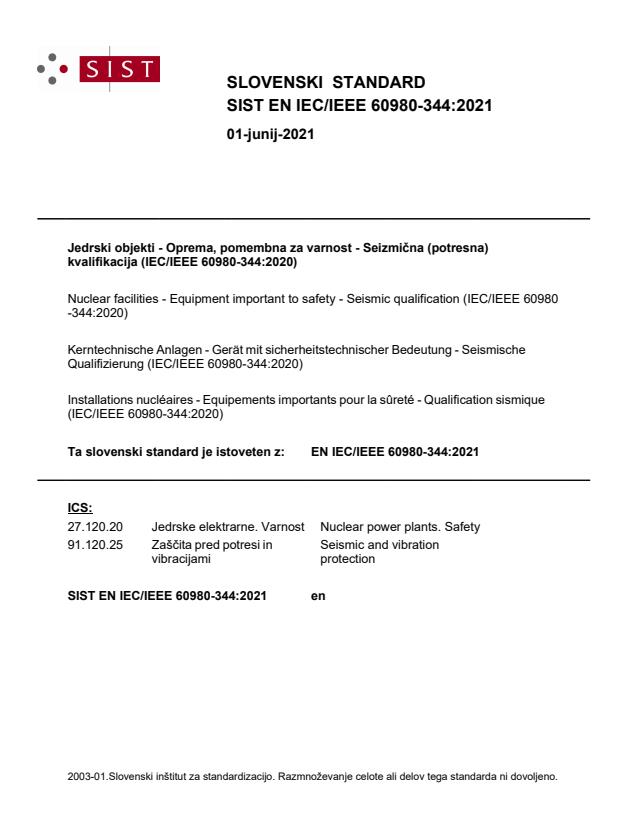
SLOVENSKI STANDARD
01-junij-2021
Jedrski objekti - Oprema, pomembna za varnost - Seizmična (potresna)
kvalifikacija (IEC/IEEE 60980-344:2020)
Nuclear facilities - Equipment important to safety - Seismic qualification (IEC/IEEE 60980
-344:2020)
Kerntechnische Anlagen - Gerät mit sicherheitstechnischer Bedeutung - Seismische
Qualifizierung (IEC/IEEE 60980-344:2020)
Installations nucléaires - Equipements importants pour la sûreté - Qualification sismique
(IEC/IEEE 60980-344:2020)
Ta slovenski standard je istoveten z: EN IEC/IEEE 60980-344:2021
ICS:
27.120.20 Jedrske elektrarne. Varnost Nuclear power plants. Safety
91.120.25 Zaščita pred potresi in Seismic and vibration
vibracijami protection
2003-01.Slovenski inštitut za standardizacijo. Razmnoževanje celote ali delov tega standarda ni dovoljeno.
EUROPEAN STANDARD EN IEC/IEEE 60980-344
NORME EUROPÉENNE
EUROPÄISCHE NORM
April 2021
ICS 27.120.10; 27.120.20
English Version
Nuclear facilities - Equipment important to safety - Seismic
qualification
(IEC/IEEE 60980-344:2020)
Installations nucléaires - Equipements importants pour la Kerntechnische Anlagen - Gerät mit sicherheitstechnischer
sûreté - Qualification sismique Bedeutung - Seismische Qualifizierung
(IEC/IEEE 60980-344:2020) (IEC/IEEE 60980-344:2020)
This European Standard was approved by CENELEC on 2021-04-19. CENELEC members are bound to comply with the CEN/CENELEC
Internal Regulations which stipulate the conditions for giving this European Standard the status of a national standard without any alteration.
Up-to-date lists and bibliographical references concerning such national standards may be obtained on application to the CEN-CENELEC
Management Centre or to any CENELEC member.
This European Standard exists in three official versions (English, French, German). A version in any other language made by translation
under the responsibility of a CENELEC member into its own language and notified to the CEN-CENELEC Management Centre has the
same status as the official versions.
CENELEC members are the national electrotechnical committees of Austria, Belgium, Bulgaria, Croatia, Cyprus, the Czech Republic,
Denmark, Estonia, Finland, France, Germany, Greece, Hungary, Iceland, Ireland, Italy, Latvia, Lithuania, Luxembourg, Malta, the
Netherlands, Norway, Poland, Portugal, Republic of North Macedonia, Romania, Serbia, Slovakia, Slovenia, Spain, Sweden, Switzerland,
Turkey and the United Kingdom.
European Committee for Electrotechnical Standardization
Comité Européen de Normalisation Electrotechnique
Europäisches Komitee für Elektrotechnische Normung
CEN-CENELEC Management Centre: Rue de la Science 23, B-1040 Brussels
© 2021 CENELEC All rights of exploitation in any form and by any means reserved worldwide for CENELEC Members.
Ref. No. EN IEC/IEEE 60980-344:2021 E
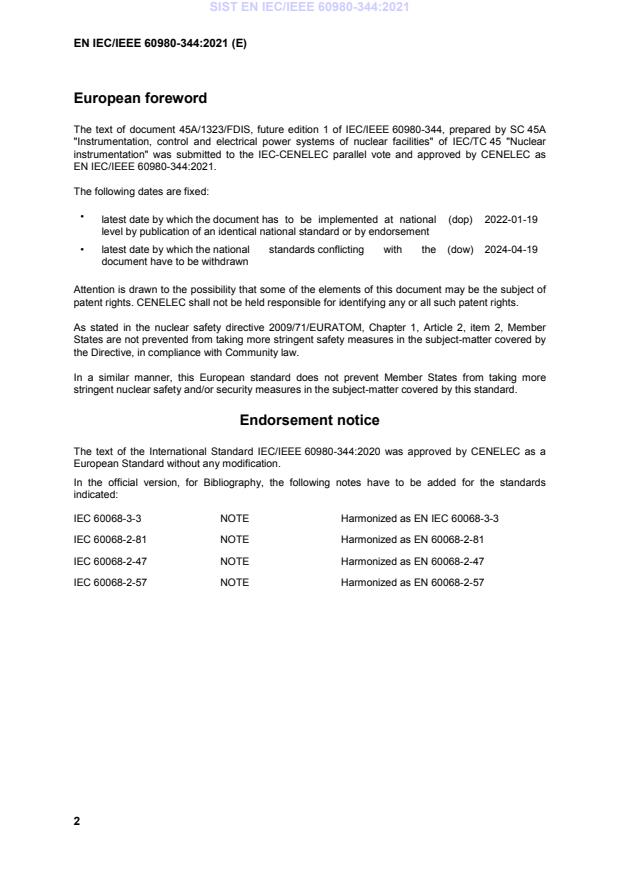
European foreword
The text of document 45A/1323/FDIS, future edition 1 of IEC/IEEE 60980-344, prepared by SC 45A
"Instrumentation, control and electrical power systems of nuclear facilities" of IEC/TC 45 "Nuclear
instrumentation" was submitted to the IEC-CENELEC parallel vote and approved by CENELEC as
The following dates are fixed:
•
latest date by which the document has to be implemented at national (dop) 2022-01-19
level by publication of an identical national standard or by endorsement
• latest date by which the national standards conflicting with the (dow) 2024-04-19
document have to be withdrawn
Attention is drawn to the possibility that some of the elements of this document may be the subject of
patent rights. CENELEC shall not be held responsible for identifying any or all such patent rights.
As stated in the nuclear safety directive 2009/71/EURATOM, Chapter 1, Article 2, item 2, Member
States are not prevented from taking more stringent safety measures in the subject-matter covered by
the Directive, in compliance with Community law.
In a similar manner, this European standard does not prevent Member States from taking more
stringent nuclear safety and/or security measures in the subject-matter covered by this standard.
Endorsement notice
The text of the International Standard IEC/IEEE 60980-344:2020 was approved by CENELEC as a
European Standard without any modification.
In the official version, for Bibliography, the following notes have to be added for the standards
indicated:
IEC 60068-3-3 NOTE Harmonized as EN IEC 60068-3-3
IEC 60068-2-81 NOTE Harmonized as EN 60068-2-81
IEC 60068-2-47 NOTE Harmonized as EN 60068-2-47
IEC 60068-2-57 NOTE Harmonized as EN 60068-2-57
Annex ZA
(normative)
Normative references to international publications
with their corresponding European publications
The following documents are referred to in the text in such a way that some or all of their content
constitutes requirements of this document. For dated references, only the edition cited applies. For
undated references, the latest edition of the referenced document (including any amendments)
applies.
NOTE 1 Where an International Publication has been modified by common modifications, indicated by (mod), the
relevant EN/HD applies.
NOTE 2 Up-to-date information on the latest versions of the European Standards listed in this annex is available
here: www.cenelec.eu.
Publication Year Title EN/HD Year
- Environmental testing - Part 2-6: Tests - -
IEC 60068-2-6 EN 60068-2-6
Test Fc: Vibration (sinusoidal)
- Nuclear facilities - Electrical equipment -
IEC/IEEE 60780- EN 60780-323
important to safety - Qualification
IEC/IEEE 60980-344 ®
Edition 1.0 2020-10
INTERNATIONAL
STANDARD
Nuclear facilities – Equipment important to safety – Seismic qualification
INTERNATIONAL
ELECTROTECHNICAL
COMMISSION
ICS 27.120.10; 27.120.20 ISBN 978-2-8322-8482-7
– 2 – IEC/IEEE 60980-344:2020
IEC/IEEE 2020
CONTENTS
FOREWORD . 6
INTRODUCTION . 8
1 Scope . 11
2 Normative references . 11
3 Terms and definitions . 11
4 Abbreviated terms . 19
5 General discussion of earthquake environment and equipment response. 20
5.1 General . 20
5.2 Earthquake environment . 20
5.3 Equipment on foundations . 20
5.4 Equipment on structures . 20
5.5 Interfaces and adverse interactions. 21
5.6 Simulating vibration induced by an earthquake . 21
5.6.1 General . 21
5.6.2 Response spectrum . 21
5.6.3 Time history . 22
5.6.4 PSD function . 22
5.7 Damping . 22
5.7.1 General . 22
5.7.2 Measurement of damping . 23
5.8 Application of damping . 23
5.8.1 General . 23
5.8.2 Application of damping in testing . 23
5.8.3 Application of damping in analysis . 24
6 Seismic qualification requirements . 24
6.1 General . 24
6.2 Specification of equipment to be qualified . 25
6.3 Specification of ageing condition . 25
6.4 Specification of seismic requirements . 25
6.5 Specification of acceptance criteria . 25
7 Seismic qualification approach . 26
7.1 Safety function . 26
7.2 Seismic qualification methods . 26
8 Ageing . 27
8.1 General . 27
8.2 Thermal ageing . 28
8.3 Radiation ageing . 28
8.4 Material degradation and corrosion . 28
8.5 Mechanical or electrical cycle ageing . 28
8.6 Vibration ageing . 28
8.6.1 General . 28
8.6.2 Ageing from non-seismic vibration conditions . 29
8.6.3 Hydrodynamic loads . 29
8.6.4 Seismic ageing (OBE/S1) . 29
9 Testing . 29
9.1 General . 29
IEC/IEEE 60980-344:2020 – 3 –
IEC/IEEE 2020
9.1.1 Test programme . 29
9.1.2 Mounting . 31
9.1.3 Monitoring . 31
9.1.4 Loading . 31
9.1.5 Refurbishment . 32
9.1.6 Exploratory tests . 32
9.1.7 Seismic ageing (OBE/S1) . 34
9.2 Proof and generic testing . 34
9.3 Fragility testing . 35
9.4 Component testing . 35
9.5 Assembly testing . 35
9.5.1 General . 35
9.6 Test methods . 36
9.6.1 General . 36
9.6.2 Single-frequency test . 37
9.6.3 Multiple-frequency tests . 40
9.6.4 Other tests . 45
9.6.5 Test duration and low-cycle fatigue potential . 45
9.6.6 Multi-axis tests . 45
9.6.7 Line-mounted equipment . 47
9.6.8 Additional tests . 48
9.7 Test documentation . 48
10 Qualification by similarity . 48
10.1 General . 48
10.2 Excitation . 48
10.3 Physical systems . 48
10.4 Safety function . 49
11 Analysis . 49
11.1 General . 49
11.2 Seismic analysis methods . 50
11.2.1 General . 50
11.2.2 Static analysis . 51
11.2.3 Static coefficient analysis . 51
11.2.4 Dynamic analysis . 51
11.3 Nonlinear equipment response . 52
11.4 Other dynamic loads . 52
11.5 Seismic analysis results . 52
11.6 Documentation of analysis . 53
12 Combined analysis and testing . 53
12.1 General . 53
12.2 Modal testing . 53
12.2.1 General . 53
12.2.2 Normal-mode method . 53
12.2.3 Transfer-function method . 54
12.2.4 Analytical methods utilizing test data . 54
12.2.5 Qualification . 54
12.3 Extrapolation for similar equipment . 54
12.3.1 General . 54
12.3.2 Test method . 54
– 4 – IEC/IEEE 60980-344:2020
IEC/IEEE 2020
12.3.3 Analysis . 55
12.4 Shock testing . 55
12.5 Extrapolation for multi-cabinet assemblies . 55
12.6 Other test/analysis . 55
13 Documentation . 56
13.1 General . 56
13.2 Seismic qualification report . 56
13.2.1 General . 56
13.2.2 Analysis . 56
13.2.3 Testing . 56
13.2.4 Combined analysis and testing or similarity . 57
Annex A (normative) Experience-based seismic qualification . 58
A.1 General . 58
A.2 Earthquake experience data . 58
A.2.1 General . 58
A.2.2 Characterization of the earthquake experience motions . 58
A.2.3 Earthquake experience spectrum (EES). 59
A.2.4 Characterization of reference equipment class . 59
A.2.5 Qualification of candidate equipment . 61
A.3 Test experience data . 62
A.3.1 General . 62
A.3.2 Characterization of test experience input motions . 62
A.3.3 Test experience spectra (TES) . 62
A.3.4 Characterization of reference equipment class . 63
A.3.5 Qualification of candidate equipment . 64
A.4 Special considerations . 64
A.4.1 Inherently rugged equipment . 64
A.4.2 Limitations . 65
A.5 Experience-based documentation . 65
A.5.1 General . 65
A.5.2 Reference data . 66
A.5.3 Candidate equipment qualification . 66
Annex B (informative) Measurement of zero period acceleration . 67
Annex C (informative) Frequency content and stationarity . 68
Annex D (informative) Fragility testing . 69
D.1 General . 69
D.2 Excitation motion . 69
D.3 Application of results. 70
D.4 Other considerations . 70
Annex E (informative) Test duration and number of cycles . 72
Annex F (informative) Statistically independent motions . 76
Annex G (informative) Seismic qualification illustrative flowcharts . 77
G.1 General . 77
G.2 Establishment of seismic conditions and acceptance criteria . 77
G.3 Qualification by testing . 77
G.4 Qualification by analysis . 77
G.5 Qualification by combination of analysis and testing . 77
Bibliography . 82
IEC/IEEE 60980-344:2020 – 5 –
IEC/IEEE 2020
Figure 1 – Sine beat . 39
Figure 2 – Decaying sine . 39
Figure 3 – Random spectrum with superimposed sine beats . 43
Figure 4 – Resonant amplification versus cycles per beat . 44
Figure E.1 – Fractional cycles to obtain one equipment maximum peak cycle . 73
Figure E.2 – Equivalent peak-stress cycles induced by stationary random motion . 74
Figure E.3 – Equivalent peak-stress cycles induced by stationary random motion to 20 Hz . 74
Figure G.1 – Seismic qualification flowchart . 78
Figure G.2 – Seismic qualification test flowchart . 79
Figure G.3 – Seismic qualification analysis flowchart . 80
Figure G.4 – Seismic qualification analysis and test flowchart . 81
Table A.1 – EES reduction factor based on number of independent items . 60
– 6 – IEC/IEEE 60980-344:2020
IEC/IEEE 2020
INTERNATIONAL ELECTROTECHNICAL COMMISSION
____________
NUCLEAR FACILITIES –
EQUIPMENT IMPORTANT TO SAFETY –
SEISMIC QUALIFICATION
FOREWORD
1) The International Electrotechnical Commission (IEC) is a worldwide organization for standardization comprising
all national electrotechnical committees (IEC National Committees). The object of IEC is to promote international
co-operation on all questions concerning standardization in the electrical and electronic fields. To this end and
in addition to other activities, IEC publishes International Standards, Technical Specifications, Technical Reports,
Publicly Available Specifications (PAS) and Guides (hereafter referred to as “IEC Publication(s)”). Their
preparation is entrusted to technical committees; any IEC National Committee interested in the subject dealt with
may participate in this preparatory work. International, governmental and non-governmental organizations liaising
with the IEC also participate in this preparation.
IEEE Standards documents are developed within IEEE Societies and Standards Coordinating Committees of the
IEEE Standards Association (IEEE-SA) Standards Board. IEEE develops its standards through a consensus
development process, which brings together volunteers representing varied viewpoints and interests to achieve
the final product. Volunteers are not necessarily members of IEEE and serve without compensation. While IEEE
administers the process and establishes rules to promote fairness in the consensus development process, IEEE
does not independently evaluate, test, or verify the accuracy of any of the information contained in its standards.
Use of IEEE Standards documents is wholly voluntary. IEEE documents are made available for use subject to
important notices and legal disclaimers (see http://standards.ieee.org/ipr/disclaimers.html for more information).
IEC collaborates closely with IEEE in accordance with conditions determined by agreement between the two
organizations.
2) The formal decisions of IEC on technical matters express, as nearly as possible, an international consensus of
opinion on the relevant subjects since each technical committee has representation from all interested IEC
National Committees. The formal decisions of IEEE on technical matters, once consensus within IEEE Societies
and Standards Coordinating Committees has been reached, is determined by a balanced ballot of materially
interested parties who indicate interest in reviewing the proposed standard. Final approval of the IEEE standards
document is given by the IEEE Standards Association (IEEE-SA) Standards Board.
3) IEC/IEEE Publications have the form of recommendations for international use and are accepted by IEC National
Committees/IEEE Societies in that sense. While all reasonable efforts are made to ensure that the technical
content of IEC/IEEE Publications is accurate, IEC or IEEE cannot be held responsible for the way in which they
are used or for any misinterpretation by any end user.
4) In order to promote international uniformity, IEC National Committees undertake to apply IEC Publications
(including IEC/IEEE Publications) transparently to the maximum extent possible in their national and regional
publications. Any divergence between any IEC/IEEE Publication and the corresponding national or regional
publication shall be clearly indicated in the latter.
5) IEC and IEEE do not provide any attestation of conformity. Independent certification bodies provide conformity
assessment services and, in some areas, access to IEC marks of conformity. IEC and IEEE are not responsible
for any services carried out by independent certification bodies.
6) All users should ensure that they have the latest edition of this publication.
7) No liability shall attach to IEC or IEEE or their directors, employees, servants or agents including individual
experts and members of technical committees and IEC National Committees, or volunteers of IEEE Societies and
the Standards Coordinating Committees of the IEEE Standards Association (IEEE-SA) Standards Board, for any
personal injury, property damage or other damage of any nature whatsoever, whether direct or indirect, or for
costs (including legal fees) and expenses arising out of the publication, use of, or reliance upon, this IEC/IEEE
Publication or any other IEC or IEEE Publications.
8) Attention is drawn to the normative references cited in this publication. Use of the referenced publications is
indispensable for the correct application of this publication.
9) Attention is drawn to the possibility that implementation of this IEC/IEEE Publication may require use of material
covered by patent rights. By publication of this standard, no position is taken with respect to the existence or
validity of any patent rights in connection therewith. IEC or IEEE shall not be held responsible for identifying
Essential Patent Claims for which a license may be required, for conducting inquiries into the legal validity or
scope of Patent Claims or determining whether any licensing terms or conditions provided in connection with
submission of a Letter of Assurance, if any, or in any licensing agreements are reasonable or non-discriminatory.
Users of this standard are expressly advised that determination of the validity of any patent rights, and the risk
of infringement of such rights, is entirely their own responsibility.
IEC/IEEE 60980-344:2020 – 7 –
IEC/IEEE 2020
International Standard IEC/IEEE 60980-344 has been prepared by subcommittee 45A:
Instrumentation, control and electrical power systems of nuclear facilities, of IEC technical
committee 45: Nuclear instrumentation, in cooperation with Nuclear Power Engineering
Committee of the IEEE, under the IEC/IEEE Dual Logo Agreement.
It is published as an IEC/IEEE dual logo standard.
This new edition cancels and replaces the first edition of IEC 60980, published in 1989, and
TM
constitutes a technical revision. It also supersedes IEEE Std 344 -2013.
The text of this standard is based on the following IEC documents:
FDIS Report on voting
45A/1323/FDIS 45A/1334/RVD
Full information on the voting for the approval of this standard can be found in the report on
voting indicated in the above table.
International standards are drafted in accordance with the rules given in the ISO/IEC Directives,
Part 2.
The IEC Technical Committee and IEEE Technical Committee have decided that the contents
of this publication will remain unchanged until the stability date indicated on the IEC web site
under "http://webstore.iec.ch" in the data related to the specific publication. At this date, the
publication will be
• reconfirmed,
• withdrawn,
• replaced by a revised edition, or
• amended.
– 8 – IEC/IEEE 60980-344:2020
IEC/IEEE 2020
INTRODUCTION
a) Technical background, main issues and organisation of the Standard
This standard is applicable to electrical equipment important to safety and its interfaces that
are necessary to perform a safety function, or whose failure could adversely affect the safety
functions of other equipment.
Electrical equipment in nuclear facilities shall meet its safety function requirements throughout
its installed life. This is accomplished by a thorough programme of quality assurance, design
control, quality control, qualification, production, transportation, storage, installation,
maintenance, periodic testing, and surveillance. This IEC/IEEE standard specifically focuses
on seismic qualification. This standard shall be used in conjunction with IEC/IEEE 60780-323.
Other aspects, relating to quality assurance, reliability, selection and use of electronic devices,
design and modification of digital systems including Verification and Validation (V&V) activities
are not part of this standard.
Industry research in the area of equipment qualification and decades of its application have
greatly benefited this standard. Future activities of the working group to update this standard
will consider the following:
• Experience and knowledge gained by using condition monitoring techniques,
• Knowledge gained on ageing mechanisms and kinetics,
• Improvement in the use of methods (test and analysis) described throughout the standard,
• Improvement of computation tools and modalities of use.
It is intended that the Standard be used by operators of NPPs (utilities), systems evaluators,
equipment manufacturers, test facilities, qualification laboratories and by licensors.
b) Situation of the current standard in the structure of the IEC SC 45A standard series
IEC 61513 and IEC 63046 are first level IEC SC 45A documents that give guidance applicable
to Instrumentation and Control (I&C) system and electrical power systems (at system level).
They are completed by guidance relative to functional classification (IEC 61226).
These documents are supplemented by second level IEC SC 45A documents. Second level IEC
SC 45A documents give guidance on hardware design (IEC 60987), software (IEC 60880 and
IEC 62138), selection and use of HDL programmed integrated circuits (IEC 62566),
requirements in order to reduce the possibility and limit the impact of common cause failure of
category A functions (IEC 62340), qualification (IEC/IEEE 60780-323, IEC/IEEE 60980-344 and
IEC 62003), control room design (IEC 62342) and cybersecurity (IEC 62645).
IEC/IEEE 60980-344 is a second level IEC SC 45A document which focuses on seismic
qualification of electrical equipment important to safety.
For more details on the structure of the IEC SC 45A standard series, see item d) of this
introduction.
IEC/IEEE 60980-344:2020 – 9 –
IEC/IEEE 2020
c) Recommendations and limitations regarding the application of this standard
This dual logo standard applies to all electrical equipment important to safety in accordance
with IAEA terminology. If using IEEE standards, this standard applies to systems, structures,
and components classified as safety or safety-related. If using the IEC 61226 and IEC 61513
classification guidance, this standard applies to all Class 1, 2 and 3 equipment. This document
shall only be applied in accordance with the single selected classification scheme, either IEC
or IEEE.
To ensure that the Standard will continue to be relevant in future years, the emphasis has been
placed on issues of principle, rather than specific technologies.
d) Description of the structure of the IEC SC 45A standard series and relationships with
other IEC documents and other bodies documents (IAEA, ISO)
The top-level documents of the IEC SC 45A standard series are IEC 61513 and IEC 63046.
IEC 61513 provides general requirements for I&C systems and equipment that are used to
perform functions important to safety in NPPs. IEC 63046 provides general requirements for
electrical power systems of NPPs; it covers power supply systems including the supply systems
of the I&C systems. IEC 61513 and IEC 63046 are to be considered in conjunction and at the
same level. IEC 61513 and IEC 63046 structure the IEC SC 45A standard series and shape a
complete framework establishing general requirements for instrumentation, control and
electrical systems for nuclear power plants.
IEC 61513 and IEC 63046 refer directly to other IEC SC 45A standards for general topics
related to categorization of functions and classification of systems, qualification, separation,
defence against common cause failure, control room design, electromagnetic compatibility,
cybersecurity, software and hardware aspects for programmable digital systems, coordination
of safety and security requirements and management of ageing. The standards referenced
directly at this second level should be considered together with IEC 61513 and IEC 63046 as a
consistent document set.
At a third level, IEC SC 45A standards not directly referenced by IEC 61513 or by IEC 63046
are standards related to specific equipment, technical methods, or specific activities. Usually
these documents, which make reference to second-level documents for general topics, can be
used on their own.
A fourth level extending the IEC SC 45 standard series, corresponds to the Technical Reports
which are not normative.
The IEC SC 45A standards series consistently implements and details the safety and security
principles and basic aspects provided in the relevant IAEA safety standards and in the relevant
documents of the IAEA nuclear security series (NSS). In particular this includes the IAEA
requirements SSR-2/1, establishing safety requirements related to the design of nuclear power
plants (NPPs), the IAEA safety guide SSG-30 dealing with the safety classification of structures,
systems and components in NPPs, the IAEA safety guide SSG-39 dealing with the design of
instrumentation and control systems for NPPs, the IAEA safety guide SSG-34 dealing with the
design of electrical power systems for NPPs and the implementing guide NSS 17 for computer
security at nuclear facilities. The safety and security terminology and definitions used by
SC 45A standards are consistent with those used by the IAEA.
– 10 – IEC/IEEE 60980-344:2020
IEC/IEEE 2020
IEC 61513 and IEC 63046 have adopted a presentation format similar to the basic safety
publication IEC 61508 with an overall life-cycle framework and a system life-cycle framework.
Regarding nuclear safety, IEC 61513 and IEC 63046 provide the interpretation of the general
requirements of IEC 61508-1, IEC 61508-2 and IEC 61508-4, for the nuclear application sector.
In this framework IEC 60880, IEC 62138 and IEC 62566 correspond to IEC 61508-3 for the
nuclear application sector. IEC 61513 and IEC 63046 refer to ISO as well as to IAEA GS-R part
2 and IAEA GS-G-3.1 and IAEA GS-G-3.5 for topics related to quality assurance (QA). At level
2, regarding nuclear security, IEC 62645 is the entry document for the IEC/SC 45A security
standards. It builds upon the valid high level principles and main concepts of the generic
security standards, in particular ISO/IEC 27001 and ISO/IEC 27002; it adapts them and
completes them to fit the nuclear context and coordinates with the IEC 62443 series. At level
2, IEC 60964 is the entry document for the IEC/SC 45A control rooms standards and IEC 62342
is the entry document for the ageing management standards.
NOTE 1 It is assumed that for the design of I&C systems in NPPs that implement conventional safety functions (e.g.
to address worker safety, asset protection, chemical hazards, process energy hazards) international or national
standards would be applied.
NOTE 2 IEC/SC 45A domain was extended in 2013 to cover electrical systems. In 2014 and 2015 discussions were
held in IEC/SC 45A to decide how and where general requirements for the design of electrical systems were to be
considered. IEC/SC 45A experts recommended that an independent standard be developed at the same level as
IEC 61513 to establish general requirements for electrical systems. Project IEC 63046 is now launched to cover this
objective. When IEC 63046 is published, this Note 2 of the introduction of IEC/SC 45A standards will be suppressed.
IEC/IEEE 60980-344:2020 – 11 –
IEC/IEEE 2020
NUCLEAR FACILITIES –
EQUIPMENT IMPORTANT TO SAFETY –
SEISMIC QUALIFICATION
1 Scope
This International Standard describes methods for establishing seismic qualification procedures
that will yield quantitative data to demonstrate that the equipment can meet its performance
requirements. This document is applicable to electrical, mechanical, instrumentation and control
equipment/components that are used in nuclear facilities. This document provides methods and
documentation requirements for seismic qualification of equipment to verify the equipment’s
ability to perform its specified performance requirements during and/or after specified seismic
demands. This document does not specify seismic demand or performance requirements. Other
aspects, relating to quality assurance, selection of equipment, and design and modification of
systems, are not part of this document. As seismic qualification is only a part of equipment
qualification, this document is used in conjunction with IEC/IEEE 60780-323.
The seismic qualification demonstrates equipment’s ability to perform its safety function(s)
during and/or after the time it is subjected to the forces resulting from at least one safe shutdown
earthquake (SSE/S2). This ability is demonstrated by taking into account, prior to the SSE/S2,
the ageing of equipment and the postulated occurrences of a given number of lower intensity
operating basis earthquake (OBE/S1). Ageing phenomena to be considered, if specified in the
design specification, are those which could increase the vulnerability of equipment to vibrations
caused by an SSE/S2.
2 Normative references
The following documents are referred to in the text in such a way that some or all of their content
constitutes requirements of this document. For dated references, only the edition cited applies.
For undated references, the latest edition of the referenced document (including any
amendments) applies.
IEC 60068-2-6, Environmental testing – Part 2-6: Tests – Test Fc: Vibration (sinusoidal)
IEC/IEEE 60780-323, Nuclear facilities – Electrical equipment important to safety –
1 2
Qualification ,
TM
IEEE Std 382 , IEEE Standard for Qualification of Safety-Related Actuators for Nuclear Power
Generating Stations
3 Terms and definitions
The terminology and definitions used in this document are consistent with IAEA Safety
Glossary .
____________
IEEE publications are available from The Institute of Electrical and Electronics Engineers
(http://standards.ieee.org/).
The IEEE standards or products referred to in this clause are trademarks of The Institute of Electrical and
Electronics Engineers, Inc.
IAEA safety glossary is available at https://www.iaea.org/publications/11098/iaea-safety-glossary-2018-edition
– 12 – IEC/IEEE 60980-344:2020
IEC/IEEE 2020
For the purposes of this document, the following terms and definitions apply.
ISO, IEC, and IEEE maintain terminological databases for us
...