

FprEN IEC 61439-6:2026
(Main)Low-voltage switchgear and controlgear assemblies - Part 6: Busbar trunking systems (busways)
- Status
- Not Published
- Publication Date
- 03-Mar-2027
- Technical Committee
- CLC/SR 121B - Low-voltage switchgear and controlgear assemblies
- Drafting Committee
- IEC/SC 121B - Low-voltage switchgear and controlgear assemblies
- Current Stage
- 5020 - Vote circulated - Formal Approval
- Start Date
- 16-Oct-2026
- Due Date
- 31-Oct-2024
- Completion Date
- 16-Oct-2026

FprEN IEC 61439-6:2026 is a CLC document for low-voltage busbar trunking systems (BTS), also called busways. It specifies the definitions, service conditions, construction requirements, technical characteristics and verification methods for these enclosed conductor systems, for original manufacturers, specifiers, installers and testers. The document is read together with IEC 61439-1 for the general rules that apply to BTS unless this part states otherwise.
What does FprEN IEC 61439-6:2026 specify?
FprEN IEC 61439-6:2026 covers BTS intended for low-voltage power transmission, distribution and control in industrial, commercial and similar applications. It applies to systems up to 1 000 V AC or 1 500 V DC, for supply frequencies up to 1 000 Hz, and for indoor or outdoor use, as stationary assemblies with or without an enclosure.
The document also covers BTS used under special service conditions, including ships, railway rolling stock and ordinary-person applications, when the relevant additional requirements are met. It is also used as supplementary guidance for BTS forming part of electrical equipment of machines.
It does not cover individual devices such as circuit-breakers, fuse-switches, motor starters, power electronic converters, SMPS, UPS, drive modules or other electronic equipment as separate products. It also excludes other assembly families covered elsewhere in the IEC 61439 series, and separate systems such as luminaires supply tracks, cable trunking and ducting systems, and powertrack systems.
| Annex | What it covers |
|---|---|
| Annex AA | Items subject to agreement between the BTS manufacturer and the user |
| Annex BB | Design verification |
| Annex CC | Calculation of voltage drop of the system |
| Annex DD | Phase conductor characteristics |
| Annex EE | Fault-loop zero-sequence impedances |
| Annex FF | Fault-loop resistances and reactances |
| Annex GG | Determination of the magnetic flux density in the vicinity of the BTS |
| Annex HH | Cracks-detection-test evaluation for BTS with solid insulation or over moulding insulation |
| Annex II | Notes concerning certain countries |
The document is organized into clauses 1 to 11, covering scope, references, terms, symbols, interface characteristics, information, service conditions, construction, performance, design verification and routine verification.
What are the key requirements of FprEN IEC 61439-6:2026?
Ratings, declared characteristics and loading
FprEN IEC 61439-6:2026 requires the original manufacturer to declare the characteristics that make the BTS compatible with the circuits it serves and the installation conditions. Clause 5.1 links these declarations to the criteria in IEC 61439-1 and the BTS-specific characteristics in this part.
Clause 5.3.1 and 5.3.2 make the rated current dependent on the reference mounting condition, ambient temperature and, where relevant, the orientation of the BT run and the position of power connection units. In practice, this means a buyer or designer should confirm the declared mounting orientation before using the stated current rating.
Clause 5.4 sets the rated diversity factor (RDF) for the whole BTS at 1 unless otherwise agreed, so the system is treated as capable of continuous simultaneous loading at full rated current within the rated limits. For tap-off power connection units with several outgoing circuits, Table 101 gives assumed loading factors when actual load data are not agreed. This matters when several circuits share one enclosure, because thermal loading is a design issue, not only an electrical one.
Clause 5.101 and the informative annexes CC, DD, EE and FF provide the conductor, fault-loop and impedance data used for voltage-drop and fault-current calculations. These values are the basis for system design, protection studies and energy distribution checks.
Construction, protection and service conditions
Clause 7 adds service conditions that matter in real installations, including pollution degree 2 for BTS intended to be operated by ordinary persons. It also lists special service conditions such as exposure to mechanical loads, repetitive overcurrent, proximity to sensitive equipment and defined performance under fire conditions.
Clause 8 sets constructional requirements for mechanical strength, IK code, IP code, clearances, creepage distances, fault protection and accessibility. It also introduces requirements for correct connection between adjacent BTUs and between separate BT run sections. In practice, the system needs design features that prevent incorrect assembly and maintain continuity of power, protective and auxiliary conductors.
Clause 8.1.5 adds a duty requirement for BTS with trolley-type tap-off facilities, and Clause 8.1.101 addresses BTS intended to withstand normal or heavy mechanical loads. Clause 8.5.2 limits how removable parts can be taken out, and Clause 8.5.5 is not applicable here. These points matter when the BTS is installed where handling, maintenance or loading conditions are more severe than a simple fixed run.
Performance and verification
Clause 9 requires temperature-rise limits and introduces optional performance items for resistance to flame-propagation and fire resistance in building penetrations. The temperature-rise rules distinguish between copper, coated aluminium and combined materials, and they treat bare aluminium separately to address contact ageing.
Clause 10 defines the design verification route. It includes tests or comparisons for lifting, mechanical impact, mechanical loads, thermal cycling of joints in a BT run, thermal cycling of plug-in power connection units, IP performance, protective-circuit short-circuit strength, temperature-rise and short-circuit withstand strength. This means conformity is based on verified performance, not only on declared design.
The document also allows previous test results from IEC 60439-2 or an earlier edition of IEC 61439-6 to be reused when they already satisfy this part. Optional verifications are provided for flame propagation and fire resistance in building penetrations.
What terms does FprEN IEC 61439-6:2026 define?
- BTS - busbar trunking system, an enclosed assembly that transmits, distributes and controls electrical energy through busbars supported by insulating material in a duct, trough or similar enclosure.
- BTU - busbar trunking unit, a single unit of a BTS complete with busbars, supports, insulation, enclosure and the means to connect to other units.
- BT run - the connected set of BTUs that forms the BTS, excluding the power connection units.
- PCU - power connection unit, the general term used for the outgoing or feeding units connected to a BTS.
- TPCU - tap-off power connection unit, an outgoing unit used to tap off power from the BTU, fixed or removable.
- BPCU - bidirectional power connection unit, a unit that can either tap off power from the BTU or feed power into it.
- FPCU - feeding power connection unit, a unit used to feed power into the BTU.
- RDF - rated diversity factor, the ratio used to express how much simultaneous loading is allowed for several circuits in one enclosure.
Who uses FprEN IEC 61439-6:2026?
FprEN IEC 61439-6:2026 is used by original manufacturers of busbar trunking systems, panel builders and system integrators who design and assemble BTS for industrial and commercial installations. It is also used by electrical designers, buyers and project engineers who need to specify ratings, mounting conditions, protection levels and verification expectations.
Test laboratories and certification bodies use it to plan design verification and routine verification. Installers and maintenance teams use it for handling, mounting, inspection and service conditions. It is especially relevant where BTS are used in buildings, machinery, ships, railway applications or other installations with special environmental or safety constraints.
What changed in FprEN IEC 61439-6:2026 from the previous edition?
FprEN IEC 61439-6:2026 cancels and replaces the first edition and is described as a technical revision. The changes stated in the document include:
- alignment with IEC 61439-1:2020 for structure and technical content where applicable
- introduction of three different types of power connection units
- new verifications for lifting, IP codes and IK codes
- a new verification for thermal ageing behaviour of joints in a BT run
- a cracks-detection test for BTS with solid insulation and over moulding insulation
- new verifications for tap-off power connection units with several outgoing circuits
- new mechanical and electrical verifications for trolley-type BTS and tap-off power connection units
- revised use of calculation for short-circuit withstand strength by comparison with a reference design
- new temperature-rise limits for aluminium and aluminium alloy conductors
- integration of BTS with solid insulation and overmolding insulation
- consideration of pressure relief flaps in short-circuit tests
- reworked annexes BB, CC, DD, EE and FF
- optional status for resistance to flame-propagation and fire resistance in building penetrations
- all country-specific notes collected in Annex II
- editorial improvements
Which standards are used with FprEN IEC 61439-6:2026?
- IEC 61439-1:2020 - the general rules part; this document is read with it, and its provisions apply where specifically cited.
- IEC 60529 - the basis for IP code verification of BTS enclosures.
- IEC 60364-4-41 - protection against electric shock, relevant for ordinary-person applications.
- IEC 60364-5-52 - wiring-system selection and erection, used for conductor selection in power connection units.
- IEC 60364-5-53 - devices for protection, isolation, switching, control and monitoring, and related connection requirements.
- IEC 60439-2 - the previous busbar trunking standard, relevant for legacy test results accepted by this edition.
- IEC 60664-1 - insulation coordination, including guidance for supplementary and reinforced insulation and altitude-related considerations.
- IEC 60909-0 - calculation of short-circuit currents, used with the fault-current methods in this part.
- IEC 61180 - high-voltage test techniques used where dielectric retesting is needed.
- IEC 61557-2 - insulation resistance measuring equipment used in Annex HH.
- IEC 61786 - measurement of magnetic fields, used in Annex GG.
- IEC 60865-1 - short-circuit effects, referenced when using comparison with a reference design.
- ISO 834-1 - fire-resistance test basis for fire barrier BTU verification.
What does the FprEN IEC 61439-6:2026 document contain?
The document contains the clause structure, requirement text, verification methods and informative annexes needed to design and assess BTS. It includes tables for assumed loading factors, phase conductor characteristics, fault-loop characteristics, fault-current calculation inputs and thermal cycling conditioning.
It also includes figures showing examples of phase transposition, conductor sequence changing, mounting orientation, power connection unit positions, mechanical load tests and fire-barrier test arrangements. The annexes provide calculation methods and test set-ups for voltage drop, conductor characteristics, fault-loop impedance, magnetic flux density and crack detection.
For practical use, the document supports design work, prototype testing, verification against declared ratings and installation agreement between manufacturer and user.
Relations
- Effective Date
- 13-Dec-2022
Get Certified
Connect with accredited certification bodies for this standard

IMQ S.p.A. (Certification)
Italian electrical product certification.

SLG Prüf- und Zertifizierungs GmbH
German testing and certification body.

UL Solutions
Global safety science company with testing, inspection and certification.
Sponsored listings
Frequently Asked Questions
FprEN IEC 61439-6:2026 is a draft published by CLC. Its full title is "Low-voltage switchgear and controlgear assemblies - Part 6: Busbar trunking systems (busways)". This standard covers: Low-voltage switchgear and controlgear assemblies - Part 6: Busbar trunking systems (busways)
Low-voltage switchgear and controlgear assemblies - Part 6: Busbar trunking systems (busways)
FprEN IEC 61439-6:2026 is classified under the following ICS (International Classification for Standards) categories: 29.130.20 - Low voltage switchgear and controlgear. The ICS classification helps identify the subject area and facilitates finding related standards.
FprEN IEC 61439-6:2026 has the following relationships with other standards: It is inter standard links to EN 61439-6:2012. Understanding these relationships helps ensure you are using the most current and applicable version of the standard.
FprEN IEC 61439-6:2026 is associated with the following European legislation: EU Directives/Regulations: 2014/30/EU, 2014/35/EU; Standardization Mandates: M/511, M/552. When a standard is cited in the Official Journal of the European Union, products manufactured in conformity with it benefit from a presumption of conformity with the essential requirements of the corresponding EU directive or regulation.
FprEN IEC 61439-6:2026 is available in PDF format for immediate download after purchase. The document can be added to your cart and obtained through the secure checkout process. Digital delivery ensures instant access to the complete standard document.
Standards Content (Sample)
SLOVENSKI STANDARD
oSIST prEN IEC 61439-6:2025
01-december-2025
Sestavi nizkonapetostnih stikalnih in krmilnih naprav - 6. del: Zbiralčni
povezovalni sistemi (zbiralčna vodila)
Low-voltage switchgear and controlgear assemblies - Part 6: Busbar trunking systems
(busways)
Niederspannungs-Schaltgerätekombinationen - Teil 6: Schienenverteilersysteme
(busways)
Ensembles d'appareillage à basse tension - Partie 6: Systèmes de canalisation
préfabriquée
Ta slovenski standard je istoveten z: prEN IEC 61439-6:2025
ICS:
29.130.20 Nizkonapetostne stikalne in Low voltage switchgear and
krmilne naprave controlgear
oSIST prEN IEC 61439-6:2025 en
2003-01.Slovenski inštitut za standardizacijo. Razmnoževanje celote ali delov tega standarda ni dovoljeno.
oSIST prEN IEC 61439-6:2025
oSIST prEN IEC 61439-6:2025
121B/223/CDV
COMMITTEE DRAFT FOR VOTE (CDV)
PROJECT NUMBER:
IEC 61439-6 ED2
DATE OF CIRCULATION: CLOSING DATE FOR VOTING:
2025-10-24 2026-01-16
SUPERSEDES DOCUMENTS:
121B/205/CD, 121B/220/CC
IEC SC 121B : LOW-VOLTAGE SWITCHGEAR AND CONTROLGEAR ASSEMBLIES
SECRETARIAT: SECRETARY:
Germany Mr Jörg Hußmann
OF INTEREST TO THE FOLLOWING COMMITTEES: HORIZONTAL FUNCTION(S):
TC 121, SC 121A
ASPECTS CONCERNED:
Electromagnetic Compatibility, Safety
SUBMITTED FOR CENELEC PARALLEL VOTING NOT SUBMITTED FOR CENELEC PARALLEL VOTING
Attention IEC-CENELEC parallel voting
The attention of IEC National Committees, members of CENELEC,
is drawn to the fact that this Committee Draft for Vote (CDV) is
submitted for parallel voting.
The CENELEC members are invited to vote through the CENELEC
online voting system.
This document is still under study and subject to change. It should not be used for reference purposes.
Recipients of this document are invited to submit, with their comments, notification of any relevant patent rights of which they are aware
and to provide supporting documentation.
Recipients of this document are invited to submit, with their comments, notification of any relevant “In Some Countries” clau ses to be
included should this proposal proceed. Recipients are reminded that the CDV stage is the final stage for submitting ISC c lauses. (SEE
AC/22/2007 OR NEW GUIDANCE DOC).
TITLE:
Low-voltage switchgear and controlgear assemblies – Part 6: Busbar trunking systems (busways)
PROPOSED STABILITY DATE: 2029
NOTE FROM TC/SC OFFICERS:
electronic file, to make a copy and to print out the content for the sole purpose of preparing National Committee positions.
You may not copy or "mirror" the file or printed version of the document, or any part of it, for any other purpose without
permission in writing from IEC.
oSIST prEN IEC 61439-6:2025
IEC CDV 61439-6 © IEC 2025
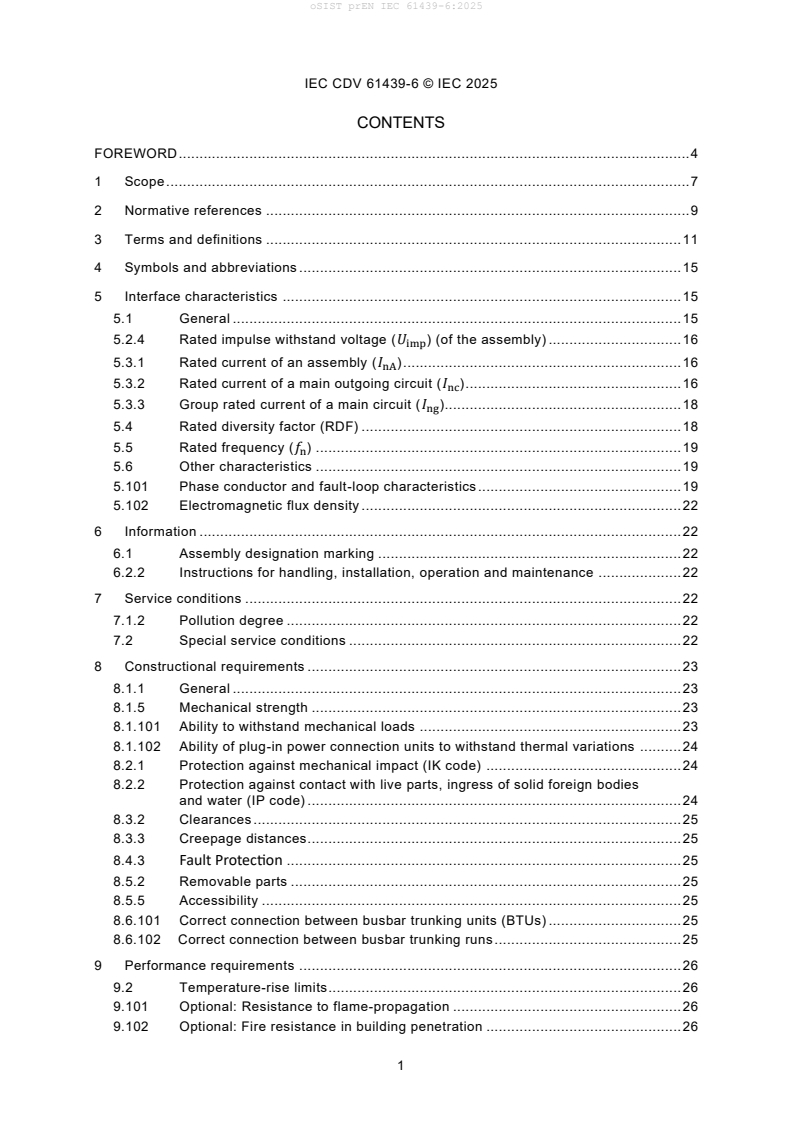
CONTENTS
FOREWORD . 4
1 Scope . 7
2 Normative references . 9
3 Terms and definitions . 11
4 Symbols and abbreviations . 15
5 Interface characteristics . 15
5.1 General . 15
5.2.4 Rated impulse withstand voltage (𝑈 ) (of the assembly) . 16
imp
5.3.1 Rated current of an assembly (𝐼 ) . 16
nA
5.3.2 Rated current of a main outgoing circuit (𝐼 ) . 16
nc
5.3.3 Group rated current of a main circuit (𝐼 ) . 18
ng
5.4 Rated diversity factor (RDF) . 18
5.5 Rated frequency (𝑓 ) . 19
n
5.6 Other characteristics . 19
5.101 Phase conductor and fault-loop characteristics . 19
5.102 Electromagnetic flux density . 22
6 Information . 22
6.1 Assembly designation marking . 22
6.2.2 Instructions for handling, installation, operation and maintenance . 22
7 Service conditions . 22
7.1.2 Pollution degree . 22
7.2 Special service conditions . 22
8 Constructional requirements . 23
8.1.1 General . 23
8.1.5 Mechanical strength . 23
8.1.101 Ability to withstand mechanical loads . 23
8.1.102 Ability of plug-in power connection units to withstand thermal variations . 24
8.2.1 Protection against mechanical impact (IK code) . 24
8.2.2 Protection against contact with live parts, ingress of solid foreign bodies
and water (IP code) . 24
8.3.2 Clearances . 25
8.3.3 Creepage distances. 25
8.4.3 Fault Protection . 25
8.5.2 Removable parts . 25
8.5.5 Accessibility . 25
8.6.101 Correct connection between busbar trunking units (BTUs) . 25
8.6.102 Correct connection between busbar trunking runs . 25
9 Performance requirements . 26
9.2 Temperature-rise limits . 26
9.101 Optional: Resistance to flame-propagation . 26
9.102 Optional: Fire resistance in building penetration . 26
oSIST prEN IEC 61439-6:2025
IEC CDV 61439-6 © IEC 2025
10 Design verification . 27
10.1 General . 27
10.2.5 Lifting . 27
10.2.6 Verification of protection against mechanical impact (IK code) . 28
10.2.8 Mechanical operation . 28
10.2.101 Ability to withstand mechanical loads . 29
10.2.102 Thermal cycling test of joints in a BT run . 31
10.2.103 Thermal cycling test of plug-in power connection units . 32
10.3 Degree of protection of BTS (IP Code) . 34
10.5.3 Short-circuit withstand strength of the protective circuit . 35
10.10 Temperature-rise . 35
10.10.1 General . 35
10.10.2 Verification by testing . 36
10.10.3 Verification by comparison . 42
10.10.4 Verification assessment. 43
10.11 Short-circuit withstand strength . 44
10.11.1 General . 44
10.11.3 Verification by comparison with a reference design – Using a checklist . 44
10.11.5 Verification by test . 44
10.101 Optional design verification: Resistance to flame-propagation . 47
10.102 Optional design verification: Fire resistance in building penetrations . 48
11 Routine verifications . 49
11.1 General . 49
Annexes . 50
Annex AA (informative) Items subject to agreement between the BTS manufacturer
and the user . 51
Annex BB (informative) Design verification . 55
Annex CC (informative) Calculation of voltage drop of the system . 57
Annex DD (informative) Phase conductor characteristics . 58
Annex EE (informative) Fault-loop zero-sequence impedances . 61
Annex FF (informative) Fault-loop resistances and reactances . 64
Annex GG (informative) Determination of the magnetic flux density in the vicinity of
the BTS . 67
Annex HH (informative) cracks-detection-test evaluation to BTS with solid insulation
or over moulding insulation . 69
Annex II (informative) List of notes concerning certain countries . 71
Bibliography . 72
Figures 101, 102, 103 Examples of phase transposition BTU . 13
Figure 104 Example of conductor sequence changer BTU . 13
Figure 105 Orientation horizontal edgewise . 17
Figure 106 Orientation horizontal flatwise . 17
oSIST prEN IEC 61439-6:2025
IEC CDV 61439-6 © IEC 2025
Figure 107 Positions of a PCU on a horizontal BTU with tap-off facilities . 18
Figure 108 Mechanical load test of a straight unit . 29
Figure 109 Mechanical load test of a joint . 30
Figure 110a Test arrangement for verification of a fire-barrier BTU in a floor . 49
Figure 110b Test arrangement for verification of a fire-barrier BTU in a wall . 49
Figure DD.1 Phase conductors characteristics determination . 58
Figure EE.1 Fault loop (phases – Neutral) zero-sequence impedances determination . 61
Figure EE.2 Fault loop (phases – PE) zero-sequence impedances determination . 61
Figure FF.1 Fault loop (here: L1 – N) resistances and reactances determination . 64
Figure FF.2 Fault loop (here: L1 – PE) resistances and reactances determination . 64
Figure GG.1 Magnetic flux density measurement arrangement . 67
Figure HH.1 Example of BTS with an over moulded insulation . 69
Figure HH.2 Example of test setup . 70
Table 101 Assumed loading factors for a tap-off power connection unit . 19
Table 102 Phase conductor characteristics . 20
Table 103 Fault-loop characteristics . 21
Table 104 Characteristics to be used for fault currents calculations . 21
Table 105 Conditioning for the thermal cycling test . 33
Table AA.1 Items subject to agreement between the BTS manufacturer and the user . 51
Table BB.1 List of design verifications to be performed . 55
oSIST prEN IEC 61439-6:2025
IEC CDV 61439-6 © IEC 2025
INTERNATIONAL ELECTROTECHNICAL COMMISSION
____________
LOW-VOLTAGE SWITCHGEAR AND CONTROLGEAR ASSEMBLIES –
Part 6: Busbar trunking systems (busways)
FOREWORD
1) The International Electrotechnical Commission (IEC) is a worldwide organization for standardization comprising all
national electrotechnical committees (IEC National Committees). The object of IEC is to promote international co -
operation on all questions concerning standardization in the electrical and electronic fields. To this end and in
addition to other activities, IEC publishes International Standards, Technical Specifications, Technical Reports,
Publicly Available Specifications (PAS) and Guides (hereafter referred to as “IEC Publication(s)”). Their preparation
is entrusted to technical committees; any IEC National Committee interested in the subject dealt with may
participate in this preparatory work. International, governmental and non-governmental organizations liaising with
the IEC also participate in this preparation. IEC collaborates closely with the International Organization for
Standardization (ISO) in accordance with conditions determined by agreement between the two organizations.
2) The formal decisions or agreements of IEC on technical matters express, as nearly as possible, an international
consensus of opinions on the relevant subjects since each technical committee has representation from all
interested IEC National Committees.
3) IEC Publications have the form of recommendations for international use and are accepted by IEC National
Committees in that sense. While all reasonable efforts are made to ensure that the technical content of IEC
Publications is accurate, IEC cannot be held responsible for the way in which they are used or for any
misinterpretation by any end user.
4) In order to promote international uniformity, IEC National Committees undertake to apply IEC Publications
transparently to the maximum extent possible in their national and regional publications. Any divergence between
any IEC Publication and the corresponding national or regional publication shall be clearly indicated in the latter.
5) IEC itself does not provide any attestation of conformity. Independent certification bodies provide conformity
assessment services and, in some areas, access to IEC marks of conformity. IEC is not responsible for any services
carried out by independent certification bodies.
6) All users should ensure that they have the latest edition of this publication.
7) No liability shall attach to IEC or its directors, employees, servants or agents including individual experts and
members of its technical committees and IEC National Committees for any personal injury, property damage or
other damage of any nature whatsoever, whether direct or indirect, or for costs (including legal fees) and expenses
arising out of the publication, use of, or reliance upon, this IEC Publication or any other IEC Publications.
8) Attention is drawn to the Normative references cited in this publication. Use of the referenced publications is
indispensable for the correct application of this publication.
9) Attention is drawn to the possibility that some of the elements of this IEC Publication may be the subject of patent
rights. IEC shall not be held responsible for identifying any or all such patent rights.
International Standard IEC 61439-6 has been prepared by subcommittee SC 121B/MT3: Low-
voltage switchgear and controlgear assemblies, of IEC technical committee TC 121: Switchgear
and controlgear and their assemblies for low voltage.
This second edition cancels and replaces the first edition and constitutes a technical revision.
This second edition includes the following significant technical changes with respect to the first
edition:
• alignment on the third edition of IEC 61439-1: 2020 regarding the structure and technical
content, as applicable;
• introduction of 3 different types of power connection units (PCU’s) (see 3.112, 3.113,
3.114)
• introduction of new verifications, accordingly;
o new verifications regarding lifting (see 10.2.5), IP codes (see 10.3) and IK codes (see
10.2.6);
oSIST prEN IEC 61439-6:2025
IEC CDV 61439-6 © IEC 2025
o new verification regarding thermal ageing behaviour of joints in a BT run (see
10.2.102);
o cracks-detection-test - evaluation to BTS with solid insulation and overmolding
insulation (see Annex HH);
o new verifications for tap-off power connection units with several outgoing circuits (see
10.10.2.3.7);
o new mechanical and electrical verifications for BTS and tap-off power connection units
trolley-type (see 10.2.8);
• modification on details of verifications;
o opportunity to use calculations to verification by comparison with a reference design(s)
regarding short-circuit withstand strength (see 10.5.3.4 and 10.11.4 of IEC 61439-1:
2020);
o Addition of new temperature-rise limits for conductors made of aluminium or aluminium
alloys (see 9.2);
o integration of BTS with solid insulation and overmolding insulation;
o considering pressure relief flaps in short circuit tests (see 10.11.5.5 and 10.11.5.6.2)
o rework of annexes BB, CC, DD, EE and FF for better understanding;
• design verification regarding resistance to flame-propagation (see 10.101) is considered
as ‘optional’;
• design verification regarding fire resistance in building penetrations (see 10.102) is
considered as ‘optional’;
• all notes concerning certain countries collected in new Annex II;
• numerous editorial improvements.
The text of this document is based on the following documents:
FDIS Report on voting
121B/XXX/FDIS 121B/XXX/RVD
Full information on the voting for the approval of this document can be found in the report on
voting indicated in the above table.
This publication has been drafted in accordance with the ISO/IEC Directives, Part 2.
This document is to be read in conjunction with the third edition of IEC 61439-1. The provisions
of the general rules dealt with in IEC 61439-1: 2020 are only applicable to this document insofar
as they are specifically cited. When this document states “addition”, “modification” or
“replacement”, the relevant text in IEC 61439-1: 2020 is to be adapted accordingly.
Subclauses that are numbered with a 101 (102, 103 etc.) suffix are additional to the same
subclause in IEC 61439-1: 2020.
Tables and figures in this document that are new, are numbered starting with 101.
New annexes in this document are lettered AA, BB, etc.
The reader's attention is drawn to the fact that Annex II lists all the “in-some-country” subclauses on
differing practices of a less permanent nature relating to the subject of this document.
A list of all parts of the IEC 61439 series, under the general title Low-voltage switchgear and
controlgear assemblies can be found on the IEC website.
oSIST prEN IEC 61439-6:2025
IEC CDV 61439-6 © IEC 2025
The committee has decided that the contents of this publication will remain unchanged until the
stability date indicated on the IEC website under "http://webstore.iec.ch" in the data related to
the specific publication. At this date, the publication will be
• reconfirmed,
• withdrawn,
• replaced by a revised edition, or
• amended.
oSIST prEN IEC 61439-6:2025
IEC CDV 61439-6 © IEC 2025
1 LOW-VOLTAGE SWITCHGEAR AND CONTROLGEAR ASSEMBLIES –
3 Part 6: Busbar trunking systems (busways)
5 1 Scope
6 Throughout this part, the abbreviation BTS is used for a busbar trunking system. Where reference
7 to IEC 61439-1: 2020 is made, the term “assembly” therefore reads as “BTS”.
8 This part of IEC 61439 lays down the definitions and states the service conditions, construction
9 requirements, technical characteristics and verification requirements for low-voltage BTS (see
10 3.101).
11 This document applies to BTS as follows:
12 • BTS for which the rated voltage does not exceed 1 000 V AC or 1 500 V DC;
13 • BTS designed for a nominal frequency of the incoming supply or supplies not exceeding 1 000
14 Hz;
15 NOTE 1 Frequencies above 1 kHz are considered as high frequencies, see also IEC 60664 -1: 2020, 5.3.3.2.5 to
16 take into account additional constraints to insulation coordination.
17 • BTS intended for indoor and outdoor applications;
18 • BTS intended for use as stationary assemblies with or without an enclosure ;
19 • BTS intended for use in connection with the generation, transmission, distribution and
20 conversion of electric energy, and for the control of electric energy consuming equipment;
21 • BTS designed for use under special service conditions, for example in ships, in Railway
22 applications - Rolling stock equipment -, or operated by ordinary persons, provided that the
23 relevant specific requirements are complied with;
24 NOTE 2 Supplementary requirements in ships are covered by IEC 60092-302-2: 2019;
25 NOTE 3 Supplementary requirements in Railway applications – Rolling stock equipment – are covered by
26 IEC 61373: 2010;
27 NOTE 4 Supplementary requirements for ordinary persons are covered by IEC 60364-4-41: 2017 and IEC 60898
28 series.
29 This document provides supplementary requirements for BTS intended for use as part of the
30 electrical equipment of machines and can be applied in addition to the requirements given in IEC
31 60204-1: 2021.
32 This document applies to all BTS whether they are designed, manufactured and verified on a
33 one-off basis or fully standardized and manufactured in quantity.
34 The manufacture and/or assembly may be carried out by a manufacturer other than the original
35 manufacturer (see 3.10.1 and 3.10.2 of IEC 61439-1: 2020).
36 This document does not apply to individual devices, for example, circuit-breakers, fuse-switches
37 and self-contained components such as, motor starters, power electronic converter systems and
38 equipment (PECS), switch mode power supplies (SMPS), uninterruptable power supplies (UPS),
39 basic drive modules (BDM), complete drive modules (CDM), adjustable speed power drives
40 systems (PDS), stand-alone energy storage systems (battery and capacitor systems), and other
41 electronic equipment which comply with their relevant product standards. This document
42 describes their integration into an BTS.
43 This document does not apply to the specific types of assemblies covered by other parts of the
44 IEC 61439 series, to supply track systems for luminaires in accordance with IEC 60570: 2019, to
oSIST prEN IEC 61439-6:2025
IEC CDV 61439-6 © IEC 2025
45 cable trunking systems and cable ducting systems for electrical installations in accordance with
46 the IEC 61084 series, nor to power track systems in accordance with the IEC 61534 series.
47 For some applications involving, for example, explosive atmospheres, functional safety, fire
48 conditions, it can be necessary to comply with the requirements of other standards or local
49 legislation in addition to those specified in this document.
50 Unless local legislation details additional requirements, equipment within the scope of this
51 document, which complies with this document, is deemed to meet essential safety requirements.
52 This includes fully verified specifier options, for example user choice of protection against
53 accidental contact with hazardous live parts of IPXXB or IP3XD. Where special requirements are
54 agreed between the user and manufacturer, that are not fully specified within this document, for
55 example, (i) part of the assembly is outside the scope of this document, (ii) exceptional vibration
56 is present at the place of installation, (iii) exceptional voltage variations occur in service, or (iv)
57 possible adverse effects from sonic or ultrasonic sources, a risk assessment and/or additional or
58 more severe verifications may be required to demonstrate that the essential safety requirements
59 have been fulfilled.
oSIST prEN IEC 61439-6:2025
IEC CDV 61439-6 © IEC 2025
60 2 Normative references
61 Clause 2 of IEC 61439-1: 2020 is applicable except as follows.
62 Replacement of all entries regarding IEC 60529 by:
63 IEC 60529: 2013, Degrees of protection provided by enclosures (IP code)
64 IEC 60529: 2013/CORR1: 2013
65 IEC 60529: 2013/CORR2: 2015
66 Addition:
67 IEC 60332-3-10: 2018, Tests on electric and optical fibre cables under fire conditions - Part 3-
68 10: Test for vertical flame spread of vertically-mounted bunched wires or cables – Apparatus
69 IEC 60332-3-10: 2018 / CORR1: 2018
70 IEC 60364-4-41: 2017, Low-voltage electrical installations - Part 4-41: Protection for safety -
71 Protection against electric shock
72 IEC 60364-4-41: 2017 / CORR1: 2018
73 IEC 60364-5-52: 2009, Low-voltage electrical installations - Part 5-52: Selection and erection of
74 electrical equipment - Wiring systems
75 IEC 60364-5-52: 2009 / CORR1: 2011
76 IEC 60364-5-53: 2024, Low-voltage electrical installations - Part 5-53: Selection and erection of
77 electrical equipment – Devices for protection for safety, isolation, switching, control and
78 monitoring
79 IEC 60439-2: 2005, Low-voltage switchgear and controlgear assemblies - Part 2: Particular
80 requirements for busbar trunking systems (busways)
81 IEC 60664-1: 2020, Insulation coordination for equipment within low-voltage supply systems -
82 Part 1: Principles, requirements and tests
83 IEC 60664-1: 2020 / CORR1: 2020
84 IEC 60909-0: 2016, Short-circuit currents in three-phase a.c. systems - Part 0: Calculation of
85 currents
86 IEC 61180: 2016, High-voltage test techniques for low-voltage equipment – Definitions, test and
87 procedure requirements, test equipment
88 IEC 61439-1: 2020, Low-voltage switchgear and controlgear assemblies - Part 1: General rules
89 IEC 61439-1: 2020 / CORR1: 2021
90 IEC 61557-2: 2019, Electrical safety in low voltage distribution systems up to 1000 V a.c. and
91 1500 V d.c. – Equipment for testing, measuring or monitoring of protective measures – Part 2:
92 Insulation resistance
93 IEC 61786 (all parts), Measurement of DC magnetic, AC magnetic and AC electric fields from 1
94 Hz to 100 kHz with regard to exposure of human beings
95 IEC TR 63482: 2024, Maintenance of low voltage switchgear and controlgear and their
96 assemblies
97 IEC 60865-1: 2011, Short-circuit currents – Calculation of effects – Part 1: Definitions and
98 calculation methods
oSIST prEN IEC 61439-6:2025
IEC CDV 61439-6 © IEC 2025
99 ISO 834-1: 1999, Fire-resistance tests - Elements of building construction - Part 1: General
100 requirements
101 ISO 834-1: 1999 / AMD1: 2012
102 ISO 834-1: 1999 / AMD2: 2021
oSIST prEN IEC 61439-6:2025
IEC CDV 61439-6 © IEC 2025
103 3 Terms and definitions
104 Clause 3 of IEC 61439-1: 2020 is applicable except as follows.
105 3.8.10.5
106 rated current of a main circuit
I
nc
Replacement:
rated current which a main circuit can carry when it is the only main circuit within one enclosure
(e.g. power connection unit) of an BTS that is carrying current
Note 1 to entry: The rated current of a main circuit can be lower than the nominal currents of the devices installed in
the main circuit, according to the respective device standards.
Note 2 to entry: Due to the complex factors determining the rated currents, no standard values can be given.
114 3.8.10.6
115 group rated current of a main circuit
Ing
Replacement:
rated current which a main circuit can carry considering the mutual thermal influences of the
other circuits that are simultaneously loaded in the same enclosure (e.g. tap-off power connection
unit, busbar trunking feeder unit) of the BTS
Note 1 to entry: I can equal I in some designs of an enclosure (e.g. tap-off power connection unit, busbar trunking
ng nc
feeder unit).
123 3.8.11
124 rated diversity factor
RDF
Replacement:
127 value, calculated by dividing the group rated current of an outgoing main circuit I by the rated
ng
128 current Inc of the same outgoing main circuit, where Ing and Inc are derived by test
129 Note 1 to entry: RDF therefore represents the per unit value of I , to which two or more outgoing circuits in the same
nc
130 enclosure (e.g. tap-off power connection unit) of a BTS can be continuously and simultaneously
131 loaded considering the mutual thermal influences.
132 Note 2 to entry: For a group of circuits that are continuously and simultaneously loaded, the rated current of a circuit
133 (I ) multiplied by the rated diversity factor (RDF) normally is not less than the design current (I ) of
nc B
134 the circuit normally provided by the user e.g. I ∗ RDF ≥ I .
nc B
oSIST prEN IEC 61439-6:2025
IEC CDV 61439-6 © IEC 2025
135 Additional definitions:
136 3.101
137 busbar trunking system
138 BTS
139 busway
140 enclosed assembly used to transmit, distribute and control electrical energy for all types of loads,
141 intended for industrial, commercial and similar applications, in the form of a conductor system
142 comprising busbars which are spaced and supported by insulating material in a duct, trough or
143 similar enclosure
144 Note 1 to entry: See 3.1.1 of IEC 61439-1: 2020 for the definition of assembly.
145 Note 2 to entry: The BTS can consist of a full range of mechanical and electrical components such as:
146 – busbar trunking units with or without tap-off facilities respectively with or without trolley-type tap-
147 off facilities;
148 – phase transposition BTUs, conductor sequence changer BTUs, thermal expansion BTUs, flexible
149 BTUs, feeder and adapter BTUs, BTUs for building movements;
150 – tap-off power connection units, bidirectional power connection units, feeding power connection
151 units;
152 – additional conductors for communication and/or control;
153 – fire barrier BTUs;
154 – fixing accessories, e.g. hangers.
155 Note 3 to entry: The term "busbar'' does not presuppose the geometrical shape, size and dimensions of the
156 conductor.
157 Note 4 to entry: The term "busbar'' does not presuppose the architecture and the technical solution used for isolation
158 between conductor and enclosure; it covers as well air insulation, solid insulation and overmolding
159 insulation.
160 3.102
161 busbar trunking unit
162 BTU
163 unit of a BTS complete with busbars, their supports and insulation, external enclosure and any
164 fixing and connecting means to other units (joints), with or without tap-off facilities
165 Note 1 to entry: BTUs can have different geometrical shapes such as straight length, elbow, tee or cross.
166 3.103
167 busbar trunking run
168 BT run
169 number of BTUs connected together to form the BTS, excluding the power connection units
170 3.104
171 busbar trunking unit with tap-off facilities
172 BTU with tap-off facilities
173 BTU designed to enable power connection units (TPCU, see 3.112 or BPCU, see 3.113 or FPCU,
174 see 3.114) to be installed at one or more points as predetermined by the original manufacturer
175 Note 1 to entry: The term "tap-off facility" does not describe the direction of energy flow. The tap-off facility can be
176 used for both energy extraction and energy injection.
177 3.105
178 busbar trunking unit with trolley-type tap-off facilities
179 BTU with trolley-type tap-off facilities
180 BTU designed to permit the use of roller- or brush-type tap-off power connection unit
oSIST prEN IEC 61439-6:2025
IEC CDV 61439-6 © IEC 2025
181 3.106
182 busbar trunking adapter unit
183 adapter BTU
184 BTU intended to connect two units of the same electrical system but of different type of BTS or
185 of different rated current
186 3.107
187 busbar trunking thermal expansion unit
188 thermal expansion BTU
189 BTU intended to permit a certain movement in the axial direction of the BT run to compensate
190 the thermal expansion of the system
191 Note 1 to entry: This term does not presuppose which elements permit movement, e.g. the conductors within the
192 enclosure or both conductors and enclosure
193 3.108
194 busbar trunking phase transposition unit
195 phase transposition BTU
196 BTU intended to change the relative positions of the phase conductors in order to balance the
197 impedances or to transpose the phases (such as N-L1-L2-L3 to N-L3-L2-L1)
198 Note 1 to entry: Positions of other conductors, such as N or PE or PEN, if any, remain unchanged
200 Figures 101, 102, 103 Examples of phase transposition BTU
201 3.109
202 busbar trunking conductor sequence changing unit
203 conductor sequence changer BTU
BTU intended to change the physical positions of all active conductors in a unit in order to adapt
position to the installation needs (such as N-L1-L2-L3 to L3-L2-L1-N)
Note 1 to entry: Relative positions of conductors to each other remain unchanged. This unit is not intended to
balance the impedances.
209 Figure 104 Example of conductor sequence changer BTU
210 3.110
211 flexible busbar trunking unit
212 flexible BTU
213 BTU having conductors and enclosures designed to allow a specified change of direction during
214 installation
215 3.111
216 busbar trunking feeder unit
217 feeder BTU
218 BTU serving as an incoming unit, integrated on a busbar trunking unit (BTU) and therefore fixed
219 to it.
220 Note 1 to entry: See 3.1.9 of IEC 61439-1: 2020 for the definition of incoming unit.
oSIST prEN IEC 61439-6:2025
IEC CDV 61439-6 © IEC 2025
221 Note 2 to entry: Examples of feeder BTUs are transformer connection BTUs, power center / switchboard / panel
222 connection BTUs and feeder / cable boxes, either end or intermediate / central types.
223 3.112
224 tap-off power connection unit
225 TPCU
226 outgoing unit with one or multiple circuits, either fixed or removable, for tapping-off power from
227 the BTU
228 Note 1 to entry: See 3.1.10, 3.2.1 and 3.2.2 of IEC 61439-1: 2020 for the definition of outgoing unit, fixed part and
229 removable part.
230 Note 2 to entry: A plug-in tap-off power connection unit is a removable tap-off power connection unit (see 8.5.2)
231 which can be connected or disconnected by manual operation.
232 Note 3 to entry: Tap-off power connection units containing outgoing circuits with rated current I not exceeding 125A
nc
233 and rated current I not exceeding 250A can be intended for operation by ordinary persons.
nA
234 Note 4 to entry: In this document general terms “power connection unit” or “PCU” is used as well – this includes
235 TPCU and BPCU and FPCU.
236 3.113
237 bidirectional power connection unit
238 BPCU
239 unit with one circuit, either fixed or removable, for tapping-off power from the BTU or feeding
240 power into the BTU
241 Note 1 to entry: A plug-in bidirectional power connection unit is a removable bidirectional power connection unit (see
242 8.5.2) which can be connected or disconnected by manual operation.
243 Note 2 to entry: Bidirectional power connection units containing a circuit with rated current I not exceeding 125A
nc
244 and rated current I not exceeding 250A can be intended for operation by ordinary persons.
nA
245 Note 3 to entry: In this document general terms “power connection unit” or “PCU” is used as well – this includes
246 TPCU and BPCU and FPCU.
247 - under consideration –
248 National Committees are invited to serve comments for additional safety aspects and design
249 verifications aspects to be considered at next revision of this standard.
250 3.114
251 feeding power connection unit
252 FPCU
253 unit with one circuit, either fixed or removable, for feeding power into the BTU
254 Note 1 to entry: A plug-in feeding power connection unit is a removable feeding power connection unit (see 8.5.2)
255 which can be connected or disconnected by manual operation.
256 Note 2 to entry: Feeding power connection units containing a feeding circuit with rated current I not exceeding 125A
nc
257 and rated current I not exceeding 250A can be intended for operation by ordinary persons.
nA
258 Note 3 to entry: In this document general terms “power connection unit” or “PCU” is used as well – this includes
259 TPCU and BPCU and FPCU.
260 - under consideration –
261 National Committees are invited to serve comments for additional safety aspects and design
262 verifications aspects to be considered at next revision of this standard.
oSIST prEN IEC 61439-6:2025
IEC CDV 61439-6 © IEC 2025
263 3.115
264 busbar trunking unit for building movements
265 BTU for building movements
266 BTU intended to accept building movements due to thermal expansion, contraction and/or flexing
267 of the building
268 3.116
269 busbar trunking fire barrier unit
270 fire barrier BTU
271 BTU or a part of, intended to prevent the propagation of fire through building divisions for a
272 specified time under fire conditions
273 3.117
274 Coated conductor
275 Conductor with a permanent surface treatment (partially or totally), which reduces corrosion on
276 contacts to ensure reliability of contact resistance over time.
277 Note 1 to entry: example of coated are multiple as tin, nickel or silver plating, but also bi-metal clad, thermal
278 projection, coextruded busbar…etc.
279 Note 2 to entry: grease and similar are not considered as a permanent surface treatment.
281 4 Symbols and abbreviations
282 Clause 4 of IEC 61439-1: 2020 is applicable except as follows.
283 Addition:
Symbol / Term Subclause
Abbreviation
k temperature factor of the BTS 5.3.1
1A
k temperature factor of a circuit 5.3.2
1c
k mounting factor of a circuit 5.3.2
2c
R, X, Z phase conductor and fault-loop characteristics 5.101
285 5 Interface characteristics
286 Clause 5 of IEC 61439-1: 2020 is applicable except as follows.
287 5.1 General
288 Replacement:
289 The characteristics of the BTS shall ensure compatibility with the ratings of the circuits to which
290 it is connected and the installation conditions. These characteristics shall be declared by the BTS
291 original manufacturer using the criteria identified in 5.2 to 5.6 of IEC 61439 -1: 2020 and in 5.101
292 to 5.102 in this document.
293 The specification schedule according to informative Annex AA is intended to help the user and
294 the BTS manufacturer to meet this objective, whether the user:
oSIST prEN IEC 61439-6:2025
IEC CDV 61439-6 © IEC 2025
295 • selects catalogue products whose performance characteristics meet his requirements and
296 the requirements of this document,
297 • and/or make a specific agreement with the manufacturer.
298 NOTE Annex AA also relates to the topics dealt with in clauses 6 and 7.
299 In some cases, information provided by the BTS original manufacturer may take the place of an
300 agreement.
301 5.2.4 Rated impulse withstand voltage (𝑼 ) (of the assembly)
𝐢𝐦𝐩
302 Addition:
303 NOTE Unless otherwise specified, the rated impulse withstand voltage is selected according to overvoltage
304 category IV (origin of installation level) or III (distribution circuit level) as given in Table G.1 of IEC 61439-1:
305 2020.
306 5.3.1 Rated current of an assembly (𝑰 )
𝐧𝐀
Replacement of Note 2:
NOTE 2 Main busbar in this context are the conductors in busbar trunking units arranged to one BT run.
309 Addition:
310 Where the BTS is not equipped with a single feeder BTU (see 3.111) at one end of the BT run, (e.g.
311 feeder BTU not installed at one end of the BTS, or more than one feeding units e.g FPCU’s see
312 3.114), the rated currents shall be subject to agreement between the user and the original
313 manufacturer.
314 The rated current shall apply for a specified mounting orientation (see 5.3.2). However, the
315 influence of the mounting orientation in horizontal BTS can be ignored for a section not longer
316 than 3m (e.g. change horizontal-vertical-horizontal or edgewise-flatwise-edgewise or vice versa).
317 The BTS original manufacturer can state the rated currents of the BTS for different ambient
318 temperatures for example by means of the following formula:
319 I’ = k ∗ I
nA 1A nA
320 where k1A is a temperature factor, equal to 1 at an ambient air temperature of 35 °C.
321 In case of significant harmonic currents (e.g. third order or higher order harmonics), special
322 agreement between the user and the original manufacturer shall be made for a reduction factor,
323 if necessary.
324 5.3.2 Rated current of a main outgoing circuit (𝑰 )
𝐧𝐜
325 Addition:
The term “section” should be understood as a collection of main outgoing circuits within one enclosure,
e.g. tap-off power connection unit.
328 The rated current (𝐼 ) of each circuit (e.g. feeder BTU, all variants of BTUs, power connection
nc
329 unit, outgoing circuit) shall be equal to or higher than its assumed loading. For tap-off power
330 connection units provided with more t
...