

EN IEC 61526:2026
(Main)Radiation protection instrumentation - Measurement of personal dose equivalents for X, gamma, neutron and beta radiations - Active personal dosemeters
General Information
- Abstract
This document applies to personal dosemeters with the following characteristics: a) They are worn on the trunk, close to the eye, or on the extremities. b) They measure the personal dose equivalents Hp(10), Hp(3), and Hp(0,07), from external X and gamma, neutron (not for Hp(3)), and beta radiations, and may measure the respective personal dose equivalent rates for the same radiations (for alarming purposes). c) They have a digital indication. This indication may or may not be attached. d) They have alarm functions for the personal dose equivalents or personal dose equivalent rates except for hybrid dosemeters. For hybrid dosemeters an alarm function for the personal dose equivalents shall be implemented in the associated readout system.
- Status
- Published
- Publication Date
- 02-Apr-2026
- Technical Committee
- CLC/TC 45B - Radiation protection instrumentation
- Drafting Committee
- CLC/TC 45B - Radiation protection instrumentation
- Current Stage
- 9093 - Decision to confirm - Review Enquiry
- Start Date
- 29-Jun-2026
- Completion Date
- 25-Aug-2026

Overview
EN IEC 61526:2026 is a European Standard developed by CLC for radiation protection instrumentation, specifically focusing on the measurement of personal dose equivalents for X, gamma, neutron, and beta radiations using active personal dosemeters. Published in 2026, this standard replaces the earlier EN 61526:2013 and aligns with the international framework set by IEC 61526:2024.
The standard provides comprehensive requirements for active personal dosemeters intended to measure and monitor individual exposure to ionizing radiation in various environments. Devices covered by this standard are typically worn on the trunk, near the eyes, or on the extremities. They offer real-time digital dose indication and are equipped with alarm functions that alert the user or associated readout systems when radiation doses approach or exceed defined thresholds.
Key Topics
- Measurement of Dose Equivalents: The standard addresses measurement of personal dose equivalents, including Hp(10), Hp(3), and Hp(0,07), which represent deep, eye, and shallow dose equivalents, respectively.
- Radiation Types: Devices are required to measure exposure from external X and gamma radiations, neutron radiation (with certain limits for Hp(3)), and beta radiation.
- Device Characteristics:
- Must feature digital indications, either integrated or via associated readout.
- Include alarm features for dose and dose rate, except in some hybrid designs, where alarms for dose must be implemented in the readout system.
- Performance Requirements: The document covers mechanical robustness, electromagnetic compatibility, marking and labeling, environmental resistance, and software performance.
- Testing and Calibration: Outlines procedures for calibrating dosemeters, verifying alarm performance, environmental and electrical testing, and ensuring dose retention and response under various conditions.
Applications
Active personal dosemeters compliant with EN IEC 61526:2026 are crucial for occupational safety in settings where workers may be exposed to ionizing radiation. These include:
- Nuclear Power Plants: For routine personal monitoring of workers.
- Medical and Radiological Facilities: To ensure regulatory compliance and patient/staff safety during radiological procedures.
- Research Laboratories: Where sources of X-rays, gamma rays, neutrons, or beta particles are used.
- Industrial Radiography and Non-destructive Testing: Ensuring worker protection during the inspection of materials and welds.
- First Responders and Emergency Services: For rapid assessment of radiation exposure in accident or incident scenarios.
By adhering to this standard, organizations ensure reliable, accurate, and timely monitoring of radiation exposure, helping to maintain compliance with regulatory requirements and international best practices in radiation protection.
Related Standards
For a comprehensive approach to radiation protection and measurement, EN IEC 61526:2026 refers to and aligns with several international and European standards, including:
- IEC 62387: Covers dosimetry systems with integrating passive detectors.
- ISO 4037 Series: Pertains to reference radiation for calibrating dosemeters and doserate meters.
- ISO 6980 Series: Focuses on reference beta-particle radiation and calibration fundamentals.
- IEC 60050-395: Reference for vocabulary in nuclear instrumentation.
- ISO 8529 Series: Defines neutron reference radiation fields and calibration.
- IEC 61000 Series: Addresses electromagnetic compatibility (EMC) requirements.
- IEC 60068 Series: Details environmental testing methods for instrumentation.
Staying current with EN IEC 61526:2026 and related standards supports robust radiation safety programs, enhances instrumentation interoperability, and ensures high levels of user protection in environments where radiation exposure is a concern.
Relations
- Effective Date
- 18-Mar-2025
- Effective Date
- 20-Feb-2026
- Effective Date
- 10-Feb-2026
- Effective Date
- 10-Feb-2026
- Effective Date
- 10-Feb-2026
- Effective Date
- 09-Feb-2026
- Effective Date
- 09-Feb-2026
- Effective Date
- 09-Feb-2026
- Effective Date
- 09-Feb-2026
- Effective Date
- 09-Feb-2026
- Effective Date
- 09-Feb-2026
- Effective Date
- 09-Feb-2026
- Effective Date
- 09-Feb-2026
- Effective Date
- 09-Feb-2026
- Effective Date
- 09-Feb-2026
Get Certified
Connect with accredited certification bodies for this standard

CIS Institut d.o.o.
Personal Protective Equipment (PPE) certification body. Notified Body NB-2890 for EU Regulation 2016/425 PPE.

Kiwa BDA Testing
Building and construction product certification.
Kmetijski inštitut Slovenije
Agricultural Institute of Slovenia. Soil testing, plant health, agricultural product analysis.
Sponsored listings
Frequently Asked Questions
EN IEC 61526:2026 is a standard published by CLC. Its full title is "Radiation protection instrumentation - Measurement of personal dose equivalents for X, gamma, neutron and beta radiations - Active personal dosemeters". This standard covers: This document applies to personal dosemeters with the following characteristics: a) They are worn on the trunk, close to the eye, or on the extremities. b) They measure the personal dose equivalents Hp(10), Hp(3), and Hp(0,07), from external X and gamma, neutron (not for Hp(3)), and beta radiations, and may measure the respective personal dose equivalent rates for the same radiations (for alarming purposes). c) They have a digital indication. This indication may or may not be attached. d) They have alarm functions for the personal dose equivalents or personal dose equivalent rates except for hybrid dosemeters. For hybrid dosemeters an alarm function for the personal dose equivalents shall be implemented in the associated readout system.
This document applies to personal dosemeters with the following characteristics: a) They are worn on the trunk, close to the eye, or on the extremities. b) They measure the personal dose equivalents Hp(10), Hp(3), and Hp(0,07), from external X and gamma, neutron (not for Hp(3)), and beta radiations, and may measure the respective personal dose equivalent rates for the same radiations (for alarming purposes). c) They have a digital indication. This indication may or may not be attached. d) They have alarm functions for the personal dose equivalents or personal dose equivalent rates except for hybrid dosemeters. For hybrid dosemeters an alarm function for the personal dose equivalents shall be implemented in the associated readout system.
EN IEC 61526:2026 is classified under the following ICS (International Classification for Standards) categories: 13.280 - Radiation protection. The ICS classification helps identify the subject area and facilitates finding related standards.
EN IEC 61526:2026 has the following relationships with other standards: It is inter standard links to EN 61526:2013, ISO 12789-1:2008, IEC 60050-395:2014, ISO 12789-2:2008, ISO 8529-2:2000, EN ISO 8529-3:2024, EN 15746-1:2010+A1:2011, EN ISO 8529-1:2023, EN ISO 4037-1:2021, EN ISO 21909-1:2023, EN ISO 6980-2:2025, EN ISO 80000-10:2019, EN ISO 4037-3:2021, EN 2588:2006, EN ISO 6980-1:2025. Understanding these relationships helps ensure you are using the most current and applicable version of the standard.
EN IEC 61526:2026 is available in PDF format for immediate download after purchase. The document can be added to your cart and obtained through the secure checkout process. Digital delivery ensures instant access to the complete standard document.
Standards Content (Sample)
SLOVENSKI STANDARD
01-junij-2026
Nadomešča:
SIST EN 61526:2013
Instrumenti za zaščito pred sevanjem - Merjenje osebnih ekvivalentnih doz za
rentgenska (X), gama, nevtronska in beta sevanja - Aktivni osebni dozimetri (IEC
61526:2024)
Radiation protection instrumentation - Measurement of personal dose equivalents for X,
gamma, neutron and beta radiations - Active personal dosemeters (IEC 61526:2024)
Strahlenschutz-Messgeräte - Messung der Personen-Äquivalentdosen für Röntgen-,
Gamma-, Neutronen- und Betastrahlung - Direkt ablesbare Personendosimeter (IEC
61526:2024)
Instrumentation pour la radioprotection - Mesure des équivalents de dose individuels
pour les rayonnements X, gamma, neutron et bêta - Dosimètres individuels actifs (IEC
61526:2024)
Ta slovenski standard je istoveten z: EN IEC 61526:2026
ICS:
13.280 Varstvo pred sevanjem Radiation protection
17.240 Merjenje sevanja Radiation measurements
2003-01.Slovenski inštitut za standardizacijo. Razmnoževanje celote ali delov tega standarda ni dovoljeno.
EUROPEAN STANDARD EN IEC 61526
NORME EUROPÉENNE
EUROPÄISCHE NORM April 2026
ICS 13.280 Supersedes EN 61526:2013
English Version
Radiation protection instrumentation - Measurement of personal
dose equivalents for X, gamma, neutron and beta radiations -
Active personal dosemeters
(IEC 61526:2024)
Instrumentation pour la radioprotection - Mesure des Strahlenschutz-Messgeräte - Messung der Personen-
équivalents de dose individuels pour les rayonnements X, Äquivalentdosen für Röntgen-, Gamma-, Neutronen- und
gamma, neutron et bêta - Dosimètres individuels actifs Betastrahlung - Direkt ablesbare Personendosimeter
(IEC 61526:2024) (IEC 61526:2024)
This European Standard was approved by CENELEC on 2025-10-20. CENELEC members are bound to comply with the CEN/CENELEC
Internal Regulations which stipulate the conditions for giving this European Standard the status of a national standard without any alteration.
Up-to-date lists and bibliographical references concerning such national standards may be obtained on application to the CEN-CENELEC
Management Centre or to any CENELEC member.
This European Standard exists in three official versions (English, French, German). A version in any other language made by translation
under the responsibility of a CENELEC member into its own language and notified to the CEN-CENELEC Management Centre has the
same status as the official versions.
CENELEC members are the national electrotechnical committees of Austria, Belgium, Bulgaria, Croatia, Cyprus, the Czech Republic,
Denmark, Estonia, Finland, France, Germany, Greece, Hungary, Iceland, Ireland, Italy, Latvia, Lithuania, Luxembourg, Malta, the
Netherlands, Norway, Poland, Portugal, Republic of North Macedonia, Romania, Serbia, Slovakia, Slovenia, Spain, Sweden, Switzerland,
Türkiye and the United Kingdom.
European Committee for Electrotechnical Standardization
Comité Européen de Normalisation Electrotechnique
Europäisches Komitee für Elektrotechnische Normung
CEN-CENELEC Management Centre: Rue de la Science 23, B-1040 Brussels
© 2026 CENELEC All rights of exploitation in any form and by any means reserved worldwide for CENELEC Members.
Ref. No. EN IEC 61526:2026 E
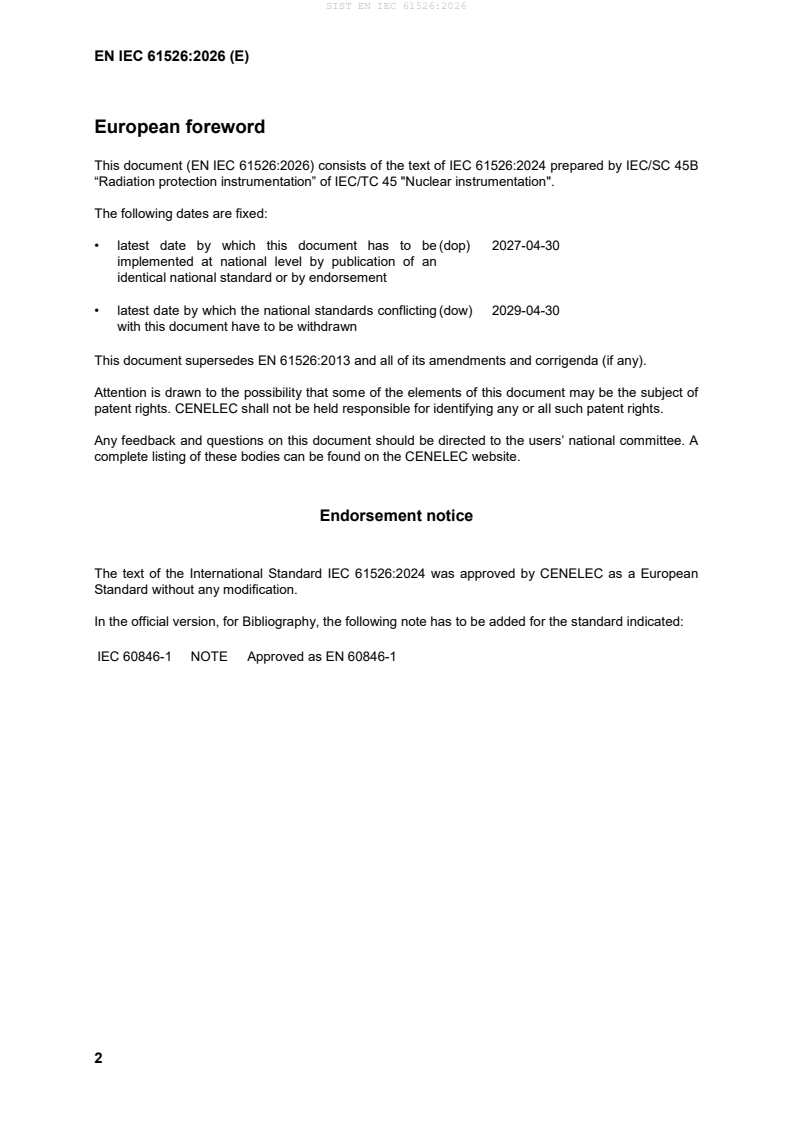
European foreword
This document (EN IEC 61526:2026) consists of the text of IEC 61526:2024 prepared by IEC/SC 45B
“Radiation protection instrumentation” of IEC/TC 45 "Nuclear instrumentation".
The following dates are fixed:
• latest date by which this document has to be (dop) 2027-04-30
implemented at national level by publication of an
identical national standard or by endorsement
• latest date by which the national standards conflicting (dow) 2029-04-30
with this document have to be withdrawn
This document supersedes EN 61526:2013 and all of its amendments and corrigenda (if any).
Attention is drawn to the possibility that some of the elements of this document may be the subject of
patent rights. CENELEC shall not be held responsible for identifying any or all such patent rights.
Any feedback and questions on this document should be directed to the users’ national committee. A
complete listing of these bodies can be found on the CENELEC website.
Endorsement notice
The text of the International Standard IEC 61526:2024 was approved by CENELEC as a European
Standard without any modification.
In the official version, for Bibliography, the following note has to be added for the standard indicated:
IEC 60846-1 NOTE Approved as EN 60846-1
Annex ZA
(normative)
Normative references to international publications
with their corresponding European publications
The following documents are referred to in the text in such a way that some or all of their content
constitutes requirements of this document. For dated references, only the edition cited applies. For
undated references, the latest edition of the referenced document (including any amendments) applies.
NOTE 1 Where an International Publication has been modified by common modifications, indicated by (mod), the
relevant EN/HD applies.
NOTE 2 Up-to-date information on the latest versions of the European Standards listed in this annex is available
here: www.cencenelec.eu.
Publication Year Title EN/HD Year
IEC 60050-395 2014 International Electrotechnical Vocabulary - - -
Part 395: Nuclear instrumentation: Physical
phenomena, basic concepts, instruments,
systems, equipment and detectors
+ A1 2016 - -
+ A2 2020 - -
IEC 60068-2-31 2008 Environmental testing - Part 2-31: Tests - EN 60068-2-31 2008
Test Ec: Rough handling shocks, primarily
for equipment-type specimens
IEC 60086-1 2021 Primary batteries - Part 1: General EN IEC 60086-1 2021
IEC 60086-2 2021 Primary batteries - Part 2: Physical and EN IEC 60086-2 2021
electrical specifications
IEC 60529 1989 Degrees of protection provided by EN 60529 1991
enclosures (IP Code)
- - + AC 1993
+ A1 1999 + A1 2000
+ A2 2013 + A2 2013
IEC 60904-3 - Photovoltaic devices - Part 3: EN IEC 60904-3 -
Measurement principles for terrestrial
photovoltaic (PV) solar devices with
reference spectral irradiance data
IEC 61000-4-2 - Electromagnetic compatibility (EMC) - Part EN IEC 61000-4-2 -
4-2: Testing and measurement techniques
- Electrostatic discharge immunity test
IEC 61000-4-3 - Electromagnetic compatibility (EMC) - Part EN IEC 61000-4-3 -
4-3 : Testing and measurement techniques
- Radiated, radio-frequency,
electromagnetic field immunity test
IEC 61000-4-4 - Electromagnetic compatibility (EMC) - Part EN 61000-4-4 -
4-4: Testing and measurement techniques
- Electrical fast transient/burst immunity
test
Publication Year Title EN/HD Year
IEC 61000-4-5 - Electromagnetic compatibility (EMC) - Part EN 61000-4-5 -
4-5: Testing and measurement techniques
- Surge immunity test
IEC 61000-4-6 - Electromagnetic compatibility (EMC) - Part EN IEC 61000-4-6 -
4-6: Testing and measurement techniques
- Immunity to conducted disturbances,
induced by radio-frequency fields
IEC 61000-4-8 - Electromagnetic compatibility (EMC) - Part EN 61000-4-8 -
4-8: Testing and measurement techniques
- Power frequency magnetic field immunity
test
IEC 61000-4-11 - Electromagnetic compatibility (EMC) - Part EN IEC 61000-4-11 -
4-11: Testing and measurement
techniques - Voltage dips, short
interruptions and voltage variations
immunity tests for equipment with input
current up to 16 A per phase
IEC 61000-6-2 - Electromagnetic compatibility (EMC) - Part EN IEC 61000-6-2 -
6-2: Generic standards - Immunity
standard for industrial environments
IEC 61187 1993 Electrical and electronic measuring - -
equipment - Documentation
IEC 62387 2020 Radiation protection instrumentation - EN IEC 62387 2022
Dosimetry systems with integrating passive
detectors for individual, workplace and
environmental monitoring of photon and
beta radiation
IEC/TR 62461 2015 Radiation protection instrumentation - CLC IEC/TR 62461 2019
Determination of uncertainty in
measurement
ISO/IEC Guide 98-3 2008 Uncertainty of measurement - Part 3: - -
Guide to the expression of uncertainty in
measurement (GUM:1995)
ISO/IEC Guide 98- 2008 Propagation of distributions using a Monte - -
3:2008/Suppl.1 Carlo method and Corr.1 (2009)
ISO 4037-1 2019 Radiological protection - X and gamma EN ISO 4037-1 2021
reference radiation for calibrating
dosemeters and doserate meters and for
determining their response as a function of
photon energy - Part 1: Radiation
characteristics and production methods
ISO 4037-2 2019 Radiological protection - X and gamma EN ISO 4037-2 2021
reference radiation for calibrating
dosemeters and doserate meters and for
determining their response as a function of
photon energy - Part 2: Dosimetry for
radiation protection over the energy ranges
from 8 keV to 1,3 MeV and 4 MeV to 9
MeV
Publication Year Title EN/HD Year
ISO 4037-3 2019 Radiological protection - X and gamma EN ISO 4037-3 2021
reference radiation for calibrating
dosemeters and doserate meters and for
determining their response as a function of
photon energy - Part 3: Calibration of area
and personal dosemeters and the
measurement of their response as a
function of energy and angle of incidence
ISO 4037-4 2019 Radiological protection - X and gamma EN ISO 4037-4 2021
reference radiation for calibrating
dosemeters and doserate meters and for
determining their response as a function of
photon energy - Part 4: Calibration of area
and personal dosemeters in low energy X
reference radiation fields
ISO 6980-1 2023 Nuclear energy - Reference beta-particle EN ISO 6980-1 2025
radiation - Part 1: Methods of production
ISO 6980-2 2023 Nuclear energy - Reference beta-particle EN ISO 6980-2 2025
radiation - Part 2: Calibration fundamentals
related to basic quantities characterizing
the radiation field
ISO 6980-3 2023 Nuclear energy - Reference beta-particle EN ISO 6980-3 2025
radiation – Part 3: Calibration of area and
personal dosemeters and the
determination of their response as a
function of beta radiation energy and angle
of incidence
ISO 8529-1 2021 Neutron reference radiations fields - Part 1: EN ISO 8529-1 2023
Characteristics and methods of production
ISO 8529-2 2000 Reference neutron radiations - Part 2: - -
Calibration fundamentals of radiation
protection devices related to the basic
quantities characterizing the radiation field
ISO 8529-3 2023 Neutron reference radiation fields - Part 3: EN ISO 8529-3 2024
Calibration of area and personal
dosemeters and determination of their
response as a function of neutron energy
and angle of incidence
ISO 12789-1 - Reference radiation fields - Simulated - -
workplace neutron fields - Part 1:
Characteristics and methods of production
ISO 12789-2 - Reference radiation fields - Simulated - -
workplace neutron fields - Part 2:
Calibration fundamentals related to the
basic quantities
ISO 21909-1 2021 Passive neutron dosimetry systems - Part EN ISO 21909-1 2023
1: Performance and test requirements for
personal dosimetry
ISO 80000-10 2019 Quantities and units - Part 10: Atomic and EN ISO 80000-10 2019
nuclear physics
Publication Year Title EN/HD Year
ICRU Report 51 - Quantities and units in radiation protection - -
dosimetry
ANSI N42.17A - American national standard for - -
performance specifications for health
physics instrumentation - Portable
instrumentation for use in normal
environmental conditions
IEC 61526 ®
Edition 4.0 2024-03
INTERNATIONAL
STANDARD
NORME
INTERNATIONALE
Radiation protection instrumentation – Measurement of personal dose
equivalents for X, gamma, neutron and beta radiations – Active personal
dosemeters
Instrumentation pour la radioprotection – Mesure des équivalents de dose
individuels pour les rayonnements X, gamma, neutron et bêta – Dosimètres
individuels actifs
INTERNATIONAL
ELECTROTECHNICAL
COMMISSION
COMMISSION
ELECTROTECHNIQUE
INTERNATIONALE
ICS 13.280 ISBN 978-2-8322-8176-5
– 2 – IEC 61526:2024 © IEC 2024
CONTENTS
FOREWORD . 7
INTRODUCTION . 9
1 Scope . 10
2 Normative references . 11
3 Terms and definitions . 13
4 Units and symbols . 21
4.1 Units . 21
4.2 Symbols . 21
5 Mechanical characteristics . 23
5.1 Case . 23
5.2 Switches . 23
6 General characteristics . 24
6.1 Storage of dose information . 24
6.2 Indication . 24
6.3 Dosemeter markings . 24
6.4 Retention of radioactive contamination. 24
6.5 Ranges for dose and dose rate . 24
6.6 Rated range of an influence quantity . 24
6.7 Effect of radiation not intended to be measured and use of more than one
dosemeter . 25
6.8 Intrinsic and environmental background of the instrument . 25
6.9 Dose or dose rate alarms . 25
6.9.1 General . 25
6.9.2 Dose alarms . 25
6.9.3 Dose rate alarms . 25
6.9.4 Alarm output . 26
6.10 Indication of malfunction . 26
6.11 Assignment of the dose value to the dosemeter . 26
6.12 Algorithm to evaluate the indicated value . 26
7 General test procedures . 26
7.1 Nature of tests . 26
7.2 Reference conditions and standard test conditions . 27
7.3 Tests for influence quantities of type F . 28
7.4 Tests for influence quantities of type S . 28
7.5 Phantom for testing . 28
7.6 Position of detector assembly for the purpose of testing. 28
7.7 Position of dosemeter during use . 28
7.8 Minimum rated range of influence quantity . 29
7.9 Low dose rates . 29
7.10 Statistical fluctuations . 29
7.11 Production of reference radiation . 29
8 Additivity of indicated value . 29
8.1 Requirements . 29
8.2 Method of test . 30
8.2.1 General . 30
8.2.2 Preparation of the test . 30
IEC 61526:2024 © IEC 2024 – 3 –
8.2.3 Practical test . 31
8.3 Interpretation of the results . 31
9 Radiation performance requirements and tests . 31
9.1 General . 31
9.2 Consideration of the uncertainty of the conventional quantity value . 32
9.3 Constancy of the dose response, dose rate dependence and statistical
fluctuations . 32
9.3.1 General . 32
9.3.2 Requirements . 32
9.3.3 Method of test using sources . 37
9.3.4 Interpretation of the results of the test using sources . 38
9.3.5 Method of test for photon dosemeters using natural radiation . 39
9.3.6 Interpretation of the results of the test using natural radiation . 39
9.4 Variation of the response due to photon radiation energy and angle of
incidence . 40
9.4.1 Measurement quantity H (0,07) or Ḣ (0,07) . 40
p p
9.4.2 Measurement quantity H (3) or Ḣ (3) . 40
p p
9.4.3 Measurement quantity H (10) or Ḣ (10) . 41
p p
9.5 Variation of the response due to neutron radiation energy and angle of
incidence . 42
9.5.1 General . 42
9.5.2 Measurement quantity H (10) or Ḣ (10) . 42
p p
9.6 Variation of the response due to beta radiation energy and angle of
incidence . 43
9.6.1 General . 43
9.6.2 Measurement quantity H (0,07) or Ḣ (0,07) . 43
p p
9.6.3 Measurement quantity H (3) or Ḣ (3) . 44
p p
9.6.4 Measurement quantity H (10) or Ḣ (10) . 45
p p
9.7 Over indication due to radiation incident from the side of an H (10), H (3) or
p p
H (0,07) dosemeter . 45
p
9.7.1 Requirements . 45
9.7.2 Method of test. 45
9.7.3 Interpretation of the results . 46
9.8 Retention of dose reading . 46
9.8.1 General . 46
9.8.2 Requirements . 46
9.8.3 Method of test and interpretation of the results . 46
9.9 Overload characteristics . 46
9.9.1 General . 46
9.9.2 Requirements . 47
9.9.3 Method of test and interpretation of the results . 47
9.10 Alarm . 48
9.10.1 General . 48
9.10.2 Response time for dose rate indication and alarm . 48
9.10.3 Accuracy of dose alarm . 49
9.10.4 Accuracy of dose rate alarm . 49
9.11 Model function . 50
10 Electrical and environmental performance requirements and tests . 50
– 4 – IEC 61526:2024 © IEC 2024
10.1 General . 50
10.2 Power supplies . 50
10.2.1 General requirements . 50
10.2.2 Specific primary batteries requirements . 51
10.2.3 Specific secondary batteries requirements . 51
10.2.4 Method of test and interpretation of the results (primary and
secondary batteries) . 51
10.3 Ambient temperature. 52
10.3.1 Requirements . 52
10.3.2 Method of test and interpretation of the results . 53
10.4 Relative humidity . 54
10.4.1 Requirements . 54
10.4.2 Method of test and interpretation of the results . 54
10.5 Atmospheric pressure . 54
10.6 Sealing . 54
10.7 Storage . 54
10.8 Light exposure . 54
10.8.1 General . 54
10.8.2 Requirements . 55
10.8.3 Interpretation of the results . 55
10.9 Dose build-up, fading and self-irradiation (hybrid dosemeters) . 55
11 Electromagnetic performance requirements and tests . 56
11.1 General . 56
11.2 Electrostatic discharge . 57
11.2.1 Requirements . 57
11.2.2 Method of test and interpretation of the results . 57
11.3 Radiated electromagnetic fields . 58
11.3.1 Requirements . 58
11.3.2 Method of test and interpretation of the results . 58
11.4 Conducted disturbances induced by fast transients or bursts . 58
11.4.1 Requirements . 58
11.4.2 Method of test and interpretation of the results . 58
11.5 Conducted disturbances induced by surges . 59
11.5.1 Requirements . 59
11.5.2 Method of test and interpretation of the results . 59
11.6 Conducted disturbances induced by radio-frequencies . 59
11.6.1 Requirements . 59
11.6.2 Method of test and interpretation of the results . 59
11.7 50 Hz/60 Hz magnetic field . 59
11.7.1 Requirements . 59
11.7.2 Method of test and interpretation of the results . 59
11.8 Voltage dips and short interruptions . 59
11.8.1 Requirements . 59
11.8.2 Method of test and interpretation of the results . 60
12 Mechanical performance, requirements and tests . 60
12.1 General . 60
12.2 Drop test . 60
12.2.1 Requirements . 60
12.2.2 Method of test and interpretation of the results . 60
IEC 61526:2024 © IEC 2024 – 5 –
12.3 Vibration test . 61
12.3.1 Requirements . 61
12.3.2 Method of test and interpretation of the results . 61
12.4 Microphonics test . 61
12.4.1 Requirements . 61
12.4.2 Method of test and interpretation of the results . 61
13 Software . 62
13.1 General . 62
13.2 Design and structure of the software . 63
13.2.1 Requirements . 63
13.2.2 Method of test. 63
13.3 Identification of the software . 63
13.3.1 Requirements . 63
13.3.2 Method of test. 63
13.4 Authenticity of the software and the presentation of results . 64
13.4.1 Requirements . 64
13.4.2 Method of test. 64
13.5 Alarm and stop of system operation under abnormal operating conditions . 64
13.5.1 Requirements . 64
13.5.2 Method of test. 64
13.6 Control of instrument parameters . 65
13.6.1 Requirements . 65
13.6.2 Method of test. 65
13.7 Storage of measurement data . 65
13.7.1 Requirements . 65
13.7.2 Method of test. 65
13.8 Transmission of data . 66
13.8.1 Requirements . 66
13.8.2 Method of test. 66
13.9 Hardware interfaces and software interfaces . 66
13.9.1 Requirements . 66
13.9.2 Method of test. 67
13.10 Documentation for the software test . 67
13.10.1 Requirements . 67
13.10.2 Method of test. 67
14 Uncertainty . 68
15 Documentation . 68
15.1 Type test report . 68
15.2 Certificate . 68
16 Operation and maintenance manual . 69
Annex A (normative) Statistical fluctuations . 70
Annex B (normative) Coverage intervals . 72
B.1 General . 72
x
B.2 Coverage interval for the mean, . 73
B.3 Coverage interval for a combined quantity . 73
Annex C (informative) Causal connection between readout signals, indicated value
and measured value . 75
– 6 – IEC 61526:2024 © IEC 2024
Annex D (informative) Procedure to determine the variation of the relative response
due to radiation energy and angle of radiation incidence . 76
Annex E (informative) Computational method of test for mixed irradiations . 78
Bibliography . 80
Figure B.1 – Test for coverage interval . 72
Figure C.1 – Data evaluation in dosimetry systems . 75
Figure E.1 – Flow chart of a computer program to perform tests according to 8.2 . 79
Table 1 – Symbols and abbreviated terms . 21
Table 2 – Reference conditions and standard test conditions . 27
Table 3 – Radiation characteristics of H (0,07) dosemeters for X, gamma and beta
p
radiation . 33
Table 4 – Radiation characteristics of H (3) dosemeters for X, gamma and beta
p
radiation . 34
Table 5 – Radiation characteristics of H (10) dosemeters for X and gamma radiation . 35
p
Table 6 – Radiation characteristics of H (10) dosemeters for neutron radiation . 36
p
Table 7 – Values of c and c for w different dose values and n indications for each
1 2
dose value . 39
Table 8 – Electrical and environmental characteristics of dosemeters . 55
Table 9 – Electromagnetic disturbance characteristics of dosemeters . 57
Table 10 – Mechanical disturbances characteristics of dosemeters . 60
Table A.1 – Number of instrument readings required to detect true differences (95 %
level of confidence) between two sets of instrument readings on the same instrument . 71
Table B.1 – Student’s t-value for a double sided 95 % coverage interval . 73
Table E.1 – Example of dosemeter response table and range limits . 78
IEC 61526:2024 © IEC 2024 – 7 –
INTERNATIONAL ELECTROTECHNICAL COMMISSION
____________
RADIATION PROTECTION INSTRUMENTATION –
MEASUREMENT OF PERSONAL DOSE EQUIVALENTS FOR X,
GAMMA, NEUTRON AND BETA RADIATIONS –
ACTIVE PERSONAL DOSEMETERS
FOREWORD
1) The International Electrotechnical Commission (IEC) is a worldwide organization for standardization comprising
all national electrotechnical committees (IEC National Committees). The object of IEC is to promote international
co-operation on all questions concerning standardization in the electrical and electronic fields. To this end and
in addition to other activities, IEC publishes International Standards, Technical Specifications, Technical Reports,
Publicly Available Specifications (PAS) and Guides (hereafter referred to as “IEC Publication(s)”). Their
preparation is entrusted to technical committees; any IEC National Committee interested in the subject dealt with
may participate in this preparatory work. International, governmental and non-governmental organizations liaising
with the IEC also participate in this preparation. IEC collaborates closely with the International Organization for
Standardization (ISO) in accordance with conditions determined by agreement between the two organizations.
2) The formal decisions or agreements of IEC on technical matters express, as nearly as possible, an international
consensus of opinion on the relevant subjects since each technical committee has representation from all
interested IEC National Committees.
3) IEC Publications have the form of recommendations for international use and are accepted by IEC National
Committees in that sense. While all reasonable efforts are made to ensure that the technical content of IEC
Publications is accurate, IEC cannot be held responsible for the way in which they are used or for any
misinterpretation by any end user.
4) In order to promote international uniformity, IEC National Committees undertake to apply IEC Publications
transparently to the maximum extent possible in their national and regional publications. Any divergence between
any IEC Publication and the corresponding national or regional publication shall be clearly indicated in the latter.
5) IEC itself does not provide any attestation of conformity. Independent certification bodies provide conformity
assessment services and, in some areas, access to IEC marks of conformity. IEC is not responsible for any
services carried out by independent certification bodies.
6) All users should ensure that they have the latest edition of this publication.
7) No liability shall attach to IEC or its directors, employees, servants or agents including individual experts and
members of its technical committees and IEC National Committees for any personal injury, property damage or
other damage of any nature whatsoever, whether direct or indirect, or for costs (including legal fees) and
expenses arising out of the publication, use of, or reliance upon, this IEC Publication or any other IEC
Publications.
8) Attention is drawn to the Normative references cited in this publication. Use of the referenced publications is
indispensable for the correct application of this publication.
9) IEC draws attention to the possibility that the implementation of this document may involve the use of (a)
patent(s). IEC takes no position concerning the evidence, validity or applicability of any claimed patent rights in
respect thereof. As of the date of publication of this document, IEC had not received notice of (a) patent(s), which
may be required to implement this document. However, implementers are cautioned that this may not represent
the latest information, which may be obtained from the patent database available at https://patents.iec.ch. IEC
shall not be held responsible for identifying any or all such patent rights.
IEC 61526 has been prepared by subcommittee 45B: Radiation protection instrumentation, of
IEC technical committee 45: Nuclear instrumentation. It is an International Standard.
This fourth edition cancels and replaces the third edition published in 2010. This edition
constitutes a technical revision.
This edition includes the following significant technical changes with respect to the previous
edition:
a) Modification of the title;
b) Inclusion of the measurement quantity for the dose in the lens of the eye, H (3);
p
c) Inclusion of measurement quantity for dose in the skin and extremities, H (0,07);
p
– 8 – IEC 61526:2024 © IEC 2024
d) Inclusion of dosemeters between active and passive: "hybrid dosemeters";
e) Inclusion of software requirements;
f) Harmonization of requirements for linearity to IEC 62387;
g) Revised neutron energy response requirements.
The text of this International Standard is based on the following documents:
Draft Report on voting
45B/1047/FDIS 45B/1049/RVD
Full information on the voting for its approval can be found in the report on voting indicated in
the above table.
The language used for the development of this International Standard is English.
This document was drafted in accordance with ISO/IEC Directives, Part 2, and developed in
accordance with ISO/IEC Directives, Part 1 and ISO/IEC Directives, IEC Supplement, available
at www.iec.ch/members_experts/refdocs. The main document types developed by IEC are
described in greater detail at www.iec.ch/publications.
The committee has decided that the contents of this document will remain unchanged until the
stability date indicated on the IEC website under webstore.iec.ch in the data related to the
specific document. At this date, the document will be
• reconfirmed,
• withdrawn, or
• revised.
IMPORTANT – The "colour inside" logo on the cover page of this document indicates
that it contains colours which are considered to be useful for the correct understanding
of its contents. Users should therefore print this document using a colour printer.
...