

prEN IEC 62321-8:2025
(Main)Determination of certain substances in electrotechnical products - Part 8: Phthalates in polymers by gas chromatography-mass spectrometry (GC-MS), gas chromatography-mass spectrometry using a pyrolyzer/thermal desorption accessory (Py-TD-GC-MS)
- Status
- Not Published
- Publication Date
- 04-Apr-2027
- Technical Committee
- CLC/TC 111X - Environment
- Current Stage
- 4060 - Enquiry results established and sent to TC, SR, BTTF - Enquiry
- Start Date
- 16-Jan-2026
- Completion Date
- 16-Jan-2026

Overview
prEN IEC 62321-8:2025 is a draft international standard developed by the International Electrotechnical Commission (IEC) and issued through CENELEC (CLC). This standard specifies methods for the determination of phthalates in polymers found in electrotechnical products. The focus is on analytical techniques using gas chromatography-mass spectrometry (GC-MS) and gas chromatography-mass spectrometry with a pyrolyzer/thermal desorption accessory (Py/TD-GC-MS).
Phthalates are widely used as plasticizers in polymeric materials. Due to their potential environmental and health impacts, accurate identification and quantification in electrical and electronic equipment are increasingly required for regulatory compliance and supply chain transparency.
Key Topics
prEN IEC 62321-8:2025 covers several essential aspects related to the testing for phthalates in electrotechnical polymers:
- Scope and Applicability: Defines the scope of polymer materials and electrotechnical products for which phthalate analysis is applicable.
- Analytical Methods:
- GC-MS for the detection and quantification of phthalates in polymeric matrices.
- Py/TD-GC-MS for analysis of substances that are difficult to extract or analyze using standard methods.
- Sample Preparation:
- Detailed protocols for preparing polymer samples to ensure reliable analytical results.
- Extraction techniques, such as Soxhlet extraction and sonication, for dissolving and isolating phthalates from polymer matrices.
- Instrumental Parameters and Calibration:
- Recommendations for establishing and validating calibration curves for quantification.
- Use of retention time, reference mass-to-charge ratios (m/z), and response factor databases.
- Quality Assurance and Precision:
- Test repeatability, reproducibility, and limits of detection/quantification (LOD/LOQ).
- Procedures for blank testing and ensuring system stability.
- Reporting Results:
- Guidance on content and format of test reports, aiding regulatory and customer documentation.
Applications
The standard is directly relevant to stakeholders in the electrical and electronics industry who must assess phthalate content in products such as:
- Cables, connectors, and insulation materials where plasticizers are routinely used.
- Electronic components and circuit boards that contain polymeric encapsulants or housings.
- Consumer electronics, household appliances, and electrical equipment subject to RoHS and REACH compliance.
- Materials testing laboratories aiming to meet customer and regulatory requirements for chemical analysis and hazardous substance control.
- Manufacturers and suppliers in the global supply chain seeking robust laboratory methods for verifying the presence and concentration of restricted phthalates.
Adoption of IEC 62321-8 enables organizations to:
- Support regulatory due diligence for hazardous substances.
- Provide transparent compliance evidence to customers and authorities.
- Optimize product design and material selection to minimize the use of restricted phthalates.
Related Standards
Analyzing phthalates in polymers is part of a broader framework of standards addressing hazardous substances in electrotechnical products. Related documents include:
- IEC 62321 (all parts): A multi-part series specifying test methods for various restricted substances (such as lead, cadmium, mercury, etc.) in electrical and electronic equipment.
- EN IEC 62321-1: Overview and guidance for the whole IEC 62321 family.
- Regulations such as:
- RoHS Directive (2011/65/EU): Restricts the use of certain hazardous substances, including specified phthalates, in electrical and electronic equipment in the European Union.
- REACH Regulation (EC 1907/2006): Governs registration, evaluation, authorization, and restriction of chemicals within the EU.
Laboratories applying prEN IEC 62321-8:2025 can align their methods with internationally recognized best practices, ensuring accurate and repeatable results in phthalate analysis for electrotechnical products.
Relations
- Effective Date
- 30-Nov-2021
Get Certified
Connect with accredited certification bodies for this standard

ECOCERT
Organic and sustainability certification.

Eurofins Food Testing Global
Global leader in food, environment, and pharmaceutical product testing.

Intertek Bangladesh
Intertek certification and testing services in Bangladesh.
Sponsored listings
Frequently Asked Questions
prEN IEC 62321-8:2025 is a draft published by CLC. Its full title is "Determination of certain substances in electrotechnical products - Part 8: Phthalates in polymers by gas chromatography-mass spectrometry (GC-MS), gas chromatography-mass spectrometry using a pyrolyzer/thermal desorption accessory (Py-TD-GC-MS)". This standard covers: Determination of certain substances in electrotechnical products - Part 8: Phthalates in polymers by gas chromatography-mass spectrometry (GC-MS), gas chromatography-mass spectrometry using a pyrolyzer/thermal desorption accessory (Py-TD-GC-MS)
Determination of certain substances in electrotechnical products - Part 8: Phthalates in polymers by gas chromatography-mass spectrometry (GC-MS), gas chromatography-mass spectrometry using a pyrolyzer/thermal desorption accessory (Py-TD-GC-MS)
prEN IEC 62321-8:2025 is classified under the following ICS (International Classification for Standards) categories: 31.020 - Electronic components in general; 71.040.50 - Physicochemical methods of analysis. The ICS classification helps identify the subject area and facilitates finding related standards.
prEN IEC 62321-8:2025 has the following relationships with other standards: It is inter standard links to EN 62321-8:2017. Understanding these relationships helps ensure you are using the most current and applicable version of the standard.
prEN IEC 62321-8:2025 is available in PDF format for immediate download after purchase. The document can be added to your cart and obtained through the secure checkout process. Digital delivery ensures instant access to the complete standard document.
Standards Content (Sample)
SLOVENSKI STANDARD
01-december-2025
Določevanje posameznih substanc v elektrotehniških izdelkih - 8. del: Ftalati v
polimerih s plinsko kromatografijo-masno spektrometrijo (GC-MS), plinsko
kromatografijo-masno spektrometrijo z uporabo pirolize/toplotne desorpcije
(Py/TD-GC-MS)
Determination of certain substances in electrotechnical products - Part 8: Phthalates in
polymers by gas chromatography-mass spectrometry (GC-MS), gas chromatography-
mass spectrometry using a pyrolyzer/thermal desorption accessory (Py-TD-GC-MS)
Détermination de certaines substances dans les produits électrotechniques - Partie 8:
Analyse des phtalates dans les polymères par chromatographie en phase gazeuse-
spectrométrie de masse (GC-MS), chromatographie en phase gazeuse -spectrométrie
de masse par pyrolyse/thermodésorption (Py/TD-GC-MS)
Ta slovenski standard je istoveten z: prEN IEC 62321-8:2025
ICS:
29.020 Elektrotehnika na splošno Electrical engineering in
general
31.020 Elektronske komponente na Electronic components in
splošno general
71.040.50 Fizikalnokemijske analitske Physicochemical methods of
metode analysis
2003-01.Slovenski inštitut za standardizacijo. Razmnoževanje celote ali delov tega standarda ni dovoljeno.
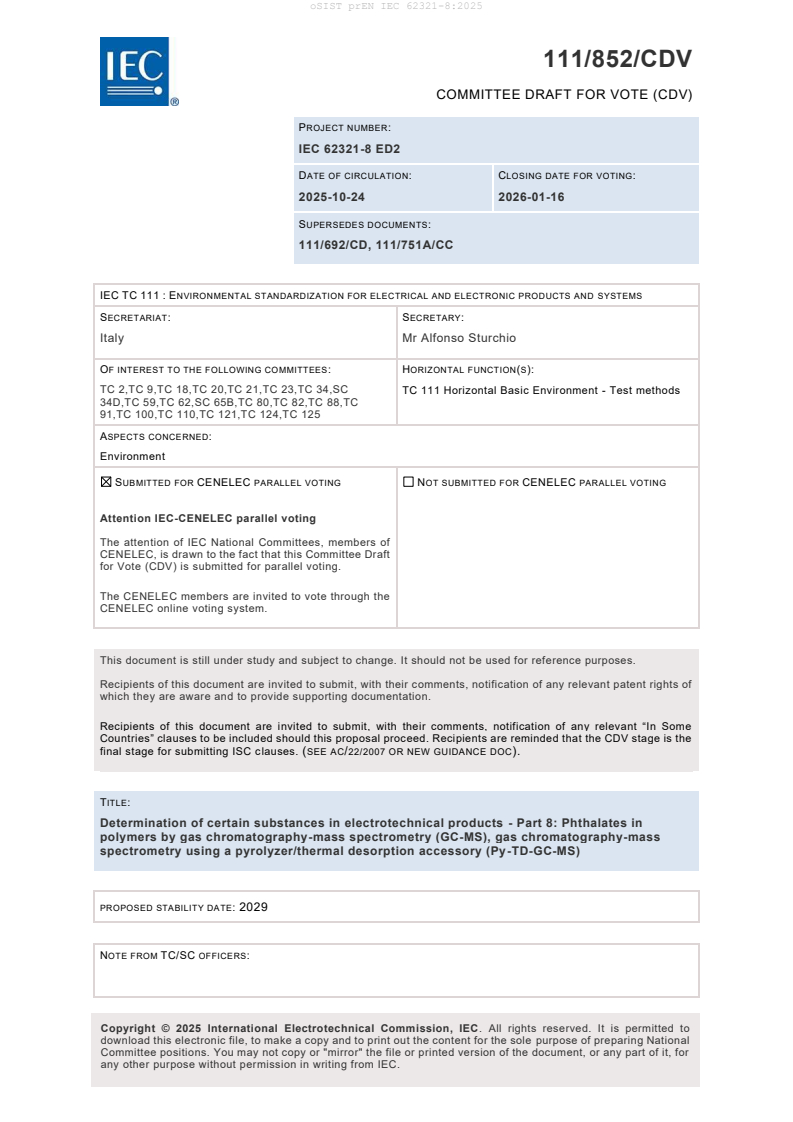
111/852/CDV
COMMITTEE DRAFT FOR VOTE (CDV)
PROJECT NUMBER:
IEC 62321-8 ED2
DATE OF CIRCULATION: CLOSING DATE FOR VOTING:
2025-10-24 2026-01-16
SUPERSEDES DOCUMENTS:
111/692/CD, 111/751A/CC
IEC TC 111 : ENVIRONMENTAL STANDARDIZATION FOR ELECTRICAL AND ELECTRONIC PRODUCTS AND SYSTEMS
SECRETARIAT: SECRETARY:
Italy Mr Alfonso Sturchio
OF INTEREST TO THE FOLLOWING COMMITTEES: HORIZONTAL FUNCTION(S):
TC 2,TC 9,TC 18,TC 20,TC 21,TC 23,TC 34,SC TC 111 Horizontal Basic Environment - Test methods
34D,TC 59,TC 62,SC 65B,TC 80,TC 82,TC 88,TC
91,TC 100,TC 110,TC 121,TC 124,TC 125
ASPECTS CONCERNED:
Environment
SUBMITTED FOR CENELEC PARALLEL VOTING NOT SUBMITTED FOR CENELEC PARALLEL VOTING
Attention IEC-CENELEC parallel voting
The attention of IEC National Committees, members of
CENELEC, is drawn to the fact that this Committee Draft
for Vote (CDV) is submitted for parallel voting.
The CENELEC members are invited to vote through the
CENELEC online voting system.
This document is still under study and subject to change. It should not be used for reference purposes.
Recipients of this document are invited to submit, with their comments, notification of any relevant patent rights of
which they are aware and to provide supporting documentation.
Recipients of this document are invited to submit, with their comments, notification of any relevant “In Some
Countries” clauses to be included should this proposal proceed. Recipients are reminded that the CDV stage is the
final stage for submitting ISC clauses. (SEE AC/22/2007 OR NEW GUIDANCE DOC).
TITLE:
Determination of certain substances in electrotechnical products - Part 8: Phthalates in
polymers by gas chromatography-mass spectrometry (GC-MS), gas chromatography-mass
spectrometry using a pyrolyzer/thermal desorption accessory (Py-TD-GC-MS)
PROPOSED STABILITY DATE: 2029
NOTE FROM TC/SC OFFICERS:
download this electronic file, to make a copy and to print out the content for the sole purpose of preparing National
Committee positions. You may not copy or "mirror" the file or printed version of the document, or any part of it, for
any other purpose without permission in writing from IEC.
IEC CDV 62321-8 ED2 © IEC 2025
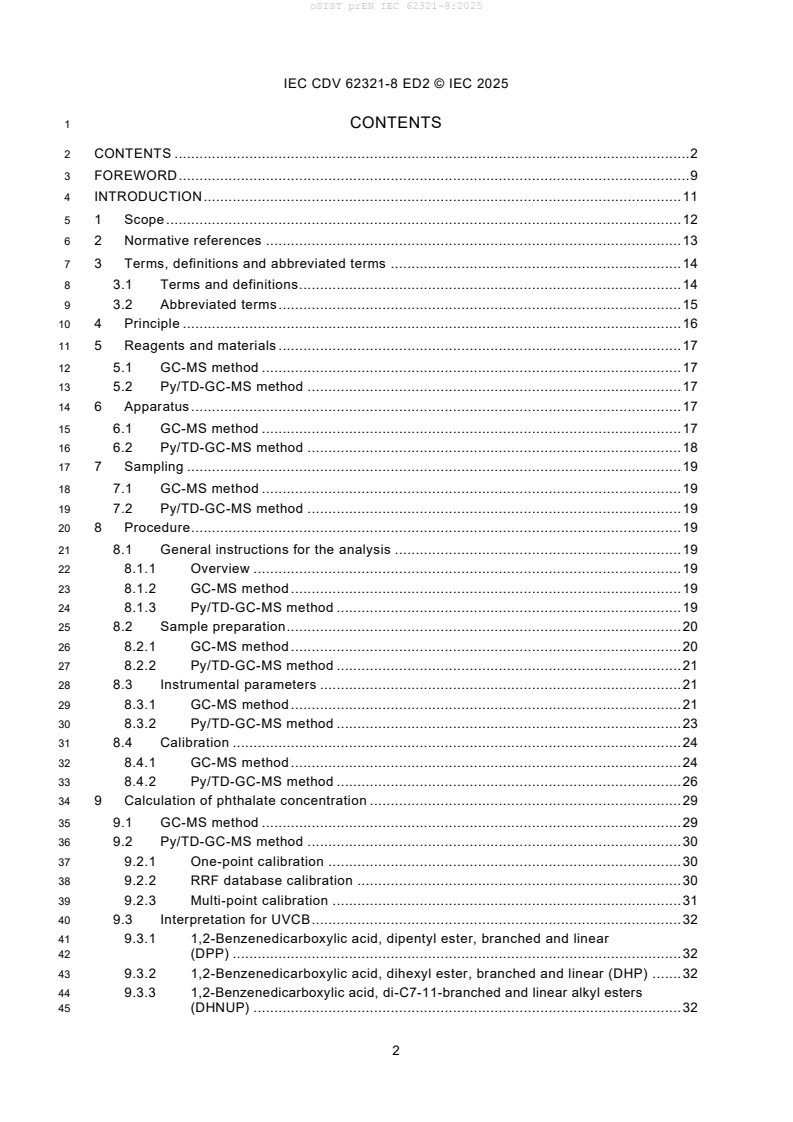
1 CONTENTS
2 CONTENTS . 2
3 FOREWORD . 9
4 INTRODUCTION . 11
5 1 Scope . 12
6 2 Normative references . 13
7 3 Terms, definitions and abbreviated terms . 14
8 3.1 Terms and definitions . 14
9 3.2 Abbreviated terms . 15
10 4 Principle . 16
11 5 Reagents and materials . 17
12 5.1 GC-MS method . 17
13 5.2 Py/TD-GC-MS method . 17
14 6 Apparatus . 17
15 6.1 GC-MS method . 17
16 6.2 Py/TD-GC-MS method . 18
17 7 Sampling . 19
18 7.1 GC-MS method . 19
19 7.2 Py/TD-GC-MS method . 19
20 8 Procedure . 19
21 8.1 General instructions for the analysis . 19
22 8.1.1 Overview . 19
23 8.1.2 GC-MS method . 19
24 8.1.3 Py/TD-GC-MS method . 19
25 8.2 Sample preparation . 20
26 8.2.1 GC-MS method . 20
27 8.2.2 Py/TD-GC-MS method . 21
28 8.3 Instrumental parameters . 21
29 8.3.1 GC-MS method . 21
30 8.3.2 Py/TD-GC-MS method . 23
31 8.4 Calibration . 24
32 8.4.1 GC-MS method . 24
33 8.4.2 Py/TD-GC-MS method . 26
34 9 Calculation of phthalate concentration . 29
35 9.1 GC-MS method . 29
36 9.2 Py/TD-GC-MS method . 30
37 9.2.1 One-point calibration . 30
38 9.2.2 RRF database calibration . 30
39 9.2.3 Multi-point calibration . 31
40 9.3 Interpretation for UVCB . 32
41 9.3.1 1,2-Benzenedicarboxylic acid, dipentyl ester, branched and linear
42 (DPP) . 32
43 9.3.2 1,2-Benzenedicarboxylic acid, dihexyl ester, branched and linear (DHP) . 32
44 9.3.3 1,2-Benzenedicarboxylic acid, di-C7-11-branched and linear alkyl esters
45 (DHNUP) . 32
IEC CDV 62321-8 ED2 © IEC 2025
46 9.3.4 1,2-benzenedicarboxylic acid, di-C6-10-alkyl esters; 1,2-
47 benzenedicarboxylic acid, mixed decyl and hexyl and octyl diesters with
48 ≥ 0,3 % of dihexyl phthalate (DC6-C10P) . 33
49 9.4 Calculation of interference effect . 33
50 9.4.1 Determination of DINP, HNP and DNP . 33
51 9.4.2 Determination of DIDP and DOP . 34
52 10 Precision . 34
53 10.1 GC-MS method . 34
54 10.1.1 Repeatability and reproducibility . 34
55 10.2 Py/TD-GC-MS method . 36
56 10.2.1 One-point calibration . 36
57 10.2.2 RRF-database calibration . 39
58 10.2.3 Multi-point calibration . 41
59 11 Quality assurance and control . 42
60 11.1 General . 42
61 11.2 GC-MS method . 42
62 11.2.1 Performance . 42
63 11.2.2 LOD or MDL and LOQ . 43
64 11.3 Py/TD-GC-MS method . 44
65 11.3.1 Sensitivity test . 44
66 11.3.2 Blank test . 44
67 11.3.3 System stability test for RRF database calibration and multi-point
68 calibration . 45
69 11.3.4 RRF test for RRF database calibration . 45
70 11.3.5 MDL and LOQ . 46
71 11.3.6 Tailing factor . 46
72 12 Test report . 46
73 Annex A (informative) Determination of phthalates in polymers by ion attachment
74 mass spectrometry (IAMS) . 47
75 A.1 Principle . 47
76 A.2 Reagents and materials . 47
77 A.3 Apparatus . 47
78 A.4 Sampling. 48
79 A.5 Procedure . 48
80 A.5.1 General instructions for the analysis . 48
81 A.5.2 Sample preparation . 48
82 A.5.3 Instrumental parameters . 49
83 A.5.4 Calibrants . 50
84 A.5.5 Calibration . 50
85 A.6 Calculation of phthalates concentration . 51
86 A.7 Quality assurance and control . 51
87 A.7.1 General . 51
88 A.7.2 Sensitivity . 51
89 A.7.3 Recovery . 51
90 A.7.4 Blank test . 52
91 A.7.5 Limit of detection (LOD) or method detection limit (MDL) and limit of
92 quantification (LOQ) . 53
93 A.8 Test report . 53
IEC CDV 62321-8 ED2 © IEC 2025
94 Annex B (informative) Determination of phthalates in polymers by liquid
95 chromatography-mass spectrometry(LC-MS) . 54
96 B.1 Principle . 54
97 B.2 Reagents and materials . 54
98 B.3 Apparatus . 54
99 B.4 Sampling. 55
100 B.5 Procedure . 55
101 B.5.1 General instructions for the analysis . 55
102 B.5.2 Sample preparation . 55
103 B.5.3 Instrumental parameters . 56
104 B.5.4 Calibrants . 58
105 B.5.5 Calibration . 58
106 B.6 Calculation of phthalates concentration . 59
107 B.7 Quality assurance and control . 60
108 B.7.1 General . 60
109 B.7.2 Performance . 60
110 B.7.3 Limit of detection (LOD) or method detection limit (MDL) and limit of
111 quantification (LOQ) . 60
112 B.8 Test report . 61
113 Annex C (informative) Examples of chromatograms at suggested conditions . 62
114 C.1 GC-MS method . 62
115 C.2 Py/TD-GC-MS method . 68
116 C.3 LC-MS method . 75
117 C.4 IAMS method . 76
118 Annex D (informative) Other test methods . 79
119 D.1 Published test method . 79
120 D.2 Non-published screening analysis method . 79
121 Annex E (informative) Verification of the EGA thermal desorption zone . 83
122 Annex F (informative) Example of IAMS and Py/TD-GC-MS instruments . 84
123 Annex G (informative) Example of false positive detection of phthalates . 86
124 Annex H (informative) Examples of sample preparation for quantitative analysis of
125 phthalates by GC-MS . 87
126 H.1 General . 87
127 H.2 Soxhlet extraction of phthalates using proper organic solvents . 87
128 Annex I (informative) Extraction of phthalates by dissolution in THF using sonication
129 and precipitation of polymer matrix . 90
130 Annex J (informative) Example of suitable products available commercially for the
131 analysis . 92
132 J.1 GC-MS . 92
133 J.2 Py/TD-GC-MS . 92
134 Annex K (informative) Commercially available capillary columns considered suitable
135 for GC-MS and Py/TD-GC-MS . 95
136 Annex L (informative) Labware cleaning procedure for phthalate testing . 96
137 L.1 With the use of a furnace (non-volumetric glassware only) . 96
138 L.2 Without the use of a furnace (glassware and plastic-ware) . 96
139 L.3 Estimation of cleanness of the inner areas of volumetric glassware . 97
140 Annex M (informative) Results of international inter-laboratory study . 98
IEC CDV 62321-8 ED2 © IEC 2025
141 M.1 Py/TD-GC-MS . 98
142 M.1.1 One-point calibration . 98
143 M.1.2 RRF-database calibration . 99
144 M.1.3 Multi-point calibration . 100
145 M.2 GC-MS . 101
146 M.3 Statistical data of IIS for IAMS and LC-MS . 102
147 Annex N (informative) Sample analysis sequence . 104
148 N.1 GC-MS . 104
149 N.2 Py/TD-GC-MS . 104
150 Annex O (informative) Flow chart . 107
151 Annex P (informative) Tailing factor . 108
152 Annex Q (informative) Determination of extraction time for sonication method . 110
153 Q.1 PE . 110
154 Q.2 NBR . 111
155 Q.3 Paint . 112
156 Annex R (informative) Determination of dimethyl phthalate (DMP) and diethyl
157 phthalate (DEP) in polymer by normative techniques . 114
158 R.1 Sample preparation . 114
159 R.2 Instrumental parameters . 114
160 R.3 Example RRFs . 114
161 Annex S (informative) Examples of RRFs. 115
163 Key Substance [Retention time (min)] . 62
164 Figure C.1 – Total ion current chromatogram of calibration standard solution (10 g/ml,
165 1 l, splitless) . 63
166 Figure C.2 – Extracted ion chromatogram of calibration standard solution at 13.70 min
167 (10 g/ml, 1 l, splitless) . 63
168 Figure C.3 – Extracted ion chromatogram of calibration standard solution at 14.60 min
169 (10 g/ml, 1 l, splitless) . 64
170 Figure C.4 – Extracted ion chromatogram of calibration standard solution at 15.70 min
171 (10 g/ml, 1 l, splitless) (10 g/ml, 1 l, splitless). 64
172 Figure C.5 – Extracted ion chromatogram of calibration standard solution at 17.00 min
173 (10 g/ml, 1 l, splitless) . 65
174 Figure C.6 – Extracted Ionchromatogram at m/z 293 of calibration standard solution
175 (10 g/ml, 1 l, splitless) . 65
176 Figure C.7 – Extracted Ion chromatogram at m/z 293 of DINP and HNP, DNP (10
177 g/ml, 1 l, splitless) . 65
178 Figure C.8 – Extracted Ion chromatogram at m/z 307 of calibration standard solution
179 (10 g/ml, 1 l, splitless) . 66
180 Figure C.9 – Extracted Ion chromatogram at m/z 307 of DIDP and DOP (10 g/ml, 1 l,
181 splitless) . 66
182 Figure C.10 – Extracted ion chromatogram of DIHP (10 g/ml, 1 l, splitless) . 67
183 Figure C.11 – Extracted ion chromatogram of DHP (10 g/ml, 1 l, splitless) . 67
184 Figure C.12 – Total ion current chromatogram of 100 g/ml of phthalate mixture . 69
185 Figure C.13 –Extracted ion chromatogram of phthalate mixture (for peak 12, 13, 14,
186 15, and 16) . 70
IEC CDV 62321-8 ED2 © IEC 2025
187 Figure C.14 –Extracted ion chromatogram of phthalate mixture (for peak 17, 18 and
188 19) 71
189 Figure C.15 –Extracted ion chromatogram of phthalate mixture by Py/TD-GC-MS (for
190 peak 22, 23 and 24) . 72
191 Figure C.16 –Extracted ion chromatogram of phthalate mixture (for peak 25 and 26) . 73
192 Figure C.17 – Extracted ion chromatogram of phthalate mixture (for peak 21 and 22) . 74
193 Figure C.18 – Extracted ion chromatogram of phthalate mixture (for peak 18, 20 and
194 23) 74
195 Figure C.19 – Total ion current chromatogram of 5 g/ml of phthalate mixture by LC-
196 MS 76
197 Figure C.20 – Mass spectrum of each phthalate by IAMS . 77
198 Figure C.21 – Total ion current chromatogram of each absolute amount (0,08 g) of
199 phthalate mixture by IAMS . 78
200 Figure C.22 – Total ion current chromatogram of approximately 0,3 mg of PVC which
201 contains 300 mg/kg of each phthalate mixture by IAMS (Absolute amount: 0,09 g) . 78
202 Figure D.1 – Outline of surface-enhanced Raman spectroscopy . 80
203 Figure D.2 – Characteristic SERS spectra and peak assignments . 80
204 Figure D.3 – SERS-based sensitive detection . 81
205 Figure D.4 – Quantitative investigation with SERS signals . 81
206 Figure E.1 – Example of EGA thermogram of a PVC sample containing phthalates . 83
207 Figure F.1 – Example of IAMS instrument . 84
208 Figure F.2 – Example of Py/TD-GC-MS instrument . 85
209 Figure G.1 – Typical laboratory wares made of plastic materials that may cause
210 phthalate contamination . 86
211 Figure G.2 – Example of a chromatogram of a blank solvent (THF) in a plastic bottle
212 showing DEHP contamination. . 86
213 Figure H.1 – Recovery ratios of Di-(2-ethylhexyl) phthalate using Soxhlet extraction
214 with different organic solvents . 89
215 Figure H.2 – Comparison of recovery ratios of phthalates using different extracting
216 conditions . 89
217 Product name . 93
218 Figure J.1 – Sample preparation of polymer reference materials . 94
219 Figure O.1 – Flow chart for screening step and quantitative step . 107
220 Figure P.1 – Comparison of total ion current chromatogram between using new column
221 and degraded column . 109
222 Figure P.2 – Model peak to calculate tailing factor . 109
223 Figure Q.1– Extraction time of cut PE sample . 110
224 Figure Q.2– Extraction time of milled/ground PE sample . 111
225 Figure Q.3– Extraction time of cut NBR sample . 111
226 Figure Q.4– Extraction time of milled/ground NBR sample . 112
227 Figure Q.5– Extraction time of cut paint sample . 112
228 Figure Q.6– Extraction time of milled/ground paint sample . 113
229 Bibliography . 117
IEC CDV 62321-8 ED2 © IEC 2025
231 Table 1 – List of phthalates . 12
232 Table 2 – Measurement condition of GC-MS . 22
233 Table 3 – Reference m/z for the quantification of each phthalate . 22
234 Table 4 – Measurement condition of Py/TD-GC-MS . 24
235 Table 5 – Calibration standard solution of phthalates . 25
236 Table 7 – Interpretation for DPP . 32
237 Table 8 – Interpretation for DHNUP . 32
238 Table 9 – Interpretation for DC6-C10P . 33
239 Table 10 – Example of quantification at ion of m/z 293 . 34
240 Table 11 – Example of quantification at ion of m/z 307 . 34
241 Table 13 –IIS repeatability and reproducibility . 35
242 Table 14 – One-point calibration screening and threshold judgement . 36
243 Table 15 –IIS repeatability and reproducibility . 38
244 Table 16 – RRF-database calibration screening and threshold judgement . 39
245 Table 17 –IIS repeatability and reproducibility . 40
246 Table 19 –IIS repeatability and reproducibility . 41
247 Table A.1 – Measurement condition of IAMS . 50
248 Table A.2 – Certified value of constituent phthalates in KRISS CRM 113-03-006 . 52
249 Table B.1 – Measurement condition of LC-MS . 58
250 Table B.2 – Standard stock solution concentrations . 59
251 Table D.1 – Published test methods . 79
252 Table H.1 – Recovery ratios of phthalates according to different Soxhlet extraction
253 times (extracting solvent: n-hexane) . 88
254 Table I.1 – Comparison of the efficiency of the sample preparation method of
255 dissolution in THF using sonication and precipitation of polymeric matrix with that of
256 Soxhlet extraction for soluble sample . 90
257 Table I.2 – Comparison of the efficiency of the sample preparation method of
258 dissolution in THF using sonication and precipitation of polymeric matrix with that of
259 Soxhlet extraction for insoluble samples . 91
260 Table J.1 – Example list of commercially available UVCB reference solutions
261 considered suitable for GC-MS . 92
262 Table J.2 – Example list of commercially available polymer reference materials
263 considered suitable for Py/TD-GC-MS. 93
264 Table K.1 – Example list of commercially available capillary columns considered
265 suitable for GC-MS and Py/TD-GC-MS analysis . 95
266 Table M.1 – Statistical data of one-point calibration for Py/TD-GC-MS . 98
267 Table M.2 – Statistical data of RRF-database calibration for Py/TD-GC-MS . 99
268 Table M.3 – Statistical data of multi-point calibration for Py/TD-GC-MS . 100
269 Table M.4 – Statistical data for GC-MS . 101
270 Table M.5 – Statistical data for IAMS . 102
271 Table M.6 – Statistical data for LC-MS . 103
272 Table N.1 – Sample analysis sequence for GC-MS analysis. 104
273 Table N.2 – Sample analysis sequence of one-point calibration for Py/TD-GC-MS
274 analysis . 104
IEC CDV 62321-8 ED2 © IEC 2025
275 Table N.3 – Sampl``e analysis sequence of RRF database calibration for Py/TD-GC-
276 MS analysis . 105
277 Table N.4 – Sample analysis sequence of multi-point calibration for Py/TD-GC-MS
278 analysis . 105
279 Table R.1 – Reference m/z for the quantification of DMP and DEP . 114
280 Table R.2 – RRFs of DMP and DEP . 114
281 Table S.1 – RRFs of analytes . 115
IEC CDV 62321-8 ED2 © IEC 2025
283 INTERNATIONAL ELECTROTECHNICAL COMMISSION
284 ____________
286 DETERMINATION OF CERTAIN SUBSTANCES
287 IN ELECTROTECHNICAL PRODUCTS –
289 Part 8: Phthalates in polymers by gas chromatography-mass spectrometry
290 (GC-MS), gas chromatography-mass spectrometry using
291 a pyrolyser/thermal desorption accessory (Py/TD-GC-MS)
293 FOREWORD
294 1) The International Electrotechnical Commission (IEC) is a worldwide organization for standardization comprising
295 all national electrotechnical committees (IEC National Committees). The object of IEC is to promote international
296 co-operation on all questions concerning standardization in the electrical and electronic fields. To this end and
297 in addition to other activities, IEC publishes International Standards, Technical Specifications, Technical Reports,
298 Publicly Available Specifications (PAS) and Guides (hereafter referred to as “IEC Publication(s)”). Their
299 preparation is entrusted to technical committees; any IEC National Committee interested in the subject dealt with
300 may participate in this preparatory work. International, governmental and non-governmental organizations liaising
301 with the IEC also participate in this preparation. IEC collaborates closely with the International Organization for
302 Standardization (ISO) in accordance with conditions determined by agreement between the two organizations.
303 2) The formal decisions or agreements of IEC on technical matters express, as nearly as possible, an international
304 consensus of opinion on the relevant subjects since each technical committee has representation from all
305 interested IEC National Committees.
306 3) IEC Publications have the form of recommendations for international use and are accepted by IEC National
307 Committees in that sense. While all reasonable efforts are made to ensure that the technical content of IEC
308 Publications is accurate, IEC cannot be held responsible for the way in which they are used or for any
309 misinterpretation by any end user.
310 4) In order to promote international uniformity, IEC National Committees undertake to apply IEC Publications
311 transparently to the maximum extent possible in their national and regional publications. Any divergence between
312 any IEC Publication and the corresponding national or regional publication shall be clearly indicated in the latter.
313 5) IEC itself does not provide any attestation of conformity. Independent certification bodies provide conformity
314 assessment services and, in some areas, access to IEC marks of conformity. IEC is not responsible for any
315 services carried out by independent certification bodies.
316 6) All users should ensure that they have the latest edition of this publication.
317 7) No liability shall attach to IEC or its directors, employees, servants or agents including individual experts and
318 members of its technical committees and IEC National Committees for any personal injury, property damage or
319 other damage of any nature whatsoever, whether direct or indirect, or for costs (including legal fees) and
320 expenses arising out of the publication, use of, or reliance upon, this IEC Publication or any other IEC Publications.
321 8) Attention is drawn to the Normative references cited in this publication. Use of the referenced publications is
322 indispensable for the correct application of this publication.
323 9) Attention is drawn to the possibility that some of the elements of this IEC Publication may be the subject of patent
324 rights. IEC shall not be held responsible for identifying any or all such patent rights.
325 International Standard IEC 62321-8 has been prepared by IEC technical committee 111:
326 Environmental standardization for electrical and electronic products and systems.
327 It has the status of a horizontal standard in accordance with IEC Guide 108.
328 This second edition cancels the first edition published in 2017 and replaces it with a technically
329 revised version.
330 In this second edition, the main technical changes with respect to the previous edition are as
331 follows :
332 a) the test methods have been evaluated by the test of PVC, PE, paint, rubber, and adhesive
333 in polymers of electrotechnical products.
334 b) determination of target phthalates in this second edition is expanded to 19 specific phthalates.
IEC CDV 62321-8 ED2 © IEC 2025
335 c) the GC-MS using a pyrolyser/thermal desorption (TD) accessory is used as quantitative
336 determination analysis of specific phthalates as well as screening analysis and semi-
337 quantitative analysis.
339 The text of this second edition is based on that of the first edition and the following documents:
Draft Report on voting
111/XX/FDIS 111/XX/RVD
340 Full information on the voting for the approval of this International Standard can be found in the
341 report on voting indicated in the above table.
342 This document has been drafted in accordance with the ISO/IEC Directives, Part 2.
343 A list of all parts in the IEC 62321 series, published under the general title: Determination of
344 certain substances in electrotechnical products, can be found on the IEC website.
345 The committee has decided that the contents of this publication will remain unchanged until the
346 stability date indicated on the IEC website under "http://webstore.iec.ch" in the data related to
347 the specific publication. At this date, the publication will be
348 • reconfirmed,
349 • withdrawn,
350 • replaced by a revised edition, or
351 • amended.
IEC CDV 62321-8 ED2 © IEC 2025
354 INTRODUCTION
355 The widespread use of electrotechnical products has drawn increased attention to their impact
356 on the environment. In many countries all over the world this has resulted in the adaptation of
357 regulations affecting wastes, substances and energy use of electrotechnical products.
358 The use of certain substances (e.g. lead (Pb), cadmium (Cd), polybrominated diphenyl ethers
359 (PBDEs) and specific phthalates) in electrotechnical products is a source of concern in current
360 and proposed regional legislation.
361 The purpose of the IEC 62321 series is therefore to provide test methods that will allow the
362 electrotechnical industry to determine the levels of certain substances of concern in
363 electrotechnical products on a consistent global basis.
364 This second edition of IEC 62321-8 describes the test method for specific phthalates based on
365 REACH Annex XVII, RoHS Directive and US CPSIA in electrotechnical products by gas
366 chromatography-mass spectrometry (GC-MS) and the GC-MS using a pyrolyser/thermal
367 desorption (TD) techniques in the normative section.
368 In addition, information on ion attachment mass spectrometry (IAMS) and liquid
369 chromatography – mass spectrometry (LC-MS) are provided in Annex A (informative) and
370 Annex B (informative), respectively.
371 WARNING – Persons using this document should be familiar with normal laboratory practice.
372 This document does not purport to address all of the safety problems, if any, associated with
373 its use. It is the responsibility of the user to establish appropriate safety and health practices
374 and to ensure compliance with any national regulatory conditions.
IEC CDV 62321-8 ED2 © IEC 2025
377 DETERMINATION OF CERTAIN SUBSTANCES
378 IN ELECTROTECHNICAL PRODUCTS –
380 Part 8: Pht
...