

prEN IEC 62841-4-12:2026
(Main)Electric motor-operated hand-held tools, transportable tools and lawn and garden machinery - Safety - Part 4-12: Particular requirements for robotic lawnmowers
- Status
- Not Published
- Publication Date
- 16-Nov-2027
- Technical Committee
- CLC/TC 116 - Safety of hand-held motor-operated electric tools
- Drafting Committee
- CLC/TC 116/WG 05 - Gardening appliances
- Current Stage
- 4060 - Enquiry results established and sent to TC, SR, BTTF - Enquiry
- Start Date
- 04-Sep-2026
- Completion Date
- 04-Sep-2026

prEN IEC 62841-4-12:2026 is the CLC draft for the safety of electric motor-operated hand-held tools, transportable tools and lawn and garden machinery, focused on robotic lawnmowers. It specifies particular requirements for the machine, its batteries, and its peripherals, and it is used together with IEC 62841-1:2014 and IEC 62841-1:2014/AMD1:2025. In practice, it is the document manufacturers, test labs, quality teams and buyers use when they need a safety basis for design, testing, and conformity assessment of robotic mowers and related equipment.
What does prEN IEC 62841-4-12:2026 specify?
prEN IEC 62841-4-12:2026 specifies safety requirements for electric motor-operated or magnetically driven rechargeable battery-powered rotary robotic lawnmowers, their batteries, and their peripherals. It covers hazards in normal use and reasonably foreseeable misuse, with the robotic lawnmower referred to as the “machine” in the document.
The scope sets the main electrical limits at 250 V d.c. for machines and battery packs, 250 V single-phase a.c. or d.c. for peripherals, and 480 V for three-phase a.c. peripherals. It also states that the document is used with the first edition of IEC 62841-1 and Amendment 1, and that clauses not mentioned remain applicable as far as reasonable.
The document is organized as a general part plus robotic-mower-specific additions. The core structure runs through Clauses 1 to 28, then the annexes, with Annex K carrying most of the mower-specific technical requirements and tests.
| Annex | What it covers |
|---|---|
| C | Leakage current |
| I | Noise and vibration emissions |
| K | Battery tools and battery packs, including robotic-lawnmower-specific requirements |
| L | Battery tools and battery packs provided with mains connection or non-isolated sources |
| AA | Product safety labels |
| BB | Test enclosure construction |
| CC | Base for the thrown object test enclosure |
| DD | Target panel elevation zones and a recommended test report for the thrown object test |
| EE | Example of a material and construction for an artificial surface |
| FF | Calculation of kinetic energy of cutting means |
| GG | Mains powered circuits for battery charging, preheating or other non-motor functions |
| HH | Aging test for gaskets, o-rings, seals and tubing used for moisture resistance |
What are the key requirements of prEN IEC 62841-4-12:2026?
prEN IEC 62841-4-12:2026 adapts the IEC 62841-1 general safety structure to robotic lawnmowers and adds mower-specific tests for cutting hazards, stopping behaviour, batteries, and construction. The most important practical point is that the standard treats the mower as an unattended machine that can operate automatically, so the document focuses on keeping people away from the cutting means and forcing the machine to stop predictably when sensors or controls act.
Base standard, product types and electrical limits
The document supplements and modifies IEC 62841-1:2014 and IEC 62841-1:2014/AMD1:2025. Where a subclause is not mentioned, the corresponding IEC 62841-1 requirement applies as far as reasonable, and where the text says “addition”, “modification” or “replacement”, the base text is adapted accordingly.
Robotic lawnmowers with a provision for a person to ride on the machine are treated as multifunctional machines. They must comply with this standard in automatic mode, manual mode and setup mode, and with the ride-on lawnmower standard when operated with a rider. For a buyer or engineer, that means a ride-on-capable product needs to satisfy more than one safety model.
Classification, ingress protection and outdoor peripherals
Machines and non-mains-powered peripherals are not treated as class I, class II or class III tools in the normal IEC 62841-1 sense. Peripherals, however, shall be either class II or class III, and outdoor-installed charging stations or other peripherals, such as a signal source for a perimeter delimiter, shall be at least IPX4.
This matters because the peripheral enclosure and shock-protection concept must match the installation environment. For outdoor equipment, moisture exposure is part of normal use, not an exceptional condition.
Cutting means protection and access prevention
Annex K adds detailed guarding requirements around the cutting means. The machine shall be designed to prevent inadvertent contact with the feet, hands and arms during operation, and the document uses probe tests for adults, standing children, kneeling children, hands and child arms to check the guarding.
A key practical detail is that some machines can use obstruction sensor performance as an alternative route: if the machine meets the obstruction sensor requirements and the stop zone includes all areas around the cutting means enclosure, compliance can be checked through the referenced ISO 5395-3 approach instead of the probe tests. In practice, this links the guarding design to the sensing and stopping behaviour of the machine.
Stopping, sensor response and restart control
The standard requires the traction drive to stop when a stop command comes from the manual stop, manual controller, lift sensor, tilt sensor or obstruction sensor. For low mass robotic lawnmowers, the document gives time or distance limits for stopping, and for high mass robotic lawnmowers it points to the relevant ISO 5395-3 stopping requirements.
Restart is also controlled. After an activation of sensors, a manual stop, or a change in the working area, restarting automatic mode must only be possible after two separate actions, an alphanumeric code of at least four characters, or multiple key strokes in response to prompts. For remote setting devices, the device must first show that automatic mode is active, the machine is inside the working area, the obstruction sensors are not activated, and any obstacle detection system is clear to avoid collisions.
Charging and battery-related requirements
The document places limits on charging behaviour and battery use. Except for contactless charging means such as solar panels on the machine, it shall not be possible to operate the cutting means or traction drive while the battery is charging.
Robotic lawnmowers shall not readily accept general purpose batteries as the energy source for their primary function. For machines with an integral battery and no manual stop, an isolation device is required so that service or user maintenance can be done without exposing people to mechanical hazards. Annex K also covers battery tools and battery packs, and Annex HH gives aging tests for moisture-sealing parts such as gaskets, seals and tubing.
Mechanical strength and construction
Annex K adds tests for structural integrity, cutting means impact, imbalance, and enclosure strength. The cutting means enclosure, guards and grass catcher have to withstand impacts expected in normal use, and the document also includes a drop test for a manual controller. High mass robotic lawnmowers require a parking brake, which must apply automatically when power is removed from the traction drive and must not rely on battery power to stay engaged.
These requirements matter because robotic lawnmowers operate outdoors, meet obstacles, and are handled in ways that can damage enclosures, controls, and the cutting system. The tests check that the machine keeps its protective functions after practical abuse conditions.
What terms does prEN IEC 62841-4-12:2026 define?
- Robotic lawnmower - an unattended lawnmower that operates automatically.
- Automatic mode - autonomous operation in which all safety functions are ensured in the working area without a manual controller.
- Manual controller - a manufacturer-provided wired or wireless device that allows manual operation of the machine.
- Setup device - a smartphone or tablet used to set the working area and settings of the machine and to move it in setup mode.
- Perimeter delimiter - a device that defines the perimeter of the working area within which the machine can operate automatically, such as a boundary wire.
- Working area - the area in which the machine can function in automatic mode.
- Stop zone - the area in which contact with the machine is likely to occur.
- Hazard zone - the area outside the stop zone where an obstacle can create a potential for injury.
Who uses prEN IEC 62841-4-12:2026?
Manufacturers of robotic lawnmowers and related peripherals use prEN IEC 62841-4-12:2026 to design the machine, choose protective functions, and plan safety tests. Test laboratories and certification bodies use it to run probe tests, stopping tests, enclosure tests, and battery-related assessments.
Quality managers, compliance teams and buyers use it to check whether a product is being assessed against the right safety basis for robotic lawnmowers rather than a general lawnmower or charger standard. It is also relevant to suppliers of battery packs, charging stations, manual controllers, perimeter delimiters and other peripherals intended for normal use with the machine.
What changed in prEN IEC 62841-4-12:2026 from the previous edition?
prEN IEC 62841-4-12:2026 supersedes 116/866/CD and 116/899A/CC.
Which standards are used with prEN IEC 62841-4-12:2026?
| Standard | What it contributes |
|---|---|
| IEC 62841-1:2014 and IEC 62841-1:2014/AMD1:2025 | General safety requirements that this part supplements or modifies |
| IEC 60112:2025 | Method for tracking index testing of solid insulating materials |
| IEC 60664-3:2016 | Use of coating, potting or moulding for protection against pollution |
| IEC 60664-4:2005 | Insulation coordination under high-frequency voltage stress |
| IEC 61672-1:2013 | Sound level meter specifications for acoustics measurements |
| ISO 354:2003 | Sound absorption measurement in a reverberation room |
| ISO 5395-1:2013 and Amendment 1:2017 | Garden equipment terminology and common tests used as references in mechanical tests |
| ISO 5395-2:2013 | Reference for pedestrian-controlled lawnmower safety requirements and cutting means impact-related provisions |
| ISO 5395-3:2013 and Amendments 1 and 2:2017 | Reference for ride-on lawnmower requirements, stopping performance and parking brake provisions |
| ISO 7000:2019 | Graphical symbols used on equipment |
| ISO 8295:1995 | Coefficients of friction for plastics films and sheetings |
| ISO 9773:2024 | Burning behaviour of thin flexible vertical plastic specimens |
| ISO 11684:2023 | General principles for safety labels on powered lawn and garden equipment |
| ISO 13857:2019 | Safety distances to prevent reaching hazard zones |
| ISO/TS 19206-9:2025 | Fatigue behaviour of ceramic composites at room temperature |
| IEC 60695-2-11:2021 | Glow-wire flammability test method for end products |
| ISO 3744:2025 | Sound power level determination by sound pressure methods |
Annex GG also accepts, for isolated mains-powered circuits, compliance with IEC 60335-1, IEC 60335-2-29, IEC 61558-1, IEC 61558-2-4, IEC 61558-2-6, IEC 61558-2-16, IEC 61558-2-26, or IEC 62368-1.
What does the prEN IEC 62841-4-12:2026 document contain?
The document contains the usual IEC 62841 structure, plus a large robotic-lawnmower-specific Annex K with test methods, figures, tables and additional definitions. It includes probe-based access tests for feet, hands and children’s limbs, stopping-distance and stopping-time checks, restart procedures, a parking-brake requirement for high mass machines, and construction rules for isolation devices, drain holes, carrying means and charging interlocks.
It also includes dedicated annexes for product safety labels, the thrown-object test enclosure, the artificial surface used for measurements, and the kinetic energy calculation for cutting means. Annex I provides noise and vibration measurement detail, including microphone positions and absorption data, while Annex FF gives the formula used to classify machines as low energy or high energy robotic lawnmowers.
Get Certified
Connect with accredited certification bodies for this standard

DVS-ZERT GmbH
German welding certification society.
CARES (UK Certification Authority for Reinforcing Steels)
UK certification for reinforcing steels and construction.
EWF/IIW (European/International Welding Federation)
International welding personnel certification.
Sponsored listings
Frequently Asked Questions
prEN IEC 62841-4-12:2026 is a draft published by CLC. Its full title is "Electric motor-operated hand-held tools, transportable tools and lawn and garden machinery - Safety - Part 4-12: Particular requirements for robotic lawnmowers". This standard covers: Electric motor-operated hand-held tools, transportable tools and lawn and garden machinery - Safety - Part 4-12: Particular requirements for robotic lawnmowers
Electric motor-operated hand-held tools, transportable tools and lawn and garden machinery - Safety - Part 4-12: Particular requirements for robotic lawnmowers
prEN IEC 62841-4-12:2026 is classified under the following ICS (International Classification for Standards) categories: 25.140.20 - Electric tools. The ICS classification helps identify the subject area and facilitates finding related standards.
prEN IEC 62841-4-12:2026 is associated with the following European legislation: EU Directives/Regulations: 2006/42/EC, 2023/1230; Standardization Mandates: M/396, M/605. When a standard is cited in the Official Journal of the European Union, products manufactured in conformity with it benefit from a presumption of conformity with the essential requirements of the corresponding EU directive or regulation.
prEN IEC 62841-4-12:2026 is available in PDF format for immediate download after purchase. The document can be added to your cart and obtained through the secure checkout process. Digital delivery ensures instant access to the complete standard document.
Standards Content (Sample)
SLOVENSKI STANDARD
01-julij-2026
Elektromotorna ročna orodja, prenosna orodja ter stroji za trato in vrt - Varnost - 4-
12. del: Posebne zahteve za robotske kosilnice
Electric motor-operated hand-held tools, transportable tools and lawn and garden
machinery - Safety - Part 4-12: Particular requirements for robotic lawnmowers
Ta slovenski standard je istoveten z: prEN IEC 62841-4-12:2026
ICS:
25.140.20 Električna orodja Electric tools
65.060.70 Vrtnarska oprema Horticultural equipment
2003-01.Slovenski inštitut za standardizacijo. Razmnoževanje celote ali delov tega standarda ni dovoljeno.
116/962/CDV
COMMITTEE DRAFT FOR VOTE (CDV)
PROJECT NUMBER:
IEC 62841-4-12 ED1
DATE OF CIRCULATION: CLOSING DATE FOR VOTING:
2026-06-12 2026-09-04
SUPERSEDES DOCUMENTS:
116/866/CD, 116/899A/CC
IEC TC 116 : SAFETY OF MOTOR-OPERATED ELECTRIC TOOLS
SECRETARIAT: SECRETARY:
United States of America Ms Heather Darrah
OF INTEREST TO THE FOLLOWING COMMITTEES: HORIZONTAL FUNCTION(S):
ASPECTS CONCERNED:
Saf ety
SUBMITTED FOR CENELEC PARALLEL VOTING NOT SUBMITTED FOR CENELEC PARALLEL VOTING
Attention IEC-CENELEC parallel voting
The attention of IEC National Committees, members of
CENELEC, is d rawn to the f act that this Co mmittee Draft
for Vote (CDV) is submitted for parallel voting.
The CENELEC memb ers are invited to vo te thro ug h the
CENELEC online voting system.
This document is still under study and subject to change. It should not be used for reference purposes.
Recip ients o f this d ocument are invited to submit, with their co mments, no tification of any relevant p atent rig hts of
which they are aware and to provide supporting documentation.
Recipients of this document are invited to submit, with their comments, notification of any relevant “In Some
Countries” clauses to be included should this proposal proceed. Recipients are reminded that the CDV stage is
the final stage for submitting ISC clauses. (SEE AC/22/2007 OR NEW GUIDANCE DOC).
TITLE:
Electric motor-operated hand-held tools, transportable tools and lawn and garden machinery -
Safety - Part 4-12: Particular requirements for robotic lawnmowers
PROPOSED STABILITY DATE: 2032
NOTE FROM TC/SC OFFICERS:
electronic file, to make a copy and to print out the content for the sole purpose of preparing National Committee positions.
You may not copy or "mirror" the f ile or printed version of the document, or any part of it, f or any other purpose without
permission in writing from IEC.
IEC CDV 62841-4-12 © IEC 2026
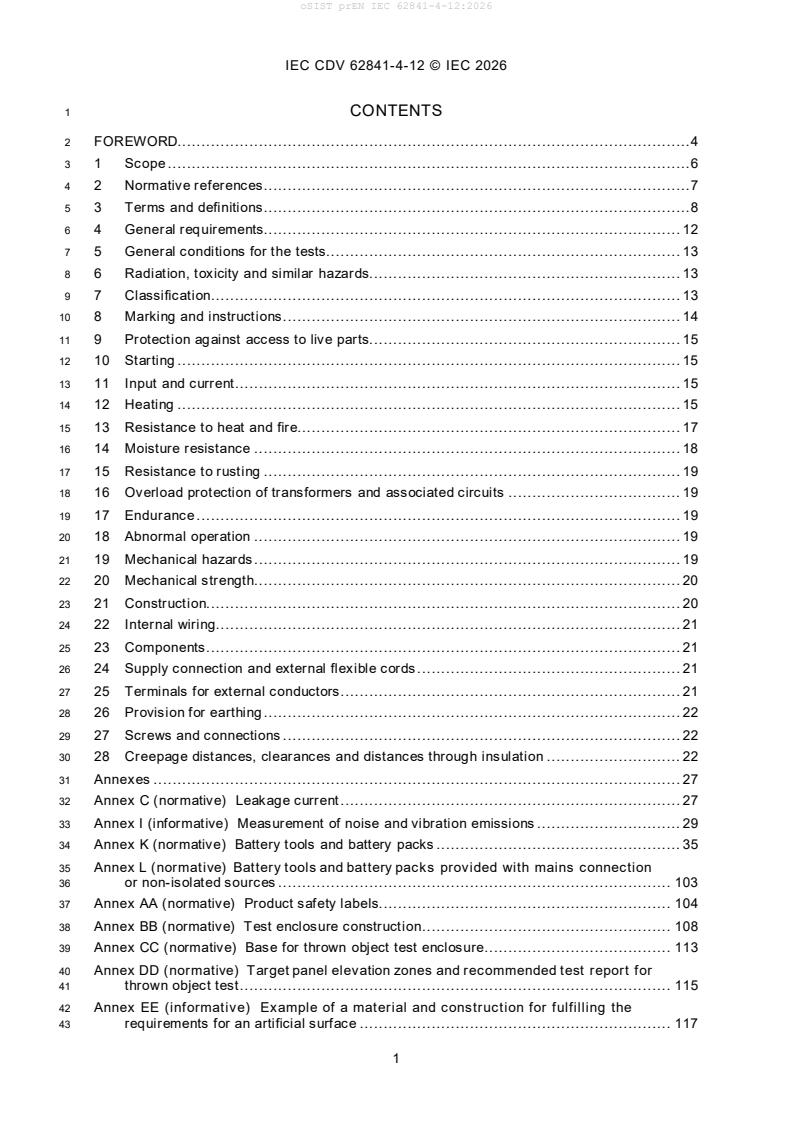
1 CONTENTS
2 FOREWORD.4
3 1 Scope .6
4 2 Normative references .7
5 3 Terms and definitions .8
6 4 General requirements. 12
7 5 General conditions for the tests. 13
8 6 Radiation, toxicity and similar hazards. 13
9 7 Classification . 13
10 8 Marking and instructions . 14
11 9 Protection against access to live parts. 15
12 10 Starting . 15
13 11 Input and current . 15
14 12 Heating . 15
15 13 Resistance to heat and fire. 17
16 14 Moisture resistance . 18
17 15 Resistance to rusting . 19
18 16 Overload protection of transformers and associated circuits . 19
19 17 Endurance . 19
20 18 Abnormal operation . 19
21 19 Mechanical hazards . 19
22 20 Mechanical strength. 20
23 21 Construction. 20
24 22 Internal wiring. 21
25 23 Components . 21
26 24 Supply connection and external flexible cords . 21
27 25 Terminals for external conductors . 21
28 26 Provision for earthing . 22
29 27 Screws and connections . 22
30 28 Creepage distances, clearances and distances through insulation . 22
31 Annexes . 27
32 Annex C (normative) Leakage current . 27
33 Annex I (informative) Measurement of noise and vibration emissions . 29
34 Annex K (normative) Battery tools and battery packs . 35
35 Annex L (normative) Battery tools and battery packs provided with mains connection
36 or non-isolated sources . 103
37 Annex AA (normative) Product safety labels. 104
38 Annex BB (normative) Test enclosure construction . 108
39 Annex CC (normative) Base for thrown object test enclosure . 113
40 Annex DD (normative) Target panel elevation zones and recommended test report for
41 thrown object test . 115
42 Annex EE (informative) Example of a material and construction for fulfilling the
43 requirements for an artificial surface . 117
IEC CDV 62841-4-12 © IEC 2026
44 Annex FF (normative) Calculation of kinetic energy of cutting means . 119
45 Annex GG (normative) Mains powered circuits for battery charging, preheating or
46 other non-motor functions . 121
47 Annex HH (normative) Aging test for gaskets, o-rings, seals and tubing used for
48 moisture resistance . 127
49 Bibliography . 128
51 Figure I.101 – Microphone positions on the hemisphere (see Table I.101) . 30
52 Figure K.301 – Example of test cycles . 62
53 Figure K.302 – Foot probe test . 65
54 Figure K.303 – Foot probe for standing child . 66
55 Figure K.304 – Foot probe for kneeling child . 68
56 Figure K.305 – Foot probe for kneeling child test positions . 70
57 Figure K.306 – Test probe for the hand probe test. 72
58 Figure K.307 – Finger probe test – Illustrations showing application of probe, insertion
59 depth limited according to the geometry of the enclosure. 74
60 Figure K.308 – Cutting means impact test - Rod position for machines, using freely
61 pivoting cutting means on a generally circular disc . 79
62 Figure K.309 – Obstruction sensor test – Illustration showing typical arrangement. 89
63 Figure K.310 – Example of obstruction sensor detection zones . 90
64 Figure K.311 – Hazard zone test object positions . 91
65 Figure K.312 – Measurement of clearances relied upon for protection against electric
66 shock . 101
67 Figure AA.1 – Product safety label illustrating – "WARNING – Beware of thrown
68 objects - keep away from the machine when operating". 105
69 Figure AA.2 – Product safety label illustrating – "WARNING – Do not ride on the
70 machine. 106
71 Figure AA.3 – Product safety labels illustrating – "WARNING – Keep hands and feet
72 away from the blades" . 106
73 Figure AA.4 – Product safety labels illustrating – "WARNING – Activate the manual
74 stop or isolation device before maintenance" . 107
75 Figure AA.5 – Product safety labels illustrating – "WARNING – Disconnect battery
76 before maintenance" . 108
77 Figure BB.1 – Thrown object test enclosure – General layout . 110
78 Figure BB.2 – Thrown object test enclosure . 111
79 Figure BB.3 – Test enclosure walls and base . 112
80 Figure BB.4 – Test fixture for corrugated fibreboard penetration test. 113
81 Figure CC.1 – Thrown object test enclosure – Base detail . 114
82 Figure CC.2 – Nail plan of test enclosure base . 115
83 Figure DD.1 – Recommended test data sheet . 117
84 Figure EE.1 – Sketch of the measurement surface covered with an artificial surface . 119
85 Figure FF.1 – Measurement of the reckonable length L . 121
87 Table 12 – Minimum creepage distances and clearances. 25
88 Table I.101 – Co-ordinates of microphone positions . 33
89 Table I.102 – Values of the constant a . 33
IEC CDV 62841-4-12 © IEC 2026
90 Table I.103 – Absorption coefficients . 33
91 Table K.301 – Artificial source characteristics . 37
92 Table K.302 – Robotic lawnmower moisture resistance classification and marking. 39
93 Table K.303 – Battery pack moisture resistance classification and marking . 40
94 Table 4 – Required performance levels . 51
95 Table K.304 – Cutting Means Stopping Time . 61
96 Table K.305 – Permissible Hits from Thrown Object Test. 64
97 Table K.306 – Pull and torque value . 96
98 Table K.307 – Minimum creepage distances and clearances between parts of different
99 potential . 98
100 Table K.308 – IEC 60664-3:2016 test parameters . 99
101 Table K.309 – Minimum total sum of creepage distances and clearances to accessible
102 surfaces. 102
103 Table HH.1 – Accelerated aging test . 128
IEC CDV 62841-4-12 © IEC 2026
106 INTERNATIONAL ELECTROTECHNICAL COMMISSION
107 ____________
109 ELECTRIC MOTOR-OPERATED HAND-HELD TOOLS,
110 TRANSPORTABLE TOOLS AND LAWN AND GARDEN
111 MACHINERY – SAFETY –
113 Part 4-12: Particular requirements for robotic lawnmowers
115 FOREWORD
116 1) The Internatio nal Electro technical Co mmission (IEC) is a wo rld wid e o rg anization f or stand ardization co mprising
117 all natio nal electro technical committees (IEC Natio nal Co mmittees). The o b ject of IEC is to p ro mote international
118 co-operation on all questions concerning standardization in the electrical and electronic fields. To this end and
119 in ad d ition to o ther activities, IEC p ub lishes International Standards, Technical Specifications, Technical Reports,
120 Publicly Available Specifications (PAS) and Guides (hereafter referred to as "IEC Publication(s)"). Their
121 p rep aratio n is entrusted to technical committees; any IEC Natio nal Co mmittee interested in the sub ject d ealt with
122 may p articipate in this prep aratory wo rk. International, g overnmental and no n-governmental o rganizations liaising
123 with the IEC also p articip ate in this p rep aratio n. IEC co llab orates clo sely with the Internatio nal Org anization for
124 Stand ard izatio n (ISO) in acco rd ance with co nd itio ns d etermined b y ag reement b etween the two o rg anizatio ns.
125 2) The f o rmal d ecisions o r ag reements o f IEC o n technical matters exp ress, as nearly as p o ssible, an international
126 consensus of opinion on the relevant subjects since each technical committee has representation from all
127 interested IEC National Committees.
128 3) IEC Publications have the f orm of recommendations f or international use and are accepted by IEC National
129 Committees in that sense. While all reasonable ef forts are made to ensure that the technical content of IEC
130 Publications is accurate, IEC cannot be held responsible for the way in which they are used or for any
131 misinterpretation by any end user.
132 4) In order to promote international uniformity, IEC National Committees undertake to apply IEC Publications
133 transp arently to the maximum extent p ossible in their national and reg ional pub lications. Any d iverg ence b etween
134 any IEC Pub lication and the co rrespo nding national o r reg ional p ublication shall b e clearly ind icated in the latter.
135 5) IEC itself does not provide any attestation of conformity. Independent certification bodies provide conformity
136 assessment services and, in some areas, access to IEC marks of conformity. IEC is not responsible f or any
137 services carried out by independent certif ication bodies.
138 6) All users should ensure that they have the latest edition of this publication.
139 7) No liability shall attach to IEC or its directors, employees, servants or agents including individual experts and
140 memb ers o f its technical co mmittees and IEC Natio nal Co mmittees f or any p erso nal injury, p ro p erty d amage or
141 other damage of any nature whatsoever, whether direct or indirect, or for costs (including legal fees) and
142 expenses arising out of the publication, use of, or reliance upon, this IEC Publication or any other IEC
143 Publications.
144 8) Attention is drawn to the Normative ref erences cited in this publication. Use of the ref erenced publications is
145 indispensable for the correct application of this publication.
146 9) Attentio n is d rawn to the p ossib ility that some of the elements of this IEC Pub lication may b e the sub ject of patent
147 rights. IEC shall not be held responsible for identifying any or all such patent rights.
148 IEC 62841-4-12 has been prepared by IEC technical committee 116: Safety of motor-operated
149 electric tools. It is an International Standard.
150 The text of this International Standard is based on the following documents:
Draf t Report on voting
116/xxx/FDIS 116/xxx/RVD
152 Full information on the voting for its approval can be found in the report on voting indicated in
153 the above table.
154 The language used for the development of this International Standard is English.
IEC CDV 62841-4-12 © IEC 2026
This document is to be used in conjunction with the first edition of IEC 62841-1:2014 and IEC
156 62841-1:2014/AMD1:2025.
157 This document supplements or modifies the corresponding clauses in IEC 62841-1, so as to
158 convert it into the IEC Standard: Particular requirements for robotic lawnmowers.
159 Where a particular subclause of IEC 62841-1 is not mentioned in this document, that subclause
160 applies as far as reasonable. Where this document states "addition", "modification" or
161 "replacement", the relevant text in IEC 62841-1 is to be adapted accordingly.
162 The following print types are used:
163 – requirements: in roman type;
164 – test specifications: in italic type;
165 – notes: in small roman type.
166 The terms defined in Clause 3 are printed in bold typeface.
167 Subclauses, notes, tables and figures which are additional to those in IEC 62841-1:2014 as
168 well as Annexes of IEC 62841-1:2014, except as described for Annex K below, are numbered
169 starting from 101.
170 Subclauses, notes, tables and fig ures in Annex K which are additional to those in the main body
171 of this document are numbered starting from 301.
172 A list of all parts in the IEC 62841 series, published under the general title Electric motor-
173 operated hand-held tools, transportable tools and lawn and garden machinery – Safety, can be
174 found on the IEC website.
175 This document was drafted in accordance with ISO/IEC Directives, Part 2, and developed in
176 accordance with ISO/IEC Directives, Part 1 and ISO/IEC Directives, IEC Supplement, available
177 at www.iec.ch/members_experts/refdocs. The main document types developed by IEC are
178 described in greater detail at www.iec.ch/standardsdev/publications.
179 The committee has decided that the contents of this document will remain unchanged until the
180 stability date indicated on the IEC website under webstore.iec.ch in the data related to the
181 specific document. At this date, the document will be
182 • reconfirmed,
183 • withdrawn,
184 • replaced by a revised edition, or
185 • amended.
186 NOTE The attention of National Committees is drawn to the fact that equipment manufacturers and testing
187 organizations may need a transitional period following publication of a new, amended or revised IEC publication in
188 which to make products in accordance with the new requirements and to equip themselves for conducting new or
189 revised tests.
190 It is the reco mmend ation of the committee that the content of this p ublication be ad opted for implementation nationally
191 not earlier than 36 months from the date of publication.
IEC CDV 62841-4-12 © IEC 2026
193 ELECTRIC MOTOR-OPERATED HAND-HELD TOOLS,
194 TRANSPORTABLE TOOLS AND LAWN AND GARDEN
195 MACHINERY – SAFETY –
197 Part 4-12: Particular requirements for robotic lawnmowers
199 1 Scope
200 Replacement:
201 This International Standard deals with the safety of
202 – electric motor-operated or mag netically driven rechargeable battery-powered rotary robotic
203 lawnmowers;
204 – their batteries; and
205 – their peripherals.
206 Robotic lawnmowers are also referred to as “machines” in this document.
207 The maximum rated voltage for machines and their battery packs is 250 V d.c.
208 The rated voltage for peripherals is not more than
209 – 250 V single-phase a.c. or d.c.; and
210 – 480 V for three-phase a.c.
211 This document deals with the hazards presented by machines and peripherals which are
212 encountered by all persons in the normal use and reasonably foreseeable misuse of the
213 machines and peripherals.
214 When evaluating a rechargeable battery for protection against electric shock during charging,
215 creepage distances, clearances and distances through insulation, the relevant requirements
216 of this document are applicable with the battery fitted to the intended charger.
217 Since rechargeable battery packs for machines and peripherals are submitted to different use
218 patterns (such as rough use, high charging and discharging currents) their safety can be
219 evaluated only by this document and not by using other standards for rechargeable battery
220 packs, such as IEC 62133-1:2017 or IEC 62133-2:2017, unless otherwise indicated in this
221 document. All relevant aspects related to the safety of rechargeable batteries are addressed
222 in this document, such that the requirements of IEC 62133-1:2017 or IEC 62133-2:2017 need
223 not be separately applied.
224 When evaluating the risk of fire associated with rechargeable battery packs for machines and
225 peripherals, consideration has been given to the fact that these battery packs are unattended
226 energy sources and have been evaluated as such in this document. Requirements in other
227 standards regarding the risk of fire due to the charging of these battery packs are therefore
228 considered to be fulfilled.
229 This document also addresses requirements covering the use of lithium-ion cells employed in
230 battery systems in robotic lawnmowers and battery-powered peripherals. The following is
231 considered within the context of these requirements:
232 – These requirements address the risk of fire or explosion of these batteries and not any
233 possible hazards associated with toxicity nor potential hazards associated with
234 transportation or disposal.
235 NOTE 1 IEC 62281:2019 covers the safety aspects of lithium-ion batteries during transport.
IEC CDV 62841-4-12 © IEC 2026
236 – Battery systems covered by these req uirements are not intended to be serviced by the end
237 user.
238 – These requirements are intended to provide comprehensive evaluation of a battery only if
239 used in products covered by this document.
240 – These requirements address the safety of lithium-ion battery systems during storage and
241 use including discharge and charge. These requirements are only considered to be
242 supplementary requirements in regards to battery charger fire and electric shock.
243 – These requirements refer to and require parameters supplied in reference to the cells that
244 establish conditions for safe use of those cells. Those parameters form the basis of
245 acceptance criteria for a number of tests contained herein. This document does not
246 independently evaluate the safety of cells. T hese parameters, taken as a set, constitute the
247 “Specified Operating Region” for a cell. T here may be several sets of specified operating
248 region(s).
249 Mains-powered circuits for battery charging, preheating or other non-motor functions are
250 covered under Annex GG.
251 This document does not apply to robotic lawnmowers using general purpose batteries
252 installed by the user and this document alone will not be sufficient to ensure all hazards are
253 considered for these products.
254 This document does not apply to battery-powered peripherals powered by rechargeable
255 general purpose batteries.
256 This document does not apply to the safety of battery chargers themselves.
257 NOTE 2 IEC 60335-2-29 covers a variety of chargers. The IEC 61558 series covers transformers and power
258 supplies.
259 2 Normative references
260 IEC 62841-1:2014, Clause 2 and IEC 62841-1:2014/AMD1:2025, Clause 2 are applicable,
261 except as follows:
262 Addition:
263 IEC 60112:2025, Method for the determination of the proof and the comparative tracking indices
264 of solid insulating materials
265 IEC 60664-3:2016, Insulation coordination for equipment within low-voltage systems – Part 3:
266 Use of coating, potting or moulding for protection against pollution
267 IEC 60664-4:2005, Insulation coordination for equipment within low-voltage systems – Part 4:
268 Consideration of high-frequency voltage stress
269 IEC 61672-1:2013, Electroacoustics – Sound level meters – Part 1: Specifications
270 IEC 62841-1:2014, Electric motor-operated hand-held tools, transportable tools and lawn and
271 garden machinery – Safety – Part 1: General requirements
272 IEC 62841-1:2014/AMD1:2025
273 ISO 354:2003, Acoustics – Measurement of sound absorption in a reverberation room
274 ISO 5395-1:2013, Garden equipment – Safety requirements for combustion-engine-powered
275 lawnmowers – Part 1: Terminology and common tests
276 ISO 5395-1:2013/Amd1:2017
IEC CDV 62841-4-12 © IEC 2026
ISO 5395-2:2013, Garden equipment – Safety requirements for combustion-engine-powered
278 lawnmowers – Part 2: Pedestrian-controlled lawnmowers
280 ISO 5395-3:2013,Garden equipment — Safety requirements for combustion-engine-powered
281 lawnmowers — Part 3: Ride-on lawnmowers with seated operator
282 ISO 5395-3:2013/Amd 1:2017
283 ISO 5395-3:2013/Amd 2:2017
284 ISO 7000:2019, Graphical symbols for use on equipment — Registered symbols
285 ISO 8295:1995, Plastics – Film and sheeting – Determination of the coefficients of friction
286 ISO 9773:2024, Plastics – Determination of burning behaviour of thin flexible vertical specimens
287 in contact with a small flame ignition source
288 ISO 11684:2023, Tractors, machinery for agriculture and forestry, powered lawn and garden
289 equipment — Safety labels — General principles
290 ISO 13857:2019, Safety of machinery – Safety distances to prevent hazard zones being
291 reached by upper and lower limbs
292 ISO/TS 19206-9:2025, Fine ceramics (advanced ceramics, advanced technical ceramics) —
293 Mechanical properties of ceramic composites — Part 9: Determination of fatigue behaviour at
294 room temperature
295 Replacement:
296 IEC 60695-2-11:2021, Fire hazard testing – Part 2-11: Glowing/hot-wire based test methods –
297 Glow-wire flammability test method for end-products
298 ISO 3744:2025, Acoustics – Determination of sound power levels of noise sources using sound
299 pressure — Engineering methods for an essentially free field over a reflecting plane
300 3 Terms and definitions
301 IEC 62841-1:2014, Clause 3 and IEC 62841-1:2014/AMD1:2025, Clause 3 are applicable,
302 except as follows:
303 Addition:
304 3.101
305 automatic mode
306 autonomous operation of the machine in which all safety functions are ensured in its working
307 area without the use of a manual controller
308 NOTE 101 to entry: Operation of the machine without the use of a manual controller and without the cutting
309 means operating during set up of the working area is not considered to be operation in automatic mode.
310 3.102
311 charging station
312 automatic battery charging facility
313 3.103
314 class II peripheral
315 peripheral in which protection against electric shock does not rely on basic insulation only,
316 but in which additional safety precautions, such as double insulation or reinforced insulation,
IEC CDV 62841-4-12 © IEC 2026
317 are provided, there being no provision for protective earthing or reliance upon installation
318 conditions
319 3.104
320 class III peripheral
321 peripheral in which protection against electric shock relies on supply at safety extra-low
322 voltage, and in which voltages higher than those of safety extra-low voltages are not
323 generated
324 3.105
325 cutting means
326 rotating mechanism or rotating part of the lawnmower that is designed to perform the cutting
327 action, in which the cutting means, cutting by impact, rotate about an axis (axes) normal to the
328 cutting plane
329 NOTE 101 to entry: The term “blade” can be used in warnings and instructions to denote “cutting means”.
330 3.106
331 cutting means enclosure
332 part or assembly, including the discharge chute and guard for grass catcher opening,
333 designed to prevent unintended contact with the cutting means
334 3.107
335 cutting means tip circle
336 path described by the outermost point of the lawnmower cutting means cutting edge as it
337 rotates about its shaft axis
338 3.108
339 cutting position
340 any height setting of the cutting means designated by the manufacturer for cutting grass
341 3.109
342 discharge chute
343 portion of the cutting means enclosure, extending outward from the discharge opening,
344 designed to control the ejection of material from the cutting means
345 3.110
346 discharge opening
347 opening in the cutting means enclosure through which material such as grass clippings can
348 be discharged
349 3.111
350 functional earth
351 earthing of a point in equipment or in a system, which is necessary for a purpose other than
352 safety
353 NOTE 101 to entry: Examples of the purpose of a functional earth include the reduction of the build-up of static
354 electricity and the reduction of electromagnetic emissions.
355 3.112
356 grass catcher
357 part or combination of parts which provides a means for collecting grass clippings or debris
IEC CDV 62841-4-12 © IEC 2026
3.113
359 hazard zone
360 area, not including the stop zone, in which if an obstacle exists, then the potential for injury
361 can exist
362 3.114
363 high energy robotic lawnmower
364 robotic lawnmower with a cutting means kinetic energy exceeding 200 J
365 NOTE 101 to entry: The formula to determine the kinetic energy is in Annex FF.
366 3.115
367 high mass robotic lawnmower
368 robotic lawnmower having a mass greater than 78 kg
369 3.116
370 lawnmower
371 lawn cutting machine, where the cutting means cuts approximately parallel to the ground and
372 which uses the ground to determine the cutting height by means of wheels or skids, etc.
373 3.117
374 lift sensor
375 device that senses when all or part of the machine is lifted from the ground
376 3.118
377 lithium-ion battery system
378 combination of a lithium-ion battery, the charging system, the machine and/or peripheral(s)
379 and the interfaces between them as existing during operation of the machine and/or
380 peripheral(s) or during charging
381 3.119
382 low energy robotic lawnmower
383 robotic lawnmower with a cutting means kinetic energy less than or equal 200 J
384 NOTE 101 to entry: The formula to determine the kinetic energy is in Annex FF.
385 3.120
386 low mass robotic lawnmower
387 robotic lawnmower with a maximum mass of 78 kg
388 3.121
389 low-power circuit
390 circuit that meets the requirements of IEC 62841-1:2014, Annex H
391 3.122
392 manual controller
393 device provided by the manufacturer either connected by a wire or wireless that allows manual
394 operation of the machine
395 NOTE 101 to entry: A d evice no t p ro vided b y the manuf acturer, such as a smartp ho ne o r tab let, is no t co nsidered
396 to be a manual controller.
397 NOTE 102 to entry: A manual co ntro ller can b e used to mo ve the machine in areas o utsid e o f the wo rking area.
398 3.123
399 manual mode
400 manual control of the machine by use of a manual controller or by riding a multifunctional
401 machine.
IEC CDV 62841-4-12 © IEC 2026
3.124
403 manual stop
404 manually actuated device using software-based or hardware-based components that bring s the
405 traction drive and cutting means to a stop
406 3.125
407 maximum speed
408 highest steady-state cutting means speed attainable under all conditions of normal use,
409 including no-load, when adjusted in accordance with the manufacturer’s specifications and/or
410 instructions
411 NOTE 101 to entry: The steady-state cutting means sp eed exclud es transients such as o versho ot that may o ccur
412 before attaining a steady-state condition.
413 3.126
414 obstruction sensor
415 device that senses a person or obstruction using either physical contact or non-contact mean
416 3.127
417 multifunctional machine
418 a machine on which a person can ride and which can be operated as robotic lawnmower.
419 3.128
420 operator control
421 device requiring operator actuation to perform specific functions during normal operation
422 NOTE 101 to entry: This includes controls on a manual controller.
423 3.129
424 operator presence control
425 control designed to detect when the operator's actuating force is removed
426 3.130
427 perimeter delimiter
428 device(s) that defines the perimeter of the working area within which the machine can operate
429 automatically
430 NOTE 101 to entry: An example o f a perimeter delimiter is a b o undary wire that emits a sig nal to ind icate the limit
431 of the working area.
432 NOTE 102 to entry: D evices that f unction as a ref erence f o r d etermining the machine p o sition within a virtual map,
433 such as satellites, camera, ultrasonic are not considered to be perimeter delimiters.
434 3.131
435 peripheral
436 equipment additional to the machine itself that is provided by the manufacturer for normal use
437 of the machine, e.g. charging station(s), manual controller, signal source for perimeter
438 delimiter
439 3.132
440 remote setting device
441 setting device, such as a smartphone or tablet, which is not connected by wire to the machine
442 and designed to set the basic functions of the machine
443 NOTE 101 to entry: A remote setting device is not a manual controller.
444 3.133
445 robotic lawnmower
446 unattended lawnmower that operates automatically
IEC CDV 62841-4-12 © IEC 2026
447 NOTE 101 to entry: When the term 'machine' is used in the text of this standard, it is used to denote a robotic
448 lawnmower.
449 3.134
450 rollover sensor
451 device that senses when the machine is inverted
452 3.135
453 sensor
454 device that responds to physical stimuli (such as, but not limited to, heat, light, sound, pressure,
455 magnetism, motion) and transmits the resulting signal or data providing a measurement,
456 operating a control, or both
457 NOTE 101 to entry: Lift sensors, obstruction sensors, rollover sensors, and tilt sensors are examples of
458 sensors.
459 3.136
460 setup device
461 setting device, such as a smartphone or tablet, which is designed to set the working area and
462 settings of the machine as well as moving it in setup mode
463 3.137
464 setup mode
465 mode of the machine for defining the working area parameters
466 3.138
467 stop zone
468 area in which contact with the machine is likely to occur
469 3.139
470 stopping time
471 time elapsed between the instant when a stop command occurs and the instant at which the
472 machine or component comes to a stop
473 3.140
474 tilt sensor
475 device that senses when the machine is at or above a predetermined angle of incline
476 3.141
477 traction drive
478 means (system) used to transmit power to the ground drives means
479 3.142
480 warning zone
481 area in which if an obstacle exists and no action is taken, then the obstacle might enter either
482 the hazard zone or the stop zone
483 3.143
484 working area
485 area in which the machine can function in automatic mode
486 4 General requirements
487 IEC 62841-1:2014, Clause 4 is applicable, except as follows:
488 Addition:
489 All requirements for machines in the main body of this document are also applicable for mains
490 powered peripherals, unless otherwise specified.
IEC CDV 62841-4-12 © IEC 2026
Robotic lawnmowers with a provision for a person to ride on the machine are considered to
492 be multifunctional machines. They shall comply with this standard in automatic mode, manual
493 mode and setup mode and with a ride-on lawnmower standard in modes when operated with
494 a rider.
495 NOTE 101 A standard for battery powered ride-on lawnmowers is under preparation as IEC 62841-4-15.
496 NOTE 102 A sup erviso ry function in accordance with the Reg ulation (EU) 2023/1230 is not relevant, since the safety
497 of robotic lawnmowers does not depend on remote operation
498 5 General conditions for the tests
499 IEC 62841-1:2014, Clause 5 is applicable, except as follows:
500 5.101 The general test conditions specified in IEC 62841-1:2014, Clause 5, are also
501 applicable for mains-powered peripherals.
502 6 Radiation, toxicity and similar hazards
503 IEC 62841-1:2014, Clause 6 is applicable.
504 7 Classification
505 IEC 62841-1:2014, Clause 7 is
506 – not applicable for robotic lawnmowers, non-mains powered peripherals, setup devices
507 and remote setting devices; and
508 – applicable for mains-powered peripherals;
509 except as follows:
510 NOTE 101 Classification req uirements for robotic lawnmowers, battery-powered peripherals and remote setting
511 devices are specified in Clause K.7.
512 7.1 Replacement:
513 This subclause is not applicable for machines and non-mains-powered peripherals.
514 NOTE 101 Machines and no n-mains-powered peripherals co vered b y this document are limited to those where the
515 only power source is a battery and are therefore considered not to be a class I tool (machine), class II tool
516 (machine) or a class III tool (machine) and are not required to have basic insulation, supplementary insulation
517 or reinforced insulation. Electric sho ck hazard is co nsidered to exist o nly b etween p arts of d ifferent p otential where
518 hazardous voltage is present.
519 Peripherals shall be of one of the following classes with respect to protection against electric
520 shock:
521 – class II peripheral; or
522 – class III peripheral.
523 Compliance is checked by inspection and by the relevant tests of IEC 62841-1:2014 for
524 – class II tools for class II peripherals; and
525 – class III tools for class III peripherals.
526 7.2 Addition:
527 Enclosures of charging stations and other peripherals intended to be installed outdoors (e.g.
528 a signal source for a perimeter delimiter) shall be at least IPX4.
IEC CDV 62841-4-12 © IEC 2026
529 8 Marking and instructions
530 IEC 62841-1:2014, Clause 8 and IEC 62841-1:2014/AMD1:2025, Clause 8 are
531 – not applicable for robotic lawnmowers, non-mains powered peripherals, setup devices
532 and remote setting devices; and
533 – applicable for mains-powered peripherals;
534 except as follows:
535 NOTE 101 Marking and instructions requirements for robotic lawnmowers, battery-powered peripherals and
536 remote setting devices are specified in Clause K.8.
537 8.1 Addition:
538 – the symbol IEC 60417-5018 (2011-07), for mains-powered peripherals incorporating a
539 functional earth only. Class II peripherals incorporating a functional earth may
540 alternatively be marked with the symbol IEC 60417-6092 (2013-03).
541 NOTE 101 In the United States of America, the addition above is not applicable.
542 8.14 This subclause of IEC 62841-1:2014 is not applicable.
543 NOTE 101 Instruction manual requirements for mains-powered peripherals are covered in K.8.14.
544 8.14.1 This subclause of IEC 62841-1:2014 is not applicable.
545 8.14.1.1 to 8.14.1.3 These subclauses of IEC 62841-1:2014 are not applicable.
546 8.14.2 This subclause of IEC 62841-1:2014 is not applicable.
547 8.14.3 This subclause of IEC 62841-1:2014 is not applicable.
548 8.14.1.101 Mains-powered peripheral safety warnings
549 WARNING Read all safety warnings, instructions, illustrations and specifications
550 provided with this product. Failure to follow all instructions listed below may result in electric
551 shock, fire and/or serious injury.
552 Save all warnings and instructions for future reference.
553 a) Do not operate devices in explosive atmospheres, such as in the presence of
554 flammable liquids, gases or dust. Devices create sparks which may ignite the dust or
555 fumes.
556 NOTE 101 The term "devices" in item a) above can be replaced by appropriate terms for mains-powered
557 peripherals.
558 b) Mains plugs must match the outlet. Never modify the plug in any way. Do not use
559 any adapter plugs with earthed (grounded) devices. Unmodified plugs and matching
560 outlets will reduce risk of electric shock.
561 c) Avoid body contact with earthed or grounded surfaces, such as pipes, radiators,
562 ranges and refrigerators. There is an increased risk of electric shock if your body is
563 earthed or grounded.
564 d) Do not abuse power cords. Never use the power cord for carrying, pulling or
565 unplugging a device. Keep power cords away from heat, oil, sharp edges or
566 moving parts. Damaged or entangled power cords increase the risk of electric shock.
567 e) If operating a mains-powered device in a damp location is unavoidable, use a
568 residual current device (RCD) protected supply. Use of an RCD reduces the risk of
569 electric shock.
IEC CDV 62841-4-12 © IEC 2026
570 NOTE 102 The term “resid ual current d evice (RCD )” in item e) ab o ve can b e rep laced b y the term “g round
571 fault circuit interrupter (GFCI)” or “earth leakage circuit breaker (ELCB)”.
572 NOTE 103 The term "d evice" in item e) above can be replaced by an appropriate term for a mains-powered
573 peripheral.
574 b) Have your device serviced by a qualified repair person using only identical
575 replacement parts. This will ensure that the safety of the device is maintained.
576 NOTE 104 The term "d evice" in item f ) ab o ve can be replaced by an ap p ro p riate term f or a mains-powered
577 peripheral.
578 9 Pr
...