


prEN IEC 62192-1:2024
(Main)Rope for electrical work - Part 1: Work within the live working zone or in contact with live parts
Rope for electrical work - Part 1: Work within the live working zone or in contact with live parts
Seile für elektrische Arbeiten – Teil 1: Arbeiten innerhalb der Gefahrenzone oder in Kontakt mit spannungsführenden Teilen
Corde pour travaux électriques - Partie 1: Travaux dans la zone des travaux sous tension ou au contact avec des parties actives
Delo pod napetostjo - Izolacijske vrvi
General Information
- Status
- Not Published
- Publication Date
- 25-May-2026
- Technical Committee
- CLC/TC 78 - Equipment and tools for live working
- Drafting Committee
- IEC/TC 78 - IEC_TC_78
- Current Stage
- 4060 - Enquiry results established and sent to TC, SR, BTTF - Enquiry
- Start Date
- 24-Jan-2025
- Completion Date
- 24-Jan-2025
Relations
- Effective Date
- 26-Jul-2021
Overview
The prEN IEC 62192-1:2024 standard, developed by the CLC and IEC technical committee TC 78, specifies the requirements for insulating ropes used in live electrical work. This standard focuses on work within the live working zone or in contact with energized parts, emphasizing safety and electrical insulation performance. It targets insulating ropes capable of withstanding power frequency system voltages up to 800 kV RMS, designed to protect users from electric shock during direct and indirect live working operations.
This second edition replaces the 2009 version, incorporating comprehensive updates to testing methods, mechanical requirements, and in-service care. The document covers physical, dimensional, electrical, and mechanical properties essential for insulating ropes used in various high-risk applications in electrical power environments.
Key Topics
Scope and Application
Defines the scope of insulating ropes used in live working zones, addressing both direct contact and non-contact tasks with live electrical parts.Electrical Properties
Specifies dielectric and leakage current performance under dry and wet conditions, ensuring reliable insulation under all atmospheric states.Mechanical and Physical Requirements
Details the mechanical strength, dimensional checks, and physical characteristics of ropes to ensure durability and adequate performance.Testing Protocols
Describes procedures for electrical and mechanical testing, including leakage current measurement, defect classification, and in-service verification. The standard mandates use of electrodes designed to provide uniform voltage stress and avoid mechanical degradation during tests.Marking and Instructions
Requires clear and durable markings to identify ropes suitable for live working, along with detailed user instructions on maintenance, periodic testing, handling, and storage.In-Service Care and Periodic Testing
Includes guidelines for inspection before use, high voltage periodic testing, cleaning, repair, retirement, and safe operation practices like using ropes with capstans or pulleys.Defect Classification
Provides a comprehensive classification system for defects, ensuring ropes failing electrical or mechanical tests are effectively identified and managed.
Applications
prEN IEC 62192-1:2024 addresses insulating ropes used in various critical live working scenarios, including:
Live Electrical Work
Enabling safe handling and maneuvering in energized environments such as power line maintenance, live conductor pulling, and stringing.Rescue and Safety Operations
Used in emergency rescue, escape procedures, and traveler safety nets where insulation from electric shock is vital.Helicopter External Cargo
Supporting live load handling with insulating ropes for helicopter transport to reduce risk during aerial operations near live conductors.Rope Access Techniques
Permitting safe live working where workers may be suspended or accessing elevated live electrified equipment.Tree Trimming Near Power Lines
Assisting in safe operations close to energized conductors to prevent accidental contact.Tag Lines and Hand Lines
Providing insulated handling lines to avoid electrical hazards when guiding or restraining equipment in proximity to live parts.
Related Standards
IEC 60417-5216
Symbol for live working suitability (double triangle marking).Other IEC Standards on Live Working
Complementary standards addressing tools, protective devices, and methods for safe operations in energized electrical environments.Electrical Insulation and Safety Standards
Covers related insulating materials and general electrical safety measures under ICS classifications 13.260 and 29.035.01.
Summary
prEN IEC 62192-1:2024 is a critical international standard for insulating ropes utilized in live electrical work, supporting worker safety through stringent electrical, mechanical, and testing requirements. It ensures insulating ropes provide reliable dielectric protection at power system voltages up to 800 kV RMS, incorporating detailed protocols for manufacturing, testing, marking, maintenance, and in-service care. Adoption of this standard aids utilities, contractors, and safety professionals in mitigating electrical hazards in live working zones, bolstering overall workplace safety and operational efficiency.

Get Certified
Connect with accredited certification bodies for this standard

Intertek Testing Services NA Inc.
Intertek certification services in North America.

NSF International
Global independent organization facilitating standards development and certification.

UL Solutions
Global safety science company with testing, inspection and certification.
Sponsored listings
Frequently Asked Questions
prEN IEC 62192-1:2024 is a draft published by CLC. Its full title is "Rope for electrical work - Part 1: Work within the live working zone or in contact with live parts". This standard covers: Rope for electrical work - Part 1: Work within the live working zone or in contact with live parts
Rope for electrical work - Part 1: Work within the live working zone or in contact with live parts
prEN IEC 62192-1:2024 is classified under the following ICS (International Classification for Standards) categories: 13.260 - Protection against electric shock. Live working; 29.240.20 - Power transmission and distribution lines; 29.260.99 - Other electrical equipment for working in special conditions. The ICS classification helps identify the subject area and facilitates finding related standards.
prEN IEC 62192-1:2024 has the following relationships with other standards: It is inter standard links to EN 62192:2009. Understanding these relationships helps ensure you are using the most current and applicable version of the standard.
prEN IEC 62192-1:2024 is available in PDF format for immediate download after purchase. The document can be added to your cart and obtained through the secure checkout process. Digital delivery ensures instant access to the complete standard document.
Standards Content (Sample)
SLOVENSKI STANDARD
01-november-2024
Delo pod napetostjo - Izolacijske vrvi
Live working - Insulating ropes
Arbeiten unter Spannung - Isolierende Seile
Travaux sous tension - Cordes isolantes
Ta slovenski standard je istoveten z: prEN IEC 62192-1:2024
ICS:
13.260 Varstvo pred električnim Protection against electric
udarom. Delo pod napetostjo shock. Live working
29.035.01 Izolacijski materiali na Insulating materials in
splošno general
2003-01.Slovenski inštitut za standardizacijo. Razmnoževanje celote ali delov tega standarda ni dovoljeno.
78/1476/CDV
COMMITTEE DRAFT FOR VOTE (CDV)
PROJECT NUMBER:
IEC 62192-1 ED1
DATE OF CIRCULATION: CLOSING DATE FOR VOTING:
2024-09-13 2024-12-06
SUPERSEDES DOCUMENTS:
78/1442/CD, 78/1458A/CC
IEC TC 78 : LIVE WORKING
SECRETARIAT: SECRETARY:
France Mrs Sophie CHABIN
OF INTEREST TO THE FOLLOWING COMMITTEES: HORIZONTAL FUNCTION(S):
ASPECTS CONCERNED:
Safety
SUBMITTED FOR CENELEC PARALLEL VOTING NOT SUBMITTED FOR CENELEC PARALLEL VOTING
Attention IEC-CENELEC parallel voting
The attention of IEC National Committees, members of
CENELEC, is drawn to the fact that this Committee Draft
for Vote (CDV) is submitted for parallel voting.
The CENELEC members are invited to vote through the
CENELEC online voting system.
This document is still under study and subject to change. It should not be used for reference purposes.
Recipients of this document are invited to submit, with their comments, notification of any relevant patent rights of
which they are aware and to provide supporting documentation.
Recipients of this document are invited to submit, with their comments, notification of any relevant “In Some
Countries” clauses to be included should this proposal proceed. Recipients are reminded that the CDV stage is
the final stage for submitting ISC clauses. (SEE AC/22/2007 OR NEW GUIDANCE DOC).
TITLE:
Live working - Insulating ropes
PROPOSED STABILITY DATE: 2027
NOTE FROM TC/SC OFFICERS:
electronic file, to make a copy and to print out the content for the sole purpose of preparing National Committee positions.
You may not copy or "mirror" the file or printed version of the document, or any part of it, for any other purpose without
permission in writing from IEC.
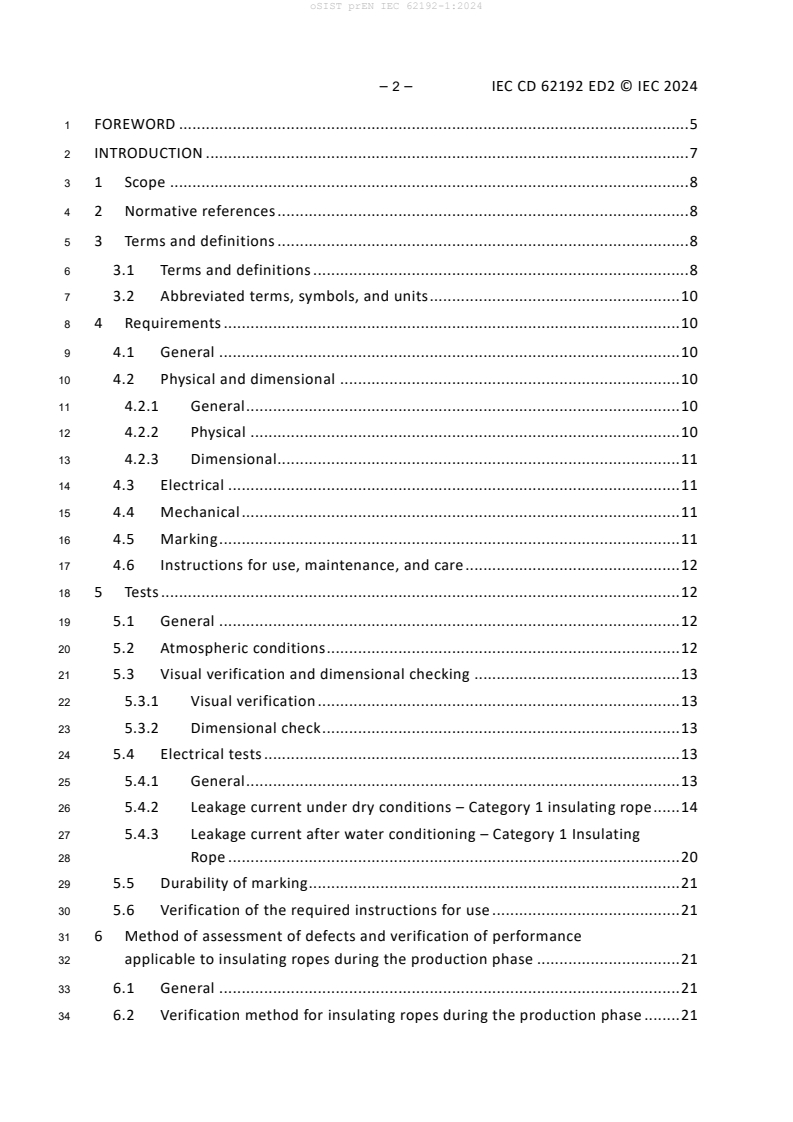
– 2 – IEC CD 62192 ED2 © IEC 2024
1 FOREWORD . 5
2 INTRODUCTION . 7
3 1 Scope . 8
4 2 Normative references . 8
5 3 Terms and definitions . 8
6 3.1 Terms and definitions . 8
7 3.2 Abbreviated terms, symbols, and units . 10
8 4 Requirements . 10
9 4.1 General . 10
10 4.2 Physical and dimensional . 10
11 4.2.1 General . 10
12 4.2.2 Physical . 10
13 4.2.3 Dimensional. 11
14 4.3 Electrical . 11
15 4.4 Mechanical . 11
16 4.5 Marking . 11
17 4.6 Instructions for use, maintenance, and care . 12
18 5 Tests . 12
19 5.1 General . 12
20 5.2 Atmospheric conditions . 12
21 5.3 Visual verification and dimensional checking . 13
22 5.3.1 Visual verification . 13
23 5.3.2 Dimensional check . 13
24 5.4 Electrical tests . 13
25 5.4.1 General . 13
26 5.4.2 Leakage current under dry conditions – Category 1 insulating rope . 14
27 5.4.3 Leakage current after water conditioning – Category 1 Insulating
28 Rope . 20
29 5.5 Durability of marking . 21
30 5.6 Verification of the required instructions for use . 21
31 6 Method of assessment of defects and verification of performance
32 applicable to insulating ropes during the production phase . 21
33 6.1 General . 21
34 6.2 Verification method for insulating ropes during the production phase . 21
– 3 – IEC CD 62192 ED2 © IEC 2024
35 6.3 Alternative means to test insulating ropes during the production
36 phase . 21
37 7 Test report . 22
38 8 Modifications . 22
39 Annex A (normative) Suitable for live working; double triangle
40 (IEC 60417-5216 (2002-10)) . 23
41 Annex B (normative) Chronology of type tests . 24
42 Annex C (informative) Test requirements and criteria overview for
43 category 1 insulating ropes . 25
44 Annex D (normative) Classification of defects . 26
45 Annex E (informative) Rationale for the classification of defects . 27
46 Annex F (normative) Markings to identify insulating rope . 28
47 Annex G (informative) Summary report of type testing example . 29
48 Annex H (informative) Terminations . 30
49 Annex I (informative) In-service care and periodic testing . 31
50 I.1 In-service care and periodic testing - General . 31
51 I.2 Identification . 31
52 I.3 Storage . 31
53 I.3.1 In the field . 31
54 I.3.2 In the storage room . 31
55 I.4 Handling . 32
56 I.5 Periodic testing . 32
57 I.5.1 Inspection in the field before each use . 32
58 I.5.2 Periodic high voltage testing – 75 kV ac rms or 105 kV dc . 32
59 I.6 Application safety factor and working load limit . 33
60 I.7 Use with capstans or pulleys . 34
61 I.8 Cleaning, repair, and recycling . 34
62 I.9 Retirement . 35
63 Bibliography . 36
64 Figure 1 – Electrode arrangement for dry and wet electrical testing. 11
65 Figure 2 – Example of test set up to measure leakage current . 12
66 Figure 3 – Example of test set up minimum clearance requirements . 13
67 Figure 4 – Electrical test configuration . 15
68 Figure 5 - Upper electrode plate and split brass die clamp insert for the insulating rope . 15
69 Figure 6 - Lower electrode plate and split brass die clamp insert for the insulating rope . 16
– 4 – IEC CD 62192 ED2 © IEC 2024
71 Table B.1 – Chronology and group of test pieces . 22
72 Table C.1 – Summary of test requirements and criteria for category 1 insulating ropes . 23
73 Table D.1 – Classification of defects and corresponding test . 24
74 Table E.1 – Justification for the type of defect . 25
– 5 – IEC CD 62192 ED2 © IEC 2024
76 INTERNATIONAL ELECTROTECHNICAL COMMISSION
77 ____________
79 LIVE WORKING – INSULATING ROPES
81 FOREWORD
82 1) The International Electrotechnical Commission (IEC) is a worldwide organization for standardization comprising
83 all national electrotechnical committees (IEC National Committees). The object of IEC is to promote international
84 co-operation on all questions concerning standardization in the electrical and electronic fields. To this end and in
85 addition to other activities, IEC publishes International Standards, Technical Specifications, Technical Reports,
86 Publicly Available Specifications (PAS) and Guides (hereafter referred to as "IEC Publication(s)"). Their
87 preparation is entrusted to technical committees; any IEC National Committee interested in the subject dealt with
88 may participate in this preparatory work. International, governmental and non-governmental organizations liaising
89 with the IEC also participate in this preparation. IEC collaborates closely with the International Organization for
90 Standardization (ISO) in accordance with conditions determined by agreement between the two organizations.
91 2) The formal decisions or agreements of IEC on technical matters express, as nearly as possible, an international
92 consensus of opinion on the relevant subjects since each technical committee has representation from all
93 interested IEC National Committees.
94 3) IEC Publications have the form of recommendations for international use and are accepted by IEC National
95 Committees in that sense. While all reasonable efforts are made to ensure that the technical content of IEC
96 Publications is accurate, IEC cannot be held responsible for the way in which they are used or for any
97 misinterpretation by any end user.
98 4) In order to promote international uniformity, IEC National Committees undertake to apply IEC Publications
99 transparently to the maximum extent possible in their national and regional publications. Any divergence between
100 any IEC Publication and the corresponding national or regional publication shall be clearly indicated in the latter.
101 5) IEC itself does not provide any attestation of conformity. Independent certification bodies provide conformity
102 assessment services and, in some areas, access to IEC marks of conformity. IEC is not responsible for any
103 services carried out by independent certification bodies.
104 6) All users should ensure that they have the latest edition of this publication.
105 7) No liability shall attach to IEC or its directors, employees, servants or agents including individual experts and
106 members of its technical committees and IEC National Committees for any personal injury, property damage or
107 other damage of any nature whatsoever, whether direct or indirect, or for costs (including legal fees) and
108 expenses arising out of the publication, use of, or reliance upon, this IEC Publication or any other IEC
109 Publications.
110 8) Attention is drawn to the Normative references cited in this publication. Use of the referenced publications is
111 indispensable for the correct application of this publication.
112 9) IEC draws attention to the possibility that the implementation of this document may involve the use of (a)
113 patent(s). IEC takes no position concerning the evidence, validity or applicability of any claimed patent rights in
114 respect thereof. As of the date of publication of this document, IEC had not received notice of (a) patent(s), which
115 may be required to implement this document. However, implementers are cautioned that this may not represent
116 the latest information, which may be obtained from the patent database available at https://patents.iec.ch. IEC
117 shall not be held responsible for identifying any or all such patent rights.
118 IEC 62192 has been prepared by IEC technical committee TC 78: LIVE WORKING. It is an
119 International Standard.
120 This second edition cancels and replaces the first edition published in 2009. This edition
121 constitutes a technical revision.
122 This edition includes the following significant technical changes with respect to the previous
123 edition:
124 a) Scope;
125 b) Introduction;
126 c) Normative references;
– 6 – IEC CD 62192 ED2 © IEC 2024
127 d) Terms and definitions;
128 e) Requirements;
129 f) Tests;
130 g) Introduction Category 1 insulating ropes which is for direct energized contact;
131 h) Requirement for the mechanical requirements to be performed and information provided by
132 the manufacture recognizing that this document provides the requirements and tests for the
133 electrical properties of an insulating rope;
134 i) Revision of the test requirements of the insulating ropes which include:
135 1) Same test setup for dry and wet electrical tests;
136 2) Electrodes which provide capacitive current shielding and a uniform voltage stress;
137 3) Equal voltage stresses when testing the rope dry and wet;
138 4) Reduced leakage currents requirement to avoid mechanical degradation;
139 5) Requirement to record the applied voltage and resulting leakage current;
140 j) Updated Annex B and new Annex C which provides a testing and criterion overview;
141 k) New Annex E provides the rationale for the classification of defects specified in Annex D;
142 l) New Annex F which demonstrates required markings from manufacturer;
143 m) New Annex G which provides sample summary report of type testing;
144 n) Annex I for the termination of insulating ropes;
145 o) Annex J which provides comprehensive in-service and periodic testing information for
146 insulating ropes;
147 The text of this document is based on the following documents:
Draft Report on voting
XX/XX/FDIS XX/XX/RVD
149 Full information on the voting for its approval can be found in the report on voting indicated in
150 the above table.
151 The language used for the development of this document is English.
152 This document was drafted in accordance with ISO/IEC Directives, Part 2, and developed in
153 accordance with ISO/IEC Directives, Part 1 and ISO/IEC Directives, IEC Supplement, available
154 at www.iec.ch/members_experts/refdocs. The main document types developed by IEC are
155 described in greater detail at www.iec.ch/publications.
156 The committee has decided that the contents of this document will remain unchanged until the
157 stability date indicated on the IEC website under webstore.iec.ch in the data related to the
158 specific document. At this date, the document will be
159 • reconfirmed,
160 • withdrawn,
161 • replaced by a revised edition, or
162 • amended.
– 7 – IEC CD 62192 ED2 © IEC 2024
164 INTRODUCTION
165 Insulating ropes designed and manufactured according to this document contribute to the safety of the
166 users, provided they are used by trained and qualified persons, in accordance with safe methods of
167 work and the instructions for use.
168 This document defines the required electrical properties of insulating ropes which already meet other
169 specifications relating to mechanical strength, physical and construction properties, for use as an
170 insulating rope, where the dielectric properties of the insulating rope are required or relied upon, at the
171 power frequency system voltages up to and including 800 kV RMS. The standard testing is performed
172 to reflect AC conditions.
173 Insulating ropes are needed when working in an energized environment whether utilizing direct-contact
174 live working, non-contact methods while working in electromagnetic fields (capacitive coupling) or for
175 de-energized work methods for protection from accidental energization. (i.e. lightning, switching errors,
176 equipment failures etc.) Applications for insulating ropes include but are not limited to general live
177 working methods, pulling, and stringing of conductor, bare hand methods, helicopter human external
178 cargo, safety netting, tree trimming, rescue and escape, rope access, tag lines and hand lines.
179 Natural fibres such as cotton, sisal, hemp and manilla or synthetic fibres untreated or uncoated such as
180 nylon, polyester, liquid crystal polymer and aramid may be unsuitable for this application, as are any
181 other ropes that exhibit electrical conductivity. Examples of ropes which are able to meet the
182 requirements of this document are formed from fibres that have an extruded thermoplastic jacket with
183 sealed ends or other form of coating or additives, such as wax, which enhances their dielectric and
184 hydrophobic properties.
185 The purpose of this document is to focus on the insulating ropes that are used to insulate the workers
186 from the energized circuits.
187 This document does not propose to address all the safety factors associated with the use of the
188 insulating rope. It is the responsibility of the user to establish appropriate safety practices. The end user
189 is responsible to validate the testing data and reports provided by the supplier and to ensure the
190 conformity and validation prior to choosing an insulating rope and utilizing it in service. The user is
191 responsible for accurately assessing and testing the dielectric properties of the rope in service.
192 The product covered by this document may have an impact on the environment during some or all
193 stages of its life cycle. These impacts can range from slight to significant, be of short-term or long-term,
194 and occur at the global, regional, or local level.
195 This document does not include requirements and test provisions for the manufacturers of the
196 product, or recommendations to the users of the product for environmental improvement.
197 However, all parties intervening in its design, manufacture, packaging, distribution, use,
198 maintenance, repair, reuse, recovery, and disposal are invited to take account of environmental
199 considerations.
– 8 – IEC CD 62192 ED2 © IEC 2024
201 LIVE WORKING – INSULATING ROPES
203 1 Scope
204 This document covers insulating ropes that are utilized during Live Working (LW) procedures
205 in contact with parts of installations operating at voltages up to and including 800 kV AC They
206 shall already meet other specifications relating to mechanical strength, physical and
207 construction properties. Insulating ropes up to a diameter of 32 mm only are given consideration
208 for the test acceptance criteria and larger diameters may require increased leakage current
209 criteria and engineering analysis for a particular application.
210 At the present time, insulating rope options include but are not limited to various styles,
211 materials, and construction, including extruded thermoplastic jacket ropes with sealed ends,
212 fibre with overlay/wax coating and additives and fibre without any additives. Extruded
213 thermoplastic jacket ropes with sealed ends are more likely to meet the acceptance criteria for
214 direct contact (Category 1) ropes.
215 This document covers in-service care and periodic testing. The arc flash properties of the
216 insulating rope are not evaluated in this document but should be given consideration.
217 An Acceptance Test may be arranged between a manufacturer and the end user in order to
218 demonstrate that the product meets the specifications and requirements of this document.
219 2 Normative references
220 The following documents are referred to in the text in such a way that some or all of their content
221 constitutes requirements of this document. For dated references, only the edition cited applies.
222 For undated references, the latest edition of the referenced document (including any
223 amendments) applies.
224 IEC 60060-1, High-voltage test techniques – Part 1: General definitions and test requirements
225 IEC 60417, Graphical symbols for use on equipment
226 IEC 60855-1:2016, Live working – Insulating foam-filed tubes and solid rods – Part 1: Tubes and rods
227 of a circular cross-section.
228 IEC 61318:2021, Live working - Methods for assessment of defects and verification of performance
229 applicable to tools, devices and equipment
230 IEC 61477, Live working – Minimum requirements for the utilization of tools, devices and equipment
231 ISO 2307:2019, Ropes – Determination of certain physical and mechanical properties
232 3 Terms and definitions
233 3.1 Terms and definitions
234 For the purposes of this document, the following terms and definitions apply.
235 ISO and IEC maintain terminology databases for use in standardization at the following
236 addresses:
237 • IEC Electropedia: available at https://www.electropedia.org/
– 9 – IEC CD 62192 ED2 © IEC 2024
238 • ISO Online browsing platform: available at https://www.iso.org/obp
239 3.1.1
240 energized environment
241 immediate surroundings of electrical apparatus, equipment and circuits that are or could
242 become energized
243 3.1.2
244 insulating rope
245 rope made of insulating material specifically designed or adapted, tested and maintained for
246 live working
247 Note 1 to entry: Ropes can only be considered insulating if they are free of contamination.
248 [SOURCE: IEC 60050 :651 :2014, 651-22-20, modified - Note 1 to entry has been added to
249 refer specifically to live working]
250 3.1.3
251 Category 1 insulating rope
252 (Direct Contact ropes)
253 synthetic rope designed, manufactured, tested, and maintained to provide direct contact
254 insulation and is intended to come in contact with energized conductors phase to earth or phase
255 to phase
256 3.1.4
257 rope
258 stout cord made from woven or twisted insulating or non-insulating material used for various
259 handling operations.
260 Note 1 to entry: Ropes, which may come into contact with live conductors or relied on as primary insulation, should
261 be Category 1 insulating rope.
262 Note 2 to entry: Ropes used to move tools and other equipment into place, which are clear of live parts but used in
263 an energized environment, should be at a minimum, rope for vicinity working. Incidents, such as burned or broken
264 ropes and human shocks, have occurred in industry as a result of capacitive coupling from nearby energized live
265 parts interacting with ropes with poor insulating properties.
266 3.1.5
267 overlay finish
268 oil, emulsion, lubricant, wax or the like applied to a yarn upon completion of textile processing
269 to enhance the intended performance of the finished fibre product
270 Note 1 to entry: For the application of insulating ropes the intended performance enhancement is the dielectric
271 properties of the fibre rope.
272 [SOURCE: CI 1202-13, modified – Note 1 to entry has been added to refer specifically to live
273 working and arc testing]
274 3.1.6
275 extruded thermoplastic jacket rope
276 rope that is manufactured by the extruding process of forming a thermoplastic jacket outer layer
277 by drawing through a die
278 [SOURCE: ISO 1968:2004, 4.3.2, modified -The definition has been changed to refer specially
279 to the extruding process of forming a thermoplastic jacket to the outer layer.]
– 10 – IEC CD 62192 ED2 © IEC 2024
280 3.1.7
281 termination
282 finish of the end of the insulating rope.
283 Note 1 to entry: Because insulating rope has special electrical and hydrophobic properties, the cut ends of the rope
284 may need special processes to assure the desired properties are not compromised.
285 Note 2 to entry:° Determination as to whether the termination portion is to be considered as insulating should be
286 made through testing by the end user or by the manufacturer.
287 Note 3 to entry:° The termination will be with a blunt cut (often a heat melt) or with an eye (soft eye or with a thimble)
288 or with a metallic mechanical assembly. Splicing, sewing methods or crimping are the various methods used to create
289 the eyes. Knots are not an appropriate rope termination.
290 3.2 Abbreviated terms, symbols, and units
LW Live Working
˚C Degree Celsius
µA Microampere
A Ampere
AC Alternative Current
DC Direct Current
h Hour
kg Kilogram
kV Kilovolt
m Metre
Minimum Break
MBS
Strength
min Minute
mm Millimetre
RMS Root Mean Square
s Second
W Watt
WLL Working Load Limit
Ω Ohm
291 4 Requirements
292 4.1 General
293 Insulating ropes covered by this document shall be deemed compliant by passing all the
294 requirements of clause 4 with results documented in a report of type testing. This shall include
295 proof that the applied voltage and leakage current were recorded continuously at a frequency
296 of at least once per second for the entire duration of the test.
297 4.2 Physical and dimensional
298 4.2.1 General
299 This part of the document provides the physical properties and the dimensional requirements
300 of an insulating rope.
301 4.2.2 Physical
302 Insulating ropes shall be free of visual contamination and all manufacturing defects such as
303 incorrect impregnation or faulty stranding or cabling.
– 11 – IEC CD 62192 ED2 © IEC 2024
304 An extruded thermoplastic jacket insulating rope shall have sealed ends. Before any electrical
305 testing, a visual inspection test should be done to verify if the ends are sealed. Their surface
306 should be free of cuts and holes.
307 4.2.3 Dimensional
308 Diameter and circumference of the insulating ropes is not given in this document but a tolerance
309 of ± 10 % is required on the given value.
310 NOTE National or regional standards could specify dimensioning where needed.
311 4.3 Electrical
312 Insulating ropes covered by this document shall have appropriate dielectric properties under
313 dry and wet conditions (as per subclause 5.4.2).
314 4.4 Mechanical
315 The manufacturers shall provide the mechanical properties of the rope per the following
316 clause/subclauses of ISO 2307:2019. At a minimum the manufacturer will provide the minimum
317 breaking strength per 4.4,5,9.3,9.7 and 11.5 and elongation at 50 % of the breaking strength
318 per 9.6 and 11.4. Insulating ropes which are used in fall arrest systems should meet the
319 performance requirements defined for such systems by recognized international standards.
320 4.5 Marking
321 The insulating ropes shall be properly identified as Category 1.
322 Insulating ropes covered by this document shall be permanently marked with the following
323 items:
324 – name of the manufacturer, or trademark,
325 – year of manufacture shall be written clearly by 4 digits in the marking.
326 The following information shall also be supplied, either by a marking or other means on the
327 insulating rope or on each reel of the insulating rope or each smallest length:
328 – symbol IEC 60417-5216 (2002-10) – Suitable for live working; double triangle (see
329 Annex A),
330 – NOTE: The exact ratio of the height of the figure to the base of the triangle is 1,43. For the purpose of
331 convenience, this ratio can be between the values of 1,4 and 1,5.
332 – required markings for the product label have been added to the annex (Refer to Annex F).
333 – reference number of the relevant IEC standard immediately adjacent to the symbol with year
334 of publication (four digits) (IEC 62192:2025),
335 – insulating rope Category 1,
336 – serial/batch number,
337 – diameter,
338 – minimum breaking strength (MBS),
339 – working load limit (WLL),
340 – shelf life,
341 – service life.
– 12 – IEC CD 62192 ED2 © IEC 2024
342 The marking shall be durable, clearly visible, and legible to a person with normal or corrected
343 vision without additional magnification. At a minimum there should be one marking per length of
344 rope. If a length is cut or shortened then a new marking shall be affixed on the remaining length.
345 4.6 Instructions for use, maintenance, and care
346 Each reel or length of the insulating rope shall be supplied with the manufacturer’s written
347 information and instructions for use, maintenance, and care. These instructions shall be
348 prepared in accordance with the general provisions given in IEC 61477:2009.
349 The information and instructions shall include as a minimum:
350 – instructions for termination, (refer to Annex I)
351 – instructions for handling, cleaning, storage, and transportation,
352 • The insulating ropes shall be always stored in atmospheric conditions as in subclause
353 5.2 by manufacturers, prior to testing and before use in the field. Extreme changes in
354 atmospheric conditions shall be avoided. Further guidance can be found in Annex J.3.
355 • A decrease or loss of insulating performance may occur in cases where insulating rope
356 is exposed to high humidity work or storage environments due to improper storage
357 condition or due to prolonged use in such environments, or some other event causing
358 contamination. In the event of such types of exposure, electrical leakage testing should
359 be carried out in accordance with Annex J.5.
360 – instructions for periodic testing, repair, and disposal of the insulating rope,
361 – retirement criteria and service cycle (refer to Annex J).
362 5 Tests
363 5.1 General
364 The present standard provides testing provisions to demonstrate compliance of the product to
365 the requirements of this document. These testing provisions are primarily intended to be used
366 as Type tests for validation of the insulating rope design. Insulating ropes having completed
367 the production phase shall also be lot tested to the same testing requirements as described in
368 Clause 6. Testing shall be carried on test pieces as specified below. If one or more test pieces
369 fail during the type or lot testing, the product has not met the requirements of this document
370 and may not be used on or near energized equipment. Tests to be completed on 3
371 representative test (start, middle, end of production run) pieces (refer to Annex B). Dimensions
372 will vary and shape is to be circular. Two failures constitute a reject and if the test is bad (see
373 following Note), it can be repeated.
374 The type tests shall be performed according to the chronological order specified in Annex B.
375 Annex C provides an overview of the test requirements and criteria for the insulating rope
376 testing.
377 NOTE If the failure of the test piece is deemed to be the result of an equipment, setup error or an operational error
378 the test can be repeated.
379 5.2 Atmospheric conditions
380 Unless otherwise stated, the lengths of insulating rope to be tested shall be preconditioned for
381 4 h ± 0,5 h at a temperature of between 15 °C and 35 °C, with a relative humidity of less than
382 70 %.
– 13 – IEC CD 62192 ED2 © IEC 2024
383 5.3 Visual verification and dimensional checking
384 5.3.1 Visual verification
385 The insulating ropes shall be visually verified to check if the requirements of 4.2 and 4.5 are
386 fulfilled.
387 When visual verification is specified, it shall be understood to be visual verification by a person
388 with normal or corrected vision without additional magnification.
389 5.3.2 Dimensional check
390 Nominal diameter and nominal circumference of the insulating ropes shall be measured to check
391 for compliance with 4.2.3.
392 5.4 Electrical tests
393 5.4.1 General
394 Unless otherwise specified, the electrical tests shall be carried out in accordance with IEC
395 60060-1.
396 A total of six test pieces are required for the electrical tests. Always handle test samples with
397 great care, using new and clean protective gloves and avoiding contacting the insulating rope
398 between the test area (see Figure 1 - B to C). Prior to the testing the insulating ropes shall be
399 pre-conditioned as defined in 5.2.
401 Key
– 14 – IEC CD 62192 ED2 © IEC 2024
A Insulating rope attachment point. Insulators can be used to isolate the insulating rope from other
current paths.
B Upper electrode
C Lower electrode
D Weight attachment point
K Mass 4,5 kg (a spring scale may be used as a substitute)
402 Figure 5 – Electrode arrangement for dry and wet electrical testing
403 5.4.2 Leakage current under dry conditions – Category 1 insulating rope
404 The electrical tests under dry conditions for Category 1 insulating ropes are described in the
405 following clauses.
406 5.4.2.1 Test Set-up for both dry and wet conditions
407 The test shall be performed on three test pieces with a minimum length of 1500 mm. A voltage
408 of 100 kV RMS shall be applied across a 300 mm length of insulating rope for 1 min and the
409 leakage current during this period shall be measured (see Figure 2 for example of a test set-
410 up).
413 Key
1 Rope test piece
2 Shielded wire
3 Faraday box. A shielded container enclosing and guarding the resistor R. Both the screen and the
shield of the measuring lead by-pass R and M, by providing a path for stray capacitive currents to
ground.
4 Capacitive (or resistive) divider
R A 100-1000 Ω (depending on the voltmeter measurement sensitivity and the insulating rope
characteristics), 50 W wire wound non-inductive resistor is recommended. A 50 W resistor at a
minimum is recommended because a hazardous condition would exist if the resistor failed and
created an open circuit.
M Battery operated, true RMS, solid state voltmeter with shielded wires
A Insulating rope attachment point
B Upper electrode
C Lower electrode
– 15 – IEC CD 62192 ED2 © IEC 2024
D Weight attachment point
E Brass plates
414 Figure 6 – Example of test set up to measure leakage current
415 Prior to commencing tests with the test piece, the leakage current shall be measured with no
416 test piece in the test fixture to determine the background capacitive stray currents. The
417 measured leakage current shall be less than 6 μA at 100 kV RMS applied across the electrodes
418 with a 300 mm separation. If leakage current of the test fixture exceeds 6 μA, the setup shall
419 be repaired/reconfigured before proceeding.
420 NOTE: The position of the test setup in relation to grounded walls and the high voltage test supply can influence the
421 measured leakage current. It is suggested that:
422 1. Distance between test arrangement and grounded walls:
423 Distance can be greater than 1000 mm around test arrangement without any other equipment, walls etc.
424 2. Positioning of the voltage supply (high voltage side):
425 A 90-degree angle or greater can be applied between the high voltage supply and the insulating rope.
426 Figure 3 shows suggested minimum clearances: 600 mm vertical from upper electrode to
427 insulating rope attachment point (A) and 1000 mm horizontal (appr. 2100 mm above floor).
– 16 – IEC CD 62192 ED2 © IEC 2024
≥ 1000 mm
431 Figure 7 – Example of test set up minimum clearance requirements
432 5.4.2.2 Test procedure for dry conditions
433 The test piece shall be mounted in the vertical position with a distance of 1 500 mm between
434 the attachment points and tensioned at the lower attachment point with a 4,5 kg mass.
435 The electrodes shall be centred in the test section with a clearance of 300 mm between the
436 electrodes and mounted to provide a good electrical contact. Figure 1 illustrates the connection.
437 The electrodes and configuration shall be the same as those in Figure 4. Electrical contact is
438 made through clamps that fit snugly around the insulating rope. The electrodes shall be
439 mounted in a suitable non-conductive frame like Figure 4 to allow the suspension of the 300
440 mm test section between the electrodes. See Figure 5 and Figure 6 for the upper and lower
441 electrode plate and clamp details. The dies should not protrude past the bottom (Figure 5) or
442 top (Figure 6) of the plate. The lower clamp shall be isolated from the lower plate by use of an
~ 2100 mm
– 17 – IEC CD 62192 ED2 © IEC 2024
443 insulating material as demonstrated in Figure 4, Detail B. The insulating rope sample shall be
444 isolated from the floor and ceiling.
446 Key
A Insulating rope attachment point
B Split brass die for upper electrode
C Split brass die for lower electrode
D Weight attachment point
E Brass plates
F Insulating rope sample
G Insulating material
H Non-conductive frame
J Insulating hangers (or frame can be extended for support)
K Mass, 4,5 kg
T Test length
– 18 – IEC CD 62192 ED2 © IEC 2024
447 Figure 8 – Electrical test configuration
449 Key
1 Split brass die for upper electrode
2 Brass plate
3 Copper tubing, braised on brass plate
450 Figure 5 - Upper electrode plate and split brass die clamp insert for the
451 insulating rope
– 19 – IEC CD 62192 ED2 © IEC 2024
453 Key
1 Split brass die for lower electrode
2 Brass plate
3 Copper tubing, braised on brass plate
454 Figure 6 - Lower electrode plate and split brass die clamp insert for the
455 insulating rope
456 A power frequency voltage of 100 kV RMS shall be applied to the upper electrode and the lower
457 electrode shall be connected to earth. The voltage shall be raised to 100 kV RMS in a 10 s to
458 20 s interval and maintained at 100 kV RMS for a period of 1 min. After 1 min, the voltage shall
459 be decreased to zero in not more than 5 s.
460 The applied voltage and leakage current shall be recorded continuously at a frequency of at
461 least once per second for the entire duration of the test and the recorded applied voltage and
462 leakage current shall be included with the test report. All test and measurement equipment shall
463 be calibrated as per the manufacturer’s specification.
464 5.4.2.3 Test acceptance criteria
465 The leakage current test under dry conditions shall be considered as passed if
466 – the measured maximum leakage current does not exceed 20 μA RMS at any time during the
467 1 min test,
468 – the leakage current is stable and not increasing at the end of the 1 min interval,
469 – during the test, the insulating rope does not initiate a flashover, and at the end of test, the
470 insulating rope does not show burn marks or other signs of damage after a visual
471 verification.
– 20 – IEC CD 62192 ED2 © IEC 2024
472 5.4.3 Leakage current after water conditioning – Category 1 Insulating Rope
473 The tests shall be performed on three other test pieces with a minimum length of 1500 mm each
474 (the minimum length required shall be sufficient to perform the break strength tests after the
475 wet tests of 5.4.3.5). The required sample length may vary depending on the actual length
476 required to perform the break strength testing.
477 5.4.3.1 Conditioning the insulating rope
478 5.4.3.1.1 Category 1 insulating rope
479 Before the electrical tests, each of the three test pieces shall be kept submerged for a period
480 of 4 hours in the wetting tank with water having a resistivity of a minimum 100 Ω·m.
481 5.4.3.2 Test set-up
482 Do not touch and use great care to not remove water on the 300 mm test section of the insulating
483 rope sample before electrical testing.
484 Category 1 insulating ropes of the extruded thermoplastic jacket type shall be tested with sealed
485 ends submerged.
486 5.4.3.2.1 Category 1 insulating rope
487 Within 5 min after removal from the wetting tank, a mass of 4,5 kg shall be attached to the test
488 piece below the lower electrode. Two electrodes shall be formed 300 mm apart as demonstrated
489 in Figure 2. Reference 5.4.2.2 for the electrical test configuration and required electrode plates
490 and clamps. The test piece shall be immediately electrically tested once the setup is complete.
491 A power frequency voltage of a 100 kV RMS shall be applied to the upper electrode, and the
492 lower electrode shall be connected to earth through the measuring resistor using the suggested
493 setup of Figure 2.
494 5.4.3.3 Electrical test procedure
495 5.4.3.3.1 Category 1 Insulating Rope
496 The voltage shall be raised from 0 kV to 100 kV RMS in not
...
Questions, Comments and Discussion
Ask us and Technical Secretary will try to provide an answer. You can facilitate discussion about the standard in here.
Loading comments...