

EN 45554:2020
(Main)General methods for the assessment of the ability to repair, reuse and upgrade energy-related products
General Information
- Abstract
This standard will fulfil requirements in Standardisation request M/543 by defining parameters and methods relevant for assessing the ability to repair and reuse products; the ability to upgrade products, excluding remanufacturing; the ability to access or remove certain components, consumables or assemblies from products to facilitate repair, reuse or upgrade and lastly by defining reusability indexes or criteria.
- Status
- Published
- Publication Date
- 20-Feb-2020
- Withdrawal Date
- 01-Dec-2022
- Current Stage
- 6060 - Document made available - Publishing
- Start Date
- 21-Feb-2020
- Due Date
- 14-Nov-2020
- Completion Date
- 21-Feb-2020



Overview
EN 45554:2020 - published by CLC/CENELEC in February 2020 - provides general methods to assess the ability to repair, reuse and upgrade energy‑related products (ErP). Developed under Standardisation Request M/543, the standard defines generic assessment approaches, criteria and documentation principles to evaluate how easily products or parts can be disassembled, repaired, reused or upgraded (excluding remanufacturing). It is intended as a horizontal, product‑agnostic tool to support ecodesign, material efficiency and circular economy objectives.
Key topics and technical requirements
Scope and purpose
- Generic methods for assessing: repairability, reusability and upgradeability of ErPs.
- Covers product‑related and support‑related criteria relevant when products are placed on the market.
- Remanufacturing is explicitly excluded (refer to EN 45553).
Assessment framework
- Steps to define a product‑specific assessment: prioritise parts, select relevant criteria, assign classification scores, and optionally aggregate results.
- Requires verifiable, reproducible assessment methods.
Product‑related criteria
- Ease and depth of disassembly, identification of priority parts, and classification of parts for repair/reuse/upgrade.
- Annex content describes disassembly index, disassembly time, fasteners/connectors, tools, working environment and required skill level.
Support‑related criteria
- Availability of spare parts, diagnostic support and interfaces, availability and types of information (service manuals, instructions), return options and data management.
- Special considerations such as passwords, factory reset and data handling for reuse.
Methods and annexes
- Main text offers a generic assessment method; Annex A contains example approaches including an Index for disassembly, time metrics, and a sample scoring/aggregation system.
- References to metrics and techniques like eDIM (Ease of Disassembly Metric) and MOST are included.
Applications and who should use it
- Product designers and manufacturers - to evaluate and improve product design for repair, upgrade and reuse in line with ecodesign and material‑efficiency goals.
- Ec odesign/standards committees and policy makers - to develop product‑specific requirements or integrate material efficiency in regulatory frameworks.
- Testing labs and conformity assessors - to create consistent, reproducible assessment protocols.
- Repair networks, remanufacturers and recyclers - to prioritise parts, plan spare‑parts provisioning and design service strategies.
- Procurement teams and sustainability professionals - to compare products on repairability and upgrade potential.
Related standards
- EN 45552 - General method for the assessment of durability of ErPs
- EN 45553 - General method for assessment of the ability to remanufacture ErPs
- EN 45559 - Methods for providing information on material efficiency aspects
Keywords: EN 45554:2020, repairability, reuse, upgrade, energy‑related products, ecodesign, disassembly, spare parts, material efficiency, CLC, CENELEC.
Get Certified
Connect with accredited certification bodies for this standard

CIS Institut d.o.o.
Personal Protective Equipment (PPE) certification body. Notified Body NB-2890 for EU Regulation 2016/425 PPE.

Kiwa BDA Testing
Building and construction product certification.
Kmetijski inštitut Slovenije
Agricultural Institute of Slovenia. Soil testing, plant health, agricultural product analysis.
Sponsored listings
Frequently Asked Questions
EN 45554:2020 is a standard published by CLC. Its full title is "General methods for the assessment of the ability to repair, reuse and upgrade energy-related products". This standard covers: This standard will fulfil requirements in Standardisation request M/543 by defining parameters and methods relevant for assessing the ability to repair and reuse products; the ability to upgrade products, excluding remanufacturing; the ability to access or remove certain components, consumables or assemblies from products to facilitate repair, reuse or upgrade and lastly by defining reusability indexes or criteria.
This standard will fulfil requirements in Standardisation request M/543 by defining parameters and methods relevant for assessing the ability to repair and reuse products; the ability to upgrade products, excluding remanufacturing; the ability to access or remove certain components, consumables or assemblies from products to facilitate repair, reuse or upgrade and lastly by defining reusability indexes or criteria.
EN 45554:2020 is classified under the following ICS (International Classification for Standards) categories: 13.030.50 - Recycling. The ICS classification helps identify the subject area and facilitates finding related standards.
EN 45554:2020 is associated with the following European legislation: EU Directives/Regulations: 2009/125/EC; Standardization Mandates: M/543. When a standard is cited in the Official Journal of the European Union, products manufactured in conformity with it benefit from a presumption of conformity with the essential requirements of the corresponding EU directive or regulation.
EN 45554:2020 is available in PDF format for immediate download after purchase. The document can be added to your cart and obtained through the secure checkout process. Digital delivery ensures instant access to the complete standard document.
Standards Content (Sample)
SLOVENSKI STANDARD
01-maj-2020
Splošne metode za ocenjevanje zmožnosti za popravila, ponovno uporabo in
izboljšave proizvodov, povezanih z energijo
General methods for the assessment of the ability to repair, reuse and upgrade energy
related products
Allgemeine Verfahren zur Bewertung der Reparier-, Wiederverwendbarkeit und
Upgrade-Fähigkeit energieverbrauchsrelevanter Produkte
Méthodes générales pour l'évaluation de la capacité de réparation, réutilisation et
amélioration des produits liés à l'énergie
Ta slovenski standard je istoveten z: EN 45554:2020
ICS:
13.030.50 Recikliranje Recycling
2003-01.Slovenski inštitut za standardizacijo. Razmnoževanje celote ali delov tega standarda ni dovoljeno.
EUROPEAN STANDARD EN 45554
NORME EUROPÉENNE
EUROPÄISCHE NORM
February 2020
ICS 13.030.50
English Version
General methods for the assessment of the ability to repair,
reuse and upgrade energy-related products
Méthodes générales pour l'évaluation de la capacité de Allgemeine Verfahren zur Bewertung der Reparatur-,
réparation, réutilisation et amélioration des produits liés à Wiederverwendbarkeits- und Upgrade-Fähigkeit
l'énergie energieverbrauchsrelevanter Produkte
This European Standard was approved by CENELEC on 2 December 2019. CEN and CENELEC members are bound to comply with the
CEN/CENELEC Internal Regulations which stipulate the conditions for giving this European Standard the status of a national standard
without any alteration.
Up-to-date lists and bibliographical references concerning such national standards may be obtained on application to the CEN-CENELEC
Management Centre or to any CEN and CENELEC member.
This European Standard exists in three official versions (English, French, German). A version in any other language made by translation
under the responsibility of a CEN and CENELEC member into its own language and notified to the CEN-CENELEC Management Centre
has the same status as the official versions.
CEN and CENELEC members are the national standards bodies and national electrotechnical committees of Austria, Belgium, Bulgaria,
Croatia, Cyprus, Czech Republic, Denmark, Estonia, Finland, France, Germany, Greece, Hungary, Iceland, Ireland, Italy, Latvia, Lithuania,
Luxembourg, Malta, Netherlands, Norway, Poland, Portugal, Republic of North Macedonia, Romania, Serbia, Slovakia, Slovenia, Spain,
Sweden, Switzerland, Turkey and United Kingdom
European Committee for Electrotechnical Standardization
Comité Européen de Normalisation Electrotechnique
Europäisches Komitee für Elektrotechnische Normung
CEN-CENELEC Management Centre: Rue de la Science 23, B-1040 Brussels
© 2020 All rights of exploitation in any form and by any means reserved worldwide for CEN national Members and for
CEN/CENELEC CENELEC Members.
Ref. No. EN 45554:2020 E
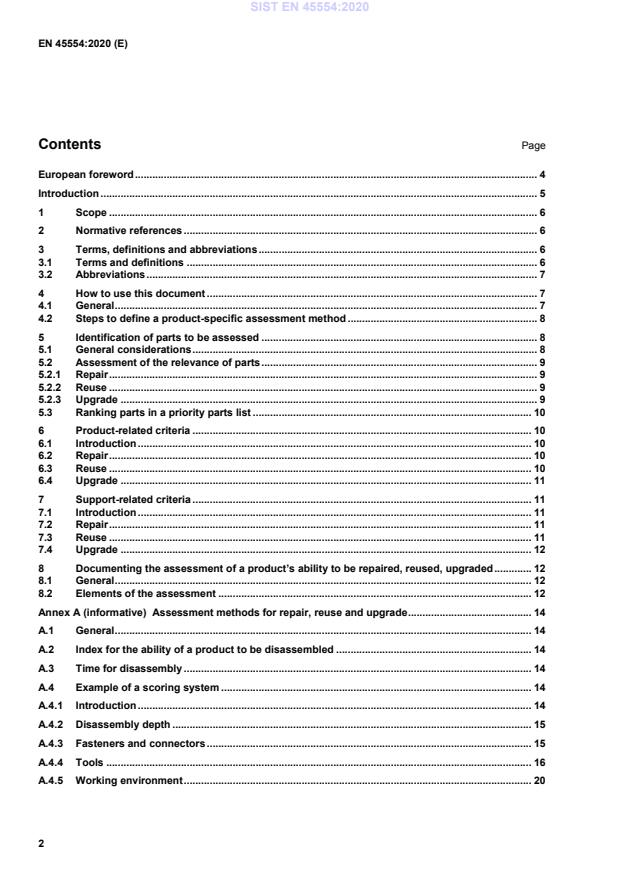
Contents Page
European foreword . 4
Introduction . 5
1 Scope . 6
2 Normative references . 6
3 Terms, definitions and abbreviations . 6
3.1 Terms and definitions . 6
3.2 Abbreviations . 7
4 How to use this document . 7
4.1 General . 7
4.2 Steps to define a product-specific assessment method . 8
5 Identification of parts to be assessed . 8
5.1 General considerations . 8
5.2 Assessment of the relevance of parts . 9
5.2.1 Repair . 9
5.2.2 Reuse . 9
5.2.3 Upgrade . 9
5.3 Ranking parts in a priority parts list . 10
6 Product-related criteria . 10
6.1 Introduction . 10
6.2 Repair . 10
6.3 Reuse . 10
6.4 Upgrade . 11
7 Support-related criteria . 11
7.1 Introduction . 11
7.2 Repair . 11
7.3 Reuse . 11
7.4 Upgrade . 12
8 Documenting the assessment of a product’s ability to be repaired, reused, upgraded . 12
8.1 General . 12
8.2 Elements of the assessment . 12
Annex A (informative) Assessment methods for repair, reuse and upgrade . 14
A.1 General . 14
A.2 Index for the ability of a product to be disassembled . 14
A.3 Time for disassembly . 14
A.4 Example of a scoring system . 14
A.4.1 Introduction . 14
A.4.2 Disassembly depth . 15
A.4.3 Fasteners and connectors . 15
A.4.4 Tools . 16
A.4.5 Working environment . 20
Skill level . 20
A.4.6
A.4.7 Diagnostic support and interfaces . 21
A.4.8 Availability of spare parts . 22
A.4.9 Types and availability of information . 25
A.4.10 Return options . 27
A.4.11 Data management . 27
A.4.12 Password and factory reset for reuse . 28
A.4.13 Aggregation of criteria scores . 29
Bibliography . 30
European foreword
This document (EN 45554:2020) has been prepared by CEN/CLC/JTC 10 “Energy-related products - Material
Efficiency Aspects for Ecodesign”.
The following dates are fixed:
• latest date by which this document has to be implemented (dop) 2020-12-02
at national level by publication of an identical national
standard or by endorsement
• latest date by which the national standards conflicting with (dow) 2022-12-02
this document have to be withdrawn
The dual logo CEN-CENELEC standardization deliverables, in the numerical range of 45550 – 45559, have
been developed under standardization request M/543 of the European Commission and are intended to
potentially apply to any product within the scope of the Directive 2009/125/EC concerning energy-related
products (ErP).
Topics covered in the above standardization request are linked to the following material efficiency aspects:
a) Extending product lifetime
b) Ability to reuse components or recycle materials from products at end-of-life
c) Use of reused components and/or recycled materials in products
Attention is drawn to the possibility that some of the elements of this document may be the subject of patent
rights. CENELEC shall not be held responsible for identifying any or all such patent rights.
This document has been prepared under a mandate given to CENELEC by the European Commission and the
European Free Trade Association
These standards are general in nature and describe or define fundamental principles, concepts, terminology or
technical characteristics. They can be cited together with other product publications, e.g. developed by product
technical committees.
This document is intended to be used by technical committees when producing horizontal, generic, and product-
specific, or product group publications.
NOTE CEN-CENELEC JTC 10 uses either CEN or CENELEC foreword templates, as appropriate. The template for
the current document is correct at the time of publication.
Introduction
In this document, common elements for the ability of an ErP to be repaired, reused or upgraded, such as an
evaluation of the ability of parts to be disassembled, are addressed at part and product levels.
This document is especially linked to the generic documents on “Durability” and “Ability of ErPs to be
remanufactured”, EN 45552, "General method for the assessment of the durability of energy-related products",
and EN 45553, "General method for the assessment of the ability to remanufacture energy-related products",
[1], respectively.
1 Scope
This document provides generic methods to assess the following aspects:
1. the ability of products to be repaired
2. the ability of products, or parts thereof, to be reused
3. the ability of products to be upgraded
For the purposes of this document, “product” refers to “Energy-related Product (ErP)”.
This document includes generic criteria and methods relevant for assessing the ability of certain parts to be
removed from products for the purpose of repair, reuse or upgrade.
NOTE The ability to of a product to be remanufactured is covered in prEN 45553:2018.
The methods in this document include product-related and support-related criteria when the product is placed
on the market, taking into account knowledge of parts that are likely to fail, need replacing, or have reuse
potential.
The decision whether a product should be repaired, reused or upgraded, is dependent on a range of factors
such as health and safety, as well as economic, legal and environmental aspects. However, the question of
whether it is reasonable to repair, reuse or upgrade products is outside of the scope of this document.
2 Normative references
The following documents are referred to in the text in such a way that some or all of their content constitutes
requirements of this document. For dated references, only the edition cited applies. For undated references, the
latest edition of the referenced document (including any amendments) applies.
EN 45552:—, General method for the assessment of the durability of energy-related products
EN 45559, Methods for providing information relating to material efficiency aspects of energy-related products
3 Terms, definitions and abbreviations
3.1 Terms and definitions
For the purposes of this document, the following terms and definitions apply.
ISO and IEC maintain terminological databases for use in standardization at the following addresses:
• IEC Electropedia: available at http://www.electropedia.org/
• ISO Online browsing platform: available at http://www.iso.org/obp
NOTE CEN CLC/TR 45550 [2], which is currently under development, contains additional definitions related to material
efficiency of ErP.
3.1.1
part
hardware, firmware or software constituent of a product
Under preparation. Stage at the time of publication: prEN 45552:2018
3.1.2
disassembly
process whereby a product is taken apart in such a way that it could subsequently be reassembled and made
operational
[SOURCE: IEC 62542 definition 6.1, modified by changing “an item” into “a product” and deleting the note]
3.1.3
reuse
process by which a product or its parts, having reached the end of their first use, are used for the same purpose
for which they were conceived
Note 1 to entry: Reuse after second or subsequent usage is also considered as reuse, but normal, regular or sporadic use
is not considered as reuse.
3.1.4
repair
process of returning a faulty product to a condition where it can fulfil its intended use
3.1.5
upgrade
process of enhancing the functionality, performance, capacity or aesthetics of a product
Note 1 to entry: An upgrade to a product may involve changes to its software, firmware and/or hardware.
Note 2 to entry: Refer to the “Blue Guide” [3] for conditions under which a product is considered as a new product when
placing it on the market after upgrading it.
3.2 Abbreviations
The following abbreviations have been used in this document:
ErP Energy-related Product
eDIM Ease of Disassembly Metric
MOST Maynard Operation Sequence Technique
4 How to use this document
4.1 General
This document provides the following generic methods and criteria for assessing the ability of products, or parts
thereof, to be repaired, reused and/or upgraded:
• An assessment method elaborated in 4.2 to Clause 8
• Two additional methods (Index and Time) offered as examples in A.1 and A.2, respectively.
This document is general in nature and allows the user to select assessment methods and criteria as appropriate
for different groups of products. The options, list of criteria and their classifications provided in this document
are not exhaustive. The relevance of each criterion and appropriateness of a classification for a specific product
group shall be assessed according to the characteristics of the product group.
Clause 5 addresses the prioritization of parts and Clauses 6 and 7 list criteria that influence the ability of a
product or parts thereof, to be repaired, reused and/or upgraded. A description and classification is provided for
each criterion in Annex A.4. References linking each repair, reuse and upgrade criterion in the main text with its
description and classification in the Annex is provided in Clauses 6 and 7. Clause 8 covers how the assessment
can be reported.
Additionally, information on an index for the ability of a product to be disassembled and the time for disassembly
are provided in Annexes A.1 and A.2 respectively.
There is considerable overlap in terms of prioritization of parts and criteria among the three aspects this
document addresses (repair, reuse and upgrade). Therefore, in order to facilitate their presentation, the aspect
of repair is used as a basis when presenting methods and criteria, and separate subclauses address specific
aspects related to reuse and upgrade.
The user of this document shall also provide a method to verify the result of the assessment. The assessment
criteria shall be reliable, accurate and reproducible.
4.2 Steps to define a product-specific assessment method
When defining a product-specific assessment method, the user of this document shall use the following steps:
1. Determination of priority parts for the assessment (see Clause 5);
2. Identification of criteria (see Clause 6 and 7) and applicable categories relevant for the assessment of each
priority part (See A.4.1 to A.4.12);
3. Assignment of a ranking/classification score to each applicable category of relevant criteria for each priority
part (See A.4.1 and A.4.13);
Optionally, the following step can also be used:
4. Specification of a calculation method to aggregate results deriving from the aforementioned step 3, taking
into account each criterion for each priority part (See A.4.13).
5 Identification of parts to be assessed
5.1 General considerations
To assess the ability of a product to be repaired, reused or upgraded, the user of this document shall establish
a list of priority parts. This shall be based on available information or criteria as defined in 5.2.
It is necessary to prioritize parts because not all will be equally relevant to repair, reuse, or upgrade. The parts
that have been prioritized are considered priority parts.
In order to identify priority parts, all parts shall be considered taking into account the analysis of EN 45552. The
assessment described in Clauses 6 and 7 applies to priority parts only.
The following sources of information shall be consulted (as available; the list is non-exhaustive):
— Regulations;
— Product manufacturers;
— Parts manufacturers;
— Repair or maintenance organizations;
— Reuse organizations;
— Consumer organizations;
— Scientific literature and study reports.
The established product-group specific lists of priority parts for assessing the ability of a product to be repaired,
reused or upgraded can be different from one another. The need to replace a part for repair or maintenance is
also highly dependent on the technology used for that part. Parts providing the same function in similar products
can be based on different technologies, resulting in different likelihoods of failure or wear-out. Therefore, the
identification of priority parts should also take into account such technology differences.
What determines a priority part is:
• The likelihood of the need to replace or upgrade the part,
• The suitability of the part for reuse, and
• The functionality of the part.
NOTE Priority parts likely to suffer damage or induce damage to the product upon removal do not facilitate repair,
reuse or upgrade as those that are easily removable.
5.2 Assessment of the relevance of parts
5.2.1 Repair
Parts with a high average occurrence of failure shall be added to the list of priority parts for repair, taking into
account their relevance to the functionality of the product.
Data shall be gathered to assess the likelihood that parts fail, such that replacement or repair are necessary.
More details can be found in EN 45552.
Data may be based on physical testing, statistical surveys, calculations and field data. Accidental breakdowns
and normal wear-out shall also be considered as sources of part failure.
NOTE Accidental breakdown is the unintentional breaking of a product by inadvertence, a mistake or a misuse of the
user.
5.2.2 Reuse
Reuse of products
If deemed appropriate, the assessment of the ability of a product to be reused shall follow the criteria for repair
in 5.2.1. If applicable, parts of a product containing personal data and parts of a product enabling the transfer
and/or deletion of personal data shall be classified as priority parts.
Reuse of parts
For building a list of priority parts for their reuse, the following shall be taken into account:
• Parts can be harvested in cases where there is a high demand for them to be reused.
• Parts can be of reuse interest because they last longer than the lifetime of the product.
For some parts, the ability to be reused can be determined by the ability of user data to be transferred and/or
deleted (see example in A.4.11), and factory settings to be restored (see example in A.4.12).
NOTE The motivation to reuse a part is influenced by its ability to withstand wear and tear and also by its continued
compatibility with other products.
5.2.3 Upgrade
Parts subject to rapid technological changes or changes in use profiles over the use phase of the product shall
be added to the list of priority parts for upgrade.
When compiling the list of priority parts for upgrade, the following shall be taken into account:
• Typical upgrade features and frequency of upgrade
• Product replacement motivations: the recurring motivations for replacing a still functioning product (i.e.
motivated by increasing performance or functionality demands).
• Upgrade upon repair options: the priority parts for repair are analysed for their potential to be replaced
with enhanced functionality or capacity.
5.3 Ranking parts in a priority parts list
Where relevant, the list of priority parts shall be ranked according to the criteria defined under 5.2, in terms of
enabling repair, reuse or upgrade. Ranking helps to focus on the parts most likely to require repair, reuse or
upgrade. If the ranking of priority parts takes place, it shall be used to weight the assessment results as
described in Annex A.4.13.
6 Product-related criteria
6.1 Introduction
To determine the criteria for the assessment of a product or product group, the applicability, appropriateness
and relevance shall be considered. The criteria listed in this and Clause 7 shall be compiled in a product-specific
assessment method.
By way of example, these criteria are elaborated in Annex A, which provides a basis for the development of
product-specific methods, and includes an example of a scoring system for the assessment of the ability of a
product to be repaired, reused and/or upgraded.
The product-related criteria listed for repair can also be applicable for reuse and upgrade. Similarly, for any of
the three aspects assessed, the other two can also have an influence and should be considered.
6.2 Repair
A non-exhaustive list of criteria influencing the ability of the product to be repaired is provided in this subclause.
When defining a product-specific assessment method, the user of this document shall consider the criteria below
to decide which of the criteria are relevant for the product group in question:
• Disassembly depth (see example in A.4.2);
• Fasteners and connectors (see example in A.4.3);
• Tools (see example in A.4.4);
• Working environment (see example in A.4.5); and
• Skill level (see example in A.4.6).
A list of basic tools used for repair purposes in general, regardless of the specific product being repaired is
provided in Table A.3. If the concept of basic tools is used in the assessment of a specific product group, then
the list in Table A.3 shall be used.
6.3 Reuse
Reuse can apply to both a product and a part.
NOTE The motivation to reuse a product or a part is influenced by its ability to withstand wear and tear and also by its
continued compatibility with other products.
The ability of a product to be reused is influenced by its ability to be repaired or upgraded.
The ability of some products to be reused can be determined by the ability of user data to be transferred and/or
deleted (see example in A.4.11), and factory settings to be restored (see example in A.4.12).
6.4 Upgrade
The ability of a product to be upgraded can be assessed based on the ability of the product to be fitted with and
function with parts of enhanced functionality, performance, capacity or aesthetics. For assessing the ability of
products to be upgraded, the criteria referenced in 6.2 and 6.3 shall also be taken into account.
Specific attention should be given to the role of software and firmware. The ability of a product to be upgraded
can have a positive impact on the ability of a product to be reused.
7 Support-related criteria
7.1 Introduction
To determine the support-related criteria for the assessment of a product or product group, the applicability,
appropriateness and relevance shall be considered. The criteria listed in this clause and in Clause 6 should be
compiled in a product-specific assessment method.
NOTE 1 Support means the provision by the manufacturer of human resources, equipment, materials and spare parts,
facilities, documentation, information, and information systems, with the aim to facilitate repair, reuse and/or upgrading.
NOTE 2 Support-related criteria are limited to provisions from and/or authorized by the manufacturer of the product.
By way of example, these criteria are elaborated in Annex A, which provides a basis for the development of
product-specific methods and includes an example of a scoring system for the assessment of the ability of a
product to be repaired, reused and/or upgraded.
7.2 Repair
The support provided by the manufacturer for repair shall be assessed based on information provided with the
product, or in the product’s terms and conditions, or publicly available information from the manufacturer.
When defining a product-specific assessment method, the user of this document shall consider the non-
exhaustive list below:
• Diagnostic support and interfaces (see example in A.4.7);
• Availability of spare parts (see example in A.4.8);
• Types and availability of information (see example in A.4.9); and
• Return models for repair (see example in A.4.10).
Some of these criteria are also relevant for reuse and upgrade.
7.3 Reuse
The support-related criteria for reuse shall be assessed based on information provided with the product, or in
the terms and conditions of the product, or publicly available information from the manufacturer.
The ability of products to be reused is dependent on the ability to be repaired and/or upgraded. Support-related
criteria for repair and upgrade are therefore also relevant for reuse.
All support-related criteria that enable the transfer of ownership are relevant, including information, tools and
services offered by the manufacturer to facilitate identification of the product or part, the ability of data to be
deleted and/or transferred or factory settings to be restored (see examples in A.4.9, A.4.11 and A.4.12).
7.4 Upgrade
The support-related criteria for upgrade shall be assessed based on information provided with the product, or
in the product’s terms and conditions, or publicly available information from the manufacturer.
When defining a product-specific assessment method, the user of this document shall consider the non-
exhaustive list below:
• Diagnostic support and interfaces (see example in A.4.7);
• Availability of parts for upgrade (see example in A.4.8);
• Types and availability of information (see example in A.4.9); and
• Return models for upgrade (see example in A.4.10).
NOTE For certain products the availability of software and firmware support, including updates can be important to
consider (A.4.8 and A.4.9).
8 Documenting the assessment of the ability of a product to be repaired, reused,
upgraded
8.1 General
The repair, reuse and upgrade assessment of < product / product group > shall be documented.
The need to report topic-related content to the different target audiences shall be assessed, and the data
classified within the different sensitivity levels 1, 2, and 3. See Clauses 5.1 and 5.2 of EN 45559.
Depending on the specific target audience to whom the information will be reported, a suitable communication
approach shall be defined in accordance with EN 45559.
Special care shall be taken to demonstrate the correlation between information on the results of the assessment
and the input data and assumptions used.
8.2 Elements of the assessment
The documentation shall have the following structure:
A. General
1. Instigator of and/or responsible for the assessment
2. Date of report, place, etc.
B. Scope of assessment
1. Description of product assessed
2. Description of assumptions applied
C. Input data and approach for the assessment of product’s ability to be repaired, reused, upgraded
1. Description of data and other information used/needed for the assessment. Typical input data for the
assessment are:
• Repair instructions;
• Information on repair centres;
• Disassembly instructions;
• Information on the transfer and deletion of personal data from a product;
• Information on upgrade potential of certain product parts;
• Upgrade instructions;
• Availability of spare parts
2. Calculations or scoring when relevant
3. Methods or tools used in the assessment
D. Output of the assessment:
1. Result of the assessment covering a list of qualitative and quantitative topic-related content that shall be
reported to the different target audiences. Examples include:
• The assessment result for each of the individual criteria;
• Calculation and final result of any aggregate scores.
2. List of applicable references (including standards, legislation and other requirements)
Annex A
(informative)
Assessment methods for repair, reuse and upgrade
A.1 General
As specified in Clause 4.1, this Annex presents a number of methods for the assessment of a product’s ability
to be repaired, reused and upgraded.
A.2 Index for the ability of a product to be disassembled
An index for the ability of a product to be disassembled can be calculated based on the number of parts to be
removed, the fastener types, connector types and difficulty coefficients.
Using the minimum number of fasteners and connectors is a key principle in design for disassembly. Different
fastener and connector types can require different unfastening tools, different access directions and different
disassembly configurations, which would ultimately result in an increase in the disassembly effort.
More information on the Index can be found on source [4].
A.3 Time for disassembly
The ability of a product to be disassembled is influenced, among other technical aspects, by the number of
steps needed to disassemble parts of the product, by the ease of access to parts and by the difficulty of the
operation itself. The time for disassembly can be an aggregated parameter to assess the overall ability of a
product to be disassembled. Time can easily be measured but the overall length depends on the operator skills
and other factors. The Ease of Disassembly Metric (eDiM) [5] method is based on the Maynard Operation
Sequence Technique (MOST) and requires information about product parts and adopted fasteners and
connectors that can be directly verified within the product. The eDiM is a comprehensive method, although it
comes with a significant computational effort.
NOTE MOST is a measurement technique used by industrial engineers and practitioners to measure assembly times
for a wide variety of products. Reference values of eDIM have been determined by using MOST.
In eDIM, the tasks necessary to disassemble a particular part or product are listed and reference time values
are associated with each of them. These represent the effort needed to perform the task. The references [5]
and [6] include reference values for common disassembly tasks which can be adapted, extended and/or
updated.
The overall eDiM, measured in time units, is calculated by summing all contributions associated with a
disassembly sequence. Measuring single disassembly activities and quantifying standard values, as
implemented in MOST, reduces subjectivity.
More information on eDiM and MOST can be found on sources [6] and [7].
A.4 Example of a scoring system
A.4.1 Introduction
An assessment of the ability of a product to be repaired, reused and/or upgraded is performed following the
steps according to Clause 4.
The user of this document specifies the relevant classes for the criteria chosen according to Clauses 6 and 7.
NOTE Disassembly depth (A.4.2) is the only criterion where a calculation is used instead of classes.
Aggregation of scores is described in A.4.13.
A.4.2 Disassembly depth
The disassembly depth is the number of steps required to remove a part from a product, without damaging the
product. The analysis of disassembly depth is fundamental to assess the effort required to access and/or replace
priority parts. When defining product-specific assessment methods, the user of this document can specify what
constitutes as a step.
EXAMPLE A step can be defined as an operation that finishes with the removal of a part, and/or with a change of tool.
If fasteners or connectors are not visible, the disassembly sequence can require further steps to locate the
fasteners or connectors such as removing stickers or finding disassembly instructions.
A score according to the number of steps could be assigned to this criterion for each priority part according to
the following formula:
()D − 1
i
S 1− with Sdepth,i = 0 for Di > Dref.
depth, i
()D − 1
ref
where
— S is the disassembly depth score for priority part i
depth,i
— D is the depth for part i
i
— D is the reference depth for the product group specified at product-specific level
ref
A.4.3 Fasteners and connectors
The number of fasteners and their visibility can be used as a proxy for the time needed to repair or upgrade a
product, or can be included in the calculation of disassembly depth (see section A.4.2). For the assessment of
fasteners, important criteria are the reversibility and the reusability of fasteners. Fasteners can be closely
interlinked to the assessment of necessary tools and skills for repair, reuse or upgrade.
NOTE When fasteners are mentioned in this subclause, they also include connectors.
The following types should be considered for the classification of fasteners:
Table A.1 — Classification of fastener types
Category Description Class
Reusable A
Removable B
Neither removable nor reusable C
The various classes of fasteners are described below:
• Reusable (Class A): An original fastening system that can be completely reused, or any elements of the
fastening system that cannot be reused are supplied with the new part for the repair, reuse or upgrade
process.
• Removable (Class B): An original fastening system that is not reusable, but can be removed without
causing damage or leaving residue which precludes reassembly (in case of repair or upgrade) or reuse of
the removed part (in case of reuse) for the repair, reuse or upgrade process.
• Neither removable nor reusable (Class C): An original fastening system that is not removable and not
reusable, as defined above, for the repair, reuse or upgrade process.
=
A.4.4 Tools
Tools necessary for repair are determined by the product design and are an objective characteristic of the
product. Repair, reuse or upgrade processes can, therefore, be classified according to the tools necessary to
carry them out. Table A.2 gives an overview of process classification by necessary tools.
Processes corresponding to Class A entail less constraints with regard to the variety of feasible repair scenarios
than processes corresponding to Class B, etc. Not all classes may apply to every type of product.
Table A.2 — Process classification by necessary tools
Category Description Class
Feasible with: A
— the use of no tool, or
— a tool or set of tools that is supplied
with the product or spare part, or
— basic tools as listed in Table A.3
Feasible with product group specific tools B
Feasible with other commercially available C
tools
Feasible with proprietary tools D
Not feasible with any existing tool E
Many processes, such as the removal of fasteners and connectors for instance, can be completed with several
different types of tools. In order to assess the applicable tool category, only the simplest tool that is required for
a given process is taken into account, regardless of the type of tool that can be used in practice by actual repair
operators. For instance, if a process is feasible with Class A and also feasible with Class B tools, then Class A
takes precedence for the purpose of the assessment even if Class B tools can be more frequently used for the
actual repair.
The various classes of necessary tools are described below:
Basic tools, no tools, provided tools (Class A): A repair, reuse or upgrade process, which can be carried out
without the use of any tools, or with a tool or set of tools that is supplied with the product or spare part, or with
basic tools as listed in Table A.3. This table contains a selection of hand-operated tools that can be used for
repairing various products.
Table A.3 —Basic tools and their reference standards
Tool type Illustration Reference
(informative example)
Screwdriver for ISO 2380, ISO 8764,
slotted heads, ISO 10664
cross recess or
for hexalobular
recess heads
Tool type Illustration Reference
(informative example)
Hexagon socket ISO 2936
key
Combination ISO 7738
wrench
Combination ISO 5746
pliers
Half round nose ISO 5745
pliers
Diagonal cutters ISO 5749
Multigrip pliers ISO 8976
(multiple slip joint
pliers)
Tool type Illustration Reference
(informative example)
Locking pliers
Combination
pliers for wire
stripping and
terminal crimping
Prying lever
Tweezers
Hammer, steel ISO 15601
head
Utility knife
(cutter) with snap-
off blades
Multimeter
Tool type Illustration Reference
(informative example)
Voltage tester
Soldering iron
Hot glue gun
Magnifying glass
NOTE 1 Most tools come in different sizes. This list only refers to the tool type. Although some sizes are more common
than others, for practical purposes, any size of the listed tools is considered to be a basic tool.
Product group specific tools (Class B): A repair, reuse or upgrade process, which cannot be carried out with
tools as defined above (Class A), but can be carried out with a tool or set of tools as defined in an applicable
product-specific method for assessing the ability of a product to be repair, reused or upgraded:
— either by way of a finite list of tools, or
— by way of criteria for identifying product group specific tools and verifiably distinguishing them from other
commercially available tools, or
— by a combination of both,
insofar as the tools defined in the product-specific method are:
— not proprietary, and
— necessary for repairing, preparing for reuse or upgrading products produced by at least two different
manufacturers.
NOTE 2 In the absence of a product-specific method defining product group specific tool lists or criteria as described
above, this category is void.
Other commercially available tools (Class C): A repair, reuse or upgrade process, which cannot be carried
out with basic or product group specific tools as defined above (Classes A and B), but can be carried out without
the use of any proprietary tools.
Proprietary tools (Class D): A repair, reuse or upgrade process, which can be carried out only with one or
more proprietary tools. These are tools that are not available for purchase by the general public or for which
any applicable patents are not available to license under fair, reasonable, and non-discriminatory terms.
Not feasible with any existing tool (Class E): A repair, reuse or upgrade process, which cannot be carried
out with any existing tool.
A.4.5 Working environment
Working environment requirements refer to the degree of specialization of the environment required to perform
the repair, reuse, upgrade process; which can take place for example at home, in a professional workshop or
in a production-equivalent environment. Safety provisions and equipment are some of the factors influencing
where the repair, reuse, upgrade process can be performed.
The environment can be categorized according to the table below.
Table A.4 — Classification of working environment
Category Description Class
Use environment A
Workshop environment B
Production-equivalent environment C
The various classes of working environment are described below:
• Use environment (Class A): If a repair, reuse or upgrade process can be carried out in the environment
where the product is in use without any working environment requirements it is categorized as requiring a
use environment.
• Workshop environment (Class B)
...