

EN 50636-2-107:2015
(Main)Safety of household and similar appliances - Part 2-107: Particular requirements for robotic battery powered electrical lawnmowers
General Information
- Abstract
This clause of Part 1 is replaced by the following: This European Standard specifies safety requirements and their verification for the design and construction of robotic battery powered electrical rotary lawnmowers and their peripherals with the rated voltage of the battery being not more than 75 V d.c. charged by mains electrical and/or alternative energies, e.g. solar power. This European Standard does not apply to non-robotic machines such as lawn trimmers, lawn edge trimmers, lawn edgers, ride-on lawnmowers or pedestrian controlled lawnmowers. This European Standard is not applicable to EMC and environmental hazards (except noise). This European Standard does not apply to internal combustion engine(s), hybrid and fuel cell powered machines and associated charging systems. This European Standard deals with all the significant hazards presented by battery powered robotic lawnmowers and their peripherals when they are used as intended and under conditions of misuse which are reasonably foreseeable. This European Standard is not applicable to machines, which are manufactured before the date of publication of this document by CENELEC. NOTE This European Standard does not apply to battery chargers (EN 60335-2-29:2004).
- Status
- Published
- Publication Date
- 22-Jan-2015
- Withdrawal Date
- 30-Nov-2017
- Technical Committee
- CLC/TC 116 - Safety of hand-held motor-operated electric tools
- Drafting Committee
- CLC/TC 116/WG 05 - Gardening appliances
- Current Stage
- 6060 - Document made available - Publishing
- Start Date
- 23-Jan-2015
- Due Date
- 05-Mar-2015
- Completion Date
- 23-Jan-2015
- Directive
- 2006/42/EC - Directive 2006/42/EC of the European Parliament and of the Council of 17 May 2006 on machinery, and amending Directive 95/16/EC (recast)OJ Ref: C, C 14 OJ Date: 15-Jan-2016



Overview
EN 50636-2-107:2015 (CLC) is the European particular requirements standard for robotic battery powered electrical rotary lawnmowers. It supplements EN 60335-1 (“Household and similar electrical appliances – Safety – Part 1: General requirements”) and sets safety requirements and verification methods for design and construction of robotic mowers and their peripherals where the battery nominal voltage is not more than 75 V d.c.. The standard focuses on hazards arising from intended use and reasonably foreseeable misuse. It excludes non-robotic machines (ride‑on, pedestrian‑controlled mowers, trimmers, edgers), internal combustion, hybrid or fuel‑cell machines, and battery chargers.
Key topics and technical requirements
- Scope and exclusions: Applies only to robotic battery‑powered rotary lawnmowers (≤75 V DC); excludes EMC and most environmental hazards (noise is included).
- Integration with EN 60335-1: Modifies or adds clauses to Part 1 to address robotic mower‑specific risks.
- Mechanical hazards & stability: Requirements and test methods for structural integrity, impact resistance, thrown‑object risk and stability under operation.
- Cutting‑system safety: Procedures for assessing kinetic energy of pivoting cutting elements (Annex AA) and guarding to prevent access to dangerous parts.
- Sensors and control: Tests for obstruction sensors, starting/stopping controls and software safety assessment (Annex R – software evaluation).
- Thrown object testing: Construction and reporting for thrown object test enclosures (Annex BB/CC/DD) to verify containment and reduce injurious projections.
- Noise testing: Engineering noise test code and microphone positioning (Annex FF) - as environmental noise is a covered hazard.
- Marking, instructions and safety signs: Required labeling, user instructions and recommended safety signs (Annex EE/HH).
- Battery and electrical safety: Verification of leakage currents, insulation, thermal behaviour and battery‑related hazards (referenced to EN 62133 and EN 60335 clauses where applicable).
- Test methods and fixtures: Detailed test cycles, foot probe, finger probe and impact fixture illustrations and sizing.
Applications and who uses this standard
- Manufacturers and product designers: To design compliant robotic lawnmowers and peripherals that meet EU safety expectations.
- Testing & certification laboratories: For type testing, conformity assessment and preparing test reports for CE marking.
- Compliance engineers & safety assessors: For risk assessments, technical files and evidence of conformity with EU directives (see Annex ZZ for Machinery Directive linkage).
- Procurement, retailers and fleet managers: To specify safety requirements and verify supplier compliance.
- Regulators and notified bodies: As a reference for enforcement and product market surveillance.
Related standards
- EN 60335-1:2012 (Part 1 general requirements)
- EN 60335-2-29 (battery chargers) - noted as not covered by EN 50636-2-107
- EN 62133 (battery cell/battery safety)
- IEC/ISO standards referenced for probes, signs and noise testing
Keywords: EN 50636-2-107, robotic lawnmower standard, battery powered lawnmower safety, CENELEC, rotary lawnmower safety, thrown object test, software evaluation, noise test code.
Relations
- Effective Date
- 10-Feb-2026
- Effective Date
- 09-Feb-2026
- Refers
EN ISO 354:2003 - Acoustics - Measurement of sound absorption in a reverberation room (ISO 354:2003) - Effective Date
- 09-Feb-2026
- Effective Date
- 09-Feb-2026
- Effective Date
- 09-Feb-2026
- Effective Date
- 09-Feb-2026
- Effective Date
- 09-Feb-2026
- Effective Date
- 09-Feb-2026
- Effective Date
- 09-Feb-2026
- Effective Date
- 09-Feb-2026
- Effective Date
- 03-Feb-2026
- Effective Date
- 03-Feb-2026
- Effective Date
- 03-Feb-2026
- Effective Date
- 03-Feb-2026
- Effective Date
- 03-Feb-2026
Get Certified
Connect with accredited certification bodies for this standard

Control Union Certifications
Global certification for agriculture and sustainability.

ECOCERT
Organic and sustainability certification.

FSC International
Forest Stewardship Council certification.
Sponsored listings
Frequently Asked Questions
EN 50636-2-107:2015 is a standard published by CLC. Its full title is "Safety of household and similar appliances - Part 2-107: Particular requirements for robotic battery powered electrical lawnmowers". This standard covers: This clause of Part 1 is replaced by the following: This European Standard specifies safety requirements and their verification for the design and construction of robotic battery powered electrical rotary lawnmowers and their peripherals with the rated voltage of the battery being not more than 75 V d.c. charged by mains electrical and/or alternative energies, e.g. solar power. This European Standard does not apply to non-robotic machines such as lawn trimmers, lawn edge trimmers, lawn edgers, ride-on lawnmowers or pedestrian controlled lawnmowers. This European Standard is not applicable to EMC and environmental hazards (except noise). This European Standard does not apply to internal combustion engine(s), hybrid and fuel cell powered machines and associated charging systems. This European Standard deals with all the significant hazards presented by battery powered robotic lawnmowers and their peripherals when they are used as intended and under conditions of misuse which are reasonably foreseeable. This European Standard is not applicable to machines, which are manufactured before the date of publication of this document by CENELEC. NOTE This European Standard does not apply to battery chargers (EN 60335-2-29:2004).
This clause of Part 1 is replaced by the following: This European Standard specifies safety requirements and their verification for the design and construction of robotic battery powered electrical rotary lawnmowers and their peripherals with the rated voltage of the battery being not more than 75 V d.c. charged by mains electrical and/or alternative energies, e.g. solar power. This European Standard does not apply to non-robotic machines such as lawn trimmers, lawn edge trimmers, lawn edgers, ride-on lawnmowers or pedestrian controlled lawnmowers. This European Standard is not applicable to EMC and environmental hazards (except noise). This European Standard does not apply to internal combustion engine(s), hybrid and fuel cell powered machines and associated charging systems. This European Standard deals with all the significant hazards presented by battery powered robotic lawnmowers and their peripherals when they are used as intended and under conditions of misuse which are reasonably foreseeable. This European Standard is not applicable to machines, which are manufactured before the date of publication of this document by CENELEC. NOTE This European Standard does not apply to battery chargers (EN 60335-2-29:2004).
EN 50636-2-107:2015 is classified under the following ICS (International Classification for Standards) categories: 65.060.70 - Horticultural equipment. The ICS classification helps identify the subject area and facilitates finding related standards.
EN 50636-2-107:2015 has the following relationships with other standards: It is inter standard links to ISO 3767-1:1998, EN ISO 12100:2010, EN ISO 354:2003, EN ISO 3744:2010, EN ISO 11203:2009, EN ISO 4871:2009, EN ISO 13857:2008, EN ISO 11201:2010, EN ISO 7010:2012, EN ISO 11688-1:2009, EN 60335-2-29:2004, EN 60320-1:2001, EN 60320-2-1:2000, EN 61754-22:2005, EN 60320-1:2001/A1:2007. Understanding these relationships helps ensure you are using the most current and applicable version of the standard.
EN 50636-2-107:2015 is associated with the following European legislation: EU Directives/Regulations: 2006/42/EC; Standardization Mandates: M/396. When a standard is cited in the Official Journal of the European Union, products manufactured in conformity with it benefit from a presumption of conformity with the essential requirements of the corresponding EU directive or regulation.
EN 50636-2-107:2015 is available in PDF format for immediate download after purchase. The document can be added to your cart and obtained through the secure checkout process. Digital delivery ensures instant access to the complete standard document.
Standards Content (Sample)
2003-01.Slovenski inštitut za standardizacijo. Razmnoževanje celote ali delov tega standarda ni dovoljeno.Sicherheit elektrischer Geräte für den Hausgebrauch und ähnliche Zwecke - Teil 2-107: Besondere Anforderungen für batteriebetriebene Roboter-RasenmäherAppareils électrodomestiques et analogues - Partie 2-107: Exigences particulières relatives aux tondeuses à gazon électriques robotisées alimentées par batteriesSafety of household and similar appliances - Part 2-107: Particular requirements for robotic battery powered electrical lawnmowers65.060.70Vrtnarska opremaHorticultural equipment13.120Varnost na domuDomestic safetyICS:Ta slovenski standard je istoveten z:EN 50636-2-107:2015SIST EN 50636-2-107:2015en01-september-2015SIST EN 50636-2-107:2015SLOVENSKI
STANDARD
EUROPEAN STANDARD NORME EUROPÉENNE EUROPÄISCHE NORM
EN 50636-2-107
January 2015 ICS 65.060.70
English Version
Safety of household and similar appliances - Part 2-107: Particular requirements for robotic battery powered electrical lawnmowers (IEC 60335-2-107:2012 , modified)
This European Standard was approved by CENELEC on 2014-12-01. CENELEC members are bound to comply with the CEN/CENELEC Internal Regulations which stipulate the conditions for giving this European Standard the status of a national standard without any alteration. Up-to-date lists and bibliographical references concerning such national standards may be obtained on application to the CEN-CENELEC Management Centre or to any CENELEC member.
This European Standard exists in three official versions (English, French, German). A version in any other language made by translation under the responsibility of a CENELEC member into its own language and notified to the CEN-CENELEC Management Centre has the same status as the official versions. CENELEC members are the national electrotechnical committees of Austria, Belgium, Bulgaria, Croatia, Cyprus, the Czech Republic, Denmark, Estonia, Finland, Former Yugoslav Republic of Macedonia, France, Germany, Greece, Hungary, Iceland, Ireland, Italy, Latvia, Lithuania, Luxembourg, Malta, the Netherlands, Norway, Poland, Portugal, Romania, Slovakia, Slovenia, Spain, Sweden, Switzerland, Turkey and the United Kingdom. European Committee for Electrotechnical Standardization
Comité Européen de Normalisation Electrotechnique Europäisches Komitee für Elektrotechnische Normung CEN-CENELEC Management Centre: Avenue Marnix 17,
B-1000 Brussels © 2015 CENELEC All rights of exploitation in any form and by any means reserved worldwide for CENELEC Members.
Ref. No. EN 50636-2-107:2015 E SIST EN 50636-2-107:2015
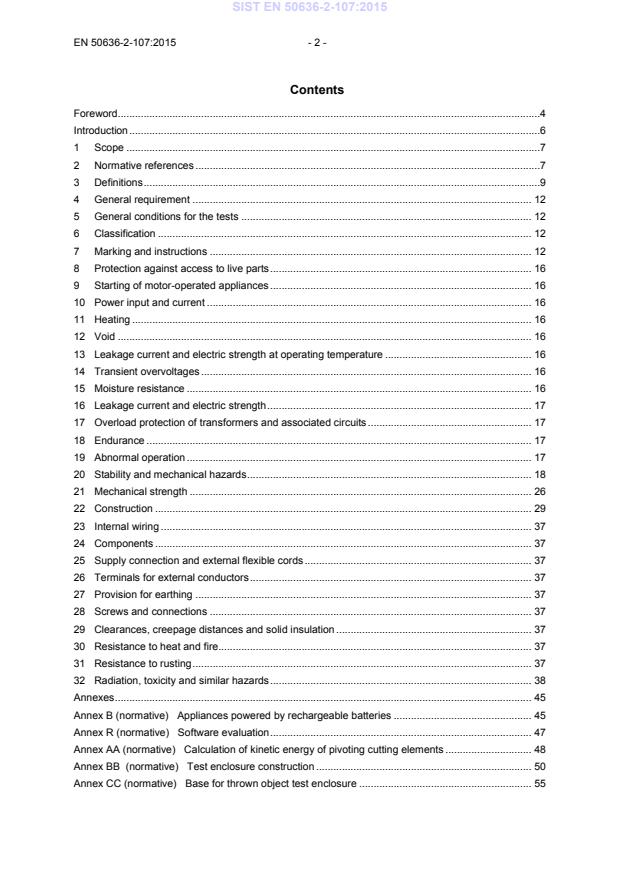
Contents Foreword.4 Introduction .6 1 Scope .7 2 Normative references .7 3 Definitions .9 4 General requirement . 12 5 General conditions for the tests . 12 6 Classification . 12 7 Marking and instructions . 12 8 Protection against access to live parts . 16 9 Starting of motor-operated appliances . 16 10 Power input and current . 16 11 Heating . 16 12 Void . 16 13 Leakage current and electric strength at operating temperature . 16 14 Transient overvoltages . 16 15 Moisture resistance . 16 16 Leakage current and electric strength . 17 17 Overload protection of transformers and associated circuits . 17 18 Endurance . 17 19 Abnormal operation . 17 20 Stability and mechanical hazards . 18 21 Mechanical strength . 26 22 Construction . 29 23 Internal wiring . 37 24 Components . 37 25 Supply connection and external flexible cords . 37 26 Terminals for external conductors . 37 27 Provision for earthing . 37 28 Screws and connections . 37 29 Clearances, creepage distances and solid insulation . 37 30 Resistance to heat and fire . 37 31 Resistance to rusting . 37 32 Radiation, toxicity and similar hazards . 38 Annexes . 45 Annex B (normative)
Appliances powered by rechargeable batteries . 45 Annex R (normative)
Software evaluation . 47 Annex AA (normative)
Calculation of kinetic energy of pivoting cutting elements . 48 Annex BB
(normative)
Test enclosure construction . 50 Annex CC (normative)
Base for thrown object test enclosure . 55 SIST EN 50636-2-107:2015
- 3 - EN 50636-2-107:2015 Annex DD (normative)
Target panel elevation zones and recommended test report for thrown object test . 57 Annex EE (normative)
Safety signs . 59 Annex FF (normative)
Noise test code – Engineering method (grade 2) . 62 Annex GG (informative)
Example of a material and construction fulfilling the requirements for an artificial surface . 67 Annex HH (informative)
Safety instructions . 69 Annex ZZ (informative)
Coverage of Essential Requirements of Directive 2006/42/EC . 71 Bibliography . 72 Figures Figure 101 – Example of test cycles (see Clause 20.102.2) . 38 Figure 102 – Foot probe test (see Clause 20.102.4) . 39 Figure 103 – Impact test fixture (see Clause 21.101.1) . 40 Figure 104 – Example of structural integrity test fixtures (see Clause 21.101.3.1.1). 42 Figure 105 - Finger probe test - Illustrations showing application of probe, insertion depth limited according to the geometry of the enclosure . 43 Figure 106 - Obstruction sensor test - Illustration showing typical arrangement (see Clause 22.105.2) . 44 Figure AA.1 – Measurement of the reckonable length L . 49 Figure BB.1 – Thrown object test enclosure – General layout . 51 Figure BB.2 – Thrown object test enclosure . 52 Figure BB.3 – Test enclosure walls and base . 53 Figure BB.4 – Test fixture for corrugated fibreboard penetration test . 54 Figure CC.1 – Thrown object test enclosure – Base detail . 55 Figure CC.2 – Nail plan of test enclosure base . 56 Figure DD.1 – Recommended test data sheet . 58 Figure EE.1 – Safety sign illustrating – " WARNING – Read user instructions before operating the machine " . 59 Figure EE.2 – Alternative safety sign for the supplementary safety information panel of Figure EE.1 (safety sign 1641 of ISO 7000:2014) . 59 Figure EE.3 – Alternative safety sign for the supplementary safety information panel of Figure EE.1 (safety sign M002 of EN ISO 7010:2012) . 59 Figure EE.4 – Safety sign illustrating – "WARNING – Keep a safe distance from the machine when operating" . 60 Figure EE.5 – Safety sign illustrating – “WARNING – Remove the disabling device before working on or lifting the machine" . 60 Figure EE.6 – Safety sign illustrating – “WARNING – Operate the disabling device before working on or lifting the machine" . 61 Figure EE.7 – Safety sign illustrating – "WARNING – Do not ride on the machine" . 61 Figure FF.1 – Microphone positions on the hemisphere (see Table FF.1) . 63 Figure GG.1 – Sketch of the measurement surface covered
with an artificial surface (not to scale) . 68 Tables Table 1 – Sizing of test fixture air inlet holes . 28 Table FF.1 – Co-ordinates of microphone positions . 64 Table FF.2 – Absorption coefficients . 64 SIST EN 50636-2-107:2015
Foreword This document (EN 50636-2-107:2015) has been prepared by CLC/TC 116, "Safety of hand-held motor-operated electric tools".
The following dates are fixed: • latest date by which the standard has to be implemented at national level by publication of an identical national standard or by endorsement
(dop)
2015-12-01 • latest date by which the national standards conflicting with the standard have to be withdrawn
(dow)
2017-12-01 Attention is drawn to the possibility that some of the elements of this document may be the subject of patent rights. CENELEC shall not be held responsible for identifying any or all such patent rights. This document has been prepared under a mandate given to CENELEC by the European Commission and the European Free Trade Association, and supports essential requirements of EU Directives. For the relationship with EU Directive 2006/42/EC, see informative Annex ZZ, which is an integral part of this document. The text of IEC 60335-2-107:2012 has been revised by CLC/TC 116/WG 5, "Garden appliances", to bring this European Standard in line with the European Machinery Directive 2006/42/EC. This document was submitted to the UAP under the reference FprEN 60335-2-107:2013. CLC/TC 116 confirmed that EN 60335-1:2012 is Part 1 of this document.
This European Standard is to be used in conjunction with EN 60335-1:2012 “Household and similar electrical appliances - Safety – Part 1: General requirements” and its amendments. When “Part 1” is mentioned in this standard, it refers to EN 60335-1:2012. This European Standard supplements or modifies the corresponding clauses in Part 1, so as to convert that publication into the European Standard “Particular requirements for robotic battery powered electrical lawnmowers”. Where a particular subclause of Part 1 is not mentioned in this European Standard, that subclause applies as far as is relevant. Where this standard states “addition”, “modification” or “replacement”, the relevant text in Part 1 is to be adapted accordingly. Compliance with the relevant clauses of Part 1 together with this European Standard provides one means of conforming to the specified essential health and safety requirements of the Directive concerned. This European Standard follows the overall requirements of EN ISO 12100:2010. Warning: Other requirements arising from other EU Directives can be applicable to the products falling within the scope of this European Standard. The following numbering system is used: – subclauses that are numbered starting from 101 are additional to those in Part 1; – additional annexes are lettered AA, BB, etc. NOTE In this European Standard the following print types are used:
- requirements proper: in Roman type;
- 5 - EN 50636-2-107:2015 - test specifications: in italic type;
- explanatory matter: in smaller Roman type. Words in bold in the text are defined in Clause 3. When a definition concerns an adjective, the adjective and the associated noun are also in bold.
Introduction This document is a type C standard as stated in EN ISO 12100:2010. The machinery concerned and the extent to which hazards, hazardous situations and events are covered is as indicated in the scope of this document. When provisions of this type C standard are different from those which are stated in type A or B standards, the provisions of this type C standard take precedence over the other standards, for machines which have been built and designed to the provisions of this type C standard. SIST EN 50636-2-107:2015
- 7 - EN 50636-2-107:2015 1 Scope This clause of Part 1 is replaced by the following: This European Standard specifies safety requirements and their verification for the design and construction of robotic battery powered electrical rotary lawnmowers and their peripherals with the rated voltage of the battery being not more than 75 V d.c. charged by mains electrical and/or alternative energies, e.g. solar power. This European Standard does not apply to non-robotic machines such as lawn trimmers, lawn edge trimmers, lawn edgers, ride-on lawnmowers or pedestrian controlled lawnmowers. This European Standard is not applicable to EMC and environmental hazards (except noise). This European Standard does not apply to internal combustion engine(s), hybrid and fuel cell powered machines and associated charging systems. This European Standard deals with all the significant hazards presented by battery powered robotic lawnmowers and their peripherals when they are used as intended and under conditions of misuse which are reasonably foreseeable. This European Standard is not applicable to machines, which are manufactured before the date of publication of this document by CENELEC. NOTE This European Standard does not apply to battery chargers (EN 60335-2-29:2004). 2 Normative references This clause of Part 1 is applicable except as follows. Addition: EN 60320-1:2001+ EN 60320-1:2001/A1:2007, Appliance couplers for household and similar general purposes – Part 1: General requirements (IEC 60320-1:2001 + A1:2007) EN 60320-2-1:2000, Appliance couplers for household and similar general purposes – Part 2-1: Sewing machine couplers (IEC 60320-2-1:2000) EN 60320-2-2:1998, Appliance couplers for household and similar general purposes – Part 2-2: Interconnection couplers for household and similar equipment (IEC 60320-2-2:1998) EN 60320-2-4:2006 + EN 60320-2-4:2006/A1:2009, Appliance couplers for household and similar general purposes – Part 2 -4: Appliance couplers dependent on appliance weight for engagement (IEC 60320-2-4:2005 + A1:2009) EN 60335-1:2012, Household and similar electrical appliances – Safety – Part 1: General requirements
(IEC 60335-1:2010, mod.) EN 60335-2-29:2004, Household and similar electrical appliances – Safety – Part 2-29: Particular requirements for battery chargers (IEC 60335-2-29:2002) EN 61032:1998, Protection of persons and equipment by enclosures – Probes for verification (IEC 61032:1997) EN 62133:2003, Secondary cells and batteries containing alkaline or other non-acid electrolytes – Safety requirements for portable sealed secondary cells, and for batteries made from them, for use in portable applications (IEC 62133:2002) EN ISO 354:2003, Acoustics – Measurement of sound absorption in a reverberation room (ISO 354:2003) SIST EN 50636-2-107:2015
EN ISO 3744:2010, Acoustics – Determination of sound power levels and sound enrgy levels of noise sources using sound pressure – Engineering methods for an essentially free field over a reflecting plane (ISO 3744:2010) EN ISO 4871:2009, Acoustics – Declaration and verification of noise emission values of machinery and equipment (ISO 4871:1996) EN ISO 7010:2012, Graphical symbols – Safety colours and safety signs – Registered safety signs
(ISO 7010:2011) EN ISO 11201:2010, Acoustics – Noise emitted by machinery and equipment – Determination of emission sound pressure levels at a work station and at other specified positions in an essentially free field over a reflecting plane with negligible environmental corrections (ISO 11201:2010) EN ISO 11203:2009, Acoustics – Noise emitted by machinery and equipment – Determination of emission sound pressure levels at a work station and at other specified positions from the sound power level (ISO 11203:1995) EN ISO 11688-1:2009, Acoustics – Recommended practice for the design of low-noise machinery and equipment – Part 1: Planning (ISO/TR 11688-1:1995) EN ISO 12100:2010, Safety of machinery – General principles for design – Risk assessment and risk reduction (ISO 12100:2010) EN ISO 13857:2008, Safety of machinery – Safety distances to prevent hazard zones being reached by upper and lower limbs (ISO 13857:2008) ISO 683-4:2014, Heat-treatable steels, alloy steels and free-cutting steels – Part 4: Free-cutting steels ISO 3767-1:1998+A1:2008+A2:2012, Tractors, machinery for agriculture and forestry, powered lawn and garden equipment – Symbols for operator controls and other displays – Part 1: Common symbols
ISO 3767-3:1995, Tractors, machinery for agriculture and forestry, powered lawn and garden equipment – Symbols for operator controls and other displays – Part 3: Symbols for powered lawn and garden equipment
ISO 7000:2014, Graphical symbols for use on equipment – Index and synopsis ISO 11684:1995, Tractors, machinery for agriculture and forestry, powered lawn and garden equipment –Safety signs and hazard pictorials – General principles SIST EN 50636-2-107:2015
- 9 - EN 50636-2-107:2015 3 Definitions This clause of Part 1 is applicable except as follows. 3.101 Void 3.102 control means or device which will control the operation of the machine or any specific operating function thereof 3.103 cutting means mechanism used to provide the cutting action Note 1 to entry
The term “blade” can be used in warnings and instructions to denote “cutting means”. 3.104 cutting means enclosure part or assembly which provides the protective means around the cutting means 3.105 cutting means tip circle path described by the outermost point of the cutting means as it rotates about its shaft axis 3.106 cutting position any height setting of the cutting means designated by the manufacturer for cutting grass 3.107 disabling device a) removable detachable part, such as for example a key, which prevents operation of the lawnmower when it is removed b) code protected device which, when operated, prevents operation of the lawnmower and requires a coded input (such as via a keypad) before it can operate Note 1 to entry: See Clause 22.103. 3.108 discharge chute extension of the cutting means enclosure from the discharge opening, generally used to control the discharge of material from the cutting means 3.109 discharge opening gap or opening in the cutting means enclosure through which grass can be discharged 3.110 charging station automatic battery charging facility located on or within the delimited or pre-programmed area 3.111 manual stop device using software-based or hardware-based components that overrides all other controls and removes power to the motor(s) and brings all moving parts to a stop 3.112 grass catcher part or combination of parts which provides a means for collecting grass clippings or debris SIST EN 50636-2-107:2015
3.113 guard part of the machine or a component incorporated to provide protection for the operator and/or bystander by means of a physical barrier 3.114 intended use any use of the machine which is reasonably foreseeable, as described in the instruction manual, and which is consistent with such activities as cutting grass, starting, stopping, or connecting to (or disconnecting from) a source of power 3.115 lawn edge trimmer powered grass cutting machine for trimming lawn edges usually in a vertical plane 3.116 lawn edger powered machine suitable for cutting lawn and soil, usually in a vertical plane 3.117 lawnmower grass-cutting machine where the cutting means operates in a plane approximately parallel to the ground and which uses the ground to determine the height of cut by means of wheels, air cushion or skids, etc., and which utilizes an electric motor for a power source 3.118 lawn trimmer powered grass-cutting machine where the operator determines the plane of operation of the cutting means and the height of cut, possibly assisted by a wheel or skid, etc. 3.119 manual controller device either connected by a wire or wireless that allows manual control of the movement and cutting means operation of the machine 3.120 maximum operating motor speed the highest motor speed obtainable when adjusted in accordance with the manufacturers specifications and/or instructions, with the cutting means engaged 3.121 mowing attachment cutting means designed to be easily detached from the machine, generally to allow the machine to be used for other purposes 3.122 mulching lawnmower rotary lawnmower without discharge openings in the cutting means enclosure 3.123 no load the minimum load attainable at rated voltage 3.124 operator control any control requiring operator actuation to perform specific functions Note 1 to entry: This includes controls on a manual controller. 3.125 operator presence control control on a manual controller designed so that it will automatically interrupt power to a drive when the operator's actuating force is removed SIST EN 50636-2-107:2015
- 11 - EN 50636-2-107:2015 3.126 pedestrian controlled lawnmower grass-cutting machine, either pushed or self-propelled, normally controlled by the operator holding a handle walking behind the unit 3.127 perimeter delimiter a device(s) that define the perimeter of the area within which the machine can operate automatically 3.128 power source motor which provides mechanical energy for linear or rotational movement 3.129 ride-on lawnmower self-propelled lawnmower on which an operator rides and which is designed primarily for cutting grass 3.130 robotic lawnmower unattended lawnmower that operates automatically Note 1 to entry: When the term 'machine' is used in the text of this standard, it is used to denote a robotic lawnmower. 3.131 rotary lawnmower lawnmower in which the cutting means, cutting by impact, rotate about an axis (axes) normal to the cutting plane 3.132 sensor device that responds to physical stimuli (such as, but not limited to, heat, light, sound, pressure, magnetism, motion) and transmits the resulting signal or data providing a measurement, operating a control, or both: a) lift sensor device that senses when the machine is lifted bodily from the ground b) obstruction sensor device that senses when the machine contacts an obstruction c) tilt sensor device that senses when the machine is at or above a predetermined angle of incline d) rollover sensor device that senses when the machine is inverted 3.133 stopping time the time elapsed between the instant when either a sensor is activated or the actuator on a manual controller is released and the instant at which the machine or component comes to a stop 3.134 thrown object hazard the potential for injury caused by object(s) propelled by the moving cutting means 3.135 traction drive the means (system) used to transmit power from the power source to the ground drives means 3.136 remote setting device a setting device which is not connected by wire to the lawnmower and designed to set the basic functions of the lawnmower but not for controlling the lawnmower SIST EN 50636-2-107:2015
3.137 working area any defined area in which the machine can function automatically 3.138 peripherals equipment additional to the machine itself that is provided by the manufacturer for intended use of the machine, e.g. charging station(s), manual controller 4 General requirement This clause of Part 1 is applicable except as follows: 4.101 Attachments Where attachments are available from the original manufacturer which modify the use of a robotic lawnmower, the complete machine shall still comply with the safety requirements of this standard. Compliance is checked by inspection and by the relevant tests, where applicable. 5 General conditions for the tests This clause of Part 1 is applicable except as follows: 5.1 Addition: Where an electronic speed control device can be adjusted, it is set for the highest speed. 5.2 Replacement: A new machine shall be used for each of the tests of Clause 21. 5.8.1 Replacement: Unless otherwise specified, a fully charged battery shall be used for each test. Where for consecutive tests the same battery is specified, there shall be a minimum of 1 min rest time between tests. 6 Classification This clause of Part 1 is applicable except as follows: 6.1 Replacement: Machines shall be of one of the following classes with respect to protection against electric shock: − machines and charging stations with a rated voltage above 42 V shall be class II; parts of machines with an integrated mains powered charger shall be class II; other parts complying with SELV shall be at least class III; − charging stations supplied with SELV shall be at least class III; − other machines shall be at least class III. Compliance is checked by inspection and by the relevant tests. 6.2 Addition: Class II parts of machines shall be at least IPX4. Class III machines shall be at least IPX1. 7 Marking and instructions This clause of Part 1 is applicable except as follows: SIST EN 50636-2-107:2015
- 13 - EN 50636-2-107:2015 7.1 Replacement: Replace the third indent by: - rated power in kilowatts or rated current in amperes for mains supplied chargers 7.1 Addition: Add the following indents: − business name and full address of the manufacturer and, where applicable, his authorized representative; − year of construction; − mass in kilograms; − designation of the machine,
designation of machine may be achieved by a combination of letters and/or numbers provided that this code is explained by giving the explicit designation such as “battery powered robotic lawnmowers” etc. in the instructions supplied with the machine; NOTE 1 An example of such code is “A123B”. − designation of series or type,
allowing the technical identification of the product. This may be achieved by a combination of letters and/or numbers and may be combined with the designation of machine; NOTE 2 The term “designation of series or type” is also known as model number. − serial number, if any; − mandatory markings; NOTE 3 For machines and their related products intended to be put on the market in the EEA, CE-marking as defined in the applicable European Directive(s), e.g. the Machinery Directive. − symbol IEC 60417-5172 for class II machines only; − symbol IEC 60417-5180 (2003-02), for class III machines. This marking is not necessary for machines that are operated only by batteries (primary batteries or secondary batteries that are recharged outside of the machine); − cutting width in centimetres. Controls which may give rise to a hazard (e.g. operator presence controls in accordance with Clause 20.101.1) when operated shall be marked or so placed as to indicate clearly which part of the machine they control. The following warnings shall be located in easily visible positions, indicating: On the machine: WARNING – Read instruction manual before operating the machine. WARNING – Keep a safe distance from the machine when operating. WARNING – Do not ride on the machine. WARNING – Remove (or operate) the disabling device before working on or lifting the machine. NOTE 4 Use “Remove” or “Operate” as appropriate to the type of disabling device that is fitted to the machine. CAUTION – Do not touch rotating blade. SIST EN 50636-2-107:2015
For machines equipped with a manual controller, the manual controller shall be marked with: WARNING – Read instruction manual before operating the machine. WARNING – Keep a safe distance from the machine when operating. Marking giving cautionary information shall be located as close as practicable to the relevant hazard. Such marking shall be in one of the official languages of the country in which the machine is to be sold. Instead of written markings, symbols according to Annex EE are allowed. Symbols according to ISO 3767-1:1998+A1:2008+A2:2012, ISO 3767-3:2003, ISO 11684:1995 and EN ISO 7010:2012 may also be used as appropriate. Contrasting colours shall be used unless the symbols are cast, embossed or stamped when colours are not required. If symbols are used, their significance shall be described in the instruction manual. Also: − the cutting means shall be marked for identification; − if a grass catcher requires an adapter to be used, instructions shall be affixed to the machine near the discharge opening and to the grass catcher adapter stating that the machine shall not be operated without either the entire grass catcher or guard in place. 7.6 Addition: Additional symbols are shown in Annex EE. 7.8 Addition: If a cell or battery is intended to be replaced by the user and it is possible for it to be put in a reverse polarity then the correct location and polarity shall be marked at its intended location. 7.9 Modification: Replace the first paragraph by the following: Operator controls shall have the function, direction and/or method of operation clearly identified by a durable label or mark. The manual stop shall be marked with the word "STOP" and be coloured red, no other externally visible controls shall be coloured red. 7.12 Replacement: An instruction manual shall be supplied with the machine, giving operating, servicing, maintenance and safety instructions that comply as appropriate with EN ISO 12100:2010, Clause 6.4. The words ‘Original instructions’ shall appear on the language version(s) verified by the manufacturer or his authorized representative. Where no ‘Original instructions’ exist in the official language(s) of the country where the machine is to be used, a translation into that/those language(s) shall be provided by the manufacturer or his authorized representative or by the person bringing the machine into the language area in question. The translations shall bear the words ‘Translation of the original instructions’, and they shall be accompanied by a copy of the ‘Original instructions’.
This instruction manual shall include: a) a repeat of those warnings required to be marked on the machine together with further explanation, where appropriate. Where safety signs are used in the marking on the machine, their function shall be explained; b) a warning to never allow children, persons with reduced physical, sensory or mental capabilities or lack of experience and knowledge or people unfamiliar with these instructions to use the machine, local regulations may restrict the age of the operator; c) a warning, not to allow children to be in the vicinity or play with the machine when it is operating; d) a general description of the machine and its peripherals, the intended use, instructions for the proper use of the machine including advice on what the machine and its peripherals should be used for, how to use it for the intended purpose(s) and any reasonably foreseeable misuse thereof; SIST EN 50636-2-107:2015
- 15 - EN 50636-2-107:2015 e) warnings concerning ways - that experience has shown might occur - in which the machinery shall not be used; f) instructions for the proper assembly and disassembly of the machine and its peripherals for use, if the machine and/or its peripherals are not supplied in a completely assembled form; g) instructions for proper adjustment and any necessary user maintenance of the machine and its peripherals, including timescales and a warning of the danger of moving hazardous parts; h) instructions for the proper setting out the perimeter of the working area; i) instructions for the recommended replacement or repair of, or service attention to, critical components. Where parts are consumable, the spare part shall be clearly identified, e.g. by the use of a part number or other means; j) instructions on the operation of all controls; k) information how to start and operate the machine safely; l) instructions for the operating position and the correct and safe operation of the machine and its peripherals such as moving, safe positioning, handling, clearing blockages, and if a collecting facility is provided keeping the discharge chute clear of processed material, for use, preparation, maintenance and storage of the machine; m) an advice to not overreach and to keep the balance at all times, to always be sure of the footing on slopes and to walk, never run while operating the machine or its peripherals; n) a warning not to touch moving hazardous parts before these have come to a complete stop; o) details of the battery charger to be used and advice on the safe disposal of batteries at the end of their life; p) if designed for use with an extension cord, an advice on the use, length and type of extension cords to be used (not lighter than required by Clause 25.7); q) if a collecting facility is provided with the machine, instructions for when and how to attach and detach the collection device to and from the machine; r) instructions for fitting and use of attachments, if any; s) information about the residual risks that remain despite the inherent safe design measures, safeguarding and complementary protective measures adopted; t) instructions to always wear substantial footwear and long trousers while operating the machine; u) instructions to disconnect the supply (e.g. remove the plug from the mains or remove the disabling device) - before clearing a blockage; - before checking, cleaning or working on the machine; - after striking a foreign object to inspect the machine for damage; - if the machine starts to vibrate abnormally, and to check for damage before restarting; v) instructions when, where and how to inspect the machine and its peripherals, the supply and extension cord for signs of damage or ageing and, if permitted, how to make repairs; w) a warning never to operate the machine and/or its peripherals with defective guards or shields, or without safety devices, or if the cord is damaged or worn; x) an advice not to connect a damaged cord to the supply or touch a damaged cord before it is disconnected from the supply for the reason that damaged cords can lead to contact with live parts; y) an advice to keep extension cords away from moving hazardous parts to avoid damage to the cords which can lead to contact with live parts; z) instructions on the action to take in the event of accident or breakdown; aa) instructions on the action to take in the event of leakage of electrolyte; bb) instructions how to disconnect the machine or its peripherals from the mains, if the cord becomes damaged or entangled during use; SIST EN 50636-2-107:2015
cc) recommendations - to connect the machine and/or its peripherals only to a supply circuit protected by a residual current device (RCD) with a tripping current of not more than 30 mA, - to avoid using the machine and its peripherals in bad weather conditions especially when there is a risk of lightning; dd) information about airborne noise emissions of the machine according to Annex FF, this includes: - the A-weighted emission sound pressure level at the operator position as determined according to Annex FF, where this exceeds 70 dB(A); where this level does not exceed 70 dB(A), this fact shall be indicated; - the A-weighted sound power level emitted by the machinery as determined according to Annex FF; - the uncertainties surrounding the determined noise emission values according to Annex FF; ee) instructions how to proceed in case of abnormal vibrations; ff) mass in kilograms. NOTE Examples of safety instructions are given Annex HH. Compliance shall be checked by inspection. 7.12.1 This clause of Part 1 is applicable. 7.12.5 to 7.12.6 These clauses of Part 1 are applicable. 8 Protection against access to live parts This clause of Part 1 is applicable. 9 Starting of motor-operated appliances This clause of Part 1 is not applicable. 10 Power input and current This clause of Part 1 is only applicable for class II charging stations and machines with an integrated mains operated charger. 11 Heating This clause of Part 1 is only applicable for class II charging stations and machines with an integrated mains operated charger. 12 Void 13 Leakage current and electric strength at operating temperature This clause of Part 1 is only applicable for class II charging stations and machines with an integrated mains operated charger. 14 Transient overvoltages This clause of Part 1 is applicable. 15 Moisture resistance This clause of Part 1 is applicable except as follows: SIST EN 50636-2-107:2015
- 17 - EN 50636-2-107:2015 15.1 Addition: The machine shall be tested according to its IP rating both separately and while in its charging station. The charging station shall be tested according to its IP rating both separately and while the machine is in its charging position. Compliance for the machine and charging station is assessed individually according to its IP rating. 15.1.2 Modification: Machines or charging stations classified as IPX4 shall be rotated during the test along its vertical axis. The rate of rotation shall be 1,2 ± 0,2 revolutions per minute. 15.2 Addition: Machines or charging stations fitted with an appliance inlet or cable coupler shall be tested without the appropriate mating connector in place. Air filters are not removed. 16 Leakage current and electric strength This clause of Part 1 is only applicable for class II parts of machines or charging stations. 17 Overload protection of transformers and associated circuits This clause of Part 1 is applicable. 18 Endurance This clause of Part 1 is not applicable. 19 Abnormal operation This clause of Part 1 is applicable except as follows: 19.1 Modification: Addition to the first paragraph: This includes leakage of electrolyte from the battery. 19.7 Modification: Replacement of last paragraph: During the test, the temperatures of the windings are not measured but the machine shall not emit flames, molten metal or liquids, or poisonous or ignitable gas in hazardous amounts. 19.9
Modification: Replacement of last paragraph: During the test, the temperature of the windings are not measured but the machine shall not emit flames, molten metal or liquids, or poisonous or ignitable gas in hazardous amounts. 19.10 Not applicable. 19.11 Modification: Addition after last paragraph: The first fault may be applied at any time. If an additional fault in a protective electronic circuit has to be applied, it shall not be applied before a new operating cycle of the machine. NOTE This sequence of applied failures is also applicable for the test given in Clause 20 and 22 if tests according Clause 19.11.2 are required. SIST EN 50636-2-107:2015
19.11.3 Modification: Addition after last paragraph: However the test is not repeated, if the protective electronic circuit provides a non-self-resetting interruption of the supply of the machine's part that would render the machine unsafe during the relevant test. 20 Stability and mechanical hazards This clause of Part 1 is applicable except as follows: 20.2 Replacement: To prevent unexpected operation which may result in a hazard, the cutting means shall not start until either, a) manually reset; or b) the startup procedure as described in Clause 22.110 is completed. All power driven components except the cutting means and the ground contacting parts shall be guarded to prevent inadvertent contact. Any apertures or safety distances shall comply with Clause 4.2.4.2 and 4.2.4.3 of EN ISO 13857:2008. To prevent inadvertent access to the cutting means these are guarded by the cutting means enclosure. The cutting means enclosure shall comply with the requirements of Clauses 20.102.1 and 20.102.4. Where a guard is designed to be opened or removed and which exposes a hazard, a safety sign warning of the hazard shall be located on the guard or adjacent to the gua
...