

EN IEC 60034-33:2022
(Main)Rotating electrical machines - Part 33: Synchronous hydrogenerators including motor-generators - Specific requirements
General Information
- Abstract
This part of IEC 60034 applies to three-phase salient-pole synchronous generators and synchronous motor-generators for hydraulic turbine and pump-turbine applications, that have rated frequency of 50 Hz or 60 Hz, rated output of 10 MVA and above, pole pair number 3 and above, and rated voltage of 6 kV and above. This document supplements basic requirements for rotating machines given in IEC 60034-1.
- Status
- Published
- Publication Date
- 10-Mar-2022
- Technical Committee
- CLC/TC 2 - Rotating machinery
- Drafting Committee
- IEC/TC 2 - IEC_TC_2
- Current Stage
- 9093 - Decision to confirm - Review Enquiry
- Start Date
- 01-Jun-2026
- Completion Date
- 25-Aug-2026
Overview
EN IEC 60034-33:2022 - Rotating electrical machines, Part 33 specifies specific requirements for three‑phase salient‑pole synchronous hydrogenerators including motor‑generators used with hydraulic turbines and pump‑turbines. It supplements the general requirements in IEC 60034‑1 and applies to machines with rated frequency 50 Hz or 60 Hz, rated output ≥ 10 MVA, pole pair number ≥ 3, and rated voltage ≥ 6 kV. The standard covers site operation conditions, ratings, electrical and mechanical performance, insulation and testing requirements tailored to hydroelectric applications.
Key topics and technical requirements
- Ratings & parameters: definitions for output ratings, rated voltage, rated speed, power factor and P–Q capability diagrams specific to hydrogenerators and motor‑generators.
- Electrical characteristics: short‑circuit ratio, direct‑axis transient and subtransient reactances, time constants, tolerances on reactances and total harmonic distortion (THD).
- Losses & efficiency: procedures for determining winding, windage, thrust bearing losses and weighted average efficiency; tolerances on total losses.
- Temperature & thermal requirements: stator/rotor temperature rise limits, measurement procedures and corrections for site deviations.
- Winding insulation & dielectric testing: insulation resistance, dielectric dissipation factor, partial discharge, voltage withstand, voltage endurance and thermal‑cycle tests for stator and field windings.
- Operational performance: overload capabilities (stator/rotor), unbalanced loading, sudden short‑circuit behaviour, starting of motor‑generators, synchronization and grid connection considerations.
- Mechanical design & installation: rotating mass inertia, bearing losses (including thrust bearings for vertical machines), shaft direction/phase sequence, and installation tolerances referenced to IEC/ISO guidance.
- Site and safety aspects: system earthing, neutral leads, man‑machine interface markings and site reference conditions.
Practical applications and users
EN IEC 60034‑33:2022 is used to:
- Prepare technical specifications and procurement documents for hydro generators and motor‑generators.
- Guide OEM design and validation for large synchronous hydrogenerators (≥10 MVA).
- Define factory and site acceptance tests (insulation, partial discharge, voltage endurance, thermal cycling).
- Support commissioning and maintenance procedures in hydroelectric plants and pumped‑storage facilities.
- Inform grid‑connection, protection and vibration/structural assessments.
Typical users: hydroelectric OEMs, system integrators, electrical/mechanical engineers, test laboratories, plant operators, procurement specialists and certification bodies.
Related standards
Key normative references include: IEC 60034‑1, IEC 60034‑2‑1, IEC 60034‑27 series (partial discharge, dielectric testing), IEC 60034‑18 series (insulation evaluation), ISO 20816 (vibration), and IEC/ISO installation guidance for hydro machines. Use EN IEC 60034‑33:2022 alongside these documents for comprehensive design, testing and acceptance of synchronous hydrogenerators.
Relations
- Refers
EN 13924:2006 - Bitumen and bituminous binders - Specifications for hard paving grade bitumens - Effective Date
- 09-Feb-2026
- Effective Date
- 03-Feb-2026
- Effective Date
- 03-Feb-2026
- Effective Date
- 03-Feb-2026
- Effective Date
- 03-Feb-2026
- Effective Date
- 03-Feb-2026
- Effective Date
- 03-Feb-2026
- Effective Date
- 03-Feb-2026
- Effective Date
- 03-Feb-2026
- Effective Date
- 03-Feb-2026
- Effective Date
- 03-Feb-2026
- Effective Date
- 03-Feb-2026
- Effective Date
- 03-Feb-2026
- Effective Date
- 03-Feb-2026
- Effective Date
- 03-Feb-2026
Get Certified
Connect with accredited certification bodies for this standard

IMQ S.p.A. (Certification)
Italian electrical product certification.

SLG Prüf- und Zertifizierungs GmbH
German testing and certification body.

UL Solutions
Global safety science company with testing, inspection and certification.
Sponsored listings
Frequently Asked Questions
EN IEC 60034-33:2022 is a standard published by CLC. Its full title is "Rotating electrical machines - Part 33: Synchronous hydrogenerators including motor-generators - Specific requirements". This standard covers: This part of IEC 60034 applies to three-phase salient-pole synchronous generators and synchronous motor-generators for hydraulic turbine and pump-turbine applications, that have rated frequency of 50 Hz or 60 Hz, rated output of 10 MVA and above, pole pair number 3 and above, and rated voltage of 6 kV and above. This document supplements basic requirements for rotating machines given in IEC 60034-1.
This part of IEC 60034 applies to three-phase salient-pole synchronous generators and synchronous motor-generators for hydraulic turbine and pump-turbine applications, that have rated frequency of 50 Hz or 60 Hz, rated output of 10 MVA and above, pole pair number 3 and above, and rated voltage of 6 kV and above. This document supplements basic requirements for rotating machines given in IEC 60034-1.
EN IEC 60034-33:2022 is classified under the following ICS (International Classification for Standards) categories: 29.160.01 - Rotating machinery in general; 29.160.20 - Generators. The ICS classification helps identify the subject area and facilitates finding related standards.
EN IEC 60034-33:2022 has the following relationships with other standards: It is inter standard links to EN 13924:2006, CLC/TS 60034-18-33:2011, EN IEC 60034-4-1:2018, EN IEC 60034-27-1:2018, EN IEC 63132-2:2020, EN IEC 60034-18-1:2023, EN 60085:2008, EN IEC 60034-2-2:2024, EN IEC 60445:2021, EN IEC 60060-1:2025, EN IEC 60034-15:2025, EN IEC 63132-1:2020, EN IEC 60034-27-4:2018, EN 60034-27-3:2016, EN IEC 60034-18-32:2022. Understanding these relationships helps ensure you are using the most current and applicable version of the standard.
EN IEC 60034-33:2022 is available in PDF format for immediate download after purchase. The document can be added to your cart and obtained through the secure checkout process. Digital delivery ensures instant access to the complete standard document.
Standards Content (Sample)
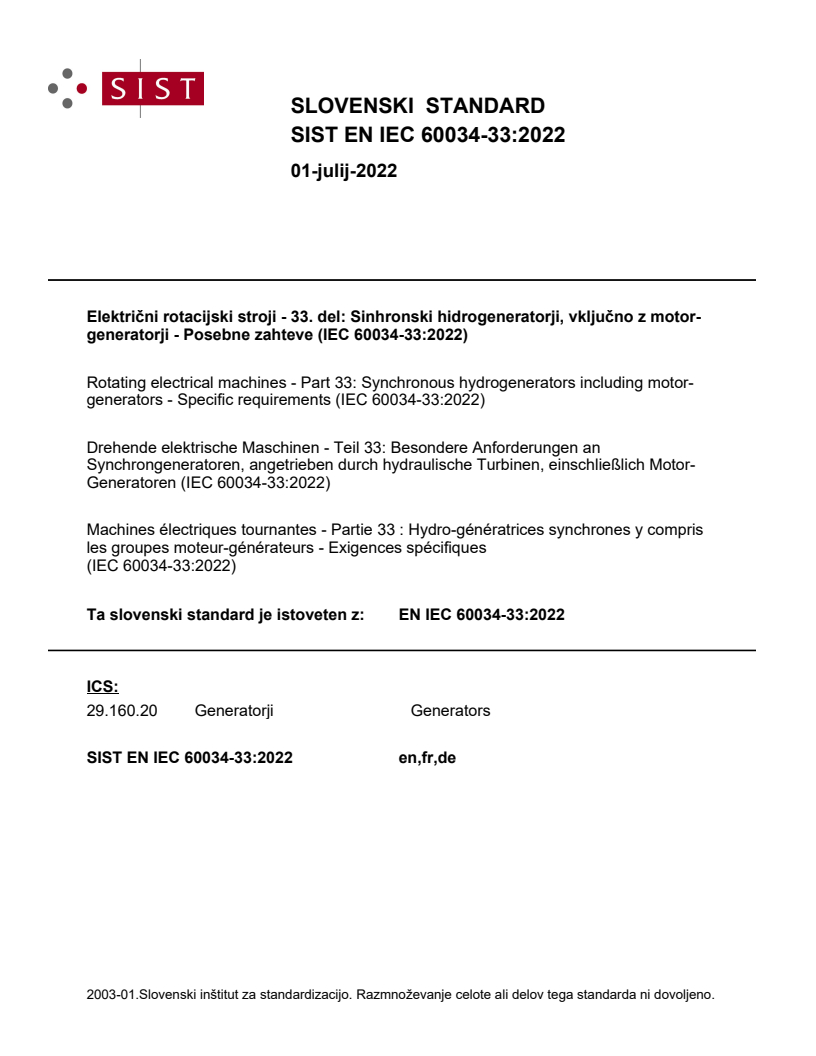
SLOVENSKI STANDARD
01-julij-2022
Električni rotacijski stroji - 33. del: Sinhronski hidrogeneratorji, vključno z motor-
generatorji - Posebne zahteve (IEC 60034-33:2022)
Rotating electrical machines - Part 33: Synchronous hydrogenerators including motor-
generators - Specific requirements (IEC 60034-33:2022)
Drehende elektrische Maschinen - Teil 33: Besondere Anforderungen an
Synchrongeneratoren, angetrieben durch hydraulische Turbinen, einschließlich Motor-
Generatoren (IEC 60034-33:2022)
Machines électriques tournantes - Partie 33 : Hydro-génératrices synchrones y compris
les groupes moteur-générateurs - Exigences spécifiques
(IEC 60034-33:2022)
Ta slovenski standard je istoveten z: EN IEC 60034-33:2022
ICS:
29.160.20 Generatorji Generators
2003-01.Slovenski inštitut za standardizacijo. Razmnoževanje celote ali delov tega standarda ni dovoljeno.
EUROPEAN STANDARD EN IEC 60034-33
NORME EUROPÉENNE
EUROPÄISCHE NORM March 2022
ICS 29.160.01; 29.160.20
English Version
Rotating electrical machines - Part 33: Synchronous
hydrogenerators including motor-generators - Specific
requirements
(IEC 60034-33:2022)
Machines électriques tournantes - Partie 33 : Hydro- Drehende elektrische Maschinen - Teil 33: Besondere
génératrices synchrones y compris les groupes moteur- Anforderungen an Synchrongeneratoren, angetrieben durch
générateurs - Exigences spécifiques hydraulische Turbinen, einschließlich Motor-Generatoren
(IEC 60034-33:2022) (IEC 60034-33:2022)
This European Standard was approved by CENELEC on 2022-03-04. CENELEC members are bound to comply with the CEN/CENELEC
Internal Regulations which stipulate the conditions for giving this European Standard the status of a national standard without any alteration.
Up-to-date lists and bibliographical references concerning such national standards may be obtained on application to the CEN-CENELEC
Management Centre or to any CENELEC member.
This European Standard exists in three official versions (English, French, German). A version in any other language made by translation
under the responsibility of a CENELEC member into its own language and notified to the CEN-CENELEC Management Centre has the
same status as the official versions.
CENELEC members are the national electrotechnical committees of Austria, Belgium, Bulgaria, Croatia, Cyprus, the Czech Republic,
Denmark, Estonia, Finland, France, Germany, Greece, Hungary, Iceland, Ireland, Italy, Latvia, Lithuania, Luxembourg, Malta, the
Netherlands, Norway, Poland, Portugal, Republic of North Macedonia, Romania, Serbia, Slovakia, Slovenia, Spain, Sweden, Switzerland,
Turkey and the United Kingdom.
European Committee for Electrotechnical Standardization
Comité Européen de Normalisation Electrotechnique
Europäisches Komitee für Elektrotechnische Normung
CEN-CENELEC Management Centre: Rue de la Science 23, B-1040 Brussels
© 2022 CENELEC All rights of exploitation in any form and by any means reserved worldwide for CENELEC Members.
Ref. No. EN IEC 60034-33:2022 E
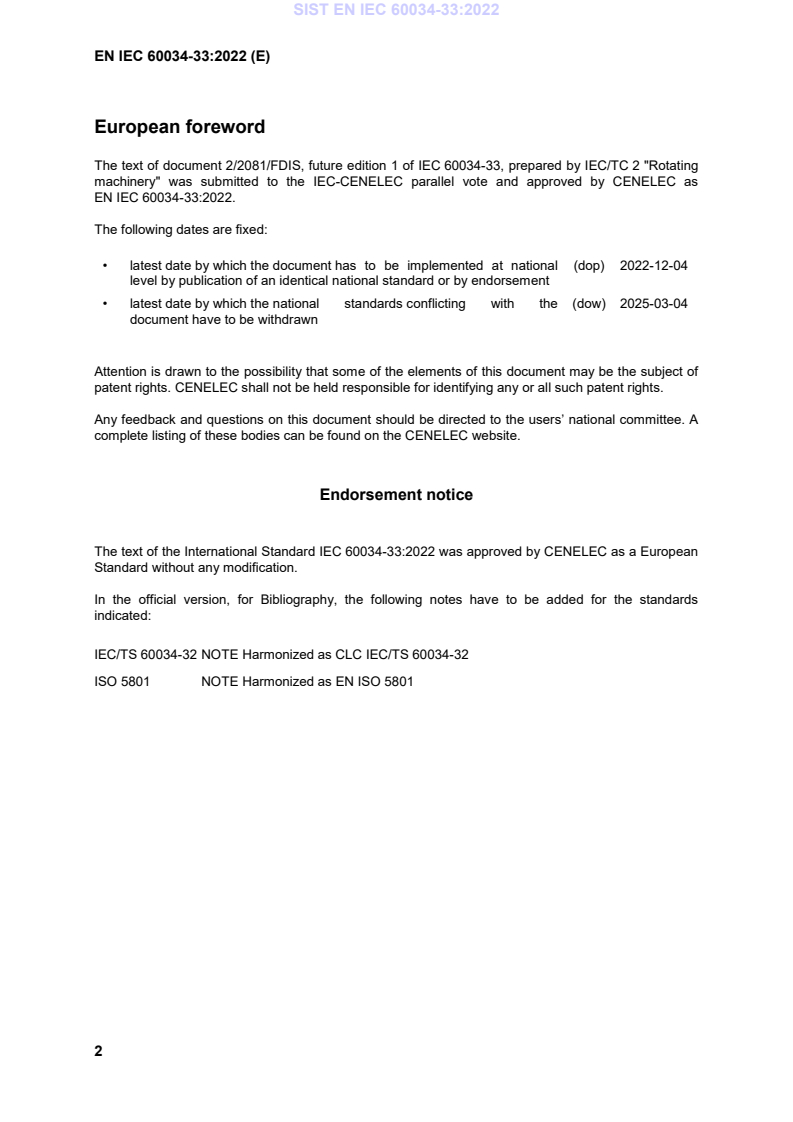
European foreword
The text of document 2/2081/FDIS, future edition 1 of IEC 60034-33, prepared by IEC/TC 2 "Rotating
machinery" was submitted to the IEC-CENELEC parallel vote and approved by CENELEC as
The following dates are fixed:
• latest date by which the document has to be implemented at national (dop) 2022-12-04
level by publication of an identical national standard or by endorsement
• latest date by which the national standards conflicting with the (dow) 2025-03-04
document have to be withdrawn
Attention is drawn to the possibility that some of the elements of this document may be the subject of
patent rights. CENELEC shall not be held responsible for identifying any or all such patent rights.
Any feedback and questions on this document should be directed to the users’ national committee. A
complete listing of these bodies can be found on the CENELEC website.
Endorsement notice
The text of the International Standard IEC 60034-33:2022 was approved by CENELEC as a European
Standard without any modification.
In the official version, for Bibliography, the following notes have to be added for the standards
indicated:
IEC/TS 60034-32 NOTE Harmonized as CLC IEC/TS 60034-32
ISO 5801 NOTE Harmonized as EN ISO 5801
Annex ZA
(normative)
Normative references to international publications
with their corresponding European publications
The following documents are referred to in the text in such a way that some or all of their content
constitutes requirements of this document. For dated references, only the edition cited applies. For
undated references, the latest edition of the referenced document (including any amendments)
applies.
NOTE 1 Where an International Publication has been modified by common modifications, indicated by (mod), the
relevant EN/HD applies.
NOTE 2 Up-to-date information on the latest versions of the European Standards listed in this annex is available
here: www.cenelec.eu.
Publication Year Title EN/HD Year
IEC 60034-1 - Rotating electrical machines - Part 1: EN 60034-1 -
Rating and performance
IEC 60034-2-1 - Rotating electrical machines - Part 2-1: EN 60034-2-1 -
Standard methods for determining losses
and efficiency from tests (excluding
machines for traction vehicles)
IEC 60034-2-2 - Rotating electrical machines - Part 2-2: EN 60034-2-2 -
Specific methods for determining separate
losses of large machines from tests -
Supplement to IEC 60034-2-1
IEC 60034-4-1 - Rotating electrical machines - Part 4-1: EN IEC 60034-4-1 -
Methods for determining electrically
excited synchronous machine quantities
from tests
IEC 60034-15 - Rotating electrical machines - Part 15: EN 60034-15 -
Impulse voltage withstand levels of form-
wound stator coils for rotating a.c.
machines
IEC 60034-18-1 - Rotating electrical machines - Part 18-1: EN 60034-18-1 -
Functional evaluation of insulation
systems - General guidelines
IEC 60034-18-32 - Rotating electrical machines - Part 18-32: EN IEC 60034-18-32 -
Functional evaluation of insulation
systems - Test procedures for form-wound
windings - Evaluation by electrical
endurance
Under preparation. Stage at the time of publication: FprEN 60034-1 and FprEN 60034-1/prAA.
IEC/TS 60034-18-33 - Rotating electrical machines - Part 18-33: CLC/TS 60034-18-33
Functional evaluation of insulation
systems - Test procedures for form-wound
windings - Multifactor evaluation by
endurance under simultaneous thermal
and electrical stresses
IEC 60034-27-1 - Rotating electrical machines - Part 27-1: EN IEC 60034-27-1 -
Off-line partial discharge measurements
on the winding insulation
IEC 60034-27-3 - Rotating electrical machines - Part 27-3: EN 60034-27-3 -
Dielectric dissipation factor measurement
on stator winding insulation of rotating
electrical machines
IEC 60034-27-4 - Rotating electrical machines - Part 27-4: EN IEC 60034-27-4 -
Measurement of insulation resistance and
polarization index of winding insulation of
rotating electrical machines
IEC 60050-411 - International Electrotechnical Vocabulary - -
(IEV) - Part 411: Rotating machinery
IEC 60060-1 - High-voltage test techniques - Part 1: EN 60060-1 -
General definitions and test requirements
IEC 60085 - Electrical insulation - Thermal evaluation EN 60085 -
and designation
IEC 60287-3-1 - Electric cables - Calculation of the current - -
rating - Part 3-1: Operating conditions -
Site reference conditions
IEC 60417 2002 Graphical symbols for use on equipment - - -
12-month subscription to regularly
updated online database comprising all
graphical symbols published in IEC 60417
IEC 60445 - Basic and safety principles for man- EN IEC 60445 -
machine interface, marking and
identification - Identification of equipment
terminals, conductor terminations and
conductors
IEC 63132-1 - Guidance for installation procedures and EN IEC 63132-1 -
tolerances of hydroelectric machines -
Part 1: General aspects
IEC 63132-2 - Guidance for installation procedures and EN IEC 63132-2 -
tolerances of hydroelectric machines -
Part 2: Vertical generators
ISO 20816-1 - Mechanical vibration - Measurement and - -
evaluation of machine vibration - Part 1:
General guidelines
ISO 20816-5 - Mechanical vibration - Measurement and - -
evaluation of machine vibration - Part 5:
Machine sets in hydraulic power
generating and pump-storage plants
- - Earthing of power installations exceeding EN 50522 2010
1 kV a.c.
TM
IEEE Std 1043 1996 IEEE Recommended practice for voltage- - -
endurance testing of form-wound bars and
coils
TM
IEEE Std 1310 2012 IEEE Recommended practice for thermal - -
cycle for voltage-endurance testing of
form-wound bars and coils for large
rotating machines
TM
IEEE Std 1553 2002 IEEE Trial-use standard for voltage- - -
endurance testing of form-wound coils
and bars for hydrogenerators
IEC 60034-33 ®
Edition 1.0 2022-01
INTERNATIONAL
STANDARD
NORME
INTERNATIONALE
Rotating electrical machines –
Part 33: Synchronous hydrogenerators including motor-generators – Specific
requirements
Machines électriques tournantes –
Partie 33: Hydro-génératrices synchrones y compris les groupes moteur-
générateurs – Exigences spécifiques
INTERNATIONAL
ELECTROTECHNICAL
COMMISSION
COMMISSION
ELECTROTECHNIQUE
INTERNATIONALE
ICS 29.160.01; 29.160.20 ISBN 978-2-8322-1071-2
– 2 – IEC 60034-33:2022 © IEC 2022
CONTENTS
FOREWORD . 6
1 Scope . 8
2 Normative references . 8
3 Terms and definitions . 9
4 Site operation conditions . 11
5 Ratings and parameters. 11
5.1 Output. 11
5.1.1 Output rating of a hydrogenerator . 11
5.1.2 Output ratings of a motor-generator . 11
5.1.3 Increase in active power . 11
5.1.4 Under-excited operation . 11
5.2 Rated voltage . 12
5.3 Rated power factor. 12
5.4 Rated speed . 12
5.5 P-Q capability diagram . 12
5.6 Voltage and frequency variations during operation . 13
5.7 Efficiency and losses . 15
5.7.1 Weighted average efficiency . 15
5.7.2 Losses . 15
5.7.3 Determination of winding losses . 16
5.7.4 Windage Losses . 16
5.7.5 Determination of thrust bearing losses for vertical machines . 16
5.7.6 Tolerance of the total losses . 17
5.8 Electrical parameters and time constants . 17
5.8.1 Short-circuit ratio . 17
5.8.2 Direct axis transient and subtransient reactances . 17
5.8.3 General case . 18
5.9 Tolerances on reactance . 18
5.10 Total harmonic distortion (THD) . 18
5.11 Torques . 18
6 Temperature . 18
6.1 Temperature rise . 18
6.2 Measurements for the stator winding . 19
6.3 Measurements for the stator core . 20
6.4 Correction due to deviation from reference operation . 20
6.5 Bearing temperature . 21
7 Operating performances and electrical connections . 21
7.1 Special operational requirements . 21
7.1.1 Stator overload current . 21
7.1.2 Rotor overload current . 21
7.1.3 Continuous unbalanced load . 21
7.1.4 Short time unbalanced load . 22
7.1.5 Mechanical output overload . 22
7.1.6 Sudden short circuit . 22
7.2 Connection to grid . 23
7.2.1 Synchronization . 23
IEC 60034-33:2022 © IEC 2022 – 3 –
7.2.2 Application of load . 23
7.3 Starting of motor-generator . 23
7.4 System earthing . 24
7.5 Neutral point leads . 25
7.6 Rotating direction and phase sequence . 25
7.7 Stator winding . 25
8 Winding insulation . 25
8.1 Winding insulation performance . 25
8.1.1 General . 25
8.1.2 Winding insulation resistance . 25
8.1.3 Dielectric dissipation factor measurements on new stator bars or coils . 26
8.1.4 Partial discharge measurements for stator winding . 27
8.1.5 Voltage withstand test for turn insulation of multi-turn coil for stator. 27
8.2 Voltage withstand tests . 27
8.2.1 Stator bars/coils . 27
8.2.2 Inserted stator bars/coils . 27
8.2.3 Stator winding completed before rotor inserted . 27
8.2.4 Field winding before delivery . 27
8.2.5 Field winding completed . 28
8.2.6 Stator winding for completed machine . 28
8.2.7 Field winding for completed machine . 28
8.2.8 DC alternative tests . 28
8.2.9 Global VPI stators . 28
8.3 Breakdown test for insulation . 28
8.4 Voltage endurance test for insulation . 29
8.5 Thermal cycle test . 30
8.6 Stator winding terminals . 30
9 Mechanical performances and design . 30
9.1 Rotating part mass moment of inertia . 30
9.2 Maximum speed . 30
9.3 Structural strength . 30
9.4 Critical bending speed . 31
9.5 Start and stop of motor-generators . 31
9.6 Start and stop of hydrogenerators . 31
9.7 Over speed . 31
9.8 Fatigue verification . 32
10 Core vibration . 32
11 Noise . 32
12 Basic structural requirements . 34
12.1 General layout . 34
12.1.1 Structure and general layout of the machines . 34
12.1.2 Machine components . 34
12.1.3 Hydraulic or pneumatic braking system . 34
12.1.4 Hydraulic jacking system . 34
12.1.5 Dynamical (electrical) braking . 34
12.2 Stator . 34
12.2.1 Frame and core structure . 34
12.2.2 Stator frame connecting structure . 35
– 4 – IEC 60034-33:2022 © IEC 2022
12.2.3 Stator end winding . 35
12.3 Rotor . 35
12.3.1 Damper winding . 35
12.3.2 Structure with one shaft or segmented shafts . 35
12.4 Structure tolerance . 35
12.5 Bearings . 35
12.5.1 Bearing alloy . 35
12.5.2 Bearing lubricant . 35
12.5.3 Shaft currents . 35
12.5.4 Bearing insulation resistance . 36
13 Ventilation and cooling system . 36
13.1 Cooling scheme . 36
13.1.1 General . 36
13.1.2 Air cooling system . 36
13.1.3 Evaporative cooling system . 36
13.1.4 Water cooling system . 36
13.2 Redundancy on the design of coolers and motor fans . 37
13.3 Cooling structure . 37
13.3.1 Materials . 37
13.3.2 Water supply and drainage . 37
13.3.3 Cooling water pressure . 37
14 Instrumentation required for protection and control . 37
14.1 General . 37
14.2 Stator and bearing temperature. 37
14.3 Bearing vibration and shaft displacement . 38
15 Condition monitoring of machines . 38
15.1 General . 38
15.2 Instrumentation required for condition monitoring . 39
16 Marking . 39
16.1 Information to be marked on machine nameplate: . 39
16.2 Repaired or refurbished machines. 40
17 Factory and site tests . 40
Annex A (informative) Special tools . 41
Annex B (informative) Correction of measured windage losses on the machines . 42
Annex C (informative) Correction of measured bearing losses for different oil bath
temperatures . 45
Annex D (informative) Scope of supply . 47
Annex E (informative) Test run and guaranteed period . 48
E.1 72 h test run . 48
E.2 15~30-day examination test run for motor-generators . 48
E.3 Handover and guarantee period . 48
Annex F (informative) Test items . 49
F.1 Inspection test for hydrogenerator and motor-generator in factory . 49
F.2 Site routine test of hydrogenerator and motor-generator . 49
F.3 Startup test run of hydrogenerator and motor-generator . 50
F.4 Performance test of hydrogenerator . 50
Annex G (informative) Condition monitoring . 51
G.1 Air gap distance . 51
IEC 60034-33:2022 © IEC 2022 – 5 –
G.2 Core and frame vibration . 51
G.3 Stator end winding vibration . 51
G.4 Partial discharge . 51
G.5 Air gap magnetic flux . 52
G.6 Others. 52
Bibliography . 53
Figure 1 – P-Q capability in p.u. . 13
Figure 2 – Voltage and frequency limits for hydro machines . 14
Figure 3 – Location of measuring points in the horizontal plane . 33
Table 1 – Preferred speed for 50 Hz machines . 12
Table 2 – Preferred speed for 60 Hz machines . 12
Table 3 – Reference temperature . 16
Table 4 – Temperature rise limits . 19
Table 5 – Permitted overload current multiple vs. time duration . 21
Table 6 – Permitted negative phase sequence current for the machines . 22
Table 7 – Permitted negative phase sequence current for the machines . 22
Table 8 – Material properties for grounding connectors . 24
Table 9 – Test voltage for insulating resistance measurement . 26
Table 10 – Dielectric dissipation factor. 26
Table 11 – Testing values for voltage withstand test of field winding . 28
Table 12 – Test voltage and time limits . 29
Table 13 – Limits for vibration in the core . 32
Table 14 – Temperature sensor locations . 38
Table A.1 – Special tools . 41
– 6 – IEC 60034-33:2022 © IEC 2022
INTERNATIONAL ELECTROTECHNICAL COMMISSION
____________
ROTATING ELECTRICAL MACHINES –
Part 33: Synchronous hydrogenerators including motor-generators –
Specific requirements
FOREWORD
1) The International Electrotechnical Commission (IEC) is a worldwide organization for standardization comprising
all national electrotechnical committees (IEC National Committees). The object of IEC is to promote international
co-operation on all questions concerning standardization in the electrical and electronic fields. To this end and
in addition to other activities, IEC publishes International Standards, Technical Specifications, Technical Reports,
Publicly Available Specifications (PAS) and Guides (hereafter referred to as “IEC Publication(s)”). Their
preparation is entrusted to technical committees; any IEC National Committee interested in the subject dealt with
may participate in this preparatory work. International, governmental and non-governmental organizations liaising
with the IEC also participate in this preparation. IEC collaborates closely with the International Organization for
Standardization (ISO) in accordance with conditions determined by agreement between the two organizations.
2) The formal decisions or agreements of IEC on technical matters express, as nearly as possible, an international
consensus of opinion on the relevant subjects since each technical committee has representation from all
interested IEC National Committees.
3) IEC Publications have the form of recommendations for international use and are accepted by IEC National
Committees in that sense. While all reasonable efforts are made to ensure that the technical content of IEC
Publications is accurate, IEC cannot be held responsible for the way in which they are used or for any
misinterpretation by any end user.
4) In order to promote international uniformity, IEC National Committees undertake to apply IEC Publications
transparently to the maximum extent possible in their national and regional publications. Any divergence between
any IEC Publication and the corresponding national or regional publication shall be clearly indicated in the latter.
5) IEC itself does not provide any attestation of conformity. Independent certification bodies provide conformity
assessment services and, in some areas, access to IEC marks of conformity. IEC is not responsible for any
services carried out by independent certification bodies.
6) All users should ensure that they have the latest edition of this publication.
7) No liability shall attach to IEC or its directors, employees, servants or agents including individual experts and
members of its technical committees and IEC National Committees for any personal injury, property damage or
other damage of any nature whatsoever, whether direct or indirect, or for costs (including legal fees) and
expenses arising out of the publication, use of, or reliance upon, this IEC Publication or any other IEC
Publications.
8) Attention is drawn to the Normative references cited in this publication. Use of the referenced publications is
indispensable for the correct application of this publication.
9) Attention is drawn to the possibility that some of the elements of this IEC Publication may be the subject of patent
rights. IEC shall not be held responsible for identifying any or all such patent rights.
IEC 60034-33 has been prepared by IEC technical committee 2: Rotating machinery. It is an
International Standard.
The text of this International Standard is based on the following documents:
Draft Report on voting
2/2081/FDIS 2/2088/RVD
Full information on the voting for its approval can be found in the report on voting indicated in
the above table.
The language used for the development of this International Standard is English.
IEC 60034-33:2022 © IEC 2022 – 7 –
This document was drafted in accordance with ISO/IEC Directives, Part 2, and developed in
accordance with ISO/IEC Directives, Part 1 and ISO/IEC Directives, IEC Supplement, available
at www.iec.ch/members_experts/refdocs. The main document types developed by IEC are
described in greater detail at www.iec.ch/standardsdev/publications.
A list of all parts in the IEC 60034 series, published under the general title Rotating electrical
machines, can be found on the IEC website.
The committee has decided that the contents of this document will remain unchanged until the
stability date indicated on the IEC website under webstore.iec.ch in the data related to the
specific document. At this date, the document will be
• reconfirmed,
• withdrawn,
• replaced by a revised edition, or
• amended.
– 8 – IEC 60034-33:2022 © IEC 2022
ROTATING ELECTRICAL MACHINES –
Part 33: Synchronous hydrogenerators including motor-generators –
Specific requirements
1 Scope
This part of IEC 60034 applies to three-phase salient-pole synchronous generators and
synchronous motor-generators for hydraulic turbine and pump-turbine applications, that have
rated frequency of 50 Hz or 60 Hz, rated output of 10 MVA and above, pole pair number 3 and
above, and rated voltage of 6 kV and above.
This document supplements basic requirements for rotating machines given in IEC 60034-1.
2 Normative references
The following documents are referred to in the text in such a way that some or all of their content
constitutes requirements of this document. For dated references, only the edition cited applies.
For undated references, the latest edition of the referenced document (including any
amendments) applies.
IEC 60034-1, Rotating electrical machines – Part 1: Rating and performance
IEC 60034-2-1, Rotating electrical machines – Part 2-1: Standard methods for determining
losses and efficiency from tests (excluding machines for traction vehicles)
IEC 60034-2-2, Rotating electrical machines – Part 2-2: Specific methods for determining
separate losses of large machines from tests – Supplement to IEC 60034-2-1
IEC 60034-4-1, Rotating electrical machines – Part 4-1: Methods for determining electrically
excited synchronous machine quantities from tests
IEC 60034-15, Rotating electrical machines – Part 15: Impulse voltage withstand levels of form-
wound stator coils for rotating a.c. machines
IEC 60034-18-1, Rotating electrical machines – Part 18-1: Functional evaluation of insulation
systems – General guidelines
IEC 60034-18-32, Rotating electrical machines – Part 18-32: Functional evaluation of insulation
systems – Test procedures for form-wound windings – Evaluation by electrical endurance
IEC TS 60034-18-33, Rotating electrical machines – Part 18-33: Functional evaluation of
insulation systems – Test procedures for form-wound windings – Multifactor evaluation by
endurance under simultaneous thermal and electrical stresses
IEC 60034-27-1, Rotating electrical machines – Part 27-1: Off-line partial discharge
measurements on the winding insulation
IEC 60034-27-3, Rotating electrical machines – Part 27-3: Dielectric dissipation factor
measurement on stator winding insulation of rotating electrical machines
IEC 60034-33:2022 © IEC 2022 – 9 –
IEC 60034-27-4, Rotating electrical machines – Part 27-4: Measurement of insulation
resistance and polarization index of winding insulation of rotating electrical machines
IEC 60050-411, International Electrotechnical Vocabulary (IEV) – Part 411: Rotating machinery
IEC 60060-1, High-voltage test techniques – Part 1: General definitions and test requirements
IEC 60085, Electrical insulation – Thermal evaluation and designation
IEC 60287-3-1, Electric cables – Calculation of the current rating – Part 3-1: Operating
conditions – Site reference conditions
IEC 60417:2002, Graphical symbols for use on equipment – 12-month subscription to regularly
updated online database comprising all graphical symbols published in IEC 60417
IEC 60445, Basic and safety principles for man-machine interface, marking and identification –
Identification of equipment terminals, conductor terminations and conductors
IEC 63132-1, Guidance for installation procedures and tolerances of hydroelectric machines –
Part 1: General aspects
IEC 63132-2, Guidance for installation procedures and tolerances of hydroelectric machines –
Part 2: Vertical generators
ISO 20816-1, Mechanical vibration – Measurement and evaluation of machine vibration – Part 1:
General guidelines
ISO 20816-5, Mechanical vibration – Measurement and evaluation of machine vibration – Part 5:
Machine sets in hydraulic power generating and pump-storage plants
EN 50522:2010, Earthing of power installations exceeding 1 kV a.c.
IEEE Std 1043™:1996, IEEE Recommended practice for voltage-endurance testing of form-
wound bars and coils
IEEE Std 1310™:2012, IEEE Recommended practice for thermal cycle for voltage-endurance
testing of form-wound bars and coils for large rotating machines
IEEE Std 1553™:2002, IEEE Trial-use standard for voltage-endurance testing of form-wound
coils and bars for hydrogenerators
3 Terms and definitions
For the purposes of this document, the terms and definitions given in IEC 60034-1,
IEC 60034‑2-1, IEC 60034-2-2, IEC 60050-411 and IEC 63132-1, as well as the following apply.
3.1
hydrogenerator
synchronous machine operated as generator and driven by a hydraulic turbine
3.2
motor-generator
synchronous machine which can operate in motor mode and generator mode, generally used in
pumped-storage power plant
– 10 – IEC 60034-33:2022 © IEC 2022
3.3
stator concentricity
radial distance from the reference centre to the best centre of stator bore
3.4
rotor concentricity
radial distance from the reference centre to the best centre of rotor outer circle
3.5
stator circularity
difference between the maximum and minimum radii, measured from the best centre of stator
bore
3.6
rotor circularity
difference between the maximum and minimum radii, measured from the best centre of rotor
outer circle
3.7
Air gap
3.7.1
nominal air gap
design air gap value between stator inner surface and rotor at the centre of poleshoe at rated
conditions
3.7.2
static air gap
air gap at standstill and in cold condition after full load rejection
Note 1 to entry: This value is used for the purposes of IEC 63132-1 and IEC 63132-2.
3.8
stress control coating
paint or tape on the surface of the main insulation that extends beyond the conductive slot
portion coating in high-voltage stator bars and coils
3.9
condenser
heat exchanger device by which cooling medium is changed to liquid phase from vapour in
evaporative cooling circulation system
3.10
grid
public electrical network or a local (e.g. industrial) network which is connected to the machine
either directly or through a transformer
3.11
SFC starting
operating mode in which synchronous machine is started in motor mode by the method of
regulating power frequency, using static frequency converter (SFC) as variable-frequency
power supply
3.12
back to back starting
synchronous starting method in which one machine is started in motor mode, driven by the
other electric connected machine that is started in generator mode
IEC 60034-33:2022 © IEC 2022 – 11 –
4 Site operation conditions
The machines shall be able to operate continuously at rated conditions (MVA, MW, voltage,
frequency and power factor) at the following site operation conditions:
a) The altitude does not exceed 1 000 m above sea level (based on coupling elevation for
vertical machine, centre line of shaft for horizontal machine);
b) The cooling air temperature (primary coolant) does not exceed 40 °C;
c) The inlet water temperature (secondary coolant) of air coolers, oil coolers and heat
exchangers (e.g. of direct water cooled stator windings) is not higher than 25 °C and not
less than 5 °C;
d) The inlet water temperature (primary coolant) of direct water cooled stator windings shall be
30 °C to 40 °C, the water conductivity is in the range of 0,4 μS/cm to 2,0 μS/cm, the pH
value is 6,5 to 9,0, and the hardness is less than 2 μmol/l, at 25 °C of water temperature;
e) Relative humidity in powerhouse (generator floor) does not exceed 85 %;
f) Installed in covered powerhouse on proper foundation;
g) Structural strength of machine shall meet the requirement of seismic accelerations at the
location. Appropriate design measures shall be taken to prevent harmful damage to the
machine. The acceleration value may be different for different regions due to the local
geographical condition. The acceleration values in horizontal direction and vertical direction
shall be defined as a technical condition according to the seismic grade at the location by
the purchaser.
Site conditions different from the above shall be agreed between purchaser and manufacturer.
5 Ratings and parameters
5.1 Output
5.1.1 Output rating of a hydrogenerator
The output rating of a hydrogenerator is the apparent power (in MVA) or the active power (in
MW), available continuously at the stator terminals (main leads) at rated frequency, voltage and
power factor.
5.1.2 Output ratings of a motor-generator
The output ratings of a motor-generator include two parts:
a) The apparent power (in MVA) or the active power (in MW), available continuously at the
stator terminals (main leads) at rated frequency, v
...