


EN IEC 60947-5-3:2026
(Main)Low-voltage switchgear and controlgear - Part 5-3: Control circuit devices and switching elements - Requirements for proximity devices with defined behaviour under fault conditions (PDDB)
General Information
- Abstract
- Status
- Not Published
- Publication Date
- 01-Oct-2026
- Technical Committee
- CLC/TC 121A - Low-voltage switchgear and controlgear
- Drafting Committee
- IEC/SC 121A - Low-voltage switchgear and controlgear
- Current Stage
- 5060 - Voting results sent to TC, SR - Formal Approval
- Start Date
- 20-Mar-2026
- Completion Date
- 20-Mar-2026

Overview
EN IEC 60947-5-3:2026 is a harmonized international standard developed by CLC and IEC under the series for low-voltage switchgear and controlgear. This part specifically addresses control circuit devices and switching elements, focusing on proximity devices with defined behaviour under fault conditions (PDDBs). PDDBs are critical for safety and control in industrial automation, as they are designed to react in a predetermined and reliable way when faults occur, thereby supporting overall system safety integrity.
EN IEC 60947-5-3:2026 sets out detailed requirements for the design, construction, marking, testing, and documentation of proximity devices. The standard ensures these devices deliver dependable operation both during normal functioning and under various fault scenarios - essential for the safe operation of machinery and automated systems.
Key Topics
- Classification and Types: The standard defines multiple classes of PDDBs based on sensing means, method of connection, construction, output types, operating mode, and compliance with safety classifications from related ISO standards.
- Performance under Fault Conditions: EN IEC 60947-5-3:2026 addresses the predefined responses of proximity devices in the presence of faults, including safe-state requirements and diagnostic capabilities.
- Functional Safety Integration: The document aligns with functional safety standards such as ISO 13849-1 and introduces device types, coding levels, and safety-related switching distances to ensure systematic risk reduction.
- Product Information and Marking: Requirements for clear marking, product identification, and user information (including installation, operation, and maintenance instructions) are covered to support traceability and compliance.
- Testing and Verification: Comprehensive test protocols are stipulated for type, routine, and sampling tests, including verification of switching distances, electromagnetic compatibility (EMC), performance under environmental stress, and safety-related timing.
- Environmental and Constructional Requirements: The standard includes guidelines for environmental considerations, materials selection, electromagnetic immunity, and robust mechanical construction for reliable operation.
Applications
Proximity devices with defined behaviour under fault conditions are widely used in:
- Industrial Automation and Robotics: For position sensing, safeguarding zones, and automatic shutdowns in case of faults.
- Machine Safety Systems: As part of safety interlocks and emergency-stop chains to prevent hazardous situations when errors occur.
- Process Control Environments: Ensuring reliable sensing and actuating functions even in harsh and safety-critical conditions.
- Automated Manufacturing: Where predictable response to sensor or switch faults is essential to minimize downtime and avoid process interruptions.
- Functional Safety Systems: As components in systems requiring high integrity and compliance with international safety standards.
By mandating defined fault behaviour, the standard facilitates easier integration of PDDBs into safety-related control systems and simplifies the validation of complex automation solutions.
Related Standards
EN IEC 60947-5-3:2026 is closely related to and should be used in conjunction with the following standards:
- EN IEC 60947-1: Low-voltage switchgear and controlgear - General rules.
- EN IEC 60947-5-2: Control circuit devices and switching elements – Proximity switches (covers general proximity switch requirements including EMC).
- ISO 13849-1: Safety of machinery – Functional safety of control systems (providing device type and safety integrity guidance).
- ISO 14119: Safety of machinery – Interlocking devices associated with guards (coding and interlock device types).
- ISO/IEC Guide 98-3:2008 (GUM): Guideline for uncertainty measurement, relevant for switching distance verification.
Practical Value
Adhering to EN IEC 60947-5-3:2026 enables manufacturers, integrators, and operators to ensure proximity switches and similar devices meet stringent safety and quality requirements. This enhances machinery reliability, reduces risk, and supports compliance with legal and industry safety obligations in global markets.
Keywords: EN IEC 60947-5-3:2026, low-voltage switchgear, controlgear, proximity device, PDDB, fault conditions, functional safety, industrial automation, machine safety, control circuit, IEC standards, EMC, reliable sensing.
Relations
- Effective Date
- 22-Sep-2026
- Effective Date
- 22-Sep-2026
- Effective Date
- 22-Sep-2026
- Effective Date
- 22-Sep-2026
- Effective Date
- 22-Sep-2026
- Effective Date
- 22-Sep-2026
- Effective Date
- 22-Sep-2026
- Effective Date
- 22-Sep-2026
- Effective Date
- 22-Sep-2026
- Effective Date
- 22-Sep-2026
- Effective Date
- 22-Sep-2026
- Effective Date
- 22-Sep-2026
- Effective Date
- 22-Sep-2026
- Effective Date
- 22-Sep-2026
- Effective Date
- 22-Sep-2026
Get Certified
Connect with accredited certification bodies for this standard

IMQ S.p.A. (Certification)
Italian electrical product certification.

SLG Prüf- und Zertifizierungs GmbH
German testing and certification body.

UL Solutions
Global safety science company with testing, inspection and certification.
Sponsored listings
Frequently Asked Questions
EN IEC 60947-5-3:2026 is a draft published by CLC. Its full title is "Low-voltage switchgear and controlgear - Part 5-3: Control circuit devices and switching elements - Requirements for proximity devices with defined behaviour under fault conditions (PDDB)". This standard covers: Low-voltage switchgear and controlgear - Part 5-3: Control circuit devices and switching elements - Requirements for proximity devices with defined behaviour under fault conditions (PDDB)
Low-voltage switchgear and controlgear - Part 5-3: Control circuit devices and switching elements - Requirements for proximity devices with defined behaviour under fault conditions (PDDB)
EN IEC 60947-5-3:2026 is classified under the following ICS (International Classification for Standards) categories: 29.130.20 - Low voltage switchgear and controlgear. The ICS classification helps identify the subject area and facilitates finding related standards.
EN IEC 60947-5-3:2026 has the following relationships with other standards: It is inter standard links to EN 60204-1:2018, EN 61000-4-8:2010, EN 61508-2:2010, EN IEC 60730-1:2024, EN IEC 60812:2018, EN 61000-4-4:2012, prEN IEC 60947-1:2026, EN 60068-2-30:2005, EN 60204-1:2018/A1:2025, EN IEC 61000-4-2:2025, EN ISO 13849-1:2023, EN IEC 60947-5-1:2025, EN IEC 60947-5-2:2020, EN IEC 61131-2:2025, EN 61508-3:2010. Understanding these relationships helps ensure you are using the most current and applicable version of the standard.
EN IEC 60947-5-3:2026 is associated with the following European legislation: EU Directives/Regulations: 2006/42/EC; Standardization Mandates: M/396. When a standard is cited in the Official Journal of the European Union, products manufactured in conformity with it benefit from a presumption of conformity with the essential requirements of the corresponding EU directive or regulation.
EN IEC 60947-5-3:2026 is available in PDF format for immediate download after purchase. The document can be added to your cart and obtained through the secure checkout process. Digital delivery ensures instant access to the complete standard document.
Standards Content (Sample)
SLOVENSKI STANDARD
oSIST prEN IEC 60947-5-3:2025
01-april-2025
Nizkonapetostne stikalne in krmilne naprave - 5-3. del: Krmilne naprave in stikalni
elementi - Zahteve za približevalne naprave z določenim obnašanjem ob pogojih
za okvare (PDDB)
Low-voltage switchgear and controlgear - Part 5-3: Control circuit devices and switching
elements - Requirements for proximity devices with defined behaviour under fault
conditions (PDDB)
Niederspannungsschaltgeräte - Teil 5-3: Steuergeräte und Schaltelemente -
Anforderungen für Näherungsschalter mit definiertem Verhalten unter
Fehlerbedingungen (PDDB)
Appareillage à basse tension - Partie 5-3: Appareils et éléments de commutation pour
circuits de commande - Exigences pour dispositifs de détection de proximité à
comportement défini dans des conditions de défaut (PDDB)
Ta slovenski standard je istoveten z: prEN IEC 60947-5-3:2025
ICS:
29.120.40 Stikala Switches
29.130.20 Nizkonapetostne stikalne in Low voltage switchgear and
krmilne naprave controlgear
oSIST prEN IEC 60947-5-3:2025 en
2003-01.Slovenski inštitut za standardizacijo. Razmnoževanje celote ali delov tega standarda ni dovoljeno.
oSIST prEN IEC 60947-5-3:2025
oSIST prEN IEC 60947-5-3:2025
121A/640/CDV
COMMITTEE DRAFT FOR VOTE (CDV)
PROJECT NUMBER:
IEC 60947-5-3 ED3
DATE OF CIRCULATION: CLOSING DATE FOR VOTING:
2025-02-07 2025-05-02
SUPERSEDES DOCUMENTS:
121A/614/CD, 121A/624A/CC
IEC SC 121A : LOW-VOLTAGE SWITCHGEAR AND CONTROLGEAR
SECRETARIAT: SECRETARY:
France Mr Michaël LAHEURTE
OF INTEREST TO THE FOLLOWING COMMITTEES: HORIZONTAL FUNCTION(S):
TC 44,TC 65
ASPECTS CONCERNED:
Electromagnetic Compatibility,Safety
SUBMITTED FOR CENELEC PARALLEL VOTING NOT SUBMITTED FOR CENELEC PARALLEL VOTING
Attention IEC-CENELEC parallel voting
The attention of IEC National Committees, members of CENELEC,
is drawn to the fact that this Committee Draft for Vote (CDV) is
submitted for parallel voting.
The CENELEC members are invited to vote through the CENELEC
online voting system.
This document is still under study and subject to change. It should not be used for reference purposes.
Recipients of this document are invited to submit, with their comments, notification of any relevant patent rights of which they are aware
and to provide supporting documentation.
Recipients of this document are invited to submit, with their comments, notification of any relevant “In Some Countries” clau ses to be
included should this proposal proceed. Recipients are reminded that the CDV stage is the final stage for submitting ISC c lauses. (SEE
AC/22/2007 OR NEW GUIDANCE DOC).
TITLE:
Low-voltage switchgear and controlgear – Part 5-3: Control circuit devices and switching elements –
Requirements for proximity devices with defined behaviour under fault conditions (PDDB)
PROPOSED STABILITY DATE: 2028
NOTE FROM TC/SC OFFICERS:
SC121A officers are supporting the circulation of the CDV for IEC 60947-5-3 ED3; experts are kindly asked to indicate the
line number(s) when commenting
electronic file, to make a copy and to print out the content for the sole purpose of preparing National Committee positions.
You may not copy or "mirror" the file or printed version of the document, or any part of it, for any other purpose without
permission in writing from IEC.
oSIST prEN IEC 60947-5-3:2025
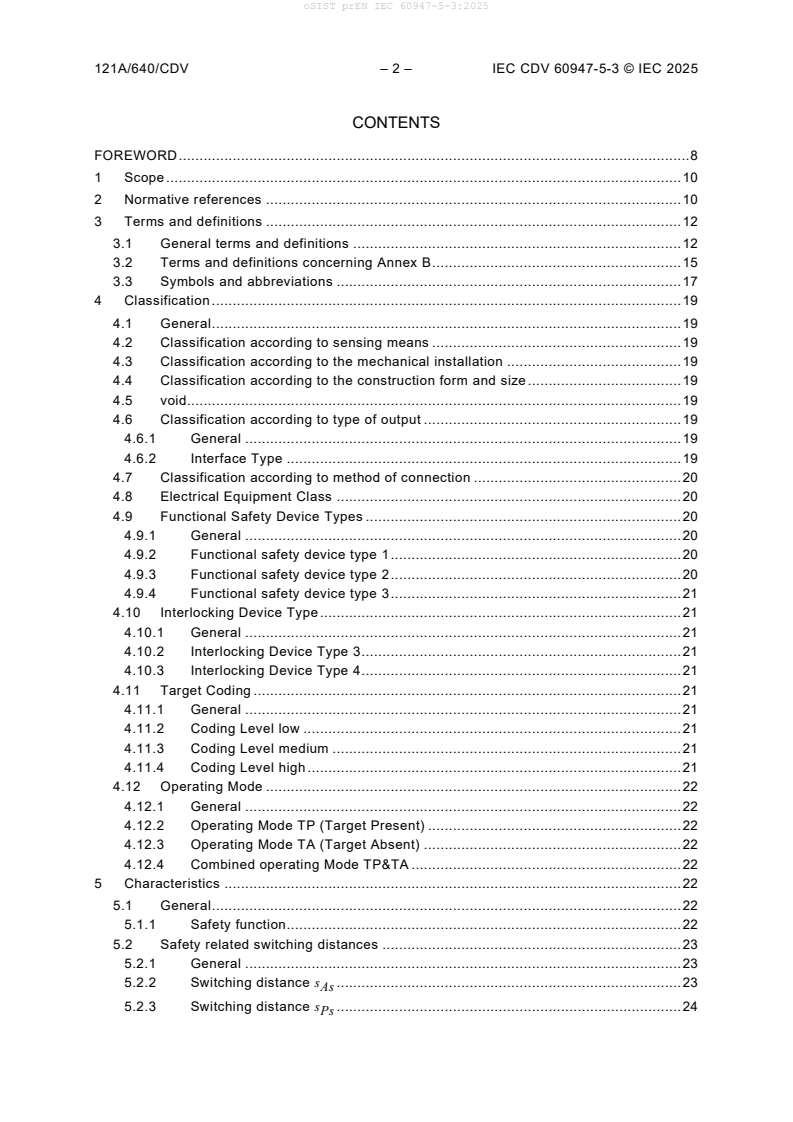
121A/640/CDV – 2 – IEC CDV 60947-5-3 © IEC 2025
CONTENTS
FOREWORD . 8
1 Scope . 10
2 Normative references . 10
3 Terms and definitions . 12
3.1 General terms and definitions . 12
3.2 Terms and definitions concerning Annex B . 15
3.3 Symbols and abbreviations . 17
4 Classification . 19
4.1 General . 19
4.2 Classification according to sensing means . 19
4.3 Classification according to the mechanical installation . 19
4.4 Classification according to the construction form and size . 19
4.5 void. 19
4.6 Classification according to type of output . 19
4.6.1 General . 19
4.6.2 Interface Type . 19
4.7 Classification according to method of connection . 20
4.8 Electrical Equipment Class . 20
4.9 Functional Safety Device Types . 20
4.9.1 General . 20
4.9.2 Functional safety device type 1 . 20
4.9.3 Functional safety device type 2 . 20
4.9.4 Functional safety device type 3 . 21
4.10 Interlocking Device Type . 21
4.10.1 General . 21
4.10.2 Interlocking Device Type 3. 21
4.10.3 Interlocking Device Type 4. 21
4.11 Target Coding . 21
4.11.1 General . 21
4.11.2 Coding Level low . 21
4.11.3 Coding Level medium . 21
4.11.4 Coding Level high . 21
4.12 Operating Mode . 22
4.12.1 General . 22
4.12.2 Operating Mode TP (Target Present) . 22
4.12.3 Operating Mode TA (Target Absent) . 22
4.12.4 Combined operating Mode TP&TA . 22
5 Characteristics . 22
5.1 General . 22
5.1.1 Safety function. 22
5.2 Safety related switching distances . 23
5.2.1 General . 23
5.2.2 Switching distance s . 23
As
5.2.3 Switching distance s . 24
Ps
oSIST prEN IEC 60947-5-3:2025
IEC CDV 60947-5-3 © IEC 2025 – 3 – 121A/640/CDV
5.2.4 Sensing means with operating range . 25
5.3 Rated and limiting values for the proximity switch and switching element(s) . 25
5.3.1 Voltages . 25
5.3.2 Currents . 26
5.3.3 Rated supply frequency . 26
5.3.4 void . 26
5.3.5 Normal load and abnormal load characteristics . 26
5.3.6 Short-circuit characteristics . 26
5.3.7 OFF-state of the OSSD . 27
5.3.8 Interface Type A0, B0, C0, C1, C2, C3 . 27
5.4 Utilization categories for the switching element . 27
5.5 Safety related characteristics . 28
5.5.1 Proximity device with defined behaviour . 28
5.5.2 Safety integrity . 28
5.6 Electrical Equipment Classes . 29
5.6.1 Electrical Equipment Class III . 29
6 Product information . 29
6.1 Nature of information – Identification . 29
6.2 Marking . 30
6.2.1 General . 30
6.2.2 Terminal identification and marking . 30
6.2.3 Marking of Electrical Equipment Class II . 30
6.2.4 Marking of Electrical Equipment Class III . 30
6.3 Instructions for installation, operation, and maintenance . 30
6.3.1 General . 30
6.3.2 Information for PDDB of Electrical Equipment Class III . 31
6.3.3 Diagnostic test information . 31
6.3.4 Information to the interface types . 31
6.4 Environmental information . 32
6.4.1 Environmentally conscious design process (ECD process) . 32
6.4.2 Procedure to establish material declaration . 32
7 Normal service, mounting and transport conditions . 32
7.1 Normal service conditions . 32
7.2 Conditions during transport and storage . 32
7.3 Mounting . 32
8 Constructional and performance requirements . 32
8.1 Constructional requirements . 32
8.1.1 Materials . 32
8.1.2 Current-carrying parts and their connections . 32
8.1.3 Clearance and creepage distances . 32
8.1.4 Actuation . 32
8.1.5 Void . 33
8.1.6 Void . 33
8.1.7 Terminals . 33
8.1.8 Vacant . 33
8.1.9 Provision for protective earthing . 33
8.1.10 Enclosure Degree of Protection . 33
oSIST prEN IEC 60947-5-3:2025
121A/640/CDV – 4 – IEC CDV 60947-5-3 © IEC 2025
8.1.11 Requirements for proximity switches with integrally connected cables . 33
8.1.12 Electrical Equipment Class II . 33
8.1.13 Chemical stress . 33
8.1.14 Equipment design . 34
8.1.15 Protection against artificial optical radiation . 34
8.1.16 Biological and chemical effects . 34
8.1.17 Unattended operation . 34
8.1.18 Software related security . 34
8.1.19 Requirements for embedded software . 34
8.1.20 Requirements for safety related hardware. 34
8.1.21 Limited energy source . 34
8.2 Performance requirements . 37
8.2.1 Operating conditions . 37
8.2.2 Temperature rise . 42
8.2.3 Dielectric properties . 43
8.2.4 Ability to make and break under normal load and abnormal load
conditions . 43
8.2.5 Conditional short-circuit current . 43
8.2.6 Electromagnetic compatibility (EMC) . 43
8.3 Physical dimensions . 46
8.4 Shock and vibration . 46
8.4.1 Shock . 46
8.4.2 Vibration . 47
8.4.3 Results to be obtained . 47
8.4.4 Special environmental condition – damp heat, salt mist, vibration and
shock . 47
8.5 Fault detection requirements . 47
8.5.1 Faults . 47
8.5.2 Diagnostic . 48
8.5.3 Lock-out Condition . 48
8.6 Measures to influence quantities . 48
9 Tests . 49
9.1 Kind of tests . 49
9.1.1 General . 49
9.1.2 Type tests . 49
9.1.3 Routine tests . 49
9.1.4 Sampling tests . 49
9.2 Compliance with constructional requirements . 49
9.2.1 General . 49
9.2.2 Materials . 50
9.2.3 void . 50
9.2.4 Enclosures for equipment . 50
9.2.5 Mechanical and electrical properties of terminals . 50
9.2.6 indication of the main contact position of the device suitable for
isolation . 50
9.2.7 Limited energy source test . 50
9.2.8 Stored charge energy test . 50
oSIST prEN IEC 60947-5-3:2025
IEC CDV 60947-5-3 © IEC 2025 – 5 – 121A/640/CDV
9.2.9 Conduit pull-out test, torque test and bending test with metallic conduits . 50
9.2.10 Test of earth continuity for protective earth . 50
9.2.11 Breakdown of components . 50
9.2.12 Short-circuit and overload protection of ports . 50
9.2.13 void . 50
9.2.14 Wire flexing test . 50
9.2.15 Artificial optical radiation test . 50
9.3 Performances . 51
9.3.1 Test sequences . 51
9.3.2 General test conditions . 52
9.3.3 Performance under no load, normal load and abnormal load conditions . 54
9.3.4 Performances under short-circuit current conditions . 58
9.3.5 Fault insertion tests . 58
9.4 Verification of the safety related switching distances . 59
9.4.1 General . 59
9.4.2 Switching distance test . 59
9.4.3 Acceptance criteria . 60
9.5 Verification of timing . 61
9.5.1 General . 61
9.5.2 Verification of Turn-on time (t ) . 61
on
9.5.3 Verification of Turn-off time (t ) . 61
off
9.6 Verification of electromagnetic compatibility . 62
9.6.1 General . 62
9.6.2 Immunity . 62
9.6.3 Emission . 62
9.7 Test results and test report . 62
9.8 Ambient temperature variation and humidity. 63
9.8.1 General . 63
9.8.2 Temperature variation . 63
9.8.3 Temperature variation and humidity test . 63
9.8.4 Condensing test . 63
Annex A (informative) Example of a safety related control system. 65
A.1 Description . 65
A.1.1 Safety integrity level requirements, Performance level requirements . 65
A.1.2 Conditions of use . 65
A.2 Realization . 66
A.3 Collection of data . 66
A.4 Quantitative Calculation . 67
A.5 Results . 69
Annex B (informative) Classification of Binary Interfaces – Functional Safety aspects
covered by dynamic testing . 70
B.1 General . 70
B.2 Minimum information on compatibility to be provided in the product
documentation . 70
B.2.1 General . 70
B.2.2 Basic electrical parameters . 70
B.2.3 Structure of the identifying key for a PDDB . 70
oSIST prEN IEC 60947-5-3:2025
121A/640/CDV – 6 – IEC CDV 60947-5-3 © IEC 2025
B.3 Characteristics of interface type A0 . 71
B.3.1 General . 71
B.3.2 Static characteristics of interface type A0 . 72
B.3.3 Dynamic characteristics of interface type A0 . 72
B.3.4 Product information to be supplied in the product documentation . 72
B.4 Characteristics of interface type B0 . 73
B.4.1 General . 73
B.4.2 Static characteristics of interface type B0 . 73
B.4.3 Dynamic characteristics of interface type B0 . 73
B.4.4 Product information to be supplied in the product documentation . 75
B.5 Characteristics of interface type C . 75
B.5.1 General . 75
B.5.2 Static characteristics of interface type C . 76
B.5.3 Dynamic characteristics of interface type C . 76
B.5.4 Classification of interface type C. 76
B.5.5 Product information to be supplied in the product documentation . 78
Annex C (informative) Catalogue of single faults affecting the electrical equipment of
the PDDB . 80
C.1 General . 80
C.2 Conductors and connectors . 80
C.3 Switches . 80
C.4 Discrete electrical components . 80
C.5 Solid-state electrical components . 80
Annex D (informative) Void . 81
Annex E (informative) Product Information . 82
E.1 General . 82
Bibliography . 85
Figure 1 – Absent and Present switching distance s and s for a PDDB with
As P
Operating Mode TP (Target Present) . 24
Figure 2 – Absent and Present switching distance s and s for a PDDB with
A Ps
Operating Mode TA (Target Absent) . 25
Figure 3 – Characteristics of the absent switching distance . 37
Figure 4 – Characteristics of the present switching distance . 38
Figure 5 – Voltages and Current Characteristics . 54
Figure 6 – Test circuit diagram for the detection of fault stuck@high . 56
Figure A.1 – Position monitoring of movable guards for the prevention of hazardous
movements . 66
Figure A.2 – Safety-related block diagram of the safety related function . 67
Figure B.1 – Interface type A0 . 71
Figure B.2 – Interface type B0 . 73
Figure B.3 – Test pulse delay ∆t much smaller than test pulse duration t . 74
i i
Figure B.4 – Test pulse delay ∆t greater than test pulse duration t . 74
i i
Figure B.5 – Interface type C . 75
Figure B.6 – Dynamic behaviour interface type C . 78
oSIST prEN IEC 60947-5-3:2025
IEC CDV 60947-5-3 © IEC 2025 – 7 – 121A/640/CDV
Table 1 – Symbols and abbreviations . 17
Table 2 – Interface types of PDDBs . 19
Table 3 – Operating Modes of PDDBs . 22
Table 4 – Static Characteristics of Interface Types A0, B0, C0, C1, C2 and C3 . 27
Table 5 – Dynamic Characteristics of Interface Types A0, B0, C0, C1, C2 and C3 . 27
Table 6 – Characteristic safety values of functional safety device types . 29
Table 7 – Product Information on Interface Types A0, B0, C0, C1, C2 and C3 . 31
Table 8 – Limits for limited energy sources without an overcurrent protective device . 35
Table 9 – Limits for limited energy sources with an overcurrent protective device . 36
Table 10 – Limits for limited energy source with limited current impedance . 36
Table 11 – Characteristics of the absent switching distance . 38
Table 12 – Characteristics of the present switching distance. 38
Table 13 – Operating Voltages of 24 V solid state OSSD . 42
Table 14 – Reaction of PDDB during test . 44
Table 15 – Immunity test requirements for PDDBs . 45
Table 16 – Acceptance criteria for s . 60
Ai
Table 17 – Acceptance criteria for s . 61
Pi
Table A.1 – Collection of safety related reliability . 66
Table B.1 – Basic electrical parameters . 70
Table B.2 – Product information interface type A0 – Source . 72
Table B.3 – Product information interface type A0 – Sink . 72
Table B.4 – Product information interface type B0 – source . 75
Table B.5 – Product information interface type B0 – sink . 75
Table B.6 – Classification for interface type C . 77
Table B.7 – Product information interface type C – Source . 78
Table B.8 – Product information interface type C – Sink . 79
Table E.1 – Product Information . 82
oSIST prEN IEC 60947-5-3:2025
121A/640/CDV – 8 – IEC CDV 60947-5-3 © IEC 2025
INTERNATIONAL ELECTROTECHNICAL COMMISSION
____________
LOW-VOLTAGE SWITCHGEAR AND CONTROLGEAR –
Part 5-3: Control circuit devices and switching elements –
Requirements for proximity devices
with defined behaviour under fault conditions (PDDB)
FOREWORD
1) The International Electrotechnical Commission (IEC) is a worldwide organization for standardization comprising
all national electrotechnical committees (IEC National Committees). The object of IEC is to promote international
co-operation on all questions concerning standardization in the electrical and electronic fields. To this end and
in addition to other activities, IEC publishes International Standards, Technical Specifications, Technical Reports,
Publicly Available Specifications (PAS) and Guides (hereafter referred to as “IEC Publication(s)”). Their
preparation is entrusted to technical committees; any IEC National Committee interested in the subject dealt with
may participate in this preparatory work. International, governmental and non-governmental organizations liaising
with the IEC also participate in this preparation. IEC collaborates closely with the International Organization for
Standardization (ISO) in accordance with conditions determined by agreement between the two organizations.
2) The formal decisions or agreements of IEC on technical matters express, as nearly as possible, an international
consensus of opinion on the relevant subjects since each technical committee has representation from all
interested IEC National Committees.
3) IEC Publications have the form of recommendations for international use and are accepted by IEC National
Committees in that sense. While all reasonable efforts are made to ensure that the technical content of IEC
Publications is accurate, IEC cannot be held responsible for the way in which they are used or for any
misinterpretation by any end user.
4) In order to promote international uniformity, IEC National Committees undertake to apply IEC Publications
transparently to the maximum extent possible in their national and regional publications. Any divergence between
any IEC Publication and the corresponding national or regional publication shall be clearly indicated in the latter.
5) IEC itself does not provide any attestation of conformity. Independent certification bodies provide conformity
assessment services and, in some areas, access to IEC marks of conformity. IEC is not responsible for any
services carried out by independent certification bodies.
6) All users should ensure that they have the latest edition of this publication.
7) No liability shall attach to IEC or its directors, employees, servants or agents including individual experts and
members of its technical committees and IEC National Committees for any personal injury, property damage or
other damage of any nature whatsoever, whether direct or indirect, or for costs (including legal fees) and
expenses arising out of the publication, use of, or reliance upon, this IEC Publication or any other IEC
Publications.
8) Attention is drawn to the Normative references cited in this publication. Use of the referenced publications is
indispensable for the correct application of this publication.
9) Attention is drawn to the possibility that some of the elements of this IEC Publication may be the subject of patent
rights. IEC shall not be held responsible for identifying any or all such patent rights.
International Standard IEC 60947-5-3 has been prepared by subcommittee SC121A:
Low-voltage switchgear and controlgear, of IEC technical committee 121: Switchgear and
controlgear and their assemblies for low voltage.
This third edition includes the following significant technical changes with respect to the
previous edition:
– Update of the scope, refined fault performance aspects and relation to standards of
functional safety.
– The ‘safe state’ is generally determined as ‘OFF-state’ (see 3.1.8).
– Update of EMC requirements in clause 8.2.6 with references to IEC 60947-5-2 for
acceptance criteria A, B and C and requirements of Table 15 for acceptance criterion DS.
– Interface types for binary interfaces are introduced. (See 4.6.2 and Annex B).
oSIST prEN IEC 60947-5-3:2025
IEC CDV 60947-5-3 © IEC 2025 – 9 – 121A/640/CDV
– Functional safety device types according to ISO 13849-1:2022 Annex O (See 4.9).
– Interlocking device type and coding level according to ISO 14119 are adapted (see 4.10 and
4.11).
– The operating modes Target Present (4.12.2) and Target Absent (4.12.3) are introduced.
– The ‘switching distance’ replaces the terms ‘release’ and ‘operating’. The behaviour of the
PDDB is described according to the operating mode (clause 4.12).
– The context and verification of the switching distances are considered according to ISO/IEC
Guide 98-3:2008 (GUM) and IEC TR 6xxxxx:2025 (See 8.2.1.3 and 9.4.2).
– Requirements for electrical equipment class III are refined.
– The risk time is replaced with the safety response time (3.1.11).
– Annex A gives a new example of safety related control system.
– The test sequences (see 9.3.1) are updated for the specific behaviour of a PDDB.
This standard is to be read in conjunction with IEC 60947-1, Low voltage switchgear and
controlgear – Part 1: General rules and IEC 60947-5-2, Low-voltage switchgear and controlgear
– Part 5-2: Control circuit devices and switching elements – Proximity switches. The provisions
of Part 1 and Part 5-2 are only applicable to this standard where specifically called for. The
numbering of the subclauses of this standard is sometimes not continuous because it is based
on the numbering of the subclauses of IEC 60947-1 or IEC 60947-5-2.
The text of this standard is based on the following documents:
FDIS Report on voting
xxx xxx
Full information on the voting for the approval of this standard can be found in the report on
voting indicated in the above table.
This publication has been drafted in accordance with the ISO/IEC Directives, Part 2.
A list of all parts in the IEC 60947 series, published under the general title Low-voltage
switchgear and controlgear, can be found on the IEC website.
The committee has decided that the contents of this publication will remain unchanged until the
stability date indicated on the IEC web site under "http://webstore.iec.ch" in the data related to
the specific publication. At this date, the publication will be
• reconfirmed,
• withdrawn,
• replaced by a revised edition, or
• amended.
oSIST prEN IEC 60947-5-3:2025
121A/640/CDV – 10 – IEC CDV 60947-5-3 © IEC 2025
1 LOW-VOLTAGE SWITCHGEAR AND CONTROLGEAR –
3 Part 5-3: Control circuit devices and switching elements –
4 Requirements for proximity devices
5 with defined behaviour under fault conditions (PDDB)
9 1 Scope
10 This part of IEC 60947 series provides additional requirements to those given in
11 IEC 60947-5-2 and IEC 60947-5-1:2024 Annex D (reed contact magnetic switches). It
12 addresses the fault performance aspects of proximity devices with a defined behaviour under
13 fault conditions (PDDB). It does not address any other characteristics that can be required for
14 specific applications.
15 This document does not apply to protective equipment to directly detect the presence of
16 persons, that are covered by IEC 61496 series or IEC/TS 62998 series.
17 NOTE A PDDB device can be used to detect indirectly the presence of a person, for example by detecting the
18 position of a platform on which the operator stands (example, garbage trucks).
19 This product standard does not specify requirements for the analogue output of PDDB, if any.
20 This product standard does not deal with any specific requirements on acoustic noise as the
21 noise emission of proximity devices is not considered to be a relevant hazard.
22 A PDDB product is intended to be used as sensing subsystem of a safety related control system
23 according to IEC 62061 or ISO 13849-1. Depending on construction principles and complexity,
24 this standard is based on product development of IEC 61508 series in order to meet the product
25 specific requirements of IEC 61508 series, IEC 62061 and/or ISO 13849 series.
26 NOTE The Functional Safety Device Type classification regarding functional safety correlates with IEC 62683-2-3 DB.
27 This standard includes requirements for PDDBs when designed for use as part of an interlocking
28 devices according to ISO 14119.
29 This document does not consider aspects of:
30 – software updates and self-evolving behaviour
31 – explosive atmospheres
32 2 Normative references
33 The following documents are referred to in the text in such a way that some or all of their content
34 constitutes requirements of this document. For dated references, only the edition cited applies.
35 For undated references, the latest edition of the referenced document (including any
36 amendments) applies.
37 IEC 60068-2-1:2007, Environmental testing – Part 2-1: Tests – Test A: Cold
38 IEC 60068-2-30:2005, Environmental testing – Part 2-30: Tests – Test Db: Damp heat, cyclic
39 (12 + 12 h cycle)
oSIST prEN IEC 60947-5-3:2025
IEC CDV 60947-5-3 © IEC 2025 – 11 – 121A/640/CDV
40 IEC 60204-1:2016, Safety of machinery – Electrical equipment of machines – Part 1: General
41 requirements
42 IEC 60529:1989+AMD1:1999+AMD2:2013 CSV, Degrees of protection provided by enclosures
43 (IP Code)
44 IEC 60812:2018, Failure modes and effects analysis (FMEA and FMEDA)
45 IEC 60947-1:2020, Low-voltage switchgear and controlgear – Part 1: General rules
46 IEC 60947-5-1:2016, Low-voltage switchgear and controlgear – Part 5-1: Control circuit devices
47 and switching elements – Electromechanical control circuit devices
48 IEC 60947-5-2:2019, Low-voltage switchgear and controlgear – Part 5-2: Control circuit devices
49 and switching elements – Proximity switches
50 IEC 61000-4-2:2008, Electromagnetic compatibility (EMC) – Part 4-2: Testing and
51 measurement techniques – Electrostatic discharge immunity test
52 IEC 61000-4-3:2020, Electromagnetic compatibility (EMC) – Part 4-3: Testing and
53 measurement techniques – Radiated, radio-frequency, electromagnetic field immunity test
54 IEC 61000-4-4:2012, Electromagnetic compatibility (EMC) – Part 4-4: Testing and
55 measurement techniques – Electrical fast transient/burst immunity test
56 IEC 61000-4-5:2014+AMD1:2017 CSV, Electromagnetic compatibility (EMC) – Part 4-5: Te
...