


FprEN ISO 60721-2-5:2026
(Main)Classification of environmental conditions - Part 2-5: Environmental conditions appearing in nature - Dust, sand, salt mist
General Information
- Abstract
- Status
- Not Published
- Publication Date
- 31-Jan-2027
- Technical Committee
- CLC/SR 104 - Environmental conditions, classification and methods of test
- Drafting Committee
- IEC/TC 104 - IEC_TC_104
- Current Stage
- 5020 - Vote circulated - Formal Approval
- Start Date
- 18-Sep-2026
- Due Date
- 31-Jul-2025
- Completion Date
- 18-Sep-2026

Overview
FprEN ISO 60721-2-5:2026 – Classification of Environmental Conditions – Part 2-5: Environmental conditions appearing in nature – Dust, sand, salt mist is an important international standard developed by CLC, mirroring prEN IEC 60721-2-5. This standard is a key reference for understanding the occurrence, classification, and impacts of environmental conditions such as dust, sand, and salt mist on products during storage, transportation, and use.
The document is essential for industries involved in environmental testing, equipment design, and quality assurance, helping organizations better assess the risk and durability of products exposed to naturally occurring environmental conditions.
Key Topics
Definitions and Classification:
- Dust and sand are defined based on particle size and aerodynamic behavior, with dust being particles smaller than 75 µm and sand larger than 150 µm.
- The standard references methodologies for laboratory simulation and demarcation, such as the use of a No. 100 standard sieve.
Distribution and Severity:
- Describes global distribution of dust and sand, with high-risk areas including deserts, beaches, and dry inland regions.
- Outlines environmental factors influencing severity, such as wind velocity, temperature, humidity, and precipitation.
Measurement Approaches:
- Provides guidance for assessing dust and sand conditions using World Meteorological Organisation (WMO) present weather codes, direct measurements, ground- and satellite-based instruments, and unified dust models.
- Details methods for correlating visibility data with dust concentrations.
Physical Effects on Products:
- Explains how dust, sand, and salt mist can cause abrasion, corrosion, and other deleterious effects on product surfaces and mechanisms.
- Discusses penetration mechanisms, such as through air movement, thermal expansion, and electrostatic attraction.
Salt Mist Considerations:
- Addresses constituents and concentrations of salt mist, typically arising in marine or coastal environments.
- Highlights the risk of accelerated metallic corrosion due to salt deposition.
Applications
FprEN ISO 60721-2-5:2026 finds application in a wide range of sectors, supporting effective environmental testing, product development, and system reliability assessments:
- Electronics and Electrical Equipment: Ensures equipment is designed to withstand abrasion, dust penetration, and corrosion throughout its operational life, especially in outdoor or coastal installations.
- Military and Aerospace: Assists in evaluating the resistance of vehicles, machinery, and sensors to dust storms, sand abrasion, and saline atmospheres.
- Construction and Civil Engineering: Provides guidelines for material selection and building design in environments prone to airborne particulates or salt mist.
- Automotive and Transportation: Helps manufacturers guarantee reliable operation of vehicles in dusty or sandy terrains.
- Industrial and Agricultural Equipment: Supports the development of robust machinery for use in harsh, particulate-laden settings.
Organizations benefit from applying this standard by improving product durability, reducing failure rates, and satisfying regulatory or customer requirements related to environmental fitness.
Related Standards
Professionals working with FprEN ISO 60721-2-5:2026 may also need to reference these associated standards:
- IEC 60721-2-2: Classification of environmental conditions - Environmental conditions appearing in nature - Precipitation and wind
- ISO 9225: Corrosion of metals and alloys - Corrosivity of atmospheres - Measurement of environmental parameters
- IEC 60068 Series: Environmental testing - General methods for environmental simulation and testing
- IEC 60721 Series: Full set of standards for environmental classification, including other parts focusing on different natural and artificial environmental stresses
Adopting FprEN ISO 60721-2-5:2026 supports robust product design, lifecycle planning, and compliance for organizations exposed to the challenges of dust, sand, and salt mist in natural environments.
Relations
- Effective Date
- 18-Oct-2022
Get Certified
Connect with accredited certification bodies for this standard

IMP NDT d.o.o.
Non-destructive testing services. Radiography, ultrasonic, magnetic particle, penetrant, visual inspection.
Inštitut za kovinske materiale in tehnologije
Institute of Metals and Technology. Materials testing, metallurgical analysis, NDT.
Q Techna d.o.o.
NDT and quality assurance specialist. 30+ years experience. NDT personnel certification per ISO 9712, nuclear and thermal power plant inspections, QA/
Sponsored listings
Frequently Asked Questions
FprEN ISO 60721-2-5:2026 is a draft published by CLC. Its full title is "Classification of environmental conditions - Part 2-5: Environmental conditions appearing in nature - Dust, sand, salt mist". This standard covers: Classification of environmental conditions - Part 2-5: Environmental conditions appearing in nature - Dust, sand, salt mist
Classification of environmental conditions - Part 2-5: Environmental conditions appearing in nature - Dust, sand, salt mist
FprEN ISO 60721-2-5:2026 is classified under the following ICS (International Classification for Standards) categories: 19.040 - Environmental testing. The ICS classification helps identify the subject area and facilitates finding related standards.
FprEN ISO 60721-2-5:2026 has the following relationships with other standards: It is inter standard links to HD 478.2.5 S1:1993. Understanding these relationships helps ensure you are using the most current and applicable version of the standard.
FprEN ISO 60721-2-5:2026 is available in PDF format for immediate download after purchase. The document can be added to your cart and obtained through the secure checkout process. Digital delivery ensures instant access to the complete standard document.
Standards Content (Sample)
SLOVENSKI STANDARD
oSIST prEN IEC 60721-2-5:2024
01-februar-2024
Klasifikacija okoljskih pogojev - 2. del: Okoljski pogoji v naravi - 5. odsek : Prah,
pesek, solna meglica
Classification of environmental conditions - Part 2: Environmental conditions appearing
in nature - Section 5: Dust, sand, salt mist
Klassifizierung von Umweltbedingungen - Teil 2: Natürliche Umweltbedingungen -
Hauptabschnitt 5: Staub, Sand, Salznebel
Classification des conditions d'environnement - Partie 2: Conditions d'environnement
présentes dans la nature - Section 5: Poussière, sable, brouillard salin
Ta slovenski standard je istoveten z: prEN IEC 60721-2-5:2023
ICS:
19.040 Preskušanje v zvezi z Environmental testing
okoljem
oSIST prEN IEC 60721-2-5:2024 en
2003-01.Slovenski inštitut za standardizacijo. Razmnoževanje celote ali delov tega standarda ni dovoljeno.
oSIST prEN IEC 60721-2-5:2024
oSIST prEN IEC 60721-2-5:2024
104/1025/CDV
COMMITTEE DRAFT FOR VOTE (CDV)
PROJECT NUMBER:
IEC 60721-2-5 ED2
DATE OF CIRCULATION: CLOSING DATE FOR VOTING:
2023-11-17 2024-02-09
SUPERSEDES DOCUMENTS:
104/979/CD, 104/992A/CC
IEC TC 104 : ENVIRONMENTAL CONDITIONS, CLASSIFICATION AND METHODS OF TEST
SECRETARIAT: SECRETARY:
Sweden Mr Henrik Lagerström
OF INTEREST TO THE FOLLOWING COMMITTEES: PROPOSED HORIZONTAL STANDARD:
Other TC/SCs are requested to indicate their interest, if
any, in this CDV to the secretary.
FUNCTIONS CONCERNED:
EMC ENVIRONMENT QUALITY ASSURANCE SAFETY
SUBMITTED FOR CENELEC PARALLEL VOTING NOT SUBMITTED FOR CENELEC PARALLEL VOTING
Attention IEC-CENELEC parallel voting
The attention of IEC National Committees, members of
CENELEC, is drawn to the fact that this Committee Draft
for Vote (CDV) is submitted for parallel voting.
The CENELEC members are invited to vote through the
CENELEC online voting system.
This document is still under study and subject to change. It should not be used for reference purposes.
Recipients of this document are invited to submit, with their comments, notification of any relevant patent rights
of which they are aware and to provide supporting documentation.
Recipients of this document are invited to submit, with their comments, notification of any relevant “In So me
Countries” clauses to be included should this proposal proceed. Recipients are reminded that the CDV stage is
the final stage for submitting ISC clauses. (SEE AC/22/2007 OR NEW GUIDANCE DOC).
TITLE:
Classification of environmental conditions - Part 2: Environmental conditions appearing in
nature - Section 5: Dust, sand, salt mist
PROPOSED STABILITY DATE: 2028
NOTE FROM TC/SC OFFICERS:
download this electronic file, to make a copy and to print out the content for the sole purpose of preparing National
Committee positions. You may not copy or "mirror" the file or printed version of the document, or any part of it,
for any other purpose without permission in writing from IEC.
oSIST prEN IEC 60721-2-5:2024
IEC CDV 60721-2-5 © IEC 2023 2 104/1025/CDV
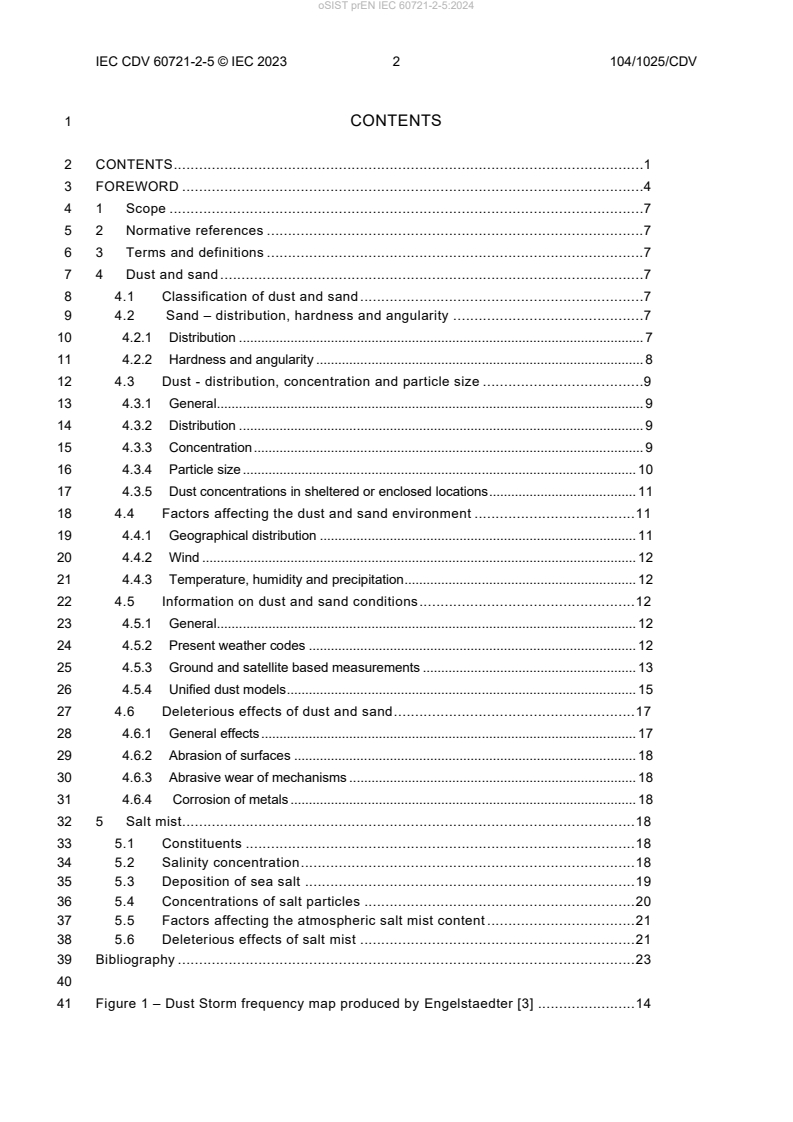
1 CONTENTS
2 CONTENTS .1
3 FOREWORD .4
4 1 Scope .7
5 2 Normative references .7
6 3 Terms and definitions .7
7 4 Dust and sand .7
8 4.1 Classification of dust and sand .7
9 4.2 Sand – distribution, hardness and angularity .7
10 4.2.1 Distribution . 7
11 4.2.2 Hardness and angularity . 8
12 4.3 Dust - distribution, concentration and particle size .9
13 4.3.1 General . 9
14 4.3.2 Distribution . 9
15 4.3.3 Concentration . 9
16 4.3.4 Particle size . 10
17 4.3.5 Dust concentrations in sheltered or enclosed locations . 11
18 4.4 Factors affecting the dust and sand environment . 11
19 4.4.1 Geographical distribution . 11
20 4.4.2 Wind . 12
21 4.4.3 Temperature, humidity and precipitation . 12
22 4.5 Information on dust and sand conditions . 12
23 4.5.1 General . 12
24 4.5.2 Present weather codes . 12
25 4.5.3 Ground and satellite based measurements . 13
26 4.5.4 Unified dust models . 15
27 4.6 Deleterious effects of dust and sand . 17
28 4.6.1 General effects . 17
29 4.6.2 Abrasion of surfaces . 18
30 4.6.3 Abrasive wear of mechanisms . 18
31 4.6.4 Corrosion of metals . 18
32 5 Salt mist . 18
33 5.1 Constituents . 18
34 5.2 Salinity concentration . 18
35 5.3 Deposition of sea salt . 19
36 5.4 Concentrations of salt particles . 20
37 5.5 Factors affecting the atmospheric salt mist content . 21
38 5.6 Deleterious effects of salt mist . 21
39 Bibliography . 23
41 Figure 1 – Dust Storm frequency map produced by Engelstaedter [3] . 14
oSIST prEN IEC 60721-2-5:2024
IEC CDV 60721-2-5 © IEC 2023 3 104/1025/CDV
42 Figure 2 – Average aerosol optical depth developed from satellite measurements [5] 14
43 Figure 3 – Global distribution of seasonal mean aerosol optical depth (blue)
44 over-plotted by dust optical depth (red). [4] . 15
45 Figure 4 – Sea salt distribution over land masses (average salt deposition
46 values over the year) . 19
47 Figure 5 – Sodium chloride deposit (on wet linen) varying with distance
48 from the seashore . 19
50 Table 1 – Hardness scale .7
51 Table 2 – Constituents of natural sands .7
52 Table 3 – Typical dust concentrations in various temperate regions .8
53 Table 4 − Variation of concentration of dust with increasing altitude .9
54 Table 5 – Typical dust concentrations surrounding a tracked vehicle operating
55 over desert terrain .9
56 Table 6 – Variation of particle size distribution with height of dust storm . 10
57 Table 7 – WMO present weather codes relating to duststorms and sandstorms . 12
58 Table 8 – Principal constituents of seawater. 18
59 Table 9 – Main influencing factors of atmospheric salt mist content . 20
oSIST prEN IEC 60721-2-5:2024
IEC CDV 60721-2-5 © IEC 2023 4 104/1025/CDV
62 INTERNATIONAL ELECTROTECHNICAL COMMISSION
63 ____________
65 CLASSIFICATION OF ENVIRONMENTAL CONDITIONS –
67 Part 2-5: Environmental conditions appearing in nature –
68 Dust, sand and salt mist
70 FOREWORD
71 1) The International Electrotechnical Commission (IEC) is a worldwide organization for standardization comprising
72 all national electrotechnical committees (IEC National Committees). The object of IEC is to promote international
73 co-operation on all questions concerning standardization in the electrical and electronic fields. To this end and
74 in addition to other activities, IEC publishes International Standards, Technical Specifications, Technical
75 Reports, Publicly Available Specifications (PAS) and Guides (hereafter referred to as “IEC Publication(s)”). Their
76 preparation is entrusted to technical committees; any IEC National Committee interested in the subject dealt with
77 may participate in this preparatory work. International, governmental and non-governmental organizations
78 liaising with the IEC also participate in this preparation. IEC collaborates closely with the International
79 Organization for Standardization (ISO) in accordance with conditions determined by agreement between the two
80 organizations.
81 2) The formal decisions or agreements of IEC on technical matters express, as nearly as possible, an international
82 consensus of opinion on the relevant subjects since each technical committee has representation from all
83 interested IEC National Committees.
84 3) IEC Publications have the form of recommendations for international use and are accepted by IEC National
85 Committees in that sense. While all reasonable efforts are made to ensure that the technical content of IEC
86 Publications is accurate, IEC cannot be held responsible for the way in which they are used or for any
87 misinterpretation by any end user.
88 4) In order to promote international uniformity, IEC National Committees undertake to apply IEC Publications
89 transparently to the maximum extent possible in their national and regional publications. Any divergence between
90 any IEC Publication and the corresponding national or regional publication shall be clearly indicated in the latter.
91 5) IEC itself does not provide any attestation of conformity. Independent certification b odies provide conformity
92 assessment services and, in some areas, access to IEC marks of conformity. IEC is not responsible for any
93 services carried out by independent certification bodies.
94 6) All users should ensure that they have the latest edition of this publication.
95 7) No liability shall attach to IEC or its directors, employees, servants or agents including individual experts and
96 members of its technical committees and IEC National Committees for any personal injury, property damage or
97 other damage of any nature whatsoever, whether direct or indirect, or for costs (including legal fees) and
98 expenses arising out of the publication, use of, or reliance upon, this IEC Publication or any other IEC
99 Publications.
100 8) Attention is drawn to the Normative references cited in this publication. Use of the referenced publications is
101 indispensable for the correct application of this publication.
102 9) Attention is drawn to the possibility that some of the elements of this IEC Publication may be the subject of
103 patent rights. IEC shall not be held responsible for identifying any or all such patent rights.
104 International Standard IEC 60721-2-5 has been prepared by IEC technical committee 104:
105 Environmental conditions, classification, and methods of test.
106 This second edition cancels and replaces the first edition, published in 1997, and constitutes a
107 technical revision.
108 This edition includes the following significant technical changes with respect to the previous
109 edition:
110 a) The Information provided in previous issue has been extensively enhanced and revised.
111 b) New information on methodologies for deriving dust and sand severities has been
112 included.
oSIST prEN IEC 60721-2-5:2024
IEC CDV 60721-2-5 © IEC 2023 5 104/1025/CDV
113 c) Annex A has been removed because, despite extensive investigation, the source and
114 accuracy of the severities could not be verified. Equivalent information is now provided
115 within the text.
116 The text of this International Standard is based on the following documents:
FDIS Report on voting
xxx xxx
117 Full information on the voting for the approval of this International Standard can be found in
118 the report on voting indicated in the above table.
119 This document has been drafted in accordance with the ISO/IEC Directives, Part 2.
120 A list of all parts in the IEC 60721 series, published under the general title Classification of
121 environmental conditions, can be found on the IEC website.
122 The committee has decided that the contents of this document will remain unchanged until the
123 stability date indicated on the IEC website under "http://webstore.iec.ch" in the data related to
124 the specific document. At this date, the document will be
125 • reconfirmed,
126 • withdrawn,
127 • replaced by a revised edition, or
128 • amended.
IMPORTANT – The 'colour inside' logo on the cover page of this publication indicates that it
contains colours which are considered to be useful for the correct understanding of its
contents. Users should therefore print this document using a colour printer.
oSIST prEN IEC 60721-2-5:2024
IEC CDV 60721-2-5 © IEC 2023 6 104/1025/CDV
131 INTRODUCTION
132 This section of IEC 60721-2 is intended to be used as part of the background information when selecting
133 appropriate severities of parameters relating to dust, sand and salt mist for product application.
134 This document presents information related to the occurrence and characteristics of dust, sand and salt
135 mist. It describes the influences from these environmental factors to which products are liable to be
136 exposed during storage, transportation and use.
137 The effects of dust, sand and salt mist can be enhanced by precipitation and wind. Information related
138 to the occurrence and characteristics of precipitation and wind is provided in IEC 60721-2-2 [1].
oSIST prEN IEC 60721-2-5:2024
IEC CDV 60721-2-5 © IEC 2023 7 104/1025/CDV
140 CLASSIFICATION OF ENVIRONMENTAL CONDITIONS –
141 Part 2-5: Environmental conditions appearing in nature –
142 Dust, sand and salt mist
143 1 Scope
144 This part of IEC 60721 presents information related to the occurrence and characteristics of dust, sand
145 and salt mist. It describes the influences from these environmental factors to which products are liable
146 to be exposed during storage, transportation and use. The effects of dust, sand and salt mist can be
147 enhanced by precipitation and wind.
148 Information related to the occurrence and characteristics of precipitation and wind is provided in
149 IEC 60721-2-2 [1].
150 2 Normative references
151 There are no normative references in this document.
152 3 Terms and definitions
153 No terms and definitions are listed in this document.
154 ISO and IEC maintain terminological databases for use in standardization at the following addresses:
155 IEC Electropedia: available at http://www.electropedia.org/
156 ISO Online browsing platform: available at http://www.iso.org/obp
157 4 Dust and sand
158 4.1 Classification of dust and sand
159 'Dust' and 'Sand' are terms for solid non-cohesive particulate matter, usually of mineral origin, found on
160 the surface of the earth or suspended in the atmosphere. The range of particle diameters of dust and
161 sand together extends from about 0.1 µm to 2 000 µm. The 2 000 µm value is generally considered as
162 the lower limit for very fine pebbles. Conversely, particles below 1 µm are usually termed smoke and
163 fumes. Although dust and sand are normally differentiated on the basis of particle diameters, no
164 universally accepted demarcation value exists.
165 In this document, a classification based on their different aerodynamic behaviour is adopted. Particles
166 of less than 75 µm diameter can remain suspended in the atmosphere by natural turbulence of the air
167 for very long periods, even years. These are termed 'dust' by most authorities. Conversely, those
168 greater than 150 µm diameter are unable to remain airborne unless continually subjected to strong
169 natural winds, powerful air flows or the turbulence which may be caused, for example, by aircraft,
170 helicopter or convoys of land vehicles. These particles are termed 'sand'. Over the intermediate range
171 of diameters from 75 µm to 150 µm, there is a gradual transition in settling times and the particles are
172 variously referred to as 'dust' or 'sand' in different documents.
173 For the purposes of laboratory simulation, the default demarcation value for distinguishing sand from
174 dust is typically 149 µm, which is the diameter of the smallest particles retained by a No 100 standard
175 sieve.
176 4.2 Sand – distribution, hardness and angularity
177 4.2.1 Distribution
178 Sand is distributed widely over the Earth's surface. There are vast sandy regions in the Sahara and in
179 Saudi Arabia as well as significant areas in most the world's deserts. All the continents have sandy
180 beaches of various widths and there are large deposits at or near the surface in mainly inland areas
181 formerly covered by water. On account of this widespread occurrence of sand, it should be assumed
oSIST prEN IEC 60721-2-5:2024
IEC CDV 60721-2-5 © IEC 2023 8 104/1025/CDV
182 that most unprotected products have the potential to be exposed to sandy conditions at some time
183 during their life.
184 4.2.2 Hardness and angularity
185 Hardness of the individual particles can determine their ability to scratch objects upon contact. Sand
186 which consists mainly of tiny broken chips of crystalline quartz or other mineral is generally harder than
187 most fused silica glass compositions. Consequently, sand can scratch the surface of most glass optical
188 devices. Table 1 lists a few common substances and hardness levels according to the Mohs scale.
189 Substances with a higher number can scratch any substance with a lower number.
190 Table 1 -- Hardness scale
Mohs scale Typical materials
1 - Talc Graphite, Soapstone
2 - Gypsum Kaolinite, Alabaster, Mica (muscovite)
3 - Calcite Limestone, Marble
4 - Fluorite -
5 - Apatite Turquoise, Titanite, Hornblende, glass
6 - Orthoclase Magnetite, Feldspar, Opal, Pyrite
7 - Quartz Flint, Fused Silica, Olivine, Andalusite, Agate, Tourmaline
8 - Topaz Emery
9 - Corundum Sapphire, Silicon Carbide, Tungsten Carbide
10 - Diamond -
191 Hardness and angularity are usually the most important characteristics of sand grains. On a world-wide
192 basis, the majority of sands are composed of quartz (SiO2), which, in its most common form, has a
193 hardness of 7 on the Mohs scale. Other minerals which may be found in sand range from hardness 2
194 for white gypsum, to hardness 9 for corundum. Table 2 shows the main constituents of natural dusts
195 and sand, and the relative hardness of the particles. Minute quantities of other minerals such as zircon,
196 garnet, mica, magnetite, etc. may also be found. In addition, particulates resulting from industrial
197 processes, as well as microscopic vegetable and microbiological entities, may be present in dust. On a
198 world-wide basis, the majority of sands are composed of quartz.
199 Table 2 -- Constituents of natural sands
Hardness
Constituent Composition
(Mohs scale)
Quartz SiO2 7
K Al Si O or
3 8
Feldspars Na Al Si3O8 or 6
Ca Al Si O
2 2 8
Limestone Ca CO3 and Mg CO3 2 to 4
200 Although in time, grains of sand become rounded by mutual abrasion; those having angular shape are
201 found in substantial proportion in most samples of sand. The latter arise from the tendency of some
202 rock-forming minerals, particularly quartz, to fracture along cleavage planes through impact action.
203 In general, the movement of sand by wind pressure is confined to the air layer within the first metre
204 above the ground. Even within this layer, about half the sand grains (by weight) move within the first
205 10 mm above the surface and most of the remainder are within the first 100 mm. As a consequence of
206 the low elevation at which the majority of sand grains move, most abrasion damage caused by sand
207 outside high wind periods is at or near ground level.
oSIST prEN IEC 60721-2-5:2024
IEC CDV 60721-2-5 © IEC 2023 9 104/1025/CDV
208 4.3 Dust - distribution, concentration and particle size
209 4.3.1 General
210 The extent to which dust penetrates the atmosphere depends on several factors. The primary
211 requirements for a dust storm include the existence of loose dry soil and a strong wind, whilst a deep
212 layer of convection will favour the upward distribution of the dust. Extreme conditions occur over desert
213 terrain. The critical wind velocity depends on the size and distribution of particles and so is extremely
214 variable from one region to another. Dust storms are more likely by day than by night and are more
215 likely in dry summer months than in rainy winter months.
216 In those regions which are part cultivated land and part desert the wind-blown material is likely to consist
217 of a true mixture of dust and sand, but even in a true sand desert region some dust particles are likely
218 to be present.
219 4.3.2 Distribution
220 In contrast to sand, dust particles can remain suspended in air indefinitely and may settle on surfaces
221 anywhere.
222 In dry conditions, soils with more than 9% by weight of dust particles become at least moderately dusty
223 and those with 14% or more are potentially very dusty. Thus, as over 40% of the land surface of the
224 world, excluding Antarctica, is classified as moisture deficient and a further 40% is seasonally dry, dust
225 should be expected to be present over much of the land surfaces of the world for substantial parts of
226 the year. Even in regions and seasons of heavy rainfall, dust continues to create problems where the
227 protective cover has been broken. Many moist areas are so well drained that most unprotected soil
228 becomes dust in a remarkably short time after heavy rain. There is evidence that dust problems are
229 aggravated by higher atmospheric temperatures, by relative humidities below 30% and by the drying
230 action of winds.
231 4.3.3 Concentration
232 The concentration of dust in the atmosphere varies widely with geographical locality, local climatic
233 conditions and the degree of human activity taking place. Under suitable conditions enormous additions
234 of dust may be injected locally and temporarily at the surface whilst the suspended dust drifts away with
235 the wind.
236 Table 3 indicates typical concentrations encountered in various regions within an area having a
237 temperate climate. Degrees of visibility and concentrations at various altitudes over an Australian desert
238 are given in Table 4.
239 Probably the most effective dust production agent is human activity, especially when equipped with
240 machinery to increase speed and mobility. Trucks, bulldozers, aircraft, and people are effective in the
241 destruction of protective cover and the consequent generation of small particles to such an extent that
242 dust problems should be expected nearly everywhere these activities take place. Possible exceptions
243 are those locations which are under permanent snow, ice or water cover, and where precipitation is so
244 frequent that the surface never dries out.
245 Measured about 2 metres above ground dust concentrations as high as 3,5 g/m have been observed
246 adjacent to tracked vehicles moving across deserts. Table 5 shows average measured concentrations
247 surrounding a tracked vehicle operating over desert terrain.
248 Table 3 --Typical dust concentrations in various temperate regions
Typical range of dust concentration
Region
(µg/m )
Rural and suburban 40 to 110
Metropolitan 100 to 450
Industrial 450 to 2 000
oSIST prEN IEC 60721-2-5:2024
IEC CDV 60721-2-5 © IEC 2023 10 104/1025/CDV
249 Table 4 -- Variation of concentration of dust with increasing altitude
Concentration of dust with altitude
Height Air temperature Typical concentration
Weather condition
(m) (°C) (µg/m )
150 33 210
300 30,5 220
Clear to slight haze 600 30 170
1 200 29 140
1 800 19 050
150 34 240
300 33 260
Slight haze 600 32 200
1 200 27 140
1 800 21,5 190
150 27 -
Moderately dense dust
300 25 17 420
storm
600 24 6 960
Visibility 300 m
900 23 1 800
Wind 10 to 13 m/s
1 200 22 640
250 Table 5 -- Typical dust concentrations surrounding a tracked vehicle operating over desert
251 terrain
Typical concentration
(µg/m )
Position
Single Convoy
Crew compartment (doors open) 210 000 280 000
Crew compartment (doors closed) 640 000 -
Rear of vehicle 6 000 000 -
252 For the active area of a dust storm, a useful relationship exists between visibility and dust
253 concentrations.
-0.8
254 V = 25100∙C
255 Where;
256 V = Visibility (m)
257 C = Dust concentration, at a height of 2 m, (mg/m ).
-0.28
258 NOTE 1: Within the lowest 6 m of the atmosphere; C α h where h is the height in metres.
259 Thus, for a visibility of 30 m the average dust concentration, 2 m above the ground, would be 4,5 g/m
260 reducing to 3,3 g/m at 6 m above ground. Visibilities as low as 15 m can occur in severe dust storms;
3 3
261 although likely to be rare, the dust concentrations would then be 10,7 g/m at 2 m and 7,9 g/m at 6 m.
262 It should be noted that the above relationship does not apply for dust clouds some distance from the
263 storm area or at heights greater than 6 metres above the ground. The formula was derived from
264 observations in the region of Kansas and Colorado.
265 4.3.4 Particle size
266 Particle size refers to the mean diameter. The following sub-divisions of the overall size range of
267 airborne desert dust and sand have been proposed, based on the falling velocities of the particles:
268 a) Instantaneously airborne dust' comprises small pebbles and large particles greater than 150 µm
269 with a falling velocity in still air exceeding 1 m/s. The larger particles in this category are raised
270 by artificial means, such as vehicles and aircraft and missile propulsion systems, and are
271 unlikely to remain in suspension for more than a few seconds. 'Instantaneously airborne dust'
272 generally forms less than 50 % by weight of the total material in suspension.
oSIST prEN IEC 60721-2-5:2024
IEC CDV 60721-2-5 © IEC 2023 11 104/1025/CDV
273 b) For 'temporarily airborne dust' the particle size range is between 2 µm and 150 µm and the
274 falling velocity in still air 0,002 m/s to 1 m/s. Dust in this category may be raised by artificial
275 means or natural winds, and the settling velocity is sufficiently low for the dust to remain in
276 suspension for a considerable time, particularly if the air flow is turbulent. Particles in this size
277 range comprise between 50 % and 100 % by weight of the total dust suspension.
278 c) 'Very slow settling dust' comprises dust with a particle size below 2 µm. The period of
279 suspension will depend on the terminal velocity of the particle. A particle of diameter 2 µm has
280 a terminal velocity of about 0,003 m/s, and if raised to a height of 1 km it would take about
281 30 days to fall to the ground even if the up currents no longer existed. Hence it is not surprising
282 that dust clouds can cover very large distances (several 1 000 km). The proportion by weight
283 for this range is generally less than 3 % of the total dust in suspension.
284 The particle size distribution may be stated on a percentage weight or count basis, sometimes in terms
285 of the percentage by weight of the particle that will pass through sieves of varying mesh sizes.
286 Particle size distributions to be expected in dust storms at various heights are illustrated in Table 6. It
287 should be noted that these data are given as percentage by count and cannot be directly compared
288 with size data given on a weight basis.
289 Table 6 -- Variation of particle size distribution with height of dust storm
Particle Size Distribution (µm)
Height
Distribution Percent by count
(m)
0 % to 5 % 5 % to 10 % 10 % to 20 % 20 % to 40 % > 40 %
150 25,0 35,0 30,0 8,0 2,0
300 43,0 31,0 19,5 5,6 0,9
600 50,0 28,0 15,5 4,5 2,0
900 66,5 22,0 9,0 2,1 0,4
1 200 64,0 21,0 11,5 2,8 0,7
290 4.3.5 Dust concentrations in sheltered or enclosed locations
291 In sheltered or enclosed locations, with negligible movement of air, the following actions may occur.
292 a) Sedimentation. Sedimentation of dust and sand on products can occur due to the four different
293 mechanisms set out below. Movement of air tends to retard or inhibit sedimentation of dust and
294 sand.
295 -- sedimentation in stagnant air
296 -- sedimentation on sheltered surfaces
297 -- attraction by electrostatic forces
298 -- trapping in narrow
...