

prEN IEC 62607-3-1:2025
(Main)Nanomanufacturing - Key control characteristics - Part 3-1: Nanophotonic products - Photoluminescence quantum yield of luminescent nanomaterials: Absorption and photoluminescence spectroscopy
- Status
- Not Published
- Publication Date
- 03-Mar-2027
- Current Stage
- 4060 - Enquiry results established and sent to TC, SR, BTTF - Enquiry
- Start Date
- 12-Dec-2025
- Completion Date
- 12-Dec-2025


Overview
prEN IEC 62607-3-1:2025, titled Nanomanufacturing – Key control characteristics – Part 3-1: Nanophotonic products – Photoluminescence quantum yield of luminescent nanomaterials: Absorption and photoluminescence spectroscopy, is an international standard developed by CLC and IEC TC 113. This standard establishes a reliable test method for measuring the photoluminescence quantum yield (PLQY) of luminescent nanomaterials using absorption and photoluminescence spectroscopy.
Photoluminescence quantum yield is a critical parameter for nanophotonic products, providing a comparative measurement of the efficiency of light emission from luminescent nanomaterials. The standard provides manufacturers, researchers, and suppliers with a consistent protocol to evaluate and compare nanomaterials’ optical performance, supporting quality control, product development, and supplier qualification processes.
Key Topics
Definition and Scope of PLQY
The standard defines photoluminescence quantum yield as the ratio of emitted photons to absorbed photons at a specific excitation wavelength in nanomaterial samples. It applies to various nanomaterials, including quantum dots, nanocrystals, and nanophosphors in transparent matrices.Measurement Methodology
- Emphasizes relative PLQY measurements using calibrated absorption spectrophotometers and spectrofluorometers.
- Details necessary calibration steps for both emission and excitation channels.
- Describes required apparatus, such as certified reference materials, standard quartz cuvettes, and fluorescence spectrometers.
- Offers guidance on sample preparation, instrument calibration, and best practices for ensuring accuracy and reproducibility.
Measurement Procedures
- Covers both same-wavelength and different-wavelength excitation protocols for standards and samples.
- Addresses impact of sample concentration, optical density, and matrix properties.
- Notes that the standard is intended for non-scattering, transparent nanomaterial systems in solutions or compatible solid matrices.
Reporting and Data Analysis
- Specifies documentation of experimental conditions, sample identity, measurement results, and uncertainties.
- Provides recommendations for data analysis, including linear regression techniques for PLQY calculations.
Applications
Quality Control in Nanomanufacturing
Enables consistent assessment of the quantum yield of incoming raw materials and finished nanophotonic components, supporting conformance with product specifications.Supplier Evaluation and Material Comparison
Facilitates direct comparisons of luminescent nanomaterials from different vendors, critical for procurement and qualification in solid-state lighting and display technologies.Research and Development
Supports the development of new nanomaterials by providing a trusted framework for evaluating photoluminescent performance, supporting innovation in optoelectronic devices and life sciences.Performance Assessment in Industry
Applicable to manufacturers and users of LEDs, quantum dots, fluorescent markers, or devices that rely on the efficient photoluminescence of nanomaterials in transparent environments.
Related Standards
- IEC 80004-9:2017 – Provides definitions for terms related to nanomaterials, including luminescent properties.
- CIE 017/E:2011 – International Lighting Vocabulary, offering essential terminology for photometric and radiometric measurements.
- ISO/IEC Guide 99:2007 – International vocabulary of metrology, clarifying concepts such as measurement accuracy, reference material, and calibration.
- Integrating Sphere Standards – For absolute quantum yield measurements in scattering materials, not covered by this standard.
By adopting prEN IEC 62607-3-1:2025, organizations benefit from internationally harmonized methods for the relative measurement of photoluminescence quantum yield in luminescent nanomaterials. This ensures reliable specification, manufacturing, and commercialization of advanced nanophotonic products for sectors such as solid-state lighting, displays, and biotechnology.
Relations
- Effective Date
- 14-Dec-2021
Frequently Asked Questions
prEN IEC 62607-3-1:2025 is a draft published by CLC. Its full title is "Nanomanufacturing - Key control characteristics - Part 3-1: Nanophotonic products - Photoluminescence quantum yield of luminescent nanomaterials: Absorption and photoluminescence spectroscopy". This standard covers: Nanomanufacturing - Key control characteristics - Part 3-1: Nanophotonic products - Photoluminescence quantum yield of luminescent nanomaterials: Absorption and photoluminescence spectroscopy
Nanomanufacturing - Key control characteristics - Part 3-1: Nanophotonic products - Photoluminescence quantum yield of luminescent nanomaterials: Absorption and photoluminescence spectroscopy
prEN IEC 62607-3-1:2025 is classified under the following ICS (International Classification for Standards) categories: 07.030 - Physics. Chemistry; 07.120 - Nanotechnologies. The ICS classification helps identify the subject area and facilitates finding related standards.
prEN IEC 62607-3-1:2025 has the following relationships with other standards: It is inter standard links to EN 62607-3-1:2014. Understanding these relationships helps ensure you are using the most current and applicable version of the standard.
prEN IEC 62607-3-1:2025 is available in PDF format for immediate download after purchase. The document can be added to your cart and obtained through the secure checkout process. Digital delivery ensures instant access to the complete standard document.
Standards Content (Sample)
SLOVENSKI STANDARD
01-november-2025
Nanoproizvodnja - Ključne značilnosti - 3-1. del: Nanofotonski proizvodi -
Fotoluminiscenčni kvantni izkoristek luminescentnih nanomaterialov:
absorpcijska in fotoluminiscenčna spektroskopija
Nanomanufacturing - Key control characteristics - Part 3-1: Nanophotonic products -
Photoluminescence quantum yield of luminescent nanomaterials: Absorption and
photoluminescence spectroscopy
Nanofertigung - Schlüsselmerkmale - Teil 3-1: Lumineszierende Nanomaterialien -
Quanteneffizienz
Nanofabrication - Caractéristiques de contrôle clé - Partie 3-1: Produits nanophotoniques
- Rendement quantique de photoluminescence des nanomatériaux luminescents:
Spectroscopie d'absorption et de photoluminescence
Ta slovenski standard je istoveten z: prEN IEC 62607-3-1:2025
ICS:
07.120 Nanotehnologije Nanotechnologies
71.040.50 Fizikalnokemijske analitske Physicochemical methods of
metode analysis
2003-01.Slovenski inštitut za standardizacijo. Razmnoževanje celote ali delov tega standarda ni dovoljeno.
113/912/CDV
COMMITTEE DRAFT FOR VOTE (CDV)
PROJECT NUMBER:
IEC 62607-3-1 ED2
DATE OF CIRCULATION: CLOSING DATE FOR VOTING:
2025-09-19 2025-12-12
SUPERSEDES DOCUMENTS:
113/636/RR
IEC TC 113 : NANOTECHNOLOGY FOR ELECTROTECHNICAL PRODUCTS AND SYSTEMS
SECRETARIAT: SECRETARY:
Germany Mr Norbert Fabricius
OF INTEREST TO THE FOLLOWING COMMITTEES: HORIZONTAL FUNCTION(S):
ASPECTS CONCERNED:
SUBMITTED FOR CENELEC PARALLEL VOTING NOT SUBMITTED FOR CENELEC PARALLEL VOTING
Attention IEC-CENELEC parallel voting
The attention of IEC National Committees, members of
CENELEC, is drawn to the fact that this Committee Draft for Vote
(CDV) is submitted for parallel voting.
The CENELEC members are invited to vote through the
CENELEC online voting system.
This document is still under study and subject to change. It should not be used for reference purposes.
Recipients of this document are invited to submit, with their comments, notification of any relevant patent rights of which they are
aware and to provide supporting documentation.
Recipients of this document are invited to submit, with their comments, notification of any relevant “In Some Countries” clau ses to
be included should this proposal proceed. Recipients are reminded that the CDV stage is the final stage for submitting ISC c lauses.
(SEE AC/22/2007 OR NEW GUIDANCE DOC).
TITLE:
Nanomanufacturing - Key control characteristics - Part 3-1: Nanophotonic products - Photoluminescence
quantum yield of luminescent nanomaterials: absorption and photoluminescence spectroscopy
PROPOSED STABILITY DATE: 2030
NOTE FROM TC/SC OFFICERS:
electronic file, to make a copy and to print out the content for the sole purpose of preparing National Committee positions.
You may not copy or "mirror" the file or printed version of the document, or any part of it, for any other purpose without
permission in writing from IEC.
IEC CDV 62607-3-1 © IEC 2025
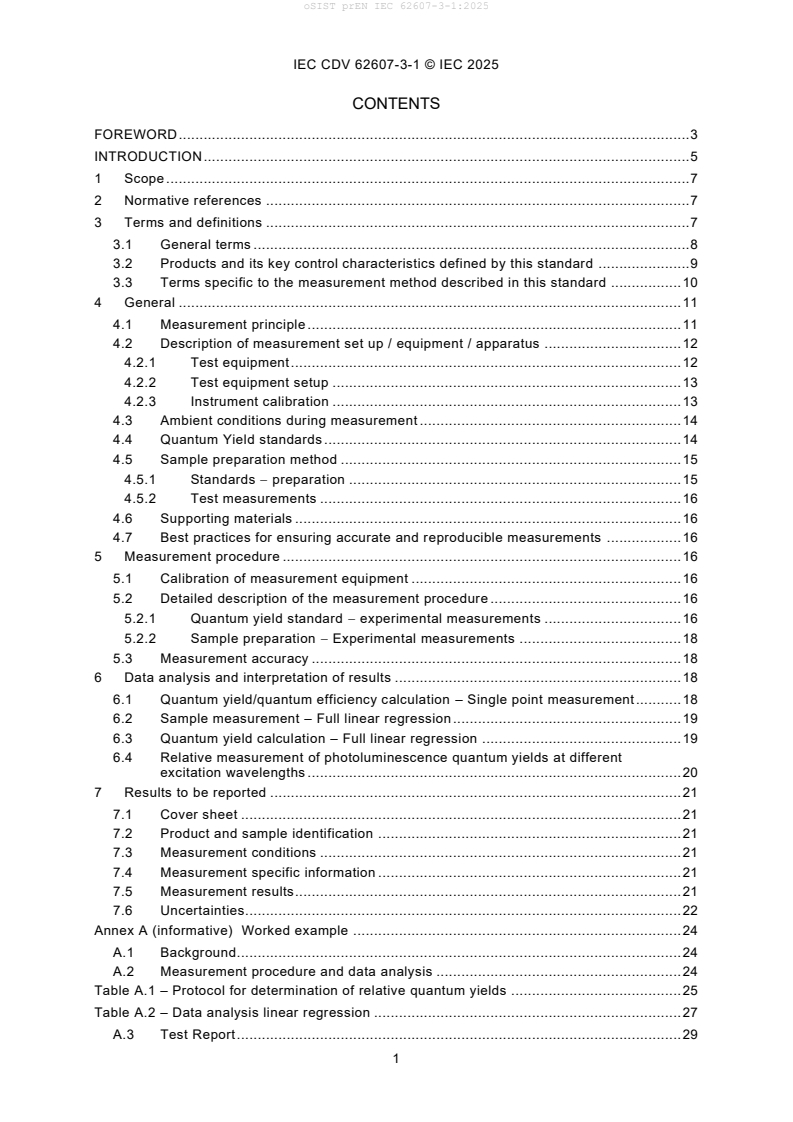
CONTENTS
FOREWORD . 3
INTRODUCTION . 5
1 Scope . 7
2 Normative references . 7
3 Terms and definitions . 7
3.1 General terms . 8
3.2 Products and its key control characteristics defined by this standard . 9
3.3 Terms specific to the measurement method described in this standard . 10
4 General . 11
4.1 Measurement principle . 11
4.2 Description of measurement set up / equipment / apparatus . 12
4.2.1 Test equipment . 12
4.2.2 Test equipment setup . 13
4.2.3 Instrument calibration . 13
4.3 Ambient conditions during measurement . 14
4.4 Quantum Yield standards . 14
4.5 Sample preparation method . 15
4.5.1 Standards − preparation . 15
4.5.2 Test measurements . 16
4.6 Supporting materials . 16
4.7 Best practices for ensuring accurate and reproducible measurements . 16
5 Measurement procedure . 16
5.1 Calibration of measurement equipment . 16
5.2 Detailed description of the measurement procedure . 16
5.2.1 Quantum yield standard − experimental measurements . 16
5.2.2 Sample preparation − Experimental measurements . 18
5.3 Measurement accuracy . 18
6 Data analysis and interpretation of results . 18
6.1 Quantum yield/quantum efficiency calculation – Single point measurement . 18
6.2 Sample measurement – Full linear regression . 19
6.3 Quantum yield calculation – Full linear regression . 19
6.4 Relative measurement of photoluminescence quantum yields at different
excitation wavelengths . 20
7 Results to be reported . 21
7.1 Cover sheet . 21
7.2 Product and sample identification . 21
7.3 Measurement conditions . 21
7.4 Measurement specific information . 21
7.5 Measurement results . 21
7.6 Uncertainties. 22
Annex A (informative) Worked example . 24
A.1 Background. 24
A.2 Measurement procedure and data analysis . 24
Table A.1 – Protocol for determination of relative quantum yields . 25
Table A.2 – Data analysis linear regression . 27
A.3 Test Report . 29
IEC CDV 62607-3-1 © IEC 2025
Annex B (informative) . 30
B.1 Possible sources of uncertainty . 30
B.1.1 Detection of internal filter effects . 30
B.1.2 Fluorophores with strongly overlapping absorption and emission bands . 30
B.1.3 Measurement of anisotropic samples . 30
B.1.4 Scattering samples . 30
B.1.5 Aggregation . 30
Bibliography . 31
Table 1 - Recommended standards for relative quantum efficiency measurements of
transparent luminescent nanoparticle solutions . 14
Table 2 – Spreadsheet format for quantum efficiency data comparisons . 17
Table 3 – Spreadsheet format for quantum yield/efficiency data comparisons . 18
Table 4 – Spreadsheet format for quantum yield/efficiency data comparisons for
different excitation for sample and standard . 19
IEC CDV 62607-3-1 © IEC 2025
INTERNATIONAL ELECTROTECHNICAL COMMISSION
____________
NANOMANUFACTURING – KEY CONTROL CHARACTERIASTICS –
Part 3-1: Nanophotonic products – Photoluminescence quantum yield of
luminescent nanomaterials: absorption and photoluminescence spectroscopy
FOREWORD
1) The International Electrotechnical Commission (IEC) is a worldwide organization for standardization comprising
all national electrotechnical committees (IEC National Committees). The object of IEC is to promote international
co-operation on all questions concerning standardization in the electrical and electronic fields. To this end and
in addition to other activities, IEC publishes International Standards, Technical Specifications, Technical Reports,
Publicly Available Specifications (PAS) and Guides (hereafter referred to as "IEC Publication(s)"). Their
preparation is entrusted to technical committees; any IEC National Committee interested in the subject dealt with
may participate in this preparatory work. International, governmental and non-governmental organizations liaising
with the IEC also participate in this preparation. IEC collaborates closely with the International Organization for
Standardization (ISO) in accordance with conditions determined by agreement between the two organizations.
2) The formal decisions or agreements of IEC on technical matters express, as nearly as possible, an international
consensus of opinion on the relevant subjects since each technical committee has representation from all
interested IEC National Committees.
3) IEC Publications have the form of recommendations for international use and are accepted by IEC National
Committees in that sense. While all reasonable efforts are made to ensure that the technical content of IEC
Publications is accurate, IEC cannot be held responsible for the way in which they are used or for any
misinterpretation by any end user.
4) In order to promote international uniformity, IEC National Committees undertake to apply IEC Publications
transparently to the maximum extent possible in their national and regional publications. Any divergence between
any IEC Publication and the corresponding national or regional publication shall be clearly indicated in the latter.
5) IEC itself does not provide any attestation of conformity. Independent certification bodies provide conformity
assessment services and, in some areas, access to IEC marks of conformity. IEC is not responsible for any
services carried out by independent certification bodies.
6) All users should ensure that they have the latest edition of this publication.
7) No liability shall attach to IEC or its directors, employees, servants or agents including individual experts and
members of its technical committees and IEC National Committees for any personal injury, property damage or
other damage of any nature whatsoever, whether direct or indirect, or for costs (including legal fees) and
expenses arising out of the publication, use of, or reliance upon, this IEC Publication or any other IEC
Publications.
8) Attention is drawn to the Normative references cited in this publication. Use of the referenced publications is
indispensable for the correct application of this publication.
9) [IEC/IEC and ISO] [draws/draw] attention to the possibility that the implementation of this document may involve
the use of (a) patent(s). [IEC/IEC and ISO] [takes/take] no position concerning the evidence, validity or
applicability of any claimed patent rights in respect thereof. As of the date of publication of this document,
[IEC/IEC and ISO] [had/had not] received notice of (a) patent(s), which may be required to implement this
document. However, implementers are cautioned that this may not represent the latest information, which may
be obtained from the patent database available at https://patents.iec.ch [and/or] www.iso.org/patents. [IEC/IEC
and ISO] shall not be held responsible for identifying any or all such patent rights.
IEC 62607-3-1 has been prepared by IEC technical committee 113: Nanotechnology for
electrotechnical products and systems. It is an International Standard.
This second edition cancels and replaces the first edition published in 2014. This edition
constitutes a technical revision.
This edition includes the following significant technical changes with respect to the previous
edition:
a) .;
b)
IEC CDV 62607-3-1 © IEC 2025
The text of this International Standard is based on the following documents:
Draft Report on voting
113/xxxx/XX 113/xxxx/XX
Full information on the voting for its approval can be found in the report on voting indicated in
the above table.
The language used for the development of this International Standard is English.
This document was drafted in accordance with ISO/IEC Directives, Part 2, and developed in
accordance with ISO/IEC Directives, Part 1 and ISO/IEC Directives, IEC Supplement available
at www.iec.ch/members_experts/refdocs. The main document types developed by IEC are
described in greater detail at www.iec.ch/publications.
The committee has decided that the contents of this document will remain unchanged until the
stability date indicated on the IEC website under webstore.iec.ch in the data related to the
specific document. At this date, the document will be
• reconfirmed,
• withdrawn,
• replaced by a revised edition, or
• amended.
IEC CDV 62607-3-1 © IEC 2025
1 INTRODUCTION
2 The luminous efficiency of solid state luminescence
6 SSL devices is a critical measurement for their overall efficiency and standard methods to
7 perform these measurements have been established for the final products The same need for
8 performance assessment exists for the luminescent materials on which these light-emitting
9 diode (LED) manufacturers rely; however, no such standard for the assessment of luminescent
10 materials currently exists. This standard provides SSL manufacturers a universal means for
11 comparing luminescent nanomaterials from different suppliers, and potentially for luminescent
12 materials for LEDs in general.
13 A critical measurement parameter for luminescent materials used in the life and material
14 sciences and in solid-state lighting is the quantum efficiency or photoluminescence quantum
15 yield. The latter term is used in the following due to its frequent use also for the characterization
16 of the performance of molecular luminophores or emitters as the test method described here
17 can be generally used for the determination of this key performance parameter of all molecular
18 and nanoparticle emitters in a transparent matrix such as a solution.
19 The photoluminescence quantum yield is defined in this standard as the number of photons
20 emitted into free space by an emitter such as a luminescent nanoparticle divided by the number
21 of photons absorbed by the nanoparticle at the chosen excitation wavelength. Suppliers of all
22 kinds of luminophores including QDs and luminescent nanomaterials typically measure only
23 quantum efficiencies or quantum yields of transparent luminophore solutions or dispersions only
24 relatively to due to the ease of such measurements. These measurements are commonly done
25 at low luminophore concentrations to minimize effects such as nanoparticle agglomeration and
26 signal distortions by luminophore reabsorption.
27 However, in end-use applications such as solid-state lighting, the actual concentration of the
28 luminescent nanomaterials may be significantly different. For example, concentrated
29 luminescent nanoparticle formulations (in either the solid or liquid state) may be required to
30 achieve a desired luminous flux and correlated colour temperature in an SSL device.
31 This standard codifies this test method for the first time and establishes a test method for the
32 relative determination of the photoluminescence quantum yield of transparent liquid
33 luminophore samples such as solutions of molecular emitters and colloidal suspensions of small
34 luminescent nanoparticles. The standard may be also applied to luminophores in transparent
35 solid matrices such as luminescent nanoparticles embedded in polymer matrices with proper
36 consideration of specific characteristics of such solid luminescent materials like possible
37 polarization effects requiring the use of polarizers for the accurate determination of
38 photoluminescence quantum yields by this relative test method.
39 In addition, the absorbance of these solid luminophore systems at the respective excitation
40 wavelength must be high enough to enable the accurate determination of the number of
41 absorbed photons. This can present a challenge, e.g., for thin films of luminescent
42 nanomaterials coated on glass optics or applied directly to light emitted diodes.
43 Overall, this test method is intended to enable suppliers and purchasers to compare the
44 performance of one material to another, both in their raw (solution) phase as well as their
45 technologically relevant (solid) phase of matter.
IEC CDV 62607-3-1 © IEC 2025
46 This part of IEC 62607 covers the relative measurements of the key control characteristic
47 photoluminescence quantum yield (used in the following instead of quantum efficiency), defined
48 as the number of emitted photons per number of absorbed photons of different types of molecular
49 and nanocrystalline luminophores (emitters) in transparent matrices like solutions/dispersions using
50 relative optical methods. This implies experimental methods such as absorption and photoluminescence
51 spectroscopy and, mandatory, a fluorescence quantum yield standard of known quantum yield value
52 traceable to a national standard.
54 The document describes the procedures to be followed for the relative measurement of
55 photoluminescence quantum yields such as the usage of identical instrument settings for sample
56 and quantum yield standard including their choice based upon screening measurements with sample
57 and standard and requirements on the accurate calibration of the spectrophotometer and particularly
58 the spectrofluorometer employed as well as precautions to be taken when performing reproducible
59 measurements of the quantum yield of molecular luminophores and luminescent nanomaterials
60 in transparent matrices.
61 In addition, recommendations on the calibration of the optical instruments utilized for this test
62 method and suitable reference materials (termed also spectral fluorescence standards) are
63 given as well as recommendations on well-characterized reference materials (termed also
64 fluorescence quantum yield standards) for relative quantum yield measurements are given that
65 are commercially available.
67 This standard does not cover the determination of the absolute quantum yield in transparent
68 materials, neither is it applicable for the determination of quantum yield in scattering media.
IEC CDV 62607-3-1 © IEC 2025
70 NANOMANUFACTURING – KEY CONTROL CHARACTERIASTICS –
72 Part 3-1: Nanophotonic products - Photoluminescence quantum yield of
73 luminescent nanomaterials: absorption and photoluminescence spectroscopy
74 1 Scope
75 This part of IEC 62607 establishes a standardized method to determine the key control
76 characteristics
77 • photoluminescence quantum yield
78 for luminescent nanomaterials in transparent matrices by
79 • absorption and photoluminescence spectroscopy.
80 The photoluminescence quantum yield is derived by using a calibrated spectrophotometer in
81 combination with a spectrofluorometer.
82 – Photoluminescence quantum yield is defined as the number of emitted photons per number
83 of absorbed photons of different types of molecular and nanocrystalline luminophores
84 (emitters) in transparent matrices like solutions/dispersions using relative optical methods.
85 – The method is applicable for luminescent nanomaterials which includes nano-objects such
86 as spherical and rod-shaped quantum dots, nanophosphors, nanofibers, nanocrystals, nano
87 platelets and structures containing these materials that are small enough not to introduce
88 light scattering or for which the refractive index of dispersed nanomaterial and matrix closely
89 match, thereby preventing or at least strongly reducing light scattering also for larger nano -
90 object sizes.
91 – In principle, this method is also suitable for the determination of the photoluminescence
92 quantum yield of molecular luminophores and luminescent nanoparticles in transparent solid
93 matrices, meeting the previously stated size restrictions. For these systems, the accurate
94 relative determination of the photoluminescence quantum yield can require the use of
95 polarizers as luminophores can be susceptible to polarization effects in solid matrices.
96 – This test method is not suited for the determination of the photoluminescence quantum yield of
97 scattering dispersions of luminescent nanomaterials such as semiconductor quantum rods with a
98 large aspect ratio. Measurement of the photoluminescence quantum yield of scattering
99 luminophore systems such as dispersions of larger nano-objects or powders of luminescent
100 nanoparticles and differently sized phosphors requires the usage of integrating sphere
101 spectroscopy.
102 – Fields of application include the determination of the fluorescence quantum yields of
103 transparent dispersions of semiconductor quantum dots or other nanoobjects.
104 2 Normative references
105 The following documents are referred to in the text in such a way that some or all of their content
106 constitutes requirements of this document. For dated references, only the edition cited applies.
107 For undated references, the latest edition of the referenced document (including any
108 amendments) applies.
109 CIE 017/E:2011, International Lighting Vocabulary.
110 3 Terms and definitions
111 For the purposes of this document, the following terms and definitions apply.
IEC CDV 62607-3-1 © IEC 2025
112 ISO and IEC maintain terminology databases for use in standardization at the following
113 addresses:
114 • IEC Electropedia: available at https://www.electropedia.org/
115 • ISO Online browsing platform: available at https://www.iso.org/obp
116 • CIE Online E-ILV: available at https://cie.co.at/e-ilv
118 3.1 General terms
119 3.1.1
120 key control characteristic
121 KCC
122 product characteristic which can affect safety or compliance with regulations, fit, function,
123 performance, quality, reliability, or subsequent processing of the final product
124 Note 1 to entry: The measurement of a key control characteristic is described in a standardized measurement
125 procedure with known accuracy and precision.
126 Note 2 to entry: It is possible to define more than one measurement method for a key control characteristic if the
127 correlation of the results is well-defined and known.
128 [Source: IEC/TS 62565-1, 3.1]
129 [SOURCE ISO/IEC Guide 99: 2007, 2.3 modified - Note 1 changed and note 2 to 4 removed]
130 3.1.2
131 measurement
132 process of experimentally obtaining one or more values that can reasonably be attributed to a
133 quantity
134 Note 1 to entry: If the quantity is a key control characteristic, the measurement is an essential part of the quality
135 management system.
136 [SOURCE ISO/IEC Guide 99: 2007, 2.1 modified - Note 1 changed and note 2 to 3 removed]
137 3.1.3
138 measurement accuracy
139 closeness of agreement between a measured quantity value and a true quantity value of a
140 measurand
141 Note 1 to entry: The concept ‘measurement accuracy’ is not a quantity and is not given a numerical quantity value.
142 A measurement is said to be more accurate when it offers a smaller measurement error.
143 [SOURCE: ISO/IEC Guide 99: 2007, 2.13, modified – Notes 2 and 3 to entry removed]
144 3.1.4
145 measurement method
146 process of experimentally obtaining one or more values that can reasonably be attributed to a
147 quantity
148 Note 1 to entry: If the quantity is a key control characteristic, the measurement is an essential part of the quality
149 management system.
150 [SOURCE ISO/IEC Guide 99: 2007, 2.5 modified - Note 1 changed]
151 3.1.5
152 measurement principle
153 phenomenon serving as a basis of a measurement
IEC CDV 62607-3-1 © IEC 2025
154 EXAMPLE 1:Thermoelectric effect applied to the measurement of temperature.
155 EXAMPLE 2:Energy absorption applied to the measurement of amount-of-substance concentration.
156 EXAMPLE 3: Hall effect applied to the measurement of magnetic flux density.
157 Note 1 to entry: The phenomenon can be of a physical, chemical, or biological nature.
158 [SOURCE ISO/IEC Guide 99: 2007, 2.4]
159 3.1.6
160 measurement procedure
161 measurement protocol
162 detailed description of a measurement according to one or more measurement principles and
163 to a given measurement method, based on a measurement model and including any calculation
164 to obtain a measurement result
165 Note 1 to entry: A measurement procedure is usually documented in sufficient detail to enable an operator to perform
166 a measurement.
167 Note 2 to entry: A measurement procedure can include a statement concerning a target measurement uncertainty.
168 Note 2 to entry: A measurement procedure is sometimes called a standard operating procedure, abbreviated SOP.
169 [SOURCE: ISO/IEC Guide 99: 2007, 2.6]
170 [SOURCE: ISO/IEC Guide 99: 2007, 2.9, modified – Notes 1 and 3 to entry removed.]
172 3.2 Products and its key control characteristics defined by this standard
173 3.2.1
174 nanomaterial
175 classification of materials that encompasses both nano-objects and nanostructured materials
176 Note 1 to entry: Nano-objects are materials with one, two, or three dimensions in the size range from 1 to 100
177 nanometres.
178 3.2.2
179 luminescent nanomaterial
180 nanomaterial that can emit light upon optical or electric excitation
181 [SOURCE: IEC 80004-9:2017, 3.3.1]
182 3.2.3
183 quantum dot
184 semiconductor nanocrystal that exhibits size dependent optical properties due to quantum
185 confinement effects on the electronic states, that lead to a size-dependent optical bandgap and
186 a size dependent spectral position of the luminescence
187 3.2.4
188 dye
189 organic molecules, the optical properties of which are governed by transitions of excited
190 electrons between discrete energy levels
191 Note 1 to entry: energy levels involved are the HOMO: highest occupied molecular orbital, and the LUMO: lowest
192 unoccupied molecular orbital. Transitions between these energy levels results in discrete spectral positions of the
193 absorption and emission bands.
194 3.2.5
195 luminophore
196 a chemical compound that is capable of emitting light
IEC CDV 62607-3-1 © IEC 2025
197 Note 1 to entry: luminescence as response of its electronic excitation, e.g., by the absorption of photons (termed
198 then photoluminescence). Also referred to as fluorophore or phosphor if the first singulet or triplet state state is
199 involved as excited state in the emission process.
200 3.3 Terms specific to the measurement method described in this standard
201 For the purposes of this document, the terms and definitions given in CIE 017/E:2011 as well
202 as the following terms and definitions apply.
203 3.3.1
204 absorbance
205 negative base 10 logarithm of the ratio of the intensity of light (I) that has passed through and
206 transmitted by a sample to the incident intensity (I ) at a specified wavelength
o
207 Note 1 to entry: Expressed mathematically, absorbance = -log(I/I ). Proper corrections are required for other losses
o
208 (e.g., reflection and scattering) for this equation to be correct.
209 3.3.2
210 absorptance
211 ratio of the radiant or luminous flux in a given spectral interval that is absorbed by a medium to
212 the radiant or luminous flux of the incident light source
213 Note 1 to entry: The sum of the hemispherical reflectance, the hemispherical transmittance, and the absorptance
214 is one.
215 3.3.3
216 absorption
217 process by which matter removes photons from incident light and converts it to another form of
218 energy such as heat or luminescence.
219 Note 1 to entry: All of the incident photon flux is accounted for by the processes of absorption, reflection, and
220 transmission
221 Note 2 to entry:. The absorption is meanwhile often characterized by the absorption factor
222 3.3.4
223 matrix
224 components of a sample other than the material being analyzed; e.g., in the case of nanoparticle
225 dispersions this presents the solvent
226 Note 1 to entry: Matrix materials are typically inert organic or inorganic materials that contain luminescent
227 nanoparticles.
228 3.3.5
229 optical density OD
230 negative base 10 logarithm of the ratio of the intensity of light that has passed through a sample,
231 at a specified wavelength, to the intensity of the incident light source at that wavelength
232 Note 1 to entry: The abbreviation for optical density is OD. The optical density and absorbance of a sample are the
233 same, if reflection losses have first been taken into account.
235 3.3.6
236 photon flux
237 time rate flow of radiant energy given in photonic units
238 3.3.7
239 radiant flux
240
241 time rate flow of radiant energy
IEC CDV 62607-3-1 © IEC 2025
242 3.3.8
243 spectral radiant flux
244 radiant flux per unit wavelength interval at a given wavelength ( )
245 Note 1 to entry: Spectral radiant flux is typically denoted by , which is equivalent to d /d , and is usually
246 expressed in units of watts per nm.
247 3.3.9
248 standard reference material
249 SRM
250 material which has been characterized under define and stated application specific conditions
251 to be sufficiently homogeneous and stable with respect to one or more specified properties and
252 typically comes with an uncertainty assigned to its specified property or properties.
253 Note 1 to entry: The scope and all application relevant properties of an SRM must be well documented including its
254 shelf life and storage conditions, and normally these properties should be traceable to a SI unit or primary standard
255 or a related unit. This is commonly accomplished during its certification yielding a certified reference material. Such
256 reference materials of very high quality are available from National Metrology Institutes such as BAM or NIST.
257 Note 2 to entry: SRMs are accompanied by a certificate which certifies the values of these properties that have been
258 established with traceability to the accurate realization of the unit and each certified value includes a stated
nd
259 uncertainty with a given level of confidence (see also SIPM Metrology brochure, 2 edition, December 2003).
261 4 General
262 4.1 Measurement principle
263 Relative measurements of photoluminescence quantum yield (PLQY) are conducted using a
264 standard reference material with well-characterized, preferably certified, properties. Two
265 primary methods are available for such measurements:
266 a) Using the same excitation wavelength for both the standard and the sample, which requires
267 only an emission correction. This involves accounting for the wavelength dependence of
268 the spectrofluorometer’s emission or detection channel through reliable instrument
269 calibration.
270 b) Using different excitation wavelengths for the standard and the sample, which requires
271 adjustments to address the spectral properties of both under varying excitation conditions.
272 In the latter case, two instrument calibrations are mandatory to consider the wavelength
273 dependence of the spectral radiance or excitation radiant power reaching the sample
274 determined by the emission spectrum of the excitation light source and the wavelength
275 dependent transmission of the optical components in the spectrofluorometer´s excitation
276 channel (termed excitation correction) and the wavelength dependence of the spectral
277 responsivity of the spectrofluorometer´s emission or detection channel. Due to the widespread
278 use of relative measurement methods, there are a several reports in the literature that describe
279 the instrumentation and setup procedures for the underlying absorption and fluorescence
1-5
280 measurements and the mandatory instrument calibrations.
281 An example of a standard reference material used in relative quantum yield measurements is
282 the use of a fluorescent organic dye of known quantum yield in determining the quantum
283 efficiency of a colloidal suspension of quantum dots. Examples of 12 quantum yield standards
284 the absorption and emission spectra of which cover the UV/vis/NIR and were recently certified
285 by BAM are included (see Table 1).
286 For the determination of the fluorescence quantum yield of solutions, fluorescence
287 measurements are usually performed in a 0°/90° measurement geometry under identical
288 conditions (identical instrument parameters such as photomultiplier voltage, slit width of
289 excitation and emission monochromator, slit width in the reference channel, excitation
290 wavelength, polarizer positions, if necessary, the same filters, the same temperature).
IEC CDV 62607-3-1 © IEC 2025
291 For anisotropic samples, conventional fluorescence spectrometers without integrating sphere
292 accessories with polarizers (magic angle settings: Polarizer in excitation channel at 0° - and
293 polarizer in emission channel at 54.7°-position). The integration times and the number of
294 measurement repetitions for the emission spectra, the slit widths in the excitation channel must
295 be chosen such that the resulting spectra have a sufficiently high S/N value to minimize
296 uncertainties in the integration. The selected slit widths of the emission monochromator must
297 be identical to the settings used to generate the spectral correction curve of the emission
298 channel.
299 In addition to the emission spectra of the samples, the spectra of the solvents must be
300 determined with the measurement parameters used above (blank spectra) in order to determine
301 any Raman or Rayleigh bands that may occur and any fluorescence bands of the solvents.
302 These should not be integrated when determining the integral fluorescence of the solutions of
303 sample and standard.
304 Two options for relative quantum yield measurements can be chosen:
305 1) excitation of standard and sample at the same excitation wavelength and
306 2) excitation at different wavelength.
307 For both procedures the detection system must be calibrated and for 2) an additional calibration
308 of the excitation channel is mandatory.
309 4.2 Description of measurement set up / equipment / apparatus
310 4.2.1 Test equipment
311 For relative measurements of quantum efficiency the following equipment is mandatory:
312 – Standard fluorescence quartz cuvette of known path length. In the discussion below, it is
313 assumed that cuvettes with a path length of 10 mm are used. If different sizes of cuvettes
314 are used, appropriate adjustments in solution volumes may be necessary.
315 NOTE Incomplete cleaning of the cuvettes may leave residues that could negatively impact quantum efficiency
316 measurements. It is good practice to acid-wash all quartz cuvettes before use to ensure that all residual quantum
317 dots are removed from the cuvette prior to measurements.
318 – Microbalance;
319 – Eppendorf pipette or microsyringe;
320 – Absorption spectrophotometer that measures absorption over the spectral region of interest
321 (typically the ultraviolet and visible (UV-Vis) regions). The calibration of the wavelength and
322 intensity scales of the spectrophotometer shall be verified at least annually using certified
323 reference materials such as certified filters with known wavelength dependent transmission
324 properties available from different calibration laboratories.
325 – Fluorescence spectrometer capable of producing excitation radiation in the spectral region
326 of interest (typically UV-Vis, increasingly also NIR) and measuring the excitation and emitted
327 radiation as a function of wavelength. Additional information on the setup and calibration of
1-3
328 fluorescence spectrophotometers can be found elsewhere. Typically, the excitation
329 radiation is produced by an excitation light source such as a xenon lamp combined with a
330 monochromator with adjustable slit widths. Alternatively, monochromatic light sources such
331 as lasers and LEDs can be used. The emitted radiation from the sample typically passes
332 through additional optics including an emission monochromator with adjustable slit widths
333 and is then detected by the detector, e.g., a photomultiplier tube (PMT). A charge coupled
334 device (CCD) is commonly used for an integrating sphere setup. A calibration file to consider
335 the instrument-specific wavelength dependence of the spectral responsivity of the detection
336 system including emission monochromator and detector and the wavelength dependence of
337 the transmission of other optical components such as lenses or/and polarizers in the
338 detection channel is needed. This so-called emission correction curve shall be either
339 obtained from the instrument manufacturer or shall be created using a calibrated light
340 source. For the determination of photoluminescence quantum yields with different excitation
341 wavelengths also an excitation correction is necessary, i.e., the excitation photon flux at the
IEC CDV 62607-3-1 © IEC 2025
342 sample position for the different excitation wavelengths used shall be known. This shall be
343 determined with a calibrated detector such as a silicon photodiode placed at the sample
344 position for the instrument settings employed for the relative determination of the
345 photoluminescence quantum yield.
346 4.2.2 Test equipment setup
347 4.2.2.1 Absorption spectrophotometer
348 The spectrophotometer, which commonly measures either the wavelength dependent
349 transmission or absorption shall be set to scan the spectral region of interest, which is typically
350 set from 300 nm to 1000 nm. Acquisition parameters for the spectrophotometer shall be
351 adjusted to achieve an optimum signal-to-noise ratio.
352 4.2.2.2 Fluorescence spectrophotometer
353 To measure the sample fluorescence with a fluorescence spectrophotometer, it is necessary to
354 specify an excitation wavelength and a detection range, i.e., start and end wavelength of the
355 emission spectra. In choosing these wavelengths, consideration shall be given to minimize the
356 overlap region between the red edge of the excitation spectrum and blue edge of the emission
357 spectrum. In the overlap region typically an OD less than 0.05 is recommended to minimize re-
358 absorption or inner-filter effects. The choice of a suitable slit width is a trade-off between signal
359 intensity and peak resolution. It is recommended that the slit width be set to the minimum value
360 that does not adversely affect signal-to-noise ratio. However, the spectral bandpass conditions
361 (i.e., slit width multiplied by the reciprocal linear dispersion of the monochromator) shall remain
362 unchanged for the measurement of the sample and reference standard. Other
363 spectrofluorometer settings such as the photomultiplier tube (PMT) voltage shall be kept
364 constant for sample and reference material measurements. For anisotropic samples,
365 conventional fluorescence spectrometers without integrating sphere accessories shall use
366 polarizers (magic angle settings: polarizer in the excitation channel set to 0°- and polarizer in
367 the emission channel set to 54.7°-position) shall be used.
368 4.2.3 Instrument calibration
369 The calibration of the spectrofluorometer requires the calibration of the excitation and emission
370 channel or pathway.
371 As the first step, the wavelength accuracy of the excitation and emission channels or pathways
372 of the spectrofluorometer shall be checked and if necessary corrected. Typically, gas discharge
373 lamps are used for this purpose, that are either placed in front of the excitation monochromator
374 (control of the wavelength accuracy of the excitation channel) or at the sample position (control
375 of the wavelength accuracy of the emission channel) and very narrow slit widths of the excitation
376 and emission monochromator. The emitting species are noble gases like helium (He), neon
377 (Ne), argon (Ar), krypton (Kr), and xenon (Xe) that provide a multitude of extremely narrow
378 emission lines, the spectral position of which can be found in physicochemical databases as
379 provided, e.g., by NIST.
380 For the calibration of the emission channel and the detection equipment, requiring the relative
381 determination of the instrument specific wavelength dependent spectral responsivity, liquid
382 transfer standards such as dye- or luminophore-based spectral fluorescence s
...