

prEN IEC 60034-18-41:2025
(Main)Rotating electrical machines - Part 18-41: Partial discharge free electrical insulation systems (Type I) used in rotating electrical machines fed from voltage converters - Qualification and quality control tests
General Information
- Abstract
- Status
- Not Published
- Publication Date
- 06-Jun-2027
- Technical Committee
- CLC/TC 2 - Rotating machinery
- Drafting Committee
- IEC/TC 2 - IEC_TC_2
- Current Stage
- 4098 - Decision to drop project - Standstill maintained / released - Enquiry
- Start Date
- 13-Jul-2026
- Completion Date
- 25-Aug-2026

Overview
prEN IEC 60034-18-41:2025 specifies qualification and quality control tests for partial discharge (PD) free electrical insulation systems (Type I) used in rotating electrical machines that are fed from voltage converters. The draft standard (IEC TC 2) focuses on ensuring insulation systems withstand the specific impulse and converter-related stresses that occur with inverter-fed motors and generators. It defines test regimes for design qualification, type testing and routine (quality control) testing, and includes requirements for test equipment and pass/fail criteria.
Key topics and technical requirements
- Impulse Voltage Insulation Class (IVIC): Defines IVIC concepts for phase-to-phase, phase-to-ground and turn-to-turn insulation in converter-fed machines and provides guidance for IVIC selection and machine marking.
- Design qualification tests: Procedures and sample types (twisted-pair, motorette/formette, complete windings) for long-term PD-free qualification, including diagnostic tests, ageing cycles and impulse PD testing.
- Type and routine (quality control) tests: Test sequences, peak-to-peak voltage derivation, routine withstand voltage and PD checks to validate manufacturing consistency.
- Test equipment and methods: Requirements for impulse voltage generators, PD measurement during impulses and power-frequency PD testing.
- Normative test data and circuits: Annexes provide detailed test circuits, voltage waveforms, derivation of allowable and test voltages, and routine withstand voltages.
- PD pass/fail criteria: Normative guidance on PD-free acceptance levels during impulse and power-frequency tests.
- Converter-related guidance: Informative annexes cover machine terminal voltages arising from converter operation, voltage overshoots, turn voltage calculations, and common-mode stresses.
- Additional guidance: Informative material on insulation degradation mechanisms, measuring fraction of terminal voltage appearing between turns (ρ), and recommended qualification routes.
Applications and who uses it
This standard is essential for:
- Motor and generator designers specifying Type I, PD-free insulation systems for inverter-fed machines.
- OEMs and winding suppliers performing design qualification and routine quality control.
- Independent test laboratories and certification bodies conducting PD and impulse testing.
- Specifiers, asset owners and procurement teams seeking assurance that rotating machines will withstand converter-induced electrical stress.
- R&D teams developing insulation materials and systems for traction, industrial drives, renewable energy and other converter-fed applications.
Related standards
- Part of the IEC 60034 family (rotating electrical machines). The draft references earlier editions (IEC 60034-18-41 Ed.1) and aligns with IEC TC 2 work on converter-fed machine insulation.
Keywords: rotating electrical machines, partial discharge free, Type I insulation systems, voltage converters, qualification tests, quality control tests, IVIC, PD measurement, impulse voltage testing.
Relations
- Effective Date
- 22-Mar-2022
- Effective Date
- 22-Mar-2022
- Effective Date
- 22-Mar-2022
Get Certified
Connect with accredited certification bodies for this standard

IMQ S.p.A. (Certification)
Italian electrical product certification.

SLG Prüf- und Zertifizierungs GmbH
German testing and certification body.

UL Solutions
Global safety science company with testing, inspection and certification.
Sponsored listings
Frequently Asked Questions
prEN IEC 60034-18-41:2025 is a draft published by CLC. Its full title is "Rotating electrical machines - Part 18-41: Partial discharge free electrical insulation systems (Type I) used in rotating electrical machines fed from voltage converters - Qualification and quality control tests". This standard covers: Rotating electrical machines - Part 18-41: Partial discharge free electrical insulation systems (Type I) used in rotating electrical machines fed from voltage converters - Qualification and quality control tests
Rotating electrical machines - Part 18-41: Partial discharge free electrical insulation systems (Type I) used in rotating electrical machines fed from voltage converters - Qualification and quality control tests
prEN IEC 60034-18-41:2025 is classified under the following ICS (International Classification for Standards) categories: 29.160.01 - Rotating machinery in general. The ICS classification helps identify the subject area and facilitates finding related standards.
prEN IEC 60034-18-41:2025 has the following relationships with other standards: It is inter standard links to EN 60034-18-41:2014, EN 60034-18-41:2014/A1:2019/AC:2020-12, EN 60034-18-41:2014/A1:2019. Understanding these relationships helps ensure you are using the most current and applicable version of the standard.
prEN IEC 60034-18-41:2025 is available in PDF format for immediate download after purchase. The document can be added to your cart and obtained through the secure checkout process. Digital delivery ensures instant access to the complete standard document.
Standards Content (Sample)
SLOVENSKI STANDARD
01-januar-2026
Električni rotacijski stroji - 18-41. del: Kvalificiranje in preskusi pri obvladovanju
kakovosti električnih izolacijskih sistemov brez delne razelektritve (tip I) v
električnih rotacijskih strojih, ki jih napajajo napetostni pretvorniki
Rotating electrical machines - Part 18-41: Partial discharge free electrical insulation
systems (Type I) used in rotating electrical machines fed from voltage converters -
Qualification and quality control tests
Drehende elektrische Maschinen - Teil 18-41: Qualifizierung und Qualitätsprüfungen für
teilentladungsfreie elektrische Isoliersysteme (Typ I) in drehenden elektrischen
Maschinen, die von Spannungsumrichtern gespeist werden
Machines électriques tournantes - Partie 18-41: Systèmes d'isolation électrique sans
décharge partielle (Type I) utilisés dans des machines électriques tournantes alimentées
par des convertisseurs de tension - Essais de qualification et de contrôle qualité
Ta slovenski standard je istoveten z: prEN IEC 60034-18-41:2025
ICS:
29.080.30 Izolacijski sistemi Insulation systems
29.160.01 Rotacijski stroji na splošno Rotating machinery in
general
2003-01.Slovenski inštitut za standardizacijo. Razmnoževanje celote ali delov tega standarda ni dovoljeno.
2/2269/CDV
COMMITTEE DRAFT FOR VOTE (CDV)
PROJECT NUMBER:
IEC 60034-18-41 ED2
DATE OF CIRCULATION: CLOSING DATE FOR VOTING:
2025-11-14 2026-02-06
SUPERSEDES DOCUMENTS:
2/2226/CD, 2/2252A/CC
IEC TC 2 : ROTATING MACHINERY
SECRETARIAT: SECRETARY:
United Kingdom Mr Charles Whitlock
OF INTEREST TO THE FOLLOWING COMMITTEES: HORIZONTAL FUNCTION(S):
ASPECTS CONCERNED:
SUBMITTED FOR CENELEC PARALLEL VOTING NOT SUBMITTED FOR CENELEC PARALLEL VOTING
Attention IEC-CENELEC parallel voting
The attention of IEC National Committees, members of
CENELEC, is drawn to the fact that this Committee Draft
for Vote (CDV) is submitted for parallel voting.
The CENELEC members are invited to vote through the
CENELEC online voting system.
This document is still under study and subject to change. It should not be used for reference purposes.
Recipients of this document are invited to submit, with their comments, notification of any relevant patent rights of which they are
aware and to provide supporting documentation.
Recipients of this document are invited to submit, with their comments, notification of any relevant “In Some Countries” clauses to
be included should this proposal proceed. Recipients are reminded that the CDV stage is the final stage for submitting ISC clauses.
(SEE AC/22/2007 OR NEW GUIDANCE DOC).
TITLE:
Rotating electrical machines - Part 18-41: Partial discharge free electrical insulation systems (Type I) used in
rotating electrical machines fed from voltage converters - Qualification and quality control tests
PROPOSED STABILITY DATE: 2029
NOTE FROM TC/SC OFFICERS:
Enclosed is the CD version I have received from the convenor.
electronic file, to make a copy and to print out the content for the sole purpose of preparing National Committee positions.
You may not copy or "mirror" the file or printed version of the document, or any part of it, for any other purpose without
permission in writing from IEC.
IEC CDV 60034-18-41 © IEC 2025
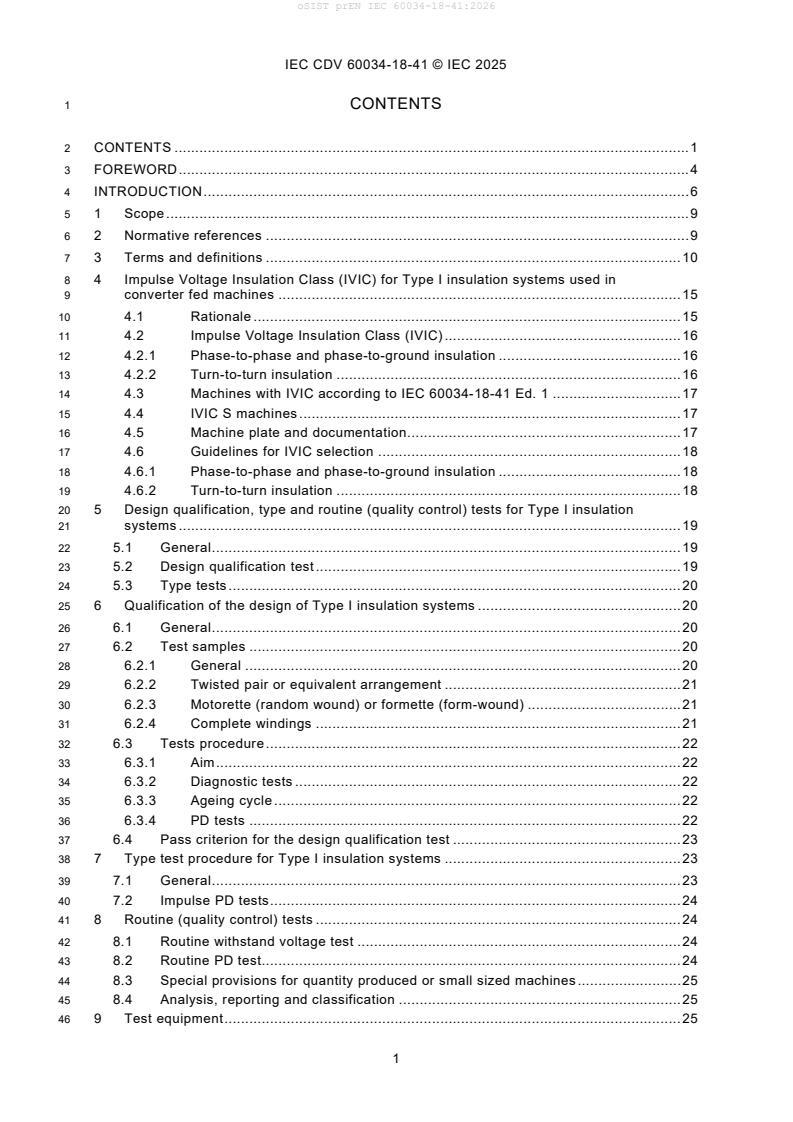
1 CONTENTS
2 CONTENTS . 1
3 FOREWORD . 4
4 INTRODUCTION . 6
5 1 Scope . 9
6 2 Normative references . 9
7 3 Terms and definitions . 10
8 4 Impulse Voltage Insulation Class (IVIC) for Type I insulation systems used in
9 converter fed machines . 15
10 4.1 Rationale . 15
11 4.2 Impulse Voltage Insulation Class (IVIC) . 16
12 4.2.1 Phase-to-phase and phase-to-ground insulation . 16
13 4.2.2 Turn-to-turn insulation . 16
14 4.3 Machines with IVIC according to IEC 60034-18-41 Ed. 1 . 17
15 4.4 IVIC S machines . 17
16 4.5 Machine plate and documentation . 17
17 4.6 Guidelines for IVIC selection . 18
18 4.6.1 Phase-to-phase and phase-to-ground insulation . 18
19 4.6.2 Turn-to-turn insulation . 18
20 5 Design qualification, type and routine (quality control) tests for Type I insulation
21 systems . 19
22 5.1 General . 19
23 5.2 Design qualification test . 19
24 5.3 Type tests . 20
25 6 Qualification of the design of Type I insulation systems . 20
26 6.1 General . 20
27 6.2 Test samples . 20
28 6.2.1 General . 20
29 6.2.2 Twisted pair or equivalent arrangement . 21
30 6.2.3 Motorette (random wound) or formette (form-wound) . 21
31 6.2.4 Complete windings . 21
32 6.3 Tests procedure . 22
33 6.3.1 Aim . 22
34 6.3.2 Diagnostic tests . 22
35 6.3.3 Ageing cycle . 22
36 6.3.4 PD tests . 22
37 6.4 Pass criterion for the design qualification test . 23
38 7 Type test procedure for Type I insulation systems . 23
39 7.1 General . 23
40 7.2 Impulse PD tests . 24
41 8 Routine (quality control) tests . 24
42 8.1 Routine withstand voltage test . 24
43 8.2 Routine PD test. 24
44 8.3 Special provisions for quantity produced or small sized machines . 25
45 8.4 Analysis, reporting and classification . 25
46 9 Test equipment . 25
IEC CDV 60034-18-41 © IEC 2025
47 9.1 Voltage impulse generators . 25
48 9.2 PD measurement during voltage impulses. 26
49 9.3 Power frequency PD tests . 26
50 Annex A (normative) Test circuits and voltage waveforms for impulse voltage
51 generators . 27
52 A.1 Test circuits and voltage settings . 27
53 A.2 Correct setting of peak-to-peak voltage . 27
54 A.3 Impulsive voltage rise time . 29
55 A.4 Voltage impulse repetition frequency . 29
56 A.5 Voltage waveform . 29
57 Annex B (normative) Derivation of maximum allowable peak/peak voltages in service . 32
58 Annex C (normative) Derivation of peak-to-peak voltages for qualification and
59 type/routine (quality control) tests for two-levels machines . 34
60 C.1 General . 34
61 C.2 Derivation of peak-to-peak test voltages . 35
62 C.3 Example of calculation of peak-to-peak test voltages . 36
63 Annex D (normative) Derivation of routine withstand test voltages . 38
64 Annex E (normative) PD-free pass/fall criteria during voltage tests . 39
65 E.1 Impulse voltage PD tests . 39
66 E.2 Power frequency PD tests . 39
67 Annex F (informative) Machine terminal voltages arising from converter operation. . 40
68 F.1 General considerations . 40
69 F.2 Calculation of DC bus voltage . 40
70 F.3 Voltage overshoots . 41
71 F.4 Voltage stress in the insulation system . 42
72 F.4.1 Voltages stressing the phase-to-phase insulation . 45
73 F.4.2 Voltages stressing the phase-to-ground insulation . 45
74 F.4.3 Voltages stressing the turn and strand insulation . 45
75 F.5 Terminal voltages calculation . 45
76 F.6 Turn voltage calculation . 46
77 F.7 Common mode stress . 47
78 Annex G (informative) Mechanisms of insulation degradation. 48
79 Annex H (informative) Measurement of the fraction of the terminal voltage appearing
80 between turns ρ . 49
81 H.1 General . 49
82 H.2 Equipment Required . 49
83 H.3 Connections . 49
84 H.4 Measurements . 50
85 Annex I (informative) Routes for qualification . 51
86 I.1 General 51
87 I.2 Reduced functional evaluation. . 52
88 Bibliography . 53
IEC CDV 60034-18-41 © IEC 2025
91 Figure 2 – Safe operation zone for a machine having IVIC C/C/B . 18
92 Figure A.1 – Connection of the impulse voltage source. For phase-to-ground and
93 phase-to-phase insulation tests, the rise time should exceed 500 ns. 0
94 Figure A.2 – Impulse test voltage waveforms and the levels for applying the same
95 peak/peak voltage of 2ρU on the turn-to-turn insulation (schematic representation).
j
96 The meaning of ρ is discussed in Annex F.5 . 1
97 Figure A.3 – Test voltages (V in Figure A.1) for phase-to-ground, phase-to-phase.
test
98 and turn-to-turn impulse tests using a unipolar and repetitive bipolar square wave. In
99 all figures, the peak-to-peak test voltage is the same (1000 V) but does not reflect the
100 difference in the voltage applied during the tests due to, for instance, the different
101 temperature enhancement factors. . 2
102 Figure F.1 – Voltage enhancement at the terminals of a motor due to reflection as a
103 function of cable length for various impulse rise times . 12
104 Figure F.2 – Example of a random wound design . 13
105 Figure F.3 – Example of a form-wound design . 13
106 Figure F.4 – Five step phase to phase voltage at the terminals of a machine fed by a 3-
107 level converter . 14
108 Figure F.5 – Jump voltage (U ) at the machine terminals associated with a converter
j
109 drive . 14
110 Figure F.6 – Comparison of phase-to-phase, phase-to-ground, and turn-to-turn
111 voltages for a 2-level converter . 15
112 Figure F.8 – Worst case voltage stressing the turn-to-turn insulation in a variety of
113 random wound stators as a function of the rise time of the impulse . 17
115 Table 1 – IVIC for the phase-to-phase and phase-to-ground insulation systems based
116 on a 2-level converter . 14
117 Table 2 – Worst case estimate of the fraction ρ based on the inverter rise time . 14
118 Table A.1 – Example of settings of the impulse voltage source. . 25
119 Table B.1 – Maximum peak/peak operating voltages related to U for a 2-level
N
120 converter according to the IVIC of Table 1 . 3
121 Table B.2 – Examples of maximum peak/peak operating voltage for a rated RMS
122 voltage of 500 V winding fed from a 2-level converter, according to the IVIC of Table 1. . 3
123 Table C.1 – Summary of enhancement factors to be applied to the operating voltages. 5
124 Table C.2 – Qualification tests: range of peak/peak voltages related to U for a 2-level
N
125 converter according to the IVIC of Table 1 . 6
126 Table C.3 –Type and routine (quality control) test: range of peak/peak voltages related
127 to U for a 2-level converter according to the IVIC of Table 1 . 6
N
128 Table C.4 – Examples of qualification test voltage ranges for a rated RMS voltage 500
129 V winding fed from a 2-level converter, according to the IVIC of Table 1 and Table C.2. . 7
130 Table C.5 – Examples of type test and routine (quality control) test voltage ranges for
131 of 500 V RMS rated winding fed from a 2-level converter, according to the stress
132 categories of Table 1 and Table C.3. . 7
133 Table D.1 – Withstand test voltages according to IVIC for Type I insulation systems . 8
134 Table F.1 – Definition of symbols . 10
135 Table F.2 – Reflection coefficients as a function of machine rated power (indicative
136 values) . 11
IEC CDV 60034-18-41 © IEC 2025
139 INTERNATIONAL ELECTROTECHNICAL COMMISSION
140 ____________
142 ROTATING ELECTRICAL MACHINES –
144 Part 18-41: Partial discharge free electrical insulation systems (Type I)
145 used in rotating electrical machines fed from voltage converters –
146 Qualification and quality control tests
149 FOREWORD
150 1) The International Electrotechnical Commission (IEC) is a worldwide organization for standardization comprising
151 all national electrotechnical committees (IEC National Committees). The object of IEC is to promote international
152 co-operation on all questions concerning standardization in the electrical and electronic fields. To this end and
153 in addition to other activities, IEC publishes International Standards, Technical Specifications, Technical Reports,
154 Publicly Available Specifications (PAS) and Guides (hereafter referred to as “IEC Publication(s)”). Their
155 preparation is entrusted to technical committees; any IEC National Committee interested in the subject dealt with
156 may participate in this preparatory work. International, governmental and non-governmental organizations liaising
157 with the IEC also participate in this preparation. IEC collaborates closely with the International Organization for
158 Standardization (ISO) in accordance with conditions determined by agreement between the two organizations.
159 2) The formal decisions or agreements of IEC on technical matters express, as nearly as possible, an international
160 consensus of opinion on the relevant subjects since each technical committee has representation from all
161 interested IEC National Committees.
162 3) IEC Publications have the form of recommendations for international use and are accepted by IEC National
163 Committees in that sense. While all reasonable efforts are made to ensure that the technical content of IEC
164 Publications is accurate, IEC cannot be held responsible for the way in which they are used or for any
165 misinterpretation by any end user.
166 4) In order to promote international uniformity, IEC National Committees undertake to apply IEC Publications
167 transparently to the maximum extent possible in their national and regional publications. Any divergence between
168 any IEC Publication and the corresponding national or regional publication shall be clearly indicated in the latter.
169 5) IEC itself does not provide any attestation of conformity. Independent certification bodies provide conformity
170 assessment services and, in some areas, access to IEC marks of conformity. IEC is not responsible for any
171 services carried out by independent certification bodies.
172 6) All users should ensure that they have the latest edition of this publication.
173 7) No liability shall attach to IEC or its directors, employees, servants or agents including individual experts and
174 members of its technical committees and IEC National Committees for any personal injury, property damage or
175 other damage of any nature whatsoever, whether direct or indirect, or for costs (including legal fees) and
176 expenses arising out of the publication, use of, or reliance upon, this IEC Publication or any other IEC
177 Publications.
178 8) Attention is drawn to the Normative references cited in this publication. Use of the referenced publications is
179 indispensable for the correct application of this publication.
180 9) Attention is drawn to the possibility that some of the elements of this IEC Publication may be the subject of patent
181 rights. IEC shall not be held responsible for identifying any or all such patent rights.
DISCLAIMER
This Consolidated version is not an official IEC Standard and has been prepared for user
convenience. Only the current versions of the standard and its amendment(s) are to be
considered the official documents.
182 This Consolidated version of IEC 60034-18-41 bears the edition number 1.1. It consists of
183 the first edition (2014-03) [documents 2/1728/FDIS and 2/1738/RVD], its amendment 1
184 (2019-06) [documents 2/1949/FDIS and 2/1957/RVD] and its corrigendum (2020-12). The
185 technical content is identical to the base edition and its amendment.
186 This Final version does not show where the technical content is modified by amendment
187 1. A separate Redline version with all changes highlighted is available in this publication.
188 International Standard IEC 60034-18-41 has been prepared by IEC technical committee 2:
189 Rotating machinery.
IEC CDV 60034-18-41 © IEC 2025
190 This publication has been drafted in accordance with the ISO/IEC Directives, Part 2.
191 NOTE A table of cross-references of all IEC TC 2 publications can be found in the IEC TC 2 dashboard on the IEC
192 website.
193 The committee has decided that the contents of the base publication and its amendment will
194 remain unchanged until the stability date indicated on the IEC web site under
195 "http://webstore.iec.ch" in the data related to the specific publication. At this date, the
196 publication will be
197 • reconfirmed,
198 • withdrawn,
199 • replaced by a revised edition, or
200 • amended.
IEC CDV 60034-18-41 © IEC 2025
202 INTRODUCTION
203 The approval of electrical insulation systems for use in rotating electrical machines driven from
204 voltage converters is set out in two IEC documents. They divide the systems or parts of it into
205 those which are not expected to experience continuous partial discharge PD activity under the
206 specified rated conditions. (Type I) and those which are expected to withstand partial discharge
207 activity under the specified rated conditions (Type II).
208 For both Type I and Type II insulation systems, the drive system integrator (the person
209 responsible for co-ordinating the electrical performance of the entire drive system) is
210 responsible to specify the Impulse Voltage Insulation Class (IVIC, defined in this standard)
211 necessary to ensure the machine reliability.
212 After installation of the converter/machine system, it is recommended that the drive system
213 integrator measures the phase-to-phase and phase-to-ground voltages between the machine
214 terminals and ground to check for compliance.
215 It should be borne in mind that acting only on the insulation does not provide the best and most
216 effective results. In light of IEC TS 60034-25, the drive system integrator should consider using
217 output filters, shortening connection cables (when feasible) and/or adopting multilevel inverters
218 as these solutions can lead to an improved power density of the machine through better heat
219 exchange capabilities, better reliability of the drive, larger maintainability (replacing a filter is
220 easier, faster, and cheaper than replacing a complete machine). An accurate co-ordination of
221 the variable speed drive and electrical rotating machine features leads to an optimal total cost
222 of ownership and a lower environmental footprint. Further, the usage of filters will enhance
223 noise and vibration behaviour for increased environmental performance.
224 IEC 60034-18-41
225 The Type I systems are dealt with in this standard. The procedures described here are directed
226 at:
227 – Qualification of the insulation system.
228 – Type and routine (quality control) testing of the complete windings of service machines.
229 Before undertaking any testing, the machine manufacturer shall decide upon the level of
230 severity that the insulation system will be required to withstand in operation. The severity is
231 based on how large the voltage overshoot and how short the impulse rise time will be at the
232 machine terminals. The machine designer then makes a choice from a table in which the range
233 of expected overshoot voltage is divided into bands. Testing is performed at the extreme value
234 of each band. The overshoot factors and the fraction ρ of the jump voltage applied to the first
235 coil (random wound machines) or first couple of turns (form wound machines) in one phase
236 experienced in operation are classified for the sake of simplicity into four classes. These classes
237 are indicated as impulse voltage insulation class (IVIC).
238 In qualification testing, a candidate insulation system is used to construct various representative
239 test objects. These are subjected to the sequence of tests described in IEC 60034-18-21 or IEC
240 60034-18-31 with the addition of a diagnostic partial discharge test. The results of the sequence
241 of tests are compared with those achieved by a system with proven experience (reference) to
242 ascertain if the candidate system performs better than the reference. Provisions for accelerated
243 qualification are also reported in this standard.
244 Type and routine (quality control) tests are performed on complete windings to demonstrate
245 that they are partial discharge free under impulse voltage conditions (sinewave voltages might
246 be appropriate for the phase-to-ground and phase-to-phase insulation systems, not for the turn-
247 to-turn system) for the band of voltage severity that the manufacturer has chosen. The impulse
248 voltage rise time used for testing should be appropriate for the chosen IVIC. An impulse voltage
249 insulation class (IVIC) are then assigned to the machine or for each insulation subsystem (turn-
IEC CDV 60034-18-41 © IEC 2025
250 to-turn, phase-to-ground, phase-to-phase). A mechanism is described for dealing with special
251 cases.
252 IEC 60034-18-42
253 The tests for qualification and acceptance of electrical insulation systems chosen for Type II
254 rotating electrical machines are described in this technical specification. The qualification
255 procedure is completely different from that used for Type I insulation systems and involves
256 destructive ageing of insulated test objects under accelerated conditions. The rotating machine
257 manufacturer requires a life curve for the insulation system that can be interpreted to provide
258 an estimate of life under the service conditions with converter drive. Great importance is
259 attached to the qualification of any stress grading system that is used and testing here should
260 be performed under repetitive impulse conditions. If the insulation system can be shown to
261 provide an acceptable life under the appropriate ageing conditions, it is qualified for use.
262 Acceptance testing is performed on coils made using this insulation system when subjected to
263 a voltage endurance test.
264 Note: Type I qualification process (of insulation systems or parts) may also be necessary for
265 parts that are not able to withstand continuous partial discharge activity in what is otherwise a
266 Type II insulation system. As an example, some high voltage machines have turn insulation
267 which is unable to withstand continuous partial discharge activity (Type I), whereas the
268 micaceous ground insulation is able to (Type II).
269 Differences between IEC 60034-18-41 Ed. 1 and IEC 60034-18-41 Ed. 2
270 • Editorial changes were made to help the reader find the contents more easily.
271 • Introduced the definition of the turn insulation stress factor, which is now indicated with
272 ρ (it was “a” in Ed. 1)
273 • The IVIC in Ed. 1 was a unique to all insulation sub-systems. In Ed. 2, each insulation
274 sub-system is characterized by its IVIC.
275 • For the turn-to-turn insulation system, IVIC is based on the fraction ρ of the jump voltage
276 applied to the first coil or first couple of turns of the winding in one phase, for random
277 wound and form wound winding, respectively. This choice allows to deal with wide
278 bandgap converters.
279 • It is suggested as a good practice to measure, using different rise times, and report the
280 fraction of the jump voltage applied to the first coil or first couple of turns of the winding
281 in one phase, for random wound and form wound winding, respectively.
282 • Following 60034-18-1, if minor changes are made to the insulation system, an
283 accelerated procedure for qualification can be carried out.
284 • Testing using impulse voltages is considered preferrable to testing with AC sinusoidal
285 voltages.
286 • For the sake of simplicity, test voltages are now reported in per-unit of the rated voltage
287 UN. These values are consistent with those reported in Edition 1 assuming that
288 U /U =1,35.
DC N
289 • Surge testers providing bipolar square voltage waveforms with high repetition rates are
290 to be preferred to surge tester providing unipolar impulses with reduced repetition rates.
291 • Provisions for testing delta windings are reported.
IEC CDV 60034-18-41 © IEC 2025
IEC CDV 60034-18-41 © IEC 2025
295 ROTATING ELECTRICAL MACHINES –
297 Part 18-41: Partial discharge free electrical insulation systems (Type I)
298 used in rotating electrical machines fed from voltage source converters –
299 Qualification and quality control tests
301 1 Scope
302 This part of IEC 60034 defines criteria for assessing the insulation system of stator/rotor
303 windings which are powered from voltage-source pulse-width-modulation (PWM) drives. It
304 applies to stator/rotor windings of single or polyphase AC machines with insulation systems for
305 converter operation.
306 It describes qualification tests and quality control (type and routine) tests on representative
307 samples or on completed machines which verify fitness for operation with voltage source
308 converters.
309 This standard does not apply to:
310 – rotating machines which are only started by converters;
311 – rotating electrical machines with U ≤ 250V (U ≤340V); these limits should be reduced for
N DC
312 machinery used aboard aircraft.
313 – rotor windings of rotating electrical machines with U ≤ 250V (U ≤340V); these limits
N DC
314 should be reduced for machinery used aboard aircraft.
315 2 Normative references
316 The following documents, in whole or in part, are normatively referenced in this document and
317 are indispensable for its application. For dated references, only the edition cited applies. For
318 undated references, the latest edition of the referenced document (including any amendments)
319 applies.
320 IEC 60034-18-1:2022, Rotating electrical machines – Part 18-1: Functional evaluation of
321 insulation systems – General guidelines
322 IEC 60034-18-21, Rotating electrical machines – Part 18-21: Functional evaluation of insulation
323 systems – Test procedures for wire-wound windings – Thermal evaluation and classification
324 IEC 60034-18-31, Rotating electrical machines – Part 18-31: Functional evaluation of insulation
325 systems – Test procedures for form-wound windings – Thermal evaluation and classification of
326 insulation systems used in rotating machines
327 IEC/TS 60034-18-42, Rotating electrical machines – Part 18-42: Qualification and acceptance
328 tests for partial discharge resistant electrical insulation systems (Type II) used in rotating
329 electrical machines fed from voltage converters
330 IEC/TS 60034-25:2007, Rotating electrical machines – Part 25: Guidance for the design and
331 performance of a.c. motors specifically designed for converter supply
332 IEC 60034-27-1, Rotating electrical machines – Part 27: Off-line partial discharge
333 measurements on the stator winding insulation of rotating electrical machines
_______________
This TS is in the process of being transformed into an IS.
IEC CDV 60034-18-41 © IEC 2025
334 IEC 60172, Test procedure for the determination of the temperature index of enamelled winding
335 wires
336 IEC 60664-1, Insulation co-ordination for equipment within low voltage systems – Part 1:
337 Principles, requirements, and tests
338 IEC/TS 61800-8, Adjustable speed electrical power drive systems – Part 8: Specification of
339 voltage on the power interface
340 IEC/TS 60034-27-5, Rotating electrical machines – Part 27-5: Off-line measurement of partial
341 discharge inception voltage on winding insulation under repetitive impulse voltage
342 3 Terms and definitions
343 For the purposes of this document, the following terms and definitions apply.
344 3.1
345 partial discharge
346 PD
347 electric discharge that only partially bridges the insulation between electrical conductors
348 Note 1 to entry: It may occur inside the insulation or adjacent to an electrical conductor.
349 Note 2 to entry: It may accelerate the aging of the insulation system.
350 Note 3 to entry: It may be often detected as electric or electromagnetic pulses
351 3.2
352 PD free
353 State of an electrical insulation system where no partial discharges occur during operation or
354 during a voltage test. During tests, it means the state of an electrical insulation system where
355 no PD pulses are detected at the test voltage in a certain test time or the numbers of detected
356 PD pulses are less than a certain value mentioned in Annex E.2.
357 3.3
358 partial discharge inception voltage
359 PDIV
360 lowest voltage at which partial discharges are initiated in the test object when the voltage
361 applied to the test object is gradually increased from a lower value at which no such discharges
362 are observed
363 Note 1 to entry: The PDIV is defined as the peak-to-peak voltage. With sinusoidal applied voltages, the PDIV is
364 normally measured as the RMS value of the voltage. Converting to the peak-to-peak voltage requires the knowledge
365 of the form factor.
366 3.4
367 partial discharge extinction voltage
368 PDEV
369 voltage at which partial discharges are extinguished in the test object when the voltage applied
370 to the test object is gradually decreased from a higher value at which such discharges are
371 observed
372 Note 1 to entry: The PDEV is defined as the peak-to-peak voltage. With sinusoidal applied voltages, the PDEV is
373 normally measured as the RMS value of the voltage. Converting to the peak-to-peak voltage requires the knowledge
374 of the form factor.
IEC CDV 60034-18-41 © IEC 2025
375 3.5
376 repetitive partial discharge inception voltage
377 RPDIV
378 minimum peak-to-peak impulse voltage at which more than five PD pulses occur on ten voltage
379 impulses when the voltage applied to the test object is increased with step-by-step method from
380 a lower value at which no discharges are observed
381 Note 1 to entry: This is a mean value for the specified test time and a test arrangement where the voltage applied
382 to the test object is gradually increased from a value at which no partial discharges can be detected for the measured
383 PD sensitivity.
384 3.6
385 repetitive partial discharge extinction voltage
386 RPDEV
387 maximum peak-to-peak impulse voltage at which less than five PD pulses occur on ten voltage impulses
388 of the same peak-to-peak values when the voltage applied to the test object is decreased with step-by-
389 step method from a higher value at which such discharges are observed.
390 Note. This is a mean value for the specified test time and a test arrangement where the voltage applied to the test
391 object is decreased with step-by-step method. Details are mentioned in 5.5.
392 3.7
393 unipolar impulse
394 voltage impulse, the polarity of which is either positive or negative
395 Note 1 to entry: The term impulse is used to describe the transient stressing voltage applied to the test object and
396 the term pulse is used to describe the partial discharge signal.
397 3.8
398 bipolar impulse
399 voltage impulse, the polarity of which changes periodically from positive to negative or vice
400 versa
401 3.9
402 DC bus voltage
403 U
DC
404 voltage of the intermediate circuit of the voltage converter (DC-link-circuit).
405 Note 1 to entry: For a two-level converter U is equal to U in Figure 1.
DC a
406 3.10
407 initial impulse voltage magnitude
408 U
409 initial magnitude of the voltage impulse
410 3.11
411 steady state impulse voltage magnitude
412 U
a
413 final magnitude of the voltage impulse (see Figure 1)
414 3.12
415 voltage overshoot
416 U
b
417 magnitude of the peak voltage in excess of the steady state impulse voltage magnitude.
IEC CDV 60034-18-41 © IEC 2025
418 3.13
419 peak voltage
420 U
p
421 For positive impulses: difference between the maximum voltage and the ground voltage reached
422 during a voltage impulse (see Figure 1). For negative impulses: difference between minimum
423 voltage and ground voltage reached during a voltage impulse.
424 3.14
425 peak to peak impulse frequency voltage
426 U’
pk/pk
427 peak to peak voltage at the impulse repetition rate (see Figure F.4)
428 3.15
429 peak to peak fundamental frequency voltage
430 U
pk/pk
431 peak to peak voltage at the fundamental frequency (see Figure F.4)
432 3.16
433 jump voltage
434 U
j
435 change in phase-to-ground voltage at the terminals of the machine occurring at the start of each
436 impulse when fed from a converter (see Figure F.7)
437 3.17
438 turn insulation stress factor
439 ρ
440 fraction of the jump voltage applied to the first coil or first couple of turns in one phase for
441 random wound and form wound machines, respectively.
443 3.18
444 overshoot factor
445 OF
446 ratio of the voltage appearing at the machine terminals and the voltage at the converter for each
447 converter level
448 3.19
449 impulse rise time
450 t
r
451 rise time of the voltage is defined as the time between 10 % to 90 % of the voltage transient
452 peak equal to t -t (see Figure 1)
90 10
453 3.20
454 impulse duration
455 impulse width
456 interval of time between the first and last instants at which the instantaneous value of an impulse
457 reaches a specified threshold or a specified fraction of its impulse magnitude
458 Note 1 to entry: Typically the threshold is the DC bus voltage of the converter.
459 3.21
460 impulse voltage repetition rate
461 f
462 inverse of the average time between two successive impulses of the same polarity, whether
463 unipolar or bipolar
IEC CDV 60034-18-41 © IEC 2025
464 3.22
465 electrical insulation system
466 insulating structure containing one or more electrical insulating materials together with
467 associated conducting parts employed in an electrotechnical device
468 3.23
469 type I insulation system
470 insulation systems, or parts of, that are not expected to experience PD activity under the
471 specified rated conditions.
472 3.24
473 type II insulation system
474 insulation systems, or parts of, that are expected to withstand PD activity under the specified
475 rated conditions.
476 3.25
477 formette
478 special test model used for the evaluation of the electrical insulation systems for form-wound
479 windings
480 3.26
481 motorette
482 special test model used for the evaluation of the electrical insulation systems of random-wound
483 windings
484 3.27
485 (electric) stress
486 electric field expressed in V/m or other multiples as appropriate
487 3.28
488 fundamental frequency
489 reciprocal of the period of a periodic function
490 Note 1 entry: first frequency, in the spectrum obtained from a Fourier transform of a periodic time function, to which
491 all the frequencies of the spectrum are referred.
492 Note 2 to entry: For the purposes of this standard, the fundamental frequency of the machine terminal voltage is the
493 one defining the speed of the converter fed machine.
494 3.29
495 power drive system
496 complete drive module and rotating machine together with the connecting cable if necessary
497 3.30
498 drive system integrator
499 the person or organization responsible for co-ordinating the electrical performance of the entire
500 drive system)
501 3.31
502 rated voltage
503 U
N
504 voltage assigned by the manufacturer for a specified power frequency operating condition of a
505 machine and indicated on its rating plate
st
506 Note 1 to entry: The rated voltage is the RMS value of the 1 harmonic of the voltage between two lines on the
507 machine side
IEC CDV 60034-18-41 © IEC 2025
508 3.32
509 impulse voltage insulation class (phase and ground insulation)
510 IVIC
511 peak to peak voltage classes A, B, C, D, S. The voltage classes are assigned by the
512 manufacturer in relation to the rated voltage. The phase and ground IV
...