


ETSI EN 303 804 V1.1.1 (2025-06)
Environmental Engineering (EE); Energy efficiency metrics and measurement methods for data storage equipment
Environmental Engineering (EE); Energy efficiency metrics and measurement methods for data storage equipment
DEN/EE-EEPS44
Okoljski inženiring (EE) - Meritve energijske učinkovitosti in merilne metode za opremo za shranjevanje podatkov
Ta dokument temelji na merilih energetske učinkovitosti za izdelke za shranjevanje podatkov. Ta dokument določa: 1) meritev aktivnega stanja, preskusne pogoje in konfiguracijo družine izdelkov za oceno energetske učinkovitosti opreme za shranjevanje podatkov (DSE) z uporabo zanesljivih, natančnih in ponovljivih merilnih metod; 2) meritev stanja mirovanja in izračun moči v stanju mirovanja; 3) metodo za merjenje moči v aktivnem stanju; 4) metodo za merjenje moči v stanju mirovanja; 5) merjenje in izračun največje moči; 6) merjenje in izračun razreda obratovalnih razmer (validacija ASHRAE) z uporabo zanesljivih, natančnih in ponovljivih merilnih metod, ki upoštevajo priznano najsodobnejšo tehnologijo; 7) zahteve za opremo za izvajanje meritev in analiz; 8) zahteve glede dokumentacije in poročanja; 9) metodologijo ocenjevanja ravni varčevanja z energijo z vidika podprtih funkcij varčevanja z energijo. Ta dokument obravnava opremo za shranjevanje podatkov. Ta dokument se uporablja za meritve energetske učinkovitosti: • spletnega shranjevanja; • arhivskega (nearline) shranjevanja. Ta dokument opredeljuje meritve za oceno energetske učinkovitosti opreme za shranjevanje podatkov in s tem povezano preskusno metodologijo ob upoštevanju strojne opreme in sistemov za shranjevanje podatkov.
General Information

Standards Content (Sample)
Draft ETSI EN 303 804 V0.0.9 (2025-01)
EUROPEAN STANDARD
Environmental Engineering (EE);
Energy efficiency metrics and measurement methods
for data storage equipment
2 Draft ETSI EN 303 804 V0.0.9 (2025-01)
Reference
DEN/EE-EEPS44
Keywords
data storage, data storage equipment, energy
efficiency, environment, measurement, metrics,
storage
ETSI
650 Route des Lucioles
F-06921 Sophia Antipolis Cedex - FRANCE
Tel.: +33 4 92 94 42 00 Fax: +33 4 93 65 47 16
Siret N° 348 623 562 00017 - APE 7112B
Association à but non lucratif enregistrée à la
Sous-Préfecture de Grasse (06) N° w061004871
Important notice
The present document can be downloaded from the
ETSI Search & Browse Standards application.
The present document may be made available in electronic versions and/or in print. The content of any electronic and/or
print versions of the present document shall not be modified without the prior written authorization of ETSI. In case of any
existing or perceived difference in contents between such versions and/or in print, the prevailing version of an ETSI
deliverable is the one made publicly available in PDF format on ETSI deliver repository.
Users should be aware that the present document may be revised or have its status changed,
this information is available in the Milestones listing.
If you find errors in the present document, please send your comments to
the relevant service listed under Committee Support Staff.
If you find a security vulnerability in the present document, please report it through our
Coordinated Vulnerability Disclosure (CVD) program.
Notice of disclaimer & limitation of liability
The information provided in the present deliverable is directed solely to professionals who have the appropriate degree of
experience to understand and interpret its content in accordance with generally accepted engineering or
other professional standard and applicable regulations.
No recommendation as to products and services or vendors is made or should be implied.
In no event shall ETSI be held liable for loss of profits or any other incidental or consequential damages.
Any software contained in this deliverable is provided "AS IS" with no warranties, express or implied, including but not
limited to, the warranties of merchantability, fitness for a particular purpose and non-infringement of intellectual property
rights and ETSI shall not be held liable in any event for any damages whatsoever (including, without limitation, damages
for loss of profits, business interruption, loss of information, or any other pecuniary loss) arising out of or related to the use
of or inability to use the software.
Copyright Notification
No part may be reproduced or utilized in any form or by any means, electronic or mechanical, including photocopying and
microfilm except as authorized by written permission of ETSI.
The content of the PDF version shall not be modified without the written authorization of ETSI.
The copyright and the foregoing restriction extend to reproduction in all media.
© ETSI 2025.
All rights reserved.
ETSI
3 Draft ETSI EN 303 804 V0.0.9 (2025-01)
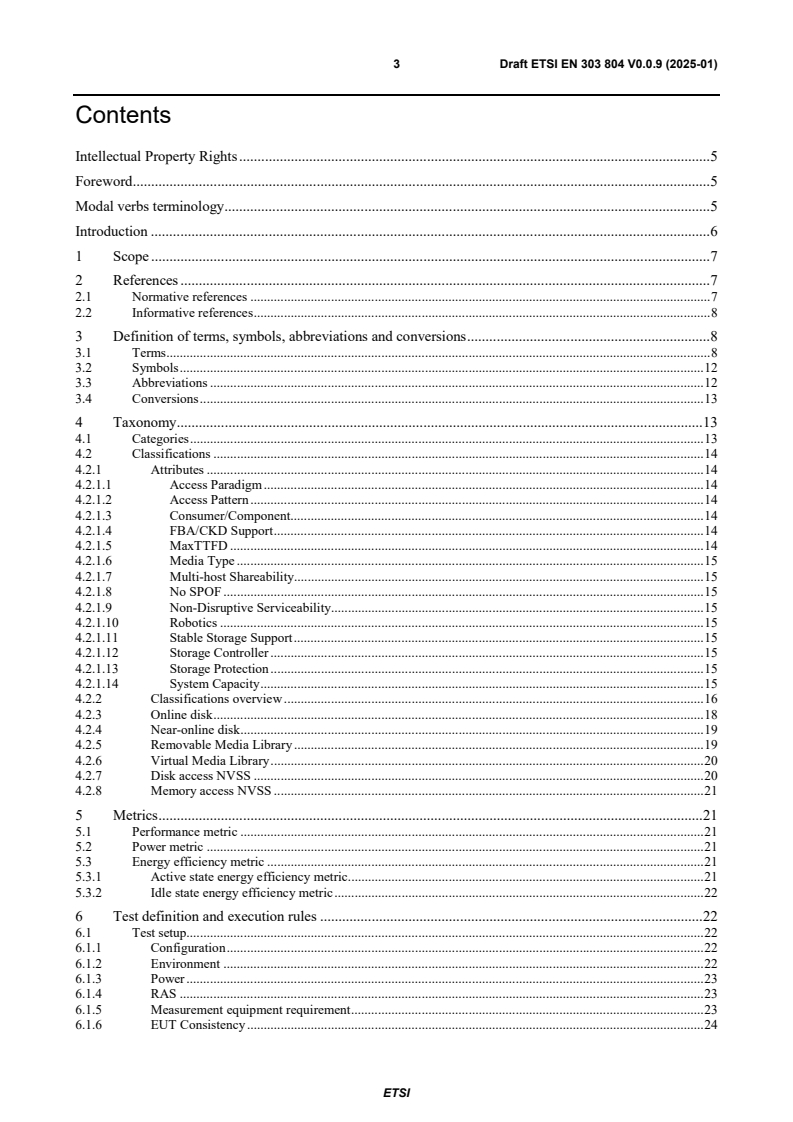
Contents
Intellectual Property Rights . 5
Foreword . 5
Modal verbs terminology . 5
Introduction . 6
1 Scope . 7
2 References . 7
2.1 Normative references . 7
2.2 Informative references . 8
3 Definition of terms, symbols, abbreviations and conversions . 8
3.1 Terms . 8
3.2 Symbols . 12
3.3 Abbreviations . 12
3.4 Conversions . 13
4 Taxonomy . 13
4.1 Categories . 13
4.2 Classifications . 14
4.2.1 Attributes . 14
4.2.1.1 Access Paradigm . 14
4.2.1.2 Access Pattern . 14
4.2.1.3 Consumer/Component. 14
4.2.1.4 FBA/CKD Support . 14
4.2.1.5 MaxTTFD . 14
4.2.1.6 Media Type . 15
4.2.1.7 Multi-host Shareability . 15
4.2.1.8 No SPOF . 15
4.2.1.9 Non-Disruptive Serviceability. 15
4.2.1.10 Robotics . 15
4.2.1.11 Stable Storage Support . 15
4.2.1.12 Storage Controller . 15
4.2.1.13 Storage Protection . 15
4.2.1.14 System Capacity . 15
4.2.2 Classifications overview . 16
4.2.3 Online disk . 18
4.2.4 Near-online disk . 19
4.2.5 Removable Media Library . 19
4.2.6 Virtual Media Library . 20
4.2.7 Disk access NVSS . 20
4.2.8 Memory access NVSS . 21
5 Metrics . 21
5.1 Performance metric . 21
5.2 Power metric . 21
5.3 Energy efficiency metric . 21
5.3.1 Active state energy efficiency metric. 21
5.3.2 Idle state energy efficiency metric . 22
6 Test definition and execution rules . 22
6.1 Test setup. 22
6.1.1 Configuration . 22
6.1.2 Environment . 22
6.1.3 Power . 23
6.1.4 RAS . 23
6.1.5 Measurement equipment requirement . 23
6.1.6 EUT Consistency . 24
ETSI
4 Draft ETSI EN 303 804 V0.0.9 (2025-01)
6.2 Equipment Under Test (EUT) Configuration . 24
6.3 Workload . 25
6.3.1 General . 25
6.3.2 Block Access IO Profiles . 25
6.3.3 File Access IO Profiles . 25
6.3.3.1 Overview of Workloads . 25
6.3.3.2 Software Building Workload . 26
6.3.3.3 Video Data Acquisition Workload . 26
6.3.3.4 Electronic Design Automation Workload . 26
6.3.3.5 AI Image Workload. 26
6.3.3.6 Genomics Workload. 26
6.3.4 Workload Generator . 26
6.4 Test procedures . 27
6.4.1 Block Access workload Test procedure . 27
6.4.2 File Access workload Test procedure . 28
6.4.3 Test procedure for idle power at normal operating conditions . 28
7 Measurement . 29
7.1 Measurement for active state efficiency . 29
7.2 Measurement for idle state efficiency . 29
7.3 Measurement metrics and intervals . 30
7.4 Sensitivity analysis . 30
7.5 Active state Periodic energy efficiency . 30
7.6 Idle state energy efficiency . 31
7.7 Total energy efficiency score . 31
8 Test report . 31
9 Energy saving level evaluation . 33
9.1 General . 33
9.2 Energy saving feature . 33
9.2.1 Energy saving features at idle and low loadlevel state. 33
9.2.2 Energy saving features in active state . 33
9.3 Evaluation methodology . 33
9.3.1 Information obtaining . 33
9.3.2 scoring rules . 33
Annex A (informative): BenchDEE Benchmark . 35 ®
Annex B (informative): SPECstorage Solution 2020 . 36
Annex C (informative): CTS Lite Device . 37
Annex D (informative): SNIA Emerald™ Power Efficiency Measurement . 38
Annex E (normative): Block Access workload IO Profile . 39
Annex F (normative): File Access workload IO Profile . 41
Annex G (informative): Bibliography . 43
History . 44
ETSI
5 Draft ETSI EN 303 804 V0.0.9 (2025-01)
Intellectual Property Rights
Essential patents
IPRs essential or potentially essential to normative deliverables may have been declared to ETSI. The declarations
pertaining to these essential IPRs, if any, are publicly available for ETSI members and non-members, and can be
found in ETSI SR 000 314: "Intellectual Property Rights (IPRs); Essential, or potentially Essential, IPRs notified to
ETSI in respect of ETSI standards", which is available from the ETSI Secretariat. Latest updates are available on the
ETSI IPR online database.
Pursuant to the ETSI Directives including the ETSI IPR Policy, no investigation regarding the essentiality of IPRs,
including IPR searches, has been carried out by ETSI. No guarantee can be given as to the existence of other IPRs not
referenced in ETSI SR 000 314 (or the updates on the ETSI Web server) which are, or may be, or may become,
essential to the present document.
Trademarks
The present document may include trademarks and/or tradenames which are asserted and/or registered by their owners.
ETSI claims no ownership of these except for any which are indicated as being the property of ETSI, and conveys no
right to use or reproduce any trademark and/or tradename. Mention of those trademarks in the present document does
not constitute an endorsement by ETSI of products, services or organizations associated with those trademarks.
DECT™, PLUGTESTS™, UMTS™ and the ETSI logo are trademarks of ETSI registered for the benefit of its
Members. 3GPP™, LTE™ and 5G™ logo are trademarks of ETSI registered for the benefit of its Members and of the
3GPP Organizational Partners. oneM2M™ logo is a trademark of ETSI registered for the benefit of its Members and of ®
the oneM2M Partners. GSM and the GSM logo are trademarks registered and owned by the GSM Association.
Foreword
This draft European Standard (EN) has been produced by ETSI Technical Committee Environmental Engineering (EE),
and is now submitted for the combined Public Enquiry and Vote phase of the ETSI EN Approval Procedure (ENAP).
Proposed national transposition dates
Date of latest announcement of this EN (doa): 3 months after ETSI publication
Date of latest publication of new National Standard
or endorsement of this EN (dop/e): 6 months after doa
Date of withdrawal of any conflicting National Standard (dow): 6 months after doa
Modal verbs terminology
In the present document "shall", "shall not", "should", "should not", "may", "need not", "will", "will not", "can" and
"cannot" are to be interpreted as described in clause 3.2 of the ETSI Drafting Rules (Verbal forms for the expression of
provisions).
"must" and "must not" are NOT allowed in ETSI deliverables except when used in direct citation.
ETSI
6 Draft ETSI EN 303 804 V0.0.9 (2025-01)
Introduction
The present document specifies:
1) A metric for the assessment of energy efficiency of Data Storage Equipment (DSE).
The metric for energy efficiency of DSE is different from server's. For DSE it is important to evaluate the performance
of data operation in the unit of Input/Output operations or data throughput per second, while for servers it is mainly to
evaluate the performance of computing.
For comparison, evaluations should be conducted across similar types of categories of DSE. The present document
categorizes DSE to address applicability, configuration groupings to represent a family of DSE to address the broad
range of custom configurations possible within each family, and tool revision control to ensure comparability and
consistency of the resulting metric value.
2) Test and evaluation methodologies for the assessment of energy efficiency of DSE.
The present document formalizes the tools, conditions and calculations used to generate a single figure of merit of DSE.
The present document formalizes the methodology for evaluating energy saving level of DSE from the perspective of
supported energy saving feature.
The present document considers some benchmark documents on energy efficiency of DSE.
ETSI
7 Draft ETSI EN 303 804 V0.0.9 (2025-01)
1 Scope
The present document is based upon Energy Efficiency Benchmark for Data storage products.
The present document specifies:
1) an active state metric, test conditions and product family configuration for the assessment of energy efficiency
of DSE using reliable, accurate and reproducible measurement methods;
2) an idle state metric and the calculation of the idle state power;
3) a measurement method of the active state power;
4) a measurement method of the idle state power;
5) the measurement and calculation of the maximum power;
6) the measurement and calculation of the operating condition class, the ASHRAE validation, using reliable,
accurate and reproducible measurement methods, which take into account the recognized state of the art;
7) requirements for equipment to perform the measurements and analysis;
8) documentation and reporting requirements;
9) evaluation methodology for energy saving level from the perspective of supported energy saving features.
The present document addresses DSE.
The present document is applicable at the energy efficiency of:
• online storage;
• nearline storage.
The present document defines metric for the assessment of energy efficiency of DSE and related testing methodology
considering data storage equipment HW and system.
2 References
2.1 Normative references
References are either specific (identified by date of publication and/or edition number or version number) or
non-specific. For specific references, only the cited version applies. For non-specific references, the latest version of the
referenced document (including any amendments) applies.
Referenced documents which are not found to be publicly available in the expected location might be found in the
ETSI docbox.
NOTE: While any hyperlinks included in this clause were valid at the time of publication, ETSI cannot guarantee
their long term validity.
The following referenced documents are necessary for the application of the present document.
[1] ANSI INCITS 400-2004: "Information Technology - SCSI Object-Based Storage Device
Commands (OSD)".
[2] ANSI INCITS 458-2011: "Information Technology - SCSI Object Based Storage Device
Commands- 2 (OSD 2)".
ETSI
8 Draft ETSI EN 303 804 V0.0.9 (2025-01)
2.2 Informative references
References are either specific (identified by date of publication and/or edition number or version number) or
non-specific. For specific references, only the cited version applies. For non-specific references, the latest version of the
referenced document (including any amendments) applies.
NOTE: While any hyperlinks included in this clause were valid at the time of publication, ETSI cannot guarantee
their long term validity.
The following referenced documents are not necessary for the application of the present document but they assist the
user with regard to a particular subject area.
[i.1] "SNIA Emerald™ Power Efficiency Measurement Specification", Version 4.0.0.
[i.2] BenchDEE. ®
[i.3] "SPECstorage Solution 2020".
[i.4] "CTS Lite Device Test - Power Efficiency Measurement".
[i.5] ASHRAE TC 9.9 Reference Card: "Equipment Thermal Guidelines for Data Processing
Environments".
3 Definition of terms, symbols, abbreviations and
conversions
3.1 Terms
For the purposes of the present document, the following terms apply:
a.c.-d.c. power supply unit: power supply unit that converts line-voltage alternating current (a.c.) input power into one
or more direct current (d.c.) power outputs
active state: operational state of a DSE (as opposed to the idle state) in which the DSE is carrying out work in response
to prior or concurrent external requests (e.g. instruction over the network), mainly data operation work
auto-tiering: policy-based system that automatically places and moves data across tiers to optimize performance
service levels, cost targets, and overall energy consumption
NOTE: Each storage tier may comprise different storage technologies, offering varying performance, cost, and
energy consumption characteristics.
blade storage: storage device that is designed for use in a blade chassis and that is dependent upon shared blade chassis
resources (e.g. power supplies, cooling) for operation
cache: temporary data storage, not directly addressable by end-user applications, used to store data for expedited access
to or from slower media
committed data: data that has been written to stable storage
compression: process of encoding data to reduce its size
controller system: computer or computer server that manages a benchmark evaluation process
Count-Key-Data (CKD): disk data organization model in which the disk is assumed to consist of a fixed number of
tracks, each having a maximum data capacity
NOTE: The CKD architecture derives its name from the record format, which consists of a field containing the
number of bytes of data and a record address, an optional key field by which particular records can be
easily recognized, and the data itself.
ETSI
9 Draft ETSI EN 303 804 V0.0.9 (2025-01)
data deduplication: replacement of multiple copies of data at variable levels of granularity with references to a shared
copy in order to save storage space and/or bandwidth
Data Storage Equipment (DSE): collective term for disk drives, solid state drives and modules, tape cartridges, and
any other mechanisms providing non-volatile data storage
data storage server: enterprise storage device which contains the same components as a computer server together with
rd
≥ 10 storage devices and software (vendor or 3 party) that supports storage system connectivity, capacity optimization
management, virtualized storage environment and software defined storage
NOTE: Supporting features are described by the product's datasheet description and are either accompanied with
vendor specific utilities and/or commercially available software supporting these functions.
data storage system: fully-functional system that supplies data storage services to clients and devices attached directly
or through a network
NOTE 1: A storage system may be composed of integrated storage controllers, storage devices, embedded network
elements, software, and other devices.
NOTE 2: While storage system may contain one or more embedded processors, these processors do not execute
user-supplied software applications but may execute data-specific applications (e.g. data replication,
backup utilities, data compression, install agents).
NOTE 3: Components and subsystems that are an integral part of the storage product architecture (e.g. to provide
internal communications between controllers and disks) are considered to be part of the storage system.
NOTE 4: Components that are normally associated with a storage environment (e.g. devices required for operation
of an external Storage Area Network) are not considered to be part of the storage system.
d.c.-d.c. power supply unit: power supply unit that converts line-voltage direct current (d.c.) input power to one or
more d.c. outputs
NOTE: For purposes of the present document, a d.c-d.c. converter that is internal to a data storage system and is
used to convert a low voltage d.c. (e.g. 12 VDC) into other d.c. power outputs for use by components
inside is not considered a d.c-d.c. power supply unit.
dedupable: property that a collection of data is said to possess if the needed storage capacity for the data is reduced
significantly by data deduplication
delta snapshot: type of point in time copy that preserves the state of data at an instant in time, by storing only those
blocks that are different from an already existing full copy of the data
direct-connected: storage designed to be under the control of a single host, or multiple hosts in a non-shared
environment
efficiency: ratio of workload output to the resource input to the system
energy efficiency: ratio of workload output to the power input to the system
file: abstract data object made up of:
a) an ordered sequence of data bytes stored on a disk or tape;
b) a symbolic name by which the object can be uniquely identified; and
c) a set of properties, such as ownership and access permissions;
that allow the object to be managed by a file system or backup manager
file system: software component that imposes structure on the address space of one or more physical or virtual disks so
that applications may deal more conveniently with abstract named data objects of variable size (files)
Fixed Block Architecture (FBA): model of disks in which storage space is organized as linear, dense address spaces of
blocks of a fixed size
NOTE: Fixed block architecture is the disk model on which SCSI is predicated.
ETSI
10 Draft ETSI EN 303 804 V0.0.9 (2025-01)
formatted capacity: total number of bytes available to be written after a system or device has been formatted for use,
e.g. by an object store, file system or block services manager
NOTE: Formatted capacity is less than or equal to raw capacity. It does not include areas set aside for system use,
spares, RAID parity areas, checksum space, host- or file system-level remapping, "right sizing" of disks,
disk labelling, caches, file system metadata, and so on. However, it may include areas that are normally
reserved such as snapshot set-asides if they can alternatively be configured for ordinary data storage by
the storage administrator.
free space: amount of additional irreducible data that can be written to the product under test as configured
hot band: simulation of naturally occurring areas of storage address space accessed more frequently than is typical
hybrid Solid State Storage and magnetic disk system: storage system whose formatted capacity is provided by a
combination of Solid State Storage and magnetic disk storage devices
hyper converged system: software-defined set of resources with at least two of the following: compute, storage,
networking and/or virtualization
ICT equipment: equipment providing data storage, processing and transport services
NOTE: A combination of Information Technology Equipment and Network Telecommunications Equipment.
idle state: operational state of a DSE (as opposed to the active state) in which the DSE is not performing any useful
work
NOTE 1: The DSE is capable of completing workload transactions, but no active workload transactions are
requested or pending by the system.
NOTE 2: For systems where ACPI standards are applicable, idle state correlates only to ACPI System Level S0.
I/O device: device which provides data input and output capability between a DSE and other devices
NOTE: An I/O device may be integral to the DSE motherboard or may be connected to the motherboard via
expansion slots.
I/O intensity: measure of the number of IOPS requested by a load generator
NOTE: IO intensity is phrased as a percentage of selected maximum IOPS level that satisfies the timing
requirement(s) for a taxonomy category.
I/O port: physical circuitry within an I/O device where an independent I/O session can be established
NOTE: A port is not the same as a connector receptacle; it is possible that a single connector receptacle can
service multiple ports of the same interface.
irreducible data: data that is neither compressible nor dedupable
Just a Bunch Of Disks (JBOD): shelf that does not provide storage protection
NOTE: A JBOD is a "simple" "just a bunch of disks," an architecture that does not provide storage protection
capabilities. The storage devices of a JBOD can function as individual volumes or can be combined to
form a single logical volume by a simple controller. A JBOD provides no redundancy or resilience, so
failure of a single storage device amounts to failure of a whole logical volume. A JBOD is a single shelf.
load generator: hardware and software environment executing the workload generator to drive the product under test
during measurements
Logical Unit (LU): entity within a SCSI target that executes IO commands
Logical Unit Number (LUN): synonym for logical unit
maximum power: peak sustained or root means square power consumption value while operating the worst case
functions
Maximum Time to First Data (MaxTTFD): maximum time required to start receiving data from a storage system to
satisfy a read request for arbitrary data
ETSI
11 Draft ETSI EN 303 804 V0.0.9 (2025-01)
memory: server component external to the processor in which information is stored for immediate use by the processor
motherboard: main circuit board of the DSE typically accommodating the processor, memory, expansion slots and
enabling the attachment of additional circuit boards
network-connected: storage designed to be connected to a host via a network protocol (e.g. TCP/IP, IB, and FC)
non-disruptive serviceability: support for continued availability of data during all service operations
NOTE 1: Examples of non-disruptive serviceability are FRU replacement, code patches, software/firmware
upgrades, configuration changes, data migrations, and system expansion done during production time.
NOTE 2: Service operations may result in performance impacts to data availability, but will not result in a loss of
access.
non-volatile: property of retaining data in the event of the loss of power
normalized performance: relative performance values calibrated to a baseline common to the set of equipment being
evaluated
parity RAID: collective term used to refer to Berkeley RAID Levels 3, 4, 5 and 6
permanent storage: data storage media which can retain data indefinitely without a power source
power supply unit: self-contained device, physically separable from the motherboard of the computer server, that
converts a.c. or d.c. input power to one or more d.c. power outputs for powering the computer server via a removable or
hard-wired electrical connection
raw capacity: sum of the raw, unformatted, uncompressed capacity of each of the storage device in the product under
test
ready idle: operational state in which a system is capable of satisfying an arbitrary IO request within the response time
and MaxTTFD constraints of its selected taxonomy category, but no user-initiated IO requests are being submitted to
the system
NOTE: In the ready idle state, background I/O activity, autonomously initiated by the solution under test, may
take place.
sequential read: IO load consisting of consecutively issued read requests to logically adjacent data
sequential write: IO load consisting of consecutively issued write requests to logically adjacent data
shelf: modular enclosure suitable for installation in a rack
NOTE: A shelf typically houses storage devices, storage controllers, power supplies, and cooling devices. A shelf
typically has a pre-wired backplane that carries power and I/O interconnect signals to the housed
components.
Single Point of Failure (SPOF): one component or path in a system, the failure of which would make the system
inoperable or data inaccessible
solid state drive: storage device that uses memory chips instead of rotating magnetic platters for data storage
solid state storage: storage capability built from non-volatile solid state electronic devices
storage controller: device for handling storage requests that includes a processor or sequencer programmed to
autonomously process a substantial portion of IO requests directed to storage devices
NOTE: This definition is specifically intended to exclude aggregating storage elements such as RAID array
subsystems, robotic tape libraries, filers, and file servers. Also excluded are storage devices which are not
directly accessible by end-user application programs, and are instead employed as a form of internal
cache.
storage protection: any combination of hardware and software (e.g. RAID, NVRAM, disk sparing and background
disk scrubbing or media scan) that assures that all completed IO operations will be preserved in the event of power loss
or storage device failure
ETSI
12 Draft ETSI EN 303 804 V0.0.9 (2025-01)
system crash: hardware or software failure which causes data to be temporarily unavailable and which requires a
reboot of one or more hardware components and/or re-initialization of one or more software components in order for
data access to be restored
Uninterruptible Power Supply (UPS): combination of convertors, switches, and energy storage devices (such as
batteries) constituting a power system for maintaining continuity of load power in case of input power failure
virtual drive: removable media storage device, e.g. tape drive, that is emulated using other storage devices
weighted geometric mean: geometric mean calculated using a predetermined factor for each of the elements prior to
aggregation
worklet: synthetic software routine, using real application functions focused on a particular type of data operation
activity, which stresses a particular characteristic of the system
workload generator: software used in the load generator to drive the product under test during measurement
3.2 Symbols
Void.
3.3 Abbreviations
For the purposes of the present document, the following abbreviations apply:
a.c., AC Alternating Current
ACPI Advanced Configuration and Power Interface
ASHRAE American Society of Heating, Refrigerating and Air-Conditioning Engineers
BIOS Basic Input/Output System
CPU Central Processor Unit
d.c., DC Direct Current
DSE Data Storage Equipment
ESC Energy Saving Cooling
ETSI European Telecommunications Standards Institute
EUT Equipment Under Test
FBA Fixed Block Architecture
FRU Field-Replaceable Unit
GB GigaByte
HDD Hard Disk Drive
I/O Input/Output
ICT Information and Communication Technology
ID IDentification
INCITS InterNational Committee for Information Technology Standards
IOPS Input/Output operation Per Second
JBOD Just a Bunch Of Disks
MaxTTFD Maximum Time To First Data
NVRAM Non-Volatile Random Access Memory
NVSS Non-Volatile Solid State
OS Operating System
OSD Object-based Storage Device
PDU Power Distribution Unit
PSU Power Supply Unit
RAID Redundant Array of Independent Disks
RAS Reliability, Availability, and Serviceability
RMS Root Mean Square
RVML Removable and Virtual Media Library
SCSI Small Computer System Interface
SPOF Single Point of Failure
SSD Solid State Drive
UPS Uninterruptible Power Supply
VDA Video Data Acquisition
ETSI
13 Draft ETSI EN 303 804 V0.0.9 (2025-01)
VDC Volts (DC)
3.4 Conversions
For the purposes of the present document, the following conversions apply:
A kilobyte (KB) is equal to 10 B.
A megabyte (MB) is equal to 10 B.
A gigabyte (GB) is equal to 10 B.
A terabyte (TB) is equal to 10 B
A petabyte (PB) is equal to 10 B.
An exabyte (EB) is equal to 10 B.
A kibibyte (KiB) is equal to 2 B.
A mebibyte (MiB) is equal to 2 B.
A gibibyte (GiB) is equal to 2 B.
A tebibyte (TiB) is equal to 2 B.
A pebibyte (PiB) is equal to 2 B.
An exbibyte (EiB) is equal to 2 B.
4 Taxonomy
4.1 Categories
The Taxonomy of DSE is specified in order to define suitable energy efficiency measurement methods for different
types of DSE. Performance and energy efficiency comparison is suggested to conducted among same categories of
DSEs.
Categories of DSE are defined based on attributes including media type and access paradigm.
Media types include magnetic disk, magnetic tape, optical disk, solid state disk and hybrid disk. A DSE with hybrid
disk has both magnetic disks and solid state disks.
Access paradigm is one or more of block access, file access, object access, and memory access. A DSE with block
access paradigm shall provide fixed-block or CKD access to data, e.g. via SCSI block access for disks/tapes. A DSE
with file access paradigm shall provide file access to data, e.g. via the NFS protocol. A DSE with object access
paradigm shall provide object access to data, e.g. via the SCSI OSD protocol (ANSI INCITS 400-2004 [1] and ANSI
INCITS 458-2011 [2]). A DSE with memory access paradigm shall provide access to data via CPU memory access
instructions, e.g. load and store.
In conclusion, DSEs are classified into the following categories:
• Online disk
• Near-Online disk
• Removable Media Library
• Virtual Media Library
• Disk Access NVSS
• Memory Access NVSS
Attributes of different categories of DSE are listed in Table 1.
ETSI
14 Draft ETSI EN 303 804 V0.0.9 (2025-01)
Table 1: Taxonomy categories overview
Disk RVML NVSS
Category Near-online Removable Virtual Media Disk access Memory
Online disk
disk Media Library Library NVSS access NVSS
Solid State
Magnetic disk,
Magnetic tape, Storage + Solid State
Media Type Magnetic disk Magnetic disk Solid State
optical disk optional Storage
Storage
magnetic diska
Access
Block, File, Block, File, Block, File,
Block Block memory
Paradigm Object Object Object
4.2 Classifications
4.2.1 Attributes
4.2.1.1 Access Paradigm
Access Paradigm is one or more of Block, File, Object, and Memory.
A storage product having the Block Access Paradigm attribute shall provide fixed-block or CKD access to data, e.g. via
SCSI block access for disks/tapes.
A storage product having the File Access Paradigm attribute shall provide file access to data, e.g. via the NFS protocol.
A storage product having the Object Access Paradigm attribute shall provide object access to data, e.g. via the SCSI
OSD protocol [1] and [2].
A storage product having the Memory Paradigm attribute shall provide access to data via CPU memory access
instructions, e.g. load and store.
4.2.1.2 Access Pattern
Access Pattern is one or more of Random and Sequential.
A storage product having the Random Access Pattern attribute shall provide roughly equal access time to any stored
data.
A storage product having the Sequential Access Pattern attribute may provide faster access to data at the address
following the last accessed data than to other data.
4.2.1.3 Consumer/Component
A consumer product is any of a
...
EUROPEAN STANDARD
Environmental Engineering (EE);
Energy efficiency metrics and measurement methods
for data storage equipment
2 ETSI EN 303 804 V1.1.1 (2025-06)
Reference
DEN/EE-EEPS44
Keywords
data storage, data storage equipment, energy
efficiency, environment, measurement, metrics,
storage
ETSI
650 Route des Lucioles
F-06921 Sophia Antipolis Cedex - FRANCE
Tel.: +33 4 92 94 42 00 Fax: +33 4 93 65 47 16
Siret N° 348 623 562 00017 - APE 7112B
Association à but non lucratif enregistrée à la
Sous-Préfecture de Grasse (06) N° w061004871
Important notice
The present document can be downloaded from the
ETSI Search & Browse Standards application.
The present document may be made available in electronic versions and/or in print. The content of any electronic and/or
print versions of the present document shall not be modified without the prior written authorization of ETSI. In case of any
existing or perceived difference in contents between such versions and/or in print, the prevailing version of an ETSI
deliverable is the one made publicly available in PDF format on ETSI deliver repository.
Users should be aware that the present document may be revised or have its status changed,
this information is available in the Milestones listing.
If you find errors in the present document, please send your comments to
the relevant service listed under Committee Support Staff.
If you find a security vulnerability in the present document, please report it through our
Coordinated Vulnerability Disclosure (CVD) program.
Notice of disclaimer & limitation of liability
The information provided in the present deliverable is directed solely to professionals who have the appropriate degree of
experience to understand and interpret its content in accordance with generally accepted engineering or
other professional standard and applicable regulations.
No recommendation as to products and services or vendors is made or should be implied.
In no event shall ETSI be held liable for loss of profits or any other incidental or consequential damages.
Any software contained in this deliverable is provided "AS IS" with no warranties, express or implied, including but not
limited to, the warranties of merchantability, fitness for a particular purpose and non-infringement of intellectual property
rights and ETSI shall not be held liable in any event for any damages whatsoever (including, without limitation, damages
for loss of profits, business interruption, loss of information, or any other pecuniary loss) arising out of or related to the use
of or inability to use the software.
Copyright Notification
No part may be reproduced or utilized in any form or by any means, electronic or mechanical, including photocopying and
microfilm except as authorized by written permission of ETSI.
The content of the PDF version shall not be modified without the written authorization of ETSI.
The copyright and the foregoing restriction extend to reproduction in all media.
© ETSI 2025.
All rights reserved.
ETSI
3 ETSI EN 303 804 V1.1.1 (2025-06)
Contents
Intellectual Property Rights . 5
Foreword . 5
Modal verbs terminology . 5
Introduction . 6
1 Scope . 7
2 References . 7
2.1 Normative references . 7
2.2 Informative references . 8
3 Definition of terms, symbols, abbreviations and conversions . 8
3.1 Terms . 8
3.2 Symbols . 12
3.3 Abbreviations . 12
3.4 Conversions . 13
4 Taxonomy . 13
4.1 Categories . 13
4.2 Classifications . 14
4.2.1 Attributes . 14
4.2.1.1 Access Paradigm . 14
4.2.1.2 Access Pattern . 14
4.2.1.3 Consumer/Component. 14
4.2.1.4 FBA/CKD Support . 14
4.2.1.5 MaxTTFD . 14
4.2.1.6 Media Type . 15
4.2.1.7 Multi-host Shareability . 15
4.2.1.8 No SPOF . 15
4.2.1.9 Non-Disruptive Serviceability. 15
4.2.1.10 Robotics . 15
4.2.1.11 Stable Storage Support . 15
4.2.1.12 Storage Controller . 15
4.2.1.13 Storage Protection . 15
4.2.1.14 System Capacity . 15
4.2.2 Classifications overview . 16
4.2.3 Online disk . 18
4.2.4 Near-online disk . 19
4.2.5 Removable Media Library . 19
4.2.6 Virtual Media Library . 20
4.2.7 Disk access NVSS . 20
4.2.8 Memory access NVSS . 21
5 Metrics . 21
5.1 Performance metric . 21
5.2 Power metric . 21
5.3 Energy efficiency metric . 21
5.3.1 Active state energy efficiency metric. 21
5.3.2 Idle state energy efficiency metric . 22
6 Test definition and execution rules . 22
6.1 Test setup. 22
6.1.1 Configuration . 22
6.1.2 Environment . 22
6.1.3 Power . 23
6.1.4 RAS . 23
6.1.5 Measurement equipment requirement . 23
6.1.6 EUT Consistency . 24
ETSI
4 ETSI EN 303 804 V1.1.1 (2025-06)
6.2 Equipment Under Test (EUT) Configuration . 24
6.3 Workload . 25
6.3.1 General . 25
6.3.2 Block Access IO Profiles . 25
6.3.3 File Access IO Profiles . 25
6.3.3.1 Overview of Workloads . 25
6.3.3.2 Software Building Workload . 26
6.3.3.3 Video Data Acquisition Workload . 26
6.3.3.4 Electronic Design Automation Workload . 26
6.3.3.5 AI Image Workload. 26
6.3.3.6 Genomics Workload. 26
6.3.4 Workload Generator . 26
6.4 Test procedures . 27
6.4.1 Block Access workload Test procedure . 27
6.4.2 File Access workload Test procedure . 28
6.4.3 Test procedure for idle power at normal operating conditions . 28
7 Measurement . 29
7.1 Measurement for active state efficiency . 29
7.2 Measurement for idle state efficiency . 29
7.3 Measurement metrics and intervals . 30
7.4 Sensitivity analysis . 30
7.5 Active state Periodic energy efficiency . 30
7.6 Idle state energy efficiency . 31
7.7 Total energy efficiency score . 31
8 Test report . 31
9 Energy saving level evaluation . 33
9.1 General . 33
9.2 Energy saving feature . 33
9.2.1 Energy saving features at idle and low loadlevel state. 33
9.2.2 Energy saving features in active state . 33
9.3 Evaluation methodology . 33
9.3.1 Information obtaining . 33
9.3.2 scoring rules . 33
Annex A (informative): BenchDEE Benchmark . 35 ®
Annex B (informative): SPECstorage Solution 2020 . 36
Annex C (informative): CTS Lite Device . 37
Annex D (informative): SNIA Emerald™ Power Efficiency Measurement . 38
Annex E (normative): Block Access workload IO Profile . 39
Annex F (normative): File Access workload IO Profile . 41
Annex G (informative): Bibliography . 43
History . 44
ETSI
5 ETSI EN 303 804 V1.1.1 (2025-06)
Intellectual Property Rights
Essential patents
IPRs essential or potentially essential to normative deliverables may have been declared to ETSI. The declarations
pertaining to these essential IPRs, if any, are publicly available for ETSI members and non-members, and can be
found in ETSI SR 000 314: "Intellectual Property Rights (IPRs); Essential, or potentially Essential, IPRs notified to
ETSI in respect of ETSI standards", which is available from the ETSI Secretariat. Latest updates are available on the
ETSI IPR online database.
Pursuant to the ETSI Directives including the ETSI IPR Policy, no investigation regarding the essentiality of IPRs,
including IPR searches, has been carried out by ETSI. No guarantee can be given as to the existence of other IPRs not
referenced in ETSI SR 000 314 (or the updates on the ETSI Web server) which are, or may be, or may become,
essential to the present document.
Trademarks
The present document may include trademarks and/or tradenames which are asserted and/or registered by their owners.
ETSI claims no ownership of these except for any which are indicated as being the property of ETSI, and conveys no
right to use or reproduce any trademark and/or tradename. Mention of those trademarks in the present document does
not constitute an endorsement by ETSI of products, services or organizations associated with those trademarks.
DECT™, PLUGTESTS™, UMTS™ and the ETSI logo are trademarks of ETSI registered for the benefit of its
Members. 3GPP™, LTE™ and 5G™ logo are trademarks of ETSI registered for the benefit of its Members and of the
3GPP Organizational Partners. oneM2M™ logo is a trademark of ETSI registered for the benefit of its Members and of ®
the oneM2M Partners. GSM and the GSM logo are trademarks registered and owned by the GSM Association.
Foreword
This European Standard (EN) has been produced by ETSI Technical Committee Environmental Engineering (EE).
National transposition dates
Date of adoption of this EN: 30 April 2025
Date of latest announcement of this EN (doa): 31 July 2025
Date of latest publication of new National Standard
or endorsement of this EN (dop/e): 31 January 2026
Date of withdrawal of any conflicting National Standard (dow): 31 January 2026
Modal verbs terminology
In the present document "shall", "shall not", "should", "should not", "may", "need not", "will", "will not", "can" and
"cannot" are to be interpreted as described in clause 3.2 of the ETSI Drafting Rules (Verbal forms for the expression of
provisions).
"must" and "must not" are NOT allowed in ETSI deliverables except when used in direct citation.
ETSI
6 ETSI EN 303 804 V1.1.1 (2025-06)
Introduction
The present document specifies:
1) A metric for the assessment of energy efficiency of Data Storage Equipment (DSE).
The metric for energy efficiency of DSE is different from server's. For DSE it is important to evaluate the performance
of data operation in the unit of Input/Output operations or data throughput per second, while for servers it is mainly to
evaluate the performance of computing.
For comparison, evaluations should be conducted across similar types of categories of DSE. The present document
categorizes DSE to address applicability, configuration groupings to represent a family of DSE to address the broad
range of custom configurations possible within each family, and tool revision control to ensure comparability and
consistency of the resulting metric value.
2) Test and evaluation methodologies for the assessment of energy efficiency of DSE.
The present document formalizes the tools, conditions and calculations used to generate a single figure of merit of DSE.
The present document formalizes the methodology for evaluating energy saving level of DSE from the perspective of
supported energy saving feature.
The present document considers some benchmark documents on energy efficiency of DSE.
ETSI
7 ETSI EN 303 804 V1.1.1 (2025-06)
1 Scope
The present document is based upon Energy Efficiency Benchmark for Data storage products.
The present document specifies:
1) an active state metric, test conditions and product family configuration for the assessment of energy efficiency
of DSE using reliable, accurate and reproducible measurement methods;
2) an idle state metric and the calculation of the idle state power;
3) a measurement method of the active state power;
4) a measurement method of the idle state power;
5) the measurement and calculation of the maximum power;
6) the measurement and calculation of the operating condition class, the ASHRAE validation, using reliable,
accurate and reproducible measurement methods, which take into account the recognized state of the art;
7) requirements for equipment to perform the measurements and analysis;
8) documentation and reporting requirements;
9) evaluation methodology for energy saving level from the perspective of supported energy saving features.
The present document addresses DSE.
The present document is applicable at the energy efficiency of:
• online storage;
• nearline storage.
The present document defines metric for the assessment of energy efficiency of DSE and related testing methodology
considering data storage equipment HW and system.
2 References
2.1 Normative references
References are either specific (identified by date of publication and/or edition number or version number) or
non-specific. For specific references, only the cited version applies. For non-specific references, the latest version of the
referenced document (including any amendments) applies.
Referenced documents which are not found to be publicly available in the expected location might be found in the
ETSI docbox.
NOTE: While any hyperlinks included in this clause were valid at the time of publication, ETSI cannot guarantee
their long term validity.
The following referenced documents are necessary for the application of the present document.
[1] ANSI INCITS 400-2004: "Information Technology - SCSI Object-Based Storage Device
Commands (OSD)".
[2] ANSI INCITS 458-2011: "Information Technology - SCSI Object Based Storage Device
Commands- 2 (OSD 2)".
ETSI
8 ETSI EN 303 804 V1.1.1 (2025-06)
2.2 Informative references
References are either specific (identified by date of publication and/or edition number or version number) or
non-specific. For specific references, only the cited version applies. For non-specific references, the latest version of the
referenced document (including any amendments) applies.
NOTE: While any hyperlinks included in this clause were valid at the time of publication, ETSI cannot guarantee
their long term validity.
The following referenced documents are not necessary for the application of the present document but they assist the
user with regard to a particular subject area.
[i.1] "SNIA Emerald™ Power Efficiency Measurement Specification", Version 4.0.0.
[i.2] BenchDEE. ®
[i.3] "SPECstorage Solution 2020".
[i.4] "CTS Lite Device Test - Power Efficiency Measurement".
[i.5] ASHRAE TC 9.9 Reference Card: "Equipment Thermal Guidelines for Data Processing
Environments".
3 Definition of terms, symbols, abbreviations and
conversions
3.1 Terms
For the purposes of the present document, the following terms apply:
a.c.-d.c. power supply unit: power supply unit that converts line-voltage alternating current (a.c.) input power into one
or more direct current (d.c.) power outputs
active state: operational state of a DSE (as opposed to the idle state) in which the DSE is carrying out work in response
to prior or concurrent external requests (e.g. instruction over the network), mainly data operation work
auto-tiering: policy-based system that automatically places and moves data across tiers to optimize performance
service levels, cost targets, and overall energy consumption
NOTE: Each storage tier may comprise different storage technologies, offering varying performance, cost, and
energy consumption characteristics.
blade storage: storage device that is designed for use in a blade chassis and that is dependent upon shared blade chassis
resources (e.g. power supplies, cooling) for operation
cache: temporary data storage, not directly addressable by end-user applications, used to store data for expedited access
to or from slower media
committed data: data that has been written to stable storage
compression: process of encoding data to reduce its size
controller system: computer or computer server that manages a benchmark evaluation process
Count-Key-Data (CKD): disk data organization model in which the disk is assumed to consist of a fixed number of
tracks, each having a maximum data capacity
NOTE: The CKD architecture derives its name from the record format, which consists of a field containing the
number of bytes of data and a record address, an optional key field by which particular records can be
easily recognized, and the data itself.
ETSI
9 ETSI EN 303 804 V1.1.1 (2025-06)
data deduplication: replacement of multiple copies of data at variable levels of granularity with references to a shared
copy in order to save storage space and/or bandwidth
Data Storage Equipment (DSE): collective term for disk drives, solid state drives and modules, tape cartridges, and
any other mechanisms providing non-volatile data storage
data storage server: enterprise storage device which contains the same components as a computer server together with
rd
≥ 10 storage devices and software (vendor or 3 party) that supports storage system connectivity, capacity optimization
management, virtualized storage environment and software defined storage
NOTE: Supporting features are described by the product's datasheet description and are either accompanied with
vendor specific utilities and/or commercially available software supporting these functions.
data storage system: fully-functional system that supplies data storage services to clients and devices attached directly
or through a network
NOTE 1: A storage system may be composed of integrated storage controllers, storage devices, embedded network
elements, software, and other devices.
NOTE 2: While storage system may contain one or more embedded processors, these processors do not execute
user-supplied software applications but may execute data-specific applications (e.g. data replication,
backup utilities, data compression, install agents).
NOTE 3: Components and subsystems that are an integral part of the storage product architecture (e.g. to provide
internal communications between controllers and disks) are considered to be part of the storage system.
NOTE 4: Components that are normally associated with a storage environment (e.g. devices required for operation
of an external Storage Area Network) are not considered to be part of the storage system.
d.c.-d.c. power supply unit: power supply unit that converts line-voltage direct current (d.c.) input power to one or
more d.c. outputs
NOTE: For purposes of the present document, a d.c-d.c. converter that is internal to a data storage system and is
used to convert a low voltage d.c. (e.g. 12 VDC) into other d.c. power outputs for use by components
inside is not considered a d.c-d.c. power supply unit.
dedupable: property that a collection of data is said to possess if the needed storage capacity for the data is reduced
significantly by data deduplication
delta snapshot: type of point in time copy that preserves the state of data at an instant in time, by storing only those
blocks that are different from an already existing full copy of the data
direct-connected: storage designed to be under the control of a single host, or multiple hosts in a non-shared
environment
efficiency: ratio of workload output to the resource input to the system
energy efficiency: ratio of workload output to the power input to the system
file: abstract data object made up of:
a) an ordered sequence of data bytes stored on a disk or tape;
b) a symbolic name by which the object can be uniquely identified; and
c) a set of properties, such as ownership and access permissions;
that allow the object to be managed by a file system or backup manager
file system: software component that imposes structure on the address space of one or more physical or virtual disks so
that applications may deal more conveniently with abstract named data objects of variable size (files)
Fixed Block Architecture (FBA): model of disks in which storage space is organized as linear, dense address spaces of
blocks of a fixed size
NOTE: Fixed block architecture is the disk model on which SCSI is predicated.
ETSI
10 ETSI EN 303 804 V1.1.1 (2025-06)
formatted capacity: total number of bytes available to be written after a system or device has been formatted for use,
e.g. by an object store, file system or block services manager
NOTE: Formatted capacity is less than or equal to raw capacity. It does not include areas set aside for system use,
spares, RAID parity areas, checksum space, host- or file system-level remapping, "right sizing" of disks,
disk labelling, caches, file system metadata, and so on. However, it may include areas that are normally
reserved such as snapshot set-asides if they can alternatively be configured for ordinary data storage by
the storage administrator.
free space: amount of additional irreducible data that can be written to the product under test as configured
hot band: simulation of naturally occurring areas of storage address space accessed more frequently than is typical
hybrid Solid State Storage and magnetic disk system: storage system whose formatted capacity is provided by a
combination of Solid State Storage and magnetic disk storage devices
hyper converged system: software-defined set of resources with at least two of the following: compute, storage,
networking and/or virtualization
ICT equipment: equipment providing data storage, processing and transport services
NOTE: A combination of Information Technology Equipment and Network Telecommunications Equipment.
idle state: operational state of a DSE (as opposed to the active state) in which the DSE is not performing any useful
work
NOTE 1: The DSE is capable of completing workload transactions, but no active workload transactions are
requested or pending by the system.
NOTE 2: For systems where ACPI standards are applicable, idle state correlates only to ACPI System Level S0.
I/O device: device which provides data input and output capability between a DSE and other devices
NOTE: An I/O device may be integral to the DSE motherboard or may be connected to the motherboard via
expansion slots.
I/O intensity: measure of the number of IOPS requested by a load generator
NOTE: IO intensity is phrased as a percentage of selected maximum IOPS level that satisfies the timing
requirement(s) for a taxonomy category.
I/O port: physical circuitry within an I/O device where an independent I/O session can be established
NOTE: A port is not the same as a connector receptacle; it is possible that a single connector receptacle can
service multiple ports of the same interface.
irreducible data: data that is neither compressible nor dedupable
Just a Bunch Of Disks (JBOD): shelf that does not provide storage protection
NOTE: A JBOD is a "simple" "just a bunch of disks," an architecture that does not provide storage protection
capabilities. The storage devices of a JBOD can function as individual volumes or can be combined to
form a single logical volume by a simple controller. A JBOD provides no redundancy or resilience, so
failure of a single storage device amounts to failure of a whole logical volume. A JBOD is a single shelf.
load generator: hardware and software environment executing the workload generator to drive the product under test
during measurements
Logical Unit (LU): entity within a SCSI target that executes IO commands
Logical Unit Number (LUN): synonym for logical unit
maximum power: peak sustained or root means square power consumption value while operating the worst case
functions
Maximum Time to First Data (MaxTTFD): maximum time required to start receiving data from a storage system to
satisfy a read request for arbitrary data
ETSI
11 ETSI EN 303 804 V1.1.1 (2025-06)
memory: server component external to the processor in which information is stored for immediate use by the processor
motherboard: main circuit board of the DSE typically accommodating the processor, memory, expansion slots and
enabling the attachment of additional circuit boards
network-connected: storage designed to be connected to a host via a network protocol (e.g. TCP/IP, IB, and FC)
non-disruptive serviceability: support for continued availability of data during all service operations
NOTE 1: Examples of non-disruptive serviceability are FRU replacement, code patches, software/firmware
upgrades, configuration changes, data migrations, and system expansion done during production time.
NOTE 2: Service operations may result in performance impacts to data availability, but will not result in a loss of
access.
non-volatile: property of retaining data in the event of the loss of power
normalized performance: relative performance values calibrated to a baseline common to the set of equipment being
evaluated
parity RAID: collective term used to refer to Berkeley RAID Levels 3, 4, 5 and 6
permanent storage: data storage media which can retain data indefinitely without a power source
power supply unit: self-contained device, physically separable from the motherboard of the computer server, that
converts a.c. or d.c. input power to one or more d.c. power outputs for powering the computer server via a removable or
hard-wired electrical connection
raw capacity: sum of the raw, unformatted, uncompressed capacity of each of the storage device in the product under
test
ready idle: operational state in which a system is capable of satisfying an arbitrary IO request within the response time
and MaxTTFD constraints of its selected taxonomy category, but no user-initiated IO requests are being submitted to
the system
NOTE: In the ready idle state, background I/O activity, autonomously initiated by the solution under test, may
take place.
sequential read: IO load consisting of consecutively issued read requests to logically adjacent data
sequential write: IO load consisting of consecutively issued write requests to logically adjacent data
shelf: modular enclosure suitable for installation in a rack
NOTE: A shelf typically houses storage devices, storage controllers, power supplies, and cooling devices. A shelf
typically has a pre-wired backplane that carries power and I/O interconnect signals to the housed
components.
Single Point of Failure (SPOF): one component or path in a system, the failure of which would make the system
inoperable or data inaccessible
solid state drive: storage device that uses memory chips instead of rotating magnetic platters for data storage
solid state storage: storage capability built from non-volatile solid state electronic devices
storage controller: device for handling storage requests that includes a processor or sequencer programmed to
autonomously process a substantial portion of IO requests directed to storage devices
NOTE: This definition is specifically intended to exclude aggregating storage elements such as RAID array
subsystems, robotic tape libraries, filers, and file servers. Also excluded are storage devices which are not
directly accessible by end-user application programs, and are instead employed as a form of internal
cache.
storage protection: any combination of hardware and software (e.g. RAID, NVRAM, disk sparing and background
disk scrubbing or media scan) that assures that all completed IO operations will be preserved in the event of power loss
or storage device failure
ETSI
12 ETSI EN 303 804 V1.1.1 (2025-06)
system crash: hardware or software failure which causes data to be temporarily unavailable and which requires a
reboot of one or more hardware components and/or re-initialization of one or more software components in order for
data access to be restored
Uninterruptible Power Supply (UPS): combination of convertors, switches, and energy storage devices (such as
batteries) constituting a power system for maintaining continuity of load power in case of input power failure
virtual drive: removable media storage device, e.g. tape drive, that is emulated using other storage devices
weighted geometric mean: geometric mean calculated using a predetermined factor for each of the elements prior to
aggregation
worklet: synthetic software routine, using real application functions focused on a particular type of data operation
activity, which stresses a particular characteristic of the system
workload generator: software used in the load generator to drive the product under test during measurement
3.2 Symbols
Void.
3.3 Abbreviations
For the purposes of the present document, the following abbreviations apply:
a.c., AC Alternating Current
ACPI Advanced Configuration and Power Interface
ASHRAE American Society of Heating, Refrigerating and Air-Conditioning Engineers
BIOS Basic Input/Output System
CPU Central Processor Unit
d.c., DC Direct Current
DSE Data Storage Equipment
EDA Electronic Design Automation
ESC Energy Saving Cooling
ETSI European Telecommunications Standards Institute
EUT Equipment Under Test
FBA Fixed Block Architecture
FRU Field-Replaceable Unit
GB GigaByte
HDD Hard Disk Drive
I/O Input/Output
ICT Information and Communication Technology
ID IDentification
INCITS InterNational Committee for Information Technology Standards
IOPS Input/Output operation Per Second
JBOD Just a Bunch Of Disks
LBA Logical Block Address
MaxTTFD Maximum Time To First Data
NVRAM Non-Volatile Random Access Memory
NVSS Non-Volatile Solid State
OS Operating System
OSD Object-based Storage Device
PDU Power Distribution Unit
PSU Power Supply Unit
RAID Redundant Array of Independent Disks
RAS Reliability, Availability, and Serviceability
RMS Root Mean Square
RVML Removable and Virtual Media Library
SCSI Small Computer System Interface
SPOF Single Point of Failure
SSD Solid State Drive
ETSI
13 ETSI EN 303 804 V1.1.1 (2025-06)
UPS Uninterruptible Power Supply
VDA Video Data Acquisition
VDC Volts (DC)
3.4 Conversions
For the purposes of the present document, the following conversions apply:
A kilobyte (KB) is equal to 10 B.
A megabyte (MB) is equal to 10 B.
A gigabyte (GB) is equal to 10 B.
A terabyte (TB) is equal to 10 B
A petabyte (PB) is equal to 10 B.
An exabyte (EB) is equal to 10 B.
A kibibyte (KiB) is equal to 2 B.
A mebibyte (MiB) is equal to 2 B.
A gibibyte (GiB) is equal to 2 B.
A tebibyte (TiB) is equal to 2 B.
A pebibyte (PiB) is equal to 2 B.
An exbibyte (EiB) is equal to 2 B.
4 Taxonomy
4.1 Categories
The Taxonomy of DSE is specified in order to define suitable energy efficiency measurement methods for different
types of DSE. Performance and energy efficiency comparison is suggested to conducted among same categories of
DSEs.
Categories of DSE are defined based on attributes including media type and access paradigm.
Media types include magnetic disk, magnetic tape, optical disk, solid state disk and hybrid disk. A DSE with hybrid
disk has both magnetic disks and solid state disks.
Access paradigm is one or more of block access, file access, object access, and memory access. A DSE with block
access paradigm shall provide fixed-block or CKD access to data, e.g. via SCSI block access for disks/tapes. A DSE
with file access paradigm shall provide file access to data, e.g. via the NFS protocol. A DSE with object access
paradigm shall provide object access to data, e.g. via the SCSI OSD protocol (ANSI INCITS 400-2004 [1] and ANSI
INCITS 458-2011 [2]). A DSE with memory access paradigm shall provide access to data via CPU memory access
instructions, e.g. load and store.
In conclusion, DSEs are classified into the following categories:
• Online disk
• Near-Online disk
• Removable Media Library
• Virtual Media Library
• Disk Access NVSS
• Memory Access NVSS
Attributes of different categories of DSE are listed in Table 1.
ETSI
14 ETSI EN 303 804 V1.1.1 (2025-06)
Table 1: Taxonomy categories overview
Disk RVML NVSS
Category Near-online Removable Virtual Media Disk access Memory
Online disk
disk Media Library Library NVSS access NVSS
Solid State
Magnetic disk,
Magnetic tape, Storage + Solid State
Media Type Magnetic disk Magnetic disk Solid State
optical disk optional Storage
Storage
magnetic diska
Access
Block, File, Block, File, Block, File,
Block Block memory
Paradigm Object Object Object
4.2 Classifications
4.2.1 Attributes
4.2.1.1 Access Paradigm
Access Paradigm is one or more of Block, File, Object, and Memory.
A storage product having the Block Access Paradigm attribute shall provide fixed-block or CKD access to data, e.g. via
SCSI block access for disks/tapes.
A storage product having the File Access Paradigm attribute shall provide file access to data, e.g. via the NFS protocol.
A storage product having the Object Access Paradigm attribute shall provide object access to data, e.g. via the SCSI
OSD protocol [1] and [2].
A storage product having the Memory Paradigm attribute shall provide access to data via CPU memory access
instructions, e.g. load and store.
4.2.1.2 Access Pattern
Access Pattern is one or more of Random and Sequential.
A storage product having the Random Access Pattern attribute shall provide roughly equal access time to any stored
data.
A storage product having the Sequential Access Pattern attribute may provide faster access to data at the address
following the last accessed data than to other data.
4.2.1.3 Consumer/Component
A consumer product is any of a wide array of storage products which are used primarily for personal, family,
household, or small-business purposes.
Componen
...
SLOVENSKI STANDARD
01-julij-2025
Okoljski inženiring (EE) - Meritve energijske učinkovitosti in merilne metode za
opremo za shranjevanje podatkov
Environmental Engineering (EE) - Energy efficiency metrics and measurement methods
for data storage equipment
Ta slovenski standard je istoveten z: ETSI EN 303 804 V1.1.1 (2025-06)
ICS:
19.040 Preskušanje v zvezi z Environmental testing
okoljem
27.015 Energijska učinkovitost. Energy efficiency. Energy
Ohranjanje energije na conservation in general
splošno
2003-01.Slovenski inštitut za standardizacijo. Razmnoževanje celote ali delov tega standarda ni dovoljeno.
EUROPEAN STANDARD
Environmental Engineering (EE);
Energy efficiency metrics and measurement methods
for data storage equipment
2 ETSI EN 303 804 V1.1.1 (2025-06)
Reference
DEN/EE-EEPS44
Keywords
data storage, data storage equipment, energy
efficiency, environment, measurement, metrics,
storage
ETSI
650 Route des Lucioles
F-06921 Sophia Antipolis Cedex - FRANCE
Tel.: +33 4 92 94 42 00 Fax: +33 4 93 65 47 16
Siret N° 348 623 562 00017 - APE 7112B
Association à but non lucratif enregistrée à la
Sous-Préfecture de Grasse (06) N° w061004871
Important notice
The present document can be downloaded from the
ETSI Search & Browse Standards application.
The present document may be made available in electronic versions and/or in print. The content of any electronic and/or
print versions of the present document shall not be modified without the prior written authorization of ETSI. In case of any
existing or perceived difference in contents between such versions and/or in print, the prevailing version of an ETSI
deliverable is the one made publicly available in PDF format on ETSI deliver repository.
Users should be aware that the present document may be revised or have its status changed,
this information is available in the Milestones listing.
If you find errors in the present document, please send your comments to
the relevant service listed under Committee Support Staff.
If you find a security vulnerability in the present document, please report it through our
Coordinated Vulnerability Disclosure (CVD) program.
Notice of disclaimer & limitation of liability
The information provided in the present deliverable is directed solely to professionals who have the appropriate degree of
experience to understand and interpret its content in accordance with generally accepted engineering or
other professional standard and applicable regulations.
No recommendation as to products and services or vendors is made or should be implied.
In no event shall ETSI be held liable for loss of profits or any other incidental or consequential damages.
Any software contained in this deliverable is provided "AS IS" with no warranties, express or implied, including but not
limited to, the warranties of merchantability, fitness for a particular purpose and non-infringement of intellectual property
rights and ETSI shall not be held liable in any event for any damages whatsoever (including, without limitation, damages
for loss of profits, business interruption, loss of information, or any other pecuniary loss) arising out of or related to the use
of or inability to use the software.
Copyright Notification
No part may be reproduced or utilized in any form or by any means, electronic or mechanical, including photocopying and
microfilm except as authorized by written permission of ETSI.
The content of the PDF version shall not be modified without the written authorization of ETSI.
The copyright and the foregoing restriction extend to reproduction in all media.
© ETSI 2025.
All rights reserved.
ETSI
3 ETSI EN 303 804 V1.1.1 (2025-06)
Contents
Intellectual Property Rights . 5
Foreword . 5
Modal verbs terminology . 5
Introduction . 6
1 Scope . 7
2 References . 7
2.1 Normative references . 7
2.2 Informative references . 8
3 Definition of terms, symbols, abbreviations and conversions . 8
3.1 Terms . 8
3.2 Symbols . 12
3.3 Abbreviations . 12
3.4 Conversions . 13
4 Taxonomy . 13
4.1 Categories . 13
4.2 Classifications . 14
4.2.1 Attributes . 14
4.2.1.1 Access Paradigm . 14
4.2.1.2 Access Pattern . 14
4.2.1.3 Consumer/Component. 14
4.2.1.4 FBA/CKD Support . 14
4.2.1.5 MaxTTFD . 14
4.2.1.6 Media Type . 15
4.2.1.7 Multi-host Shareability . 15
4.2.1.8 No SPOF . 15
4.2.1.9 Non-Disruptive Serviceability. 15
4.2.1.10 Robotics . 15
4.2.1.11 Stable Storage Support . 15
4.2.1.12 Storage Controller . 15
4.2.1.13 Storage Protection . 15
4.2.1.14 System Capacity . 15
4.2.2 Classifications overview . 16
4.2.3 Online disk . 18
4.2.4 Near-online disk . 19
4.2.5 Removable Media Library . 19
4.2.6 Virtual Media Library . 20
4.2.7 Disk access NVSS . 20
4.2.8 Memory access NVSS . 21
5 Metrics . 21
5.1 Performance metric . 21
5.2 Power metric . 21
5.3 Energy efficiency metric . 21
5.3.1 Active state energy efficiency metric. 21
5.3.2 Idle state energy efficiency metric . 22
6 Test definition and execution rules . 22
6.1 Test setup. 22
6.1.1 Configuration . 22
6.1.2 Environment . 22
6.1.3 Power . 23
6.1.4 RAS . 23
6.1.5 Measurement equipment requirement . 23
6.1.6 EUT Consistency . 24
ETSI
4 ETSI EN 303 804 V1.1.1 (2025-06)
6.2 Equipment Under Test (EUT) Configuration . 24
6.3 Workload . 25
6.3.1 General . 25
6.3.2 Block Access IO Profiles . 25
6.3.3 File Access IO Profiles . 25
6.3.3.1 Overview of Workloads . 25
6.3.3.2 Software Building Workload . 26
6.3.3.3 Video Data Acquisition Workload . 26
6.3.3.4 Electronic Design Automation Workload . 26
6.3.3.5 AI Image Workload. 26
6.3.3.6 Genomics Workload. 26
6.3.4 Workload Generator . 26
6.4 Test procedures . 27
6.4.1 Block Access workload Test procedure . 27
6.4.2 File Access workload Test procedure . 28
6.4.3 Test procedure for idle power at normal operating conditions . 28
7 Measurement . 29
7.1 Measurement for active state efficiency . 29
7.2 Measurement for idle state efficiency . 29
7.3 Measurement metrics and intervals . 30
7.4 Sensitivity analysis . 30
7.5 Active state Periodic energy efficiency . 30
7.6 Idle state energy efficiency . 31
7.7 Total energy efficiency score . 31
8 Test report . 31
9 Energy saving level evaluation . 33
9.1 General . 33
9.2 Energy saving feature . 33
9.2.1 Energy saving features at idle and low loadlevel state. 33
9.2.2 Energy saving features in active state . 33
9.3 Evaluation methodology . 33
9.3.1 Information obtaining . 33
9.3.2 scoring rules . 33
Annex A (informative): BenchDEE Benchmark . 35 ®
Annex B (informative): SPECstorage Solution 2020 . 36
Annex C (informative): CTS Lite Device . 37
Annex D (informative): SNIA Emerald™ Power Efficiency Measurement . 38
Annex E (normative): Block Access workload IO Profile . 39
Annex F (normative): File Access workload IO Profile . 41
Annex G (informative): Bibliography . 43
History . 44
ETSI
5 ETSI EN 303 804 V1.1.1 (2025-06)
Intellectual Property Rights
Essential patents
IPRs essential or potentially essential to normative deliverables may have been declared to ETSI. The declarations
pertaining to these essential IPRs, if any, are publicly available for ETSI members and non-members, and can be
found in ETSI SR 000 314: "Intellectual Property Rights (IPRs); Essential, or potentially Essential, IPRs notified to
ETSI in respect of ETSI standards", which is available from the ETSI Secretariat. Latest updates are available on the
ETSI IPR online database.
Pursuant to the ETSI Directives including the ETSI IPR Policy, no investigation regarding the essentiality of IPRs,
including IPR searches, has been carried out by ETSI. No guarantee can be given as to the existence of other IPRs not
referenced in ETSI SR 000 314 (or the updates on the ETSI Web server) which are, or may be, or may become,
essential to the present document.
Trademarks
The present document may include trademarks and/or tradenames which are asserted and/or registered by their owners.
ETSI claims no ownership of these except for any which are indicated as being the property of ETSI, and conveys no
right to use or reproduce any trademark and/or tradename. Mention of those trademarks in the present document does
not constitute an endorsement by ETSI of products, services or organizations associated with those trademarks.
DECT™, PLUGTESTS™, UMTS™ and the ETSI logo are trademarks of ETSI registered for the benefit of its
Members. 3GPP™, LTE™ and 5G™ logo are trademarks of ETSI registered for the benefit of its Members and of the
3GPP Organizational Partners. oneM2M™ logo is a trademark of ETSI registered for the benefit of its Members and of ®
the oneM2M Partners. GSM and the GSM logo are trademarks registered and owned by the GSM Association.
Foreword
This European Standard (EN) has been produced by ETSI Technical Committee Environmental Engineering (EE).
National transposition dates
Date of adoption of this EN: 30 April 2025
Date of latest announcement of this EN (doa): 31 July 2025
Date of latest publication of new National Standard
or endorsement of this EN (dop/e): 31 January 2026
Date of withdrawal of any conflicting National Standard (dow): 31 January 2026
Modal verbs terminology
In the present document "shall", "shall not", "should", "should not", "may", "need not", "will", "will not", "can" and
"cannot" are to be interpreted as described in clause 3.2 of the ETSI Drafting Rules (Verbal forms for the expression of
provisions).
"must" and "must not" are NOT allowed in ETSI deliverables except when used in direct citation.
ETSI
6 ETSI EN 303 804 V1.1.1 (2025-06)
Introduction
The present document specifies:
1) A metric for the assessment of energy efficiency of Data Storage Equipment (DSE).
The metric for energy efficiency of DSE is different from server's. For DSE it is important to evaluate the performance
of data operation in the unit of Input/Output operations or data throughput per second, while for servers it is mainly to
evaluate the performance of computing.
For comparison, evaluations should be conducted across similar types of categories of DSE. The present document
categorizes DSE to address applicability, configuration groupings to represent a family of DSE to address the broad
range of custom configurations possible within each family, and tool revision control to ensure comparability and
consistency of the resulting metric value.
2) Test and evaluation methodologies for the assessment of energy efficiency of DSE.
The present document formalizes the tools, conditions and calculations used to generate a single figure of merit of DSE.
The present document formalizes the methodology for evaluating energy saving level of DSE from the perspective of
supported energy saving feature.
The present document considers some benchmark documents on energy efficiency of DSE.
ETSI
7 ETSI EN 303 804 V1.1.1 (2025-06)
1 Scope
The present document is based upon Energy Efficiency Benchmark for Data storage products.
The present document specifies:
1) an active state metric, test conditions and product family configuration for the assessment of energy efficiency
of DSE using reliable, accurate and reproducible measurement methods;
2) an idle state metric and the calculation of the idle state power;
3) a measurement method of the active state power;
4) a measurement method of the idle state power;
5) the measurement and calculation of the maximum power;
6) the measurement and calculation of the operating condition class, the ASHRAE validation, using reliable,
accurate and reproducible measurement methods, which take into account the recognized state of the art;
7) requirements for equipment to perform the measurements and analysis;
8) documentation and reporting requirements;
9) evaluation methodology for energy saving level from the perspective of supported energy saving features.
The present document addresses DSE.
The present document is applicable at the energy efficiency of:
• online storage;
• nearline storage.
The present document defines metric for the assessment of energy efficiency of DSE and related testing methodology
considering data storage equipment HW and system.
2 References
2.1 Normative references
References are either specific (identified by date of publication and/or edition number or version number) or
non-specific. For specific references, only the cited version applies. For non-specific references, the latest version of the
referenced document (including any amendments) applies.
Referenced documents which are not found to be publicly available in the expected location might be found in the
ETSI docbox.
NOTE: While any hyperlinks included in this clause were valid at the time of publication, ETSI cannot guarantee
their long term validity.
The following referenced documents are necessary for the application of the present document.
[1] ANSI INCITS 400-2004: "Information Technology - SCSI Object-Based Storage Device
Commands (OSD)".
[2] ANSI INCITS 458-2011: "Information Technology - SCSI Object Based Storage Device
Commands- 2 (OSD 2)".
ETSI
8 ETSI EN 303 804 V1.1.1 (2025-06)
2.2 Informative references
References are either specific (identified by date of publication and/or edition number or version number) or
non-specific. For specific references, only the cited version applies. For non-specific references, the latest version of the
referenced document (including any amendments) applies.
NOTE: While any hyperlinks included in this clause were valid at the time of publication, ETSI cannot guarantee
their long term validity.
The following referenced documents are not necessary for the application of the present document but they assist the
user with regard to a particular subject area.
[i.1] "SNIA Emerald™ Power Efficiency Measurement Specification", Version 4.0.0.
[i.2] BenchDEE. ®
[i.3] "SPECstorage Solution 2020".
[i.4] "CTS Lite Device Test - Power Efficiency Measurement".
[i.5] ASHRAE TC 9.9 Reference Card: "Equipment Thermal Guidelines for Data Processing
Environments".
3 Definition of terms, symbols, abbreviations and
conversions
3.1 Terms
For the purposes of the present document, the following terms apply:
a.c.-d.c. power supply unit: power supply unit that converts line-voltage alternating current (a.c.) input power into one
or more direct current (d.c.) power outputs
active state: operational state of a DSE (as opposed to the idle state) in which the DSE is carrying out work in response
to prior or concurrent external requests (e.g. instruction over the network), mainly data operation work
auto-tiering: policy-based system that automatically places and moves data across tiers to optimize performance
service levels, cost targets, and overall energy consumption
NOTE: Each storage tier may comprise different storage technologies, offering varying performance, cost, and
energy consumption characteristics.
blade storage: storage device that is designed for use in a blade chassis and that is dependent upon shared blade chassis
resources (e.g. power supplies, cooling) for operation
cache: temporary data storage, not directly addressable by end-user applications, used to store data for expedited access
to or from slower media
committed data: data that has been written to stable storage
compression: process of encoding data to reduce its size
controller system: computer or computer server that manages a benchmark evaluation process
Count-Key-Data (CKD): disk data organization model in which the disk is assumed to consist of a fixed number of
tracks, each having a maximum data capacity
NOTE: The CKD architecture derives its name from the record format, which consists of a field containing the
number of bytes of data and a record address, an optional key field by which particular records can be
easily recognized, and the data itself.
ETSI
9 ETSI EN 303 804 V1.1.1 (2025-06)
data deduplication: replacement of multiple copies of data at variable levels of granularity with references to a shared
copy in order to save storage space and/or bandwidth
Data Storage Equipment (DSE): collective term for disk drives, solid state drives and modules, tape cartridges, and
any other mechanisms providing non-volatile data storage
data storage server: enterprise storage device which contains the same components as a computer server together with
rd
≥ 10 storage devices and software (vendor or 3 party) that supports storage system connectivity, capacity optimization
management, virtualized storage environment and software defined storage
NOTE: Supporting features are described by the product's datasheet description and are either accompanied with
vendor specific utilities and/or commercially available software supporting these functions.
data storage system: fully-functional system that supplies data storage services to clients and devices attached directly
or through a network
NOTE 1: A storage system may be composed of integrated storage controllers, storage devices, embedded network
elements, software, and other devices.
NOTE 2: While storage system may contain one or more embedded processors, these processors do not execute
user-supplied software applications but may execute data-specific applications (e.g. data replication,
backup utilities, data compression, install agents).
NOTE 3: Components and subsystems that are an integral part of the storage product architecture (e.g. to provide
internal communications between controllers and disks) are considered to be part of the storage system.
NOTE 4: Components that are normally associated with a storage environment (e.g. devices required for operation
of an external Storage Area Network) are not considered to be part of the storage system.
d.c.-d.c. power supply unit: power supply unit that converts line-voltage direct current (d.c.) input power to one or
more d.c. outputs
NOTE: For purposes of the present document, a d.c-d.c. converter that is internal to a data storage system and is
used to convert a low voltage d.c. (e.g. 12 VDC) into other d.c. power outputs for use by components
inside is not considered a d.c-d.c. power supply unit.
dedupable: property that a collection of data is said to possess if the needed storage capacity for the data is reduced
significantly by data deduplication
delta snapshot: type of point in time copy that preserves the state of data at an instant in time, by storing only those
blocks that are different from an already existing full copy of the data
direct-connected: storage designed to be under the control of a single host, or multiple hosts in a non-shared
environment
efficiency: ratio of workload output to the resource input to the system
energy efficiency: ratio of workload output to the power input to the system
file: abstract data object made up of:
a) an ordered sequence of data bytes stored on a disk or tape;
b) a symbolic name by which the object can be uniquely identified; and
c) a set of properties, such as ownership and access permissions;
that allow the object to be managed by a file system or backup manager
file system: software component that imposes structure on the address space of one or more physical or virtual disks so
that applications may deal more conveniently with abstract named data objects of variable size (files)
Fixed Block Architecture (FBA): model of disks in which storage space is organized as linear, dense address spaces of
blocks of a fixed size
NOTE: Fixed block architecture is the disk model on which SCSI is predicated.
ETSI
10 ETSI EN 303 804 V1.1.1 (2025-06)
formatted capacity: total number of bytes available to be written after a system or device has been formatted for use,
e.g. by an object store, file system or block services manager
NOTE: Formatted capacity is less than or equal to raw capacity. It does not include areas set aside for system use,
spares, RAID parity areas, checksum space, host- or file system-level remapping, "right sizing" of disks,
disk labelling, caches, file system metadata, and so on. However, it may include areas that are normally
reserved such as snapshot set-asides if they can alternatively be configured for ordinary data storage by
the storage administrator.
free space: amount of additional irreducible data that can be written to the product under test as configured
hot band: simulation of naturally occurring areas of storage address space accessed more frequently than is typical
hybrid Solid State Storage and magnetic disk system: storage system whose formatted capacity is provided by a
combination of Solid State Storage and magnetic disk storage devices
hyper converged system: software-defined set of resources with at least two of the following: compute, storage,
networking and/or virtualization
ICT equipment: equipment providing data storage, processing and transport services
NOTE: A combination of Information Technology Equipment and Network Telecommunications Equipment.
idle state: operational state of a DSE (as opposed to the active state) in which the DSE is not performing any useful
work
NOTE 1: The DSE is capable of completing workload transactions, but no active workload transactions are
requested or pending by the system.
NOTE 2: For systems where ACPI standards are applicable, idle state correlates only to ACPI System Level S0.
I/O device: device which provides data input and output capability between a DSE and other devices
NOTE: An I/O device may be integral to the DSE motherboard or may be connected to the motherboard via
expansion slots.
I/O intensity: measure of the number of IOPS requested by a load generator
NOTE: IO intensity is phrased as a percentage of selected maximum IOPS level that satisfies the timing
requirement(s) for a taxonomy category.
I/O port: physical circuitry within an I/O device where an independent I/O session can be established
NOTE: A port is not the same as a connector receptacle; it is possible that a single connector receptacle can
service multiple ports of the same interface.
irreducible data: data that is neither compressible nor dedupable
Just a Bunch Of Disks (JBOD): shelf that does not provide storage protection
NOTE: A JBOD is a "simple" "just a bunch of disks," an architecture that does not provide storage protection
capabilities. The storage devices of a JBOD can function as individual volumes or can be combined to
form a single logical volume by a simple controller. A JBOD provides no redundancy or resilience, so
failure of a single storage device amounts to failure of a whole logical volume. A JBOD is a single shelf.
load generator: hardware and software environment executing the workload generator to drive the product under test
during measurements
Logical Unit (LU): entity within a SCSI target that executes IO commands
Logical Unit Number (LUN): synonym for logical unit
maximum power: peak sustained or root means square power consumption value while operating the worst case
functions
Maximum Time to First Data (MaxTTFD): maximum time required to start receiving data from a storage system to
satisfy a read request for arbitrary data
ETSI
11 ETSI EN 303 804 V1.1.1 (2025-06)
memory: server component external to the processor in which information is stored for immediate use by the processor
motherboard: main circuit board of the DSE typically accommodating the processor, memory, expansion slots and
enabling the attachment of additional circuit boards
network-connected: storage designed to be connected to a host via a network protocol (e.g. TCP/IP, IB, and FC)
non-disruptive serviceability: support for continued availability of data during all service operations
NOTE 1: Examples of non-disruptive serviceability are FRU replacement, code patches, software/firmware
upgrades, configuration changes, data migrations, and system expansion done during production time.
NOTE 2: Service operations may result in performance impacts to data availability, but will not result in a loss of
access.
non-volatile: property of retaining data in the event of the loss of power
normalized performance: relative performance values calibrated to a baseline common to the set of equipment being
evaluated
parity RAID: collective term used to refer to Berkeley RAID Levels 3, 4, 5 and 6
permanent storage: data storage media which can retain data indefinitely without a power source
power supply unit: self-contained device, physically separable from the motherboard of the computer server, that
converts a.c. or d.c. input power to one or more d.c. power outputs for powering the computer server via a removable or
hard-wired electrical connection
raw capacity: sum of the raw, unformatted, uncompressed capacity of each of the storage device in the product under
test
ready idle: operational state in which a system is capable of satisfying an arbitrary IO request within the response time
and MaxTTFD constraints of its selected taxonomy category, but no user-initiated IO requests are being submitted to
the system
NOTE: In the ready idle state, background I/O activity, autonomously initiated by the solution under test, may
take place.
sequential read: IO load consisting of consecutively issued read requests to logically adjacent data
sequential write: IO load consisting of consecutively issued write requests to logically adjacent data
shelf: modular enclosure suitable for installation in a rack
NOTE: A shelf typically houses storage devices, storage controllers, power supplies, and cooling devices. A shelf
typically has a pre-wired backplane that carries power and I/O interconnect signals to the housed
components.
Single Point of Failure (SPOF): one component or path in a system, the failure of which would make the system
inoperable or data inaccessible
solid state drive: storage device that uses memory chips instead of rotating magnetic platters for data storage
solid state storage: storage capability built from non-volatile solid state electronic devices
storage controller: device for handling storage requests that includes a processor or sequencer programmed to
autonomously process a substantial portion of IO requests directed to storage devices
NOTE: This definition is specifically intended to exclude aggregating storage elements such as RAID array
subsystems, robotic tape libraries, filers, and file servers. Also excluded are storage devices which are not
directly accessible by end-user application programs, and are instead employed as a form of internal
cache.
storage protection: any combination of hardware and software (e.g. RAID, NVRAM, disk sparing and background
disk scrubbing or media scan) that assures that all completed IO operations will be preserved in the event of power loss
or storage device failure
ETSI
12 ETSI EN 303 804 V1.1.1 (2025-06)
system crash: hardware or software failure which causes data to be temporarily unavailable and which requires a
reboot of one or more hardware components and/or re-initialization of one or more software components in order for
data access to be restored
Uninterruptible Power Supply (UPS): combination of convertors, switches, and energy storage devices (such as
batteries) constituting a power system for maintaining continuity of load power in case of input power failure
virtual drive: removable media storage device, e.g. tape drive, that is emulated using other storage devices
weighted geometric mean: geometric mean calculated using a predetermined factor for each of the elements prior to
aggregation
worklet: synthetic software routine, using real application functions focused on a particular type of data operation
activity, which stresses a particular characteristic of the system
workload generator: software used in the load generator to drive the product under test during measurement
3.2 Symbols
Void.
3.3 Abbreviations
For the purposes of the present document, the following abbreviations apply:
a.c., AC Alternating Current
ACPI Advanced Configuration and Power Interface
ASHRAE American Society of Heating, Refrigerating and Air-Conditioning Engineers
BIOS Basic Input/Output System
CPU Central Processor Unit
d.c., DC Direct Current
DSE Data Storage Equipment
EDA Electronic Design Automation
ESC Energy Saving Cooling
ETSI European Telecommunications Standards Institute
EUT Equipment Under Test
FBA Fixed Block Architecture
FRU Field-Replaceable Unit
GB GigaByte
HDD Hard Disk Drive
I/O Input/Output
ICT Information and Communication Technology
ID IDentification
INCITS InterNational Committee for Information Technology Standards
IOPS Input/Output operation Per Second
JBOD Just a Bunch Of Disks
LBA Logical Block Address
MaxTTFD Maximum Time To First Data
NVRAM Non-Volatile Random Access Memory
NVSS Non-Volatile Solid State
OS Operating System
OSD Object-based Storage Device
PDU Power Distribution Unit
PSU Power Supply Unit
RAID Redundant Array of Independent Disks
RAS Reliability, Availability, and Serviceability
RMS Root Mean Square
RVML Removable and Virtual Media Library
SCSI Small Computer System Interface
SPOF Single Point of Failure
SSD Solid State Drive
ETSI
13 ETSI EN 303 804 V1.1.1 (2025-06)
UPS Uninterruptible Power Supply
VDA Video Data Acquisition
VDC Volts (DC)
3.4 Conversions
For the purposes of the present document, the following conversions apply:
A kilobyte (KB) is equal to 10 B.
A megabyte (MB) is equal to 10 B.
A gigabyte (GB) is equal to 10 B.
A terabyte (TB) is equal to 10 B
A petabyte (PB) is equal to 10 B.
An exabyte (EB) is equal to 10 B.
A kibibyte (KiB) is equal to 2 B.
A mebibyte (MiB) is equal to 2 B.
A gibibyte (GiB) is equal to 2 B.
A tebibyte (TiB) is equal to 2 B.
A pebibyte (PiB) is equal to 2 B.
An exbibyte (EiB) is equal to 2 B.
4 Taxonomy
4.1 Categories
The Taxonomy of DSE is specified in order to define suitable energy efficiency measurement methods for different
types of DSE. Performance and energy efficiency comparison is suggested to conducted among same categories of
DSEs.
Categories of DSE are defined based on attributes including media type and access paradigm.
Media types include magnetic disk, magnetic tape, optical disk, solid state disk and hybrid disk. A DSE with hybrid
disk has both magnetic disks and solid state disks.
Access paradigm is one or more of block access, file access, object access, and memory access. A DSE with block
access paradigm shall provide fixed-block or CKD access to data, e.g. via SCSI block access for disks/tapes. A DSE
with file access paradigm shall provide file access to data, e.g. via the NFS protocol. A DSE with object access
paradigm shall provide object access to data, e.g. via the SCSI OSD protocol (ANSI INCITS 400-2004 [1] and ANSI
INCITS 458-2011 [2]). A DSE with memory access paradigm shall provide access to data via CPU memory access
instructions, e.g. load and store.
In conclusion, DSEs are classified into the following categories:
• Online disk
• Near-Online disk
• Removable Media Library
• Virtual Media Library
• Disk Access NVSS
• Memory Access NVSS
Attributes of different categories of DSE are listed in Table 1.
ETSI
14 ETSI EN 303 804 V1.1.1 (2025-06)
Table 1: Taxonomy categories overview
Disk RVML NVSS
Category Near-online Removable Virtual Media Disk access Memory
Online disk
disk Media Library Library NVSS access NVSS
Solid State
Magnetic disk,
Magnetic tape, Storage + Solid State
Media Type Magnetic disk Magnetic disk Solid State
optical disk optional Storage
Storage
magnetic diska
Access
Block, File, Block, File, Block, File,
Block Block memory
Paradigm Object Object Object
4.2 Classifications
...
SLOVENSKI STANDARD
01-julij-2025
Okoljski inženiring (EE) - Meritve energetske učinkovitosti in merilne metode za
opremo za shranjevanje podatkov
Environmental Engineering (EE) - Energy efficiency metrics and measurement methods
for data storage equipment
Ta slovenski standard je istoveten z: ETSI EN 303 804 V1.1.1 (2025-06)
ICS:
19.040 Preskušanje v zvezi z Environmental testing
okoljem
27.015 Energijska učinkovitost. Energy efficiency. Energy
Ohranjanje energije na conservation in general
splošno
2003-01.Slovenski inštitut za standardizacijo. Razmnoževanje celote ali delov tega standarda ni dovoljeno.
EUROPEAN STANDARD
Environmental Engineering (EE);
Energy efficiency metrics and measurement methods
for data storage equipment
2 ETSI EN 303 804 V1.1.1 (2025-06)
Reference
DEN/EE-EEPS44
Keywords
data storage, data storage equipment, energy
efficiency, environment, measurement, metrics,
storage
ETSI
650 Route des Lucioles
F-06921 Sophia Antipolis Cedex - FRANCE
Tel.: +33 4 92 94 42 00 Fax: +33 4 93 65 47 16
Siret N° 348 623 562 00017 - APE 7112B
Association à but non lucratif enregistrée à la
Sous-Préfecture de Grasse (06) N° w061004871
Important notice
The present document can be downloaded from the
ETSI Search & Browse Standards application.
The present document may be made available in electronic versions and/or in print. The content of any electronic and/or
print versions of the present document shall not be modified without the prior written authorization of ETSI. In case of any
existing or perceived difference in contents between such versions and/or in print, the prevailing version of an ETSI
deliverable is the one made publicly available in PDF format on ETSI deliver repository.
Users should be aware that the present document may be revised or have its status changed,
this information is available in the Milestones listing.
If you find errors in the present document, please send your comments to
the relevant service listed under Committee Support Staff.
If you find a security vulnerability in the present document, please report it through our
Coordinated Vulnerability Disclosure (CVD) program.
Notice of disclaimer & limitation of liability
The information provided in the present deliverable is directed solely to professionals who have the appropriate degree of
experience to understand and interpret its content in accordance with generally accepted engineering or
other professional standard and applicable regulations.
No recommendation as to products and services or vendors is made or should be implied.
In no event shall ETSI be held liable for loss of profits or any other incidental or consequential damages.
Any software contained in this deliverable is provided "AS IS" with no warranties, express or implied, including but not
limited to, the warranties of merchantability, fitness for a particular purpose and non-infringement of intellectual property
rights and ETSI shall not be held liable in any event for any damages whatsoever (including, without limitation, damages
for loss of profits, business interruption, loss of information, or any other pecuniary loss) arising out of or related to the use
of or inability to use the software.
Copyright Notification
No part may be reproduced or utilized in any form or by any means, electronic or mechanical, including photocopying and
microfilm except as authorized by written permission of ETSI.
The content of the PDF version shall not be modified without the written authorization of ETSI.
The copyright and the foregoing restriction extend to reproduction in all media.
© ETSI 2025.
All rights reserved.
ETSI
3 ETSI EN 303 804 V1.1.1 (2025-06)
Contents
Intellectual Property Rights . 5
Foreword . 5
Modal verbs terminology . 5
Introduction . 6
1 Scope . 7
2 References . 7
2.1 Normative references . 7
2.2 Informative references . 8
3 Definition of terms, symbols, abbreviations and conversions . 8
3.1 Terms . 8
3.2 Symbols . 12
3.3 Abbreviations . 12
3.4 Conversions . 13
4 Taxonomy . 13
4.1 Categories . 13
4.2 Classifications . 14
4.2.1 Attributes . 14
4.2.1.1 Access Paradigm . 14
4.2.1.2 Access Pattern . 14
4.2.1.3 Consumer/Component. 14
4.2.1.4 FBA/CKD Support . 14
4.2.1.5 MaxTTFD . 14
4.2.1.6 Media Type . 15
4.2.1.7 Multi-host Shareability . 15
4.2.1.8 No SPOF . 15
4.2.1.9 Non-Disruptive Serviceability. 15
4.2.1.10 Robotics . 15
4.2.1.11 Stable Storage Support . 15
4.2.1.12 Storage Controller . 15
4.2.1.13 Storage Protection . 15
4.2.1.14 System Capacity . 15
4.2.2 Classifications overview . 16
4.2.3 Online disk . 18
4.2.4 Near-online disk . 19
4.2.5 Removable Media Library . 19
4.2.6 Virtual Media Library . 20
4.2.7 Disk access NVSS . 20
4.2.8 Memory access NVSS . 21
5 Metrics . 21
5.1 Performance metric . 21
5.2 Power metric . 21
5.3 Energy efficiency metric . 21
5.3.1 Active state energy efficiency metric. 21
5.3.2 Idle state energy efficiency metric . 22
6 Test definition and execution rules . 22
6.1 Test setup. 22
6.1.1 Configuration . 22
6.1.2 Environment . 22
6.1.3 Power . 23
6.1.4 RAS . 23
6.1.5 Measurement equipment requirement . 23
6.1.6 EUT Consistency . 24
ETSI
4 ETSI EN 303 804 V1.1.1 (2025-06)
6.2 Equipment Under Test (EUT) Configuration . 24
6.3 Workload . 25
6.3.1 General . 25
6.3.2 Block Access IO Profiles . 25
6.3.3 File Access IO Profiles . 25
6.3.3.1 Overview of Workloads . 25
6.3.3.2 Software Building Workload . 26
6.3.3.3 Video Data Acquisition Workload . 26
6.3.3.4 Electronic Design Automation Workload . 26
6.3.3.5 AI Image Workload. 26
6.3.3.6 Genomics Workload. 26
6.3.4 Workload Generator . 26
6.4 Test procedures . 27
6.4.1 Block Access workload Test procedure . 27
6.4.2 File Access workload Test procedure . 28
6.4.3 Test procedure for idle power at normal operating conditions . 28
7 Measurement . 29
7.1 Measurement for active state efficiency . 29
7.2 Measurement for idle state efficiency . 29
7.3 Measurement metrics and intervals . 30
7.4 Sensitivity analysis . 30
7.5 Active state Periodic energy efficiency . 30
7.6 Idle state energy efficiency . 31
7.7 Total energy efficiency score . 31
8 Test report . 31
9 Energy saving level evaluation . 33
9.1 General . 33
9.2 Energy saving feature . 33
9.2.1 Energy saving features at idle and low loadlevel state. 33
9.2.2 Energy saving features in active state . 33
9.3 Evaluation methodology . 33
9.3.1 Information obtaining . 33
9.3.2 scoring rules . 33
Annex A (informative): BenchDEE Benchmark . 35 ®
Annex B (informative): SPECstorage Solution 2020 . 36
Annex C (informative): CTS Lite Device . 37
Annex D (informative): SNIA Emerald™ Power Efficiency Measurement . 38
Annex E (normative): Block Access workload IO Profile . 39
Annex F (normative): File Access workload IO Profile . 41
Annex G (informative): Bibliography . 43
History . 44
ETSI
5 ETSI EN 303 804 V1.1.1 (2025-06)
Intellectual Property Rights
Essential patents
IPRs essential or potentially essential to normative deliverables may have been declared to ETSI. The declarations
pertaining to these essential IPRs, if any, are publicly available for ETSI members and non-members, and can be
found in ETSI SR 000 314: "Intellectual Property Rights (IPRs); Essential, or potentially Essential, IPRs notified to
ETSI in respect of ETSI standards", which is available from the ETSI Secretariat. Latest updates are available on the
ETSI IPR online database.
Pursuant to the ETSI Directives including the ETSI IPR Policy, no investigation regarding the essentiality of IPRs,
including IPR searches, has been carried out by ETSI. No guarantee can be given as to the existence of other IPRs not
referenced in ETSI SR 000 314 (or the updates on the ETSI Web server) which are, or may be, or may become,
essential to the present document.
Trademarks
The present document may include trademarks and/or tradenames which are asserted and/or registered by their owners.
ETSI claims no ownership of these except for any which are indicated as being the property of ETSI, and conveys no
right to use or reproduce any trademark and/or tradename. Mention of those trademarks in the present document does
not constitute an endorsement by ETSI of products, services or organizations associated with those trademarks.
DECT™, PLUGTESTS™, UMTS™ and the ETSI logo are trademarks of ETSI registered for the benefit of its
Members. 3GPP™, LTE™ and 5G™ logo are trademarks of ETSI registered for the benefit of its Members and of the
3GPP Organizational Partners. oneM2M™ logo is a trademark of ETSI registered for the benefit of its Members and of ®
the oneM2M Partners. GSM and the GSM logo are trademarks registered and owned by the GSM Association.
Foreword
This European Standard (EN) has been produced by ETSI Technical Committee Environmental Engineering (EE).
National transposition dates
Date of adoption of this EN: 30 April 2025
Date of latest announcement of this EN (doa): 31 July 2025
Date of latest publication of new National Standard
or endorsement of this EN (dop/e): 31 January 2026
Date of withdrawal of any conflicting National Standard (dow): 31 January 2026
Modal verbs terminology
In the present document "shall", "shall not", "should", "should not", "may", "need not", "will", "will not", "can" and
"cannot" are to be interpreted as described in clause 3.2 of the ETSI Drafting Rules (Verbal forms for the expression of
provisions).
"must" and "must not" are NOT allowed in ETSI deliverables except when used in direct citation.
ETSI
6 ETSI EN 303 804 V1.1.1 (2025-06)
Introduction
The present document specifies:
1) A metric for the assessment of energy efficiency of Data Storage Equipment (DSE).
The metric for energy efficiency of DSE is different from server's. For DSE it is important to evaluate the performance
of data operation in the unit of Input/Output operations or data throughput per second, while for servers it is mainly to
evaluate the performance of computing.
For comparison, evaluations should be conducted across similar types of categories of DSE. The present document
categorizes DSE to address applicability, configuration groupings to represent a family of DSE to address the broad
range of custom configurations possible within each family, and tool revision control to ensure comparability and
consistency of the resulting metric value.
2) Test and evaluation methodologies for the assessment of energy efficiency of DSE.
The present document formalizes the tools, conditions and calculations used to generate a single figure of merit of DSE.
The present document formalizes the methodology for evaluating energy saving level of DSE from the perspective of
supported energy saving feature.
The present document considers some benchmark documents on energy efficiency of DSE.
ETSI
7 ETSI EN 303 804 V1.1.1 (2025-06)
1 Scope
The present document is based upon Energy Efficiency Benchmark for Data storage products.
The present document specifies:
1) an active state metric, test conditions and product family configuration for the assessment of energy efficiency
of DSE using reliable, accurate and reproducible measurement methods;
2) an idle state metric and the calculation of the idle state power;
3) a measurement method of the active state power;
4) a measurement method of the idle state power;
5) the measurement and calculation of the maximum power;
6) the measurement and calculation of the operating condition class, the ASHRAE validation, using reliable,
accurate and reproducible measurement methods, which take into account the recognized state of the art;
7) requirements for equipment to perform the measurements and analysis;
8) documentation and reporting requirements;
9) evaluation methodology for energy saving level from the perspective of supported energy saving features.
The present document addresses DSE.
The present document is applicable at the energy efficiency of:
• online storage;
• nearline storage.
The present document defines metric for the assessment of energy efficiency of DSE and related testing methodology
considering data storage equipment HW and system.
2 References
2.1 Normative references
References are either specific (identified by date of publication and/or edition number or version number) or
non-specific. For specific references, only the cited version applies. For non-specific references, the latest version of the
referenced document (including any amendments) applies.
Referenced documents which are not found to be publicly available in the expected location might be found in the
ETSI docbox.
NOTE: While any hyperlinks included in this clause were valid at the time of publication, ETSI cannot guarantee
their long term validity.
The following referenced documents are necessary for the application of the present document.
[1] ANSI INCITS 400-2004: "Information Technology - SCSI Object-Based Storage Device
Commands (OSD)".
[2] ANSI INCITS 458-2011: "Information Technology - SCSI Object Based Storage Device
Commands- 2 (OSD 2)".
ETSI
8 ETSI EN 303 804 V1.1.1 (2025-06)
2.2 Informative references
References are either specific (identified by date of publication and/or edition number or version number) or
non-specific. For specific references, only the cited version applies. For non-specific references, the latest version of the
referenced document (including any amendments) applies.
NOTE: While any hyperlinks included in this clause were valid at the time of publication, ETSI cannot guarantee
their long term validity.
The following referenced documents are not necessary for the application of the present document but they assist the
user with regard to a particular subject area.
[i.1] "SNIA Emerald™ Power Efficiency Measurement Specification", Version 4.0.0.
[i.2] BenchDEE. ®
[i.3] "SPECstorage Solution 2020".
[i.4] "CTS Lite Device Test - Power Efficiency Measurement".
[i.5] ASHRAE TC 9.9 Reference Card: "Equipment Thermal Guidelines for Data Processing
Environments".
3 Definition of terms, symbols, abbreviations and
conversions
3.1 Terms
For the purposes of the present document, the following terms apply:
a.c.-d.c. power supply unit: power supply unit that converts line-voltage alternating current (a.c.) input power into one
or more direct current (d.c.) power outputs
active state: operational state of a DSE (as opposed to the idle state) in which the DSE is carrying out work in response
to prior or concurrent external requests (e.g. instruction over the network), mainly data operation work
auto-tiering: policy-based system that automatically places and moves data across tiers to optimize performance
service levels, cost targets, and overall energy consumption
NOTE: Each storage tier may comprise different storage technologies, offering varying performance, cost, and
energy consumption characteristics.
blade storage: storage device that is designed for use in a blade chassis and that is dependent upon shared blade chassis
resources (e.g. power supplies, cooling) for operation
cache: temporary data storage, not directly addressable by end-user applications, used to store data for expedited access
to or from slower media
committed data: data that has been written to stable storage
compression: process of encoding data to reduce its size
controller system: computer or computer server that manages a benchmark evaluation process
Count-Key-Data (CKD): disk data organization model in which the disk is assumed to consist of a fixed number of
tracks, each having a maximum data capacity
NOTE: The CKD architecture derives its name from the record format, which consists of a field containing the
number of bytes of data and a record address, an optional key field by which particular records can be
easily recognized, and the data itself.
ETSI
9 ETSI EN 303 804 V1.1.1 (2025-06)
data deduplication: replacement of multiple copies of data at variable levels of granularity with references to a shared
copy in order to save storage space and/or bandwidth
Data Storage Equipment (DSE): collective term for disk drives, solid state drives and modules, tape cartridges, and
any other mechanisms providing non-volatile data storage
data storage server: enterprise storage device which contains the same components as a computer server together with
rd
≥ 10 storage devices and software (vendor or 3 party) that supports storage system connectivity, capacity optimization
management, virtualized storage environment and software defined storage
NOTE: Supporting features are described by the product's datasheet description and are either accompanied with
vendor specific utilities and/or commercially available software supporting these functions.
data storage system: fully-functional system that supplies data storage services to clients and devices attached directly
or through a network
NOTE 1: A storage system may be composed of integrated storage controllers, storage devices, embedded network
elements, software, and other devices.
NOTE 2: While storage system may contain one or more embedded processors, these processors do not execute
user-supplied software applications but may execute data-specific applications (e.g. data replication,
backup utilities, data compression, install agents).
NOTE 3: Components and subsystems that are an integral part of the storage product architecture (e.g. to provide
internal communications between controllers and disks) are considered to be part of the storage system.
NOTE 4: Components that are normally associated with a storage environment (e.g. devices required for operation
of an external Storage Area Network) are not considered to be part of the storage system.
d.c.-d.c. power supply unit: power supply unit that converts line-voltage direct current (d.c.) input power to one or
more d.c. outputs
NOTE: For purposes of the present document, a d.c-d.c. converter that is internal to a data storage system and is
used to convert a low voltage d.c. (e.g. 12 VDC) into other d.c. power outputs for use by components
inside is not considered a d.c-d.c. power supply unit.
dedupable: property that a collection of data is said to possess if the needed storage capacity for the data is reduced
significantly by data deduplication
delta snapshot: type of point in time copy that preserves the state of data at an instant in time, by storing only those
blocks that are different from an already existing full copy of the data
direct-connected: storage designed to be under the control of a single host, or multiple hosts in a non-shared
environment
efficiency: ratio of workload output to the resource input to the system
energy efficiency: ratio of workload output to the power input to the system
file: abstract data object made up of:
a) an ordered sequence of data bytes stored on a disk or tape;
b) a symbolic name by which the object can be uniquely identified; and
c) a set of properties, such as ownership and access permissions;
that allow the object to be managed by a file system or backup manager
file system: software component that imposes structure on the address space of one or more physical or virtual disks so
that applications may deal more conveniently with abstract named data objects of variable size (files)
Fixed Block Architecture (FBA): model of disks in which storage space is organized as linear, dense address spaces of
blocks of a fixed size
NOTE: Fixed block architecture is the disk model on which SCSI is predicated.
ETSI
10 ETSI EN 303 804 V1.1.1 (2025-06)
formatted capacity: total number of bytes available to be written after a system or device has been formatted for use,
e.g. by an object store, file system or block services manager
NOTE: Formatted capacity is less than or equal to raw capacity. It does not include areas set aside for system use,
spares, RAID parity areas, checksum space, host- or file system-level remapping, "right sizing" of disks,
disk labelling, caches, file system metadata, and so on. However, it may include areas that are normally
reserved such as snapshot set-asides if they can alternatively be configured for ordinary data storage by
the storage administrator.
free space: amount of additional irreducible data that can be written to the product under test as configured
hot band: simulation of naturally occurring areas of storage address space accessed more frequently than is typical
hybrid Solid State Storage and magnetic disk system: storage system whose formatted capacity is provided by a
combination of Solid State Storage and magnetic disk storage devices
hyper converged system: software-defined set of resources with at least two of the following: compute, storage,
networking and/or virtualization
ICT equipment: equipment providing data storage, processing and transport services
NOTE: A combination of Information Technology Equipment and Network Telecommunications Equipment.
idle state: operational state of a DSE (as opposed to the active state) in which the DSE is not performing any useful
work
NOTE 1: The DSE is capable of completing workload transactions, but no active workload transactions are
requested or pending by the system.
NOTE 2: For systems where ACPI standards are applicable, idle state correlates only to ACPI System Level S0.
I/O device: device which provides data input and output capability between a DSE and other devices
NOTE: An I/O device may be integral to the DSE motherboard or may be connected to the motherboard via
expansion slots.
I/O intensity: measure of the number of IOPS requested by a load generator
NOTE: IO intensity is phrased as a percentage of selected maximum IOPS level that satisfies the timing
requirement(s) for a taxonomy category.
I/O port: physical circuitry within an I/O device where an independent I/O session can be established
NOTE: A port is not the same as a connector receptacle; it is possible that a single connector receptacle can
service multiple ports of the same interface.
irreducible data: data that is neither compressible nor dedupable
Just a Bunch Of Disks (JBOD): shelf that does not provide storage protection
NOTE: A JBOD is a "simple" "just a bunch of disks," an architecture that does not provide storage protection
capabilities. The storage devices of a JBOD can function as individual volumes or can be combined to
form a single logical volume by a simple controller. A JBOD provides no redundancy or resilience, so
failure of a single storage device amounts to failure of a whole logical volume. A JBOD is a single shelf.
load generator: hardware and software environment executing the workload generator to drive the product under test
during measurements
Logical Unit (LU): entity within a SCSI target that executes IO commands
Logical Unit Number (LUN): synonym for logical unit
maximum power: peak sustained or root means square power consumption value while operating the worst case
functions
Maximum Time to First Data (MaxTTFD): maximum time required to start receiving data from a storage system to
satisfy a read request for arbitrary data
ETSI
11 ETSI EN 303 804 V1.1.1 (2025-06)
memory: server component external to the processor in which information is stored for immediate use by the processor
motherboard: main circuit board of the DSE typically accommodating the processor, memory, expansion slots and
enabling the attachment of additional circuit boards
network-connected: storage designed to be connected to a host via a network protocol (e.g. TCP/IP, IB, and FC)
non-disruptive serviceability: support for continued availability of data during all service operations
NOTE 1: Examples of non-disruptive serviceability are FRU replacement, code patches, software/firmware
upgrades, configuration changes, data migrations, and system expansion done during production time.
NOTE 2: Service operations may result in performance impacts to data availability, but will not result in a loss of
access.
non-volatile: property of retaining data in the event of the loss of power
normalized performance: relative performance values calibrated to a baseline common to the set of equipment being
evaluated
parity RAID: collective term used to refer to Berkeley RAID Levels 3, 4, 5 and 6
permanent storage: data storage media which can retain data indefinitely without a power source
power supply unit: self-contained device, physically separable from the motherboard of the computer server, that
converts a.c. or d.c. input power to one or more d.c. power outputs for powering the computer server via a removable or
hard-wired electrical connection
raw capacity: sum of the raw, unformatted, uncompressed capacity of each of the storage device in the product under
test
ready idle: operational state in which a system is capable of satisfying an arbitrary IO request within the response time
and MaxTTFD constraints of its selected taxonomy category, but no user-initiated IO requests are being submitted to
the system
NOTE: In the ready idle state, background I/O activity, autonomously initiated by the solution under test, may
take place.
sequential read: IO load consisting of consecutively issued read requests to logically adjacent data
sequential write: IO load consisting of consecutively issued write requests to logically adjacent data
shelf: modular enclosure suitable for installation in a rack
NOTE: A shelf typically houses storage devices, storage controllers, power supplies, and cooling devices. A shelf
typically has a pre-wired backplane that carries power and I/O interconnect signals to the housed
components.
Single Point of Failure (SPOF): one component or path in a system, the failure of which would make the system
inoperable or data inaccessible
solid state drive: storage device that uses memory chips instead of rotating magnetic platters for data storage
solid state storage: storage capability built from non-volatile solid state electronic devices
storage controller: device for handling storage requests that includes a processor or sequencer programmed to
autonomously process a substantial portion of IO requests directed to storage devices
NOTE: This definition is specifically intended to exclude aggregating storage elements such as RAID array
subsystems, robotic tape libraries, filers, and file servers. Also excluded are storage devices which are not
directly accessible by end-user application programs, and are instead employed as a form of internal
cache.
storage protection: any combination of hardware and software (e.g. RAID, NVRAM, disk sparing and background
disk scrubbing or media scan) that assures that all completed IO operations will be preserved in the event of power loss
or storage device failure
ETSI
12 ETSI EN 303 804 V1.1.1 (2025-06)
system crash: hardware or software failure which causes data to be temporarily unavailable and which requires a
reboot of one or more hardware components and/or re-initialization of one or more software components in order for
data access to be restored
Uninterruptible Power Supply (UPS): combination of convertors, switches, and energy storage devices (such as
batteries) constituting a power system for maintaining continuity of load power in case of input power failure
virtual drive: removable media storage device, e.g. tape drive, that is emulated using other storage devices
weighted geometric mean: geometric mean calculated using a predetermined factor for each of the elements prior to
aggregation
worklet: synthetic software routine, using real application functions focused on a particular type of data operation
activity, which stresses a particular characteristic of the system
workload generator: software used in the load generator to drive the product under test during measurement
3.2 Symbols
Void.
3.3 Abbreviations
For the purposes of the present document, the following abbreviations apply:
a.c., AC Alternating Current
ACPI Advanced Configuration and Power Interface
ASHRAE American Society of Heating, Refrigerating and Air-Conditioning Engineers
BIOS Basic Input/Output System
CPU Central Processor Unit
d.c., DC Direct Current
DSE Data Storage Equipment
EDA Electronic Design Automation
ESC Energy Saving Cooling
ETSI European Telecommunications Standards Institute
EUT Equipment Under Test
FBA Fixed Block Architecture
FRU Field-Replaceable Unit
GB GigaByte
HDD Hard Disk Drive
I/O Input/Output
ICT Information and Communication Technology
ID IDentification
INCITS InterNational Committee for Information Technology Standards
IOPS Input/Output operation Per Second
JBOD Just a Bunch Of Disks
LBA Logical Block Address
MaxTTFD Maximum Time To First Data
NVRAM Non-Volatile Random Access Memory
NVSS Non-Volatile Solid State
OS Operating System
OSD Object-based Storage Device
PDU Power Distribution Unit
PSU Power Supply Unit
RAID Redundant Array of Independent Disks
RAS Reliability, Availability, and Serviceability
RMS Root Mean Square
RVML Removable and Virtual Media Library
SCSI Small Computer System Interface
SPOF Single Point of Failure
SSD Solid State Drive
ETSI
13 ETSI EN 303 804 V1.1.1 (2025-06)
UPS Uninterruptible Power Supply
VDA Video Data Acquisition
VDC Volts (DC)
3.4 Conversions
For the purposes of the present document, the following conversions apply:
A kilobyte (KB) is equal to 10 B.
A megabyte (MB) is equal to 10 B.
A gigabyte (GB) is equal to 10 B.
A terabyte (TB) is equal to 10 B
A petabyte (PB) is equal to 10 B.
An exabyte (EB) is equal to 10 B.
A kibibyte (KiB) is equal to 2 B.
A mebibyte (MiB) is equal to 2 B.
A gibibyte (GiB) is equal to 2 B.
A tebibyte (TiB) is equal to 2 B.
A pebibyte (PiB) is equal to 2 B.
An exbibyte (EiB) is equal to 2 B.
4 Taxonomy
4.1 Categories
The Taxonomy of DSE is specified in order to define suitable energy efficiency measurement methods for different
types of DSE. Performance and energy efficiency comparison is suggested to conducted among same categories of
DSEs.
Categories of DSE are defined based on attributes including media type and access paradigm.
Media types include magnetic disk, magnetic tape, optical disk, solid state disk and hybrid disk. A DSE with hybrid
disk has both magnetic disks and solid state disks.
Access paradigm is one or more of block access, file access, object access, and memory access. A DSE with block
access paradigm shall provide fixed-block or CKD access to data, e.g. via SCSI block access for disks/tapes. A DSE
with file access paradigm shall provide file access to data, e.g. via the NFS protocol. A DSE with object access
paradigm shall provide object access to data, e.g. via the SCSI OSD protocol (ANSI INCITS 400-2004 [1] and ANSI
INCITS 458-2011 [2]). A DSE with memory access paradigm shall provide access to data via CPU memory access
instructions, e.g. load and store.
In conclusion, DSEs are classified into the following categories:
• Online disk
• Near-Online disk
• Removable Media Library
• Virtual Media Library
• Disk Access NVSS
• Memory Access NVSS
Attributes of different categories of DSE are listed in Table 1.
ETSI
14 ETSI EN 303 804 V1.1.1 (2025-06)
Table 1: Taxonomy categories overview
Disk RVML NVSS
Category Near-online Removable Virtual Media Disk access Memory
Online disk
disk Media Library Library NVSS access NVSS
Solid State
Magnetic disk,
Magnetic tape, Storage + Solid State
Media Type Magnetic disk Magnetic disk Solid State
optical disk optional Storage
Storage
magnetic diska
Access
Block, File, Block, File, Block, File,
Block Block memory
Paradigm Object Object Object
4.2 Classifications
...
Questions, Comments and Discussion
Ask us and Technical Secretary will try to provide an answer. You can facilitate discussion about the standard in here.
Loading comments...