

ETSI EN 300 797 V1.3.1 (2017-11)
Digital Audio Broadcasting (DAB); Distribution interfaces; Service Transport Interface (STI)
General Information
- Abstract
REN/JTC-DAB-88
- Status
- Published
- Publication Date
- 22-Nov-2017
- Technical Committee
- BROADCAS - EBU/CENELEC/ETSI on Broadcasting
- Current Stage
- 12 - Completion
- Due Date
- 05-Dec-2017
- Completion Date
- 23-Nov-2017
- Mandate
- T-244
Buy Documents


ETSI EN 300 797 V1.3.1 (2017-08) - Digital Audio Broadcasting (DAB); Distribution interfaces; Service Transport Interface (STI)

ETSI EN 300 797 V1.3.1 (2017-11) - Digital Audio Broadcasting (DAB); Distribution interfaces; Service Transport Interface (STI)



Overview
ETSI EN 300 797 V1.3.1 (2017-11) - Digital Audio Broadcasting (DAB) Service Transport Interface (STI) - defines a standard, interoperable method to transport DAB Service components (audio and data) from service providers’ studios to the DAB multiplexing equipment managed by an ensemble provider. The standard applies to Collection Networks in a DAB system and describes a logical, layered and implementation model for STI over a variety of physical media and telecommunication networks. It includes provisions for error detection/correction and management of network transit delay. This version is aligned with ETSI EN 300 401 V2.1.1 and adds control for User Application information.
Key technical topics and requirements
- Scope and models
- Conceptual, logical and layered views of the Service Transport Interface (STI).
- Implementation model with examples of network topologies, hierarchical collection networks and multicasting.
- STI Data Part (STI‑D(LI))
- Frame and stream structure: header, main stream data, end-of-frame.
- Stream characterization (type identifiers, stream identifiers) and handling of multiple streams within one data frame.
- Time stamping (TIST) and stream integrity checks.
- Error reporting and CRC mechanisms for header and per-stream validation.
- STI Control Part (STI‑C(LI))
- Control message architecture: message sets for action and configuration.
- Message types referenced in the standard (examples): RCONFIG (remote configuration), CONFDEF (configuration definition), SUBCHAN, USESTRM, CMPNENT - used to manage service definitions, sub-channels and component assignments.
- Rules for message handling, data exchange sessions and control-state management.
- Character sets, bit/byte ordering and reserved fields
- Guidance on byte/bit ordering, reserved bits, and character sets for control messages.
Practical applications and target users
- Who uses this standard:
- Radio broadcasters and service providers delivering program audio/data from studios.
- Ensemble providers and multiplex operators receiving and multiplexing service components.
- Network operators and system integrators designing studio-to-multiplexer links and collection networks.
- Equipment vendors (encoders, routers, transport gateways) implementing STI-compliant interfaces.
- Regulators and testing labs ensuring interoperability and compliance.
- Typical use cases:
- Studio-to-multiplex contribution links over dedicated circuits, IP/MPLS, multicast-capable networks or hybrid transport.
- Managing multiple audio/data streams and in-house data channels with integrity and timing guarantees.
- Remote reconfiguration and dynamic service management via STI control messages.
Related standards
- ETSI EN 300 401 (DAB system standard) - STI aligned to V2.1.1.
- Other ETSI and regional broadcasting interface and transport standards for DAB distribution.
Keywords: DAB, Service Transport Interface, STI, distribution interfaces, collection networks, studio-to-multiplexer, ensemble provider, audio transport, error detection, CRC, timestamps, multicast, ETSI, SIST.
Buy Documents
ETSI EN 300 797 V1.3.1 (2017-08) - Digital Audio Broadcasting (DAB); Distribution interfaces; Service Transport Interface (STI)
ETSI EN 300 797 V1.3.1 (2017-11) - Digital Audio Broadcasting (DAB); Distribution interfaces; Service Transport Interface (STI)
Frequently Asked Questions
ETSI EN 300 797 V1.3.1 (2017-11) is a standard published by the European Telecommunications Standards Institute (ETSI). Its full title is "Digital Audio Broadcasting (DAB); Distribution interfaces; Service Transport Interface (STI)". This standard covers: REN/JTC-DAB-88
REN/JTC-DAB-88
ETSI EN 300 797 V1.3.1 (2017-11) is associated with the following European legislation: Standardization Mandates: T-244. When a standard is cited in the Official Journal of the European Union, products manufactured in conformity with it benefit from a presumption of conformity with the essential requirements of the corresponding EU directive or regulation.
ETSI EN 300 797 V1.3.1 (2017-11) is available in PDF format for immediate download after purchase. The document can be added to your cart and obtained through the secure checkout process. Digital delivery ensures instant access to the complete standard document.
Standards Content (Sample)
Draft ETSI EN 300 797 V1.3.1 (2017-08)
EUROPEAN STANDARD
Digital Audio Broadcasting (DAB);
Distribution interfaces;
Service Transport Interface (STI)
2 Draft ETSI EN 300 797 V1.3.1 (2017-08)
Reference
REN/JTC-DAB-88
Keywords
audio, broadcasting, DAB, data, digital, interface,
transport
ETSI
650 Route des Lucioles
F-06921 Sophia Antipolis Cedex - FRANCE
Tel.: +33 4 92 94 42 00 Fax: +33 4 93 65 47 16
Siret N° 348 623 562 00017 - NAF 742 C
Association à but non lucratif enregistrée à la
Sous-Préfecture de Grasse (06) N° 7803/88
Important notice
The present document can be downloaded from:
http://www.etsi.org/standards-search
The present document may be made available in electronic versions and/or in print. The content of any electronic and/or
print versions of the present document shall not be modified without the prior written authorization of ETSI. In case of any
existing or perceived difference in contents between such versions and/or in print, the only prevailing document is the
print of the Portable Document Format (PDF) version kept on a specific network drive within ETSI Secretariat.
Users of the present document should be aware that the document may be subject to revision or change of status.
Information on the current status of this and other ETSI documents is available at
https://portal.etsi.org/TB/ETSIDeliverableStatus.aspx
If you find errors in the present document, please send your comment to one of the following services:
https://portal.etsi.org/People/CommiteeSupportStaff.aspx
Copyright Notification
No part may be reproduced or utilized in any form or by any means, electronic or mechanical, including photocopying
and microfilm except as authorized by written permission of ETSI.
The content of the PDF version shall not be modified without the written authorization of ETSI.
The copyright and the foregoing restriction extend to reproduction in all media.
© ETSI 2017.
© European Broadcasting Union 2017.
All rights reserved.
TM TM TM
DECT , PLUGTESTS , UMTS and the ETSI logo are trademarks of ETSI registered for the benefit of its Members.
TM
3GPP and LTE™ are trademarks of ETSI registered for the benefit of its Members and
of the 3GPP Organizational Partners.
oneM2M logo is protected for the benefit of its Members.
GSM® and the GSM logo are trademarks registered and owned by the GSM Association.
ETSI
3 Draft ETSI EN 300 797 V1.3.1 (2017-08)
Contents
Intellectual Property Rights . 11
Foreword . 11
Modal verbs terminology . 12
Introduction . 12
1 Scope . 15
2 References . 15
2.1 Normative references . 15
2.2 Informative references . 16
3 Definitions, abbreviations, symbols and terminology . 16
3.1 Definitions . 16
3.2 Abbreviations . 20
3.3 Symbols . 21
3.3.1 Numerical ranges . 21
3.3.2 Bit and byte numbering . 21
3.3.3 Arithmetic operators . 21
3.3.4 Logical operators . 21
3.3.5 STI-C(LI) Field Types . 21
4 Overview of the Service Transport Interface definition . 22
4.1 Conceptual model of the Service Transport Interface . 22
4.2 The logical model of the STI . 24
4.3 The layered model of the STI . 25
4.4 The implementation model of the STI . 26
4.4.1 Examples of network topologies . 26
4.4.2 Hierarchical collection networks . 28
4.4.3 Multicasting . 28
4.5 Ordering of bytes and bits for transmission . 29
4.6 Reserved bits . 29
4.7 STI-C character set . 29
4.7.1 General . 29
4.7.2 STI-C(LI) message character set . 29
4.7.3 STI-C(TA) character set . 29
5 Logical definition of the STI Data Part, STI-D(LI) . 30
5.1 General structure . 30
5.2 Error field (ERR) . 32
5.3 Frame characterization field (FC) . 32
5.3.0 Introduction. 32
5.3.1 Service provider identifier field (SPID) . 32
5.3.2 Reserved bits . 32
5.3.3 Data length field (DL) . 33
5.3.4 Reserved bits . 33
5.3.5 Data frame count field (DFCT). 33
5.3.6 Number of streams field (NST) . 33
5.4 Stream characterization field (STC) . 33
5.4.0 Introduction. 33
5.4.1 Individual stream characterization field (ISTC ) . 34
Strm
5.4.1.0 Introduction . 34
5.4.1.1 Type identifier field (TID) . 34
5.4.1.2 Stream length field (STL) . 34
5.4.1.3 Type identifier extension field (TIDext) . 34
5.4.1.4 Stream cyclic redundancy checksum flag field (CRCSTF) . 35
5.4.1.5 Stream identifier field (STID) . 35
5.5 End-of-header field (EOH) . 35
5.5.0 Introduction. 35
ETSI
4 Draft ETSI EN 300 797 V1.3.1 (2017-08)
5.5.1 Reserved bytes . 35
5.5.2 Header cyclic redundancy checksum field (CRCH) . 36
5.6 Main stream data field (MST) . 36
5.6.0 Introduction. 36
5.6.1 Individual stream data field (ISTD ) . 36
Strm
5.6.2 Stream cyclic redundancy checksum field (CRCST ) . 36
Strm
5.7 End-of-frame field (EOF) . 36
5.8 STI-D(LI) time stamp field (TIST) . 36
5.9 Details of the individual streams carried in the MST . 37
5.9.1 MSC sub-channel streams . 37
5.9.1.1 MSC audio stream . 37
5.9.1.2 MSC data stream . 37
5.9.1.3 MSC packet mode stream . 37
5.9.2 MSC sub-channel contributions . 37
5.9.3 FIC FIG stream . 37
5.9.4 FIC FIB stream . 38
5.9.5 In-house data . 38
6 Logical definition of the STI Control Part STI-C(LI) . 38
6.1 General structure . 38
6.2 Message handling . 39
6.2.0 Introduction. 39
6.2.1 Data Exchange Sessions . 40
6.3 STI-C(LI) message set . 40
6.4 Action messages . 42
6.4.0 Introduction. 42
6.4.1 General rules to use action messages . 43
6.4.2 RCONFIG messages . 43
6.4.2.0 Introduction . 43
6.4.2.1 RCONFIG REQ . 44
6.4.2.2 RCONFIG DEF . 44
6.4.2.3 RCONFIG INF . 45
6.4.2.4 RCONFIG CAN . 45
6.4.2.5 RCONFIG ACK . 46
6.4.2.6 RCONFIG ERR . 46
6.5 Configuration messages . 47
6.5.0 Introduction. 47
6.5.1 General rules to use configuration messages . 48
6.5.2 CONFDEF messages . 49
6.5.2.0 Introduction . 49
6.5.2.1 CONFDEF INF . 49
6.5.2.2 CONFDEF DEF . 50
6.5.2.3 CONFDEF END . 50
6.5.2.4 CONFDEF DEL . 51
6.5.2.5 CONFDEF ERR . 51
6.5.3 SUBCHAN messages . 52
6.5.3.0 Introduction . 52
6.5.3.1 SUBCHAN DEF . 52
6.5.4 USESTRM messages . 53
6.5.4.0 Introduction . 53
6.5.4.1 USESTRM DEF . 53
6.5.5 CMPNENT messages . 54
6.5.5.0 Introduction . 54
6.5.5.1 CMPNENT DEF . 55
6.5.6 SERVICE messages . 55
6.5.6.0 Introduction . 55
6.5.6.1 SERVICE DEF . 56
6.5.7 USEFIGF messages . 56
6.5.7.0 Introduction . 56
6.5.7.1 USEFIGF DEF . 57
6.5.8 USERAPP messages . 57
6.5.8.0 Introduction . 57
ETSI
5 Draft ETSI EN 300 797 V1.3.1 (2017-08)
6.5.8.1 USERAPP DEF . 57
6.6 FIG file messages . 58
6.6.0 Introduction. 58
6.6.1 General rules to use FIG file messages . 58
6.6.2 FIGFILE messages . 59
6.6.2.0 Introduction . 59
6.6.2.1 FIGFILE INF . 59
6.6.2.2 FIGFILE DEF . 60
6.6.2.3 FIGFILE REC . 60
6.6.2.4 FIGFILE END . 61
6.6.2.5 FIGFILE DEL . 61
6.6.2.6 FIGFILE SEL . 61
6.6.2.7 FIGFILE DES . 62
6.6.2.8 FIGFILE ERR . 62
6.7 FIB grid messages . 63
6.7.0 Introduction. 63
6.7.1 General rules to use FIBGRID messages . 63
6.7.2 FIBGRID messages . 64
6.7.2.0 Introduction . 64
6.7.2.1 FIBGRID INF . 64
6.7.2.2 FIBGRID DEF . 64
6.7.2.3 FIBGRID REC . 65
6.7.2.4 FIBGRID END . 66
6.7.2.5 FIBGRID ACT . 66
6.7.2.6 FIBGRID ERR . 66
6.8 Resource messages . 67
6.8.0 Introduction. 67
6.8.1 General rules to use resource messages . 68
6.8.2 RESOURC messages . 68
6.8.2.0 Introduction . 68
6.8.2.1 RESOURC INF . 68
6.8.2.2 RESOURC DEF . 68
6.8.2.3 RESOURC END . 69
6.8.2.4 RESOURC ERR . 69
6.8.3 CHANCAP messages . 70
6.8.3.0 Introduction . 70
6.8.3.1 CHANCAP DEF . 70
6.8.4 STLIMIT messages. 71
6.8.4.0 Introduction . 71
6.8.4.1 STLIMIT DEF . 71
6.8.5 IDALLOC messages . 72
6.8.5.0 Introduction . 72
6.8.5.1 IDALLOC DEF . 72
6.8.6 IDLIMIT messages . 73
6.8.6.0 Introduction . 73
6.8.6.1 IDLIMIT DEF . 73
6.8.7 PACKCON messages . 74
6.8.7.0 Introduction . 74
6.8.7.1 PACKCON DEF . 75
6.8.8 FIGBLCK messages . 75
6.8.8.0 Introduction . 75
6.8.8.1 FIGBLCK DEF . 76
6.8.9 ANNSEND messages . 76
6.8.9.0 Introduction . 76
6.8.9.1 ANNSEND DEF . 77
6.9 Information messages . 78
6.9.0 Introduction. 78
6.9.1 General rules to use information messages . 78
6.9.2 CONINFO messages. 79
6.9.2.0 Introduction . 79
6.9.2.1 CONINFO INF . 79
6.9.2.2 CONINFO DEF . 79
ETSI
6 Draft ETSI EN 300 797 V1.3.1 (2017-08)
6.9.3 CONNAME messages . 80
6.9.3.0 Introduction . 80
6.9.3.1 CONNAME INF . 80
6.9.3.2 CONNAME DEF . 80
6.9.3.3 CONNAME REC . 81
6.9.3.4 CONNAME END . 81
6.9.3.5 CONNAME ERR . 81
6.9.4 FIGINFO messages. 82
6.9.4.0 Introduction . 82
6.9.4.1 FIGINFO INF . 82
6.9.4.2 FIGINFO DEF . 82
6.9.5 FIGNAME messages . 83
6.9.5.0 Introduction . 83
6.9.5.1 FIGNAME INF . 83
6.9.5.2 FIGNAME DEF . 83
6.9.5.3 FIGNAME REC . 84
6.9.5.4 FIGNAME END . 84
6.9.5.5 FIGNAME ERR . 84
6.9.6 COUNTER messages . 85
6.9.6.0 Introduction . 85
6.9.6.1 COUNTER INF . 85
6.9.6.2 COUNTER DEF . 85
6.10 Supervision Messages . 86
6.10.0 Introduction. 86
6.10.1 General rules for the use of supervision messages . 86
6.10.2 PRERROR messages . 87
6.10.2.0 Introduction . 87
6.10.2.1 PRERROR GBG . 87
6.10.2.2 PRERROR UKN . 87
6.10.2.3 PRERROR SYN . 88
6.10.2.4 PRERROR SEM . 88
6.10.2.5 PRERROR PRT . 89
6.10.3 ALARMST messages . 89
6.10.3.0 Introduction . 89
6.10.3.1 ALARMST INF . 90
6.10.3.2 ALARMST DEF . 90
6.10.4 STERROR messages . 91
6.10.4.0 Introduction . 91
6.10.4.1 STERROR INF . 91
6.10.4.2 STERROR DEF . 91
7 Transport Adaptation for the STI control part STI-C(TA) . 92
7.0 Introduction . 92
7.1 General structure . 92
7.1.0 Introduction. 92
7.1.1 STI-C(TA) on synchronous physical links . 92
7.1.2 STI-C(TA) on asynchronous physical links . 93
7.2 The data link layer . 94
7.2.0 Introduction. 94
7.2.1 Start field (START) . 94
7.2.2 Network packet . 94
7.2.3 Cyclic redundancy checksum field (CRC) . 94
7.2.4 End field (END) . 94
7.2.5 Data link packet handling . 94
7.2.5.1 Packet transmission . 94
7.2.5.2 Packet reception . 94
7.3 Padding character . 94
7.4 The network layer . 95
7.4.0 Introduction. 95
7.4.1 Source address field (SAD) . 95
7.4.2 Destination address field (DAD) . 95
7.4.3 Transport packet . 95
ETSI
7 Draft ETSI EN 300 797 V1.3.1 (2017-08)
7.4.4 Separator fields (SEP) . 95
7.4.5 Network packet handling . 95
7.4.5.1 Packet transmission . 95
7.4.5.2 Packet reception . 95
7.5 The transport layer. 95
7.5.0 Introduction. 95
7.5.1 Packet number (PKTNUM) . 96
7.5.2 Acknowledge Number (ACKNUM) . 96
7.5.3 Repetition Index (REP) . 96
7.5.4 Acknowledge field (ACK) . 96
7.5.5 Flag field (FLAG) . 96
7.5.6 Logical packet . 96
7.5.7 Separator fields (SEP) . 96
7.5.8 Transport packet handling . 97
7.5.8.0 Introduction . 97
7.5.8.1 Opening a connection . 97
7.5.8.2 Closing a connection . 97
7.5.8.3 Transmission on an open connection . 98
7.5.8.4 Reception on an open connection . 98
7.6 The logical layer . 98
7.6.0 Introduction. 98
7.6.1 STI-C(LI) . 99
7.6.2 Logical packet handling . 99
7.6.2.1 Packet transmission . 99
7.6.2.2 Packet reception . 99
8 Generic transport frame STI(PI, X) .
...
EUROPEAN STANDARD
Digital Audio Broadcasting (DAB);
Distribution interfaces;
Service Transport Interface (STI)
2 ETSI EN 300 797 V1.3.1 (2017-11)
Reference
REN/JTC-DAB-88
Keywords
audio, broadcasting, DAB, data, digital, interface,
transport
ETSI
650 Route des Lucioles
F-06921 Sophia Antipolis Cedex - FRANCE
Tel.: +33 4 92 94 42 00 Fax: +33 4 93 65 47 16
Siret N° 348 623 562 00017 - NAF 742 C
Association à but non lucratif enregistrée à la
Sous-Préfecture de Grasse (06) N° 7803/88
Important notice
The present document can be downloaded from:
http://www.etsi.org/standards-search
The present document may be made available in electronic versions and/or in print. The content of any electronic and/or
print versions of the present document shall not be modified without the prior written authorization of ETSI. In case of any
existing or perceived difference in contents between such versions and/or in print, the only prevailing document is the
print of the Portable Document Format (PDF) version kept on a specific network drive within ETSI Secretariat.
Users of the present document should be aware that the document may be subject to revision or change of status.
Information on the current status of this and other ETSI documents is available at
https://portal.etsi.org/TB/ETSIDeliverableStatus.aspx
If you find errors in the present document, please send your comment to one of the following services:
https://portal.etsi.org/People/CommiteeSupportStaff.aspx
Copyright Notification
No part may be reproduced or utilized in any form or by any means, electronic or mechanical, including photocopying
and microfilm except as authorized by written permission of ETSI.
The content of the PDF version shall not be modified without the written authorization of ETSI.
The copyright and the foregoing restriction extend to reproduction in all media.
© ETSI 2017.
© European Broadcasting Union 2017.
All rights reserved.
TM TM TM
DECT , PLUGTESTS , UMTS and the ETSI logo are trademarks of ETSI registered for the benefit of its Members.
TM
3GPP and LTE™ are trademarks of ETSI registered for the benefit of its Members and
of the 3GPP Organizational Partners.
oneM2M logo is protected for the benefit of its Members.
GSM® and the GSM logo are trademarks registered and owned by the GSM Association.
ETSI
3 ETSI EN 300 797 V1.3.1 (2017-11)
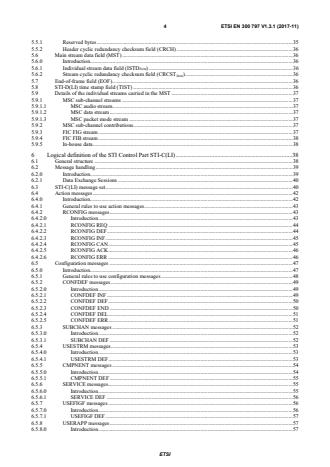
Contents
Intellectual Property Rights . 11
Foreword . 11
Modal verbs terminology . 12
Introduction . 12
1 Scope . 15
2 References . 15
2.1 Normative references . 15
2.2 Informative references . 16
3 Definitions, abbreviations, symbols and terminology . 16
3.1 Definitions . 16
3.2 Abbreviations . 20
3.3 Symbols . 21
3.3.1 Numerical ranges . 21
3.3.2 Bit and byte numbering . 21
3.3.3 Arithmetic operators . 21
3.3.4 Logical operators . 21
3.3.5 STI-C(LI) Field Types . 21
4 Overview of the Service Transport Interface definition . 22
4.1 Conceptual model of the Service Transport Interface . 22
4.2 The logical model of the STI . 24
4.3 The layered model of the STI . 25
4.4 The implementation model of the STI . 26
4.4.1 Examples of network topologies . 26
4.4.2 Hierarchical collection networks . 28
4.4.3 Multicasting . 28
4.5 Ordering of bytes and bits for transmission . 29
4.6 Reserved bits . 29
4.7 STI-C character set . 29
4.7.1 General . 29
4.7.2 STI-C(LI) message character set . 29
4.7.3 STI-C(TA) character set . 29
5 Logical definition of the STI Data Part, STI-D(LI) . 30
5.1 General structure . 30
5.2 Error field (ERR) . 32
5.3 Frame characterization field (FC) . 32
5.3.0 Introduction. 32
5.3.1 Service provider identifier field (SPID) . 32
5.3.2 Reserved bits . 32
5.3.3 Data length field (DL) . 33
5.3.4 Reserved bits . 33
5.3.5 Data frame count field (DFCT). 33
5.3.6 Number of streams field (NST) . 33
5.4 Stream characterization field (STC) . 33
5.4.0 Introduction. 33
5.4.1 Individual stream characterization field (ISTC ) . 34
Strm
5.4.1.0 Introduction . 34
5.4.1.1 Type identifier field (TID) . 34
5.4.1.2 Stream length field (STL) . 34
5.4.1.3 Type identifier extension field (TIDext) . 34
5.4.1.4 Stream cyclic redundancy checksum flag field (CRCSTF) . 35
5.4.1.5 Stream identifier field (STID) . 35
5.5 End-of-header field (EOH) . 35
5.5.0 Introduction. 35
ETSI
4 ETSI EN 300 797 V1.3.1 (2017-11)
5.5.1 Reserved bytes . 35
5.5.2 Header cyclic redundancy checksum field (CRCH) . 36
5.6 Main stream data field (MST) . 36
5.6.0 Introduction. 36
5.6.1 Individual stream data field (ISTD ) . 36
Strm
5.6.2 Stream cyclic redundancy checksum field (CRCST ) . 36
Strm
5.7 End-of-frame field (EOF) . 36
5.8 STI-D(LI) time stamp field (TIST) . 36
5.9 Details of the individual streams carried in the MST . 37
5.9.1 MSC sub-channel streams . 37
5.9.1.1 MSC audio stream . 37
5.9.1.2 MSC data stream . 37
5.9.1.3 MSC packet mode stream . 37
5.9.2 MSC sub-channel contributions . 37
5.9.3 FIC FIG stream . 37
5.9.4 FIC FIB stream . 38
5.9.5 In-house data . 38
6 Logical definition of the STI Control Part STI-C(LI) . 38
6.1 General structure . 38
6.2 Message handling . 39
6.2.0 Introduction. 39
6.2.1 Data Exchange Sessions . 40
6.3 STI-C(LI) message set . 40
6.4 Action messages . 42
6.4.0 Introduction. 42
6.4.1 General rules to use action messages . 43
6.4.2 RCONFIG messages . 43
6.4.2.0 Introduction . 43
6.4.2.1 RCONFIG REQ . 44
6.4.2.2 RCONFIG DEF . 44
6.4.2.3 RCONFIG INF . 45
6.4.2.4 RCONFIG CAN . 45
6.4.2.5 RCONFIG ACK . 46
6.4.2.6 RCONFIG ERR . 46
6.5 Configuration messages . 47
6.5.0 Introduction. 47
6.5.1 General rules to use configuration messages . 48
6.5.2 CONFDEF messages . 49
6.5.2.0 Introduction . 49
6.5.2.1 CONFDEF INF . 49
6.5.2.2 CONFDEF DEF . 50
6.5.2.3 CONFDEF END . 50
6.5.2.4 CONFDEF DEL . 51
6.5.2.5 CONFDEF ERR . 51
6.5.3 SUBCHAN messages . 52
6.5.3.0 Introduction . 52
6.5.3.1 SUBCHAN DEF . 52
6.5.4 USESTRM messages . 53
6.5.4.0 Introduction . 53
6.5.4.1 USESTRM DEF . 53
6.5.5 CMPNENT messages . 54
6.5.5.0 Introduction . 54
6.5.5.1 CMPNENT DEF . 55
6.5.6 SERVICE messages . 55
6.5.6.0 Introduction . 55
6.5.6.1 SERVICE DEF . 56
6.5.7 USEFIGF messages . 56
6.5.7.0 Introduction . 56
6.5.7.1 USEFIGF DEF . 57
6.5.8 USERAPP messages . 57
6.5.8.0 Introduction . 57
ETSI
5 ETSI EN 300 797 V1.3.1 (2017-11)
6.5.8.1 USERAPP DEF . 57
6.6 FIG file messages . 58
6.6.0 Introduction. 58
6.6.1 General rules to use FIG file messages . 58
6.6.2 FIGFILE messages . 59
6.6.2.0 Introduction . 59
6.6.2.1 FIGFILE INF . 59
6.6.2.2 FIGFILE DEF . 60
6.6.2.3 FIGFILE REC . 60
6.6.2.4 FIGFILE END . 61
6.6.2.5 FIGFILE DEL . 61
6.6.2.6 FIGFILE SEL . 61
6.6.2.7 FIGFILE DES . 62
6.6.2.8 FIGFILE ERR . 62
6.7 FIB grid messages . 63
6.7.0 Introduction. 63
6.7.1 General rules to use FIBGRID messages . 63
6.7.2 FIBGRID messages . 64
6.7.2.0 Introduction . 64
6.7.2.1 FIBGRID INF . 64
6.7.2.2 FIBGRID DEF . 64
6.7.2.3 FIBGRID REC . 65
6.7.2.4 FIBGRID END . 66
6.7.2.5 FIBGRID ACT . 66
6.7.2.6 FIBGRID ERR . 66
6.8 Resource messages . 67
6.8.0 Introduction. 67
6.8.1 General rules to use resource messages . 68
6.8.2 RESOURC messages . 68
6.8.2.0 Introduction . 68
6.8.2.1 RESOURC INF . 68
6.8.2.2 RESOURC DEF . 68
6.8.2.3 RESOURC END . 69
6.8.2.4 RESOURC ERR . 69
6.8.3 CHANCAP messages . 70
6.8.3.0 Introduction . 70
6.8.3.1 CHANCAP DEF . 70
6.8.4 STLIMIT messages. 71
6.8.4.0 Introduction . 71
6.8.4.1 STLIMIT DEF . 71
6.8.5 IDALLOC messages . 72
6.8.5.0 Introduction . 72
6.8.5.1 IDALLOC DEF . 72
6.8.6 IDLIMIT messages . 73
6.8.6.0 Introduction . 73
6.8.6.1 IDLIMIT DEF . 73
6.8.7 PACKCON messages . 74
6.8.7.0 Introduction . 74
6.8.7.1 PACKCON DEF . 75
6.8.8 FIGBLCK messages . 75
6.8.8.0 Introduction . 75
6.8.8.1 FIGBLCK DEF . 76
6.8.9 ANNSEND messages . 76
6.8.9.0 Introduction . 76
6.8.9.1 ANNSEND DEF . 77
6.9 Information messages . 78
6.9.0 Introduction. 78
6.9.1 General rules to use information messages . 78
6.9.2 CONINFO messages. 79
6.9.2.0 Introduction . 79
6.9.2.1 CONINFO INF . 79
6.9.2.2 CONINFO DEF . 79
ETSI
6 ETSI EN 300 797 V1.3.1 (2017-11)
6.9.3 CONNAME messages . 80
6.9.3.0 Introduction . 80
6.9.3.1 CONNAME INF . 80
6.9.3.2 CONNAME DEF . 80
6.9.3.3 CONNAME REC . 81
6.9.3.4 CONNAME END . 81
6.9.3.5 CONNAME ERR . 81
6.9.4 FIGINFO messages. 82
6.9.4.0 Introduction . 82
6.9.4.1 FIGINFO INF . 82
6.9.4.2 FIGINFO DEF . 82
6.9.5 FIGNAME messages . 83
6.9.5.0 Introduction . 83
6.9.5.1 FIGNAME INF . 83
6.9.5.2 FIGNAME DEF . 83
6.9.5.3 FIGNAME REC . 84
6.9.5.4 FIGNAME END . 84
6.9.5.5 FIGNAME ERR . 84
6.9.6 COUNTER messages . 85
6.9.6.0 Introduction . 85
6.9.6.1 COUNTER INF . 85
6.9.6.2 COUNTER DEF . 85
6.10 Supervision Messages . 86
6.10.0 Introduction. 86
6.10.1 General rules for the use of supervision messages . 86
6.10.2 PRERROR messages . 87
6.10.2.0 Introduction . 87
6.10.2.1 PRERROR GBG . 87
6.10.2.2 PRERROR UKN . 87
6.10.2.3 PRERROR SYN . 88
6.10.2.4 PRERROR SEM . 88
6.10.2.5 PRERROR PRT . 89
6.10.3 ALARMST messages . 89
6.10.3.0 Introduction . 89
6.10.3.1 ALARMST INF . 90
6.10.3.2 ALARMST DEF . 90
6.10.4 STERROR messages . 91
6.10.4.0 Introduction . 91
6.10.4.1 STERROR INF . 91
6.10.4.2 STERROR DEF . 91
7 Transport Adaptation for the STI control part STI-C(TA) . 92
7.0 Introduction . 92
7.1 General structure . 92
7.1.0 Introduction. 92
7.1.1 STI-C(TA) on synchronous physical links . 92
7.1.2 STI-C(TA) on asynchronous physical links . 93
7.2 The data link layer . 94
7.2.0 Introduction. 94
7.2.1 Start field (START) . 94
7.2.2 Network packet . 94
7.2.3 Cyclic redundancy checksum field (CRC) . 94
7.2.4 End field (END) . 94
7.2.5 Data link packet handling . 94
7.2.5.1 Packet transmission . 94
7.2.5.2 Packet reception . 94
7.3 Padding character . 94
7.4 The network layer . 95
7.4.0 Introduction. 95
7.4.1 Source address field (SAD) . 95
7.4.2 Destination address field (DAD) . 95
7.4.3 Transport packet . 95
ETSI
7 ETSI EN 300 797 V1.3.1 (2017-11)
7.4.4 Separator fields (SEP) . 95
7.4.5 Network packet handling . 95
7.4.5.1 Packet transmission . 95
7.4.5.2 Packet reception . 95
7.5 The transport layer. 95
7.5.0 Introduction. 95
7.5.1 Packet number (PKTNUM) . 96
7.5.2 Acknowledge Number (ACKNUM) . 96
7.5.3 Repetition Index (REP) . 96
7.5.4 Acknowledge field (ACK) . 96
7.5.5 Flag field (FLAG) . 96
7.5.6 Logical packet . 96
7.5.7 Separator fields (SEP) . 96
7.5.8 Transport packet handling . 97
7.5.8.0 Introduction . 97
7.5.8.1 Opening a connection . 97
7.5.8.2 Closing a connection . 97
7.5.8.3 Transmission on an open connection . 98
7.5.8.4 Reception on an open connection . 98
7.6 The logical layer . 98
7.6.0 Introduction. 98
7.6.1 STI-C(LI) . 99
7.6.2 Logical packet handling . 99
7.6.2.1 Packet transmission . 99
7.6.2.2 Packet reception . 99
8 Generic transport frame STI(PI, X) .
...
2003-01.Slovenski inštitut za standardizacijo. Razmnoževanje celote ali delov tega standarda ni dovoljeno.Digitalna zvokovna radiodifuzija (DAB) - Vmesniki za razpošiljanje - Vmesnik za prenos storitev (STI)Digital Audio Broadcasting (DAB) - Distribution interfaces - Service Transport Interface (STI)33.170Televizijska in radijska difuzijaTelevision and radio broadcastingICS:Ta slovenski standard je istoveten z:ETSI EN 300 797 V1.3.1 (2017-11)SIST EN 300 797 V1.3.1:2018en01-januar-2018SIST EN 300 797 V1.3.1:2018SLOVENSKI
STANDARD
EUROPEAN STANDARD SIST EN 300 797 V1.3.1:2018
ETSI ETSI EN 300 797 V1.3.1 (2017-11) 2
Reference REN/JTC-DAB-88 Keywords audio, broadcasting, DAB, data, digital, interface, transport ETSI 650 Route des Lucioles F-06921 Sophia Antipolis Cedex - FRANCE
Tel.: +33 4 92 94 42 00
Fax: +33 4 93 65 47 16
Siret N° 348 623 562 00017 - NAF 742 C Association à but non lucratif enregistrée à la Sous-Préfecture de Grasse (06) N° 7803/88
Important notice The present document can be downloaded from: http://www.etsi.org/standards-search The present document may be made available in electronic versions and/or in print. The content of any electronic and/or print versions of the present document shall not be modified without the prior written authorization of ETSI. In case of any existing or perceived difference in contents between such versions and/or in print, the only prevailing document is the print of the Portable Document Format (PDF) version kept on a specific network drive within ETSI Secretariat. Users of the present document should be aware that the document may be subject to revision or change of status. Information on the current status of this and other ETSI documents is available at https://portal.etsi.org/TB/ETSIDeliverableStatus.aspx If you find errors in the present document, please send your comment to one of the following services: https://portal.etsi.org/People/CommiteeSupportStaff.aspx Copyright Notification No part may be reproduced or utilized in any form or by any means, electronic or mechanical, including photocopying and microfilm except as authorized by written permission of ETSI. The content of the PDF version shall not be modified without the written authorization of ETSI. The copyright and the foregoing restriction extend to reproduction in all media.
© ETSI 2017. © European Broadcasting Union 2017. All rights reserved.
DECTTM, PLUGTESTSTM, UMTSTM and the ETSI logo are trademarks of ETSI registered for the benefit of its Members. 3GPPTM and LTE™ are trademarks of ETSI registered for the benefit of its Members and of the 3GPP Organizational Partners. oneM2M logo is protected for the benefit of its Members. GSM® and the GSM logo are trademarks registered and owned by the GSM Association. SIST EN 300 797 V1.3.1:2018
ETSI ETSI EN 300 797 V1.3.1 (2017-11) 3 Contents Intellectual Property Rights . 11 Foreword . 11 Modal verbs terminology . 12 Introduction . 12 1 Scope . 15 2 References . 15 2.1 Normative references . 15 2.2 Informative references . 16 3 Definitions, abbreviations, symbols and terminology . 16 3.1 Definitions . 16 3.2 Abbreviations . 20 3.3 Symbols . 21 3.3.1 Numerical ranges . 21 3.3.2 Bit and byte numbering . 21 3.3.3 Arithmetic operators . 21 3.3.4 Logical operators . 21 3.3.5 STI-C(LI) Field Types . 21 4 Overview of the Service Transport Interface definition . 22 4.1 Conceptual model of the Service Transport Interface . 22 4.2 The logical model of the STI . 24 4.3 The layered model of the STI . 25 4.4 The implementation model of the STI . 26 4.4.1 Examples of network topologies . 26 4.4.2 Hierarchical collection networks . 28 4.4.3 Multicasting . 28 4.5 Ordering of bytes and bits for transmission . 29 4.6 Reserved bits . 29 4.7 STI-C character set . 29 4.7.1 General . 29 4.7.2 STI-C(LI) message character set . 29 4.7.3 STI-C(TA) character set . 29 5 Logical definition of the STI Data Part, STI-D(LI) . 30 5.1 General structure . 30 5.2 Error field (ERR) . 32 5.3 Frame characterization field (FC) . 32 5.3.0 Introduction. 32 5.3.1 Service provider identifier field (SPID) . 32 5.3.2 Reserved bits . 32 5.3.3 Data length field (DL) . 33 5.3.4 Reserved bits . 33 5.3.5 Data frame count field (DFCT). 33 5.3.6 Number of streams field (NST) . 33 5.4 Stream characterization field (STC) . 33 5.4.0 Introduction. 33 5.4.1 Individual stream characterization field (ISTCStrm) . 34 5.4.1.0 Introduction . 34 5.4.1.1 Type identifier field (TID) . 34 5.4.1.2 Stream length field (STL) . 34 5.4.1.3 Type identifier extension field (TIDext) . 34 5.4.1.4 Stream cyclic redundancy checksum flag field (CRCSTF) . 35 5.4.1.5 Stream identifier field (STID) . 35 5.5 End-of-header field (EOH) . 35 5.5.0 Introduction. 35 SIST EN 300 797 V1.3.1:2018
ETSI ETSI EN 300 797 V1.3.1 (2017-11) 4 5.5.1 Reserved bytes . 35 5.5.2 Header cyclic redundancy checksum field (CRCH) . 36 5.6 Main stream data field (MST) . 36 5.6.0 Introduction. 36 5.6.1 Individual stream data field (ISTDStrm) . 36 5.6.2 Stream cyclic redundancy checksum field (CRCSTStrm) . 36 5.7 End-of-frame field (EOF) . 36 5.8 STI-D(LI) time stamp field (TIST) . 36 5.9 Details of the individual streams carried in the MST . 37 5.9.1 MSC sub-channel streams . 37 5.9.1.1 MSC audio stream . 37 5.9.1.2 MSC data stream . 37 5.9.1.3 MSC packet mode stream . 37 5.9.2 MSC sub-channel contributions . 37 5.9.3 FIC FIG stream . 37 5.9.4 FIC FIB stream . 38 5.9.5 In-house data . 38 6 Logical definition of the STI Control Part STI-C(LI) . 38 6.1 General structure . 38 6.2 Message handling . 39 6.2.0 Introduction. 39 6.2.1 Data Exchange Sessions . 40 6.3 STI-C(LI) message set . 40 6.4 Action messages . 42 6.4.0 Introduction. 42 6.4.1 General rules to use action messages . 43 6.4.2 RCONFIG messages . 43 6.4.2.0 Introduction . 43 6.4.2.1 RCONFIG REQ . 44 6.4.2.2 RCONFIG DEF . 44 6.4.2.3 RCONFIG INF . 45 6.4.2.4 RCONFIG CAN . 45 6.4.2.5 RCONFIG ACK . 46 6.4.2.6 RCONFIG ERR . 46 6.5 Configuration messages . 47 6.5.0 Introduction. 47 6.5.1 General rules to use configuration messages . 48 6.5.2 CONFDEF messages . 49 6.5.2.0 Introduction . 49 6.5.2.1 CONFDEF INF . 49 6.5.2.2 CONFDEF DEF . 50 6.5.2.3 CONFDEF END . 50 6.5.2.4 CONFDEF DEL . 51 6.5.2.5 CONFDEF ERR . 51 6.5.3 SUBCHAN messages . 52 6.5.3.0 Introduction . 52 6.5.3.1 SUBCHAN DEF . 52 6.5.4 USESTRM messages . 53 6.5.4.0 Introduction . 53 6.5.4.1 USESTRM DEF . 53 6.5.5 CMPNENT messages . 54 6.5.5.0 Introduction . 54 6.5.5.1 CMPNENT DEF . 55 6.5.6 SERVICE messages . 55 6.5.6.0 Introduction . 55 6.5.6.1 SERVICE DEF . 56 6.5.7 USEFIGF messages . 56 6.5.7.0 Introduction . 56 6.5.7.1 USEFIGF DEF . 57 6.5.8 USERAPP messages . 57 6.5.8.0 Introduction . 57 SIST EN 300 797 V1.3.1:2018
ETSI ETSI EN 300 797 V1.3.1 (2017-11) 5 6.5.8.1 USERAPP DEF . 57 6.6 FIG file messages . 58 6.6.0 Introduction. 58 6.6.1 General rules to use FIG file messages . 58 6.6.2 FIGFILE messages . 59 6.6.2.0 Introduction . 59 6.6.2.1 FIGFILE INF . 59 6.6.2.2 FIGFILE DEF . 60 6.6.2.3 FIGFILE REC . 60 6.6.2.4 FIGFILE END . 61 6.6.2.5 FIGFILE DEL . 61 6.6.2.6 FIGFILE SEL . 61 6.6.2.7 FIGFILE DES . 62 6.6.2.8 FIGFILE ERR . 62 6.7 FIB grid messages . 63 6.7.0 Introduction. 63 6.7.1 General rules to use FIBGRID messages . 63 6.7.2 FIBGRID messages . 64 6.7.2.0 Introduction . 64 6.7.2.1 FIBGRID INF . 64 6.7.2.2 FIBGRID DEF . 64 6.7.2.3 FIBGRID REC . 65 6.7.2.4 FIBGRID END . 66 6.7.2.5 FIBGRID ACT . 66 6.7.2.6 FIBGRID ERR . 66 6.8 Resource messages . 67 6.8.0 Introduction. 67 6.8.1 General rules to use resource messages . 68 6.8.2 RESOURC messages . 68 6.8.2.0 Introduction . 68 6.8.2.1 RESOURC INF . 68 6.8.2.2 RESOURC DEF . 68 6.8.2.3 RESOURC END . 69 6.8.2.4 RESOURC ERR . 69 6.8.3 CHANCAP messages . 70 6.8.3.0 Introduction . 70 6.8.3.1 CHANCAP DEF . 70 6.8.4 STLIMIT messages. 71 6.8.4.0 Introduction . 71 6.8.4.1 STLIMIT DEF . 71 6.8.5 IDALLOC messages . 72 6.8.5.0 Introduction . 72 6.8.5.1 IDALLOC DEF . 72 6.8.6 IDLIMIT messages . 73 6.8.6.0 Introduction . 73 6.8.6.1 IDLIMIT DEF . 73 6.8.7 PACKCON messages . 74 6.8.7.0 Introduction . 74 6.8.7.1 PACKCON DEF . 75 6.8.8 FIGBLCK messages . 75 6.8.8.0 Introduction . 75 6.8.8.1 FIGBLCK DEF . 76 6.8.9 ANNSEND messages . 76 6.8.9.0 Introduction . 76 6.8.9.1 ANNSEND DEF . 77 6.9 Information messages . 78 6.9.0 Introduction. 78 6.9.1 General rules to use information messages . 78 6.9.2 CONINFO messages. 79 6.9.2.0 Introduction . 79 6.9.2.1 CONINFO INF . 79 6.9.2.2 CONINFO DEF . 79 SIST EN 300 797 V1.3.1:2018
ETSI ETSI EN 300 797 V1.3.1 (2017-11) 6 6.9.3 CONNAME messages . 80 6.9.3.0 Introduction . 80 6.9.3.1 CONNAME INF . 80 6.9.3.2 CONNAME DEF . 80 6.9.3.3 CONNAME REC . 81 6.9.3.4 CONNAME END . 81 6.9.3.5 CONNAME ERR . 81 6.9.4 FIGINFO messages. 82 6.9.4.0 Introduction . 82 6.9.4.1 FIGINFO INF . 82 6.9.4.2 FIGINFO DEF . 82 6.9.5 FIGNAME messages . 83 6.9.5.0 Introduction . 83 6.9.5.1 FIGNAME INF . 83 6.9.5.2 FIGNAME DEF . 83 6.9.5.3 FIGNAME REC . 84 6.9.5.4 FIGNAME END . 84 6.9.5.5 FIGNAME ERR . 84 6.9.6 COUNTER messages . 85 6.9.6.0 Introduction . 85 6.9.6.1 COUNTER INF . 85 6.9.6.2 COUNTER DEF . 85 6.10 Supervision Messages . 86 6.10.0 Introduction. 86 6.10.1 General rules for the use of supervision messages . 86 6.10.2 PRERROR messages . 87 6.10.2.0 Introduction . 87 6.10.2.1 PRERROR GBG . 87 6.10.2.2 PRERROR UKN . 87 6.10.2.3 PRERROR SYN . 88 6.10.2.4 PRERROR SEM . 88 6.10.2.5 PRERROR PRT . 89 6.10.3 ALARMST messages . 89 6.10.3.0 Introduction . 89 6.10.3.1 ALARMST INF . 90 6.10.3.2 ALARMST DEF . 90 6.10.4 STERROR messages . 91 6.10.4.0 Introduction . 91 6.10.4.1 STERROR INF . 91 6.10.4.2 STERROR DEF . 91 7 Transport Adaptation for the STI control part STI-C(TA) . 92 7.0 Introduction . 92 7.1 General structure . 92 7.1.0 Introduction. 92 7.1.1 STI-C(TA) on synchronous physical links . 92 7.1.2 STI-C(TA) on asynchronous physical links . 93 7.2 The data link layer . 94 7.2.0 Introduction. 94 7.2.1 Start field (START) . 94 7.2.2 Network packet . 94 7.2.3 Cyclic redundancy checksum field (CRC) . 94 7.2.4 End field (END) . 94 7.2.5 Data link packet handling . 94 7.2.5.1 Packet transmission . 94 7.2.5.2 Packet reception . 94 7.3 Padding character . 94 7.4 The network layer . 95 7.4.0 Introduction. 95 7.4.1 Source address field (SAD) . 95 7.4.2 Destination address field (DAD) . 95 7.4.3 Transport packet . 95 SIST EN 300 797 V1.3.1:2018
ETSI ETSI EN 300 797 V1.3.1 (2017-11) 7 7.4.4 Separator fields (SEP) . 95 7.4.5 Network packet handling . 95 7.4.5.1 Packet transmission . 95 7.4.5.2 Packet reception . 95 7.5 The transport layer. 95 7.5.0 Introduction. 95 7.5.1 Packet number (PKTNUM) . 96 7.5.2 Acknowledge Number (ACKNUM) . 96 7.5.3 Repetition Index (REP) . 96 7.5.4 Acknowledge field (ACK) . 96 7.5.5 Flag field (FLAG) . 96 7.5.6 Logical packet . 96 7.5.7 Separator fields (SEP) . 96 7.5.8 Transport packet handling . 97 7.5.8.0 Introduction . 97 7.5.8.1 Opening a connection . 97 7.5.8.2 Closing a connection . 97 7.5.8.3 Transmission on an open connection . 98 7.5.8.4 Reception on an open connection . 98 7.6 The logical layer . 98 7.6.0 Introduction. 98 7.6.1 STI-C(LI) . 99 7.6.2 Logical packet handling . 99 7.6.2.1 Packet transmission . 99 7.6.2.2 Packet reception . 99 8 Generic transport frame STI(PI, X) .
...