

ETSI EN 300 175-4 V2.3.1 (2010-06)
Digital Enhanced Cordless Telecommunications (DECT); Common Interface (CI); Part 4: Data Link Control (DLC) layer
General Information
- Abstract
REN/DECT-000254-4
- Status
- Published
- Publication Date
- 14-Jun-2010
- Technical Committee
- DECT - Digital Enhanced Cordless Telecommunications (DECT)
- Current Stage
- 12 - Completion
- Due Date
- 21-Jun-2010
- Completion Date
- 15-Jun-2010
Buy Documents
ETSI EN 300 175-4 V2.3.0 (2010-02) - Digital Enhanced Cordless Telecommunications (DECT); Common Interface (CI); Part 4: Data Link Control (DLC) layer
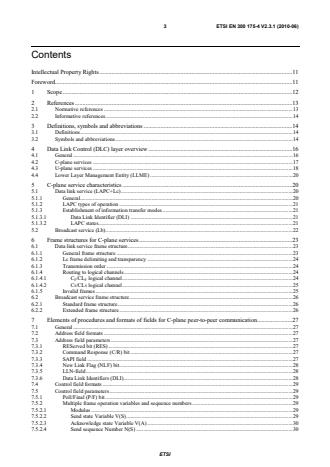
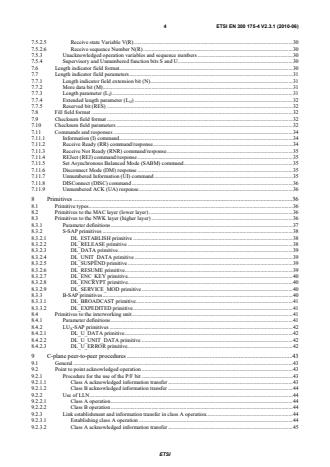
ETSI EN 300 175-4 V2.3.1 (2010-06) - Digital Enhanced Cordless Telecommunications (DECT); Common Interface (CI); Part 4: Data Link Control (DLC) layer

Overview
ETSI EN 300 175-4 V2.3.1 (2010-06) (identical to ETSI EN 300 175-4 V2.3.1) defines the Data Link Control (DLC) layer for the Digital Enhanced Cordless Telecommunications (DECT) Common Interface (CI). As Layer 2b of the DECT protocol stack, this standard specifies reliable and flexible link-layer services used for DECT signalling and user data transport. It is part 4 of the DECT CI specification and addresses both control and user-plane requirements for DECT-based systems.
Key topics and technical requirements
- Two operational planes
- Control plane (C‑plane): Provides reliable point-to-point services for DECT signalling using a link access protocol (LAPC + Lc) and a dedicated point‑to‑multipoint (broadcast Lb) service for network messages.
- User plane (U‑plane): Handles end‑to‑end user information and hosts a family of independent services (circuit‑mode and packet‑mode) that create point‑to‑point U‑plane data links tailored to application needs.
- Service alternatives and performance classes
- Services range from “unprotected with low delay” (suitable for speech) to “highly protected with variable delay” (suitable for local area network applications).
- Frame structures and link procedures
- Defines C‑plane frame formats, delimiting/transparency, transmission order and routing to logical channels (e.g., CF/CLF, CS/CLS).
- Protocol elements
- Address and control field formats, sequence numbers, length indicators, checksum fields and defined commands/responses (I, RR, RNR, REJ, SABM, DISC, UA, UI).
- Primitives and interfaces
- Primitives between DLC and MAC (lower layer), DLC and NWK (higher layer) including S‑SAP and B‑SAP primitives (e.g., DL_ESTABLISH, DL_DATA, DL_BROADCAST), and LUX‑SAP primitives for interworking.
- Management and lower-layer interaction
- Lower Layer Management Entity (LLME) procedures and parameters for link establishment, suspend/resume, encryption primitives and service modification.
Practical applications and who uses this standard
- Telecom equipment vendors implementing DECT base stations, handsets and IP-DECT gateways
- Chipset and firmware developers building DECT link‑layer stacks (LAPC/DLC)
- System integrators and network engineers deploying DECT for voice, data and local area networking
- Test labs and certification bodies verifying compliance with the DECT CI family
- Companies integrating DECT with higher‑layer applications that require defined QoS/performance classes
Related standards
- ETSI/EN DECT Common Interface family (ETSI EN 300 175 series)
- Other DECT and radio interface standards for system-level, MAC and physical‑layer specifications
Keywords: DECT, Data Link Control, DLC layer, SIST EN 300 175-4, ETSI EN 300 175-4, DECT Common Interface, LAPC, C-plane, U-plane, DECT broadcast, DL primitives, DECT protocols.
Buy Documents
ETSI EN 300 175-4 V2.3.0 (2010-02) - Digital Enhanced Cordless Telecommunications (DECT); Common Interface (CI); Part 4: Data Link Control (DLC) layer
ETSI EN 300 175-4 V2.3.1 (2010-06) - Digital Enhanced Cordless Telecommunications (DECT); Common Interface (CI); Part 4: Data Link Control (DLC) layer
Frequently Asked Questions
ETSI EN 300 175-4 V2.3.1 (2010-06) is a standard published by the European Telecommunications Standards Institute (ETSI). Its full title is "Digital Enhanced Cordless Telecommunications (DECT); Common Interface (CI); Part 4: Data Link Control (DLC) layer". This standard covers: REN/DECT-000254-4
REN/DECT-000254-4
ETSI EN 300 175-4 V2.3.1 (2010-06) is available in PDF format for immediate download after purchase. The document can be added to your cart and obtained through the secure checkout process. Digital delivery ensures instant access to the complete standard document.
Standards Content (Sample)
Final draft ETSI EN 300 175-4 V2.3.0 (2010-02)
European Standard (Telecommunications series)
Digital Enhanced Cordless Telecommunications (DECT);
Common Interface (CI);
Part 4: Data Link Control (DLC) layer
2 Final draft ETSI EN 300 175-4 V2.3.0 (2010-02)
Reference
REN/DECT-000254-4
Keywords
DECT, IMT-2000, mobility, radio, TDD, TDMA
ETSI
650 Route des Lucioles
F-06921 Sophia Antipolis Cedex - FRANCE
Tel.: +33 4 92 94 42 00 Fax: +33 4 93 65 47 16
Siret N° 348 623 562 00017 - NAF 742 C
Association à but non lucratif enregistrée à la
Sous-Préfecture de Grasse (06) N° 7803/88
Important notice
Individual copies of the present document can be downloaded from:
http://www.etsi.org
The present document may be made available in more than one electronic version or in print. In any case of existing or
perceived difference in contents between such versions, the reference version is the Portable Document Format (PDF).
In case of dispute, the reference shall be the printing on ETSI printers of the PDF version kept on a specific network drive
within ETSI Secretariat.
Users of the present document should be aware that the document may be subject to revision or change of status.
Information on the current status of this and other ETSI documents is available at
http://portal.etsi.org/tb/status/status.asp
If you find errors in the present document, please send your comment to one of the following services:
http://portal.etsi.org/chaircor/ETSI_support.asp
Copyright Notification
No part may be reproduced except as authorized by written permission.
The copyright and the foregoing restriction extend to reproduction in all media.
© European Telecommunications Standards Institute 2010.
All rights reserved.
TM TM TM TM
DECT , PLUGTESTS , UMTS , TIPHON , the TIPHON logo and the ETSI logo are Trade Marks of ETSI registered
for the benefit of its Members.
TM
3GPP is a Trade Mark of ETSI registered for the benefit of its Members and of the 3GPP Organizational Partners.
LTE™ is a Trade Mark of ETSI currently being registered
for the benefit of its Members and of the 3GPP Organizational Partners.
GSM® and the GSM logo are Trade Marks registered and owned by the GSM Association.
ETSI
3 Final draft ETSI EN 300 175-4 V2.3.0 (2010-02)
Contents
Intellectual Property Rights . 11
Foreword . 11
1 Scope . 12
2 References . 13
2.1 Normative references . 13
2.2 Informative references . 14
3 Definitions, symbols and abbreviations . 14
3.1 Definitions . 14
3.2 Symbols and abbreviations . 14
4 Data Link Control (DLC) layer overview . 16
4.1 General . 16
4.2 C-plane services . 17
4.3 U-plane services . 18
4.4 Lower Layer Management Entity (LLME) . 21
5 C-plane service characteristics . 21
5.1 Data link service (LAPC+Lc) . 21
5.1.1 General . 21
5.1.2 LAPC types of operation . 22
5.1.3 Establishment of information transfer modes . 22
5.1.3.1 Data Link Identifier (DLI) . 22
5.1.3.2 LAPC states. 22
5.2 Broadcast service (Lb) . 23
6 Frame structures for C-plane services . 24
6.1 Data link service frame structure . 24
6.1.1 General frame structure . 24
6.1.2 Lc frame delimiting and transparency . 25
6.1.3 Transmission order . 25
6.1.4 Routing to logical channels . 25
6.1.4.1 C /CL logical channel . 25
F F
6.1.4.2 C /CL logical channel . 26
S S
6.1.5 Invalid frames . 26
6.2 Broadcast service frame structure. 27
6.2.1 Standard frame structure . 27
6.2.2 Extended frame structure . 27
7 Elements of procedures and formats of fields for C-plane peer-to-peer communication . 28
7.1 General . 28
7.2 Address field formats . 28
7.3 Address field parameters . 28
7.3.1 REServed bit (RES) . 28
7.3.2 Command Response (C/R) bit . 28
7.3.3 SAPI field . 28
7.3.4 New Link Flag (NLF) bit . 29
7.3.5 LLN-field . 29
7.3.6 Data Link Identifiers (DLI) . 29
7.4 Control field formats . 30
7.5 Control field parameters . 30
7.5.1 Poll/Final (P/F) bit . 30
7.5.2 Multiple frame operation variables and sequence numbers . 30
7.5.2.1 Modulus . 30
7.5.2.2 Send state Variable V(S) . 30
7.5.2.3 Acknowledge state Variable V(A) . 31
7.5.2.4 Send sequence Number N(S) . 31
ETSI
4 Final draft ETSI EN 300 175-4 V2.3.0 (2010-02)
7.5.2.5 Receive state Variable V(R) . 31
7.5.2.6 Receive sequence Number N(R) . 31
7.5.3 Unacknowledged operation variables and sequence numbers . 31
7.5.4 Supervisory and Unnumbered function bits S and U . 31
7.6 Length indicator field format. 31
7.7 Length indicator field parameters . 32
7.7.1 Length indicator field extension bit (N) . 32
7.7.2 More data bit (M) . 32
7.7.3 Length parameter (L ) . 32
I
7.7.4 Extended length parameter (L ) . 33
JJ
7.7.5 Reserved bit (RES) . 33
7.8 Fill field format . 33
7.9 Checksum field format . 33
7.10 Checksum field parameters . 33
7.11 Commands and responses . 35
7.11.1 Information (I) command . 35
7.11.2 Receive Ready (RR) command/response . 35
7.11.3 Receive Not Ready (RNR) command/response . 36
7.11.4 REJect (REJ) command/response . 36
7.11.5 Set Asynchronous Balanced Mode (SABM) command . 36
7.11.6 Disconnect Mode (DM) response . 36
7.11.7 Unnumbered Information (UI) command . 36
7.11.8 DISConnect (DISC) command . 37
7.11.9 Unnumbered ACK (UA) response . 37
8 Primitives . 37
8.1 Primitive types . 37
8.2 Primitives to the MAC layer (lower layer) . 37
8.3 Primitives to the NWK layer (higher layer) . 37
8.3.1 Parameter definitions . 38
8.3.2 S-SAP primitives . 39
8.3.2.1 DL_ESTABLISH primitive . 39
8.3.2.2 DL_RELEASE primitive . 39
8.3.2.3 DL_DATA primitive . 40
8.3.2.4 DL_UNIT_DATA primitive . 40
8.3.2.5 DL_SUSPEND primitive . 40
8.3.2.6 DL_RESUME primitive . 40
8.3.2.7 DL_ENC_KEY primitive . 41
8.3.2.8 DL_ENCRYPT primitive . 41
8.3.2.9 DL_SERVICE_MOD primitive . 41
8.3.3 B-SAP primitives . 41
8.3.3.1 DL_BROADCAST primitive . 42
8.3.3.2 DL_EXPEDITED primitive . 42
8.4 Primitives to the interworking unit . 42
8.4.1 Parameter definitions . 42
8.4.2 LU -SAP primitives . 43
X
8.4.2.1 DL_U_DATA primitive . 43
8.4.2.2 DL_U_UNIT_DATA primitive . 43
8.4.2.3 DL_U_ERROR primitive . 43
9 C-plane peer-to-peer procedures . 44
9.1 General . 44
9.2 Point to point acknowledged operation . 44
9.2.1 Procedure for the use of the P/F bit . 44
9.2.1.1 Class A acknowledged information transfer . 44
9.2.1.2 Class B acknowledged information transfer . 45
9.2.2 Use of LLN . 45
9.2.2.1 Class A operation . 45
9.2.2.2 Class B operation . 45
9.2.3 Link establishment and information transfer in class A operation . 45
9.2.3.1 Establishing class A operation . 45
9.2.3.2 Class A acknowledged information transfer . 46
ETSI
5 Final draft ETSI EN 300 175-4 V2.3.0 (2010-02)
9.2.3.3 Transmission of class A I-frames . 46
9.2.3.4 Reception of class A I-frames . 47
9.2.3.5 Receiving acknowledgements . 47
9.2.3.6 Waiting for acknowledgement . 47
9.2.3.7 Release of class A operation . 48
9.2.3.8 Re-establishment of class A operation . 48
9.2.4 Establishing class B multiple frame operation . 48
9.2.4.1 Overview . 48
9.2.4.2 Class B multiple frame establishment procedures . 49
9.2.4.3 Class B LLN assignment procedures . 50
9.2.4.3.1 PT establishment . 50
9.2.4.3.2 FT establishment . 51
9.2.5 Link maintenance and information transfer in class B multiple frame operation . 51
9.2.5.1 Transmitting I-frames. 51
9.2.5.2 Receiving I-frames . 52
9.2.5.2.1 P bit set to 1 . 52
9.2.5.2.2 P bit set to 0 . 52
9.2.5.3 Sending and receiving acknowledgements . 52
9.2.5.3.1 Sending acknowledgements . 52
9.2.5.3.2 Receiving acknowledgements . 52
9.2.5.4 Receiving REJ-frames . 53
9.2.5.5 Receiving RNR-frames . 54
9.2.5.6 LAPC own receiver busy condition . 55
9.2.5.7 Waiting acknowledgement . 55
9.2.5.8 Appropriate supervisory frame. 56
9.2.6 Release of class B multiple frame operation . 56
9.2.7 Link suspension and resumption . 57
9.2.7.1 Link su sp ension . 57
9.2.7.1.1 Class B acknowledged suspend . 57
9.2.7.1.2 Unacknowledged suspend . 58
9.2.7.2 Class B link resumption . 59
9.2.7.3 Connection handover . 60
9.2.7.3.1 Class A connection handover . 61
9.2.7.3.2 Class B connection handover . 62
9.2.7.3.3 Expiry of connection handover timer . 62
9.2.8 Re-establishment of class B multi-frame operation . 62
9.2.8.1 Criteria for re-establishment. 62
9.2.8.2 Procedure . 63
9.2.9 Exception handling . 63
9.2.9.1 General . 63
9.2.9.2 Class B exception condition reporting and recovery . 64
9.2.9.2.1 N(S) sequence error . 64
9.2.9.2.2 N(R) sequence error . 64
9.2.9.2.3 Timer recovery condition . 64
9.2.9.2.4 Collision of identical transmitted and received commands . 64
9.3 Unacknowledged operation . 65
9.3.1 Use of LLN for unacknowledged information transfer . 65
9.3.2 Class U link establishment . 65
9.3.3 Unacknowledged information transfer . 65
9.3.3.1 Transmission of unacknowledged information . 65
9.3.3.2 Reception of unacknowledged information . 65
9.3.4 Unacknowledged release . 65
9.4 Broadcast operation . 66
9.4.1 Normal operation . 66
9.4.1.1 Procedure in the Fixed radio Termination (FT) . 66
9.4.1.2 Procedure in the Portable radio Termination (PT) . 66
9.4.2 Expedited operation . 66
9.4.2.1 Procedure in the Fixed radio Termination (FT) . 66
9.4.2.2 Procedure in the Portable radio Termination (PT) . 66
9.5 MAC layer interfaces . 67
9.5.1 MC-SAP . 67
9.5.1.1 C-plane overview . 67
ETSI
6 Final draft ETSI EN 300 175-4 V2.3.0 (2010-02)
9.5.1.2 C-plane service data procedures . 67
9.5.1.3 U-plane service data . 68
9.5.2 MB-SAP . 68
9.5.2.1 C-plane service data procedures . 68
9.5.2.2 U-plane service data . 68
9.5.3 MA-SAP . 69
9.5.3.1 Overview . 69
9.5.3.2 Service data procedures . 69
10 Management procedures. 69
10.1 Lower Layer Management Entity (LLME) . 69
10.2 MAC connection management . 70
10.2.1 MAC connection set-up . 70
10.2.2 MAC connection release . 70
10.2.3 MAC connection modification . 70
10.2.4 MAC connection identifiers . 71
10.2.4.1 Overview . 71
10.2.4.2 Advanced MAC Connection Identifiers (AMCI) . 71
10.2.4.3 Basic MAC Connection Identifiers (BMCI) . 72
10.2.4.4 MAC Connection Endpoint Identifier (MCEI) . 72
10.2.5 Selection of logical channel (C or C ) . 72
S F
10.3 DLC C-plane (LAPC) management . 73
10.3.1 Provision of link signature . 73
10.3.2 Routing of connection oriented links . 73
10.3.3 Routing of connectionless links . 74
10.4 DLC U-plane (LUX) management . 74
10.4.1 U-plane establishment. 74
10.4.2 U-plane release . 74
10.4.3 U-plane suspend and resume . 74
10.5 Connection handover management . 75
10.6 Ciphering management . 75
10.6.1 Ciphering management in cases where the NWK layer executes the ciphering related MM procedure . 75
10.6.1.1 Providing a key to the MAC layer . 75
10.6.1.2 Starting and stopping the ciphering . 76
10.6.1.3 Connection handover . 76
10.6.2 Ciphering management in cases where the NWK layer does not execute the ciphering related MM
procedure . 76
10.7 Broadband data link management . 76
11 U-plane service characteristics . 77
11.1 General . 77
11.2 LU1 TRansparent UnProtected service (TRUP) . 77
11.3 LU2 Frame RELay service (FREL). 78
11.3.1 General . 78
11.3.2 Checksum operation . 79
11.3.3 Segmentation and transmission class . 79
11.3.4 Data transmission . 80
11.3.4.1 Send side procedure . 80
11.3.4.2 Receive side procedure . 80
11.4 LU3 Frame SWItching service (FSWI) . 81
11.5 LU4 Forward Error Correction (FEC) service. 81
11.6 LU5 Basic RATe adaption service (BRAT) . 82
11.6.1 Overview . 82
11.6.2 Protected service operation . 83
11.6.2.1 General . 83
11.6.2.2 Data buffering and initial rate adaptation . 83
11.6.2.3 Multi-channel set multiplexing . 84
11.6.2.4 Segmentation of Multiplexed Data Units (MDU) . 85
11.6.2.5 Frame sequencing and addition of control and fill octets . 86
11.6.2.6 Frame transmission . 87
11.6.3 Unprotected service operation . 88
11.6.3.1 General . 88
ETSI
7 Final draft ETSI EN 300 175-4 V2.3.0 (2010-02)
11.6.3.2 Data buffering and initial rate adaption . 88
11.6.3.3 Multi-channel set multiplexing . 88
11.6.3.4 Segmentation of MDUs . 90
11.6.3.5 Frame transmission . 90
11.7 LU6 Secondary RATe adaption (SRAT) service . 90
11.7.1 General . 90
11.8 LU16 ESCape Service (ESC) . 91
11.8.1 General . 91
11.9 LU7 64 kbit/s data bearer service . 92
11.9.1 General . 92
11.9.2 Physical layer service. 92
11.9.3 MAC layer service . 92
11.9.4 DLC layer service . 92
11.9.4.1 Architectural model . 92
11.9.4.1.1 Transmit (Tx) frame buffering . 93
11.9.4.1.2 Receive (Rx) frame buffering . 93
11.9.4.2 Automatic-Repeat-Request (ARQ) and Forward Error Control (FEC) . 93
11.9.4.2.1 Control field . 94
11.9.4.2.2 Information field . 96
11.9.4.2.3 ARQ chec ksum . 97
11.9.4.3 Procedures for normal operation . 97
11.9.4.3.1 Establishment and synchronization procedures . 97
11.9.4.3.2 Active phase . 99
11.9.4.3.3 Release. 101
11.9.4.4 Exceptional procedures . 101
11.9.4.4.1 Invalid frame condition . 101
11.9.4.4.2 Establishment . 101
11.9.4.4.3 Transmitting frames . 101
11.9.4.4.4 Receiving frames . 101
11.9.4.4.5 Sending acknowledgements . 102
11.9.4.4.6 Forwarding of received data . 102
11.9.4.4.7 N(R) sequence error . 102
11.9.4.4.8 N(O) sequence error . 102
11.9.4.4.9 N(S) sequence error . 103
11.9.4.4.10 Format error . 103
11.9.4.4.11 Abnormal release . 103
11.9.4.4.12 Implicit reset .
...
European Standard (Telecommunications series)
Digital Enhanced Cordless Telecommunications (DECT);
Common Interface (CI);
Part 4: Data Link Control (DLC) layer
2 ETSI EN 300 175-4 V2.3.1 (2010-06)
Reference
REN/DECT-000254-4
Keywords
DECT, IMT-2000, mobility, radio, TDD, TDMA
ETSI
650 Route des Lucioles
F-06921 Sophia Antipolis Cedex - FRANCE
Tel.: +33 4 92 94 42 00 Fax: +33 4 93 65 47 16
Siret N° 348 623 562 00017 - NAF 742 C
Association à but non lucratif enregistrée à la
Sous-Préfecture de Grasse (06) N° 7803/88
Important notice
Individual copies of the present document can be downloaded from:
http://www.etsi.org
The present document may be made available in more than one electronic version or in print. In any case of existing or
perceived difference in contents between such versions, the reference version is the Portable Document Format (PDF).
In case of dispute, the reference shall be the printing on ETSI printers of the PDF version kept on a specific network drive
within ETSI Secretariat.
Users of the present document should be aware that the document may be subject to revision or change of status.
Information on the current status of this and other ETSI documents is available at
http://portal.etsi.org/tb/status/status.asp
If you find errors in the present document, please send your comment to one of the following services:
http://portal.etsi.org/chaircor/ETSI_support.asp
Copyright Notification
No part may be reproduced except as authorized by written permission.
The copyright and the foregoing restriction extend to reproduction in all media.
© European Telecommunications Standards Institute 2010.
All rights reserved.
TM TM TM TM
DECT , PLUGTESTS , UMTS , TIPHON , the TIPHON logo and the ETSI logo are Trade Marks of ETSI registered
for the benefit of its Members.
TM
3GPP is a Trade Mark of ETSI registered for the benefit of its Members and of the 3GPP Organizational Partners.
LTE™ is a Trade Mark of ETSI currently being registered
for the benefit of its Members and of the 3GPP Organizational Partners.
GSM® and the GSM logo are Trade Marks registered and owned by the GSM Association.
ETSI
3 ETSI EN 300 175-4 V2.3.1 (2010-06)
Contents
Intellectual Property Rights . 11
Foreword . 11
1 Scope . 12
2 References . 13
2.1 Normative references . 13
2.2 Informative references . 14
3 Definitions, symbols and abbreviations . 14
3.1 Definitions . 14
3.2 Symbols and abbreviations . 14
4 Data Link Control (DLC) layer overview . 16
4.1 General . 16
4.2 C-plane services . 17
4.3 U-plane services . 18
4.4 Lower Layer Management Entity (LLME) . 20
5 C-plane service characteristics . 20
5.1 Data link service (LAPC+Lc) . 20
5.1.1 General . 20
5.1.2 LAPC types of operation . 21
5.1.3 Establishment of information transfer modes . 21
5.1.3.1 Data Link Identifier (DLI) . 21
5.1.3.2 LAPC states. 21
5.2 Broadcast service (Lb) . 22
6 Frame structures for C-plane services . 23
6.1 Data link service frame structure . 23
6.1.1 General frame structure . 23
6.1.2 Lc frame delimiting and transparency . 24
6.1.3 Transmission order . 24
6.1.4 Routing to logical channels . 24
6.1.4.1 C /CL logical channel . 24
F F
6.1.4.2 C /CL logical channel . 25
S S
6.1.5 Invalid frames . 25
6.2 Broadcast service frame structure. 26
6.2.1 Standard frame structure . 26
6.2.2 Extended frame structure . 26
7 Elements of procedures and formats of fields for C-plane peer-to-peer communication . 27
7.1 General . 27
7.2 Address field formats . 27
7.3 Address field parameters . 27
7.3.1 REServed bit (RES) . 27
7.3.2 Command Response (C/R) bit . 27
7.3.3 SAPI field . 27
7.3.4 New Link Flag (NLF) bit . 28
7.3.5 LLN-field . 28
7.3.6 Data Link Identifiers (DLI) . 28
7.4 Control field formats . 29
7.5 Control field parameters . 29
7.5.1 Poll/Final (P/F) bit . 29
7.5.2 Multiple frame operation variables and sequence numbers . 29
7.5.2.1 Modulus . 29
7.5.2.2 Send state Variable V(S) . 29
7.5.2.3 Acknowledge state Variable V(A) . 30
7.5.2.4 Send sequence Number N(S) . 30
ETSI
4 ETSI EN 300 175-4 V2.3.1 (2010-06)
7.5.2.5 Receive state Variable V(R) . 30
7.5.2.6 Receive sequence Number N(R) . 30
7.5.3 Unacknowledged operation variables and sequence numbers . 30
7.5.4 Supervisory and Unnumbered function bits S and U . 30
7.6 Length indicator field format. 30
7.7 Length indicator field parameters . 31
7.7.1 Length indicator field extension bit (N) . 31
7.7.2 More data bit (M) . 31
7.7.3 Length parameter (L ) . 31
I
7.7.4 Extended length parameter (L ) . 32
JJ
7.7.5 Reserved bit (RES) . 32
7.8 Fill field format . 32
7.9 Checksum field format . 32
7.10 Checksum field parameters . 32
7.11 Commands and responses . 34
7.11.1 Information (I) command . 34
7.11.2 Receive Ready (RR) command/response . 34
7.11.3 Receive Not Ready (RNR) command/response . 35
7.11.4 REJect (REJ) command/response . 35
7.11.5 Set Asynchronous Balanced Mode (SABM) command . 35
7.11.6 Disconnect Mode (DM) response . 35
7.11.7 Unnumbered Information (UI) command . 35
7.11.8 DISConnect (DISC) command . 36
7.11.9 Unnumbered ACK (UA) response . 36
8 Primitives . 36
8.1 Primitive types . 36
8.2 Primitives to the MAC layer (lower layer) . 36
8.3 Primitives to the NWK layer (higher layer) . 36
8.3.1 Parameter definitions . 37
8.3.2 S-SAP primitives . 38
8.3.2.1 DL_ESTABLISH primitive . 38
8.3.2.2 DL_RELEASE primitive . 38
8.3.2.3 DL_DATA primitive . 39
8.3.2.4 DL_UNIT_DATA primitive . 39
8.3.2.5 DL_SUSPEND primitive . 39
8.3.2.6 DL_RESUME primitive . 39
8.3.2.7 DL_ENC_KEY primitive . 40
8.3.2.8 DL_ENCRYPT primitive . 40
8.3.2.9 DL_SERVICE_MOD primitive . 40
8.3.3 B-SAP primitives . 40
8.3.3.1 DL_BROADCAST primitive . 41
8.3.3.2 DL_EXPEDITED primitive . 41
8.4 Primitives to the interworking unit . 41
8.4.1 Parameter definitions . 41
8.4.2 LU -SAP primitives . 42
X
8.4.2.1 DL_U_DATA primitive . 42
8.4.2.2 DL_U_UNIT_DATA primitive . 42
8.4.2.3 DL_U_ERROR primitive . 42
9 C-plane peer-to-peer procedures . 43
9.1 General . 43
9.2 Point to point acknowledged operation . 43
9.2.1 Procedure for the use of the P/F bit . 43
9.2.1.1 Class A acknowledged information transfer . 43
9.2.1.2 Class B acknowledged information transfer . 44
9.2.2 Use of LLN . 44
9.2.2.1 Class A operation . 44
9.2.2.2 Class B operation . 44
9.2.3 Link establishment and information transfer in class A operation . 44
9.2.3.1 Establishing class A operation . 44
9.2.3.2 Class A acknowledged information transfer . 45
ETSI
5 ETSI EN 300 175-4 V2.3.1 (2010-06)
9.2.3.3 Transmission of class A I-frames . 45
9.2.3.4 Reception of class A I-frames . 46
9.2.3.5 Receiving acknowledgements . 46
9.2.3.6 Waiting for acknowledgement . 46
9.2.3.7 Release of class A operation . 47
9.2.3.8 Re-establishment of class A operation . 47
9.2.4 Establishing class B multiple frame operation . 47
9.2.4.1 Overview . 47
9.2.4.2 Class B multiple frame establishment procedures . 48
9.2.4.3 Class B LLN assignment procedures . 49
9.2.4.3.1 PT establishment . 49
9.2.4.3.2 FT establishment . 50
9.2.5 Link maintenance and information transfer in class B multiple frame operation . 50
9.2.5.1 Transmitting I-frames. 50
9.2.5.2 Receiving I-frames . 51
9.2.5.2.1 P bit set to 1 . 51
9.2.5.2.2 P bit set to 0 . 51
9.2.5.3 Sending and receiving acknowledgements . 51
9.2.5.3.1 Sending acknowledgements . 51
9.2.5.3.2 Receiving acknowledgements . 51
9.2.5.4 Receiving REJ-frames . 52
9.2.5.5 Receiving RNR-frames . 53
9.2.5.6 LAPC own receiver busy condition . 54
9.2.5.7 Waiting acknowledgement . 54
9.2.5.8 Appropriate supervisory frame. 55
9.2.6 Release of class B multiple frame operation . 55
9.2.7 Link suspension and resumption . 56
9.2.7.1 Link su sp ension . 56
9.2.7.1.1 Class B acknowledged suspend . 56
9.2.7.1.2 Unacknowledged suspend . 57
9.2.7.2 Class B link resumption . 58
9.2.7.3 Connection handover . 59
9.2.7.3.1 Class A connection handover . 60
9.2.7.3.2 Class B connection handover . 61
9.2.7.3.3 Expiry of connection handover timer . 61
9.2.8 Re-establishment of class B multi-frame operation . 61
9.2.8.1 Criteria for re-establishment. 61
9.2.8.2 Procedure . 62
9.2.9 Exception handling . 62
9.2.9.1 General . 62
9.2.9.2 Class B exception condition reporting and recovery . 63
9.2.9.2.1 N(S) sequence error . 63
9.2.9.2.2 N(R) sequence error . 63
9.2.9.2.3 Timer recovery condition . 63
9.2.9.2.4 Collision of identical transmitted and received commands . 63
9.3 Unacknowledged operation . 64
9.3.1 Use of LLN for unacknowledged information transfer . 64
9.3.2 Class U link establishment . 64
9.3.3 Unacknowledged information transfer . 64
9.3.3.1 Transmission of unacknowledged information . 64
9.3.3.2 Reception of unacknowledged information . 64
9.3.4 Unacknowledged release . 64
9.4 Broadcast operation . 65
9.4.1 Normal operation . 65
9.4.1.1 Procedure in the Fixed radio Termination (FT) . 65
9.4.1.2 Procedure in the Portable radio Termination (PT) . 65
9.4.2 Expedited operation . 65
9.4.2.1 Procedure in the Fixed radio Termination (FT) . 65
9.4.2.2 Procedure in the Portable radio Termination (PT) . 65
9.5 MAC layer interfaces . 66
9.5.1 MC-SAP . 66
9.5.1.1 C-plane overview . 66
ETSI
6 ETSI EN 300 175-4 V2.3.1 (2010-06)
9.5.1.2 C-plane service data procedures . 66
9.5.1.3 U-plane service data . 67
9.5.2 MB-SAP . 67
9.5.2.1 C-plane service data procedures . 67
9.5.2.2 U-plane service data . 67
9.5.3 MA-SAP . 68
9.5.3.1 Overview . 68
9.5.3.2 Service data procedures . 68
10 Management procedures. 68
10.1 Lower Layer Management Entity (LLME) . 68
10.2 MAC connection management . 69
10.2.1 MAC connection set-up . 69
10.2.2 MAC connection release . 69
10.2.3 MAC connection modification . 69
10.2.4 MAC connection identifiers . 70
10.2.4.1 Overview . 70
10.2.4.2 Advanced MAC Connection Identifiers (AMCI) . 70
10.2.4.3 Basic MAC Connection Identifiers (BMCI) . 71
10.2.4.4 MAC Connection Endpoint Identifier (MCEI) . 71
10.2.5 Selection of logical channel (C or C ) . 71
S F
10.3 DLC C-plane (LAPC) management . 72
10.3.1 Provision of link signature . 72
10.3.2 Routing of connection oriented links . 72
10.3.3 Routing of connectionless links . 73
10.4 DLC U-plane (LUX) management . 73
10.4.1 U-plane establishment. 73
10.4.2 U-plane release . 73
10.4.3 U-plane suspend and resume . 73
10.5 Connection handover management . 74
10.6 Ciphering management . 74
10.6.1 Ciphering management in cases where the NWK layer executes the ciphering related MM procedure . 74
10.6.1.1 Providing a key to the MAC layer . 74
10.6.1.2 Starting and stopping the ciphering . 75
10.6.1.3 Connection handover . 75
10.6.2 Ciphering management in cases where the NWK layer does not execute the ciphering related MM
procedure . 75
10.7 Broadband data link management . 75
11 U-plane service characteristics . 76
11.1 General . 76
11.2 LU1 TRansparent UnProtected service (TRUP) . 76
11.3 LU2 Frame RELay service (FREL). 77
11.3.1 General . 77
11.3.2 Checksum operation . 78
11.3.3 Segmentation and transmission class . 78
11.3.4 Data transmission . 79
11.3.4.1 Send side procedure . 79
11.3.4.2 Receive side procedure . 79
11.4 LU3 Frame SWItching service (FSWI) . 80
11.5 LU4 Forward Error Correction (FEC) service. 80
11.6 LU5 Basic RATe adaption service (BRAT) . 81
11.6.1 Overview . 81
11.6.2 Protected service operation . 82
11.6.2.1 General . 82
11.6.2.2 Data buffering and initial rate adaptation . 82
11.6.2.3 Multi-channel set multiplexing . 83
11.6.2.4 Segmentation of Multiplexed Data Units (MDU) . 84
11.6.2.5 Frame sequencing and addition of control and fill octets . 85
11.6.2.6 Frame transmission . 86
11.6.3 Unprotected service operation . 87
11.6.3.1 General . 87
ETSI
7 ETSI EN 300 175-4 V2.3.1 (2010-06)
11.6.3.2 Data buffering and initial rate adaption . 87
11.6.3.3 Multi-channel set multiplexing . 87
11.6.3.4 Segmentation of MDUs . 89
11.6.3.5 Frame transmission . 89
11.7 LU6 Secondary RATe adaption (SRAT) service . 89
11.7.1 General . 89
11.8 LU16 ESCape Service (ESC) . 90
11.8.1 General . 90
11.9 LU7 64 kbit/s data bearer service . 91
11.9.1 General . 91
11.9.2 Physical layer service. 91
11.9.3 MAC layer service . 91
11.9.4 DLC layer service . 91
11.9.4.1 Architectural model . 91
11.9.4.1.1 Transmit (Tx) frame buffering . 92
11.9.4.1.2 Receive (Rx) frame buffering . 92
11.9.4.2 Automatic-Repeat-Request (ARQ) and Forward Error Control (FEC) . 92
11.9.4.2.1 Control field . 93
11.9.4.2.2 Information field . 95
11.9.4.2.3 ARQ chec ksum . 96
11.9.4.3 Procedures for normal operation . 96
11.9.4.3.1 Establishment and synchronization procedures . 96
11.9.4.3.2 Active phase . 98
11.9.4.3.3 Release. 100
11.9.4.4 Exceptional procedures . 100
11.9.4.4.1 Invalid frame condition . 100
11.9.4.4.2 Establishment . 100
11.9.4.4.3 Transmitting frames . 100
11.9.4.4.4 Receiving frames . 100
11.9.4.4.5 Sending acknowledgements . 101
11.9.4.4.6 Forwarding of received data . 101
11.9.4.4.7 N(R) sequence error . 101
11.9.4.4.8 N(O) sequence error . 101
11.9.4.4.9 N(S) sequence error . 102
11.9.4.4.10 Format error . 102
11.9.4.4.11 Abnormal release . 102
11.9.4.4.12 Implicit reset . 102
11.9.5 Network layer servi
...
2003-01.Slovenski inštitut za standardizacijo. Razmnoževanje celote ali delov tega standarda ni dovoljeno.Digital Enhanced Cordless Telecommunications (DECT) - Common Interface (CI) - Part 4: Data Link Control (DLC) layer35.100.20Podatkovni povezovalni slojData link layer33.070.30'(&7Digital Enhanced Cordless Telecommunications (DECT)ICS:Ta slovenski standard je istoveten z:EN 300 175-4 Version 2.3.1SIST EN 300 175-4 V2.3.1:2010en01-oktober-2010SIST EN 300 175-4 V2.3.1:2010SLOVENSKI
STANDARD
ETSI ETSI EN 300 175-4 V2.3.1 (2010-06) 2
Reference REN/DECT-000254-4 Keywords DECT, IMT-2000, mobility, radio, TDD, TDMA ETSI 650 Route des Lucioles F-06921 Sophia Antipolis Cedex - FRANCE
Tel.: +33 4 92 94 42 00
Fax: +33 4 93 65 47 16
Siret N° 348 623 562 00017 - NAF 742 C Association à but non lucratif enregistrée à la Sous-Préfecture de Grasse (06) N° 7803/88
Important notice Individual copies of the present document can be downloaded from: http://www.etsi.org The present document may be made available in more than one electronic version or in print. In any case of existing or perceived difference in contents between such versions, the reference version is the Portable Document Format (PDF). In case of dispute, the reference shall be the printing on ETSI printers of the PDF version kept on a specific network drive within ETSI Secretariat. Users of the present document should be aware that the document may be subject to revision or change of status. Information on the current status of this and other ETSI documents is available at http://portal.etsi.org/tb/status/status.asp If you find errors in the present document, please send your comment to one of the following services: http://portal.etsi.org/chaircor/ETSI_support.asp Copyright Notification No part may be reproduced except as authorized by written permission. The copyright and the foregoing restriction extend to reproduction in all media.
© European Telecommunications Standards Institute 2010. All rights reserved.
DECTTM, PLUGTESTSTM, UMTSTM, TIPHONTM, the TIPHON logo and the ETSI logo are Trade Marks of ETSI registered for the benefit of its Members. 3GPPTM is a Trade Mark of ETSI registered for the benefit of its Members and of the 3GPP Organizational Partners. LTE™ is a Trade Mark of ETSI currently being registered for the benefit of its Members and of the 3GPP Organizational Partners. GSM® and the GSM logo are Trade Marks registered and owned by the GSM Association. SIST EN 300 175-4 V2.3.1:2010
ETSI ETSI EN 300 175-4 V2.3.1 (2010-06) 3 Contents Intellectual Property Rights . 11 Foreword . 11 1 Scope . 12 2 References . 13 2.1 Normative references . 13 2.2 Informative references . 14 3 Definitions, symbols and abbreviations . 14 3.1 Definitions . 14 3.2 Symbols and abbreviations . 14 4 Data Link Control (DLC) layer overview . 16 4.1 General . 16 4.2 C-plane services . 17 4.3 U-plane services . 18 4.4 Lower Layer Management Entity (LLME) . 20 5 C-plane service characteristics . 20 5.1 Data link service (LAPC+Lc) . 20 5.1.1 General . 20 5.1.2 LAPC types of operation . 21 5.1.3 Establishment of information transfer modes . 21 5.1.3.1 Data Link Identifier (DLI) . 21 5.1.3.2 LAPC states. 21 5.2 Broadcast service (Lb) . 22 6 Frame structures for C-plane services . 23 6.1 Data link service frame structure . 23 6.1.1 General frame structure . 23 6.1.2 Lc frame delimiting and transparency . 24 6.1.3 Transmission order . 24 6.1.4 Routing to logical channels . 24 6.1.4.1 CF/CLF logical channel . 24 6.1.4.2 CS/CLS logical channel . 25 6.1.5 Invalid frames . 25 6.2 Broadcast service frame structure. 26 6.2.1 Standard frame structure . 26 6.2.2 Extended frame structure . 26 7 Elements of procedures and formats of fields for C-plane peer-to-peer communication . 27 7.1 General . 27 7.2 Address field formats . 27 7.3 Address field parameters . 27 7.3.1 REServed bit (RES) . 27 7.3.2 Command Response (C/R) bit . 27 7.3.3 SAPI field . 27 7.3.4 New Link Flag (NLF) bit . 28 7.3.5 LLN-field . 28 7.3.6 Data Link Identifiers (DLI) . 28 7.4 Control field formats . 29 7.5 Control field parameters . 29 7.5.1 Poll/Final (P/F) bit . 29 7.5.2 Multiple frame operation variables and sequence numbers . 29 7.5.2.1 Modulus . 29 7.5.2.2 Send state Variable V(S) . 29 7.5.2.3 Acknowledge state Variable V(A) . 30 7.5.2.4 Send sequence Number N(S) . 30 SIST EN 300 175-4 V2.3.1:2010
ETSI ETSI EN 300 175-4 V2.3.1 (2010-06) 4 7.5.2.5 Receive state Variable V(R) . 30 7.5.2.6 Receive sequence Number N(R) . 30 7.5.3 Unacknowledged operation variables and sequence numbers . 30 7.5.4 Supervisory and Unnumbered function bits S and U . 30 7.6 Length indicator field format. 30 7.7 Length indicator field parameters . 31 7.7.1 Length indicator field extension bit (N) . 31 7.7.2 More data bit (M) . 31 7.7.3 Length parameter (LI) . 31 7.7.4 Extended length parameter (LJJ) . 32 7.7.5 Reserved bit (RES) . 32 7.8 Fill field format . 32 7.9 Checksum field format . 32 7.10 Checksum field parameters . 32 7.11 Commands and responses . 34 7.11.1 Information (I) command . 34 7.11.2 Receive Ready (RR) command/response . 34 7.11.3 Receive Not Ready (RNR) command/response . 35 7.11.4 REJect (REJ) command/response . 35 7.11.5 Set Asynchronous Balanced Mode (SABM) command . 35 7.11.6 Disconnect Mode (DM) response . 35 7.11.7 Unnumbered Information (UI) command . 35 7.11.8 DISConnect (DISC) command . 36 7.11.9 Unnumbered ACK (UA) response . 36 8 Primitives . 36 8.1 Primitive types . 36 8.2 Primitives to the MAC layer (lower layer) . 36 8.3 Primitives to the NWK layer (higher layer) . 36 8.3.1 Parameter definitions . 37 8.3.2 S-SAP primitives . 38 8.3.2.1 DL_ESTABLISH primitive . 38 8.3.2.2 DL_RELEASE primitive . 38 8.3.2.3 DL_DATA primitive . 39 8.3.2.4 DL_UNIT_DATA primitive . 39 8.3.2.5 DL_SUSPEND primitive . 39 8.3.2.6 DL_RESUME primitive . 39 8.3.2.7 DL_ENC_KEY primitive . 40 8.3.2.8 DL_ENCRYPT primitive . 40 8.3.2.9 DL_SERVICE_MOD primitive . 40 8.3.3 B-SAP primitives . 40 8.3.3.1 DL_BROADCAST primitive . 41 8.3.3.2 DL_EXPEDITED primitive . 41 8.4 Primitives to the interworking unit . 41 8.4.1 Parameter definitions . 41 8.4.2 LUX-SAP primitives . 42 8.4.2.1 DL_U_DATA primitive . 42 8.4.2.2 DL_U_UNIT_DATA primitive . 42 8.4.2.3 DL_U_ERROR primitive . 42 9 C-plane peer-to-peer procedures . 43 9.1 General . 43 9.2 Point to point acknowledged operation . 43 9.2.1 Procedure for the use of the P/F bit . 43 9.2.1.1 Class A acknowledged information transfer . 43 9.2.1.2 Class B acknowledged information transfer . 44 9.2.2 Use of LLN . 44 9.2.2.1 Class A operation . 44 9.2.2.2 Class B operation . 44 9.2.3 Link establishment and information transfer in class A operation . 44 9.2.3.1 Establishing class A operation . 44 9.2.3.2 Class A acknowledged information transfer . 45 SIST EN 300 175-4 V2.3.1:2010
ETSI ETSI EN 300 175-4 V2.3.1 (2010-06) 5 9.2.3.3 Transmission of class A I-frames . 45 9.2.3.4 Reception of class A I-frames . 46 9.2.3.5 Receiving acknowledgements . 46 9.2.3.6 Waiting for acknowledgement . 46 9.2.3.7 Release of class A operation . 47 9.2.3.8 Re-establishment of class A operation . 47 9.2.4 Establishing class B multiple frame operation . 47 9.2.4.1 Overview . 47 9.2.4.2 Class B multiple frame establishment procedures . 48 9.2.4.3 Class B LLN assignment procedures . 49 9.2.4.3.1 PT establishment . 49 9.2.4.3.2 FT establishment . 50 9.2.5 Link maintenance and information transfer in class B multiple frame operation . 50 9.2.5.1 Transmitting I-frames. 50 9.2.5.2 Receiving I-frames . 51 9.2.5.2.1 P bit set to 1 . 51 9.2.5.2.2 P bit set to 0 . 51 9.2.5.3 Sending and receiving acknowledgements . 51 9.2.5.3.1 Sending acknowledgements . 51 9.2.5.3.2 Receiving acknowledgements . 51 9.2.5.4 Receiving REJ-frames . 52 9.2.5.5 Receiving RNR-frames . 53 9.2.5.6 LAPC own receiver busy condition . 54 9.2.5.7 Waiting acknowledgement . 54 9.2.5.8 Appropriate supervisory frame. 55 9.2.6 Release of class B multiple frame operation . 55 9.2.7 Link suspension and resumption . 56 9.2.7.1 Link suspension . 56 9.2.7.1.1 Class B acknowledged suspend . 56 9.2.7.1.2 Unacknowledged suspend . 57 9.2.7.2 Class B link resumption . 58 9.2.7.3 Connection handover . 59 9.2.7.3.1 Class A connection handover . 60 9.2.7.3.2 Class B connection handover . 61 9.2.7.3.3 Expiry of connection handover timer . 61 9.2.8 Re-establishment of class B multi-frame operation . 61 9.2.8.1 Criteria for re-establishment. 61 9.2.8.2 Procedure . 62 9.2.9 Exception handling . 62 9.2.9.1 General . 62 9.2.9.2 Class B exception condition reporting and recovery . 63 9.2.9.2.1 N(S) sequence error . 63 9.2.9.2.2 N(R) sequence error . 63 9.2.9.2.3 Timer recovery condition . 63 9.2.9.2.4 Collision of identical transmitted and received commands . 63 9.3 Unacknowledged operation . 64 9.3.1 Use of LLN for unacknowledged information transfer . 64 9.3.2 Class U link establishment . 64 9.3.3 Unacknowledged information transfer . 64 9.3.3.1 Transmission of unacknowledged information . 64 9.3.3.2 Reception of unacknowledged information . 64 9.3.4 Unacknowledged release . 64 9.4 Broadcast operation . 65 9.4.1 Normal operation . 65 9.4.1.1 Procedure in the Fixed radio Termination (FT) . 65 9.4.1.2 Procedure in the Portable radio Termination (PT) . 65 9.4.2 Expedited operation . 65 9.4.2.1 Procedure in the Fixed radio Termination (FT) . 65 9.4.2.2 Procedure in the Portable radio Termination (PT) . 65 9.5 MAC layer interfaces . 66 9.5.1 MC-SAP . 66 9.5.1.1 C-plane overview . 66 SIST EN 300 175-4 V2.3.1:2010
ETSI ETSI EN 300 175-4 V2.3.1 (2010-06) 6 9.5.1.2 C-plane service data procedures . 66 9.5.1.3 U-plane service data . 67 9.5.2 MB-SAP . 67 9.5.2.1 C-plane service data procedures . 67 9.5.2.2 U-plane service data . 67 9.5.3 MA-SAP . 68 9.5.3.1 Overview . 68 9.5.3.2 Service data procedures . 68 10 Management procedures. 68 10.1 Lower Layer Management Entity (LLME) . 68 10.2 MAC connection management . 69 10.2.1 MAC connection set-up . 69 10.2.2 MAC connection release . 69 10.2.3 MAC connection modification . 69 10.2.4 MAC connection identifiers . 70 10.2.4.1 Overview . 70 10.2.4.2 Advanced MAC Connection Identifiers (AMCI) . 70 10.2.4.3 Basic MAC Connection Identifiers (BMCI) . 71 10.2.4.4 MAC Connection Endpoint Identifier (MCEI) . 71 10.2.5 Selection of logical channel (CS or CF) . 71 10.3 DLC C-plane (LAPC) management . 72 10.3.1 Provision of link signature . 72 10.3.2 Routing of connection oriented links . 72 10.3.3 Routing of connectionless links . 73 10.4 DLC U-plane (LUX) management . 73 10.4.1 U-plane establishment. 73 10.4.2 U-plane release . 73 10.4.3 U-plane suspend and resume . 73 10.5 Connection handover management . 74 10.6 Ciphering management . 74 10.6.1 Ciphering management in cases where the NWK layer executes the ciphering related MM procedure . 74 10.6.1.1 Providing a key to the MAC layer . 74 10.6.1.2 Starting and stopping the ciphering . 75 10.6.1.3 Connection handover . 75 10.6.2 Ciphering management in cases where the NWK layer does not execute the ciphering related MM procedure . 75 10.7 Broadband data link management . 75 11 U-plane service characteristics . 76 11.1 General . 76 11.2 LU1 TRansparent UnProtected service (TRUP) . 76 11.3 LU2 Frame RELay service (FREL). 77 11.3.1 General . 77 11.3.2 Checksum operation . 78 11.3.3 Segmentation and transmission class . 78 11.3.4 Data transmission . 79 11.3.4.1 Send side procedure . 79 11.3.4.2 Receive side procedure . 79 11.4 LU3 Frame SWItching service (FSWI) . 80 11.5 LU4 Forward Error Correction (FEC) service. 80 11.6 LU5 Basic RATe adaption service (BRAT) . 81 11.6.1 Overview . 81 11.6.2 Protected service operation . 82 11.6.2.1 General . 82 11.6.2.2 Data buffering and initial rate adaptation . 82 11.6.2.3 Multi-channel set multiplexing . 83 11.6.2.4 Segmentation of Multiplexed Data Units (MDU) . 84 11.6.2.5 Frame sequencing and addition of control and fill octets . 85 11.6.2.6 Frame transmission . 86 11.6.3 Unprotected service operation . 87 11.6.3.1 General . 87 SIST EN 300 175-4 V2.3.1:2010
ETSI ETSI EN 300 175-4 V2.3.1 (2010-06) 7 11.6.3.2 Data buffering and initial rate adaption . 87 11.6.3.3 Multi-channel set multiplexing . 87 11.6.3.4 Segmentation of MDUs . 89 11.6.3.5 Frame transmission . 89 11.7 LU6 Secondary RATe adaption (SRAT) service . 89 11.7.1 General . 89 11.8 LU16 ESCape Service (ESC) . 90 11.8.1 General . 90 11.9 LU7 64 kbit/s data bearer service . 91 11.9.1 General . 91 11.9.2 Physical layer service. 91 11.9.3 MAC layer service . 91 11.9.4 DLC layer service . 91 11.9.4.1 Architectural model . 91 11.9.4.1.1 Transmit (Tx) frame buffering . 92 11.9.4.1.2 Receive (Rx) frame buffering . 92 11.9.4.2 Automatic-Repeat-Request (ARQ) and Forward Error Control (FEC) . 92 11.9.4.2.1 Control field . 93 11.9.4.2.2 Information field . 95 11.9.4.2.3 ARQ checksum . 96 11.9.4.3 Procedures for normal operation . 96 11.9.4.3.1 Establishment and synchronization procedures . 96 11.9.4.3.2 Active phase . 98 11.9.4.3.3 Release. 100 11.9.4.4 Exceptional procedures . 100 11.9.4.4.1 Invalid frame condition . 100 11.9.4.4.2 Establishment . 100 11.9.4.4.3 Transmitting frames . 100 11.9.4.4.4 Receiving frames . 100 11.9.4.4.5 Sending acknowledgements . 101 11.9.4.4.6 Forwarding of received data . 101 11.9.4.4.7 N(R) sequence error . 101 11.9.4.4.8 N(O) sequence error . 101 11.9.4.4.9 N(S) sequence error . 102 11.9.4.4.10 Format error . 102 11.9.4.4.11 Abnormal release . 102 11.9.4.4.12 Implicit reset . 102 11.9
...