


ETSI TS 103 652-3 V1.1.1 (2021-01)
Reconfigurable Radio Systems (RRS); evolved Licensed Shared Access (eLSA); Part 3: Information elements and protocols for the interface between eLSA Controller (eLC) and eLSA Repository (eLR)
Reconfigurable Radio Systems (RRS); evolved Licensed Shared Access (eLSA); Part 3: Information elements and protocols for the interface between eLSA Controller (eLC) and eLSA Repository (eLR)
DTS/RRS-0154
General Information
Standards Content (Sample)
TECHNICAL SPECIFICATION
Reconfigurable Radio Systems (RRS);
evolved Licensed Shared Access (eLSA);
Part 3: Information elements and protocols for
the interface between eLSA Controller (eLC) and
eLSA Repository (eLR)
2 ETSI TS 103 652-3 V1.1.1 (2021-01)
Reference
DTS/RRS-0154
Keywords
LSA spectrum resource, network, protocol, radio
ETSI
650 Route des Lucioles
F-06921 Sophia Antipolis Cedex - FRANCE
Tel.: +33 4 92 94 42 00 Fax: +33 4 93 65 47 16
Siret N° 348 623 562 00017 - NAF 742 C
Association à but non lucratif enregistrée à la
Sous-Préfecture de Grasse (06) N° 7803/88
Important notice
The present document can be downloaded from:
http://www.etsi.org/standards-search
The present document may be made available in electronic versions and/or in print. The content of any electronic and/or
print versions of the present document shall not be modified without the prior written authorization of ETSI. In case of any
existing or perceived difference in contents between such versions and/or in print, the prevailing version of an ETSI
deliverable is the one made publicly available in PDF format at www.etsi.org/deliver.
Users of the present document should be aware that the document may be subject to revision or change of status.
Information on the current status of this and other ETSI documents is available at
https://portal.etsi.org/TB/ETSIDeliverableStatus.aspx
If you find errors in the present document, please send your comment to one of the following services:
https://portal.etsi.org/People/CommiteeSupportStaff.aspx
Copyright Notification
No part may be reproduced or utilized in any form or by any means, electronic or mechanical, including photocopying
and microfilm except as authorized by written permission of ETSI.
The content of the PDF version shall not be modified without the written authorization of ETSI.
The copyright and the foregoing restriction extend to reproduction in all media.
© ETSI 2021.
All rights reserved.
DECT™, PLUGTESTS™, UMTS™ and the ETSI logo are trademarks of ETSI registered for the benefit of its Members.
3GPP™ and LTE™ are trademarks of ETSI registered for the benefit of its Members and
of the 3GPP Organizational Partners.
oneM2M™ logo is a trademark of ETSI registered for the benefit of its Members and
of the oneM2M Partners. ®
GSM and the GSM logo are trademarks registered and owned by the GSM Association.
ETSI
3 ETSI TS 103 652-3 V1.1.1 (2021-01)
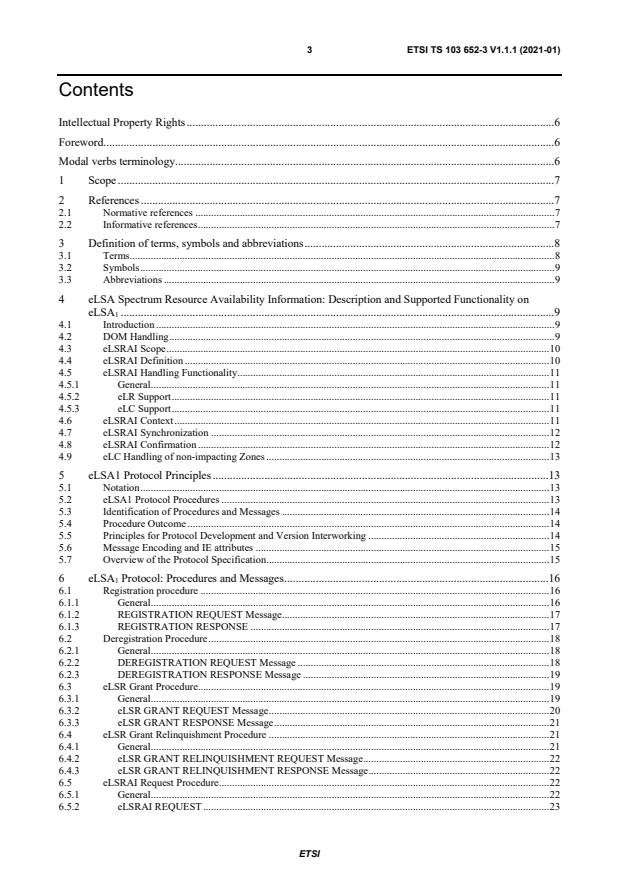
Contents
Intellectual Property Rights . 6
Foreword . 6
Modal verbs terminology . 6
1 Scope . 7
2 References . 7
2.1 Normative references . 7
2.2 Informative references . 7
3 Definition of terms, symbols and abbreviations . 8
3.1 Terms . 8
3.2 Symbols . 9
3.3 Abbreviations . 9
4 eLSA Spectrum Resource Availability Information: Description and Supported Functionality on
eLSA1 . 9
4.1 Introduction . 9
4.2 DOM Handling . 9
4.3 eLSRAI Scope . 10
4.4 eLSRAI Definition . 10
4.5 eLSRAI Handling Functionality . 11
4.5.1 General . 11
4.5.2 eLR Support . 11
4.5.3 eLC Support . 11
4.6 eLSRAI Context . 11
4.7 eLSRAI Synchronization . 12
4.8 eLSRAI Confirmation . 12
4.9 eLC Handling of non-impacting Zones . 13
5 eLSA1 Protocol Principles . 13
5.1 Notation . 13
5.2 eLSA1 Protocol Procedures . 13
5.3 Identification of Procedures and Messages . 14
5.4 Procedure Outcome . 14
5.5 Principles for Protocol Development and Version Interworking . 14
5.6 Message Encoding and IE attributes . 15
5.7 Overview of the Protocol Specification. 15
6 eLSA Protocol: Procedures and Messages . 16
6.1 Registration procedure . 16
6.1.1 General . 16
6.1.2 REGISTRATION REQUEST Message. 17
6.1.3 REGISTRATION RESPONSE . 17
6.2 Deregistration Procedure . 18
6.2.1 General . 18
6.2.2 DEREGISTRATION REQUEST Message . 18
6.2.3 DEREGISTRATION RESPONSE Message . 19
6.3 eLSR Grant Procedure . 19
6.3.1 General . 19
6.3.2 eLSR GRANT REQUEST Message . 20
6.3.3 eLSR GRANT RESPONSE Message . 21
6.4 eLSR Grant Relinquishment Procedure . 21
6.4.1 General . 21
6.4.2 eLSR GRANT RELINQUISHMENT REQUEST Message . 22
6.4.3 eLSR GRANT RELINQUISHMENT RESPONSE Message . 22
6.5 eLSRAI Request Procedure . 22
6.5.1 General . 22
6.5.2 eLSRAI REQUEST . 23
ETSI
4 ETSI TS 103 652-3 V1.1.1 (2021-01)
6.5.3 eLSRAI RESPONSE . 24
6.6 eLSRAI Notification Procedure . 24
6.6.1 General . 24
6.6.2 eLSRAI NOTIFICATION . 25
6.6.3 eLSRAI NOTIFICATION ACK . 26
6.7 eLSRAI Confirmation Procedure . 26
6.7.1 General . 26
6.7.2 eLSRAI CONFIRMATION REQUEST . 27
6.7.3 eLSRAI CONFIRMATION RESPONSE . 28
6.8 Connectivity Check Notification Procedure . 28
6.8.1 General . 28
6.8.2 CONNECTIVITY CHECK NOTIFICATION . 29
6.8.3 CONNECTIVITY CHECK NOTIFICATION ACK . 29
6.9 Connectivity Check Request Procedure . 29
6.9.1 General . 29
6.9.2 CONNECTIVITY CHECK REQUEST . 30
6.9.3 CONNECTIVITY CHECK RESPONSE . 30
7 eLSA1 Protocol: Information Elements . 31
7.1 ELSRAI . 31
7.2 Zone Description . 31
7.3 Zone Type . 32
7.4 Zone Action . 32
7.5 Frequency . 32
7.6 Grant BW . 33
7.7 Frequency Blocks . 33
7.8 Radio Constraints . 33
7.8.1 Introduction. 33
7.8.2 Radio Constraints parameters . 33
7.8.3 Radio Constraints Profiles . 34
7.9 Space . 35
7.10 Time . 35
7.11 Synchronization Information . 36
7.12 Synchronization ACK Information . 36
7.13 Circle . 36
7.14 Circle-2 . 36
7.15 Polygon . 37
7.16 Area Descriptor . 37
7.17 Geographical Coordinates . 37
7.18 Frequency Value . 38
7.19 Periodic . 38
7.20 Aperiodic . 38
7.21 Time . 39
7.22 Day Schedule . 39
7.23 Week Schedule . 39
7.24 Month Schedule . 40
7.25 Year Schedule . 40
7.26 Time of Day . 40
7.27 Time of Week . 41
7.28 Time of Month . 41
7.29 Time of Year . 41
7.30 Confirmed Zone List . 41
7.31 Zone Confirmation . 42
7.32 Zone Configuration Index . 42
7.33 Message Type . 42
7.34 Transaction ID . 43
7.35 ELR ID . 43
7.36 ELC ID . 43
7.37 VSP ID . 43
7.38 L-ID . 43
7.39 Mode of Operation . 44
7.40 eLSA1 Availability in DOM . 44
ETSI
5 ETSI TS 103 652-3 V1.1.1 (2021-01)
7.41 Result . 44
7.42 Sync ID . 44
7.43 Sync Zone List . 44
7.44 Synched Zone . 45
7.45 Cause . 45
7.46 Cause Details . 46
7.47 Zone ID . 47
7.48 Protocol Version List. 47
7.49 Protocol Version . 47
Annex A (informative): Detached Operation Mode Scenarios and Workflow . 48
History . 49
ETSI
6 ETSI TS 103 652-3 V1.1.1 (2021-01)
Intellectual Property Rights
Essential patents
IPRs essential or potentially essential to normative deliverables may have been declared to ETSI. The information
pertaining to these essential IPRs, if any, is publicly available for ETSI members and non-members, and can be found
in ETSI SR 000 314: "Intellectual Property Rights (IPRs); Essential, or potentially Essential, IPRs notified to ETSI in
respect of ETSI standards", which is available from the ETSI Secretariat. Latest updates are available on the ETSI Web
server (https://ipr.etsi.org/).
Pursuant to the ETSI IPR Policy, no investigation, including IPR searches, has been carried out by ETSI. No guarantee
can be given as to the existence of other IPRs not referenced in ETSI SR 000 314 (or the updates on the ETSI Web
server) which are, or may be, or may become, essential to the present document.
Trademarks
The present document may include trademarks and/or tradenames which are asserted and/or registered by their owners.
ETSI claims no ownership of these except for any which are indicated as being the property of ETSI, and conveys no
right to use or reproduce any trademark and/or tradename. Mention of those trademarks in the present document does
not constitute an endorsement by ETSI of products, services or organizations associated with those trademarks.
Foreword
This Technical Specification (TS) has been produced by ETSI Technical Committee Reconfigurable Radio Systems
(RRS).
The present document is part 3 of a multi-part deliverable. Full details of the entire series can be found in part 1
ETSI TS 103 652-1 [i.2].
Modal verbs terminology
In the present document "shall", "shall not", "should", "should not", "may", "need not", "will", "will not", "can" and
"cannot" are to be interpreted as described in clause 3.2 of the ETSI Drafting Rules (Verbal forms for the expression of
provisions).
"must" and "must not" are NOT allowed in ETSI deliverables except when used in direct citation.
ETSI
7 ETSI TS 103 652-3 V1.1.1 (2021-01)
1 Scope
The present document defines the application protocol on the eLSA interface, between eLSA Controller (eLC) and
eLSA Repository (eLR) (eLSA protocol) [i.3], and the content of the eLSA Spectrum Resource Availability
Information (eLSRAI) conveyed by this protocol. It is based on the System Requirements defined in ETSI
TS 103 652-1 [i.2] and the System Architecture and High-Level Procedures defined in ETSI TS 103 652-2 [i.3].
The present document supports the operation of MFCNs operated by vertical sector players under the evolved Licensed
Shared Access (eLSA) system, aimed at enabling the automatic provision of local spectrum access rights to vertical
sector players through:
• licenses acquired in advanced from the NRA and provided by the eLSA procedures; and/or
• licenses/leases acquired and provided by the eLSA procedures.
The operation of eLSA is frequency agnostic. The application of eLSA to concrete frequency bands depends on national
regulatory decisions.
2 References
2.1 Normative references
References are either specific (identified by date of publication and/or edition number or version number) or
non-specific. For specific references, only the cited version applies. For non-specific references, the latest version of the
referenced document (including any amendments) applies.
Referenced documents which are not found to be publicly available in the expected location might be found at
https://docbox.etsi.org/Reference.
NOTE: While any hyperlinks included in this clause were valid at the time of publication, ETSI cannot guarantee
their long term validity.
The following referenced documents are necessary for the application of the present document.
Not applicable.
2.2 Informative references
References are either specific (identified by date of publication and/or edition number or version number) or
non-specific. For specific references, only the cited version applies. For non-specific references, the latest version of the
referenced document (including any amendments) applies.
NOTE: While any hyperlinks included in this clause were valid at the time of publication, ETSI cannot guarantee
their long-term validity.
The following referenced documents are not necessary for the application of the present document, but they assist the
user with regard to a particular subject area.
[i.1] ETSI TR 103 588: "Reconfigurable Radio Systems (RRS); Feasibility study on temporary
spectrum access for local high-quality wireless networks".
[i.2] ETSI TS 103 652-1: "Reconfigurable Radio Systems (RRS); evolved Licensed Shared Access
(eLSA); Part 1: System requirements".
[i.3] ETSI TS 103 652-2: "Reconfigurable Radio Systems (RRS); evolved Licensed Shared Access
(eLSA); Part 2: System architecture and high-level procedures".
ETSI
8 ETSI TS 103 652-3 V1.1.1 (2021-01)
[i.4] ETSI TS 103 379 (V1.1.1): "Reconfigurable Radio Systems (RRS); Information elements and
protocols for the interface between LSA Controller (LC) and LSA Repository (LR) for operation
of Licensed Shared Access (LSA) in the 2 300 MHz - 2 400 MHz band".
[i.5] ETSI TS 138 101 (all parts): "5G; NR; User Equipment (UE) radio transmission and reception
(3GPP TS 38.101)".
[i.6] CEPT Report 58: "Report B2 from CEPT to the European Commission in response to the Mandate
on 'Harmonised technical conditions for the 2300-2400 MHz ('2.3 GHz') frequency band in the EU
for the provision of wireless broadband electronic communications services. Technical sharing
solutions for the shared use of the 2300-2400 MHz band for WBB and PMSE".
3 Definition of terms, symbols and abbreviations
3.1 Terms
For the purposes of the present document, the following terms apply:
allowance zone: geographical area within which an eLSA Licensee can operate radio transmitters on its assigned
spectrum resource
NOTE 1: An allowance zone is defined using specific measurement quantities and thresholds, e.g. a maximum field
strength level expressed in dBµ V/m/MHz, along the border of its geographical area.
NOTE 2: An allowance zone is normally applicable for a defined frequency range and time period.
detached operation mode: operation mode where a VSP operates a MFCN without a permanent network connection
NOTE: The point of detachment between the VSP and the eLSA system can be located at the eLSA and/or the
eLSA interface.
eLSA spectrum resource availability information: information provided to a Licensee, which conveys the eLSA
spectrum resource that may be used by the Licensee, and the respective operational conditions or restrictions
eLSRAI context: set of zones and their parameters that are to be maintained by the nodes (eLC and eLR) for a
license/lease for a VSP in an instance of the eLSA1 interface
eLSRAI synchronization process: process to synchronize the eLSRAI context between eLC and eLR
idle zone: zone which has been defined but which is not currently operational
license/lease identity: identifies the individual rights of use of a license or lease of an eLSA spectrum resource in a
defined area for a specified amount of time
Mobile/Fixed Communication Network (MFCN): referring to a local high-quality wireless network as defined in
ETSI TR 103 588 [i.1]
operational zone: zone to be considered by the Licensee, when making use of the eLSA spectrum resource
sharing arrangement: set of practical details for sharing an eLSA spectrum resource
sharing framework: set of sharing rules or sharing conditions that will materialize the change, if any, in the spectrum
rights of the Incumbent(s) and define the spectrum, with corresponding technical and operational conditions, that can be
made available for alternative usage under eLSA
spectrum resource: resource or set of resources defined in time, space and frequency domains
vertical sector player: entity holding the individual right of use to an eLSA spectrum resource
NOTE: A license or a lease.
ETSI
9 ETSI TS 103 652-3 V1.1.1 (2021-01)
3.2 Symbols
Void.
3.3 Abbreviations
For the purposes of the present document, the following abbreviations apply:
ACLR Adjacent Channel Leakage Ratio
ACS Adjacent Channel Selectivity
BW BandWidth
DOM Detached Operation Mode
EIRP Equivalent Isotopically Radiated Power
eLC evolved LSA Controller
eLR evolved LSA Repository
eLSR eLSA Spectrum Resource
eLSRAI evolved LSA Spectrum Resource Availability Information
ID IDentifier
IE Information Element
L-Id License/Lease Identity
MFCN Mobile/Fixed Communication Network
NRA National Regulatory Authority
PMSE Programme Making and Special Events
RF Radio Frequency
TRP Total Radiated Power
UTC Coordinated Universal Time
VSP Vertical Sector Player
4 eLSA Spectrum Resource Availability Information:
Description and Supported Functionality on eLSA
4.1 Introduction
Clause 4 contains a high-level description of the eLSA Spectrum Resource Availability information (eLSRAI), and
eLSRAI-related functionality supported by the eLSA functional nodes (eLC and eLR), and the interface eLSA . Main
scope is to extend the related material in the stage 2 specification of ETSI TS 103 652-2 [i.3], and to describe details for
the eLSA protocol and its operation.
4.2 DOM Handling
As described in clause A.7 of ETSI TS 103 652.2 [i.3], the eLSA system can work in detached operation mode (DOM)
and foresees two possible points of temporary detachment within the eLSA system:
1) At the eLSA interface, i.e. the connection between an eLC and an eLR can be temporarily disconnected.
2) At the eLSA interface, i.e. the connection between an MFCN and its eLC can be temporarily disconnected.
While the disconnection of the eLSA interface may have impact on the response times and the end to end
acknowledgement handling of eLSRAI changes at the eLSA interface, the disconnection of the eLSA interface will
1 1
basically prevent that the eLR can initiate any eLSA procedure until eLC re-initiate eLSA interface.
1 1
The possibility for a VSP to operate an eLSA Spectrum Resource (eLSR) in DOM is defined in the license/lease.
Depending on national regulation, some eLSRs may allow detached operation but others may not. Such rules as well as
the maximum allowed duration of the DOM period are defined in the Sharing Framework and/or the Sharing
Arrangement.
ETSI
10 ETSI TS 103 652-3 V1.1.1 (2021-01)
In DOM scenarios where the eLSR is not pre-allocated and needs to be assigned by eLR, eLC provides the information
on DOM with the eLSR Grant Request message.
interface as detachment point, the eLC initiates the
When DOM for the eLSR is allowed and the VSP selects eLSA
DOM by sending an eLSRAI Confirmation Request message containing the eLSA detachment point information to the
eLR. After receiving the eLSRAI Confirmation Response the eLC can temporarily detach from the eLR. During the
DOM period, eLC can re-initiate eLSA whenever it needs it. For that, eLC will send a Confirmation Request message
to eLR.
For eLCs serving several VSPs, as considered in clause A.8 of ETSI TS 103 652-2 [i.3], a VSP requesting DOM can
only imply a disconnection of the eLSA .
4.3 eLSRAI Scope
eLSA Spectrum Resource Availability Information (eLSRAI) is information provided to a VSP, which conveys
information on the eLSA spectrum resource that may be used by a VSP. The information exchange of eLSRAI shall
comply with Sharing Framework, Sharing Arrangements, and further national laws to protect privacy data. As described
in ETSI TS 103 652-2 [i.3], eLSRAI is generated in the eLR, and sent to the eLC over the eLSA interface, using
eLSA protocol messages. A VSP may be granted more than one license and/or lease. Each license or lease will have its
own instance of an eLSRAI.
Under eLSA operation, the spectrum resources which are allocated to the respective VSP may not be predefined, and
therefore such information needs to be conveyed over eLSA as part of eLSRAI. Further eLSRAI may include any
additional operational conditions or restrictions that the VSP shall apply.
NOTE: It is a deployment choice whether permanent restrictions contained in the Sharing Framework or Sharing
Arrangements, are conveyed to the eLC as part of eLSRAI.
The conditions or restrictions within eLSRAI may apply to the licensed spectrum resource, or to a subset (described in
frequency, space, time or a combination of these).
4.4 eLSRAI Definition
eLSRAI has the following characteristics:
• It contains a license/lease identity (L-ID).
• It contains one or more Zones. A Zone is an information object which describes a set of operational conditions
or restrictions to be applied by the VSP.
• A Zone has a Zone Type associated to it (e.g. allowance, restriction, protection, exclusion).
• A Zone contains space, frequency, radio and time parameters (e.g. validity time):
- Space parameters describing the geographical area to which the set of operational conditions or
restrictions applies.
- Frequency parameters describing the frequency range to which the set of operational conditions or
restrictions applies.
- Time parameters describing when the set of operational conditions or restrictions applies.
- Radio parameters describing the RF operational conditions or restrictions to be applied within the
space/frequency/time combination defined by the above parameters.
• A Zone has a Zone ID and a Zone Configuration Index associated to it.
ETSI
11 ETSI TS 103 652-3 V1.1.1 (2021-01)
• It contains optionally information about geographically located neighbours' spectrum and time allocations. The
knowledge that there are neighbouring/adjacent licenses (or possibly leasing agreements) may be useful
information:
- To negotiate Sharing Arrangements.
- To coordinate interference behaviour between neighbours when planning/configuring the radio network.
NOTE: When eLSRAI is conveyed over the eLSA interface, each Zone is associated to a Zone Action.
4.5 eLSRAI Handling Functionality
4.5.1 General
As described in ETSI TS 103 652-2 [i.3], the eLSA Information Exchange Function supports communication
mechanisms to exchange eLSRAI and related acknowledgment information between eLR and eLC.
Clauses 4.4.2 and 4.4.3 further specify the related functional split between eLR and eLC in support of this high-level
function.
4.5.2 eLR Support
The eLR supports the eLSA Information Exchange Function by:
• Providing a license or a lease by constructing Zone information including type and parameters for each Zone.
• Assigning a Zone ID, which uniquely identifies a Zone over all instances of the eLSA interface for a given
eLR.
• Assigning a Zone Configuration Index, which uniquely identifies the particular configuration (set of Zone
parameters).
• Conveying the Zone information towards concerned eLCs.
• Monitoring the status of eLSRAI conveyed to the eLC (e.g. per- Zone acknowledgment and confirmation).
• Conveying a modification of Zone parameters towards the eLC (with corresponding Zone Configuration
Index).
• Conveying deletion of a Zone towards the eLC.
• Synchronizing eLSRAI with the eLC.
4.5.3 eLC Support
The eLC supports the eLSA Information Exchange Function by:
• Requesting a license or a lease using the Grant procedure.
• Receiving and acknowledging eLSRAI (including checking of parameters).
• Confirming eLSRAI.
• Synchronizing eLSRAI with the eLR.
4.6 eLSRAI Context
The eLSRAI Context is the complete set of zones and their parameters that are to be maintained by the nodes (eLC and
eLR) in an instance of the eLSA interface for an L-Id. The eLR determines the eLSRAI Context and informs the eLC
of any changes due to creation, modification or deletion of zones.
ETSI
12 ETSI TS 103 652-3 V1.1.1 (2021-01)
When receiving zone information, the eLC shall consider that:
• a Zone with a Zone Action set to "Create" is to be added to the eLSRAI Context (including its parameters);
• a Zone with a Zone Action set to "Modify" is to be kept in the eLSRAI Context (including modified parameter
set);
• a Zone with a Zone Action set to "Delete" is to be removed from the eLSRAI Context.
There is no relationship between the current status of a Zone (idle/operational), and whether the Zone is part of the
eLSRAI Context. The eLSRAI Context may therefore include both idle and operational zones at any moment in time.
NOTE: The eLR may define a Zone in such a way that it is idle (at the time that it is conveyed to the eLC) and
has no future idle-operational transition. During operation of the eLSA interface, the eLR may modify
the time parameters of the Zone such that it will trigger an idle-operational transition at any desired point
in time.
4.7 eLSRAI Synchronization
eLSRAI Synchronization is the process used to synchronize the eLSRAI of eLR and eLC. eLSRAI Synchronization is
supported by the eLSA Information Exchange Function in ETSI TS 103 652-2 [i.3]. The eLSRAI Synchronization
process can be initiated by either eLC or eLR at any time.
The provision of the eLSRAI Context from the eLR towards the eLC uses either the eLC-initiated eLSRAI Request
procedure (clause 6.5) or the eLR-initiated eLSRAI Notification procedure (clause 6.6). The eLSRAI Context may
optionally be segmented over two or more instances of the same procedure.
All procedures that are part of an eLSRAI Synchronization process shall be identified by a specific synchronization
process identity.
An eLSRAI Synchronization process may be used to reset the eLSRAI Context at the eLC. In the case of eLSRAI
Synchronization with context reset, the eLC shall immediately replace the eLSRAI Context with the newly received
context and shall consider that all zones in the eLSRAI Context require confirmation [i.3]. If no context reset is
requested by the eLR, the eLC:
• shall use the information received to update the local eLSRAI Context at the eLC;
• shall consider that any existing zones not included in the received eLSRAI Context are implicitly deleted;
• shall consider that confirmations are required for new or modified zones.
Once an eLSRAI Synchronization process is initiated, any existing eLSRAI-handling procedures shall be considered
terminated. A node receiving an initiating message for an eLSRAI-handling procedure while an eLSRAI
Synchronization process is ongoing shall fail such procedure with an appropriate cause e.g. "Synchronization ongoing",
except if the new procedure indicates the initiation of a new eLSRAI Synchronization process. In this case, the old
eLSRAI Synchronization process shall be considered to have been unsuccessfully terminated.
4.8 eLSRAI Confirmation
As described in ETSI TS 103 652-2 [i.3], the eLSA Information Exchange Function supports means for the eLC to
notify the eLR once the necessary configuration changes in the MFCN have been applied according to the received
eLSRAI.
Confirmation may also be used by the eLC to inform the eLR that the configuration changes cannot be implemented
('negative confirmation').
The eLC shall explicitly provide confirmation for each zone within the eLSRAI Context. Each zone shall be confirmed
at least once. If the configuration of an existing zone is modified, the eLC shall consider that a further confirmation is
required for the zone (regardless of whether it had been previously confirmed, and regardless of the modification
details). In order to identify the configuration that is confirmed, the eLC shall include both the Zone ID and the Zone
Configuration Index within the confirmation signalling.
ETSI
13 ETSI TS 103 652-3 V1.1.1 (2021-01)
If the received eLSRAI contains zones whose time configuration includes multiple operational periods (i.e. scheduled or
periodic zones), the eLC shall provide confirmation for each zone at least once (in connection with the first operational
period), meaning that exactly a single confirmation will be sent and that this single confirmation is enough to confirm
successive idle-operational transitions of the zone that may happen later.
When a VSP works in Detached Operation Mode (DOM), eLSRAI Confirmation shall follow the behaviour in
clause 4.2.
NOTE: Confirmation messages may be sent by the eLC more than once for a given combination of Zone ID and
Zone Configuration Index (e.g. in the case of scheduled or periodic zones, an initial positive confirmation
is sent by the eLC; later the MFCN is not able to comply with a subsequent operational period, and a
negative confirmation is sent). In all cases, the confirmation status of the last received message overwrites
any previously received information.
4.9 eLC Handling of non-impacting Zones
The eLC may receive a zone configuration such that the eLC has identified that no MFCN resource is impacted by the
zone. The eLC shall however consider that the zone (and its information) forms part of the eLSRAI Context.
The eLC shall also act as if the necessary configuration changes have been applied, by sending an associated
confirmation for any such zone towards the eLR.
5 eLSA1 Protocol Principles
5.1 Notation
For the purpose of the present document, the following notations apply:
Procedure When referring to an elementary procedure in the specification, the procedure name is written with
the first letters in each word in upper case characters followed by the word "procedure",
e.g. ELSRAI N
...
Questions, Comments and Discussion
Ask us and Technical Secretary will try to provide an answer. You can facilitate discussion about the standard in here.
Loading comments...