


ETSI TS 104 015 V1.1.1 (2025-02)
Cyber Security (CYBER); Quantum-Safe Cryptography (QSC); Efficient Quantum-Safe Hybrid Key Exchanges with Hidden Access Policies
Cyber Security (CYBER); Quantum-Safe Cryptography (QSC); Efficient Quantum-Safe Hybrid Key Exchanges with Hidden Access Policies
DTS/CYBER-QSC-0023
General Information
Standards Content (Sample)
TECHNICAL SPECIFICATION
Cyber Security (CYBER); Quantum-Safe Cryptography (QSC);
Efficient Quantum-Safe Hybrid Key Exchanges with
Hidden Access Policies
2 ETSI TS 104 015 V1.1.1 (2025-02)
Reference
DTS/CYBER-QSC-0023
Keywords
anonymity, authentication, encryption,
key exchange, quantum safe cryptography,
traceability
ETSI
650 Route des Lucioles
F-06921 Sophia Antipolis Cedex - FRANCE
Tel.: +33 4 92 94 42 00 Fax: +33 4 93 65 47 16
Siret N° 348 623 562 00017 - APE 7112B
Association à but non lucratif enregistrée à la
Sous-Préfecture de Grasse (06) N° w061004871
Important notice
The present document can be downloaded from the
ETSI Search & Browse Standards application.
The present document may be made available in electronic versions and/or in print. The content of any electronic and/or
print versions of the present document shall not be modified without the prior written authorization of ETSI. In case of any
existing or perceived difference in contents between such versions and/or in print, the prevailing version of an ETSI
deliverable is the one made publicly available in PDF format on ETSI deliver repository.
Users should be aware that the present document may be revised or have its status changed,
this information is available in the Milestones listing.
If you find errors in the present document, please send your comments to
the relevant service listed under Committee Support Staff.
If you find a security vulnerability in the present document, please report it through our
Coordinated Vulnerability Disclosure (CVD) program.
Notice of disclaimer & limitation of liability
The information provided in the present deliverable is directed solely to professionals who have the appropriate degree of
experience to understand and interpret its content in accordance with generally accepted engineering or
other professional standard and applicable regulations.
No recommendation as to products and services or vendors is made or should be implied.
No representation or warranty is made that this deliverable is technically accurate or sufficient or conforms to any law
and/or governmental rule and/or regulation and further, no representation or warranty is made of merchantability or fitness
for any particular purpose or against infringement of intellectual property rights.
In no event shall ETSI be held liable for loss of profits or any other incidental or consequential damages.
Any software contained in this deliverable is provided "AS IS" with no warranties, express or implied, including but not
limited to, the warranties of merchantability, fitness for a particular purpose and non-infringement of intellectual property
rights and ETSI shall not be held liable in any event for any damages whatsoever (including, without limitation, damages
for loss of profits, business interruption, loss of information, or any other pecuniary loss) arising out of or related to the use
of or inability to use the software.
Copyright Notification
No part may be reproduced or utilized in any form or by any means, electronic or mechanical, including photocopying and
microfilm except as authorized by written permission of ETSI.
The content of the PDF version shall not be modified without the written authorization of ETSI.
The copyright and the foregoing restriction extend to reproduction in all media.
© ETSI 2025.
All rights reserved.
ETSI
3 ETSI TS 104 015 V1.1.1 (2025-02)
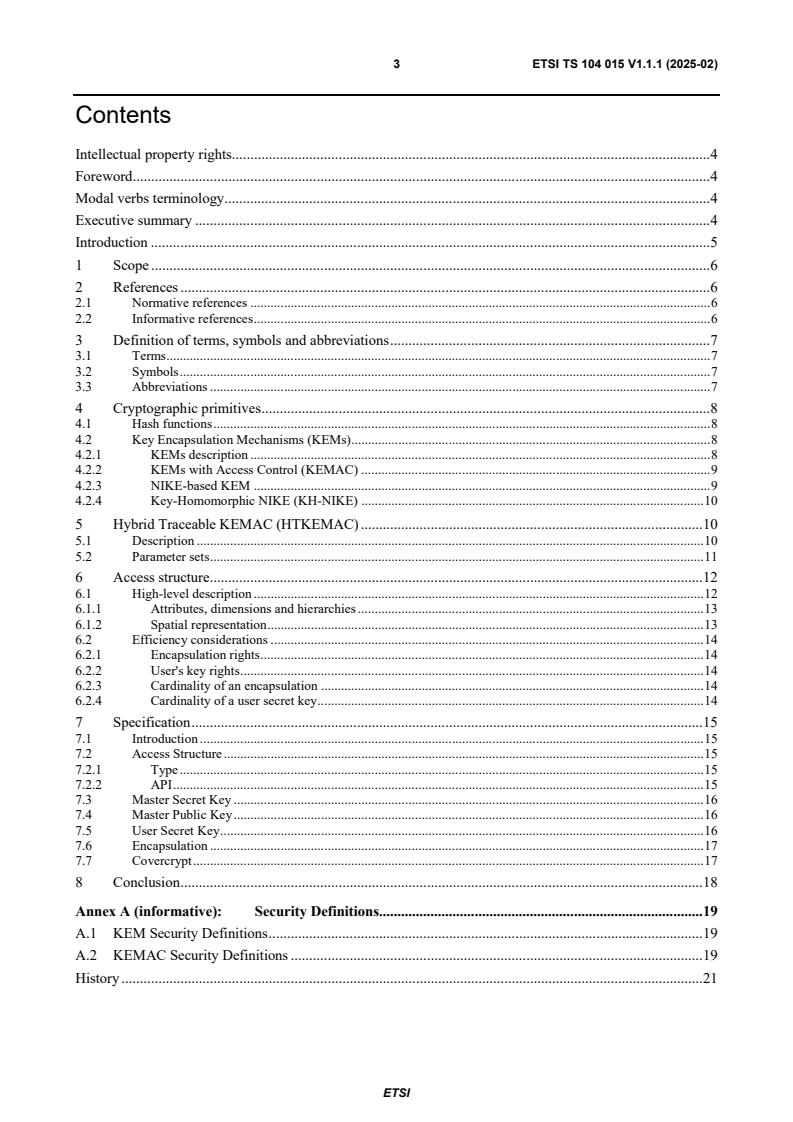
Contents
Intellectual property rights . 4
Foreword . 4
Modal verbs terminology . 4
Executive summary . 4
Introduction . 5
1 Scope . 6
2 References . 6
2.1 Normative references . 6
2.2 Informative references . 6
3 Definition of terms, symbols and abbreviations . 7
3.1 Terms . 7
3.2 Symbols . 7
3.3 Abbreviations . 7
4 Cryptographic primitives . 8
4.1 Hash functions . 8
4.2 Key Encapsulation Mechanisms (KEMs) . 8
4.2.1 KEMs description . 8
4.2.2 KEMs with Access Control (KEMAC) . 9
4.2.3 NIKE-based KEM . 9
4.2.4 Key-Homomorphic NIKE (KH-NIKE) . 10
5 Hybrid Traceable KEMAC (HTKEMAC) . 10
5.1 Description . 10
5.2 Parameter sets . 11
6 Access structure . 12
6.1 High-level description . 12
6.1.1 Attributes, dimensions and hierarchies . 13
6.1.2 Spatial representation . 13
6.2 Efficiency considerations . 14
6.2.1 Encapsulation rights . 14
6.2.2 User's key rights . 14
6.2.3 Cardinality of an encapsulation . 14
6.2.4 Cardinality of a user secret key . 14
7 Specification . 15
7.1 Introduction . 15
7.2 Access Structure . 15
7.2.1 Type . 15
7.2.2 API . 15
7.3 Master Secret Key . 16
7.4 Master Public Key . 16
7.5 User Secret Key . 16
7.6 Encapsulation . 17
7.7 Covercrypt . 17
8 Conclusion . 18
Annex A (informative): Security Definitions. . 19
A.1 KEM Security Definitions . 19
A.2 KEMAC Security Definitions . 19
History . 21
ETSI
4 ETSI TS 104 015 V1.1.1 (2025-02)
Intellectual property rights
Essential patents
IPRs essential or potentially essential to normative deliverables may have been declared to ETSI. The declarations
pertaining to these essential IPRs, if any, are publicly available for ETSI members and non-members, and can be
found in ETSI SR 000 314: "Intellectual Property Rights (IPRs); Essential, or potentially Essential, IPRs notified to
ETSI in respect of ETSI standards", which is available from the ETSI Secretariat. Latest updates are available on the
ETSI IPR online database.
Pursuant to the ETSI Directives including the ETSI IPR Policy, no investigation regarding the essentiality of IPRs,
including IPR searches, has been carried out by ETSI. No guarantee can be given as to the existence of other IPRs not
referenced in ETSI SR 000 314 (or the updates on the ETSI Web server) which are, or may be, or may become,
essential to the present document.
Trademarks
The present document may include trademarks and/or tradenames which are asserted and/or registered by their owners.
ETSI claims no ownership of these except for any which are indicated as being the property of ETSI, and conveys no
right to use or reproduce any trademark and/or tradename. Mention of those trademarks in the present document does
not constitute an endorsement by ETSI of products, services or organizations associated with those trademarks.
DECT™, PLUGTESTS™, UMTS™ and the ETSI logo are trademarks of ETSI registered for the benefit of its
Members. 3GPP™, LTE™ and 5G™ logo are trademarks of ETSI registered for the benefit of its Members and of the
3GPP Organizational Partners. oneM2M™ logo is a trademark of ETSI registered for the benefit of its Members and of ®
the oneM2M Partners. GSM and the GSM logo are trademarks registered and owned by the GSM Association.
Foreword
This Technical Specification (TS) has been produced by ETSI Technical Committee Cyber Security (CYBER).
Modal verbs terminology
In the present document "shall", "shall not", "should", "should not", "may", "need not", "will", "will not", "can" and
"cannot" are to be interpreted as described in clause 3.2 of the ETSI Drafting Rules (Verbal forms for the expression of
provisions).
"must" and "must not" are NOT allowed in ETSI deliverables except when used in direct citation.
Executive summary
The present document will provide a framework to build Key Encapsulation Mechanisms (KEMs) retaining both
pre-quantum and post-quantum security through hybridization, with additional features for practical use, while being
efficient enough for browser or mobile use. Namely, keys will be encapsulated with respect to user-attributes, the
encapsulations will be anonymous, and any user having attributes fulfilling the encapsulation policy will be able to
retrieve the keys, while those who are not authorized will not be able to. Since many users could have the same
attributes, the scheme includes an optional tracing feature, in which a tracing authority would have the means to
distinguish users with the same attributes, to possibly later deactivate rights in case of abuse.
ETSI
5 ETSI TS 104 015 V1.1.1 (2025-02)
Introduction
Key Encapsulation Mechanisms (KEMs) provide the most efficient practical instantiations of Public-Key Encryption
(PKE) mechanisms when combined with a Data Encapsulation Mechanism (DEM) to encrypt large amounts of data.
The KEM-DEM paradigm introduced by Shoup in [i.4] wisely combines a public-key scheme together with a
symmetric encryption scheme to create a scheme with ciphertexts of similar size to plaintexts.
In short, KEMs provide a tool to transmit session keys. First, a user runs the encapsulation procedure with respect to a
recipient or set of recipients, generating a session key and an encapsulation of the latter. The recipients are provided
with this encapsulation and, if they were among the set of intended recipients, are then able to derive the session key
from it. The payload is then encrypted/decrypted under this session key using a DEM, which can be implemented by
any authenticated encryption mechanism.
In order to provide additional confidence during the post-quantum migration, it is possible to hybridize two KEMs so
that the security of the scheme relies on the stronger of two component algorithms. That is, if one component KEM
algorithm is vulnerable to a cryptographic attack, then the privacy of the encapsulated keys is nonetheless maintained.
This can be done with one pre-quantum and one post-quantum secure scheme (post-quantum schemes are resistant to
adversaries with a cryptographically relevant quantum computer).
Moreover, for fine-grained access-control of users able to decrypt the payload, one just needs fine-grained
access-control on the KEM part. Attribute-Based Encryption (ABE) - which often first generates an encapsulated
session key, in the KEM-DEM paradigm- has been proposed to control decryption with respect to attributes and policies
in ciphertexts and a user's keys [i.2]. More advanced ABE schemes have been proposed in the literature to handle
complex access policies, but at a high computational cost and large ciphertexts, in particular when one wants
post-quantum security.
To give two specific examples, a first work [i.3] proposed key-policy ABE, where a Boolean formula (the policy) is
associated to the user's key, and attributes associated to the ciphertext, so that the user can decrypt if and only if the
Boolean formula accepts on the ciphertext's attributes. The more general work [i.2] also defines ciphertext-policy ABE,
where a Boolean formula (the policy) is associated to the ciphertext, and attributes associated to the user's key, so that
the user can decrypt if and only if Boolean formula in the ciphertext accepts on the user's attributes.
The present document follows the approach of ciphertext-policy ABE, with policies with particular properties for
efficiency reasons.
The scheme specified in the present document targets particular access-structures, with several orthogonal dimensions,
with a hybrid KEM, providing fine-grained access control, key rotation to allow dynamicity of users and user's rights
and an optional traceability feature that allows detection of abuse by individual users. It is described in a black box
model, allowing component cryptographic algorithms to be selected according to the preferences of the implementer.
ETSI
6 ETSI TS 104 015 V1.1.1 (2025-02)
1 Scope
The present document specifies methods to efficiently build and instantiate Key Encapsulation Mechanisms (KEMs)
with hidden access policies, while having the privacy of encapsulated keys relying on the best security of two
hybridized schemes, namely with an instantiation where the privacy relies on the Computational Diffie-Hellman (CDH)
classical assumption and the Learning With Errors (LWE) post-quantum assumption. Both problems have to be broken
to endanger the privacy of the encapsulated key.
2 References
2.1 Normative references
References are either specific (identified by date of publication and/or edition number or version number) or
non-specific. For specific references, only the cited version applies. For non-specific references, the latest version of the
referenced document (including any amendments) applies.
Referenced documents which are not found to be publicly available in the expected location might be found in the
ETSI docbox.
NOTE: While any hyperlinks included in this clause were valid at the time of publication, ETSI cannot guarantee
their long term validity.
The following referenced documents are necessary for the application of the present document.
[1] NIST SP 800-186: "Recommendations for Discrete Logarithm-Based Cryptography: Elliptic
Curve Domain Parameters".
[2] IETF RFC 7748: "Elliptic Curves for Security".
[3] NIST SP800-185: "SHA-3 Derived Functions: cSHAKE, KMAC, TupleHash and ParallelHash".
[4] FIPS PUB 180-4: "Secure Hash Standard (SHS)".
[5] FIPS PUB 202: "SHA-3 Standard: Permutation-Based Hash and Extendable-Output Functions".
[6] FIPS PUB 203: "Module-Lattice-Based Key-Encapsulation Mechanism Standard".
2.2 Informative references
References are either specific (identified by date of publication and/or edition number or version number) or
non-specific. For specific references, only the cited version applies. For non-specific references, the latest version of the
referenced document (including any amendments) applies.
NOTE: While any hyperlinks included in this clause were valid at the time of publication, ETSI cannot guarantee
their long term validity.
The following referenced documents are not necessary for the application of the present document but they assist the
user with regard to a particular subject area.
[i.1] Théophile Brézot, Paola de Perthuis, and David Pointcheval: "Covercrypt: an Efficient
Early-Abort KEM for Hidden Access Policies with Traceability from the DDH and LWE".
ESORICS 2023.
[i.2] Vipul Goyal, Omkant Pandey, Amit Sahai, and Brent Waters: "Attribute-Based Encryption for
Fine-Grained Access Control of Encrypted Data". ACM CCS 2006.
[i.3] Amit Sahai and Brent Waters: "Fuzzy identity-based encryption". EUROCRYPT 2005.
[i.4] ISO/IEC 18033-2: "Information technology — Security techniques — Encryption algorithms —
Part 2: Asymmetric ciphers".
ETSI
7 ETSI TS 104 015 V1.1.1 (2025-02)
3 Definition of terms, symbols and abbreviations
3.1 Terms
For the purposes of the present document, the following terms apply:
adversary's advantage: probability for an adversary to distinguish two distributions
NOTE: Formally, for an adversary A, given two distributions D and D , the advantage is defined as:
0 1
� � � � � � � � � � � � � �
Adv A =Pr A x =1 −Pr A x =1 =2 . Pr A x =b −1.
� � �,�
� �
�
negligible probability in κ: probability that is smaller than the inverse of any polynomial in κ, for κ large enough
oracle access: efficient evaluation of a function for inputs of their choice
overwhelming probability in κ: probability p such that 1-p is negligible in κ
polynomial time: running time can be expressed as a polynomial in the security parameter
security parameter: number of bits in the security level
-κ
NOTE: If the security parameter is equal to κ, then the security should hold except with probability less than 2 .
3.2 Symbols
For the purposes of the present document, the following symbols apply:
κ
1 The security parameter κ taken as input to an algorithm
|| The logical (non-exclusive) OR
&& The logical AND
⊕ The logical XOR
x ← f(y) x is the output of the algorithm f applied to the input y. Unless stated otherwise, f is a randomized
algorithm, implicitly also using an input of random coins
$
x ← S x is drawn from a uniform distribution on the finite set S
¬A For an event A, the event in which A does not happen
D = { A : B } The distribution of B given A (where A will specify the distribution from which B is taken). For
$
instance, D = { a ← � : a } denotes the distribution of a knowing that a is drawn from a uniform
distribution on the finite set �
f : X → Y The function f takes input values in the space X and outputs values in Y
⊥ Output to an algorithm that indicates that it has failed and returns nothing, except for the indication
that it did not terminate correctly
3.3 Abbreviations
For the purposes of the present document, the following abbreviations apply:
ABE Attribute-Based Encryption
CCA Chosen-Ciphertext Attacks
CDH Computational Diffie-Hellman
CPA Chosen-Plaintext Attacks
DEM Data Encryption Mechanism
DNF Disjunctive Normal Form
IND INDistinguishability
KEM Key Encapsulation Mechanism
KEMAC KEM with Access Control
LWE Learning With Errors
NIKE Non-Interactive Key Exchange
ETSI
8 ETSI TS 104 015 V1.1.1 (2025-02)
PKE Public-Key Encryption
PK-IND Public-Key privacy INDistinguishability
PPT Probabilistic Polynomial Time
SK-IND Session-Key privacy INDistinguishability
4 Cryptographic primitives
4.1 Hash functions
Hash functions are used to produce a fixed length random output y from an arbitrary length input x:
• H(x) → y
Approved hash functions for the purpose of the present document are:
• SHA-256, SHA-384, SHA-512, SHA-512/256 as defined in FIPS PUB 180-4 [4].
• SHA3-256, SHA3-384, SHA3-512 as defined in FIPS PUB 202 [5].
4.2 Key Encapsulation Mechanisms (KEMs)
4.2.1 KEMs description
A Key Encapsulation Mechanism KEM is a public-key scheme defined by three algorithms:
κ
• KEM.KeyGen(1 ) → (pk, sk): on input of a security parameter κ, returns a public key pk and a secret key sk;
• KEM.Enc(pk) → (C, K): on input of the public key pk, generates a session key K, and its encapsulation C, and
returns (C, K);
• KEM.Dec(sk, C) → K: on input of the encapsulation C and the secret key sk, returns the session key K
encapsulated in C.
Correctness: A KEM is said to achieve correctness if the probability that KEM.Dec(sk,C) is not equal to K is negligible
κ
in κ, on the distribution of {(pk,sk) ←KEM.KeyGen(1 ), (C,K)←KEM.Enc(pk)}.
Security: The main goal of a KEM is to encapsulate a session key K that can only be recovered from the encapsulation
C with knowledge of the secret key. This is called Session Key Indistinguishability (SK-IND). One may also wish to
protect the privacy of the recipient, meaning that an adversary cannot identify whether a particular encapsulation has
been prepared for a specific public key. This is called Public Key Indistinguishability (PK-IND).
The adversary can be modelled as having access to an encapsulation oracle (equivalently, the KEM's public key), in
which case the scheme should be resistant to a Chosen Plaintext Attack (CPA security), or having additional access to a
decapsulation oracle, in which case the scheme should be resistant to a Chosen Ciphertext Attack (CCA security). The
adversary is not allowed to submit any challenge values to the decapsulation oracle.
For a more detailed description of these properties, including the precise security games, see clause A.1.
Approved KEMs for the purpose of the present document are:
• ML-KEM [6].
ETSI
9 ETSI TS 104 015 V1.1.1 (2025-02)
4.2.2 KEMs with Access Control (KEMAC)
When several users are in a KEM system, a KEM with Access Control (KEMAC) can issue users keys according to a
key-policy Y, and encapsulate session keys with respect to an encapsulation-policy X, so that a user with key-policy Y
can decapsulate if and only if R(X,Y) evaluates to 1, for a fixed Boolean rule R. Said differently, the access control is
defined with respect to the rule R on policies X and Y. For any user-policy Y and encapsulation-policy X, R(X,Y)
evaluates to 1 if the user with keys corresponding to the policy Y is allowed to decapsulate an encapsulation made with
the policy X; else, R(X,Y) evaluates to 0.
A KEMAC KEMAC is defined with the following algorithms:
κ
• KEMAC.Setup(R,1 ) → (MPK, MSK): on input of the rule R and the security parameter κ, outputs the global
public parameters MPK and the master secret key MSK;
• KEMAC.KeyGen(MSK, Y) → USK: on input of the master secret key MSK and the user-policy Y, outputs a
user secret key USK;
• KEMAC.Enc(MPK, X) → (C, K): on input of the global public parameters MPK and the encapsulation -policy
X, outputs the session key K and an encapsulation C of K;
• KEMAC.Dec(USK, C) → K: on input of the user secret key USK and the encapsulation C, outputs the key K
encapsulated in C.
Correctness. KEMAC is said to achieve correctness with respect to the rule R if for each user-policy Y and
encapsulation-policy X such that R(X,Y)=1, given the security parameter κ, the distribution of user keys built with
respect to Y, and of encapsulations C of keys K with respect to the policy X is such that except with probability
negligible in κ, the decapsulation of C using these user keys is equal to K.
Security. The challenge setup consists of chosen policies X and Y according to R, a random key pair
κ
(MPK,MSK) ← KEM.Setup (R,1 ), a random encapsulation (C,K )←KEM.Enc(MPK, X), a random bit b, and a random
. For SK-IND-CPA security, given (C, K ), no adversary, that can only ask keys for user-policies Y' such that
key K1 b
R(X,Y')=0, can guess b with non-negligible advantage. Note that allowing key queries for a user-policy Y' such that
R(X,Y')=1 would allow decapsulating C, and trivially guess b. For PK-IND-CCA security, the adversary has additional
access to a decapsulation oracle, which provides the encapsulated key K for any encapsulation C' under a key USK,
according to any user-policy Y', except for the challenge encapsulation C.
Traceability. An optional feature of a KEMAC is offering traceability in the case of a pirate decoder in which a
particular user's key has been embedded. This is a recommended but not required feature, which gives each user distinct
keys even if they have common attributes. Several levels of traceability exist. The simplest one is called white-box
tracing, where from the key extracted in the pirate decoder one can trace back the traitor. In this case, the KeyGen
algorithm takes an additional input U, the identity of the user. Then no adversary should be able to design a
decapsulating algorithm that uses a key that does not correspond to a user U.
4.2.3 NIKE-based KEM
A Non-Interactive Key Exchange (NIKE) is defined by two algorithms:
κ
• NIKE.KeyGen(1 ) → (pk, sk): on input of a security
...
Questions, Comments and Discussion
Ask us and Technical Secretary will try to provide an answer. You can facilitate discussion about the standard in here.
Loading comments...