


ETSI TS 103 246-5 V1.1.1 (2016-01)
Satellite Earth Stations and Systems (SES); GNSS based location systems; Part 5: Performance Test Specification
Satellite Earth Stations and Systems (SES); GNSS based location systems; Part 5: Performance Test Specification
DTS/SES-00349
General Information
Standards Content (Sample)
TECHNICAL SPECIFICATION
Satellite Earth Stations and Systems (SES);
GNSS based location systems;
Part 5: Performance Test Specification
�
2 ETSI TS 103 246-5 V1.1.1 (2016-01)
Reference
DTS/SES-00349
Keywords
GNSS, location, MSS, navigation, performance,
receiver, satellite, system, terminal
ETSI
650 Route des Lucioles
F-06921 Sophia Antipolis Cedex - FRANCE
Tel.: +33 4 92 94 42 00 Fax: +33 4 93 65 47 16
Siret N° 348 623 562 00017 - NAF 742 C
Association à but non lucratif enregistrée à la
Sous-Préfecture de Grasse (06) N° 7803/88
Important notice
The present document can be downloaded from:
http://www.etsi.org/standards-search
The present document may be made available in electronic versions and/or in print. The content of any electronic and/or
print versions of the present document shall not be modified without the prior written authorization of ETSI. In case of any
existing or perceived difference in contents between such versions and/or in print, the only prevailing document is the
print of the Portable Document Format (PDF) version kept on a specific network drive within ETSI Secretariat.
Users of the present document should be aware that the document may be subject to revision or change of status.
Information on the current status of this and other ETSI documents is available at
http://portal.etsi.org/tb/status/status.asp
If you find errors in the present document, please send your comment to one of the following services:
https://portal.etsi.org/People/CommiteeSupportStaff.aspx
Copyright Notification
No part may be reproduced or utilized in any form or by any means, electronic or mechanical, including photocopying
and microfilm except as authorized by written permission of ETSI.
The content of the PDF version shall not be modified without the written authorization of ETSI.
The copyright and the foregoing restriction extend to reproduction in all media.
© European Telecommunications Standards Institute 2016.
All rights reserved.
TM TM TM
DECT , PLUGTESTS , UMTS and the ETSI logo are Trade Marks of ETSI registered for the benefit of its Members.
TM
3GPP and LTE™ are Trade Marks of ETSI registered for the benefit of its Members and
of the 3GPP Organizational Partners.
GSM® and the GSM logo are Trade Marks registered and owned by the GSM Association.
ETSI
3 ETSI TS 103 246-5 V1.1.1 (2016-01)
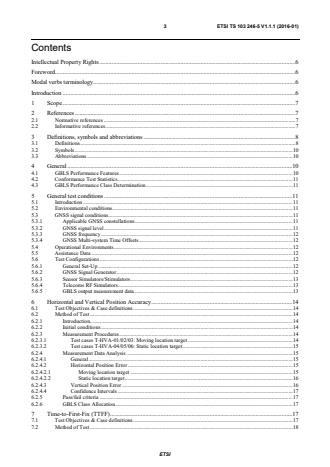
Contents
Intellectual Property Rights . 6
Foreword . 6
Modal verbs terminology . 6
Introduction . 6
1 Scope . 7
2 References . 7
2.1 Normative references . 7
2.2 Informative references . 7
3 Definitions, symbols and abbreviations . 8
3.1 Definitions . 8
3.2 Symbols . 10
3.3 Abbreviations . 10
4 General . 10
4.1 GBLS Performance Features . 10
4.2 Conformance Test Statistics . 11
4.3 GBLS Performance Class Determination . 11
5 General test conditions . 11
5.1 Introduction . 11
5.2 Environmental conditions . 11
5.3 GNSS signal conditions . 11
5.3.1 Applicable GNSS constellations . 11
5.3.2 GNSS signal level . 11
5.3.3 GNSS frequency . 12
5.3.4 GNSS Multi-system Time Offsets . 12
5.4 Operational Environments . 12
5.5 Assistance Data . 12
5.6 Test Configurations . 12
5.6.1 General Set-Up . 12
5.6.2 GNSS Signal Generator . 12
5.6.3 Sensor Simulators/Stimulators . 13
5.6.4 Telecoms RF Simulators . 13
5.6.5 GBLS output measurement data . 13
6 Horizontal and Vertical Position Accuracy . 14
6.1 Test Objectives & Case definitions . 14
6.2 Method of Test . 14
6.2.1 Introduction. 14
6.2.2 Initial conditions . 14
6.2.3 Measurement Procedures . 14
6.2.3.1 Test cases T-HVA-01/02/03: Moving location target . 14
6.2.3.2 Test cases T-HVA-04/05/06: Static location target . 15
6.2.4 Measurement Data Analysis . 15
6.2.4.1 General . 15
6.2.4.2 Horizontal Position Error . 15
6.2.4.2.1 Moving location target . 15
6.2.4.2.2 Static location target . 16
6.2.4.3 Vertical Position Error . 16
6.2.4.4 Confidence Intervals . 17
6.2.5 Pass/fail criteria . 17
6.2.6 GBLS Class Allocation . 17
7 Time-to-First-Fix (TTFF) . 17
7.1 Test Objectives & Case definitions . 17
7.2 Method of Test . 18
ETSI
4 ETSI TS 103 246-5 V1.1.1 (2016-01)
7.2.1 Introduction. 18
7.2.2 Initial conditions . 18
7.2.3 Measurement Procedures . 18
7.2.3.1 Test cases T-TTF-01 to -05: Moving location target . 18
7.2.3.2 Test cases T-TTF-05 to -08: Static location target . 19
7.3 Pass/fail criteria . 19
7.4 GBLS Class Allocation . 19
8 Position Authenticity . 19
8.1 Test Objectives & Case definitions . 19
8.2 Method of test . 20
8.2.1 Introduction. 20
8.2.2 Initial conditions . 20
8.2.3 Measurement procedures . 20
8.2.3.1 Test cases T-PA-01 and T-PA-02: Moving location target . 20
8.2.3.2 Test cases T-PA-03 and T-PA-04: Static location target . 20
8.2.4 Measurement Data Analysis . 21
8.2.4.1 Probability of False Alarm (Test cases T-PA-01 and T-PA-03) . 21
8.2.4.2 Probability of Detection (Test cases T-PA-02 and T-PA-04) . 21
8.3 Pass/Fail Criteria . 21
8.3.1 T-PA-01 and T-PA-03 . 21
8.3.2 T-PA-02 and T-PA-04 . 21
8.4 GBLS Class allocation . 21
9 Robustness to Interference . 22
9.1 Test Objectives & Case definitions . 22
9.2 Method of Test . 22
9.2.1 Initial conditions . 22
9.2.2 Measurement Procedure . 22
9.3 Pass/fail criteria . 23
9.4 GBLS Class Allocation . 23
10 GNSS sensitivity . 23
10.1 Test Objectives & Case definitions . 23
10.2 Method of Test . 23
10.2.1 Initial conditions . 23
10.2.2 Procedure . 23
10.3 Pass/fail criteria . 25
10.4 GBLS Class Allocation . 25
11 Position Integrity . 25
11.1 Test Objectives & Case definitions . 25
11.2 Method of Test . 26
11.2.1 Initial conditions . 26
11.2.2 Procedure . 26
11.3 Pass/fail criteria . 26
11.4 GBLS Class Allocation . 26
Annex A (normative): Test Configurations . 27
A.1 Anechoic Chamber Test Configuration . 27
A.2 Wired Connections Test Configuration . 27
Annex B (normative): Scenarios for tests . 28
B.1 GNSS Scenario . 28
B.2 Telecoms Scenarios . 28
B.3 Sensor Scenarios . 28
Annex C (normative): Formulae to convert East and North coordinates to Along- and
Cross-Track coordinates . 29
C.1 Coordinates conversion formulae . 29
ETSI
5 ETSI TS 103 246-5 V1.1.1 (2016-01)
Annex D (normative): Rules for statistical testing . 30
D.1 For 95 % success rate, 95 % Confidence Level . 30
D.2 For 90 % success rate, 95 % CL . 32
D.3 Formulae to compute the confidence interval for the mean value of one-dimensional errors . 33
D.4 Formulae to compute the confidence level for percentile values of one-dimensional errors . 34
Annex E (informative): GBLS Implementation profiles . 35
E.1 Overview . 35
E.2 Implementation Profile #1 . 35
E.3 Implementation Profile #2 . 37
E.4 Implementation Profile #3 . 38
E.5 Implementation Profile #4 . 39
E.6 Implementation Profile #5 . 40
E.7 Implementation Profile #6 . 41
E.8 Implementation Profile #7 . 42
Annex F (informative): Bibliography . 43
History . 44
ETSI
6 ETSI TS 103 246-5 V1.1.1 (2016-01)
Intellectual Property Rights
IPRs essential or potentially essential to the present document may have been declared to ETSI. The information
pertaining to these essential IPRs, if any, is publicly available for ETSI members and non-members, and can be found
in ETSI SR 000 314: "Intellectual Property Rights (IPRs); Essential, or potentially Essential, IPRs notified to ETSI in
respect of ETSI standards", which is available from the ETSI Secretariat. Latest updates are available on the ETSI Web
server (https://ipr.etsi.org).
Pursuant to the ETSI IPR Policy, no investigation, including IPR searches, has been carried out by ETSI. No guarantee
can be given as to the existence of other IPRs not referenced in ETSI SR 000 314 (or the updates on the ETSI Web
server) which are, or may be, or may become, essential to the present document.
Foreword
This Technical Specification (TS) has been produced by ETSI Technical Committee Satellite Earth Stations and
Systems (SES).
The present document is part 5 of a multi-part deliverable covering GNSS-based Location Systems (GBLS), as
identified below:
Part 1: "Functional requirements";
Part 2: "Reference Architecture";
Part 3: "Performance requirements";
Part 4: "Requirements for location data exchange protocols";
Part 5: "Performance Test Specification".
Modal verbs terminology
In the present document "shall", "shall not", "should", "should not", "may", "need not", "will", "will not", "can" and
"cannot" are to be interpreted as described in clause 3.2 of the ETSI Drafting Rules (Verbal forms for the expression of
provisions).
"must" and "must not" are NOT allowed in ETSI deliverables except when used in direct citation.
Introduction
The increasing proliferation of location-based services is based on several trends in user applications and devices; these
include notably the widespread adoption of multi-functional smart-phones, etc., and the wider adoption of tracking
devices (e.g. in transport). This need for new and innovative location-based services is generating a need for
increasingly complex location systems. These systems are designed to deliver location-related information for one or
more location targets to user applications.
The wide spectrum of technical features identified in ETSI TR 103 183 [i.1] calls for a new and broader concept for
location systems, taking into account hybrid solutions in which GNSS technologies are complemented with other
technology sensors to improve robustness and the performance.
ETSI
7 ETSI TS 103 246-5 V1.1.1 (2016-01)
1 Scope
The present document specifies the procedures for testing conformance of a GNSS-based Location System (GBLS)
with the Performance Requirements specified in ETSI TS 103 246-3 [3].
The tests specified are of a complete GBLS, considered as "Black Box" i.e. the tests are made at outputs of the system
in response to stimuli applied at the inputs. The tests are defined for laboratory testing only, and not in the "field".
2 References
2.1 Normative references
References are either specific (identified by date of publication and/or edition number or version number) or
non-specific. For specific references, only the cited version applies. For non-specific references, the latest version of the
reference document (including any amendments) applies.
Referenced documents which are not found to be publicly available in the expected location might be found at
http://docbox.etsi.org/Reference.
NOTE: While any hyperlinks included in this clause were valid at the time of publication, ETSI cannot guarantee
their long term validity.
The following referenced documents are necessary for the application of the present document.
[1] ETSI TS 103 246-1: "Satellite Earth Stations and Systems (SES); GNSS based location systems;
Part 1: Functional requirements".
[2] ETSI TS 103 246-2: "Satellite Earth Stations and Systems (SES); GNSS based location systems;
Part 2: Reference Architecture".
[3] ETSI TS 103 246-3: "Satellite Earth Stations and Systems (SES); GNSS based location systems;
Part 3: Performance requirements".
[4] ETSI TS 103 246-4: "Satellite Earth Stations and Systems (SES); GNSS based location systems;
Part 4: Requirements for location data exchange protocols".
2.2 Informative references
References are either specific (identified by date of publication and/or edition number or version number) or
non-specific. For specific references, only the cited version applies. For non-specific references, the latest version of the
reference document (including any amendments) applies.
NOTE: While any hyperlinks included in this clause were valid at the time of publication, ETSI cannot guarantee
their long term validity.
The following referenced documents are not necessary for the application of the present document but they assist the
user with regard to a particular subject area.
[i.1] ETSI TR 103 183: "Satellite Earth Stations and Systems (SES); Global Navigation Satellite
Systems (GNSS) based applications and standardisation needs".
[i.2] ETSI TS 137 571-1: "Universal Mobile Telecommunications System (UMTS); LTE; Universal
Terrestrial Radio Access (UTRA) and Evolved UTRA (E-UTRA) and Evolved Packet Core
(EPC); User Equipment (UE) conformance specification for UE positioning; Part 1: Conformance
test specification (3GPP TS 37.571-1)".
[i.3] IEEE 802.11™: "Wireless Local Area Networks".
[i.4] IEEE 802.15.1™: for Bluetooth.
[i.5] IEEE 802.15.4a™: for low rate WPAN.
ETSI
8 ETSI TS 103 246-5 V1.1.1 (2016-01)
[i.6] ETSI TS 145 001: "Digital cellular telecommunications system (Phase 2+); Physical layer on the
radio path; General description (3GPP TS 45.001)".
[i.7] ETSI TS 125 104: "Universal Mobile Telecommunications System (UMTS); Base Station (BS)
radio transmission and reception (FDD) (3GPP TS 25.104)".
[i.8] ETSI TS 136 171: "LTE; Evolved Universal Terrestrial Radio Access (E-UTRA); Requirements
for Support of Assisted Global Navigation Satellite System (A-GNSS) (3GPP TS 36.171)".
[i.9] M.M. Desu, D. Raghavarao: "Non-parametric Statistical Methods For Complete and Censored
th
Data", CRC press, 29 September 2003.
[i.10] RINEX: The Receiver Independent Exchange Format Version 2.10.
[i.11] RINEX: The Receiver Independent Exchange Format Version 3.02.
3 Definitions, symbols and abbreviations
3.1 Definitions
For the purposes of the present document, the terms and definitions given in ETSI TS 103 246-1 [1] and the following
apply:
accuracy (or error): difference between a measured or estimated value and its real value
almanac: information providing coarse orbit and coarse clock model information for GNSS satellites. Database
providing location information for a reference network used for positioning
assistance: use of position data from, typically, a telecommunications network to enable a GBLS receiver to acquire
and calculate position more quickly (e.g. A-GNSS)
availability: measures percentage of time when a location system is able to provide the required location-related data
class A, B, C: classes categorize the performance level of the GBLS for a given performance feature
NOTE: In all cases Class A is the highest performance class and C is the lowest.
cold-start: condition of the GBLS GNSS receiver having no accurate prior information on the position, velocity and
time of the location target, or on the positions of any of the GNSS satellites
continuity: likelihood that the navigation signal-in-space supports accuracy and integrity requirements for duration of
intended operation
NOTE: Continuity aids a user to start an operation during a given exposure period without an interruption of this
operation and assuming that the service was available at beginning of the operation. Related to the
Continuity concept, a Loss of Continuity occurs when the user is forced to abort an operation during a
specified time interval after it has begun (the system predicts service was available at start of operation).
continuity risk: probability of detected but unscheduled navigation interruption after initiation of an operation
electromagnetic interference: any source of RF transmission that is within the frequency band used by a
communication link, and that degrades the performance of this link
NOTE: Jamming is a particular case of electromagnetic interference.
estimator: rule in statistics for calculating an estimate of a given quantity based on observed data
GNSS Signal Generator (GSG): device or system capable of generating simulated GNSS satellite transmissions in
order to create the required test environment for the GNSS sensor under test
Horizontal Dilution Of Precision (HDOP): measure of position determination accuracy that is a function of the
geometrical layout of the satellites used for the fix, relative to the receiver antenna
ETSI
9 ETSI TS 103 246-5 V1.1.1 (2016-01)
integrity: measure of the trust in the accuracy of the location-related data provided by the location system
NOTE: Integrity is expressed through the computation of a protection level. The Integrity function includes the
ability of the location system to provide timely and valid warnings to users when the system does not
fulfil the condition for intended operation. Specifically, a location system is required to deliver a warning
(an alert) of any malfunction (as a result of a set alert limit being exceeded) to users within a given period
of time (time-to-alert). Related to the Integrity concept, a Loss of Integrity event occurs when an unsafe
condition occurs without annunciation for a time longer than the time-to-alert limit.
integrity risk: risk that the positioning error is greater than the protection level
jamming: deliberate transmission of interference to disrupt processing of wanted signals (which in this case are GNSS
or telecommunications signals)
location: 3-dimensional position or location
location-based application: application that is able to deliver a location-based service to one or several users
location-based service: service built on the processing of the Location-related data associated with one or several
location targets
location-related data: set of data associated with a given location target, containing at least one or several of the
following time-tagged information elements: location target position, location target motion indicators (velocity and
acceleration), and Quality of Service indicators (estimates of the position accuracy, reliability or authenticity)
NOTE: This data is the main output of a Location system.
location system: system responsible for providing to a location based application the Location-related data of one or
several location targets
location target: physical entity on whose position the location system builds the location-related data
NOTE: This entity may be mobile or stationary.
meaconing: interception and rebroadcast of navigation signals, typically with power higher than the original signal, to
falsify positioning
percentile: percentage of a set of observations of a parameter which give a successful result (i.e. success rate)
performance feature: set of performance requirements for a given location-related data category produced by the
GBLS
position: 3-dimensional position or location
positioning: process of determining the position or location of a location target
Protection Level (PL): upper bound to the positioning error such that the probability: P(ε > PL) < I , where I is the
risk risk
integrity risk and ε is the position error
NOTE: The protection level is provided by the location system, and with the integrity risk, is one of the two
sub-features of the integrity system.
Pseudo-Random Noise Code (PRN): unique binary code (or sequence) transmitted by a GNSS satellite to allow a
receiver to determine the travel time of the radio signal from satellite to receiver
spoofer: device or system that generates false GNSS signals intended to deceive location processing into reporting false
location target data e.g. meaconing
spoofing: transmission of signals intended to deceive location processing into reporting false location target data e.g.
meaconing
time-to-alert: time from when an unsafe integrity condition occurs to when an alerting message reaches the user
vertical axis: axis locally defined for the location target, collinear to the zenith/nadir axis
WGS84: reference coordinate system used by the Global Positioning System
ETSI
10 ETSI TS 103 246-5 V1.1.1 (2016-01)
3.2 Symbols
For the purposes of the present document, the symbols given in ETSI TS 103 246-1 [1] apply.
3.3 Abbreviations
For the purposes of the present document, the abbreviations given in ETSI TS 103 246-1 [1] and the following apply:
rd
3GPP 3 Generation Partnership Project
A-GNSS Assisted GNSS
AT Along-Track
BDS BeiDou Navigation Satellite System
CL Confidence Level
CT Cross-Track
DGE Data Gathering Equipment
DUT Device Under Test
ENU East/North/Up reference frame
EN East/North reference frame
E-UTRA Evolved - UMTS Terrestrial Radio Access
FFS For Further Study
GBLS GNSS Based Location System
GEO Geostationary Earth Orbit
GLONASS Global Navigation Satellite System (Russian based system)
GMLC Gateway Mobile Location Centre
GNSS Global Navigation Satellite System
GPS Global Positioning System
GSG GNSS Signal Generator
GSM Global System for Mobile communications
HDOP Horizontal Dilution Of Precision
HPE Horizontal Positioning Error
HPL Horizontal Protection Level
ITS Intelligent Transport Systems
LoS Line of Sight
LPP LTE Positioning Protocol
LPPe LTE Positioning Protocol extension
LTE Long-Term Evolution
n/a Not Applicable
PL Protection Level
PVT Position, Velocity and Time
RF Radio Frequency
SMLC Serving Mobile Location Centre
SNR Signal-to-Noise Ratio
TBD To Be Defined
TTFF Time-To-First-Fix
UMTS Universal Mobile Telecommunications System
UTRA UMTS Terrestrial Radio Access
Wi-Fi Wireless Fidelity
WPAN Wireless Personal Area Network
4 General
4.1 GBLS Performance Features
The following clauses define the test procedures required to test conformance with the Performance Features defined in
ETSI TS 103 246-3 [3].
These Features are:
1) Horizontal Position Accuracy.
2) Vertical Position Accuracy.
ETSI
11 ETSI TS 103 246-5 V1.1.1 (2016-01)
3) Time-to-First-Fix (TTFF).
4) Position Authenticity.
5) Robustness to Interference.
6) GNSS Sensitivity.
7) Position Integrity (Protection Level).
NOTE: The test procedure for the feature "GNSS Time Accuracy" defined in ETSI TS 103 246-3 [3] is FFS.
4.2 Conformance Test Statistics
Performance requirements in ETSI TS 103 246-3 [3] are expressed either as a single value or, when it has a statistical
nature, as a success rate.
When testing a parameter with a statistical nature, a confidence level is set in the conformance test defined herein which
establishes the probability that the GBLS passing the test meets the requirement and determines how many times a test
has to be repeated.
4.3 GBLS Performance Class Determination
Performance features are defined in ETSI TS 103 246-3 [3] for GBLS performance classes A, B and C.
Results of the conformance tests herein allow a GBLS to be allocated to one of the three classes according to the
definition in ETSI TS 103 246-3 [3], unless otherwise specified.
5 General test conditions
5.1 Introduction
This clause defines the common test conditions required for all tests in the remainder of the document, unless otherwise
specified.
5.2 Environmental conditions
The environmental conditions for test will be defined by the GBLS vendor.
5.3 GNSS signal conditions
5.3.1 Applicable GNSS constellations
The applicable GNSS's are defined in clause A.2 of ETSI TS 103 246-3 [3].
Each test defined in the following clauses shall be performed with the combination of GNSS constellation(s) and
satellite signal(s) simultaneously supported by the GBLS under test.
5.3.2 GNSS signal level
The GNSS signal is defined at the GNSS antenna connector of the GBLS. For a GBLS with only an integral GNSS
antenna, this is assumed to be an antenna with a gain of 0dBi. The reference input signal power levels are defined in
table 5.1.
ETSI
12 ETSI TS 103 246-5 V1.1.1 (2016-01)
Table 5.1: Reference Power and Relative signal power levels for each GNSS signal type
Galileo GPS/Modernized GPS GLONASS BDS (Note 2)
Reference power (dBm) -130 -128,5 -131 -130
E1 0 L1 C/A 0 G1 0 B1 D1 0
Signal power level relative
to reference power level E6 +2 L1C +1,5 G2 -6 B1 D2 +5
(dB) E5 +2 L5 +3,6
NOTE 1: The GNSS signal power levels in the above table represent the total signal power per channel for pilot and
data channels.
NOTE 2: For test cases which involve "BeiDou", D1 represents MEO/IGSO satellites of B1I signal type and D2
represents GEO satellites of B1I signal type.
5.3.3 GNSS frequency
GNSS signals shall be transmitted with a frequency accuracy of ±2,5 × 10E-8.
5.3.4 GNSS Multi-system Time Offsets
If more than one GNSS is used in a test, the accuracy of the GNSS-GNSS Time Offsets at the GSG shall be better than
1 ns. The particular case where the GBLS uses D-GNSS, RTK or PPP is FFS.
5.4 Operational Environments
General operational environments are as defined in clause A.3 of ETSI TS 103 246-3 [3], and specifically in each of the
clauses for Performance Features in ETSI TS 103 246-3 [3].
5.5 Assistance Data
Any assistance data required by the GBLS shall relate to the scenario(s) being generated and shall be provided by the
appropriate means (e.g. by simulating a server such as an SLP, GMLC, SMLC and by transmission over a suitable
telecommunications link).
5.6 Test Configurations
5.6.1 General Set-Up
In general the tests for GBLS signal performance shall be conducted using RF simulators generating GNSS and
telecoms transmission and reception signals and other sensor simulators, connected either:
1) using antennas in an anechoic chamber (e.g. if the GBLS has integral antennas); or
2) with wired RF connections only when access to the GBLS antenna connectors is available.
5.6.2 GNSS Signal Generator
In each case the test set-up consists of a GNSS Signal Generator (GSG) connected to the GBLS input and generating a
set of emulated GNSS RF signals as defined in clause 5.3 above and in annex A of ETSI TS 103 246-3 [3].
The GSG shall simulate atmospheric effects (ionosphere, etc.) as specified in annex B.
The GSG shall simulate the satellites that satisfy all the following conditions:
• elevation > 5 degrees from the GBLS GNSS sensor position (clause B.1);
• those that are practically visible by the GBLS in sky attenuation conditions applicable to the relevant test (see
clause A.3.2 of ETSI TS 103 246-3 [3]) (i.e. where sky attenuation < 100 dB).
In any case the maximum number of satellites to be simulated per constellation is given in table 5.2 below. The
selection of these visible satellites shall be at the discretion of the test operator.
ETSI
13 ETSI TS 103 246-5 V1.1.1 (2016-01)
Table 5.2: Maximum number of visible Satellites to be simulated by the GSG
GNSS receiver capability of the GBLS Maximum number of satellites to be simulated
Single constellation receiver 8
Dual constellation receiver 8
Triple constellation receiver 8
Quad constellation receiver 6
5.6.3 Sensor Simulators/Stimulators
One or more sensor simulators are needed to test some GBLS implementations which include such sensors and where
an interface to the relevant external sensor is provided by the GBLS.
Otherwise if the sensor is embedded in the GBLS, a sensor stimulator for the laboratory environment (if possible) is
needed.
The requirements for sensor simulators or stimulators are shown in table 5.3.
Table 5.3: GBLS requirements for sensor simulators/stimulators
GBLS Sensor Simulator Stimulator
Odometer Digital input of distance travelled (metres) Rolling road
Magnetometer Digital input of magnetic field strength Rotating platform
Inertial Sensor Digital input of orientation and acceleration N/A
-2
(ms )
Beam-Forming Network Digital input of (relative) signal levels to Rotating platform relative to RF source(s)
antenna connectors.
5.6.4 Telecoms RF Simulators
Telecoms RF Simulators are needed to test some GBLS implementations which include telecoms sensors for:
• Wi-Fi [i.3].
• Wireless Personal Area Network (short range wireless) [i.3]:
- Bluetooth [i.4].
- WPAN [i.5].
• Cellular:
- GSM [i.6].
- UTRA [i.7].
- E-UTRA [i.8].
These simulators shall include simulation of the operational environment masking effects and beacon densities defined
in annex A of ETSI TS 103 246-3 [3]. Other parameters, such as the minimum SNR of cells to be simulated, are FFS.
5.6.5 GBLS output measurement data
Performance measurements during testing shall be made using the GBLS output data on its external interface to which a
Data Gathering Equipment (DGE) shall be connected.
The exact form of this data at its external interface depends on the GBLS implementation, and hence the DGE (Data
Gathering Equipment) shall be adapted to the GBLS under test. However, the GBLS output data content is defined in
ETSI TS 103 246-1 [1] and ETSI TS 103 246-4 [4].
The rate at which the GBLS output data is sampled by the DGE during testing is given in each test. If possible the
GBLS should be configured to provide data at this rate. If not possible then the DGE shall select samples for testing at
the required rate. If the GBLS does not provide data at the required rate (i.e. the rate is slower than required) then the
DGE shall use the GBLS output data at the rate provided and adjust the test conditions accordingly.
ETSI
14 ETSI TS 103 246-5 V1.1.1 (2016-01)
6 Horizontal and Vertical Position Accuracy
6.1 Test Objectives & Case definitions
The purpose of this test is to verify the performance of the GBLS in estimating the location target position in both
horizontal and vertical planes.
The horizontal and vertical accuracy tests can be combined since each position measurement can be used to derive both
parameters.
The position accuracy test shall be repeated for all the combinations of location target environments and motion types
as defined in table 6.1 and completely specified in clauses 5.2 and 5.5 of ETSI TS 103 246-3 [3].
Table 6.1: Horizontal and Vertical Position Accuracy test cases
Test case Operational Environment Location target dynamic conditions Applicable Implementation
Profile (Annex E)
T-HVA-01 Open Area Moving Location Target IP1, IP2, IP3, IP4, IP5, IP6, IP7
T-HVA-02 Urban area Moving Location Target IP1, IP2, I
...
Questions, Comments and Discussion
Ask us and Technical Secretary will try to provide an answer. You can facilitate discussion about the standard in here.
Loading comments...