


ETSI ES 202 718 V1.4.1 (2020-05)
Speech and multimedia Transmission Quality (STQ); Transmission Requirements for IP-based Narrowband and Wideband Home and Network Media Gateways from a QoS Perspective as Perceived by the User
Speech and multimedia Transmission Quality (STQ); Transmission Requirements for IP-based Narrowband and Wideband Home and Network Media Gateways from a QoS Perspective as Perceived by the User
RES/STQ-278
Kakovost prenosa govora in večpredstavnih vsebin (STQ) - Prenosne zahteve za ozkopasovne in širokopasovne domače prehode in omrežne medijske prehode po protokolu IP glede na kakovost storitev (QoS), kot jo dojema uporabnik
General Information


Standards Content (Sample)
Final draft ETSI ES 202 718 V1.4.1 (2020-03)
ETSI STANDARD
Speech and multimedia Transmission Quality (STQ);
Transmission Requirements for IP-based Narrowband and
Wideband Home and Network Media Gateways from
a QoS Perspective as Perceived by the User
2 Final draft ETSI ES 202 718 V1.4.1 (2020-03)
Reference
RES/STQ-278
Keywords
QoS, speech
ETSI
650 Route des Lucioles
F-06921 Sophia Antipolis Cedex - FRANCE
Tel.: +33 4 92 94 42 00 Fax: +33 4 93 65 47 16
Siret N° 348 623 562 00017 - NAF 742 C
Association à but non lucratif enregistrée à la
Sous-Préfecture de Grasse (06) N° 7803/88
Important notice
The present document can be downloaded from:
http://www.etsi.org/standards-search
The present document may be made available in electronic versions and/or in print. The content of any electronic and/or
print versions of the present document shall not be modified without the prior written authorization of ETSI. In case of any
existing or perceived difference in contents between such versions and/or in print, the prevailing version of an ETSI
deliverable is the one made publicly available in PDF format at www.etsi.org/deliver.
Users of the present document should be aware that the document may be subject to revision or change of status.
Information on the current status of this and other ETSI documents is available at
https://portal.etsi.org/TB/ETSIDeliverableStatus.aspx
If you find errors in the present document, please send your comment to one of the following services:
https://portal.etsi.org/People/CommiteeSupportStaff.aspx
Copyright Notification
No part may be reproduced or utilized in any form or by any means, electronic or mechanical, including photocopying
and microfilm except as authorized by written permission of ETSI.
The content of the PDF version shall not be modified without the written authorization of ETSI.
The copyright and the foregoing restriction extend to reproduction in all media.
© ETSI 2020.
All rights reserved.
DECT™, PLUGTESTS™, UMTS™ and the ETSI logo are trademarks of ETSI registered for the benefit of its Members.
3GPP™ and LTE™ are trademarks of ETSI registered for the benefit of its Members and
of the 3GPP Organizational Partners.
oneM2M™ logo is a trademark of ETSI registered for the benefit of its Members and
of the oneM2M Partners. ®
GSM and the GSM logo are trademarks registered and owned by the GSM Association.
ETSI
3 Final draft ETSI ES 202 718 V1.4.1 (2020-03)
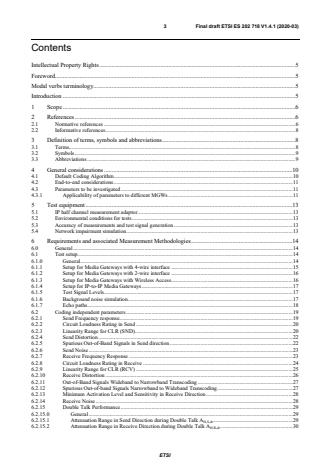
Contents
Intellectual Property Rights . 5
Foreword . 5
Modal verbs terminology . 5
Introduction . 5
1 Scope . 6
2 References . 6
2.1 Normative references . 6
2.2 Informative references . 8
3 Definition of terms, symbols and abbreviations . 8
3.1 Terms . 8
3.2 Symbols . 9
3.3 Abbreviations . 9
4 General considerations . 10
4.1 Default Coding Algorithm . 10
4.2 End-to-end considerations . 11
4.3 Parameters to be investigated . 11
4.3.1 Applicability of parameters to different MGWs . 11
5 Test equipment . 13
5.1 IP half channel measurement adaptor . 13
5.2 Environmental conditions for tests . 13
5.3 Accuracy of measurements and test signal generation . 13
5.4 Network impairment simulation . 13
6 Requirements and associated Measurement Methodologies . 14
6.0 General . 14
6.1 Test setup. 14
6.1.0 General . 14
6.1.1 Setup for Media Gateways with 4-wire interface . 15
6.1.2 Setup for Media Gateways with 2-wire interface . 16
6.1.3 Setup for Media Gateways with Wireless Access . 16
6.1.4 Setup for IP-to-IP Media Gateways . 17
6.1.5 Test Signal Levels . 17
6.1.6 Background noise simulation . 17
6.1.7 Echo paths . 18
6.2 Coding independent parameters . 19
6.2.1 Send Frequency response . 19
6.2.2 Circuit Loudness Rating in Send . 20
6.2.3 Linearity Range for CLR (SND) . 20
6.2.4 Send Distortion . 22
6.2.5 Spurious Out-of-Band Signals in Send direction . 22
6.2.6 Send Noise . 23
6.2.7 Receive Frequency Response . 23
6.2.8 Circuit Loudness Rating in Receive . 24
6.2.9 Linearity Range for CLR (RCV) . 25
6.2.10 Receive Distortion . 26
6.2.11 Out-of-Band Signals Wideband to Narrowband Transcoding . 27
6.2.12 Spurious Out-of-band Signals Narrowband to Wideband Transcoding . 27
6.2.13 Minimum Activation Level and Sensitivity in Receive Direction . 28
6.2.14 Receive Noise . 28
6.2.15 Double Talk Performance . 29
6.2.15.0 General . 29
6.2.15.1 Attenuation Range in Send Direction during Double Talk A . 29
H,S,dt
6.2.15.2 Attenuation Range in Receive Direction during Double Talk A . 30
H,R,dt
ETSI
4 Final draft ETSI ES 202 718 V1.4.1 (2020-03)
6.2.15.3 Detection of Echo Components during Double Talk . 31
6.2.15.4 Minimum Activation Level and Sensitivity of Double Talk Detection . 33
6.2.16 Switching Characteristics . 33
6.2.16.0 General . 33
6.2.16.1 Activation in Send Direction . 33
6.2.16.2 Activation in Receive Direction . 34
6.2.16.3 Silence Suppression and Comfort Noise Generation . 35
6.2.17 Background Noise Performance . 35
6.2.17.0 General . 35
6.2.17.1 Performance in Send Direction in the Presence of Background Noise . 35
6.2.17.2 Quality of Speech with Background Noise . 36
6.2.17.3 Quality of Background Noise Transmission (with Far End Speech) . 37
6.2.17.4 Quality of Background Noise Transmission (with Near End Speech) . 37
6.2.18 Quality of Echo Cancellation . 38
6.2.18.0 General . 38
6.2.18.1 Echo Performance According to Recommendation ITU-T G.168 . 38
6.2.18.2 Terminal Coupling Loss (TCLw, NB) . 38
6.2.18.3 Terminal Coupling Loss (TCL, WB) . 39
6.2.18.4 Temporal Echo Effects . 39
6.2.18.5 Spectral Echo Attenuation . 40
6.2.18.6 Occurrence of Artefacts . 41
6.2.18.7 Variable Echo Paths . 41
6.2.19 Variant Impairments . 41
6.2.19.1 Clock Accuracy Send . 41
6.2.19.2 Clock Accuracy Receive . 41
6.2.19.3 Send Packet Delay Variation. 42
6.2.20 Immunity to DTMF False Detection in Send Direction . 42
6.2.21 Send and receive delay - round trip delay . 43
6.3 Codec Specific Requirements. 44
6.3.1 Objective Listening Speech Quality MOS-LQO in Send direction . 44
6.3.2 Objective Listening Quality MOS-LQO in Receive direction . 45
6.3.3 Quality of Jitter buffer adjustment . 47
Annex A (informative): Impulse Response of a Narrowband and Wideband DECT PP . 49
Annex B (normative): Test signal for immunity to DTMF false detection in send direction . 51
Annex C (informative): Example IP Delay variation for jitterbuffer quality measurements . 52
Annex D (informative): Bibliography . 53
History . 54
ETSI
5 Final draft ETSI ES 202 718 V1.4.1 (2020-03)
Intellectual Property Rights
Essential patents
IPRs essential or potentially essential to normative deliverables may have been declared to ETSI. The information
pertaining to these essential IPRs, if any, is publicly available for ETSI members and non-members, and can be found
in ETSI SR 000 314: "Intellectual Property Rights (IPRs); Essential, or potentially Essential, IPRs notified to ETSI in
respect of ETSI standards", which is available from the ETSI Secretariat. Latest updates are available on the ETSI Web
server (https://ipr.etsi.org/).
Pursuant to the ETSI IPR Policy, no investigation, including IPR searches, has been carried out by ETSI. No guarantee
can be given as to the existence of other IPRs not referenced in ETSI SR 000 314 (or the updates on the ETSI Web
server) which are, or may be, or may become, essential to the present document.
Trademarks
The present document may include trademarks and/or tradenames which are asserted and/or registered by their owners.
ETSI claims no ownership of these except for any which are indicated as being the property of ETSI, and conveys no
right to use or reproduce any trademark and/or tradename. Mention of those trademarks in the present document does
not constitute an endorsement by ETSI of products, services or organizations associated with those trademarks.
Foreword
This final draft ETSI Standard (ES) has been produced by ETSI Technical Committee Speech and multimedia
Transmission Quality (STQ), and is now submitted for the ETSI standards Membership Approval Procedure.
Modal verbs terminology
In the present document "shall", "shall not", "should", "should not", "may", "need not", "will", "will not", "can" and
"cannot" are to be interpreted as described in clause 3.2 of the ETSI Drafting Rules (Verbal forms for the expression of
provisions).
"must" and "must not" are NOT allowed in ETSI deliverables except when used in direct citation.
Introduction
Traditionally, analogue and digital telephones were interfacing switched-circuit 64 kbit/s PCM networks. With the fast
growth of IP networks, packet-switched networks (VoIP) interfacing PSTN networks and mobile networks, as well as
different types of IP-terminals, are being rapidly introduced. Different types of gateways are used to interconnect to
such IP networks. Since the IP networks will be in many cases interworking with the traditional PSTN and private
networks, many of the basic transmission requirements have to be harmonized between these different types of network
from an end-to-end perspective, including specifications for the edge points.
The present document covers IP-based narrowband and wideband home and network media gateways. It aims to
enhance the interoperability and end-to-end quality.
In contrast to other standards which define minimum performance requirements, it is the intention of the present
document to specify gateway equipment requirements which enable manufacturers and service providers to enable
end-to-end speech performance as perceived by the user. These requirements are absolutely necessary to ensure a good
quality, but they are not sufficient. They have to be combined with requirements (and associated relevant measurement
methods) for other elements in the transmission chain (core IP network, PSTN, terminals), as well as for the whole
mouth-to-ear transmission path.
ETSI
6 Final draft ETSI ES 202 718 V1.4.1 (2020-03)
1 Scope
The present document provides speech transmission performance requirements for narrowband and wideband media
gateways from a QoS perspective as perceived by the user. Media gateways can be network or home based, they may
include a transcoding function. The present document covers the following types of IP-based media gateways:
• ATA (Analogue Terminal Adapter), home gateway IP to POTS
• ITA (ISDN Terminal Adapter), home gateway IP to ISDN
• IAD (Integrated Access device), home router including ATA or ITA
• Network based ATA and ITA
• Carrier grade media gateway, network gateway IP to TDM
• IP-to-IP media gateway, network gateway with transcoding and/or other media processing
• New Generation DECT Fixed part with IP interface (only parameters not covered by New Generation DECT)
Interfaces of media gateways used together with terminals as a system (i.e. connected via Ethernet or with a proprietary
interface) are excluded in the present document and should be measured according to the relevant terminal standard.
If a media gateway includes more than one interface type (e.g. POTS and ISDN), each interface has to be dealt with
differently.
The requirements available in the present document will ensure a high compatibility with IP- and TDM-based fixed and
wireless terminals and networks, including DECT and mobile terminals.
It is the aim to optimize interoperability, the listening and talking quality and the conversational performance. Related
requirements and test methods are defined in the present document.
The present document does not apply to media gateways with 4-wire analogue interfaces.
The requirements for MGWs with respect to voiceband data (VBD) are out of scope in the present document. These
requirements are covered in ETSI TS 102 929 [i.4].
2 References
2.1 Normative references
References are either specific (identified by date of publication and/or edition number or version number) or
non-specific. For specific references, only the cited version applies. For non-specific references, the latest version of the
referenced document (including any amendments) applies.
Referenced documents which are not found to be publicly available in the expected location might be found at
https://docbox.etsi.org/Reference/.
NOTE: While any hyperlinks included in this clause were valid at the time of publication, ETSI cannot guarantee
their long term validity.
The following referenced documents are necessary for the application of the present document.
[1] ETSI EN 300 726: "Digital cellular telecommunications system (Phase 2+) (GSM); Enhanced Full
Rate (EFR) speech transcoding (GSM 06.60)".
[2] ETSI TS 126 171 (V6.0.0): "Digital cellular telecommunications system (Phase 2+); Universal
Mobile Telecommunications System (UMTS); AMR speech codec, wideband; General description
(3GPP TS 26.171 version 6.0.0 Release 6)".
ETSI
7 Final draft ETSI ES 202 718 V1.4.1 (2020-03)
[3] Recommendation ITU-T G.107: "The E-model, a computational model for use in transmission
planning".
[4] Recommendation ITU-T G.108, including amendments 1 and 2: "Application of the E-model: A
planning guide".
[5] Recommendation ITU-T G.109: "Definition of categories of speech transmission quality".
[6] Recommendation ITU-T G.100.1: "The use of the decibel and of relative levels in speechband
telecommunications".
[7] Recommendation ITU-T G.111: "Loudness Ratings (LRs) in an international connection".
[8] Recommendation ITU-T G.122: "Influence of national systems on stability and talker echo in
international connections".
[9] Recommendation ITU-T G.711: "Pulse code modulation (PCM) of voice frequencies".
[10] Recommendation ITU-T G.723.1: "Dual rate speech coder for multimedia communications
transmitting at 5.3 and 6.3 kbit/s".
[11] Recommendation ITU-T G.726: "40, 32, 24, 16 kbit/s Adaptive Differential Pulse Code
Modulation (ADPCM)".
[12] Recommendation ITU-T G.729: "Coding of speech at 8 kbit/s using conjugate-structure algebraic-
code-excited linear prediction (CS-ACELP)".
[13] Recommendation ITU-T G.729.1: "G.729-based embedded variable bit-rate coder: An 8-32 kbit/s
scalable wideband coder bitstream interoperable with G.729".
[14] Recommendation ITU-T P.863.1: "Application guide for Recommendation ITU-T P.863".
[15] Recommendation ITU-T P.340: "Transmission characteristics and speech quality parameters of
hands-free terminals".
[16] Recommendation ITU-T P.501: "Test signals for use in telephonometry".
[17] Recommendation ITU-T P.502: "Objective test methods for speech communication systems using
complex test signals".
[18] Recommendation ITU-T P.56: "Objective measurement of active speech level".
[19] IEC 61260-1: "Electroacoustics - Octave-band and fractional-octave-band filters - Part 1:
Specification".
[20] Recommendation ITU-T P.800.1: "Mean Opinion Score (MOS) terminology".
[21] ETSI TS 102 971: "Access and Terminals (AT); Public Switched Telephone Network (PSTN);
Harmonized specification of physical and electrical characteristics of a 2-wire analogue interface
for short line interface".
[22] ETSI ES 201 970: "Access and Terminals (AT); Public Switched Telephone Network (PSTN);
Harmonized specification of physical and electrical characteristics at a 2-wire analogue presented
Network Termination Point (NTP)".
[23] Recommendation ITU-T G.168: "Digital network echo cancellers".
[24] Recommendation ITU-T P.863: "Perceptual objective listening quality prediction".
[25] Recommendation ITU-T G.722: "7 kHz audio-coding within 64 kbit/s".
[26] Recommendation ITU-T G.722.1: "Low-complexity coding at 24 and 32 kbit/s for hands-free
operation in systems with low frame loss".
[27] Recommendation ITU-T G.722.2: "Wideband coding of speech at around 16 kbit/s using Adaptive
Multi-Rate Wideband (AMR-WB)".
ETSI
8 Final draft ETSI ES 202 718 V1.4.1 (2020-03)
[28] Recommendation ITU-T P.1010: "Fundamental voice transmission objectives for VoIP terminals
and gateways".
[29] IETF RFC 3550: "RTP: A Transport Protocol for Real-Time Applications".
[30] Void.
[31] TIA-920.130-B: "Telecommunications Communications Products Transmission Requirements for
Digital Interface Communications Devices with Headsets".
[32] ETSI ES 202 737: "Speech and multimedia Transmission Quality (STQ); Transmission
requirements for narrowband VoIP terminals (handset and headset) from a QoS perspective as
perceived by the user".
[33] ETSI TS 103 224: "Speech and multimedia Transmission Quality (STQ); A sound field
reproduction method for terminal testing including a background noise database".
2.2 Informative references
References are either specific (identified by date of publication and/or edition number or version number) or
non-specific. For specific references, only the cited version applies. For non-specific references, the latest version of the
referenced document (including any amendments) applies.
NOTE: While any hyperlinks included in this clause were valid at the time of publication, ETSI cannot guarantee
their long term validity.
The following referenced documents are not necessary for the application of the present document but they assist the
user with regard to a particular subject area.
[i.1] ETSI EG 202 425: "Speech Processing, Transmission and Quality Aspects (STQ); Definition and
implementation of VoIP reference point".
[i.2] IETF RFC 2833: "RTP Payload for DTMF Digits, Telephony Tones and Telephony Signals".
[i.3] IETF RFC 4733: "RTP Payload for DTMF Digits, Telephony Tones, and Telephony Signals".
[i.4] ETSI TS 102 929: "Speech and multimedia Transmission Quality (STQ); Procedures for the
identification and selection of common modes of de-jitter buffers and echo cancellers".
[i.5] Void.
[i.6] Netem™.
NOTE: Information available at https://wiki.linuxfoundation.org/networking/netem
[i.7] IETF RFC 4737: "Packet Reordering Metrics".
[i.8] ETSI EG 202 396-3: "Speech and multimedia Transmission Quality (STQ); Speech Quality
performance in the presence of background noise Part 3: Background noise transmission -
Objective test methods".
3 Definition of terms, symbols and abbreviations
3.1 Terms
For the purposes of the present document, the following terms apply:
0dBr point: reference point always located at the digital side of the gateway, for IP-to-IP gateways located at the input
of the MGW under test
NOTE: See Recommendation ITU-T G.100.1 [6].
ETSI
9 Final draft ETSI ES 202 718 V1.4.1 (2020-03)
2-wire interface: in the context of the present document, telephony analogue interface over 2-wires used in the local
loop
4-wire interface: 4-wire digital interface with separate channels for both directions, irrespective of the physical
transmission technology
codec: combination of an analogue-to-digital encoder and a digital-to-analogue decoder operating in opposite directions
of transmission in the same equipment
Composite Source Signal (CSS): signal composed in time by various signal elements
MGW with 2-wire interface: MGW with an analogue 2-wire interface (ATA)
MGW with 4-wire interface: MGW with only 4-wire interfaces
EXAMPLE: ITA, IP-to-IP and wireless access points.
receive direction: direction from packet switched interfaces towards a synchronous interface (e.g. ISDN, analogue) or
between two packet switched interfaces (for media gateways with packet switched transport on only one side)
NOTE: For media gateways with packet switched transport on both sides (IP-to-IP-MGW), the requirements of
the receive direction have to be applied in both directions.
receive interface: interface in the measurement setup, where a receive signal is injected and/or a send signal is
measured
reordering: packet order changes during transfer over the network [i.7], packets arrive out of order at the receiver (i.e.
RTP packets)
send direction: direction from a synchronous interface (e.g. ISDN, analogue) towards a packet switched interface (for
media gateways with packet switched interface on only one side)
NOTE: For media gateways with packet switched interfaces on both sides the requirements of the send direction
are not relevant.
send interface: interface in the measurement setup, where a send signal is injected and/or a receive signal is measured
wireless home MGW: home MGW with wireless interface to the phone
EXAMPLE: Wifi or DECT.
3.2 Symbols
Void.
3.3 Abbreviations
For the purposes of the present document, the following abbreviations apply:
AM-FM Amplitude Modulation - Frequency Modulation
AMR Adaptive Multi Rate codec
ATA Analogue Terminal Adapter
CLR Circuit Loudness Rating
CS Composite Source
CSS Composite Source Signal
DECT Digital Enhanced Cordless Telecommunications
DSL Digital Subscriber Line
DSLAM Digital Subscriber Line Access Multiplexer
DTMF Dual Tone Multi Frequency
EC Echo Canceller
EFR Enhance Full Rate codec
EL Echo Loss
FFS For Further Study
ETSI
10 Final draft ETSI ES 202 718 V1.4.1 (2020-03)
FFT Fast Fourier Transformation
FP DECT Fixed Part
G-MOS-LQOn Overall transmission quality narrowband
G-MOS-LQOw Overall transmission quality wideband
GSM Global System for Mobile communication
GW GateWay
HATS Head And Torso Simulator
IAD Integrated Access Device
IP Internet Protocol
IPDV IP Packet Delay Variation
IRS Intermediate Reference System
ISDN Integrated Service Digital Network
ITA ISDN Terminal Adapter
MGW Media GateWay
MM Mandatory for both interfaces of the MGW
MOS-LQOy Mean Opinion Score - Listening Quality Objective
NOTE: y being N for narrowband, M for mixed, S for super-wideband and F for fullband. See Recommendation
ITU-T P.800.1 [20].
NA Not Applicable
NB NarrowBand
NLP Non Linear Processor
N-MOS-LQOn Transmission quality of the background noise narrowband
N-MOS-LQOw Transmission quality of the background noise wideband
PBX Private Branch eXchange
PC Personal Computer
PCM Pulse Code Modulation
PLC Packet Loss Concealment
POI Point Of Interconnect
POTS Plain Old Telephone Service
PP DECT Portable Part
PSTN Public Switched Telephone Network
QoS Quality of Service
RCV Receiving Direction
RLR Receive Loudness Rating
RMS Root Mean Square
RTP Real-Time Transport Protocol
SIP Session Initiation Protocol
SLR Send Loudness Rating
S-MOS-LQOn Transmission quality of the speech narrowband
S-MOS-LQOw Transmission quality of the speech wideband
SND Sending Direction
TCL Terminal Coupling Loss
TDM Time Division Multiplexing
VAD Voice Activity Detection
VBD Voice Band Data
VoIP Voice over Internet Protocol
WB WideBand
4 General considerations
4.1 Default Coding Algorithm
Narrowband VoIP gateways shall support the coding algorithm according to Recommendation ITU-T G.711 [9] (both
µ-law and A-law). VoIP gateways may support other coding algorithms.
Wideband VoIP gateways shall support the coding algorithm according to Recommendation ITU-T G.722 [25]. VoIP
gateways may support other coding algorithms.
ETSI
11 Final draft ETSI ES 202 718 V1.4.1 (2020-03)
NOTE: Associated Packet Loss Concealment (PLC) e.g. as defined in Recommendation ITU-T G.711 [9]
appendix I should be used.
4.2 End-to-end considerations
In order to achieve a desired end-to-end speech transmission performance (mouth-to-ear) it is recommended that the
general rules of transmission planning are carried out with the E-model of Recommendation ITU-T G.107 [3]; this
includes the a-priori determination of the desired category of speech transmission quality as defined in
Recommendation ITU-T G.109 [5].
While, in general, the transmission characteristics of single circuit-oriented network elements, such as switches or
terminals can be assumed to have a single input value for the planning tasks of Recommendation ITU-T G.108 [4] with
its amendments, this approach is not applicable in packet based systems and thus there is a need for the transmission
planner's specific attention.
In particular the decision as to which delay measured according to the present document is acceptable or representative
for the specific configuration is the responsibility of the individual transmission planner.
Recommendation ITU-T G.108 [4] with its amendments provides further guidance on this important issue.
The following optimum parameters from a user's perspective need to be considered:
• Minimized delay in send and receive direction.
• Optimum Circuit Loudness Rating (CLR).
• Compensation for network delay variation.
• Packet loss recovery performance.
• Maximized echo loss.
• Immunity to false detection of DTMF in speech signal.
4.3 Parameters to be investigated
4.3.1 Applicability of parameters to different MGWs
Table 1: Parameter applicability
Clauses in the present document 2-wire home 4-wire MGW 4-wire MGW wireless home
and network (excl. IP-to-IP (IP-to-IP-MGW) MGW (DECT FP)
MGW MGW)
6.2 Coding independent parameters
6.2.1 Send frequency response M M NA M
6.2.2 Circuit Loudness Rating in Send M M NA M
6.2.3 Linearity Range for CLR (SND) M M NA M
6.2.4 Send Distortion M M NA M
6.2.5 Spurious Out-of-Band Signals in M NA NA NA
Send direction
6.2.6 Send Noise M M NA M
6.2.7 Receive frequency response M M MM M
6.2.8 Circuit Loudness Rating in Receive M M MM M
6.2.9 Linearity Range for CLR (RCV) M M MM M
6.2.10 Receive Distortion M M MM M
6.2.11 Out-of-Band Signals in Wideband to NA M M M
Narrowband Transcoding
6.2.12 Spurious Out-of-band Signals NA M M M
Narrowband to Wideband Transcoding
6.2.13 Minimum activation level and FFS FFS FFS FFS
sensitivity in Receive direction
6.2.14 Receive Noise M M MM M
ETSI
12 Final draft ETSI ES 202 718 V1.4.1 (2020-03)
Clauses in the present document 2-wire home 4-wire MGW 4-wire MGW wireless home
and network (excl. IP-to-IP (IP-to-IP-MGW) MGW (DECT FP)
MGW MGW)
6.2.15 Double Talk Performance
6.2.15.1 Attenuation Range in Send M M M M
Direction during Double Talk (note 1) (note 1) (note 1)
6.2.15.2 Attenuation Range in Receive M M M M
Direction during Double Talk (note 1) (note 1) (note 1)
6.2.15.3 Detection of Echo Components M M M M
during Double Talk (note 1) (note 1) (note 2)
6.2.15.4 Minimum activation level and FFS FFS FFS FFS
sensitivity of double talk detection
6.2.16 Switching characteristics
6.2.16.1 Activation in Send Direction M M NA M
6.2.16.2 Activation in Receive Direction M M M M
6.2.16.3 Silence Suppression and Comfort FFS FFS FFS FFS
Noise Generation
6.2.17 Background Noise Performance
6.2.17.1 Performance in send direction in M M MM M
the presence of background noise
6.2.17.2 Quality of Speech with M M MM M
Background Noise
6.2.17.3 Quality of Background Noise M M MM M
Transmission (with Far End Speech) (note 1) (note 1) (note 1)
6.2.17.4 Quality of Background Noise M M MM M
Transmission (with Near End Speech)
6.2.18 Quality of echo cancellation
6.2.18.1 Echo Performance according to NA M NA NA
Recommendation ITU-T G.168 (note 1)
6.2.18.2 TCLw (NB) M M (note 1) (NB) NA M (note 2) (NB)
(note 1)
6.2.18.3 TCL (WB) NA M (note 1) (WB) NA M (note 2) (WB)
6.2.18.4 Temporal echo effects M M NA M
(note 1) (note 1) (note 2)
6.2.18.5 Spectral Echo Attenuation M M NA M
(note 1) (note 1) (note 2)
6.2.18.6 Occurrence of Artefacts FFS FFS NA FFS
6.2.19 Variant Impairments; Network
dependant
6.2.19.1 Clock accuracy send M M MM M
6.2.19.2 Clock accuracy receive M M MM NA
6.2.19.3 Send delay variation M M MM M
6.2.20 Immunity to DTMF false detection in M M MM M
send direction
6.2.21 Roundtrip Delay M M M NA
6.3 Codec Specific Requirements
6.3.1 Objective Listening Speech Quality M M M M
MOS-LQO in Send direction
6.3.2 Objective Listening Speech Quality M M M M
MOS-LQO in Receive direction
6.3.3 Quality of Jitter buffer adjustment M M M M
(note 3)
M: Mandatory
MM: Mandatory for both interfaces of the MGW
NA: Not Applicable
FFS: For Further Study
NOTE 1: Measurement to be done with different echopaths (see clause 6.1.7).
NOTE 2: Measurement to be done with Ref PP settings "34/42dB TCLw" only. Echopath set accordingly (see
clause 6.1.7).
NOTE 3: Measurement mandatory, if PP does not support PLC.
ETSI
13 Final draft ETSI ES 202 718 V1.4.1 (2020-03)
5 Test equipment
5.1 IP half channel measurement adaptor
The IP half channel measurement adaptor is described in ETSI EG 202 425 [i.1]. Such an apparatus is required to code
and insert audio signals into IP packets send to the IP receive interface of the gateway under test, as well as to capture
and decode audio signals constituting the payload of IP packets received from the IP sending interface of the gateway
under test.
5.2 Environmental conditions for tests
The following conditions shall apply for the testing environment:
a) Ambient temperature: 15 °C to 35 °C;
b) Relative humidity: 5 % to 85 %;
c) Air pressure: 86 kPa to 106 kPa (860 mbar to 1 060 mbar).
5.3 Accuracy of measurements and test signal generation
Unless specified otherwise, the accuracy of measurements made by test equipment shall be equal to or better than:
Table 2: Measurement Accuracy
Item Accuracy
Electrical signal level ±0,2 dB for levels ≥ -50 dBV
±0,4 dB for levels < -50 dBV
Frequency ±0,2 %
Time ±0,2 %
Unless specified otherwise, the accuracy of the signals generated by the test equipment shall be better than:
Table 3: Accuracy of test signal generation
Quantity Accuracy
Electrical excitation levels ±0,4 dB across the whole frequency range
Frequency generation ±2 % (see note)
Time ±0,2 %
Specified component values ±1 %
NOTE: This tolerance may be used to avoid measurements at critical frequencies, e.g. those
due to sampling operations within the terminal under test.
If the equipment is powered by other means and those means are not supplied as part of the apparatus, all tests shall be
carried out within the power supply limit declared by the supplier. If the power supply is a.c. the test shall be conducted
within ±4 % of the rated frequency.
5.4 Network impairment simulation
At least one set of requirements is based on the assumption of an error free packet network, and at least one other set of
requirements is based on a defined simulated malperformance of the packet network.
An appropriate network simulator has to be used, for example Netem™ [i.6].
ETSI
14 Final draft ETSI ES 202 718 V1.4.1 (2020-03)
The key points of Netem™ can be summarized as follows:
• Netem™ is part of the networking function of Linux™. With Netem™, there can be generated loss,
duplication, delay jitter and reordering (and the jitter distribution can be chosen during runtime). Netem™ can
be run on a Linux™-PC running as a bridge or a router.
• It is not advised to define specific distortion patterns for testing in standards, because it will be easy to adapt
devices to these patterns (as it is already done for test signals). But if a pattern is unknown to a manufacturer,
the same pattern can be used by a test lab for different devices and gives comparable results.
NOTE: Netem™ and Linux™ are examples of suitable products available commercially. This information is
given for the convenience of users of the present document and does not constitute an endorsement by
ETSI of these products.
Requirements for the network impairment simulation can be found in Annex D of ETSI ES 202 737 [32].
6 Requirements and associated Measurement
Methodologies
6.0 General
Differences between different media gateway types are dealt with in the respective requirements.
In the case of IP-to-IP MGW packet based interfaces are provided at both sides of the gateway. Therefore the receive
requirements apply, for both interfaces.
In the case of wireless home MGW (DECT FP) the applicable parameters in Table 1 should be measured according to
the 4-wire MGW requirements and measurement methods (wideband and narrowband) if nothing else is stated.
NOTE 1: In general the test methods as described in the present document apply. If alternative methods exist they
may be used if they have been proven to give the same result as the method described in the present
document.
NOTE 2: Due to the time variant nature of IP connections delay variation may impair the measurements. In such
cases the measurement has to be repeated until a valid measurement result is achieved.
6.1 Test setup
6.1.0 General
The preferred way of testing a gateway is to connect its interfaces to network simulators with exact defined settings and
access points. The test sequences are fed in electrically, using a reference codec or using the direct signal processing
approach.
When VoIP runs on the gateway under test only in conjunction with a registration by an application server (e.g. SIP
proxy), the network simulator may need to provide also the registration functionality.
Alternatively, if for the IP-interfaces another technology than Ethernet is used (for instance DSL access, it may be
necessary to add additional equipment in the test setup for connecting the measurement equipment (e.g. a DSLAM, if
the IP-interface works over DSL). There should be no speech signal processing in this additional equipment (the media
payload has to be passed transparent through this equipment, while e.g. header manipulation is allowed). The influence
of this additional equipment (delay and eventually delay variation) has to be taken into account for the measurements.
NOTE 1: It is up to the testlab to identify potential time invariances or non linearities in the network used for
interconnection and to take those effects into account properly.
NOTE 2: It is up to the testlab to identify potential additional delays caused by low bandwidth connections
(e.g. MGW with DSL connection and a low bitrate profile) and to take those effects into account
properly.
ETSI
15 Final draft ETSI ES 202 718 V1.4.1 (2020-03)
With this setup it is possible to measure the parameters listed in the present document over a whole network, if the
behaviour of the network is known.
In the present document, the terms "send" and "receive" can be found in the pictures of the relevant test setup.
When a coder with variable bit rate is used for testing the MGW parameters, the bit rate recognized giving the best
characteristics and/or the ones commonly used should be selected, e.g.:
• AMR-NB (ETSI TS 126 171 [2]): 12,2 kbit/s.
• AMR-WB (G.722.2 [27]): 12,65 kbit/s and/or 23,85 kbit/s.
• Recommendation ITU-T G.729.1 [13]: 32 kbit/s.
NOTE 3: Although packet capturing and network simulation in
...
ETSI STANDARD
Speech and multimedia Transmission Quality (STQ);
Transmission Requirements for IP-based Narrowband and
Wideband Home and Network Media Gateways from
a QoS Perspective as Perceived by the User
2 ETSI ES 202 718 V1.4.1 (2020-05)
Reference
RES/STQ-278
Keywords
QoS, speech
ETSI
650 Route des Lucioles
F-06921 Sophia Antipolis Cedex - FRANCE
Tel.: +33 4 92 94 42 00 Fax: +33 4 93 65 47 16
Siret N° 348 623 562 00017 - NAF 742 C
Association à but non lucratif enregistrée à la
Sous-Préfecture de Grasse (06) N° 7803/88
Important notice
The present document can be downloaded from:
http://www.etsi.org/standards-search
The present document may be made available in electronic versions and/or in print. The content of any electronic and/or
print versions of the present document shall not be modified without the prior written authorization of ETSI. In case of any
existing or perceived difference in contents between such versions and/or in print, the prevailing version of an ETSI
deliverable is the one made publicly available in PDF format at www.etsi.org/deliver.
Users of the present document should be aware that the document may be subject to revision or change of status.
Information on the current status of this and other ETSI documents is available at
https://portal.etsi.org/TB/ETSIDeliverableStatus.aspx
If you find errors in the present document, please send your comment to one of the following services:
https://portal.etsi.org/People/CommiteeSupportStaff.aspx
Copyright Notification
No part may be reproduced or utilized in any form or by any means, electronic or mechanical, including photocopying
and microfilm except as authorized by written permission of ETSI.
The content of the PDF version shall not be modified without the written authorization of ETSI.
The copyright and the foregoing restriction extend to reproduction in all media.
© ETSI 2020.
All rights reserved.
DECT™, PLUGTESTS™, UMTS™ and the ETSI logo are trademarks of ETSI registered for the benefit of its Members.
3GPP™ and LTE™ are trademarks of ETSI registered for the benefit of its Members and
of the 3GPP Organizational Partners.
oneM2M™ logo is a trademark of ETSI registered for the benefit of its Members and
of the oneM2M Partners. ®
GSM and the GSM logo are trademarks registered and owned by the GSM Association.
ETSI
3 ETSI ES 202 718 V1.4.1 (2020-05)
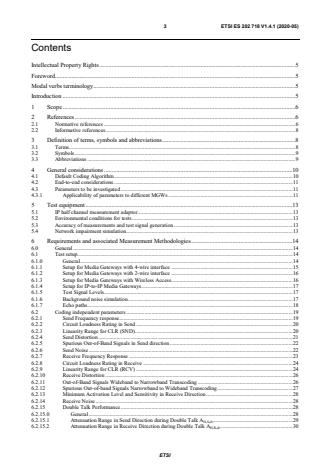
Contents
Intellectual Property Rights . 5
Foreword . 5
Modal verbs terminology . 5
Introduction . 5
1 Scope . 6
2 References . 6
2.1 Normative references . 6
2.2 Informative references . 8
3 Definition of terms, symbols and abbreviations . 8
3.1 Terms . 8
3.2 Symbols . 9
3.3 Abbreviations . 9
4 General considerations . 10
4.1 Default Coding Algorithm . 10
4.2 End-to-end considerations . 11
4.3 Parameters to be investigated . 11
4.3.1 Applicability of parameters to different MGWs . 11
5 Test equipment . 13
5.1 IP half channel measurement adaptor . 13
5.2 Environmental conditions for tests . 13
5.3 Accuracy of measurements and test signal generation . 13
5.4 Network impairment simulation . 13
6 Requirements and associated Measurement Methodologies . 14
6.0 General . 14
6.1 Test setup. 14
6.1.0 General . 14
6.1.1 Setup for Media Gateways with 4-wire interface . 15
6.1.2 Setup for Media Gateways with 2-wire interface . 16
6.1.3 Setup for Media Gateways with Wireless Access . 16
6.1.4 Setup for IP-to-IP Media Gateways . 17
6.1.5 Test Signal Levels . 17
6.1.6 Background noise simulation . 17
6.1.7 Echo paths . 18
6.2 Coding independent parameters . 19
6.2.1 Send Frequency response . 19
6.2.2 Circuit Loudness Rating in Send . 20
6.2.3 Linearity Range for CLR (SND) . 20
6.2.4 Send Distortion . 21
6.2.5 Spurious Out-of-Band Signals in Send direction . 22
6.2.6 Send Noise . 22
6.2.7 Receive Frequency Response . 23
6.2.8 Circuit Loudness Rating in Receive . 24
6.2.9 Linearity Range for CLR (RCV) . 24
6.2.10 Receive Distortion . 26
6.2.11 Out-of-Band Signals Wideband to Narrowband Transcoding . 26
6.2.12 Spurious Out-of-band Signals Narrowband to Wideband Transcoding . 27
6.2.13 Minimum Activation Level and Sensitivity in Receive Direction . 28
6.2.14 Receive Noise . 28
6.2.15 Double Talk Performance . 28
6.2.15.0 General . 28
6.2.15.1 Attenuation Range in Send Direction during Double Talk A . 29
H,S,dt
6.2.15.2 Attenuation Range in Receive Direction during Double Talk A . 30
H,R,dt
ETSI
4 ETSI ES 202 718 V1.4.1 (2020-05)
6.2.15.3 Detection of Echo Components during Double Talk . 31
6.2.15.4 Minimum Activation Level and Sensitivity of Double Talk Detection . 33
6.2.16 Switching Characteristics . 33
6.2.16.0 General . 33
6.2.16.1 Activation in Send Direction . 33
6.2.16.2 Activation in Receive Direction . 34
6.2.16.3 Silence Suppression and Comfort Noise Generation . 35
6.2.17 Background Noise Performance . 35
6.2.17.0 General . 35
6.2.17.1 Performance in Send Direction in the Presence of Background Noise . 35
6.2.17.2 Quality of Speech with Background Noise . 36
6.2.17.3 Quality of Background Noise Transmission (with Far End Speech) . 37
6.2.17.4 Quality of Background Noise Transmission (with Near End Speech) . 37
6.2.18 Quality of Echo Cancellation . 38
6.2.18.0 General . 38
6.2.18.1 Echo Performance According to Recommendation ITU-T G.168 . 38
6.2.18.2 Terminal Coupling Loss (TCLw, NB) . 38
6.2.18.3 Terminal Coupling Loss (TCL, WB) . 39
6.2.18.4 Temporal Echo Effects . 39
6.2.18.5 Spectral Echo Attenuation . 40
6.2.18.6 Occurrence of Artefacts . 41
6.2.18.7 Variable Echo Paths . 41
6.2.19 Variant Impairments . 41
6.2.19.1 Clock Accuracy Send . 41
6.2.19.2 Clock Accuracy Receive . 41
6.2.19.3 Send Packet Delay Variation. 42
6.2.20 Immunity to DTMF False Detection in Send Direction . 42
6.2.21 Send and receive delay - round trip delay . 43
6.3 Codec Specific Requirements. 44
6.3.1 Objective Listening Speech Quality MOS-LQO in Send direction . 44
6.3.2 Objective Listening Quality MOS-LQO in Receive direction . 45
6.3.3 Quality of Jitter buffer adjustment . 47
Annex A (informative): Impulse Response of a Narrowband and Wideband DECT PP . 49
Annex B (normative): Test signal for immunity to DTMF false detection in send direction . 51
Annex C (informative): Example IP Delay variation for jitterbuffer quality measurements . 52
Annex D (informative): Bibliography . 53
History . 54
ETSI
5 ETSI ES 202 718 V1.4.1 (2020-05)
Intellectual Property Rights
Essential patents
IPRs essential or potentially essential to normative deliverables may have been declared to ETSI. The information
pertaining to these essential IPRs, if any, is publicly available for ETSI members and non-members, and can be found
in ETSI SR 000 314: "Intellectual Property Rights (IPRs); Essential, or potentially Essential, IPRs notified to ETSI in
respect of ETSI standards", which is available from the ETSI Secretariat. Latest updates are available on the ETSI Web
server (https://ipr.etsi.org/).
Pursuant to the ETSI IPR Policy, no investigation, including IPR searches, has been carried out by ETSI. No guarantee
can be given as to the existence of other IPRs not referenced in ETSI SR 000 314 (or the updates on the ETSI Web
server) which are, or may be, or may become, essential to the present document.
Trademarks
The present document may include trademarks and/or tradenames which are asserted and/or registered by their owners.
ETSI claims no ownership of these except for any which are indicated as being the property of ETSI, and conveys no
right to use or reproduce any trademark and/or tradename. Mention of those trademarks in the present document does
not constitute an endorsement by ETSI of products, services or organizations associated with those trademarks.
Foreword
This ETSI Standard (ES) has been produced by ETSI Technical Committee Speech and multimedia Transmission
Quality (STQ).
Modal verbs terminology
In the present document "shall", "shall not", "should", "should not", "may", "need not", "will", "will not", "can" and
"cannot" are to be interpreted as described in clause 3.2 of the ETSI Drafting Rules (Verbal forms for the expression of
provisions).
"must" and "must not" are NOT allowed in ETSI deliverables except when used in direct citation.
Introduction
Traditionally, analogue and digital telephones were interfacing switched-circuit 64 kbit/s PCM networks. With the fast
growth of IP networks, packet-switched networks (VoIP) interfacing PSTN networks and mobile networks, as well as
different types of IP-terminals, are being rapidly introduced. Different types of gateways are used to interconnect to
such IP networks. Since the IP networks will be in many cases interworking with the traditional PSTN and private
networks, many of the basic transmission requirements have to be harmonized between these different types of network
from an end-to-end perspective, including specifications for the edge points.
The present document covers IP-based narrowband and wideband home and network media gateways. It aims to
enhance the interoperability and end-to-end quality.
In contrast to other standards which define minimum performance requirements, it is the intention of the present
document to specify gateway equipment requirements which enable manufacturers and service providers to enable
end-to-end speech performance as perceived by the user. These requirements are absolutely necessary to ensure a good
quality, but they are not sufficient. They have to be combined with requirements (and associated relevant measurement
methods) for other elements in the transmission chain (core IP network, PSTN, terminals), as well as for the whole
mouth-to-ear transmission path.
ETSI
6 ETSI ES 202 718 V1.4.1 (2020-05)
1 Scope
The present document provides speech transmission performance requirements for narrowband and wideband media
gateways from a QoS perspective as perceived by the user. Media gateways can be network or home based, they may
include a transcoding function. The present document covers the following types of IP-based media gateways:
• ATA (Analogue Terminal Adapter), home gateway IP to POTS
• ITA (ISDN Terminal Adapter), home gateway IP to ISDN
• IAD (Integrated Access device), home router including ATA or ITA
• Network based ATA and ITA
• Carrier grade media gateway, network gateway IP to TDM
• IP-to-IP media gateway, network gateway with transcoding and/or other media processing
• New Generation DECT Fixed part with IP interface (only parameters not covered by New Generation DECT)
Interfaces of media gateways used together with terminals as a system (i.e. connected via Ethernet or with a proprietary
interface) are excluded in the present document and should be measured according to the relevant terminal standard.
If a media gateway includes more than one interface type (e.g. POTS and ISDN), each interface has to be dealt with
differently.
The requirements available in the present document will ensure a high compatibility with IP- and TDM-based fixed and
wireless terminals and networks, including DECT and mobile terminals.
It is the aim to optimize interoperability, the listening and talking quality and the conversational performance. Related
requirements and test methods are defined in the present document.
The present document does not apply to media gateways with 4-wire analogue interfaces.
The requirements for MGWs with respect to voiceband data (VBD) are out of scope in the present document. These
requirements are covered in ETSI TS 102 929 [i.4].
2 References
2.1 Normative references
References are either specific (identified by date of publication and/or edition number or version number) or
non-specific. For specific references, only the cited version applies. For non-specific references, the latest version of the
referenced document (including any amendments) applies.
Referenced documents which are not found to be publicly available in the expected location might be found at
https://docbox.etsi.org/Reference/.
NOTE: While any hyperlinks included in this clause were valid at the time of publication, ETSI cannot guarantee
their long term validity.
The following referenced documents are necessary for the application of the present document.
[1] ETSI EN 300 726: "Digital cellular telecommunications system (Phase 2+) (GSM); Enhanced Full
Rate (EFR) speech transcoding (GSM 06.60)".
[2] ETSI TS 126 171 (V6.0.0): "Digital cellular telecommunications system (Phase 2+); Universal
Mobile Telecommunications System (UMTS); AMR speech codec, wideband; General description
(3GPP TS 26.171 version 6.0.0 Release 6)".
ETSI
7 ETSI ES 202 718 V1.4.1 (2020-05)
[3] Recommendation ITU-T G.107: "The E-model, a computational model for use in transmission
planning".
[4] Recommendation ITU-T G.108, including amendments 1 and 2: "Application of the E-model:
A planning guide".
[5] Recommendation ITU-T G.109: "Definition of categories of speech transmission quality".
[6] Recommendation ITU-T G.100.1: "The use of the decibel and of relative levels in speechband
telecommunications".
[7] Recommendation ITU-T G.111: "Loudness Ratings (LRs) in an international connection".
[8] Recommendation ITU-T G.122: "Influence of national systems on stability and talker echo in
international connections".
[9] Recommendation ITU-T G.711: "Pulse code modulation (PCM) of voice frequencies".
[10] Recommendation ITU-T G.723.1: "Dual rate speech coder for multimedia communications
transmitting at 5.3 and 6.3 kbit/s".
[11] Recommendation ITU-T G.726: "40, 32, 24, 16 kbit/s Adaptive Differential Pulse Code
Modulation (ADPCM)".
[12] Recommendation ITU-T G.729: "Coding of speech at 8 kbit/s using conjugate-structure algebraic-
code-excited linear prediction (CS-ACELP)".
[13] Recommendation ITU-T G.729.1: "G.729-based embedded variable bit-rate coder: An 8-32 kbit/s
scalable wideband coder bitstream interoperable with G.729".
[14] Recommendation ITU-T P.863.1: "Application guide for Recommendation ITU-T P.863".
[15] Recommendation ITU-T P.340: "Transmission characteristics and speech quality parameters of
hands-free terminals".
[16] Recommendation ITU-T P.501: "Test signals for use in telephonometry".
[17] Recommendation ITU-T P.502: "Objective test methods for speech communication systems using
complex test signals".
[18] Recommendation ITU-T P.56: "Objective measurement of active speech level".
[19] IEC 61260-1: "Electroacoustics - Octave-band and fractional-octave-band filters - Part 1:
Specification".
[20] Recommendation ITU-T P.800.1: "Mean Opinion Score (MOS) terminology".
[21] ETSI TS 102 971: "Access and Terminals (AT); Public Switched Telephone Network (PSTN);
Harmonized specification of physical and electrical characteristics of a 2-wire analogue interface
for short line interface".
[22] ETSI ES 201 970: "Access and Terminals (AT); Public Switched Telephone Network (PSTN);
Harmonized specification of physical and electrical characteristics at a 2-wire analogue presented
Network Termination Point (NTP)".
[23] Recommendation ITU-T G.168: "Digital network echo cancellers".
[24] Recommendation ITU-T P.863: "Perceptual objective listening quality prediction".
[25] Recommendation ITU-T G.722: "7 kHz audio-coding within 64 kbit/s".
[26] Recommendation ITU-T G.722.1: "Low-complexity coding at 24 and 32 kbit/s for hands-free
operation in systems with low frame loss".
[27] Recommendation ITU-T G.722.2: "Wideband coding of speech at around 16 kbit/s using Adaptive
Multi-Rate Wideband (AMR-WB)".
ETSI
8 ETSI ES 202 718 V1.4.1 (2020-05)
[28] Recommendation ITU-T P.1010: "Fundamental voice transmission objectives for VoIP terminals
and gateways".
[29] IETF RFC 3550: "RTP: A Transport Protocol for Real-Time Applications".
[30] Void.
[31] TIA-920.130-B: "Telecommunications Communications Products Transmission Requirements for
Digital Interface Communications Devices with Headsets".
[32] ETSI ES 202 737: "Speech and multimedia Transmission Quality (STQ); Transmission
requirements for narrowband VoIP terminals (handset and headset) from a QoS perspective as
perceived by the user".
[33] ETSI TS 103 224: "Speech and multimedia Transmission Quality (STQ); A sound field
reproduction method for terminal testing including a background noise database".
2.2 Informative references
References are either specific (identified by date of publication and/or edition number or version number) or
non-specific. For specific references, only the cited version applies. For non-specific references, the latest version of the
referenced document (including any amendments) applies.
NOTE: While any hyperlinks included in this clause were valid at the time of publication, ETSI cannot guarantee
their long term validity.
The following referenced documents are not necessary for the application of the present document but they assist the
user with regard to a particular subject area.
[i.1] ETSI EG 202 425: "Speech Processing, Transmission and Quality Aspects (STQ); Definition and
implementation of VoIP reference point".
[i.2] IETF RFC 2833: "RTP Payload for DTMF Digits, Telephony Tones and Telephony Signals".
[i.3] IETF RFC 4733: "RTP Payload for DTMF Digits, Telephony Tones, and Telephony Signals".
[i.4] ETSI TS 102 929: "Speech and multimedia Transmission Quality (STQ); Procedures for the
identification and selection of common modes of de-jitter buffers and echo cancellers".
[i.5] Void.
[i.6] Netem™.
NOTE: Information available at https://wiki.linuxfoundation.org/networking/netem.
[i.7] IETF RFC 4737: "Packet Reordering Metrics".
[i.8] ETSI EG 202 396-3: "Speech and multimedia Transmission Quality (STQ); Speech Quality
performance in the presence of background noise Part 3: Background noise transmission -
Objective test methods".
3 Definition of terms, symbols and abbreviations
3.1 Terms
For the purposes of the present document, the following terms apply:
0dBr point: reference point always located at the digital side of the gateway, for IP-to-IP gateways located at the input
of the MGW under test
NOTE: See Recommendation ITU-T G.100.1 [6].
ETSI
9 ETSI ES 202 718 V1.4.1 (2020-05)
2-wire interface: in the context of the present document, telephony analogue interface over 2-wires used in the local
loop
4-wire interface: 4-wire digital interface with separate channels for both directions, irrespective of the physical
transmission technology
codec: combination of an analogue-to-digital encoder and a digital-to-analogue decoder operating in opposite directions
of transmission in the same equipment
Composite Source Signal (CSS): signal composed in time by various signal elements
MGW with 2-wire interface: MGW with an analogue 2-wire interface (ATA)
MGW with 4-wire interface: MGW with only 4-wire interfaces
EXAMPLE: ITA, IP-to-IP and wireless access points.
receive direction: direction from packet switched interfaces towards a synchronous interface (e.g. ISDN, analogue) or
between two packet switched interfaces (for media gateways with packet switched transport on only one side)
NOTE: For media gateways with packet switched transport on both sides (IP-to-IP-MGW), the requirements of
the receive direction have to be applied in both directions.
receive interface: interface in the measurement setup, where a receive signal is injected and/or a send signal is
measured
reordering: packet order changes during transfer over the network [i.7], packets arrive out of order at the receiver (i.e.
RTP packets)
send direction: direction from a synchronous interface (e.g. ISDN, analogue) towards a packet switched interface (for
media gateways with packet switched interface on only one side)
NOTE: For media gateways with packet switched interfaces on both sides the requirements of the send direction
are not relevant.
send interface: interface in the measurement setup, where a send signal is injected and/or a receive signal is measured
wireless home MGW: home MGW with wireless interface to the phone
EXAMPLE: Wifi or DECT.
3.2 Symbols
Void.
3.3 Abbreviations
For the purposes of the present document, the following abbreviations apply:
AM-FM Amplitude Modulation - Frequency Modulation
AMR Adaptive Multi Rate codec
ATA Analogue Terminal Adapter
CLR Circuit Loudness Rating
CS Composite Source
CSS Composite Source Signal
DECT Digital Enhanced Cordless Telecommunications
DSL Digital Subscriber Line
DSLAM Digital Subscriber Line Access Multiplexer
DTMF Dual Tone Multi Frequency
EC Echo Canceller
EFR Enhance Full Rate codec
EL Echo Loss
FFS For Further Study
ETSI
10 ETSI ES 202 718 V1.4.1 (2020-05)
FFT Fast Fourier Transformation
FP DECT Fixed Part
G-MOS-LQOn Overall transmission quality narrowband
G-MOS-LQOw Overall transmission quality wideband
GSM Global System for Mobile communication
GW GateWay
HATS Head And Torso Simulator
IAD Integrated Access Device
IP Internet Protocol
IPDV IP Packet Delay Variation
IRS Intermediate Reference System
ISDN Integrated Service Digital Network
ITA ISDN Terminal Adapter
MGW Media GateWay
MM Mandatory for both interfaces of the MGW
MOS-LQOy Mean Opinion Score - Listening Quality Objective
NOTE: y being N for narrowband, M for mixed, S for super-wideband and F for fullband. See Recommendation
ITU-T P.800.1 [20].
NA Not Applicable
NB NarrowBand
NLP Non Linear Processor
N-MOS-LQOn Transmission quality of the background noise narrowband
N-MOS-LQOw Transmission quality of the background noise wideband
PBX Private Branch eXchange
PC Personal Computer
PCM Pulse Code Modulation
PLC Packet Loss Concealment
POI Point Of Interconnect
POTS Plain Old Telephone Service
PP DECT Portable Part
PSTN Public Switched Telephone Network
QoS Quality of Service
RCV Receiving Direction
RLR Receive Loudness Rating
RMS Root Mean Square
RTP Real-Time Transport Protocol
SIP Session Initiation Protocol
SLR Send Loudness Rating
S-MOS-LQOn Transmission quality of the speech narrowband
S-MOS-LQOw Transmission quality of the speech wideband
SND Sending Direction
TCL Terminal Coupling Loss
TDM Time Division Multiplexing
VAD Voice Activity Detection
VBD Voice Band Data
VoIP Voice over Internet Protocol
WB WideBand
4 General considerations
4.1 Default Coding Algorithm
Narrowband VoIP gateways shall support the coding algorithm according to Recommendation ITU-T G.711 [9] (both
µ-law and A-law). VoIP gateways may support other coding algorithms.
Wideband VoIP gateways shall support the coding algorithm according to Recommendation ITU-T G.722 [25]. VoIP
gateways may support other coding algorithms.
ETSI
11 ETSI ES 202 718 V1.4.1 (2020-05)
NOTE: Associated Packet Loss Concealment (PLC) e.g. as defined in Recommendation ITU-T G.711 [9]
appendix I should be used.
4.2 End-to-end considerations
In order to achieve a desired end-to-end speech transmission performance (mouth-to-ear) it is recommended that the
general rules of transmission planning are carried out with the E-model of Recommendation ITU-T G.107 [3]; this
includes the a-priori determination of the desired category of speech transmission quality as defined in
Recommendation ITU-T G.109 [5].
While, in general, the transmission characteristics of single circuit-oriented network elements, such as switches or
terminals can be assumed to have a single input value for the planning tasks of Recommendation ITU-T G.108 [4] with
its amendments, this approach is not applicable in packet based systems and thus there is a need for the transmission
planner's specific attention.
In particular the decision as to which delay measured according to the present document is acceptable or representative
for the specific configuration is the responsibility of the individual transmission planner.
Recommendation ITU-T G.108 [4] with its amendments provides further guidance on this important issue.
The following optimum parameters from a user's perspective need to be considered:
• Minimized delay in send and receive direction.
• Optimum Circuit Loudness Rating (CLR).
• Compensation for network delay variation.
• Packet loss recovery performance.
• Maximized echo loss.
• Immunity to false detection of DTMF in speech signal.
4.3 Parameters to be investigated
4.3.1 Applicability of parameters to different MGWs
Table 1: Parameter applicability
2-wire home 4-wire MGW 4-wire MGW wireless home
Clauses in the present document and network (excl. IP-to-IP (IP-to-IP-MGW) MGW (DECT FP)
MGW MGW)
6.2 Coding independent parameters
6.2.1 Send frequency response M M NA M
6.2.2 Circuit Loudness Rating in Send M M NA M
6.2.3 Linearity Range for CLR (SND) M M NA M
6.2.4 Send Distortion M M NA M
6.2.5 Spurious Out-of-Band Signals in M NA NA NA
Send direction
6.2.6 Send Noise M M NA M
6.2.7 Receive frequency response M M MM M
6.2.8 Circuit Loudness Rating in Receive M M MM M
6.2.9 Linearity Range for CLR (RCV) M M MM M
6.2.10 Receive Distortion M M MM M
6.2.11 Out-of-Band Signals in Wideband to NA M M M
Narrowband Transcoding
6.2.12 Spurious Out-of-band Signals NA M M M
Narrowband to Wideband Transcoding
6.2.13 Minimum activation level and FFS FFS FFS FFS
sensitivity in Receive direction
6.2.14 Receive Noise M M MM M
ETSI
12 ETSI ES 202 718 V1.4.1 (2020-05)
2-wire home 4-wire MGW 4-wire MGW wireless home
Clauses in the present document and network (excl. IP-to-IP (IP-to-IP-MGW) MGW (DECT FP)
MGW MGW)
6.2.15 Double Talk Performance
6.2.15.1 Attenuation Range in Send M M M M
Direction during Double Talk (note 1) (note 1) (note 1)
6.2.15.2 Attenuation Range in Receive M M M M
Direction during Double Talk (note 1) (note 1) (note 1)
6.2.15.3 Detection of Echo Components M M M M
during Double Talk (note 1) (note 1) (note 2)
6.2.15.4 Minimum activation level and FFS FFS FFS FFS
sensitivity of double talk detection
6.2.16 Switching characteristics
6.2.16.1 Activation in Send Direction M M NA M
6.2.16.2 Activation in Receive Direction M M M M
6.2.16.3 Silence Suppression and Comfort FFS FFS FFS FFS
Noise Generation
6.2.17 Background Noise Performance
6.2.17.1 Performance in send direction in M M MM M
the presence of background noise
6.2.17.2 Quality of Speech with M M MM M
Background Noise
6.2.17.3 Quality of Background Noise M M MM M
Transmission (with Far End Speech) (note 1) (note 1) (note 1)
6.2.17.4 Quality of Background Noise M M MM M
Transmission (with Near End Speech)
6.2.18 Quality of echo cancellation
6.2.18.1 Echo Performance according to NA M NA NA
Recommendation ITU-T G.168 (note 1)
6.2.18.2 TCLw (NB) M M (note 1) (NB) NA M (note 2) (NB)
(note 1)
6.2.18.3 TCL (WB) NA M (note 1) (WB) NA M (note 2) (WB)
6.2.18.4 Temporal echo effects M M NA M
(note 1) (note 1) (note 2)
6.2.18.5 Spectral Echo Attenuation M M NA M
(note 1) (note 1) (note 2)
6.2.18.6 Occurrence of Artefacts FFS FFS NA FFS
6.2.19 Variant Impairments; Network
dependant
6.2.19.1 Clock accuracy send M M MM M
6.2.19.2 Clock accuracy receive M M MM NA
6.2.19.3 Send delay variation M M MM M
6.2.20 Immunity to DTMF false detection in M M MM M
send direction
6.2.21 Roundtrip Delay M M M NA
6.3 Codec Specific Requirements
6.3.1 Objective Listening Speech Quality M M M M
MOS-LQO in Send direction
6.3.2 Objective Listening Speech Quality M M M M
MOS-LQO in Receive direction
6.3.3 Quality of Jitter buffer adjustment M M M M
(note 3)
M: Mandatory
MM: Mandatory for both interfaces of the MGW
NA: Not Applicable
FFS: For Further Study
NOTE 1: Measurement to be done with different echopaths (see clause 6.1.7).
NOTE 2: Measurement to be done with Ref PP settings "34/42dB TCLw" only. Echopath set accordingly (see
clause 6.1.7).
NOTE 3: Measurement mandatory, if PP does not support PLC.
ETSI
13 ETSI ES 202 718 V1.4.1 (2020-05)
5 Test equipment
5.1 IP half channel measurement adaptor
The IP half channel measurement adaptor is described in ETSI EG 202 425 [i.1]. Such an apparatus is required to code
and insert audio signals into IP packets send to the IP receive interface of the gateway under test, as well as to capture
and decode audio signals constituting the payload of IP packets received from the IP sending interface of the gateway
under test.
5.2 Environmental conditions for tests
The following conditions shall apply for the testing environment:
a) Ambient temperature: 15 °C to 35 °C;
b) Relative humidity: 5 % to 85 %;
c) Air pressure: 86 kPa to 106 kPa (860 mbar to 1 060 mbar).
5.3 Accuracy of measurements and test signal generation
Unless specified otherwise, the accuracy of measurements made by test equipment shall be equal to or better than:
Table 2: Measurement Accuracy
Item Accuracy
Electrical signal level ±0,2 dB for levels ≥ -50 dBV
±0,4 dB for levels < -50 dBV
Frequency ±0,2 %
Time ±0,2 %
Unless specified otherwise, the accuracy of the signals generated by the test equipment shall be better than:
Table 3: Accuracy of test signal generation
Quantity Accuracy
Electrical excitation levels ±0,4 dB across the whole frequency range
Frequency generation ±2 % (see note)
Time ±0,2 %
Specified component values ±1 %
NOTE: This tolerance may be used to avoid measurements at critical frequencies, e.g. those
due to sampling operations within the terminal under test.
If the equipment is powered by other means and those means are not supplied as part of the apparatus, all tests shall be
carried out within the power supply limit declared by the supplier. If the power supply is a.c. the test shall be conducted
within ±4 % of the rated frequency.
5.4 Network impairment simulation
At least one set of requirements is based on the assumption of an error free packet network, and at least one other set of
requirements is based on a defined simulated malperformance of the packet network.
An appropriate network simulator has to be used, for example Netem™ [i.6].
ETSI
14 ETSI ES 202 718 V1.4.1 (2020-05)
The key points of Netem™ can be summarized as follows:
• Netem™ is part of the networking function of Linux™. With Netem™, there can be generated loss,
duplication, delay jitter and reordering (and the jitter distribution can be chosen during runtime). Netem™ can
be run on a Linux™-PC running as a bridge or a router.
• It is not advised to define specific distortion patterns for testing in standards, because it will be easy to adapt
devices to these patterns (as it is already done for test signals). But if a pattern is unknown to a manufacturer,
the same pattern can be used by a test lab for different devices and gives comparable results.
NOTE: Netem™ and Linux™ are examples of suitable products available commercially. This information is
given for the convenience of users of the present document and does not constitute an endorsement by
ETSI of these products.
Requirements for the network impairment simulation can be found in Annex D of ETSI ES 202 737 [32].
6 Requirements and associated Measurement
Methodologies
6.0 General
Differences between different media gateway types are dealt with in the respective requirements.
In the case of IP-to-IP MGW packet based interfaces are provided at both sides of the gateway. Therefore the receive
requirements apply, for both interfaces.
In the case of wireless home MGW (DECT FP) the applicable parameters in Table 1 should be measured according to
the 4-wire MGW requirements and measurement methods (wideband and narrowband) if nothing else is stated.
NOTE 1: In general the test methods as described in the present document apply. If alternative methods exist they
may be used if they have been proven to give the same result as the method described in the present
document.
NOTE 2: Due to the time variant nature of IP connections delay variation may impair the measurements. In such
cases the measurement has to be repeated until a valid measurement result is achieved.
6.1 Test setup
6.1.0 General
The preferred way of testing a gateway is to connect its interfaces to network simulators with exact defined settings and
access points. The test sequences are fed in electrically, using a reference codec or using the direct signal processing
approach.
When VoIP runs on the gateway under test only in conjunction with a registration by an application server (e.g. SIP
proxy), the network simulator may need to provide also the registration functionality.
Alternatively, if for the IP-interfaces another technology than Ethernet is used (for instance DSL access, it may be
necessary to add additional equipment in the test setup for connecting the measurement equipment (e.g. a DSLAM, if
the IP-interface works over DSL). There should be no speech signal processing in this additional equipment (the media
payload has to be passed transparent through this equipment, while e.g. header manipulation is allowed). The influence
of this additional equipment (delay and eventually delay variation) has to be taken into account for the measurements.
NOTE 1: It is up to the testlab to identify potential time invariances or non linearities in the network used for
interconnection and to take those effects into account properly.
NOTE 2: It is up to the testlab to identify potential additional delays caused by low bandwidth connections
(e.g. MGW with DSL connection and a low bitrate profile) and to take those effects into account
properly.
ETSI
15 ETSI ES 202 718 V1.4.1 (2020-05)
With this setup it is possible to measure the parameters listed in the present document over a whole network, if the
behaviour of the network is known.
In the present document, the terms "send" and "receive" can be found in the pictures of the relevant test setup.
When a coder with variable bit rate is used for testing the MGW parameters, the bit rate recognized giving the best
characteristics and/or the ones commonly used should be selected, e.g.:
• AMR-NB (ETSI TS 126 171 [2]): 12,2 kbit/s.
• AMR-WB (G.722.2 [27]): 12,65 kbit/s and/or 23,85 kbit/s.
• Recommendation ITU-T G.729.1 [13]: 32 kbit/s.
NOTE 3: Although packet capturing and network simulation in figures 1 to 4 are shown in one box they may be
separate devices.
6.1.1 Setup for Media Gateways with 4-wire interface
Figure 1: Half channel measurement for MGW with 4-wire interface
ETSI
...
SLOVENSKI STANDARD
01-julij-2020
Kakovost prenosa govora in večpredstavnih vsebin (STQ) - Prenosne zahteve za
ozkopasovne in širokopasovne domače prehode in omrežne medijske prehode po
protokolu IP glede na kakovost storitev (QoS), kot jo dojema uporabnik
Speech and multimedia Transmission Quality (STQ) - Transmission Requirements for
IP-based Narrowband and Wideband Home and Network Media Gateways from a QoS
Perspective as Perceived by the User
Ta slovenski standard je istoveten z: ETSI ES 202 718 V1.4.1 (2020-05)
ICS:
33.040.35 Telefonska omrežja Telephone networks
2003-01.Slovenski inštitut za standardizacijo. Razmnoževanje celote ali delov tega standarda ni dovoljeno.
ETSI STANDARD
Speech and multimedia Transmission Quality (STQ);
Transmission Requirements for IP-based Narrowband and
Wideband Home and Network Media Gateways from
a QoS Perspective as Perceived by the User
2 ETSI ES 202 718 V1.4.1 (2020-05)
Reference
RES/STQ-278
Keywords
QoS, speech
ETSI
650 Route des Lucioles
F-06921 Sophia Antipolis Cedex - FRANCE
Tel.: +33 4 92 94 42 00 Fax: +33 4 93 65 47 16
Siret N° 348 623 562 00017 - NAF 742 C
Association à but non lucratif enregistrée à la
Sous-Préfecture de Grasse (06) N° 7803/88
Important notice
The present document can be downloaded from:
http://www.etsi.org/standards-search
The present document may be made available in electronic versions and/or in print. The content of any electronic and/or
print versions of the present document shall not be modified without the prior written authorization of ETSI. In case of any
existing or perceived difference in contents between such versions and/or in print, the prevailing version of an ETSI
deliverable is the one made publicly available in PDF format at www.etsi.org/deliver.
Users of the present document should be aware that the document may be subject to revision or change of status.
Information on the current status of this and other ETSI documents is available at
https://portal.etsi.org/TB/ETSIDeliverableStatus.aspx
If you find errors in the present document, please send your comment to one of the following services:
https://portal.etsi.org/People/CommiteeSupportStaff.aspx
Copyright Notification
No part may be reproduced or utilized in any form or by any means, electronic or mechanical, including photocopying
and microfilm except as authorized by written permission of ETSI.
The content of the PDF version shall not be modified without the written authorization of ETSI.
The copyright and the foregoing restriction extend to reproduction in all media.
© ETSI 2020.
All rights reserved.
DECT™, PLUGTESTS™, UMTS™ and the ETSI logo are trademarks of ETSI registered for the benefit of its Members.
3GPP™ and LTE™ are trademarks of ETSI registered for the benefit of its Members and
of the 3GPP Organizational Partners.
oneM2M™ logo is a trademark of ETSI registered for the benefit of its Members and
of the oneM2M Partners. ®
GSM and the GSM logo are trademarks registered and owned by the GSM Association.
ETSI
3 ETSI ES 202 718 V1.4.1 (2020-05)
Contents
Intellectual Property Rights . 5
Foreword . 5
Modal verbs terminology . 5
Introduction . 5
1 Scope . 6
2 References . 6
2.1 Normative references . 6
2.2 Informative references . 8
3 Definition of terms, symbols and abbreviations . 8
3.1 Terms . 8
3.2 Symbols . 9
3.3 Abbreviations . 9
4 General considerations . 10
4.1 Default Coding Algorithm . 10
4.2 End-to-end considerations . 11
4.3 Parameters to be investigated . 11
4.3.1 Applicability of parameters to different MGWs . 11
5 Test equipment . 13
5.1 IP half channel measurement adaptor . 13
5.2 Environmental conditions for tests . 13
5.3 Accuracy of measurements and test signal generation . 13
5.4 Network impairment simulation . 13
6 Requirements and associated Measurement Methodologies . 14
6.0 General . 14
6.1 Test setup. 14
6.1.0 General . 14
6.1.1 Setup for Media Gateways with 4-wire interface . 15
6.1.2 Setup for Media Gateways with 2-wire interface . 16
6.1.3 Setup for Media Gateways with Wireless Access . 16
6.1.4 Setup for IP-to-IP Media Gateways . 17
6.1.5 Test Signal Levels . 17
6.1.6 Background noise simulation . 17
6.1.7 Echo paths . 18
6.2 Coding independent parameters . 19
6.2.1 Send Frequency response . 19
6.2.2 Circuit Loudness Rating in Send . 20
6.2.3 Linearity Range for CLR (SND) . 20
6.2.4 Send Distortion . 21
6.2.5 Spurious Out-of-Band Signals in Send direction . 22
6.2.6 Send Noise . 22
6.2.7 Receive Frequency Response . 23
6.2.8 Circuit Loudness Rating in Receive . 24
6.2.9 Linearity Range for CLR (RCV) . 24
6.2.10 Receive Distortion . 26
6.2.11 Out-of-Band Signals Wideband to Narrowband Transcoding . 26
6.2.12 Spurious Out-of-band Signals Narrowband to Wideband Transcoding . 27
6.2.13 Minimum Activation Level and Sensitivity in Receive Direction . 28
6.2.14 Receive Noise . 28
6.2.15 Double Talk Performance . 28
6.2.15.0 General . 28
6.2.15.1 Attenuation Range in Send Direction during Double Talk A . 29
H,S,dt
6.2.15.2 Attenuation Range in Receive Direction during Double Talk A . 30
H,R,dt
ETSI
4 ETSI ES 202 718 V1.4.1 (2020-05)
6.2.15.3 Detection of Echo Components during Double Talk . 31
6.2.15.4 Minimum Activation Level and Sensitivity of Double Talk Detection . 33
6.2.16 Switching Characteristics . 33
6.2.16.0 General . 33
6.2.16.1 Activation in Send Direction . 33
6.2.16.2 Activation in Receive Direction . 34
6.2.16.3 Silence Suppression and Comfort Noise Generation . 35
6.2.17 Background Noise Performance . 35
6.2.17.0 General . 35
6.2.17.1 Performance in Send Direction in the Presence of Background Noise . 35
6.2.17.2 Quality of Speech with Background Noise . 36
6.2.17.3 Quality of Background Noise Transmission (with Far End Speech) . 37
6.2.17.4 Quality of Background Noise Transmission (with Near End Speech) . 37
6.2.18 Quality of Echo Cancellation . 38
6.2.18.0 General . 38
6.2.18.1 Echo Performance According to Recommendation ITU-T G.168 . 38
6.2.18.2 Terminal Coupling Loss (TCLw, NB) . 38
6.2.18.3 Terminal Coupling Loss (TCL, WB) . 39
6.2.18.4 Temporal Echo Effects . 39
6.2.18.5 Spectral Echo Attenuation . 40
6.2.18.6 Occurrence of Artefacts . 41
6.2.18.7 Variable Echo Paths . 41
6.2.19 Variant Impairments . 41
6.2.19.1 Clock Accuracy Send . 41
6.2.19.2 Clock Accuracy Receive . 41
6.2.19.3 Send Packet Delay Variation. 42
6.2.20 Immunity to DTMF False Detection in Send Direction . 42
6.2.21 Send and receive delay - round trip delay . 43
6.3 Codec Specific Requirements. 44
6.3.1 Objective Listening Speech Quality MOS-LQO in Send direction . 44
6.3.2 Objective Listening Quality MOS-LQO in Receive direction . 45
6.3.3 Quality of Jitter buffer adjustment . 47
Annex A (informative): Impulse Response of a Narrowband and Wideband DECT PP . 49
Annex B (normative): Test signal for immunity to DTMF false detection in send direction . 51
Annex C (informative): Example IP Delay variation for jitterbuffer quality measurements . 52
Annex D (informative): Bibliography . 53
History . 54
ETSI
5 ETSI ES 202 718 V1.4.1 (2020-05)
Intellectual Property Rights
Essential patents
IPRs essential or potentially essential to normative deliverables may have been declared to ETSI. The information
pertaining to these essential IPRs, if any, is publicly available for ETSI members and non-members, and can be found
in ETSI SR 000 314: "Intellectual Property Rights (IPRs); Essential, or potentially Essential, IPRs notified to ETSI in
respect of ETSI standards", which is available from the ETSI Secretariat. Latest updates are available on the ETSI Web
server (https://ipr.etsi.org/).
Pursuant to the ETSI IPR Policy, no investigation, including IPR searches, has been carried out by ETSI. No guarantee
can be given as to the existence of other IPRs not referenced in ETSI SR 000 314 (or the updates on the ETSI Web
server) which are, or may be, or may become, essential to the present document.
Trademarks
The present document may include trademarks and/or tradenames which are asserted and/or registered by their owners.
ETSI claims no ownership of these except for any which are indicated as being the property of ETSI, and conveys no
right to use or reproduce any trademark and/or tradename. Mention of those trademarks in the present document does
not constitute an endorsement by ETSI of products, services or organizations associated with those trademarks.
Foreword
This ETSI Standard (ES) has been produced by ETSI Technical Committee Speech and multimedia Transmission
Quality (STQ).
Modal verbs terminology
In the present document "shall", "shall not", "should", "should not", "may", "need not", "will", "will not", "can" and
"cannot" are to be interpreted as described in clause 3.2 of the ETSI Drafting Rules (Verbal forms for the expression of
provisions).
"must" and "must not" are NOT allowed in ETSI deliverables except when used in direct citation.
Introduction
Traditionally, analogue and digital telephones were interfacing switched-circuit 64 kbit/s PCM networks. With the fast
growth of IP networks, packet-switched networks (VoIP) interfacing PSTN networks and mobile networks, as well as
different types of IP-terminals, are being rapidly introduced. Different types of gateways are used to interconnect to
such IP networks. Since the IP networks will be in many cases interworking with the traditional PSTN and private
networks, many of the basic transmission requirements have to be harmonized between these different types of network
from an end-to-end perspective, including specifications for the edge points.
The present document covers IP-based narrowband and wideband home and network media gateways. It aims to
enhance the interoperability and end-to-end quality.
In contrast to other standards which define minimum performance requirements, it is the intention of the present
document to specify gateway equipment requirements which enable manufacturers and service providers to enable
end-to-end speech performance as perceived by the user. These requirements are absolutely necessary to ensure a good
quality, but they are not sufficient. They have to be combined with requirements (and associated relevant measurement
methods) for other elements in the transmission chain (core IP network, PSTN, terminals), as well as for the whole
mouth-to-ear transmission path.
ETSI
6 ETSI ES 202 718 V1.4.1 (2020-05)
1 Scope
The present document provides speech transmission performance requirements for narrowband and wideband media
gateways from a QoS perspective as perceived by the user. Media gateways can be network or home based, they may
include a transcoding function. The present document covers the following types of IP-based media gateways:
• ATA (Analogue Terminal Adapter), home gateway IP to POTS
• ITA (ISDN Terminal Adapter), home gateway IP to ISDN
• IAD (Integrated Access device), home router including ATA or ITA
• Network based ATA and ITA
• Carrier grade media gateway, network gateway IP to TDM
• IP-to-IP media gateway, network gateway with transcoding and/or other media processing
• New Generation DECT Fixed part with IP interface (only parameters not covered by New Generation DECT)
Interfaces of media gateways used together with terminals as a system (i.e. connected via Ethernet or with a proprietary
interface) are excluded in the present document and should be measured according to the relevant terminal standard.
If a media gateway includes more than one interface type (e.g. POTS and ISDN), each interface has to be dealt with
differently.
The requirements available in the present document will ensure a high compatibility with IP- and TDM-based fixed and
wireless terminals and networks, including DECT and mobile terminals.
It is the aim to optimize interoperability, the listening and talking quality and the conversational performance. Related
requirements and test methods are defined in the present document.
The present document does not apply to media gateways with 4-wire analogue interfaces.
The requirements for MGWs with respect to voiceband data (VBD) are out of scope in the present document. These
requirements are covered in ETSI TS 102 929 [i.4].
2 References
2.1 Normative references
References are either specific (identified by date of publication and/or edition number or version number) or
non-specific. For specific references, only the cited version applies. For non-specific references, the latest version of the
referenced document (including any amendments) applies.
Referenced documents which are not found to be publicly available in the expected location might be found at
https://docbox.etsi.org/Reference/.
NOTE: While any hyperlinks included in this clause were valid at the time of publication, ETSI cannot guarantee
their long term validity.
The following referenced documents are necessary for the application of the present document.
[1] ETSI EN 300 726: "Digital cellular telecommunications system (Phase 2+) (GSM); Enhanced Full
Rate (EFR) speech transcoding (GSM 06.60)".
[2] ETSI TS 126 171 (V6.0.0): "Digital cellular telecommunications system (Phase 2+); Universal
Mobile Telecommunications System (UMTS); AMR speech codec, wideband; General description
(3GPP TS 26.171 version 6.0.0 Release 6)".
ETSI
7 ETSI ES 202 718 V1.4.1 (2020-05)
[3] Recommendation ITU-T G.107: "The E-model, a computational model for use in transmission
planning".
[4] Recommendation ITU-T G.108, including amendments 1 and 2: "Application of the E-model:
A planning guide".
[5] Recommendation ITU-T G.109: "Definition of categories of speech transmission quality".
[6] Recommendation ITU-T G.100.1: "The use of the decibel and of relative levels in speechband
telecommunications".
[7] Recommendation ITU-T G.111: "Loudness Ratings (LRs) in an international connection".
[8] Recommendation ITU-T G.122: "Influence of national systems on stability and talker echo in
international connections".
[9] Recommendation ITU-T G.711: "Pulse code modulation (PCM) of voice frequencies".
[10] Recommendation ITU-T G.723.1: "Dual rate speech coder for multimedia communications
transmitting at 5.3 and 6.3 kbit/s".
[11] Recommendation ITU-T G.726: "40, 32, 24, 16 kbit/s Adaptive Differential Pulse Code
Modulation (ADPCM)".
[12] Recommendation ITU-T G.729: "Coding of speech at 8 kbit/s using conjugate-structure algebraic-
code-excited linear prediction (CS-ACELP)".
[13] Recommendation ITU-T G.729.1: "G.729-based embedded variable bit-rate coder: An 8-32 kbit/s
scalable wideband coder bitstream interoperable with G.729".
[14] Recommendation ITU-T P.863.1: "Application guide for Recommendation ITU-T P.863".
[15] Recommendation ITU-T P.340: "Transmission characteristics and speech quality parameters of
hands-free terminals".
[16] Recommendation ITU-T P.501: "Test signals for use in telephonometry".
[17] Recommendation ITU-T P.502: "Objective test methods for speech communication systems using
complex test signals".
[18] Recommendation ITU-T P.56: "Objective measurement of active speech level".
[19] IEC 61260-1: "Electroacoustics - Octave-band and fractional-octave-band filters - Part 1:
Specification".
[20] Recommendation ITU-T P.800.1: "Mean Opinion Score (MOS) terminology".
[21] ETSI TS 102 971: "Access and Terminals (AT); Public Switched Telephone Network (PSTN);
Harmonized specification of physical and electrical characteristics of a 2-wire analogue interface
for short line interface".
[22] ETSI ES 201 970: "Access and Terminals (AT); Public Switched Telephone Network (PSTN);
Harmonized specification of physical and electrical characteristics at a 2-wire analogue presented
Network Termination Point (NTP)".
[23] Recommendation ITU-T G.168: "Digital network echo cancellers".
[24] Recommendation ITU-T P.863: "Perceptual objective listening quality prediction".
[25] Recommendation ITU-T G.722: "7 kHz audio-coding within 64 kbit/s".
[26] Recommendation ITU-T G.722.1: "Low-complexity coding at 24 and 32 kbit/s for hands-free
operation in systems with low frame loss".
[27] Recommendation ITU-T G.722.2: "Wideband coding of speech at around 16 kbit/s using Adaptive
Multi-Rate Wideband (AMR-WB)".
ETSI
8 ETSI ES 202 718 V1.4.1 (2020-05)
[28] Recommendation ITU-T P.1010: "Fundamental voice transmission objectives for VoIP terminals
and gateways".
[29] IETF RFC 3550: "RTP: A Transport Protocol for Real-Time Applications".
[30] Void.
[31] TIA-920.130-B: "Telecommunications Communications Products Transmission Requirements for
Digital Interface Communications Devices with Headsets".
[32] ETSI ES 202 737: "Speech and multimedia Transmission Quality (STQ); Transmission
requirements for narrowband VoIP terminals (handset and headset) from a QoS perspective as
perceived by the user".
[33] ETSI TS 103 224: "Speech and multimedia Transmission Quality (STQ); A sound field
reproduction method for terminal testing including a background noise database".
2.2 Informative references
References are either specific (identified by date of publication and/or edition number or version number) or
non-specific. For specific references, only the cited version applies. For non-specific references, the latest version of the
referenced document (including any amendments) applies.
NOTE: While any hyperlinks included in this clause were valid at the time of publication, ETSI cannot guarantee
their long term validity.
The following referenced documents are not necessary for the application of the present document but they assist the
user with regard to a particular subject area.
[i.1] ETSI EG 202 425: "Speech Processing, Transmission and Quality Aspects (STQ); Definition and
implementation of VoIP reference point".
[i.2] IETF RFC 2833: "RTP Payload for DTMF Digits, Telephony Tones and Telephony Signals".
[i.3] IETF RFC 4733: "RTP Payload for DTMF Digits, Telephony Tones, and Telephony Signals".
[i.4] ETSI TS 102 929: "Speech and multimedia Transmission Quality (STQ); Procedures for the
identification and selection of common modes of de-jitter buffers and echo cancellers".
[i.5] Void.
[i.6] Netem™.
NOTE: Information available at https://wiki.linuxfoundation.org/networking/netem.
[i.7] IETF RFC 4737: "Packet Reordering Metrics".
[i.8] ETSI EG 202 396-3: "Speech and multimedia Transmission Quality (STQ); Speech Quality
performance in the presence of background noise Part 3: Background noise transmission -
Objective test methods".
3 Definition of terms, symbols and abbreviations
3.1 Terms
For the purposes of the present document, the following terms apply:
0dBr point: reference point always located at the digital side of the gateway, for IP-to-IP gateways located at the input
of the MGW under test
NOTE: See Recommendation ITU-T G.100.1 [6].
ETSI
9 ETSI ES 202 718 V1.4.1 (2020-05)
2-wire interface: in the context of the present document, telephony analogue interface over 2-wires used in the local
loop
4-wire interface: 4-wire digital interface with separate channels for both directions, irrespective of the physical
transmission technology
codec: combination of an analogue-to-digital encoder and a digital-to-analogue decoder operating in opposite directions
of transmission in the same equipment
Composite Source Signal (CSS): signal composed in time by various signal elements
MGW with 2-wire interface: MGW with an analogue 2-wire interface (ATA)
MGW with 4-wire interface: MGW with only 4-wire interfaces
EXAMPLE: ITA, IP-to-IP and wireless access points.
receive direction: direction from packet switched interfaces towards a synchronous interface (e.g. ISDN, analogue) or
between two packet switched interfaces (for media gateways with packet switched transport on only one side)
NOTE: For media gateways with packet switched transport on both sides (IP-to-IP-MGW), the requirements of
the receive direction have to be applied in both directions.
receive interface: interface in the measurement setup, where a receive signal is injected and/or a send signal is
measured
reordering: packet order changes during transfer over the network [i.7], packets arrive out of order at the receiver (i.e.
RTP packets)
send direction: direction from a synchronous interface (e.g. ISDN, analogue) towards a packet switched interface (for
media gateways with packet switched interface on only one side)
NOTE: For media gateways with packet switched interfaces on both sides the requirements of the send direction
are not relevant.
send interface: interface in the measurement setup, where a send signal is injected and/or a receive signal is measured
wireless home MGW: home MGW with wireless interface to the phone
EXAMPLE: Wifi or DECT.
3.2 Symbols
Void.
3.3 Abbreviations
For the purposes of the present document, the following abbreviations apply:
AM-FM Amplitude Modulation - Frequency Modulation
AMR Adaptive Multi Rate codec
ATA Analogue Terminal Adapter
CLR Circuit Loudness Rating
CS Composite Source
CSS Composite Source Signal
DECT Digital Enhanced Cordless Telecommunications
DSL Digital Subscriber Line
DSLAM Digital Subscriber Line Access Multiplexer
DTMF Dual Tone Multi Frequency
EC Echo Canceller
EFR Enhance Full Rate codec
EL Echo Loss
FFS For Further Study
ETSI
10 ETSI ES 202 718 V1.4.1 (2020-05)
FFT Fast Fourier Transformation
FP DECT Fixed Part
G-MOS-LQOn Overall transmission quality narrowband
G-MOS-LQOw Overall transmission quality wideband
GSM Global System for Mobile communication
GW GateWay
HATS Head And Torso Simulator
IAD Integrated Access Device
IP Internet Protocol
IPDV IP Packet Delay Variation
IRS Intermediate Reference System
ISDN Integrated Service Digital Network
ITA ISDN Terminal Adapter
MGW Media GateWay
MM Mandatory for both interfaces of the MGW
MOS-LQOy Mean Opinion Score - Listening Quality Objective
NOTE: y being N for narrowband, M for mixed, S for super-wideband and F for fullband. See Recommendation
ITU-T P.800.1 [20].
NA Not Applicable
NB NarrowBand
NLP Non Linear Processor
N-MOS-LQOn Transmission quality of the background noise narrowband
N-MOS-LQOw Transmission quality of the background noise wideband
PBX Private Branch eXchange
PC Personal Computer
PCM Pulse Code Modulation
PLC Packet Loss Concealment
POI Point Of Interconnect
POTS Plain Old Telephone Service
PP DECT Portable Part
PSTN Public Switched Telephone Network
QoS Quality of Service
RCV Receiving Direction
RLR Receive Loudness Rating
RMS Root Mean Square
RTP Real-Time Transport Protocol
SIP Session Initiation Protocol
SLR Send Loudness Rating
S-MOS-LQOn Transmission quality of the speech narrowband
S-MOS-LQOw Transmission quality of the speech wideband
SND Sending Direction
TCL Terminal Coupling Loss
TDM Time Division Multiplexing
VAD Voice Activity Detection
VBD Voice Band Data
VoIP Voice over Internet Protocol
WB WideBand
4 General considerations
4.1 Default Coding Algorithm
Narrowband VoIP gateways shall support the coding algorithm according to Recommendation ITU-T G.711 [9] (both
µ-law and A-law). VoIP gateways may support other coding algorithms.
Wideband VoIP gateways shall support the coding algorithm according to Recommendation ITU-T G.722 [25]. VoIP
gateways may support other coding algorithms.
ETSI
11 ETSI ES 202 718 V1.4.1 (2020-05)
NOTE: Associated Packet Loss Concealment (PLC) e.g. as defined in Recommendation ITU-T G.711 [9]
appendix I should be used.
4.2 End-to-end considerations
In order to achieve a desired end-to-end speech transmission performance (mouth-to-ear) it is recommended that the
general rules of transmission planning are carried out with the E-model of Recommendation ITU-T G.107 [3]; this
includes the a-priori determination of the desired category of speech transmission quality as defined in
Recommendation ITU-T G.109 [5].
While, in general, the transmission characteristics of single circuit-oriented network elements, such as switches or
terminals can be assumed to have a single input value for the planning tasks of Recommendation ITU-T G.108 [4] with
its amendments, this approach is not applicable in packet based systems and thus there is a need for the transmission
planner's specific attention.
In particular the decision as to which delay measured according to the present document is acceptable or representative
for the specific configuration is the responsibility of the individual transmission planner.
Recommendation ITU-T G.108 [4] with its amendments provides further guidance on this important issue.
The following optimum parameters from a user's perspective need to be considered:
• Minimized delay in send and receive direction.
• Optimum Circuit Loudness Rating (CLR).
• Compensation for network delay variation.
• Packet loss recovery performance.
• Maximized echo loss.
• Immunity to false detection of DTMF in speech signal.
4.3 Parameters to be investigated
4.3.1 Applicability of parameters to different MGWs
Table 1: Parameter applicability
2-wire home 4-wire MGW 4-wire MGW wireless home
Clauses in the present document and network (excl. IP-to-IP (IP-to-IP-MGW) MGW (DECT FP)
MGW MGW)
6.2 Coding independent parameters
6.2.1 Send frequency response M M NA M
6.2.2 Circuit Loudness Rating in Send M M NA M
6.2.3 Linearity Range for CLR (SND) M M NA M
6.2.4 Send Distortion M M NA M
6.2.5 Spurious Out-of-Band Signals in M NA NA NA
Send direction
6.2.6 Send Noise M M NA M
6.2.7 Receive frequency response M M MM M
6.2.8 Circuit Loudness Rating in Receive M M MM M
6.2.9 Linearity Range for CLR (RCV) M M MM M
6.2.10 Receive Distortion M M MM M
6.2.11 Out-of-Band Signals in Wideband to NA M M M
Narrowband Transcoding
6.2.12 Spurious Out-of-band Signals NA M M M
Narrowband to Wideband Transcoding
6.2.13 Minimum activation level and FFS FFS FFS FFS
sensitivity in Receive direction
6.2.14 Receive Noise M M MM M
ETSI
12 ETSI ES 202 718 V1.4.1 (2020-05)
2-wire home 4-wire MGW 4-wire MGW wireless home
Clauses in the present document and network (excl. IP-to-IP (IP-to-IP-MGW) MGW (DECT FP)
MGW MGW)
6.2.15 Double Talk Performance
6.2.15.1 Attenuation Range in Send M M M M
Direction during Double Talk (note 1) (note 1) (note 1)
6.2.15.2 Attenuation Range in Receive M M M M
Direction during Double Talk (note 1) (note 1) (note 1)
6.2.15.3 Detection of Echo Components M M M M
during Double Talk (note 1) (note 1) (note 2)
6.2.15.4 Minimum activation level and FFS FFS FFS FFS
sensitivity of double talk detection
6.2.16 Switching characteristics
6.2.16.1 Activation in Send Direction M M NA M
6.2.16.2 Activation in Receive Direction M M M M
6.2.16.3 Silence Suppression and Comfort FFS FFS FFS FFS
Noise Generation
6.2.17 Background Noise Performance
6.2.17.1 Performance in send direction in M M MM M
the presence of background noise
6.2.17.2 Quality of Speech with M M MM M
Background Noise
6.2.17.3 Quality of Background Noise M M MM M
Transmission (with Far End Speech) (note 1) (note 1) (note 1)
6.2.17.4 Quality of Background Noise M M MM M
Transmission (with Near End Speech)
6.2.18 Quality of echo cancellation
6.2.18.1 Echo Performance according to NA M NA NA
Recommendation ITU-T G.168 (note 1)
6.2.18.2 TCLw (NB) M M (note 1) (NB) NA M (note 2) (NB)
(note 1)
6.2.18.3 TCL (WB) NA M (note 1) (WB) NA M (note 2) (WB)
6.2.18.4 Temporal echo effects M M NA M
(note 1) (note 1) (note 2)
6.2.18.5 Spectral Echo Attenuation M M NA M
(note 1) (note 1) (note 2)
6.2.18.6 Occurrence of Artefacts FFS FFS NA FFS
6.2.19 Variant Impairments; Network
dependant
6.2.19.1 Clock accuracy send M M MM M
6.2.19.2 Clock accuracy receive M M MM NA
6.2.19.3 Send delay variation M M MM M
6.2.20 Immunity to DTMF false detection in M M MM M
send direction
6.2.21 Roundtrip Delay M M M NA
6.3 Codec Specific Requirements
6.3.1 Objective Listening Speech Quality M M M M
MOS-LQO in Send direction
6.3.2 Objective Listening Speech Quality M M M M
MOS-LQO in Receive direction
6.3.3 Quality of Jitter buffer adjustment M M M M
(note 3)
M: Mandatory
MM: Mandatory for both interfaces of the MGW
NA: Not Applicable
FFS: For Further Study
NOTE 1: Measurement to be done with different echopaths (see clause 6.1.7).
NOTE 2: Measurement to be done with Ref PP settings "34/42dB TCLw" only. Echopath set accordingly (see
clause 6.1.7).
NOTE 3: Measurement mandatory, if PP does not support PLC.
ETSI
13 ETSI ES 202 718 V1.4.1 (2020-05)
5 Test equipment
5.1 IP half channel measurement adaptor
The IP half channel measurement adaptor is described in ETSI EG 202 425 [i.1]. Such an apparatus is required to code
and insert audio signals into IP packets send to the IP receive interface of the gateway under test, as well as to capture
and decode audio signals constituting the payload of IP packets received from the IP sending interface of the gateway
under test.
5.2 Environmental conditions for tests
The following conditions shall apply for the testing environment:
a) Ambient temperature: 15 °C to 35 °C;
b) Relative humidity: 5 % to 85 %;
c) Air pressure: 86 kPa to 106 kPa (860 mbar to 1 060 mbar).
5.3 Accuracy of measurements and test signal generation
Unless specified otherwise, the accuracy of measurements made by test equipment shall be equal to or better than:
Table 2: Measurement Accuracy
Item Accuracy
Electrical signal level ±0,2 dB for levels ≥ -50 dBV
±0,4 dB for levels < -50 dBV
Frequency ±0,2 %
Time ±0,2 %
Unless specified otherwise, the accuracy of the signals generated by the test equipment shall be better than:
Table 3: Accuracy of test signal generation
Quantity Accuracy
Electrical excitation levels ±0,4 dB across the whole frequency range
Frequency generation ±2 % (see note)
Time ±0,2 %
Specified component values ±1 %
NOTE: This tolerance may be used to avoid measurements at critical frequencies, e.g. those
due to sampling operations within the terminal under test.
If the equipment is powered by other means and those means are not supplied as part of the apparatus, all tests shall be
carried out within the power supply limit declared by the supplier. If the power supply is a.c. the test shall be conducted
within ±4 % of the rated frequency.
5.4 Network impairment simulation
At least one set of requirements is based on the assumption of an error free packet network, and at least one other set of
requirements is based on a defined simulated malperformance of the packet network.
An appropriate network simulator has to be used, for example Netem™ [i.6].
ETSI
14 ETSI ES 202 718 V1.4.1 (2020-05)
The key points of Netem™ can be summarized as follows:
• Netem™ is part of the networking function of Linux™. With Netem™, there can be generated loss,
duplication, delay jitter and reordering (and the jitter distribution can be chosen during runtime). Netem™ can
be run on a Linux™-PC running as a bridge or a router.
• It is not advised to define specific distortion patterns for testing in standards, because it will be easy to adapt
devices to these patterns (as it is already done for test signals). But if a pattern is unknown to a manufacturer,
the same pattern can be used by a test lab for different devices and gives comparable results.
NOTE: Netem™ and Linux™ are examples of suitable products available commercially. This information is
given for the convenience of users of the present document and does not constitute an endorsement by
ETSI of these products.
Requirements for the network impairment simulation can be found in Annex D of ETSI ES 202 737 [32].
6 Requirements and associated Measurement
Methodologies
6.0 General
Differences between different media gateway types are dealt with in the respective requirements.
In the case of IP-to-IP MGW packet based interfaces are provided at both sides of the gateway. Therefore the receive
requirements apply, for both interfaces.
In the case of wireless home MGW (DECT FP) the applicable parameters in Table 1 should be measured according to
the 4-wire MGW requirements and measurement methods (wideband and narrowband) if nothing else is stated.
NOTE 1: In general the test methods as described in the present document apply. If alternative methods exist they
may be used if they have been proven to give the same result as the method described in the present
document.
NOTE 2: Due to the time variant nature of IP connections delay variation may impair the measurements. In such
cases the measurement has to be repeated until a valid measurement result is achieved.
6.1 Test setup
6.1.0 General
The preferred way of testing a gateway is to connect its interfaces to network simulators with exact defined settings and
access points. The test sequences are fed in electrically, using a reference codec or using the direct signal processing
approach.
When VoIP runs on the gateway under test only in conjunction with a registration by an application server (e.g. SIP
proxy), the network simulator may need to provide also the registration functionality.
Alternatively, if for the IP-interfaces another technology than Ethernet is used (for instance DSL access, it may be
necessary to add additional equipment in the test setup for connecting the measurement equipment (e.g. a DSLAM, if
the IP-interface works over DSL). There should be no speech signal processing in this additional equipment (the media
payload has to be passed transparent through this equipment, while e.g. header manipulation is allowed). The influence
of this additional equipment (delay and eventually delay variation) has to be taken into account for the measurements.
NOTE 1: It is up to the testlab to identify potential time invariances or non linearities in the network u
...
Questions, Comments and Discussion
Ask us and Technical Secretary will try to provide an answer. You can facilitate discussion about the standard in here.
Loading comments...