


ETSI TS 103 281 V1.3.1 (2019-05)
Speech and multimedia Transmission Quality (STQ); Speech quality in the presence of background noise: Objective test methods for super-wideband and fullband terminals
Speech and multimedia Transmission Quality (STQ); Speech quality in the presence of background noise: Objective test methods for super-wideband and fullband terminals
RTS/STQ-269
General Information
Standards Content (Sample)
TECHNICAL SPECIFICATION
Speech and multimedia Transmission Quality (STQ);
Speech quality in the presence of background noise:
Objective test methods for super-wideband and
fullband terminals
2 ETSI TS 103 281 V1.3.1 (2019-05)
Reference
RTS/STQ-269
Keywords
noise, quality, speech, testing, transmission
ETSI
650 Route des Lucioles
F-06921 Sophia Antipolis Cedex - FRANCE
Tel.: +33 4 92 94 42 00 Fax: +33 4 93 65 47 16
Siret N° 348 623 562 00017 - NAF 742 C
Association à but non lucratif enregistrée à la
Sous-Préfecture de Grasse (06) N° 7803/88
Important notice
The present document can be downloaded from:
http://www.etsi.org/standards-search
The present document may be made available in electronic versions and/or in print. The content of any electronic and/or
print versions of the present document shall not be modified without the prior written authorization of ETSI. In case of any
existing or perceived difference in contents between such versions and/or in print, the prevailing version of an ETSI
deliverable is the one made publicly available in PDF format at www.etsi.org/deliver.
Users of the present document should be aware that the document may be subject to revision or change of status.
Information on the current status of this and other ETSI documents is available at
https://portal.etsi.org/TB/ETSIDeliverableStatus.aspx
If you find errors in the present document, please send your comment to one of the following services:
https://portal.etsi.org/People/CommiteeSupportStaff.aspx
Copyright Notification
No part may be reproduced or utilized in any form or by any means, electronic or mechanical, including photocopying
and microfilm except as authorized by written permission of ETSI.
The content of the PDF version shall not be modified without the written authorization of ETSI.
The copyright and the foregoing restriction extend to reproduction in all media.
© ETSI 2019.
All rights reserved.
TM TM TM
DECT , PLUGTESTS , UMTS and the ETSI logo are trademarks of ETSI registered for the benefit of its Members.
TM TM
3GPP and LTE are trademarks of ETSI registered for the benefit of its Members and
of the 3GPP Organizational Partners.
oneM2M™ logo is a trademark of ETSI registered for the benefit of its Members and
of the oneM2M Partners. ®
GSM and the GSM logo are trademarks registered and owned by the GSM Association.
ETSI
3 ETSI TS 103 281 V1.3.1 (2019-05)
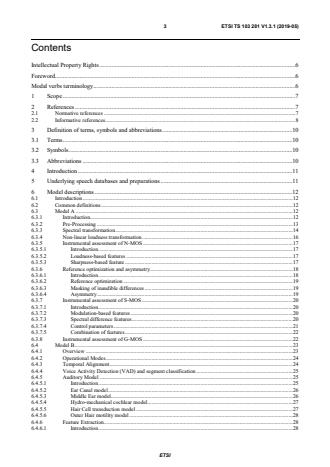
Contents
Intellectual Property Rights . 6
Foreword . 6
Modal verbs terminology . 6
1 Scope . 7
2 References . 7
2.1 Normative references . 7
2.2 Informative references . 8
3 Definition of terms, symbols and abbreviations . 10
3.1 Terms . 10
3.2 Symbols . 10
3.3 Abbreviations . 10
4 Introduction . 11
5 Underlying speech databases and preparations . 11
6 Model descriptions . 12
6.1 Introduction . 12
6.2 Common definitions . 12
6.3 Model A . 12
6.3.1 Introduction. 12
6.3.2 Pre-Processing . 13
6.3.3 Spectral transformation . 14
6.3.4 Non-linear loudness transformation . 16
6.3.5 Instrumental assessment of N-MOS . 17
6.3.5.1 Introduction . 17
6.3.5.2 Loudness-based features . 17
6.3.5.3 Sharpness-based feature . 17
6.3.6 Reference optimization and asymmetry . 18
6.3.6.1 Introduction . 18
6.3.6.2 Reference optimization . 19
6.3.6.3 Masking of inaudible differences . 19
6.3.6.4 Asymmetry . 19
6.3.7 Instrumental assessment of S-MOS . 20
6.3.7.1 Introduction . 20
6.3.7.2 Modulation-based features . 20
6.3.7.3 Spectral difference features . 20
6.3.7.4 Control parameters . 21
6.3.7.5 Combination of features . 22
6.3.8 Instrumental assessment of G-MOS . 22
6.4 Model B . 23
6.4.1 Overview . 23
6.4.2 Operational Modes . 24
6.4.3 Temporal Alignment . 24
6.4.4 Voice Activity Detection (VAD) and segment classification . 25
6.4.5 Auditory Model . 25
6.4.5.1 Introduction . 25
6.4.5.2 Ear Canal model . 26
6.4.5.3 Middle Ear model . 26
6.4.5.4 Hydro-mechanical cochlear model . 27
6.4.5.5 Hair Cell transduction model . 27
6.4.5.6 Outer Hair motility model . 28
6.4.6 Feature Extraction . 28
6.4.6.1 Introduction . 28
ETSI
4 ETSI TS 103 281 V1.3.1 (2019-05)
6.4.6.2 Salient Formant Points (SFP) feature extraction . 28
6.4.6.3 COSM (Cochlear Output Statistic Metric) feature extraction . 30
6.4.7 Training and mapping . 34
6.5 Mapping of model outputs . 35
7 Comparison of objective and subjective results after the training process . 36
7.1 Introduction . 36
7.2 Results for Model A . 36
7.3 Results for Cochlear Prediction Model (Model B) . 41
8 Validation results . 45
8.1 Introduction . 45
8.2 Validation database 1 (DES-17) . 45
8.2.1 Database description . 45
8.2.2 Validation database 1: Results for model B . 46
8.3 Validation database 2 (DES-20) . 48
8.3.1 Database description . 48
8.3.2 Validation database 2: Results for model A . 48
8.4 Validation database 3 (DES-25) . 50
8.4.1 Database description . 50
8.4.2 Validation database 3: Results for model A . 51
8.4.3 Validation database 3: Results for model B . 52
8.5 Validation database 4 (DES-26) . 54
8.5.1 Database description . 54
8.5.2 Validation database 4: Results for model A . 54
8.5.3 Validation database 4: Results for model B . 56
8.6 Validation database 5 (DES-27) . 58
8.6.1 Database description . 58
8.6.2 Validation database 5: Results for model A . 59
8.6.3 Validation database 5: Results for model B . 61
9 Application of the models . 63
9.1 Introduction . 63
9.2 Speech material . 63
9.3 Positioning of the device under test . 63
9.4 Background noise playback . 64
9.5 Recording and calibration procedure . 64
9.6 Running the prediction models . 64
9.7 Mapping function for Model A . 64
9.7.1 Derivation of mapping functions . 64
9.7.2 Resulting mapping functions . 68
Annex A (normative): Model configuration files . 69
A.1 Introduction . 69
A.2 Model A . 69
A.3 Model B . 70
Annex B (normative): Summary of Training Databases . 71
Annex C (normative): Test vectors for model verification . 73
Annex D (informative): Subjective testing framework . 74
D.1 Introduction . 74
D.2 Subjective test plan . 74
D.2.1 Traceability. 74
D.2.2 Speech database requirements . 74
D.2.3 Reference Conditions . 74
D.2.4 Test Conditions . 74
D.2.5 Post-processing of test conditions . 75
D.2.6 Calibration and equalization of headphones for presentation . 76
ETSI
5 ETSI TS 103 281 V1.3.1 (2019-05)
D.2.7 Requirements on the listening laboratory . 76
D.2.8 Experimental design . 77
D.2.9 Training session . 77
D.3 Set-up for acquisition of test conditions . 77
D.3.1 Terminal positioning and HATS calibration . 77
D.3.2 Background Noise reproduction . 78
D.3.3 Noise and speech playback synchronization . 78
D.3.4 Convergence sequence . 78
D.3.5 Example of noise and speech playback sequence including convergence period . 78
D.3.6 Recordings at the network simulator electrical reference point . 79
D.3.7 Recordings at the MRP and terminal's primary microphone location . 79
Annex E (normative): Speech material to be used for objective testing . 80
History . 82
ETSI
6 ETSI TS 103 281 V1.3.1 (2019-05)
Intellectual Property Rights
Essential patents
IPRs essential or potentially essential to normative deliverables may have been declared to ETSI. The information
pertaining to these essential IPRs, if any, is publicly available for ETSI members and non-members, and can be found
in ETSI SR 000 314: "Intellectual Property Rights (IPRs); Essential, or potentially Essential, IPRs notified to ETSI in
respect of ETSI standards", which is available from the ETSI Secretariat. Latest updates are available on the ETSI Web
server (https://ipr.etsi.org/).
Pursuant to the ETSI IPR Policy, no investigation, including IPR searches, has been carried out by ETSI. No guarantee
can be given as to the existence of other IPRs not referenced in ETSI SR 000 314 (or the updates on the ETSI Web
server) which are, or may be, or may become, essential to the present document.
Trademarks
The present document may include trademarks and/or tradenames which are asserted and/or registered by their owners.
ETSI claims no ownership of these except for any which are indicated as being the property of ETSI, and conveys no
right to use or reproduce any trademark and/or tradename. Mention of those trademarks in the present document does
not constitute an endorsement by ETSI of products, services or organizations associated with those trademarks.
Foreword
This Technical Specification (TS) has been produced by ETSI Technical Committee Speech and multimedia
Transmission Quality (STQ).
The present document is to be used in conjunction with:
• ETSI ES 202 396-1 [i.1]: "Background noise simulation technique and background noise database"; and
• ETSI TS 103 224 [i.19] series: "A sound field reproduction method for terminal testing including a
background noise database".
The present document describes an objective test method for super-wideband and fullband in order to provide a good
prediction of the uplink speech quality in the presence of background noise of modern mobile terminals in hand-held
and hands-free.
Modal verbs terminology
In the present document "shall", "shall not", "should", "should not", "may", "need not", "will", "will not", "can" and
"cannot" are to be interpreted as described in clause 3.2 of the ETSI Drafting Rules (Verbal forms for the expression of
provisions).
"must" and "must not" are NOT allowed in ETSI deliverables except when used in direct citation.
ETSI
7 ETSI TS 103 281 V1.3.1 (2019-05)
1 Scope
The present document describes testing methodologies which can be used to objectively evaluate the performance of
super-wideband and fullband mobile terminals for speech communication in the presence of background noise.
Background noise is a problem in mostly all situations and conditions and needs to be taken into account in terminal
design. The present document provides information about the testing methods applicable to objectively evaluate the
speech quality of mobile terminals (including any state-of-the-art codecs) employing background noise suppression in
the presence of background noise. The present document includes:
• The method which is applicable to objectively determine the different parameters influencing the speech
quality in the presence of background noise taking into account:
- the speech quality;
- the background noise transmission quality;
- the overall quality.
• The model results in comparison with the underlying subjective tests used for the training of the objective
model. The underlying languages are: American English, German, Chinese (Mandarin).
• The model validation results.
The present document is to be used in conjunction with:
• ETSI ES 202 396-1 [i.1] which describes a recording and reproduction setup for realistic simulation of
background noise scenarios in lab-type environments for the performance evaluation of terminals and
communication systems.
• ETSI TS 103 224 [i.19] which describes a sound field reproduction method for terminal testing including a
background noise database with background noise scenarios to be used in lab-type environments for the
performance evaluation of terminals and communication systems.
• American English speech sentences as enclosed in the present document.
2 References
2.1 Normative references
References are either specific (identified by date of publication and/or edition number or version number) or
non-specific. For specific references, only the cited version applies. For non-specific references, the latest version of the
referenced document (including any amendments) applies.
Referenced documents which are not found to be publicly available in the expected location might be found at
https://docbox.etsi.org/Reference/.
NOTE: While any hyperlinks included in this clause were valid at the time of publication, ETSI cannot guarantee
their long term validity.
The following referenced documents are necessary for the application of the present document.
Not applicable.
ETSI
8 ETSI TS 103 281 V1.3.1 (2019-05)
2.2 Informative references
References are either specific (identified by date of publication and/or edition number or version number) or
non-specific. For specific references, only the cited version applies. For non-specific references, the latest version of the
referenced document (including any amendments) applies.
NOTE: While any hyperlinks included in this clause were valid at the time of publication, ETSI cannot guarantee
their long term validity.
The following referenced documents are not necessary for the application of the present document but they assist the
user with regard to a particular subject area.
[i.1] ETSI ES 202 396-1: "Speech and multimedia Transmission Quality (STQ); Speech quality
performance in the presence of background noise; Part 1: Background noise simulation technique
and background noise database".
[i.2] ETSI EG 202 396-3: "Speech and multimedia Transmission Quality (STQ); Speech Quality
performance in the presence of background noise Part 3: Background noise transmission -
Objective test methods".
[i.3] ETSI TS 103 106: "Speech and multimedia Transmission Quality (STQ); Speech quality
performance in the presence of background noise: Background noise transmission for mobile
terminals-objective test methods".
[i.4] ETSI TS 126 441: "Universal Mobile Telecommunications System (UMTS); LTE; Codec for
Enhanced Voice Services (EVS); General overview (3GPP TS 26.441)".
[i.5] Recommendation ITU-T P.835: "Subjective test methodology for evaluating speech
communication systems that include noise suppression algorithm".
[i.6] Internet Engineering Task Force, Request for Comments 6716: "Definition of the Opus Audio
Codec", 09/2012.
[i.7] Recommendation ITU-T P.56: "Objective measurement of active speech level".
[i.8] Recommendation ITU-T P.1401: "Methods, metrics and procedures for statistical evaluation,
qualifying and comparison of objective quality prediction models".
[i.9] Recommendation ITU-T G.160 Appendix II, Amendment 2: "Voice enhancement devices:
Revised Appendix II - Objective measures for the characterization of the basic functioning of
noise reduction algorithms".
[i.10] Recommendation ITU-T P.501: "Test Signals for Use in Telephonometry".
[i.11] Recommendation ITU-T P.58: "Head and Torso simulator for telephonometry".
[i.12] Recommendation ITU-T P.57: "Artificial ears".
[i.13] Recommendation ITU-T P.800: "Methods for subjective determination of transmission quality".
[i.14] ETSI TS 126 132: "Universal Mobile Telecommunications System (UMTS); LTE; Speech and
video telephony terminal acoustic test specification (3GPP TS 26.132)".
[i.15] Recommendation ITU-T TD 477 (GEN/12): "Handbook of subjective test practical procedures"
(temporary document) - Geneva, 18-27 January 2011.
[i.16] AH-11-029: "Better Reference System for the P.835 SIG Rating Scale", Q7/12 Rapporteur's
meeting, 20-21 June 2011, Geneva, Switzerland.
[i.17] 3GPP, Tdoc S4(16)0397: "DESUDAPS-1: Common subjective testing framework for training and
validation of SWB and FB P.835 test predictors".
[i.18] Recommendation ITU-T P.64: "Determination of sensitivity/frequency characteristics of local
telephone systems".
ETSI
9 ETSI TS 103 281 V1.3.1 (2019-05)
[i.19] ETSI TS 103 224: "Speech and multimedia Transmission Quality (STQ); A sound field
reproduction method for terminal testing including a background noise database".
[i.20] Sottek R.: "Modelle zur Signalverarbeitung im menschlichen Gehör", PHD thesis RWTH Aachen,
1993.
[i.21] Sottek R.: "A Hearing Model Approach to Time-Varying Loudness", Acta Acustica united with
Acustica, vol. 102(4), pp. 725-744, 2016.
[i.22] Byrne D. et al.: "An international comparison of long-term average speech spectra", The Journal of
the Acoustical Society of America, Vol. 96, No. 4, 1994.
[i.23] IEC 61672-1:2013: "Electroacoustics - Sound level meters - Part 1: Specifications", 2003.
[i.24] Recommendation ITU-T P.863: "Methods for subjective determination of transmission quality".
[i.25] Côté N.: "Integral and Diagnostic Intrusive Prediction of Speech Quality", PHD thesis TU Berlin,
2010.
[i.26] Zwicker E. Fastl H.: "Psychoacoustics: Facts and Models", 1990.
[i.27] Falk, T. and Chan, W.-Y.: "A Non-Intrusive Quality and Intelligibility Measure of Reverberant
and Dereverberated Speech", IEEE Transactions on Audio, Speech, and Language Processing,
Volume: 18, Issue: 7, September 2010.
[i.28] Breiman L.: "Random Forests", Machine Learning (journal), Volume 45, Issue 1, pp 5-32,
October 2001.
[i.29] Berger, J.: "Instrumentelle Verfahren zur Sprachqualitätsschätzung", PhD thesis, 1998.
[i.30] W. Lu & D. Sen: "Extraction of cochlear processed formants for prediction of temporally localized
distortions in synthetized speech", ICASSP 2009.
[i.31] Christian Giguere & Philip C. Woodland: "A computational model of the auditory periphery for
speech and hearing research. I. Ascending path", JASA 1994, 95(1), pp 331-342.
[i.32] Wenliang Lu; Sen, D.: "Extraction of cochlear processed formants for prediction of temporally
localized distortions in synthetized speech", Acoustics, Speech and Signal Processing. ICASSP
2009. IEEE International Conference on , vol., no., pp.3977-3980, 19-24 April 2009.
[i.33] W. Lu & D Sen: "Tolerance and sensitivity of various parameters in the prediction of temporally
localized distortions in degraded speech", ICA 2010, Sydney, Australia, 23-27 August 2010.
[i.34] D. Talkin: "A Robust Algorithm for Pitch Tracking (RAPT)" in "Speech Coding & Synthesis",
W B Kleijn, K K Paliwal eds, Elsevier ISBN 0444821694, 1995.
[i.35] Brookes Mike: "Voicebox: Speech processing toolbox for matlab" Software, available
March 2011.
NOTE: Available at www.ee.ic.ac.uk/hp/staff/dmb/voicebox/voicebox.html.
[i.36] Puria, S. & Allen, J.B.: "A parametric study of cochlear input impedance", JASA 1991, 89(1),
pp 287-319.
[i.37] D. Sen and J. Allen: "Benchmarking a two-dimensional cochlear model against experimental
auditory data" in Proceedings of MidWinter Meeting on Association for Research in
Otolaryngology (ARO '01), February 2001.
[i.38] D. Sen and J. B. Allen: "Functionality of cochlear micromechanics-as elucidated by upward spread
of masking and two tone suppression", Acoustics Australia, vol. 34, no. 1, pp. 37-42, 2006.
[i.39] J. B. Allen and M. Sondhi: "Cochlear macromechanics: time domain solutions", The Journal of the
Acoustical Society of America, vol. 66, no. 1, pp. 123-132, 1979.
[i.40] Recommendation ITU-T P.380 (11/2003): "Electro-acoustic measurements on headsets".
ETSI
10 ETSI TS 103 281 V1.3.1 (2019-05)
[i.41] Recommendation ITU-T P.1120 (03/2017): "Super-WideBand (SWB) and FullBand (FB) stereo
hands-free communication in motor vehicles".
[i.42] Recommendation ITU-R BS.708 (06/1990): "Determination of the electro-acoustical properties of
studio monitor headphones".
[i.43] IEC 60268-7:2010: "Sound system equipment - Part 7: Headphones and earphones".
[i.44] ETSI TR 126 931: "Universal Mobile Telecommunications System (UMTS); LTE; Evaluation of
Additional Acoustic Tests for Speech Telephony (3GPP TR 26.931)".
3 Definition of terms, symbols and abbreviations
3.1 Terms
Void.
3.2 Symbols
Void.
3.3 Abbreviations
For the purposes of the present document, the following abbreviations apply:
AMR Adaptive Multi-Rate (narrowband speech codec)
AMR-WB Adaptive Multi-Rate Wideband (wideband speech codec)
AS Analysis Serial
ASL Active Speech Level
BAK Background Noise Component
BGN Background Noise
BM Basilar Membrane
CM Cochlear Model
COSM Cochlear Output Statistic Metrics
CP Characteristic Place
dB SPL Sound Pressure Level re 20 µPa in dB
DB Data Base
DES Database Enumeration
DNN Deep Neural Network
DRP Drum Reference Point
EVS Enhanced Voice Services
EVS-FB Enhanced Voice Services - Fullband
FB Fullband
FFT Fast Fourier Transformation
G-MOS Global MOS (related to the overall quality)
HATS Head and Torso Simulator
HE Headset
HHHF Hand-Held Hands-Free
HS Handset
IHC Inner Hair Cell
IIR Infinite Impulse Response
ITU International Telecommunication Union
ITU-R International Telecommunication Union - Radiocommunication sector
ITU-T International Telecommunication Union - Telecommunication sector
LQO Listening Quality Objective (related to fullband scale)
fb
ETSI
11 ETSI TS 103 281 V1.3.1 (2019-05)
LQS Listening Quality Subjective (related to fullband scale)
fb
MOS Mean Opinion Score
MRP Mouth Reference Point
NB Narrowband
N-MOS Noise MOS (related to the noise intrusiveness)
NS Noise Suppression
OHC Outer Hair Cell
OVRL Overall (speech + noise) Component
PCA Principal Component Analysis
PCM Pulse Code Modulation
RAPT Robust Algorithm for Pitch Tracking
RMS Root Mean Square
RMSE Root Mean Square Error
RMSE* epsilon insensitive Root Mean Square Error
SFP Salient Formant Points
SIG SIGnal component
SLR Send Loudness Rating
S-MOS Speech MOS (related to the speech distortion)
SNR Signal to Noise Ratio
SNR(A) Signal to Noise Ratio (A-weighted)
SPL Sound Pressure Level
SWB Super-wideband
SWB/FB Super-Wideband/Fullband
TCP Track Center Points
TM Tectorial Membrane
VAD Voice Activity Detection
WB Wideband
4 Introduction
The present document describes models for the objective prediction of speech-, background-noise- and overall quality
for super-wideband and fullband terminals and systems used in background noise in uplink on a fullband scale.
The models are intended to be used for modern terminals including e.g. different bitrates of EVS [i.4] and other
state-of-the-art coding technologies. The current models were trained and validated with EVS-SWB, EVS-FB,
Opus [i.6], AMR, AMR-WB, PCM including typical packet loss and jitter conditions and recordings in handset,
headset, hands-free and car hands-free mode.
5 Underlying speech databases and preparations
The basis of any perceptually-based measure which models the behaviour of human test persons, are auditory tests. In
general, these tests are carried out with naïve test persons, who are asked to rate a certain quality aspect of a presented
speech sample. For the evaluation of processed and transmitted noisy speech, the Recommendation ITU-T P.835 [i.5] is
a state-of-the-art method for the assessment of speech and noise quality. The listening test procedure described in [i.5]
is also the basis for the prediction model.
It is necessary to note that the Recommendation ITU-T P.835 [i.5] uses a slightly different nomenclature for the
different quality attributes. For the speech distortion scale, SIG (signal = speech) is used instead of S-MOS-LQS, BAK
(background noise) instead of N-MOS-LQS and OVRL (overall) instead of G-MOS-LQS. Whenever these
abbreviations are used in the present document, this always indicates that auditory results are addressed.
In addition to Recommendation ITU-T P.835 [i.5], several details of auditory testing were specified in [i.17]. These
more detailed descriptions focus on the recording and creation of the test and reference stimuli. An update of the
reference processing to SWB/FB mode was introduced as an extension of the procedures described in [i.3]. This revised
subjective test framework is required in order to minimize variations between subjective tests performed in different
listening laboratories. A summary of this work is provided in annex D.
ETSI
12 ETSI TS 103 281 V1.3.1 (2019-05)
6 Model descriptions
6.1 Introduction
The prediction models described in the following clauses are full-reference models. Such a predictor compares the
degraded signal under test against a reference signal. Audible disturbances between these two signals are assumed to
highly correlate with the results of auditory tests conducted in the development phase. Two models are provided in the
present document for this purpose.
6.2 Common definitions
Even though both model variants internally work differently regarding the processing steps, inputs and outputs are
common. The input time signals are denoted as x(k) for the reference signal and y(k) for the degraded signal, which is
evaluated either by the instrumental or the auditory assessment. Each prediction model provides three output values:
• S-MOS-LQO : instrumentally assessed SIG component (speech distortion).
fb
• N-MOS-LQO : instrumentally assessed BAK component (noise intrusiveness).
fb
• G-MOS-LQO : instrumentally assessed OVRL component (global quality).
fb
6.3 Model A
6.3.1 Introduction
In general, the model consists of several stages and calculation steps which finally conclude in the assessment of
instrumental S-, N- and G-MOS. Figure 6.1 provides an overview about the structure of the method. Clauses 6.3.2 to
6.3.8 provide detailed descriptions of each processing block.
Figure 6.1: Block diagram of model A
ETSI
13 ETSI TS 103 281 V1.3.1 (2019-05)
6.3.2 Pre-Processing
The pre-processing of the inputs x(k) and y(k) is conducted to compensate differences regarding temporal alignment
and level offsets between the signals. An overview of the pre-processing is given in the block diagram shown in
figure 6.2.
Figure 6.2: Block diagram of model A
The first block ensures that both input signals provide the same sampling rate of 48 kHz. The outputs are denoted as
x'(k) and y'(k).
The delay compensation between processed and clean speech signal is applied in a similar way as in the method
th
according to ETSI EG 202 396-3 [i.2]. The signals x'(k) and y'(k) are filtered with an IIR band-pass of 6 order and a
frequency range of 300 Hz - 3 300 Hz. Limiting to this range, only the signal parts containing most speech energy are
taken into account. Then, the cross-correlation Φ between the pre-filtered input signals x'(k) and y'(k) is
calculated, followed by an envelope operation according to equation (1).
ΦΦ (1)
The envelope is calculated using the Hilbert transformation according to equation (2).
Φ ∑ (2)
The maximum peak of determines the delay to compensate on the time abscissa.
The alignment is conducted by adding zeros at the beginning and cropping at the end of signal x'(k) in case of a positive
determined delay. The inverse procedure is applied in case of a negative delay. This compensation step results in x''(k)
and does not affect the degraded signal y'(k), i.e. the duration of y'(k) is maintained in both output signals.
The next block extracts the active speech parts from the signal x''(k). For this analysis, the first step is to classify energy
frames of 10 ms (block-wise, no overlap) according to the method described in [i.9]. The thresholds for the
classification are defined relatively to the active speech level [i.7]. As a result, each speech frame is identified either as
high (H), medium (M), low (L) or uncertain (U) activity. Frames without activity are either classified as short pauses
(P) or silence (S). The speech parts are finally determined as regions excluding frames of type S. The information of the
active time ranges is employed in several other blocks which are introduced in the following clauses.
The last stage performs an initial level calibration of the reference signal x''(k). For this purpose, the complex transfer
function is determined by equation (3).
f (3)
This calculation is also known as method H1 in literature, where noise is located at the output of a system. Here S (f)
x''y'
denotes the cross-power spectral density between x''(k) and y'(k), S (f) represents the power spectral density of x''(k).
x''x''
The analysis is carried out only for the active speech segments determined previously. The gain a required for the
lin
level calibration of x''(k) is obtained by averaging the magnitude H(f) over the entire frequency range. The scaled
version of the reference signal is finally denoted as x'''(k). For later application, the active speech level of x'''(k)
according to Recommendation ITU-T P.56 [i.7] is calculated as ASL .
x'''
ETSI
14 ETSI TS 103 281 V1.3.1 (2019-05)
6.3.3 Spectral transformation
Figure 6.3 depicts the flow chart of the spectral transformation and further processing steps, which are performed for
the instrumental assessment of S-MOS, N-MOS and G-MOS.
Figure 6.3: Block diagram of model A
For the consideration of a hearing-adequate signal representation, the model according to [i.20] and [i.21] is used in the
spectral analysis of the pre-processed time signals. At this stage, only outer and middle ear filtering, the auditory filter
bank, rectification, low-pass filtering and downsampling are applied, which result in a frame size of 8 ms. The
bandwidth of the auditory filterbank is specified by equation (4).
∆∆ 0 ⋅ (4)
The initial bandwidth Δf(f=0) is set to 50 Hz and the factor c equals 0,14. This results in M = 33 bands up to 20 kHz. In
addition to the specified basis filters, two intermediate filters are inserted between the neighbouring center frequencies
of the 33 frequency bands. This results in an overlap of 66 % in the frequency domain, leading to a finer resolution of
J = 99 bands. For further reference, the complete hearing model is described at full length in [i.20] and [i.21].
This intermediate representation results in a hearing model spectrum versus time, but still in the physical unit Pascal.
The time signals x'''(k) and y'(k) are transformed into the corresponding time-frequency representations X (i,j) and
Y(i,j), respectively.
The next stage is the estimation of the speech activity versus time and frequency. The thresholds for activity in each
band are defined by a long-term average speech spectrum according to [i.22]. Such a spectrum is created by
interpolating the given frequency vector and then scaling it to the overall energy of the previously determined ASL .
x'''
The limits for low (L), mid (M), high (H), uncertain (U) and silence (P) for each frequency band are then determined
again by the offsets described in [i.9]. As a result, an activity spectrum A(i,j) is obtained.
One of the most important stages of the spectral analysis is the separation of the degraded spectrum Y(i,j) according to
equation (5) into a speech and noise component.
,, , (5)
...
Questions, Comments and Discussion
Ask us and Technical Secretary will try to provide an answer. You can facilitate discussion about the standard in here.
Loading comments...