


ETSI TR 104 080 V1.1.1 (2024-07)
Environmental Engineering (EE); Example of a Life Cycle Assessment (LCA) of a mobile phone
Environmental Engineering (EE); Example of a Life Cycle Assessment (LCA) of a mobile phone
DTR/EE-MICT5
General Information
Standards Content (Sample)
TECHNICAL REPORT
Environmental Engineering (EE);
Example of a Life Cycle Assessment (LCA)
of a mobile phone
2 ETSI TR 104 080 V1.1.1 (2024-07)
Reference
DTR/EE-MICT5
Keywords
LCA, mobile, terminal
ETSI
650 Route des Lucioles
F-06921 Sophia Antipolis Cedex - FRANCE
Tel.: +33 4 92 94 42 00 Fax: +33 4 93 65 47 16
Siret N° 348 623 562 00017 - APE 7112B
Association à but non lucratif enregistrée à la
Sous-Préfecture de Grasse (06) N° w061004871
Important notice
The present document can be downloaded from:
https://www.etsi.org/standards-search
The present document may be made available in electronic versions and/or in print. The content of any electronic and/or
print versions of the present document shall not be modified without the prior written authorization of ETSI. In case of any
existing or perceived difference in contents between such versions and/or in print, the prevailing version of an ETSI
deliverable is the one made publicly available in PDF format at www.etsi.org/deliver.
Users of the present document should be aware that the document may be subject to revision or change of status.
Information on the current status of this and other ETSI documents is available at
https://portal.etsi.org/TB/ETSIDeliverableStatus.aspx
If you find errors in the present document, please send your comment to one of the following services:
https://portal.etsi.org/People/CommiteeSupportStaff.aspx
If you find a security vulnerability in the present document, please report it through our
Coordinated Vulnerability Disclosure Program:
https://www.etsi.org/standards/coordinated-vulnerability-disclosure
Notice of disclaimer & limitation of liability
The information provided in the present deliverable is directed solely to professionals who have the appropriate degree of
experience to understand and interpret its content in accordance with generally accepted engineering or
other professional standard and applicable regulations.
No recommendation as to products and services or vendors is made or should be implied.
No representation or warranty is made that this deliverable is technically accurate or sufficient or conforms to any law
and/or governmental rule and/or regulation and further, no representation or warranty is made of merchantability or fitness
for any particular purpose or against infringement of intellectual property rights.
In no event shall ETSI be held liable for loss of profits or any other incidental or consequential damages.
Any software contained in this deliverable is provided "AS IS" with no warranties, express or implied, including but not
limited to, the warranties of merchantability, fitness for a particular purpose and non-infringement of intellectual property
rights and ETSI shall not be held liable in any event for any damages whatsoever (including, without limitation, damages
for loss of profits, business interruption, loss of information, or any other pecuniary loss) arising out of or related to the use
of or inability to use the software.
Copyright Notification
No part may be reproduced or utilized in any form or by any means, electronic or mechanical, including photocopying and
microfilm except as authorized by written permission of ETSI.
The content of the PDF version shall not be modified without the written authorization of ETSI.
The copyright and the foregoing restriction extend to reproduction in all media.
© ETSI 2024.
All rights reserved.
ETSI
3 ETSI TR 104 080 V1.1.1 (2024-07)
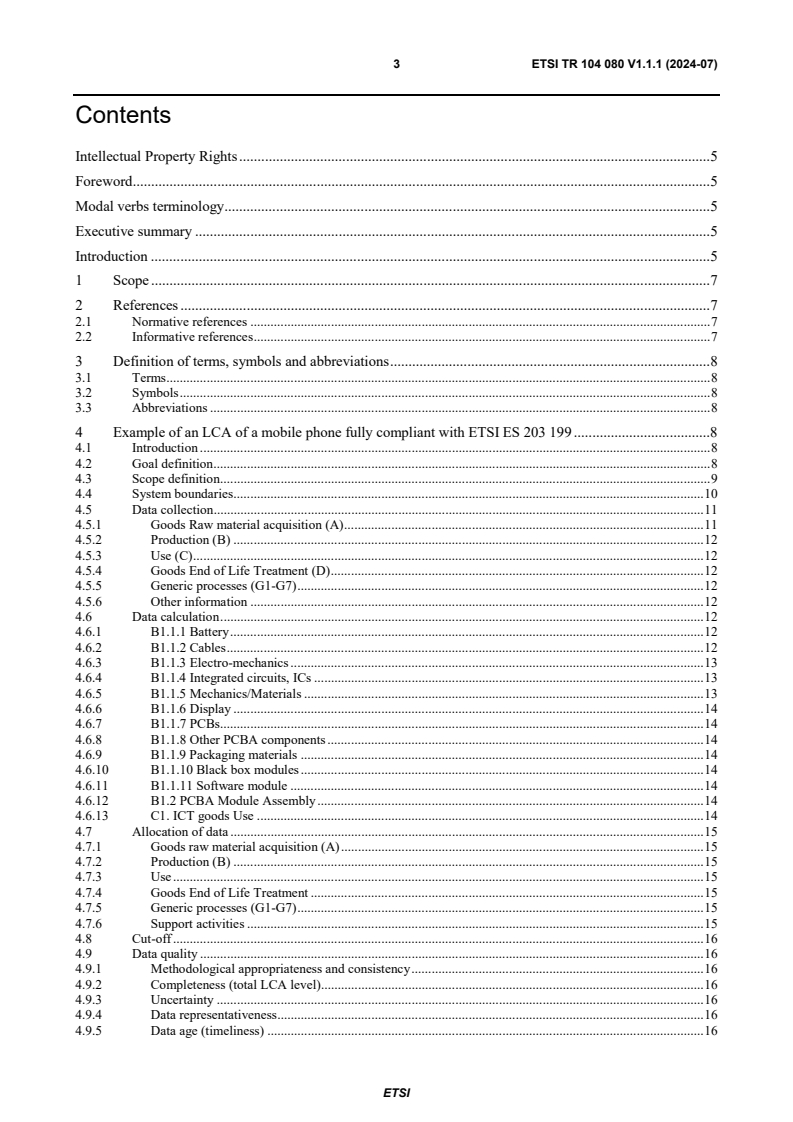
Contents
Intellectual Property Rights . 5
Foreword . 5
Modal verbs terminology . 5
Executive summary . 5
Introduction . 5
1 Scope . 7
2 References . 7
2.1 Normative references . 7
2.2 Informative references . 7
3 Definition of terms, symbols and abbreviations . 8
3.1 Terms . 8
3.2 Symbols . 8
3.3 Abbreviations . 8
4 Example of an LCA of a mobile phone fully compliant with ETSI ES 203 199 . 8
4.1 Introduction . 8
4.2 Goal definition . 8
4.3 Scope definition . 9
4.4 System boundaries . 10
4.5 Data collection . 11
4.5.1 Goods Raw material acquisition (A) . 11
4.5.2 Production (B) . 12
4.5.3 Use (C) . 12
4.5.4 Goods End of Life Treatment (D) . 12
4.5.5 Generic processes (G1-G7) . 12
4.5.6 Other information . 12
4.6 Data calculation . 12
4.6.1 B1.1.1 Battery . 12
4.6.2 B1.1.2 Cables . 12
4.6.3 B1.1.3 Electro-mechanics . 13
4.6.4 B1.1.4 Integrated circuits, ICs . 13
4.6.5 B1.1.5 Mechanics/Materials . 13
4.6.6 B1.1.6 Display . 14
4.6.7 B1.1.7 PCBs. 14
4.6.8 B1.1.8 Other PCBA components . 14
4.6.9 B1.1.9 Packaging materials . 14
4.6.10 B1.1.10 Black box modules . 14
4.6.11 B1.1.11 Software module . 14
4.6.12 B1.2 PCBA Module Assembly . 14
4.6.13 C1. ICT goods Use . 14
4.7 Allocation of data . 15
4.7.1 Goods raw material acquisition (A) . 15
4.7.2 Production (B) . 15
4.7.3 Use . 15
4.7.4 Goods End of Life Treatment . 15
4.7.5 Generic processes (G1-G7) . 15
4.7.6 Support activities . 15
4.8 Cut-off . 16
4.9 Data quality . 16
4.9.1 Methodological appropriateness and consistency . 16
4.9.2 Completeness (total LCA level) . 16
4.9.3 Uncertainty . 16
4.9.4 Data representativeness . 16
4.9.5 Data age (timeliness) . 16
ETSI
4 ETSI TR 104 080 V1.1.1 (2024-07)
4.9.6 Acquisition method . 16
4.9.7 Supplier independence . 16
4.9.8 Geographical correlation . 17
4.9.9 Technological correlation . 17
4.9.10 Cut-off rules (rules of inclusion/exclusion) . 17
4.10 LCIA . 18
4.11 Life cycle interpretation . 18
4.11.1 Conclusions. 18
4.11.1.1 CC . 18
4.11.1.2 RDMR . 18
4.11.2 Uncertainty . 18
4.12 Reporting . 20
History . 41
ETSI
5 ETSI TR 104 080 V1.1.1 (2024-07)
Intellectual Property Rights
Essential patents
IPRs essential or potentially essential to normative deliverables may have been declared to ETSI. The declarations
pertaining to these essential IPRs, if any, are publicly available for ETSI members and non-members, and can be
found in ETSI SR 000 314: "Intellectual Property Rights (IPRs); Essential, or potentially Essential, IPRs notified to
ETSI in respect of ETSI standards", which is available from the ETSI Secretariat. Latest updates are available on the
ETSI Web server (https://ipr.etsi.org/).
Pursuant to the ETSI Directives including the ETSI IPR Policy, no investigation regarding the essentiality of IPRs,
including IPR searches, has been carried out by ETSI. No guarantee can be given as to the existence of other IPRs not
referenced in ETSI SR 000 314 (or the updates on the ETSI Web server) which are, or may be, or may become,
essential to the present document.
Trademarks
The present document may include trademarks and/or tradenames which are asserted and/or registered by their owners.
ETSI claims no ownership of these except for any which are indicated as being the property of ETSI, and conveys no
right to use or reproduce any trademark and/or tradename. Mention of those trademarks in the present document does
not constitute an endorsement by ETSI of products, services or organizations associated with those trademarks.
DECT™, PLUGTESTS™, UMTS™ and the ETSI logo are trademarks of ETSI registered for the benefit of its
Members. 3GPP™ and LTE™ are trademarks of ETSI registered for the benefit of its Members and of the 3GPP
Organizational Partners. oneM2M™ logo is a trademark of ETSI registered for the benefit of its Members and of the ®
oneM2M Partners. GSM and the GSM logo are trademarks registered and owned by the GSM Association.
Foreword
This Technical Report (TR) has been produced by ETSI Technical Committee Environmental Engineering (EE).
Modal verbs terminology
In the present document "should", "should not", "may", "need not", "will", "will not", "can" and "cannot" are to be
interpreted as described in clause 3.2 of the ETSI Drafting Rules (Verbal forms for the expression of provisions).
"must" and "must not" are NOT allowed in ETSI deliverables except when used in direct citation.
Executive summary
The objective of the present document is to show how a Life Cycle Assessment (LCA) of an ICT good, a mobile phone,
is performed by an ICT manufacturer, based on ETSI ES 203 199 [i.1].
For compliance with ETSI ES 203 199 [i.1] all body text and annexes need to be considered when performing an LCA,
i.e. this example is fully compliant with ETSI ES 203 199 [i.1] as described in clause 4.2 except for a few deviations
listed in the 'Reporting' clause 4.12.
Introduction
The present document has been developed to demonstrate the application of ETSI ES 203 199 [i.1] for the
environmental assessment of the life cycle impact of a mobile phone.
ETSI
6 ETSI TR 104 080 V1.1.1 (2024-07)
ETSI ES 203 199 [i.1] defines a set of requirements to reflect the quality that practitioners should strive for. To foster
results of LCAs becoming more transparent and, for the quality of data and LCA tools to improve over time, the present
document is applying the requirements outlined in ETSI ES 203 199 [i.1] in the following pages. ETSI ES 203 199 [i.1]
requires that deviation(s) from the requirements are clearly motivated and reported. For further details regarding
compliance refer to clause 5.2 in ETSI ES 203 199 [i.1].
The present document is intended for LCA practitioners wanting to assess mobile phones environmental impacts and it
will help them to perform and report their LCAs of mobile phones in a uniform and transparent manner.
The following uses of mobile phone LCA applications are the most frequently used ones, but others may be identified
and used as well:
• Evaluation of product system environmental impact, such as climate change.
• Assessment of primary energy consumption.
• Identification of life cycle stages and activities with high significance.
• Comparisons of specific mobile phones under the conditions described in clause 5.3 in ETSI ES 203 199 [i.1].
• Comparative analysis between an ICT product system featuring mobile phones and reference product system.
The present document was developed jointly by ETSI TC EE and ITU-T Study Group 5. It will be published
respectively by ITU and ETSI as ITU-T L.Supp60 [i.7] and ETSI TR 104 080 (the present document), which are
technically-equivalent.
ETSI
7 ETSI TR 104 080 V1.1.1 (2024-07)
1 Scope
The present document aims to present an example of an objective and transparent Life Cycle Assessment (LCA) of a
mobile phone.
The present document will provide an example of an LCA of a mobile phone fully compliant with ETSI
ES 203 199 [i.1]. The present document will be technically aligned with ITU-T L.Suppl.60.
The present document can be read by anyone aiming for a better understanding of LCA of mobile phones. However, the
present document is especially intended for LCA practitioners with a prior knowledge of ETSI ES 203 199 [i.1].
The purpose of the present document is to:
• provide an example of an LCA of a mobile phone, aligned with the requirements of ETSI ES 203 199 [i.1] to
ensure a sufficient quality of LCA studies of mobile phones;
• harmonize the LCAs of mobile phones;
• increase the credibility of LCAs of mobile phones;
• increase the transparency and facilitate the interpretation of LCA studies of mobile phones;
• facilitate the communication of LCA studies of mobile phones.
Recognizing ETSI ES 203 199 [i.1] as reference, the present document will apply it for the LCA of a mobile phone. The
present document is valid for all types of mobile phones.
While ETSI ES 203 199 [i.1] defines a set of requirements which reflect the quality that practitioners should strive for,
the present document does not contain any requirements.
Comparisons of results from environmental assessments of mobile phones which have been performed by different
organizations and with different tools, are beyond the scope of ETSI ES 203 199 [i.1], as such comparisons would
require that the assumptions and context of each study are exactly equivalent.
2 References
2.1 Normative references
Normative references are not applicable in the present document.
2.2 Informative references
References are either specific (identified by date of publication and/or edition number or version number) or
non-specific. For specific references, only the cited version applies. For non-specific references, the latest version of the
referenced document (including any amendments) applies.
NOTE: While any hyperlinks included in this clause were valid at the time of publication, ETSI cannot guarantee
their long term validity.
The following referenced documents are not necessary for the application of the present document but they assist the
user with regard to a particular subject area.
[i.1] ETSI ES 203 199 (V1.4.1): "Environmental Engineering (EE); Methodology for environmental
Life Cycle Assessment (LCA) of Information and Communication Technology (ICT) goods,
networks and services".
[i.2] Recommendation ITU-T L.1015 (01/2019): "Criteria for evaluation of the environmental impact of
mobile phones".
ETSI
8 ETSI TR 104 080 V1.1.1 (2024-07)
[i.3] ETSI TR 103 679 (V1.1.1): "Environmental Engineering (EE); Explore the challenges of
developing product group-specific Product Environmental Footprint Category Rules (PEFCRs) for
smartphones".
[i.4] Galen, J. V. (2023): "The environmental impact of reusing iPhones: a case study looking into the
environmental benefits of reusing iPhones through Twig" (Master's thesis) (Accessed 28
May 2024).
[i.5] ISO 14040:2006: "Environmental management -- Life cycle assessment -- Principles and
framework".
[i.6] ISO 14044:2006: "Environmental management -- Life cycle assessment -- Requirements and
guidelines".
[i.7] ITU-T L.Supp60: "Example of a Life Cycle Assessment (LCA) of a mobile phone".
3 Definition of terms, symbols and abbreviations
3.1 Terms
For the purposes of the present document, the terms given in ETSI ES 203 199 [i.1] apply.
3.2 Symbols
Void.
3.3 Abbreviations
For the purposes of the present document, the abbreviations given in ETSI ES 203 199 [i.1] apply.
4 Example of an LCA of a mobile phone fully compliant
with ETSI ES 203 199
4.1 Introduction
The purpose of the present document is to show how an LCA of a mobile phone is performed by an ICT manufacturer
based on ETSI ES 203 199 [i.1].
NOTE: The data presented in this example are not real data but rather examples.
For compliance with [i.1] all body text and annexes need to be considered when performing an LCA, i.e. this example
as such is fully compliant with [i.1] as described in clause 5.2 in ETSI ES 203 199 [i.1] except for a few deviations
listed in the Reporting clause below.
4.2 Goal definition
The goal of this example LCA study is to clarify and understand the environmental impact of a mobile phone, during all
stages of the lifecycle, with respect to the mid-point impact categories Climate Change (CC) and Resource Use,
Mineral, Resources (RDMR).
NOTE 1: The Environmental Footprint (EF) Life Cycle impact Assessment method consists of 14 further impact
categories (such as Ozone Depletion and Respiratory Inorganics) beyond CC and RDMR which are not
considered for the present example. It is encouraged to analyse the results for each impact category to
further explore the environmental impacts.
ETSI
9 ETSI TR 104 080 V1.1.1 (2024-07)
The purpose of the LCA study is for internal use in order to develop the product and processes to be more
environmentally sound. Based on previous experience [i.3], data availability and a screening, it is judged that beyond
the mandatory CC, RDMR is enough to exemplify the application of [i.1].
NOTE 2: Many more impact categories exist and a two are selected for this example just to highlight that it is
important to assess different categories to avoid burden shifting. The purposes of performing an LCA
may vary e.g. from internal use cases to understanding the potential impact and identifying of
opportunities to improve environmental performance of a good to external use cases to gain information
about typical environmental performance of a good to assist in policy choices.
4.3 Scope definition
The studied product system is one mobile phone for Business-to-Consumer (B2C) with typical functionality such as
voice, SMS and internet browsing. Except the operating system software program, it physically consists of general
building blocks such as: display, battery, mechanics, electromechanics and electronic components. These building
blocks can in turn be categorized according to Parts defined in Table E.1 in ETSI ES 203 199 [i.1]. Table E.1 also
includes Software as a Part. In this case of an entry-level mobile phone the main software component is the general
operating system which according to clause 6.1.3 in ETSI ES 203 199 [i.1] can be considered optional due to allocation
difficulties. Moreover, applications that users may install themselves are excluded as the preferences and choices of
users vary remarkably.
In the studied product system, the sales package is out of the scope such as sales package materials, user guide and
accessories such as the charger, cable and headset.
NOTE 1: The limited scope for the present example is allowed in [i.1] however the sales package materials are
commonly included in mobile phone LCAs. Including or excluding e.g. packaging materials and chargers
could have significant effect for several impact categories.
NOTE 2: Depending on the goal and scope of the study sales package may or may not be included and the package
content may vary.
The operating lifetime is estimated to be 4 years by the first owner based on the studied type of mobile phone and on
consumer surveys. No extended operating lifetime or other lifetimes are considered.
NOTE 3: 4 years operating lifetime is considered longer than the average. However, it is nevertheless chosen as
some consumers fit the profile [i.4]. Shorter and longer lifetime are tested in the sensitivity analysis.
The functions of a mobile phone are many such as calling, web browsing, creating mobile hotspot, watching videos on
the internet, enable video meeting, setting alarm, setting of timer, keeping time, navigation.
The applicable functional unit is "3G/4G/5G access for 1 hour daily calling and enable use of a 1080×2340 pixels
video player for 2 hours web browsing and 4 hours video watching daily for 4 years".
This use case is just one specific scenario. The use pattern and therefore energy consumption of the device may vary a
great deal, for example depending on which features are used and for how much time and on whether the charger is left
plugged into the power socket. Other scenario-based sensitivity analyses may be conducted. The assessment scope is
also focused on direct operations and therefore infrastructure capacity buildings (like factories, roads, vehicles and
telecommunications) are excluded. Also, capital goods, like production machinery are excluded. Human resources,
corporate overhead and travels are also excluded.
ICT Manufacturers facility data are included (energy, materials, waste, etc.).
NOTE 4: Manufactures have the possibility to use primary data and other practitioners can use external sources
e.g. manufacturer external reports and LCI databases.
The assessed mobile phone is a globally sold and used product. As the geographical and temporal coordinates vary
dynamically for the Raw Material Acquisition and Production of most mobile phones the presented results for Raw
Material Acquisition and Production will therefore represent a global snapshot for the mobile phone.
ETSI
10 ETSI TR 104 080 V1.1.1 (2024-07)
4.4 System boundaries
Table 2 in ETSI ES 203 199 [i.1] specifies the mandatory, recommended and optional life cycle stages/unit processes
for ICT goods. Listed below are the life cycle stages included in this LCA example for a mobile phone:
• A1 Raw material extraction.
• A2 Raw material processing.
• B1.1 Parts production.
• B1.2 Assembly.
• C1 ICT goods use.
• D2.1 Storage/Disassembly/Dismantling/ Shredding.
• D2.2 Recycling.
• D3 Other EoLT.
The recommended B1.3 is left out due to allocation problems and B3 (ICT specific site construction), is not applicable
to the studied product system of one mobile phone.
Moreover, C2, C3 and C4 are not applicable to the studied product system.
In EoLT D2.1, D2.2. and D3 processes are included. D1 is not applicable to the studied product system.
Support activities are intentionally excluded for any unit processes.
Underlined Processes in Figure 1 are included in the studied product system.
Processes below in italic style are not included as they are optional or not part of the studied product system scope.
ETSI
11 ETSI TR 104 080 V1.1.1 (2024-07)
A: GOODS RAW MATERIAL
ACQUISITION
G1.
A1. Raw material extraction
TRANSPORTS&TRAVEL
A2. Raw material processing
B: PRODUCTION
B1. ICT goods production
G2. ELECTRICITY SUPPLY
B1.1 Parts production
B1.2 Assembly
B1.3 ICT manufacturer support activities
G3. FUEL SUPPLY
B2. Support goods production
B2.1 Support goods manufacturing
G4. OTHER ENERGY
B3 ICT specific site construction
SUPPLY
G5. RAW MATERIAL
C: USE
AQUISTION
C1. ICT goods use
G5.1. Raw material extraction
C2. Support goods use
G5.2. Raw material processing
C3. Operator support activities
C4. Service provider support activities
G6. END-OF-LIFE
D: GOODS END-OF-LIFE
TREATMENT
G6.1 EHW treatment TREATMENT
D1. Preparation for extended operation
G6.2 Other waste treatment
lifetime
D2. ICT specific EoLT
D2.1 Storage/Disassembly/Dismantling/
G7. RAW MATERIAL
Shredding
RECYCLING
D2.2 Recycling
D3. Other EoLT
System boundary
Figure 1: The system boundary of the product system for LCA of the mobile phone
4.5 Data collection
4.5.1 Goods Raw material acquisition (A)
Selected external databases are used for Raw Material Extraction (A1) and Raw Material Processing (A2) data.
ICT manufacturer Bill Of Materials (BOM) and primary material data are used to identify the Parts and Raw material
contents of the mobile phone.
ETSI
12 ETSI TR 104 080 V1.1.1 (2024-07)
NOTE: There are also other ways of collecting material content and BOM data, e.g. teardown reports,
manufacturers, external data sources. Data quality evaluation is always important and the chosen
approach needs to be motivated.
4.5.2 Production (B)
Primary data (transportation mode, distance and masses) are collected for transports of Raw Materials (G5) and Parts
(B1.1.1-10) to Final Product and from own production (Assembly, B1.2) operations. Primary data for consumption of
Electricity, Fuel and Raw Materials in B1.2 are also collected. Part Production (B1.1.1-10) and Raw Materials
Acquisition LCI data (G5) are collected from external databases and case by case, from suppliers based on BOMs and
material content.
4.5.3 Use (C)
Energy consumption during mobile phone use stage in the described specific scenario is estimated based on the third
alternative in clause 6.3.1.2.1 of ETSI ES 203 199 [i.1] (with certain user profile / product category) including typical
use of all functionalities of multifunctional ICT goods. Phone charging energy efficiency is based on the ICT
manufacturer's own charger relevant for the study. It is assumed that the charger is not unplugged and therefore no-load
consumption has been considered (worst case scenario). Battery capacity is based on relevant battery for the study.
World average energy mixes are used as the product is intended for global market.
4.5.4 Goods End of Life Treatment (D)
For EoLT data are based on average data from literature (e.g. regarding amount of electricity used per piece or mass of
mobile phone for Storage/Disassembly/Dismantling/Shredding (D2.1) and Recycling (D2.2.1, D2.2.2, D2.2.4 and
D2.2.5).
4.5.5 Generic processes (G1-G7)
For transports (G1) distances, transportation modes and own facilities consumption of electricity (G2), Fuels (G3), Raw
Materials (G5) and Raw Material Recycling (G7) primary data are used. Relevant local and global energy mixes are
collected from LCI databases.
4.5.6 Other information
For Raw Material Acquisition the LCI databases used are not transparently reporting data on transports (G1), thus
impact from these transports between Raw Material Extraction (A1) and Raw Material Processing (A2) cannot be
reported separately.
Furthermore, the amount and type of Transport of Raw Materials to Part Production are not transparent.
4.6 Data calculation
4.6.1 B1.1.1 Battery
Below follows some examples of data calculations.
The mass of the battery used in the mobile phone is measured. An LCI module for Lithium ion batteries expressing the
impacts per mass is applied according to Figure B.1 in ETSI ES 203 199 [i.1].
NOTE: Depending on the LCI data available also other possibilities exist that are based on battery capacity and
energy content.
4.6.2 B1.1.2 Cables
There are no cables in the studied product system.
ETSI
13 ETSI TR 104 080 V1.1.1 (2024-07)
4.6.3 B1.1.3 Electro-mechanics
The mass of electromechanics such as connectors, acoustic components (e.g. speaker, microphone) and antenna are
identified and appropriate LCI datasets expressed per masses are applied.
4.6.4 B1.1.4 Integrated circuits, ICs
The mass and type (logic or memory) of each IC inside the mobile phone is identified, as well as used amount (pieces)
of each IC.
The die area for each IC is identified where possible.
Where data for die areas are available the following approach is used for each such IC:
H × I × J + K × L
Where:
• H = Die area of IC [cm ]
• I = Environmental loadings/(cm ×masklayer)
• J = 1/front-end yield × masklayers for technology node (Scope 1,2,3 front-end)
• K = Mass IC [kg]
• L = 1/back-end yield × environmental loading/kg IC (Scope 1,2,3 back-end)
To reduce the variance, Logic type ICs and Memory type ICs use different values for masklayers and for environmental
loading/kg IC.
Where data for die areas are not available the following approach is used for each such IC:
M × N
Where:
• M = Mass of IC [kg]
• N = environmental loadings/kg IC (Scope 1,2,3 front-end and back-end, considering front-end and back-end
yields)
The individual footprints for all analysed ICs - times their respective used amounts (pieces) in the mobile phone - is the
total result for ICs.
The masses of transistors and diodes are identified. LCI data set expressed per mass transistor and diode are applied.
NOTE: There are several other ways to find out the environmental loadings for ICs such as described in
clause 5.2.1.1 of ETSI TR 103 679 [i.3].
4.6.5 B1.1.5 Mechanics/Materials
The mass of mechanical components and different materials are identified based on BOM and material data. Then
appropriate LCI datasets are applied for materials and related manufacturing technologies.
ETSI
14 ETSI TR 104 080 V1.1.1 (2024-07)
4.6.6 B1.1.6 Display
The active area of the display is determined. Then an area based CO2e model and a mass based LCI model for display
unit are used. This approach is used to the derive other environmental loadings than those contributing to CC whenever
such environmental loadings are not available per active area but instead available per mass.
The following approach is used:
• Mass (g) of display LCI module which corresponds to the active area in mobile phone:
�����
���
������ ���� �� ������� �� ������ �ℎ���,��2×� �
�����
� ������� ��� ������
NOTE: There are several other ways to find out the environmental loadings for display units.
4.6.7 B1.1.7 PCBs
The areas and number of layers for each type of PCB (both rigid and flexible pieces) are identified as well as amounts
(pieces) used for the mobile phone. An LCI data set expressing the environmental loadings per area layer is used for
each PCB.
The individual footprints for all analysed PCBs - times their respective used amounts in the mobile phone - is the total
result for PCBs.
NOTE: There are several other ways to find out the environmental loadings for PCBs such as described in
clause 5.2.2 of ETSI TR 103 679 [i.3].
4.6.8 B1.1.8 Other PCBA components
The masses of other PCBA components, electronic components such as resistors, capacitors, inductors and LEDs are
identified. LCI data sets expressed per mass of other PCBA components are applied.
4.6.9 B1.1.9 Packaging materials
There are no Packaging materials in the studied product system.
NOTE: Including the packaging materials may influence several impact categories. The present example chose
not to include the packaging as the principles of aligning with ETSI ES 203 199 [i.1] are shown anyway.
4.6.10 B1.1.10 Black box modules
ICs identified in the black box modules - including cameras - are modelled as in B1.1.4 Integrated circuits, ICs.
4.6.11 B1.1.11 Software module
The main software component in this case is the operating system which according to clause 6.1.3 of ETSI
ES 203 199 [i.1] can be considered optional due to allocation difficulties. Software module has, therefore not been
included. Also other applications that users are able to install are excluded.
4.6.12 B1.2 PCBA Module Assembly
Data are gathered for the energy and materials used for final assembly, testing and package the mobile phone and the
assembly process is modelled accordingly.
4.6.13 C1. ICT goods Use
The below approach [i.2] is used to estimate the electricity consumption during use stage for the mobile phone:
��� = � × � × � × � × 1/� × �/�
ETSI
15 ETSI TR 104 080 V1.1.1 (2024-07)
Where:
• USE = Lifetime electricity use of a mobile phone [Wh]
• A = Battery capacity [Ah]
• B = Voltage [V]
• C = Lifetime of mobile phone [years]
• D = 365 [days per year]
• E = energy efficiency of the power adapter [%]
• F = 24 [h per day]
• G = time between having to fully charge the battery if doing 1 hour calls, 2 hours web browsing and 4 hour
video playing [h]
NOTE: The scenario and the calculation model in the present example are highly specific and numerous other
calculation models are possible for estimating the use stage electricity consumption of mobile phones.
4.7 Allocation of data
4.7.1 Goods raw material acquisition (A)
The allocations performed for the database data used are not transparently reported by the database. The 50/50
allocation method is used to allocate the environmental impacts between the Raw Material Acquisition and Raw
Material Recycling.
4.7.2 Production (B)
Own assembly facility data (energy consumption, materials used (e.g. solder), waste produced) is allocated by dividing
with relevant unit volume.
4.7.3 Use
There is no need for allocations within the use stage in the present document.
4.7.4 Goods End of Life Treatment
100 % of the mobile phones are assumed to go for global average ICT specific EoLT and WEEE Recycling.
The Circular Footprint Formulae (CFF) are used to calculate the EoLT loadings per f.u.
NOTE: To use CFF as shown in Annex R in ETSI ES 203 199 [i.1] is not mandatory and other calculations
methods can flexibly be used to address allocation and material use impact calculations.
4.7.5 Generic processes (G1-G7)
See Raw Material Acquisition and Production.
4.7.6 Support activities
No support activities have been intentionally included.
ETSI
16 ETSI TR 104 080 V1.1.1 (2024-07)
4.8 Cut-off
The cut-off criterion is set as a 5 % addition to the first iteration LCA result for CC and RDMR. That is, if the excluded
activities/processes do not increase the total respective CC and RDMR results with more than 5 %, the cut-off criterion
is justified.
Based on these criteria several cut-offs are done from the studied product system:
• Some transports in Raw Material Acquisition.
• Some transports in Part Production.
• Electricity, Fuel and Raw Material consumptions within EoLT.
• Other EoLT activities (D3).
Additionally, B1.1.11 is excluded from the studied product system as the software is an operating system and is optional
according to clause 6.1.3 in ETSI ES 203 199 [i.1].
4.9 Data quality
4.9.1 Methodological appropriateness and consistency
The applied LCI methods and methodological choices are in line with the goal and scope of the data. The methods have
been applied consistently across all data.
4.9.2 Completeness (total LCA level)
90 % of applicable LCI flows in Table G.1 in ETSI ES 203 199 [i.1] are included in the LCI. The degree of coverage of
the CC LCIA indicator in Table L.10 of ETSI ES 203 199 [i.1] is 98 % based on mass. The degree of coverage of the
RDMR LCIA indicator in Table L.10 of ETSI ES 203 199 [i.1] is 98 % based on mass.
4.9.3 Uncertainty
For CC and RDMR the variability of the data elements used in the LCA is low enough to separate the Use stage from
Raw Material Acquisition + Production + EoLT stages when the mobile phone is used 4 years worldwide.
4.9.4 Data representativeness
None of the data used have unknown representativeness, however, most of the data for the Raw Material Acquisition
and Part Production stages can be characterized as "Representative data from a smaller number of sites and shorter
periods, or "incomplete data from an adequate number of sites and periods" [i.2].
4.9.5 Data age (timeliness)
No data have an unknown age.
4.9.6 Acquisition method
Some of the data used are directly measured such as the number of Parts. Si die areas are estimated based on
functionality of ICs. None of the data used are "nonqualified estimations".
4.9.7 Supplier independence
Most of the data used are "Independent source but based on unverified Information". "Verified data from independent
source" to "Unverified information from industry" are used".
ETSI
17 ETSI TR 104 080 V1.1.1 (2024-07)
4.9.8 Geographical correlation
"Average data from a larger area" are used for Raw Material Acquisition and Production and Transports and EoLT.
"Data from an area with similar production conditions" is used for electricity used in the Use stage. World average
electricity is considered optimal for Raw Material Acquisition and Production.
4.9.9 Technological correlation
"Data from process studied of the exact company" is used for Assembly and amount of Use stage electricity. "Data from
process studied of company with similar technology" is used for Parts production.
4.9.10 Cut-off rules (rules of inclusion/exclusion)
The cut-off criteria are homogeneously and transparently applied.
The average grades for the mobile phone LCA for each data quality indicator are shown in Table 1.
Table 1: Data quality indicators used in this mobile phone case study
Indicator score 1 2 3 4 5
Indicator
Methodological Very good Good Fair Poor Very poor
appropriateness
and consistency
(MC)
Completeness Very good Good Fair Poor Very poor
(total LCA analysis
level) (C)
Uncertainty (U) Very good Good Fair Poor Very poor
Acquisition method Directly Calculated data Calculated data Qualified estimation Nonqualified
(AM) measured data based on based on (by experts) estimation
measurements assumptions
Supplier Verified data Verified data Independent Unverified Unverified
independence (SI) from from enterprise source but information from informat
...
Questions, Comments and Discussion
Ask us and Technical Secretary will try to provide an answer. You can facilitate discussion about the standard in here.
Loading comments...