


ETSI EN 301 489-1 V2.2.3 (2019-11)
ElectroMagnetic Compatibility (EMC) standard for radio equipment and services; Part 1: Common technical requirements; Harmonised Standard for ElectroMagnetic Compatibility
ElectroMagnetic Compatibility (EMC) standard for radio equipment and services; Part 1: Common technical requirements; Harmonised Standard for ElectroMagnetic Compatibility
REN/ERM-EMC-368
Standard elektromagnetne združljivosti (EMC) za radijsko opremo in storitve - 1. del: Splošne tehnične zahteve - Harmonizirani standard za elektromagnetno združljivost
V tem dokumentu so opredeljene metode meritev ter tehnične značilnosti radijske opreme in pripadajoče pomožne opreme, razen oddajnih sprejemnikov, v zvezi z elektromagnetno združljivostjo (EMC). Ta dokument ne vključuje tehničnih specifikacij v zvezi z antenskim vhodom radijske opreme in sevalnimi emisijami iz vrat ohišja radijske opreme ter kombinacij radijske in pomožne opreme. Take tehnične specifikacije so običajno navedene v ustreznih standardih za izdelek na področju učinkovite uporabe radijskega spektra.
OPOMBA 1: Razmerje med tem dokumentom in bistvenimi zahtevami člena 3.1(b) Direktive 2014/53/EU [i.1] je podano v dodatku A.
OPOMBA 2: Namesto tega dokumenta se lahko uporabljajo drugi standardi, npr. posebni standardi za izdelke iz skupine standardov ETSI EN 301 489 [i.13].
General Information
- Status
- Published
- Publication Date
- 10-Dec-2019
- Technical Committee
- ERM WGEMC - ERM Electromagnetic Compatibility
- Current Stage
- 12 - Completion
- Due Date
- 09-Dec-2019
ETSI EN 301 489-1 V2.2.1 (2019-03) - ElectroMagnetic Compatibility (EMC) standard for radio equipment and services; Part 1: Common technical requirements; Harmonised Standard for ElectroMagnetic Compatibility
ETSI EN 301 489-1 V2.2.2 (2019-09) - ElectroMagnetic Compatibility (EMC) standard for radio equipment and services; Part 1: Common technical requirements; Harmonised Standard for ElectroMagnetic Compatibility
ETSI EN 301 489-1 V2.2.3 (2019-11) - ElectroMagnetic Compatibility (EMC) standard for radio equipment and services; Part 1: Common technical requirements; Harmonised Standard for ElectroMagnetic Compatibility
ETSI EN 301 489-1 V2.2.0 (2017-03) - ElectroMagnetic Compatibility (EMC) standard for radio equipment and services; Part 1: Common technical requirements; Harmonised Standard covering the essential requirements of article 3.1(b) of Directive 2014/53/EU and the essential requirements of article 6 of Directive 2014/30/EU

Frequently Asked Questions
ETSI EN 301 489-1 V2.2.3 (2019-11) is a standard published by the European Telecommunications Standards Institute (ETSI). Its full title is "ElectroMagnetic Compatibility (EMC) standard for radio equipment and services; Part 1: Common technical requirements; Harmonised Standard for ElectroMagnetic Compatibility". This standard covers: REN/ERM-EMC-368
REN/ERM-EMC-368
ETSI EN 301 489-1 V2.2.3 (2019-11) is available in PDF format for immediate download after purchase. The document can be added to your cart and obtained through the secure checkout process. Digital delivery ensures instant access to the complete standard document.
Standards Content (Sample)
Draft ETSI EN 301 489-1 V2.2.1 (2019-03)
HARMONISED EUROPEAN STANDARD
ElectroMagnetic Compatibility (EMC)
standard for radio equipment and services;
Part 1: Common technical requirements;
Harmonised Standard for ElectroMagnetic Compatibility
2 Draft ETSI EN 301 489-1 V2.2.1 (2019-03)
Reference
REN/ERM-EMC-368
Keywords
EMC, harmonised standard, radio
ETSI
650 Route des Lucioles
F-06921 Sophia Antipolis Cedex - FRANCE
Tel.: +33 4 92 94 42 00 Fax: +33 4 93 65 47 16
Siret N° 348 623 562 00017 - NAF 742 C
Association à but non lucratif enregistrée à la
Sous-Préfecture de Grasse (06) N° 7803/88
Important notice
The present document can be downloaded from:
http://www.etsi.org/standards-search
The present document may be made available in electronic versions and/or in print. The content of any electronic and/or
print versions of the present document shall not be modified without the prior written authorization of ETSI. In case of any
existing or perceived difference in contents between such versions and/or in print, the prevailing version of an ETSI
deliverable is the one made publicly available in PDF format at www.etsi.org/deliver.
Users of the present document should be aware that the document may be subject to revision or change of status.
Information on the current status of this and other ETSI documents is available at
https://portal.etsi.org/TB/ETSIDeliverableStatus.aspx
If you find errors in the present document, please send your comment to one of the following services:
https://portal.etsi.org/People/CommiteeSupportStaff.aspx
Copyright Notification
No part may be reproduced or utilized in any form or by any means, electronic or mechanical, including photocopying
and microfilm except as authorized by written permission of ETSI.
The content of the PDF version shall not be modified without the written authorization of ETSI.
The copyright and the foregoing restriction extend to reproduction in all media.
© ETSI 2019.
All rights reserved.
TM TM TM
DECT , PLUGTESTS , UMTS and the ETSI logo are trademarks of ETSI registered for the benefit of its Members.
TM TM
3GPP and LTE are trademarks of ETSI registered for the benefit of its Members and
of the 3GPP Organizational Partners.
oneM2M™ logo is a trademark of ETSI registered for the benefit of its Members and
of the oneM2M Partners. ®
GSM and the GSM logo are trademarks registered and owned by the GSM Association.
ETSI
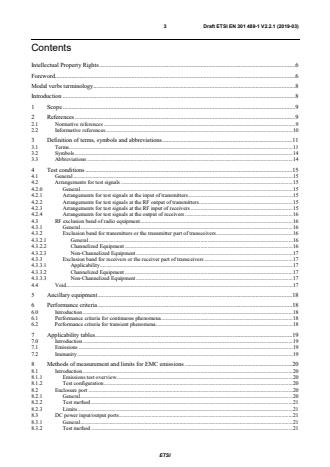
3 Draft ETSI EN 301 489-1 V2.2.1 (2019-03)
Contents
Intellectual Property Rights . 6
Foreword . 6
Modal verbs terminology . 8
Introduction . 8
1 Scope . 9
2 References . 9
2.1 Normative references . 9
2.2 Informative references . 10
3 Definition of terms, symbols and abbreviations . 11
3.1 Terms . 11
3.2 Symbols . 14
3.3 Abbreviations . 14
4 Test conditions . 15
4.1 General . 15
4.2 Arrangements for test signals . 15
4.2.0 General . 15
4.2.1 Arrangements for test signals at the input of transmitters . 15
4.2.2 Arrangements for test signals at the RF output of transmitters . 15
4.2.3 Arrangements for test signals at the RF input of receivers . 15
4.2.4 Arrangements for test signals at the output of receivers . 16
4.3 RF exclusion band of radio equipment . 16
4.3.1 General . 16
4.3.2 Exclusion band for transmitters or the transmitter part of transceivers. 16
4.3.2.1 General . 16
4.3.2.2 Channelized Equipment . 16
4.3.2.3 Non-Channelized Equipment . 17
4.3.3 Exclusion band for receivers or the receiver part of transceivers . 17
4.3.3.1 Applicability. 17
4.3.3.2 Channelized Equipment . 17
4.3.3.3 Non-Channelized Equipment . 17
4.4 Void . 17
5 Ancillary equipment . 18
6 Performance criteria . 18
6.0 Introduction . 18
6.1 Performance criteria for continuous phenomena . 18
6.2 Performance criteria for transient phenomena . 18
7 Applicability tables. 19
7.0 Introduction . 19
7.1 Emissions . 19
7.2 Immunity . 19
8 Methods of measurement and limits for EMC emissions . 20
8.1 Introduction . 20
8.1.1 Emissions test overview . 20
8.1.2 Test configuration . 20
8.2 Enclosure port . 20
8.2.1 General . 20
8.2.2 Test method . 21
8.2.3 Limits . 21
8.3 DC power input/output ports . 21
8.3.1 General . 21
8.3.2 Test method . 21
ETSI
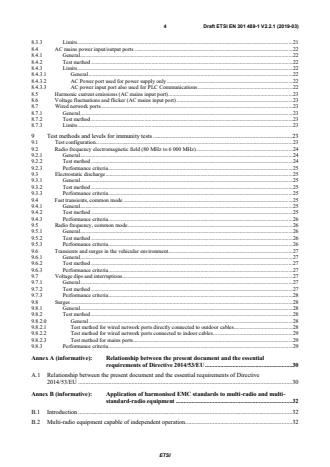
4 Draft ETSI EN 301 489-1 V2.2.1 (2019-03)
8.3.3 Limits . 21
8.4 AC mains power input/output ports . 22
8.4.1 General . 22
8.4.2 Test method . 22
8.4.3 Limits . 22
8.4.3.1 General . 22
8.4.3.2 AC Power port used for power supply only . 22
8.4.3.3 AC power input port also used for PLC Communications . 22
8.5 Harmonic current emissions (AC mains input port) . 23
8.6 Voltage fluctuations and flicker (AC mains input port) . 23
8.7 Wired network ports . 23
8.7.1 General . 23
8.7.2 Test method . 23
8.7.3 Limits . 23
9 Test methods and levels for immunity tests . 23
9.1 Test configuration. 23
9.2 Radio frequency electromagnetic field (80 MHz to 6 000 MHz) . 24
9.2.1 General . 24
9.2.2 Test method . 24
9.2.3 Performance criteria . 25
9.3 Electrostatic discharge . 25
9.3.1 General . 25
9.3.2 Test method . 25
9.3.3 Performance criteria . 25
9.4 Fast transients, common mode . 25
9.4.1 General . 25
9.4.2 Test method . 25
9.4.3 Performance criteria . 26
9.5 Radio frequency, common mode . 26
9.5.1 General . 26
9.5.2 Test method . 26
9.5.3 Performance criteria . 26
9.6 Transients and surges in the vehicular environment . 27
9.6.1 General . 27
9.6.2 Test method . 27
9.6.3 Performance criteria . 27
9.7 Voltage dips and interruptions . 27
9.7.1 General . 27
9.7.2 Test method . 27
9.7.3 Performance criteria . 28
9.8 Surges . 28
9.8.1 General . 28
9.8.2 Test method . 28
9.8.2.0 General . 28
9.8.2.1 Test method for wired network ports directly connected to outdoor cables . 28
9.8.2.2 Test method for wired network ports connected to indoor cables . 29
9.8.2.3 Test method for mains ports . 29
9.8.3 Performance criteria . 29
Annex A (informative): Relationship between the present document and the essential
requirements of Directive 2014/53/EU . 30
A.1 Relationship between the present document and the essential requirements of Directive
2014/53/EU . 30
Annex B (informative): Application of harmonised EMC standards to multi-radio and multi-
standard-radio equipment . 32
B.1 Introduction . 32
B.2 Multi-radio equipment capable of independent operation . 32
ETSI
5 Draft ETSI EN 301 489-1 V2.2.1 (2019-03)
B.3 Multi-radio equipment and multi-standard-radio equipment not capable of independent operation . 32
B.4 Multi-radio equipment comprising of numerous identical radio transmitters . 32
Annex C (informative): Information required by the test laboratory . 33
C.1 Information to be supplied . 33
Annex D (informative): Bibliography . 34
Annex E (informative): Change history . 35
History . 36
ETSI
6 Draft ETSI EN 301 489-1 V2.2.1 (2019-03)
Intellectual Property Rights
Essential patents
IPRs essential or potentially essential to normative deliverables may have been declared to ETSI. The information
pertaining to these essential IPRs, if any, is publicly available for ETSI members and non-members, and can be found
in ETSI SR 000 314: "Intellectual Property Rights (IPRs); Essential, or potentially Essential, IPRs notified to ETSI in
respect of ETSI standards", which is available from the ETSI Secretariat. Latest updates are available on the ETSI Web
server (https://ipr.etsi.org/).
Pursuant to the ETSI IPR Policy, no investigation, including IPR searches, has been carried out by ETSI. No guarantee
can be given as to the existence of other IPRs not referenced in ETSI SR 000 314 (or the updates on the ETSI Web
server) which are, or may be, or may become, essential to the present document.
Trademarks
The present document may include trademarks and/or tradenames which are asserted and/or registered by their owners.
ETSI claims no ownership of these except for any which are indicated as being the property of ETSI, and conveys no
right to use or reproduce any trademark and/or tradename. Mention of those trademarks in the present document does
not constitute an endorsement by ETSI of products, services or organizations associated with those trademarks.
Foreword
This draft Harmonised European Standard (EN) has been produced by ETSI Technical Committee Electromagnetic
compatibility and Radio spectrum Matters (ERM), and is now submitted for the combined Public Enquiry and Vote
phase of the ETSI standards EN Approval Procedure.
The present document has been prepared under the Commission's standardisation request C(2015) 5376 final [i.16] to
provide one voluntary means of conforming to the essential requirements of Directive 2014/53/EU on the harmonisation
of the laws of the Member States relating to the making available on the market of radio equipment and repealing
Directive 1999/5/EC [i.1].
Once the present document is cited in the Official Journal of the European Union under the Directives, compliance with
the normative clauses of the present document given in table A.1 confers, within the limits of the scope of the present
document, a presumption of conformity with the corresponding essential requirements of the corresponding Directives
and associated EFTA regulations.
The present document is part 1 of a multi-part EMC standard for radio equipment which is structured in the following
way:
• All common technical requirements for EMC emission and immunity have been placed in the common part,
which is the present document.
• Separate parts have been developed to cover specific product related radio equipment test conditions, test
arrangements, performance assessment, performance criteria, etc.
• A clause is included in each of the specific radio parts, entitled "special conditions", which is used as
appropriate to cover any deviations or additions to the common requirements set out in the present document.
The present document is part 1 of a multi-part deliverable covering ElectroMagnetic Compatibility (EMC) standard for
radio equipment and services, as identified below:
Part 1: "Common technical requirements;
Part 2: "Specific conditions for radio paging equipment";
Part 3: "Specific conditions for Short-Range Devices (SRD) operating on frequencies between 9 kHz and
246 GHz";
Part 4: "Specific conditions for fixed radio links and ancillary equipment";
ETSI
7 Draft ETSI EN 301 489-1 V2.2.1 (2019-03)
Part 5: "Specific conditions for Private land Mobile Radio (PMR) and ancillary equipment (speech and
non-speech) and Terrestrial Trunked Radio (TETRA)";
Part 6: "Specific conditions for Digital Enhanced Cordless Telecommunications (DECT) equipment";
Part 9: "Specific conditions for wireless microphones, similar Radio Frequency (RF) audio link equipment,
cordless audio and in-ear monitoring devices";
Part 12: "Specific conditions for Very Small Aperture Terminal, Satellite Interactive Earth Stations operated in the
frequency ranges between 4 GHz and 30 GHz in the Fixed Satellite Service (FSS)";
Part 13: "Specific conditions for Citizens' Band (CB) radio and ancillary equipment (speech and non-speech)";
Part 15: "Specific conditions for commercially available amateur radio equipment";
Part 17: "Specific conditions for Broadband Data Transmission Systems";
Part 19: "Specific conditions for Receive Only Mobile Earth Stations (ROMES) operating in the 1,5 GHz band
providing data communications and GNSS receivers operating in the RNSS band (ROGNSS) providing
positioning, navigation, and timing data";
Part 20: "Specific conditions for Mobile Earth Stations (MES) used in the Mobile Satellite Services (MSS)";
Part 22: "Specific conditions for ground based VHF aeronautical mobile and fixed radio equipment";
Part 27: "Specific conditions for Ultra Low Power Active Medical Implants (ULP-AMI) and related peripheral
devices (ULP-AMI-P) operating in the 402 MHz to 405 MHz bands";
Part 28: "Specific conditions for wireless digital video links";
Part 29: "Specific conditions for Medical Data Service Devices (MEDS) operating in the 401 MHz to 402 MHz
and 405 MHz to 406 MHz bands";
Part 31: "Specific conditions for equipment in the 9 kHz to 315 kHz band for Ultra Low Power Active Medical
Implants (ULP-AMI) and related peripheral devices (ULP-AMI-P)";
Part 33: "Specific conditions for Ultra Wide Band (UWB) devices";
Part 34: "Specific conditions for External Power Supply (EPS) for mobile phones";
Part 35: "Specific requirements for Low Power Active Medical Implants (LP-AMI) operating in the 2 483,5 MHz
to 2 500 MHz bands";
Part 50: "Specific conditions for Cellular Communication Base Station (BS), repeater and ancillary equipment";
Part 51: "Specific conditions for Automotive, Ground based Vehicles and Surveillance Radar Devices using
24,05 GHz to 24,25 GHz, 24,05 GHz to 24,5 GHz, 76 GHz to 77 GHz and 77 GHz to 81 GHz";
Part 52: "Specific conditions for Cellular Communication Mobile and portable radio and ancillary equipment";
Part 53: "Specific conditions for terrestrial sound broadcasting and digital TV broadcasting service transmitters
and associated ancillary equipment";
Part 54: "Specific conditions for ground based aeronautical and meteorological radars".
NOTE: Parts 7, 8, 10, 11, 14, 16, 18, 23, 24, 25, 26 and 32 of this multi-part deliverable have been removed from
this listing as they do not cover the new Directive in force, Directive 2014/53/EU [i.1] and Directive
2014/30/EU [i.2].
ETSI
8 Draft ETSI EN 301 489-1 V2.2.1 (2019-03)
Proposed national transposition dates
Date of latest announcement of this EN (doa): 3 months after ETSI publication
Date of latest publication of new National Standard
or endorsement of this EN (dop/e): 6 months after doa
Date of withdrawal of any conflicting National Standard (dow): 18 months after doa
Modal verbs terminology
In the present document "shall", "shall not", "should", "should not", "may", "need not", "will", "will not", "can" and
"cannot" are to be interpreted as described in clause 3.2 of the ETSI Drafting Rules (Verbal forms for the expression of
provisions).
"must" and "must not" are NOT allowed in ETSI deliverables except when used in direct citation.
Introduction
Product dependent arrangements necessary to perform the EMC tests on dedicated types of radio communications
equipment, and the assessment of test results, are detailed in the appropriate relevant radio technology parts of ETSI
EN 301 489 series [i.13] details of which can be found in annex C of the present document.
The environment classification used in the present document refers to the environment classification used in:
• CENELEC EN 61000-6-3 [i.4] and CENELEC EN 61000-6-1 [i.5] for the residential, commercial and light
industrial environment; or
• CENELEC EN 61000-6-2 [i.15] and CENELEC EN 61000-6-4 [i.14] for the industrial environment; or
• ETSI TR 101 651 [i.6] for the telecommunication centre environment; or
• ISO 7637-2 [8] for the vehicular environment.
The immunity requirements within the present document are derived from the generic immunity standard for the
residential, commercial and light industrial environment.
When it is required to evaluate the EMC performance of "combined radio and non-radio equipment", ETSI
EG 203 367 [i.3] provides guidance upon the application of the various harmonised standards, including the present
document, that could potentially apply to such equipment.
ETSI
9 Draft ETSI EN 301 489-1 V2.2.1 (2019-03)
1 Scope
The present document specifies methods of measurements and technical characteristics for radio equipment and
associated ancillary equipment, excluding broadcast receivers, in respect of ElectroMagnetic Compatibility (EMC).
Technical specifications related to the antenna port of radio equipment and radiated emissions from the enclosure port
of radio equipment and combinations of radio and associated ancillary equipment are not included in the present
document. Such technical specifications are normally found in the relevant product standards for the effective use of the
radio spectrum.
NOTE 1: The relationship between the present document and essential requirements of article 3.1(b) of Directive
2014/53/EU [i.1] given in annex A.
NOTE 2: Other standards may apply in place of the present document, e.g. product specific standards in the ETSI
EN 301 489 [i.13] series.
2 References
2.1 Normative references
References are specific, identified by date of publication and/or edition number or version number. Only the cited
version applies.
Referenced documents which are not found to be publicly available in the expected location might be found at
https://docbox.etsi.org/Reference/.
NOTE: While any hyperlinks included in this clause were valid at the time of publication, ETSI cannot guarantee
their long term validity.
The following referenced documents are necessary for the application of the present document.
[1] CENELEC EN 55032 (2015): "Electromagnetic compatibility of multimedia equipment -
Emission Requirements".
[2] CENELEC EN 61000-4-2 (2009): "Electromagnetic compatibility (EMC) - Part 4-2: Testing and
measurement techniques - Electrostatic discharge immunity test".
[3] CENELEC EN 61000-4-3 (2006), A1 (2008) and A2 (2010): "Electromagnetic compatibility
(EMC) - Part 4-3: Testing and measurement techniques - Radiated, radio-frequency,
electromagnetic field immunity test".
[4] CENELEC EN 61000-4-4 (2012): "Electromagnetic compatibility (EMC) - Part 4-4: Testing and
measurement techniques - Electrical fast transient/burst immunity test".
[5] CENELEC EN 61000-4-5 (2014): + A1(2017): "Electromagnetic compatibility (EMC) -
Part 4-5: Testing and measurement techniques - Surge immunity test".
[6] CENELEC EN 61000-4-6 (2014): "Electromagnetic compatibility (EMC) - Part 4-6: Testing and
measurement techniques - Immunity to conducted disturbances, induced by radio-frequency
fields".
[7] CENELEC EN 61000-4-11 (2004): "Electromagnetic compatibility (EMC) - Part 4-11: Testing
and measurement techniques - Voltage dips, short interruptions and voltage variations immunity
tests".
[8] ISO 7637-2 (2004): "Road vehicles - Electrical disturbances from conduction and coupling -
Part 2: Electrical transient conduction along supply lines only".
ETSI
10 Draft ETSI EN 301 489-1 V2.2.1 (2019-03)
[9] CENELEC EN 61000-3-3 (2013): "Electromagnetic compatibility (EMC) - Part 3-3: Limits -
Limitation of voltage changes, voltage fluctuations and flicker in public low-voltage supply
systems, for equipment with rated current ≤ 16 A per phase and not subject to conditional
connection".
[10] CISPR 25 (2nd Edition 2002) and COR1 (2004): "Radio disturbance characteristics for the
protection of receivers used on board vehicles, boats, and on devices - Limits and methods of
measurement".
NOTE: The dated reference of CISPR 25 has not been updated to the latest version in order to maintain alignment
with the requirements of UNECE Reg 10.
[11] CENELEC EN 61000-3-12 (2011): "Electromagnetic compatibility (EMC) - Part 3-12: Limits -
Limits for harmonic currents produced by equipment connected to public low-voltage systems
with input current > 16 A and ≤ 75 A per phase".
[12] CENELEC EN 61000-3-11 (2000): "Electromagnetic compatibility (EMC) - Part 3-11: Limits -
Limitation of voltage changes, voltage fluctuations and flicker in public low-voltage supply
systems - Equipment with rated current ≤ 75 A and subject to conditional connection".
[13] CENELEC EN 50561-3 (2016): "Power line communication apparatus used in low-voltage
installations - Radio disturbance characteristics - Limits and methods of measurement -
Part 3: Apparatus operating above 30 MHz".
[14] CENELEC EN 50561-1 (2013): "Power line communication apparatus used in low-voltage
installations - Radio disturbance characteristics - Limits and methods of measurement -
Part 1: Apparatus for in-home use".
[15] CENELEC EN 61000-3-2 (2014): "Electromagnetic compatibility (EMC) - Part 3-2: Limits -
Limits for harmonic current emissions (equipment input current ≤ 16 A per phase)".
[16] CENELEC EN 61000-4-34 (2007), A1 (2009): "Electromagnetic compatibility (EMC) -
Part 4-34: Testing and measurement techniques - Voltage dips, short interruptions and voltage
variations immunity tests for equipment with mains current more than 16 A per phase".
2.2 Informative references
References are either specific (identified by date of publication and/or edition number or version number) or
non-specific. For specific references, only the cited version applies. For non-specific references, the latest version of the
referenced document (including any amendments) applies.
NOTE: While any hyperlinks included in this clause were valid at the time of publication, ETSI cannot guarantee
their long term validity.
The following referenced documents are not necessary for the application of the present document but they assist the
user with regard to a particular subject area.
[i.1] Directive 2014/53/EU of the European Parliament and of the council of 16 April 2014 on the
harmonisation of the laws of the Member States relating to the making available on the market of
radio equipment and repealing Directive 1999/5/EC.
[i.2] Directive 2014/30/EU of the European Parliament and of the Council of 26 February 2014 on the
harmonisation of the laws of the Member States relating to electromagnetic compatibility (recast).
[i.3] ETSI EG 203 367: "Guide to the application of harmonised standards covering articles 3.1b and
3.2 of the Directive 2014/53/EU (RED) to multi-radio and combined radio and non-radio
equipment".
[i.4] CENELEC EN 61000-6-3 (2007) + A1(2011): "Electromagnetic compatibility (EMC) -
Part 6-3: Generic standards - Emission standard for residential, commercial and light-industrial
environments".
[i.5] CENELEC EN 61000-6-1 (2007): "Electromagnetic compatibility (EMC) - Part 6-1: Generic
standards - Immunity for residential, commercial and light-industrial environments".
ETSI
11 Draft ETSI EN 301 489-1 V2.2.1 (2019-03)
[i.6] ETSI TR 101 651 (V2.1.1): "Classification of the electromagnetic environment conditions for
equipment in telecommunication networks".
[i.7] IEC 60050-161: "International Electrotechnical Vocabulary. Chapter 161: Electromagnetic
compatibility".
[i.8] ITU Radio Regulations (Article 1, Section VI) definition 1.153.
[i.9] Void.
[i.10] Void.
[i.11] Void.
[i.12] Void.
[i.13] ETSI EN 301 489 series: "ElectroMagnetic Compatibility (EMC) standard for radio equipment
and services".
[i.14] CENELEC EN 61000-6-4 (2007) + A1 (2011): "Electromagnetic compatibility (EMC) -
Part 6-4: Generic standards - Emission standard for industrial environments".
[i.15] CENELEC EN 61000-6-2 (2005): "Electromagnetic compatibility (EMC) - Part 6-2: Generic
standards - Immunity for industrial environments".
[i.16] Commission Implementing Decision C(2015) 5376 final of 4.8.2015 on a standardisation request
to the European Committee for Electrotechnical Standardisation and to the European
Telecommunications Standards Institute as regards radio equipment in support of Directive
2014/53/EU of the European Parliament and of the Council.
[i.17] Void.
3 Definition of terms, symbols and abbreviations
3.1 Terms
For the purposes of the present document, the following terms apply:
ancillary equipment: electrical or electronic equipment, that is intended to be used with a receiver or transmitter
NOTE: It is considered as an ancillary equipment if:
the equipment is intended for use with a receiver or transmitter to provide additional operational
and/or control features to the radio equipment, (e.g. to extend control to another position or
location); and
the ancillary equipment cannot be used without being connected to radio equipment to provide user
functions independently of a receiver or transmitter; and
the receiver or transmitter, to which it is connected, is capable of providing some intended
operation such as transmitting and/or receiving without the ancillary equipment (i.e. it is not a
sub-unit of the main equipment essential to the main equipment basic functions);
an example of ancillary equipment would be a docking station for radio equipment whose interface
is dedicated to a particular product or range of products.
antenna port: port, for connection of an antenna used for intentional transmission and/or reception of radiated RF
energy
associated equipment: equipment needed to exercise and/or monitor the operation of the EUT
base station: radio equipment intended for operation at a fixed location which is not defined as portable equipment
ETSI
12 Draft ETSI EN 301 489-1 V2.2.1 (2019-03)
broadcast receivers: equipment containing a tuner that is intended for the reception of broadcast services
NOTE: These broadcast services are typically television and radio, including terrestrial broadcast and satellite
broadcast.
conditional connection: connection of equipment which requires the user's supply at the interface point to have an
impedance lower than the reference impedance Zref in order that the equipment emissions comply with the limits in
CENELEC EN 61000-3-11 [12]
NOTE: Meeting the voltage change limits is not the only condition for connection; emission limits for other
phenomena such as harmonics, may also have to be satisfied.
continuous phenomena (continuous disturbance): electromagnetic disturbance, the effects of which on a particular
device or equipment cannot be resolved into a succession of distinct effects
NOTE: See IEC 60050-161 [i.7].
Electrical/Electronic Sub-Assembly (ESA): electrical and/or electronic device or set(s) of devices intended to be part
of a vehicle, together with any associated electrical connections and wiring, which performs one or more specialized
functions
enclosure port: physical boundary of the equipment through which electromagnetic fields may radiate or impinge
NOTE: In the case of integral antenna equipment, this port is inseparable from the antenna port.
exclusion band: frequency range(s) not subject to test or assessment
fixed-use: use of equipment either in a fixed location permanently or connected to an ac mains adaptor on a temporary
basis
integral antenna: antenna designed for permanent connection to the equipment and considered part of the enclosure
port
NOTE: An integral antenna may be fitted internally or externally.
manufacturer: any natural or legal person who manufactures radio equipment or has radio equipment designed or
manufactured, and markets that equipment under his name or trade mark
multi-radio equipment: radio equipment containing two or more radio transmitters and/or receivers using different
technologies that may operate simultaneously
Radio Radio unit
digital unit
Standard 1
Standard 1
Communication ports Antenna ports
Radio Radio unit
digital unit
Standard 2
Standard 2
Figure 1: Multi-radio equipment
multi-standard-radio: radio equipment with ability of its receiver and transmitter to process two or more carriers in
common active RF components simultaneously in a declared RF bandwidth, where at least one carrier is of a different
radio access technology than the other carrier(s)
ETSI
13 Draft ETSI EN 301 489-1 V2.2.1 (2019-03)
Radio
digital unit
Standard 1
Communication port(s) Antenna port
Radio unit
Standard 1+2
Radio
digital unit
Standard 2
Figure 2: Multi-standard-radio equipment
occupied bandwidth: width of a frequency band such that, below the lower and above the upper frequency limits, the
mean powers emitted are each equal to a specified percentage β/2 of the total mean power of a given emission; unless
β/2 should be taken
otherwise specified in a Recommendation ITU-R for the appropriate class of emission, the value of
as 0,5 % [i.8]
operating frequency band(s): range(s) of radio frequencies covered by the Equipment Under Test (EUT) without any
change of units
port: particular interface, of the specified equipment , with the electromagnetic environment
NOTE 1: For example, any connection point on an equipment intended for connection of cables to or from that
equipment is considered as a port (see figure 3).
Enclosure port
Antenna port
AC power port
Signal/control port
DC power port
EQUIPMENT
Earth port Wired Network port
Figure 3: Examples of ports
NOTE 2: An interface, which uses optical fibre, is not a port for the purposes of testing because it does not interact
with the electromagnetic environment within the frequency range, which is applicable for the present
document. An optical fibre interface may still be used in the assessment of performance.
NOTE 3: In the case of integral antenna equipment the antenna port is the same as the enclosure port.
portable equipment: radio equipment intended for portable use and powered by integral batteries or battery
NOTE: Devices will typically be handheld.
portable-use: use of equipment in a temporary location and not connected to an external power adaptor
radio equipment: "An electrical or electronic product, which intentionally emits and/or receives radio waves for the
purpose of radio communication and/or radio determination, or an electrical or electronic product which must be
completed with an accessory, such as antenna, so as to intentionally emit and/or receive radio waves for the purpose of
radio communication and/or radio determination", definition from Directive 2014/53/EU [i.1].
NOTE: It can be operated with ancillary equipment but if so, is not dependent on it for basic functionality.
removable antenna: antenna which may be removed for the test
signal port: port intended for the interconnection of components of an EUT, or between an EUT and AE and used in
accordance with relevant functional specifications (for example for the maximum length of cable connected to it)
ETSI
14 Draft ETSI EN 301 489-1 V2.2.1 (2019-03)
transient phenomena (transient disturbance): pertaining to or designating a phenomena or a quantity which varies
between two consecutive steady states during a time interval short compared with the time-scale of interest
NOTE: See IEC 60050-161 [i.7].
vehicle use: radio equipment intended for installation and use in a vehicle, and powered by the main battery of the
vehicle
wired network port: point of connection for voice, data and signalling transfers intended to interconnect widely
dispersed systems by direct connection to a single-user or multi-user commu
...
Final draft ETSI EN 301 489-1 V2.2.2 (2019-09)
HARMONISED EUROPEAN STANDARD
ElectroMagnetic Compatibility (EMC)
standard for radio equipment and services;
Part 1: Common technical requirements;
Harmonised Standard for ElectroMagnetic Compatibility
2 Final draft ETSI EN 301 489-1 V2.2.2 (2019-09)
Reference
REN/ERM-EMC-368
Keywords
EMC, harmonised standard, radio
ETSI
650 Route des Lucioles
F-06921 Sophia Antipolis Cedex - FRANCE
Tel.: +33 4 92 94 42 00 Fax: +33 4 93 65 47 16
Siret N° 348 623 562 00017 - NAF 742 C
Association à but non lucratif enregistrée à la
Sous-Préfecture de Grasse (06) N° 7803/88
Important notice
The present document can be downloaded from:
http://www.etsi.org/standards-search
The present document may be made available in electronic versions and/or in print. The content of any electronic and/or
print versions of the present document shall not be modified without the prior written authorization of ETSI. In case of any
existing or perceived difference in contents between such versions and/or in print, the prevailing version of an ETSI
deliverable is the one made publicly available in PDF format at www.etsi.org/deliver.
Users of the present document should be aware that the document may be subject to revision or change of status.
Information on the current status of this and other ETSI documents is available at
https://portal.etsi.org/TB/ETSIDeliverableStatus.aspx
If you find errors in the present document, please send your comment to one of the following services:
https://portal.etsi.org/People/CommiteeSupportStaff.aspx
Copyright Notification
No part may be reproduced or utilized in any form or by any means, electronic or mechanical, including photocopying
and microfilm except as authorized by written permission of ETSI.
The content of the PDF version shall not be modified without the written authorization of ETSI.
The copyright and the foregoing restriction extend to reproduction in all media.
© ETSI 2019.
All rights reserved.
DECT™, PLUGTESTS™, UMTS™ and the ETSI logo are trademarks of ETSI registered for the benefit of its Members.
3GPP™ and LTE™ are trademarks of ETSI registered for the benefit of its Members and
of the 3GPP Organizational Partners.
oneM2M™ logo is a trademark of ETSI registered for the benefit of its Members and
of the oneM2M Partners. ®
GSM and the GSM logo are trademarks registered and owned by the GSM Association.
ETSI
3 Final draft ETSI EN 301 489-1 V2.2.2 (2019-09)
Contents
Intellectual Property Rights . 6
Foreword . 6
Modal verbs terminology . 8
Introduction . 8
1 Scope . 9
2 References . 9
2.1 Normative references . 9
2.2 Informative references . 10
3 Definition of terms, symbols and abbreviations . 11
3.1 Terms . 11
3.2 Symbols . 14
3.3 Abbreviations . 14
4 Test conditions . 15
4.1 General . 15
4.2 Arrangements for test signals . 15
4.2.0 General . 15
4.2.1 Arrangements for test signals at the input of transmitters . 15
4.2.2 Arrangements for test signals at the RF output of transmitters . 15
4.2.3 Arrangements for test signals at the RF input of receivers . 15
4.2.4 Arrangements for test signals at the output of receivers . 16
4.3 RF exclusion band of radio equipment . 16
4.3.1 General . 16
4.3.2 Exclusion band for transmitters or the transmitter part of transceivers. 16
4.3.2.1 General . 16
4.3.2.2 Channelized Equipment . 16
4.3.2.3 Non-Channelized Equipment . 17
4.3.3 Exclusion band for receivers or the receiver part of transceivers . 17
4.3.3.1 Applicability. 17
4.3.3.2 Channelized Equipment . 17
4.3.3.3 Non-Channelized Equipment . 17
4.4 Void . 17
5 Ancillary equipment . 18
6 Performance criteria . 18
6.0 Introduction . 18
6.1 Performance criteria for continuous phenomena . 18
6.2 Performance criteria for transient phenomena . 18
7 Applicability tables. 19
7.0 Introduction . 19
7.1 Emissions . 19
7.2 Immunity . 19
8 Methods of measurement and limits for EMC emissions . 20
8.1 Introduction . 20
8.1.1 Emissions test overview . 20
8.1.2 Test configuration . 20
8.2 Enclosure port . 20
8.2.1 General . 20
8.2.2 Test method . 21
8.2.3 Limits . 21
8.3 DC power input/output ports . 21
8.3.1 General . 21
8.3.2 Test method . 21
ETSI
4 Final draft ETSI EN 301 489-1 V2.2.2 (2019-09)
8.3.3 Limits . 21
8.4 AC mains power input/output ports . 22
8.4.1 General . 22
8.4.2 Test method . 22
8.4.3 Limits . 22
8.4.3.1 General . 22
8.4.3.2 AC Power port used for power supply only . 22
8.4.3.3 AC power input port also used for in home PLC Communications . 22
8.5 Harmonic current emissions (AC mains input port) . 23
8.6 Voltage fluctuations and flicker (AC mains input port) . 23
8.7 Wired network ports . 23
8.7.1 General . 23
8.7.2 Test method . 23
8.7.3 Limits . 23
9 Test methods and levels for immunity tests . 23
9.1 Test configuration. 23
9.2 Radio frequency electromagnetic field (80 MHz to 6 000 MHz) . 24
9.2.1 General . 24
9.2.2 Test method . 24
9.2.3 Performance criteria . 25
9.3 Electrostatic discharge . 25
9.3.1 General . 25
9.3.2 Test method . 25
9.3.3 Performance criteria . 25
9.4 Fast transients, common mode . 25
9.4.1 General . 25
9.4.2 Test method . 25
9.4.3 Performance criteria . 26
9.5 Radio frequency, common mode . 26
9.5.1 General . 26
9.5.2 Test method . 26
9.5.3 Performance criteria . 26
9.6 Transients and surges in the vehicular environment . 27
9.6.1 General . 27
9.6.2 Test method . 27
9.6.3 Performance criteria . 27
9.7 Voltage dips and interruptions . 27
9.7.1 General . 27
9.7.2 Test method . 27
9.7.3 Performance criteria . 28
9.8 Surges . 28
9.8.1 General . 28
9.8.2 Test method . 28
9.8.2.0 General . 28
9.8.2.1 Test method for wired network ports directly connected to outdoor cables . 28
9.8.2.2 Test method for wired network ports connected to indoor cables . 29
9.8.2.3 Test method for mains ports . 29
9.8.3 Performance criteria . 29
Annex A (informative): Relationship between the present document and the essential
requirements of Directive 2014/53/EU . 30
Annex B (informative): Application of harmonised EMC standards to multi-radio and multi-
standard-radio equipment . 32
B.1 Introduction . 32
B.2 Multi-radio equipment capable of independent operation . 32
B.3 Multi-radio equipment and multi-standard-radio equipment not capable of independent operation . 32
B.4 Multi-radio equipment comprising of numerous identical radio transmitters . 32
ETSI
5 Final draft ETSI EN 301 489-1 V2.2.2 (2019-09)
Annex C (informative): Information required by the test laboratory . 33
C.1 Information to be supplied . 33
Annex D (informative): Bibliography . 34
Annex E (informative): Change history . 35
History . 36
ETSI
6 Final draft ETSI EN 301 489-1 V2.2.2 (2019-09)
Intellectual Property Rights
Essential patents
IPRs essential or potentially essential to normative deliverables may have been declared to ETSI. The information
pertaining to these essential IPRs, if any, is publicly available for ETSI members and non-members, and can be found
in ETSI SR 000 314: "Intellectual Property Rights (IPRs); Essential, or potentially Essential, IPRs notified to ETSI in
respect of ETSI standards", which is available from the ETSI Secretariat. Latest updates are available on the ETSI Web
server (https://ipr.etsi.org/).
Pursuant to the ETSI IPR Policy, no investigation, including IPR searches, has been carried out by ETSI. No guarantee
can be given as to the existence of other IPRs not referenced in ETSI SR 000 314 (or the updates on the ETSI Web
server) which are, or may be, or may become, essential to the present document.
Trademarks
The present document may include trademarks and/or tradenames which are asserted and/or registered by their owners.
ETSI claims no ownership of these except for any which are indicated as being the property of ETSI, and conveys no
right to use or reproduce any trademark and/or tradename. Mention of those trademarks in the present document does
not constitute an endorsement by ETSI of products, services or organizations associated with those trademarks.
Foreword
This final draft Harmonised European Standard (EN) has been produced by ETSI Technical Committee
Electromagnetic compatibility and Radio spectrum Matters (ERM), and is now submitted for the Vote phase of the
ETSI standards EN Approval Procedure.
The present document has been prepared under the Commission's standardisation request C(2015) 5376 final [i.16] to
provide one voluntary means of conforming to the essential requirements of Directive 2014/53/EU on the harmonisation
of the laws of the Member States relating to the making available on the market of radio equipment and repealing
Directive 1999/5/EC [i.1].
Once the present document is cited in the Official Journal of the European Union under that Directive, compliance with
the normative clauses of the present document given in table A.1 confers, within the limits of the scope of the present
document, a presumption of conformity with the corresponding essential requirements of that Directive and associated
EFTA regulations.
The present document is part 1 of a multi-part EMC standard for radio equipment which is structured in the following
way:
• All common technical requirements for EMC emission and immunity have been placed in the common part,
which is the present document.
• Separate parts have been developed to cover specific product related radio equipment test conditions, test
arrangements, performance assessment, performance criteria, etc.
• A clause is included in each of the specific radio parts, entitled "special conditions", which is used as
appropriate to cover any deviations or additions to the common requirements set out in the present document.
The present document is part 1 of a multi-part deliverable covering ElectroMagnetic Compatibility (EMC) standard for
radio equipment and services, as identified below:
Part 1: "Common technical requirements";
Part 2: "Specific conditions for radio paging equipment";
Part 3: "Specific conditions for Short-Range Devices (SRD) operating on frequencies between 9 kHz and
246 GHz";
Part 4: "Specific conditions for fixed radio links and ancillary equipment";
ETSI
7 Final draft ETSI EN 301 489-1 V2.2.2 (2019-09)
Part 5: "Specific conditions for Private land Mobile Radio (PMR) and ancillary equipment (speech and
non-speech) and Terrestrial Trunked Radio (TETRA)";
Part 6: "Specific conditions for Digital Enhanced Cordless Telecommunications (DECT) equipment";
Part 9: "Specific conditions for wireless microphones, similar Radio Frequency (RF) audio link equipment,
cordless audio and in-ear monitoring devices";
Part 12: "Specific conditions for Very Small Aperture Terminal, Satellite Interactive Earth Stations operated in the
frequency ranges between 4 GHz and 30 GHz in the Fixed Satellite Service (FSS)";
Part 13: "Specific conditions for Citizens' Band (CB) radio and ancillary equipment (speech and non-speech)";
Part 15: "Specific conditions for commercially available amateur radio equipment";
Part 17: "Specific conditions for Broadband Data Transmission Systems";
Part 19: "Specific conditions for Receive Only Mobile Earth Stations (ROMES) operating in the 1,5 GHz band
providing data communications and GNSS receivers operating in the RNSS band (ROGNSS) providing
positioning, navigation, and timing data";
Part 20: "Specific conditions for Mobile Earth Stations (MES) used in the Mobile Satellite Services (MSS)";
Part 22: "Specific conditions for ground based VHF aeronautical mobile and fixed radio equipment";
Part 27: "Specific conditions for Ultra Low Power Active Medical Implants (ULP-AMI) and related peripheral
devices (ULP-AMI-P) operating in the 402 MHz to 405 MHz bands";
Part 28: "Specific conditions for wireless digital video links";
Part 29: "Specific conditions for Medical Data Service Devices (MEDS) operating in the 401 MHz to 402 MHz
and 405 MHz to 406 MHz bands";
Part 31: "Specific conditions for equipment in the 9 kHz to 315 kHz band for Ultra Low Power Active Medical
Implants (ULP-AMI) and related peripheral devices (ULP-AMI-P)";
Part 33: "Specific conditions for Ultra-WideBand (UWB) devices";
Part 34: "Specific conditions for External Power Supply (EPS) for mobile phones";
Part 35: "Specific requirements for Low Power Active Medical Implants (LP-AMI) operating in the 2 483,5 MHz
to 2 500 MHz bands";
Part 50: "Specific conditions for Cellular Communication Base Station (BS), repeater and ancillary equipment";
Part 51: "Specific conditions for Automotive, Ground based Vehicles and Surveillance Radar Devices using
24,05 GHz to 24,25 GHz, 24,05 GHz to 24,5 GHz, 76 GHz to 77 GHz and 77 GHz to 81 GHz";
Part 52: "Specific conditions for Cellular Communication Mobile and portable radio and ancillary equipment";
Part 53: "Specific conditions for terrestrial sound broadcasting and digital TV broadcasting service transmitters
and associated ancillary equipment";
Part 54: "Specific conditions for ground based aeronautical and meteorological radars".
NOTE: Parts 7, 8, 10, 11, 14, 16, 18, 23, 24, 25, 26 and 32 of this multi-part deliverable have been removed from
this listing as they do not cover the new Directives in force, Directive 2014/53/EU [i.1] and Directive
2014/30/EU [i.2].
ETSI
8 Final draft ETSI EN 301 489-1 V2.2.2 (2019-09)
Proposed national transposition dates
Date of latest announcement of this EN (doa): 3 months after ETSI publication
Date of latest publication of new National Standard
or endorsement of this EN (dop/e): 6 months after doa
Date of withdrawal of any conflicting National Standard (dow): 18 months after doa
Modal verbs terminology
In the present document "shall", "shall not", "should", "should not", "may", "need not", "will", "will not", "can" and
"cannot" are to be interpreted as described in clause 3.2 of the ETSI Drafting Rules (Verbal forms for the expression of
provisions).
"must" and "must not" are NOT allowed in ETSI deliverables except when used in direct citation.
Introduction
Product dependent arrangements necessary to perform the EMC tests on dedicated types of radio communications
equipment, and the assessment of test results, are detailed in the appropriate relevant radio technology parts of ETSI
EN 301 489 series [i.13] details of which can be found in annex C of the present document.
The environment classification used in the present document refers to the environment classification used in:
• CENELEC EN 61000-6-3 [i.4] and CENELEC EN 61000-6-1 [i.5] for the residential, commercial and light
industrial environment; or
• CENELEC EN 61000-6-2 [i.15] and CENELEC EN 61000-6-4 [i.14] for the industrial environment; or
• ETSI TR 101 651 [i.6] for the telecommunication centre environment; or
• ISO 7637-2 [8] for the vehicular environment.
The immunity requirements within the present document are derived from the generic immunity standard for the
residential, commercial and light industrial environment.
When it is required to evaluate the EMC performance of "combined radio and non-radio equipment", ETSI
EG 203 367 [i.3] provides guidance upon the application of the various harmonised standards, including the present
document, that could potentially apply to such equipment.
ETSI
9 Final draft ETSI EN 301 489-1 V2.2.2 (2019-09)
1 Scope
The present document specifies methods of measurements and technical characteristics for radio equipment and
associated ancillary equipment, excluding broadcast receivers, in respect of ElectroMagnetic Compatibility (EMC).
Technical specifications related to the antenna port of radio equipment and radiated emissions from the enclosure port
of radio equipment and combinations of radio and associated ancillary equipment are not included in the present
document. Such technical specifications are normally found in the relevant product standards for the effective use of the
radio spectrum.
NOTE 1: The relationship between the present document and essential requirements of article 3.1(b) of Directive
2014/53/EU [i.1] is given in annex A.
NOTE 2: Other standards may apply in place of the present document, e.g. product specific standards in the ETSI
EN 301 489 [i.13] series.
2 References
2.1 Normative references
References are specific, identified by date of publication and/or edition number or version number. Only the cited
version applies.
Referenced documents which are not found to be publicly available in the expected location might be found at
https://docbox.etsi.org/Reference/.
NOTE: While any hyperlinks included in this clause were valid at the time of publication, ETSI cannot guarantee
their long term validity.
The following referenced documents are necessary for the application of the present document.
[1] CENELEC EN 55032 (2015): "Electromagnetic compatibility of multimedia equipment -
Emission Requirements".
[2] CENELEC EN 61000-4-2 (2009): "Electromagnetic compatibility (EMC) - Part 4-2: Testing and
measurement techniques - Electrostatic discharge immunity test".
[3] CENELEC EN 61000-4-3 (2006), A1 (2008) and A2 (2010): "Electromagnetic compatibility
(EMC) - Part 4-3: Testing and measurement techniques - Radiated, radio-frequency,
electromagnetic field immunity test".
[4] CENELEC EN 61000-4-4 (2012): "Electromagnetic compatibility (EMC) - Part 4-4: Testing and
measurement techniques - Electrical fast transient/burst immunity test".
[5] CENELEC EN 61000-4-5 (2014): + A1 (2017): "Electromagnetic compatibility (EMC) - Part 4-5:
Testing and measurement techniques - Surge immunity test".
[6] CENELEC EN 61000-4-6 (2014): "Electromagnetic compatibility (EMC) - Part 4-6: Testing and
measurement techniques - Immunity to conducted disturbances, induced by radio-frequency
fields".
[7] CENELEC EN 61000-4-11 (2004): "Electromagnetic compatibility (EMC) - Part 4-11: Testing
and measurement techniques - Voltage dips, short interruptions and voltage variations immunity
tests".
[8] ISO 7637-2 (2004): "Road vehicles - Electrical disturbances from conduction and coupling -
Part 2: Electrical transient conduction along supply lines only".
ETSI
10 Final draft ETSI EN 301 489-1 V2.2.2 (2019-09)
[9] CENELEC EN 61000-3-3 (2013): "Electromagnetic compatibility (EMC) - Part 3-3: Limits -
Limitation of voltage changes, voltage fluctuations and flicker in public low-voltage supply
systems, for equipment with rated current ≤ 16 A per phase and not subject to conditional
connection".
nd
[10] CISPR 25 (2 Edition 2002) and COR1 (2004): "Radio disturbance characteristics for the
protection of receivers used on board vehicles, boats, and on devices - Limits and methods of
measurement".
NOTE: The dated reference of CISPR 25 has not been updated to the latest version in order to maintain alignment
with the requirements of UNECE Reg 10 [i.10].
[11] CENELEC EN 61000-3-12 (2011): "Electromagnetic compatibility (EMC) - Part 3-12: Limits -
Limits for harmonic currents produced by equipment connected to public low-voltage systems
with input current > 16 A and ≤ 75 A per phase".
[12] CENELEC EN 61000-3-11 (2000): "Electromagnetic compatibility (EMC) - Part 3-11: Limits -
Limitation of voltage changes, voltage fluctuations and flicker in public low-voltage supply
systems - Equipment with rated current ≤ 75 A and subject to conditional connection".
[13] CENELEC EN 50561-3 (2016): "Power line communication apparatus used in low-voltage
installations - Radio disturbance characteristics - Limits and methods of measurement - Part 3:
Apparatus operating above 30 MHz".
[14] CENELEC EN 50561-1 (2013)/AC (2015): "Power line communication apparatus used in low-
voltage installations - Radio disturbance characteristics - Limits and methods of measurement -
Part 1: Apparatus for in-home use".
[15] CENELEC EN 61000-3-2 (2014): "Electromagnetic compatibility (EMC) - Part 3-2: Limits -
Limits for harmonic current emissions (equipment input current ≤ 16 A per phase)".
[16] CENELEC EN 61000-4-34 (2007), A1 (2009): "Electromagnetic compatibility (EMC) - Part 4-34:
Testing and measurement techniques - Voltage dips, short interruptions and voltage variations
immunity tests for equipment with mains current more than 16 A per phase".
2.2 Informative references
References are either specific (identified by date of publication and/or edition number or version number) or
non-specific. For specific references, only the cited version applies. For non-specific references, the latest version of the
referenced document (including any amendments) applies.
NOTE: While any hyperlinks included in this clause were valid at the time of publication, ETSI cannot guarantee
their long term validity.
The following referenced documents are not necessary for the application of the present document but they assist the
user with regard to a particular subject area.
[i.1] Directive 2014/53/EU of the European Parliament and of the council of 16 April 2014 on the
harmonisation of the laws of the Member States relating to the making available on the market of
radio equipment and repealing Directive 1999/5/EC.
[i.2] Directive 2014/30/EU of the European Parliament and of the Council of 26 February 2014 on the
harmonisation of the laws of the Member States relating to electromagnetic compatibility (recast).
[i.3] ETSI EG 203 367: "Guide to the application of harmonised standards covering articles 3.1b and
3.2 of the Directive 2014/53/EU (RED) to multi-radio and combined radio and non-radio
equipment".
[i.4] CENELEC EN 61000-6-3 (2007) + A1(2011): "Electromagnetic compatibility (EMC) - Part 6-3:
Generic standards - Emission standard for residential, commercial and light-industrial
environments".
[i.5] CENELEC EN 61000-6-1 (2007): "Electromagnetic compatibility (EMC) - Part 6-1: Generic
standards - Immunity for residential, commercial and light-industrial environments".
ETSI
11 Final draft ETSI EN 301 489-1 V2.2.2 (2019-09)
[i.6] ETSI TR 101 651 (V2.1.1): "Classification of the electromagnetic environment conditions for
equipment in telecommunication networks".
[i.7] IEC 60050-161: "International Electrotechnical Vocabulary. Chapter 161: Electromagnetic
compatibility".
[i.8] ITU Radio Regulations (Article 1, Section VI).
[i.9] Void.
[i.10] UNECE Regulation No. 10: "Uniform provisions concerning the approval of vehicles with regard
to electromagnetic compatibility".
[i.11] Void.
[i.12] Void.
[i.13] ETSI EN 301 489 series: "ElectroMagnetic Compatibility (EMC) standard for radio equipment
and services".
[i.14] CENELEC EN 61000-6-4 (2007) + A1 (2011): "Electromagnetic compatibility (EMC) - Part 6-4:
Generic standards - Emission standard for industrial environments".
[i.15] CENELEC EN 61000-6-2 (2005): "Electromagnetic compatibility (EMC) - Part 6-2: Generic
standards - Immunity for industrial environments".
[i.16] Commission Implementing Decision C(2015) 5376 final of 4.8.2015 on a standardisation request
to the European Committee for Electrotechnical Standardisation and to the European
Telecommunications Standards Institute as regards radio equipment in support of Directive
2014/53/EU of the European Parliament and of the Council.
[i.17] Void.
3 Definition of terms, symbols and abbreviations
3.1 Terms
For the purposes of the present document, the terms given in article 2 of Directive 2014/53/EU [i.1] and the following
apply:
ancillary equipment: electrical or electronic equipment, that is intended to be used with a receiver or transmitter
NOTE 1: It is considered as an ancillary equipment if:
the equipment is intended for use with a receiver or transmitter to provide additional operational
and/or control features to the radio equipment, (e.g. to extend control to another position or
location); and
the ancillary equipment cannot be used without being connected to radio equipment to provide user
functions independently of a receiver or transmitter; and
the receiver or transmitter, to which it is connected, is capable of providing some intended
operation such as transmitting and/or receiving without the ancillary equipment (i.e. it is not a
sub-unit of the main equipment essential to the main equipment basic functions).
NOTE 2: An example of ancillary equipment would be a docking station for radio equipment whose interface is
dedicated to a particular product or range of products.
antenna port: port, for connection of an antenna used for intentional transmission and/or reception of radiated RF
energy
associated equipment: equipment needed to exercise and/or monitor the operation of the EUT
ETSI
12 Final draft ETSI EN 301 489-1 V2.2.2 (2019-09)
base station: radio equipment intended for operation at a fixed location which is not defined as portable equipment
broadcast receivers: equipment containing a tuner that is intended for the reception of broadcast services
NOTE: These broadcast services are typically television and radio, including terrestrial broadcast and satellite
broadcast.
conditional connection: connection of equipment which requires the user's supply at the interface point to have an
impedance lower than the reference impedance Zref in order that the equipment emissions comply with the limits in
CENELEC EN 61000-3-11 [12]
NOTE: Meeting the voltage change limits is not the only condition for connection; emission limits for other
phenomena such as harmonics, may also have to be satisfied.
continuous phenomena (continuous disturbance): electromagnetic disturbance, the effects of which on a particular
device or equipment cannot be resolved into a succession of distinct effects
NOTE: See IEC 60050-161 [i.7].
enclosure port: physical boundary of the equipment through which electromagnetic fields may radiate or impinge
NOTE: In the case of integral antenna equipment, this port is inseparable from the antenna port.
exclusion band: frequency range(s) not subject to test or assessment
fixed-use: use of equipment either in a fixed location permanently or connected to an ac mains adaptor on a temporary
basis
integral antenna: antenna designed for permanent connection to the equipment and considered part of the enclosure
port
NOTE: An integral antenna may be fitted internally or externally.
multi-radio equipment: radio equipment containing two or more radio transmitters and/or receivers using different
technologies that may operate simultaneously
Radio Radio unit
digital unit
Standard 1
Standard 1
Communication ports Antenna ports
Radio Radio unit
digital unit
Standard 2
Standard 2
Figure 1: Multi-radio equipment
multi-standard-radio: radio equipment with ability of its receiver and transmitter to process two or more carriers in
common active RF components simultaneously in a declared RF bandwidth, where at least one carrier is of a different
radio access technology than the other carrier(s)
ETSI
13 Final draft ETSI EN 301 489-1 V2.2.2 (2019-09)
Radio
digital unit
Standard 1
Communication port(s) Antenna port
Radio unit
Standard 1+2
Radio
digital unit
Standard 2
Figure 2: Multi-standard-radio equipment
occupied bandwidth: width of a frequency band such that, below the lower and above the upper frequency limits, the
mean powers emitted are each equal to a specified percentage β/2 of the total mean power of a given emission; unless
otherwise specified in a Recommendation ITU-R for the appropriate class of emission, the value of β/2 should be taken
as 0,5 % [i.8]
operating frequency band(s): range(s) of radio frequencies covered by the Equipment Under Test (EUT)
port: particular interface, of the specified equipment , with the electromagnetic environment
NOTE 1: For example, any connection point on an equipment intended for connection of cables to or from that
equipment is considered as a port (see figure 3).
Enclosure port
Antenna port
AC power port
Signal/control port
DC power port
EQUIPMENT
Wired Network port
Earth port
Figure 3: Examples of ports
NOTE 2: An interface that exclusively uses optical fibre with a non-conductive screen is not a port for the purposes
of testing because it does not interact with the electromagnetic environment within the frequency range,
which is applicable for the present document. An optical fibre interface may still be used in the
assessment of performance.
NOTE 3: In the case of integral antenna equipment the antenna port is the same as the enclosure port.
portable equipment: radio equipment intended for portable use and powered by integral batteries or battery
NOTE: Devices will typically be handheld.
portable-use: use of equipment in a temporary location and not connected to an external power adaptor
radio equipment: "An electrical or electronic product, which intentionally emits and/or receives radio waves for the
purpose of radio communication and/or radio determination, or an electrical or electronic product which must be
completed with an accessory, such as antenna, so as to intentionally emit and/or receive radio waves for the purpose of
radio communication and/or radio determination", definition from Directive 2014/53/EU [i.1].
NOTE: It can be operated with ancillary equipment but if so, is not dependent on it for basic functionality.
removable antenna: antenna which may be removed for the test
signal port: port intended for the interconnection of components of an EUT, or between an EUT and AE and used in
accordance with relevant functional specifications (for example for the maximum length of cable connected to it)
ETSI
14 Final draft ETSI EN 301 489-1 V2.2.2 (2019-09)
test jig: AE intended to be used to support the EUT in its intended use during testing
transient phenomena (transient disturbance): pertaining to or designating a phenomena or a quantity which varies
between two consecutive steady states during a time interval short compared with the time-scale of interest
NOTE: See IEC 60050-161 [i.7].
vehicle use: radio equipment intended for installation and use in a vehicle, and powered by the main battery of the
vehicle
wired network port: point of connection for voice, data and signalling transfers intended to interconnect widely
dispersed systems by direct connection to a single-user or multi-user communication network (for example CATV,
PSTN, ISDN, xDSL, LAN and similar networks)
NOTE: These ports may support screened or unscreened cables and may also carry AC or DC power where this is
an integral part of the telecommunication specification.
3.2 Symbols
For the purposes of the present document, the following symbols apply:
β Bandwid
...
HARMONISED EUROPEAN STANDARD
ElectroMagnetic Compatibility (EMC)
standard for radio equipment and services;
Part 1: Common technical requirements;
Harmonised Standard for ElectroMagnetic Compatibility
2 ETSI EN 301 489-1 V2.2.3 (2019-11)
Reference
REN/ERM-EMC-368
Keywords
EMC, harmonised standard, radio
ETSI
650 Route des Lucioles
F-06921 Sophia Antipolis Cedex - FRANCE
Tel.: +33 4 92 94 42 00 Fax: +33 4 93 65 47 16
Siret N° 348 623 562 00017 - NAF 742 C
Association à but non lucratif enregistrée à la
Sous-Préfecture de Grasse (06) N° 7803/88
Important notice
The present document can be downloaded from:
http://www.etsi.org/standards-search
The present document may be made available in electronic versions and/or in print. The content of any electronic and/or
print versions of the present document shall not be modified without the prior written authorization of ETSI. In case of any
existing or perceived difference in contents between such versions and/or in print, the prevailing version of an ETSI
deliverable is the one made publicly available in PDF format at www.etsi.org/deliver.
Users of the present document should be aware that the document may be subject to revision or change of status.
Information on the current status of this and other ETSI documents is available at
https://portal.etsi.org/TB/ETSIDeliverableStatus.aspx
If you find errors in the present document, please send your comment to one of the following services:
https://portal.etsi.org/People/CommiteeSupportStaff.aspx
Copyright Notification
No part may be reproduced or utilized in any form or by any means, electronic or mechanical, including photocopying
and microfilm except as authorized by written permission of ETSI.
The content of the PDF version shall not be modified without the written authorization of ETSI.
The copyright and the foregoing restriction extend to reproduction in all media.
© ETSI 2019.
All rights reserved.
DECT™, PLUGTESTS™, UMTS™ and the ETSI logo are trademarks of ETSI registered for the benefit of its Members.
3GPP™ and LTE™ are trademarks of ETSI registered for the benefit of its Members and
of the 3GPP Organizational Partners.
oneM2M™ logo is a trademark of ETSI registered for the benefit of its Members and
of the oneM2M Partners. ®
GSM and the GSM logo are trademarks registered and owned by the GSM Association.
ETSI
3 ETSI EN 301 489-1 V2.2.3 (2019-11)
Contents
Intellectual Property Rights . 6
Foreword . 6
Modal verbs terminology . 8
Introduction . 8
1 Scope . 9
2 References . 9
2.1 Normative references . 9
2.2 Informative references . 10
3 Definition of terms, symbols and abbreviations . 11
3.1 Terms . 11
3.2 Symbols . 14
3.3 Abbreviations . 14
4 Test conditions . 15
4.1 General . 15
4.2 Arrangements for test signals . 15
4.2.0 General . 15
4.2.1 Arrangements for test signals at the input of transmitters . 15
4.2.2 Arrangements for test signals at the RF output of transmitters . 15
4.2.3 Arrangements for test signals at the RF input of receivers . 15
4.2.4 Arrangements for test signals at the output of receivers . 16
4.3 RF exclusion band of radio equipment . 16
4.3.1 General . 16
4.3.2 Exclusion band for transmitters or the transmitter part of transceivers. 16
4.3.2.1 General . 16
4.3.2.2 Channelized Equipment . 16
4.3.2.3 Non-Channelized Equipment . 17
4.3.3 Exclusion band for receivers or the receiver part of transceivers . 17
4.3.3.1 Applicability. 17
4.3.3.2 Channelized Equipment . 17
4.3.3.3 Non-Channelized Equipment . 17
4.4 Void . 17
5 Ancillary equipment . 18
6 Performance criteria . 18
6.0 Introduction . 18
6.1 Performance criteria for continuous phenomena . 18
6.2 Performance criteria for transient phenomena . 18
7 Applicability tables. 19
7.0 Introduction . 19
7.1 Emissions . 19
7.2 Immunity . 19
8 Methods of measurement and limits for EMC emissions . 20
8.1 Introduction . 20
8.1.1 Emissions test overview . 20
8.1.2 Test configuration . 20
8.2 Enclosure port . 20
8.2.1 General . 20
8.2.2 Test method . 21
8.2.3 Limits . 21
8.3 DC power input/output ports . 21
8.3.1 General . 21
8.3.2 Test method . 21
ETSI
4 ETSI EN 301 489-1 V2.2.3 (2019-11)
8.3.3 Limits . 21
8.4 AC mains power input/output ports . 22
8.4.1 General . 22
8.4.2 Test method . 22
8.4.3 Limits . 22
8.4.3.1 General . 22
8.4.3.2 AC Power port used for power supply only . 22
8.4.3.3 AC power input port also used for in home PLC Communications . 22
8.5 Harmonic current emissions (AC mains input port) . 23
8.6 Voltage fluctuations and flicker (AC mains input port) . 23
8.7 Wired network ports . 23
8.7.1 General . 23
8.7.2 Test method . 23
8.7.3 Limits . 23
9 Test methods and levels for immunity tests . 23
9.1 Test configuration. 23
9.2 Radio frequency electromagnetic field (80 MHz to 6 000 MHz) . 24
9.2.1 General . 24
9.2.2 Test method . 24
9.2.3 Performance criteria . 25
9.3 Electrostatic discharge . 25
9.3.1 General . 25
9.3.2 Test method . 25
9.3.3 Performance criteria . 25
9.4 Fast transients, common mode . 25
9.4.1 General . 25
9.4.2 Test method . 25
9.4.3 Performance criteria . 26
9.5 Radio frequency, common mode . 26
9.5.1 General . 26
9.5.2 Test method . 26
9.5.3 Performance criteria . 26
9.6 Transients and surges in the vehicular environment . 27
9.6.1 General . 27
9.6.2 Test method . 27
9.6.3 Performance criteria . 27
9.7 Voltage dips and interruptions . 27
9.7.1 General . 27
9.7.2 Test method . 27
9.7.3 Performance criteria . 28
9.8 Surges . 28
9.8.1 General . 28
9.8.2 Test method . 28
9.8.2.0 General . 28
9.8.2.1 Test method for wired network ports directly connected to outdoor cables . 28
9.8.2.2 Test method for wired network ports connected to indoor cables . 29
9.8.2.3 Test method for mains ports . 29
9.8.3 Performance criteria . 29
Annex A (informative): Relationship between the present document and the essential
requirements of Directive 2014/53/EU . 30
Annex B (informative): Application of harmonised EMC standards to multi-radio and multi-
standard-radio equipment . 32
B.1 Introduction . 32
B.2 Multi-radio equipment capable of independent operation . 32
B.3 Multi-radio equipment and multi-standard-radio equipment not capable of independent operation . 32
B.4 Multi-radio equipment comprising of numerous identical radio transmitters . 32
ETSI
5 ETSI EN 301 489-1 V2.2.3 (2019-11)
Annex C (informative): Information required by the test laboratory . 33
C.1 Information to be supplied . 33
Annex D (informative): Bibliography . 34
Annex E (informative): Change history . 35
History . 36
ETSI
6 ETSI EN 301 489-1 V2.2.3 (2019-11)
Intellectual Property Rights
Essential patents
IPRs essential or potentially essential to normative deliverables may have been declared to ETSI. The information
pertaining to these essential IPRs, if any, is publicly available for ETSI members and non-members, and can be found
in ETSI SR 000 314: "Intellectual Property Rights (IPRs); Essential, or potentially Essential, IPRs notified to ETSI in
respect of ETSI standards", which is available from the ETSI Secretariat. Latest updates are available on the ETSI Web
server (https://ipr.etsi.org/).
Pursuant to the ETSI IPR Policy, no investigation, including IPR searches, has been carried out by ETSI. No guarantee
can be given as to the existence of other IPRs not referenced in ETSI SR 000 314 (or the updates on the ETSI Web
server) which are, or may be, or may become, essential to the present document.
Trademarks
The present document may include trademarks and/or tradenames which are asserted and/or registered by their owners.
ETSI claims no ownership of these except for any which are indicated as being the property of ETSI, and conveys no
right to use or reproduce any trademark and/or tradename. Mention of those trademarks in the present document does
not constitute an endorsement by ETSI of products, services or organizations associated with those trademarks.
Foreword
This Harmonised European Standard (EN) has been produced by ETSI Technical Committee Electromagnetic
compatibility and Radio spectrum Matters (ERM).
The present document has been prepared under the Commission's standardisation request C(2015) 5376 final [i.16] to
provide one voluntary means of conforming to the essential requirements of Directive 2014/53/EU on the harmonisation
of the laws of the Member States relating to the making available on the market of radio equipment and repealing
Directive 1999/5/EC [i.1].
Once the present document is cited in the Official Journal of the European Union under that Directive, compliance with
the normative clauses of the present document given in table A.1 confers, within the limits of the scope of the present
document, a presumption of conformity with the corresponding essential requirements of that Directive and associated
EFTA regulations.
The present document is part 1 of a multi-part EMC standard for radio equipment which is structured in the following
way:
• All common technical requirements for EMC emission and immunity have been placed in the common part,
which is the present document.
• Separate parts have been developed to cover specific product related radio equipment test conditions, test
arrangements, performance assessment, performance criteria, etc.
• A clause is included in each of the specific radio parts, entitled "special conditions", which is used as
appropriate to cover any deviations or additions to the common requirements set out in the present document.
The present document is part 1 of a multi-part deliverable covering ElectroMagnetic Compatibility (EMC) standard for
radio equipment and services, as identified below:
Part 1: "Common technical requirements";
Part 2: "Specific conditions for radio paging equipment";
Part 3: "Specific conditions for Short-Range Devices (SRD) operating on frequencies between 9 kHz and
246 GHz";
Part 4: "Specific conditions for fixed radio links and ancillary equipment";
ETSI
7 ETSI EN 301 489-1 V2.2.3 (2019-11)
Part 5: "Specific conditions for Private land Mobile Radio (PMR) and ancillary equipment (speech and
non-speech) and Terrestrial Trunked Radio (TETRA)";
Part 6: "Specific conditions for Digital Enhanced Cordless Telecommunications (DECT) equipment";
Part 9: "Specific conditions for wireless microphones, similar Radio Frequency (RF) audio link equipment,
cordless audio and in-ear monitoring devices";
Part 12: "Specific conditions for Very Small Aperture Terminal, Satellite Interactive Earth Stations operated in the
frequency ranges between 4 GHz and 30 GHz in the Fixed Satellite Service (FSS)";
Part 13: "Specific conditions for Citizens' Band (CB) radio and ancillary equipment (speech and non-speech)";
Part 15: "Specific conditions for commercially available amateur radio equipment";
Part 17: "Specific conditions for Broadband Data Transmission Systems";
Part 19: "Specific conditions for Receive Only Mobile Earth Stations (ROMES) operating in the 1,5 GHz band
providing data communications and GNSS receivers operating in the RNSS band (ROGNSS) providing
positioning, navigation, and timing data";
Part 20: "Specific conditions for Mobile Earth Stations (MES) used in the Mobile Satellite Services (MSS)";
Part 22: "Specific conditions for ground based VHF aeronautical mobile and fixed radio equipment";
Part 27: "Specific conditions for Ultra Low Power Active Medical Implants (ULP-AMI) and related peripheral
devices (ULP-AMI-P) operating in the 402 MHz to 405 MHz bands";
Part 28: "Specific conditions for wireless digital video links";
Part 29: "Specific conditions for Medical Data Service Devices (MEDS) operating in the 401 MHz to 402 MHz
and 405 MHz to 406 MHz bands";
Part 31: "Specific conditions for equipment in the 9 kHz to 315 kHz band for Ultra Low Power Active Medical
Implants (ULP-AMI) and related peripheral devices (ULP-AMI-P)";
Part 33: "Specific conditions for Ultra-WideBand (UWB) devices";
Part 34: "Specific conditions for External Power Supply (EPS) for mobile phones";
Part 35: "Specific requirements for Low Power Active Medical Implants (LP-AMI) operating in the 2 483,5 MHz
to 2 500 MHz bands";
Part 50: "Specific conditions for Cellular Communication Base Station (BS), repeater and ancillary equipment";
Part 51: "Specific conditions for Automotive, Ground based Vehicles and Surveillance Radar Devices using
24,05 GHz to 24,25 GHz, 24,05 GHz to 24,5 GHz, 76 GHz to 77 GHz and 77 GHz to 81 GHz";
Part 52: "Specific conditions for Cellular Communication Mobile and portable radio and ancillary equipment";
Part 53: "Specific conditions for terrestrial sound broadcasting and digital TV broadcasting service transmitters
and associated ancillary equipment";
Part 54: "Specific conditions for ground based aeronautical and meteorological radars".
NOTE: Parts 7, 8, 10, 11, 14, 16, 18, 23, 24, 25, 26 and 32 of this multi-part deliverable have been removed from
this listing as they do not cover the new Directives in force, Directive 2014/53/EU [i.1] and Directive
2014/30/EU [i.2].
ETSI
8 ETSI EN 301 489-1 V2.2.3 (2019-11)
National transposition dates
Date of adoption of this EN: 18 November 2019
Date of latest announcement of this EN (doa): 29 February 2020
Date of latest publication of new National Standard
or endorsement of this EN (dop/e): 31 August 2020
Date of withdrawal of any conflicting National Standard (dow): 31 August 2021
Modal verbs terminology
In the present document "shall", "shall not", "should", "should not", "may", "need not", "will", "will not", "can" and
"cannot" are to be interpreted as described in clause 3.2 of the ETSI Drafting Rules (Verbal forms for the expression of
provisions).
"must" and "must not" are NOT allowed in ETSI deliverables except when used in direct citation.
Introduction
Product dependent arrangements necessary to perform the EMC tests on dedicated types of radio communications
equipment, and the assessment of test results, are detailed in the appropriate relevant radio technology parts of ETSI
EN 301 489 series [i.13] details of which can be found in annex C of the present document.
The environment classification used in the present document refers to the environment classification used in:
• CENELEC EN 61000-6-3 [i.4] and CENELEC EN 61000-6-1 [i.5] for the residential, commercial and light
industrial environment; or
• CENELEC EN 61000-6-2 [i.15] and CENELEC EN 61000-6-4 [i.14] for the industrial environment; or
• ETSI TR 101 651 [i.6] for the telecommunication centre environment; or
• ISO 7637-2 [8] for the vehicular environment.
The immunity requirements within the present document are derived from the generic immunity standard for the
residential, commercial and light industrial environment.
When it is required to evaluate the EMC performance of "combined radio and non-radio equipment", ETSI
EG 203 367 [i.3] provides guidance upon the application of the various harmonised standards, including the present
document, that could potentially apply to such equipment.
ETSI
9 ETSI EN 301 489-1 V2.2.3 (2019-11)
1 Scope
The present document specifies methods of measurements and technical characteristics for radio equipment and
associated ancillary equipment, excluding broadcast receivers, in respect of ElectroMagnetic Compatibility (EMC).
Technical specifications related to the antenna port of radio equipment and radiated emissions from the enclosure port
of radio equipment and combinations of radio and ancillary equipment are not included in the present document. Such
technical specifications are normally found in the relevant product standards for the effective use of the radio spectrum.
NOTE 1: The relationship between the present document and essential requirements of article 3.1(b) of Directive
2014/53/EU [i.1] is given in annex A.
NOTE 2: Other standards may apply in place of the present document, e.g. product specific standards in the ETSI
EN 301 489 [i.13] series.
2 References
2.1 Normative references
References are specific, identified by date of publication and/or edition number or version number. Only the cited
version applies.
Referenced documents which are not found to be publicly available in the expected location might be found at
https://docbox.etsi.org/Reference/.
NOTE: While any hyperlinks included in this clause were valid at the time of publication, ETSI cannot guarantee
their long term validity.
The following referenced documents are necessary for the application of the present document.
[1] CENELEC EN 55032 (2015): "Electromagnetic compatibility of multimedia equipment -
Emission Requirements".
[2] CENELEC EN 61000-4-2 (2009): "Electromagnetic compatibility (EMC) - Part 4-2: Testing and
measurement techniques - Electrostatic discharge immunity test".
[3] CENELEC EN 61000-4-3 (2006), A1 (2008) and A2 (2010): "Electromagnetic compatibility
(EMC) - Part 4-3: Testing and measurement techniques - Radiated, radio-frequency,
electromagnetic field immunity test".
[4] CENELEC EN 61000-4-4 (2012): "Electromagnetic compatibility (EMC) - Part 4-4: Testing and
measurement techniques - Electrical fast transient/burst immunity test".
[5] CENELEC EN 61000-4-5 (2014): + A1 (2017): "Electromagnetic compatibility (EMC) - Part 4-5:
Testing and measurement techniques - Surge immunity test".
[6] CENELEC EN 61000-4-6 (2014): "Electromagnetic compatibility (EMC) - Part 4-6: Testing and
measurement techniques - Immunity to conducted disturbances, induced by radio-frequency
fields".
[7] CENELEC EN 61000-4-11 (2004): "Electromagnetic compatibility (EMC) - Part 4-11: Testing
and measurement techniques - Voltage dips, short interruptions and voltage variations immunity
tests".
[8] ISO 7637-2 (2004): "Road vehicles - Electrical disturbances from conduction and coupling -
Part 2: Electrical transient conduction along supply lines only".
NOTE: The dated reference of ISO 7637-2 has not been updated to the latest version in order to maintain
alignment with the requirements of UNECE Reg 10 [i.10].
ETSI
10 ETSI EN 301 489-1 V2.2.3 (2019-11)
[9] CENELEC EN 61000-3-3 (2013): "Electromagnetic compatibility (EMC) - Part 3-3: Limits -
Limitation of voltage changes, voltage fluctuations and flicker in public low-voltage supply
systems, for equipment with rated current ≤ 16 A per phase and not subject to conditional
connection".
nd
[10] CISPR 25 (2 Edition 2002) and COR1 (2004): "Radio disturbance characteristics for the
protection of receivers used on board vehicles, boats, and on devices - Limits and methods of
measurement".
NOTE: The dated reference of CISPR 25 has not been updated to the latest version in order to maintain alignment
with the requirements of UNECE Reg 10 [i.10].
[11] CENELEC EN 61000-3-12 (2011): "Electromagnetic compatibility (EMC) - Part 3-12: Limits -
Limits for harmonic currents produced by equipment connected to public low-voltage systems
with input current > 16 A and ≤ 75 A per phase".
[12] CENELEC EN 61000-3-11 (2000): "Electromagnetic compatibility (EMC) - Part 3-11: Limits -
Limitation of voltage changes, voltage fluctuations and flicker in public low-voltage supply
systems - Equipment with rated current ≤ 75 A and subject to conditional connection".
[13] CENELEC EN 50561-3 (2016): "Power line communication apparatus used in low-voltage
installations - Radio disturbance characteristics - Limits and methods of measurement - Part 3:
Apparatus operating above 30 MHz".
[14] CENELEC EN 50561-1 (2013)/AC (2015): "Power line communication apparatus used in low-
voltage installations - Radio disturbance characteristics - Limits and methods of measurement -
Part 1: Apparatus for in-home use".
[15] CENELEC EN 61000-3-2 (2014): "Electromagnetic compatibility (EMC) - Part 3-2: Limits -
Limits for harmonic current emissions (equipment input current ≤ 16 A per phase)".
[16] CENELEC EN 61000-4-34 (2007), A1 (2009): "Electromagnetic compatibility (EMC) - Part 4-34:
Testing and measurement techniques - Voltage dips, short interruptions and voltage variations
immunity tests for equipment with mains current more than 16 A per phase".
2.2 Informative references
References are either specific (identified by date of publication and/or edition number or version number) or
non-specific. For specific references, only the cited version applies. For non-specific references, the latest version of the
referenced document (including any amendments) applies.
NOTE: While any hyperlinks included in this clause were valid at the time of publication, ETSI cannot guarantee
their long term validity.
The following referenced documents are not necessary for the application of the present document but they assist the
user with regard to a particular subject area.
[i.1] Directive 2014/53/EU of the European Parliament and of the council of 16 April 2014 on the
harmonisation of the laws of the Member States relating to the making available on the market of
radio equipment and repealing Directive 1999/5/EC.
[i.2] Directive 2014/30/EU of the European Parliament and of the Council of 26 February 2014 on the
harmonisation of the laws of the Member States relating to electromagnetic compatibility (recast).
[i.3] ETSI EG 203 367: "Guide to the application of harmonised standards covering articles 3.1b and
3.2 of the Directive 2014/53/EU (RED) to multi-radio and combined radio and non-radio
equipment".
[i.4] CENELEC EN 61000-6-3 (2007) + A1(2011): "Electromagnetic compatibility (EMC) - Part 6-3:
Generic standards - Emission standard for residential, commercial and light-industrial
environments".
[i.5] CENELEC EN 61000-6-1 (2007): "Electromagnetic compatibility (EMC) - Part 6-1: Generic
standards - Immunity for residential, commercial and light-industrial environments".
ETSI
11 ETSI EN 301 489-1 V2.2.3 (2019-11)
[i.6] ETSI TR 101 651 (V2.1.1): "Classification of the electromagnetic environment conditions for
equipment in telecommunication networks".
[i.7] IEC 60050-161: "International Electrotechnical Vocabulary. Chapter 161: Electromagnetic
compatibility".
[i.8] ITU Radio Regulations (Article 1, Section VI).
[i.9] Void.
[i.10] UNECE Regulation No. 10: "Uniform provisions concerning the approval of vehicles with regard
to electromagnetic compatibility".
[i.11] Void.
[i.12] Void.
[i.13] ETSI EN 301 489 series: "ElectroMagnetic Compatibility (EMC) standard for radio equipment
and services".
[i.14] CENELEC EN 61000-6-4 (2007) + A1 (2011): "Electromagnetic compatibility (EMC) - Part 6-4:
Generic standards - Emission standard for industrial environments".
[i.15] CENELEC EN 61000-6-2 (2005): "Electromagnetic compatibility (EMC) - Part 6-2: Generic
standards - Immunity for industrial environments".
[i.16] Commission Implementing Decision C(2015) 5376 final of 4.8.2015 on a standardisation request
to the European Committee for Electrotechnical Standardisation and to the European
Telecommunications Standards Institute as regards radio equipment in support of Directive
2014/53/EU of the European Parliament and of the Council.
[i.17] Void.
3 Definition of terms, symbols and abbreviations
3.1 Terms
For the purposes of the present document, the terms given in article 2 of Directive 2014/53/EU [i.1] and the following
apply:
ancillary equipment: electrical or electronic equipment, that is intended to be used with a receiver or transmitter
NOTE 1: It is considered as an ancillary equipment if:
the equipment is intended for use with a receiver or transmitter to provide additional operational
and/or control features to the radio equipment, (e.g. to extend control to another position or
location); and
the ancillary equipment cannot be used without being connected to radio equipment to provide user
functions independently of a receiver or transmitter; and
the receiver or transmitter, to which it is connected, is capable of providing some intended
operation such as transmitting and/or receiving without the ancillary equipment (i.e. it is not a
sub-unit of the main equipment essential to the main equipment basic functions).
NOTE 2: An example of ancillary equipment would be a docking station for radio equipment whose interface is
dedicated to a particular product or range of products.
antenna port: port, for connection of an antenna used for intentional transmission and/or reception of radiated RF
energy
associated equipment: equipment needed to exercise and/or monitor the operation of the EUT
ETSI
12 ETSI EN 301 489-1 V2.2.3 (2019-11)
base station: radio equipment intended for operation at a fixed location which is not defined as portable equipment
broadcast receivers: equipment containing a tuner that is intended for the reception of broadcast services
NOTE: These broadcast services are typically television and radio, including terrestrial broadcast and satellite
broadcast.
conditional connection: connection of equipment which requires the user's supply at the interface point to have an
impedance lower than the reference impedance Zref in order that the equipment emissions comply with the limits in
CENELEC EN 61000-3-11 [12]
NOTE: Meeting the voltage change limits is not the only condition for connection; emission limits for other
phenomena such as harmonics, may also have to be satisfied.
continuous phenomena (continuous disturbance): electromagnetic disturbance, the effects of which on a particular
device or equipment cannot be resolved into a succession of distinct effects
NOTE: See IEC 60050-161 [i.7].
enclosure port: physical boundary of the equipment through which electromagnetic fields may radiate or impinge
NOTE: In the case of integral antenna equipment, this port is inseparable from the antenna port.
exclusion band: frequency range(s) not subject to test or assessment
fixed-use: use of equipment either in a fixed location permanently or connected to an ac mains adaptor on a temporary
basis
integral antenna: antenna designed for permanent connection to the equipment and considered part of the enclosure
port
NOTE: An integral antenna may be fitted internally or externally.
multi-radio equipment: radio equipment containing two or more radio transmitters and/or receivers using different
technologies that may operate simultaneously
Radio Radio unit
digital unit
Standard 1
Standard 1
Communication ports Antenna ports
Radio Radio unit
digital unit
Standard 2
Standard 2
Figure 1: Multi-radio equipment
multi-standard-radio: radio equipment with ability of its receiver and transmitter to process two or more carriers in
common active RF components simultaneously in a declared RF bandwidth, where at least one carrier is of a different
radio access technology than the other carrier(s)
ETSI
13 ETSI EN 301 489-1 V2.2.3 (2019-11)
Radio
digital unit
Standard 1
Communication port(s) Antenna port
Radio unit
Standard 1+2
Radio
digital unit
Standard 2
Figure 2: Multi-standard-radio equipment
occupied bandwidth: width of a frequency band such that, below the lower and above the upper frequency limits, the
mean powers emitted are each equal to a specified percentage β/2 of the total mean power of a given emission; unless
β/2 should be taken
otherwise specified in a Recommendation ITU-R for the appropriate class of emission, the value of
as 0,5 % [i.8]
operating frequency band(s): range(s) of radio frequencies covered by the Equipment Under Test (EUT)
port: particular interface, of the specified equipment , with the electromagnetic environment
NOTE 1: For example, any connection point on an equipment intended for connection of cables to or from that
equipment is considered as a port (see figure 3).
Enclosure port
Antenna port
AC power port
Signal/control port
DC power port
EQUIPMENT
Wired Network port
Earth port
Figure 3: Examples of ports
NOTE 2: An interface that exclusively uses optical fibre with a non-conductive screen is not a port for the purposes
of testing because it does not interact with the electromagnetic environment within the frequency range,
which is applicable for the present document. An optical fibre interface may still be used in the
assessment of performance.
NOTE 3: In the case of integral antenna equipment the antenna port is the same as the enclosure port.
portable equipment: radio equipment intended for portable use and powered by integral batteries or battery
NOTE: Devices will typically be handheld.
portable-use: use of equipment in a temporary location and not connected to an external power adaptor
radio equipment: "An electrical or electronic product, which intentionally emits and/or receives radio waves for the
purpose of radio communication and/or radio determination, or an electrical or electronic product which must be
completed with an accessory, such as antenna, so as to intentionally emit and/or receive radio waves for the purpose of
radio communication and/or radio determination", definition from Directive 2014/53/EU [i.1].
NOTE: It can be operated with ancillary equipment but if so, is not dependent on it for basic functionality.
removable antenna: antenna which may be removed for the test
signal/control port: port intended for the interconnection of components of an EUT, or between an EUT and AE and
used in accordance with relevant functional specifications (for example for the maximum length of cable connected to
it)
ETSI
14 ETSI EN 301 489-1 V2.2.3 (2019-11)
test jig: AE intended to be used to support the EUT in its intended use during testing
transient phenomena (transient disturbance): pertaining to or designating a phenomena or a quantity which varies
between two consecutive steady states during a time interval short compared with the time-scale of interest
NOTE: See IEC 60050-161 [i.7].
vehicle use: radio equipment intended for installation and use in a vehicle, and powered by the main battery of the
vehicle
wired network port: point of connection for voice, data and signalling transfers intended to interconnect widely
dispersed systems by direct connection to a single-user or multi-user communication network (for example CATV,
PSTN, ISDN, xDSL, LAN and similar networks)
NOTE: These ports may support screened or unscreened cables and may also carry AC or DC power where this is
an integral part of the telecommunication specification.
3.2 Symbols
For the purposes of the present document, the following symbols apply:
β Bandwidth
Band (lower) Lower edge, in terms of frequency, of the tuning range or allocated band of
...
Draft ETSI EN 301 489-1 V2.2.0 (2017-03)
HARMONISED EUROPEAN STANDARD
ElectroMagnetic Compatibility (EMC)
standard for radio equipment and services;
Part 1: Common technical requirements;
Harmonised Standard covering the essential requirements
of article 3.1(b) of Directive 2014/53/EU and the essential
requirements of article 6 of Directive 2014/30/EU
2 Draft ETSI EN 301 489-1 V2.2.0 (2017-03)
Reference
REN/ERM-EMC-368
Keywords
EMC, harmonised standard, radio
ETSI
650 Route des Lucioles
F-06921 Sophia Antipolis Cedex - FRANCE
Tel.: +33 4 92 94 42 00 Fax: +33 4 93 65 47 16
Siret N° 348 623 562 00017 - NAF 742 C
Association à but non lucratif enregistrée à la
Sous-Préfecture de Grasse (06) N° 7803/88
Important notice
The present document can be downloaded from:
http://www.etsi.org/standards-search
The present document may be made available in electronic versions and/or in print. The content of any electronic and/or
print versions of the present document shall not be modified without the prior written authorization of ETSI. In case of any
existing or perceived difference in contents between such versions and/or in print, the only prevailing document is the
print of the Portable Document Format (PDF) version kept on a specific network drive within ETSI Secretariat.
Users of the present document should be aware that the document may be subject to revision or change of status.
Information on the current status of this and other ETSI documents is available at
https://portal.etsi.org/TB/ETSIDeliverableStatus.aspx
If you find errors in the present document, please send your comment to one of the following services:
https://portal.etsi.org/People/CommiteeSupportStaff.aspx
Copyright Notification
No part may be reproduced or utilized in any form or by any means, electronic or mechanical, including photocopying
and microfilm except as authorized by written permission of ETSI.
The content of the PDF version shall not be modified without the written authorization of ETSI.
The copyright and the foregoing restriction extend to reproduction in all media.
© European Telecommunications Standards Institute 2017.
All rights reserved.
TM TM TM
DECT , PLUGTESTS , UMTS and the ETSI logo are Trade Marks of ETSI registered for the benefit of its Members.
TM
3GPP and LTE™ are Trade Marks of ETSI registered for the benefit of its Members and
of the 3GPP Organizational Partners.
GSM® and the GSM logo are Trade Marks registered and owned by the GSM Association.
ETSI
3 Draft ETSI EN 301 489-1 V2.2.0 (2017-03)
Contents
Intellectual Property Rights . 6
Foreword . 6
Modal verbs terminology . 8
1 Scope . 9
2 References . 10
2.1 Normative references . 10
2.2 Informative references . 11
3 Definitions, symbols and abbreviations . 12
3.1 Definitions . 12
3.2 Symbols . 15
3.3 Abbreviations . 15
4 Test conditions . 16
4.1 General . 16
4.2 Arrangements for test signals . 16
4.2.0 General . 16
4.2.1 Arrangements for test signals at the input of transmitters . 16
4.2.2 Arrangements for test signals at the RF output of transmitters . 16
4.2.3 Arrangements for test signals at the RF input of receivers . 17
4.2.4 Arrangements for test signals at the output of receivers . 17
4.2.5 Arrangements for testing transmitter and receiver together (as a system) . 17
4.3 RF exclusion band of radio equipment . 18
4.3.1 General . 18
4.3.2 Exclusion band for transmitters or the transmitter part of transceivers. 18
4.3.2.1 General . 18
4.3.2.2 Channelized Equipment . 18
4.3.2.3 Non-Channelized Equipment . 18
4.3.3 Exclusion band for receivers or the receiver part of transceivers . 18
4.3.3.1 Applicability. 18
4.3.3.2 Channelized Equipment . 18
4.3.3.3 Non-Channelized Equipment . 19
4.4 Narrow band responses of receivers or receivers which are part of transceivers . 19
4.5 Normal test modulation . 19
5 Performance assessment . 20
5.1 General . 20
5.2 Equipment which can provide a continuous communication link . 20
5.3 Equipment which does not provide a continuous communication link . 21
5.4 Ancillary equipment . 21
5.5 Equipment classification . 21
6 Performance criteria . 22
6.0 Introduction . 22
6.1 Performance criteria for continuous phenomena applied to transmitters and receivers . 22
6.2 Performance criteria for transient phenomena applied to transmitters and receivers . 22
6.3 Performance criteria for equipment which does not provide a continuous communication link . 23
6.4 Performance criteria for ancillary equipment tested on a stand alone basis . 23
7 Applicability overview tables . 23
7.0 Introduction . 23
7.1 EMC emission . 24
7.2 Immunity . 24
8 Methods of measurement and limits for EMC emissions . 25
8.1 Test configuration. 25
8.2 Enclosure port of ancillary equipment measured on a stand alone basis . 25
8.2.1 General . 25
ETSI
4 Draft ETSI EN 301 489-1 V2.2.0 (2017-03)
8.2.2 Test method . 26
8.2.3 Limits . 26
8.3 DC power input/output ports . 26
8.3.1 General . 26
8.3.2 Test method . 26
8.3.3 Limits . 27
8.4 AC mains power input/output ports . 27
8.4.1 General . 27
8.4.2 Test method . 27
8.4.3 Limits . 28
8.4.3.1 General . 28
8.4.3.2 AC Power port used for power supply only . 28
8.4.3.3 AC power input port also used for PLC Communications . 28
8.5 Harmonic current emissions (AC mains input port) . 28
8.6 Voltage fluctuations and flicker (AC mains input port) . 28
8.7 Wired network ports . 28
8.7.1 General . 28
8.7.2 Test method . 28
8.7.3 Limits . 29
9 Test methods and levels for immunity tests . 29
9.1 Test configuration. 29
9.2 Radio frequency electromagnetic field (80 MHz to 6 000 MHz) . 29
9.2.1 General . 29
9.2.2 Test method . 30
9.2.3 Performance criteria . 30
9.3 Electrostatic discharge . 30
9.3.1 General . 30
9.3.2 Test method . 30
9.3.3 Performance criteria . 31
9.4 Fast transients, common mode . 31
9.4.1 General . 31
9.4.2 Test method . 31
9.4.3 Performance criteria . 31
9.5 Radio frequency, common mode . 32
9.5.1 General . 32
9.5.2 Test method . 32
9.5.3 Performance criteria . 32
9.6 Transients and surges in the vehicular environment . 33
9.6.1 General . 33
9.6.2 Test method . 33
9.6.3 Performance criteria . 33
9.7 Voltage dips and interruptions . 33
9.7.1 General . 33
9.7.2 Test method . 33
9.7.3 Performance criteria . 34
9.8 Surges . 34
9.8.1 General . 34
9.8.2 Test method . 35
9.8.2.0 General . 35
9.8.2.1 Test method for wired network ports directly connected to outdoor cables . 35
9.8.2.2 Test method for wired network ports connected to indoor cables . 35
9.8.2.3 Test method for mains ports . 35
9.8.3 Performance criteria . 35
Annex A (informative): Relationship between the present document and the essential
requirements of Directive 2014/53/EU and Directive 2014/30/EU . 36
A.1 Relationship between the present document and the essential requirements of Directive
2014/53/EU . 36
A.2 Relationship between the present document and the essential requirements of Directive
2014/30/EU . 37
ETSI
5 Draft ETSI EN 301 489-1 V2.2.0 (2017-03)
Annex B (normative): Application of harmonised EMC standards to multi-radio and multi-
standard-radio equipment . 39
B.1 Introduction . 39
B.2 Multi-radio equipment capable of independent transmission. 39
B.3 Multi-radio equipment and multi-standard-radio equipment not capable of independent
transmission . 39
B.4 Multi-radio equipment comprising of numerous identical radio transmitters . 39
Annex C (informative): Bibliography . 40
Annex D (informative): Change history . 41
History . 42
ETSI
6 Draft ETSI EN 301 489-1 V2.2.0 (2017-03)
Intellectual Property Rights
IPRs essential or potentially essential to the present document may have been declared to ETSI. The information
pertaining to these essential IPRs, if any, is publicly available for ETSI members and non-members, and can be found
in ETSI SR 000 314: "Intellectual Property Rights (IPRs); Essential, or potentially Essential, IPRs notified to ETSI in
respect of ETSI standards", which is available from the ETSI Secretariat. Latest updates are available on the ETSI Web
server (https://ipr.etsi.org/).
Pursuant to the ETSI IPR Policy, no investigation, including IPR searches, has been carried out by ETSI. No guarantee
can be given as to the existence of other IPRs not referenced in ETSI SR 000 314 (or the updates on the ETSI Web
server) which are, or may be, or may become, essential to the present document.
Foreword
This draft Harmonised European Standard (EN) has been produced by ETSI Technical Committee Electromagnetic
compatibility and Radio spectrum Matters (ERM), and is now submitted for the combined Public Enquiry and Vote
phase of the ETSI standards EN Approval Procedure.
The present document has been prepared under the Commission's standardisation request C(2015) 5376 final [i.16] to
provide one voluntary means of conforming to the essential requirements of Directive 2014/53/EU on the harmonisation
of the laws of the Member States relating to the making available on the market of radio equipment and repealing
Directive 1999/5/EC [i.1].
The present document has been prepared under the Commission's standardisation request C(2016) 7641 final [i.17] to
provide one voluntary means of conforming to the essential requirements of Directive 2014/30/EU on the harmonisation
of the laws of the Member States relating to electromagnetic compatibility (recast) [i.2].
Once the present document is cited in the Official Journal of the European Union under the Directives, compliance with
the normative clauses of the present document given in tables A.1 and A.2 confers, within the limits of the scope of the
present document, a presumption of conformity with the corresponding essential requirements of the corresponding
Directives and associated EFTA regulations.
The present document is part 1 of a multi-part EMC standard for radio equipment which is structured in the following
way:
• One EMC standard for all radio equipment made up of several parts.
• All common technical requirements for EMC emission and immunity have been placed in the common part,
which is the present document.
• Separate parts have been developed to cover specific product related radio equipment test conditions, test
arrangements, performance assessment, performance criteria, etc.
• A clause is included in each of the specific radio parts, entitled "special conditions", which is used as
appropriate to cover any deviations or additions to the common requirements set out in the present document.
The present document is part 1 of a multi-part deliverable covering ElectroMagnetic Compatibility (EMC) standard for
radio equipment and services, as identified below:
Part 1: "Common technical requirements;
Part 2: "Specific conditions for radio paging equipment";
Part 3: "Specific conditions for Short-Range Devices (SRD) operating on frequencies between 9 kHz and
246 GHz";
Part 4: "Specific conditions for fixed radio links and ancillary equipment";
Part 5: "Specific conditions for Private land Mobile Radio (PMR) and ancillary equipment (speech and
non-speech) and Terrestrial Trunked Radio (TETRA)";
Part 6: "Specific conditions for Digital Enhanced Cordless Telecommunications (DECT) equipment";
ETSI
7 Draft ETSI EN 301 489-1 V2.2.0 (2017-03)
Part 9: "Specific conditions for wireless microphones, similar Radio Frequency (RF) audio link equipment,
cordless audio and in-ear monitoring devices";
Part 12: "Specific conditions for Very Small Aperture Terminal, Satellite Interactive Earth Stations operated in the
frequency ranges between 4 GHz and 30 GHz in the Fixed Satellite Service (FSS)";
Part 13: "Specific conditions for Citizens' Band (CB) radio and ancillary equipment (speech and non-speech)";
Part 15: "Specific conditions for commercially available amateur radio equipment";
Part 17: "Specific conditions for Broadband Data Transmission Systems";
Part 19: "Specific conditions for Receive Only Mobile Earth Stations (ROMES) operating in the 1,5 GHz band
providing data communications";
Part 20: "Specific conditions for Mobile Earth Stations (MES) used in the Mobile Satellite Services (MSS)";
Part 22: "Specific conditions for ground based VHF aeronautical mobile and fixed radio equipment";
Part 27: "Specific conditions for Ultra Low Power Active Medical Implants (ULP-AMI) and related peripheral
devices (ULP-AMI-P)";
Part 28: "Specific conditions for wireless digital video links";
Part 29: "Specific conditions for Medical Data Service Devices (MEDS) operating in the 401 MHz to 402 MHz
and 405 MHz to 406 MHz bands";
Part 31: "Specific conditions for equipment in the 9 kHz to 315 kHz band for Ultra Low Power Active Medical
Implants (ULP-AMI) and related peripheral devices (ULP-AMI-P)";
Part 33: "Specific conditions for Ultra Wide Band (UWB) devices";
Part 34: "Specific conditions for External Power Supply (EPS) for mobile phones";
Part 35: "Specific requirements for Low Power Active Medical Implants (LP-AMI) operating in the 2 483,5 MHz
to 2 500 MHz bands";
Part 50: "Specific conditions for Cellular Communication Base Station (BS), repeater and ancillary equipment";
Part 51: "Specific conditions for Automotive, Ground based Vehicles and Surveillance Radar Devices using
24,05 GHz to 24,25 GHz, 24,05 GHz to 24,5 GHz, 76 GHz to 77 GHz and 77 GHz to 81 GHz";
Part 52: "Specific conditions for Cellular Communication Mobile and portable (UE) radio and ancillary
equipment";
Part 53: "Specific conditions for terrestrial sound broadcasting and digital TV broadcasting service transmitters
and associated ancillary equipment".
NOTE: Parts 7, 8, 10, 11, 14, 16, 18, 23, 24, 25, 26 and 32 of this multi-part deliverable have been removed from
this listing as they do not cover the new Directive in force, Directive 2014/53/EU [i.1] and Directive
2014/30/EU [i.2].
Proposed national transposition dates
Date of latest announcement of this EN (doa): 3 months after ETSI publication
Date of latest publication of new National Standard
or endorsement of this EN (dop/e): 6 months after doa
Date of withdrawal of any conflicting National Standard (dow): 18 months after doa
ETSI
8 Draft ETSI EN 301 489-1 V2.2.0 (2017-03)
Modal verbs terminology
In the present document "shall", "shall not", "should", "should not", "may", "need not", "will", "will not", "can" and
"cannot" are to be interpreted as described in clause 3.2 of the ETSI Drafting Rules (Verbal forms for the expression of
provisions).
"must" and "must not" are NOT allowed in ETSI deliverables except when used in direct citation.
ETSI
9 Draft ETSI EN 301 489-1 V2.2.0 (2017-03)
1 Scope
The present document covers the essential requirements of article 3.1(b) of Directive 2014/53/EU [i.1] and article 6 of
Directive 2014/30/EU [i.2] for radio equipment and associated ancillary equipment, excluding broadcast receivers, in
respect of ElectroMagnetic Compatibility (EMC).
NOTE 1: Where the present document is being used to evaluate the EMC performance of "combined radio and non-
radio equipment", ETSI EG 203 367 [i.3] provides guidance upon the application of the various
harmonised standards, including the present document, that could potentially apply to such equipment.
Product dependent arrangements necessary to perform the EMC tests on dedicated types of radio communications
equipment, and the assessment of test results, are detailed in the appropriate relevant radio technology parts of ETSI
EN 301 489 series [i.13].
The present document, together with the relevant radio technology part, where required, specifies the applicable EMC
tests, the methods of measurement, the limits and the performance criteria for radio equipment and associated ancillary
equipment. In case of differences (for instance concerning special conditions, definitions, abbreviations) between part 1
of ETSI EN 301 489 series [i.13] and the relevant radio technology part of ETSI EN 301 489 series [i.13], the relevant
radio technology part takes precedence.
Technical specifications related to the antenna port of radio equipment and radiated emissions from the enclosure port
of radio equipment and combinations of radio and associated ancillary equipment are not included in the present
document. Such technical specifications are normally found in the relevant product standards for the effective use of the
radio spectrum.
The environment classification used in the present document refers to the environment classification used in:
• CENELEC EN 61000-6-3 [i.4] and CENELEC EN 61000-6-1 [i.5] for the residential, commercial and light
industrial environment; or
• CENELEC EN 61000-6-2 [i.15] and CENELEC EN 61000-6-4 [i.14] for the industrial environment; or
• ETSI TR 101 651 [i.6] for the telecommunication centre environment; or
• ISO 7637-2 [8] for the vehicular environment.
The EMC requirements have been selected to ensure an adequate level of compatibility for equipment intended to be
used in the environments mentioned above. The levels, however, do not cover extreme cases which may occur in any
location but with low probability of occurrence.
The present document may not cover those cases where a potential source of interference which is producing
individually repeated transient phenomena or a continuous phenomenon is permanently present, e.g. a radar or
broadcast site in the near vicinity. In such a case it may be necessary to use special protection applied to either the
source of interference or the interfered part or both.
Where none of the existing specific relevant radio technology radio parts covers the required conditions for a particular
radio equipment/service e.g. in case of the initial introduction of a new radio service or a special application, the present
document can be used for the purposes of testing to the EMC requirements set out in the present document.
In all cases where a radio product falls within the scope of a specific relevant radio technology part of the standard, the
relevant radio technology part takes precedence.
Compliance of radio equipment to the requirements of the present document does not signify compliance to any
requirements related to spectrum management or to the use of the equipment (licensing requirements).
Compliance to the requirements of the present document does not signify compliance to any safety requirements.
However, it is the responsibility of the assessor of the equipment to record in the test report any observations regarding
the test sample becoming dangerous or unsafe as a result of the application of the tests called for in the present
document.
NOTE 2: The present document does not yet fully address the industrial environment and industrial equipment,
including ISM equipment. These will be addressed in a future edition.
ETSI
10 Draft ETSI EN 301 489-1 V2.2.0 (2017-03)
NOTE 3: The immunity requirements in the present document may not reflect the severity of electromagnetic
phenomena present in the industrial locations, in such cases different requirements may be more
appropriate, see for example CENELEC EN 61000-6-2 [i.15].
2 References
2.1 Normative references
References are specific, identified by date of publication and/or edition number or version number. Only the cited
version applies.
Referenced documents which are not found to be publicly available in the expected location might be found at
https://docbox.etsi.org/Reference/.
NOTE: While any hyperlinks included in this clause were valid at the time of publication, ETSI cannot guarantee
their long term validity.
The following referenced documents are necessary for the application of the present document.
[1] CENELEC EN 55032 (2015): "Electromagnetic compatibility of multimedia equipment -
Emission Requirements".
[2] CENELEC EN 61000-4-2 (2009): "Electromagnetic compatibility (EMC) - Part 4-2: Testing and
measurement techniques - Electrostatic discharge immunity test".
[3] CENELEC EN 61000-4-3 (2006), A1 (2008) and A2 (2010): "Electromagnetic compatibility
(EMC) - Part 4-3: Testing and measurement techniques - Radiated, radio-frequency,
electromagnetic field immunity test".
[4] CENELEC EN 61000-4-4 (2012): "Electromagnetic compatibility (EMC) - Part 4-4: Testing and
measurement techniques - Electrical fast transient/burst immunity test".
[5] CENELEC EN 61000-4-5 (2006): "Electromagnetic compatibility (EMC) - Part 4-5: Testing and
measurement techniques - Surge immunity test".
NOTE: The dated reference of CENELEC EN 61000-4-5 has not been updated to the latest version because of the
significant technical changes in comparison with the referenced revision.
[6] CENELEC EN 61000-4-6 (2009): "Electromagnetic compatibility (EMC) - Part 4-6: Testing and
measurement techniques - Immunity to conducted disturbances, induced by radio-frequency
fields".
NOTE: The dated reference of CENELEC EN 61000-4-6 has not been updated to the latest version because of the
significant technical changes in comparison with the referenced revision.
[7] CENELEC EN 61000-4-11 (2004): "Electromagnetic compatibility (EMC) - Part 4-11: Testing
and measurement techniques - Voltage dips, short interruptions and voltage variations immunity
tests".
[8] ISO 7637-2 (2004): "Road vehicles - Electrical disturbances from conduction and coupling -
Part 2: Electrical transient conduction along supply lines only".
[9] CENELEC EN 61000-3-3 (2013): "Electromagnetic compatibility (EMC) - Part 3-3: Limits -
Limitation of voltage changes, voltage fluctuations and flicker in public low-voltage supply
≤ 16 A per phase and not subject to conditional
systems, for equipment with rated current
connection".
nd
[10] CISPR 25 (2 Edition 2002) and COR1 (2004): "Radio disturbance characteristics for the
protection of receivers used on board vehicles, boats, and on devices - Limits and methods of
measurement".
ETSI
11 Draft ETSI EN 301 489-1 V2.2.0 (2017-03)
[11] CENELEC EN 61000-3-12 (2011): "Electromagnetic compatibility (EMC) - Part 3-12: Limits -
Limits for harmonic currents produced by equipment connected to public low-voltage systems
with input current > 16 A and ≤ 75 A per phase".
[12] CENELEC EN 61000-3-11 (2000): "Electromagnetic compatibility (EMC) - Part 3-11: Limits -
Limitation of voltage changes, voltage fluctuations and flicker in public low-voltage supply
systems - Equipment with rated current ≤ 75 A and subject to conditional connection".
[13] CENELEC EN 50561-3 (2016): "Power line communication apparatus used in low-voltage
installations - Radio disturbance characteristics - Limits and methods of measurement -
Part 3: Apparatus operating above 30 MHz".
[14] CENELEC EN 50561-1 (2013): "Power line communication apparatus used in low-voltage
installations - Radio disturbance characteristics - Limits and methods of measurement -
Part 1: Apparatus for in-home use".
[15] CENELEC EN 61000-3-2 (2014): "Electromagnetic compatibility (EMC) - Part 3-2: Limits -
Limits for harmonic current emissions (equipment input current ≤ 16 A per phase)".
[16] CENELEC EN 61000-4-34 (2007), A1 (2009): "Electromagnetic compatibility (EMC) -
Part 4-34: Testing and measurement techniques - Voltage dips, short interruptions and voltage
variations immunity tests for equipment with mains current more than 16 A per phase".
2.2 Informative references
References are either specific (identified by date of publication and/or edition number or version number) or
non-specific. For specific references, only the cited version applies. For non-specific references, the latest version of the
referenced document (including any amendments) applies.
NOTE: While any hyperlinks included in this clause were valid at the time of publication, ETSI cannot guarantee
their long term validity.
The following referenced documents are not necessary for the application of the present document but they assist the
user with regard to a particular subject area.
[i.1] Directive 2014/53/EU of the European Parliament and of the council of 16 April 2014 on the
harmonisation of the laws of the Member States relating to the making available on the market of
radio equipment and repealing Directive 1999/5/EC.
[i.2] Directive 2014/30/EU of the European Parliament and of the Council of 26 February 2014 on the
harmonisation of the laws of the Member States relating to electromagnetic compatibility (recast).
[i.3] ETSI EG 203 367: "Guide to the application of harmonised standards covering articles 3.1b and
3.2 of the Directive 2014/53/EU (RED) to multi-radio and combined radio and non-radio
equipment".
[i.4] CENELEC EN 61000-6-3 (2007) + A1(2011): "Electromagnetic compatibility (EMC) -
Part 6-3: Generic standards - Emission standard for residential, commercial and light-industrial
environments".
[i.5] CENELEC EN 61000-6-1 (2007): "Electromagnetic compatibility (EMC) - Part 6-1: Generic
standards - Immunity for residential, commercial and light-industrial environments".
[i.6] ETSI TR 101 651 (V2.1.1): "Classification of the electromagnetic environment conditions for
equipment in telecommunication networks".
[i.7] IEC 60050-161: "International Electrotechnical Vocabulary. Chapter 161: Electromagnetic
compatibility".
[i.8] ITU Radio Regulations (Article 1, Section VI) definition 1.153.
[i.9] ETSI TR 103 088: "Electromagnetic compatibility and Radio spectrum Matters (ERM); Using the
ETSI EN 301 489 series of EMC standards".
ETSI
12 Draft ETSI EN 301 489-1 V2.2.0 (2017-03)
[i.10] Void.
[i.11] Void.
[i.12] Void.
[i.13] ETSI EN 301 489 series: "Electromagnetic compatibility and Radio spectrum Matters (ERM);
ElectroMagnetic Compatibility (EMC) standard for radio equipment and services".
[i.14] CENELEC EN 61000-6-4 (2007) + A1 (2011): "Electromagnetic compatibility (EMC) -
Part 6-4: Generic standards - Emission standard for industrial environments".
[i.15] CENELEC EN 61000-6-2 (2005): "Electromagnetic compatibility (EMC) - Part 6-2: Generic
standards - Immunity for industrial environments".
[i.16] Commission Implementing Decision C(2015) 5376 final of 4.8.2015 on a standardisation request
to the European Committee for Electrotechnical Standardisation and to the European
Telecommunications Standards Institute as regards radio equipment in support of Directive
2014/53/EU of the European Parliament and of the Council.
[i.17] Commission Implementing Decision C(2016) 7641 final of 30.11.2016 on a standardisation
request to the European Committee for Standardisation, to the European Committee for
Electrotechnical Standardisation and to the European Telecommunications Standards Institute as
regards harmonised standards in support of Directive 2014/30/EU of the European Parliament and
of the Council of 26 February 2014 on the harmonisation of the laws of the Member States relating
to electromagnetic compatibility.
3 Definitions, symbols and abbreviations
3.1 Definitions
For the purposes of the present document, the following terms and definitions apply:
ancillary equipment: electrical or electronic equipment, that is intended to be used with a receiver or transmitter
NOTE: It is considered as an ancillary equipment if:
the equipment is intended for use with a receiver or transmitter to provide additional operational
and/or control features to the radio equipment, (e.g. to extend control to another position or
location); and
the equipment cannot be used on a stand alone basis to provide user functions independently of a
receiver or transmitter; and
the receiver or transmitter, to which it is connected, is capable of providing some intended
operation such as transmitting and/or receiving without the ancillary equipment (i.e. it is not a
sub-unit of the main equipment essential to the main equipment basic functions).
antenna port: port, for connection of an antenna used for intentional transmission and/or reception of radiated RF
energy
associated equipment: equipment needed to exercise and/or monitor the operation of the EUT
base station equipment: radio and/or ancillary equipment intended for operation at a fixed location and powered
directly or indirectly (e.g. via an AC/DC converter or power supply) by the AC mains network, or an extended local DC
mains network
combined equipment: equipment consisting of two or more products where at least one of which is radio
communication or radio determination equipment (i.e. radio equipment as defined in the RED [i.1])
ETSI
13 Draft ETSI EN 301 489-1 V2.2.0 (2017-03)
conditional connection: connection of equipment which requires the user's supply at the interface point to have an
impedance lower than the reference impedance Zref in order that the equipment emissions comply with the limits in
CENELEC EN 61000-3-11 [12]
NOTE: Meeting the voltage change limits is not the only condition for connection; emission limits for other
phenomena such as harmonics, may also have to be satisfied.
continuous phenomena (continuous disturbance): electromagnetic disturbance, the effects of which on a particular
device or equipment cannot be resolved into a succession of distinct effects
NOTE: See IEC 60050-161 [i.7].
Electrical/Electronic Sub-Assembly (ESA): electrical and/or electronic device or set(s) of devices intended to be part
of a vehicle, together with any associated electrical connections and wiring, which performs one or more specialized
functions
enclosure port: physical boundary of the equipment through which electromagnetic fields may radiate or impinge
NOTE: In the case of integral antenna equipment, this port is inseparable from the antenna port.
exclusion band: frequency range(s) not subject to test or assessment
integral antenna: antenna designed for permanent connection to the equipment and considered part of the enclosure
port
NOTE: An integral antenna may be fitted internally or externally.
manufacturer: any natural or legal person who manufactures radio equipment or has radio equipment designed or
manufactured, and markets that equipment under his name or trade mark
mobile equipment: receiver, transmitter or transmitter/receiver (transceiver) intended for installation and use in a
vehicle, and powered by the main battery of the vehicle
multi-radio equipment: radio equipment containing two or more radio transmitters and/or receivers using different
technologies that may operate simultaneously
Radio Radio unit
digital unit
Standard 1
...
SLOVENSKI STANDARD
01-januar-2020
Standard elektromagnetne združljivosti (EMC) za radijsko opremo in storitve - 1.
del: Splošne tehnične zahteve - Harmonizirani standard za elektromagnetno
združljivost
ElectroMagnetic Compatibility (EMC) standard for radio equipment and services - Part 1:
Common technical requirements - Harmonised Standard for ElectroMagnetic
Compatibility
Ta slovenski standard je istoveten z: ETSI EN 301 489-1 V2.2.3 (2019-11)
ICS:
33.060.01 Radijske komunikacije na Radiocommunications in
splošno general
33.100.01 Elektromagnetna združljivost Electromagnetic compatibility
na splošno in general
2003-01.Slovenski inštitut za standardizacijo. Razmnoževanje celote ali delov tega standarda ni dovoljeno.
HARMONISED EUROPEAN STANDARD
ElectroMagnetic Compatibility (EMC)
standard for radio equipment and services;
Part 1: Common technical requirements;
Harmonised Standard for ElectroMagnetic Compatibility
2 ETSI EN 301 489-1 V2.2.3 (2019-11)
Reference
REN/ERM-EMC-368
Keywords
EMC, harmonised standard, radio
ETSI
650 Route des Lucioles
F-06921 Sophia Antipolis Cedex - FRANCE
Tel.: +33 4 92 94 42 00 Fax: +33 4 93 65 47 16
Siret N° 348 623 562 00017 - NAF 742 C
Association à but non lucratif enregistrée à la
Sous-Préfecture de Grasse (06) N° 7803/88
Important notice
The present document can be downloaded from:
http://www.etsi.org/standards-search
The present document may be made available in electronic versions and/or in print. The content of any electronic and/or
print versions of the present document shall not be modified without the prior written authorization of ETSI. In case of any
existing or perceived difference in contents between such versions and/or in print, the prevailing version of an ETSI
deliverable is the one made publicly available in PDF format at www.etsi.org/deliver.
Users of the present document should be aware that the document may be subject to revision or change of status.
Information on the current status of this and other ETSI documents is available at
https://portal.etsi.org/TB/ETSIDeliverableStatus.aspx
If you find errors in the present document, please send your comment to one of the following services:
https://portal.etsi.org/People/CommiteeSupportStaff.aspx
Copyright Notification
No part may be reproduced or utilized in any form or by any means, electronic or mechanical, including photocopying
and microfilm except as authorized by written permission of ETSI.
The content of the PDF version shall not be modified without the written authorization of ETSI.
The copyright and the foregoing restriction extend to reproduction in all media.
© ETSI 2019.
All rights reserved.
DECT™, PLUGTESTS™, UMTS™ and the ETSI logo are trademarks of ETSI registered for the benefit of its Members.
3GPP™ and LTE™ are trademarks of ETSI registered for the benefit of its Members and
of the 3GPP Organizational Partners.
oneM2M™ logo is a trademark of ETSI registered for the benefit of its Members and
of the oneM2M Partners. ®
GSM and the GSM logo are trademarks registered and owned by the GSM Association.
ETSI
3 ETSI EN 301 489-1 V2.2.3 (2019-11)
Contents
Intellectual Property Rights . 6
Foreword . 6
Modal verbs terminology . 8
Introduction . 8
1 Scope . 9
2 References . 9
2.1 Normative references . 9
2.2 Informative references . 10
3 Definition of terms, symbols and abbreviations . 11
3.1 Terms . 11
3.2 Symbols . 14
3.3 Abbreviations . 14
4 Test conditions . 15
4.1 General . 15
4.2 Arrangements for test signals . 15
4.2.0 General . 15
4.2.1 Arrangements for test signals at the input of transmitters . 15
4.2.2 Arrangements for test signals at the RF output of transmitters . 15
4.2.3 Arrangements for test signals at the RF input of receivers . 15
4.2.4 Arrangements for test signals at the output of receivers . 16
4.3 RF exclusion band of radio equipment . 16
4.3.1 General . 16
4.3.2 Exclusion band for transmitters or the transmitter part of transceivers. 16
4.3.2.1 General . 16
4.3.2.2 Channelized Equipment . 16
4.3.2.3 Non-Channelized Equipment . 17
4.3.3 Exclusion band for receivers or the receiver part of transceivers . 17
4.3.3.1 Applicability. 17
4.3.3.2 Channelized Equipment . 17
4.3.3.3 Non-Channelized Equipment . 17
4.4 Void . 17
5 Ancillary equipment . 18
6 Performance criteria . 18
6.0 Introduction . 18
6.1 Performance criteria for continuous phenomena . 18
6.2 Performance criteria for transient phenomena . 18
7 Applicability tables. 19
7.0 Introduction . 19
7.1 Emissions . 19
7.2 Immunity . 19
8 Methods of measurement and limits for EMC emissions . 20
8.1 Introduction . 20
8.1.1 Emissions test overview . 20
8.1.2 Test configuration . 20
8.2 Enclosure port . 20
8.2.1 General . 20
8.2.2 Test method . 21
8.2.3 Limits . 21
8.3 DC power input/output ports . 21
8.3.1 General . 21
8.3.2 Test method . 21
ETSI
4 ETSI EN 301 489-1 V2.2.3 (2019-11)
8.3.3 Limits . 21
8.4 AC mains power input/output ports . 22
8.4.1 General . 22
8.4.2 Test method . 22
8.4.3 Limits . 22
8.4.3.1 General . 22
8.4.3.2 AC Power port used for power supply only . 22
8.4.3.3 AC power input port also used for in home PLC Communications . 22
8.5 Harmonic current emissions (AC mains input port) . 23
8.6 Voltage fluctuations and flicker (AC mains input port) . 23
8.7 Wired network ports . 23
8.7.1 General . 23
8.7.2 Test method . 23
8.7.3 Limits . 23
9 Test methods and levels for immunity tests . 23
9.1 Test configuration. 23
9.2 Radio frequency electromagnetic field (80 MHz to 6 000 MHz) . 24
9.2.1 General . 24
9.2.2 Test method . 24
9.2.3 Performance criteria . 25
9.3 Electrostatic discharge . 25
9.3.1 General . 25
9.3.2 Test method . 25
9.3.3 Performance criteria . 25
9.4 Fast transients, common mode . 25
9.4.1 General . 25
9.4.2 Test method . 25
9.4.3 Performance criteria . 26
9.5 Radio frequency, common mode . 26
9.5.1 General . 26
9.5.2 Test method . 26
9.5.3 Performance criteria . 26
9.6 Transients and surges in the vehicular environment . 27
9.6.1 General . 27
9.6.2 Test method . 27
9.6.3 Performance criteria . 27
9.7 Voltage dips and interruptions . 27
9.7.1 General . 27
9.7.2 Test method . 27
9.7.3 Performance criteria . 28
9.8 Surges . 28
9.8.1 General . 28
9.8.2 Test method . 28
9.8.2.0 General . 28
9.8.2.1 Test method for wired network ports directly connected to outdoor cables . 28
9.8.2.2 Test method for wired network ports connected to indoor cables . 29
9.8.2.3 Test method for mains ports . 29
9.8.3 Performance criteria . 29
Annex A (informative): Relationship between the present document and the essential
requirements of Directive 2014/53/EU . 30
Annex B (informative): Application of harmonised EMC standards to multi-radio and multi-
standard-radio equipment . 32
B.1 Introduction . 32
B.2 Multi-radio equipment capable of independent operation . 32
B.3 Multi-radio equipment and multi-standard-radio equipment not capable of independent operation . 32
B.4 Multi-radio equipment comprising of numerous identical radio transmitters . 32
ETSI
5 ETSI EN 301 489-1 V2.2.3 (2019-11)
Annex C (informative): Information required by the test laboratory . 33
C.1 Information to be supplied . 33
Annex D (informative): Bibliography . 34
Annex E (informative): Change history . 35
History . 36
ETSI
6 ETSI EN 301 489-1 V2.2.3 (2019-11)
Intellectual Property Rights
Essential patents
IPRs essential or potentially essential to normative deliverables may have been declared to ETSI. The information
pertaining to these essential IPRs, if any, is publicly available for ETSI members and non-members, and can be found
in ETSI SR 000 314: "Intellectual Property Rights (IPRs); Essential, or potentially Essential, IPRs notified to ETSI in
respect of ETSI standards", which is available from the ETSI Secretariat. Latest updates are available on the ETSI Web
server (https://ipr.etsi.org/).
Pursuant to the ETSI IPR Policy, no investigation, including IPR searches, has been carried out by ETSI. No guarantee
can be given as to the existence of other IPRs not referenced in ETSI SR 000 314 (or the updates on the ETSI Web
server) which are, or may be, or may become, essential to the present document.
Trademarks
The present document may include trademarks and/or tradenames which are asserted and/or registered by their owners.
ETSI claims no ownership of these except for any which are indicated as being the property of ETSI, and conveys no
right to use or reproduce any trademark and/or tradename. Mention of those trademarks in the present document does
not constitute an endorsement by ETSI of products, services or organizations associated with those trademarks.
Foreword
This Harmonised European Standard (EN) has been produced by ETSI Technical Committee Electromagnetic
compatibility and Radio spectrum Matters (ERM).
The present document has been prepared under the Commission's standardisation request C(2015) 5376 final [i.16] to
provide one voluntary means of conforming to the essential requirements of Directive 2014/53/EU on the harmonisation
of the laws of the Member States relating to the making available on the market of radio equipment and repealing
Directive 1999/5/EC [i.1].
Once the present document is cited in the Official Journal of the European Union under that Directive, compliance with
the normative clauses of the present document given in table A.1 confers, within the limits of the scope of the present
document, a presumption of conformity with the corresponding essential requirements of that Directive and associated
EFTA regulations.
The present document is part 1 of a multi-part EMC standard for radio equipment which is structured in the following
way:
• All common technical requirements for EMC emission and immunity have been placed in the common part,
which is the present document.
• Separate parts have been developed to cover specific product related radio equipment test conditions, test
arrangements, performance assessment, performance criteria, etc.
• A clause is included in each of the specific radio parts, entitled "special conditions", which is used as
appropriate to cover any deviations or additions to the common requirements set out in the present document.
The present document is part 1 of a multi-part deliverable covering ElectroMagnetic Compatibility (EMC) standard for
radio equipment and services, as identified below:
Part 1: "Common technical requirements";
Part 2: "Specific conditions for radio paging equipment";
Part 3: "Specific conditions for Short-Range Devices (SRD) operating on frequencies between 9 kHz and
246 GHz";
Part 4: "Specific conditions for fixed radio links and ancillary equipment";
ETSI
7 ETSI EN 301 489-1 V2.2.3 (2019-11)
Part 5: "Specific conditions for Private land Mobile Radio (PMR) and ancillary equipment (speech and
non-speech) and Terrestrial Trunked Radio (TETRA)";
Part 6: "Specific conditions for Digital Enhanced Cordless Telecommunications (DECT) equipment";
Part 9: "Specific conditions for wireless microphones, similar Radio Frequency (RF) audio link equipment,
cordless audio and in-ear monitoring devices";
Part 12: "Specific conditions for Very Small Aperture Terminal, Satellite Interactive Earth Stations operated in the
frequency ranges between 4 GHz and 30 GHz in the Fixed Satellite Service (FSS)";
Part 13: "Specific conditions for Citizens' Band (CB) radio and ancillary equipment (speech and non-speech)";
Part 15: "Specific conditions for commercially available amateur radio equipment";
Part 17: "Specific conditions for Broadband Data Transmission Systems";
Part 19: "Specific conditions for Receive Only Mobile Earth Stations (ROMES) operating in the 1,5 GHz band
providing data communications and GNSS receivers operating in the RNSS band (ROGNSS) providing
positioning, navigation, and timing data";
Part 20: "Specific conditions for Mobile Earth Stations (MES) used in the Mobile Satellite Services (MSS)";
Part 22: "Specific conditions for ground based VHF aeronautical mobile and fixed radio equipment";
Part 27: "Specific conditions for Ultra Low Power Active Medical Implants (ULP-AMI) and related peripheral
devices (ULP-AMI-P) operating in the 402 MHz to 405 MHz bands";
Part 28: "Specific conditions for wireless digital video links";
Part 29: "Specific conditions for Medical Data Service Devices (MEDS) operating in the 401 MHz to 402 MHz
and 405 MHz to 406 MHz bands";
Part 31: "Specific conditions for equipment in the 9 kHz to 315 kHz band for Ultra Low Power Active Medical
Implants (ULP-AMI) and related peripheral devices (ULP-AMI-P)";
Part 33: "Specific conditions for Ultra-WideBand (UWB) devices";
Part 34: "Specific conditions for External Power Supply (EPS) for mobile phones";
Part 35: "Specific requirements for Low Power Active Medical Implants (LP-AMI) operating in the 2 483,5 MHz
to 2 500 MHz bands";
Part 50: "Specific conditions for Cellular Communication Base Station (BS), repeater and ancillary equipment";
Part 51: "Specific conditions for Automotive, Ground based Vehicles and Surveillance Radar Devices using
24,05 GHz to 24,25 GHz, 24,05 GHz to 24,5 GHz, 76 GHz to 77 GHz and 77 GHz to 81 GHz";
Part 52: "Specific conditions for Cellular Communication Mobile and portable radio and ancillary equipment";
Part 53: "Specific conditions for terrestrial sound broadcasting and digital TV broadcasting service transmitters
and associated ancillary equipment";
Part 54: "Specific conditions for ground based aeronautical and meteorological radars".
NOTE: Parts 7, 8, 10, 11, 14, 16, 18, 23, 24, 25, 26 and 32 of this multi-part deliverable have been removed from
this listing as they do not cover the new Directives in force, Directive 2014/53/EU [i.1] and Directive
2014/30/EU [i.2].
ETSI
8 ETSI EN 301 489-1 V2.2.3 (2019-11)
National transposition dates
Date of adoption of this EN: 18 November 2019
Date of latest announcement of this EN (doa): 29 February 2020
Date of latest publication of new National Standard
or endorsement of this EN (dop/e): 31 August 2020
Date of withdrawal of any conflicting National Standard (dow): 31 August 2021
Modal verbs terminology
In the present document "shall", "shall not", "should", "should not", "may", "need not", "will", "will not", "can" and
"cannot" are to be interpreted as described in clause 3.2 of the ETSI Drafting Rules (Verbal forms for the expression of
provisions).
"must" and "must not" are NOT allowed in ETSI deliverables except when used in direct citation.
Introduction
Product dependent arrangements necessary to perform the EMC tests on dedicated types of radio communications
equipment, and the assessment of test results, are detailed in the appropriate relevant radio technology parts of ETSI
EN 301 489 series [i.13] details of which can be found in annex C of the present document.
The environment classification used in the present document refers to the environment classification used in:
• CENELEC EN 61000-6-3 [i.4] and CENELEC EN 61000-6-1 [i.5] for the residential, commercial and light
industrial environment; or
• CENELEC EN 61000-6-2 [i.15] and CENELEC EN 61000-6-4 [i.14] for the industrial environment; or
• ETSI TR 101 651 [i.6] for the telecommunication centre environment; or
• ISO 7637-2 [8] for the vehicular environment.
The immunity requirements within the present document are derived from the generic immunity standard for the
residential, commercial and light industrial environment.
When it is required to evaluate the EMC performance of "combined radio and non-radio equipment", ETSI
EG 203 367 [i.3] provides guidance upon the application of the various harmonised standards, including the present
document, that could potentially apply to such equipment.
ETSI
9 ETSI EN 301 489-1 V2.2.3 (2019-11)
1 Scope
The present document specifies methods of measurements and technical characteristics for radio equipment and
associated ancillary equipment, excluding broadcast receivers, in respect of ElectroMagnetic Compatibility (EMC).
Technical specifications related to the antenna port of radio equipment and radiated emissions from the enclosure port
of radio equipment and combinations of radio and ancillary equipment are not included in the present document. Such
technical specifications are normally found in the relevant product standards for the effective use of the radio spectrum.
NOTE 1: The relationship between the present document and essential requirements of article 3.1(b) of Directive
2014/53/EU [i.1] is given in annex A.
NOTE 2: Other standards may apply in place of the present document, e.g. product specific standards in the ETSI
EN 301 489 [i.13] series.
2 References
2.1 Normative references
References are specific, identified by date of publication and/or edition number or version number. Only the cited
version applies.
Referenced documents which are not found to be publicly available in the expected location might be found at
https://docbox.etsi.org/Reference/.
NOTE: While any hyperlinks included in this clause were valid at the time of publication, ETSI cannot guarantee
their long term validity.
The following referenced documents are necessary for the application of the present document.
[1] CENELEC EN 55032 (2015): "Electromagnetic compatibility of multimedia equipment -
Emission Requirements".
[2] CENELEC EN 61000-4-2 (2009): "Electromagnetic compatibility (EMC) - Part 4-2: Testing and
measurement techniques - Electrostatic discharge immunity test".
[3] CENELEC EN 61000-4-3 (2006), A1 (2008) and A2 (2010): "Electromagnetic compatibility
(EMC) - Part 4-3: Testing and measurement techniques - Radiated, radio-frequency,
electromagnetic field immunity test".
[4] CENELEC EN 61000-4-4 (2012): "Electromagnetic compatibility (EMC) - Part 4-4: Testing and
measurement techniques - Electrical fast transient/burst immunity test".
[5] CENELEC EN 61000-4-5 (2014): + A1 (2017): "Electromagnetic compatibility (EMC) - Part 4-5:
Testing and measurement techniques - Surge immunity test".
[6] CENELEC EN 61000-4-6 (2014): "Electromagnetic compatibility (EMC) - Part 4-6: Testing and
measurement techniques - Immunity to conducted disturbances, induced by radio-frequency
fields".
[7] CENELEC EN 61000-4-11 (2004): "Electromagnetic compatibility (EMC) - Part 4-11: Testing
and measurement techniques - Voltage dips, short interruptions and voltage variations immunity
tests".
[8] ISO 7637-2 (2004): "Road vehicles - Electrical disturbances from conduction and coupling -
Part 2: Electrical transient conduction along supply lines only".
NOTE: The dated reference of ISO 7637-2 has not been updated to the latest version in order to maintain
alignment with the requirements of UNECE Reg 10 [i.10].
ETSI
10 ETSI EN 301 489-1 V2.2.3 (2019-11)
[9] CENELEC EN 61000-3-3 (2013): "Electromagnetic compatibility (EMC) - Part 3-3: Limits -
Limitation of voltage changes, voltage fluctuations and flicker in public low-voltage supply
systems, for equipment with rated current ≤ 16 A per phase and not subject to conditional
connection".
nd
[10] CISPR 25 (2 Edition 2002) and COR1 (2004): "Radio disturbance characteristics for the
protection of receivers used on board vehicles, boats, and on devices - Limits and methods of
measurement".
NOTE: The dated reference of CISPR 25 has not been updated to the latest version in order to maintain alignment
with the requirements of UNECE Reg 10 [i.10].
[11] CENELEC EN 61000-3-12 (2011): "Electromagnetic compatibility (EMC) - Part 3-12: Limits -
Limits for harmonic currents produced by equipment connected to public low-voltage systems
with input current > 16 A and ≤ 75 A per phase".
[12] CENELEC EN 61000-3-11 (2000): "Electromagnetic compatibility (EMC) - Part 3-11: Limits -
Limitation of voltage changes, voltage fluctuations and flicker in public low-voltage supply
systems - Equipment with rated current ≤ 75 A and subject to conditional connection".
[13] CENELEC EN 50561-3 (2016): "Power line communication apparatus used in low-voltage
installations - Radio disturbance characteristics - Limits and methods of measurement - Part 3:
Apparatus operating above 30 MHz".
[14] CENELEC EN 50561-1 (2013)/AC (2015): "Power line communication apparatus used in low-
voltage installations - Radio disturbance characteristics - Limits and methods of measurement -
Part 1: Apparatus for in-home use".
[15] CENELEC EN 61000-3-2 (2014): "Electromagnetic compatibility (EMC) - Part 3-2: Limits -
Limits for harmonic current emissions (equipment input current ≤ 16 A per phase)".
[16] CENELEC EN 61000-4-34 (2007), A1 (2009): "Electromagnetic compatibility (EMC) - Part 4-34:
Testing and measurement techniques - Voltage dips, short interruptions and voltage variations
immunity tests for equipment with mains current more than 16 A per phase".
2.2 Informative references
References are either specific (identified by date of publication and/or edition number or version number) or
non-specific. For specific references, only the cited version applies. For non-specific references, the latest version of the
referenced document (including any amendments) applies.
NOTE: While any hyperlinks included in this clause were valid at the time of publication, ETSI cannot guarantee
their long term validity.
The following referenced documents are not necessary for the application of the present document but they assist the
user with regard to a particular subject area.
[i.1] Directive 2014/53/EU of the European Parliament and of the council of 16 April 2014 on the
harmonisation of the laws of the Member States relating to the making available on the market of
radio equipment and repealing Directive 1999/5/EC.
[i.2] Directive 2014/30/EU of the European Parliament and of the Council of 26 February 2014 on the
harmonisation of the laws of the Member States relating to electromagnetic compatibility (recast).
[i.3] ETSI EG 203 367: "Guide to the application of harmonised standards covering articles 3.1b and
3.2 of the Directive 2014/53/EU (RED) to multi-radio and combined radio and non-radio
equipment".
[i.4] CENELEC EN 61000-6-3 (2007) + A1(2011): "Electromagnetic compatibility (EMC) - Part 6-3:
Generic standards - Emission standard for residential, commercial and light-industrial
environments".
[i.5] CENELEC EN 61000-6-1 (2007): "Electromagnetic compatibility (EMC) - Part 6-1: Generic
standards - Immunity for residential, commercial and light-industrial environments".
ETSI
11 ETSI EN 301 489-1 V2.2.3 (2019-11)
[i.6] ETSI TR 101 651 (V2.1.1): "Classification of the electromagnetic environment conditions for
equipment in telecommunication networks".
[i.7] IEC 60050-161: "International Electrotechnical Vocabulary. Chapter 161: Electromagnetic
compatibility".
[i.8] ITU Radio Regulations (Article 1, Section VI).
[i.9] Void.
[i.10] UNECE Regulation No. 10: "Uniform provisions concerning the approval of vehicles with regard
to electromagnetic compatibility".
[i.11] Void.
[i.12] Void.
[i.13] ETSI EN 301 489 series: "ElectroMagnetic Compatibility (EMC) standard for radio equipment
and services".
[i.14] CENELEC EN 61000-6-4 (2007) + A1 (2011): "Electromagnetic compatibility (EMC) - Part 6-4:
Generic standards - Emission standard for industrial environments".
[i.15] CENELEC EN 61000-6-2 (2005): "Electromagnetic compatibility (EMC) - Part 6-2: Generic
standards - Immunity for industrial environments".
[i.16] Commission Implementing Decision C(2015) 5376 final of 4.8.2015 on a standardisation request
to the European Committee for Electrotechnical Standardisation and to the European
Telecommunications Standards Institute as regards radio equipment in support of Directive
2014/53/EU of the European Parliament and of the Council.
[i.17] Void.
3 Definition of terms, symbols and abbreviations
3.1 Terms
For the purposes of the present document, the terms given in article 2 of Directive 2014/53/EU [i.1] and the following
apply:
ancillary equipment: electrical or electronic equipment, that is intended to be used with a receiver or transmitter
NOTE 1: It is considered as an ancillary equipment if:
the equipment is intended for use with a receiver or transmitter to provide additional operational
and/or control features to the radio equipment, (e.g. to extend control to another position or
location); and
the ancillary equipment cannot be used without being connected to radio equipment to provide user
functions independently of a receiver or transmitter; and
the receiver or transmitter, to which it is connected, is capable of providing some intended
operation such as transmitting and/or receiving without the ancillary equipment (i.e. it is not a
sub-unit of the main equipment essential to the main equipment basic functions).
NOTE 2: An example of ancillary equipment would be a docking station for radio equipment whose interface is
dedicated to a particular product or range of products.
antenna port: port, for connection of an antenna used for intentional transmission and/or reception of radiated RF
energy
associated equipment: equipment needed to exercise and/or monitor the operation of the EUT
ETSI
12 ETSI EN 301 489-1 V2.2.3 (2019-11)
base station: radio equipment intended for operation at a fixed location which is not defined as portable equipment
broadcast receivers: equipment containing a tuner that is intended for the reception of broadcast services
NOTE: These broadcast services are typically television and radio, including terrestrial broadcast and satellite
broadcast.
conditional connection: connection of equipment which requires the user's supply at the interface point to have an
impedance lower than the reference impedance Zref in order that the equipment emissions comply with the limits in
CENELEC EN 61000-3-11 [12]
NOTE: Meeting the voltage change limits is not the only condition for connection; emission limits for other
phenomena such as harmonics, may also have to be satisfied.
continuous phenomena (continuous disturbance): electromagnetic disturbance, the effects of which on a particular
device or equipment cannot be resolved into a succession of distinct effects
NOTE: See IEC 60050-161 [i.7].
enclosure port: physical boundary of the equipment through which electromagnetic fields may radiate or impinge
NOTE: In the case of integral antenna equipment, this port is inseparable from the antenna port.
exclusion band: frequency range(s) not subject to test or assessment
fixed-use: use of equipment either in a fixed location permanently or connected to an ac mains adaptor on a temporary
basis
integral antenna: antenna designed for permanent connection to the equipment and considered part of the enclosure
port
NOTE: An integral antenna may be fitted internally or externally.
multi-radio equipment: radio equipment containing two or more radio transmitters and/or receivers using different
technologies that may operate simultaneously
Radio Radio unit
digital unit
Standard 1
Standard 1
Communication ports Antenna ports
Radio Radio unit
digital unit
Standard 2
Standard 2
Figure 1: Multi-radio equipment
multi-standard-radio: radio equipment with ability of its receiver and transmitter to process two or more carriers in
common active RF components simultaneously in a declared RF bandwidth, where at least one carrier is of a different
radio access technology than the other carrier(s)
ETSI
13 ETSI EN 301 489-1 V2.2.3 (2019-11)
Radio
digital unit
Standard 1
Communication port(s) Antenna port
Radio unit
Standard 1+2
Radio
digital unit
Standard 2
Figure 2: Multi-standard-radio equipment
occupied bandwidth: width of a frequency band such that, below the lower and above the upper frequency limits, the
mean powers emitted are each equal to a specified percentage β/2 of the total mean power of a given emission; unless
β/2 should be taken
otherwise specified in a Recommendation ITU-R for the appropriate class of emission, the value of
as 0,5 % [i.8]
operating frequency band(s): range(s) of radio frequencies covered by the Equipment Under Test (EUT)
port: particular interface, of the specified equipment , with the electromagnetic environment
NOTE 1: For example, any connection point on an equipment intended for connection of cables to or from that
equipment is considered as a port (see figure 3).
Enclosure port
Antenna port
AC power port
Signal/control port
DC power port
EQUIPMENT
Wired Network port
Earth port
Figure 3: Examples of ports
NOTE 2: An interface that exclusively uses optical fibre with a non-conductive screen is not a port for the purposes
of testing because it does not interact with the electromagnetic environment within the frequency range,
which is applicable for the present document. An optical fibre interface may still be used in the
assessment of performance.
NOTE 3: In the case of integral antenna equipment the antenna port is the same as the enclosure port.
portable equipment: radio equipment intended for portable use and powered by integral batteries or battery
NOTE: Devices will typically be handheld.
portable-use: use of equipment in a temporary location and not connected to an external power adaptor
radio equipment: "An electrical or electronic product, which intentionally emits and/or receives radio waves for the
purpose of radio communication and/or radio determination, or an electrical or electronic product which must be
completed with an accessory, such as antenna, so as to intentionally emit and/or receive radio waves for the purpose of
radio communication and/or radio determination", definition from Directive 2014/53/EU [i.1].
NOTE: It can be operated with ancillary equipment but if so, is not dependent on it for basic functionality.
removable antenna: antenna which may be removed for the test
signal/control port: port intended for the interconnection of
...
Questions, Comments and Discussion
Ask us and Technical Secretary will try to provide an answer. You can facilitate discussion about the standard in here.
Loading comments...