


ETSI TS 103 786 V1.3.1 (2024-09)
Environmental Engineering (EE); Measurement method for energy efficiency of wireless access network equipment; Dynamic energy efficiency measurement method of 5G Base Station (BS)
Environmental Engineering (EE); Measurement method for energy efficiency of wireless access network equipment; Dynamic energy efficiency measurement method of 5G Base Station (BS)
RTS/EE-EEPS74
General Information
Standards Content (Sample)
TECHNICAL SPECIFICATION
Environmental Engineering (EE);
Measurement method for energy efficiency
of wireless access network equipment;
Dynamic energy efficiency measurement method of
5G Base Station (BS)
2 ETSI TS 103 786 V1.3.1 (2024-09)
Reference
RTS/EE-EEPS74
Keywords
5G, base station, energy efficiency, KPI, NR
ETSI
650 Route des Lucioles
F-06921 Sophia Antipolis Cedex - FRANCE
Tel.: +33 4 92 94 42 00 Fax: +33 4 93 65 47 16
Siret N° 348 623 562 00017 - APE 7112B
Association à but non lucratif enregistrée à la
Sous-Préfecture de Grasse (06) N° w061004871
Important notice
The present document can be downloaded from the
ETSI Search & Browse Standards application.
The present document may be made available in electronic versions and/or in print. The content of any electronic and/or
print versions of the present document shall not be modified without the prior written authorization of ETSI. In case of any
existing or perceived difference in contents between such versions and/or in print, the prevailing version of an ETSI
deliverable is the one made publicly available in PDF format on ETSI deliver.
Users should be aware that the present document may be revised or have its status changed,
this information is available in the Milestones listing.
If you find errors in the present document, please send your comments to
the relevant service listed under Committee Support Staff.
If you find a security vulnerability in the present document, please report it through our
Coordinated Vulnerability Disclosure (CVD) program.
Notice of disclaimer & limitation of liability
The information provided in the present deliverable is directed solely to professionals who have the appropriate degree of
experience to understand and interpret its content in accordance with generally accepted engineering or
other professional standard and applicable regulations.
No recommendation as to products and services or vendors is made or should be implied.
No representation or warranty is made that this deliverable is technically accurate or sufficient or conforms to any law
and/or governmental rule and/or regulation and further, no representation or warranty is made of merchantability or fitness
for any particular purpose or against infringement of intellectual property rights.
In no event shall ETSI be held liable for loss of profits or any other incidental or consequential damages.
Any software contained in this deliverable is provided "AS IS" with no warranties, express or implied, including but not
limited to, the warranties of merchantability, fitness for a particular purpose and non-infringement of intellectual property
rights and ETSI shall not be held liable in any event for any damages whatsoever (including, without limitation, damages
for loss of profits, business interruption, loss of information, or any other pecuniary loss) arising out of or related to the use
of or inability to use the software.
Copyright Notification
No part may be reproduced or utilized in any form or by any means, electronic or mechanical, including photocopying and
microfilm except as authorized by written permission of ETSI.
The content of the PDF version shall not be modified without the written authorization of ETSI.
The copyright and the foregoing restriction extend to reproduction in all media.
© ETSI 2024.
All rights reserved.
ETSI
3 ETSI TS 103 786 V1.3.1 (2024-09)
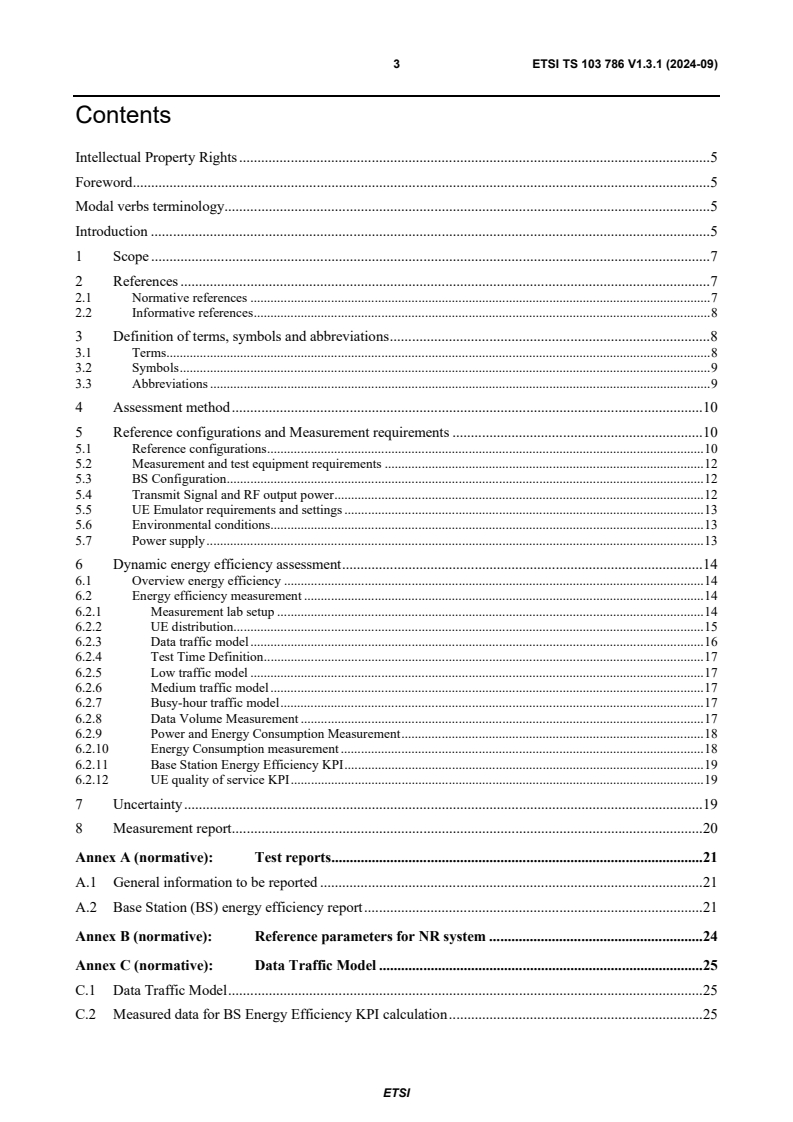
Contents
Intellectual Property Rights . 5
Foreword . 5
Modal verbs terminology . 5
Introduction . 5
1 Scope . 7
2 References . 7
2.1 Normative references . 7
2.2 Informative references . 8
3 Definition of terms, symbols and abbreviations . 8
3.1 Terms . 8
3.2 Symbols . 9
3.3 Abbreviations . 9
4 Assessment method . 10
5 Reference configurations and Measurement requirements . 10
5.1 Reference configurations . 10
5.2 Measurement and test equipment requirements . 12
5.3 BS Configuration . 12
5.4 Transmit Signal and RF output power . 12
5.5 UE Emulator requirements and settings . 13
5.6 Environmental conditions . 13
5.7 Power supply . 13
6 Dynamic energy efficiency assessment . 14
6.1 Overview energy efficiency . 14
6.2 Energy efficiency measurement . 14
6.2.1 Measurement lab setup . 14
6.2.2 UE distribution . 15
6.2.3 Data traffic model . 16
6.2.4 Test Time Definition . 17
6.2.5 Low traffic model . 17
6.2.6 Medium traffic model . 17
6.2.7 Busy-hour traffic model . 17
6.2.8 Data Volume Measurement . 17
6.2.9 Power and Energy Consumption Measurement . 18
6.2.10 Energy Consumption measurement . 18
6.2.11 Base Station Energy Efficiency KPI . 19
6.2.12 UE quality of service KPI . 19
7 Uncertainty . 19
8 Measurement report . 20
Annex A (normative): Test reports . 21
A.1 General information to be reported . 21
A.2 Base Station (BS) energy efficiency report . 21
Annex B (normative): Reference parameters for NR system . 24
Annex C (normative): Data Traffic Model . 25
C.1 Data Traffic Model . 25
C.2 Measured data for BS Energy Efficiency KPI calculation . 25
ETSI
4 ETSI TS 103 786 V1.3.1 (2024-09)
Annex D (normative): Channel model. 27
D.1 Tapped Delay Line - A (TDL-A) model . 27
Annex E (normative): Uncertainty assessment . 28
E.1 General requirements . 28
E.2 Components contributing to uncertainty . 29
E.2.1 Contribution of the measurement system . 29
E.2.1.1 Uncertainty Tree description. 29
E.2.1.2 Measurement equipment . 29
E.2.1.3 Attenuators, cables . 29
E.2.1.4 UE emulator . 29
E.2.1.5 Impact of environmental parameters. 29
E.2.1.6 Impact of path loss . 29
E.2.1.7 Data volume . 30
E.2.1.8 Variance of device under test . 30
E.3 Uncertainty assessment . 30
E.3.1 Combined and expanded uncertainties . 30
E.3.2 Cross correlation of uncertainty factors . 31
E.3.3 Maximum expanded uncertainty . 31
Annex F (informative): Bibliography . 32
History . 33
ETSI
5 ETSI TS 103 786 V1.3.1 (2024-09)
Intellectual Property Rights
Essential patents
IPRs essential or potentially essential to normative deliverables may have been declared to ETSI. The declarations
pertaining to these essential IPRs, if any, are publicly available for ETSI members and non-members, and can be
found in ETSI SR 000 314: "Intellectual Property Rights (IPRs); Essential, or potentially Essential, IPRs notified to
ETSI in respect of ETSI standards", which is available from the ETSI Secretariat. Latest updates are available on the
ETSI Web server (https://ipr.etsi.org/).
Pursuant to the ETSI Directives including the ETSI IPR Policy, no investigation regarding the essentiality of IPRs,
including IPR searches, has been carried out by ETSI. No guarantee can be given as to the existence of other IPRs not
referenced in ETSI SR 000 314 (or the updates on the ETSI Web server) which are, or may be, or may become,
essential to the present document.
Trademarks
The present document may include trademarks and/or tradenames which are asserted and/or registered by their owners.
ETSI claims no ownership of these except for any which are indicated as being the property of ETSI, and conveys no
right to use or reproduce any trademark and/or tradename. Mention of those trademarks in the present document does
not constitute an endorsement by ETSI of products, services or organizations associated with those trademarks.
DECT™, PLUGTESTS™, UMTS™ and the ETSI logo are trademarks of ETSI registered for the benefit of its
Members. 3GPP™ and LTE™ are trademarks of ETSI registered for the benefit of its Members and of the 3GPP
Organizational Partners. oneM2M™ logo is a trademark of ETSI registered for the benefit of its Members and of the ®
oneM2M Partners. GSM and the GSM logo are trademarks registered and owned by the GSM Association.
Foreword
This Technical Specification (TS) has been produced by ETSI Technical Committee Environmental Engineering (EE).
Modal verbs terminology
In the present document "shall", "shall not", "should", "should not", "may", "need not", "will", "will not", "can" and
"cannot" are to be interpreted as described in clause 3.2 of the ETSI Drafting Rules (Verbal forms for the expression of
provisions).
"must" and "must not" are NOT allowed in ETSI deliverables except when used in direct citation.
Introduction
Increase of energy consumption and the related cost has been one of the key questions among the whole industry
depending on energy and specially telecom operators whose energy consumption cost is one of the main contributors to
their OPEX. Despite the increasing of the OPEX, the environmental aspect in terms of CO2 emission has been one of
the most debated subjects within global warming discussions. Energy efficiency is one of the critical factors of the
modern telecommunication systems.
In mobile telecom industry the energy consumption of the access network is the dominating part of a wireless telecom
network energy consumption. Therefore, the core network and the service network are not considered in the present
document. In a radio access network, the energy consumption of the Base Station is dominating.
In context of 5G, one is often talking about three classes of use cases: enhanced Mobile Broadband (eMBB), massive
Machine-Type Communication (mMTC) and Ultra-Reliable and Low-Latency Communication (URLLC). eMBB
corresponds to the evolution of today's mobile broadband services, enabling even larger data volumes and further
enhanced user experience, higher end-user data rates while mMTC and URLLC correspond to services characterized by
a massive number of devices and services with very low latency and extremely high reliability respectively.
ETSI
6 ETSI TS 103 786 V1.3.1 (2024-09)
The present document defines the dynamic measurement method for evaluating energy efficiency of 5G radio Base
Stations with respect to the eMBB use case only. Dynamic measurement method for evaluating energy efficiency of 5G
radio Base Stations with respect to mMTC and URLLC is subjected for further study and will be handled in future
versions of the present document. Due to the dynamic nature of eMBB service it may be very difficult or impossible to
show gains of some Base Station features that improve energy efficiency using static method ETSI ES 202 706-1 [i.6]
alone. Compared to static method, the dynamic method strives to give more realistic estimates of Base Station's energy
consumption and energy efficiency.
To evaluate BS energy efficiency under dynamic traffic load conditions, the BS capacity under dynamic traffic load
provided within a defined coverage area and the corresponding energy consumption are measured for given reference
configurations.
ETSI ES 202 706-1 [i.6] defines daily average power consumption of the base station (static method), and ETSI
TS 102 706-2 [i.5] defines energy efficiency measurement of the LTE base station with dynamic load.
ETSI
7 ETSI TS 103 786 V1.3.1 (2024-09)
1 Scope
The present document covers the following radio access technology:
• 5G NR.
The methodology described in the present document is to measure Base Station dynamic energy efficiency. Within the
present document, it is referred to as dynamic measurement.
The results based on dynamic measurements of the BS provide energy efficiency information for BS with dynamic
load.
The present document covers only the enhanced Mobile Broadband (eMBB) use case of 5G. Other use cases such as
massive Machine-Type Communication (mMTC) and Ultra-Reliable and Low-Latency Communication (URLLC) will
be the subject for future versions of the present document.
Energy consumption of terminal (end-user) equipment is outside the scope of the present document, however, how a
User Equipment (UE) affects a Base Station energy performance will be considered for further study.
The scope of the present document is not to set and define target values for the power consumption nor the energy
efficiency of equipment and neither for regulatory nor type approval purpose.
The results should only be used to assess and compare the energy efficiency of complete Base Stations.
Wide Area Base Stations are covered in the present document.
The present document only covers conducted testing, not Over The Air (OTA) testing. In other words, the present
document is applicable to BS type 1-C and BS type 1-H (at TAB connectors).
2 References
2.1 Normative references
References are either specific (identified by date of publication and/or edition number or version number) or
non-specific. For specific references, only the cited version applies. For non-specific references, the latest version of the
referenced document (including any amendments) applies.
Referenced documents which are not found to be publicly available in the expected location might be found at
https://docbox.etsi.org/Reference/.
NOTE: While any hyperlinks included in this clause were valid at the time of publication, ETSI cannot guarantee
their long term validity.
The following referenced documents are necessary for the application of the present document.
[1] ETSI EN 300 132-2: "Environmental Engineering (EE); Power supply interface at the input of
Information and Communication Technology (ICT) equipment; Part 2: -48 V Direct Current
(DC)".
[2] ETSI EN 300 132-1: "Environmental Engineering (EE); Power supply interface at the input to
Information and Communication Technology (ICT) equipment; Part 1: Alternating Current (AC)".
[3] ETSI EN 300 132-3: "Environmental Engineering (EE); Power supply interface at the input of
Information and Communication Technology (ICT) equipment; Part 3: Up to 400 V Direct Current
(DC)".
[4] ETSI TS 138 211: "5G; NR; Physical channels and modulation (3GPP TS 38.211)".
[5] ETSI TS 138 104: "5G; NR; Base Station (BS) radio transmission and reception (3GPP
TS 38.104)".
ETSI
8 ETSI TS 103 786 V1.3.1 (2024-09)
[6] ETSI TS 138 141-1: "5G; NR; Base Station (BS) conformance testing Part 1: Conducted
conformance testing (3GPP TS 38.141-1)".
[7] IEC/ISO Guide 98-3 or equivalent GUM:2008/JCGM 100:2008: "Evaluation of measurement data
- Guide to the expression of uncertainty in measurement".
[8] Void.
[9] Void.
2.2 Informative references
References are either specific (identified by date of publication and/or edition number or version number) or
non-specific. For specific references, only the cited version applies. For non-specific references, the latest version of the
referenced document (including any amendments) applies.
NOTE: While any hyperlinks included in this clause were valid at the time of publication, ETSI cannot guarantee
their long term validity.
The following referenced documents are not necessary for the application of the present document but they assist the
user with regard to a particular subject area.
[i.1] ISO/IEC 17025: "General requirements for the competence of testing and calibration laboratories".
[i.2] IEC 62018: "Power consumption of information technology equipment - Measurement methods".
NOTE: Equivalent to CENELEC EN 62018.
[i.3] Void.
[i.4] ETSI TR 138 901 (V17.0.0): "5G; Study on channel model for frequencies from 0.5 to 100 GHz
(3GPP TR 38.901 version 17.0.0 Release 17)".
[i.5] ETSI TS 102 706-2: "Environmental Engineering (EE); Metrics and measurement method for
energy efficiency of wireless access network equipment; Part 2: Energy efficiency - dynamic
measurement method".
[i.6] ETSI ES 202 706-1: "Environmental Engineering (EE); Metrics and measurement method for
energy efficiency of wireless access network equipment; Part 1: Power consumption - static
measurement method".
[i.7] ETSI ES 202 336-12: "Environmental Engineering (EE); Monitoring and control interface for
infrastructure equipment (power, cooling and building environment systems used in
telecommunication networks); Part 12: ICT equipment power, energy and environmental
parameters monitoring information model".
3 Definition of terms, symbols and abbreviations
3.1 Terms
For the purposes of the present document, the following terms apply:
Base Station (BS): radio access network component which serves one or more radio cells and interfaces the user
terminal (through air interface) and a wireless network infrastructure
BS test control unit: unit which can be used to control and manage BS locally in a lab
busy-hour (load): period during which occurs the maximum total load in a given 24-hour period
distributed BS: BS architecture which contains remote radio heads (i.e. RRH) close to antenna element and a central
element connecting BS to network infrastructure
ETSI
9 ETSI TS 103 786 V1.3.1 (2024-09)
efficiency: relation between the useful output (telecom service, etc.) and energy consumption of the BS
energy efficiency: relation between the useful output (telecom service, etc.) and energy consumption of the BS
NOTE: In more details, the ratio between the produced task or work and the consumed power for producing this
task or work over a time period is called energy efficiency. The task or work could be anything and in
telecommunication it can for example be the delivered bits to a User Equipment (UE). In this case the unit
could be for example [Mbits / kWh] or [bits / kWh] or [Mbits / Joules]. Since the electricity bills for
operators are normally presented in kWh and the work can be expressed as delivering Mbits to a user it
would be more convenient to express the unit as [Mbits / kWh].
integrated BS: BS architecture in which all BS elements are located close to each other; for example, in one single
cabinet
NOTE: The integrated BS architecture may include Tower Mount Amplifier (TMA) close to antenna.
low load: lowest generated traffic during the dynamic measurement period
medium load: load between the lowest and busy-hour load generated during the dynamic measurement period
power saving feature: software/hardware feature in a BS which contributes to decrease power consumption
static measurement: power consumption measurement performed with different radio resource configurations with
pre-defined and fixed load levels (see ETSI ES 202 706-1 [i.6])
UE group: group of UEs whose path losses to the BS are identical
Wide Area Base Station: Base Station characterized by requirements derived from Macro Cell scenarios with a BS to
UE minimum coupling loss equals to 70 dB and a rated output power (PRAT) above 38 dBm
NOTE: For example, for NR this PRAT is the mean power level per carrier according to ETSI
TS 138 104 [5].
3.2 Symbols
Void.
3.3 Abbreviations
For the purposes of the present document, the following abbreviations apply:
AC Alternating Current
BH Busy Hour
BS Base Station
BSEE Base Station Energy Efficiency
DC Direct Current
DL DownLink
DUT Device Under Test
eMBB enhanced Mobile BroadBand
GUM Guide to the expression of Uncertainty in Measurement
HW HardWare
KPI Key Performance Indicator
LTE Long Term Evolution
MIMO Multiple Input Multiple Output
mMTC massive Machine-Type Communications
NIST National Institute of Standards and Technology
NR New Radio
NSA Non-StandAlone
OPEX Operating Expense
OTA Over The Air
PBCH Packet Broadcast Control Channel
PCM Pulse Code Modulation
ETSI
10 ETSI TS 103 786 V1.3.1 (2024-09)
PRAT Power RATed
PRB Physical Resource Block
PSS Primary Synchronizing Signal
RF Radio Frequency
RMSI Remaining Minimum System Information
RRH Remote Radio Head
RX Receiver
SA StandAlone
SDH Synchronous Digital Hierarchy
SIB System Information Block
SS Synchronization Signals
SSB Synchronization Signal Block
SSS Secondary Synchronizing Signal
SW SoftWare
TAB Transceiver Array Boundary
TCP Transmission Control Protocol
TDD Time Division Duplex
TMA Tower Mount Amplifier
TX Transmitter
UE User Equipment
UL UpLink
URLLC Ultra-Reliable Low-Latency Communication
4 Assessment method
The assessment method is covering the BS equipment dynamic energy efficiency for which the present document
defines reference BS equipment configurations and reference load levels to be used when measuring BS energy
efficiency.
The assessment procedure contains the following tasks:
1) Identification of equipment under test:
1.1 Identify BS basic parameters (Annex A).
1.2 List BS configuration (Annex A and Annex B).
1.3 List traffic load(s) for measurements (Annex C).
1.4 List of used power saving features and capacity enhancement features.
2) Energy efficiency measurement under dynamic load conditions, Measure BS equipment delivered task in
terms of bits and the consumed energy under required conditions (see clause 6).
3) Collect and report the energy efficiency measurement results (Annex B).
5 Reference configurations and Measurement
requirements
5.1 Reference configurations
The BS equipment is a network component which serves a number of user equipment within a specific coverage area
over an air interface. A BS interfaces user equipment (through air interface) and a wireless network infrastructure.
Reference configurations are defined in Annex B.
These configurations cover integrated and distributed BS, mast head amplifiers, remote radio heads, RF feeder cables,
number of carriers, number of sectors, power range per sector, frequency range, diversity, MIMO.
ETSI
11 ETSI TS 103 786 V1.3.1 (2024-09)
The BS shall be tested with its intended commercially available configuration at temperatures defined in clause 5.6. It
shall be clearly reported in the measurement report if the BS cannot be operated without additional air-conditioning at
the defined temperatures.
Appropriate transmission e.g. a transport function or other providing capacity corresponding to the BS capacity, shall be
included in the BS configuration during testing. The configurations include:
1) UL diversity (this is a standard feature in all BS. Therefore, it is considered sufficient that the test is performed
on the main RX antenna only. The diversity RX shall be active during the measurement without connection to
the test signal).
2) DL diversity: Rank 1, single layer transmission, (MU-MIMO).
Figure 1: Integrated BS model (Example)
Figure 2: Distributed BS model (Example)
ETSI
12 ETSI TS 103 786 V1.3.1 (2024-09)
5.2 Measurement and test equipment requirements
The measurement of the power consumption shall be performed by either measuring the power supply voltage and true
effective current in parallel and calculate the resulting power consumption (applicable only for DC) or with a wattmeter
(applicable for both AC and DC). The measurements can be performed by a variety of measurement equipment,
including power clamps, or power supplies with in-built power measurement capability.
All stand-alone measurement equipment such as power measurement instruments, shall be calibrated and shall have
data output interface to allow long term data recording and calculation of the complete power consumption over a given
time.
The below requirements are not applied to any internal measurement mechanism build in a Base Station defined in
ETSI ES 202 336-12 [i.7]. The below requirements shall be applied to stand-alone equipment such as power
measurement instrument.
The stand-alone measurement equipment shall comply with following attributes:
• Input power:
- Resolution: ≤ 10 mA; ≤ 100 mV; ≤ 100 mW.
- DC current: ±1 %.
- DC voltage: ±1 %.
- AC power: ±1 %:
An available current crest factor of 5 or more.
The test instrument shall have a bandwidth of at least 1 kHz.
NOTE: Additional information on accuracy can be found in IEC 62018 [i.2].
• RF output power accuracy: ±0,4 dB.
5.3 BS Configuration
The BS shall be tested under normal test conditions according to the information accompanying the equipment. The BS,
test configuration and mode of operation (baseband, control and RF part of the BS as well as the software and firmware)
shall represent the normal intended use and shall be recorded in the test report.
The BS shall be tested with its typical configuration. In case of multiple configurations, a configuration with 3 sectors
shall be used. Examples: a typical wide area BS configuration consists of three sectors and shall therefore be tested in a
three-sector configuration.
If a BS is designed for dual or single sector applications, it shall be tested in its designed configuration.
The connection to the simulator via the BS controller interface shall be an electrical or optical cable-based interface
(e.g. PCM, SDH, and Ethernet) which is commercially offered along with the applied BS configuration.
Additional power consuming features like battery loading shall be switched off.
The used power saving features and SW version shall be listed in the measurement report.
The measurement report shall state the configuration of the BS for example the type of RF signal combining (antenna
network combining, air combining or multi-carrier).
5.4 Transmit Signal and RF output power
The maximum RF transmit power that the Base Station under test is capable of, shall be reported.
The Base Station under test shall control the RF transmit signal to fulfil the traffic profiles as listed in Annex C.
ETSI
13 ETSI TS 103 786 V1.3.1 (2024-09)
The power amplifier(s) of the BS shall support the same crest factor (peak to average ratio) and back-off as applied in
the commercial product.
All relevant requirements from 3GPP specifications for the 5G NR air-interface shall be fulfilled.
5.5 UE Emulator requirements and settings
UE power consumption is not considered in the present document. However, UE category and performance has a
significant impact on the Base Station energy efficiency. To assess energy efficiency of the BS, the UE capabilities
represented by the UE emulator shall be used as follows:
• The UE emulator shall provide the total capacity (number of simultaneous UEs as defined in Annex C,
maximum data rate, etc.) to load the BS per the test specifications.
• The UE emulator shall be capable of supporting at least NR release 16.
• Multiband radio interface support 400 MHz to 4 000 MHz.
• Simulation capacity of 1 000 UE's.
• Full stack E2E UE simulation.
• Capability of Mobility simulation.
• Fading simulation capability (according 3GPP models).
• Possibility to control every UE position (pathloss), data traffic, fading, etc., individually.
• Logging of UE performance.
The used UE emulator type shall be recorded in detail for the test protocol. This shall include the brand name of UE
emulator, the model, HW and S/W versions.
5.6 Environmental conditions
For the BS energy efficiency measurements, the environmental conditions under which the BS shall be tested are
defined as follows.
Table 1: BS environmental conditions
Condition Minimum Maximum
Barometric pressure 86 kPa (860 mbar) 106 kPa (1 060 mbar)
Relative Humidity 20 % 85 %
Vibration Negligible
Temperature +25 °C
Temperature accuracy ±2 °C
The BS energy efficiency measurements shall be performed when stable temperature conditions inside the equipment
are reached. For this purpose, the BS shall be placed in the environmental conditions for minimum two hours with a
minimum operation time of one hour before doing the measurements. After change of traffic load level, a minimum
operation time of one hour shall also be applied before conducting measurements again.
5.7 Power supply
For the measurements, the following operating voltage values shall be used. Equipment designed for non-standard
power supply voltages one shall use the nominal equipment operating voltage (±2,5 % tolerance).
Nominal value and operating value for AC testing shall be according to [2] and for DC testing to [1] and [3].
The frequency of the power supply corresponding to the AC mains shall be according to [2].
ETSI
14 ETSI TS 103 786 V1.3.1 (2024-09)
Power measurement is done at the input of power to the power supply unit to the Base Station. See Figure 1 and
Figure 2 for location of measurement point for both the integrated and distributed Base Station.
6 Dynamic energy efficiency assessment
6.1 Overview energy efficiency
For dynamic measurement, the BS shall be operated in a test and measuring environment as illustrated in Figure 3.
For BS energy efficiency measurements, the following items are specified for each system in Annexes B and C:
• Reference configuration (Annex B).
• Frequency bands (Annex B).
• Traffic load levels (Annex C).
• Traffic case (Annex C).
Power Savings features and other radio and traffic related features implemented in BS can be used during the testing.
Such features shall be listed in the measurement report, as specified in Annex A.
The BS is powered by a DC or AC power supply. The control unit itself is connected to the core network. The
core network can be either a real network element or a core network emulator.
6.2 Energy efficiency measurement
6.2.1 Measurement lab setup
Figure 3 shows the test setup using a UE emulator and a channel emulator connected to the BS under test. A traffic
generator is used to generate both data traffic requested by the UEs and measuring the received data by the UEs during
the test. The test setup in Figure 3 is applicable for 5G NR and LTE as an anchor, Non-StandAlone (NSA) but it can
also be applicable for only NR, StandAlone (SA) case, by just removing the LTE Anchor from the test setup.
ETSI
15 ETSI TS 103 786 V1.3.1 (2024-09)
Iperf 5G
Server MME
Ohm AC/DC
NR + LTE
Amper
FIC CARD
TN UE Control
Baseband 5G UE
Iperf Client
LTE Anchor
WS
Secure Shell
(SSH)
Serial Port
Server
LAB NW
NOTE: BS as defined in Figure 1 (integrated BS) or Figure 2 (distributed BS). AC supply to be used for BS with
build in AC power supply, otherwise default DC supply voltage as specified in clause 5.7.
Figure 3: Example of NSA test setup for dynamic measurement with integrated BS and UE emulator
The BS shall be operated and controlled via the controller units as illustrated in Figure 3 in conjunction with the UE
distribution, the traffic models and reference parameters given in Annexes B and C.
A channel emulator is used either by an in-build channel emulator in the UE emulator or as a standalone channel
emulator. It is used for emulating fading over the radio channels between UEs and the BS. The fading model shall be
TDL-A for non-line-of-sight, see Annex D.
6.2.2 UE distribution
The UEs are distributed in three different path loss regions, low path loss, medium path loss and high path loss regions
as shown in Figure 4. The path loss value for each region is according to Table C.3.
The number of UEs for low, medium, and busy-hour traffic load scenarios are different and are according to Annex C,
Table C.3.
Figure 4: UE distribution in three different pathloss regions
ETSI
16 ETSI TS 103 786 V1.3.1 (2024-09)
6.2.3 Data traffic model
The traffic model used for BS energy efficiency measurement in the present document is based on artificially generated
data traffic by a traffic generator. This traffic generator is either inbuilt in the UE emulator used in the test setup or is a
standalone traffic generator. The following requirements shall be fulfilled for the data traffic model in the present
document:
• The data traffic model shall be based on TCP protocol.
• Measurement results shall be repeatable within a given confidence interval of 95 %. The test time for each
traffic load scenario is 60 min. This means that all UEs stop to request data when this time is elapsed.
• Three different file sizes, F (small size), F (medium size) and F (large size) are defined to be
small medium large
randomly requested by each UE during each test scenario. These file sizes are defined in Annex C.
• Each UE continues requesting files of the above file sizes on a random basis until the end of the test time.
• The probability of requesting a file of each file size (F , F , F ) is defined in Table C.2 in Annex C
small medium large
and denoted as PF , PF and PF .
small medium large
• Each time a UE has received a file, the UE shall wait for a waiting time (WT , WT , WT ) randomly before
1 2 3
requesting a new file of random file size. Applying the waiting time for each UE is also on random basis
according to Table C.2 in Annex C and the probability for each waiting time is denoted as PT , PT and PT .
1 2 3
• All the UEs shall stay connected during the test time. The UEs shall be disconnected when the test time has
ended.
• An idle state time for BS shall be applied after the test time has ended, i.e. when all the UEs have finished
requesting data and disconnected the BS enters the idle state. This idle state time is defined according to
Annex C.
• Startup procedure: All UEs shall be in connected mode before the test starts.
• At the end of each tested traffic load scenario the total amount of delivered data during the test time, the
consumed energy during the test time, and the consumed energy during the idle state time shall be collected
and reported.
Figure 5 shows an example over how different files in a random way are transmitted to each UE. All the UEs shall be in
connected mode before the start of the test. At the start of the test each UE starts to request data on a random basis as
explained above. The data traffic model used in the present document is based on transmitting three different file sizes
denoted as small, medium, and large file sizes. The size of these files is defined in Annex C. Each UE continues
requesting data until the end of the test time.
When the test time ended and all UEs disconnected the BS enters an idle state for an idle time defined according to
Annex C.
The following data needs to be collected after each tested traffic load scenario:
• The energy consumption during the test time.
• The energy consumption during the idle time. Note that the idle time energy consumption shall not be included
when calculating the BS Energy Efficiency KPI (see clauses 6.2.8 to 6.2.11 below).
• The total received data by the UEs during the test time.
ETSI
17 ETSI TS 103 786 V1.3.1 (2024-09)
Figure 5: An example of data traffic flow to each UE
6.2.4 Test Time Definition
The test time is fixed according to Table C.2. This test time is denoted as T and it is the time between the start of the
test
measurement and the time when the UEs stop requesting files.
The test time for low, medium and busy-hour traffic load scenarios are in the following denoted as: T , T ,
test-low test-medium
and T respectively.
test-busy-hour
6.2.5 Low traffic model
For low load traffic scenario, the amount of delivered data is at a low level due to low number of connected UEs. The
number of connected UEs for low load scenario is defined in Table C.3.
6.2.6 Medium traffic model
For medium load traffic scenario, the amount of delivered data is at a medium level due to medium number of
connected UEs. The number of connected UEs for medium load scenario is defined in Table C.3.
6.2.7 Busy-hour traffic model
For busy-hour load traffic scenario, the amount of delivered data is at a busy-hour level due to high number of
connected UEs. The number of connected UEs for busy-hour load scenario is defined in Table C.3.
6.2.8 Data Volume Measurement
All received data by the UEs during the test time of each traffic load scenario shall be measured. The measured data is
the net data volume and shall not contain any duplicated or retransmitted data. The data shall be generated as described
in clause 6.2.3 and Annex C. The measured data in Mbits will be used for calculation of the BS energy efficiency KPI.
For the calculation of the BS energy efficiency, weighting factors based on a daily (24 hours) traffic load distribution
profile consisting of the three measured traffic load levels; low load (low), medium load (med), and Busy-Hour (BH)
load are used. A mobile network operator is allowed to define a load distribution profile reflecting the situation in the
network and mandate that profile to be used. Note that the selected load durations shall sum up to 24 hours. In case no
load distribution profile has been defined, the default values defined in Annex C can be used.
ETSI
...
Questions, Comments and Discussion
Ask us and Technical Secretary will try to provide an answer. You can facilitate discussion about the standard in here.
Loading comments...