


ETSI TS 103 525-2 V1.2.1 (2022-01)
Intelligent Transport Systems (ITS); Testing; Conformance test specifications for ITS PKI management; Part 2: Test Suite Structure and Test Purposes (TSS & TP)
Intelligent Transport Systems (ITS); Testing; Conformance test specifications for ITS PKI management; Part 2: Test Suite Structure and Test Purposes (TSS & TP)
RTS/ITS-005208
General Information
Standards Content (Sample)
TECHNICAL SPECIFICATION
Intelligent Transport Systems (ITS);
Testing;
Conformance test specifications for ITS PKI management;
Part 2: Test Suite Structure and Test Purposes (TSS & TP)
2 ETSI TS 103 525-2 V1.2.1 (2022-01)
Reference
RTS/ITS-005208
Keywords
ITS, security, testing, TSS&TP
ETSI
650 Route des Lucioles
F-06921 Sophia Antipolis Cedex - FRANCE
Tel.: +33 4 92 94 42 00 Fax: +33 4 93 65 47 16
Siret N° 348 623 562 00017 - APE 7112B
Association à but non lucratif enregistrée à la
Sous-Préfecture de Grasse (06) N° w061004871
Important notice
The present document can be downloaded from:
http://www.etsi.org/standards-search
The present document may be made available in electronic versions and/or in print. The content of any electronic and/or
print versions of the present document shall not be modified without the prior written authorization of ETSI. In case of any
existing or perceived difference in contents between such versions and/or in print, the prevailing version of an ETSI
deliverable is the one made publicly available in PDF format at www.etsi.org/deliver.
Users of the present document should be aware that the document may be subject to revision or change of status.
Information on the current status of this and other ETSI documents is available at
https://portal.etsi.org/TB/ETSIDeliverableStatus.aspx
If you find errors in the present document, please send your comment to one of the following services:
https://portal.etsi.org/People/CommiteeSupportStaff.aspx
Notice of disclaimer & limitation of liability
The information provided in the present deliverable is directed solely to professionals who have the appropriate degree of
experience to understand and interpret its content in accordance with generally accepted engineering or
other professional standard and applicable regulations.
No recommendation as to products and services or vendors is made or should be implied.
No representation or warranty is made that this deliverable is technically accurate or sufficient or conforms to any law
and/or governmental rule and/or regulation and further, no representation or warranty is made of merchantability or fitness
for any particular purpose or against infringement of intellectual property rights.
In no event shall ETSI be held liable for loss of profits or any other incidental or consequential damages.
Any software contained in this deliverable is provided "AS IS" with no warranties, express or implied, including but not
limited to, the warranties of merchantability, fitness for a particular purpose and non-infringement of intellectual property
rights and ETSI shall not be held liable in any event for any damages whatsoever (including, without limitation, damages
for loss of profits, business interruption, loss of information, or any other pecuniary loss) arising out of or related to the use
of or inability to use the software.
Copyright Notification
No part may be reproduced or utilized in any form or by any means, electronic or mechanical, including photocopying and
microfilm except as authorized by written permission of ETSI.
The content of the PDF version shall not be modified without the written authorization of ETSI.
The copyright and the foregoing restriction extend to reproduction in all media.
© ETSI 2022.
All rights reserved.
ETSI
3 ETSI TS 103 525-2 V1.2.1 (2022-01)
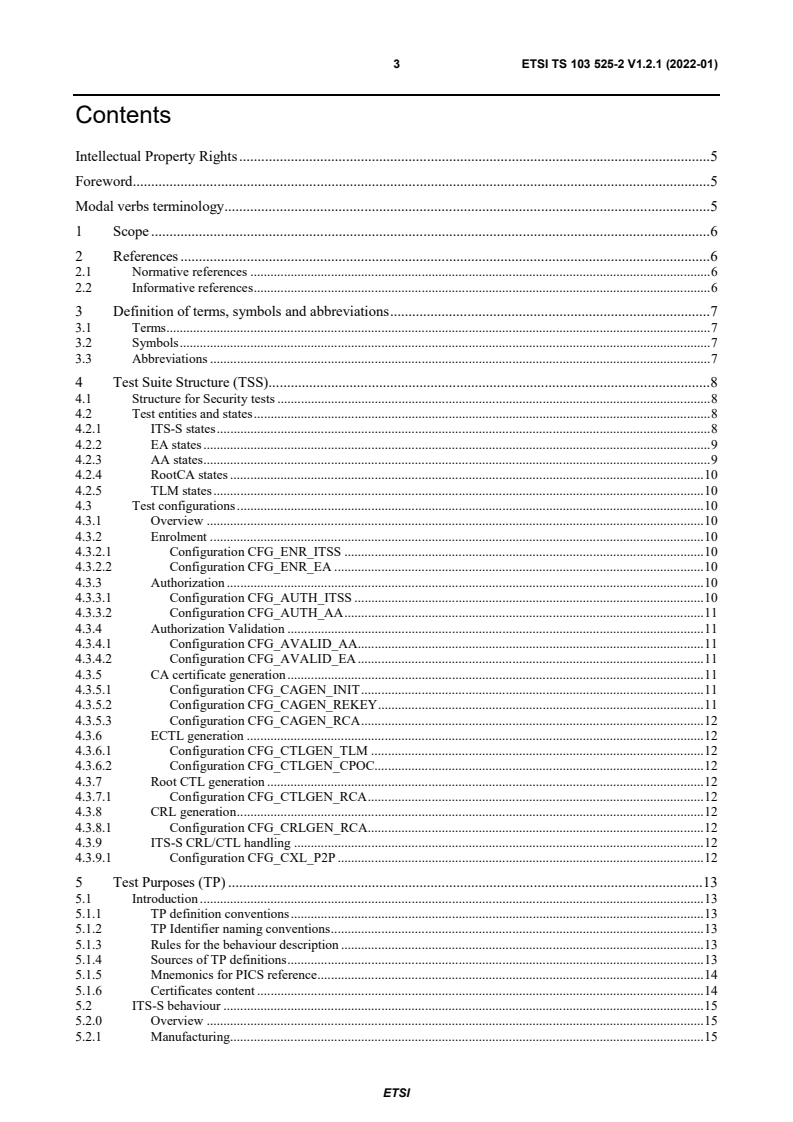
Contents
Intellectual Property Rights . 5
Foreword . 5
Modal verbs terminology . 5
1 Scope . 6
2 References . 6
2.1 Normative references . 6
2.2 Informative references . 6
3 Definition of terms, symbols and abbreviations . 7
3.1 Terms . 7
3.2 Symbols . 7
3.3 Abbreviations . 7
4 Test Suite Structure (TSS) . 8
4.1 Structure for Security tests . 8
4.2 Test entities and states . 8
4.2.1 ITS-S states . 8
4.2.2 EA states . 9
4.2.3 AA states . 9
4.2.4 RootCA states . 10
4.2.5 TLM states . 10
4.3 Test configurations . 10
4.3.1 Overview . 10
4.3.2 Enrolment . 10
4.3.2.1 Configuration CFG_ENR_ITSS . 10
4.3.2.2 Configuration CFG_ENR_EA . 10
4.3.3 Authorization . 10
4.3.3.1 Configuration CFG_AUTH_ITSS . 10
4.3.3.2 Configuration CFG_AUTH_AA . 11
4.3.4 Authorization Validation . 11
4.3.4.1 Configuration CFG_AVALID_AA . 11
4.3.4.2 Configuration CFG_AVALID_EA . 11
4.3.5 CA certificate generation . 11
4.3.5.1 Configuration CFG_CAGEN_INIT . 11
4.3.5.2 Configuration CFG_CAGEN_REKEY . 11
4.3.5.3 Configuration CFG_CAGEN_RCA . 12
4.3.6 ECTL generation . 12
4.3.6.1 Configuration CFG_CTLGEN_TLM . 12
4.3.6.2 Configuration CFG_CTLGEN_CPOC. 12
4.3.7 Root CTL generation . 12
4.3.7.1 Configuration CFG_CTLGEN_RCA . 12
4.3.8 CRL generation . 12
4.3.8.1 Configuration CFG_CRLGEN_RCA. 12
4.3.9 ITS-S CRL/CTL handling . 12
4.3.9.1 Configuration CFG_CXL_P2P . 12
5 Test Purposes (TP) . 13
5.1 Introduction . 13
5.1.1 TP definition conventions . 13
5.1.2 TP Identifier naming conventions . 13
5.1.3 Rules for the behaviour description . 13
5.1.4 Sources of TP definitions . 13
5.1.5 Mnemonics for PICS reference . 14
5.1.6 Certificates content . 14
5.2 ITS-S behaviour . 15
5.2.0 Overview . 15
5.2.1 Manufacturing . 15
ETSI
4 ETSI TS 103 525-2 V1.2.1 (2022-01)
5.2.2 Enrolment . 15
5.2.2.0 Overview . 15
5.2.2.1 Enrolment request . 16
5.2.2.2 Enrolment response handling . 21
5.2.2.3 Enrolment request repetition . 22
5.2.3 Authorization . 24
5.2.3.0 Overview . 24
5.2.3.1 Authorization request . 24
5.2.3.2 Authorization response handling . 33
5.2.3.3 Authorization request repetition . 33
5.2.4 CTL handling . 35
5.2.5 CTL distribution . 36
5.2.6 CRL handling. 42
5.2.7 CRL distribution . 44
5.3 Common CA beha viour . 47
5.3.0 Overview . 47
5.3.1 Certificate validation. 48
5.3.1.1 Basic certificate content . 48
5.3.1.2 Check certificate region validity restriction . 51
5.3.1.3 Check ECC point type of the certificate signature . 55
5.3.1.4 Check ECC point type of the certificate public keys . 55
5.3.1.5 Verify certificate signatures . 56
5.3.1.6 Verify certificate permissions . 57
5.3.1.7 Check time validity restriction in the chain . 60
5.4 EA behaviour . 60
5.4.0 Overview . 60
5.4.1 Enrolment request handling . 60
5.4.2 Enrolment response. 66
5.4.3 Authorization validation request handling . 71
5.4.4 Authorization validation response . 72
5.4.5 CA Certificate Request . 76
5.5 AA behaviour . 80
5.5.0 Overview . 80
5.5.1 Authorization request handling . 81
5.5.2 Authorization validation request . 91
5.5.3 Authorization validation response handling . 95
5.5.4 Authorization response . 96
5.5.5 CA Certificate Request . 100
5.6 RootCA beha viour . 105
5.6.0 Overview . 105
5.6.1 CTL generation . 106
5.6.2 CRL generation . 115
5.6.3 CA certificate generation . 119
5.7 DC behaviour . 121
5.8 TLM behaviour . 122
5.8.1 CTL generation . 122
5.9 CPOC behaviour . 128
History . 129
ETSI
5 ETSI TS 103 525-2 V1.2.1 (2022-01)
Intellectual Property Rights
Essential patents
IPRs essential or potentially essential to normative deliverables may have been declared to ETSI. The declarations
pertaining to these essential IPRs, if any, are publicly available for ETSI members and non-members, and can be
found in ETSI SR 000 314: "Intellectual Property Rights (IPRs); Essential, or potentially Essential, IPRs notified to
ETSI in respect of ETSI standards", which is available from the ETSI Secretariat. Latest updates are available on the
ETSI Web server (https://ipr.etsi.org/).
Pursuant to the ETSI Directives including the ETSI IPR Policy, no investigation regarding the essentiality of IPRs,
including IPR searches, has been carried out by ETSI. No guarantee can be given as to the existence of other IPRs not
referenced in ETSI SR 000 314 (or the updates on the ETSI Web server) which are, or may be, or may become,
essential to the present document.
Trademarks
The present document may include trademarks and/or tradenames which are asserted and/or registered by their owners.
ETSI claims no ownership of these except for any which are indicated as being the property of ETSI, and conveys no
right to use or reproduce any trademark and/or tradename. Mention of those trademarks in the present document does
not constitute an endorsement by ETSI of products, services or organizations associated with those trademarks.
DECT™, PLUGTESTS™, UMTS™ and the ETSI logo are trademarks of ETSI registered for the benefit of its
Members. 3GPP™ and LTE™ are trademarks of ETSI registered for the benefit of its Members and of the 3GPP
Organizational Partners. oneM2M™ logo is a trademark of ETSI registered for the benefit of its Members and of the ®
oneM2M Partners. GSM and the GSM logo are trademarks registered and owned by the GSM Association.
Foreword
This Technical Specification (TS) has been produced by ETSI Technical Committee Intelligent Transport Systems
(ITS).
The present document is part 2 of a multi-part deliverable. Full details of the entire series can be found in part 1 [4].
Modal verbs terminology
In the present document "shall", "shall not", "should", "should not", "may", "need not", "will", "will not", "can" and
"cannot" are to be interpreted as described in clause 3.2 of the ETSI Drafting Rules (Verbal forms for the expression of
provisions).
"must" and "must not" are NOT allowed in ETSI deliverables except when used in direct citation.
ETSI
6 ETSI TS 103 525-2 V1.2.1 (2022-01)
1 Scope
The present document provides the Test Suite Structure and Test Purposes (TSS & TP) for PKI management as defined
in ETSI TS 102 941 [1] in accordance with the relevant guidance given in ISO/IEC 9646-7 [i.6].
The ISO standard for the methodology of conformance testing (ISO/IEC 9646-1 [i.3] and ISO/IEC 9646-2 [i.4]) as well
as the ETSI rules for conformance testing (ETSI ETS 300 406 [i.7]) are used as a basis for the test methodology.
2 References
2.1 Normative references
References are either specific (identified by date of publication and/or edition number or version number) or
non-specific. For specific references, only the cited version applies. For non-specific references, the latest version of the
referenced document (including any amendments) applies.
Referenced documents which are not found to be publicly available in the expected location might be found at
https://docbox.etsi.org/Reference/.
NOTE: While any hyperlinks included in this clause were valid at the time of publication, ETSI cannot guarantee
their long term validity.
The following referenced documents are necessary for the application of the present document.
[1] ETSI TS 102 941 (V1.4.1): "Intelligent Transport Systems (ITS); Security; Trust and Privacy
Management".
[2] ETSI TS 103 097 (V1.4.1): "Intelligent Transport Systems (ITS); Security; Security header and
certificate formats".
[3] IEEE Std 1609.2™-2016: "IEEE Standard for Wireless Access in Vehicular Environments -
Security Services for Applications and Management Messages", as amended by IEEE Std
1609.2a™-2017: "Standard for Wireless Access In Vehicular Environments - Security Services for
Applications and Management Messages Amendment 1".
[4] ETSI TS 103 525-1 (V1.2.1): "Intelligent Transport Systems (ITS); Testing; Conformance test
specifications for ITS PKI management; Part 1: Protocol Implementation Conformance Statement
(PICS)".
[5] ETSI TS 103 096-2 (V1.5.1): "Intelligent Transport Systems (ITS); Testing; Conformance test
specifications for ITS Security; Part 2: Test Suite Structure and Test Purposes (TSS & TP)".
[6] ETSI TS 103 601 (V1.1.1): "Intelligent Transport Systems (ITS); Security; Security management
messages communication requirements and distribution protocols".
2.2 Informative references
References are either specific (identified by date of publication and/or edition number or version number) or
non-specific. For specific references, only the cited version applies. For non-specific references, the latest version of the
referenced document (including any amendments) applies.
NOTE: While any hyperlinks included in this clause were valid at the time of publication, ETSI cannot guarantee
their long term validity.
The following referenced documents are not necessary for the application of the present document but they assist the
user with regard to a particular subject area.
[i.1] ETSI EG 202 798 (V1.1.1): "Intelligent Transport Systems (ITS); Testing; Framework for
conformance and interoperability testing".
ETSI
7 ETSI TS 103 525-2 V1.2.1 (2022-01)
[i.2] ETSI TS 102 965 (V1.3.1): "Intelligent Transport Systems (ITS); Application Object Identifier
(ITS-AID); Registration".
[i.3] ISO/IEC 9646-1 (1994): "Information technology -- Open Systems Interconnection --
Conformance testing methodology and framework -- Part 1: General concepts".
[i.4] ISO/IEC 9646-2 (1994): "Information technology -- Open Systems Interconnection --
Conformance testing methodology and framework -- Part 2: Abstract Test Suite specification".
[i.5] ISO/IEC 9646-6 (1994): "Information technology -- Open Systems Interconnection --
Conformance testing methodology and framework -- Part 6: Protocol profile test specification".
[i.6] ISO/IEC 9646-7 (1995): "Information technology -- Open Systems Interconnection --
Conformance testing methodology and framework -- Part 7: Implementation Conformance
Statements".
[i.7] ETSI ETS 300 406 (1995): "Methods for testing and Specification (MTS); Protocol and profile
conformance testing specifications; Standardization methodology".
[i.8] United Nations Statistics Division: "Standard country or area codes for statistical use (M49)".
3 Definition of terms, symbols and abbreviations
3.1 Terms
For the purposes of the present document, the terms given in ETSI TS 102 941 [1], ETSI TS 103 097 [2], ETSI
TS 103 525-1 [4], ETSI TS 102 965 [i.2], ISO/IEC 9646-6 [i.5], ISO/IEC 9646-7 [i.6] and the following apply:
AID_CERT_REQ: "Secured certificate request service" ITS-AID
AID_CTL: "CTL service" ITS-AID
AID_CRL: "CRL service" ITS-AID
3.2 Symbols
Void.
3.3 Abbreviations
For the purposes of the present document, the following abbreviations apply:
AA Authorization Authority
AID Application IDentifier
AID_CAM ITS Application IDentifier for CAM
AID_DENM Application Identifier for DENM
AID_GN Application Identifier for general GeoNetworking messages
AT Authorization Ticket
ATS Abstract Test Suite
BO exceptional BehaviOur
BV Valid Behaviour
CA Certification Authority
CAM Co-operative Awareness Messages
CERT CERTificate
CRL Certificate Revocation List
CTL Certificate Trust List
DENM Decentralized Environmental Notification Message
EA Enrolment Authority
ECC Elliptic Curve Cryptography
ETSI
8 ETSI TS 103 525-2 V1.2.1 (2022-01)
ECTL European Certificate Trust List
GN GeoNetworking
ITS Intelligent Transportation Systems
ITS-S Intelligent Transport System - Station
IUT Implementation Under Test
MSG MesSaGe
PICS Protocol Implementation Conformance Statement
SSP Service Specific Permissions
TP Test Purposes
TS Test System
TSS Test Suite Structure
4 Test Suite Structure (TSS)
4.1 Structure for Security tests
Table 1 shows the Security Test Suite Structure (TSS) defined for conformance testing.
Table 1: TSS for Security Management
Root Group Sub-Group Category
Security Management ITS-S Enrolment Valid
Authorization Valid
CRL handling Valid
CTL handling Valid
CA Common Certificate Authority Valid
EA Enrolment Valid
Authorization Validation Valid
CA certificate generation Valid
CRL handling Valid
CTL handling Valid
AA Authorization Valid
Authorization Validation Valid
CA certificate generation Valid
CRL handling Valid
CTL handling Valid
RootCA CA certificate generation Valid
CTL/CRL generation Valid
DC CTL/CRL distribution Valid
TLM ECTL generation Valid
TLM certificate generation Valid
CPOC ECTL distribution Valid
4.2 Test entities and states
4.2.1 ITS-S states
• State 'initialized':
- ITS-S in 'initialized' state is ready to perform the enrolment request.
- ITS-S in 'initialized' state contains following information elements:
permanent canonical identifier (PCI);
public/private key pair for cryptographic purposes (canonical key pair);
the trust anchor (Root CA) public key certificate and the DC network address;
ETSI
9 ETSI TS 103 525-2 V1.2.1 (2022-01)
contact information for the EA which will issue certificates for the ITS-S:
- network address;
- public key certificate.
• State 'enrolled':
- ITS-S in 'enrolled' state has successfully performed the enrolment request process.
- ITS-S in 'enrolled' state is ready to perform an authorization request.
- ITS-S in 'enrolled' state contains all information elements of the 'initialized' state and additionally:
enrolment credential (EC) - with the condition of being neither expired nor revoked;
private key corresponding to the EC public encryption key;
private key corresponding to the EC public verification key.
• State 'authorized':
- ITS-S in 'authorized' state has successfully performed the authorization request process.
- ITS-S in 'authorized' state contains all information elements of the 'enrolled' state and additionally:
one or more authorization tickets (AT):
- being not expired;
- of which at least one is currently valid;
all private keys corresponding to the AT public verification keys;
if applicable: all private keys corresponding to the AT public encryption keys.
4.2.2 EA states
• State 'initial':
- EA contains following information elements:
the trust anchor (Root CA) public key certificate and the DC network address.
• State 'operational':
- EA is ready to receive enrolment requests from ITS-S.
- In addition to information elements enumerated in the 'initial' state, EA in the 'operational' state contains
following information elements:
public/private key pairs and EA certificate permitting issuing of enrolment certificates.
4.2.3 AA states
• State 'initial':
- AA in initial state contains following information elements:
the trust anchor (Root CA) public key certificate and the DC network address;
• State 'operational':
- public/private key pairs and AA certificate permitting issuing of authorization tickets (AT certificates);
- root CTL containing trusted EA certificates;
ETSI
10 ETSI TS 103 525-2 V1.2.1 (2022-01)
- the EA access point URL.
4.2.4 RootCA states
• State 'operational':
- RootCA is offline, but can generate CRL, CTL, AA, EA, RCA, etc. certificates by manual request.
4.2.5 TLM states
• State 'operational':
- TLM is offline, but can generate ECTL by manual request.
4.3 Test configurations
4.3.1 Overview
4.3.2 Enrolment
4.3.2.1 Configuration CFG_ENR_ITSS
IUT: ITS-S in the state 'initialized':
• Following information elements shall be provided by IUT for the EA emulated by the TS:
- Permanent Canonical Identifier (PCI);
- public key of canonical key pair;
- profile information.
TS: EA is emulated by TS.
4.3.2.2 Configuration CFG_ENR_EA
IUT: EA is in the state 'operational', ready to handle enrolment requests and contains following information about ITS-S
emulated by the TS:
• the permanent canonical identifier of the emulated ITS-S;
• the profile information for the emulated ITS-S;
• the public key from the canonical key pair belonging to the emulated ITS-S.
TS: ITS-S is emulated by the TS.
4.3.3 Authorization
4.3.3.1 Configuration CFG_AUTH_ITSS
IUT: ITS-S in the state 'enrolled' and containing following information:
• the AA certificate of the emulated AA;
• the EA certificate of the emulated EA;
• the EC certificate issued by the emulated EA.
ETSI
11 ETSI TS 103 525-2 V1.2.1 (2022-01)
The URL of the emulated AATS: AA is emulated by the TS.
4.3.3.2 Configuration CFG_AUTH_AA
IUT: AA in the operational state and containing following information:
• The profile information for the emulated ITS-S.
TS: ITS-S is emulated by the TS:
• EA is emulated by the TS and validates all incoming requests.
4.3.4 Authorization Validation
4.3.4.1 Configuration CFG_AVALID_AA
IUT: AA in the operational state and containing following information:
• the certificate of the emulated EA;
• the URL of the emulated EA.
TS: EA is emulated by the TS and ready to receive authorization validation requests:
• ITS-S is emulated by TS to trigger the authorization process.
4.3.4.2 Configuration CFG_AVALID_EA
IUT: EA is in the operational state, ready to handle authorization validation requests and contains following information
about AA and ITS-S emulated by the TS:
• the permanent canonical identifier of the emulated ITS-S;
• the profile information for the emulated ITS-S;
• the public key from the key pair belonging to the emulated ITS-S.
TS: AA and ITS-S are emulated by the TS and contain following information elements:
• EC certificate issued by IUT;
• EA certificate of IUT;
• the URL of the EA.
4.3.5 CA certificate generation
4.3.5.1 Configuration CFG_CAGEN_INIT
IUT: CA (EA or AA) in the initial state.
TS: TS checks generated certificate requests and does not emulate any ITS entity.
4.3.5.2 Configuration CFG_CAGEN_REKEY
IUT: CA (EA or AA) in the operational state.
TS: TS checks generated certificate requests and does not emulate any ITS entity.
ETSI
12 ETSI TS 103 525-2 V1.2.1 (2022-01)
4.3.5.3 Configuration CFG_CAGEN_RCA
IUT: Offline RootCA in operational state, generating EA, AA or RCA certificate.
TS: TS checks generated certificate and does not emulate any ITS entity.
4.3.6 ECTL generation
4.3.6.1 Configuration CFG_CTLGEN_TLM
IUT: TLM in the operational state.
TS: TS checks generated CTL and does not emulate any ITS entity.
4.3.6.2 Configuration CFG_CTLGEN_CPOC
IUT: CPOC in the operational state.
TS: TS checks generated CTL emulating http client of CPOC.
4.3.7 Root CTL generation
4.3.7.1 Configuration CFG_CTLGEN_RCA
IUT: RCA in the operational state.
TS: TS checks generated CTL and does not emulate any ITS entity.
4.3.8 CRL generation
4.3.8.1 Configuration CFG_CRLGEN_RCA
IUT: RCA in the operational state.
TS: TS checks generated CRL and does not emulate any ITS entity.
4.3.9 ITS-S CRL/CTL handling
4.3.9.1 Configuration CFG_CXL_P2P
IUT: ITS-S in the state 'authorized' and containing following information:
• the RCA certificate of the emulated RCA;
• the AT certificate issued by the emulated AA;
• the AA certificate of the emulated AA;
• the EA certificate of the emulated EA;
• the EC certificate issued by the emulated EA;
• the URL of the emulated DC.
Neighbour ITS-S: is emulated by the TS.
RCA: is emulated by the TS.
DC: is emulated by the TS.
ETSI
13 ETSI TS 103 525-2 V1.2.1 (2022-01)
5 Test Purposes (TP)
5.1 Introduction
5.1.1 TP definition conventions
The TP definition is built according to ETSI EG 202 798 [i.1].
5.1.2 TP Identifier naming conventions
The identifier of the TP is built according to Table 2.
Table 2: TP naming convention
Identifier TP_____
= root SECPKI
= target ITSS ITS-Station
CA Common Certificate Authority
AA Authorization Authority
EA Enrolment Authority
RCA Root Certification Authority
DC Distribution Center
CPOC C-ITS Point of Contact
= group ENR Enrolment
AUTH Authorization
AUTHVAL Authorization Validation
CRL CRL handling
CTL CTL handling
CERTGEN Certificate generation
CTLGEN CTL generation
ECTLGEN ECTL generation
CRLGEN CRL generation
LISTDIST CTL/CRL/ECTL distribution
TLMCERTGEN TLM certificate generation
=sub-group SND Sending behaviour
RCV Receiving behaviour
REP Repetition behaviour
= test purpose sequential number 01 to 99
= category BV Valid Behaviour tests
BI Invalid Behaviour Tests
5.1.3 Rules for the behaviour description
The description of the TP is built according to ETSI EG 202 798 [i.1].
ETSI TS 102 941 [1] does not use the finite state machine concept. As consequence, the test purposes use a generic
"Initial State" that corresponds to a state where the IUT is ready for starting the test execution. Furthermore, the IUT
shall be left in this "Initial State", when the test is completed.
Being in the "Initial State" refers to the starting point of the initial device configuration. There are no pending actions,
no instantiated buffers or variables, which could disturb the execution of a test.
5.1.4 Sources of TP definitions
All TPs have been specified according to ETSI TS 102 941 [1] which shall be followed as specified in the clauses
below.
ETSI
14 ETSI TS 103 525-2 V1.2.1 (2022-01)
5.1.5 Mnemonics for PICS reference
To avoid an update of all TPs when the PICS document is changed, Table 3 introduces mnemonics name and the
correspondence with the real PICS item number. The 'PICS item' as defined in tables provided in clause A.6 of ETSI
TS 103 525-1 [4] and in IEEE 1609.2 [3] shall be used to determine the test applicability.
Table 3: Mnemonics for PICS reference
Mnemonic PICS item
PICS_SECPKI_IUT_ITSS [4] A.3.1
PICS_SECPKI_IUT_EA [4] A.4.2
PICS_SECPKI_IUT_AA [4] A.4.3
PICS_SECPKI_IUT_RCA [4] A.4.4
PICS_SECPKI_IUT_DC [4] A.4.5
PICS_SECPKI_IUT_TLM [4] A.4.6
PICS_SECPKI_IUT_CPOC [4] A.4.7
PICS_SECPKI_ENROLMENT [4] A.3.2 or A.5.1
PICS_SECPKI_ENROLMENT_RETRY [4] A.3.2.2 or A.5.4
PICS_SECPKI_REENROLMENT [4] A.3.2.1 or A.5.2
PICS_SECPKI_AUTHORIZATION [4] A.3.3 or A.6.1
PICS_SECPKI_ AUTHORIZATION _RETRY [4] A.3.3.3 or A.6.5
PICS_SECPKI_AUTH_PRIVACY [4] A.3.3.1 or A.6.3
PICS_SECPKI_AUTH_POP [4] A.3.3.2 or A.6.2
PICS_SECPKI_AUTH_VALIDATION [4] A.5.3
PICS_SECPKI_CRL [4] A.9.5 or A.7.1
PICS_SECPKI_CRL_DOWNLOAD [4] A.9.6
PICS_SECPKI_CRL_BROADCAST [4] A.9.9
PICS_SECPKI_CTL [4] A.9.3 or A.7.2
PICS_SECPKI_CTL_DELTA [4] A.9.3.1 or A.7.2.1 or A.7.4.1
PICS_SECPKI_CTL_DOWNLOAD [4] A.9.4
PICS_SECPKI_CTL_BROADCAST [4] A.9.8
PICS_SECPKI_ECTL [4] A.9.1 or A.8.1
PICS_SECPKI_ECTL_DELTA [4] A.9.1.1 or A.8.1.1 or A.8.2.1
PICS_SECPKI_ECTL_DOWNLOAD [4] A.9.2 or A.8.3
PICS_SECPKI_ECTL_BROADCAST [4] A.9.7
PICS_SEC_SHA256 [3] S1.2.2.1.1 or S1.3.2.1.1
PICS_SEC_SHA384 [3] S1.2.2.1.2 or S1.3.2.1.2
PICS_SEC_BRAINPOOL_P256R1 [3] S1.2.2.4.1.2 or S1.3.2.4.1.2
PICS_SEC_BRAINPOOL_P384R1 [3] S1.2.2.4.2 or S1.3.2.4.2
PICS_SEC_IMPLICIT_CERTIFICATES [3] S1.2.2.8, S1.3.2.7 and S1.3.2.9
PICS_SEC_EXPLICIT_CERTIFICATES [3] S1.2.2.7, S1.3.2.6 and S1.3.2.8
5.1.6 Certificates content
The certificates, defined in ETSI TS 103 096-2 [5], clause 6.1.1 is applicable for the present document. Additional
certificates used in the test purposes are defined in the Table 4.
ETSI
15 ETSI TS 103 525-2 V1.2.1 (2022-01)
Table 4: Certificates content
AA certificate Content To be installed on
the IUT
CERT_IUT_A_AA Yes
• signer digest of the CERT_IUT_A_CA
• application permissions:
− CRT_REQ with SSP 0x0132;
• certificate issuing permissions (SSP value/mask):
− CAM with all possible SPP (0x01FFFC / 0xFF0003);
− DENM with all possible SSP (0x01FFFFFF / 0xFF000000);
− SPATEM with all possible SSP (0x01E0 / 0xFF1F);
− MAPEM with all possible SSP (0x01C0 / 0xFF3F);
− IVIM with all possible SSP (0x01000000FFF8 /
0xFF0000000007);
− SREM with all possible SSP (0x01FFFFE0 / 0xFF00001F);
− SSEM with all possible SSP (0x01 / 0xFF);
− GPC with all possible SSP (0x01 / 0xFF);
− GN-MGMT without SSP;
• validation time for 3 years;
• no region restriction;
• assurance level 4;
• verification key of type compressed with NIST P256R curve;
• encryption key of type compressed with NIST P256R curve;
• valid signature of type x-only with NIST P256R curve;
CERT_IUT_A_CA Yes
• same as CERT_IUT_A_AA;
CERT_IUT_I_CA Yes
• same as CERT_IUT_A_CA;
• type implicit;
• not containing signature;
• not containing verification key;
• containing reconstruction value.
5.2 ITS-S behaviour
5.2.0 Overview
All test purposes in the present clause may be included in the test sequence if following PICS items are set:
PICS_SECPKI_IUT_ITSS = TRUE
5.2.1 Manufacturing
The manufacturing procedure defined in ETSI TS 102 941 [1] is out of scope of the present document.
5.2.2 Enrolment
5.2.2.0 Overview
All test purposes in clause 5.2.2 may be included in the test sequence if following PICS items are set:
PICS_SECPKI_ENROLMENT = TRUE
ETSI
16 ETSI TS 103 525-2 V1.2.1 (2022-01)
5.2.2.1 Enrolment request
TP Id SECPKI_ITSS_ENR_01_BV
Summary Check that IUT sends an enrolment request when triggered
Reference
ETSI TS 102 941 [1], clause 6.1.3
Configuration
CFG_ENR_ITSS
PICS Selection
Expected behaviour
with
the IUT being in the 'initialized' state
ensure that
when
the IUT is triggered to requested a new Enrolment Certificate (EC)
then
the IUT sends to EA an EnrolmentRequestMessage
TP Id SECPKI_ITSS_ENR_02_BV
If the enrolment request of the IUT is an initial enrolment request, the itsId (contained in
the InnerECRequest) shall be set to the canonical identifier, the signer (contained in the
Summary
outer EtsiTs1030971Data-Signed) shall be set to self and the outer signature shall be
computed using the canonical private key
Reference
ETSI TS 102 941 [1], clauses 6.1.3 and 6.2.3.2.1
Configuration
CFG_ENR_ITSS
PICS Selection
Expected behaviour
with
the IUT being in the 'initialized' state
ensure that
when
the IUT is requested to send an EnrolmentRequestMessage
then
the IUT sends an EtsiTs103097Data-Encrypted
containing an encrypted EtsiTs103097Data-Signed
containing EtsiTs103097Data
containing InnerECRequestSignedForPOP
containing InnerEcRequest
containing itsId
indicating the canonical identifier of the ITS-S
and containing signer
declared as self
and containing signature
computed using the canonical private key
ETSI
17 ETSI TS 103 525-2 V1.2.1 (2022-01)
TP Id
SECPKI_ITSS_ENR_03_BV
In presence of a valid EC, the enrolment request of the IUT is a rekeying enrolment
request with the itsId (contained in the InnerECRequest) and the SignerIdentifier
Summary (contained in the outer EtsiTs1030971Data-Signed) both declared as digest containing the
HashedId8 of the EC and the outer signature computed using the current valid EC private
key corresponding to the verification public key
Reference ETSI TS 102 941 [1], clauses 6.1.3 and 6.2.3.2.1
Configuration CFG_ENR_ITSS
PICS Selection PICS_SECPKI_REENROLMENT
Expected behaviour
with
the IUT being in the 'enrolled' state
ensure that
when
the IUT is requested to send an EnrolmentRequestMessage
then
the IUT sends an EtsiTs103097Data-Encrypted
containing an encrypted EtsiTs103097Data-Signed
containing EtsiTs103097Data
containing InnerECRequestSignedForPOP
containing InnerEcRequest
containing itsId
declared as digest containing the HashedId8 of the EC identifier
and containing signer
declared as digest containing the HashedId8 of the EC identifier
and containing signature
computed using the current valid EC private key corresponding to the
...
Questions, Comments and Discussion
Ask us and Technical Secretary will try to provide an answer. You can facilitate discussion about the standard in here.
Loading comments...