


ETSI TS 102 545-1 V1.3.1 (2009-06)
Broadband Radio Access Networks (BRAN); HiperMAN; Conformance Testing for WiMAX/HiperMAN 1.3.1 Part 1: Protocol Implementation Conformance Statement (PICS) proforma
Broadband Radio Access Networks (BRAN); HiperMAN; Conformance Testing for WiMAX/HiperMAN 1.3.1 Part 1: Protocol Implementation Conformance Statement (PICS) proforma
RTS/BRAN-004T008-1-R2
General Information
Standards Content (Sample)
Technical Specification
Broadband Radio Access Networks (BRAN);
HiperMAN;
Conformance Testing for WiMAX/HiperMAN 1.3.1;
Part 1: Protocol Implementation Conformance
Statement (PICS) proforma
2 ETSI TS 102 545-1 V1.3.1 (2009-06)
Reference
RTS/BRAN-004T008-1-R2
Keywords
ATS, broadband, DLC, FWA, HiperMAN, MAC,
point-to-multipoint, radio, testing
ETSI
650 Route des Lucioles
F-06921 Sophia Antipolis Cedex - FRANCE
Tel.: +33 4 92 94 42 00 Fax: +33 4 93 65 47 16
Siret N° 348 623 562 00017 - NAF 742 C
Association à but non lucratif enregistrée à la
Sous-Préfecture de Grasse (06) N° 7803/88
Important notice
Individual copies of the present document can be downloaded from:
http://www.etsi.org
The present document may be made available in more than one electronic version or in print. In any case of existing or
perceived difference in contents between such versions, the reference version is the Portable Document Format (PDF).
In case of dispute, the reference shall be the printing on ETSI printers of the PDF version kept on a specific network drive
within ETSI Secretariat.
Users of the present document should be aware that the document may be subject to revision or change of status.
Information on the current status of this and other ETSI documents is available at
http://portal.etsi.org/tb/status/status.asp
If you find errors in the present document, please send your comment to one of the following services:
http://portal.etsi.org/chaircor/ETSI_support.asp
Copyright Notification
No part may be reproduced except as authorized by written permission.
The copyright and the foregoing restriction extend to reproduction in all media.
© European Telecommunications Standards Institute 2009.
© WIMAX Forum 2009.
All rights reserved.
TM TM TM TM
DECT , PLUGTESTS , UMTS , TIPHON , the TIPHON logo and the ETSI logo are Trade Marks of ETSI registered
for the benefit of its Members.
TM
3GPP is a Trade Mark of ETSI registered for the benefit of its Members and of the 3GPP Organizational Partners.
LTE™ is a Trade Mark of ETSI currently being registered
for the benefit of its Members and of the 3GPP Organizational Partners.
GSM® and the GSM logo are Trade Marks registered and owned by the GSM Association.
ETSI
3 ETSI TS 102 545-1 V1.3.1 (2009-06)
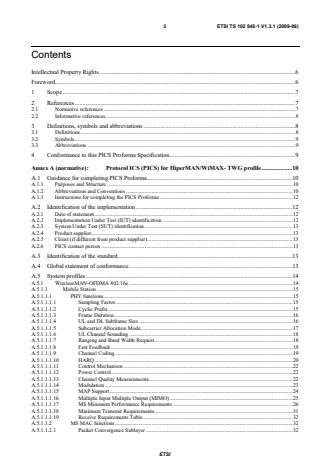
Contents
Intellectual Property Rights.6
Foreword.6
1 Scope.7
2 References.7
2.1 Normative references.7
2.2 Informative references.8
3 Definitions, symbols and abbreviations .8
3.1 Definitions.8
3.2 Symbols.9
3.3 Abbreviations.9
4 Conformance to this PICS Proforma Specification.9
Annex A (normative): Protocol ICS (PICS) for HiperMAN/WiMAX- TWG profile.10
A.1 Guidance for completing PICS Proforma.10
A.1.1 Purposes and Structure .10
A.1.2 Abbreviations and Conventions .10
A.1.3 Instructions for completing the PICS Proforma .12
A.2 Identification of the implementation .12
A.2.1 Date of statement.12
A.2.2 Implementation Under Test (IUT) identification .12
A.2.3 System Under Test (SUT) identification.13
A.2.4 Product supplier.13
A.2.5 Client (if different from product supplier).13
A.2.6 PICS contact person .13
A.3 Identification of the standard.13
A.4 Global statement of conformance.13
A.5 System profiles.14
A.5.1 WirelessMAN-OFDMA 802.16e .14
A.5.1.1 Mobile Station.15
A.5.1.1.1 PHY functions.15
A.5.1.1.1.1 Sampling Factor.15
A.5.1.1.1.2 Cyclic Prefix.15
A.5.1.1.1.3 Frame Duration.16
A.5.1.1.1.4 UL and DL Subframe Size .16
A.5.1.1.1.5 Subcarrier Allocation Mode .17
A.5.1.1.1.6 UL Channel Sounding.18
A.5.1.1.1.7 Ranging and Band Width Request.18
A.5.1.1.1.8 Fast Feedback.19
A.5.1.1.1.9 Channel Coding.19
A.5.1.1.1.10 HARQ.20
A.5.1.1.1.11 Control Mechanism.22
A.5.1.1.1.12 Power Control.22
A.5.1.1.1.13 Channel Quality Measurements.22
A.5.1.1.1.14 Modulation.23
A.5.1.1.1.15 MAP Support.24
A.5.1.1.1.16 Multiple Input Multiple Output (MIMO) .25
A.5.1.1.1.17 MS Minimum Performance Requirements.26
A.5.1.1.1.18 Minimum Transmit Requirements.31
A.5.1.1.1.19 Receive Requirements Table.32
A.5.1.1.2 MS MAC functions.32
A.5.1.1.2.1 Packet Convergence Sublayer .32
ETSI
4 ETSI TS 102 545-1 V1.3.1 (2009-06)
A.5.1.1.2.2 MAC common part sub layer .33
A.5.1.2 Base Station.51
A.5.1.2.1 PHY functions.51
A.5.1.2.1.1 Sampling Factor.51
A.5.1.2.1.2 Cyclic Prefix.51
A.5.1.2.1.3 Frame Duration.52
A.5.1.2.1.4 TTG/RTG.52
A.5.1.2.1.5 UL and DL Subframe Size .53
A.5.1.2.1.6 Subcarrier Allocation Mode .54
A.5.1.2.1.7 UL Channel Sounding.54
A.5.1.2.1.8 Ranging and Band Width Request.55
A.5.1.2.1.9 Fast Feedback.56
A.5.1.2.1.10 Channel Coding.56
A.5.1.2.1.11 HARQ.57
A.5.1.2.1.12 Control Mechanism.57
A.5.1.2.1.13 Power Control.57
A.5.1.2.1.14 Channel Quality Measurements.58
A.5.1.2.1.15 Modulation.59
A.5.1.2.1.16 MAP Support.61
A.5.1.2.1.17 Multiple Input Multiple Output (MIMO) .61
A.5.1.2.1.18 BS Performance Requirements.62
A.5.1.2.1.19 Minimum Transmit Requirements.65
A.5.1.2.1.20 Receive Requirements.65
A.5.1.2.1.21 BS Synchronization.66
A.5.1.2.2 BS MAC functions.66
A.5.1.2.2.1 Packet Convergence Sublayer .66
A.5.1.2.2.2 MAC common part sub layer .67
A.6 List of PDUs, MAP IEs, sub-headers, and extended sub-headers.84
A.6.1 PDUs for MAC layer.84
A.6.1.1 PDUs for network entry and initialization .84
A.6.1.2 PDUs for service flows .85
A.6.1.3 PDUs for ARQ.87
A.6.1.4 PDUs for miscellaneous capabilities .88
A.6.1.5 PDUs for security .89
A.6.1.6 PDUs for Sleep Mode.90
A.6.1.7 PDUs for Handover .91
A.6.1.8 PDUs for Idle mode .93
A.6.1.9 PDUs for Feedback.93
A.6.1.10 PDUs and MAP IEs for Power Control .94
A.6.1.11 PDUs for band AMC .96
A.6.2 MAP IEs.98
A.7 PDU fields.102
A.7.1 Fields of PDUs for MAC layer.102
A.7.1.1 DL-MAP.102
A.7.1.2 DCD.103
A.7.1.3 UCD.104
A.7.1.4 UL-MAP.106
A.7.1.5 RNG-REQ and RNG-RSP .108
A.7.1.6 SBC-REQ and SBC-RSP.109
A.7.1.7 ARQ messages.112
A.7.1.8 RES-CMD.113
A.7.1.9 CLK-CMP.113
A.7.1.10 DREG-REQ and DREG-CMD .113
A.7.1.11 DSX-RVD.114
A.7.1.12 REP-REQ and REP-RSP .114
A.7.1.13 FPC.115
A.7.1.14 REG-REQ and REG-RSP.115
A.7.1.15 PKM-REQ and PKM-RSP Messages .119
A.7.1.16 DSA-REQ, DSA-RSP and DSA-ACK messages .122
A.7.1.17 DSC-REQ, DSC-RSP and DSC-ACK messages.126
ETSI
5 ETSI TS 102 545-1 V1.3.1 (2009-06)
A.7.1.18 DSD-REQ and DSD-RSP messages.127
A.7.1.19 TLVs for Handover, Sleep and Idle Mode.128
A.7.1.20 MOB_NBR-ADV .132
A.7.1.21 MOB_SCN-REQ.132
A.7.1.22 MOB_SCN-RSP.133
A.7.1.23 MOB_SCN-REP.134
A.7.1.24 MOB_BSHO-REQ.135
A.7.1.25 MOB_BSHO-RSP.136
A.7.1.26 MOB_MSHO-REQ.136
A.7.1.27 MOB_HO-IND.137
A.7.1.28 PDUs fields for Idle Mode.137
A.7.1.29 Feedback.137
A.7.1.30 NSP Selection.138
History .139
ETSI
6 ETSI TS 102 545-1 V1.3.1 (2009-06)
Intellectual Property Rights
IPRs essential or potentially essential to the present document may have been declared to ETSI. The information
pertaining to these essential IPRs, if any, is publicly available for ETSI members and non-members, and can be found
in ETSI SR 000 314: "Intellectual Property Rights (IPRs); Essential, or potentially Essential, IPRs notified to ETSI in
respect of ETSI standards", which is available from the ETSI Secretariat. Latest updates are available on the ETSI Web
server (http://webapp.etsi.org/IPR/home.asp).
Pursuant to the ETSI IPR Policy, no investigation, including IPR searches, has been carried out by ETSI. No guarantee
can be given as to the existence of other IPRs not referenced in ETSI SR 000 314 (or the updates on the ETSI Web
server) which are, or may be, or may become, essential to the present document.
Foreword
This Technical Specification (TS) has been produced by ETSI Technical Committee Broadband Radio Access
Networks (BRAN).
The present document specifies the Protocol Implementation Conformance Statement (PICS) for High PERformance
Radio Metropolitan Area Network (HiperMAN) and WiMAX, which operates on frequencies between 2 GHz and
11 GHz.
The present document has been developed on the basis of preceding versions of HiperMAN and WiMAX PICS and
makes the previous versions obsolete.
The present document is part 1 of a multi-part deliverable covering Broadband Radio Access Networks (BRAN);
HiperMAN; Conformance testing for WiMAX/HiperMAN 1.3.1, as identified below:
Part 1: "Protocol Implementation Conformance Statement (PICS) proforma";
Part 2: "Test Suite Structure and Test Purposes (TSS&TP)";
Part 3: "Abstract Test Suite (ATS)".
ETSI
7 ETSI TS 102 545-1 V1.3.1 (2009-06)
1 Scope
The present document specifies the Protocol Implementation Conformance Statement (PICS) for HiperMAN/WiMAX
per ISO/IEC 9646-7 [10], ITU-T Recommendation X.296 [11] and EG 201 058 [12] for conformance of
HiperMAN1.3.1/WiMAX compliant systems.
2 References
References are either specific (identified by date of publication and/or edition number or version number) or
non-specific.
• For a specific reference, subsequent revisions do not apply.
• Non-specific reference may be made only to a complete document or a part thereof and only in the following
cases:
- if it is accepted that it will be possible to use all future changes of the referenced document for the
purposes of the referring document;
- for informative references.
Referenced documents which are not found to be publicly available in the expected location might be found at
http://docbox.etsi.org/Reference.
NOTE: While any hyperlinks included in this clause were valid at the time of publication ETSI cannot guarantee
their long term validity.
2.1 Normative references
The following referenced documents are indispensable for the application of the present document. For dated
references, only the edition cited applies. For non-specific references, the latest edition of the referenced document
(including any amendments) applies.
[1] ETSI TS 102 177: "Broadband Radio Access Networks (BRAN); HiperMAN; Physical (PHY)
layer".
[2] ETSI TS 102 178: "Broadband Radio Access Networks (BRAN); HiperMAN; Data Link Control
(DLC) layer".
[3] ETSI TS 102 210: "Broadband Radio Access Networks (BRAN); HiperMAN; System profiles".
[4] IEEE 802.16-2004: "IEEE Standard for Local and Metropolitan Area Networks - Part 16: Air
Interface for Fixed Broadband Wireless Access Systems".
[5] IEEE 802.16e-2005 and IEEE 802.16-2004/Cor 1-2005: "Standard for Local and metropolitan area
networks - Part 16: Air Interface for Fixed and Mobile Broadband Wireless Access Systems.
Amendment 2: Physical and Medium Access Control Layers for Combined Fixed and Mobile
Operation in Licensed Bands and Corrigendum1".
[6] IEEE 802.16-Rev2/D7 (October 2008): "Standard for Local and metropolitan area networks - Part
16: Air Interface for Broadband Wireless Access Systems.
[7] WiMAX ForumTM Mobile System Profile v16.1: "WiMAX ForumTM, Technical Working
Group, April 2008".
[8] WiMAX ForumTM Mobile Radio Specifications v0.1.0: "WiMAX ForumTM, Technical Working
Group, April 2008".
[9] ISO/IEC 9646-1: "Information technology - Open Systems Interconnection - Conformance testing
methodology and framework - Part 1: General concepts".
ETSI
8 ETSI TS 102 545-1 V1.3.1 (2009-06)
[10] ISO/IEC 9646-7: "Information technology - Open Systems Interconnection - Conformance testing
methodology and framework - Part 7: Implementation Conformance Statements".
[11] ITU-T Recommendation X.296: "OSI conformance testing methodology and framework for
protocol Recommendations for ITU-T applications - Implementation conformance statements".
[12] ETSI EG 201 058: "Methods for Testing and Specification (MTS); Implementation Conformance
Statement (ICS) proforma style guide".
[13] IEEE 802.3: "IEEE Standard for Information technology - Telecommunications and information
exchange between systems - Local and metropolitan area networks - specific requirements - Part 3:
Carrier Sense Multiple Access with Collision Detection (CSMA/CD) Access Method and Physical
Layer Specifications".
[14] IEEE 802.1Q: "IEEE Standards for Local and metropolitan area networks - Virtual Bridged Local
Area Networks".
[15] ITU-T Recommendation X.690: "Information technology - ASN.1 encoding rules: Specification of
Basic Encoding Rules (BER), Canonical Encoding Rules (CER) and Distinguished Encoding
Rules (DER)".
[16] IETF RFC 2131: "Dynamic Host Configuration Protocol".
[17] IETF RFC 868: "Time Protocol".
[18] IEEE 802.2 (ISO/IEC 8802-2:1998): "EEE Standard for Information technology -
Telecommunications and information exchange between systems - Local and metropolitan area
networks - Specific Requirements - Part 2: Logical Link Control".
[19] IEEE 802.1D: "IEEE standard for local and metropolitan area networks--Media access control
(MAC) Bridges (Incorporates IEEE 802.1t-2001 and IEEE 802.1w)".
[20] IETF RFC 3344: "IP Mobility Support for IPv4 ".
2.2 Informative references
The following referenced documents are not essential to the use of the present document but they assist the user with
regard to a particular subject area. For non-specific references, the latest version of the referenced document (including
any amendments) applies.
Not applicable.
3 Definitions, symbols and abbreviations
3.1 Definitions
For the purposes of the present document, the terms and definitions given in ISO/IEC 9646-1 [9], TS 102 177 [1],
TS 102 178 [2], ISO/IEC 9646-7 [10] and IEEE 802.16-2004 [4] with Corrigendum and Amendment as provided by
IEEE 802.16e-2005 [5] apply.
ETSI
9 ETSI TS 102 545-1 V1.3.1 (2009-06)
3.2 Symbols
For the purposes of the present document, the following symbols apply:
BW Nominal channel bandwidth (MHz)
m CID range divider
P Maximum mean transmit power at the antenna port (dBm)
TX,max
T Useful OFDM symbol time (s)
b
T Frame duration (ms)
F
T OFDM symbol guard time or CP time (s)
g
T OFDM symbol time (s)
s
3.3 Abbreviations
For the purposes of the present document, the abbreviations given in TS 102 177 [1], TS 102 178 [2],
ISO/IEC 9646-1 [9] and the following apply:
BS Base Station
IUT Implementation Under Test
MS Mobile Station
PICS Protocol Implementation Conformance Statement
SUT System Under Test
4 Conformance to this PICS Proforma Specification
If it claims to conform to the present document, the actual PICS proforma to be filled in by a supplier shall be
technically equivalent to the text of the PICS proforma given in annex A, and shall preserve the numbering, naming,
and ordering of the proforma items.
A PICS which conforms to the present document shall be a conforming PICS proforma completed in accordance with
the guidance for completion given in clause A.1.
ETSI
10 ETSI TS 102 545-1 V1.3.1 (2009-06)
Annex A (normative):
Protocol ICS (PICS) for HiperMAN/WiMAX- TWG profile
Notwithstanding the provisions of the copyright clause related to the text of the present document, ETSI grants that
users of the present document may freely reproduce the PICS proforma in this annex so that it can be used for its
intended purposes and may further publish the completed PICS.
A.1 Guidance for completing PICS Proforma
A.1.1 Purposes and Structure
The purpose of this PICS proforma is to provide a mechanism whereby a supplier of an implementation of the
requirements defined in defined in references [1], [2](which mandates requirements defined in [4] and [5]) may provide
information about the implementation in a standardized manner. The PICS proforma does not cover every possible
compliant WiMAX implementation, but only those implementations that are compliant with the system profiles as
defined in [7] and [8].
The PICS proforma is subdivided into clauses for the following categories of information:
• guidance for completing the PICS proforma;
• identification and implementation;
• identification of the standard;
• global statement of conformance;
• roles;
• Mobile Station (MS);
• Base Station (BS);
• List of MAC PDUs;
• PDU Fields.
A.1.2 Abbreviations and Conventions
Item column
• The Item column contains a number which identifies the item in the table.
Capability column
• The capability column describes in free text each respective item (e.g. parameters, timers, etc.). It implicitly
means "Is supported by the implementation?".
Reference column
• The reference column indicates the clause of [1], [2], [4], [5] and [7] from which the requirement for the
capability is derived.
• By convention, indicating a clause of [5] may also refer implicitly to [1], [2], [4], and [7] as applicable.
ETSI
11 ETSI TS 102 545-1 V1.3.1 (2009-06)
Status column
• The following notations, defined in [9], are used in the status column:
m Explicitly shown as mandatory in the standard. It is required to implement.
o Explicitly mentioned as optional in the standard or is not explicitly mentioned but has capability
negotiations. It may or may not be implemented.
oi Qualified option- for mutually exclusive or selectable options from a set. One or more of the options from
the set shall be supported.
IO-NNNN Inter-operable Options: Item belongs to NNNN group of features for which it is requested to provide
testing procedure and distinct labelling of BS equipment. More specifically:
The item is not required to get general "WiMAX certified" label; and
Is required to get distinct "WiMAX certified with NNNN capability" label.
The following Inter-operable Options are defined and used in the present document:
1. IO-MIMO: Group of Inter-operable Option features related to Multiple Input Multiple Output (MIMO)
operation.
2. IO-BF: Group of Inter-operable Option features related to Beam Forming (BF) operation.
3. IO-MBS: Group of Inter-operable Option features related to Multicast and Broadcast Services (MBS)
operation.
4. IO-ETHx (x = 1, 2, 3): Groups of features on three Inter-operable options related to Ethernet CS IO-ETH1, IO-
ETH2 and IO-ETH3.
Support column
• The support column shall be filled in by the supplier of the implementation. The following common notations,
defined in [9] are used for the support column.
Y or y Supported by implementation.
N or n Not supported by implementation.
N/A, n/a or - No answer required (allowed only if the status is n/a either directly or after the evaluation of a
conditional status).
Values allowed column
• The values allowed column is only used when necessary in a table. It contains the type, the list, the range, or
the length of values allowed. The following notations are used.
Range of values: to
Example: 5 to 20
List of values: , , to,
Example 1: 2, 4, 6, 8, 9
Example 2: 1101b, 1011b, 1111b
Example 3: 0x0A, 0x34, 0x2F
List of named values: (), (), to, ()
Example: reject(1), accept(2)
Length: Size ( to )
Example: Size (1 to 8)
Values supported column
• The values supported column is only present when the values allowed column is present. It shall be filled in by
the supplier of the implementation. In this column, the value or the ranges of values supported by the
implementation shall be indicated.
ETSI
12 ETSI TS 102 545-1 V1.3.1 (2009-06)
Reference to items
• For each possible item answer in the support column within the PICS proforma a unique reference exists
which may be used, for example, in conditional expressions. It is defined as the table identifier, followed by
the "/" character, followed by the item number in the table. If there is more than one support column in a table,
the columns are discriminated by letters (a, b, etc.).
Example 1: Table A.5/4 is the reference to the answer of item 4 in table A.5.
Example 2: Table A.6/3b is the reference to the second answer (i.e. in the second support column) of
item 3 in table A.6.
Prerequisite Line
• A prerequisite line takes the form: Prerequisite: .
• A prerequisite line after a clause or table title indicates that the entire clause or the entire table is not required
to be completed if the predicate is FALSE.
Support of specific MAC PDUs or fields does not automatically mean support of the corresponding functionality. It
means only that BS(MS) is capable of transmitting or receiving/parsing the message of specific format.
A.1.3 Instructions for completing the PICS Proforma
The supplier of the implementation shall complete the PICS proforma in each of the spaces provided. In particular, an
explicit answer shall be entered, in the support or values supported column boxes provided, using the notation described
in clause A.1.2.
However, tables related to Mobile Station shall only be completed for Mobile Station (MS) implementations, and tables
related to Base Station shall only be filled in for Base Station implementations.
If necessary, the supplier may provide additional comments in space at the bottom of the tables or separately.
A.2 Identification of the implementation
Identification of the Implementation Under Test (IUT) and the system in which it resides (the System Under Test
(SUT)) should be filled in so as to provide as much detail as possible regarding version numbers and configuration
options.
The product supplier and client information should both be filled in if they are different.
A person who can answer queries regarding information supplied in the PICS should be named as the contact person.
A.2.1 Date of statement
Date of statement
(MM/DD/YYYY):
A.2.2 Implementation Under Test (IUT) identification
IUT name:
IUT version:
ETSI
13 ETSI TS 102 545-1 V1.3.1 (2009-06)
A.2.3 System Under Test (SUT) identification
SUT name:
Hardware configuration:
Operating system:
A.2.4 Product supplier
Name:
Address:
Telephone Number:
Fax Number:
E-mail address:
Additional information:
A.2.5 Client (if different from product supplier)
Name:
Address:
Telephone Number:
Fax Number:
E-mail address:
Additional information:
A.2.6 PICS contact person
(A person to contact if there are any queries concerning the content of the PICS.)
Name:
Address:
Telephone Number:
Fax Number:
E-mail address:
Additional information:
A.3 Identification of the standard
This PICS proforma applies to the ETSI HiperMAN/WiMAX standard consisting of the following normative
references:
• HiperMAN/WiMAX Physical Layer: [1] which normatively references [4] and [5];
• HiperMAN/WiMAX Data Logical Control Layer: [2] which normatively references [4] and [5].
A.4 Global statement of conformance
Are all mandatory capabilities implemented? (Yes/No)
NOTE: Answering "No" to this question indicates non-conformance to the HiperMAN/WiMAX standard.
Non-supported mandatory capabilities are to be identified in the PICS, with an explanation of why the
implementation is non-conforming, on pages attached to the PICS proforma.
ETSI
14 ETSI TS 102 545-1 V1.3.1 (2009-06)
A.5 System profiles
Table A.1: System profiles
Item Role Reference Status Support
TM
1 [7] m
WiMAX Forum Mobile System Profile
Comments:
Table A.2: Roles
Item Role Reference Status Support
1 Mobile Station (MS) [5] and [6] oi.2.1
1.4.3
2 Base Station (BS) [5] and [6] oi.2.1
1.4.3
Comments:
oi.2.1: It is mandatory to support exactly one of these items.
A.5.1 WirelessMAN-OFDMA 802.16e
Table A.3: Band Class Group
WirelessMAN-OFDMA 802.16e
Item Capability Reference Status Support
1 Prof1.A_2.3 - 8,75 MHz channel PHY (2,3 GHz to 2,4 GHz) [7] 6 oi.3.1
2 Prof1.B_2.3 - 5 AND 10 MHz channel PHY (2,3 GHz to 2,4 GHz) [7] 6 oi.3.1
3 Prof2.A_2.305 - 3,5 MHz channel PHY (2,305 GHz to 2,320, 2,345 GHz to [7] 6 oi.3.1
2,360 GHz)
4 Prof2.B_2.305 - 5 MHz channel PHY (2,305 GHz to 2,320, 2,345 GHz to [7] 6 oi.3.1
2,360 GHz)
5 Prof2.C_2.305 -10 MHz channel PHY (2,305 GHz to 2,320, 2,345 GHz to [7] 6 oi.3.1
2,360 GHz)
6 Prof3.A_2.496 - 5 AND 10 MHz channel PHY (2,496 GHz to 2,69 GHz) [7] 6 oi.3.1
7 Prof4.A_3.3 - 5 MHz channel PHY (3,3 GHz to 3,4 GHz) [7] 6 oi.3.1
8 Prof4.B_3.3 - 7 MHz channel PHY (3,3 GHz to 3,4 GHz) [7] 6 oi.3.1
9 Prof4.C_3.3 - 10 MHz channel PHY (3,3 GHz to 3,4 GHz) [7] 6 oi.3.1
10 Prof5.A_3.4 - 5 MHz channel PHY (3,4 GHz to 3,8 GHz) [7] 6 oi.3.1
Prof5L.A_3.4 - 5 MHz channel PHY (3,4 GHz to 3,6 GHz) oi.3.1
Prof5H.A_3.4 - 5 MHz channel PHY (3,6 GHz to 3,8 GHz) oi.3.1
11 Prof5.B_3.4 - 7 MHz channel PHY (3,4 GHz to 3,8 GHz) [7] 6 oi.3.1
Prof5L.B_3.4 - 7MHz channel PHY (3,4 GHz to 3,6 GHz) oi.3.1
Prof5H.B_3.4 - 7 MHz channel PHY (3,6 GHz to 3.8 GHz) oi.3.1
Prof5.C_3.4 - 10 MHz channel PHY (3,4 GHz to 3,8 GHz) [7] 6 oi.3.1
Prof5L.C_3.4 - 10 MHz channel PHY (3,4 GHz to 3,6 GHz) oi.3.1
Prof5H.C_3,4 - 10 MHz channel PHY (3,6 GHz to 3,8 GHz) oi.3.1
Comments:
oi.3.1: It is mandatory to support at least one of these items.
With regards to Items 2 and 6, the BS shall support 5 MHz or 10 MHz or both bandwidth sizes.
ETSI
15 ETSI TS 102 545-1 V1.3.1 (2009-06)
Table A.4: Power classes
WirelessMAN-OFDMA 802.16e
Item Capability Reference Status Support
Transmit Power (dBm) for Transmit Power (dBm) for
16QAM QPSK
1 18 ≤ PTx,max < 21 20 ≤ PTx,max < 23 [7] 7 oi.4.1
2 21 ≤ PTx,max < 25 23 ≤ PTx,max < 27 [7] 7 oi.4.1
3 25 ≤ PTx,max < 30 27 ≤ PTx,max < 30 [7] 7 oi.4.1
4 30 ≤ PTx,max 30 ≤ PTx,max [7] 7 oi.4.1
Comments:
oi.4.1: It is mandatory to support at least one of these items.
The Power Classes listed in this table is developed to cover the complete target range of power levels while
different interpretation of applicable modulation levels is addressed through a dual range requirement for QPSK
and 16QAM per Power Class.
Table A.5: Duplexing modes
WirelessMAN-OFDMA 802.16e
Item Capability Reference Status Support
1 TDD Time Division Duplexing [5] and [6] m
6.3.7.2,
[7] 4.1.1.2
Comments:
A.5.1.1 Mobile Station
A.5.1.1.1 PHY functions
A.5.1.1.1.1 Sampling Factor
Table A.6: Sampling Factor for MS
Mobile Station (MS)
Item Capability Reference Status Support
1 8/7 [5] and [6] m
8.4.2.3
[7] 4.1.1.3
2 28/25 [5] and [6] m
8.4.2.3
[7] 4.1.1.3
Comments:
Item 1 is used for A.3-1, 3, 8 and 11 and Item 2 is used for A.3-2, 4, 5, 6, 7, 9, 10 and 12.
A.5.1.1.1.2 Cyclic Prefix
Table A.7: Cyclic Prefix for MS
Mobile Station (MS)
Item Capability Reference Status Support
1 1/8 [5] and [6] 8.4.2.3, m
[7] 4.1.1.4
Comments:
ETSI
16 ETSI TS 102 545-1 V1.3.1 (2009-06)
A.5.1.1.1.3 Frame Duration
Table A.8: Frame duration codes for MS
Mobile Station (MS)
Item Capability Reference Status Support
1 5 msec [5] and [6] m
8.4.5.2,
[7] 4.1.1.5
Comments:
A.5.1.1.1.4 UL and DL Subframe Size
Table A.9: Number of OFDM Symbols in DL and UL
Mobile Station (MS)
Item Capability Value Reference Status Support
Number of OFDM (35, 12) [5] and [6] oi.9.1
1 Symbols in DL and UL for (34, 13) 8.4.4.2,
5 MHz BW [7] 4.1.1.7
(33, 14)
(32, 15)
(31, 16)
(30, 17)
(29, 18)
(28, 19)
(27, 20)
(26, 21)
2 Number of OFDM (35, 12) [5] and [6] oi.9.1
Symbols in DL and UL for (34, 13) 8.4.4.2,
10 MHz BW [7] 4.1.1.7
(33, 14)
(32, 15)
(31, 16)
(30, 17)
(29, 18)
(28, 19)
(27, 20)
(26, 21)
3 Number of OFDM (30, 12) [5] and [6] oi.9.1
Symbols in DL and UL for (29, 13) 8.4.4.2,
8,75 MHz BW [7] 4.1.1.7
(28, 14)
(27, 15)
(26, 16)
(25, 17)
(24,18)
4 Number of OFDM (24, 09) [5] and [6] oi.9.1
Symbols in DL and UL for 8.4.4.2,
(23, 10)
3,5 MHz BW [7] 4.1.1.7
(22, 11)
(21, 12)
(20, 13)
(19, 14)
(18, 15)
5 Number of OFDM (24, 09) [5] and [6] oi.9.1
Symbols in DL and UL for 8.4.4.2,
(23, 10)
7 MHz BW [7] 4.1.1.7
(22, 11)
(21, 12)
(20, 13)
(19, 14)
(18, 15)
Comments:
oi.9.1: It is mandatory to support at least one of these items.
First value in the pairs is number of symbols in DL subframe and the second value is the number of
symbols in UL subframe. If the MS supports one or more oi.11 item, then it shall support all DL/UL number
of symbols combinations listed associated with each channel bandwidth.
ETSI
17 ETSI TS 102 545-1 V1.3.1 (2009-06)
A.5.1.1.1.5 Subcarrier Allocation Mode
Table A.10: DL subcarrier allocation for MS
Mobile Station (MS)
Item Capability Reference Status Support
1 PUSC [5] and [6] m
8.4.6.1.2.1,
[7] 4.1.2.1
2 PUSC with all subchannels [5] and [6] m
8.4.6.1.2.1,
[7] 4.1.2.1
3 PUSC with dedicated pilots [5] and [6] m
8.4.6.1.2.1,
8.4.5.3.4,
[7] 4.1.2.1
4 FUSC [5] and [6] m
8.4.6.1.2.2,
[7] 4.1.2.1
5 AMC 2x3 [5] and [6] m
8.4.6.3,
[7] 4.1.2.1
6 AMC 2x3 with dedicated pilots [5] and [6] m
8.4.6.3,
8.4.5.3.4,
[7] 4.1.2.1
Comments:
Table A.11: UL subcarrier allocation for MS
Mobile Station (MS)
Item Capability Reference Status Support
1 PUSC [5] and [6] m
8.4.6.2.1,
[7] 4.1.2.2
PUSC without subchannel rotation [5] and [6] 11.3.1 m
[7] 4.1.2.2
3 AMC 2x3 [5] and [6] m
8.4.6.3,
[7]
...
Questions, Comments and Discussion
Ask us and Technical Secretary will try to provide an answer. You can facilitate discussion about the standard in here.
Loading comments...