

ETSI EN 301 842-3 V1.3.1 (2011-09)
VHF air-ground Digital Link (VDL) Mode 4 radio equipment; Technical characteristics and methods of measurement for ground-based equipment; Part 3: Additional broadcast aspects
General Information
- Abstract
REN/AERO-00006-3
- Status
- Published
- Publication Date
- 25-Sep-2011
- Technical Committee
- AERO - Aeronautics
- Current Stage
- 12 - Completion
- Due Date
- 03-Oct-2011
- Completion Date
- 26-Sep-2011
Buy Documents
en_30184203v010301c - VHF air-ground digital Link (VDL) Mode 4 radio equipment; Technical characteristics and methods of measurement for ground-based equipment; Part 3: Additional broadcast aspects
en_30184203v010301p - VHF air-ground Digital Link (VDL) Mode 4 radio equipment; Technical characteristics and methods of measurement for ground-based equipment; Part 3: Additional broadcast aspects
en_30184203v010301v - VHF air-ground digital Link (VDL) Mode 4 radio equipment; Technical characteristics and methods of measurement for ground-based equipment; Part 3: Additional broadcast aspects

Overview
ETSI EN 301 842-3 V1.3.1 (2011-09) (ETSI EN 301 842-3) defines the technical characteristics and measurement methods for VDL Mode 4 ground-based radio equipment used in VHF air–ground digital link communications. The document addresses ground station transceivers, transmitters and receivers that operate with Gaussian-filtered Frequency Shift Keying (GFSK) modulation, 25 kHz channel spacing, and tuning across the VHF aviation band specified by ICAO (118.000–136.975 MHz), with a possible future extension to 108.000–117.975 MHz. Part 3 focuses on additional broadcast aspects and is intended to ensure compatibility with ICAO VDL SARPs and the VDL Mode 4 Technical Manual.
Key topics and technical requirements
- Scope and applicability
- Ground-station-only specification (airborne equivalent: EN 302 842).
- Supports full ADS-B capability and optionally TIS-B, FIS-B, and GNS-B services.
- Air–ground link characteristics
- GFSK modulation, 25 kHz channel spacing, ICAO VHF channel tuning.
- Functional requirements
- Message formats, reporting procedures and channel management for ADS-B, Traffic Information Service-Broadcast (TIS-B), Flight Information Service-Broadcast (FIS-B), and GNSS Augmentation Service-Broadcast (GNS-B).
- Definition of minimum receive/transmit functionality when the service processor is external to the transceiver (e.g., passing FIS-B report requests to a separate processor).
- Performance and protocol testing
- Detailed performance specifications under standard test conditions.
- Protocol test suites and test-rig requirements to validate ADS-B / TIS-B / FIS-B / GNS-B behavior.
- Design and measurement
- General design requirements and methods of measurement for ground equipment.
- Documentation and structure
- Clauses covering references, definitions, link-layer description, performance specs, design, protocol tests, plus Annex A (cross-reference) and Annex B (bibliography).
Practical applications and users
- Manufacturers of VDL Mode 4 ground transceivers and base stations - for product design, certification and interoperability.
- Test laboratories and certification bodies - to develop conformance and performance test procedures.
- Air Navigation Service Providers (ANSPs) and airports - to deploy and integrate ADS-B, TIS-B, FIS-B and GNS-B broadcast services.
- Regulators and systems integrators - for compliance with ICAO SARPs and national transposition of ETSI/SIST standards.
Related standards and references
- EN 301 842-1: physical layer tests
- EN 301 842-2: link layer and system description
- EN 302 842: airborne equipment equivalent
- ICAO VDL Digital Link SARPs and VDL Mode 4 Technical Manual
Keywords: VDL Mode 4, VHF air–ground digital link, ADS-B, TIS-B, FIS-B, GNS-B, GFSK, 25 kHz, ground station, EN 301 842-3, ETSI, SIST, ICAO.
Buy Documents
en_30184203v010301c - VHF air-ground digital Link (VDL) Mode 4 radio equipment; Technical characteristics and methods of measurement for ground-based equipment; Part 3: Additional broadcast aspects
en_30184203v010301p - VHF air-ground Digital Link (VDL) Mode 4 radio equipment; Technical characteristics and methods of measurement for ground-based equipment; Part 3: Additional broadcast aspects
en_30184203v010301v - VHF air-ground digital Link (VDL) Mode 4 radio equipment; Technical characteristics and methods of measurement for ground-based equipment; Part 3: Additional broadcast aspects
Frequently Asked Questions
ETSI EN 301 842-3 V1.3.1 (2011-09) is a standard published by the European Telecommunications Standards Institute (ETSI). Its full title is "VHF air-ground Digital Link (VDL) Mode 4 radio equipment; Technical characteristics and methods of measurement for ground-based equipment; Part 3: Additional broadcast aspects". This standard covers: REN/AERO-00006-3
REN/AERO-00006-3
ETSI EN 301 842-3 V1.3.1 (2011-09) is available in PDF format for immediate download after purchase. The document can be added to your cart and obtained through the secure checkout process. Digital delivery ensures instant access to the complete standard document.
Standards Content (Sample)
Draft ETSI EN 301 842-3 V1.3.1 (2010-12)
European Standard (Telecommunications series)
VHF air-ground Digital Link (VDL) Mode 4 radio equipment;
Technical characteristics and methods of measurement
for ground-based equipment;
Part 3: Additional broadcast aspects
2 Draft ETSI EN 301 842-3 V1.3.1 (2010-12)
Reference
REN/AERO-00006-3
Keywords
aeronautical, digital, radio, testing, VHF
ETSI
650 Route des Lucioles
F-06921 Sophia Antipolis Cedex - FRANCE
Tel.: +33 4 92 94 42 00 Fax: +33 4 93 65 47 16
Siret N° 348 623 562 00017 - NAF 742 C
Association à but non lucratif enregistrée à la
Sous-Préfecture de Grasse (06) N° 7803/88
Important notice
Individual copies of the present document can be downloaded from:
http://www.etsi.org
The present document may be made available in more than one electronic version or in print. In any case of existing or
perceived difference in contents between such versions, the reference version is the Portable Document Format (PDF).
In case of dispute, the reference shall be the printing on ETSI printers of the PDF version kept on a specific network drive
within ETSI Secretariat.
Users of the present document should be aware that the document may be subject to revision or change of status.
Information on the current status of this and other ETSI documents is available at
http://portal.etsi.org/tb/status/status.asp
If you find errors in the present document, please send your comment to one of the following services:
http://portal.etsi.org/chaircor/ETSI_support.asp
Copyright Notification
No part may be reproduced except as authorized by written permission.
The copyright and the foregoing restriction extend to reproduction in all media.
© European Telecommunications Standards Institute 2010.
All rights reserved.
TM TM TM TM
DECT , PLUGTESTS , UMTS , TIPHON , the TIPHON logo and the ETSI logo are Trade Marks of ETSI registered
for the benefit of its Members.
TM
3GPP is a Trade Mark of ETSI registered for the benefit of its Members and of the 3GPP Organizational Partners.
LTE™ is a Trade Mark of ETSI currently being registered
for the benefit of its Members and of the 3GPP Organizational Partners.
GSM® and the GSM logo are Trade Marks registered and owned by the GSM Association.
ETSI
3 Draft ETSI EN 301 842-3 V1.3.1 (2010-12)
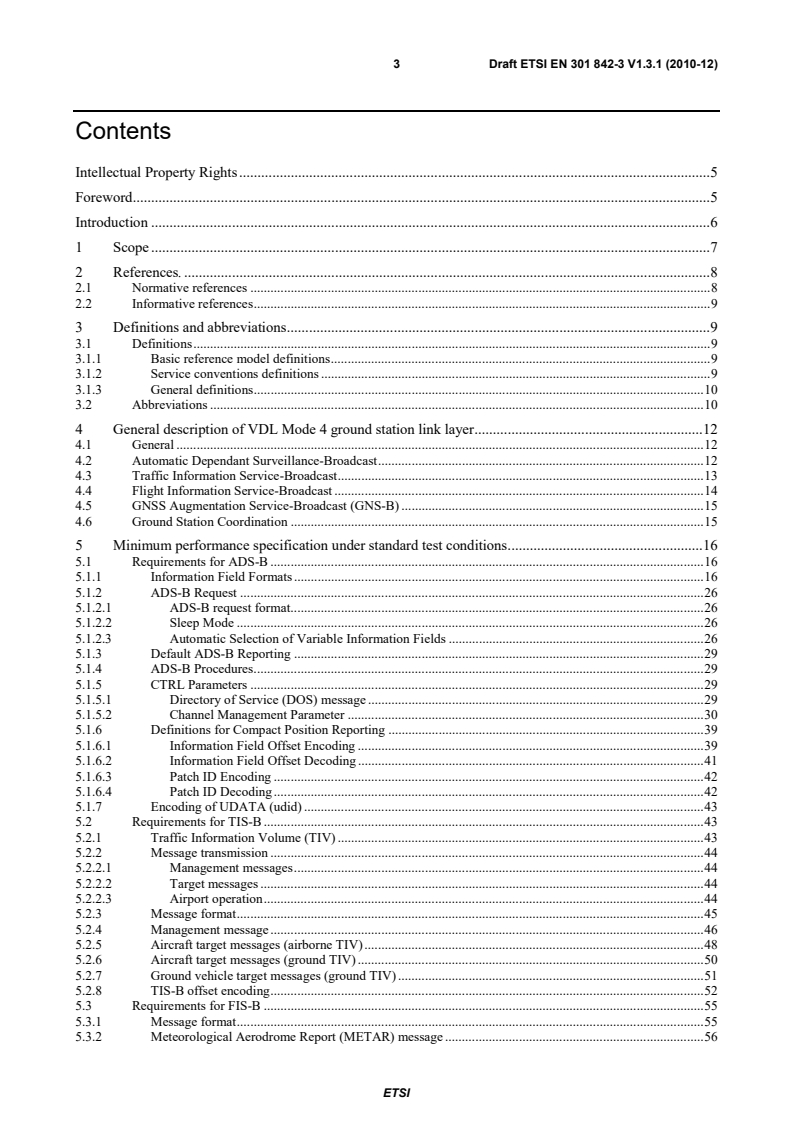
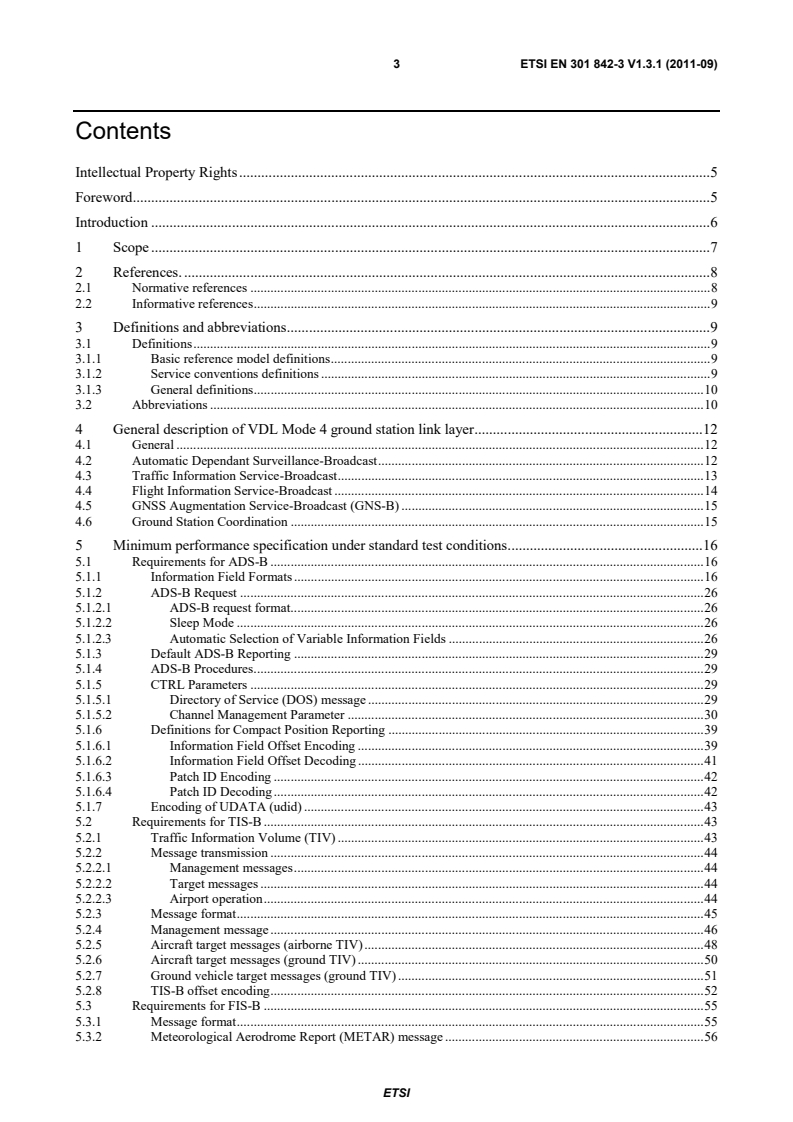
Contents
Intellectual Property Rights . 5
Foreword . 5
Introduction . 6
1 Scope . 7
2 References. . 8
2.1 Normative references . 8
2.2 Informative references . 9
3 Definitions and abbreviations . 9
3.1 Definitions . 9
3.1.1 Basic reference model definitions . 9
3.1.2 Service conventions definitions . 9
3.1.3 General definitio ns . 10
3.2 Abbreviations . 10
4 General description of VDL Mode 4 ground station link layer . 12
4.1 General . 12
4.2 Automatic Dependant Surveillance-Broadcast . 12
4.3 Traffic Information Service-Broadcast . 13
4.4 Flight Information Service-Broadcast . 14
4.5 GNSS Augmentation Service-Broadcast (GNS-B) . 15
4.6 Ground Station Coordination . 15
5 Minimum performance specification under standard test conditions . 16
5.1 Requirements for ADS-B . 16
5.1.1 Information Field Formats . 16
5.1.2 ADS-B Request . 26
5.1.2.1 ADS-B request format. 26
5.1.2.2 Sleep Mode . 26
5.1.2.3 Automatic Selection of Variable Information Fields . 26
5.1.3 Default ADS-B Reporting . 29
5.1.4 ADS-B Procedures . 29
5.1.5 CTRL Parameters . 29
5.1.5.1 Directory of Service (DOS) message . 29
5.1.5.2 Channel Management Parameter . 30
5.1.6 Definitions for Compact Position Reporting . 39
5.1.6.1 Information Field Offset Encoding . 39
5.1.6.2 Information Field Offset Decoding . 41
5.1.6.3 Patch ID Encoding . 42
5.1.6.4 Patch ID Decoding . 42
5.1.7 Encoding of UDATA (udid) . 43
5.2 Requirements for TIS-B . 43
5.2.1 Traffic Information Volume (TIV) . 43
5.2.2 Message transmission . 44
5.2.2.1 Management messages . 44
5.2.2.2 Target messages . 44
5.2.2.3 Airport operation . 44
5.2.3 Message format . 45
5.2.4 Management message . 46
5.2.5 Aircraft target messages (airborne TIV) . 48
5.2.6 Aircraft target messages (ground TIV) . 50
5.2.7 Ground vehicle target messages (ground TIV) . 51
5.2.8 TIS-B offset encoding . 52
5.3 Requirements for FIS-B . 55
5.3.1 Message format . 55
5.3.2 Meteorological Aerodrome Report (METAR) message . 56
ETSI
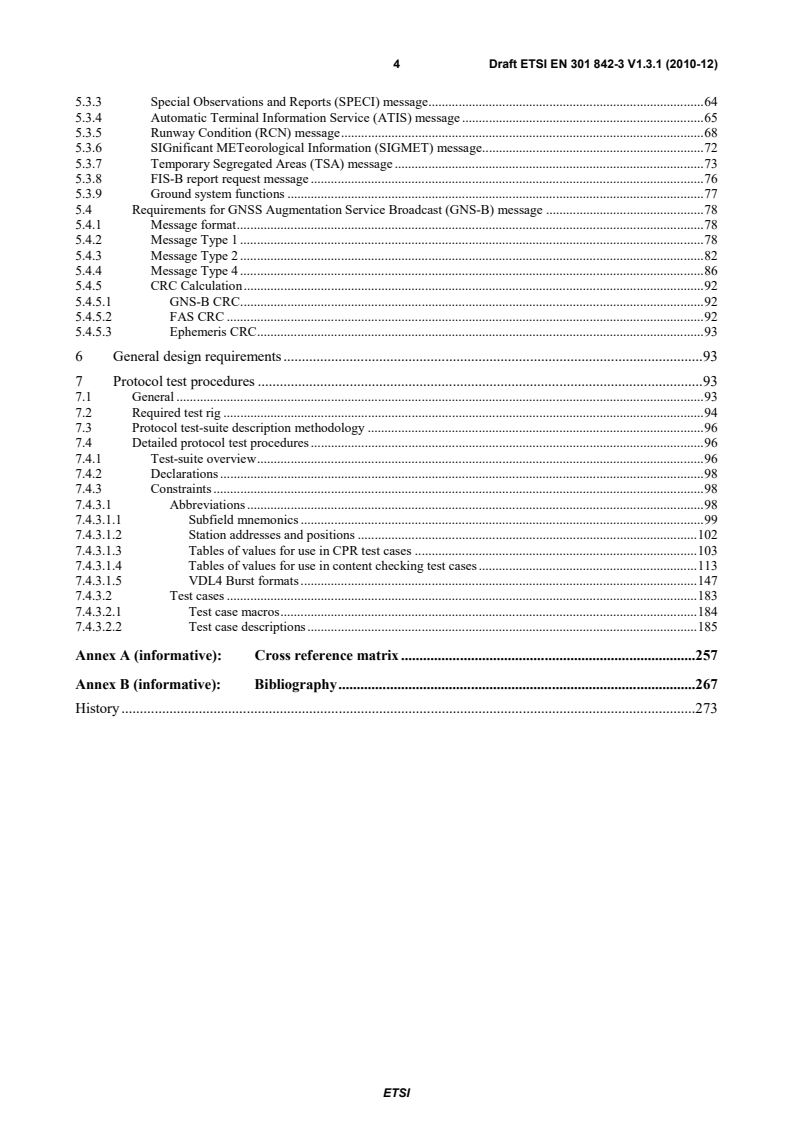
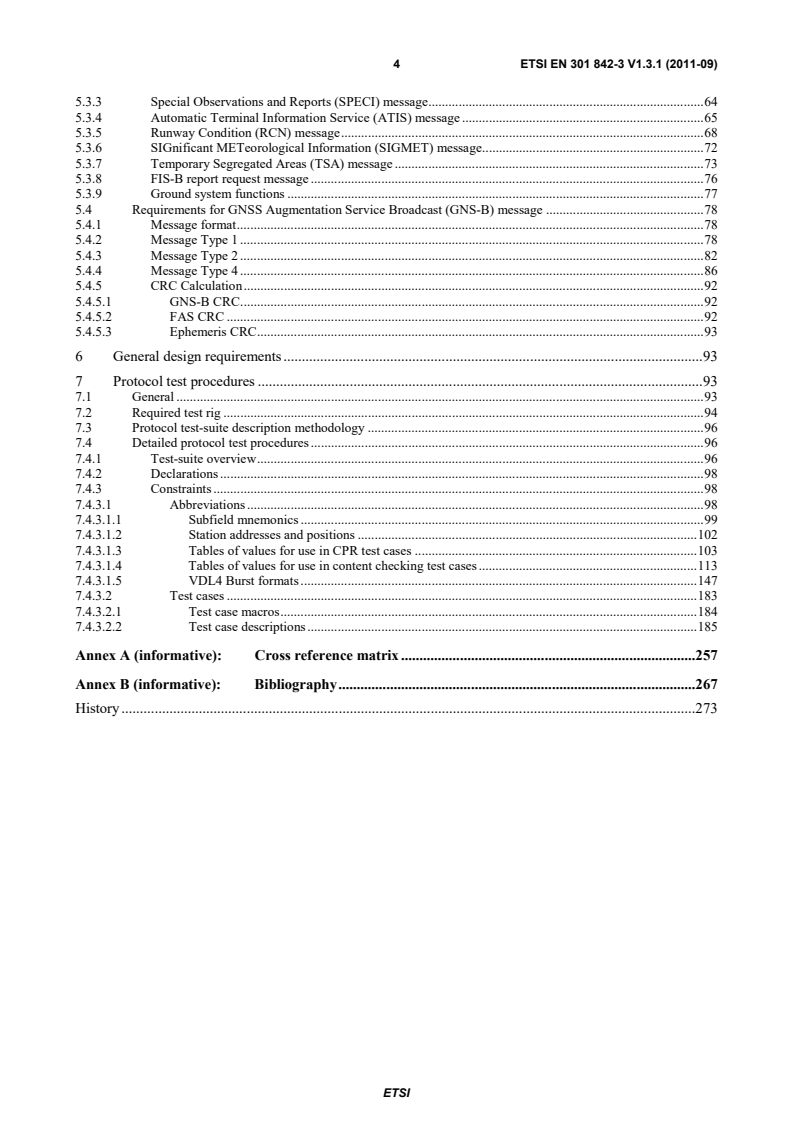
4 Draft ETSI EN 301 842-3 V1.3.1 (2010-12)
5.3.3 Special Observations and Reports (SPECI) message . 64
5.3.4 Automatic Terminal Information Service (ATIS) message . 65
5.3.5 Runway Condition (RCN) message . 68
5.3.6 SIGnificant METeorological Information (SIGMET) message . 72
5.3.7 Temporary Segregated Areas (TSA) message . 73
5.3.8 FIS-B report request message . 76
5.3.9 Ground system functions . 77
5.4 Requirements for GNSS Augmentation Service Broadcast (GNS-B) message . 78
5.4.1 Message format . 78
5.4.2 Message Type 1 . 78
5.4.3 Message Type 2 . 82
5.4.4 Message Type 4 . 86
5.4.5 CRC Calculation . 92
5.4.5.1 GNS-B CRC . 92
5.4.5.2 FAS CRC . 92
5.4.5.3 Ephemeris CRC . 93
6 General design requirements . 93
7 Protocol test procedures . 93
7.1 General . 93
7.2 Required test rig . 94
7.3 Protocol test-suite description methodology . 96
7.4 Detailed protocol test procedures . 96
7.4.1 Test-suite overview . 96
7.4.2 Declarations . 98
7.4.3 Constraints . 98
7.4.3.1 Abbreviations . 98
7.4.3.1.1 Subfield mnemonics . 99
7.4.3.1.2 Station addresses and positions . 102
7.4.3.1.3 Tables of values for use in CPR test cases . 103
7.4.3.1.4 Tables of values for use in content checking test cases . 113
7.4.3.1.5 VDL4 Burst formats . 147
7.4.3.2 Test cases . 183
7.4.3.2.1 Test case macros . 184
7.4.3.2.2 Test case descriptions . 185
Annex A (informative): Cross reference matrix . 257
Annex B (informative): Bibliography . 267
History . 273
ETSI
5 Draft ETSI EN 301 842-3 V1.3.1 (2010-12)
Intellectual Property Rights
IPRs essential or potentially essential to the present document may have been declared to ETSI. The information
pertaining to these essential IPRs, if any, is publicly available for ETSI members and non-members, and can be found
in ETSI SR 000 314: "Intellectual Property Rights (IPRs); Essential, or potentially Essential, IPRs notified to ETSI in
respect of ETSI standards", which is available from the ETSI Secretariat. Latest updates are available on the ETSI Web
server (http://webapp.etsi.org/IPR/home.asp).
Pursuant to the ETSI IPR Policy, no investigation, including IPR searches, has been carried out by ETSI. No guarantee
can be given as to the existence of other IPRs not referenced in ETSI SR 000 314 (or the updates on the ETSI Web
server) which are, or may be, or may become, essential to the present document.
Foreword
This European Standard (Telecommunications series) has been produced by ETSI Technical Committee Aeronautics
(AERO), and is now submitted for the Public Enquiry phase of the ETSI standards Two-step Approval Procedure.
The present document is part 3 of a multi-part deliverable covering the VHF air-ground Digital Link (VDL) Mode 4
radio equipment; Technical characteristics and methods of measurement for ground-based equipment, as identified
below:
Part 1: "EN for ground equipment";
Part 2: "General description and data link layer";
Part 3: "Additional broadcast aspects";
Part 4: "Point-to-point functions";
Part 5: "Harmonized EN covering the essential requirements of article 3.2 of the R&TTE Directive".
The present document is accompanied by an equivalent airborne standard, EN 302 842 [6] parts 1 to 4, covering the
VHF air-ground Digital Link (VDL) Mode 4 radio equipment; Technical characteristics and methods of measurement
for airborne equipment.
Proposed national transposition dates
Date of latest announcement of this EN (doa): 3 months after ETSI publication
Date of latest publication of new National Standard
or endorsement of this EN (dop/e): 6 months after doa
Date of withdrawal of any conflicting National Standard (dow): 6 months after doa
ETSI
6 Draft ETSI EN 301 842-3 V1.3.1 (2010-12)
Introduction
The present document is part of a set of deliverables developed by ETSI and is designed to fit in a modular structure to
cover all radio and telecommunications terminal equipment within the scope of the R&TTE Directive [i.5]. The
modular structure is shown in EG 201 399 [i.7].
The present document states the technical specifications for Very High Frequency (VHF) Digital Link (VDL) Mode 4
ground-based radio transmitters, transceivers and receivers for air-ground communications operating in the VHF band,
using Gaussian-filtered Frequency Shift Keying (GFSK) Modulation with 25 kHz channel spacing and capable of
tuning to any of the 25 kHz channels from 118,000 MHz to 136,975 MHz as defined in ICAO VHF Digital Link (VDL)
Standards and Recommended Practices (SARPs) [i.4].
The present document considers the additional broadcast functionality required to support ADS-B, TIS-B, FIS-B, and
GNS-B services.
The present document may be used to produce tests for the assessment of the performance of the equipment. The
performance of the equipment submitted for type testing should be representative of the performance of the
corresponding production model.
The present document has been written on the assumption that:
• the type test measurements will be performed only once, in an accredited test laboratory and the measurements
accepted by the various authorities in order to grant type approval;
• if equipment available on the market is required to be checked it will be tested in accordance with the methods
of measurement specified in the present document or a documented alternative approved by the certifying
authority;
• equipment comply with EN 301 489-22 [1], EN 301 842-1 [2] and EN 301 842-2 [3].
ETSI
7 Draft ETSI EN 301 842-3 V1.3.1 (2010-12)
1 Scope
The present document applies to the following radio equipment types:
• Very High Frequency (VHF) Digital Link (VDL) Mode 4 ground-based radio transmitters and receivers for
air-ground communications operating in the VHF band, using Gaussian-filtered Frequency Shift Keying
(GFSK) Modulation with 25 kHz channel spacing and capable of tuning to any of the 25 kHz channels from
118,000 MHz to 136,975 MHz as defined in ICAO VHF Digital Link (VDL) Standards and Recommended
Practices (SARPs) [i.4].
The present document provides part 3 of the technical specifications.
The present document is designed to ensure that equipment certified to it will be compatible with the relevant ICAO
VHF Digital Link (VDL) Standards and Recommended Practices (SARPs) [i.4] and VDL Mode 4 Technical
Manual (TM) [i.1].
Manufacturers should note that in future the tuning range for the ground transceivers may also cover any 25 kHz
channel from 108,000 MHz to 117,975 MHz.
The scope of the present document is limited to ground stations. The equivalent specification for airborne stations is
EN 302 842 [6].
A description of the scope of the VDL Mode 4 system is provided in EN 301 842-2 [3], clause 1.
EN 301 842-1 [2] deals with tests of the physical layer. EN 301 842-2 [3] deals with tests of the link layer sufficient to
support broadcast functionality including requirements and tests sufficient to recognize and respond to transmissions
associated with point-to-point communication. The present document provides technical specifications for a VDL Mode
4 ground-based transceiver supporting a full Automatic Dependent Surveillance-Broadcast (ADS-B) capability and,
optionally, the additional functionality of either, or a combination of, the following services:
• Traffic Information Service-Broadcast (TIS-B);
• Flight Information Service-Broadcast (FIS-B);
• GNSS Augmentation Service-Broadcast (GNS-B).
The TIS-B, FIS-B or GNS-B functionality in the ground-based equipment is expected to be provided by a TIS-B, FIS B
or GNS-B processor, which could be contained within the VDL Mode 4 transceiver, but could also be housed in a
separate physical unit. Therefore to support TIS-B, FIS-B or GNS-B, the minimum functionality demanded of a basic
VDL Mode 4 ground-based transceiver unit (i.e. one that does not have a TIS-B, FIS-B or GNS-B processor housed
within it) is to receive, from the TIS-B, FIS-B or GNS-B processor, all messages to be transmitted, and to transmit
them. In the case of FIS-B there is an additional requirement to receive report request messages (from other VDL4
stations) and to pass those messages to the FIS-B processor.
It should be noted that the specifications for TIS-B, FIS-B and GNS-B in the present document represent a first step
towards defining these applications, based on the work carried out as part of the NUP and MEDUP Programmes, and
changes to the specifications for these services may therefore occur in the future.
The present document is organized as follows:
• clause 2 provides references to relevant documents;
• clause 3 provides general definitions, abbreviations and symbols used;
• clause 4 describes the VDL Mode 4 ground station functionality to support ADS-B, TIS-B, FIS-B and GNS B;
• clause 5 provides performance specifications for the VDL Mode 4 ground station supporting ADS-B, TIS-B,
FIS-B and GNS-B Services;
• clause 6 provides general design requirements;
• clause 7 provides protocol tests which emphasis the ADS-B, TIS-B, FIS-B and GNS-B functions of the
system;
ETSI
8 Draft ETSI EN 301 842-3 V1.3.1 (2010-12)
• annex A provides a detailed cross-reference to the relevant requirements contained in [i.1];
• annex B provides a Bibliography;
• a document history.
Note that the system can support a very wide range of functions. It is not practical to provide specific tests for all
aspects of functionality. The approach used is to provide detailed tests for the core functionality to support ADS-B, FIS
B, TIS-B and GNS-B focusing on the system requirements which, if wrongly implemented, could cause a deterioration
in the service offered by other VDL Mode 4 stations.
Mandating and Recommendation Phrases
a) "Shall":
the use of the word "Shall" indicates a mandated criterion; i.e. compliance with the particular procedure or
specification is mandatory and no alternative may be applied.
b) "Should":
the use of the word "Should" (and phrases such as "It is recommended that.", etc.) indicates that though the
procedure or criterion is regarded as the preferred option, alternative procedures, specifications or criteria may
be applied, provided that the manufacturer, installer or tester can provide information or data to adequately
support and justify the alternative.
2 References.
References are either specific (identified by date of publication and/or edition number or version number) or
non-specific. For specific references, only the cited version applies. For non-specific references, the latest version of the
referenced document (including any amendments) applies.
Referenced documents which are not found to be publicly available in the expected location might be found at
http://docbox.etsi.org/Reference.
NOTE: While any hyperlinks included in this clause were valid at the time of publication ETSI cannot guarantee
their long term validity.
2.1 Normative references
The following referenced documents are necessary for the application of the present document.
[1] ETSI EN 301 489-22 (V1.3.1): "Electromagnetic compatibility and Radio spectrum Matters
(ERM); ElectroMagnetic Compatibility (EMC) standard for radio equipment and services;
Part 22: Specific conditions for ground based VHF aeronautical mobile and fixed radio
equipment".
[2] ETSI EN 301 842-1 (V1.3.2): "VHF air-ground Digital Link (VDL) Mode 4 radio equipment;
Technical characteristics and methods of measurement for ground-based equipment; Part 1: EN for
ground equipment".
[3] ETSI EN 301 842-2 (V1.6.1): "VHF air-ground Digital Link (VDL) Mode 4 radio equipment;
Technical characteristics and methods of measurement for ground-based equipment; Part 2:
General description and data link layer".
[4] ETSI EN 301 842-4 (V1.2.2): "VHF air-ground Digital Link (VDL) Mode 4 radio equipment;
Technical characteristics and methods of measurement for ground-based equipment;
Part 4: Point-to-point functions".
[5] EUROCAE ED-114 (September 2003): "MOPS for a GBAS ground facility to support CAT I
approach and landing".
ETSI
9 Draft ETSI EN 301 842-3 V1.3.1 (2010-12)
[6] ETSI EN 302 842 (all parts): "VHF air-ground and air-air Digital Link (VDL) Mode 4 radio
equipment; Technical characteristics and methods of measurement for aeronautical mobile
(airborne) equipment".
2.2 Informative references
The following referenced documents are not necessary for the application of the present document but they assist the
user with regard to a particular subject area.
[i.1] ICAO Doc 9816 AN/448 (First Edition 2004): "Manual on VHF Digital Link (VDL) Mode 4,
Part 2: Detailed Technical Specifications".
[i.2] RTCA DO-242A: "Minimum Aviation System Performance Standards for Automatic Dependent
Surveillance Broadcast (ADS-B)".
[i.3] Amendments 76 and 77 to Volume I of Annex 10 to the Convention on International Civil
Aviation, International Civil Aviation Organization: appendix B-B2, 3.6 Ground-Based
Augmentation System (GBAS).
[i.4] ICAO Annex 10 to the Convention on International Civil Aviation: "Aeronautical
Telecommunications, Volume III: Communication Systems, Part I: Digital Data Communication
Systems, chapter 6".
[i.5] Directive 1999/5/EC of the European Parliament and of the Council of 9 March 1999 on radio
equipment and telecommunications terminal equipment and the mutual recognition of their
conformity (R&TTE Directive).
[i.6] Void.
[i.7] ETSI EG 201 399: "Electromagnetic compatibility and Radio spectrum Matters (ERM); A guide to
the production of Harmonized Standards for application under the R&TTE Directive".
[i.8] WMO Publication No306: "Manual on Codes Vol 1.1, Part A".
3 Definitions and abbreviations
3.1 Definitions
3.1.1 Basic reference model definitions
See EN 301 842-2 [3], clause 3.1.1.
3.1.2 Service conventions definitions
See EN 301 842-2 [3], clause 3.1.2.
ETSI
10 Draft ETSI EN 301 842-3 V1.3.1 (2010-12)
3.1.3 General definitions
For the purposes of the present document, the terms and definitions given in EN 301 842-1 [2], clause 3.1.3, EN 301
842-2 [3], clause 3.1.3 and the following apply:
Automatic Dependent Surveillance-Broadcast (ADS-B): surveillance application transmitting parameters, such as
position, track, ground speed and time via a broadcast mode data link for use by any air and ground users requiring it
NOTE: ADS-B is a surveillance service based on aircraft self-determination of position/velocity/time and
automatic, periodic, broadcast of this information along with auxiliary data such as aircraft identity (ID),
intent information and communications control parameters, etc. ADS-B is intended to support multiple
high-level applications and associated services such as cockpit display of traffic information, traffic alert
and collision avoidance functionality, enhanced traffic management in the air and on the ground, search
and rescue support and others.
Automatic Terminal Information Service (ATIS): report generated by a ground station that includes weather
conditions, operating procedures, runways and approaches in use, and any other information that may affect the
departure, runway, and landing phase of flight
Flight Information Service-Broadcast (FIS-B): uplink broadcast application providing local airborne traffic with
information
GNSS augmentation Service-Broadcast (GNS-B): uplink broadcast application providing aircraft with GNSS
augmentation and integrity data
METeorological Aerodrome Report (METAR): report generated by a ground station that broadcasts meteorological
conditions at aerodromes, officially recoded and communicated at regular intervals
SIGnificant METeorological information (SIGMET): report generated by a ground station that broadcasts
information about weather phenomena that may have an impact on aircraft at subsonic, transonic and supersonic
cruising levels including thunderstorms, cyclones, turbulence and icing
SPECIal observations and reports (SPECI): report generated by a ground station that is issued when meteorological
conditions change sufficiently to affect aviation operations. The SPECI report contains the same information as a
METAR
Traffic Information Service-Broadcast (TIS-B): uplink surveillance service that derives traffic information from one
or more ground surveillance sources and broadcasts that information to suitably equipped aircraft or surface vehicles
Traffic Information Volume (TIV): volume of airspace for which surveillance information is provided for all targets
NOTE: Inside the TIV, a pilot knows he can rely on the surveillance picture presented to him; outside the TIV,
ADS-B reports may be received but TIS-B reports may not be available.
3.2 Abbreviations
For the purposes of the present document, the following abbreviations apply:
ADS-B Automatic Dependent Surveillance-Broadcast
ATIS Automatic Terminal Information Service
CCI Co-Channel Interference
CPR Compact Position Reporting
CRC Cyclic Redundancy Code
DLPDU Data Link Protocol Data Unit
DLS Data Link Service
DOS Directory Of Services
erid extended reservation ID
EUROCAE EURopean Organization for Civil Aviation Equipment
FAS Final Approach Segment
FIS-B Flight Information Service-Broadcast
FPAP Flight Path Alignment Point
fpm feet per minute
fps feet per second
ETSI
11 Draft ETSI EN 301 842-3 V1.3.1 (2010-12)
FTP Fictitious Threshold Point
GBAS Ground-Based Augmentation System
GCID GNS-B Continuity / Integrity Designator
GFSK Gaussian filtered Frequency Shift Keying
GLONASS GLObal NAvigation Satellite System (Russian system)
GNS-B GNSS augmentation Service-Broadcast
GNSS Global Navigation Satellite System
GPA Glide Path Angle
GPS Global Positioning System
GRAS Ground-based Regional Augmentation System
GSC Global Signalling Channel
hex hexadecimal
IA-5 International Alphabet 5
ICAO International Civil Aviation Organization
ID IDentity
LTP Landing Threshold Point
MASPS Minimum Aviation System Performance Standards
MEDUP MEDiterranean Update Programme
METAR METeorological Aerodrome Report
MOPS Minimum Operational Performance Specification
NEAN North European ADS-B Network
NIC Navigation Integrity Category
NM Nautical Mile
NUP NEAN Update Programme
PCO Point of Control and Observation
PRN Pseudo Random Noise
R&TTE Radio equipment and Telecommunications Terminal Equipment
RCN Runway Condition
RF Radio Frequency
rid reservation ID
SARPs Standards And Recommended Practices
SBAS Space-Based Augmentation System
SIGMET SIGnificant METeorological event
SPECI SPECIal observations and reports
SVQ State Vector Quality
TCH Threshold Crossing Height
TCP Trajectory Change Point
TIS-B Traffic Information Service-Broadcast
TIV Traffic Information Volume
TV Transmission Volume
UTC Universal Time Coordinated
VDL VHF Digital Link
VHF Very High Frequency
VSS VDL Mode 4 Specific Services
In the tables included in the present document to illustrate the format of bursts, the following order is implied:
a bit order in each burst subfield shall be indicated by subscript numbers. Bit 1 shall indicate the least significant
bit; and
b) bits shall be transmitted octet by octet, starting with the first octet in each table, and within each octet the
rightmost bit (as shown in the tables) shall be transmitted first.
ETSI
12 Draft ETSI EN 301 842-3 V1.3.1 (2010-12)
4 General description of VDL Mode 4 ground station
link layer
4.1 General
A description of VDL Mode 4 is provided in EN 301 842-2 [3]. This clause provides a description of the assumptions
made in the derivation of the requirements for the VDL Mode 4 ground station.
In most respects, the VDL Mode 4 ground station follows the provisions of the ICAO standards material for VDL
Mode 4. Within the ICAO standard, there are some requirements that apply explicitly only to airborne stations. A
number of other requirements will also not apply because of the assumed services provided by the ground station. For
example, it is assumed that the ground station will have no need to support net entry on a timescale shorter than one
minute. The assumed services are provided by the ground station and the impact on the requirements is summarized in
the rest of clause 4.
The scope of the present document is for a ground station supporting broadcast applications. Hence the ability to
support point-to-point communication is not included in the present document. Those requirements are presented in
EN 301 842-4 [4].
Note that, although certain protocols will not be used by the ground station, the ability to recognize the use by mobiles
of these protocols and to respond in a consistent manner is a ground station requirement and is included in the present
document.
4.2 Automatic Dependant Surveillance-Broadcast
Automatic Dependent Surveillance-Broadcast (ADS-B) is a surveillance application in which aircraft, vehicles and
ground stations broadcast their identity, position, velocity, time, intent and other information, enabling other aircraft,
vehicles and ground stations to develop a surveillance picture. ADS-B relies on the regular and frequent transmission of
position reports via a broadcast data link. The position reports are sent periodically by the aircraft with no intervention
from the ground. Position reports may be received by any recipient in range of the transmitting aircraft. Recipients may
be other aircraft, ground vehicles or fixed ground sites.
ADS-B offers data delivery from aircraft-to-aircraft or from aircraft-to-ground. Transmitting data directly from air to air
means that there is no need for a ground infrastructure to be present for airborne surveillance to be performed. By using
position reports received from surrounding aircraft, a traffic surveillance picture can be generated in the cockpits of all
of the aircraft. This potentially allows new applications or new manoeuvres to be performed by pilots.
The transmitting aircraft does not know which, if any, recipients are receiving and processing the position reports.
Unlike a point-to-point link, position reports are not acknowledged. The concept with ADS-B is that position reports are
transmitted so frequently that the loss of a small number of position reports is not operationally significant.
ADS-B messages are broadcast and received by appropriately equipped participant subsystems. ADS-B subsystems
include aircraft, vehicles and ground subsystems. The capabilities of participant subsystems will vary based upon class
of equipage. The ADS-B aircraft subsystem may interact with other onboard systems such as flight management
systems, pilot display equipment and the aircraft navigation system. The ADS-B ground subsystem may interact with
other ground systems such as flight data processing systems, ATM applications and controller display processing
equipment.
If received by a data acquisition unit, the position report will be processed with other surveillance data and may be
forwarded to a controller/pilot display.
Ground stations play an active part in the ADS-B application by broadcasting their own position (the information is
used by other stations in selecting transmission slots). In addition:
• Ground Stations receive and process ADS-B reports from aircraft and other vehicles, passing the results to a
surveillance server.
• Ground Stations may also transmit ADS-B requests in order to control the rate and content of the ADS-B
reports generated by aircraft and other vehicles.
ETSI
13 Draft ETSI EN 301 842-3 V1.3.1 (2010-12)
Figure 4.1 illustrates the context for the ground station supporting ADS-B functions.
ADS-B
Targets
Surveillance VDL Mode 4
Network Ground Station
Figure 4.1: Ground station supporting ADS-B functions
The requirements for ADS-B are taken from the ICAO VDL Mode 4 Technical Manual [i.1].
4.3 Traffic Information Service-Broadcast
Traffic Information Service-Broadcast (TIS-B) is a surveillance service that derives traffic information from one or
more ground surveillance sources and broadcasts that information to suitably equipped aircraft or surface vehicles.
The purpose of TIS-B is to complement the surveillance information provided from ADS-B aircraft to ensure that a full
surveillance picture is available to airborne systems.
The TIS-B service is provided within an area known as the Traffic Information Volume (TIV), which is the volume of
airspace for which surveillance information is provided for all targets. Inside the TIV, a pilot knows he can rely on the
surveillance picture presented to him; outside the TIV, ADS-B reports may be received but TIS-B reports may not be
available.
A TIS-B service either provides a "full surveillance picture" or a "gap filler service". For the full surveillance picture
information is provided on all targets, the "gap filler service" information is only provided for targets which do not
support ADS-B via VDL Mode 4.
TIS-B Ground Stations broadcast two main sorts of message:
a) Management Messages: contain information about the TIS-B service and the TIV.
b) Target Messages: contain information about aircraft of ground vehicle targets.
Figure 4.2 illustrates the context for the ground station supporting TIS-B functions.
TIS-B
Targets
Surveillance TIS-B VDL Mode 4
Sensors Server Ground Station
Figure 4.2: Ground station supporting TIS-B functions
The TIS-B server generates Target Messages from information provided by surveillance sensors and passes them on to
the VDL Mode 4 ground station for onward broadcast transmission to targets.
ETSI
14 Draft ETSI EN 301 842-3 V1.3.1 (2010-12)
The specifications for TIS-B as presented in the present document are derived from the TIS-B Service Description
developed by the Nean Update Programme (NUP) and Mediterranean UpDate Programme (MEDUP). A reference to
the NUP TIS-B Service Description is contained in the bibliography.
4.4 Flight Information Service-Broadcast
Flight Information Service-Broadcast (FIS-B) is an uplink broadcast application providing local traffic with information
concerning:
The following message types are supported:
a) Meteorological Aerodrome Report (METAR): METAR reports are of meteorological conditions at
aerodromes, officially recoded and communicated at regular intervals. Intermediate observations are also
recorded and communicated when meteorological conditions change sufficiently to affect aviation operations
(see SPECI).
b) Automatic Terminal Information Service (ATIS): ATIS reports are broadcasts that include weather conditions,
operating procedures, runways and approaches in use, and any other information that may affect the departure,
runway and landing phase of flight.
c) Runway Condition (RCN): RCN reports include information about the current runway visual range conditions
and any other runway condition that may affect the departure, runway and landing phases of flight.
d) SIGnificant Meteorological Information (SIGMET): A SIGMET report broadcasts information about weather
phenomena which may have an impact on aircraft at subsonic, transonic and supersonic cruising levels
including thunderstorms, cyclones, turbulence and icing.
e) SPECIal Observations and Reports (SPECI): A SPECI message is generated when meteorological conditions
change sufficiently to affect aviation operations. The SPECI report contains the same information as a
METAR.
f) REPORT REQUEST: The FIS-B report request enables an aircraft to request specific FIS data.
The FIS-B service is provided within the Transmission Volume (TV) which is defined as the area in which FIS-B
reception is possible.
Figure 4.3 illustrates the context for the ground station supporting FIS-B functions.
FIS-B
Targets
Information FIS-B VDL Mode 4
Sources Server Ground Station
Figure 4.3: Ground station supporting FIS-B functions
The FIS-B server generates reports from relevant information sources and passes them to the VDL Mode 4 ground
station for onward broadcast transmission to targets.
The specifications for FIS-B as presented in the present document are derived from the FIS-B Service Description
developed by the Nean Update Programme (NUP) and Mediterranean Update Programme (MEDUP). A reference to the
NUP FIS-B Service Description is contained in the bibliography.
ETSI
15 Draft ETSI EN 301 842-3 V1.3.1 (2010-12)
4.5 GNSS Augmentation Service-Broadcast (GNS-B)
Each ground station will need to support a set of minimum requirements for the uplinking of GNSS Augmentation to
enhance accuracy and integrity of GNSS. The GNSS Augmentation Service-Broadcast (GNS-B) is intended to support
a range of applications such as airport surface surveillance, terminal area and en-route operations, especially at high
latitudes where space based augmentation systems is outside of coverage. This function could be provided by a single
ground station or as an element within a ground network.
The specifications for GNS-B shall include broadcast of:
a) Pseudorange corrections (Message Type 1);
b) GNS-B related data (Message Type 2);
c) Final Approach Segment Data (Message Type 4).
Clause 5.4 of the present document includes detailed message a
...
European Standard
VHF air-ground Digital Link (VDL) Mode 4 radio equipment;
Technical characteristics and methods of measurement
for ground-based equipment;
Part 3: Additional broadcast aspects
2 ETSI EN 301 842-3 V1.3.1 (2011-09)
Reference
REN/AERO-00006-3
Keywords
aeronautical, digital, radio, testing, VHF
ETSI
650 Route des Lucioles
F-06921 Sophia Antipolis Cedex - FRANCE
Tel.: +33 4 92 94 42 00 Fax: +33 4 93 65 47 16
Siret N° 348 623 562 00017 - NAF 742 C
Association à but non lucratif enregistrée à la
Sous-Préfecture de Grasse (06) N° 7803/88
Important notice
Individual copies of the present document can be downloaded from:
http://www.etsi.org
The present document may be made available in more than one electronic version or in print. In any case of existing or
perceived difference in contents between such versions, the reference version is the Portable Document Format (PDF).
In case of dispute, the reference shall be the printing on ETSI printers of the PDF version kept on a specific network drive
within ETSI Secretariat.
Users of the present document should be aware that the document may be subject to revision or change of status.
Information on the current status of this and other ETSI documents is available at
http://portal.etsi.org/tb/status/status.asp
If you find errors in the present document, please send your comment to one of the following services:
http://portal.etsi.org/chaircor/ETSI_support.asp
Copyright Notification
No part may be reproduced except as authorized by written permission.
The copyright and the foregoing restriction extend to reproduction in all media.
© European Telecommunications Standards Institute 2011.
All rights reserved.
TM TM TM
DECT , PLUGTESTS , UMTS and the ETSI logo are Trade Marks of ETSI registered for the benefit of its Members.
TM
3GPP and LTE™ are Trade Marks of ETSI registered for the benefit of its Members and
of the 3GPP Organizational Partners.
GSM® and the GSM logo are Trade Marks registered and owned by the GSM Association.
ETSI
3 ETSI EN 301 842-3 V1.3.1 (2011-09)
Contents
Intellectual Property Rights . 5
Foreword . 5
Introduction . 6
1 Scope . 7
2 References. . 8
2.1 Normative references . 8
2.2 Informative references . 9
3 Definitions and abbreviations . 9
3.1 Definitions . 9
3.1.1 Basic reference model definitions . 9
3.1.2 Service conventions definitions . 9
3.1.3 General definitio ns . 10
3.2 Abbreviations . 10
4 General description of VDL Mode 4 ground station link layer . 12
4.1 General . 12
4.2 Automatic Dependant Surveillance-Broadcast . 12
4.3 Traffic Information Service-Broadcast . 13
4.4 Flight Information Service-Broadcast . 14
4.5 GNSS Augmentation Service-Broadcast (GNS-B) . 15
4.6 Ground Station Coordination . 15
5 Minimum performance specification under standard test conditions . 16
5.1 Requirements for ADS-B . 16
5.1.1 Information Field Formats . 16
5.1.2 ADS-B Request . 26
5.1.2.1 ADS-B request format. 26
5.1.2.2 Sleep Mode . 26
5.1.2.3 Automatic Selection of Variable Information Fields . 26
5.1.3 Default ADS-B Reporting . 29
5.1.4 ADS-B Procedures . 29
5.1.5 CTRL Parameters . 29
5.1.5.1 Directory of Service (DOS) message . 29
5.1.5.2 Channel Management Parameter . 30
5.1.6 Definitions for Compact Position Reporting . 39
5.1.6.1 Information Field Offset Encoding . 39
5.1.6.2 Information Field Offset Decoding . 41
5.1.6.3 Patch ID Encoding . 42
5.1.6.4 Patch ID Decoding . 42
5.1.7 Encoding of UDATA (udid) . 43
5.2 Requirements for TIS-B . 43
5.2.1 Traffic Information Volume (TIV) . 43
5.2.2 Message transmission . 44
5.2.2.1 Management messages . 44
5.2.2.2 Target messages . 44
5.2.2.3 Airport operation . 44
5.2.3 Message format . 45
5.2.4 Management message . 46
5.2.5 Aircraft target messages (airborne TIV) . 48
5.2.6 Aircraft target messages (ground TIV) . 50
5.2.7 Ground vehicle target messages (ground TIV) . 51
5.2.8 TIS-B offset encoding . 52
5.3 Requirements for FIS-B . 55
5.3.1 Message format . 55
5.3.2 Meteorological Aerodrome Report (METAR) message . 56
ETSI
4 ETSI EN 301 842-3 V1.3.1 (2011-09)
5.3.3 Special Observations and Reports (SPECI) message . 64
5.3.4 Automatic Terminal Information Service (ATIS) message . 65
5.3.5 Runway Condition (RCN) message . 68
5.3.6 SIGnificant METeorological Information (SIGMET) message . 72
5.3.7 Temporary Segregated Areas (TSA) message . 73
5.3.8 FIS-B report request message . 76
5.3.9 Ground system functions . 77
5.4 Requirements for GNSS Augmentation Service Broadcast (GNS-B) message . 78
5.4.1 Message format . 78
5.4.2 Message Type 1 . 78
5.4.3 Message Type 2 . 82
5.4.4 Message Type 4 . 86
5.4.5 CRC Calculation . 92
5.4.5.1 GNS-B CRC . 92
5.4.5.2 FAS CRC . 92
5.4.5.3 Ephemeris CRC . 93
6 General design requirements . 93
7 Protocol test procedures . 93
7.1 General . 93
7.2 Required test rig . 94
7.3 Protocol test-suite description methodology . 96
7.4 Detailed protocol test procedures . 96
7.4.1 Test-suite overview . 96
7.4.2 Declarations . 98
7.4.3 Constraints . 98
7.4.3.1 Abbreviations . 98
7.4.3.1.1 Subfield mnemonics . 99
7.4.3.1.2 Station addresses and positions . 102
7.4.3.1.3 Tables of values for use in CPR test cases . 103
7.4.3.1.4 Tables of values for use in content checking test cases . 113
7.4.3.1.5 VDL4 Burst formats . 147
7.4.3.2 Test cases . 183
7.4.3.2.1 Test case macros . 184
7.4.3.2.2 Test case descriptions . 185
Annex A (informative): Cross reference matrix . 257
Annex B (informative): Bibliography . 267
History . 273
ETSI
5 ETSI EN 301 842-3 V1.3.1 (2011-09)
Intellectual Property Rights
IPRs essential or potentially essential to the present document may have been declared to ETSI. The information
pertaining to these essential IPRs, if any, is publicly available for ETSI members and non-members, and can be found
in ETSI SR 000 314: "Intellectual Property Rights (IPRs); Essential, or potentially Essential, IPRs notified to ETSI in
respect of ETSI standards", which is available from the ETSI Secretariat. Latest updates are available on the ETSI Web
server (http://ipr.etsi.org).
Pursuant to the ETSI IPR Policy, no investigation, including IPR searches, has been carried out by ETSI. No guarantee
can be given as to the existence of other IPRs not referenced in ETSI SR 000 314 (or the updates on the ETSI Web
server) which are, or may be, or may become, essential to the present document.
Foreword
This European Standard (EN) has been produced by ETSI Technical Committee Aeronautics (AERO).
The present document is part 3 of a multi-part deliverable covering the VHF air-ground Digital Link (VDL) Mode 4
radio equipment; Technical characteristics and methods of measurement for ground-based equipment, as identified
below:
Part 1: "EN for ground equipment";
Part 2: "General description and data link layer";
Part 3: "Additional broadcast aspects";
Part 4: "Point-to-point functions";
Part 5: "Harmonized EN covering the essential requirements of article 3.2 of the R&TTE Directive".
The present document is accompanied by an equivalent airborne standard, EN 302 842 [6], [7], [8] and [9] parts 1-4,
covering the VHF air-ground Digital Link (VDL) Mode 4 radio equipment; Technical characteristics and methods of
measurement for airborne equipment.
NOTE: Following the decision taken at the ICAO Aeronautical Communication Panel's WG/M (Bangkok,
February 2011), it remains to be seen if ICAO Annex 10 Vol III will be amended changing the
recommended tuning frequency range from 108-117,975 MHz to 112-117,975 MHz. The present
document will be updated accordingly if the amendment is accepted and made publicly available.
National transposition dates
Date of adoption of this EN: 19 September 2011
Date of latest announcement of this EN (doa): 31 December 2011
Date of latest publication of new National Standard
or endorsement of this EN (dop/e): 30 June 2012
Date of withdrawal of any conflicting National Standard (dow): 30 June 2012
ETSI
6 ETSI EN 301 842-3 V1.3.1 (2011-09)
Introduction
The present document is part of a set of deliverables developed by ETSI and is designed to fit in a modular structure to
cover all radio and telecommunications terminal equipment within the scope of the R&TTE Directive [i.5]. The
modular structure is shown in EG 201 399 [i.7].
The present document states the technical specifications for Very High Frequency (VHF) Digital Link (VDL) Mode 4
ground-based radio transmitters, transceivers and receivers for air-ground communications operating in the VHF band,
using Gaussian-filtered Frequency Shift Keying (GFSK) Modulation with 25 kHz channel spacing and capable of
tuning to any of the 25 kHz channels from 118,000 MHz to 136,975 MHz as defined in ICAO VHF Digital Link (VDL)
Standards and Recommended Practices (SARPs) [i.4].
The present document considers the additional broadcast functionality required to support ADS-B, TIS-B, FIS-B, and
GNS-B services.
The present document may be used to produce tests for the assessment of the performance of the equipment. The
performance of the equipment submitted for type testing should be representative of the performance of the
corresponding production model.
The present document has been written on the assumption that:
• the type test measurements will be performed only once, in an accredited test laboratory and the measurements
accepted by the various authorities in order to grant type approval;
• if equipment available on the market is required to be checked it will be tested in accordance with the methods
of measurement specified in the present document or a documented alternative approved by the certifying
authority;
• equipment comply with EN 301 489-22 [1], EN 301 842-1 [2] and EN 301 842-2 [3].
ETSI
7 ETSI EN 301 842-3 V1.3.1 (2011-09)
1 Scope
The present document applies to the following radio equipment types:
• Very High Frequency (VHF) Digital Link (VDL) Mode 4 ground-based radio transmitters and receivers for
air-ground communications operating in the VHF band, using Gaussian-filtered Frequency Shift Keying
(GFSK) Modulation with 25 kHz channel spacing and capable of tuning to any of the 25 kHz channels from
118,000 MHz to 136,975 MHz as defined in ICAO VHF Digital Link (VDL) Standards and Recommended
Practices (SARPs) [i.4].
The present document provides part 3 of the technical specifications.
The present document is designed to ensure that equipment certified to it will be compatible with the relevant ICAO
VHF Digital Link (VDL) Standards and Recommended Practices (SARPs) [i.4] and VDL Mode 4 Technical
Manual (TM) [i.1].
Manufacturers should note that in future the tuning range for the ground transceivers may also cover any 25 kHz
channel from 108,000 MHz to 117,975 MHz.
The scope of the present document is limited to ground stations. The equivalent specification for airborne stations is
EN 302 842 [6], [7], [8] and [9].
A description of the scope of the VDL Mode 4 system is provided in EN 301 842-2 [3], clause 1.
EN 301 842-1 [2] deals with tests of the physical layer. EN 301 842-2 [3] deals with tests of the link layer sufficient to
support broadcast functionality including requirements and tests sufficient to recognize and respond to transmissions
associated with point-to-point communication. The present document provides technical specifications for a VDL Mode
4 ground-based transceiver supporting a full Automatic Dependent Surveillance-Broadcast (ADS-B) capability and,
optionally, the additional functionality of either, or a combination of, the following services:
• Traffic Information Service-Broadcast (TIS-B);
• Flight Information Service-Broadcast (FIS-B);
• GNSS Augmentation Service-Broadcast (GNS-B).
The TIS-B, FIS-B or GNS-B functionality in the ground-based equipment is expected to be provided by a TIS-B, FIS B
or GNS-B processor, which could be contained within the VDL Mode 4 transceiver, but could also be housed in a
separate physical unit. Therefore to support TIS-B, FIS-B or GNS-B, the minimum functionality demanded of a basic
VDL Mode 4 ground-based transceiver unit (i.e. one that does not have a TIS-B, FIS-B or GNS-B processor housed
within it) is to receive, from the TIS-B, FIS-B or GNS-B processor, all messages to be transmitted, and to transmit
them. In the case of FIS-B there is an additional requirement to receive report request messages (from other VDL4
stations) and to pass those messages to the FIS-B processor.
It should be noted that the specifications for TIS-B, FIS-B and GNS-B in the present document represent a first step
towards defining these applications, based on the work carried out as part of the NUP and MEDUP Programmes, and
changes to the specifications for these services may therefore occur in the future.
The present document is organized as follows:
• clause 2 provides references to relevant documents;
• clause 3 provides general definitions, abbreviations and symbols used;
• clause 4 describes the VDL Mode 4 ground station functionality to support ADS-B, TIS-B, FIS-B and GNS B;
• clause 5 provides performance specifications for the VDL Mode 4 ground station supporting ADS-B, TIS-B,
FIS-B and GNS-B Services;
• clause 6 provides general design requirements;
• clause 7 provides protocol tests which emphasis the ADS-B, TIS-B, FIS-B and GNS-B functions of the
system;
ETSI
8 ETSI EN 301 842-3 V1.3.1 (2011-09)
• annex A provides a detailed cross-reference to the relevant requirements contained in [i.1];
• annex B provides a Bibliography;
• a document history.
Note that the system can support a very wide range of functions. It is not practical to provide specific tests for all
aspects of functionality. The approach used is to provide detailed tests for the core functionality to support ADS-B, FIS
B, TIS-B and GNS-B focusing on the system requirements which, if wrongly implemented, could cause a deterioration
in the service offered by other VDL Mode 4 stations.
Mandating and Recommendation Phrases
a) "Shall":
the use of the word "Shall" indicates a mandated criterion; i.e. compliance with the particular procedure or
specification is mandatory and no alternative may be applied.
b) "Should":
the use of the word "Should" (and phrases such as "It is recommended that.", etc.) indicates that though the
procedure or criterion is regarded as the preferred option, alternative procedures, specifications or criteria may
be applied, provided that the manufacturer, installer or tester can provide information or data to adequately
support and justify the alternative.
2 References.
References are either specific (identified by date of publication and/or edition number or version number) or
non-specific. For specific references, only the cited version applies. For non-specific references, the latest version of the
referenced document (including any amendments) applies.
Referenced documents which are not found to be publicly available in the expected location might be found at
http://docbox.etsi.org/Reference.
NOTE: While any hyperlinks included in this clause were valid at the time of publication ETSI cannot guarantee
their long term validity.
2.1 Normative references
The following referenced documents are necessary for the application of the present document.
[1] ETSI EN 301 489-22 (V1.3.1): "Electromagnetic compatibility and Radio spectrum Matters
(ERM); ElectroMagnetic Compatibility (EMC) standard for radio equipment and services; Part 22:
Specific conditions for ground based VHF aeronautical mobile and fixed radio equipment".
[2] ETSI EN 301 842-1 (V1.3.3): "VHF air-ground Digital Link (VDL) Mode 4 radio equipment;
Technical characteristics and methods of measurement for ground-based equipment; Part 1: EN for
ground equipment".
[3] ETSI EN 301 842-2 (V1.6.1): "VHF air-ground Digital Link (VDL) Mode 4 radio equipment;
Technical characteristics and methods of measurement for ground-based equipment; Part 2:
General description and data link layer".
[4] ETSI EN 301 842-4 (V1.2.2): "VHF air-ground Digital Link (VDL) Mode 4 radio equipment;
Technical characteristics and methods of measurement for ground-based equipment; Part 4: Point-
to-point functions".
[5] EUROCAE ED-114 (September 2003): "MOPS for a GBAS ground facility to support CAT I
approach and landing".
ETSI
9 ETSI EN 301 842-3 V1.3.1 (2011-09)
[6] ETSI EN 302 842-1 (V1.2.3): "VHF air-ground and air-air Digital Link (VDL) Mode 4 radio
equipment; Technical characteristics and methods of measurement for aeronautical mobile
(airborne) equipment; Part 1: Physical layer.
[7] ETSI EN 302 842-2 (V1.3.1): "VHF air-ground and air-air Digital Link (VDL) Mode 4 radio
equipment; Technical characteristics and methods of measurement for aeronautical mobile
(airborne) equipment; Part 2: General description and data link layer".
[8] ETSI EN 302 842-3 (V1.3.1): "VHF air-ground and air-air Digital Link (VDL) Mode 4 radio
equipment; Technical characteristics and methods of measurement for aeronautical mobile
(airborne) equipment; Part 3: Additional broadcast aspects".
[9] ETSI EN 302 842-4 (V1.2.2): "VHF air-ground and air-air Digital Link (VDL) Mode 4 radio
equipment; Technical characteristics and methods of measurement for aeronautical mobile
(airborne) equipment; Part 4: Point-to-point functions".
2.2 Informative references
The following referenced documents are not necessary for the application of the present document but they assist the
user with regard to a particular subject area.
[i.1] ICAO Doc 9816 AN/448 (First Edition 2004): "Manual on VHF Digital Link (VDL) Mode 4,
Part 2: Detailed Technical Specifications".
[i.2] RTCA DO-242A: "Minimum Aviation System Performance Standards for Automatic Dependent
Surveillance Broadcast (ADS-B)".
[i.3] Amendments 76 and 77 to Volume I of Annex 10 to the Convention on International Civil
Aviation, International Civil Aviation Organization: appendix B-B2, 3.6 Ground-Based
Augmentation System (GBAS).
[i.4] ICAO Annex 10 to the Convention on International Civil Aviation: "Aeronautical
Telecommunications, Volume III: Communication Systems, Part I: Digital Data Communication
Systems, chapter 6".
[i.5] Directive 1999/5/EC of the European Parliament and of the Council of 9 March 1999 on radio
equipment and telecommunications terminal equipment and the mutual recognition of their
conformity (R&TTE Directive).
[i.6] Void.
[i.7] ETSI EG 201 399: "Electromagnetic compatibility and Radio spectrum Matters (ERM); A guide to
the production of Harmonized Standards for application under the R&TTE Directive".
[i.8] WMO Publication No306: "Manual on Codes Vol 1.1, Part A".
3 Definitions and abbreviations
3.1 Definitions
3.1.1 Basic reference model definitions
See EN 301 842-2 [3], clause 3.1.1.
3.1.2 Service conventions definitions
See EN 301 842-2 [3], clause 3.1.2.
ETSI
10 ETSI EN 301 842-3 V1.3.1 (2011-09)
3.1.3 General definitions
For the purposes of the present document, the terms and definitions given in EN 301 842-1 [2], clause 3.1.3,
EN 301 842-2 [3], clause 3.1.3 and the following apply:
Automatic Dependent Surveillance-Broadcast (ADS-B): surveillance application transmitting parameters, such as
position, track, ground speed and time via a broadcast mode data link for use by any air and ground users requiring it
NOTE: ADS-B is a surveillance service based on aircraft self-determination of position/velocity/time and
automatic, periodic, broadcast of this information along with auxiliary data such as aircraft identity (ID),
intent information and communications control parameters, etc. ADS-B is intended to support multiple
high-level applications and associated services such as cockpit display of traffic information, traffic alert
and collision avoidance functionality, enhanced traffic management in the air and on the ground, search
and rescue support and others.
Automatic Terminal Information Service (ATIS): report generated by a ground station that includes weather
conditions, operating procedures, runways and approaches in use, and any other information that may affect the
departure, runway, and landing phase of flight
Flight Information Service-Broadcast (FIS-B): uplink broadcast application providing local airborne traffic with
information
GNSS augmentation Service-Broadcast (GNS-B): uplink broadcast application providing aircraft with GNSS
augmentation and integrity data
METeorological Aerodrome Report (METAR): report generated by a ground station that broadcasts meteorological
conditions at aerodromes, officially recoded and communicated at regular intervals
SIGnificant METeorological information (SIGMET): report generated by a ground station that broadcasts
information about weather phenomena that may have an impact on aircraft at subsonic, transonic and supersonic
cruising levels including thunderstorms, cyclones, turbulence and icing
SPECIal observations and reports (SPECI): report generated by a ground station that is issued when meteorological
conditions change sufficiently to affect aviation operations. The SPECI report contains the same information as a
METAR
Traffic Information Service-Broadcast (TIS-B): uplink surveillance service that derives traffic information from one
or more ground surveillance sources and broadcasts that information to suitably equipped aircraft or surface vehicles
Traffic Information Volume (TIV): volume of airspace for which surveillance information is provided for all targets
NOTE: Inside the TIV, a pilot knows he can rely on the surveillance picture presented to him; outside the TIV,
ADS-B reports may be received but TIS-B reports may not be available.
3.2 Abbreviations
For the purposes of the present document, the following abbreviations apply:
ADS-B Automatic Dependent Surveillance-Broadcast
ATIS Automatic Terminal Information Service
CCI Co-Channel Interference
CPR Compact Position Reporting
CRC Cyclic Redundancy Code
DLPDU Data Link Protocol Data Unit
DLS Data Link Service
DOS Directory Of Services
erid extended reservation ID
EUROCAE EURopean Organization for Civil Aviation Equipment
FAS Final Approach Segment
FIS-B Flight Information Service-Broadcast
FPAP Flight Path Alignment Point
fpm feet per minute
fps feet per second
ETSI
11 ETSI EN 301 842-3 V1.3.1 (2011-09)
FTP Fictitious Threshold Point
GBAS Ground-Based Augmentation System
GCID GNS-B Continuity / Integrity Designator
GFSK Gaussian filtered Frequency Shift Keying
GLONASS GLObal NAvigation Satellite System (Russian system)
GNS-B GNSS augmentation Service-Broadcast
GNSS Global Navigation Satellite System
GPA Glide Path Angle
GPS Global Positioning System
GRAS Ground-based Regional Augmentation System
GSC Global Signalling Channel
hex hexadecimal
IA-5 International Alphabet 5
ICAO International Civil Aviation Organization
ID IDentity
LTP Landing Threshold Point
MASPS Minimum Aviation System Performance Standards
MEDUP MEDiterranean Update Programme
METAR METeorological Aerodrome Report
MOPS Minimum Operational Performance Specification
NEAN North European ADS-B Network
NIC Navigation Integrity Category
NM Nautical Mile
NUP NEAN Update Programme
PCO Point of Control and Observation
PRN Pseudo Random Noise
R&TTE Radio equipment and Telecommunications Terminal Equipment
RCN Runway Condition
RF Radio Frequency
rid reservation ID
SARPs Standards And Recommended Practices
SBAS Space-Based Augmentation System
SIGMET SIGnificant METeorological event
SPECI SPECIal observations and reports
SVQ State Vector Quality
TCH Threshold Crossing Height
TCP Trajectory Change Point
TIS-B Traffic Information Service-Broadcast
TIV Traffic Information Volume
TV Transmission Volume
UTC Universal Time Coordinated
VDL VHF Digital Link
VHF Very High Frequency
VSS VDL Mode 4 Specific Services
In the tables included in the present document to illustrate the format of bursts, the following order is implied:
a bit order in each burst subfield shall be indicated by subscript numbers. Bit 1 shall indicate the least significant
bit; and
b) bits shall be transmitted octet by octet, starting with the first octet in each table, and within each octet the
rightmost bit (as shown in the tables) shall be transmitted first.
ETSI
12 ETSI EN 301 842-3 V1.3.1 (2011-09)
4 General description of VDL Mode 4 ground station
link layer
4.1 General
A description of VDL Mode 4 is provided in EN 301 842-2 [3]. This clause provides a description of the assumptions
made in the derivation of the requirements for the VDL Mode 4 ground station.
In most respects, the VDL Mode 4 ground station follows the provisions of the ICAO standards material for VDL
Mode 4. Within the ICAO standard, there are some requirements that apply explicitly only to airborne stations. A
number of other requirements will also not apply because of the assumed services provided by the ground station. For
example, it is assumed that the ground station will have no need to support net entry on a timescale shorter than one
minute. The assumed services are provided by the ground station and the impact on the requirements is summarized in
the rest of clause 4.
The scope of the present document is for a ground station supporting broadcast applications. Hence the ability to
support point-to-point communication is not included in the present document. Those requirements are presented in
EN 301 842-4 [4].
Note that, although certain protocols will not be used by the ground station, the ability to recognize the use by mobiles
of these protocols and to respond in a consistent manner is a ground station requirement and is included in the present
document.
4.2 Automatic Dependant Surveillance-Broadcast
Automatic Dependent Surveillance-Broadcast (ADS-B) is a surveillance application in which aircraft, vehicles and
ground stations broadcast their identity, position, velocity, time, intent and other information, enabling other aircraft,
vehicles and ground stations to develop a surveillance picture. ADS-B relies on the regular and frequent transmission of
position reports via a broadcast data link. The position reports are sent periodically by the aircraft with no intervention
from the ground. Position reports may be received by any recipient in range of the transmitting aircraft. Recipients may
be other aircraft, ground vehicles or fixed ground sites.
ADS-B offers data delivery from aircraft-to-aircraft or from aircraft-to-ground. Transmitting data directly from air to air
means that there is no need for a ground infrastructure to be present for airborne surveillance to be performed. By using
position reports received from surrounding aircraft, a traffic surveillance picture can be generated in the cockpits of all
of the aircraft. This potentially allows new applications or new manoeuvres to be performed by pilots.
The transmitting aircraft does not know which, if any, recipients are receiving and processing the position reports.
Unlike a point-to-point link, position reports are not acknowledged. The concept with ADS-B is that position reports are
transmitted so frequently that the loss of a small number of position reports is not operationally significant.
ADS-B messages are broadcast and received by appropriately equipped participant subsystems. ADS-B subsystems
include aircraft, vehicles and ground subsystems. The capabilities of participant subsystems will vary based upon class
of equipage. The ADS-B aircraft subsystem may interact with other onboard systems such as flight management
systems, pilot display equipment and the aircraft navigation system. The ADS-B ground subsystem may interact with
other ground systems such as flight data processing systems, ATM applications and controller display processing
equipment.
If received by a data acquisition unit, the position report will be processed with other surveillance data and may be
forwarded to a controller/pilot display.
Ground stations play an active part in the ADS-B application by broadcasting their own position (the information is
used by other stations in selecting transmission slots). In addition:
• Ground Stations receive and process ADS-B reports from aircraft and other vehicles, passing the results to a
surveillance server.
• Ground Stations may also transmit ADS-B requests in order to control the rate and content of the ADS-B
reports generated by aircraft and other vehicles.
ETSI
13 ETSI EN 301 842-3 V1.3.1 (2011-09)
Figure 4.1 illustrates the context for the ground station supporting ADS-B functions.
ADS-B
Targets
Surveillance VDL Mode 4
Network Ground Station
Figure 4.1: Ground station supporting ADS-B functions
The requirements for ADS-B are taken from the ICAO VDL Mode 4 Technical Manual [i.1].
4.3 Traffic Information Service-Broadcast
Traffic Information Service-Broadcast (TIS-B) is a surveillance service that derives traffic information from one or
more ground surveillance sources and broadcasts that information to suitably equipped aircraft or surface vehicles.
The purpose of TIS-B is to complement the surveillance information provided from ADS-B aircraft to ensure that a full
surveillance picture is available to airborne systems.
The TIS-B service is provided within an area known as the Traffic Information Volume (TIV), which is the volume of
airspace for which surveillance information is provided for all targets. Inside the TIV, a pilot knows he can rely on the
surveillance picture presented to him; outside the TIV, ADS-B reports may be received but TIS-B reports may not be
available.
A TIS-B service either provides a "full surveillance picture" or a "gap filler service". For the full surveillance picture
information is provided on all targets, the "gap filler service" information is only provided for targets which do not
support ADS-B via VDL Mode 4.
TIS-B Ground Stations broadcast two main sorts of message:
a) Management Messages: contain information about the TIS-B service and the TIV.
b) Target Messages: contain information about aircraft of ground vehicle targets.
Figure 4.2 illustrates the context for the ground station supporting TIS-B functions.
TIS-B
Targets
Surveillance TIS-B VDL Mode 4
Sensors Server Ground Station
Figure 4.2: Ground station supporting TIS-B functions
The TIS-B server generates Target Messages from information provided by surveillance sensors and passes them on to
the VDL Mode 4 ground station for onward broadcast transmission to targets.
ETSI
14 ETSI EN 301 842-3 V1.3.1 (2011-09)
The specifications for TIS-B as presented in the present document are derived from the TIS-B Service Description
developed by the Nean Update Programme (NUP) and Mediterranean UpDate Programme (MEDUP). A reference to
the NUP TIS-B Service Description is contained in the bibliography.
4.4 Flight Information Service-Broadcast
Flight Information Service-Broadcast (FIS-B) is an uplink broadcast application providing local traffic with information
concerning:
The following message types are supported:
a) Meteorological Aerodrome Report (METAR): METAR reports are of meteorological conditions at
aerodromes, officially recoded and communicated at regular intervals. Intermediate observations are also
recorded and communicated when meteorological conditions change sufficiently to affect aviation operations
(see SPECI).
b) Automatic Terminal Information Service (ATIS): ATIS reports are broadcasts that include weather conditions,
operating procedures, runways and approaches in use, and any other information that may affect the departure,
runway and landing phase of flight.
c) Runway Condition (RCN): RCN reports include information about the current runway visual range conditions
and any other runway condition that may affect the departure, runway and landing phases of flight.
d) SIGnificant Meteorological Information (SIGMET): A SIGMET report broadcasts information about weather
phenomena which may have an impact on aircraft at subsonic, transonic and supersonic cruising levels
including thunderstorms, cyclones, turbulence and icing.
e) SPECIal Observations and Reports (SPECI): A SPECI message is generated when meteorological conditions
change sufficiently to affect aviation operations. The SPECI report contains the same information as a
METAR.
f) REPORT REQUEST: The FIS-B report request enables an aircraft to request specific FIS data.
The FIS-B service is provided within the Transmission Volume (TV) which is defined as the area in which FIS-B
reception is possible.
Figure 4.3 illustrates the context for the ground station supporting FIS-B functions.
FIS-B
Targets
Information FIS-B VDL Mode 4
Sources Server Ground Station
Figure 4.3: Ground station supporting FIS-B functions
The FIS-B server generates reports from relevant information sources and passes them to the VDL Mode 4 ground
station for onward broadcast transmission to targets.
The specifications for FIS-B as presented in the present document are derived from the FIS-B Service Description
developed by the Nean Update Programme (NUP) and Mediterranean Update Programme (MEDUP). A reference to the
NUP FIS-B Service Description is contained in the bibliography.
ETSI
15 ETSI EN 301 842-3 V1.3.1 (2011-09)
4.5 GNSS Augmentation Service-Bro
...
Final draft ETSI EN 301 842-3 V1.3.1 (2011-07)
European Standard
VHF air-ground Digital Link (VDL) Mode 4 radio equipment;
Technical characteristics and methods of measurement
for ground-based equipment;
Part 3: Additional broadcast aspects
2 Final draft ETSI EN 301 842-3 V1.3.1 (2011-07)
Reference
REN/AERO-00006-3
Keywords
aeronautical, digital, radio, testing, VHF
ETSI
650 Route des Lucioles
F-06921 Sophia Antipolis Cedex - FRANCE
Tel.: +33 4 92 94 42 00 Fax: +33 4 93 65 47 16
Siret N° 348 623 562 00017 - NAF 742 C
Association à but non lucratif enregistrée à la
Sous-Préfecture de Grasse (06) N° 7803/88
Important notice
Individual copies of the present document can be downloaded from:
http://www.etsi.org
The present document may be made available in more than one electronic version or in print. In any case of existing or
perceived difference in contents between such versions, the reference version is the Portable Document Format (PDF).
In case of dispute, the reference shall be the printing on ETSI printers of the PDF version kept on a specific network drive
within ETSI Secretariat.
Users of the present document should be aware that the document may be subject to revision or change of status.
Information on the current status of this and other ETSI documents is available at
http://portal.etsi.org/tb/status/status.asp
If you find errors in the present document, please send your comment to one of the following services:
http://portal.etsi.org/chaircor/ETSI_support.asp
Copyright Notification
No part may be reproduced except as authorized by written permission.
The copyright and the foregoing restriction extend to reproduction in all media.
© European Telecommunications Standards Institute 2011.
All rights reserved.
TM TM TM
DECT , PLUGTESTS , UMTS and the ETSI logo are Trade Marks of ETSI registered for the benefit of its Members.
TM
3GPP and LTE™ are Trade Marks of ETSI registered for the benefit of its Members and
of the 3GPP Organizational Partners.
GSM® and the GSM logo are Trade Marks registered and owned by the GSM Association.
ETSI
3 Final draft ETSI EN 301 842-3 V1.3.1 (2011-07)
Contents
Intellectual Property Rights . 5
Foreword . 5
Introduction . 6
1 Scope . 7
2 References. . 8
2.1 Normative references . 8
2.2 Informative references . 9
3 Definitions and abbreviations . 9
3.1 Definitions . 9
3.1.1 Basic reference model definitions . 9
3.1.2 Service conventions definitions . 9
3.1.3 General definitio ns . 10
3.2 Abbreviations . 10
4 General description of VDL Mode 4 ground station link layer . 12
4.1 General . 12
4.2 Automatic Dependant Surveillance-Broadcast . 12
4.3 Traffic Information Service-Broadcast . 13
4.4 Flight Information Service-Broadcast . 14
4.5 GNSS Augmentation Service-Broadcast (GNS-B) . 15
4.6 Ground Station Coordination . 15
5 Minimum performance specification under standard test conditions . 16
5.1 Requirements for ADS-B . 16
5.1.1 Information Field Formats . 16
5.1.2 ADS-B Request . 26
5.1.2.1 ADS-B request format. 26
5.1.2.2 Sleep Mode . 26
5.1.2.3 Automatic Selection of Variable Information Fields . 26
5.1.3 Default ADS-B Reporting . 29
5.1.4 ADS-B Procedures . 29
5.1.5 CTRL Parameters . 29
5.1.5.1 Directory of Service (DOS) message . 29
5.1.5.2 Channel Management Parameter . 30
5.1.6 Definitions for Compact Position Reporting . 39
5.1.6.1 Information Field Offset Encoding . 39
5.1.6.2 Information Field Offset Decoding . 41
5.1.6.3 Patch ID Encoding . 42
5.1.6.4 Patch ID Decoding . 42
5.1.7 Encoding of UDATA (udid) . 43
5.2 Requirements for TIS-B . 43
5.2.1 Traffic Information Volume (TIV) . 43
5.2.2 Message transmission . 44
5.2.2.1 Management messages . 44
5.2.2.2 Target messages . 44
5.2.2.3 Airport operation . 44
5.2.3 Message format . 45
5.2.4 Management message . 46
5.2.5 Aircraft target messages (airborne TIV) . 48
5.2.6 Aircraft target messages (ground TIV) . 50
5.2.7 Ground vehicle target messages (ground TIV) . 51
5.2.8 TIS-B offset encoding . 52
5.3 Requirements for FIS-B . 55
5.3.1 Message format . 55
5.3.2 Meteorological Aerodrome Report (METAR) message . 56
ETSI
4 Final draft ETSI EN 301 842-3 V1.3.1 (2011-07)
5.3.3 Special Observations and Reports (SPECI) message . 64
5.3.4 Automatic Terminal Information Service (ATIS) message . 65
5.3.5 Runway Condition (RCN) message . 68
5.3.6 SIGnificant METeorological Information (SIGMET) message . 72
5.3.7 Temporary Segregated Areas (TSA) message . 73
5.3.8 FIS-B report request message . 76
5.3.9 Ground system functions . 77
5.4 Requirements for GNSS Augmentation Service Broadcast (GNS-B) message . 78
5.4.1 Message format . 78
5.4.2 Message Type 1 . 78
5.4.3 Message Type 2 . 82
5.4.4 Message Type 4 . 86
5.4.5 CRC Calculation . 92
5.4.5.1 GNS-B CRC . 92
5.4.5.2 FAS CRC . 92
5.4.5.3 Ephemeris CRC . 93
6 General design requirements . 93
7 Protocol test procedures . 93
7.1 General . 93
7.2 Required test rig . 94
7.3 Protocol test-suite description methodology . 96
7.4 Detailed protocol test procedures . 96
7.4.1 Test-suite overview . 96
7.4.2 Declarations . 98
7.4.3 Constraints . 98
7.4.3.1 Abbreviations . 98
7.4.3.1.1 Subfield mnemonics . 99
7.4.3.1.2 Station addresses and positions . 102
7.4.3.1.3 Tables of values for use in CPR test cases . 103
7.4.3.1.4 Tables of values for use in content checking test cases . 113
7.4.3.1.5 VDL4 Burst formats . 147
7.4.3.2 Test cases . 183
7.4.3.2.1 Test case macros . 184
7.4.3.2.2 Test case descriptions . 185
Annex A (informative): Cross reference matrix . 257
Annex B (informative): Bibliography . 267
History . 273
ETSI
5 Final draft ETSI EN 301 842-3 V1.3.1 (2011-07)
Intellectual Property Rights
IPRs essential or potentially essential to the present document may have been declared to ETSI. The information
pertaining to these essential IPRs, if any, is publicly available for ETSI members and non-members, and can be found
in ETSI SR 000 314: "Intellectual Property Rights (IPRs); Essential, or potentially Essential, IPRs notified to ETSI in
respect of ETSI standards", which is available from the ETSI Secretariat. Latest updates are available on the ETSI Web
server (http://ipr.etsi.org).
Pursuant to the ETSI IPR Policy, no investigation, including IPR searches, has been carried out by ETSI. No guarantee
can be given as to the existence of other IPRs not referenced in ETSI SR 000 314 (or the updates on the ETSI Web
server) which are, or may be, or may become, essential to the present document.
Foreword
This final draft European Standard (EN) has been produced by ETSI Technical Committee Aeronautics (AERO), and is
now submitted for the Vote phase of the ETSI standards Two-step Approval Procedure.
The present document is part 3 of a multi-part deliverable covering the VHF air-ground Digital Link (VDL) Mode 4
radio equipment; Technical characteristics and methods of measurement for ground-based equipment, as identified
below:
Part 1: "EN for ground equipment";
Part 2: "General description and data link layer";
Part 3: "Additional broadcast aspects";
Part 4: "Point-to-point functions";
Part 5: "Harmonized EN covering the essential requirements of article 3.2 of the R&TTE Directive".
The present document is accompanied by an equivalent airborne standard, EN 302 842 [6], [7], [8] and [9] parts 1-4,
covering the VHF air-ground Digital Link (VDL) Mode 4 radio equipment; Technical characteristics and methods of
measurement for airborne equipment.
NOTE: Following the decision taken at the ICAO Aeronautical Communication Panel (Bangkok, February 2011),
it is expected that ICAO Annex 10 will be amended in 2012 changing the frequency range from 108-
137.975 MHz to 112-137.975 MHz. The present deliverable will be updated accordingly once the
amendment is publicly available.
Proposed national transposition dates
Date of latest announcement of this EN (doa): 3 months after ETSI publication
Date of latest publication of new National Standard
or endorsement of this EN (dop/e): 6 months after doa
Date of withdrawal of any conflicting National Standard (dow): 6 months after doa
ETSI
6 Final draft ETSI EN 301 842-3 V1.3.1 (2011-07)
Introduction
The present document is part of a set of deliverables developed by ETSI and is designed to fit in a modular structure to
cover all radio and telecommunications terminal equipment within the scope of the R&TTE Directive [i.5]. The
modular structure is shown in EG 201 399 [i.7].
The present document states the technical specifications for Very High Frequency (VHF) Digital Link (VDL) Mode 4
ground-based radio transmitters, transceivers and receivers for air-ground communications operating in the VHF band,
using Gaussian-filtered Frequency Shift Keying (GFSK) Modulation with 25 kHz channel spacing and capable of
tuning to any of the 25 kHz channels from 118,000 MHz to 136,975 MHz as defined in ICAO VHF Digital Link (VDL)
Standards and Recommended Practices (SARPs) [i.4].
The present document considers the additional broadcast functionality required to support ADS-B, TIS-B, FIS-B, and
GNS-B services.
The present document may be used to produce tests for the assessment of the performance of the equipment. The
performance of the equipment submitted for type testing should be representative of the performance of the
corresponding production model.
The present document has been written on the assumption that:
• the type test measurements will be performed only once, in an accredited test laboratory and the measurements
accepted by the various authorities in order to grant type approval;
• if equipment available on the market is required to be checked it will be tested in accordance with the methods
of measurement specified in the present document or a documented alternative approved by the certifying
authority;
• equipment comply with EN 301 489-22 [1], EN 301 842-1 [2] and EN 301 842-2 [3].
ETSI
7 Final draft ETSI EN 301 842-3 V1.3.1 (2011-07)
1 Scope
The present document applies to the following radio equipment types:
• Very High Frequency (VHF) Digital Link (VDL) Mode 4 ground-based radio transmitters and receivers for
air-ground communications operating in the VHF band, using Gaussian-filtered Frequency Shift Keying
(GFSK) Modulation with 25 kHz channel spacing and capable of tuning to any of the 25 kHz channels from
118,000 MHz to 136,975 MHz as defined in ICAO VHF Digital Link (VDL) Standards and Recommended
Practices (SARPs) [i.4].
The present document provides part 3 of the technical specifications.
The present document is designed to ensure that equipment certified to it will be compatible with the relevant ICAO
VHF Digital Link (VDL) Standards and Recommended Practices (SARPs) [i.4] and VDL Mode 4 Technical
Manual (TM) [i.1].
Manufacturers should note that in future the tuning range for the ground transceivers may also cover any 25 kHz
channel from 108,000 MHz to 117,975 MHz.
The scope of the present document is limited to ground stations. The equivalent specification for airborne stations is
EN 302 842 [6], [7], [8] and [9].
A description of the scope of the VDL Mode 4 system is provided in EN 301 842-2 [3], clause 1.
EN 301 842-1 [2] deals with tests of the physical layer. EN 301 842-2 [3] deals with tests of the link layer sufficient to
support broadcast functionality including requirements and tests sufficient to recognize and respond to transmissions
associated with point-to-point communication. The present document provides technical specifications for a VDL Mode
4 ground-based transceiver supporting a full Automatic Dependent Surveillance-Broadcast (ADS-B) capability and,
optionally, the additional functionality of either, or a combination of, the following services:
• Traffic Information Service-Broadcast (TIS-B);
• Flight Information Service-Broadcast (FIS-B);
• GNSS Augmentation Service-Broadcast (GNS-B).
The TIS-B, FIS-B or GNS-B functionality in the ground-based equipment is expected to be provided by a TIS-B, FIS B
or GNS-B processor, which could be contained within the VDL Mode 4 transceiver, but could also be housed in a
separate physical unit. Therefore to support TIS-B, FIS-B or GNS-B, the minimum functionality demanded of a basic
VDL Mode 4 ground-based transceiver unit (i.e. one that does not have a TIS-B, FIS-B or GNS-B processor housed
within it) is to receive, from the TIS-B, FIS-B or GNS-B processor, all messages to be transmitted, and to transmit
them. In the case of FIS-B there is an additional requirement to receive report request messages (from other VDL4
stations) and to pass those messages to the FIS-B processor.
It should be noted that the specifications for TIS-B, FIS-B and GNS-B in the present document represent a first step
towards defining these applications, based on the work carried out as part of the NUP and MEDUP Programmes, and
changes to the specifications for these services may therefore occur in the future.
The present document is organized as follows:
• clause 2 provides references to relevant documents;
• clause 3 provides general definitions, abbreviations and symbols used;
• clause 4 describes the VDL Mode 4 ground station functionality to support ADS-B, TIS-B, FIS-B and GNS B;
• clause 5 provides performance specifications for the VDL Mode 4 ground station supporting ADS-B, TIS-B,
FIS-B and GNS-B Services;
• clause 6 provides general design requirements;
• clause 7 provides protocol tests which emphasis the ADS-B, TIS-B, FIS-B and GNS-B functions of the
system;
ETSI
8 Final draft ETSI EN 301 842-3 V1.3.1 (2011-07)
• annex A provides a detailed cross-reference to the relevant requirements contained in [i.1];
• annex B provides a Bibliography;
• a document history.
Note that the system can support a very wide range of functions. It is not practical to provide specific tests for all
aspects of functionality. The approach used is to provide detailed tests for the core functionality to support ADS-B, FIS
B, TIS-B and GNS-B focusing on the system requirements which, if wrongly implemented, could cause a deterioration
in the service offered by other VDL Mode 4 stations.
Mandating and Recommendation Phrases
a) "Shall":
the use of the word "Shall" indicates a mandated criterion; i.e. compliance with the particular procedure or
specification is mandatory and no alternative may be applied.
b) "Should":
the use of the word "Should" (and phrases such as "It is recommended that.", etc.) indicates that though the
procedure or criterion is regarded as the preferred option, alternative procedures, specifications or criteria may
be applied, provided that the manufacturer, installer or tester can provide information or data to adequately
support and justify the alternative.
2 References.
References are either specific (identified by date of publication and/or edition number or version number) or
non-specific. For specific references, only the cited version applies. For non-specific references, the latest version of the
referenced document (including any amendments) applies.
Referenced documents which are not found to be publicly available in the expected location might be found at
http://docbox.etsi.org/Reference.
NOTE: While any hyperlinks included in this clause were valid at the time of publication ETSI cannot guarantee
their long term validity.
2.1 Normative references
The following referenced documents are necessary for the application of the present document.
[1] ETSI EN 301 489-22 (V1.3.1): "Electromagnetic compatibility and Radio spectrum Matters
(ERM); ElectroMagnetic Compatibility (EMC) standard for radio equipment and services; Part 22:
Specific conditions for ground based VHF aeronautical mobile and fixed radio equipment".
[2] ETSI EN 301 842-1 (V1.3.3): "VHF air-ground Digital Link (VDL) Mode 4 radio equipment;
Technical characteristics and methods of measurement for ground-based equipment; Part 1: EN for
ground equipment".
[3] ETSI EN 301 842-2 (V1.6.1): "VHF air-ground Digital Link (VDL) Mode 4 radio equipment;
Technical characteristics and methods of measurement for ground-based equipment; Part 2:
General description and data link layer".
[4] ETSI EN 301 842-4 (V1.2.2): "VHF air-ground Digital Link (VDL) Mode 4 radio equipment;
Technical characteristics and methods of measurement for ground-based equipment; Part 4: Point-
to-point functions".
[5] EUROCAE ED-114 (September 2003): "MOPS for a GBAS ground facility to support CAT I
approach and landing".
ETSI
9 Final draft ETSI EN 301 842-3 V1.3.1 (2011-07)
[6] ETSI EN 302 842-1 (V1.2.3): "VHF air-ground and air-air Digital Link (VDL) Mode 4 radio
equipment; Technical characteristics and methods of measurement for aeronautical mobile
(airborne) equipment; Part 1: Physical layer.
[7] ETSI EN 302 842-2 (V1.3.1): "VHF air-ground and air-air Digital Link (VDL) Mode 4 radio
equipment; Technical characteristics and methods of measurement for aeronautical mobile
(airborne) equipment; Part 2: General description and data link layer".
[8] ETSI EN 302 842-3 (V1.3.1): "VHF air-ground and air-air Digital Link (VDL) Mode 4 radio
equipment; Technical characteristics and methods of measurement for aeronautical mobile
(airborne) equipment; Part 3: Additional broadcast aspects".
[9] ETSI EN 302 842-4 (V1.2.2): "VHF air-ground and air-air Digital Link (VDL) Mode 4 radio
equipment; Technical characteristics and methods of measurement for aeronautical mobile
(airborne) equipment; Part 4: Point-to-point functions".
2.2 Informative references
The following referenced documents are not necessary for the application of the present document but they assist the
user with regard to a particular subject area.
[i.1] ICAO Doc 9816 AN/448 (First Edition 2004): "Manual on VHF Digital Link (VDL) Mode 4,
Part 2: Detailed Technical Specifications".
[i.2] RTCA DO-242A: "Minimum Aviation System Performance Standards for Automatic Dependent
Surveillance Broadcast (ADS-B)".
[i.3] Amendments 76 and 77 to Volume I of Annex 10 to the Convention on International Civil
Aviation, International Civil Aviation Organization: appendix B-B2, 3.6 Ground-Based
Augmentation System (GBAS).
[i.4] ICAO Annex 10 to the Convention on International Civil Aviation: "Aeronautical
Telecommunications, Volume III: Communication Systems, Part I: Digital Data Communication
Systems, chapter 6".
[i.5] Directive 1999/5/EC of the European Parliament and of the Council of 9 March 1999 on radio
equipment and telecommunications terminal equipment and the mutual recognition of their
conformity (R&TTE Directive).
[i.6] Void.
[i.7] ETSI EG 201 399: "Electromagnetic compatibility and Radio spectrum Matters (ERM); A guide to
the production of Harmonized Standards for application under the R&TTE Directive".
[i.8] WMO Publication No306: "Manual on Codes Vol 1.1, Part A".
3 Definitions and abbreviations
3.1 Definitions
3.1.1 Basic reference model definitions
See EN 301 842-2 [3], clause 3.1.1.
3.1.2 Service conventions definitions
See EN 301 842-2 [3], clause 3.1.2.
ETSI
10 Final draft ETSI EN 301 842-3 V1.3.1 (2011-07)
3.1.3 General definitions
For the purposes of the present document, the terms and definitions given in EN 301 842-1 [2], clause 3.1.3,
EN 301 842-2 [3], clause 3.1.3 and the following apply:
Automatic Dependent Surveillance-Broadcast (ADS-B): surveillance application transmitting parameters, such as
position, track, ground speed and time via a broadcast mode data link for use by any air and ground users requiring it
NOTE: ADS-B is a surveillance service based on aircraft self-determination of position/velocity/time and
automatic, periodic, broadcast of this information along with auxiliary data such as aircraft identity (ID),
intent information and communications control parameters, etc. ADS-B is intended to support multiple
high-level applications and associated services such as cockpit display of traffic information, traffic alert
and collision avoidance functionality, enhanced traffic management in the air and on the ground, search
and rescue support and others.
Automatic Terminal Information Service (ATIS): report generated by a ground station that includes weather
conditions, operating procedures, runways and approaches in use, and any other information that may affect the
departure, runway, and landing phase of flight
Flight Information Service-Broadcast (FIS-B): uplink broadcast application providing local airborne traffic with
information
GNSS augmentation Service-Broadcast (GNS-B): uplink broadcast application providing aircraft with GNSS
augmentation and integrity data
METeorological Aerodrome Report (METAR): report generated by a ground station that broadcasts meteorological
conditions at aerodromes, officially recoded and communicated at regular intervals
SIGnificant METeorological information (SIGMET): report generated by a ground station that broadcasts
information about weather phenomena that may have an impact on aircraft at subsonic, transonic and supersonic
cruising levels including thunderstorms, cyclones, turbulence and icing
SPECIal observations and reports (SPECI): report generated by a ground station that is issued when meteorological
conditions change sufficiently to affect aviation operations. The SPECI report contains the same information as a
METAR
Traffic Information Service-Broadcast (TIS-B): uplink surveillance service that derives traffic information from one
or more ground surveillance sources and broadcasts that information to suitably equipped aircraft or surface vehicles
Traffic Information Volume (TIV): volume of airspace for which surveillance information is provided for all targets
NOTE: Inside the TIV, a pilot knows he can rely on the surveillance picture presented to him; outside the TIV,
ADS-B reports may be received but TIS-B reports may not be available.
3.2 Abbreviations
For the purposes of the present document, the following abbreviations apply:
ADS-B Automatic Dependent Surveillance-Broadcast
ATIS Automatic Terminal Information Service
CCI Co-Channel Interference
CPR Compact Position Reporting
CRC Cyclic Redundancy Code
DLPDU Data Link Protocol Data Unit
DLS Data Link Service
DOS Directory Of Services
erid extended reservation ID
EUROCAE EURopean Organization for Civil Aviation Equipment
FAS Final Approach Segment
FIS-B Flight Information Service-Broadcast
FPAP Flight Path Alignment Point
fpm feet per minute
fps feet per second
ETSI
11 Final draft ETSI EN 301 842-3 V1.3.1 (2011-07)
FTP Fictitious Threshold Point
GBAS Ground-Based Augmentation System
GCID GNS-B Continuity / Integrity Designator
GFSK Gaussian filtered Frequency Shift Keying
GLONASS GLObal NAvigation Satellite System (Russian system)
GNS-B GNSS augmentation Service-Broadcast
GNSS Global Navigation Satellite System
GPA Glide Path Angle
GPS Global Positioning System
GRAS Ground-based Regional Augmentation System
GSC Global Signalling Channel
hex hexadecimal
IA-5 International Alphabet 5
ICAO International Civil Aviation Organization
ID IDentity
LTP Landing Threshold Point
MASPS Minimum Aviation System Performance Standards
MEDUP MEDiterranean Update Programme
METAR METeorological Aerodrome Report
MOPS Minimum Operational Performance Specification
NEAN North European ADS-B Network
NIC Navigation Integrity Category
NM Nautical Mile
NUP NEAN Update Programme
PCO Point of Control and Observation
PRN Pseudo Random Noise
R&TTE Radio equipment and Telecommunications Terminal Equipment
RCN Runway Condition
RF Radio Frequency
rid reservation ID
SARPs Standards And Recommended Practices
SBAS Space-Based Augmentation System
SIGMET SIGnificant METeorological event
SPECI SPECIal observations and reports
SVQ State Vector Quality
TCH Threshold Crossing Height
TCP Trajectory Change Point
TIS-B Traffic Information Service-Broadcast
TIV Traffic Information Volume
TV Transmission Volume
UTC Universal Time Coordinated
VDL VHF Digital Link
VHF Very High Frequency
VSS VDL Mode 4 Specific Services
In the tables included in the present document to illustrate the format of bursts, the following order is implied:
a bit order in each burst subfield shall be indicated by subscript numbers. Bit 1 shall indicate the least significant
bit; and
b) bits shall be transmitted octet by octet, starting with the first octet in each table, and within each octet the
rightmost bit (as shown in the tables) shall be transmitted first.
ETSI
12 Final draft ETSI EN 301 842-3 V1.3.1 (2011-07)
4 General description of VDL Mode 4 ground station
link layer
4.1 General
A description of VDL Mode 4 is provided in EN 301 842-2 [3]. This clause provides a description of the assumptions
made in the derivation of the requirements for the VDL Mode 4 ground station.
In most respects, the VDL Mode 4 ground station follows the provisions of the ICAO standards material for VDL
Mode 4. Within the ICAO standard, there are some requirements that apply explicitly only to airborne stations. A
number of other requirements will also not apply because of the assumed services provided by the ground station. For
example, it is assumed that the ground station will have no need to support net entry on a timescale shorter than one
minute. The assumed services are provided by the ground station and the impact on the requirements is summarized in
the rest of clause 4.
The scope of the present document is for a ground station supporting broadcast applications. Hence the ability to
support point-to-point communication is not included in the present document. Those requirements are presented in
EN 301 842-4 [4].
Note that, although certain protocols will not be used by the ground station, the ability to recognize the use by mobiles
of these protocols and to respond in a consistent manner is a ground station requirement and is included in the present
document.
4.2 Automatic Dependant Surveillance-Broadcast
Automatic Dependent Surveillance-Broadcast (ADS-B) is a surveillance application in which aircraft, vehicles and
ground stations broadcast their identity, position, velocity, time, intent and other information, enabling other aircraft,
vehicles and ground stations to develop a surveillance picture. ADS-B relies on the regular and frequent transmission of
position reports via a broadcast data link. The position reports are sent periodically by the aircraft with no intervention
from the ground. Position reports may be received by any recipient in range of the transmitting aircraft. Recipients may
be other aircraft, ground vehicles or fixed ground sites.
ADS-B offers data delivery from aircraft-to-aircraft or from aircraft-to-ground. Transmitting data directly from air to air
means that there is no need for a ground infrastructure to be present for airborne surveillance to be performed. By using
position reports received from surrounding aircraft, a traffic surveillance picture can be generated in the cockpits of all
of the aircraft. This potentially allows new applications or new manoeuvres to be performed by pilots.
The transmitting aircraft does not know which, if any, recipients are receiving and processing the position reports.
Unlike a point-to-point link, position reports are not acknowledged. The concept with ADS-B is that position reports are
transmitted so frequently that the loss of a small number of position reports is not operationally significant.
ADS-B messages are broadcast and received by appropriately equipped participant subsystems. ADS-B subsystems
include aircraft, vehicles and ground subsystems. The capabilities of participant subsystems will vary based upon class
of equipage. The ADS-B aircraft subsystem may interact with other onboard systems such as flight management
systems, pilot display equipment and the aircraft navigation system. The ADS-B ground subsystem may interact with
other ground systems such as flight data processing systems, ATM applications and controller display processing
equipment.
If received by a data acquisition unit, the position report will be processed with other surveillance data and may be
forwarded to a controller/pilot display.
Ground stations play an active part in the ADS-B application by broadcasting their own position (the information is
used by other stations in selecting transmission slots). In addition:
• Ground Stations receive and process ADS-B reports from aircraft and other vehicles, passing the results to a
surveillance server.
• Ground Stations may also transmit ADS-B requests in order to control the rate and content of the ADS-B
reports generated by aircraft and other vehicles.
ETSI
13 Final draft ETSI EN 301 842-3 V1.3.1 (2011-07)
Figure 4.1 illustrates the context for the ground station supporting ADS-B functions.
ADS-B
Targets
Surveillance VDL Mode 4
Network Ground Station
Figure 4.1: Ground station supporting ADS-B functions
The requirements for ADS-B are taken from the ICAO VDL Mode 4 Technical Manual [i.1].
4.3 Traffic Information Service-Broadcast
Traffic Information Service-Broadcast (TIS-B) is a surveillance service that derives traffic information from one or
more ground surveillance sources and broadcasts that information to suitably equipped aircraft or surface vehicles.
The purpose of TIS-B is to complement the surveillance information provided from ADS-B aircraft to ensure that a full
surveillance picture is available to airborne systems.
The TIS-B service is provided within an area known as the Traffic Information Volume (TIV), which is the volume of
airspace for which surveillance information is provided for all targets. Inside the TIV, a pilot knows he can rely on the
surveillance picture presented to him; outside the TIV, ADS-B reports may be received but TIS-B reports may not be
available.
A TIS-B service either provides a "full surveillance picture" or a "gap filler service". For the full surveillance picture
information is provided on all targets, the "gap filler service" information is only provided for targets which do not
support ADS-B via VDL Mode 4.
TIS-B Ground Stations broadcast two main sorts of message:
a) Management Messages: contain information about the TIS-B service and the TIV.
b) Target Messages: contain information about aircraft of ground vehicle targets.
Figure 4.2 illustrates the context for the ground station supporting TIS-B functions.
TIS-B
Targets
Surveillance TIS-B VDL Mode 4
Sensors Server Ground Station
Figure 4.2: Ground station supporting TIS-B functions
The TIS-B server generates Target Messages from information provided by surveillance sensors and passes them on to
the VDL Mode 4 ground station for onward broadcast transmission to targets.
ETSI
14 Final draft ETSI EN 301 842-3 V1.3.1 (2011-07)
The specifications for TIS-B as presented in the present document are derived from the TIS-B Service Description
developed by the Nean Update Programme (NUP) and Mediterranean UpDate Programme (MEDUP). A reference to
the NUP TIS-B Service Description is contained in the bibliography.
4.4 Flight Information Service-Broadcast
Flight Information Service-Broadcast (FIS-B) is an uplink broadcast application providing local traffic with information
concerning:
The following message types are supported:
a) Meteorological Aerodrome Report (METAR): METAR reports are of meteorological conditions at
aerodromes, officially recoded and communicated at regular intervals. Intermediate observations are also
recorded and communicated when meteorological conditions change sufficiently to affect aviation operations
(see SPECI).
b) Automatic Terminal Information Service (ATIS): ATIS reports are broadcasts that include weather conditions,
operating procedures, runways and approaches in use, and any other information that may affect the departure,
runway and landing phase of flight.
c) Runway Condition (RCN): RCN reports include information about the current runway visual range conditions
and any other runway condition that may affect the departure, runway and landing phases of flight.
d) SIGnificant Meteorological Information (SIGMET): A SIGMET report broadcasts information about weather
phenomena which may have an impact on aircraft at subsonic, transonic and supersonic cruising levels
including thunderstorms, cyclones, turbulence and icing.
e) SPECIal Observations and Reports (SPECI): A SPECI message is generated when meteorological conditions
change sufficiently to affect aviation operations. The SPECI report contains the same information as a
METAR.
f) REPORT REQUEST: The FIS-B report request enables an aircraft to request specific FIS data.
The FIS-B service is provided within the Transmission Volume (TV) which is defined as the area in which FIS-B
reception is possible.
Figure 4.3 illustrates the context for the ground station supporting FIS-B functions.
FIS-B
Targets
Information FIS-B VDL Mode 4
Sources Server Ground Station
Figure 4.3: Ground station supporting FIS-B functions
The FIS-B server generates reports from relevant information sources and passes them to the VDL Mode 4 ground
station for onward broadcast transmission to targets.
The specifications for FIS-B as presented in the present document are derived from the FIS-B Service Description
developed by the Nean Update Programme (NUP) and Mediterranean Update Programme (MEDUP). A r
...
2003-01.Slovenski inštitut za standardizacijo. Razmnoževanje celote ali delov tega standarda ni dovoljeno.KQLþQHUDGLRGLIX]LMRVHF air-ground digital Link (VDL) Mode 4 radio equipment - Technical characteristics and methods of measurement for ground-based equipment - Part 3: Additional broadband aspects49.090On-board equipment and instruments33.060.99Druga oprema za radijske komunikacijeOther equipment for radiocommunicationsICS:Ta slovenski standard je istoveten z:EN 301 842-3 Version 1.3.1SIST EN 301 842-3 V1.3.1:2011en01-november-2011SIST EN 301 842-3 V1.3.1:2011SLOVENSKI
STANDARD
European Standard SIST EN 301 842-3 V1.3.1:2011
ETSI ETSI EN 301 842-3 V1.3.1 (2011-09) 2
Reference REN/AERO-00006-3 Keywords aeronautical, digital, radio, testing, VHF ETSI 650 Route des Lucioles F-06921 Sophia Antipolis Cedex - FRANCE
Tel.: +33 4 92 94 42 00
Fax: +33 4 93 65 47 16
Siret N° 348 623 562 00017 - NAF 742 C Association à but non lucratif enregistrée à la Sous-Préfecture de Grasse (06) N° 7803/88
Important notice Individual copies of the present document can be downloaded from: http://www.etsi.org The present document may be made available in more than one electronic version or in print. In any case of existing or perceived difference in contents between such versions, the reference version is the Portable Document Format (PDF). In case of dispute, the reference shall be the printing on ETSI printers of the PDF version kept on a specific network drive within ETSI Secretariat. Users of the present document should be aware that the document may be subject to revision or change of status. Information on the current status of this and other ETSI documents is available at http://portal.etsi.org/tb/status/status.asp If you find errors in the present document, please send your comment to one of the following services: http://portal.etsi.org/chaircor/ETSI_support.asp Copyright Notification No part may be reproduced except as authorized by written permission. The copyright and the foregoing restriction extend to reproduction in all media.
© European Telecommunications Standards Institute 2011. All rights reserved.
DECTTM, PLUGTESTSTM, UMTSTM and the ETSI logo are Trade Marks of ETSI registered for the benefit of its Members. 3GPPTM and LTE™ are Trade Marks of ETSI registered for the benefit of its Members and of the 3GPP Organizational Partners. GSM® and the GSM logo are Trade Marks registered and owned by the GSM Association. SIST EN 301 842-3 V1.3.1:2011
ETSI ETSI EN 301 842-3 V1.3.1 (2011-09) 3 Contents Intellectual Property Rights . 5 Foreword . 5 Introduction . 6 1 Scope . 7 2 References. . 8 2.1 Normative references . 8 2.2 Informative references . 9 3 Definitions and abbreviations . 9 3.1 Definitions . 9 3.1.1 Basic reference model definitions . 9 3.1.2 Service conventions definitions . 9 3.1.3 General definitions . 10 3.2 Abbreviations . 10 4 General description of VDL Mode 4 ground station link layer . 12 4.1 General . 12 4.2 Automatic Dependant Surveillance-Broadcast . 12 4.3 Traffic Information Service-Broadcast . 13 4.4 Flight Information Service-Broadcast . 14 4.5 GNSS Augmentation Service-Broadcast (GNS-B) . 15 4.6 Ground Station Coordination . 15 5 Minimum performance specification under standard test conditions . 16 5.1 Requirements for ADS-B . 16 5.1.1 Information Field Formats . 16 5.1.2 ADS-B Request . 26 5.1.2.1 ADS-B request format. 26 5.1.2.2 Sleep Mode . 26 5.1.2.3 Automatic Selection of Variable Information Fields . 26 5.1.3 Default ADS-B Reporting . 29 5.1.4 ADS-B Procedures . 29 5.1.5 CTRL Parameters . 29 5.1.5.1 Directory of Service (DOS) message . 29 5.1.5.2 Channel Management Parameter . 30 5.1.6 Definitions for Compact Position Reporting . 39 5.1.6.1 Information Field Offset Encoding . 39 5.1.6.2 Information Field Offset Decoding . 41 5.1.6.3 Patch ID Encoding . 42 5.1.6.4 Patch ID Decoding . 42 5.1.7 Encoding of UDATA (udid) . 43 5.2 Requirements for TIS-B . 43 5.2.1 Traffic Information Volume (TIV) . 43 5.2.2 Message transmission . 44 5.2.2.1 Management messages . 44 5.2.2.2 Target messages . 44 5.2.2.3 Airport operation . 44 5.2.3 Message format . 45 5.2.4 Management message . 46 5.2.5 Aircraft target messages (airborne TIV) . 48 5.2.6 Aircraft target messages (ground TIV) . 50 5.2.7 Ground vehicle target messages (ground TIV) . 51 5.2.8 TIS-B offset encoding . 52 5.3 Requirements for FIS-B . 55 5.3.1 Message format . 55 5.3.2 Meteorological Aerodrome Report (METAR) message . 56 SIST EN 301 842-3 V1.3.1:2011
ETSI ETSI EN 301 842-3 V1.3.1 (2011-09) 4 5.3.3 Special Observations and Reports (SPECI) message . 64 5.3.4 Automatic Terminal Information Service (ATIS) message . 65 5.3.5 Runway Condition (RCN) message . 68 5.3.6 SIGnificant METeorological Information (SIGMET) message . 72 5.3.7 Temporary Segregated Areas (TSA) message . 73 5.3.8 FIS-B report request message . 76 5.3.9 Ground system functions . 77 5.4 Requirements for GNSS Augmentation Service Broadcast (GNS-B) message . 78 5.4.1 Message format . 78 5.4.2 Message Type 1 . 78 5.4.3 Message Type 2 . 82 5.4.4 Message Type 4 . 86 5.4.5 CRC Calculation . 92 5.4.5.1 GNS-B CRC . 92 5.4.5.2 FAS CRC . 92 5.4.5.3 Ephemeris CRC . 93 6 General design requirements . 93 7 Protocol test procedures . 93 7.1 General . 93 7.2 Required test rig . 94 7.3 Protocol test-suite description methodology . 96 7.4 Detailed protocol test procedures . 96 7.4.1 Test-suite overview . 96 7.4.2 Declarations . 98 7.4.3 Constraints . 98 7.4.3.1 Abbreviations . 98 7.4.3.1.1 Subfield mnemonics . 99 7.4.3.1.2 Station addresses and positions . 102 7.4.3.1.3 Tables of values for use in CPR test cases . 103 7.4.3.1.4 Tables of values for use in content checking test cases . 113 7.4.3.1.5 VDL4 Burst formats . 147 7.4.3.2 Test cases . 183 7.4.3.2.1 Test case macros . 184 7.4.3.2.2 Test case descriptions . 185 Annex A (informative): Cross reference matrix . 257 Annex B (informative): Bibliography . 267 History . 273
ETSI ETSI EN 301 842-3 V1.3.1 (2011-09) 5 Intellectual Property Rights IPRs essential or potentially essential to the present document may have been declared to ETSI. The information pertaining to these essential IPRs, if any, is publicly available for ETSI members and non-members, and can be found in ETSI SR 000 314: "Intellectual Property Rights (IPRs); Essential, or potentially Essential, IPRs notified to ETSI in respect of ETSI standards", which is available from the ETSI Secretariat. Latest updates are available on the ETSI Web server (http://ipr.etsi.org). Pursuant to the ETSI IPR Policy, no investigation, including IPR searches, has been carried out by ETSI. No guarantee can be given as to the existence of other IPRs not referenced in ETSI SR 000 314 (or the updates on the ETSI Web server) which are, or may be, or may become, essential to the present document. Foreword This European Standard (EN) has been produced by ETSI Technical Committee Aeronautics (AERO). The present document is part 3 of a multi-part deliverable covering the VHF air-ground Digital Link (VDL) Mode 4 radio equipment; Technical characteristics and methods of measurement for ground-based equipment, as identified below: Part 1: "EN for ground equipment"; Part 2: "General description and data link layer"; Part 3: "Additional broadcast aspects"; Part 4: "Point-to-point functions"; Part 5: "Harmonized EN covering the essential requirements of article 3.2 of the R&TTE Directive". The present document is accompanied by an equivalent airborne standard, EN 302 842 [6], [7], [8] and [9] parts 1-4, covering the VHF air-ground Digital Link (VDL) Mode 4 radio equipment; Technical characteristics and methods of measurement for airborne equipment. NOTE: Following the decision taken at the ICAO Aeronautical Communication Panel's WG/M (Bangkok, February 2011), it remains to be seen if ICAO Annex 10 Vol III will be amended changing the recommended tuning frequency range from 108-117,975 MHz to 112-117,975 MHz. The present document will be updated accordingly if the amendment is accepted and made publicly available.
National transposition dates Date of adoption of this EN: 19 September 2011 Date of latest announcement of this EN (doa): 31 December 2011 Date of latest publication of new National Standard or endorsement of this EN (dop/e):
30 June 2012 Date of withdrawal of any conflicting National Standard (dow): 30 June 2012
ETSI ETSI EN 301 842-3 V1.3.1 (2011-09) 6 Introduction The present document is part of a set of deliverables developed by ETSI and is designed to fit in a modular structure to cover all radio and telecommunications terminal equipment within the scope of the R&TTE Directive [i.5]. The modular structure is shown in EG 201 399 [i.7]. The present document states the technical specifications for Very High Frequency (VHF) Digital Link (VDL) Mode 4 ground-based radio transmitters, transceivers and receivers for air-ground communications operating in the VHF band, using Gaussian-filtered Frequency Shift Keying (GFSK) Modulation with 25 kHz channel spacing and capable of tuning to any of the 25 kHz channels from 118,000 MHz to 136,975 MHz as defined in ICAO VHF Digital Link (VDL) Standards and Recommended Practices (SARPs) [i.4]. The present document considers the additional broadcast functionality required to support ADS-B, TIS-B, FIS-B, and GNS-B services. The present document may be used to produce tests for the assessment of the performance of the equipment. The performance of the equipment submitted for type testing should be representative of the performance of the corresponding production model. The present document has been written on the assumption that: • the type test measurements will be performed only once, in an accredited test laboratory and the measurements accepted by the various authorities in order to grant type approval; • if equipment available on the market is required to be checked it will be tested in accordance with the methods of measurement specified in the present document or a documented alternative approved by the certifying authority; • equipment comply with EN 301 489-22 [1], EN 301 842-1 [2] and EN 301 842-2 [3]. SIST EN 301 842-3 V1.3.1:2011
ETSI ETSI EN 301 842-3 V1.3.1 (2011-09) 7 1 Scope The present document applies to the following radio equipment types: • Very High Frequency (VHF) Digital Link (VDL) Mode 4 ground-based radio transmitters and receivers for air-ground communications operating in the VHF band, using Gaussian-filtered Frequency Shift Keying (GFSK) Modulation with 25 kHz channel spacing and capable of tuning to any of the 25 kHz channels from 118,000 MHz to 136,975 MHz as defined in ICAO VHF Digital Link (VDL) Standards and Recommended Practices (SARPs) [i.4]. The present document provides part 3 of the technical specifications. The present document is designed to ensure that equipment certified to it will be compatible with the relevant ICAO VHF Digital Link (VDL) Standards and Recommended Practices (SARPs) [i.4] and VDL Mode 4 Technical Manual (TM) [i.1]. Manufacturers should note that in future the tuning range for the ground transceivers may also cover any 25 kHz channel from 108,000 MHz to 117,975 MHz. The scope of the present document is limited to ground stations. The equivalent specification for airborne stations is EN 302 842 [6], [7], [8] and [9]. A description of the scope of the VDL Mode 4 system is provided in EN 301 842-2 [3], clause 1. EN 301 842-1 [2] deals with tests of the physical layer. EN 301 842-2 [3] deals with tests of the link layer sufficient to support broadcast functionality including requirements and tests sufficient to recognize and respond to transmissions associated with point-to-point communication. The present document provides technical specifications for a VDL Mode 4 ground-based transceiver supporting a full Automatic Dependent Surveillance-Broadcast (ADS-B) capability and, optionally, the additional functionality of either, or a combination of, the following services: • Traffic Information Service-Broadcast (TIS-B); • Flight Information Service-Broadcast (FIS-B); • GNSS Augmentation Service-Broadcast (GNS-B). The TIS-B, FIS-B or GNS-B functionality in the ground-based equipment is expected to be provided by a TIS-B, FIS B or GNS-B processor, which could be contained within the VDL Mode 4 transceiver, but could also be housed in a separate physical unit. Therefore to support TIS-B, FIS-B or GNS-B, the minimum functionality demanded of a basic VDL Mode 4 ground-based transceiver unit (i.e. one that does not have a TIS-B, FIS-B or GNS-B processor housed within it) is to receive, from the TIS-B, FIS-B or GNS-B processor, all messages to be transmitted, and to transmit them. In the case of FIS-B there is an additional requirement to receive report request messages (from other VDL4 stations) and to pass those messages to the FIS-B processor. It should be noted that the specifications for TIS-B, FIS-B and GNS-B in the present document represent a first step towards defining these applications, based on the work carried out as part of the NUP and MEDUP Programmes, and changes to the specifications for these services may therefore occur in the future. The present document is organized as follows: • clause 2 provides references to relevant documents; • clause 3 provides general definitions, abbreviations and symbols used; • clause 4 describes the VDL Mode 4 ground station functionality to support ADS-B, TIS-B, FIS-B and GNS B; • clause 5 provides performance specifications for the VDL Mode 4 ground station supporting ADS-B, TIS-B, FIS-B and GNS-B Services; • clause 6 provides general design requirements; • clause 7 provides protocol tests which emphasis the ADS-B, TIS-B, FIS-B and GNS-B functions of the system; SIST EN 301 842-3 V1.3.1:2011
ETSI ETSI EN 301 842-3 V1.3.1 (2011-09) 8 • annex A provides a detailed cross-reference to the relevant requirements contained in [i.1]; • annex B provides a Bibliography; • a document history. Note that the system can support a very wide range of functions. It is not practical to provide specific tests for all aspects of functionality. The approach used is to provide detailed tests for the core functionality to support ADS-B, FIS B, TIS-B and GNS-B focusing on the system requirements which, if wrongly implemented, could cause a deterioration in the service offered by other VDL Mode 4 stations.
Mandating and Recommendation Phrases a) "Shall":
the use of the word "Shall" indicates a mandated criterion; i.e. compliance with the particular procedure or specification is mandatory and no alternative may be applied. b) "Should":
the use of the word "Should" (and phrases such as "It is recommended that.", etc.) indicates that though the procedure or criterion is regarded as the preferred option, alternative procedures, specifications or criteria may be applied, provided that the manufacturer, installer or tester can provide information or data to adequately support and justify the alternative. 2 References. References are either specific (identified by date of publication and/or edition number or version number) or non-specific. For specific references, only the cited version applies. For non-specific references, the latest version of the referenced document (including any amendments) applies. Referenced documents which are not found to be publicly available in the expected location might be found at http://docbox.etsi.org/Reference. NOTE: While any hyperlinks included in this clause were valid at the time of publication ETSI cannot guarantee their long term validity. 2.1 Normative references The following referenced documents are necessary for the application of the present document. [1] ETSI EN 301 489-22 (V1.3.1): "Electromagnetic compatibility and Radio spectrum Matters (ERM); ElectroMagnetic Compatibility (EMC) standard for radio equipment and services; Part 22: Specific conditions for ground based VHF aeronautical mobile and fixed radio equipment". [2] ETSI EN 301 842-1 (V1.3.3): "VHF air-ground Digital Link (VDL) Mode 4 radio equipment; Technical characteristics and methods of measurement for ground-based equipment; Part 1: EN for ground equipment". [3] ETSI EN 301 842-2 (V1.6.1): "VHF air-ground Digital Link (VDL) Mode 4 radio equipment; Technical characteristics and methods of measurement for ground-based equipment; Part 2: General description and data link layer". [4] ETSI EN 301 842-4 (V1.2.2): "VHF air-ground Digital Link (VDL) Mode 4 radio equipment; Technical characteristics and methods of measurement for ground-based equipment; Part 4: Point-to-point functions". [5] EUROCAE ED-114 (September 2003): "MOPS for a GBAS ground facility to support CAT I approach and landing". SIST EN 301 842-3 V1.3.1:2011
ETSI ETSI EN 301 842-3 V1.3.1 (2011-09) 9 [6] ETSI EN 302 842-1 (V1.2.3): "VHF air-ground and air-air Digital Link (VDL) Mode 4 radio equipment; Technical characteristics and methods of measurement for aeronautical mobile (airborne) equipment; Part 1: Physical layer. [7] ETSI EN 302 842-2 (V1.3.1): "VHF air-ground and air-air Digital Link (VDL) Mode 4 radio equipment; Technical characteristics and methods of measurement for aeronautical mobile (airborne) equipment; Part 2: General description and data link layer". [8] ETSI EN 302 842-3 (V1.3.1): "VHF air-ground and air-air Digital Link (VDL) Mode 4 radio equipment; Technical characteristics and methods of measurement for aeronautical mobile (airborne) equipment; Part 3: Additional broadcast aspects". [9] ETSI EN 302 842-4 (V1.2.2): "VHF air-ground and air-air Digital Link (VDL) Mode 4 radio equipment; Technical characteristics and methods of measurement for aeronautical mobile (airborne) equipment; Part 4: Point-to-point functions". 2.2 Informative references The following referenced documents are not necessary for the application of the present document but they assist the user with regard to a particular subject area. [i.1] ICAO Doc 9816 AN/448 (First Edition 2004): "Manual on VHF Digital Link (VDL) Mode 4,
Part 2: Detailed Technical Specifications". [i.2] RTCA DO-242A: "Minimum Aviation System Performance Standards for Automatic Dependent Surveillance Broadcast (ADS-B)". [i.3] Amendments 76 and 77 to Volume I of Annex 10 to the Convention on International Civil Aviation, International Civil Aviation Organization: appendix B-B2, 3.6 Ground-Based Augmentation System (GBAS). [i.4] ICAO Annex 10 to the Convention on International Civil Aviation: "Aeronautical Telecommunications, Volume III: Communication Systems, Part I: Digital Data Communication Systems, chapter 6". [i.5] Directive 1999/5/EC of the European Parliament and of the Council of 9 March 1999 on radio equipment and telecommunications terminal equipment and the mutual recognition of their conformity (R&TTE Directive). [i.6] Void. [i.7] ETSI EG 201 399: "Electromagnetic compatibility and Radio spectrum Matters (ERM); A guide to the production of Harmonized Standards for application under the R&TTE Directive". [i.8] WMO Publication No306: "Manual on Codes Vol 1.1, Part A". 3 Definitions and abbreviations 3.1 Definitions 3.1.1 Basic reference model definitions See EN 301 842-2 [3], clause 3.1.1. 3.1.2 Service conventions definitions See EN 301 842-2 [3], clause 3.1.2. SIST EN 301 842-3 V1.3.1:2011
ETSI ETSI EN 301 842-3 V1.3.1 (2011-09) 10 3.1.3 General definitions For the purposes of the present document, the terms and definitions given in EN 301 842-1 [2], clause 3.1.3,
EN 301 842-2 [3], clause 3.1.3 and the following apply: Automatic Dependent Surveillance-Broadcast (ADS-B): surveillance application transmitting parameters, such as position, track, ground speed and time via a broadcast mode data link for use by any air and ground users requiring it NOTE: ADS-B is a surveillance service based on aircraft self-determination of position/velocity/time and automatic, periodic, broadcast of this information along with auxiliary data such as aircraft identity (ID), intent information and communications control parameters, etc. ADS-B is intended to support multiple high-level applications and associated services such as cockpit display of traffic information, traffic alert and collision avoidance functionality, enhanced traffic management in the air and on the ground, search and rescue support and others. Automatic Terminal Information Service (ATIS): report generated by a ground station that includes weather conditions, operating procedures, runways and approaches in use, and any other information that may affect the departure, runway, and landing phase of flight Flight Information Service-Broadcast (FIS-B): uplink broadcast application providing local airborne traffic with information GNSS augmentation Service-Broadcast (GNS-B): uplink broadcast application providing aircraft with GNSS augmentation and integrity data METeorological Aerodrome Report (METAR): report generated by a ground station that broadcasts meteorological conditions at aerodromes, officially recoded and communicated at regular intervals SIGnificant METeorological information (SIGMET): report generated by a ground station that broadcasts information about weather phenomena that may have an impact on aircraft at subsonic, transonic and supersonic cruising levels including thunderstorms, cyclones, turbulence and icing SPECIal observations and reports (SPECI): report generated by a ground station that is issued when meteorological conditions change sufficiently to affect aviation operations. The SPECI report contains the same information as a METAR Traffic Information Service-Broadcast (TIS-B): uplink surveillance service that derives traffic information from one or more ground surveillance sources and broadcasts that information to suitably equipped aircraft or surface vehicles Traffic Information Volume (TIV): volume of airspace for which surveillance information is provided for all targets NOTE: Inside the TIV, a pilot knows he can rely on the surveillance picture presented to him; outside the TIV, ADS-B reports may be received but TIS-B reports may not be available. 3.2 Abbreviations For the purposes of the present document, the following abbreviations apply: ADS-B Automatic Dependent Surveillance-Broadcast ATIS Automatic Terminal Information Service CCI Co-Channel Interference CPR Compact Position Reporting CRC Cyclic Redundancy Code DLPDU Data Link Protocol Data Unit DLS Data Link Service DOS Directory Of Services erid extended reservation ID EUROCAE EURopean Organization for Civil Aviation Equipment FAS Final Approach Segment FIS-B Flight Information Service-Broadcast FPAP Flight Path Alignment Point fpm feet per minute fps feet per second SIST EN 301 842-3 V1.3.1:2011
ETSI ETSI EN 301 842-3 V1.3.1 (2011-09) 11 FTP Fictitious Threshold Point
GBAS Ground-Based Augmentation System GCID GNS-B Continuity / Integrity Designator GFSK Gaussian filtered Frequency Shift Keying GLONASS GLObal NAvigation Satellite System (Russian system) GNS-B GNSS augmentation Service-Broadcast GNSS Global Navigation Satellite System GPA Glide Path Angle GPS Global Positioning System GRAS Ground-based Regional Augmentation System GSC Global Signalling Channel hex hexadecimal IA-5 International Alphabet 5 ICAO International Civil Aviation Organization ID IDentity LTP Landing Threshold Point MASPS Minimum Aviation System Performance Standards MEDUP MEDiterranean Update Programme METAR METeorological Aerodrome Report MOPS Minimum Operational Performance Specification NEAN North European ADS-B Network NIC Navigation Integrity Category NM Nautical Mile NUP NEAN Update Programme PCO Point of Control and Observation PRN Pseudo Random Noise R&TTE Radio equipment and Telecommunications Terminal Equipment RCN Runway Condition RF Radio Frequency rid reservation ID SARPs Standards And Recommended Practices SBAS Space-Based Augmentation System SIGMET SIGnificant METeorological event SPECI SPECIal observations and reports SVQ State Vector Quality TCH Threshold Crossing Height TCP Trajectory Change Point TIS-B Traffic Information Service-Broadcast TIV Traffic Information Volume TV Transmission Volume UTC Universal Time Coordinated VDL VHF Digital Link VHF Very High Frequency VSS VDL Mode 4 Specific Services In the tables included in the present document to illustrate the format of bursts, the following order is implied: a bit order in each burst subfield shall be indicated by subscript numbers. Bit 1 shall indicate the least significant bit; and b) bits shall be transmitted octet by octet, starting with the first octet in each table, and within each octet the rightmost bit (as shown in the tables) shall be transmitted first. SIST EN 301 842-3 V1.3.1:2011
ETSI ETSI EN 301 842-3 V1.3.1 (2011-09) 12 4 General description of VDL Mode 4 ground station link layer 4.1 General A description of VDL Mode 4 is provided in EN 301 842-2 [3]. This clause provides a description of the assumptions made in the derivation of the requirements for the VDL Mode 4 ground station. In most respects, the VDL Mode 4 ground station follows the provisions of the ICAO standards material for VDL Mode 4. Within the ICAO standard, there are some requirements that apply explicitly only to airborne stations. A number of other requirements will also not apply because of the assumed services provided by the ground station. For example, it is assumed that the ground station will have no need to support net entry on a timescale shorter than one minute. The assumed services are provided by the ground station and the impact on the requirements is summarized in the rest of clause 4. The scope of the present document is for a ground station supporting broadcast applications. Hence the ability to support point-to-point communication is not included in the present document. Those requirements are presented in EN 301 842-4 [4]. Note that, although certain protocols will not be used by the ground station, the ability to recognize the use by mobiles of these protocols and to respond in a consistent manner is a ground station requirement and is included in the present document. 4.2 Automatic Dependant Surveillance-Broadcast Automatic Dependent Surveillance-Broadcast (ADS-B) is a surveillance application in which aircraft, vehicles and ground stations broadcast their identity, position, velocity, time, intent and other information, enabling other aircraft, vehicles and ground stations to develop a surveillance picture. ADS-B relies on the regular and frequent transmission of position reports via a broadcast data link. The position reports are sent periodically by the aircraft with no intervention from the ground. Position reports may be received by any recipient in range of the transmitting aircraft. Recipients may be other aircraft, ground vehicles or fixed ground sites. ADS-B offers data delivery from aircraft-to-aircraft or from aircraft-to-ground. Transmitting data directly from air to air means that there is no need for a ground infrastructure to be present for airborne surveillance to be performed. By using position reports received from surrounding aircraft, a traffic surveillance picture can be generated in the cockpits of all of the aircraft. This potentially allows new applications or new manoeuvres to be performed by pilots. The transmitting aircraft does not know which, if any, recipients are receiving and processing the position reports. Unlike a point-to-point link, position reports are not acknowledged. The concept with ADS-B is that position reports are transmitted so frequently that the loss of a small number of position reports is not operationally significant. ADS-B messages are broadcast and received by appropriately equipped participant subsystems. ADS-B subsystems include aircraft, vehicles and ground subsystems. The capabilities of participant subsystems will vary based upon class of equipage. The ADS-B aircraft subsystem may interact with other onboard systems such as flight management systems, pilot display equipment and the aircraft navigation system. The ADS-B ground subsystem may interact with other ground systems such as flight data processing systems, ATM applications and controller display processing equipment. If received by a data acquisition unit, the position report will be processed with other surveillance data and may be forwarded to a controller/pilot display. Ground stations play an active part in the ADS-B application by broadcasting their own position (the information is used by other stations in selecting transmission slots). In addition: • Ground Stations receive and process ADS-B reports from aircraft and other vehicles, passing the results to a surveillance server. • Ground Stations may also transmit ADS-B requests in order to control the rate and content of the ADS-B reports generated by aircraft and other vehicles. SIST EN 301 842-3 V1.3.1:2011
ETSI ETSI EN 301 842-3 V1.3.1 (2011-09) 13 Figure 4.1 illustrates the context for the ground station supporting ADS-B functions.
VDL Mode 4Ground StationSurveillanceNetworkADS-BTargets Figure 4.1: Ground station supporting ADS-B functions The requirements for ADS-B are taken from the ICAO VDL Mode 4 Technical Manual [i.1]. 4.3 Traffic Information Service-Broadcast Traffic Information Service-Broadcast (TIS-B) is a surveillance service that derives traffic information from one or more ground surveillance sources and broadcasts that information to suitably equipped aircraft or surface vehicles.
The purpose of TIS-B is to complement the surveillance information provided from ADS-B aircraft to ensure that a full surveillance picture is available to airborne systems. The TIS-B service is provided within an area known as the Traffic Information Volume (TIV), which is the volume of airspace for which surveillance information is provided for all targets. Inside the TIV, a pilot knows he can rely on the surveillance picture presented to him; outside the TIV, ADS-B reports may be received but TIS-B reports may not be available. A TIS-B service either provides a "full surveillance picture" or a "gap filler service". For the full surveillance picture information is provided on all targets, the "gap filler service" information is only provided for targets which do not support ADS-B via VDL Mode 4. TIS-B Ground Stations broadcast two main sorts of message: a) Management Messages: contain information about the TIS-B service and the TIV. b) Target Messages: contain information about aircraft of ground vehicle targets. Figure 4.2 illustrates the context for the ground station supporting TIS-B functions.
TIS-BServerVDL Mode 4Ground StationSurveillanceSensorsTIS-BTargets Figure 4.2: Ground station supporting TIS-B functions The TIS-B server generates Target Messages from information provided by surveillance sensors and passes them on to the VDL Mode 4 ground station for onward broadcast transmission to targets.
ETSI ETSI EN 301 842-3 V1.3.1 (2011-09) 14 The specifications for TIS-B as presented in the present document are derived from the TIS-B Service Description developed by the Nean Update Programme (NUP) and Mediterranean UpDate Programme (MEDUP). A reference to the NUP TIS-B Service Description is contained in the bibliography. 4.4 Flight Information Service-Broadcast Flight Information Service-Broadcast (FIS-B) is an uplink broadcast application providing local traffic with information concerning: The following message types are supported: a) Meteorological Aerodrome Report (METAR): METAR reports are of meteorological conditions at aerodromes, officially recoded and communicated at regular intervals. Intermediate observations are also recorded and communicated when meteorological conditions change sufficiently to affect aviation operations (see SPECI). b) Automatic Terminal Information Service (ATIS): ATIS reports are broadcasts that include weather conditions, operating procedures, runways and approaches in use, and any other information that may affect the departure, runway and landing phase of flight. c) Runway Condition (RCN): RCN reports include information about the current runway visual range conditions and any other runway condition that may affect the departure, runway and landing phases of flight. d) SIGnificant Meteorological Information (SIGMET): A SIGMET report broadcasts information about weather phenomena which may have an impact on aircraft at subsonic, transonic and supersonic cruising levels including thunderstorms, cyclones, turbulence and icing. e) SPECIal Observations and Reports (SPECI): A SPECI message is generated when meteorological conditions change sufficiently to affect aviation operations. The SPECI report contains the same information as a METAR. f) REPORT REQUEST: The FIS-B report request enables an aircraft to request specific FIS data. The FIS-B service is provided within the Transmission Volume (TV) which is defined as the area in which FIS-B reception is possible. Figure 4.3 illustrates the context for the ground station supporting FIS-B functions.
FIS-BServerVDL Mode 4Ground StationInformationSourcesFIS-BTargets Figure 4.3: Ground station supporting FIS-B functions The FIS-B server generates reports from relevant information sources and passes them to the VDL Mode 4 ground station for onward broadcast transmission to targets.
The specifications for FIS-B as presented in the present document are derived from the FIS-B Service Description developed by the Nean Update Programme (NUP) and Mediterranean Update Programme (MEDUP). A reference to the NUP FIS-B Service Description is contained in the bibliography. SIST EN 301 842-3 V1.3.1:2011
ETSI ETSI EN 301 842-3 V1.3.1 (2011-09) 15 4.5 GNSS Augmentation Service-Broadcast (GNS-B) Each ground station will need to support a set of minimum requirements for the uplinking of GNSS Augmentation to enhance accuracy and integrity of GNSS. The GNSS Augmentation Service-Broadcast (GNS-B) is intended to support a range of applications such as airport surface surveillance, terminal area and en-r
...