

ETSI EN 301 473 V1.4.1 (2012-12)
Satellite Earth Stations and Systems (SES); Aircraft Earth Stations (AES) operating below 3 GHz under the Aeronautical Mobile Satellite Service (AMSS)/Mobile Satellite Service (MSS) and/or the Aeronautical Mobile Satellite on Route Service (AMS(R)S)/Mobile Satellite Service (MSS)
General Information
- Abstract
REN/SES-00325
- Status
- Published
- Publication Date
- 07-Mar-2013
- Technical Committee
- SES SCN - Satellite Communications and Navigation
- Current Stage
- 12 - Completion
- Due Date
- 08-Mar-2013
- Completion Date
- 08-Mar-2013
Buy Documents
en_301473v010400c - Satellite Earth Stations and Systems (SES); Aircraft Earth Stations (AES) operating below 3 GHz under the Aeronautical Mobile Satellite Service (AMSS)/Mobile Satellite Service (MSS) and/or the Aeronautical Mobile Satellite on Route Service (AMS(R)S)/Mobile Satellite Service (MSS)
ETSI EN 301 473 V1.4.1 (2012-12) - Satellite Earth Stations and Systems (SES); Aircraft Earth Stations (AES) operating below 3 GHz under the Aeronautical Mobile Satellite Service (AMSS)/Mobile Satellite Service (MSS) and/or the Aeronautical Mobile Satellite on Route Service (AMS(R)S)/Mobile Satellite Service (MSS)
ETSI EN 301 473 V1.4.1 (2013-03) - Satellite Earth Stations and Systems (SES); Aircraft Earth Stations (AES) operating below 3 GHz under the Aeronautical Mobile Satellite Service (AMSS)/Mobile Satellite Service (MSS) and/or the Aeronautical Mobile Satellite on Route Service (AMS(R)S)/Mobile Satellite Service (MSS)

Overview
ETSI EN 301 473 V1.4.1 (2012-12) (ETSI EN 301 473 V1.4.1) specifies minimum technical performance requirements for Aircraft Earth Stations (AES) operating below 3 GHz under the Aeronautical Mobile Satellite Service (AMSS)/Mobile Satellite Service (MSS) and/or the Aeronautical Mobile Satellite on Route Service (AMS(R)S)/MSS. The standard focuses on AES with both transmit and receive capabilities and defines requirements intended to protect other radio services and satellite networks while ensuring safe, controlled AES operation in the frequency bands cited in the document.
Key topics and technical requirements
- Emission limits
- Unwanted emissions (carrier-on and carrier-off) limits to prevent harmful interference to other radio systems.
- EIRP density and in-band/unwanted emission measurement methods and test procedures are described for the relevant frequency ranges (example bands referenced include 1 610–1 626.5 MHz and adjacent bands).
- AES Control and Monitoring Functions (CMF)
- Mandatory CMF capabilities for AES to prevent unwanted transmissions and respond to network commands.
- CMF must be capable of answering commands from Network Control Facilities (NCF) of the supporting satellite network.
- Conformance and test methods
- Test procedures for peak and average measurements, measurement bandwidths and instrumentation requirements are outlined to validate compliance.
- Equipment identity and reporting
- Requirements for unique equipment identification and related test verifications.
- Interoperability and additional requirements
- Note that AES operating in specific bands (e.g., 1 610–1 626.5 MHz or 1 980–2 010 MHz) are subject to NCF requirements contained in ETS 300 735; AES may also be subject to other standards depending on services supported and airworthiness certification.
Practical applications and users
This standard is essential for:
- AES manufacturers and designers - to design transmit/receive subsystems, emission control, CMF and to prepare for type approval testing.
- Aircraft integrators and installers - to ensure on-board satellite communications meet regulatory emission and control requirements.
- Satellite network operators and NCFs - to define control interfaces and ensure terminals can be managed remotely to protect the network.
- Regulatory bodies, test laboratories and certification agencies - for conformity assessment, interference protection and spectrum management.
- System architects for aeronautical satellite services (AMSS/AMS(R)S/MSS) - to ensure terminal behaviour aligns with network and regulatory constraints.
Related standards
- ETS 300 735 (requirements for Network Control Facilities for certain S‑PCN/MES bands) - referenced as applicable to AES in specific bands.
- Note: AES may be subject to additional telecommunications interworking and airworthiness standards depending on functionality; consult national aviation authorities and ETSI listings for updates.
Keywords: Satellite Earth Stations, Aircraft Earth Stations, AMSS, MSS, AMS(R)S, AES, unwanted emissions, CMF, Network Control Facilities, EIRP density, frequency bands.
Buy Documents
en_301473v010400c - Satellite Earth Stations and Systems (SES); Aircraft Earth Stations (AES) operating below 3 GHz under the Aeronautical Mobile Satellite Service (AMSS)/Mobile Satellite Service (MSS) and/or the Aeronautical Mobile Satellite on Route Service (AMS(R)S)/Mobile Satellite Service (MSS)
ETSI EN 301 473 V1.4.1 (2012-12) - Satellite Earth Stations and Systems (SES); Aircraft Earth Stations (AES) operating below 3 GHz under the Aeronautical Mobile Satellite Service (AMSS)/Mobile Satellite Service (MSS) and/or the Aeronautical Mobile Satellite on Route Service (AMS(R)S)/Mobile Satellite Service (MSS)
ETSI EN 301 473 V1.4.1 (2013-03) - Satellite Earth Stations and Systems (SES); Aircraft Earth Stations (AES) operating below 3 GHz under the Aeronautical Mobile Satellite Service (AMSS)/Mobile Satellite Service (MSS) and/or the Aeronautical Mobile Satellite on Route Service (AMS(R)S)/Mobile Satellite Service (MSS)
Frequently Asked Questions
ETSI EN 301 473 V1.4.1 (2012-12) is a standard published by the European Telecommunications Standards Institute (ETSI). Its full title is "Satellite Earth Stations and Systems (SES); Aircraft Earth Stations (AES) operating below 3 GHz under the Aeronautical Mobile Satellite Service (AMSS)/Mobile Satellite Service (MSS) and/or the Aeronautical Mobile Satellite on Route Service (AMS(R)S)/Mobile Satellite Service (MSS)". This standard covers: REN/SES-00325
REN/SES-00325
ETSI EN 301 473 V1.4.1 (2012-12) is available in PDF format for immediate download after purchase. The document can be added to your cart and obtained through the secure checkout process. Digital delivery ensures instant access to the complete standard document.
Standards Content (Sample)
Draft ETSI EN 301 473 V1.4.0 (2012-07)
European Standard
Satellite Earth Stations and Systems (SES);
Aircraft Earth Stations (AES) operating below 3 GHz under the
Aeronautical Mobile Satellite Service (AMSS)/
Mobile Satellite Service (MSS) and/or the
Aeronautical Mobile Satellite on Route Service (AMS(R)S)/
Mobile Satellite Service (MSS)
2 Draft ETSI EN 301 473 V1.4.0 (2012-07)
Reference
REN/SES-00325
Keywords
aeronautical, AMSS, earth station, mobile, MSS,
satellite
ETSI
650 Route des Lucioles
F-06921 Sophia Antipolis Cedex - FRANCE
Tel.: +33 4 92 94 42 00 Fax: +33 4 93 65 47 16
Siret N° 348 623 562 00017 - NAF 742 C
Association à but non lucratif enregistrée à la
Sous-Préfecture de Grasse (06) N° 7803/88
Important notice
Individual copies of the present document can be downloaded from:
http://www.etsi.org
The present document may be made available in more than one electronic version or in print. In any case of existing or
perceived difference in contents between such versions, the reference version is the Portable Document Format (PDF).
In case of dispute, the reference shall be the printing on ETSI printers of the PDF version kept on a specific network drive
within ETSI Secretariat.
Users of the present document should be aware that the document may be subject to revision or change of status.
Information on the current status of this and other ETSI documents is available at
http://portal.etsi.org/tb/status/status.asp
If you find errors in the present document, please send your comment to one of the following services:
http://portal.etsi.org/chaircor/ETSI_support.asp
Copyright Notification
No part may be reproduced except as authorized by written permission.
The copyright and the foregoing restriction extend to reproduction in all media.
© European Telecommunications Standards Institute 2012.
All rights reserved.
TM TM TM
DECT , PLUGTESTS , UMTS and the ETSI logo are Trade Marks of ETSI registered for the benefit of its Members.
TM TM
3GPP and LTE are Trade Marks of ETSI registered for the benefit of its Members and
of the 3GPP Organizational Partners.
GSM® and the GSM logo are Trade Marks registered and owned by the GSM Association.
ETSI
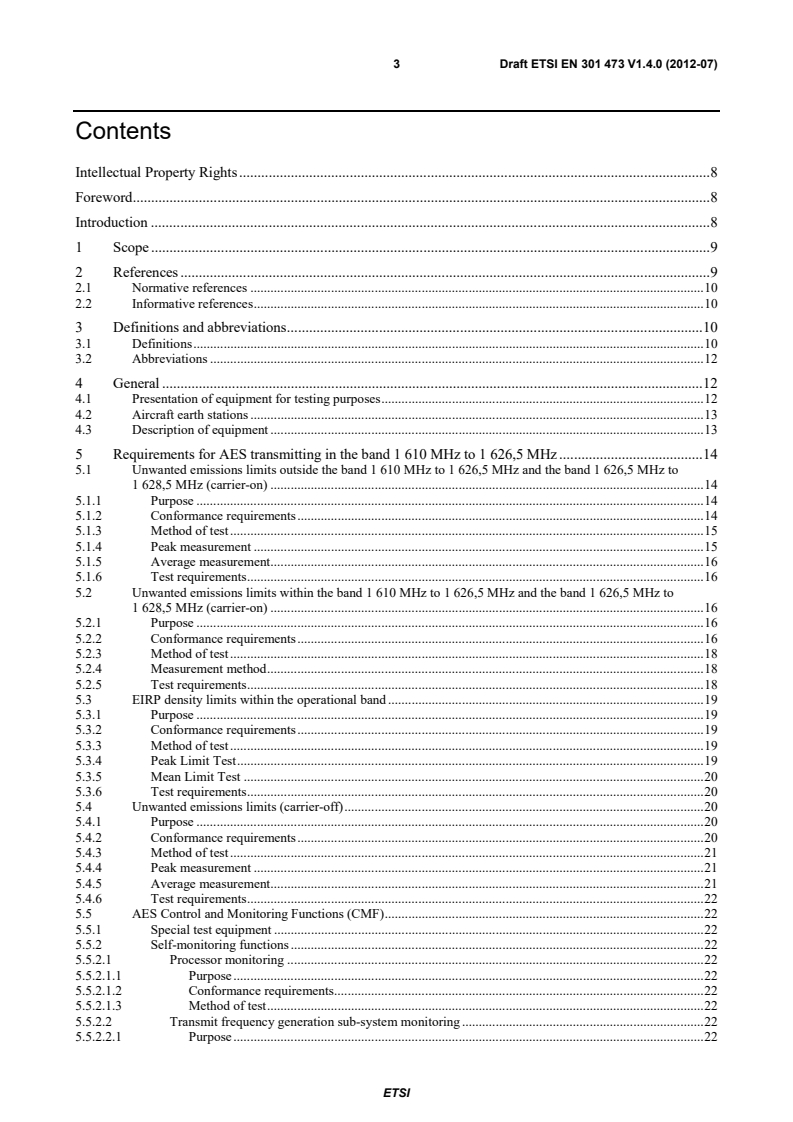
3 Draft ETSI EN 301 473 V1.4.0 (2012-07)
Contents
Intellectual Property Rights . 8
Foreword . 8
Introduction . 8
1 Scope . 9
2 References . 9
2.1 Normative references . 10
2.2 Informative references . 10
3 Definitions and abbreviations . 10
3.1 Definitions . 10
3.2 Abbreviations . 12
4 General . 12
4.1 Presentation of equipment for testing purposes . 12
4.2 Aircraft earth stations . 13
4.3 Description of equipment . 13
5 Requirements for AES transmitting in the band 1 610 MHz to 1 626,5 MHz . 14
5.1 Unwanted emissions limits outside the band 1 610 MHz to 1 626,5 MHz and the band 1 626,5 MHz to
1 628,5 MHz (carrier-on) . 14
5.1.1 Purpose . 14
5.1.2 Conformance requirements . 14
5.1.3 Method of test . 15
5.1.4 Peak measurement . 15
5.1.5 Average measurement . 16
5.1.6 Test requirements . 16
5.2 Unwanted emissions limits within the band 1 610 MHz to 1 626,5 MHz and the band 1 626,5 MHz to
1 628,5 MHz (carrier-on) . 16
5.2.1 Purpose . 16
5.2.2 Conformance requirements . 16
5.2.3 Method of test . 18
5.2.4 Measurement method . 18
5.2.5 Test requirements . 18
5.3 EIRP density limits within the operational band . 19
5.3.1 Purpose . 19
5.3.2 Conformance requirements . 19
5.3.3 Method of test . 19
5.3.4 Peak Limit Test . 19
5.3.5 Mean Limit Test . 20
5.3.6 Test requirements . 20
5.4 Unwanted emissions limits (carrier-off) . 20
5.4.1 Purpose . 20
5.4.2 Conformance requirements . 20
5.4.3 Method of test . 21
5.4.4 Peak measurement . 21
5.4.5 Average measurement . 21
5.4.6 Test requirements . 22
5.5 AES Control and Monitoring Functions (CMF) . 22
5.5.1 Special test equipment . 22
5.5.2 Self-monitoring functions . 22
5.5.2.1 Processor monitoring . 22
5.5.2.1.1 Purpose . 22
5.5.2.1.2 Conformance requirements . 22
5.5.2.1.3 Method of test . 22
5.5.2.2 Transmit frequency generation sub-system monitoring . 22
5.5.2.2.1 Purpose . 22
ETSI
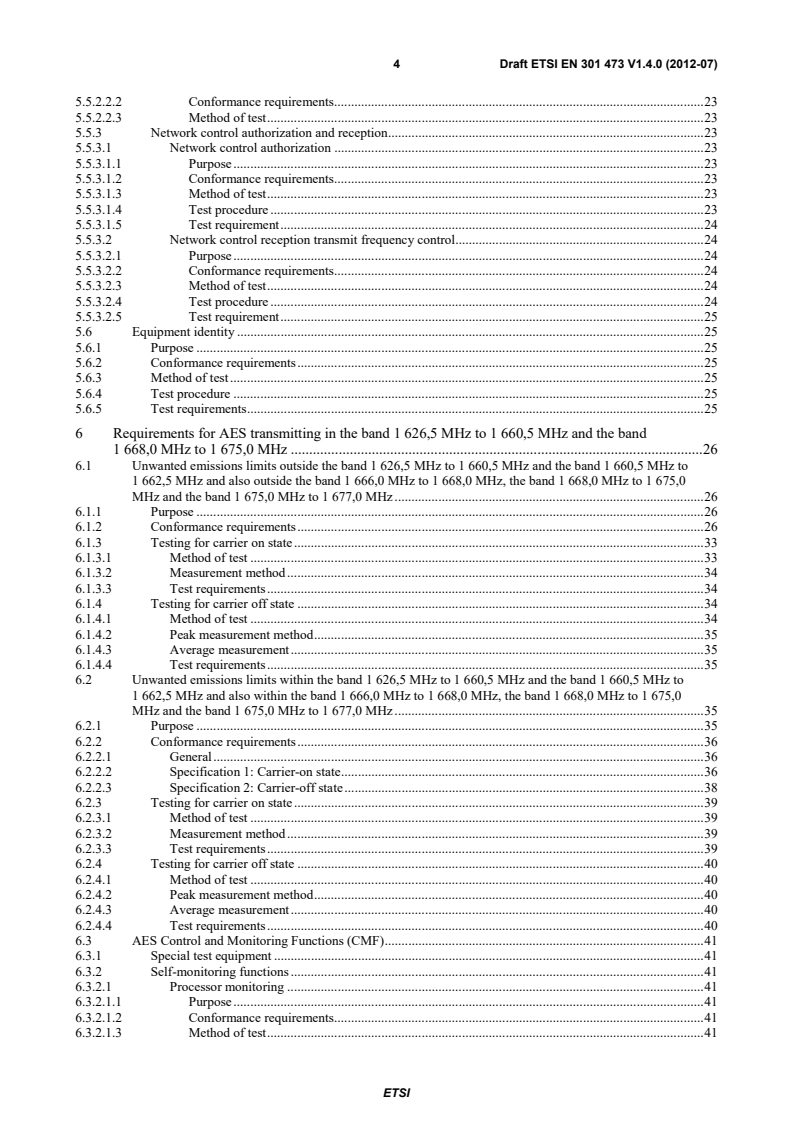
4 Draft ETSI EN 301 473 V1.4.0 (2012-07)
5.5.2.2.2 Conformance requirements . 23
5.5.2.2.3 Method of test . 23
5.5.3 Network control authorization and reception . 23
5.5.3.1 Network control authorization . 23
5.5.3.1.1 Purpose . 23
5.5.3.1.2 Conformance requirements . 23
5.5.3.1.3 Method of test . 23
5.5.3.1.4 Test procedure . 23
5.5.3.1.5 Test requirement . 24
5.5.3.2 Network control reception transmit frequency control. 24
5.5.3.2.1 Purpose . 24
5.5.3.2.2 Conformance requirements . 24
5.5.3.2.3 Method of test . 24
5.5.3.2.4 Test procedure . 24
5.5.3.2.5 Test requirement . 25
5.6 Equipment identity . 25
5.6.1 Purpose . 25
5.6.2 Conformance requirements . 25
5.6.3 Method of test . 25
5.6.4 Test procedure . 25
5.6.5 Test requirements . 25
6 Requirements for AES transmitting in the band 1 626,5 MHz to 1 660,5 MHz and the band
1 668,0 MHz to 1 675,0 MHz . 26
6.1 Unwanted emissions limits outside the band 1 626,5 MHz to 1 660,5 MHz and the band 1 660,5 MHz to
1 662,5 MHz and also outside the band 1 666,0 MHz to 1 668,0 MHz, the band 1 668,0 MHz to 1 675,0
MHz and the band 1 675,0 MHz to 1 677,0 MHz . 26
6.1.1 Purpose . 26
6.1.2 Conformance requirements . 26
6.1.3 Testing for carrier on state . 33
6.1.3.1 Method of test . 33
6.1.3.2 Measurement method . 34
6.1.3.3 Test requirements . 34
6.1.4 Testing for carrier off state . 34
6.1.4.1 Method of test . 34
6.1.4.2 Peak measurement method . 35
6.1.4.3 Average measurement . 35
6.1.4.4 Test requirements . 35
6.2 Unwanted emissions limits within the band 1 626,5 MHz to 1 660,5 MHz and the band 1 660,5 MHz to
1 662,5 MHz and also within the band 1 666,0 MHz to 1 668,0 MHz, the band 1 668,0 MHz to 1 675,0
MHz and the band 1 675,0 MHz to 1 677,0 MHz . 35
6.2.1 Purpose . 35
6.2.2 Conformance requirements . 36
6.2.2.1 General . 36
6.2.2.2 Specification 1: Carrier-on state . 36
6.2.2.3 Specification 2: Carrier-off state . 38
6.2.3 Testing for carrier on state . 39
6.2.3.1 Method of test . 39
6.2.3.2 Measurement method . 39
6.2.3.3 Test requirements . 39
6.2.4 Testing for carrier off state . 40
6.2.4.1 Method of test . 40
6.2.4.2 Peak measurement method . 40
6.2.4.3 Average measurement . 40
6.2.4.4 Test requirements . 40
6.3 AES Control and Monitoring Functions (CMF) . 41
6.3.1 Special test equipment . 41
6.3.2 Self-monitoring functions . 41
6.3.2.1 Processor monitoring . 41
6.3.2.1.1 Purpose . 41
6.3.2.1.2 Conformance requirements . 41
6.3.2.1.3 Method of test . 41
ETSI
5 Draft ETSI EN 301 473 V1.4.0 (2012-07)
6.3.2.2 Transmit frequency generation sub-system monitoring . 41
6.3.2.2.1 Purpose . 41
6.3.2.2.2 Conformance requirements . 41
6.3.2.2.3 Method of test . 42
6.3.3 Network control authorization and reception . 42
6.3.3.1 Network control authorization . 42
6.3.3.1.1 Purpose . 42
6.3.3.1.2 Conformance requirements . 42
6.3.3.1.3 Method of test . 42
6.3.3.1.4 Test procedure . 42
6.3.3.1.5 Test requirement . 43
6.3.3.2 Network control reception transmit frequency control. 43
6.3.3.2.1 Purpose . 43
6.3.3.2.2 Conformance requirements . 43
6.3.3.2.3 Method of test . 43
6.3.3.2.4 Test procedure . 43
6.3.3.2.5 Test requirement . 44
6.4 Equipment identity . 44
6.4.1 Purpose . 44
6.4.2 Conformance requirements . 44
6.4.3 Method of test . 44
6.4.4 Test procedure . 44
6.4.5 Test requirements . 44
7 Requirements for NGSO AES transmitting in the band 1 980 MHz to 2 010 MHz . 44
7.1 Unwanted emissions limits outside the band 1 980,1 MHz to 2 009,9 MHz (carrier-on) . 45
7.1.1 Purpose . 45
7.1.2 Conformance requirements . 45
7.1.3 Method of test . 45
7.1.4 Peak measurement . 46
7.1.5 Average measurement . 46
7.1.6 Test requirements . 47
7.2 Unwanted emissions limits within the bands 1 980,1 MHz to 2 009,9 MHz, 1 978,1 MHz to
1 980,1 MHz and 2 009,9 MHz to 2 011,9 MHz (carrier-on). 47
7.2.1 Purpose . 47
7.2.2 Conformance requirements . 47
7.2.3 Method of test . 48
7.2.4 Measurement method . 48
7.2.5 Test requirements . 48
7.3 Unwanted emissions limits (carrier-off) . 49
7.3.1 Purpose . 49
7.3.2 Conformance requirements . 49
7.3.3 Method of test . 49
7.3.4 Peak measurement . 49
7.3.5 Average measurement . 50
7.3.6 Test requirements . 50
7.4 AES Control and Monitoring Functions (CMF) . 50
7.4.1 Special test equipment . 50
7.4.2 Self-monitoring functions . 50
7.4.2.1 Processor monitoring . 50
7.4.2.1.1 Purpose . 50
7.4.2.1.2 Conformance requirements . 50
7.4.2.1.3 Method of test . 51
7.4.2.2 Transmit frequency generation sub-system monitoring . 51
7.4.2.2.1 Purpose . 51
7.4.2.2.2 Conformance requirements . 51
7.4.2.2.3 Method of test . 51
7.4.3 Network control authorization and reception . 51
7.4.3.1 Network control authorization . 51
7.4.3.1.1 Purpose . 51
7.4.3.1.2 Conformance requirements . 51
7.4.3.1.3 Method of test . 51
ETSI
6 Draft ETSI EN 301 473 V1.4.0 (2012-07)
7.4.3.1.4 Test procedure . 52
7.4.3.1.5 Test requirement . 52
7.4.3.2 Network control reception . 52
7.4.3.2.1 Transmit frequency control . 52
7.5 Equipment identity . 53
7.5.1 Purpose . 53
7.5.2 Conformance requirements . 53
7.5.3 Method of test . 53
7.5.4 Test procedure . 54
7.5.5 Test requirements . 54
8 Protection of the global navigation satellite service operating in the band 1 559 MHz to
1 610 MHz . 54
8.1 1 559 MHz to 1 605 MHz . 54
8.1.1 Purpose . 54
8.1.2 Conformance requirements . 54
8.2 1 605 MHz to 1 610 MHz . 54
8.2.1 Purpose . 54
8.2.2 Conformance requirements . 55
8.3 Method of test . 55
8.4 Average measurement . 55
8.5 Test requirements . 56
9 Protection of the radio astronomy services operating in the band 1 610,6 MHz to 1 613,8 MHz
and in the band 1 660 MHz to 1 670 MHz . 56
9.1 Purpose . 56
9.2 Conformance requirements . 56
9.2.1 Alternative 1 . 56
9.2.2 Alternative 2 . 57
9.2.3 Protection of the radio astronomy service in the 1 660,0 MHz to 1 670,0 MHz band . 58
9.3 Method of test - unwanted emissions (alternative 1) . 58
9.4 Test procedure - unwanted emissions (alternative 1) . 58
9.5 Test requirement - unwanted emissions (alternative 1) . 59
9.6 Method of test - CMF function (alternative 2) . 59
9.7 Test procedure- CMF function (alternative 2) . 59
9.8 Test requirement- CMF function (alternative 2) . 59
Annex A (normative): General test requirements . 60
A.1 AES test modes . 60
A.2 Special Test Equipment . 60
A.2.1 STE description . 60
A.2.2 Use of STE for control and monitoring functions tests . 61
A.2.3 Test modulating signal . 61
A.3 Laboratory Test Equipment . 62
A.4 Interpretation of the measurement results . 62
A.5 Test report . 62
Annex B (normative): Environmental conditions . 63
B.1 General . 63
B.2 Environmental conformance requirements. 63
B.3 Environmental test conditions . 63
Annex C (normative): Arrangements for measurement of emissions from AES . 64
C.1 General . 64
C.2 Carrier-on emissions. 64
C.2.1 Equipment required . 64
ETSI
7 Draft ETSI EN 301 473 V1.4.0 (2012-07)
C.2.2 Equipment arrangement . 65
C.2.3 Emissions from 4 GHz to 18 GHz . 65
C.2.4 Emissions from 10 kHz to 4 GHz . 65
C.3 Carrier-off emissions . 66
C.3.1 Equipment required . 66
C.3.2 Equipment arrangement . 66
C.3.3 Carrier-off emissions from 4 GHz to 18 GHz . 66
C.3.4 Carrier-off emissions from 10 kHz to 4 GHz . 67
Annex D (informative): Explanation of nominated bandwidth . 68
D.1 Introduction . 68
D.2 Interpretation of Parameters [Bn, f , a, b] . 68
c
D.3 Choice of nominated bandwidth . 68
D.4 Maximum value for nominated bandwidth . 70
Annex E (informative): Bibliography . 72
History . 73
ETSI
8 Draft ETSI EN 301 473 V1.4.0 (2012-07)
Intellectual Property Rights
IPRs essential or potentially essential to the present document may have been declared to ETSI. The information
pertaining to these essential IPRs, if any, is publicly available for ETSI members and non-members, and can be found
in ETSI SR 000 314: "Intellectual Property Rights (IPRs); Essential, or potentially Essential, IPRs notified to ETSI in
respect of ETSI standards", which is available from the ETSI Secretariat. Latest updates are available on the ETSI Web
server (http://ipr.etsi.org).
Pursuant to the ETSI IPR Policy, no investigation, including IPR searches, has been carried out by ETSI. No guarantee
can be given as to the existence of other IPRs not referenced in ETSI SR 000 314 (or the updates on the ETSI Web
server) which are, or may be, or may become, essential to the present document.
Foreword
This draft European Standard (EN) has been produced by ETSI Technical Committee Satellite Earth Stations and
Systems (SES), and is now submitted for the Public Enquiry phase of the ETSI standards Two-step Approval
Procedure.
Proposed national transposition dates
Date of latest announcement of this EN (doa): 3 months after ETSI publication
Date of latest publication of new National Standard
or endorsement of this EN (dop/e): 6 months after doa
Date of withdrawal of any conflicting National Standard (dow): 6 months after doa
Introduction
An AES to be effectively used on board an aircraft will also be subject to airworthiness approval. This approval will
refer to additional requirements (e.g. ISO 7137 equivalent to EUROCAE ED-14D and RTCA DO-160D [1]).
Foreseeable evolution of the GNSS (i.e. Galileo or GPS L5) would result in the coming years in specific requirements
to protect the use of the GNSS signals on board aircraft. Therefore these new GNSS frequency bands may require
different protection than currently stated in the present document.
ETSI
9 Draft ETSI EN 301 473 V1.4.0 (2012-07)
1 Scope
The present document specifies certain minimum technical performance requirements of Aircraft Earth Station (AES)
equipment with both transmit and receive capabilities for operation in the Aeronautical Mobile Satellite Service
(AMSS)/Mobile Satellite Service (MSS), and/or in the Aeronautical Mobile Satellite on Route Service
(AMS(R)S)/Mobile Satellite Service (MSS), in the frequency bands given in table 1.
Table 1: Aeronautical Mobile Satellite Service (AMSS)/Mobile Satellite Service (MSS),
and/or Aeronautical Mobile Satellite on Route Service (AMS(R)S)/
Mobile Satellite Service (MSS) frequency bands
AMSS/MSS and/or AMS(R)S/MSS frequency bands
AES transmit 1 610 MHz to 1 626,5 MHz
AES receive 1 613,8 MHz to 1 626,5 MHz
AES receive 2 483,5 MHz to 2 500 MHz
AES transmit 1 626,5 MHz to 1 660,5 MHz
AES receive 1 525 MHz to 1 559 MHz
AES transmit 1 668 MHz to 1 675 MHz
AES receive 1 518 MHz to 1 525 MHz
AES transmit 1 980 MHz to 2 010 MHz
AES receive 2 170 MHz to 2 200 MHz
The technical requirements in the present document are in two major categories:
• emission limits: to protect other radio services and systems from harmful interference generated by the AES
in normal use;
• AES Control and Monitoring Functions (CMF): to protect other radio services and systems from unwanted
transmissions from the AES. The CMF in each AES is capable of answering to commands from the Network
Control Facilities (NCF) for its supporting satellite network.
NOTE: The requirements for Network Control Facilities (NCF) for S-PCN MES transmitting in the 1 610 MHz to
1 626,5 MHz band or the 1 980 MHz to 2 010 MHz band are contained in ETS 300 735 [4]; these
requirements are also applicable to AES transmitting in those bands.
An AES may be subject to additional or alternative requirements in other standards depending on its functionality, in
particular if it supports a service which is considered a justified case for regulation of terminal equipment interworking
via the public telecommunications network. An AES will also be subject to additional airworthiness certification
requirements.
2 References
References are either specific (identified by date of publication and/or edition number or version number) or
non-specific. For specific references, only the cited version applies. For non-specific references, the latest version of the
reference document (including any amendments) applies.
Referenced documents which are not found to be publicly available in the expected location might be found at
http://docbox.etsi.org/Reference.
NOTE: While any hyperlinks included in
...
Final draft ETSI EN 301 473 V1.4.1 (2012-12)
European Standard
Satellite Earth Stations and Systems (SES);
Aircraft Earth Stations (AES) operating below 3 GHz under the
Aeronautical Mobile Satellite Service (AMSS)/
Mobile Satellite Service (MSS) and/or the
Aeronautical Mobile Satellite on Route Service (AMS(R)S)/
Mobile Satellite Service (MSS)
2 Final draft ETSI EN 301 473 V1.4.1 (2012-12)
Reference
REN/SES-00325
Keywords
aeronautical, AMSS, earth station, mobile, MSS,
satellite
ETSI
650 Route des Lucioles
F-06921 Sophia Antipolis Cedex - FRANCE
Tel.: +33 4 92 94 42 00 Fax: +33 4 93 65 47 16
Siret N° 348 623 562 00017 - NAF 742 C
Association à but non lucratif enregistrée à la
Sous-Préfecture de Grasse (06) N° 7803/88
Important notice
Individual copies of the present document can be downloaded from:
http://www.etsi.org
The present document may be made available in more than one electronic version or in print. In any case of existing or
perceived difference in contents between such versions, the reference version is the Portable Document Format (PDF).
In case of dispute, the reference shall be the printing on ETSI printers of the PDF version kept on a specific network drive
within ETSI Secretariat.
Users of the present document should be aware that the document may be subject to revision or change of status.
Information on the current status of this and other ETSI documents is available at
http://portal.etsi.org/tb/status/status.asp
If you find errors in the present document, please send your comment to one of the following services:
http://portal.etsi.org/chaircor/ETSI_support.asp
Copyright Notification
No part may be reproduced except as authorized by written permission.
The copyright and the foregoing restriction extend to reproduction in all media.
© European Telecommunications Standards Institute 2012.
All rights reserved.
TM TM TM
DECT , PLUGTESTS , UMTS and the ETSI logo are Trade Marks of ETSI registered for the benefit of its Members.
TM
3GPP and LTE™ are Trade Marks of ETSI registered for the benefit of its Members and
of the 3GPP Organizational Partners.
GSM® and the GSM logo are Trade Marks registered and owned by the GSM Association.
ETSI
3 Final draft ETSI EN 301 473 V1.4.1 (2012-12)
Contents
Intellectual Property Rights . 8
Foreword . 8
Introduction . 8
1 Scope . 9
2 References . 9
2.1 Normative references . 9
2.2 Informative references . 10
3 Definitions and abbreviations . 10
3.1 Definitions . 10
3.2 Abbreviations . 11
4 General . 12
4.1 Presentation of equipment for testing purposes . 12
4.2 Aircraft earth stations . 12
4.3 Description of equipment . 13
5 Requirements for AES transmitting in the band 1 610 MHz to 1 626,5 MHz . 14
5.1 Unwanted emissions limits outside the band 1 610 MHz to 1 626,5 MHz and the band 1 626,5 MHz to
1 628,5 MHz (carrier-on) . 14
5.1.1 Purpose . 14
5.1.2 Conformance requirements . 14
5.1.3 Method of test . 14
5.1.4 Peak measurement . 15
5.1.5 Average measurement . 15
5.1.6 Test requirements . 16
5.2 Unwanted emissions limits within the band 1 610 MHz to 1 626,5 MHz and the band 1 626,5 MHz to
1 628,5 MHz (carrier-on) . 16
5.2.1 Purpose . 16
5.2.2 Conformance requirements . 16
5.2.3 Method of test . 17
5.2.4 Measurement method . 18
5.2.5 Test requirements . 18
5.3 EIRP density limits within the operational band . 18
5.3.1 Purpose . 18
5.3.2 Conformance requirements . 18
5.3.3 Method of test . 19
5.3.4 Peak Limit Test . 19
5.3.5 Mean Limit Test . 19
5.3.6 Test requirements . 20
5.4 Unwanted emissions limits (carrier-off) . 20
5.4.1 Purpose . 20
5.4.2 Conformance requirements . 20
5.4.3 Method of test . 20
5.4.4 Peak measurement . 21
5.4.5 Average measurement . 21
5.4.6 Test requirements . 21
5.5 AES Control and Monitoring Functions (CMF) . 21
5.5.1 Special test equipment . 21
5.5.2 Self-monitoring functions . 22
5.5.2.1 Processor monitoring . 22
5.5.2.1.1 Purpose . 22
5.5.2.1.2 Conformance requirements . 22
5.5.2.1.3 Method of test . 22
5.5.2.2 Transmit frequency generation sub-system monitoring . 22
5.5.2.2.1 Purpose . 22
ETSI
4 Final draft ETSI EN 301 473 V1.4.1 (2012-12)
5.5.2.2.2 Conformance requirements . 22
5.5.2.2.3 Method of test . 22
5.5.3 Network control authorization and reception . 22
5.5.3.1 Network control authorization . 22
5.5.3.1.1 Purpose . 22
5.5.3.1.2 Conformance requirements . 23
5.5.3.1.3 Method of test . 23
5.5.3.1.4 Test procedure . 23
5.5.3.1.5 Test requirement . 23
5.5.3.2 Network control reception transmit frequency control. 23
5.5.3.2.1 Purpose . 23
5.5.3.2.2 Conformance requirements . 24
5.5.3.2.3 Method of test . 24
5.5.3.2.4 Test procedure . 24
5.5.3.2.5 Test requirement . 24
5.6 Equipment identity . 24
5.6.1 Purpose . 24
5.6.2 Conformance requirements . 24
5.6.3 Method of test . 25
5.6.4 Test procedure . 25
5.6.5 Test requirements . 25
6 Requirements for AES transmitting in the band 1 626,5 MHz to 1 660,5 MHz and the band
1 668,0 MHz to 1 675,0 MHz . 25
6.1 Unwanted emissions limits outside the band 1 626,5 MHz to 1 660,5 MHz and the band 1 660,5 MHz to
1 662,5 MHz and also outside the band 1 666,0 MHz to 1 668,0 MHz, the band 1 668,0 MHz to 1 675,0
MHz and the band 1 675,0 MHz to 1 677,0 MHz . 25
6.1.1 Purpose . 25
6.1.2 Conformance requirements . 26
6.1.3 Testing for carrier on state . 32
6.1.3.1 Method of test . 32
6.1.3.2 Measurement method . 33
6.1.3.3 Test requirements . 33
6.1.4 Testing for carrier off state . 33
6.1.4.1 Method of test . 33
6.1.4.2 Peak measurement method . 34
6.1.4.3 Average measurement . 34
6.1.4.4 Test requirements . 34
6.2 Unwanted emissions limits within the band 1 626,5 MHz to 1 660,5 MHz and the band 1 660,5 MHz to
1 662,5 MHz and also within the band 1 666,0 MHz to 1 668,0 MHz, the band 1 668,0 MHz to 1 675,0
MHz and the band 1 675,0 MHz to 1 677,0 MHz . 35
6.2.1 Purpose . 35
6.2.2 Conformance requirements . 35
6.2.2.1 General . 35
6.2.2.2 Specification 1: Carrier-on state . 35
6.2.2.3 Specification 2: Carrier-off state . 38
6.2.3 Testing for carrier on state . 38
6.2.3.1 Method of test . 38
6.2.3.2 Measurement method . 39
6.2.3.3 Test requirements . 39
6.2.4 Testing for carrier off state . 39
6.2.4.1 Method of test . 39
6.2.4.2 Peak measurement method . 40
6.2.4.3 Average measurement . 40
6.2.4.4 Test requirements . 40
6.3 AES Control and Monitoring Functions (CMF) . 40
6.3.1 Special test equipment . 40
6.3.2 Self-monitoring functions . 41
6.3.2.1 Processor monitoring . 41
6.3.2.1.1 Purpose . 41
6.3.2.1.2 Conformance requirements . 41
6.3.2.1.3 Method of test . 41
ETSI
5 Final draft ETSI EN 301 473 V1.4.1 (2012-12)
6.3.2.2 Transmit frequency generation sub-system monitoring . 41
6.3.2.2.1 Purpose . 41
6.3.2.2.2 Conformance requirements . 41
6.3.2.2.3 Method of test . 41
6.3.3 Network control authorization and reception . 41
6.3.3.1 Network control authorization . 41
6.3.3.1.1 Purpose . 41
6.3.3.1.2 Conformance requirements . 42
6.3.3.1.3 Method of test . 42
6.3.3.1.4 Test procedure . 42
6.3.3.1.5 Test requirement . 42
6.3.3.2 Network control reception transmit frequency control. 42
6.3.3.2.1 Purpose . 42
6.3.3.2.2 Conformance requirements . 43
6.3.3.2.3 Method of test . 43
6.3.3.2.4 Test procedure . 43
6.3.3.2.5 Test requirement . 43
6.4 Equipment identity . 43
6.4.1 Purpose . 43
6.4.2 Conformance requirements . 43
6.4.3 Method of test . 44
6.4.4 Test procedure . 44
6.4.5 Test requirements . 44
7 Requirements for NGSO AES transmitting in the band 1 980 MHz to 2 010 MHz . 44
7.1 Unwanted emissions limits outside the band 1 980,1 MHz to 2 009,9 MHz (carrier-on) . 44
7.1.1 Purpose . 44
7.1.2 Conformance requirements . 44
7.1.3 Method of test . 45
7.1.4 Peak measurement . 46
7.1.5 Average measurement . 46
7.1.6 Test requirements . 46
7.2 Unwanted emissions limits within the bands 1 980,1 MHz to 2 009,9 MHz, 1 978,1 MHz to
1 980,1 MHz and 2 009,9 MHz to 2 011,9 MHz (carrier-on). 46
7.2.1 Purpose . 46
7.2.2 Conformance requirements . 47
7.2.3 Method of test . 47
7.2.4 Measurement method . 48
7.2.5 Test requirements . 48
7.3 Unwanted emissions limits (carrier-off) . 48
7.3.1 Purpose . 48
7.3.2 Conformance requirements . 48
7.3.3 Method of test . 49
7.3.4 Peak measurement . 49
7.3.5 Average measurement . 49
7.3.6 Test requirements . 50
7.4 AES Control and Monitoring Functions (CMF) . 50
7.4.1 Special test equipment . 50
7.4.2 Self-monitoring functions . 50
7.4.2.1 Processor monitoring . 50
7.4.2.1.1 Purpose . 50
7.4.2.1.2 Conformance requirements . 50
7.4.2.1.3 Method of test . 50
7.4.2.2 Transmit frequency generation sub-system monitoring . 50
7.4.2.2.1 Purpose . 50
7.4.2.2.2 Conformance requirements . 51
7.4.2.2.3 Method of test . 51
7.4.3 Network control authorization and reception . 51
7.4.3.1 Network control authorization . 51
7.4.3.1.1 Purpose . 51
7.4.3.1.2 Conformance requirements . 51
7.4.3.1.3 Method of test . 51
ETSI
6 Final draft ETSI EN 301 473 V1.4.1 (2012-12)
7.4.3.1.4 Test procedure . 51
7.4.3.1.5 Test requirement . 52
7.4.3.2 Network control reception . 52
7.4.3.2.1 Transmit frequency control . 52
7.5 Equipment identity . 53
7.5.1 Purpose . 53
7.5.2 Conformance requirements . 53
7.5.3 Method of test . 53
7.5.4 Test procedure . 53
7.5.5 Test requirements . 53
8 Protection of the global navigation satellite service operating in the band 1 559 MHz to
1 610 MHz . 54
8.1 1 559 MHz to 1 605 MHz . 54
8.1.1 Purpose . 54
8.1.2 Conformance requirements . 54
8.2 1 605 MHz to 1 610 MHz . 54
8.2.1 Purpose . 54
8.2.2 Conformance requirements . 54
8.3 Method of test . 55
8.4 Average measurement . 55
8.5 Test requirements . 55
9 Protection of the radio astronomy services operating in the band 1 610,6 MHz to 1 613,8 MHz
and in the band 1 660 MHz to 1 670 MHz . 56
9.1 Purpose . 56
9.2 Conformance requirements . 56
9.2.1 Alternative 1 . 56
9.2.2 Alternative 2 . 57
9.2.3 Protection of the radio astronomy service in the 1 660,0 MHz to 1 670,0 MHz band . 57
9.3 Method of test - unwanted emissions (alternative 1) . 57
9.4 Test procedure - unwanted emissions (alternative 1) . 57
9.5 Test requirement - unwanted emissions (alternative 1) . 58
9.6 Method of test - CMF function (alternative 2) . 58
9.7 Test procedure- CMF function (alternative 2) . 58
9.8 Test requirement- CMF function (alternative 2) . 59
Annex A (normative): General test requirements . 60
A.1 AES test modes . 60
A.2 Special Test Equipment . 60
A.2.1 STE description . 60
A.2.2 Use of STE for control and monitoring functions tests . 61
A.2.3 Test modulating signal . 61
A.3 Laboratory Test Equipment . 62
A.4 Interpretation of the measurement results . 62
A.5 Test report . 62
Annex B (normative): Environmental conditions . 63
B.1 General . 63
B.2 Environmental conformance requirements. 63
B.3 Environmental test conditions . 63
Annex C (normative): Arrangements for measurement of emissions from AES . 64
C.1 General . 64
C.2 Carrier-on emissions. 64
C.2.1 Equipment required . 64
ETSI
7 Final draft ETSI EN 301 473 V1.4.1 (2012-12)
C.2.2 Equipment arrangement . 65
C.2.3 Emissions from 4 GHz to 18 GHz . 65
C.2.4 Emissions from 10 kHz to 4 GHz . 65
C.3 Carrier-off emissions . 66
C.3.1 Equipment required . 66
C.3.2 Equipment arrangement . 66
C.3.3 Carrier-off emissions from 4 GHz to 18 GHz . 66
C.3.4 Carrier-off emissions from 10 kHz to 4 GHz . 67
Annex D (informative): Explanation of nominated bandwidth . 68
D.1 Introduction . 68
D.2 Interpretation of Parameters [Bn, f , a, b] . 68
c
D.3 Choice of nominated bandwidth . 68
D.4 Maximum value for nominated bandwidth . 70
Annex E (informative): Bibliography . 72
History . 73
ETSI
8 Final draft ETSI EN 301 473 V1.4.1 (2012-12)
Intellectual Property Rights
IPRs essential or potentially essential to the present document may have been declared to ETSI. The information
pertaining to these essential IPRs, if any, is publicly available for ETSI members and non-members, and can be found
in ETSI SR 000 314: "Intellectual Property Rights (IPRs); Essential, or potentially Essential, IPRs notified to ETSI in
respect of ETSI standards", which is available from the ETSI Secretariat. Latest updates are available on the ETSI Web
server (http://ipr.etsi.org).
Pursuant to the ETSI IPR Policy, no investigation, including IPR searches, has been carried out by ETSI. No guarantee
can be given as to the existence of other IPRs not referenced in ETSI SR 000 314 (or the updates on the ETSI Web
server) which are, or may be, or may become, essential to the present document.
Foreword
This final draft European Standard (EN) has been produced by ETSI Technical Committee Satellite Earth Stations and
Systems (SES), and is now submitted for the Vote phase of the ETSI standards Two-step Approval Procedure.
Proposed national transposition dates
Date of latest announcement of this EN (doa): 3 months after ETSI publication
Date of latest publication of new National Standard
or endorsement of this EN (dop/e): 6 months after doa
Date of withdrawal of any conflicting National Standard (dow): 6 months after doa
Introduction
An AES to be effectively used on board an aircraft will also be subject to airworthiness approval. This approval will
refer to additional requirements (e.g. ISO 7137 equivalent to EUROCAE ED-14D and RTCA DO-160D [1]).
Foreseeable evolution of the GNSS (i.e. Galileo or GPS L5) would result in the coming years in specific requirements
to protect the use of the GNSS signals on board aircraft. Therefore these new GNSS frequency bands may require
different protection than currently stated in the present document.
ETSI
9 Final draft ETSI EN 301 473 V1.4.1 (2012-12)
1 Scope
The present document specifies certain minimum technical performance requirements of Aircraft Earth Station (AES)
equipment with both transmit and receive capabilities for operation in the Aeronautical Mobile Satellite Service
(AMSS)/Mobile Satellite Service (MSS), and/or in the Aeronautical Mobile Satellite on Route Service
(AMS(R)S)/Mobile Satellite Service (MSS), in the frequency bands given in table 1.
Table 1: Aeronautical Mobile Satellite Service (AMSS)/Mobile Satellite Service (MSS),
and/or Aeronautical Mobile Satellite on Route Service (AMS(R)S)/
Mobile Satellite Service (MSS) frequency bands
AMSS/MSS and/or AMS(R)S/MSS frequency bands
AES transmit 1 610 MHz to 1 626,5 MHz
AES receive 1 613,8 MHz to 1 626,5 MHz
AES receive 2 483,5 MHz to 2 500 MHz
AES transmit 1 626,5 MHz to 1 660,5 MHz
AES receive 1 525 MHz to 1 559 MHz
AES transmit 1 668 MHz to 1 675 MHz
AES receive 1 518 MHz to 1 525 MHz
AES transmit 1 980 MHz to 2 010 MHz
AES receive 2 170 MHz to 2 200 MHz
The technical requirements in the present document are in two major categories:
• emission limits: to protect other radio services and systems from harmful interference generated by the AES
in normal use;
• AES Control and Monitoring Functions (CMF): to protect other radio services and systems from unwanted
transmissions from the AES. The CMF in each AES is capable of answering to commands from the Network
Control Facilities (NCF) for its supporting satellite network.
NOTE: The requirements for Network Control Facilities (NCF) for S-PCN MES transmitting in the 1 610 MHz to
1 626,5 MHz band or the 1 980 MHz to 2 010 MHz band are contained in ETS 300 735 [4]; these
requirements are also applicable to AES transmitting in those bands.
An AES may be subject to additional or alternative requirements in other standards depending on its functionality, in
particular if it supports a service which is considered a justified case for regulation of terminal equipment interworking
via the public telecommunications network. An AES will also be subject to additional airworthiness certification
requirements.
2 References
References are either specific (identified by date of publication and/or edition number or version number) or
non-specific. For specific references, only the cited version applies. For non-specific references, the latest version of the
reference document (including any amendments) applies.
Referenced documents which are not found to be publicly available in the expected location might be found at
http://docbox.etsi.org/Reference
...
ETSI EN 301 473 V1.4.1 (2013-03)
European Standard
Satellite Earth Stations and Systems (SES);
Aircraft Earth Stations (AES) operating below 3 GHz under the
Aeronautical Mobile Satellite Service (AMSS)/
Mobile Satellite Service (MSS) and/or the
Aeronautical Mobile Satellite on Route Service (AMS(R)S)/
Mobile Satellite Service (MSS)
2 ETSI EN 301 473 V1.4.1 (2013-03)
Reference
REN/SES-00325
Keywords
aeronautical, AMSS, earth station, mobile, MSS,
satellite
ETSI
650 Route des Lucioles
F-06921 Sophia Antipolis Cedex - FRANCE
Tel.: +33 4 92 94 42 00 Fax: +33 4 93 65 47 16
Siret N° 348 623 562 00017 - NAF 742 C
Association à but non lucratif enregistrée à la
Sous-Préfecture de Grasse (06) N° 7803/88
Important notice
Individual copies of the present document can be downloaded from:
http://www.etsi.org
The present document may be made available in more than one electronic version or in print. In any case of existing or
perceived difference in contents between such versions, the reference version is the Portable Document Format (PDF).
In case of dispute, the reference shall be the printing on ETSI printers of the PDF version kept on a specific network drive
within ETSI Secretariat.
Users of the present document should be aware that the document may be subject to revision or change of status.
Information on the current status of this and other ETSI documents is available at
http://portal.etsi.org/tb/status/status.asp
If you find errors in the present document, please send your comment to one of the following services:
http://portal.etsi.org/chaircor/ETSI_support.asp
Copyright Notification
No part may be reproduced except as authorized by written permission.
The copyright and the foregoing restriction extend to reproduction in all media.
© European Telecommunications Standards Institute 2013.
All rights reserved.
TM TM TM
DECT , PLUGTESTS , UMTS and the ETSI logo are Trade Marks of ETSI registered for the benefit of its Members.
TM
3GPP and LTE™ are Trade Marks of ETSI registered for the benefit of its Members and
of the 3GPP Organizational Partners.
GSM® and the GSM logo are Trade Marks registered and owned by the GSM Association.
ETSI
3 ETSI EN 301 473 V1.4.1 (2013-03)
Contents
Intellectual Property Rights . 8
Foreword . 8
Introduction . 8
1 Scope . 9
2 References . 9
2.1 Normative references . 9
2.2 Informative references . 10
3 Definitions and abbreviations . 10
3.1 Definitions . 10
3.2 Abbreviations . 11
4 General . 12
4.1 Presentation of equipment for testing purposes . 12
4.2 Aircraft earth stations . 12
4.3 Description of equipment . 13
5 Requirements for AES transmitting in the band 1 610 MHz to 1 626,5 MHz . 14
5.1 Unwanted emissions limits outside the band 1 610 MHz to 1 626,5 MHz and the band 1 626,5 MHz to
1 628,5 MHz (carrier-on) . 14
5.1.1 Purpose . 14
5.1.2 Conformance requirements . 14
5.1.3 Method of test . 14
5.1.4 Peak measurement . 15
5.1.5 Average measurement . 15
5.1.6 Test requirements . 16
5.2 Unwanted emissions limits within the band 1 610 MHz to 1 626,5 MHz and the band 1 626,5 MHz to
1 628,5 MHz (carrier-on) . 16
5.2.1 Purpose . 16
5.2.2 Conformance requirements . 16
5.2.3 Method of test . 17
5.2.4 Measurement method . 18
5.2.5 Test requirements . 18
5.3 EIRP density limits within the operational band . 18
5.3.1 Purpose . 18
5.3.2 Conformance requirements . 18
5.3.3 Method of test . 19
5.3.4 Peak Limit Test . 19
5.3.5 Mean Limit Test . 19
5.3.6 Test requirements . 20
5.4 Unwanted emissions limits (carrier-off) . 20
5.4.1 Purpose . 20
5.4.2 Conformance requirements . 20
5.4.3 Method of test . 20
5.4.4 Peak measurement . 21
5.4.5 Average measurement . 21
5.4.6 Test requirements . 21
5.5 AES Control and Monitoring Functions (CMF) . 21
5.5.1 Special test equipment . 21
5.5.2 Self-monitoring functions . 22
5.5.2.1 Processor monitoring . 22
5.5.2.1.1 Purpose . 22
5.5.2.1.2 Conformance requirements . 22
5.5.2.1.3 Method of test . 22
5.5.2.2 Transmit frequency generation sub-system monitoring . 22
5.5.2.2.1 Purpose . 22
ETSI
4 ETSI EN 301 473 V1.4.1 (2013-03)
5.5.2.2.2 Conformance requirements . 22
5.5.2.2.3 Method of test . 22
5.5.3 Network control authorization and reception . 22
5.5.3.1 Network control authorization . 22
5.5.3.1.1 Purpose . 22
5.5.3.1.2 Conformance requirements . 23
5.5.3.1.3 Method of test . 23
5.5.3.1.4 Test procedure . 23
5.5.3.1.5 Test requirement . 23
5.5.3.2 Network control reception transmit frequency control. 23
5.5.3.2.1 Purpose . 23
5.5.3.2.2 Conformance requirements . 24
5.5.3.2.3 Method of test . 24
5.5.3.2.4 Test procedure . 24
5.5.3.2.5 Test requirement . 24
5.6 Equipment identity . 24
5.6.1 Purpose . 24
5.6.2 Conformance requirements . 24
5.6.3 Method of test . 25
5.6.4 Test procedure . 25
5.6.5 Test requirements . 25
6 Requirements for AES transmitting in the band 1 626,5 MHz to 1 660,5 MHz and the band
1 668,0 MHz to 1 675,0 MHz . 25
6.1 Unwanted emissions limits outside the band 1 626,5 MHz to 1 660,5 MHz and the band 1 660,5 MHz to
1 662,5 MHz and also outside the band 1 666,0 MHz to 1 668,0 MHz, the band 1 668,0 MHz to 1 675,0
MHz and the band 1 675,0 MHz to 1 677,0 MHz . 25
6.1.1 Purpose . 25
6.1.2 Conformance requirements . 26
6.1.3 Testing for carrier on state . 32
6.1.3.1 Method of test . 32
6.1.3.2 Measurement method . 33
6.1.3.3 Test requirements . 33
6.1.4 Testing for carrier off state . 33
6.1.4.1 Method of test . 33
6.1.4.2 Peak measurement method . 34
6.1.4.3 Average measurement . 34
6.1.4.4 Test requirements . 34
6.2 Unwanted emissions limits within the band 1 626,5 MHz to 1 660,5 MHz and the band 1 660,5 MHz to
1 662,5 MHz and also within the band 1 666,0 MHz to 1 668,0 MHz, the band 1 668,0 MHz to 1 675,0
MHz and the band 1 675,0 MHz to 1 677,0 MHz . 35
6.2.1 Purpose . 35
6.2.2 Conformance requirements . 35
6.2.2.1 General . 35
6.2.2.2 Specification 1: Carrier-on state . 35
6.2.2.3 Specification 2: Carrier-off state . 38
6.2.3 Testing for carrier on state . 38
6.2.3.1 Method of test . 38
6.2.3.2 Measurement method . 39
6.2.3.3 Test requirements . 39
6.2.4 Testing for carrier off state . 39
6.2.4.1 Method of test . 39
6.2.4.2 Peak measurement method . 40
6.2.4.3 Average measurement . 40
6.2.4.4 Test requirements . 40
6.3 AES Control and Monitoring Functions (CMF) . 40
6.3.1 Special test equipment . 40
6.3.2 Self-monitoring functions . 41
6.3.2.1 Processor monitoring . 41
6.3.2.1.1 Purpose . 41
6.3.2.1.2 Conformance requirements . 41
6.3.2.1.3 Method of test . 41
ETSI
5 ETSI EN 301 473 V1.4.1 (2013-03)
6.3.2.2 Transmit frequency generation sub-system monitoring . 41
6.3.2.2.1 Purpose . 41
6.3.2.2.2 Conformance requirements . 41
6.3.2.2.3 Method of test . 41
6.3.3 Network control authorization and reception . 41
6.3.3.1 Network control authorization . 41
6.3.3.1.1 Purpose . 41
6.3.3.1.2 Conformance requirements . 42
6.3.3.1.3 Method of test . 42
6.3.3.1.4 Test procedure . 42
6.3.3.1.5 Test requirement . 42
6.3.3.2 Network control reception transmit frequency control. 42
6.3.3.2.1 Purpose . 42
6.3.3.2.2 Conformance requirements . 43
6.3.3.2.3 Method of test . 43
6.3.3.2.4 Test procedure . 43
6.3.3.2.5 Test requirement . 43
6.4 Equipment identity . 43
6.4.1 Purpose . 43
6.4.2 Conformance requirements . 43
6.4.3 Method of test . 44
6.4.4 Test procedure . 44
6.4.5 Test requirements . 44
7 Requirements for NGSO AES transmitting in the band 1 980 MHz to 2 010 MHz . 44
7.1 Unwanted emissions limits outside the band 1 980,1 MHz to 2 009,9 MHz (carrier-on) . 44
7.1.1 Purpose . 44
7.1.2 Conformance requirements . 44
7.1.3 Method of test . 45
7.1.4 Peak measurement . 46
7.1.5 Average measurement . 46
7.1.6 Test requirements . 46
7.2 Unwanted emissions limits within the bands 1 980,1 MHz to 2 009,9 MHz, 1 978,1 MHz to
1 980,1 MHz and 2 009,9 MHz to 2 011,9 MHz (carrier-on). 46
7.2.1 Purpose . 46
7.2.2 Conformance requirements . 47
7.2.3 Method of test . 47
7.2.4 Measurement method . 48
7.2.5 Test requirements . 48
7.3 Unwanted emissions limits (carrier-off) . 48
7.3.1 Purpose . 48
7.3.2 Conformance requirements . 48
7.3.3 Method of test . 49
7.3.4 Peak measurement . 49
7.3.5 Average measurement . 49
7.3.6 Test requirements . 50
7.4 AES Control and Monitoring Functions (CMF) . 50
7.4.1 Special test equipment . 50
7.4.2 Self-monitoring functions . 50
7.4.2.1 Processor monitoring . 50
7.4.2.1.1 Purpose . 50
7.4.2.1.2 Conformance requirements . 50
7.4.2.1.3 Method of test . 50
7.4.2.2 Transmit frequency generation sub-system monitoring . 50
7.4.2.2.1 Purpose . 50
7.4.2.2.2 Conformance requirements . 51
7.4.2.2.3 Method of test . 51
7.4.3 Network control authorization and reception . 51
7.4.3.1 Network control authorization . 51
7.4.3.1.1 Purpose . 51
7.4.3.1.2 Conformance requirements . 51
7.4.3.1.3 Method of test . 51
ETSI
6 ETSI EN 301 473 V1.4.1 (2013-03)
7.4.3.1.4 Test procedure . 51
7.4.3.1.5 Test requirement . 52
7.4.3.2 Network control reception . 52
7.4.3.2.1 Transmit frequency control . 52
7.5 Equipment identity . 53
7.5.1 Purpose . 53
7.5.2 Conformance requirements . 53
7.5.3 Method of test . 53
7.5.4 Test procedure . 53
7.5.5 Test requirements . 53
8 Protection of the global navigation satellite service operating in the band 1 559 MHz to
1 610 MHz . 54
8.1 1 559 MHz to 1 605 MHz . 54
8.1.1 Purpose . 54
8.1.2 Conformance requirements . 54
8.2 1 605 MHz to 1 610 MHz . 54
8.2.1 Purpose . 54
8.2.2 Conformance requirements . 54
8.3 Method of test . 55
8.4 Average measurement . 55
8.5 Test requirements . 55
9 Protection of the radio astronomy services operating in the band 1 610,6 MHz to 1 613,8 MHz
and in the band 1 660 MHz to 1 670 MHz . 56
9.1 Purpose . 56
9.2 Conformance requirements . 56
9.2.1 Alternative 1 . 56
9.2.2 Alternative 2 . 57
9.2.3 Protection of the radio astronomy service in the 1 660,0 MHz to 1 670,0 MHz band . 57
9.3 Method of test - unwanted emissions (alternative 1) . 57
9.4 Test procedure - unwanted emissions (alternative 1) . 57
9.5 Test requirement - unwanted emissions (alternative 1) . 58
9.6 Method of test - CMF function (alternative 2) . 58
9.7 Test procedure- CMF function (alternative 2) . 58
9.8 Test requirement- CMF function (alternative 2) . 59
Annex A (normative): General test requirements . 60
A.1 AES test modes . 60
A.2 Special Test Equipment . 60
A.2.1 STE description . 60
A.2.2 Use of STE for control and monitoring functions tests . 61
A.2.3 Test modulating signal . 61
A.3 Laboratory Test Equipment . 62
A.4 Interpretation of the measurement results . 62
A.5 Test report . 62
Annex B (normative): Environmental conditions . 63
B.1 General . 63
B.2 Environmental conformance requirements. 63
B.3 Environmental test conditions . 63
Annex C (normative): Arrangements for measurement of emissions from AES . 64
C.1 General . 64
C.2 Carrier-on emissions. 64
C.2.1 Equipment required . 64
ETSI
7 ETSI EN 301 473 V1.4.1 (2013-03)
C.2.2 Equipment arrangement . 65
C.2.3 Emissions from 4 GHz to 18 GHz . 65
C.2.4 Emissions from 10 kHz to 4 GHz . 65
C.3 Carrier-off emissions . 66
C.3.1 Equipment required . 66
C.3.2 Equipment arrangement . 66
C.3.3 Carrier-off emissions from 4 GHz to 18 GHz . 66
C.3.4 Carrier-off emissions from 10 kHz to 4 GHz . 67
Annex D (informative): Explanation of nominated bandwidth . 68
D.1 Introduction . 68
D.2 Interpretation of Parameters [Bn, f , a, b] . 68
c
D.3 Choice of nominated bandwidth . 68
D.4 Maximum value for nominated bandwidth . 70
Annex E (informative): Bibliography . 72
History . 73
ETSI
8 ETSI EN 301 473 V1.4.1 (2013-03)
Intellectual Property Rights
IPRs essential or potentially essential to the present document may have been declared to ETSI. The information
pertaining to these essential IPRs, if any, is publicly available for ETSI members and non-members, and can be found
in ETSI SR 000 314: "Intellectual Property Rights (IPRs); Essential, or potentially Essential, IPRs notified to ETSI in
respect of ETSI standards", which is available from the ETSI Secretariat. Latest updates are available on the ETSI Web
server (http://ipr.etsi.org).
Pursuant to the ETSI IPR Policy, no investigation, including IPR searches, has been carried out by ETSI. No guarantee
can be given as to the existence of other IPRs not referenced in ETSI SR 000 314 (or the updates on the ETSI Web
server) which are, or may be, or may become, essential to the present document.
Foreword
This European Standard (EN) has been produced by ETSI Technical Committee Satellite Earth Stations and Systems
(SES).
National transposition dates
Date of adoption of this EN: 22 February 2013
Date of latest announcement of this EN (doa): 31 May 2013
Date of latest publication of new National Standard
or endorsement of this EN (dop/e): 30 November 2013
Date of withdrawal of any conflicting National Standard (dow): 30 November 2013
Introduction
An AES to be effectively used on board an aircraft will also be subject to airworthiness approval. This approval will
refer to additional requirements (e.g. ISO 7137 equivalent to EUROCAE ED-14D and RTCA DO-160D [1]).
Foreseeable evolution of the GNSS (i.e. Galileo or GPS L5) would result in the coming years in specific requirements
to protect the use of the GNSS signals on board aircraft. Therefore these new GNSS frequency bands may require
different protection than currently stated in the present document.
ETSI
9 ETSI EN 301 473 V1.4.1 (2013-03)
1 Scope
The present document specifies certain minimum technical performance requirements of Aircraft Earth Station (AES)
equipment with both transmit and receive capabilities for operation in the Aeronautical Mobile Satellite Service
(AMSS)/Mobile Satellite Service (MSS), and/or in the Aeronautical Mobile Satellite on Route Service
(AMS(R)S)/Mobile Satellite Service (MSS), in the frequency bands given in table 1.
Table 1: Aeronautical Mobile Satellite Service (AMSS)/Mobile Satellite Service (MSS),
and/or Aeronautical Mobile Satellite on Route Service (AMS(R)S)/
Mobile Satellite Service (MSS) frequency bands
AMSS/MSS and/or AMS(R)S/MSS frequency bands
AES transmit 1 610 MHz to 1 626,5 MHz
AES receive 1 613,8 MHz to 1 626,5 MHz
AES receive 2 483,5 MHz to 2 500 MHz
AES transmit 1 626,5 MHz to 1 660,5 MHz
AES receive 1 525 MHz to 1 559 MHz
AES transmit 1 668 MHz to 1 675 MHz
AES receive 1 518 MHz to 1 525 MHz
AES transmit 1 980 MHz to 2 010 MHz
AES receive 2 170 MHz to 2 200 MHz
The technical requirements in the present document are in two major categories:
• emission limits: to protect other radio services and systems from harmful interference generated by the AES
in normal use;
• AES Control and Monitoring Functions (CMF): to protect other radio services and systems from unwanted
transmissions from the AES. The CMF in each AES is capable of answering to commands from the Network
Control Facilities (NCF) for its supporting satellite network.
NOTE: The requirements for Network Control Facilities (NCF) for S-PCN MES transmitting in the 1 610 MHz to
1 626,5 MHz band or the 1 980 MHz to 2 010 MHz band are contained in ETS 300 735 [4]; these
requirements are also applicable to AES transmitting in those bands.
An AES may be subject to additional or alternative requirements in other standards depending on its functionality, in
particular if it supports a service which is considered a justified case for regulation of terminal equipment interworking
via the public telecommunications network. An AES will also be subject to additional airworthiness certification
requirements.
2 References
References are either specific (identified by date of publication and/or edition number or version number) or
non-specific. For specific references, only the cited version applies. For non-specific references, the latest version of the
reference document (including any amendments) applies.
Referenced documents which are not found to be publicly available in the expected location might be found at
http://docbox.etsi.org/Reference.
NOTE: While any hyperlinks included in this clause were valid at the time of publication, ETSI cannot guarantee
their long term validity.
2.1 Normative references
The following refere
...
2003-01.Slovenski inštitut za standardizacijo. Razmnoževanje celote ali delov tega standarda ni dovoljeno.Satellite Earth Stations and Systems (SES) - Aircraft Earth Stations (AES) operating below 3 GHz under the Aeronautical Mobile Satellite Service (AMSS)/Mobile Satellite Service (MSS) and/or the Aeronautical Mobile Satellite on Route Service (AMS(R)S)/Mobile Satellite Service (MSS)33.060.30Radiorelejni in fiksni satelitski komunikacijski sistemiRadio relay and fixed satellite communications systemsICS:Ta slovenski standard je istoveten z:EN 301 473 Version1.4.0SIST EN 301 473 V1.4.1:2013en01-maj-2013SIST EN 301 473 V1.4.1:2013SLOVENSKI
STANDARD
ETSI EN 301 473 V1.4.1 (2013-03) Satellite Earth Stations and Systems (SES); Aircraft Earth Stations (AES) operating below 3 GHz under the Aeronautical Mobile Satellite Service (AMSS)/ Mobile Satellite Service (MSS) and/or the Aeronautical Mobile Satellite on Route Service (AMS(R)S)/ Mobile Satellite Service (MSS)
European Standard SIST EN 301 473 V1.4.1:2013
ETSI ETSI EN 301 473 V1.4.1 (2013-03) 2
Reference REN/SES-00325 Keywords aeronautical, AMSS, earth station, mobile, MSS, satellite ETSI 650 Route des Lucioles F-06921 Sophia Antipolis Cedex - FRANCE
Tel.: +33 4 92 94 42 00
Fax: +33 4 93 65 47 16
Siret N° 348 623 562 00017 - NAF 742 C Association à but non lucratif enregistrée à la Sous-Préfecture de Grasse (06) N° 7803/88
Important notice Individual copies of the present document can be downloaded from: http://www.etsi.org The present document may be made available in more than one electronic version or in print. In any case of existing or perceived difference in contents between such versions, the reference version is the Portable Document Format (PDF). In case of dispute, the reference shall be the printing on ETSI printers of the PDF version kept on a specific network drive within ETSI Secretariat. Users of the present document should be aware that the document may be subject to revision or change of status. Information on the current status of this and other ETSI documents is available at http://portal.etsi.org/tb/status/status.asp If you find errors in the present document, please send your comment to one of the following services: http://portal.etsi.org/chaircor/ETSI_support.asp Copyright Notification No part may be reproduced except as authorized by written permission. The copyright and the foregoing restriction extend to reproduction in all media.
© European Telecommunications Standards Institute 2013. All rights reserved.
DECTTM, PLUGTESTSTM, UMTSTM and the ETSI logo are Trade Marks of ETSI registered for the benefit of its Members. 3GPPTM and LTE™ are Trade Marks of ETSI registered for the benefit of its Members and of the 3GPP Organizational Partners. GSM® and the GSM logo are Trade Marks registered and owned by the GSM Association. SIST EN 301 473 V1.4.1:2013
ETSI ETSI EN 301 473 V1.4.1 (2013-03) 3 Contents Intellectual Property Rights . 8 Foreword . 8 Introduction . 8 1 Scope . 9 2 References . 9 2.1 Normative references . 9 2.2 Informative references . 10 3 Definitions and abbreviations . 10 3.1 Definitions . 10 3.2 Abbreviations . 11 4 General . 12 4.1 Presentation of equipment for testing purposes . 12 4.2 Aircraft earth stations . 12 4.3 Description of equipment . 13 5 Requirements for AES transmitting in the band 1 610 MHz to 1 626,5 MHz . 14 5.1 Unwanted emissions limits outside the band 1 610 MHz to 1 626,5 MHz and the band 1 626,5 MHz to 1 628,5 MHz (carrier-on) . 14 5.1.1 Purpose . 14 5.1.2 Conformance requirements . 14 5.1.3 Method of test . 14 5.1.4 Peak measurement . 15 5.1.5 Average measurement . 15 5.1.6 Test requirements . 16 5.2 Unwanted emissions limits within the band 1 610 MHz to 1 626,5 MHz and the band 1 626,5 MHz to 1 628,5 MHz (carrier-on) . 16 5.2.1 Purpose . 16 5.2.2 Conformance requirements . 16 5.2.3 Method of test . 17 5.2.4 Measurement method . 18 5.2.5 Test requirements . 18 5.3 EIRP density limits within the operational band . 18 5.3.1 Purpose . 18 5.3.2 Conformance requirements . 18 5.3.3 Method of test . 19 5.3.4 Peak Limit Test . 19 5.3.5 Mean Limit Test . 19 5.3.6 Test requirements . 20 5.4 Unwanted emissions limits (carrier-off) . 20 5.4.1 Purpose . 20 5.4.2 Conformance requirements . 20 5.4.3 Method of test . 20 5.4.4 Peak measurement . 21 5.4.5 Average measurement . 21 5.4.6 Test requirements . 21 5.5 AES Control and Monitoring Functions (CMF) . 21 5.5.1 Special test equipment . 21 5.5.2 Self-monitoring functions . 22 5.5.2.1 Processor monitoring . 22 5.5.2.1.1 Purpose . 22 5.5.2.1.2 Conformance requirements . 22 5.5.2.1.3 Method of test . 22 5.5.2.2 Transmit frequency generation sub-system monitoring . 22 5.5.2.2.1 Purpose . 22 SIST EN 301 473 V1.4.1:2013
ETSI ETSI EN 301 473 V1.4.1 (2013-03) 4 5.5.2.2.2 Conformance requirements . 22 5.5.2.2.3 Method of test . 22 5.5.3 Network control authorization and reception . 22 5.5.3.1 Network control authorization . 22 5.5.3.1.1 Purpose . 22 5.5.3.1.2 Conformance requirements . 23 5.5.3.1.3 Method of test . 23 5.5.3.1.4 Test procedure . 23 5.5.3.1.5 Test requirement . 23 5.5.3.2 Network control reception transmit frequency control. 23 5.5.3.2.1 Purpose . 23 5.5.3.2.2 Conformance requirements . 24 5.5.3.2.3 Method of test . 24 5.5.3.2.4 Test procedure . 24 5.5.3.2.5 Test requirement . 24 5.6 Equipment identity . 24 5.6.1 Purpose . 24 5.6.2 Conformance requirements . 24 5.6.3 Method of test . 25 5.6.4 Test procedure . 25 5.6.5 Test requirements . 25 6 Requirements for AES transmitting in the band 1 626,5 MHz to 1 660,5 MHz and the band 1 668,0 MHz to 1 675,0 MHz . 25 6.1 Unwanted emissions limits outside the band 1 626,5 MHz to 1 660,5 MHz and the band 1 660,5 MHz to 1 662,5 MHz and also outside the band 1 666,0 MHz to 1 668,0 MHz, the band 1 668,0 MHz to 1 675,0 MHz and the band 1 675,0 MHz to 1 677,0 MHz . 25 6.1.1 Purpose . 25 6.1.2 Conformance requirements . 26 6.1.3 Testing for carrier on state . 32 6.1.3.1 Method of test . 32 6.1.3.2 Measurement method . 33 6.1.3.3 Test requirements . 33 6.1.4 Testing for carrier off state . 33 6.1.4.1 Method of test . 33 6.1.4.2 Peak measurement method . 34 6.1.4.3 Average measurement . 34 6.1.4.4 Test requirements . 34 6.2 Unwanted emissions limits within the band 1 626,5 MHz to 1 660,5 MHz and the band 1 660,5 MHz to 1 662,5 MHz and also within the band 1 666,0 MHz to 1 668,0 MHz, the band 1 668,0 MHz to 1 675,0 MHz and the band 1 675,0 MHz to 1 677,0 MHz . 35 6.2.1 Purpose . 35 6.2.2 Conformance requirements . 35 6.2.2.1 General . 35 6.2.2.2 Specification 1: Carrier-on state . 35 6.2.2.3 Specification 2: Carrier-off state . 38 6.2.3 Testing for carrier on state . 38 6.2.3.1 Method of test . 38 6.2.3.2 Measurement method . 39 6.2.3.3 Test requirements . 39 6.2.4 Testing for carrier off state . 39 6.2.4.1 Method of test . 39 6.2.4.2 Peak measurement method . 40 6.2.4.3 Average measurement . 40 6.2.4.4 Test requirements . 40 6.3 AES Control and Monitoring Functions (CMF) . 40 6.3.1 Special test equipment . 40 6.3.2 Self-monitoring functions . 41 6.3.2.1 Processor monitoring . 41 6.3.2.1.1 Purpose . 41 6.3.2.1.2 Conformance requirements . 41 6.3.2.1.3 Method of test . 41 SIST EN 301 473 V1.4.1:2013
ETSI ETSI EN 301 473 V1.4.1 (2013-03) 5 6.3.2.2 Transmit frequency generation sub-system monitoring . 41 6.3.2.2.1 Purpose . 41 6.3.2.2.2 Conformance requirements . 41 6.3.2.2.3 Method of test . 41 6.3.3 Network control authorization and reception . 41 6.3.3.1 Network control authorization . 41 6.3.3.1.1 Purpose . 41 6.3.3.1.2 Conformance requirements . 42 6.3.3.1.3 Method of test . 42 6.3.3.1.4 Test procedure . 42 6.3.3.1.5 Test requirement . 42 6.3.3.2 Network control reception transmit frequency control. 42 6.3.3.2.1 Purpose . 42 6.3.3.2.2 Conformance requirements . 43 6.3.3.2.3 Method of test . 43 6.3.3.2.4 Test procedure . 43 6.3.3.2.5 Test requirement . 43 6.4 Equipment identity . 43 6.4.1 Purpose . 43 6.4.2 Conformance requirements . 43 6.4.3 Method of test . 44 6.4.4 Test procedure . 44 6.4.5 Test requirements . 44 7 Requirements for NGSO AES transmitting in the band 1 980 MHz to 2 010 MHz . 44 7.1 Unwanted emissions limits outside the band 1 980,1 MHz to 2 009,9 MHz (carrier-on) . 44 7.1.1 Purpose . 44 7.1.2 Conformance requirements . 44 7.1.3 Method of test . 45 7.1.4 Peak measurement . 46 7.1.5 Average measurement . 46 7.1.6 Test requirements . 46 7.2 Unwanted emissions limits within the bands 1 980,1 MHz to 2 009,9 MHz, 1 978,1 MHz to 1 980,1 MHz and 2 009,9 MHz to 2 011,9 MHz (carrier-on). 46 7.2.1 Purpose . 46 7.2.2 Conformance requirements . 47 7.2.3 Method of test . 47 7.2.4 Measurement method . 48 7.2.5 Test requirements . 48 7.3 Unwanted emissions limits (carrier-off) . 48 7.3.1 Purpose . 48 7.3.2 Conformance requirements . 48 7.3.3 Method of test . 49 7.3.4 Peak measurement . 49 7.3.5 Average measurement . 49 7.3.6 Test requirements . 50 7.4 AES Control and Monitoring Functions (CMF) . 50 7.4.1 Special test equipment . 50 7.4.2 Self-monitoring functions . 50 7.4.2.1 Processor monitoring . 50 7.4.2.1.1 Purpose . 50 7.4.2.1.2 Conformance requirements . 50 7.4.2.1.3 Method of test . 50 7.4.2.2 Transmit frequency generation sub-system monitoring . 50 7.4.2.2.1 Purpose . 50 7.4.2.2.2 Conformance requirements . 51 7.4.2.2.3 Method of test . 51 7.4.3 Network control authorization and reception . 51 7.4.3.1 Network control authorization . 51 7.4.3.1.1 Purpose . 51 7.4.3.1.2 Conformance requirements . 51 7.4.3.1.3 Method of test . 51 SIST EN 301 473 V1.4.1:2013
ETSI ETSI EN 301 473 V1.4.1 (2013-03) 6 7.4.3.1.4 Test procedure . 51 7.4.3.1.5 Test requirement . 52 7.4.3.2 Network control reception . 52 7.4.3.2.1 Transmit frequency control . 52 7.5 Equipment identity . 53 7.5.1 Purpose . 53 7.5.2 Conformance requirements . 53 7.5.3 Method of test . 53 7.5.4 Test procedure . 53 7.5.5 Test requirements . 53 8 Protection of the global navigation satellite service operating in the band 1 559 MHz to 1 610 MHz . 54 8.1 1 559 MHz to 1 605 MHz . 54 8.1.1 Purpose . 54 8.1.2 Conformance requirements . 54 8.2 1 605 MHz to 1 610 MHz . 54 8.2.1 Purpose . 54 8.2.2 Conformance requirements . 54 8.3 Method of test . 55 8.4 Average measurement . 55 8.5 Test requirements . 55 9 Protection of the radio astronomy services operating in the band 1 610,6 MHz to 1 613,8 MHz and in the band 1 660 MHz to 1 670 MHz . 56 9.1 Purpose . 56 9.2 Conformance requirements . 56 9.2.1 Alternative 1 . 56 9.2.2 Alternative 2 . 57 9.2.3 Protection of the radio astronomy service in the 1 660,0 MHz to 1 670,0 MHz band . 57 9.3 Method of test - unwanted emissions (alternative 1) . 57 9.4 Test procedure - unwanted emissions (alternative 1) . 57 9.5 Test requirement - unwanted emissions (alternative 1) . 58 9.6 Method of test - CMF function (alternative 2) . 58 9.7 Test procedure- CMF function (alternative 2) . 58 9.8 Test requirement- CMF function (alternative 2) . 59 Annex A (normative): General test requirements . 60 A.1 AES test modes . 60 A.2 Special Test Equipment . 60 A.2.1 STE description . 60 A.2.2 Use of STE for control and monitoring functions tests . 61 A.2.3 Test modulating signal . 61 A.3 Laboratory Test Equipment . 62 A.4 Interpretation of the measurement results . 62 A.5 Test report . 62 Annex B (normative): Environmental conditions . 63 B.1 General . 63 B.2 Environmental conformance requirements. 63 B.3 Environmental test conditions . 63 Annex C (normative): Arrangements for measurement of emissions from AES . 64 C.1 General . 64 C.2 Carrier-on emissions. 64 C.2.1 Equipment required . 64 SIST EN 301 473 V1.4.1:2013
ETSI ETSI EN 301 473 V1.4.1 (2013-03) 7 C.2.2 Equipment arrangement . 65 C.2.3 Emissions from 4 GHz to 18 GHz . 65 C.2.4 Emissions from 10 kHz to 4 GHz . 65 C.3 Carrier-off emissions . 66 C.3.1 Equipment required . 66 C.3.2 Equipment arrangement . 66 C.3.3 Carrier-off emissions from 4 GHz to 18 GHz . 66 C.3.4 Carrier-off emissions from 10 kHz to 4 GHz . 67 Annex D (informative): Explanation of nominated bandwidth . 68 D.1 Introduction . 68 D.2 Interpretation of Parameters [Bn, fc, a, b] . 68 D.3 Choice of nominated bandwidth . 68 D.4 Maximum value for nominated bandwidth . 70 Annex E (informative): Bibliography . 72 History . 73
ETSI ETSI EN 301 473 V1.4.1 (2013-03) 8 Intellectual Property Rights IPRs essential or potentially essential to the present document may have been declared to ETSI. The information pertaining to these essential IPRs, if any, is publicly available for ETSI members and non-members, and can be found in ETSI SR 000 314: "Intellectual Property Rights (IPRs); Essential, or potentially Essential, IPRs notified to ETSI in respect of ETSI standards", which is available from the ETSI Secretariat. Latest updates are available on the ETSI Web server (http://ipr.etsi.org). Pursuant to the ETSI IPR Policy, no investigation, including IPR searches, has been carried out by ETSI. No guarantee can be given as to the existence of other IPRs not referenced in ETSI SR 000 314 (or the updates on the ETSI Web server) which are, or may be, or may become, essential to the present document. Foreword This European Standard (EN) has been produced by ETSI Technical Committee Satellite Earth Stations and Systems (SES).
National transposition dates Date of adoption of this EN: 22 February 2013 Date of latest announcement of this EN (doa): 31 May 2013 Date of latest publication of new National Standard or endorsement of this EN (dop/e):
30 November 2013 Date of withdrawal of any conflicting National Standard (dow): 30 November 2013
Introduction An AES to be effectively used on board an aircraft will also be subject to airworthiness approval. This approval will refer to additional requirements (e.g. ISO 7137 equivalent to EUROCAE ED-14D and RTCA DO-160D [1]). Foreseeable evolution of the GNSS (i.e. Galileo or GPS L5) would result in the coming years in specific requirements to protect the use of the GNSS signals on board aircraft. Therefore these new GNSS frequency bands may require different protection than currently stated in the present document. SIST EN 301 473 V1.4.1:2013
ETSI ETSI EN 301 473 V1.4.1 (2013-03) 9 1 Scope The present document specifies certain minimum technical performance requirements of Aircraft Earth Station (AES) equipment with both transmit and receive capabilities for operation in the Aeronautical Mobile Satellite Service (AMSS)/Mobile Satellite Service (MSS), and/or in the Aeronautical Mobile Satellite on Route Service (AMS(R)S)/Mobile Satellite Service (MSS), in the frequency bands given in table 1. Table 1: Aeronautical Mobile Satellite Service (AMSS)/Mobile Satellite Service (MSS), and/or Aeronautical Mobile Satellite on Route Service (AMS(R)S)/ Mobile Satellite Service (MSS) frequency bands
AMSS/MSS and/or AMS(R)S/MSS frequency bands AES transmit 1 610 MHz to 1 626,5 MHz AES receive 1 613,8 MHz to 1 626,5 MHz AES receive 2 483,5 MHz to 2 500 MHz AES transmit 1 626,5 MHz to 1 660,5 MHz AES receive 1 525 MHz to 1 559 MHz AES transmit 1 668 MHz to 1 675 MHz AES receive 1 518 MHz to 1 525 MHz AES transmit 1 980 MHz to 2 010 MHz AES receive 2 170 MHz to 2 200 MHz
The technical requirements in the present document are in two major categories: • emission limits: to protect other radio services and systems from harmful interference generated by the AES in normal use; • AES Control and Monitoring Functions (CMF): to protect other radio services and systems from unwanted transmissions from the AES. The CMF in each AES is capable of answering to commands from the Network Control Facilities (NCF) for its supporting satellite network. NOTE: The requirements for Network Control Facilities (NCF) for S-PCN MES transmitting in the 1 610 MHz to 1 626,5 MHz band or the 1 980 MHz to 2 010 MHz band are contained in ETS 300 735 [4]; these requirements are also applicable to AES transmitting in those bands. An AES may be subject to additional or alternative requirements in other standards depending on its functionality, in particular if it supports a service which is considered a justified case for regulation of terminal equipment interworking via the public telecommunications network. An AES will also be subject to additional airworthiness certification requirements. 2 References References are either specific (identified by date of publication and/or edition number or version number) or non-specific. For specific references, only the cited version applies. For non-specific references, the latest version of the reference document (including any amendments) applies. Referenced documents which are not found to be publicly available in the expected location might be found at http://docbox.etsi.org/Reference. NOTE: While any hyperlinks included in this clause were valid at the time of publication, ETSI cannot guaran
...