


ETSI TR 103 966 V1.1.1 (2024-10)
CYBER Security (CYBER); Quantum-Safe Cryptography (QSC); Deployment Considerations for Hybrid Schemes
CYBER Security (CYBER); Quantum-Safe Cryptography (QSC); Deployment Considerations for Hybrid Schemes
DTR/CYBER-QSC-0021
General Information
Standards Content (Sample)
TECHNICAL REPORT
CYBER Security (CYBER);
Quantum-Safe Cryptography (QSC);
Deployment Considerations for Hybrid Schemes
2 ETSI TR 103 966 V1.1.1 (2024-10)
Reference
DTR/CYBER-QSC-0021
Keywords
cybersecurity, hybrid, quantum safe cryptography
ETSI
650 Route des Lucioles
F-06921 Sophia Antipolis Cedex - FRANCE
Tel.: +33 4 92 94 42 00 Fax: +33 4 93 65 47 16
Siret N° 348 623 562 00017 - APE 7112B
Association à but non lucratif enregistrée à la
Sous-Préfecture de Grasse (06) N° w061004871
Important notice
The present document can be downloaded from the
ETSI Search & Browse Standards application.
The present document may be made available in electronic versions and/or in print. The content of any electronic and/or
print versions of the present document shall not be modified without the prior written authorization of ETSI. In case of any
existing or perceived difference in contents between such versions and/or in print, the prevailing version of an ETSI
deliverable is the one made publicly available in PDF format on ETSI deliver.
Users should be aware that the present document may be revised or have its status changed,
this information is available in the Milestones listing.
If you find errors in the present document, please send your comments to
the relevant service listed under Committee Support Staff.
If you find a security vulnerability in the present document, please report it through our
Coordinated Vulnerability Disclosure (CVD) program.
Notice of disclaimer & limitation of liability
The information provided in the present deliverable is directed solely to professionals who have the appropriate degree of
experience to understand and interpret its content in accordance with generally accepted engineering or
other professional standard and applicable regulations.
No recommendation as to products and services or vendors is made or should be implied.
No representation or warranty is made that this deliverable is technically accurate or sufficient or conforms to any law
and/or governmental rule and/or regulation and further, no representation or warranty is made of merchantability or fitness
for any particular purpose or against infringement of intellectual property rights.
In no event shall ETSI be held liable for loss of profits or any other incidental or consequential damages.
Any software contained in this deliverable is provided "AS IS" with no warranties, express or implied, including but not
limited to, the warranties of merchantability, fitness for a particular purpose and non-infringement of intellectual property
rights and ETSI shall not be held liable in any event for any damages whatsoever (including, without limitation, damages
for loss of profits, business interruption, loss of information, or any other pecuniary loss) arising out of or related to the use
of or inability to use the software.
Copyright Notification
No part may be reproduced or utilized in any form or by any means, electronic or mechanical, including photocopying and
microfilm except as authorized by written permission of ETSI.
The content of the PDF version shall not be modified without the written authorization of ETSI.
The copyright and the foregoing restriction extend to reproduction in all media.
© ETSI 2024.
All rights reserved.
ETSI
3 ETSI TR 103 966 V1.1.1 (2024-10)
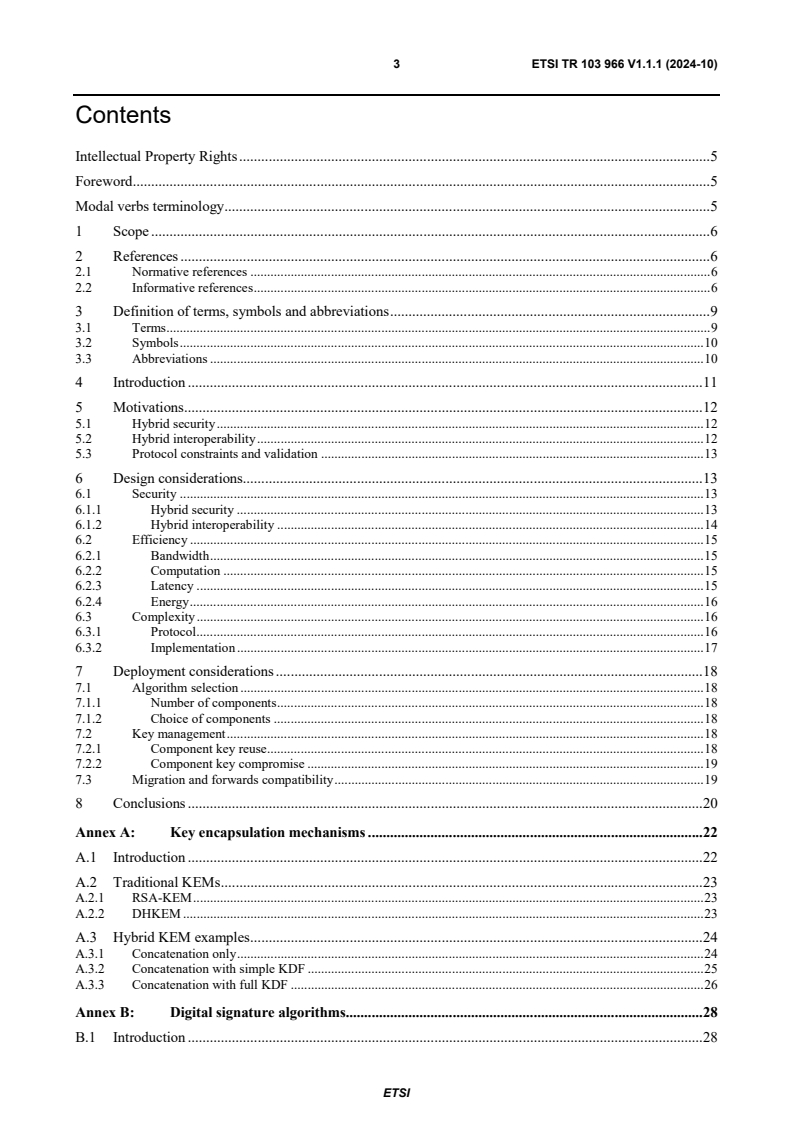
Contents
Intellectual Property Rights . 5
Foreword . 5
Modal verbs terminology . 5
1 Scope . 6
2 References . 6
2.1 Normative references . 6
2.2 Informative references . 6
3 Definition of terms, symbols and abbreviations . 9
3.1 Terms . 9
3.2 Symbols . 10
3.3 Abbreviations . 10
4 Introduction . 11
5 Motivations . 12
5.1 Hybrid security . 12
5.2 Hybrid interoperability . 12
5.3 Protocol constraints and validation . 13
6 Design considerations. 13
6.1 Security . 13
6.1.1 Hybrid security . 13
6.1.2 Hybrid interoperability . 14
6.2 Efficiency . 15
6.2.1 Bandwidth . 15
6.2.2 Computation . 15
6.2.3 Latency . 15
6.2.4 Energy . 16
6.3 Complexity . 16
6.3.1 Protocol . 16
6.3.2 Implementation . 17
7 Deployment considerations . 18
7.1 Algorithm selection . 18
7.1.1 Number of components . 18
7.1.2 Choice of components . 18
7.2 Key management . 18
7.2.1 Component key reuse. 18
7.2.2 Component key compromise . 19
7.3 Migration and forwards compatibility . 19
8 Conclusions . 20
Annex A: Key encapsulation mechanisms . 22
A.1 Introduction . 22
A.2 Traditional KEMs . 23
A.2.1 RSA-KEM . 23
A.2.2 DHKEM . 23
A.3 Hybrid KEM examples . 24
A.3.1 Concatenation only . 24
A.3.2 Concatenation with simple KDF . 25
A.3.3 Concatenation with full KDF . 26
Annex B: Digital signature algorithms . 28
B.1 Introduction . 28
ETSI
4 ETSI TR 103 966 V1.1.1 (2024-10)
B.2 Separability . 28
B.3 Hybrid signature examples . 29
B.3.1 Concatenation only . 29
B.3.2 Concatenation with identifiers . 29
B.3.3 Strong non-separability . 30
Annex C: Change History . 32
History . 33
ETSI
5 ETSI TR 103 966 V1.1.1 (2024-10)
Intellectual Property Rights
Essential patents
IPRs essential or potentially essential to normative deliverables may have been declared to ETSI. The declarations
pertaining to these essential IPRs, if any, are publicly available for ETSI members and non-members, and can be
found in ETSI SR 000 314: "Intellectual Property Rights (IPRs); Essential, or potentially Essential, IPRs notified to
ETSI in respect of ETSI standards", which is available from the ETSI Secretariat. Latest updates are available on the
ETSI Web server (https://ipr.etsi.org/).
Pursuant to the ETSI Directives including the ETSI IPR Policy, no investigation regarding the essentiality of IPRs,
including IPR searches, has been carried out by ETSI. No guarantee can be given as to the existence of other IPRs not
referenced in ETSI SR 000 314 (or the updates on the ETSI Web server) which are, or may be, or may become,
essential to the present document.
Trademarks
The present document may include trademarks and/or tradenames which are asserted and/or registered by their owners.
ETSI claims no ownership of these except for any which are indicated as being the property of ETSI, and conveys no
right to use or reproduce any trademark and/or tradename. Mention of those trademarks in the present document does
not constitute an endorsement by ETSI of products, services or organizations associated with those trademarks.
DECT™, PLUGTESTS™, UMTS™ and the ETSI logo are trademarks of ETSI registered for the benefit of its
Members. 3GPP™ and LTE™ are trademarks of ETSI registered for the benefit of its Members and of the 3GPP
Organizational Partners. oneM2M™ logo is a trademark of ETSI registered for the benefit of its Members and of the ®
oneM2M Partners. GSM and the GSM logo are trademarks registered and owned by the GSM Association.
Foreword
This Technical Report (TR) has been produced by ETSI Technical Committee Cyber Security (CYBER).
Modal verbs terminology
In the present document "should", "should not", "may", "need not", "will", "will not", "can" and "cannot" are to be
interpreted as described in clause 3.2 of the ETSI Drafting Rules (Verbal forms for the expression of provisions).
"must" and "must not" are NOT allowed in ETSI deliverables except when used in direct citation.
ETSI
6 ETSI TR 103 966 V1.1.1 (2024-10)
1 Scope
The present document explores issues around combining traditional and post-quantum algorithms to construct hybrid
cryptographic schemes.
Specifically, the present document examines some of the reasons for proposing and adopting hybrid schemes, both for
key establishment and digital signatures; clarifies some of the terminology used to describe hybrid schemes; discusses
some of the security, efficiency, and agility trade-offs; highlights some important things to consider when selecting
algorithm and parameter combinations; explores some potential deployment and migration issues; and identifies
situations where hybrid schemes will need to be deprecated in favour of purely post-quantum algorithms.
The present document does not provide guidance on whether or not to use hybrid schemes.
2 References
2.1 Normative references
Normative references are not applicable in the present document.
2.2 Informative references
References are either specific (identified by date of publication and/or edition number or version number) or
non-specific. For specific references, only the cited version applies. For non-specific references, the latest version of the
referenced document (including any amendments) applies.
NOTE: While any hyperlinks included in this clause were valid at the time of publication ETSI cannot guarantee
their long term validity.
The following referenced documents are not necessary for the application of the present document but they assist the
user with regard to a particular subject area.
[i.1] ETSI TR 103 616: "CYBER; Quantum-safe signatures".
[i.2] ETSI TR 103 692: "CYBER; State management for stateful authentication mechanisms".
[i.3] ETSI TS 103 744: "CYBER; Quantum-Safe Cryptography (QSC); Quantum-safe hybrid key
exchanges".
[i.4] ETSI TR 103 823: "CYBER; Quantum-safe public-key encryption and key encapsulation".
[i.5] IETF RFC 5652: "Cryptographic Message Syntax (CMS)".
[i.6] IETF RFC 6090: "Fundamental elliptic curve cryptography algorithms".
[i.7] IETF RFC 8551: "Secure/Multipurpose Internet Mail Extensions (S/MIME) Version 4.0 message
specification".
[i.8] IETF RFC 9370: "Multiple key exchanges in the Internet Key Exchange protocol Version 2
(IKEv2)".
[i.9] IRTF IETF RFC 7748: "Elliptic curves for security".
[i.10] IRTF IETF RFC 8391: "XMSS: eXtended Merkle Signature Scheme".
[i.11] IRTF IETF RFC 8554: "Leighton-Micali hash-based signatures".
[i.12] IRTF IETF RFC 9180: "Hybrid public key encryption".
[i.13] NIST FIPS 140-3: "Security requirements for cryptographic modules".
[i.14] NIST FIPS 186-4: "Digital Signature Standard (DSS)".
ETSI
7 ETSI TR 103 966 V1.1.1 (2024-10)
[i.15] NIST FIPS 203 (initial public draft): "Module-lattice-based key-encapsulation mechanism
standard".
[i.16] NIST FIPS 204 (initial public draft): "Module-lattice-based digital signature standard".
[i.17] NIST FIPS 205 (initial public draft): "Stateless hash-based digital signature standard".
[i.18] NIST SP 800-56A Rev. 3: "Recommendation for pair-wise key establishment schemes using
discrete logarithm cryptography".
[i.19] NIST SP 800-56B Rev. 2: "Recommendation for pair-wise key establishment schemes using
integer factorization cryptography".
[i.20] NIST: "Post-quantum cryptography FAQs".
[i.21] Recommendation ITU-T X.509: "Information technology - Open Systems Interconnection - The
Directory: Public key and attribute certificate frameworks".
[i.22] M.R. Albrecht, et al: "Classic McEliece: conservative code-based cryptography". NIST round
3 post-quantum submission.
[i.23] R. Avanzi et al: "CRYSTALS-Kyber: Algorithm specifications and supporting documentation".
NIST round 3 post-quantum submission.
[i.24] J.-P. Aumasson et al: "SPHINCS+: Submission to the NIST post-quantum project". NIST round
3 post-quantum submission.
[i.25] N. Aviram et al: "DROWN: Breaking TLS using SSLv2". USENIX Security 2016.
[i.26] J. Baena et al: "Improving support-minors rank attacks: Applications to GeMSS and Rainbow".
CRYPTO 2022.
[i.27] S. Bai et al: "CRYSTALS-Dilithium: Algorithm specifications and supporting documentation".
NIST round 3 post-quantum submission.
[i.28] M. Barbosa et al: "X-Wing: The hybrid KEM you've been looking for". IACR ePrint 2024/039.
[i.29] N. Bindel and B. Hale: "A note on hybrid signature schemes". IACR ePrint 2023/423.
[i.30] N. Bindel et al: "Hybrid key encapsulation mechanisms and authenticated key exchange".
PQCrypto 2019.
[i.31] N. Bindel et al: "Transitioning to a quantum-resistant public key infrastructure". PQCrypto 2017.
[i.32] W. Beullens: "Breaking Rainbow takes a weekend on a laptop". CRYPTO 2022.
[i.33] D. Bleichenbacher: "Chosen ciphertext attacks against protocols based on the RSA encryption
standard PKCS# 1". CRYPTO 1998.
[i.34] C. Bonnell et al: "A mechanism for encoding differences in paired certificates". IETF
Internet-Draft (work in progress), draft-bonnell-lamps-chameleon-certs-03.
[i.35] F. Byszio, K.-D. Wirth and K. Nguyen: "Intelligent composed algorithms". IACR ePrint 2021/813.
[i.36] M. Campagna and A. Petcher: "Security of hybrid key encapsulation". IACR ePrint 2020/1364.
[i.37] W. Castryck and T. Decru: "An efficient key recovery attack on SIDH". EUROCRYPT 2023.
[i.38] D. Connolly, P. Schwabe and B. Westerbaan: "X-Wing: General-purpose hybrid post-quantum
KEM". IETF Internet-Draft (work in progress), draft-connolly-cfrg-xwing-kem-01.
[i.39] Y. Dodis and J. Katz: "Chosen-ciphertext security of multiple encryption", TCC 2005.
[i.40] B. Dowling et al: "A cryptographic analysis of the TLS 1.3 handshake protocol candidates". ACM
CCS 2015.
ETSI
8 ETSI TR 103 966 V1.1.1 (2024-10)
[i.41] P.-A. Fouque et al: "Falcon: Fast-Fourier lattice-based compact signatures over NTRU". NIST
round 3 post-quantum submission.
[i.42] M. Friedl, J. Mojzis and S. Josefsson: "Secure Shell (SSH) key exchange method using hybrid
Streamlined NTRU Prime sntrup761 and X25519 with SHA-512: sntrup761x25519-sha512". IETF
Internet-Draft (expired), draft-josefsson-ntruprime-ssh-02.
[i.43] F. Giacon, F. Heuer and B. Poettering: "KEM combiners". PKC 2018.
[i.44] P. Kampanakis, D. Stebila and T. Hansen: "Post-quantum hybrid key exchange in SSH". IETF
Internet-Draft (work in progress), draft-kampanakis-curdle-ssh-pq-ke-21.
[i.45] A. Kipnis, J. Patarin and L. Goubin: "Unbalanced oil and vinegar signature schemes".
EUROCRYPT 1999.
[i.46] V. Klíma, O. Pokorný and T. Rosa: "Attacking RSA-based sessions in SSL/TLS". CHES 2003.
[i.47] S. Kousidis, J.Roth, F. Strenzke and A. Wussler: "Post-quantum cryptography in OpenPGP". IETF
Internet-Draft (work in progress), draft-ietf-openpgp-pqc-02.
[i.48] K. Kwiatkowski and P. Kampanakis: "Post-quantum hybrid ECDHE-Kyber key agreement for
TLSv1.3". IETF Internet-Draft (expired), draft-kwiatkowski-tls-ecdhe-kyber-01.
[i.49] A. Langley: "CECPQ1 results". Imperial Violet blog, 28 November 2016.
[i.50] A. Langley: "CECPQ2". Imperial Violet blog, 12 December 2018.
[i.51] Y. Nir: "A hybrid signature method with strong non-separability". IETF Internet-Draft (expired),
draft-nir-lamps-altcompsigs-00.
[i.52] M. Ounsworth and J. Gray: "Composite ML-KEM for use in the internet X.509 Public Key
Infrastructure and CMS". IETF Internet-Draft (work in progress),
draft-ietf-lamps-pq-composite-kem-03.
[i.53] M. Ounsworth, J. Gray and S. Mister: "Composite encryption for use in internet PKI". IETF
Internet-Draft (expired), draft-ounsworth-pq-composite-encryption-01.
[i.54] M. Ounsworth, J. Gray, M. Pala and J. Klaussner: "Composite signatures for use in internet PKI".
IETF Internet-Draft (work in progress), draft-ietf-lamps-pq-composite-sigs-10.
[i.55] M. Ounsworth, M. Pala and J. Klaussner: "Composite public and private keys for use in internet
PKI". IETF Internet-Draft (expired), draft-ounsworth-pq-composite-keys-05.
[i.56] M. Ounsworth, A. Wussler and S. Kousidis: "Combiner function for hybrid key encapsulation
mechanisms (Hybrid KEMs)". IETF Internet-Draft (work in progress),
draft-ounsworth-cfrg-kem-combiners-05.
[i.57] C. Paquin, D. Stebila and G. Tamvada: "Benchmarking post-quantum cryptography in TLS".
PQCrypto 2020.
[i.58] A. Petcher and M. Campagna: "Security of hybrid key establishment using concatenation". IACR
ePrint 2023/972.
[i.59] B. Poettering and S. Rastikian: "A study of KEM generalizations". SSR 2023.
[i.60] J. Proos and C. Zalka: "Shor's discrete logarithm quantum algorithm for elliptic curves". Quantum
Information and Computation 3.4 (2003), 317-344.
[i.61] P.W. Shor: "Algorithms for quantum computation: discrete logarithms and factoring". FOCS,
1994.
[i.62] D. Sikeridis, P. Kampanakis and M. Devetsikiotis: "Post-quantum authentication in TLS 1.3: A
performance study". NDSS 2020.
[i.63] D. Sikeridis, P. Kampanakis and M. Devetsikiotis: "Assessing the overhead of post-quantum
cryptography in TLS 1.3 and SSH". CoNEXT 2020.
ETSI
9 ETSI TR 103 966 V1.1.1 (2024-10)
[i.64] V. Shoup: "A proposal for an ISO standard for public key encryption". IACR ePrint 2001/112.
[i.65] D. Stebila, S. Fluhrer and S. Gueron: "Hybrid key exchange in TLS 1.3". IETF Internet-Draft
(work in progress), draft-ietf-tls-hybrid-design-10.
[i.66] G. Taspoulos et al: "Energy consumption evaluation of post-quantum TLS 1.3 for
resource-constrained embedded devices". IACR ePrint 2023/506.
[i.67] B. Westerbaan and D. Stebila: "X25519Kyber768Draft00 hybrid post-quantum key agreement".
IETF Internet-Draft (expired), draft-tls-westerbaan-xyber768d00-03.
[i.68] B. Westerbaan and C.A. Wood: "X25519Kyber768Draft00 hybrid post-quantum KEM for
HPKE". IETF Internet-Draft (work in progress), draft-westerbaan-cfrg-hpke-xyber768d00-03.
[i.69] R. Zhang, et al: "On the security of multiple encryption or CCA-security + CCA-security =
CCA-security?". PKC 2004.
3 Definition of terms, symbols and abbreviations
3.1 Terms
For the purposes of the present document, the following terms apply:
active adversary: adversary who can query a decapsulation oracle with chosen ciphertexts or a signing oracle with
chosen messages
NOTE 1: An active adversary who is attempting to recover the session key for a target ciphertext is not permitted to
query the decapsulation oracle with that ciphertext.
NOTE 2: An active adversary who is attempting to forge a signature value for a target message is not permitted to
query the signing oracle with that message.
NOTE 3: The present document assumes that active adversaries only have classical access to the decapsulation or
signing oracles. Adversaries who can query decapsulation or signing oracles with inputs in quantum
superposition are out of scope.
classical adversary: adversary who can only implement attacks on classical computers
component algorithm: cryptographic algorithm that forms part of a hybrid scheme or hybrid protocol
hybrid interoperability: property that a hybrid scheme or hybrid protocol can be completed successfully provided that
at least one component algorithm is supported by both parties
hybrid protocol: protocol that incorporates two or more component algorithms providing the same cryptographic
functionality
NOTE 1: The present document only considers hybrid protocols where at least one component is a post-quantum
algorithm and at least one is a traditional algorithm. Hybrid protocols that combine two or more
post-quantum algorithms and no traditional algorithms are out of scope.
EXAMPLE 1: A protocol that uses a hybrid key establishment scheme for confidentiality and a traditional digital
signature algorithm for authentication.
EXAMPLE 2: A protocol that uses a post-quantum key encapsulation mechanism for confidentiality and a hybrid
digital signature scheme for authentication.
EXAMPLE 3: A protocol that establishes an initial session key using a traditional key exchange, updates the
session key using a post-quantum key encapsulation mechanism, and then performs authentication
using a traditional digital signature algorithm.
NOTE 2: A protocol that negotiates the use of either a traditional algorithm or a post-quantum algorithm, but not
the use of both algorithms, is not considered to be a hybrid protocol.
ETSI
10 ETSI TR 103 966 V1.1.1 (2024-10)
hybrid scheme: cryptographic scheme that incorporates two or more component algorithms providing the same
cryptographic functionality
NOTE: The present document only considers hybrid schemes where at least one component is a post-quantum
algorithm and at least one is a traditional algorithm. Hybrid schemes that combine two or more
post-quantum algorithms and no traditional algorithms are out of scope.
EXAMPLE 1: A hybrid key establishment scheme that combines a traditional key exchange and a post-quantum
key encapsulation mechanism.
EXAMPLE 2: A hybrid digital signature scheme that combines a traditional digital signature algorithm and a
post-quantum digital signature algorithm.
hybrid security: property that a hybrid scheme or hybrid protocol remains secure provided that at least one component
algorithm is secure
oracle: functionality that provides an adversary with the output of a cryptographic operation without the adversary
needing to know the keys used in the operation
passive adversary: adversary who can only query an encapsulation oracle or a verification oracle
post-quantum algorithm: public-key algorithm believed to be secure against both classical and quantum adversaries
EXAMPLE 1: Key encapsulation mechanisms based on lattices such as the Module-Lattice-based Key
Encapsulation Mechanism (ML-KEM) [i.15], or error correcting codes such as Classic McEliece
[i.22].
NOTE 1: ML-KEM is derived from the Kyber [i.23] submission to the NIST Post-Quantum Cryptography
Standardisation Project
EXAMPLE 2: Digital signature algorithms based on lattices such as the Module-Lattice-based Digital Signature
Algorithm (ML-DSA) [i.16], or hash functions such as the Stateless Hash-based Digital Signature
Algorithm [i.17].
NOTE 2: ML-DSA is derived from the Dilithium [i.27] submission to the NIST Post-Quantum Cryptography
Standardisation Project.
+
NOTE 3: SLH-DSA is derived from the SPHINCS [i.24] submission to the NIST Post-Quantum Cryptography
Standardisation Project.
quantum adversary: adversary who can implement attacks on both classical and quantum computers
traditional algorithm: public-key algorithm based on integer factorisation, finite field discrete logarithms, or elliptic
curve discrete logarithms
EXAMPLE 1: Key establishment algorithms such as RSA [i.19], Finite-Field Diffie-Hellman (FFDH), and
Elliptic Curve Diffie-Hellman (ECDH) [i.18].
EXAMPLE 2: Digital signature algorithms such as RSA, the finite-field Digital Signature Algorithm (DSA), and
the Elliptic Curve Digital Signature Algorithm (ECDSA) [i.14].
3.2 Symbols
Void.
3.3 Abbreviations
For the purposes of the present document, the following abbreviations apply:
CCA Chosen-Ciphertext Attack
CMS Cryptographic Message Syntax
CRQC Cryptographically Relevant Quantum Computer
DHKEM Diffie-Hellman Key Encapsulation Mechanism
ETSI
11 ETSI TR 103 966 V1.1.1 (2024-10)
DSA Digital Signature Algorithm
ECDH Elliptic Curve Diffie-Hellman
ECDSA Elliptic Curve Digital Signature Algorithm
EUF-CMA Existential Unforgeability under Chosen-Message Attack
FFDH Finite-Field Diffie-Hellman
FIPS Federal Information Processing Standard
HPKE Hybrid Public-Key Encryption
IETF Internet Engineering Task Force
IKE Internet Key Exchange
IND-CCA Indistinguishability under Chosen-Ciphertext Attack
IND-CPA Indistinguishability under Chosen-Plaintext Attack
IRTF Internet Research Task Force
KDF Key Derivation Function
KDFEM Key Derivation Function Encapsulation Mechanism
KEM Key Encapsulation Mechanism
LMS Leighton-Micali Signature
ML-DSA Module-Lattice-based Digital Signature Algorithm
ML-KEM Module-Lattice-based Key Encapsulation Mechanism
OW-CCA One-Way under Chosen-Ciphertext Attack
OW-CPA One-Way under Chosen-Plaintext Attack
PKCS Public-Key Cryptography Standards
PRF Pseudo-Random Function
RSA Rivest-Shamir-Adleman
S/MIME Secure/Multipurpose Internet Mail Extensions
SIKE Supersingular Isogeny Key Encapsulation
SLH-DSA Stateless Hash-based Digital Signature Algorithm
SSH Secure Shell
SSL Secure Sockets Layer
TLS Transport Layer Security
UOV Unbalanced Oil and Vinegar
XMSS eXtended Merkle Signature Scheme
4 Introduction
The security of traditional approaches to public-key cryptography, including key establishment and digital signatures,
relies on the difficulty of factoring integers or computing discrete logarithms over finite fields or elliptic curves. When
suitably parameterised, these algorithms are believed to be hard to break using classical computers. However, they are
known to be vulnerable to attacks using quantum computers [i.60] and [i.61].
Although existing quantum computers are not large enough to threaten currently deployed algorithms, the risk
associated with the future development of a Cryptographically Relevant Quantum Computer (CRQC) is best mitigated
by migrating to post-quantum cryptography.
EXAMPLE 1: In a store-and-decrypt attack, long-lived sensitive information protected by a traditional key
establishment algorithm could be intercepted and stored by an adversary, and subsequently
decrypted once a CRQC is available.
EXAMPLE 2: In a future forgery attack, a long-lived root of trust protected by a traditional digital signature
algorithm might still be trusted and could be exploited by an adversary once a CRQC is available.
Post-quantum algorithms are intended to be secure against both classical and quantum computers. ETSI
TR 103 616 [i.1] gives an overview of post-quantum digital signature algorithms and ETSI TR 103 823 [i.4] gives an
overview of post-quantum public-key encryption algorithms and key encapsulation mechanisms. (See annexes A and B
for background on key encapsulation mechanisms and digital signature algorithms.)
During the migration to post-quantum cryptography there will be situations where it could be desirable to combine
existing traditional algorithms with post-quantum algorithms in a hybrid scheme. The main reasons for considering
hybrid schemes are:
• to maintain security in the event that vulnerabilities are found in the post-quantum algorithm or its
implementation (see clause 5.1);
ETSI
12 ETSI TR 103 966 V1.1.1 (2024-10)
• to provide backwards compatibility for clients that are not yet able to understand and use post-quantum
algorithms (see clause 5.2); and
• to satisfy constraints imposed by protocols or validation requirements (see clause 5.3).
The different reasons for using hybrid schemes mean that different approaches have been proposed for their design and
integration into hybrid protocols. This can lead to differences in:
• security guarantees provided by a hybrid scheme (see clause 6.1);
• efficiency of a hybrid protocol (see clause 6.2); and
• complexity of a hybrid protocol or its implementation (see clause 6.3).
There are a variety of issues that need to be considered when deploying hybrid schemes, which depend on the protocol
and application. These include:
• algorithm choices for a hybrid scheme (see clause 7.1);
• key management approach for a hybrid protocol (see clause 7.2); and
• migration strategies and forward compatibility (see clause 7.3).
5 Motivations
5.1 Hybrid security
A common reason given for deploying hybrid schemes is the potential security risk involved in deprecating traditional
algorithms and moving directly to post-quantum algorithms.
Although post-quantum cryptography has become a significant research topic, there are concerns about the maturity of
the cryptanalysis of some algorithms and families of algorithms. There have been high-profile practical attacks against
GeMSS [i.26], Rainbow [i.32], and SIKE [i.37] during the third round of the NIST Post-Quantum Cryptography
Standardisation Project. It will also take time to build confidence in the assurance of post-quantum implementations.
Post-quantum algorithms tend to be more complicated than traditional algorithms and implementation mistakes can be
difficult to detect. Effective techniques for protecting post-quantum implementations against side-channel attacks are
still being developed.
Well-designed hybrid schemes that remain secure if at least one of their component algorithms is secure can mitigate
future vulnerabilities in post-quantum algorithms or their implementations. This approach has already been used in
experiments exploring the viability of post-quantum algorithms in protocols such as TLS [i.49] and [i.50]. However,
care needs to be taken as hybrid schemes proposed for hybrid interoperability (see clause 5.2) might not provide the
same security guarantees as hybrid schemes proposed for hybrid security, while ad-hoc constructions can introduce
weaknesses that would not be present when using post-quantum algorithms in a non-hybrid mode (see clause 6.1).
5.2 Hybrid interoperability
Another reason commonly given for deploying hybrid schemes is to provide backwards compatibility and allow a
gradual migration to post-quantum algorithms.
In a public or large enterprise system, it might not be possible to update all clients simultaneously to support
post-quantum cryptography. During a gradual migration, such systems would potentially need to cope with mixed
populations of clients: traditional clients that can only understand and use traditional algorithms, post-quantum aware
clients that can understand and use both traditional and post-quantum algorithms, and post-quantum clients that can
only understand and use post-quantum algorithms.
ETSI
13 ETSI TR 103 966 V1.1.1 (2024-10)
Hybrid schemes can provide a backwards compatibility mechanism for protocols that do not permit flexible negotiation
of algorithms. For example, Recommendation ITU-T X.509 [i.21] specifies hybrid certificates with non-critical
certificate extensions for post-quantum public keys and signature values that could be used by post-quantum aware
clients, but that would be ignored by traditional clients. However, hybrid schemes proposed for hybrid security (see
clause 5.1) might not provide the same backwards compatibility as hybrid schemes proposed for hybrid interoperability.
5.3 Protocol constraints and validation
Other reasons for retaining traditional algorithms in a hybrid scheme are limitations in the protocol or the need to satisfy
accreditation requirements.
The size of the initial key exchange in IKEv2 is limited by the need to avoid packet fragmentation. Most post-quantum
key exchanges have public keys that are too large to fit into the available space. The pragmatic solution proposed by
IETF RFC 9370 [i.8] keeps a traditional algorithm for the initial key exchange where standard IKE fragmentation
mechanisms cannot be used, and allows it to be followed by one or more key exchanges that can be safely fragmented,
updating the session key appropriately.
FIPS 140-3 [i.13] validation for cryptographic modules requires the use of approved public-key algorithms. NIST have
only approved certain traditional algorithms and have not yet approved any post-quantum algorithms. However, they
indicate in their post-quantum FAQs [i.20] that a post-quantum key establishment or digital signature algorithm can be
included in an implementation if it is used with an approved traditional algorithm in a FIPS-compliant hybrid mode.
6 Design considerations
6.1 Security
6.1.1 Hybrid security
A common assumption is that the use of hybrid schemes can only increase security. In practice, the security provided by
a hybrid scheme depends on the type of scheme and the details of its construction.
Well-designed hybrid schemes can remain secure if at least one component algorithm is secure. It is important to note
that traditional and post-quantum algorithms address different security considerations, so the security properties of a
hybrid scheme intended to provide hybrid security can still be impacted if one if its component algorithms is insecure.
EXAMPLE 1: The "and-mode" hybrid digital signature schemes proposed in [i.31], [i.35] and [i.54] sign the
message using all component digital signature algorithms, and the hybrid signature value is
considered valid only if all component signature values are valid (see clause B.3.1).
When instantiated with a single traditional digital signature algorithm and a single post-quantum
digital signature algorithm, the hybrid scheme will be secure against both classical and quantum
adversaries provided that the post-quantum algorithm is secure.
If the post-quantum algorithm is vulnerable, the hybrid scheme remains secure against classical
adversaries because they cannot forge signature values for the traditional algorithm. However, it
will be insecure against quantum adversaries and so will no longer protect against future forgery
attacks (see clause 4).
NOTE: Including more than one post-quantum algorithm in a hybrid scheme can provide additional mitigation
against quantum adversaries at the cost of reducing the efficiency (see clause 6.2) and increasing the
complexity (see clause 6.3) of the scheme.
Care needs to be taken when designing hybrid key encapsulation schemes. Naïve constructions can lead to hybrid
schemes that are less secure than their component algorithms [i.69] and [i.39]. For example, the "concatenation only"
hybrid key encapsulation scheme proposed in [i.35] constructs the hybrid session key as the concatenation of the
session keys from the component algorithms. This will not be secure against active adversaries, regardless of the
security of the component algorithms: changing one component ciphertext only affects the corresponding part of the
session key, not the entire session key (see clause A.3.1 for details).
ETSI
14 ETSI TR 103 966 V1.1.1 (2024-10)
ETSI TS 103 744 [i.3] includes constructions for hybrid key encapsulation schemes that maintain their security against
passive adversaries. Bindel et al [i.30] describe constructions for hybrid key encapsulation schemes that maintain their
security against active adversaries.
EXAMPLE 2: The "dual-PRF" hybrid key encapsulation scheme proposed in [i.30] constructs the hybrid session
key by concatenating the session keys from the component algorithms and then passing the result
through a key derivation function together with the component ciphertexts (see clause A.3.3).
When instantiated with a single traditional key encapsulation mechanism and a single
post-quantum key encapsulation mechanism, the hybrid scheme will be secure against both
classical and quantum adversaries provided that the post-quantum algorithm is secure.
If the post-quantum algorithm is vulnerable, the hybrid scheme remains secure against classical
adversaries because they cannot recover session keys for the traditional algorithm. However, it will
be insecure against quantum adversaries and so will no longer protect against store-and-decrypt
attacks (see clause 4).
The "dual-PRF" hybrid key encapsulation scheme assumes that all component algorithms are key encapsulation
mechanisms. Although traditional Diffie-Hellman key exchanges can be modelled as key encapsulation mechanisms
(see, for example, the discussion in [i.65]), they will not be secure against active adversaries: it is possible to modify
ciphertexts in a way that causes predictable changes in the session key (see clause A.2.2 for details). For [i.30] to give
full security guarantees against active adversaries it is necessary to use a conversion such as DHKEM [i.12].
6.1.2 Hybrid interoperability
Hybrid schemes that are intended to provide backwards compatibility might not possess the same security guarantees as
hybrid schemes intended to provide hybrid security. They can be vulnerable to downgrade attacks where an attacker
exploits the use of an insecure component algorithm. It is possible for a backwards compatible hybrid scheme to be less
secure than using a post-quantum algorithm in a non-hybrid mode.
EXAMPLE: The "or-mode" hybrid digital signature scheme proposed in [i.35] signs the message using all
component digital signature algorithms and the hybrid signature value is considered valid if any
component signature value is valid.
When instantiated with a single traditional digital signature algorithm and a single post-quantum
digital signature algorithm, the hybrid scheme is secure against classical adversaries provided both
the post-quantum and traditional algorithms are secure because they cannot forge signature values
for either algorithm. However, it will be insecure against quantum adversaries as they can forge
signature values for the traditional algorithm and so does not protect against future active attacks
(see clause 4).
If the post-quantum algorithm is vulnerable to a classical attack, the hybrid scheme will be
insecure against classical adversaries.
NOTE: The only difference between the "or-mode" hybrid digital signature scheme and the "and-mode" hybrid
digital signature scheme in clause 6.1.1 is the verification process. Switching an existing client from an
"or-mode" verification policy to an "and-mode" verification policy would prevent downgrade attacks on
that client wit
...
Questions, Comments and Discussion
Ask us and Technical Secretary will try to provide an answer. You can facilitate discussion about the standard in here.
Loading comments...