


ETSI TR 101 147 V1.2.1 (2025-02)
Environmental Engineering (EE); Interworking between Direct Current/Isolated (DC/I) and Direct Current/Common (DC/C) electrical power systems
Environmental Engineering (EE); Interworking between Direct Current/Isolated (DC/I) and Direct Current/Common (DC/C) electrical power systems
RTR/EE-02100
General Information
Standards Content (Sample)
TECHNICAL REPORT
Environmental Engineering (EE);
Interworking between Direct Current/Isolated (DC/I) and
Direct Current/Common (DC/C) electrical power systems
2 ETSI TR 101 147 V1.2.1 (2025-02)
Reference
RTR/EE-02100
Keywords
earthing, power supply
ETSI
650 Route des Lucioles
F-06921 Sophia Antipolis Cedex - FRANCE
Tel.: +33 4 92 94 42 00 Fax: +33 4 93 65 47 16
Siret N° 348 623 562 00017 - APE 7112B
Association à but non lucratif enregistrée à la
Sous-Préfecture de Grasse (06) N° w061004871
Important notice
The present document can be downloaded from the
ETSI Search & Browse Standards application.
The present document may be made available in electronic versions and/or in print. The content of any electronic and/or
print versions of the present document shall not be modified without the prior written authorization of ETSI. In case of any
existing or perceived difference in contents between such versions and/or in print, the prevailing version of an ETSI
deliverable is the one made publicly available in PDF format on ETSI deliver repository.
Users should be aware that the present document may be revised or have its status changed,
this information is available in the Milestones listing.
If you find errors in the present document, please send your comments to
the relevant service listed under Committee Support Staff.
If you find a security vulnerability in the present document, please report it through our
Coordinated Vulnerability Disclosure (CVD) program.
Notice of disclaimer & limitation of liability
The information provided in the present deliverable is directed solely to professionals who have the appropriate degree of
experience to understand and interpret its content in accordance with generally accepted engineering or
other professional standard and applicable regulations.
No recommendation as to products and services or vendors is made or should be implied.
No representation or warranty is made that this deliverable is technically accurate or sufficient or conforms to any law
and/or governmental rule and/or regulation and further, no representation or warranty is made of merchantability or fitness
for any particular purpose or against infringement of intellectual property rights.
In no event shall ETSI be held liable for loss of profits or any other incidental or consequential damages.
Any software contained in this deliverable is provided "AS IS" with no warranties, express or implied, including but not
limited to, the warranties of merchantability, fitness for a particular purpose and non-infringement of intellectual property
rights and ETSI shall not be held liable in any event for any damages whatsoever (including, without limitation, damages
for loss of profits, business interruption, loss of information, or any other pecuniary loss) arising out of or related to the use
of or inability to use the software.
Copyright Notification
No part may be reproduced or utilized in any form or by any means, electronic or mechanical, including photocopying and
microfilm except as authorized by written permission of ETSI.
The content of the PDF version shall not be modified without the written authorization of ETSI.
The copyright and the foregoing restriction extend to reproduction in all media.
© ETSI 2025.
All rights reserved.
ETSI
3 ETSI TR 101 147 V1.2.1 (2025-02)
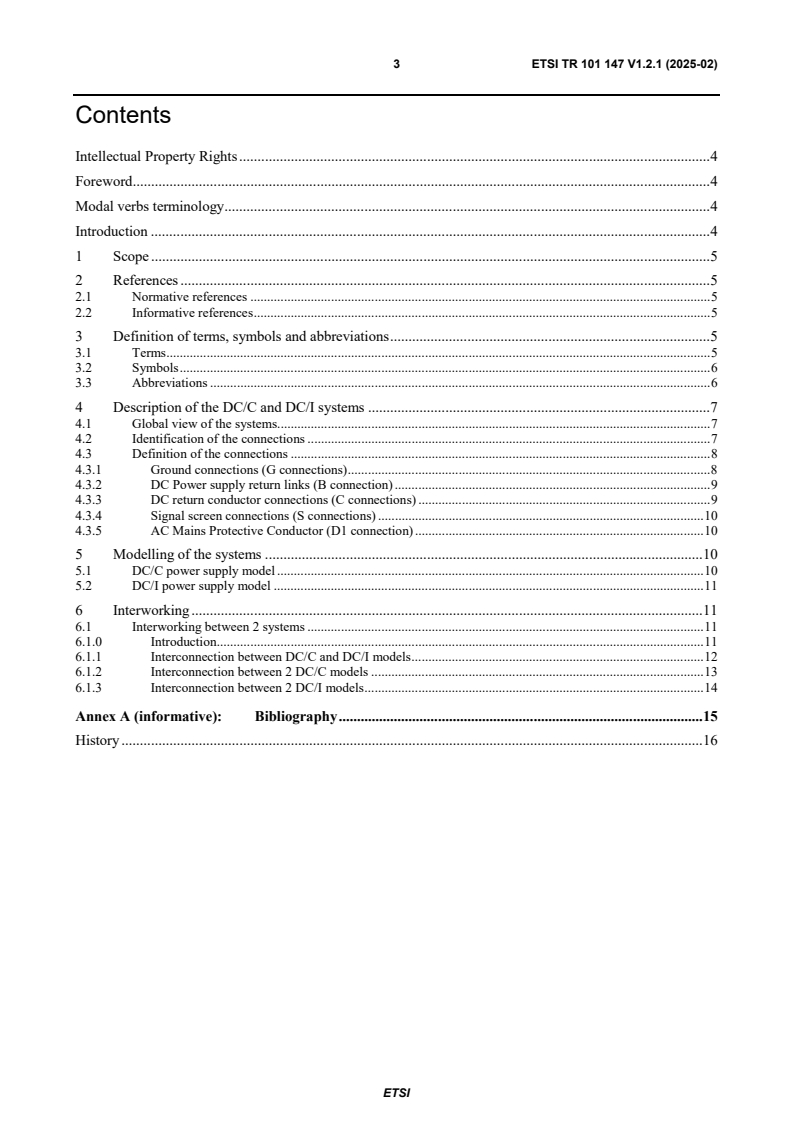
Contents
Intellectual Property Rights . 4
Foreword . 4
Modal verbs terminology . 4
Introduction . 4
1 Scope . 5
2 References . 5
2.1 Normative references . 5
2.2 Informative references . 5
3 Definition of terms, symbols and abbreviations . 5
3.1 Terms . 5
3.2 Symbols . 6
3.3 Abbreviations . 6
4 Description of the DC/C and DC/I systems . 7
4.1 Global view of the systems. 7
4.2 Identification of the connections . 7
4.3 Definition of the connections . 8
4.3.1 Ground connections (G connections) . 8
4.3.2 DC Power supply return links (B connection) . 9
4.3.3 DC return conductor connections (C connections) . 9
4.3.4 Signal screen connections (S connections) . 10
4.3.5 AC Mains Protective Conductor (D1 connection) . 10
5 Modelling of the systems . 10
5.1 DC/C power supply model . 10
5.2 DC/I power supply model . 11
6 Interworking . 11
6.1 Interworking between 2 systems . 11
6.1.0 Introduction. 11
6.1.1 Interconnection between DC/C and DC/I models . 12
6.1.2 Interconnection between 2 DC/C models . 13
6.1.3 Interconnection between 2 DC/I models . 14
Annex A (informative): Bibliography . 15
History . 16
ETSI
4 ETSI TR 101 147 V1.2.1 (2025-02)
Intellectual Property Rights
Essential patents
IPRs essential or potentially essential to normative deliverables may have been declared to ETSI. The declarations
pertaining to these essential IPRs, if any, are publicly available for ETSI members and non-members, and can be
found in ETSI SR 000 314: "Intellectual Property Rights (IPRs); Essential, or potentially Essential, IPRs notified to
ETSI in respect of ETSI standards", which is available from the ETSI Secretariat. Latest updates are available on the
ETSI IPR online database.
Pursuant to the ETSI Directives including the ETSI IPR Policy, no investigation regarding the essentiality of IPRs,
including IPR searches, has been carried out by ETSI. No guarantee can be given as to the existence of other IPRs not
referenced in ETSI SR 000 314 (or the updates on the ETSI Web server) which are, or may be, or may become,
essential to the present document.
Trademarks
The present document may include trademarks and/or tradenames which are asserted and/or registered by their owners.
ETSI claims no ownership of these except for any which are indicated as being the property of ETSI, and conveys no
right to use or reproduce any trademark and/or tradename. Mention of those trademarks in the present document does
not constitute an endorsement by ETSI of products, services or organizations associated with those trademarks.
DECT™, PLUGTESTS™, UMTS™ and the ETSI logo are trademarks of ETSI registered for the benefit of its
Members. 3GPP™, LTE™ and 5G™ logo are trademarks of ETSI registered for the benefit of its Members and of the
3GPP Organizational Partners. oneM2M™ logo is a trademark of ETSI registered for the benefit of its Members and of ®
the oneM2M Partners. GSM and the GSM logo are trademarks registered and owned by the GSM Association.
Foreword
This Technical Report (TR) has been produced by ETSI Technical Committee Environmental Engineering (EE).
Modal verbs terminology
In the present document "should", "should not", "may", "need not", "will", "will not", "can" and "cannot" are to be
interpreted as described in clause 3.2 of the ETSI Drafting Rules (Verbal forms for the expression of provisions).
"must" and "must not" are NOT allowed in ETSI deliverables except when used in direct citation.
Introduction
ETSI EN 300 253 [i.1] recognizes the Direct Current/Common (DC/C) and Direct Current /Isolated (DC/I) electrical
power systems usable in telecommunication equipments.
The aim of the present document is to show the effective interconnecting possibility of the two systems and to list some
engineering precautions ensuring good interworking.
ETSI
5 ETSI TR 101 147 V1.2.1 (2025-02)
1 Scope
The present document describes and establishes simplified models of the different sections of the ground distribution
network constituting the DC/I and the DC/C electrical power systems.
These models are interworked to identify the common impedance where DC power supply currents can circulate
(interconnection between DC/C and DC/I, DC/C and DC/C, DC/I and DC/I).
These results allow the establishment of some basic engineering advice that should be applied to guarantee the good
behaviour when interconnecting two systems. These precautions are given for functionality reasons:
• the noise immunity of the pre-existing system and of the links between the system and the MDF should be
conserved;
and safety aspects:
• the screens of signal cables between the pre-existing system and the Main Distribution Frame (MDF), the
conductors and the connections of the pre-existing system have to withstand additional currents.
2 References
2.1 Normative references
Normative references are not applicable in the present document.
2.2 Informative references
References are either specific (identified by date of publication and/or edition number or version number) or
non-specific. For specific references, only the cited version applies. For non-specific references, the latest version of the
referenced document (including any amendments) applies.
NOTE: While any hyperlinks included in this clause were valid at the time of publication, ETSI cannot guarantee
their long term validity.
The following referenced documents are not necessary for the application of the present document but they assist the
user with regard to a particular subject area.
[i.1] ETSI EN 300 253 "Environmental Engineering (EE); Earthing and bonding of ICT equipment
powered by -48 VDC in telecom and data centres".
3 Definition of terms, symbols and abbreviations
3.1 Terms
For the purposes of the present document, the following terms apply:
DC power return conductor: name given to the 0V power supply conductor
NOTE: It is also called "battery return".
DC/C system: system where the DC power return conductors are connected to the Common Bonding Network (CBN),
ensuring simultaneously the supply and protection functions
NOTE: The DC/C system is also called a "2 wire system".
ETSI
6 ETSI TR 101 147 V1.2.1 (2025-02)
DC/I system: system where the current return function and the grounding of t
...
Questions, Comments and Discussion
Ask us and Technical Secretary will try to provide an answer. You can facilitate discussion about the standard in here.
Loading comments...