


ETSI TS 103 919 V1.1.1 (2024-08)
Emergency Communications (EMTEL); Accessibility and interoperability of emergency communications and for the answering of emergency communications by the public safety answering points (PSAPs) (including to the single European Emergency number 112)
Emergency Communications (EMTEL); Accessibility and interoperability of emergency communications and for the answering of emergency communications by the public safety answering points (PSAPs) (including to the single European Emergency number 112)
DTS/EMTEL-00068
General Information
Standards Content (Sample)
TECHNICAL SPECIFICATION
Emergency Communications (EMTEL);
Accessibility and interoperability of emergency
communications and
for the answering of emergency communications by
the public safety answering points (PSAPs)
(including to the single European Emergency number 112)
2 ETSI TS 103 919 V1.1.1 (2024-08)
Reference
DTS/EMTEL-00068
Keywords
accessibility, emergency communications,
language, location information, PSAP, real-time
text, relay services, roaming, sign language, SIP,
total conversation
ETSI
650 Route des Lucioles
F-06921 Sophia Antipolis Cedex - FRANCE
Tel.: +33 4 92 94 42 00 Fax: +33 4 93 65 47 16
Siret N° 348 623 562 00017 - APE 7112B
Association à but non lucratif enregistrée à la
Sous-Préfecture de Grasse (06) N° w061004871
Important notice
The present document can be downloaded from the
ETSI Search & Browse Standards application.
The present document may be made available in electronic versions and/or in print. The content of any electronic and/or
print versions of the present document shall not be modified without the prior written authorization of ETSI. In case of any
existing or perceived difference in contents between such versions and/or in print, the prevailing version of an ETSI
deliverable is the one made publicly available in PDF format on ETSI deliver.
Users should be aware that the present document may be revised or have its status changed,
this information is available in the Milestones listing.
If you find errors in the present document, please send your comments to
the relevant service listed under Committee Support Staff.
If you find a security vulnerability in the present document, please report it through our
Coordinated Vulnerability Disclosure (CVD) program.
Notice of disclaimer & limitation of liability
The information provided in the present deliverable is directed solely to professionals who have the appropriate degree of
experience to understand and interpret its content in accordance with generally accepted engineering or
other professional standard and applicable regulations.
No recommendation as to products and services or vendors is made or should be implied.
No representation or warranty is made that this deliverable is technically accurate or sufficient or conforms to any law
and/or governmental rule and/or regulation and further, no representation or warranty is made of merchantability or fitness
for any particular purpose or against infringement of intellectual property rights.
In no event shall ETSI be held liable for loss of profits or any other incidental or consequential damages.
Any software contained in this deliverable is provided "AS IS" with no warranties, express or implied, including but not
limited to, the warranties of merchantability, fitness for a particular purpose and non-infringement of intellectual property
rights and ETSI shall not be held liable in any event for any damages whatsoever (including, without limitation, damages
for loss of profits, business interruption, loss of information, or any other pecuniary loss) arising out of or related to the use
of or inability to use the software.
Copyright Notification
No part may be reproduced or utilized in any form or by any means, electronic or mechanical, including photocopying and
microfilm except as authorized by written permission of ETSI.
The content of the PDF version shall not be modified without the written authorization of ETSI.
The copyright and the foregoing restriction extend to reproduction in all media.
© ETSI 2024.
All rights reserved.
ETSI
3 ETSI TS 103 919 V1.1.1 (2024-08)
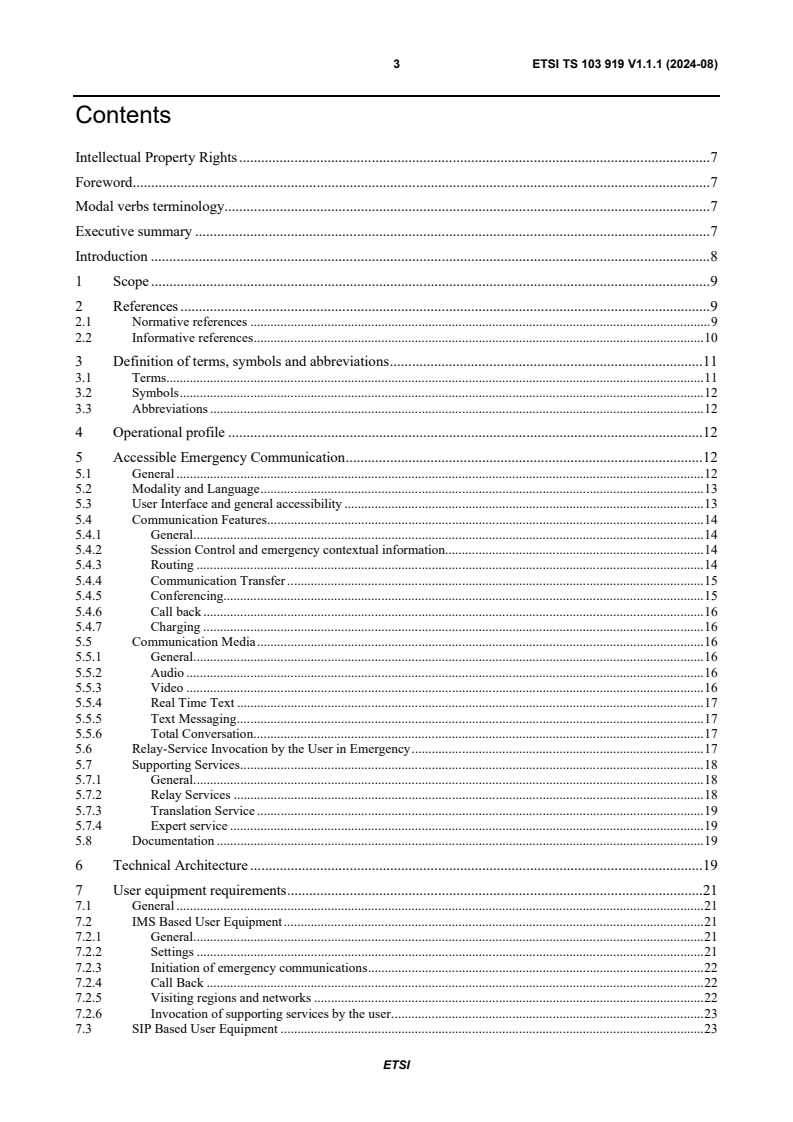
Contents
Intellectual Property Rights . 7
Foreword . 7
Modal verbs terminology . 7
Executive summary . 7
Introduction . 8
1 Scope . 9
2 References . 9
2.1 Normative references . 9
2.2 Informative references . 10
3 Definition of terms, symbols and abbreviations . 11
3.1 Terms . 11
3.2 Symbols . 12
3.3 Abbreviations . 12
4 Operational profile . 12
5 Accessible Emergency Communication . 12
5.1 General . 12
5.2 Modality and Language . 13
5.3 User Interface and general accessibility . 13
5.4 Communication Features . 14
5.4.1 General . 14
5.4.2 Session Control and emergency contextual information. 14
5.4.3 Routing . 14
5.4.4 Communication Transfer . 15
5.4.5 Conferencing. 15
5.4.6 Call back . 16
5.4.7 Charging . 16
5.5 Communication Media . 16
5.5.1 General . 16
5.5.2 Audio . 16
5.5.3 Video . 16
5.5.4 Real Time Text . 17
5.5.5 Text Messaging . 17
5.5.6 Total Conversation . 17
5.6 Relay-Service Invocation by the User in Emergency . 17
5.7 Supporting Services . 18
5.7.1 General . 18
5.7.2 Relay Services . 18
5.7.3 Translation Service . 19
5.7.4 Expert service . 19
5.8 Documentation . 19
6 Technical Architecture . 19
7 User equipment requirements . 21
7.1 General . 21
7.2 IMS Based User Equipment . 21
7.2.1 General . 21
7.2.2 Settings . 21
7.2.3 Initiation of emergency communications . 22
7.2.4 Call Back . 22
7.2.5 Visiting regions and networks . 22
7.2.6 Invocation of supporting services by the user . 23
7.3 SIP Based User Equipment . 23
ETSI
4 ETSI TS 103 919 V1.1.1 (2024-08)
7.3.1 General . 23
7.3.2 Settings . 23
7.3.3 Initiation of emergency communications . 24
7.3.4 Call back . 24
7.3.5 Invocation of support services by the user . 24
7.4 Other technologies for communication services. 25
8 Originating Service Requirements . 25
8.1 General . 25
8.2 IMS Based Originating Service . 25
8.2.1 General . 25
8.2.2 Settings . 26
8.2.3 Initiation of emergency communications . 26
8.2.4 Call back . 26
8.2.5 Visiting regions and networks . 27
8.3 SIP Based Originating Service . 27
8.3.1 General . 27
8.3.2 Settings . 27
8.3.3 Initiation of emergency communications . 27
8.3.4 Call back . 28
8.3.5 Visiting regions and networks . 28
8.4 Other technologies for emergency communication . 28
8.4.1 General . 28
8.4.2 Conversion to ETSI TS 103 479 emergency communication interfaces . 29
8.4.3 Use of ETSI TS 103 479 together with PEMEA . 29
8.4.3.1 General . 29
8.4.3.2 Initiating emergency communication with PEMEA support . 29
8.4.3.3 Emergency communications by IMS in regions without PEMEA support . 29
8.4.3.4 Emergency communications by SIP in regions without PEMEA support . 30
8.4.3.5 Accessibility related details in use of PEMEA. 30
8.4.4 Use of ETSI TS 103 479 with future technologies . 30
9 Emergency communications network and PSAP . 30
9.1 General . 30
9.2 Media . 30
9.3 Modality and Language indication . 31
9.4 Routing . 31
9.5 Bridging . 32
9.6 Call back . 32
9.7 Communications handling . 32
9.8 Considerations for PSAP domains . 33
9.8.1 General . 33
9.8.2 Forest Guide for routing to the responsible PSAP domain . 33
9.8.3 Spoken or written language competence . 33
9.8.4 Sign language handling . 33
10 Supporting Services . 34
Annex A (informative): Relationship between the present document and the essential
requirements of Directive (EU) 2019/882 . 35
Annex B (normative): Testing for compliance with technical requirements . 39
B.1 Introduction . 39
B.2 Specific concerns when testing emergency communications. 39
B.3 Testing with and without technical interface observations . 39
B.4 Operational scenarios for testing . 39
B.4.1 Introduction of operational scenarios for testing . 39
B.4.2 Operational scenarios for testing . 40
B.4.2.1 Scenarios for testing of user terminals . 40
B.4.2.2 Scenarios for testing of originating services . 40
ETSI
5 ETSI TS 103 919 V1.1.1 (2024-08)
B.4.2.3 Scenarios for testing of emergency communication networks and PSAPs . 40
B.4.2.4 Scenarios for testing of relay services. 40
B.4.2.5 Scenarios for testing of other supporting services . 41
B.5 Accessible Emergency Communication . 41
B.5.1 General . 41
B.5.2 Modality and Language . 41
B.5.3 User Interface and General Accessibility . 41
B.5.4 Communication Features . 41
B.5.5 Communication Media . 41
B.5.6 Relay Service Invocation by the User in Emergency . 41
B.5.7 Supporting Services . 41
B.5.8 Documentation . 41
B.6 Void . 42
B.7 User equipment . 42
B.7.1 General . 42
B.7.2 IMS Based User Equipment . 42
B.7.2.1 General . 42
B.7.2.2 Settings . 42
B.7.2.3 Initiation of emergency communications . 43
B.7.2.4 Call back . 44
B.7.2.5 Visiting regions and networks . 45
B.7.2.6 Invocation of support services by the user . 45
B.7.3 SIP Based User Equipment . 46
B.7.3.1 General . 46
B.7.3.2 Settings . 46
B.7.3.3 Initiation of emergency communications . 47
B.7.3.4 Call back . 48
B.7.3.5 Invocation of support services by the user . 49
B.7.4 Other technologies for emergency communication . 50
B.8 Originating Service. 50
B.8.1 General . 50
B.8.2 IMS Based Originating Service . 50
B.8.2.1 General . 50
B.8.2.2 Settings . 51
B.8.2.3 Initiation of emergency communications . 52
B.8.2.4 Call back . 53
B.8.2.5 Visiting regions and networks . 54
B.8.3 SIP Based Originating Service . 54
B.8.3.1 General . 54
B.8.3.2 Settings . 55
B.8.3.3 Initiation of emergency communications . 56
B.8.3.4 Call back . 57
B.8.4 Other technologies for emergency communication . 57
B.8.4.1 General . 57
B.8.4.2 Conversion to ETSI TS 103 479 emergency communication interfaces . 58
B.8.4.3 Use of ETSI TS 103 479 together with PEMEA . 58
B.8.4.3.1 General . 58
B.8.4.3.2 Initiating emergency communication with PEMEA support . 59
B.8.4.3.3 Emergency communications by IMS in regions without PEMEA support . 60
B.8.4.3.4 Emergency communications by SIP in regions without PEMEA support . 60
B.8.4.3.5 Accessibility related details in use of PEMEA. 61
B.8.4.4 Use of ETSI TS 103 479 with future technologies . 61
B.9 Emergency communications network including PSAP . 62
B.9.1 General . 62
B.9.2 Media . 62
B.9.3 Modality and Language indication . 63
B.9.4 Routing . 63
B.9.5 Bridging . 64
B.9.6 Call back . 65
ETSI
6 ETSI TS 103 919 V1.1.1 (2024-08)
B.9.7 Communications handling . 66
B.10 Supporting Services . 66
Annex C (informative): User Level Use Cases . 68
C.1 Introduction . 68
C.2 Users with mobile phones with voice and RTT . 68
C.3 Users with mobile phones with total conversation . 69
C.4 Users with app or web based Total Conversation . 69
Annex D (informative): Cross References Between Requirements Labels and Clauses . 71
History . 75
ETSI
7 ETSI TS 103 919 V1.1.1 (2024-08)
Intellectual Property Rights
Essential patents
IPRs essential or potentially essential to normative deliverables may have been declared to ETSI. The declarations
pertaining to these essential IPRs, if any, are publicly available for ETSI members and non-members, and can be
found in ETSI SR 000 314: "Intellectual Property Rights (IPRs); Essential, or potentially Essential, IPRs notified to
ETSI in respect of ETSI standards", which is available from the ETSI Secretariat. Latest updates are available on the
ETSI Web server (https://ipr.etsi.org/).
Pursuant to the ETSI Directives including the ETSI IPR Policy, no investigation regarding the essentiality of IPRs,
including IPR searches, has been carried out by ETSI. No guarantee can be given as to the existence of other IPRs not
referenced in ETSI SR 000 314 (or the updates on the ETSI Web server) which are, or may be, or may become,
essential to the present document.
Trademarks
The present document may include trademarks and/or tradenames which are asserted and/or registered by their owners.
ETSI claims no ownership of these except for any which are indicated as being the property of ETSI, and conveys no
right to use or reproduce any trademark and/or tradename. Mention of those trademarks in the present document does
not constitute an endorsement by ETSI of products, services or organizations associated with those trademarks.
DECT™, PLUGTESTS™, UMTS™ and the ETSI logo are trademarks of ETSI registered for the benefit of its
Members. 3GPP™ and LTE™ are trademarks of ETSI registered for the benefit of its Members and of the 3GPP
Organizational Partners. oneM2M™ logo is a trademark of ETSI registered for the benefit of its Members and of the ®
oneM2M Partners. GSM and the GSM logo are trademarks registered and owned by the GSM Association.
Foreword
This Technical Specification (TS) has been produced by ETSI Special Committee Emergency
Communications (EMTEL).
Modal verbs terminology
In the present document "shall", "shall not", "should", "should not", "may", "need not", "will", "will not", "can" and
"cannot" are to be interpreted as described in clause 3.2 of the ETSI Drafting Rules (Verbal forms for the expression of
provisions).
"must" and "must not" are NOT allowed in ETSI deliverables except when used in direct citation.
Executive summary
Accessible emergency communications is needed to provide equal opportunities for all persons. The present document
specifies technical, and accessibility means to provide accessible emergency communications. The communications
environment is based on packet switched communications technologies, and ETSI TS 103 479 [3] specifies the details
for emergency communications. The present document requires a set of functions to ensure access to other media than
voice, namely real time text and video, additional functions such as text messaging and access to supporting services are
also specified.
When voice, video and real time text are provided together, the communication is called total conversation and is
regarded to make communication more accessible than voice communication.
ETSI
8 ETSI TS 103 919 V1.1.1 (2024-08)
Video is commonly used for sign language communication. The provision of total conversation in emergency
communications enables rapid and fluent emergency communications for sign language users, when competence in the
sign language favoured by the user in emergency can be provided. In many cases, interpreters need to be invoked in the
communication in a three-party fashion. The present document tells which technical solutions are to be implemented to
support such interaction.
Technical details are provided for SIP based technologies, in particular communication services known as IMS and SIP
based VoIP. Since the intention is that users shall be able to request emergency assistance through efficient emergency
communications anywhere in Europe, it is essential that communication interoperability is established for travelling
users. That requires few and well specified interfaces for the communication. Openings for emergency apps and other
technologies are briefly mentioned. The present document describes these interfaces, which are consistent with the
default interoperability solutions prescribed in ETSI EN 301 549 [1], clause 6, enhancing them with the specific
requirements needed for accessible emergency communications.
The present document serves as a basis for a future harmonised standard on the same topic.
General accessibility aspects are presented in ETSI EN 301 549 [1].
Introduction
When communication is made accessible for persons they are provided with accessible complements in
communications. This may be in the communication media, where real time text and video are accessible complements
for voice in various situations. Larger fonts and a spoken user interface are also used as complements to regular visual
user interfaces. The emergency communications related requirements on accessible electronic communications are
specified in the present document, while the general accessibility requirements on emergency communications are
specified in ETSI EN 301 549 [1].
The present document presents in clause 4 the operational profile concept for expressing a scope for the requirements.
In clause 5 the functional accessibility and interoperability requirements, usually on the whole chain involved in an
emergency communication. Clause 6 provides a symbolic technical architecture with the division in the components
involved in emergency communications from user terminal to PSAP.
Clauses 7-10 shows how these different parts of the emergency communications chain fulfil their requirements when
providing accessible and interoperable emergency communications, referring to the functional requirements of clause 5
by a set of labels for requirements established in clause 5, and cross referenced in Annex D.
The division between clauses 7-10 is:
• Clause 7: user equipment requirements.
• Clause 8: originating service requirements.
• Clause 9: emergency communications network and PSAP.
• Clause 10: supporting services.
ETSI
9 ETSI TS 103 919 V1.1.1 (2024-08)
1 Scope
The present document specifies interoperable and accessible emergency communications, which incorporates voice,
video, and real time text. Involvement of originating devices, originating service provider, packet switched emergency
communications infrastructure, PSAPs, and supporting services in the emergency communications chain is specified,
and the use of the different media.
The present document also addresses technical aspects of interoperability between communication services and
emergency communication networks, and the interoperability and functionality required to be able to route emergency
communications to the most appropriate PSAP.
Focus is on SIP and IMS technologies for originating services and SIP technology for the emergency communications
systems, while also other technologies are briefly touched.
For conversion of modality between sign language and spoken language, the possibility to invoke sign language
interpreters in the communication is specified.
The emergency communications related requirements on accessible electronic communications are specified in the
present document, while the general accessibility requirements on emergency communications are specified in ETSI
EN 301 549 [1].
2 References
2.1 Normative references
References are either specific (identified by date of publication and/or edition number or version number) or
non-specific. For specific references, only the cited version applies. For non-specific references, the latest version of the
referenced document (including any amendments) applies.
Referenced documents which are not found to be publicly available in the expected location might be found at
https://docbox.etsi.org/Reference/.
NOTE: While any hyperlinks included in this clause were valid at the time of publication, ETSI cannot guarantee
their long term validity.
The following referenced documents are necessary for the application of the present document.
[1] ETSI/CEN/CENELEC EN 301 549 (V3.2.1): "Accessibility requirements for ICT products and
services".
[2] ETSI ES 202 975 (V2.1.1): "Human Factors (HF); Requirements for relay services".
[3] ETSI TS 103 479 (V1.2.1): "Emergency Communications (EMTEL); Core elements for network
independent access to emergency services".
[4] ETSI TS 103 698 (V1.1.1): "Emergency Communications (EMTEL); Lightweight Messaging
Protocol for Emergency Service Accessibility (LMPE)".
[5] ETSI TS 122 101 (V18.6.0): "Universal Mobile Telecommunications System (UMTS); LTE; 5G;
Service aspects; Service principles (3GPP TS 22.101)".
[6] ETSI TS 122 173 (V18.0.1): "Digital cellular telecommunications system (Phase 2+) (GSM);
Universal Mobile Telecommunications System (UMTS); LTE; IP Multimedia Core Network
Subsystem (IMS) Multimedia Telephony Service and supplementary services; Stage 1 (3GPP
TS 22.173)".
[7] ETSI TS 123 167 (V17.2.0): "Universal Mobile Telecommunications System (UMTS); LTE; IP
Multimedia Subsystem (IMS) emergency sessions (3GPP TS 23.167)".
ETSI
10 ETSI TS 103 919 V1.1.1 (2024-08)
[8] ETSI TS 124 229 (V18.5.0): "Digital cellular telecommunications system (Phase 2+) (GSM);
Universal Mobile Telecommunications System (UMTS); LTE; 5G; IP multimedia call control
protocol based on Session Initiation Protocol (SIP) and Session Description Protocol (SDP);
Stage 3 (3GPP TS 24.229)".
[9] ETSI TS 126 114 (V18.6.0): "Universal Mobile Telecommunications System (UMTS); LTE; 5G;
IP Multimedia Subsystem (IMS); Multimedia telephony; Media handling and interaction (3GPP
TS 26.114)".
[10] IETF RFC 3261 (2002): "Session Initiation Protocol (SIP)", Rosenberg J., et al.
[11] IETF RFC 3550 (2003): "RTP: A Transport Protocol for Real-Time Applications", H. Schulzrinne
et al.
[12] IETF RFC 3840 (2004): "Indicating User Agent Capabilities in the Session Initiation Protocol
(SIP)", Rosenberg J., et al.
[13] IETF RFC 3841 (2004): "Caller Preferences for the Session Initiation Protocol (SIP)",
Rosenberg J., et al.
[14] IETF RFC 4579 (2006): "Session Initiation Protocol (SIP) Call Control - Conferencing for User
Agents", Johnston A., Levin O.
[15] IETF RFC 7852 (2016): "Additional Data Related to an Emergency Call", Gellens R.,
Tschofenig H., Rosen B., Marschall R., Winterbottom J.
[16] IETF RFC 8373 (2018): "Negotiating Human Language in Real-Time Communications",
Gellens R.
[17] IETF RFC 8866 (2021): "SDP Session Description Protocol", Began A., et al.
[18] IETF RFC 7090 (2014): "Public Safety Answering Point (PSAP) Callback", Schulzrinne H., et al.
2.2 Informative references
References are either specific (identified by date of publication and/or edition number or version number) or
non-specific. For specific references, only the cited version applies. For non-specific references, the latest version of the
referenced document (including any amendments) applies.
NOTE: While any hyperlinks included in this clause were valid at the time of publication, ETSI cannot guarantee
their long term validity.
The following referenced documents are not necessary for the application of the present document but they assist the
user with regard to a particular subject area.
[i.1] ETSI TS 101 470 (V1.1.1): "Emergency Communications (EMTEL); Total Conversation Access
to Emergency Services".
[i.2] ETSI TS 122 228 (V18.0.1): "Digital cellular telecommunications system (Phase 2+) (GSM);
Universal Mobile Telecommunications System (UMTS); LTE; Service requirements for the
Internet Protocol (IP) multimedia core network subsystem (IMS); Stage 1 (3GPP TS 22.228)".
[i.3] IETF RFC 4596 (2006): "Guidelines for Usage of the Session Initiation Protocol (SIP) Caller
Preferences Extension", Rosenberg J., Kyzivat P.
[i.4] ETSI TS 103 478 (V1.2.1): "Emergency Communications (EMTEL); Pan-European Mobile
Emergency Application".
[i.5] ETSI TS 103 755 (V1.1.1): "Emergency Communications (EMTEL); PEMEA ESInet Shared
Services".
[i.6] ETSI TS 103 871 (V1.1.1): "Emergency Communications (EMTEL); PEMEA Real-Time Text
Extension".
ETSI
11 ETSI TS 103 919 V1.1.1 (2024-08)
[i.7] ETSI TS 103 872 (V1.1.1): "Emergency Communications (EMTEL); PEMEA Service Discovery
Extension".
[i.8] ETSI TS 103 945 (V1.1.1): "Emergency Communications (EMTEL); PEMEA Audio Video
Extension".
[i.9] ISO 9241-11:2018: "Ergonomics of human-system interaction; Part 11: Usability: Definitions and
concepts".
[i.10] Directive (EU) 2019/882 of the European Parliament and of the Council of 17 April 2019 on the
accessibility requirements for products and services.
3 Definition of terms, symbols and abbreviations
3.1 Terms
For the purposes of the present document, the following terms apply:
accessibility: extent to which products, systems, services, environments, and facilities can be used by people from a
population with the widest range of user needs, characteristics, and capabilities, to ac
...
Questions, Comments and Discussion
Ask us and Technical Secretary will try to provide an answer. You can facilitate discussion about the standard in here.
Loading comments...