

IEC 62052-31:2015
(Main)Electricity metering equipment (AC) - General requirements, tests and test conditions - Part 31: Product safety requirements and tests
General Information
- Abstract
IEC 62052-31:2015 specifies product safety requirements for equipment for electrical energy measurement and control. It applies to newly manufactured metering equipment designed to measure and control electrical energy on 50 Hz or 60 Hz networks with a voltage up to 600 V, where all functional elements, including add-on modules are enclosed in or form a single case. When such equipment is designed to be installed in a specified matching socket, then the requirements apply to, and the tests shall be performed on, equipment installed in its specified matching socket. However, requirements for sockets and inserting / removing the meters from the socket are outside the scope of this standard. This International Standard is also applicable to auxiliary input and output circuits.
This bilingual version (2016-11) corresponds to the monolingual English version, published in 2015-09.
The contents of the Interpretation Sheet 1 of June 2019 have been included in this copy.
- Status
- Published
- Publication Date
- 14-Sep-2015
- Technical Committee
- TC 13 - Electrical energy measurement and control
- Drafting Committee
- PT 62052-31 - TC 13/PT 62052-31
- Current Stage
- DELPUB - Deleted Publication
- Start Date
- 25-Oct-2024
- Completion Date
- 30-Apr-2020
Buy Documents

IEC 62052-31:2015 - Electricity metering equipment (AC) - General requirements, tests and test conditions - Part 31: Product safety requirements and tests Released:9/15/2015

IEC 62052-31:2015 - Electricity metering equipment (AC) - General requirements, tests and test conditions - Part 31: Product safety requirements and tests Released:9/15/2015
Overview
IEC 62052-31:2015 - Electricity metering equipment (AC) Part 31 - specifies the product safety requirements and tests for AC electrical energy metering and control equipment. It applies to newly manufactured meters and load/tariff control devices designed for 50 Hz or 60 Hz networks up to 600 V where all functional elements (including add‑on modules) are enclosed in or form a single case. The standard also covers relevant auxiliary input and output circuits and includes Interpretation Sheet 1 (2019) clarifications.
Key topics and requirements
- Scope and applicability: Safety requirements for self‑contained meters and equipment installed in a specified matching socket (tests performed when installed in that socket). Socket design and meter insertion/removal are outside scope.
- Protection against electrical shock: Determination of accessible parts, classification of hazardous live (HLV) circuits, and insulation requirements.
- Insulation and overvoltage classification (OVC): Basis for clearance and creepage dimensions uses OVC III for mains circuits; Interpretation Sheet allows some auxiliary circuits to be designed and marked for OVC II when justified and documented.
- Tests and test conditions: Type‑test sequences, reference atmospheric and state conditions, single‑fault testing, long‑term overvoltage and impulse withstand tests.
- Information, marking and documentation: Label durability, marking of circuits (especially those not designed for OVC III), installation and user manuals, commissioning and maintenance instructions.
- Specific clarifications from Interpretation Sheet 1: insulation between current/voltage/auxiliary circuits, when current transformer (CT) secondary circuits are considered earthed (ELV), and applicability of long‑term overvoltage tests to auxiliary supplies.
Applications and who uses it
IEC 62052-31 is essential for:
- Meter manufacturers designing and certifying AC electricity meters and load/tariff control devices.
- Test laboratories and certification bodies performing safety type tests and issuing compliance reports.
- Utilities and procurement teams specifying safety requirements in tenders and acceptance testing.
- Installers and maintenance personnel who rely on the standard’s installation, marking and safety guidance.
- Standards committees and regulatory authorities referencing product safety norms for grid‑connected metering.
Related standards and practical value
IEC 62052-31 links with other IEC standards (e.g., insulation, EMC and equipment‑specific standards) and may reference requirements from IEC 61010, IEC 60364 and relevant communication port standards. Use IEC 62052-31 to ensure meter safety design, compliance testing, correct documentation and safe field installation - reducing risk, easing certification and improving interoperability.
Relations
- Effective Date
- 05-Sep-2023
- Effective Date
- 05-Sep-2023
Buy Documents
IEC 62052-31:2015 - Electricity metering equipment (AC) - General requirements, tests and test conditions - Part 31: Product safety requirements and tests Released:9/15/2015
IEC 62052-31:2015 - Electricity metering equipment (AC) - General requirements, tests and test conditions - Part 31: Product safety requirements and tests Released:9/15/2015
Get Certified
Connect with accredited certification bodies for this standard

DIBt (Deutsches Institut für Bautechnik)
German Institute for Building Technology.
DIN CERTCO
DIN Group product certification.

Aboma Certification B.V.
Specialized in construction, metal, and transport sectors.
Sponsored listings
Frequently Asked Questions
IEC 62052-31:2015 is a standard published by the International Electrotechnical Commission (IEC). Its full title is "Electricity metering equipment (AC) - General requirements, tests and test conditions - Part 31: Product safety requirements and tests". This standard covers: IEC 62052-31:2015 specifies product safety requirements for equipment for electrical energy measurement and control. It applies to newly manufactured metering equipment designed to measure and control electrical energy on 50 Hz or 60 Hz networks with a voltage up to 600 V, where all functional elements, including add-on modules are enclosed in or form a single case. When such equipment is designed to be installed in a specified matching socket, then the requirements apply to, and the tests shall be performed on, equipment installed in its specified matching socket. However, requirements for sockets and inserting / removing the meters from the socket are outside the scope of this standard. This International Standard is also applicable to auxiliary input and output circuits. This bilingual version (2016-11) corresponds to the monolingual English version, published in 2015-09. The contents of the Interpretation Sheet 1 of June 2019 have been included in this copy.
IEC 62052-31:2015 specifies product safety requirements for equipment for electrical energy measurement and control. It applies to newly manufactured metering equipment designed to measure and control electrical energy on 50 Hz or 60 Hz networks with a voltage up to 600 V, where all functional elements, including add-on modules are enclosed in or form a single case. When such equipment is designed to be installed in a specified matching socket, then the requirements apply to, and the tests shall be performed on, equipment installed in its specified matching socket. However, requirements for sockets and inserting / removing the meters from the socket are outside the scope of this standard. This International Standard is also applicable to auxiliary input and output circuits. This bilingual version (2016-11) corresponds to the monolingual English version, published in 2015-09. The contents of the Interpretation Sheet 1 of June 2019 have been included in this copy.
IEC 62052-31:2015 is classified under the following ICS (International Classification for Standards) categories: 19.080 - Electrical and electronic testing; 91.140.50 - Electricity supply systems. The ICS classification helps identify the subject area and facilitates finding related standards.
IEC 62052-31:2015 has the following relationships with other standards: It is inter standard links to IEC 62052-31:2024, IEC 62052-31:2015/ISH1:2019. Understanding these relationships helps ensure you are using the most current and applicable version of the standard.
IEC 62052-31:2015 is available in PDF format for immediate download after purchase. The document can be added to your cart and obtained through the secure checkout process. Digital delivery ensures instant access to the complete standard document.
Standards Content (Sample)
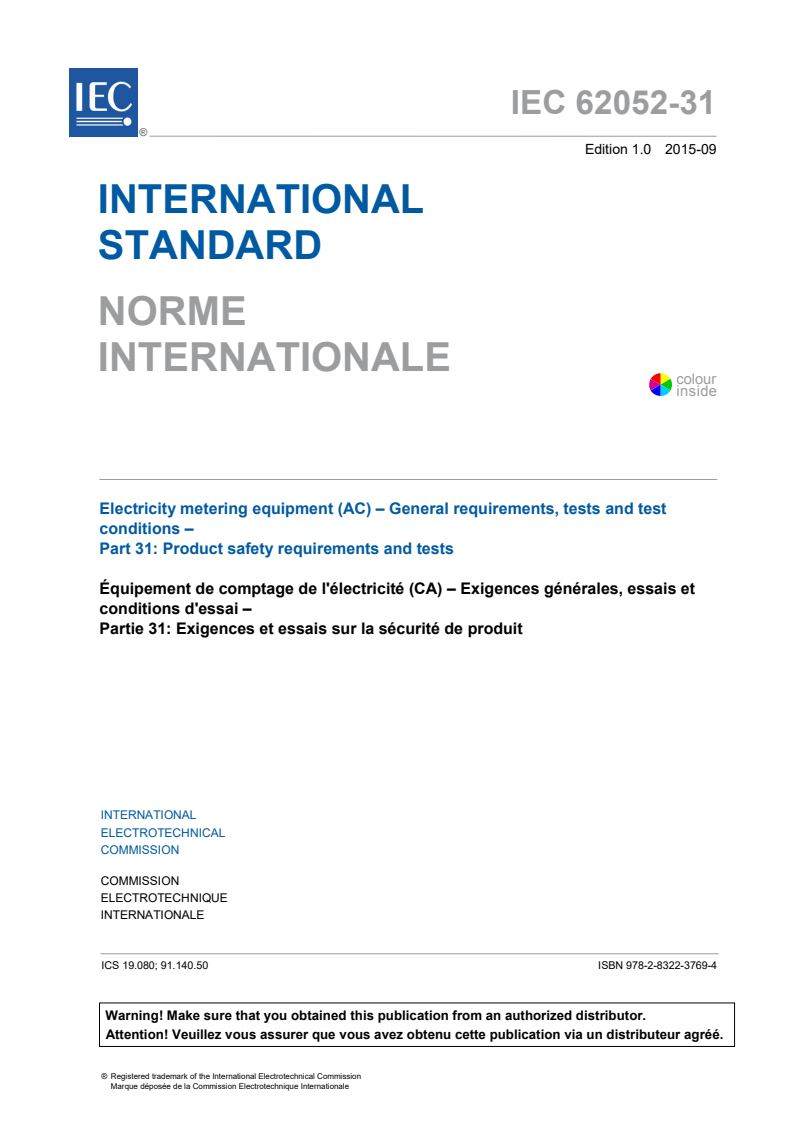
IEC 62052-31 ®
Edition 1.0 2015-09
INTERNATIONAL
STANDARD
colour
inside
Electricity metering equipment (AC) – General requirements, tests and test
conditions –
Part 31: Product safety requirements and tests
All rights reserved. Unless otherwise specified, no part of this publication may be reproduced or utilized in any form
or by any means, electronic or mechanical, including photocopying and microfilm, without permission in writing from
either IEC or IEC's member National Committee in the country of the requester. If you have any questions about IEC
copyright or have an enquiry about obtaining additional rights to this publication, please contact the address below or
your local IEC member National Committee for further information.
IEC Central Office Tel.: +41 22 919 02 11
3, rue de Varembé Fax: +41 22 919 03 00
CH-1211 Geneva 20 info@iec.ch
Switzerland www.iec.ch
About the IEC
The International Electrotechnical Commission (IEC) is the leading global organization that prepares and publishes
International Standards for all electrical, electronic and related technologies.
About IEC publications
The technical content of IEC publications is kept under constant review by the IEC. Please make sure that you have the
latest edition, a corrigenda or an amendment might have been published.
IEC Catalogue - webstore.iec.ch/catalogue Electropedia - www.electropedia.org
The stand-alone application for consulting the entire The world's leading online dictionary of electronic and
bibliographical information on IEC International Standards, electrical terms containing more than 30 000 terms and
Technical Specifications, Technical Reports and other definitions in English and French, with equivalent terms in 15
documents. Available for PC, Mac OS, Android Tablets and additional languages. Also known as the International
iPad. Electrotechnical Vocabulary (IEV) online.
IEC publications search - www.iec.ch/searchpub IEC Glossary - std.iec.ch/glossary
The advanced search enables to find IEC publications by a More than 60 000 electrotechnical terminology entries in
variety of criteria (reference number, text, technical English and French extracted from the Terms and Definitions
committee,…). It also gives information on projects, replaced clause of IEC publications issued since 2002. Some entries
and withdrawn publications. have been collected from earlier publications of IEC TC 37,
77, 86 and CISPR.
IEC Just Published - webstore.iec.ch/justpublished
Stay up to date on all new IEC publications. Just Published IEC Customer Service Centre - webstore.iec.ch/csc
details all new publications released. Available online and If you wish to give us your feedback on this publication or
also once a month by email. need further assistance, please contact the Customer Service
Centre: csc@iec.ch.
IEC 62052-31 ®
Edition 1.0 2015-09
INTERNATIONAL
STANDARD
colour
inside
Electricity metering equipment (AC) – General requirements, tests and test
conditions –
Part 31: Product safety requirements and tests
INTERNATIONAL
ELECTROTECHNICAL
COMMISSION
ICS 19.080: 91.140.50 ISBN 978-2-8322-2848-7
IEC 2019
INTERNATIONAL ELECTROTECHNICAL COMMISSION
____________
IEC 62052-31
Edition 1.0 2015-09
ELECTRICITY METERING EQUIPMENT (AC) –
GENERAL REQUIREMENTS, TESTS AND TEST CONDITIONS –
Part 31: Product safety requirements and tests
INTERPRETATION SHEET 1
This interpretation sheet has been prepared by subcommittee WG11: Electricity metering
equipment, of IEC technical committee TC13: Electrical energy measurement and control.
The text of this interpretation sheet is based on the following documents:
DISH Report on voting
13/1787/DISH 13/1789/RVDISH
Full information on the voting for the approval of this interpretation sheet can be found in the
report on voting indicated in the above table.
IMPORTANT – The 'colour inside' logo on the cover page of this publication indicates
that it contains colours which are considered to be useful for the correct
understanding of its contents. Users should therefore print this document using a
colour printer.
____________
6.7.1.3 – Requirement pertaining to classification of impulse withstand voltages
(overvoltage categories)
This subclause specifies the following:
The impulse withstand voltage (overvoltage category, OVC) is used to classify equipment
energized directly from the mains.
[…]
ICS 19.080; 91.140.50
– 2 – IEC 62052-31:2015/ISH1:2019
IEC 2019
For metering equipment, overvoltage category III is taken as a basis for determining
clearances. See also 1.4 and Annex K.
Background:
• in substations, auxiliary supply circuits of the meter may be energized from a d.c. supply,
from an Uninterruptable Power Supply (UPS) or a dedicated a.c. supply that is
independent of the mains to which the current and voltage circuits of the meter are
connected;
• similarly, auxiliary circuits of the meter – like control circuits – may be connected to such
circuits.
For equipment connected to such circuits generally OVC II applies.
This gives rise to the following question: Does OVC III apply to all HLV mains circuits and
auxiliary circuits of the meter?
Interpretation
In general, meters shall be designed for OVC III. However, under the conditions described in
the Background above, dimensioning the auxiliary supply and auxiliary circuits to meet OVC
III requirements – as specified in 6.7.3 and 6.7.4 – is not justifiable.
They can be dimensioned to meet OVC II requirements provided that those circuits are clearly
marked on the meter and identified in the Installation manual, User Manual and Maintenance
manual and suitable warnings are provided.
It is then the responsibility of the installer to make sure that the circuits designed for OVC II
are not connected to circuits that require OVC III or higher.
As IEC 62052-31:2015 specifies the insulation requirements and tests for OVC III only, such
circuits shall be designed and tested according to the relevant clauses of IEC 61010-1.
NOTE During the upcoming revision of IEC 62052-31, requirements and tests for OVC II will be added.
6.8 – Insulation requirements between circuits and parts
This subclause specifies the following:
The following mains circuits shall be considered as hazardous live (HLV) circuits:
• voltage and current circuits of direct connected and transformer operated meters;
NOTE 2 Current circuits of CT operated meters are generally earthed.
• neutral circuits;
• relays / control switches switching mains voltage;
• auxiliary supply circuits intended for connection to the mains.
Background: Current circuits of transformer operated meters are generally earthed.
This gives rise to the following question: According to IEC 62052-31, what insulation
requirements apply between current circuits of transformer operated meters and other circuits
and parts?
IEC 2019
Interpretation
The current text is ambiguous:
• on the one hand, it says that voltage and current circuits of direct connected and
transformer operated meters shall be considered as HLV circuits,
• on the other hand, Note 2 says that current circuits of CT operated meters are generally
earthed. Therefore, they are not Hazardous Live circuits.
The text shall be interpreted as below:
The following mains circuits shall be considered as hazardous live (HLV) circuits:
• voltage circuits;
• current circuits of direct connected meters;
• current circuits of current transformer operated meters unless they are earthed in which
case they shall be considered as ELV non-mains circuits;
• neutral circuits;
• relays / control switches switching mains voltage;
• auxiliary supply circuits intended for connection to the mains.
Consequently, Table 20 applies.
Table 20 – Insulation requirements between any two circuits
Table 20 with Note 6 specifies Functional / Basic insulation between any two SELV / PELV
circuits and supplementary or basic insulation if one of the circuits is an independent circuit or
is adjacent to a conductive part which may be earthed when the equipment is installed.
Part of Table 20 is reproduced below:
– 4 – IEC 62052-31:2015/ISH1:2019
IEC 2019
Table 20 – Insulation requirements between any two circuits
This gives rise to the following questions:
a) Why should basic insulation be required at all between SELV / PELV circuits?
b) What is the definition of “independent circuits”?
c) If basic insulation is needed in SELV circuits, what insulation requirements apply?
Interpretation
Answer to question a): Basic insulation or supplementary insulation is required in the cases
specified in IEC 60364-4-41:2005,414.4 and in all cases where the specification requires
voltage withstand capability between said circuits.
Answer to question b): The independent circuits are those which are so described by the
manufacturer (See IEC 60255-27:2013, 10.6.4.2.5).
Answer to question c): As specified in Table 20:
• Table 13 applies for determining clearance and test voltages;
• Table 14 applies for creepage distances.
In specific cases, 6.7.5 applies.
IEC 2019
The dimensioning of the insulations shall also take into account requirements specified in
other applicable standards, – e.g. IEEE 802.3 for Ethernet communication ports – and may be
influenced by transient voltage levels originating from the EMC requirements (such as surge,
Electrical Fast Transient / burst).
6.10.3.2 – Requirement pertaining to long term overvoltage withstand
as follows:
“Meters and tariff and load control equipment shall withstand the maximum withstand voltage,
1,9 U […]”
n
This has given rise to the following question:Does the long-term overvoltage test apply to the
auxiliary power supply circuit of a meter?
Interpretation
The auxiliary supply generally originates from an electrical network separate from the
measured mains, as it is expected to keep the meter working when the measured mains
network is de-energized, or is under fault conditions. See 3.5.9:
3.5.9
auxiliary supply
a.c. or d.c. electrical power supply, other than the measurand, provided via dedicated
terminals
The long-term overvoltage test (6.10.3.2) does not apply to the meter’s auxiliary power supply
circuit or other auxiliary circuits if these circuits are rated for connection to external networks
other than the measured mains supply network.
– 2 – IEC 62052-31:2015 © IEC 2015
CONTENTS
FOREWORD . 8
INTRODUCTION . 10
1 Scope and object . 12
1.1 Scope . 12
1.2 Object . 13
1.2.1 Aspects included in scope . 13
1.2.2 Aspects excluded from scope . 13
1.3 Verification. 14
1.4 Environmental conditions . 14
1.4.1 Normal environmental conditions . 14
1.4.2 Extended environmental conditions . 14
1.4.3 Extreme environmental conditions . 15
2 Normative references . 15
3 Terms and definitions . 16
3.1 Equipment and states of equipment . 16
3.2 Parts and accessories . 17
3.3 Quantities . 19
3.4 Tests . 21
3.5 Safety terms . 21
3.6 Insulation . 25
3.7 Terms related to switches of metering equipment . 29
4 Tests . 31
4.1 General . 31
4.2 Type test – sequence of tests . 31
4.3 Reference test conditions. 32
4.3.1 Atmospheric conditions . 32
4.3.2 State of the equipment . 32
4.4 Testing in single fault condition . 36
4.4.1 General . 36
4.4.2 Application of fault conditions . 36
4.4.3 Duration of tests . 38
4.4.4 Conformity after application of fault conditions . 38
5 Information and marking requirements . 39
5.1 General . 39
5.2 Labels, signs and signals . 41
5.2.1 General . 41
5.2.2 Durability of markings . 43
5.3 Information for selection . 43
5.3.1 General . 43
5.3.2 General information . 43
5.3.3 Information related to meters / metering elements . 44
5.3.4 Information related to stand-alone tariff-and load control equipment . 44
5.3.5 Information related to supply control and load control switches . 44
5.4 Information for installation and commissioning . 44
5.4.1 General . 44
5.4.2 Handling and mounting . 45
5.4.3 Enclosure . 45
5.4.4 Connection . 45
5.4.5 Protection . 47
5.4.6 Auxiliary power supply . 48
5.4.7 Supply for external devices . 48
5.4.8 Batteries . 48
5.4.9 Self-consumption . 48
5.4.10 Commissioning . 49
5.5 Information for use . 49
5.5.1 General . 49
5.5.2 Display, push buttons and other controls . 49
5.5.3 Switches . 49
5.5.4 Connection to user’s equipment . 50
5.5.5 External protection devices . 50
5.5.6 Cleaning . 50
5.6 Information for maintenance . 50
6 Protection against electrical shock . 50
6.1 General requirements . 50
6.2 Determination of accessible parts . 51
6.2.1 General . 51
6.2.2 Examination . 51
6.2.3 Openings above parts that are hazardous live . 52
6.2.4 Openings for pre-set controls . 52
6.2.5 Wiring terminals . 53
6.3 Limit values for accessible parts . 53
6.3.1 General . 53
6.3.2 Levels in normal condition . 53
6.3.3 Levels in single fault condition . 53
6.4 Primary means of protection (protection against direct contact) . 56
6.4.1 General . 56
6.4.2 Equipment case . 56
6.4.3 Basic insulation . 56
6.4.4 Impedance . 56
6.5 Additional means of protection in case of single fault conditions (protection
against indirect contact) . 57
6.5.1 General . 57
6.5.2 Protective bonding . 57
6.5.3 Supplementary insulation and reinforced insulation . 61
6.5.4 Protective impedance . 61
6.5.5 Automatic disconnection of the supply . 61
6.5.6 Current- or voltage-limiting device . 62
6.6 Connection to external circuits . 62
6.6.1 General . 62
6.6.2 Terminals for external circuits . 63
6.6.3 Terminals for stranded conductors . 63
6.7 Insulation requirements . 63
6.7.1 General – Electrical stresses, overvoltages and overvoltage categories. 63
6.7.2 The nature of insulation . 64
6.7.3 Insulation requirements for mains-circuits . 68
– 4 – IEC 62052-31:2015 © IEC 2015
6.7.4 Insulation requirements for non-mains-circuits . 74
6.7.5 Insulation in circuits not addressed in 0 or 6.7.4 . 78
6.7.6 Reduction of transient overvoltages by the use of overvoltage limiting
devices . 84
6.8 Insulation requirements between circuits and parts . 84
6.9 Constructional requirements for protection against electric shock . 88
6.9.1 General . 88
6.9.2 Insulating materials . 88
6.9.3 Colour coding . 88
6.9.4 Equipment case . 88
6.9.5 Terminal blocks . 89
6.9.6 Insulating materials of supply control and load switches . 89
6.9.7 Terminals . 90
6.9.8 Requirements for current circuits . 92
6.10 Safety related electrical tests . 99
6.10.1 Overview . 99
6.10.2 Test methods . 101
6.10.3 Testing of voltage circuits . 104
6.10.4 Dielectric tests . 106
6.10.5 Electrical tests on current circuits of direct connected meters without
supply control switches (SCSs) . 112
6.10.6 Electrical tests on current circuits of direct connected meters with SCSs . 113
6.10.7 Electrical tests on load control switches (LCSs) . 119
7 Protection against mechanical hazards . 122
7.1 General . 122
7.2 Sharp edges . 122
7.3 Provisions for lifting and carrying . 123
8 Resistance to mechanical stresses . 123
8.1 General . 123
8.2 Spring hammer test . 123
9 Protection against spread of fire . 124
9.1 General . 124
9.2 Eliminating or reducing the sources of ignition within the equipment . 125
9.3 Containment of fire within the equipment, should it occur . 125
9.3.1 General . 125
9.3.2 Constructional requirements . 126
9.4 Limited-energy circuit . 126
9.5 Overcurrent protection . 128
10 Equipment temperature limits and resistance to heat . 128
10.1 Surface temperature limits for protection against burns . 128
10.2 Temperature limits for terminals . 129
10.3 Temperatures of internal parts . 130
10.4 Temperature test . 132
10.5 Resistance to heat . 133
10.5.1 Non-metallic enclosures . 133
10.5.2 Insulating materials . 134
11 Protection against penetration of dust and water . 134
12 Protection against liberated gases and substances explosion and implosion –
Batteries and battery charging . 136
13 Components and sub-assemblies . 136
13.1 General . 136
13.2 Mains transformers tested outside equipment . 138
13.3 Printed wiring boards . 138
13.4 Components bridging insulation . 138
13.5 Circuits or components used as transient overvoltage limiting devices . 138
14 Hazards resulting from application – Reasonably foreseeable misuse . 138
15 Risk assessment . 139
Annex A (normative) Measuring circuits for touch current . 140
A.1 Measuring circuit for a.c. with frequencies up to 1 MHz and for d.c. . 140
A.2 Measuring circuits for sinusoidal a.c. with frequencies up to 100 Hz and for
d.c. . 141
A.3 Current measuring circuit for electrical burns at high frequencies . 141
A.4 Current measuring circuit for wet location . 142
Annex B (informative) Examples for insulation between parts . 143
B.1 Insulation between parts – Example 1 . 143
B.2 Insulation between parts – Example 2 . 144
B.3 Insulation between parts – Example 3 . 145
B.4 Insulation between parts – Example 4 . 146
B.5 Insulation between parts – Example 5 . 147
Annex C (informative) Examples for direct connected meters equipped with supply
control and load control switches . 149
Annex D (normative) Test circuit diagram for the test of long term overvoltage
withstand . 151
Annex E (normative) Test circuit diagram for short current test on the current circuit of
direct connected meters . 152
Annex F (informative) Examples for voltage tests . 154
Annex G (normative) Additional a.c. voltage tests for electromechanical meters . 158
Annex H (normative) Test equipment for cable flexion and pull test . 159
Annex I (informative) Routine tests . 161
I.1 General . 161
I.2 Protective earth . 161
I.3 AC power-frequency high-voltage test for mains-circuits . 161
I.4 Mains-circuits with voltage limiting devices . 161
Annex J (informative) Examples of battery protection . 162
Annex K (informative) Rationale for specifying overvoltage category III . 163
K.1 Transient overvoltage requirements in TC 13 standards . 163
K.2 Electricity meters mentioned in basic safety publications and group safety
publications . 163
K.2.1 IEC 60664-1 . 163
K.2.2 IEC 60364-4-44 . 164
K.2.3 IEC 61010-1 . 164
K.3 Conclusion . 165
Annex L (informative) Overview of safety aspects covered . 166
Annex M (informative) Index of defined terms . 181
Bibliography . 184
– 6 – IEC 62052-31:2015 © IEC 2015
Figure 1 – Measurements through openings in enclosures . 52
Figure 2 – Maximum duration of short-term accessible voltages in single fault
condition (see 6.3.3 a)) . 54
Figure 3 – Capacitance level versus voltage in normal condition and single fault
condition (see 6.3.2 c) and 6.3.3 c)) . 55
Figure 4 – Acceptable arrangements of protection means against electric shock . 57
Figure 5 – Examples of binding screw assemblies . 59
Figure 6 – Distance between conductors on an interface between two layers . 72
Figure 7 – Distance between adjacent conductors along an interface of an inner layer . 72
Figure 8 – Distance between adjacent conductors located between the same two
layers. 74
Figure 9 – Example of recurring peak voltage . 82
Figure 10 – Flowchart of safety related electrical tests . 100
Figure 11 – Flow chart to explain the requirements for protection against the spread of
fire . 125
Figure 12 – Ball-pressure test apparatus. 134
Figure 13 – Flow chart for conformity options 13.1 a), b), c) and d) . 137
Figure A.1 – Measuring circuit for a.c. with frequencies up to 1 MHz and for d.c. . 140
Figure A.2 – Measuring circuits for sinusoidal a.c. with frequencies up to 100 Hz and
for d.c. . 141
Figure A.3 – Current measuring circuit for electrical burns . 142
Figure A.4 – Current measuring circuit for wet contact . 142
Figure B.1 – Insulation between parts – Example 1 . 143
Figure B.2 – Insulation between parts – Example 2 . 144
Figure B.3 – Insulation between parts – Example 3 . 145
Figure B.4 – Insulation between parts – Example 4 . 146
Figure B.5 – Insulation between parts – Example 5 . 147
Figure C.1 – Single phase two wire meter with UC2 SCS and 25A LCS . 149
Figure C.2 – Three phase four wire meter with UC2 SCS and 2A auxiliary control
switch . 150
Figure D.1 – Circuit for three-phase four-wire meters to simulate long term
overvoltage, voltage moved to L3. 151
Figure D.2 – Voltages at the meter under test . 151
Figure E.1 – Test circuit for verification of short-time withstand current test on current
circuits with and without supply control switches . 152
Figure E.2 – Example of short-circuit carrying test record in the case of a single-pole
equipment on single-phase a.c. . 153
Figure F.1 – Test arrangement for voltage tests: 3 phase 4 wire direct connected
meter with supply control and load control switches . 154
Figure F.2 – Test arrangement for voltage tests: 3 phase 4 wire transformer connected
meter . 156
Figure H.1 – Test equipment for cable flexion and pull test (see 6.9.7.3) . 159
Figure J.1 – Non-rechargeable battery protection . 162
Figure J.2 – Rechargeable battery protection . 162
Table 1 – Test copper conductors for current and switch terminals . 35
Table 2 – Information requirements . 40
Table 3 – IEC 60417 symbols and ISO 7000 that may be used on metering equipment . 42
Table 4 – Tightening torque for binding screw assemblies . 60
Table 5 – Multiplication factors for clearance for altitudes up to 5 000 m . 64
Table 6 – Overview of clauses specifying requirements and tests for insulations . 67
Table 7 – Nominal / rated voltages and rated impulse voltages . 68
Table 8 – Clearances for mains-circuits . 69
Table 9 – Creepage distances for mains-circuits . 70
Table 10 – Test voltages for solid insulation in mains-circuits . 71
Table 11 – Test voltages for testing long-term stress of solid insulation in mains-
circuits . 71
Table 12 – Minimum values for distance or thickness of solid insulation . 73
Table 13 – Clearances and test voltages for non-mains-circuits derived from mains-
circuits of overvoltage category III . 75
Table 14 – Creepage distances for non-mains-circuits . 75
Table 15 – Minimum values for distance or thickness (see 6.7.4.4.2 to 6.7.4.4.4) . 77
Table 16 – Clearance values for the calculation of 6.7.5.2 . 80
Table 17 – Test voltages based on clearances . 81
Table 18 – Clearances for basic insulation in circuits having recurring peak voltages . 83
Table 19 – Isolation classes for non-mains-circuits . 85
Table 20 – Insulation requirements between any two circuits . 86
Table 21 – Summary of requirements for current circuits of direct connected meters
without SCS . 95
Table 22 – Summary of requirements for current circuits of direct connected meters
with SCS . 96
Table 23 – Summary of requirements for load control switches . 98
Table 24 – Correction factors according to test site altitude for test voltages for
clearances . 104
Table 25 – AC voltage test . 109
Table 26 – Test sequence and sample plan for supply control switches . 113
Table 27 – Power factor ranges of the test circuit . 116
Table 28 – Test sequence and sample plan for load control switches . 120
Table 29 – Limits of maximum available current . 127
Table 30 – Values for overcurrent protection devices . 127
Table 31 – Surface temperature limits in normal condition . 129
Table 32 – Temperature limits for terminals . 130
Table 33 – Maximum measured total temperatures for internal materials and
components . 131
Table G.1 – AC voltage tests of electromechanical meters . 158
Table H.1 – Test values for flexion and pull-out tests for round copper conductors . 160
Table L.1 – Overview of safety aspects . 166
– 8 – IEC 62052-31:2015 © IEC 2015
INTERNATIONAL ELECTROTECHNICAL COMMISSION
____________
ELECTRICITY METERING EQUIPMENT (AC) –
GENERAL REQUIREMENTS, TESTS AND TEST CONDITIONS –
Part 31: Product safety requirements and tests
FOREWORD
1) The International Electrotechnical Commission (IEC) is a worldwide organization for standardization comprising
all national electrotechnical committees (IEC National Committees). The object of IEC is to promote
international co-operation on all questions concerning standardization in the electrical and electronic fields. To
this end and in addition to other activities, IEC publishes International Standards, Technical Specifications,
Technical Reports, Publicly Available Specifications (PAS) and Guides (hereafter referred to as “IEC
Publication(s)”). Their preparation is entrusted to technical committees; any IEC National Committee interested
in the subject dealt with may participate in this preparatory work. International, governmental and non-
governmental organizations liaising with the IEC also participate in this preparation. IEC collaborates closely
with the Internat
...
IEC 62052-31 ®
Edition 1.0 2015-09
INTERNATIONAL
STANDARD
NORME
INTERNATIONALE
colour
inside
Electricity metering equipment (AC) – General requirements, tests and test
conditions –
Part 31: Product safety requirements and tests
Équipement de comptage de l'électricité (CA) – Exigences générales, essais et
conditions d'essai –
Partie 31: Exigences et essais sur la sécurité de produit
All rights reserved. Unless otherwise specified, no part of this publication may be reproduced or utilized in any form
or by any means, electronic or mechanical, including photocopying and microfilm, without permission in writing from
either IEC or IEC's member National Committee in the country of the requester. If you have any questions about IEC
copyright or have an enquiry about obtaining additional rights to this publication, please contact the address below or
your local IEC member National Committee for further information.
Droits de reproduction réservés. Sauf indication contraire, aucune partie de cette publication ne peut être reproduite
ni utilisée sous quelque forme que ce soit et par aucun procédé, électronique ou mécanique, y compris la photocopie
et les microfilms, sans l'accord écrit de l'IEC ou du Comité national de l'IEC du pays du demandeur. Si vous avez des
questions sur le copyright de l'IEC ou si vous désirez obtenir des droits supplémentaires sur cette publication, utilisez
les coordonnées ci-après ou contactez le Comité national de l'IEC de votre pays de résidence.
IEC Central Office Tel.: +41 22 919 02 11
3, rue de Varembé Fax: +41 22 919 03 00
CH-1211 Geneva 20 info@iec.ch
Switzerland www.iec.ch
About the IEC
The International Electrotechnical Commission (IEC) is the leading global organization that prepares and publishes
International Standards for all electrical, electronic and related technologies.
About IEC publications
The technical content of IEC publications is kept under constant review by the IEC. Please make sure that you have the
latest edition, a corrigenda or an amendment might have been published.
IEC Catalogue - webstore.iec.ch/catalogue Electropedia - www.electropedia.org
The stand-alone application for consulting the entire The world's leading online dictionary of electronic and
bibliographical information on IEC International Standards, electrical terms containing 20 000 terms and definitions in
Technical Specifications, Technical Reports and other English and French, with equivalent terms in 15 additional
documents. Available for PC, Mac OS, Android Tablets and languages. Also known as the International Electrotechnical
iPad. Vocabulary (IEV) online.
IEC publications search - www.iec.ch/searchpub IEC Glossary - std.iec.ch/glossary
The advanced search enables to find IEC publications by a 65 000 electrotechnical terminology entries in English and
variety of criteria (reference number, text, technical French extracted from the Terms and Definitions clause of
committee,…). It also gives information on projects, replaced IEC publications issued since 2002. Some entries have been
and withdrawn publications. collected from earlier publications of IEC TC 37, 77, 86 and
CISPR.
IEC Just Published - webstore.iec.ch/justpublished
Stay up to date on all new IEC publications. Just Published IEC Customer Service Centre - webstore.iec.ch/csc
details all new publications released. Available online and If you wish to give us your feedback on this publication or
also once a month by email. need further assistance, please contact the Customer Service
Centre: csc@iec.ch.
A propos de l'IEC
La Commission Electrotechnique Internationale (IEC) est la première organisation mondiale qui élabore et publie des
Normes internationales pour tout ce qui a trait à l'électricité, à l'électronique et aux technologies apparentées.
A propos des publications IEC
Le contenu technique des publications IEC est constamment revu. Veuillez vous assurer que vous possédez l’édition la
plus récente, un corrigendum ou amendement peut avoir été publié.
Catalogue IEC - webstore.iec.ch/catalogue Electropedia - www.electropedia.org
Application autonome pour consulter tous les renseignements
Le premier dictionnaire en ligne de termes électroniques et
bibliographiques sur les Normes internationales,
électriques. Il contient 20 000 termes et définitions en anglais
Spécifications techniques, Rapports techniques et autres
et en français, ainsi que les termes équivalents dans 15
documents de l'IEC. Disponible pour PC, Mac OS, tablettes
langues additionnelles. Egalement appelé Vocabulaire
Android et iPad.
Electrotechnique International (IEV) en ligne.
Recherche de publications IEC - www.iec.ch/searchpub
Glossaire IEC - std.iec.ch/glossary
65 000 entrées terminologiques électrotechniques, en anglais
La recherche avancée permet de trouver des publications IEC
en utilisant différents critères (numéro de référence, texte, et en français, extraites des articles Termes et Définitions des
comité d’études,…). Elle donne aussi des informations sur les publications IEC parues depuis 2002. Plus certaines entrées
projets et les publications remplacées ou retirées. antérieures extraites des publications des CE 37, 77, 86 et
CISPR de l'IEC.
IEC Just Published - webstore.iec.ch/justpublished
Service Clients - webstore.iec.ch/csc
Restez informé sur les nouvelles publications IEC. Just
Published détaille les nouvelles publications parues. Si vous désirez nous donner des commentaires sur cette
Disponible en ligne et aussi une fois par mois par email. publication ou si vous avez des questions contactez-nous:
csc@iec.ch.
IEC 62052-31 ®
Edition 1.0 2015-09
INTERNATIONAL
STANDARD
NORME
INTERNATIONALE
colour
inside
Electricity metering equipment (AC) – General requirements, tests and test
conditions –
Part 31: Product safety requirements and tests
Équipement de comptage de l'électricité (CA) – Exigences générales, essais et
conditions d'essai –
Partie 31: Exigences et essais sur la sécurité de produit
INTERNATIONAL
ELECTROTECHNICAL
COMMISSION
COMMISSION
ELECTROTECHNIQUE
INTERNATIONALE
ICS 19.080; 91.140.50 ISBN 978-2-8322-3769-4
IEC 2019
INTERNATIONAL ELECTROTECHNICAL COMMISSION
____________
IEC 62052-31
Edition 1.0 2015-09
ELECTRICITY METERING EQUIPMENT (AC) –
GENERAL REQUIREMENTS, TESTS AND TEST CONDITIONS –
Part 31: Product safety requirements and tests
INTERPRETATION SHEET 1
This interpretation sheet has been prepared by subcommittee WG11: Electricity metering
equipment, of IEC technical committee TC13: Electrical energy measurement and control.
The text of this interpretation sheet is based on the following documents:
DISH Report on voting
13/1787/DISH 13/1789/RVDISH
Full information on the voting for the approval of this interpretation sheet can be found in the
report on voting indicated in the above table.
IMPORTANT – The 'colour inside' logo on the cover page of this publication indicates
that it contains colours which are considered to be useful for the correct
understanding of its contents. Users should therefore print this document using a
colour printer.
____________
6.7.1.3 – Requirement pertaining to classification of impulse withstand voltages
(overvoltage categories)
This subclause specifies the following:
The impulse withstand voltage (overvoltage category, OVC) is used to classify equipment
energized directly from the mains.
[…]
ICS 19.080; 91.140.50
– 2 – IEC 62052-31:2015/ISH1:2019
IEC 2019
For metering equipment, overvoltage category III is taken as a basis for determining
clearances. See also 1.4 and Annex K.
Background:
• in substations, auxiliary supply circuits of the meter may be energized from a d.c. supply,
from an Uninterruptable Power Supply (UPS) or a dedicated a.c. supply that is
independent of the mains to which the current and voltage circuits of the meter are
connected;
• similarly, auxiliary circuits of the meter – like control circuits – may be connected to such
circuits.
For equipment connected to such circuits generally OVC II applies.
This gives rise to the following question: Does OVC III apply to all HLV mains circuits and
auxiliary circuits of the meter?
Interpretation
In general, meters shall be designed for OVC III. However, under the conditions described in
the Background above, dimensioning the auxiliary supply and auxiliary circuits to meet OVC
III requirements – as specified in 6.7.3 and 6.7.4 – is not justifiable.
They can be dimensioned to meet OVC II requirements provided that those circuits are clearly
marked on the meter and identified in the Installation manual, User Manual and Maintenance
manual and suitable warnings are provided.
It is then the responsibility of the installer to make sure that the circuits designed for OVC II
are not connected to circuits that require OVC III or higher.
As IEC 62052-31:2015 specifies the insulation requirements and tests for OVC III only, such
circuits shall be designed and tested according to the relevant clauses of IEC 61010-1.
NOTE During the upcoming revision of IEC 62052-31, requirements and tests for OVC II will be added.
6.8 – Insulation requirements between circuits and parts
This subclause specifies the following:
The following mains circuits shall be considered as hazardous live (HLV) circuits:
• voltage and current circuits of direct connected and transformer operated meters;
NOTE 2 Current circuits of CT operated meters are generally earthed.
• neutral circuits;
• relays / control switches switching mains voltage;
• auxiliary supply circuits intended for connection to the mains.
Background: Current circuits of transformer operated meters are generally earthed.
This gives rise to the following question: According to IEC 62052-31, what insulation
requirements apply between current circuits of transformer operated meters and other circuits
and parts?
IEC 2019
Interpretation
The current text is ambiguous:
• on the one hand, it says that voltage and current circuits of direct connected and
transformer operated meters shall be considered as HLV circuits,
• on the other hand, Note 2 says that current circuits of CT operated meters are generally
earthed. Therefore, they are not Hazardous Live circuits.
The text shall be interpreted as below:
The following mains circuits shall be considered as hazardous live (HLV) circuits:
• voltage circuits;
• current circuits of direct connected meters;
• current circuits of current transformer operated meters unless they are earthed in which
case they shall be considered as ELV non-mains circuits;
• neutral circuits;
• relays / control switches switching mains voltage;
• auxiliary supply circuits intended for connection to the mains.
Consequently, Table 20 applies.
Table 20 – Insulation requirements between any two circuits
Table 20 with Note 6 specifies Functional / Basic insulation between any two SELV / PELV
circuits and supplementary or basic insulation if one of the circuits is an independent circuit or
is adjacent to a conductive part which may be earthed when the equipment is installed.
Part of Table 20 is reproduced below:
– 4 – IEC 62052-31:2015/ISH1:2019
IEC 2019
Table 20 – Insulation requirements between any two circuits
This gives rise to the following questions:
a) Why should basic insulation be required at all between SELV / PELV circuits?
b) What is the definition of “independent circuits”?
c) If basic insulation is needed in SELV circuits, what insulation requirements apply?
Interpretation
Answer to question a): Basic insulation or supplementary insulation is required in the cases
specified in IEC 60364-4-41:2005,414.4 and in all cases where the specification requires
voltage withstand capability between said circuits.
Answer to question b): The independent circuits are those which are so described by the
manufacturer (See IEC 60255-27:2013, 10.6.4.2.5).
Answer to question c): As specified in Table 20:
• Table 13 applies for determining clearance and test voltages;
• Table 14 applies for creepage distances.
In specific cases, 6.7.5 applies.
IEC 2019
The dimensioning of the insulations shall also take into account requirements specified in
other applicable standards, – e.g. IEEE 802.3 for Ethernet communication ports – and may be
influenced by transient voltage levels originating from the EMC requirements (such as surge,
Electrical Fast Transient / burst).
6.10.3.2 – Requirement pertaining to long term overvoltage withstand
as follows:
“Meters and tariff and load control equipment shall withstand the maximum withstand voltage,
1,9 U […]”
n
This has given rise to the following question:Does the long-term overvoltage test apply to the
auxiliary power supply circuit of a meter?
Interpretation
The auxiliary supply generally originates from an electrical network separate from the
measured mains, as it is expected to keep the meter working when the measured mains
network is de-energized, or is under fault conditions. See 3.5.9:
3.5.9
auxiliary supply
a.c. or d.c. electrical power supply, other than the measurand, provided via dedicated
terminals
The long-term overvoltage test (6.10.3.2) does not apply to the meter’s auxiliary power supply
circuit or other auxiliary circuits if these circuits are rated for connection to external networks
other than the measured mains supply network.
– 2 – IEC 62052-31:2015 © IEC 2015
CONTENTS
FOREWORD . 8
INTRODUCTION . 10
1 Scope and object . 12
1.1 Scope . 12
1.2 Object . 13
1.2.1 Aspects included in scope . 13
1.2.2 Aspects excluded from scope . 13
1.3 Verification. 14
1.4 Environmental conditions . 14
1.4.1 Normal environmental conditions . 14
1.4.2 Extended environmental conditions . 14
1.4.3 Extreme environmental conditions . 15
2 Normative references . 15
3 Terms and definitions . 16
3.1 Equipment and states of equipment . 16
3.2 Parts and accessories . 17
3.3 Quantities . 19
3.4 Tests . 21
3.5 Safety terms . 21
3.6 Insulation . 25
3.7 Terms related to switches of metering equipment . 29
4 Tests . 31
4.1 General . 31
4.2 Type test – sequence of tests . 31
4.3 Reference test conditions. 32
4.3.1 Atmospheric conditions . 32
4.3.2 State of the equipment . 32
4.4 Testing in single fault condition . 36
4.4.1 General . 36
4.4.2 Application of fault conditions . 36
4.4.3 Duration of tests . 38
4.4.4 Conformity after application of fault conditions . 38
5 Information and marking requirements . 39
5.1 General . 39
5.2 Labels, signs and signals . 41
5.2.1 General . 41
5.2.2 Durability of markings . 43
5.3 Information for selection . 43
5.3.1 General . 43
5.3.2 General information . 43
5.3.3 Information related to meters / metering elements . 44
5.3.4 Information related to stand-alone tariff-and load control equipment . 44
5.3.5 Information related to supply control and load control switches . 44
5.4 Information for installation and commissioning . 44
5.4.1 General . 44
5.4.2 Handling and mounting . 45
5.4.3 Enclosure . 45
5.4.4 Connection . 45
5.4.5 Protection . 47
5.4.6 Auxiliary power supply . 48
5.4.7 Supply for external devices . 48
5.4.8 Batteries . 48
5.4.9 Self-consumption . 48
5.4.10 Commissioning . 49
5.5 Information for use . 49
5.5.1 General . 49
5.5.2 Display, push buttons and other controls . 49
5.5.3 Switches . 49
5.5.4 Connection to user’s equipment . 50
5.5.5 External protection devices . 50
5.5.6 Cleaning . 50
5.6 Information for maintenance . 50
6 Protection against electrical shock . 50
6.1 General requirements . 50
6.2 Determination of accessible parts . 51
6.2.1 General . 51
6.2.2 Examination . 51
6.2.3 Openings above parts that are hazardous live . 52
6.2.4 Openings for pre-set controls . 52
6.2.5 Wiring terminals . 53
6.3 Limit values for accessible parts . 53
6.3.1 General . 53
6.3.2 Levels in normal condition . 53
6.3.3 Levels in single fault condition . 53
6.4 Primary means of protection (protection against direct contact) . 56
6.4.1 General . 56
6.4.2 Equipment case . 56
6.4.3 Basic insulation . 56
6.4.4 Impedance . 56
6.5 Additional means of protection in case of single fault conditions (protection
against indirect contact) . 57
6.5.1 General . 57
6.5.2 Protective bonding . 57
6.5.3 Supplementary insulation and reinforced insulation . 61
6.5.4 Protective impedance . 61
6.5.5 Automatic disconnection of the supply . 61
6.5.6 Current- or voltage-limiting device . 62
6.6 Connection to external circuits . 62
6.6.1 General . 62
6.6.2 Terminals for external circuits . 63
6.6.3 Terminals for stranded conductors . 63
6.7 Insulation requirements . 63
6.7.1 General – Electrical stresses, overvoltages and overvoltage categories. 63
6.7.2 The nature of insulation . 64
6.7.3 Insulation requirements for mains-circuits . 68
– 4 – IEC 62052-31:2015 © IEC 2015
6.7.4 Insulation requirements for non-mains-circuits . 74
6.7.5 Insulation in circuits not addressed in 6.7.3 or 6.7.4 . 78
6.7.6 Reduction of transient overvoltages by the use of overvoltage limiting
devices . 84
6.8 Insulation requirements between circuits and parts . 84
6.9 Constructional requirements for protection against electric shock . 88
6.9.1 General . 88
6.9.2 Insulating materials . 88
6.9.3 Colour coding . 88
6.9.4 Equipment case . 88
6.9.5 Terminal blocks . 89
6.9.6 Insulating materials of supply control and load switches . 89
6.9.7 Terminals . 90
6.9.8 Requirements for current circuits . 92
6.10 Safety related electrical tests . 99
6.10.1 Overview . 99
6.10.2 Test methods . 101
6.10.3 Testing of voltage circuits . 104
6.10.4 Dielectric tests . 106
6.10.5 Electrical tests on current circuits of direct connected meters without
supply control switches (SCSs) . 112
6.10.6 Electrical tests on current circuits of direct connected meters with SCSs . 113
6.10.7 Electrical tests on load control switches (LCSs) . 119
7 Protection against mechanical hazards . 122
7.1 General . 122
7.2 Sharp edges . 122
7.3 Provisions for lifting and carrying . 123
8 Resistance to mechanical stresses . 123
8.1 General . 123
8.2 Spring hammer test . 123
9 Protection against spread of fire . 124
9.1 General . 124
9.2 Eliminating or reducing the sources of ignition within the equipment . 125
9.3 Containment of fire within the equipment, should it occur . 125
9.3.1 General . 125
9.3.2 Constructional requirements . 126
9.4 Limited-energy circuit . 126
9.5 Overcurrent protection . 128
10 Equipment temperature limits and resistance to heat . 128
10.1 Surface temperature limits for protection against burns . 128
10.2 Temperature limits for terminals . 129
10.3 Temperatures of internal parts . 130
10.4 Temperature test . 132
10.5 Resistance to heat . 133
10.5.1 Non-metallic enclosures . 133
10.5.2 Insulating materials . 134
11 Protection against penetration of dust and water . 134
12 Protection against liberated gases and substances explosion and implosion –
Batteries and battery charging . 136
13 Components and sub-assemblies . 136
13.1 General . 136
13.2 Mains transformers tested outside equipment . 138
13.3 Printed wiring boards . 138
13.4 Components bridging insulation . 138
13.5 Circuits or components used as transient overvoltage limiting devices . 138
14 Hazards resulting from application – Reasonably foreseeable misuse . 138
15 Risk assessment . 139
Annex A (normative) Measuring circuits for touch current . 140
A.1 Measuring circuit for a.c. with frequencies up to 1 MHz and for d.c. . 140
A.2 Measuring circuits for sinusoidal a.c. with frequencies up to 100 Hz and for
d.c. . 141
A.3 Current measuring circuit for electrical burns at high frequencies . 141
A.4 Current measuring circuit for wet location . 142
Annex B (informative) Examples for insulation between parts . 143
B.1 Insulation between parts – Example 1 . 143
B.2 Insulation between parts – Example 2 . 144
B.3 Insulation between parts – Example 3 . 145
B.4 Insulation between parts – Example 4 . 146
B.5 Insulation between parts – Example 5 . 147
Annex C (informative) Examples for direct connected meters equipped with supply
control and load control switches . 149
Annex D (normative) Test circuit diagram for the test of long term overvoltage
withstand . 151
Annex E (normative) Test circuit diagram for short current test on the current circuit of
direct connected meters . 152
Annex F (informative) Examples for voltage tests . 154
Annex G (normative) Additional a.c. voltage tests for electromechanical meters . 158
Annex H (normative) Test equipment for cable flexion and pull test . 159
Annex I (informative) Routine tests . 161
I.1 General . 161
I.2 Protective earth . 161
I.3 AC power-frequency high-voltage test for mains-circuits . 161
I.4 Mains-circuits with voltage limiting devices . 161
Annex J (informative) Examples of battery protection . 162
Annex K (informative) Rationale for specifying overvoltage category III . 163
K.1 Transient overvoltage requirements in TC 13 standards . 163
K.2 Electricity meters mentioned in basic safety publications and group safety
publications . 163
K.2.1 IEC 60664-1 . 163
K.2.2 IEC 60364-4-44 . 164
K.2.3 IEC 61010-1 . 164
K.3 Conclusion . 165
Annex L (informative) Overview of safety aspects covered . 166
Annex M (informative) Index of defined terms . 181
Bibliography . 184
Figure 1 – Measurements through openings in enclosures . 52
– 6 – IEC 62052-31:2015 © IEC 2015
Figure 2 – Maximum duration of short-term accessible voltages in single fault
condition (see 6.3.3 a)) . 54
Figure 3 – Capacitance level versus voltage in normal condition and single fault
condition (see 6.3.2 c) and 6.3.3 c)) . 55
Figure 4 – Acceptable arrangements of protection means against electric shock . 57
Figure 5 – Examples of binding screw assemblies . 59
Figure 6 – Distance between conductors on an interface between two layers . 72
Figure 7 – Distance between adjacent conductors along an interface of an inner layer . 72
Figure 8 – Distance between adjacent conductors located between the same two
layers. 74
Figure 9 – Example of recurring peak voltage . 82
Figure 10 – Flowchart of safety related electrical tests . 100
Figure 11 – Flow chart to explain the requirements for protection against the spread of
fire . 125
Figure 12 – Ball-pressure test apparatus. 134
Figure 13 – Flow chart for conformity options 13.1 a), b), c) and d) . 137
Figure A.1 – Measuring circuit for a.c. with frequencies up to 1 MHz and for d.c. . 140
Figure A.2 – Measuring circuits for sinusoidal a.c. with frequencies up to 100 Hz and
for d.c. . 141
Figure A.3 – Current measuring circuit for electrical burns . 142
Figure A.4 – Current measuring circuit for wet contact . 142
Figure B.1 – Insulation between parts – Example 1 . 143
Figure B.2 – Insulation between parts – Example 2 . 144
Figure B.3 – Insulation between parts – Example 3 . 145
Figure B.4 – Insulation between parts – Example 4 . 146
Figure B.5 – Insulation between parts – Example 5 . 147
Figure C.1 – Single phase two wire meter with UC2 SCS and 25A LCS . 149
Figure C.2 – Three phase four wire meter with UC2 SCS and 2A auxiliary control
switch . 150
Figure D.1 – Circuit for three-phase four-wire meters to simulate long term
overvoltage, voltage moved to L3. 151
Figure D.2 – Voltages at the meter under test . 151
Figure E.1 – Test circuit for verification of short-time withstand current test on current
circuits with and without supply control switches . 152
Figure E.2 – Example of short-circuit carrying test record in the case of a single-pole
equipment on single-phase a.c. . 153
Figure F.1 – Test arrangement for voltage tests: 3 phase 4 wire direct connected
meter with supply control and load control switches . 154
Figure F.2 – Test arrangement for voltage tests: 3 phase 4 wire transformer connected
meter . 156
Figure H.1 – Test equipment for cable flexion and pull test (see 6.9.7.3) . 159
Figure J.1 – Non-rechargeable battery protection . 162
Figure J.2 – Rechargeable battery protection . 162
Table 1 – Test copper conductors for current and switch terminals . 35
Table 2 – Information requirements . 40
Table 3 – IEC 60417 symbols and ISO 7000 that may be used on metering equipment . 42
Table 4 – Tightening torque for binding screw assemblies . 60
Table 5 – Multiplication factors for clearance for altitudes up to 5 000 m . 64
Table 6 – Overview of clauses specifying requirements and tests for insulations . 67
Table 7 – Nominal / rated voltages and rated impulse voltages . 68
Table 8 – Clearances for mains-circuits . 69
Table 9 – Creepage distances for mains-circuits . 70
Table 10 – Test voltages for solid insulation in mains-circuits . 71
Table 11 – Test voltages for testing long-term stress of solid insulation in mains-
circuits . 71
Table 12 – Minimum values for distance or thickness of solid insulation . 73
Table 13 – Clearances and test voltages for non-mains-circuits derived from mains-
circuits of overvoltage category III . 75
Table 14 – Creepage distances for non-mains-circuits . 76
Table 15 – Minimum values for distance or thickness (see 6.7.4.4.2 to 6.7.4.4.4) . 77
Table 16 – Clearance values for the calculation of 6.7.5.2 . 80
Table 17 – Test voltages based on clearances . 81
Table 18 – Clearances for basic insulation in circuits having recurring peak voltages . 83
Table 19 – Isolation classes for non-mains-circuits . 85
Table 20 – Insulation requirements between any two circuits . 86
Table 21 – Summary of requirements for current circuits of direct connected meters
without SCS . 95
Table 22 – Summary of requirements
...