

IEC 61326-2-4:2020
(Main)Electrical equipment for measurement, control and laboratory use - EMC requirements - Part 2-4: Particular requirements - Test configurations, operational conditions and performance criteria for insulation monitoring devices according to IEC 61557-8 and for equipment for insulation fault location according to IEC 61557-9
General Information
- Abstract
IEC 61326-2-4:2020 specifies more detailed test configurations, operational conditions and performance criteria than IEC 61326-1 for equipment for
- insulation monitoring according to IEC 61557-8;
- insulation fault location according to IEC 61557-9.
This applies to insulation monitoring devices and for equipment for insulation fault location systems permanently or semi-permanently connected to the distribution system.
- Status
- Published
- Publication Date
- 26-Oct-2020
- Technical Committee
- SC 65A - System aspects
- Drafting Committee
- WG 4 - TC 65/SC 65A/WG 4
- Current Stage
- PPUB - Publication issued
- Start Date
- 27-Oct-2020
- Completion Date
- 27-Nov-2020
Buy Documents
IEC 61326-2-4:2020 RLV - Electrical equipment for measurement, control and laboratory use - EMC requirements - Part 2-4: Particular requirements - Test configurations, operational conditions and performance criteria for insulation monitoring devices according to IEC 61557-8 and for equipment for insulation fault location according to IEC 61557-9 Released:10/27/2020
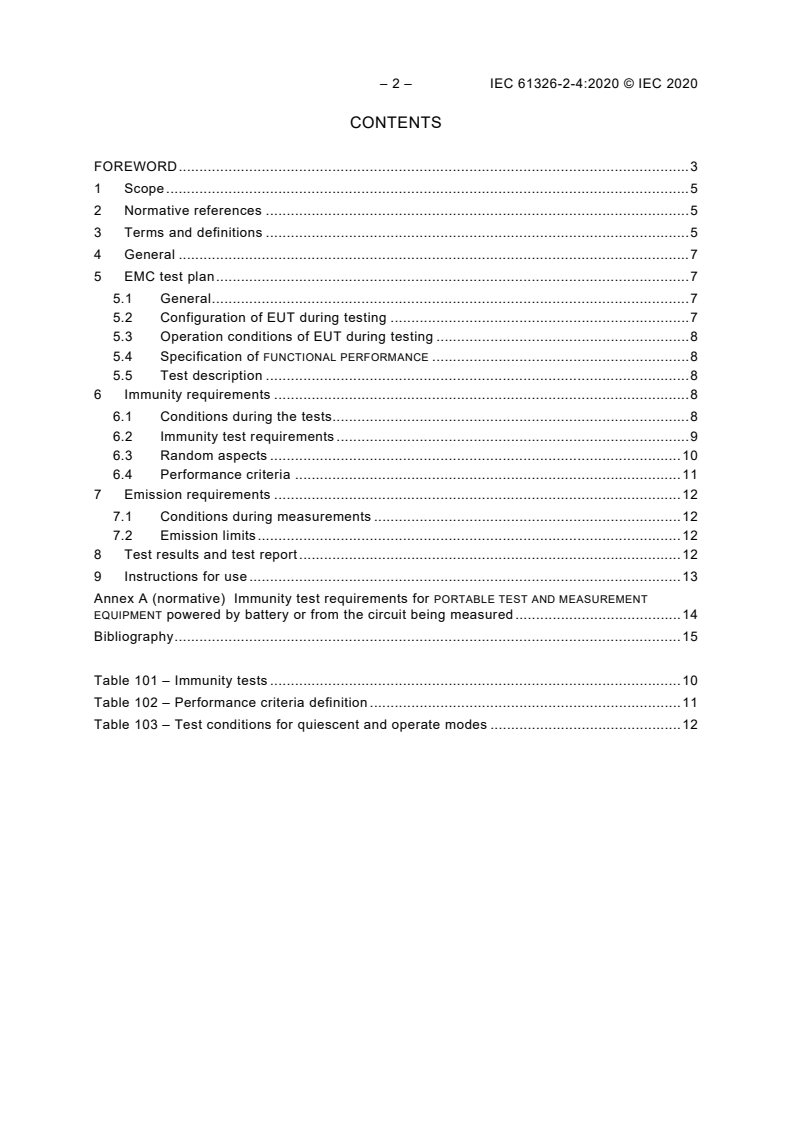
IEC 61326-2-4:2020 - Electrical equipment for measurement, control and laboratory use - EMC requirements - Part 2-4: Particular requirements - Test configurations, operational conditions and performance criteria for insulation monitoring devices according to IEC 61557-8 and for equipment for insulation fault location according to IEC 61557-9 Released:10/27/2020
Overview
IEC 61326-2-4:2020 is an International Electrotechnical Commission (IEC) standard that specifies the electromagnetic compatibility (EMC) requirements for electrical equipment used in measurement, control, and laboratory environments. This part of the IEC 61326 series delivers particular requirements concerning test configurations, operational conditions, and performance criteria for:
- Insulation monitoring devices (IMDs) as per IEC 61557-8
- Equipment for insulation fault location (IFL) as per IEC 61557-9
The scope covers IMDs and IFL equipment that are permanently or semi-permanently connected to low-voltage distribution systems. This standard complements IEC 61326-1 by providing more detailed EMC requirements relevant for insulation monitoring and fault location devices.
Key Topics
Test Configurations & Operational Conditions
- Defines precise ways to configure Equipment Under Test (EUT) for EMC compliance tests
- Specifies that devices must be supplied and operated as recommended by the manufacturer and tested at both minimum and maximum supply voltages, within specified limits
Performance Criteria
- Establishes criteria (A1, A2, B) for evaluating immunity test results to ensure reliable equipment operation during and after EMC disturbances
- Differentiates between modes of operation (quiescent and operate mode) and sets requirements for alarm and measurement functions
Immunity & Emission Requirements
- Details immunity tests for phenomena such as electrostatic discharge, electromagnetic fields, electrical fast transients, surges, conducted RF, and power frequency magnetic fields based on industrial environments
- Specifies emission limits for domestic and non-domestic installations in line with CISPR 11, Group 1, Class A (industrial) and Class B (residential)
Reporting & Usage Instructions
- Mandates thorough documentation of test configurations, results, and operating conditions for EMC compliance
- Requires clear user instructions for correct installation and operation to maintain EMC performance
Applications
IEC 61326-2-4:2020 is essential for manufacturers, test laboratories, and users of:
- Insulation Monitoring Devices (IMDs): Devices that continuously supervise the insulation resistance of ungrounded (IT) electrical systems to ensure safety and prevent faults
- Insulation Fault Location Systems: Equipment designed to locate the place of insulation breakdown within IT systems, enhancing maintenance and minimizing downtime
These requirements are particularly relevant for:
- Industrial automation and process control
- Electrical safety in medical and laboratory environments
- Power distribution infrastructure where automatic insulation monitoring and fault location are critical for operational resilience and safety
Implementing IEC 61326-2-4 ensures devices perform reliably in electromagnetic environments typical of industrial or laboratory settings, meeting national and international regulatory standards.
Related Standards
- IEC 61326-1:2020: EMC requirements - General requirements for electrical measurement, control, and laboratory equipment; Foundation standard for the IEC 61326 series
- IEC 61557-8:2014: Electrical safety in low voltage distribution systems - Insulation monitoring devices for IT systems
- IEC 61557-9:2014: Equipment for insulation fault location in IT systems
- CISPR 11: EMC emission standards for industrial, scientific, and medical equipment
IEC 61326-2-4 aligns with these standards to ensure comprehensive EMC requirements for insulation monitoring and fault location equipment, supporting safe and reliable operation in demanding electrical environments.
Keywords: IEC 61326-2-4, EMC requirements, insulation monitoring device, insulation fault location equipment, IEC 61557-8, IEC 61557-9, CISPR 11, industrial automation, electrical safety, electromagnetic compatibility, test configuration, performance criteria.
Relations
- Effective Date
- 05-Sep-2023
Buy Documents
IEC 61326-2-4:2020 RLV - Electrical equipment for measurement, control and laboratory use - EMC requirements - Part 2-4: Particular requirements - Test configurations, operational conditions and performance criteria for insulation monitoring devices according to IEC 61557-8 and for equipment for insulation fault location according to IEC 61557-9 Released:10/27/2020
IEC 61326-2-4:2020 - Electrical equipment for measurement, control and laboratory use - EMC requirements - Part 2-4: Particular requirements - Test configurations, operational conditions and performance criteria for insulation monitoring devices according to IEC 61557-8 and for equipment for insulation fault location according to IEC 61557-9 Released:10/27/2020
Get Certified
Connect with accredited certification bodies for this standard

DVS-ZERT GmbH
German welding certification society.

ANCE
Mexican certification and testing association.
BSMI (Bureau of Standards, Metrology and Inspection)
Taiwan's standards and inspection authority.
Sponsored listings
Frequently Asked Questions
IEC 61326-2-4:2020 is a standard published by the International Electrotechnical Commission (IEC). Its full title is "Electrical equipment for measurement, control and laboratory use - EMC requirements - Part 2-4: Particular requirements - Test configurations, operational conditions and performance criteria for insulation monitoring devices according to IEC 61557-8 and for equipment for insulation fault location according to IEC 61557-9". This standard covers: IEC 61326-2-4:2020 specifies more detailed test configurations, operational conditions and performance criteria than IEC 61326-1 for equipment for - insulation monitoring according to IEC 61557-8; - insulation fault location according to IEC 61557-9. This applies to insulation monitoring devices and for equipment for insulation fault location systems permanently or semi-permanently connected to the distribution system.
IEC 61326-2-4:2020 specifies more detailed test configurations, operational conditions and performance criteria than IEC 61326-1 for equipment for - insulation monitoring according to IEC 61557-8; - insulation fault location according to IEC 61557-9. This applies to insulation monitoring devices and for equipment for insulation fault location systems permanently or semi-permanently connected to the distribution system.
IEC 61326-2-4:2020 is classified under the following ICS (International Classification for Standards) categories: 17.220.20 - Measurement of electrical and magnetic quantities; 25.040.40 - Industrial process measurement and control; 33.100.20 - Immunity. The ICS classification helps identify the subject area and facilitates finding related standards.
IEC 61326-2-4:2020 has the following relationships with other standards: It is inter standard links to IEC 61326-2-4:2012. Understanding these relationships helps ensure you are using the most current and applicable version of the standard.
IEC 61326-2-4:2020 is available in PDF format for immediate download after purchase. The document can be added to your cart and obtained through the secure checkout process. Digital delivery ensures instant access to the complete standard document.
Standards Content (Sample)
IEC 61326-2-4 ®
Edition 3.0 2020-10
REDLINE VERSION
INTERNATIONAL
STANDARD
colour
inside
Electrical equipment for measurement, control and laboratory use –
EMC requirements –
Part 2-4: Particular requirements – Test configurations, operational conditions
and performance criteria for insulation monitoring devices according to
IEC 61557-8 and for equipment for insulation fault location according to
IEC 61557-9
All rights reserved. Unless otherwise specified, no part of this publication may be reproduced or utilized in any form
or by any means, electronic or mechanical, including photocopying and microfilm, without permission in writing from
either IEC or IEC's member National Committee in the country of the requester. If you have any questions about IEC
copyright or have an enquiry about obtaining additional rights to this publication, please contact the address below or
your local IEC member National Committee for further information.
IEC Central Office Tel.: +41 22 919 02 11
3, rue de Varembé info@iec.ch
CH-1211 Geneva 20 www.iec.ch
Switzerland
About the IEC
The International Electrotechnical Commission (IEC) is the leading global organization that prepares and publishes
International Standards for all electrical, electronic and related technologies.
About IEC publications
The technical content of IEC publications is kept under constant review by the IEC. Please make sure that you have the
latest edition, a corrigendum or an amendment might have been published.
IEC publications search - webstore.iec.ch/advsearchform Electropedia - www.electropedia.org
The advanced search enables to find IEC publications by a The world's leading online dictionary on electrotechnology,
variety of criteria (reference number, text, technical containing more than 22 000 terminological entries in English
committee,…). It also gives information on projects, replaced and French, with equivalent terms in 16 additional languages.
and withdrawn publications. Also known as the International Electrotechnical Vocabulary
(IEV) online.
IEC Just Published - webstore.iec.ch/justpublished
Stay up to date on all new IEC publications. Just Published IEC Glossary - std.iec.ch/glossary
details all new publications released. Available online and 67 000 electrotechnical terminology entries in English and
once a month by email. French extracted from the Terms and Definitions clause of
IEC publications issued since 2002. Some entries have been
IEC Customer Service Centre - webstore.iec.ch/csc collected from earlier publications of IEC TC 37, 77, 86 and
If you wish to give us your feedback on this publication or CISPR.
need further assistance, please contact the Customer Service
Centre: sales@iec.ch.
IEC 61326-2-4 ®
Edition 3.0 2020-10
REDLINE VERSION
INTERNATIONAL
STANDARD
colour
inside
Electrical equipment for measurement, control and laboratory use –
EMC requirements –
Part 2-4: Particular requirements – Test configurations, operational conditions
and performance criteria for insulation monitoring devices according to
IEC 61557-8 and for equipment for insulation fault location according to
IEC 61557-9
INTERNATIONAL
ELECTROTECHNICAL
COMMISSION
ICS 17.220.20; 25.040.40; 33.100.20 ISBN 978-2-8322-9011-8
– 2 – IEC 61326-2-4:2020 RLV © IEC 2020
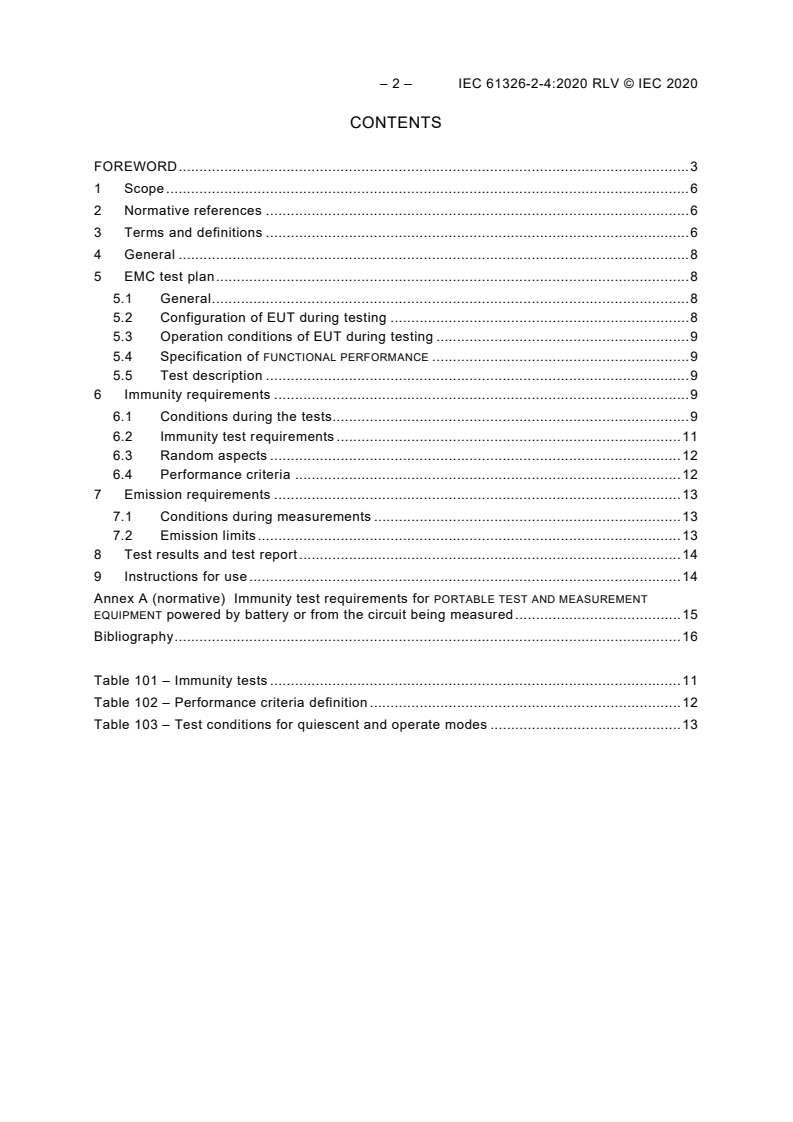
CONTENTS
FOREWORD . 3
1 Scope . 6
2 Normative references . 6
3 Terms and definitions . 6
4 General . 8
5 EMC test plan . 8
5.1 General . 8
5.2 Configuration of EUT during testing . 8
5.3 Operation conditions of EUT during testing . 9
5.4 Specification of FUNCTIONAL PERFORMANCE . 9
5.5 Test description . 9
6 Immunity requirements . 9
6.1 Conditions during the tests. 9
6.2 Immunity test requirements . 11
6.3 Random aspects . 12
6.4 Performance criteria . 12
7 Emission requirements . 13
7.1 Conditions during measurements . 13
7.2 Emission limits . 13
8 Test results and test report . 14
9 Instructions for use . 14
Annex A (normative) Immunity test requirements for PORTABLE TEST AND MEASUREMENT
EQUIPMENT powered by battery or from the circuit being measured . 15
Bibliography . 16
Table 101 – Immunity tests . 11
Table 102 – Performance criteria definition . 12
Table 103 – Test conditions for quiescent and operate modes . 13
INTERNATIONAL ELECTROTECHNICAL COMMISSION
____________
ELECTRICAL EQUIPMENT FOR MEASUREMENT,
CONTROL AND LABORATORY USE –
EMC REQUIREMENTS –
Part 2-4: Particular requirements –
Test configurations, operational conditions and performance
criteria for insulation monitoring devices according to IEC 61557-8
and for equipment for insulation fault location according to IEC 61557-9
FOREWORD
1) The International Electrotechnical Commission (IEC) is a worldwide organization for standardization comprising
all national electrotechnical committees (IEC National Committees). The object of IEC is to promote
international co-operation on all questions concerning standardization in the electrical and electronic fields. To
this end and in addition to other activities, IEC publishes International Standards, Technical Specifications,
Technical Reports, Publicly Available Specifications (PAS) and Guides (hereafter referred to as “IEC
Publication(s)”). Their preparation is entrusted to technical committees; any IEC National Committee interested
in the subject dealt with may participate in this preparatory work. International, governmental and non-
governmental organizations liaising with the IEC also participate in this preparation. IEC collaborates closely
with the International Organization for Standardization (ISO) in accordance with conditions determined by
agreement between the two organizations.
2) The formal decisions or agreements of IEC on technical matters express, as nearly as possible, an international
consensus of opinion on the relevant subjects since each technical committee has representation from all
interested IEC National Committees.
3) IEC Publications have the form of recommendations for international use and are accepted by IEC National
Committees in that sense. While all reasonable efforts are made to ensure that the technical content of IEC
Publications is accurate, IEC cannot be held responsible for the way in which they are used or for any
misinterpretation by any end user.
4) In order to promote international uniformity, IEC National Committees undertake to apply IEC Publications
transparently to the maximum extent possible in their national and regional publications. Any divergence
between any IEC Publication and the corresponding national or regional publication shall be clearly indicated in
the latter.
5) IEC itself does not provide any attestation of conformity. Independent certification bodies provide conformity
assessment services and, in some areas, access to IEC marks of conformity. IEC is not responsible for any
services carried out by independent certification bodies.
6) All users should ensure that they have the latest edition of this publication.
7) No liability shall attach to IEC or its directors, employees, servants or agents including individual experts and
members of its technical committees and IEC National Committees for any personal injury, property damage or
other damage of any nature whatsoever, whether direct or indirect, or for costs (including legal fees) and
expenses arising out of the publication, use of, or reliance upon, this IEC Publication or any other IEC
Publications.
8) Attention is drawn to the Normative references cited in this publication. Use of the referenced publications is
indispensable for the correct application of this publication.
9) Attention is drawn to the possibility that some of the elements of this IEC Publication may be the subject of
patent rights. IEC shall not be held responsible for identifying any or all such patent rights.
This redline version of the official IEC Standard allows the user to identify the changes
made to the previous edition. A vertical bar appears in the margin wherever a change
has been made. Additions are in green text, deletions are in strikethrough red text.
– 4 – IEC 61326-2-4:2020 RLV © IEC 2020
International Standard IEC 61326-2-4 has been prepared by subcommittee 65A: System
aspects, of IEC technical committee 65: Industrial-process measurement, control and
automation.
This third edition cancels and replaces the second edition published in 2012. This edition
constitutes a technical revision.
This edition includes the following significant technical change with respect to the previous
edition:
– update of the document with respect to IEC 61326-1:2020.
The text of this International Standard is based on the following documents:
FDIS Report on voting
65A/981/FDIS 65A/992/RVD
Full information on the voting for the approval of this International Standard can be found in
the report on voting indicated in the above table.
This document has been drafted in accordance with the ISO/IEC Directives, Part 2.
In this document the following print types are used:
– Terms used throughout this document which have been defined in Clause 3 of this
document and of IEC 61326-1:2020: SMALL CAPITALS.
This part of the IEC 61326 series is to be used in conjunction with IEC 61326-1:2020 and
follows the same numbering of clauses, subclauses, tables and figures.
When a particular subclause of IEC 61326-1 is not mentioned in this part, that subclause
applies as far as is reasonable. When this standard states “addition”, “modification” or
“replacement”, the relevant text in IEC 61326-1 is to be adapted accordingly.
NOTE The following numbering system is used:
– subclauses, tables and figures that are numbered starting from 101 are additional to those in IEC 61326-1;
– unless notes are in a new subclause or involve notes in IEC 61326-1, they are numbered starting from 101
including those in a replaced clause or subclause;
– additional annexes are lettered AA, BB, etc.
A list of all parts of the IEC 61326 series, under the general title Electrical equipment for
measurement, control and laboratory use, control and laboratory use – EMC requirements,
can be found on the IEC website.
The committee has decided that the contents of this document will remain unchanged until the
stability date indicated on the IEC website under "http://webstore.iec.ch" in the data related to
the specific document. At this date, the document will be
• reconfirmed,
• withdrawn,
• replaced by a revised edition, or
• amended.
IMPORTANT – The 'colour inside' logo on the cover page of this publication indicates
that it contains colours which are considered to be useful for the correct
understanding of its contents. Users should therefore print this document using a
colour printer.
– 6 – IEC 61326-2-4:2020 RLV © IEC 2020
ELECTRICAL EQUIPMENT FOR MEASUREMENT,
CONTROL AND LABORATORY USE –
EMC REQUIREMENTS –
Part 2-4: Particular requirements –
Test configurations, operational conditions and performance
criteria for insulation monitoring devices according to IEC 61557-8
and for equipment for insulation fault location according to IEC 61557-9
1 Scope
In addition to IEC 61326-1, this part of IEC 61326 specifies more detailed test configurations,
operational conditions and performance criteria than IEC 61326-1 for equipment for
– insulation monitoring according to IEC 61557-8;
– insulation fault location according to IEC 61557-9.
This applies to insulation monitoring devices and for equipment for insulation fault location
systems permanently or semi-permanently connected to the distribution system.
2 Normative references
The following documents are referred to in the text in such a way that some or all of their
content constitutes requirements of this document. For dated references, only the edition
cited applies. For undated references, the latest edition of the referenced document (including
any amendments) applies.
Clause 2 of IEC 61326-1:20122020 applies, except as follows:
Addition:
IEC 61326-1:20122020, Electrical equipment for measurement, control and laboratory use –
EMC requirements – Part 1: General requirements
IEC 61557-8:20072014, Electrical safety in low voltage distribution systems up to 1 000 V a.c.
and 1 500 V d.c. – Equipment for testing, measuring or monitoring of protective measures –
Part 8: Insulation monitoring devices for IT systems
IEC 61557-9:20092014, Electrical safety in low voltage distribution systems up to 1 000 V a.c.
and 1 500 V d.c. – Equipment for testing, measuring or monitoring of protective measures –
Part 9: Equipment for insulation fault location in IT systems
3 Terms and definitions
For the purposes of this document, the terms and definitions given in IEC 61326-1:2020
apply, except as follows.
ISO and IEC maintain terminological databases for use in standardization at the following
addresses:
• IEC Electropedia: available at http://www.electropedia.org/
• ISO Online browsing platform: available at http://www.iso.org/obp
Addition:
3.101
insulation resistance
R
F
resistance in the system being monitored, including the resistance of all the connected
appliances to earth
IEC 61557-8:20072014, 3.1.2]
[SOURCE:
3.102
specified response value
R
an
value of the INSULATION RESISTANCE, permanently set or adjustable, on the device and
monitored if the INSULATION RESISTANCE falls below this limit
IEC 61557-8:2007, 3.3 2014, 3.1.4, modified – The note to entry has been deleted]
[SOURCE:
3.103
response sensitivity
value of the evaluating current or INSULATION RESISTANCE at which the evaluator responds
under specified conditions
[SOURCE: IEC 61557-9:20092014, 3.1.4]
3.104
nominal voltage of the distribution system nominal system voltage
U
n
voltage by which a distribution system or equipment is designated and to which certain
operating characteristics are referred
value of the voltage by which the distribution system is designated and to which certain
characteristics are assigned
[SOURCE: IEC 61557-1:20072019, 3.1]
3.105
supply voltage
U
S
voltage at a point where the measuring equipment does or can accept electric energy as a
supply
voltage that is used to power the measurement equipment
Note 1 to entry: If a SUPPLY VOLTAGE is specified, for instance in the supply contract, then it is called "declared
SUPPLY VOLTAGE".
[SOURCE: IEC 61557-1:2007, 3.8, modified 2019, 3.7]
– 8 – IEC 61326-2-4:2020 RLV © IEC 2020
3.106
system leakage capacitance
C
e
maximum permissible value of the total capacitance to earth of the system to be monitored,
including any connected appliances, up to which value the insulation monitoring device can
work as specified
[SOURCE: IEC 61557-8:2007, 3.6 2014, 3.1.6, modified – The end of the definition has been
deleted]
4 General
Clause 4 of IEC 61326-1:20122020 applies.
5 EMC test plan
5.1 General
Subclause 5.1 of IEC 61326-1:20122020 applies.
5.2 Configuration of EUT during testing
5.2.1 General
Subclause 5.2.1 of IEC 61326-1:20122020 applies, except as follows.
Addition:
During the tests, the EUT is supplied as specified by the manufacturer.
For EUTs having several ratings, the EUT shall be connected
– to the lowest nominal SUPPLY VOLTAGE U ;
S
– to the highest NOMINAL VOLTAGE of the distribution system U , but not more than 400 V.
n
If the EUT has only a combined terminal for the SUPPLY VOLTAGE and the voltage of the
distribution system, it shall be connected to the highest NOMINAL VOLTAGE, but not more than
400 V.
If the EUT has interfaces for remote functions, they shall be connected during the tests as
specified by the manufacturer for normal installation.
Insulation monitoring devices and equipment for insulation fault location shall be tested
separately.
5.2.2 Composition of EUT
Subclause 5.2.2 of IEC 61326-1:20122020 applies.
5.2.3 Assembly of EUT
Subclause 5.2.3 of IEC 61326-1:20122020 applies.
5.2.4 I/O PORTS
Subclause 5.2.4 of IEC 61326-1:20122020 applies.
5.2.5 AUXILIARY EQUIPMENT
Subclause 5.2.5 of IEC 61326-1:20122020 applies.
5.2.6 Cabling and earthing (grounding)
Subclause 5.2.6 of IEC 61326-1:20122020 applies.
5.3 Operation conditions of EUT during testing
Subclause 5.3 of IEC 61326-1:20122020 applies, except as follows.
Addition:
5.3.101 Operational conditions
The EUT shall be set as specified by the manufacturer for normal operation.
If the EUT has adjustable SPECIFIED RESPONSE VALUES, tests shall be performed as follows:
– for insulation monitoring devices, one value shall be selected by the manufacturer among
the following possibilities:
• at the value equal or closest to the internal DC resistance value;
• at the value equal or closest to the internal AC impedance value;
– for insulation fault location equipment, at the value in the middle of the RESPONSE
SENSITIVITY range;
The INSULATION RESISTANCE shall be simulated by a single phase INSULATION RESISTANCE.
If the EUT has a selectable time delay, the time delay shall be set to the minimum value.
The SYSTEM LEAKAGE CAPACITANCE shall be set to the maximum value as defined by the
manufacturer but not more than 1 µF. The SYSTEM LEAKAGE CAPACITANCE is to be installed
symmetrically to all phases of U . For example:
n
– 2 × 0,5 µF for single-phase AC and for DC systems,
– 3 × 0,33 µF for 3-phase AC systems.
5.4 Specification of FUNCTIONAL PERFORMANCE
Subclause 5.4 of IEC 61326-1:20122020 applies.
5.5 Test description
Subclause 5.5 of IEC 61326-1:20122020 applies.
6 Immunity requirements
6.1 Conditions during the tests
Subclause 6.1 of IEC 61326-1:20122020 applies, except as follows.
Addition:
The configuration and modes of operation during the tests shall be precisely noted in the test
report.
– 10 – IEC 61326-2-4:2020 RLV © IEC 2020
Tests shall be applied to the relevant PORTS in accordance with Table 101.
The tests shall be conducted performed in accordance with the basic EMC standards listed in
the relevant table. The tests shall be carried out one at a time. If additional methods are
required, the method and rationale shall be documented.
6.1.101 Electrostatic discharge immunity tests
The test shall be applied only to parts of the EUT which are accessible to the user in normal
operations, for example, push-buttons and displays. This test does not apply to connection
terminals.
Electrostatic discharges of positive and negative polarity shall be applied 10 times to each of
the selected test points.
The points of application shall be stated in the report.
6.1.102 Electromagnetic field tests
The dwell time for each frequency shall be 1,5 times the longest response time of the EUT
specified by the manufacturer, plus the time delay, see 5.3. The actual dwell time shall be
stated in the test report.
6.1.103 Burst tests
PORTS for remote control functions shall be tested separately. Cables for functions not tested
shall be disconnected.
The bursts shall be applied for a minimum time of 1 minute; however, the time of application
shall be greater than the response time of the EUT specified by the manufacturer.
6.1.104 Surge immunity tests
In deviation from the general test conditions of 5.2.1, this test is applied at the maximum
SUPPLY VOLTAGE U .
S
Pulses both with positive and negative polarity shall be injected. For AC lines, surge shall be
applied with a phase angles being 90° and 270°.
A series of five pulses is applied for each polarity and each phase angle with a time between
the pulses of 1 minute or less.
6.1.105 Conducted RF tests
The dwell time for each frequency shall be 1,5 times the longest response time of the EUT
specified by the manufacturer, plus the time delay (see 5.3). The actual dwell time shall be
stated in the test report.
6.1.106 Power frequency magnetic field tests
The test is performed only on EUT with integrated magnetic magnetically sensitive
components equipment.
It is recommended to apply the test for a minimum time of 1 minute for each frequency and
orientation of the EUT. However, the time of application should be greater than the response
time of the EUT.
6.2 Immunity test requirements
Subclause 6.2 of IEC 61326-1:20122020 does not apply.
Replacement:
The immunity requirements are given in Table 101.
NOTE The required tests correspond to the required tests applicable for equipment of INDUSTRIAL
ELECTROMAGNETIC ENVIRONMENTS.
Table 101 – Immunity tests
PORT Phenomenon Basic standard Test value Performance
criteria
(as defined
in 6.4)
Enclosure ESD IEC 61000-4-2 ±4 kV contact discharge, A2
±8 kV air discharge A2
Enclosure Electromagnetic field IEC 61000-4-3 80 MHz to 1 000 MHz, 10 A1
V/m1,4 GHz to 2 GHz, 3 V/m A1
2,0 GHz to 2,7 GHz, 1 V/m A1
80 % AM modulation
10 V/m (80 MHz to 1 000 MHz)
a
3 V/m (1,4 GHz to 6 GHz)
AC and DC power Fast transients IEC 61000-4-4 2 kV (5/50 ns, 5 kHz) A2
supply, AC and DC (burst)
b
±2 kV (5 kHz or 100 kHz)
connections to
distribution system
(including
connection to earth)
and I/O
signal/control
connected directly
to distribution
network
I/O signal/control 1 kV (5/50 ns, 5 kHz) A2
(including functional
±1 kV (5 kHz or 100 kHz)
earth lines and
remote connections)
AC power supply, Surge IEC 61000-4-5 2 kV lineto earth B
AC connections to
1 kV linetoline A2
distribution system
(including
±2 kV line-to-ground
connection to earth)
and I/O ±1 kV line-to-line
signal/control
connected directly
to distribution
network
I/O signal/control 1 kV lineto earth B
(including functional
±1 kV line-to-ground
earth lines and
remote connections)
All PORTS except Conducted RF IEC 61000-4-6 150 kHz to 80 MHz, 10 V A1
ENCLOSURE PORT
Common mode
80 % AM modulation
10 V (150 kHz to 80 MHz)
Enclosure Power frequency IEC 61000-4-8 30 A/m (50 Hz, 60 Hz) A1
magnetic field
Only for EUT with integrated
magnetic sensitive
components
– 12 – IEC 61326-2-4:2020 RLV © IEC 2020
PORT Phenomenon Basic standard Test value Performance
criteria
(as defined
in 6.4)
AC power Voltage dip IEC 61000-4-11 0 % during 1 cycle, A2
a b
40 % during 10/12 cycles C
c
70 % during 25/30 cycles C
c
Short interruptions IEC 61000-4-11 0 % during 250/300 cycles C
a
In case testing is performed also in the frequency range from 1 GHz to 1,4 GHz, the same test level as above
1,4 GHz is recommended.
b
DC POWER PORTS intended to be connected to a low voltage DC supply (≤ 60 V), where secondary circuits
(isolated from the AC mains supply) are not subject to transient overvoltages (i.e. reliably-grounded,
capacitively-filtered DC secondary circuits) shall be regarded as I/O signal/control PORTS.
c
For example, “25/30 cycles” means “25 cycles for 50 Hz test” or “30 cycles for 60 Hz test”.
6.3 Random aspects
Subclause 6.3 of IEC 61326-1:20122020 applies.
6.4 Performance criteria
Subclause 6.4 of IEC 61326-1:20122020 does not apply, with the exception of performance
Criterion C defined in IEC 61326-1:2020, 6.4.4.
Replacement:
The performance criteria A1, A2 and B for the evaluation of the immunity test results are
given in Table 102. The performance criteria C defined in IEC 61326-1:2012, 6.4.4 applies.
Table 102 – Performance criteria definition
Function Criterion A1 Criterion A2 Criterion B
(for permanent phenomena) (for transient phenomena)
a a a
Alarm In Quiescent mode : The In Quiescent mode : The In Quiescent mode : The
functions alarm digital output and the alarm digital output and the alarm digital output and the
visual indicators shall not visual indicators shall not visual indicators may switch
switch to the alarm state switch to the alarm state to the alarm state but shall
during the test. during the test. not remain in the alarm state
after the test.
a a a
In Operate mode : The alarm In Operate mode : The alarm In Operate mode : The alarm
digital output and the visual digital output and the visual digital output and the visual
indicators shall switch to the indicators shall switch to the indicators need not remain in
alarm state and remain in the alarm state and remain in the the alarm state during this
alarm state during the test. alarm state during the test. test but shall switch to or
remain in the alarm state after
the test.
Measurement When insulation fault location During the test, the During the test, the
functions equipment includes indicators measurement functions may measurement functions may
for the INSULATION RESISTANCE be transiently influenced. be transiently influenced.
or equivalent values, the After the test, the EUT shall After the test, the EUT shall
measurement uncertainty continue to operate as continue to operate as
during the immunity test shall intended for normal operation. intended for normal operation.
not be greater than the
specified measurement
uncertainty declared by the
manufacturer.
Function Criterion A1 Criterion A2 Criterion B
(for permanent phenomena) (for transient phenomena)
Man machine Visual indicators (for example, Visual indicators (for example, Visual indicators (for example,
Interface displays, LEDs) and remote displays, LEDs) and remote displays, LEDs) and remote
functions functions (for example, functions (for example, functions (for example,
analogue or digital control analogue or digital control analogue or digital control
interfaces) shall work as interfaces) may be transiently interfaces) may be transiently
intended. influenced. influenced.
a
Quiescent mode and Operate mode are defined in Table 103.
Table 103 – Test conditions for quiescent and operate modes
Operation modes Definition
Quiescent mode (the device is For devices allowing the SPECIFIED RESPONSE VALUE R to be configured
an
operating under conditions where within a range of values, the test shall be performed in accordance with
– as a result of INSULATION 5.3.101.
RESISTANCE measurement – no
For devices with a fixed value for the SPECIFIED RESPONSE VALUE R , the test
an
alarm should be detected)
shall be made with this specified value.
For insulation monitoring devices, an INSULATION RESISTANCE R of 1,3 × R is
F an
applied.
For equipment for insulation fault location, the following values shall be
applied:
– for equipment evaluating the INSULATION RESISTANCE: 1,3 × (the specified
RESPONSE SENSITIVITY plus uncertainty of RESPONSE SENSITIVITY declared by
the manufacturer);
– for equipment evaluating the current: 0,7 × (the specified RESPONSE
SENSITIVITY minus uncertainty of RESPONSE SENSITIVITY declared by the
manufacturer).
Operate mode (the device is in a For devices allowing R to be configured within a range of values, the test
an
mode where an alarm should be shall be performed in accordance with 5.3.101.
detected)
For devices with a fixed value for R , the test shall be made with this
an
specified value.
For insulation monitoring devices, an INSULATION RESISTANCE R of 0,7 × R is
F an
applied.
For equipment for insulation fault location, the following values shall be
applied:
– for equipment evaluating the INSULATION RESISTANCE: 0,7 × (the specified
RESPONSE SENSITIVITY minus uncertainty of RESPONSE SENSITIVITY declared
by the manufacturer);
– for equipment evaluating the current: 1,3 × (the specified RESPONSE
SENSITIVITY plus uncertainty of RESPONSE SENSITIVITY declared by the
manufacturer).
After the immunity tests, the EUT shall operate as intended in accordance with the
requirements of IEC 61557-8 or IEC 61557-9.
7 Emission requirements
7.1 Conditions during measurements
Subclause 7.1 of IEC 61326-1:20122020 applies.
7.2 Emission limits
Subclause 7.2 of IEC 61326-1:20122020 applies, except as follows:
Addition:
– 14 – IEC 61326-2-4:2020 RLV © IEC 2020
In a non-domestic environment, limits according to CISPR 11, Group 1, Class A, apply.
In a domestic environment, limits according to CISPR 11, Group 1, Class B, apply.
8 Test results and test report
Clause 8 of IEC 61326-1:20122020 applies.
9 Instructions for use
Clause 9 of IEC 61326-1:20122020 applies.
Annex A
(normative)
Immunity test requirements for PORTABLE TEST AND MEASUREMENT
EQUIPMENT powered by battery or from the circuit being measured
Annex A of IEC 61326-1:20122020 does not apply.
– 16 – IEC 61326-2-4:2020 RLV © IEC 2020
Bibliography
IEC 61557-1:20072019, Electrical safety in low voltage distribution systems up to 1 000 V AC
and 1 500 V DC – Equipment for testing, measuring or monitoring of protective measures –
Part 1: General requirements
___________
IEC 61326-2-4 ®
Edition 3.0 2020-10
INTERNATIONAL
STANDARD
NORME
INTERNATIONALE
Electrical equipment for measurement, control and laboratory use –
EMC requirements –
Part 2-4: Particular requirements – Test configurations, operational conditions
and performance criteria for insulation monitoring devices according to
IEC 61557-8 and for equipment for insulation fault location according to
IEC 61557-9
Matériel électrique de mesure, de commande et de laboratoire –
Exigences relatives à la CEM –
Partie 2-4: Exigences particulières – Configurations d'essai, conditions de
fonctionnement et critères de performance pour les contrôleurs d'isolement
conformes à l’IEC 61557-8 et pour les dispositifs de localisation de défaut
d’isolement conformes à l’IEC 61557-9
– 2 – IEC 61326-2-4:2020 © IEC 2020
CONTENTS
FOREWORD . 3
1 Scope . 5
2 Normative references . 5
3 Terms and definitions . 5
4 General . 7
5 EMC test plan . 7
5.1 General . 7
5.2 Configuration of EUT during testing . 7
5.3 Operation conditions of EUT during testing . 8
5.4 Specification of FUNCTIONAL PERFORMANCE . 8
5.5 Test description . 8
6 Immunity requirements . 8
6.1 Conditions during the tests. 8
6.2 Immunity test requirements . 9
6.3 Random aspects . 10
6.4 Performance criteria . 11
7 Emission requirements . 12
7.1 Conditions during measurements . 12
7.2 Emission limits . 12
8 Test results and test report . 12
9 Instructions for use . 13
Annex A (normative) Immunity test requirements for PORTABLE TEST AND MEASUREMENT
EQUIPMENT powered by battery or from the circuit being measured . 14
Bibliography . 15
Table 101 – Immunity tests . 10
Table 102 – Performance criteria definition . 11
Table 103 – Test conditions for quiescent and operate modes . 12
INTERNATIONAL ELECTROTECHNICAL COMMISSION
____________
ELECTRICAL EQUIPMENT FOR MEASUREMENT,
CONTROL AND LABORATORY USE –
EMC REQUIREMENTS –
Part 2-4: Particular requirements –
Test configurations, operational conditions and performance
criteria for insulation monitoring devices according to IEC 61557-8
and for equipment for insulation fault location according to IEC 61557-9
FOREWORD
1) The International Electrotechnical Commission (IEC) is a worldwide organization for standardization comprising
all national electrotechnical committees (IEC National Committees). The object of IEC is to promote
international co-operation on all questions concerning standardization in the electrical and electronic fields. To
this end and in addition to other activities, IEC publishes International Standards, Technical Specifications,
Technical Reports, Publicly Available Specifications (PAS) and Guides (hereafter referred to as “IEC
Publication(s)”). Their preparation is entrusted to technical committees; any IEC National Committee interested
in the subject dealt with may participate in this preparatory work. International, governmental and non-
governmental organizations liaising with the IEC also participate in this preparation. IEC collaborates closely
with the International Organization for Standardization (ISO) in accordance with conditions determined by
agreement between the two organizations.
2) The formal decisions or agreements of IEC on technical matters express, as nearly as possible, an international
consensus of opinion on the relevant subjects since each technical committee has representation from all
interested IEC National Committees.
3) IEC Publications have the form of recommendations for international use and are accepted by IEC National
Committees in that sense. While all reasonable efforts are made to ensure that the technical content of IEC
Publications is accurate, IEC cannot be held responsible for the way in which they are used or for any
misinterpretation by any end user.
4) In order to promote international uniformity, IEC National Committees undertake to apply IEC Publications
transparently to the maximum extent possible in their national and regional publications. Any divergence
between any IEC Publication and the corresponding national or regional publication shall be clearly indicated in
the latter.
5) IEC itself does not provide any attestation of conformity. Independent certification bodies provide conformity
assessment services and, in some areas, access to IEC marks of conformity. IEC is not responsible for any
services carried out by independent certification bodies.
6) All users should ensure that they have the latest edition of this publication.
7) No liability shall attach to IEC or its directors, employees, servants or agents including individual experts and
members of its technical committees and IEC National Committees for any personal injury, property damage or
other damage of any nature whatsoever, whether direct or indirect, or for costs (including legal fees) and
expenses arising out of the publication, use of, or reliance upon, this IEC Publication or any other IEC
Publications.
8) Attention is drawn to the Normative references cited in this publication. Use of the referenced publications is
indispensable for the correct application of this publication.
9) Attention is drawn to the possibility that some of the elements of this IEC Publication may be the subject of
patent rights. IEC shall not be held responsible for identifying any or all such patent rights.
International Standard IEC 61326-2-4 has been prepared by subcommittee 65A: System
aspects, of IEC technical committee 65: Industrial-process measurement, control and
automation.
This third edition cancels and replaces the second edition published in 2012. This edition
constitutes a technical revision.
This edition includes the following significant technical change with respect to the previous
edition:
– update of the document with respect to IEC 61326-1:2020.
– 4 – IEC 61326-2-4:2020 © IEC 2020
The text of this International Standard is based on the following documents:
FDIS Report on voting
65A/981/FDIS 65A/992/RVD
Full information on the voting for the approval of this International Standard can be found in
the report on voting indicated in the above table.
This document has been drafted in accordance with the ISO/IEC Directives, Part 2.
In this document the following print types are used:
– Terms used throughout this document which have been defined in Clause 3 of this
document and of IEC 61326-1:2020: SMALL CAPITALS.
This part of the IEC 61326 series is to be used in conjunction with IEC 61326-1:2020 and
follows the same numbering of clauses, subclauses, tables and figures.
When a particular subclause of IEC 61326-1 is not mentioned in this part, that subclause
applies as far as is reasonable. When this standard states “addition”, “modification” or
“replacement”, the relevant text in IEC 61326-1 is to be adapted accordingly.
NOTE The following numbering system is used:
– subclauses, tables and figures that are numbered starting from 101 are additional to those in IEC 61326-1;
– unless notes are in a new subclause or involve notes in IEC 61326-1, they are numbered starting from 101
including those in a replaced clause or subclause;
– additional annexes are lettered AA, BB, etc.
A list of all parts of the IEC 61326 series, under the general title Electrical equipment for
measurement, control and laboratory use, control and laboratory use – EMC requirements,
can be found on the IEC website.
The committee has decided that the contents of this document will remain unchanged until the
stability date indicated on the IEC website under "http://webstore.iec.ch" in the data related to
the specific document. At this date, the document will be
• reconfirmed,
• withdrawn,
• replaced by a revised edition, or
• amended.
ELECTRICAL EQUIPMENT FOR MEASUREMENT,
CONTROL AND LABORATORY USE –
EMC REQUIREMENTS –
Part 2-4: Particular requirements –
Test configurations, operational conditions and performance
criteria for insulation monitoring devices according to IEC 61557-8
and for equipment for insulation fault location according to IEC 61557-9
1 Scope
In addition to IEC 61326-1, this part of IEC 61326 specifies more detailed test configurations,
operational conditions and performance criteria than IEC 61326-1 for equipment for
– insulation monitoring according to IEC 61557-8;
– insulation fault location according to IEC 61557-9.
This applies to insulation monitoring devices and for equipment for insulation fault location
systems permanently or semi-permanently connected to the distribution system.
2 Normative references
The following documents are referred to in the text in such a way that some or all of their
content constitutes requirements of this document. For dated references, only the edition
cited applies. For undated references, the latest edition of the referenced document (including
any amendments) applies.
Clause 2 of IEC 61326-1:2020 applies, except as follows:
Addition:
IEC 61326-1:2020, Electrical equipment for measurement, control and laboratory use – EMC
requirements – Part 1: General requirements
IEC 61557-8:2014, Electrical safety in low voltage distribution systems up to 1 000 V a.c. and
1 500 V d.c. – Equipment for testing, measuring or monitoring of protective measures –
Part 8: Insulation monitoring devices for IT systems
IEC 61557-9:2014, Electrical safety in low voltage distribution systems up to 1 000 V
...
IEC 61326-2-4 ®
Edition 3.0 2020-10
INTERNATIONAL
STANDARD
NORME
INTERNATIONALE
Electrical equipment for measurement, control and laboratory use –
EMC requirements –
Part 2-4: Particular requirements – Test configurations, operational conditions
and performance criteria for insulation monitoring devices according to
IEC 61557-8 and for equipment for insulation fault location according to
IEC 61557-9
Matériel électrique de mesure, de commande et de laboratoire –
Exigences relatives à la CEM –
Partie 2-4: Exigences particulières – Configurations d'essai, conditions de
fonctionnement et critères de performance pour les contrôleurs d'isolement
conformes à l’IEC 61557-8 et pour les dispositifs de localisation de défaut
d’isolement conformes à l’IEC 61557-9
All rights reserved. Unless otherwise specified, no part of this publication may be reproduced or utilized in any form
or by any means, electronic or mechanical, including photocopying and microfilm, without permission in writing from
either IEC or IEC's member National Committee in the country of the requester. If you have any questions about IEC
copyright or have an enquiry about obtaining additional rights to this publication, please contact the address below or
your local IEC member National Committee for further information.
Droits de reproduction réservés. Sauf indication contraire, aucune partie de cette publication ne peut être reproduite
ni utilisée sous quelque forme que ce soit et par aucun procédé, électronique ou mécanique, y compris la photocopie
et les microfilms, sans l'accord écrit de l'IEC ou du Comité national de l'IEC du pays du demandeur. Si vous avez des
questions sur le copyright de l'IEC ou si vous désirez obtenir des droits supplémentaires sur cette publication, utilisez
les coordonnées ci-après ou contactez le Comité national de l'IEC de votre pays de résidence.
IEC Central Office Tel.: +41 22 919 02 11
3, rue de Varembé info@iec.ch
CH-1211 Geneva 20 www.iec.ch
Switzerland
About the IEC
The International Electrotechnical Commission (IEC) is the leading global organization that prepares and publishes
International Standards for all electrical, electronic and related technologies.
About IEC publications
The technical content of IEC publications is kept under constant review by the IEC. Please make sure that you have the
latest edition, a corrigendum or an amendment might have been published.
IEC publications search - webstore.iec.ch/advsearchform Electropedia - www.electropedia.org
The advanced search enables to find IEC publications by a The world's leading online dictionary on electrotechnology,
variety of criteria (reference number, text, technical containing more than 22 000 terminological entries in English
committee,…). It also gives information on projects, replaced and French, with equivalent terms in 16 additional languages.
and withdrawn publications. Also known as the International Electrotechnical Vocabulary
(IEV) online.
IEC Just Published - webstore.iec.ch/justpublished
Stay up to date on all new IEC publications. Just Published IEC Glossary - std.iec.ch/glossary
details all new publications released. Available online and 67 000 electrotechnical terminology entries in English and
once a month by email. French extracted from the Terms and Definitions clause of
IEC publications issued since 2002. Some entries have been
IEC Customer Service Centre - webstore.iec.ch/csc collected from earlier publications of IEC TC 37, 77, 86 and
If you wish to give us your feedback on this publication or CISPR.
need further assistance, please contact the Customer Service
Centre: sales@iec.ch.
A propos de l'IEC
La Commission Electrotechnique Internationale (IEC) est la première organisation mondiale qui élabore et publie des
Normes internationales pour tout ce qui a trait à l'électricité, à l'électronique et aux technologies apparentées.
A propos des publications IEC
Le contenu technique des publications IEC est constamment revu. Veuillez vous assurer que vous possédez l’édition la
plus récente, un corrigendum ou amendement peut avoir été publié.
Recherche de publications IEC - Electropedia - www.electropedia.org
webstore.iec.ch/advsearchform Le premier dictionnaire d'électrotechnologie en ligne au
La recherche avancée permet de trouver des publications IEC monde, avec plus de 22 000 articles terminologiques en
en utilisant différents critères (numéro de référence, texte, anglais et en français, ainsi que les termes équivalents dans
comité d’études,…). Elle donne aussi des informations sur les 16 langues additionnelles. Egalement appelé Vocabulaire
projets et les publications remplacées ou retirées. Electrotechnique International (IEV) en ligne.
IEC Just Published - webstore.iec.ch/justpublished Glossaire IEC - std.iec.ch/glossary
Restez informé sur les nouvelles publications IEC. Just 67 000 entrées terminologiques électrotechniques, en anglais
Published détaille les nouvelles publications parues. et en français, extraites des articles Termes et Définitions des
Disponible en ligne et une fois par mois par email. publications IEC parues depuis 2002. Plus certaines entrées
antérieures extraites des publications des CE 37, 77, 86 et
Service Clients - webstore.iec.ch/csc CISPR de l'IEC.
Si vous désirez nous donner des commentaires sur cette
publication ou si vous avez des questions contactez-nous:
sales@iec.ch.
IEC 61326-2-4 ®
Edition 3.0 2020-10
INTERNATIONAL
STANDARD
NORME
INTERNATIONALE
Electrical equipment for measurement, control and laboratory use –
EMC requirements –
Part 2-4: Particular requirements – Test configurations, operational conditions
and performance criteria for insulation monitoring devices according to
IEC 61557-8 and for equipment for insulation fault location according to
IEC 61557-9
Matériel électrique de mesure, de commande et de laboratoire –
Exigences relatives à la CEM –
Partie 2-4: Exigences particulières – Configurations d'essai, conditions de
fonctionnement et critères de performance pour les contrôleurs d'isolement
conformes à l’IEC 61557-8 et pour les dispositifs de localisation de défaut
d’isolement conformes à l’IEC 61557-9
INTERNATIONAL
ELECTROTECHNICAL
COMMISSION
COMMISSION
ELECTROTECHNIQUE
INTERNATIONALE
ICS 17.220.20; 25.040.40; 33.100.20 ISBN 978-2-8322-8981-5
– 2 – IEC 61326-2-4:2020 © IEC 2020
CONTENTS
FOREWORD . 3
1 Scope . 5
2 Normative references . 5
3 Terms and definitions . 5
4 General . 7
5 EMC test plan . 7
5.1 General . 7
5.2 Configuration of EUT during testing . 7
5.3 Operation conditions of EUT during testing . 8
5.4 Specification of FUNCTIONAL PERFORMANCE . 8
5.5 Test description . 8
6 Immunity requirements . 8
6.1 Conditions during the tests. 8
6.2 Immunity test requirements . 9
6.3 Random aspects . 10
6.4 Performance criteria . 11
7 Emission requirements . 12
7.1 Conditions during measurements . 12
7.2 Emission limits . 12
8 Test results and test report . 12
9 Instructions for use . 13
Annex A (normative) Immunity test requirements for PORTABLE TEST AND MEASUREMENT
EQUIPMENT powered by battery or from the circuit being measured . 14
Bibliography . 15
Table 101 – Immunity tests . 10
Table 102 – Performance criteria definition . 11
Table 103 – Test conditions for quiescent and operate modes . 12
INTERNATIONAL ELECTROTECHNICAL COMMISSION
____________
ELECTRICAL EQUIPMENT FOR MEASUREMENT,
CONTROL AND LABORATORY USE –
EMC REQUIREMENTS –
Part 2-4: Particular requirements –
Test configurations, operational conditions and performance
criteria for insulation monitoring devices according to IEC 61557-8
and for equipment for insulation fault location according to IEC 61557-9
FOREWORD
1) The International Electrotechnical Commission (IEC) is a worldwide organization for standardization comprising
all national electrotechnical committees (IEC National Committees). The object of IEC is to promote
international co-operation on all questions concerning standardization in the electrical and electronic fields. To
this end and in addition to other activities, IEC publishes International Standards, Technical Specifications,
Technical Reports, Publicly Available Specifications (PAS) and Guides (hereafter referred to as “IEC
Publication(s)”). Their preparation is entrusted to technical committees; any IEC National Committee interested
in the subject dealt with may participate in this preparatory work. International, governmental and non-
governmental organizations liaising with the IEC also participate in this preparation. IEC collaborates closely
with the International Organization for Standardization (ISO) in accordance with conditions determined by
agreement between the two organizations.
2) The formal decisions or agreements of IEC on technical matters express, as nearly as possible, an international
consensus of opinion on the relevant subjects since each technical committee has representation from all
interested IEC National Committees.
3) IEC Publications have the form of recommendations for international use and are accepted by IEC National
Committees in that sense. While all reasonable efforts are made to ensure that the technical content of IEC
Publications is accurate, IEC cannot be held responsible for the way in which they are used or for any
misinterpretation by any end user.
4) In order to promote international uniformity, IEC National Committees undertake to apply IEC Publications
transparently to the maximum extent possible in their national and regional publications. Any divergence
between any IEC Publication and the corresponding national or regional publication shall be clearly indicated in
the latter.
5) IEC itself does not provide any attestation of conformity. Independent certification bodies provide conformity
assessment services and, in some areas, access to IEC marks of conformity. IEC is not responsible for any
services carried out by independent certification bodies.
6) All users should ensure that they have the latest edition of this publication.
7) No liability shall attach to IEC or its directors, employees, servants or agents including individual experts and
members of its technical committees and IEC National Committees for any personal injury, property damage or
other damage of any nature whatsoever, whether direct or indirect, or for costs (including legal fees) and
expenses arising out of the publication, use of, or reliance upon, this IEC Publication or any other IEC
Publications.
8) Attention is drawn to the Normative references cited in this publication. Use of the referenced publications is
indispensable for the correct application of this publication.
9) Attention is drawn to the possibility that some of the elements of this IEC Publication may be the subject of
patent rights. IEC shall not be held responsible for identifying any or all such patent rights.
International Standard IEC 61326-2-4 has been prepared by subcommittee 65A: System
aspects, of IEC technical committee 65: Industrial-process measurement, control and
automation.
This third edition cancels and replaces the second edition published in 2012. This edition
constitutes a technical revision.
This edition includes the following significant technical change with respect to the previous
edition:
– update of the document with respect to IEC 61326-1:2020.
– 4 – IEC 61326-2-4:2020 © IEC 2020
The text of this International Standard is based on the following documents:
FDIS Report on voting
65A/981/FDIS 65A/992/RVD
Full information on the voting for the approval of this International Standard can be found in
the report on voting indicated in the above table.
This document has been drafted in accordance with the ISO/IEC Directives, Part 2.
In this document the following print types are used:
– Terms used throughout this document which have been defined in Clause 3 of this
document and of IEC 61326-1:2020: SMALL CAPITALS.
This part of the IEC 61326 series is to be used in conjunction with IEC 61326-1:2020 and
follows the same numbering of clauses, subclauses, tables and figures.
When a particular subclause of IEC 61326-1 is not mentioned in this part, that subclause
applies as far as is reasonable. When this standard states “addition”, “modification” or
“replacement”, the relevant text in IEC 61326-1 is to be adapted accordingly.
NOTE The following numbering system is used:
– subclauses, tables and figures that are numbered starting from 101 are additional to those in IEC 61326-1;
– unless notes are in a new subclause or involve notes in IEC 61326-1, they are numbered starting from 101
including those in a replaced clause or subclause;
– additional annexes are lettered AA, BB, etc.
A list of all parts of the IEC 61326 series, under the general title Electrical equipment for
measurement, control and laboratory use, control and laboratory use – EMC requirements,
can be found on the IEC website.
The committee has decided that the contents of this document will remain unchanged until the
stability date indicated on the IEC website under "http://webstore.iec.ch" in the data related to
the specific document. At this date, the document will be
• reconfirmed,
• withdrawn,
• replaced by a revised edition, or
• amended.
ELECTRICAL EQUIPMENT FOR MEASUREMENT,
CONTROL AND LABORATORY USE –
EMC REQUIREMENTS –
Part 2-4: Particular requirements –
Test configurations, operational conditions and performance
criteria for insulation monitoring devices according to IEC 61557-8
and for equipment for insulation fault location according to IEC 61557-9
1 Scope
In addition to IEC 61326-1, this part of IEC 61326 specifies more detailed test configurations,
operational conditions and performance criteria than IEC 61326-1 for equipment for
– insulation monitoring according to IEC 61557-8;
– insulation fault location according to IEC 61557-9.
This applies to insulation monitoring devices and for equipment for insulation fault location
systems permanently or semi-permanently connected to the distribution system.
2 Normative references
The following documents are referred to in the text in such a way that some or all of their
content constitutes requirements of this document. For dated references, only the edition
cited applies. For undated references, the latest edition of the referenced document (including
any amendments) applies.
Clause 2 of IEC 61326-1:2020 applies, except as follows:
Addition:
IEC 61326-1:2020, Electrical equipment for measurement, control and laboratory use – EMC
requirements – Part 1: General requirements
IEC 61557-8:2014, Electrical safety in low voltage distribution systems up to 1 000 V a.c. and
1 500 V d.c. – Equipment for testing, measuring or monitoring of protective measures –
Part 8: Insulation monitoring devices for IT systems
IEC 61557-9:2014, Electrical safety in low voltage distribution systems up to 1 000 V a.c. and
1 500 V d.c. – Equipment for testing, measuring or monitoring of protective measures –
Part 9: Equipment for insulation fault location in IT systems
3 Terms and definitions
For the purposes of this document, the terms and definitions given in IEC 61326-1:2020
apply, except as follows.
– 6 – IEC 61326-2-4:2020 © IEC 2020
ISO and IEC maintain terminological databases for use in standardization at the following
addresses:
• IEC Electropedia: available at http://www.electropedia.org/
• ISO Online browsing platform: available at http://www.iso.org/obp
Addition:
3.101
insulation resistance
R
F
resistance in the system being monitored, including the resistance of all the connected
appliances to earth
[SOURCE: IEC 61557-8:2014, 3.1.2]
3.102
specified response value
R
an
value of the INSULATION RESISTANCE, permanently set or adjustable, on the device and
monitored if the INSULATION RESISTANCE falls below this limit
[SOURCE: IEC 61557-8:2014, 3.1.4, modified – The note to entry has been deleted]
3.103
response sensitivity
value of the evaluating current or INSULATION RESISTANCE at which the evaluator responds
under specified conditions
[SOURCE: IEC 61557-9:2014, 3.1.4]
3.104
nominal system voltage
U
n
value of the voltage by which the distribution system is designated and to which certain
characteristics are assigned
[SOURCE: IEC 61557-1:2019, 3.1]
3.105
supply voltage
voltage that is used to power the measurement equipment
Note 1 to entry: If a SUPPLY VOLTAGE is specified, for instance in the supply contract, then it is called "declared
SUPPLY VOLTAGE".
[SOURCE: IEC 61557-1:2019, 3.7]
3.106
system leakage capacitance
C
e
maximum permissible value of the total capacitance to earth of the system to be monitored,
including any connected appliances, up to which value the insulation monitoring device can
work as specified
[SOURCE: IEC 61557-8:2014, 3.1.6, modified – The end of the definition has been deleted]
4 General
Clause 4 of IEC 61326-1:2020 applies.
5 EMC test plan
5.1 General
Subclause 5.1 of IEC 61326-1:2020 applies.
5.2 Configuration of EUT during testing
5.2.1 General
Subclause 5.2.1 of IEC 61326-1:2020 applies, except as follows.
Addition:
During the tests, the EUT is supplied as specified by the manufacturer.
For EUTs having several ratings, the EUT shall be connected
– to the lowest nominal SUPPLY VOLTAGE U ;
S
– to the highest NOMINAL VOLTAGE of the distribution system U , but not more than 400 V.
n
If the EUT has only a combined terminal for the SUPPLY VOLTAGE and the voltage of the
distribution system, it shall be connected to the highest NOMINAL VOLTAGE, but not more than
400 V.
If the EUT has interfaces for remote functions, they shall be connected during the tests as
specified by the manufacturer for normal installation.
Insulation monitoring devices and equipment for insulation fault location shall be tested
separately.
5.2.2 Composition of EUT
Subclause 5.2.2 of IEC 61326-1:2020 applies.
5.2.3 Assembly of EUT
Subclause 5.2.3 of IEC 61326-1:2020 applies.
5.2.4 I/O PORTS
Subclause 5.2.4 of IEC 61326-1:2020 applies.
5.2.5 AUXILIARY EQUIPMENT
Subclause 5.2.5 of IEC 61326-1:2020 applies.
5.2.6 Cabling and earthing (grounding)
Subclause 5.2.6 of IEC 61326-1:2020 applies.
– 8 – IEC 61326-2-4:2020 © IEC 2020
5.3 Operation conditions of EUT during testing
Subclause 5.3 of IEC 61326-1:2020 applies, except as follows.
Addition:
5.3.101 Operational conditions
The EUT shall be set as specified by the manufacturer for normal operation.
If the EUT has adjustable SPECIFIED RESPONSE VALUES, tests shall be performed as follows:
– for insulation monitoring devices, one value shall be selected by the manufacturer among
the following possibilities:
• at the value equal or closest to the internal DC resistance value;
• at the value equal or closest to the internal AC impedance value;
– for insulation fault location equipment, at the value in the middle of the RESPONSE
SENSITIVITY range;
The INSULATION RESISTANCE shall be simulated by a single phase INSULATION RESISTANCE.
If the EUT has a selectable time delay, the time delay shall be set to the minimum value.
The SYSTEM LEAKAGE CAPACITANCE shall be set to the maximum value as defined by the
manufacturer but not more than 1 µF. The SYSTEM LEAKAGE CAPACITANCE is to be installed
. For example:
symmetrically to all phases of U
n
– 2 × 0,5 µF for single-phase AC and for DC systems,
– 3 × 0,33 µF for 3-phase AC systems.
5.4 Specification of FUNCTIONAL PERFORMANCE
Subclause 5.4 of IEC 61326-1:2020 applies.
5.5 Test description
Subclause 5.5 of IEC 61326-1:2020 applies.
6 Immunity requirements
6.1 Conditions during the tests
Subclause 6.1 of IEC 61326-1:2020 applies, except as follows.
Addition:
The configuration and modes of operation during the tests shall be precisely noted in the test
report.
Tests shall be applied to the relevant PORTS in accordance with Table 101.
The tests shall be performed in accordance with the basic EMC standards listed in the
relevant table. The tests shall be carried out one at a time. If additional methods are required,
the method and rationale shall be documented.
6.1.101 Electrostatic discharge immunity tests
The test shall be applied only to parts of the EUT which are accessible to the user in normal
operations, for example, push-buttons and displays. This test does not apply to connection
terminals.
Electrostatic discharges of positive and negative polarity shall be applied 10 times to each of
the selected test points.
The points of application shall be stated in the report.
6.1.102 Electromagnetic field tests
The dwell time for each frequency shall be 1,5 times the longest response time of the EUT
specified by the manufacturer, plus the time delay, see 5.3. The actual dwell time shall be
stated in the test report.
6.1.103 Burst tests
PORTS for remote control functions shall be tested separately. Cables for functions not tested
shall be disconnected.
The bursts shall be applied for a minimum time of 1 minute; however, the time of application
shall be greater than the response time of the EUT specified by the manufacturer.
6.1.104 Surge immunity tests
In deviation from the general test conditions of 5.2.1, this test is applied at the maximum
SUPPLY VOLTAGE U .
S
Pulses both with positive and negative polarity shall be injected. For AC lines, surge shall be
applied with phase angles being 90° and 270°.
A series of five pulses is applied for each polarity and each phase angle with a time between
the pulses of 1 minute or less.
6.1.105 Conducted RF tests
The dwell time for each frequency shall be 1,5 times the longest response time of the EUT
specified by the manufacturer, plus the time delay (see 5.3). The actual dwell time shall be
stated in the test report.
6.1.106 Power frequency magnetic field tests
The test is performed only on EUT with magnetically sensitive equipment.
It is recommended to apply the test for a minimum time of 1 minute for each frequency and
orientation of the EUT. However, the time of application should be greater than the response
time of the EUT.
6.2 Immunity test requirements
Subclause 6.2 of IEC 61326-1:2020 does not apply.
Replacement:
The immunity requirements are given in Table 101.
– 10 – IEC 61326-2-4:2020 © IEC 2020
NOTE The required tests correspond to the required tests applicable for equipment of INDUSTRIAL
ELECTROMAGNETIC ENVIRONMENTS.
Table 101 – Immunity tests
Performance
PORT Phenomenon Basic standard Test value
criteria
(as defined
in 6.4)
Enclosure ESD IEC 61000-4-2 ±4 kV contact discharge, A2
±8 kV air discharge A2
Enclosure Electromagnetic field IEC 61000-4-3 10 V/m (80 MHz to 1 000 MHz) A1
a
3 V/m (1,4 GHz to 6 GHz) A1
b
AC and DC power Fast transients IEC 61000-4-4 ±2 kV (5 kHz or 100 kHz) A2
supply, AC and DC (burst)
connections to
distribution system
(including
connection to earth)
and I/O
signal/control
connected directly
to distribution
network
I/O signal/control ±1 kV (5 kHz or 100 kHz) A2
(including functional
earth lines and
remote connections)
AC power supply, Surge IEC 61000-4-5 ±2 kV line-to-ground B
AC connections to
±1 kV line-to-line A2
distribution system
(including
connection to earth)
and I/O
signal/control
connected directly
to distribution
network
I/O signal/control ±1 kV line-to-ground B
(including functional
earth lines and
remote connections)
All PORTS except Conducted RF IEC 61000-4-6 10 V (150 kHz to 80 MHz) A1
ENCLOSURE PORT
Enclosure Power frequency IEC 61000-4-8 30 A/m (50 Hz, 60 Hz) A1
magnetic field
Only for EUT with integrated
magnetic sensitive
components
AC power Voltage dip IEC 61000-4-11 0 % during 1 cycle, A2
b
40 % during 10/12 cycles C
c
70 % during 25/30 cycles C
c
Short interruptions IEC 61000-4-11 0 % during 250/300 cycles C
a
In case testing is performed also in the frequency range from 1 GHz to 1,4 GHz, the same test level as above
1,4 GHz is recommended.
b
DC power PORTS intended to be connected to a low voltage DC supply (≤ 60 V), where secondary circuits
(isolated from the AC mains supply) are not subject to transient overvoltages (i.e. reliably-grounded,
capacitively-filtered DC secondary circuits) shall be regarded as I/O signal/control PORTS.
c
For example, “25/30 cycles” means “25 cycles for 50 Hz test” or “30 cycles for 60 Hz test”.
6.3 Random aspects
Subclause 6.3 of IEC 61326-1:2020 applies.
6.4 Performance criteria
Subclause 6.4 of IEC 61326-1:2020 does not apply, with the exception of performance
Criterion C defined in IEC 61326-1:2020, 6.4.4.
Replacement:
The performance criteria A1, A2 and B for the evaluation of the immunity test results are
given in Table 102.
Table 102 – Performance criteria definition
Function Criterion A1 Criterion A2 Criterion B
(for permanent phenomena) (for transient phenomena)
a a a
Alarm In Quiescent mode : The In Quiescent mode : The In Quiescent mode : The
functions alarm digital output and the alarm digital output and the alarm digital output and the
visual indicators shall not visual indicators shall not visual indicators may switch
switch to the alarm state switch to the alarm state to the alarm state but shall
during the test. during the test. not remain in the alarm state
after the test.
a a a
In Operate mode : The alarm In Operate mode : The alarm In Operate mode : The alarm
digital output and the visual digital output and the visual digital output and the visual
indicators shall switch to the indicators shall switch to the indicators need not remain in
alarm state and remain in the alarm state and remain in the the alarm state during this
test but shall switch to or
alarm state during the test. alarm state during the test.
remain in the alarm state after
the test.
Measurement When insulation fault location During the test, the During the test, the
functions equipment includes indicators measurement functions may measurement functions may
for the INSULATION RESISTANCE be transiently influenced. be transiently influenced.
or equivalent values, the After the test, the EUT shall After the test, the EUT shall
measurement uncertainty continue to operate as continue to operate as
during the immunity test shall intended for normal operation. intended for normal operation.
not be greater than the
specified measurement
uncertainty declared by the
manufacturer.
Man machine Visual indicators (for example, Visual indicators (for example, Visual indicators (for example,
Interface displays, LEDs) and remote displays, LEDs) and remote displays, LEDs) and remote
functions functions (for example, functions (for example, functions (for example,
analogue or digital control analogue or digital control analogue or digital control
interfaces) shall work as interfaces) may be transiently interfaces) may be transiently
intended. influenced. influenced.
a
Quiescent mode and Operate mode are defined in Table 103.
– 12 – IEC 61326-2-4:2020 © IEC 2020
Table 103 – Test conditions for quiescent and operate modes
Operation modes Definition
Quiescent mode (the device is For devices allowing the SPECIFIED RESPONSE VALUE R to be configured
an
operating under conditions where within a range of values, the test shall be performed in accordance with
– as a result of INSULATION 5.3.101.
measurement – no
RESISTANCE
For devices with a fixed value for the SPECIFIED RESPONSE VALUE R , the test
an
alarm should be detected)
shall be made with this specified value.
For insulation monitoring devices, an INSULATION RESISTANCE R of 1,3 × R is
F an
applied.
For equipment for insulation fault location, the following values shall be
applied:
– for equipment evaluating the INSULATION RESISTANCE: 1,3 × (the specified
RESPONSE SENSITIVITY plus uncertainty of RESPONSE SENSITIVITY declared by
the manufacturer);
– for equipment evaluating the current: 0,7 × (the specified RESPONSE
SENSITIVITY minus uncertainty of RESPONSE SENSITIVITY declared by the
manufacturer).
Operate mode (the device is in a For devices allowing R to be configured within a range of values, the test
an
mode where an alarm should be shall be performed in accordance with 5.3.101.
detected)
For devices with a fixed value for R , the test shall be made with this
an
specified value.
For insulation monitoring devices, an INSULATION RESISTANCE R of 0,7 × R is
F an
applied.
For equipment for insulation fault location, the following values shall be
applied:
– for equipment evaluating the INSULATION RESISTANCE: 0,7 × (the specified
RESPONSE SENSITIVITY minus uncertainty of RESPONSE SENSITIVITY declared
by the ma
...