

IEC 63193:2020
(Main)Lead-acid batteries for propulsion power of lightweight vehicles - General requirements and methods of test
General Information
- Abstract
IEC 63193:2020 is applicable to lead-acid batteries powering electric two-wheelers (mopeds) and three-wheelers (e-rickshaws and delivery vehicles), and also to golf cars and similar light utility and multi-passenger vehicles.
The document specifies methods of tests tailored to batteries destined for the above‑referenced types of vehicles so as to ensure satisfactory and safe battery performance in the intended application.
This document does not apply for example to lead-acid cells and batteries used for:
vehicle engine starting applications (IEC 60095 series);
traction applications (IEC 60254 series);
stationary applications (IEC 60896 series);
general purpose applications (IEC 61056 series); or to
motorized wheelchairs and similar personal assist vehicles
- Status
- Published
- Publication Date
- 17-Nov-2020
- Technical Committee
- TC 21 - Secondary cells and batteries
- Drafting Committee
- WG 3 - TC 21/WG 3
- Current Stage
- PPUB - Publication issued
- Start Date
- 18-Nov-2020
- Completion Date
- 28-Aug-2020
Overview
IEC 63193:2020 sets out the general requirements and standard test methods for lead-acid batteries used in the propulsion of lightweight vehicles. This international standard, published by the International Electrotechnical Commission (IEC), specifically addresses lead-acid batteries powering electric two-wheelers (such as mopeds), electric three-wheelers (including e-rickshaws and delivery vehicles), as well as golf cars and comparable light utility or multi-passenger vehicles.
IEC 63193:2020 plays a critical role in supporting the safe and reliable performance of lead-acid propulsion batteries within their intended applications. It does not cover batteries used for starting engine applications, heavier traction applications, stationary power, general-purpose applications, or for personal assist devices such as motorized wheelchairs.
Key Topics
This IEC standard covers a broad array of topics relevant to ensuring battery reliability, performance, and safety, including:
- Scope and Definitions: Clear terminology and boundaries for the types of batteries and vehicles included.
- Test Set-up and Equipment: Specifications for the accuracy of measuring instruments, test conditions, and sample requirements to ensure consistent, repeatable results.
- Test Methods: Performance tests customized to the battery application, including capacity determination, cycle life, charge retention, vibration resistance, and protection against ignition from external sparks.
- Temperatures and Environmental Factors: Test and evaluation procedures under various operating and storage temperatures to represent real-world conditions.
- Marking and Material Identification: Requirements for clear and durable battery labeling and identification of materials used.
- Safety Considerations: Specific protocols to minimize risks such as fire, explosions, electrical shocks, and chemical burns during battery use and charging, particularly in public-access environments.
Applications
IEC 63193:2020 is central to manufacturers, testing laboratories, and specialists involved with:
- Electric Two- and Three-Wheelers: Mopeds, electric scooters, e-rickshaws, and delivery vehicles that require robust propulsion batteries for frequent acceleration and deceleration cycles.
- Golf Cars and Light Utility Vehicles: Electric vehicles deployed in sports, industry, resorts, and airports where operating safety and performance reliability are vital, often in scenarios involving untrained users and bystanders.
- Battery Quality Control: Battery producers and OEMs can use the test methods to validate design, support product claims, and comply with procurement and regulatory requirements.
- Market Access and Safety Compliance: Ensures batteries meet international safety and performance standards, supporting smoother market entry and reducing liability risks.
By adhering to IEC 63193:2020, stakeholders can demonstrate due diligence in delivering batteries that are reliable, user-friendly, and safe for both regular operations and public exposures.
Related Standards
IEC 63193:2020 should be considered alongside related IEC standards, as it is positioned within a family of battery standards, including:
- IEC 60095 Series: Covers lead-acid batteries for vehicle engine starting applications.
- IEC 60254 Series: Addresses lead-acid traction batteries for industrial vehicles and machinery.
- IEC 60896 Series: Specifies stationary lead-acid battery systems used in backup and emergency power.
- IEC 61056 Series: Concerns general-purpose sealed lead-acid batteries.
- IEC 62902: Standardizes marking symbols for identification of battery chemistry.
- IEC 60695-11-10 / IEC 60695-11-4: Provides fire hazard testing methodologies, referenced for material flammability within IEC 63193.
By implementing IEC 63193:2020 and referencing associated standards, organizations can ensure full-spectrum compliance for lead-acid propulsion batteries within lightweight mobility applications, thereby supporting product safety, reliability, and regulatory acceptance.
Get Certified
Connect with accredited certification bodies for this standard

IMQ S.p.A. (Certification)
Italian electrical product certification.

SLG Prüf- und Zertifizierungs GmbH
German testing and certification body.

UL Solutions
Global safety science company with testing, inspection and certification.
Sponsored listings
Frequently Asked Questions
IEC 63193:2020 is a standard published by the International Electrotechnical Commission (IEC). Its full title is "Lead-acid batteries for propulsion power of lightweight vehicles - General requirements and methods of test". This standard covers: IEC 63193:2020 is applicable to lead-acid batteries powering electric two-wheelers (mopeds) and three-wheelers (e-rickshaws and delivery vehicles), and also to golf cars and similar light utility and multi-passenger vehicles. The document specifies methods of tests tailored to batteries destined for the above‑referenced types of vehicles so as to ensure satisfactory and safe battery performance in the intended application. This document does not apply for example to lead-acid cells and batteries used for: vehicle engine starting applications (IEC 60095 series); traction applications (IEC 60254 series); stationary applications (IEC 60896 series); general purpose applications (IEC 61056 series); or to motorized wheelchairs and similar personal assist vehicles
IEC 63193:2020 is applicable to lead-acid batteries powering electric two-wheelers (mopeds) and three-wheelers (e-rickshaws and delivery vehicles), and also to golf cars and similar light utility and multi-passenger vehicles. The document specifies methods of tests tailored to batteries destined for the above‑referenced types of vehicles so as to ensure satisfactory and safe battery performance in the intended application. This document does not apply for example to lead-acid cells and batteries used for: vehicle engine starting applications (IEC 60095 series); traction applications (IEC 60254 series); stationary applications (IEC 60896 series); general purpose applications (IEC 61056 series); or to motorized wheelchairs and similar personal assist vehicles
IEC 63193:2020 is classified under the following ICS (International Classification for Standards) categories: 29.220.20 - Acid secondary cells and batteries. The ICS classification helps identify the subject area and facilitates finding related standards.
IEC 63193:2020 is available in PDF format for immediate download after purchase. The document can be added to your cart and obtained through the secure checkout process. Digital delivery ensures instant access to the complete standard document.
Standards Content (Sample)
IEC 63193 ®
Edition 1.0 2020-11
INTERNATIONAL
STANDARD
NORME
INTERNATIONALE
Lead-acid batteries for propulsion power of lightweight vehicles – General
requirements and methods of test
Batteries au plomb pour la puissance de propulsion des véhicules légers –
Exigences générales et méthodes d'essai
All rights reserved. Unless otherwise specified, no part of this publication may be reproduced or utilized in any form
or by any means, electronic or mechanical, including photocopying and microfilm, without permission in writing from
either IEC or IEC's member National Committee in the country of the requester. If you have any questions about IEC
copyright or have an enquiry about obtaining additional rights to this publication, please contact the address below or
your local IEC member National Committee for further information.
Droits de reproduction réservés. Sauf indication contraire, aucune partie de cette publication ne peut être reproduite
ni utilisée sous quelque forme que ce soit et par aucun procédé, électronique ou mécanique, y compris la photocopie
et les microfilms, sans l'accord écrit de l'IEC ou du Comité national de l'IEC du pays du demandeur. Si vous avez des
questions sur le copyright de l'IEC ou si vous désirez obtenir des droits supplémentaires sur cette publication, utilisez
les coordonnées ci-après ou contactez le Comité national de l'IEC de votre pays de résidence.
IEC Central Office Tel.: +41 22 919 02 11
3, rue de Varembé info@iec.ch
CH-1211 Geneva 20 www.iec.ch
Switzerland
About the IEC
The International Electrotechnical Commission (IEC) is the leading global organization that prepares and publishes
International Standards for all electrical, electronic and related technologies.
About IEC publications
The technical content of IEC publications is kept under constant review by the IEC. Please make sure that you have the
latest edition, a corrigendum or an amendment might have been published.
IEC publications search - webstore.iec.ch/advsearchform Electropedia - www.electropedia.org
The advanced search enables to find IEC publications by a The world's leading online dictionary on electrotechnology,
variety of criteria (reference number, text, technical containing more than 22 000 terminological entries in English
committee,…). It also gives information on projects, replaced and French, with equivalent terms in 16 additional languages.
and withdrawn publications. Also known as the International Electrotechnical Vocabulary
(IEV) online.
IEC Just Published - webstore.iec.ch/justpublished
Stay up to date on all new IEC publications. Just Published IEC Glossary - std.iec.ch/glossary
details all new publications released. Available online and 67 000 electrotechnical terminology entries in English and
once a month by email. French extracted from the Terms and Definitions clause of
IEC publications issued since 2002. Some entries have been
IEC Customer Service Centre - webstore.iec.ch/csc collected from earlier publications of IEC TC 37, 77, 86 and
If you wish to give us your feedback on this publication or CISPR.
need further assistance, please contact the Customer Service
Centre: sales@iec.ch.
A propos de l'IEC
La Commission Electrotechnique Internationale (IEC) est la première organisation mondiale qui élabore et publie des
Normes internationales pour tout ce qui a trait à l'électricité, à l'électronique et aux technologies apparentées.
A propos des publications IEC
Le contenu technique des publications IEC est constamment revu. Veuillez vous assurer que vous possédez l’édition la
plus récente, un corrigendum ou amendement peut avoir été publié.
Recherche de publications IEC - Electropedia - www.electropedia.org
webstore.iec.ch/advsearchform Le premier dictionnaire d'électrotechnologie en ligne au
La recherche avancée permet de trouver des publications IEC monde, avec plus de 22 000 articles terminologiques en
en utilisant différents critères (numéro de référence, texte, anglais et en français, ainsi que les termes équivalents dans
comité d’études,…). Elle donne aussi des informations sur les 16 langues additionnelles. Egalement appelé Vocabulaire
projets et les publications remplacées ou retirées. Electrotechnique International (IEV) en ligne.
IEC Just Published - webstore.iec.ch/justpublished Glossaire IEC - std.iec.ch/glossary
Restez informé sur les nouvelles publications IEC. Just 67 000 entrées terminologiques électrotechniques, en anglais
Published détaille les nouvelles publications parues. et en français, extraites des articles Termes et Définitions des
Disponible en ligne et une fois par mois par email. publications IEC parues depuis 2002. Plus certaines entrées
antérieures extraites des publications des CE 37, 77, 86 et
Service Clients - webstore.iec.ch/csc CISPR de l'IEC.
Si vous désirez nous donner des commentaires sur cette
publication ou si vous avez des questions contactez-nous:
sales@iec.ch.
IEC 63193 ®
Edition 1.0 2020-11
INTERNATIONAL
STANDARD
NORME
INTERNATIONALE
Lead-acid batteries for propulsion power of lightweight vehicles – General
requirements and methods of test
Batteries au plomb pour la puissance de propulsion des véhicules légers –
Exigences générales et méthodes d'essai
INTERNATIONAL
ELECTROTECHNICAL
COMMISSION
COMMISSION
ELECTROTECHNIQUE
INTERNATIONALE
ICS 29.220.20 ISBN 978-2-8322-8717-0
– 2 – IEC 63193:2020 © IEC 2020
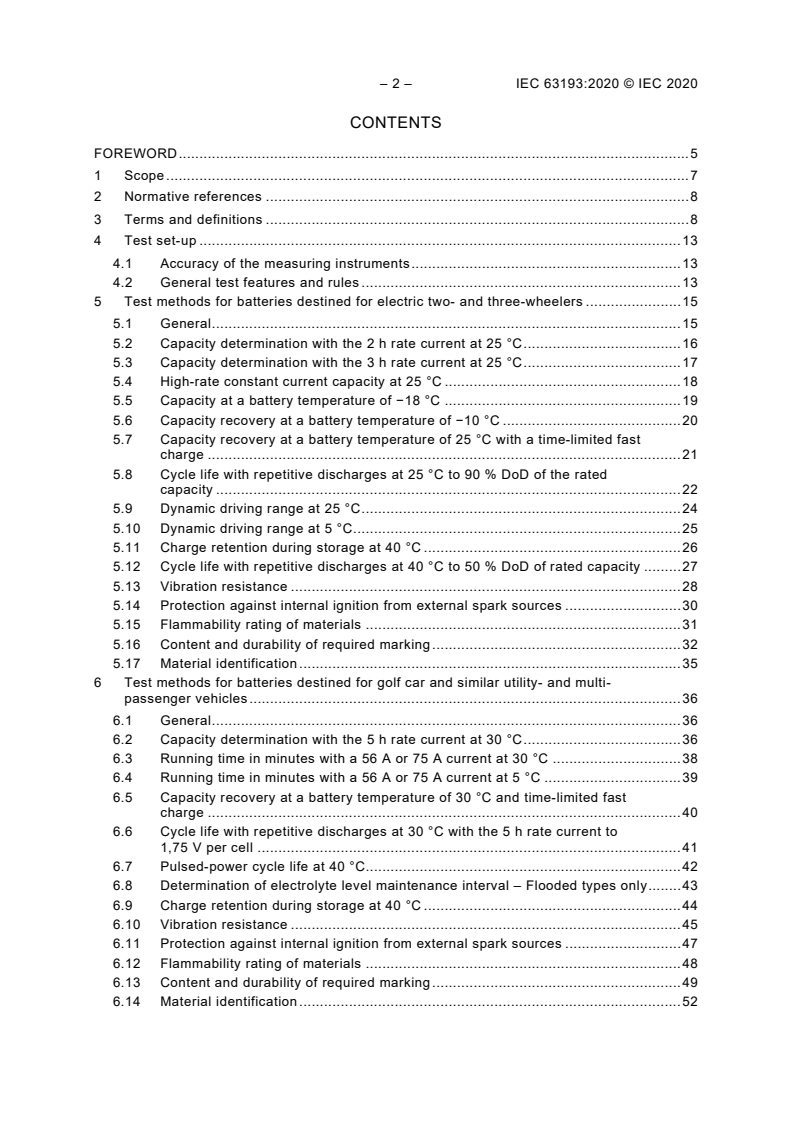
CONTENTS
FOREWORD . 5
1 Scope . 7
2 Normative references . 8
3 Terms and definitions . 8
4 Test set-up . 13
4.1 Accuracy of the measuring instruments . 13
4.2 General test features and rules . 13
5 Test methods for batteries destined for electric two- and three-wheelers . 15
5.1 General . 15
5.2 Capacity determination with the 2 h rate current at 25 °C . 16
5.3 Capacity determination with the 3 h rate current at 25 °C . 17
5.4 High-rate constant current capacity at 25 °C . 18
5.5 Capacity at a battery temperature of −18 °C . 19
5.6 Capacity recovery at a battery temperature of −10 °C . 20
5.7 Capacity recovery at a battery temperature of 25 °C with a time-limited fast
charge . 21
5.8 Cycle life with repetitive discharges at 25 °C to 90 % DoD of the rated
capacity . 22
5.9 Dynamic driving range at 25 °C . 24
5.10 Dynamic driving range at 5 °C . 25
5.11 Charge retention during storage at 40 °C . 26
5.12 Cycle life with repetitive discharges at 40 °C to 50 % DoD of rated capacity . 27
5.13 Vibration resistance . 28
5.14 Protection against internal ignition from external spark sources . 30
5.15 Flammability rating of materials . 31
5.16 Content and durability of required marking . 32
5.17 Material identification . 35
6 Test methods for batteries destined for golf car and similar utility- and multi-
passenger vehicles . 36
6.1 General . 36
6.2 Capacity determination with the 5 h rate current at 30 °C . 36
6.3 Running time in minutes with a 56 A or 75 A current at 30 °C . 38
6.4 Running time in minutes with a 56 A or 75 A current at 5 °C . 39
6.5 Capacity recovery at a battery temperature of 30 °C and time-limited fast
charge . 40
6.6 Cycle life with repetitive discharges at 30 °C with the 5 h rate current to
1,75 V per cell . 41
6.7 Pulsed-power cycle life at 40 °C. 42
6.8 Determination of electrolyte level maintenance interval – Flooded types only . 43
6.9 Charge retention during storage at 40 °C . 44
6.10 Vibration resistance . 45
6.11 Protection against internal ignition from external spark sources . 47
6.12 Flammability rating of materials . 48
6.13 Content and durability of required marking . 49
6.14 Material identification . 52
Annex A (informative) Guidance on expected test results . 53
A.1 General . 53
A.2 Expected outcomes for tests 5.2 to 5.17 with batteries destined for electric
two- and three-wheelers . 53
A.3 Expected outcomes for tests in 6.2 to 6.14 with batteries destined for golf
car and similar utility- and multi-passenger vehicles . 55
Figure 1 – Examples of vehicles covered by this document . 7
Figure 2 – Example of orientation of the monoblocs on the vibration table in relation to
their specified orientation in service . 29
Figure 3 – Example of orientation of the monoblocs on the vibration table in relation to
their specified orientation in service . 46
Table 1 – Listing of the number of monoblocs to be tested for Clause 5 applications . 15
Table 2 – Capacity at 25 °C determined with the 2 h rate discharge current I . 17
Table 3 – Capacity at 25 °C determined with the 3 h rate discharge current I . 18
Table 4 – Capacity at 25 °C determined with the high-rate discharge current 3,6 I . 19
Table 5 – Capacity at −18 °C determined with the 2 h rate discharge current I . 20
Table 6 – Capacity recovery after discharge and charge at −10 °C . 21
Table 7 – Capacity recovery at 25 °C with a time-limited fast charge . 22
Table 8 – Cycle life with repetitive discharges to 90 % of the rated C capacity at 25 °C . 23
Table 9 – Cycle life with repetitive discharges to 90 % of the rated C capacity at 25 °C . 24
Table 10 – Dynamic discharge sequence . 24
Table 11 – Achieved discharge sequences at 25 °C . 25
Table 12 – Dynamic discharge sequence . 25
Table 13 – Achieved discharge sequences at 5 °C . 26
Table 14 – Capacity retained after 30 days of storage at 40 °C . 27
Table 15 – Cycle life with repetitive discharges to 50 % DoD of rated C capacity at
40 °C . 28
Table 16 – Cycle life with repetitive discharges to 50 % DoD of rated C capacity at
40 °C . 28
Table 17 – Capacity retained after 60 min vibration and subsequent 24 h OC stand . 30
Table 18 – Battery status after spark test . 31
Table 19 – Burning classification achieved when tested in accordance with
IEC 60695-11-10:2013 . 32
Table 20 – Content and durability of the required marking . 33
Table 21 – Information to be present on the monobloc . 34
Table 22 – Material identification and durability of the required marking. 35
Table 23 – Listing of the number of monoblocs to be tested for Clause 6 applications . 36
Table 24 – Capacity at 30 °C determined with the 5 h rate discharge current I . 37
Table 25 – Running time determined with the 56 A or 75 A discharge current at 30 °C. 38
Table 26 – Running time determined with the 56 A or 75 A discharge current at 5 °C . 39
Table 27 – Capacity recovery at 30 °C with a time-limited fast charge. 41
Table 28 – Cycle life with repetitive discharges at 30 °C to 1,75 V per cell with the I
current . 42
Table 29 – Pulsed power discharge and charge sequence – Flooded types . 42
– 4 – IEC 63193:2020 © IEC 2020
Table 30 – Pulsed power discharge and charge sequence – VRLA types . 42
Table 31 – Achieved discharge and charge cycle sequences at 40 °C . 42
Table 32 – Discharge and charge sequence for the determination of the electrolyte
level maintenance interval . 43
Table 33 – Achieved discharge and charge sequences at 40 °C until the manufacturer
specified minimum electrolyte level mark is reached . 44
Table 34 – Capacity retained after 30 days of storage at 40 °C . 45
Table 35 – Capacity retained after 60 min vibration and subsequent 24 h OC stand . 46
Table 36 – Battery status after spark test . 48
Table 37 – Burning classification achieved when tested in accordance with
IEC 60696‑11‑10:2013 . 49
Table 38 – Content and durability of the required marking . 50
Table 39 – Information to be present on the monobloc . 51
Table 40 – Material identification and durability of the required marking. 52
INTERNATIONAL ELECTROTECHNICAL COMMISSION
____________
LEAD-ACID BATTERIES FOR PROPULSION
POWER OF LIGHTWEIGHT VEHICLES –
GENERAL REQUIREMENTS AND METHODS OF TEST
FOREWORD
1) The International Electrotechnical Commission (IEC) is a worldwide organization for standardization comprising
all national electrotechnical committees (IEC National Committees). The object of IEC is to promote
international co-operation on all questions concerning standardization in the electrical and electronic fields. To
this end and in addition to other activities, IEC publishes International Standards, Technical Specifications,
Technical Reports, Publicly Available Specifications (PAS) and Guides (hereafter referred to as "IEC
Publication(s)"). Their preparation is entrusted to technical committees; any IEC National Committee interested
in the subject dealt with may participate in this preparatory work. International, governmental and non-
governmental organizations liaising with the IEC also participate in this preparation. IEC collaborates closely
with the International Organization for Standardization (ISO) in accordance with conditions determined by
agreement between the two organizations.
2) The formal decisions or agreements of IEC on technical matters express, as nearly as possible, an international
consensus of opinion on the relevant subjects since each technical committee has representation from all
interested IEC National Committees.
3) IEC Publications have the form of recommendations for international use and are accepted by IEC National
Committees in that sense. While all reasonable efforts are made to ensure that the technical content of IEC
Publications is accurate, IEC cannot be held responsible for the way in which they are used or for any
misinterpretation by any end user.
4) In order to promote international uniformity, IEC National Committees undertake to apply IEC Publications
transparently to the maximum extent possible in their national and regional publications. Any divergence
between any IEC Publication and the corresponding national or regional publication shall be clearly indicated in
the latter.
5) IEC itself does not provide any attestation of conformity. Independent certification bodies provide conformity
assessment services and, in some areas, access to IEC marks of conformity. IEC is not responsible for any
services carried out by independent certification bodies.
6) All users should ensure that they have the latest edition of this publication.
7) No liability shall attach to IEC or its directors, employees, servants or agents including individual experts and
members of its technical committees and IEC National Committees for any personal injury, property damage or
other damage of any nature whatsoever, whether direct or indirect, or for costs (including legal fees) and
expenses arising out of the publication, use of, or reliance upon, this IEC Publication or any other IEC
Publications.
8) Attention is drawn to the Normative references cited in this publication. Use of the referenced publications is
indispensable for the correct application of this publication.
9) Attention is drawn to the possibility that some of the elements of this IEC Publication may be the subject of
patent rights. IEC shall not be held responsible for identifying any or all such patent rights.
International Standard IEC 63193 has been prepared by IEC technical committee 21:
Secondary cells and batteries.
The text of this International Standard is based on the following documents:
FDIS Report on voting
21/1056/FDIS 21/1066/RVD
Full information on the voting for the approval of this International Standard can be found in
the report on voting indicated in the above table.
This document has been drafted in accordance with the ISO/IEC Directives, Part 2.
– 6 – IEC 63193:2020 © IEC 2020
The committee has decided that the contents of this document will remain unchanged until the
stability date indicated on the IEC website under "http://webstore.iec.ch" in the data related to
the specific document. At this date, the document will be
• reconfirmed,
• withdrawn,
• replaced by a revised edition, or
• amended.
LEAD-ACID BATTERIES FOR PROPULSION
POWER OF LIGHTWEIGHT VEHICLES –
GENERAL REQUIREMENTS AND METHODS OF TEST
1 Scope
This document is applicable to lead-acid batteries powering electric two-wheelers (mopeds)
and three-wheelers (e-rickshaws and delivery vehicles), and also to golf cars and similar light
utility and multi-passenger vehicles.
a) Electric two- and three-wheelers
b) Electric golf car and light utility and multi-passenger vehicles
Figure 1 – Examples of vehicles covered by this document
Persons with a low level of technical skills as regards these vehicles and associated batteries,
operate them most often in an environment with many bystanders who are unaware of the
possible risks involved. The batteries have thus to be eminently reliable, consumer friendly
and minimize risks of fire, explosions, electrical shocks and chemical burns.
These batteries are submitted to frequent and deep discharges with electrical power delivered
to the propulsion system in short surges of high current when accelerating, followed by lower
current levels when at cruising speed. The subsequent charge of the battery can also occur in
areas accessible to the public.
The document specifies methods of tests tailored to batteries destined for the
above-referenced types of vehicles so as to ensure satisfactory and safe battery performance
in the intended application.
This document does not apply for example to lead acid cells and batteries used for:
• vehicle engine starting applications (IEC 60095 series);
• traction applications (IEC 60254 series);
– 8 – IEC 63193:2020 © IEC 2020
• stationary applications (IEC 60896 series);
• general purpose applications (IEC 61056 series); or to
• motorized wheelchairs and similar personal assist vehicles.
2 Normative references
The following documents are referred to in the text in such a way that some or all of their
content constitutes requirements of this document. For dated references, only the edition
cited applies. For undated references, the latest edition of the referenced document (including
any amendments) applies.
IEC 60695-11-4:2011, Fire hazard testing – Part 11-4: Test flames – 50 W flame – Apparatus
and confirmational test method
IEC 60695-11-10:2013, Fire hazard testing – Part 11-10: Test flames – 50 W horizontal and
vertical flame test methods
IEC TR 61430:1997, Secondary cells and batteries – Test methods for checking the
performance of devices designed for reducing explosion hazards – Lead-acid starter batteries
IEC 62902:2019, Secondary cells and batteries – Marking symbols for identification of their
chemistry
ISO 1043-1:2011, Plastics – Symbols and abbreviated terms – Part 1: Basic polymers and
their special characteristics
ISO 3864-1:2011, Graphical symbols – Safety colours and safety signs – Part 1: Design
principles for safety signs and safety markings
ISO 3864-3:2012, Graphical symbols – Safety colours and safety signs – Part 3: Design
principles for graphical symbols for use in safety signs
ISO 7000, Graphical symbols for use on equipment – Registered symbols (available at
http://www.graphical-symbols.info/equipment)
ISO 7010, Graphical symbols – Safety colours and safety signs – Registered safety signs
(available at https://www.iso.org/obp)
ISO 8608:2016, Mechanical vibration – Road surface profiles – Reporting of measured data
Directive 2012/19/EU of the European Parliament and of the Council of 4 July 2012 on waste
electrical and electronic equipment (WEEE)
3 Terms and definitions
For the purposes of this document, the following terms and definitions apply.
ISO and IEC maintain terminological databases for use in standardization at the following
addresses:
• IEC Electropedia: available at http://www.electropedia.org/
• ISO Online browsing platform: available at http://www.iso.org/obp
3.1
acceptance test
contractual test to prove to the customer that the battery meets certain
conditions of its specification
Note 1 to entry: Such a test consists generally in a capacity determination carried out at the manufacturer's
premises prior to shipping and in the presence of the customer.
Note 2 to entry: Such a test could be also be combined with the commissioning test.
[SOURCE: IEC 60050-151:2001, 151-16-23, modified – The second preferred term "hand-over
test" has been omitted, "item" has been replaced with "battery" in the definition, and the
domain and notes to entry have been added.]
3.2
accuracy
quality which characterizes the ability of a measuring instrument
to provide an indicated value close to a true value of the measurand
Note 1 to entry: This term is used in the "true value" approach.
Note 2 to entry: Accuracy is all the better when the indicated value is closer to the corresponding true value.
[SOURCE: IEC 60050-311:2001, 311-06-08]
3.3
ambient temperature
average temperature of air or another medium in the vicinity of the battery
Note 1 to entry: During the measurement of the ambient temperature the measuring instrument/probe should be
shielded from draughts and radiant heating.
[SOURCE: IEC 60050-826:2001, 826-10-03, modified – The word "equipment" has been
replaced with "battery" in the definition.]
3.4
running time
autonomy time
extent of time over which the battery can support independently the electrical
load by providing all the load's required power
Note 1 to entry: This time is also called back-up or discharge duration and varies in function of battery age, load
size, state of charge and temperature.
3.5
capacity
electric charge which a cell or battery can deliver under specified
discharge conditions
Note 1 to entry: The SI unit for electric charge, or quantity of electricity, is the coulomb (1 C = 1 A·s) but in
practice, capacity is usually expressed in ampere hours (Ah).
[SOURCE: IEC 60050-482:2004, 482-03-14]
3.6
actual capacity
capacity value determined experimentally at a defined instant of time
with a discharge at a specified rate to a specified end-voltage and at a specified temperature
Note 1 to entry: Each actual capacity determination may yield a capacity value which may differ from the
preceding one.
– 10 – IEC 63193:2020 © IEC 2020
3.7
rated capacity
capacity value of a battery determined under specified conditions and
declared by the manufacturer
[SOURCE: IEC 60050-482:2004, 482-03-15, modified – The domain ""
has been added.]
3.8
nominal voltage
suitable approximate value of the voltage used to designate or identify a cell, a battery or an
electrochemical system
[SOURCE: IEC 60050-482:2004, 482-03-31]
3.9
residual capacity
capacity remaining in a cell or battery following a discharge, operation
or storage under specific test condition
[SOURCE: IEC 60050-482:2004, 482-03-16, modified – The domain ""
has been added.]
3.10
charging
operation during which a secondary cell or battery is supplied with electric
energy from an external circuit which results in chemical changes within the cell and thus the
storage of energy as chemical energy
Note 1 to entry: A charge operation is defined by its maximum voltage, current, duration and ancillary conditions
as specified by the manufacturer.
[SOURCE: IEC 60050-482:2004, 482-05-27, modified – The note has been added.]
3.11
charge voltage
voltage specified by the manufacturer for charging a battery in a specific application
3.12
end-of-charge voltage
voltage attained at the end of a charging step, at a specified constant current
Note 1 to entry: The end-of charge voltage may be used to initiate the termination of the charge process.
[SOURCE: IEC 60050-482:2004, 482-05-55]
3.13
compliance test
procedure to verify if a characteristic or a property complies with the
stated requirements
[SOURCE: IEC 60050-192:2015, 192-09-02, modified – The domain ""
has been added.]
3.14
depth-of-discharge
DoD
amount of capacity discharged from a cell or battery relative to a rated capacity
value and expressed as a percentage
Note 1 to entry: A discharge with I current for 2,5 h would result in a 50 % depth of discharge or DoD, relative to
the rated 5 h or C capacity.
3.15
discharge
operation by which a battery delivers, to an external electric circuit and under specified
conditions, electric energy produced in the cells
[SOURCE: IEC 60050-482:2004, 482-03-23, modified – "(of a battery)" omitted from the term.]
3.16
electrolyte
liquid or solid substance containing mobile ions that render it ionically conductive
Note 1 to entry: The electrolyte may be liquid, solid or a gel.
[SOURCE: IEC 60050-482:2004, 482-02-29]
3.17
final voltage
end-of-discharge voltage
cut-off voltage
end-point voltage
U
final
specified voltage of a battery at which the battery discharge is terminated
[SOURCE: IEC 60050-482:2004, 482-03-30, modified – The symbol has been added, and
"final voltage" has been moved ahead of "end-of-discharge voltage" to be the first preferred
term.]
3.18
full charge
state of charge wherein the battery has been charged in accordance with the
manufacturer's recommended charging conditions and has reached the specified end-of-
charge criteria and the specified maximum storable energy level
3.19
lead acid battery
lead dioxide lead battery
secondary battery with an aqueous electrolyte based on dilute sulphuric acid, a positive
electrode of lead dioxide and a negative electrode of lead
Note 1 to entry: Novel types of lead acid batteries incorporate various amounts of carbon or carbon structures,
but the active materials are still lead, lead dioxide and sulphuric acid.
[SOURCE: IEC 60050-482:2004, 482-05-01, modified – The term "lead acid battery" has been
added and the original note has been replaced with the note as formulated.]
3.20
laboratory test
test made under prescribed and controlled conditions that may or may not
simulate field conditions
[SOURCE: IEC 60050-192:2015,192-09-05, modified – The domain "" has been
added.]
3.21
test
technical operation that consists of the determination of one or more
characteristics of a given battery according to a specified procedure
– 12 – IEC 63193:2020 © IEC 2020
Note 1 to entry: A test is carried out to measure or classify a characteristic or a property of a battery by applying
to the battery a set of environmental and operating conditions and/or requirements.
[SOURCE: IEC 60050-151:2001, 151-16-13, modified – Addition of the domain "
battery>" and replacement of the words "product, process or service" with "battery" in the
definition, and the word "item" with "battery" in the note.]
3.22
type test
conformity test made on one or more batteries representative of the production
[SOURCE: IEC 60050-151:2001, 151-16-16, modified – Addition of the domain "
battery>" and replacement of the word "item" with "batteries" in the definition.]
3.23
valve regulated lead acid battery
VRLA
secondary battery in which cells are closed but have a valve which allows the escape of gas if
the internal pressure exceeds a predetermined value
Note 1 to entry: The cell or battery cannot normally receive additions to the electrolyte.
3.24
VRLA/AGM
valve regulated lead acid cell or battery where the electrolyte is immobilized
in an absorbent glass mat (AGM)
3.25
VRLA/Gel
valve regulated lead acid cell or battery where the electrolyte is immobilized
in a gel
3.26
monobloc battery
monobloc
battery with multiple separate but electrically connected cell compartments each of which is
designed to house an assembly of electrodes, electrolyte, terminals or interconnections and
possible separators
Note 1 to entry: The cells in a monobloc can be connected in series or in parallel.
[SOURCE: IEC 60050-482:2004, 482-02-17, modified – The term "monobloc" has been
added.]
3.27
battery
two or more cells fitted with devices necessary for use, for example case, terminals, marking
and protective devices
[SOURCE: IEC 60050-482:2004, 482-01-04, modified – The wording "one or more cells" has
been replaced with "two or more cells" in the definition.]
3.28
flooded, adj.
lead acid design where the mobile liquid electrolyte also
occupies part of the free volume above the plate groups
4 Test set-up
4.1 Accuracy of the measuring instruments
The overall accuracy, i.e. the measurement's degree of correctness of controlled or measured
values, relative to the specified or actual values, shall be within the following tolerances:
• Class of 0,5 or better for voltage measurements;
• Class of 0,5 or better for current measurements;
• 1 °C or better with 1 °C resolution for temperature measurements;
• ±1 % for time measurements;
• ±1 % for mass measurements;
• ±1 % for frequency measurements.
These tolerances comprise the combined accuracy of the measuring instruments, the
measurement technique used, and all other sources of error in the test procedure.
4.2 General test features and rules
4.2.1 Number of test units
The number and layout of test samples is specified in each test clause and summarized in
Table 1 and Table 23.
4.2.2 Age of test units
Monoblocs produced and stored for long periods prior to testing may not yield an accurate
view of their capabilities. The monoblocs to be tested according to this document shall not
therefore have been produced more than ninety days prior to the commencement of testing
except for those cases when aged or used batteries are to be verified for specific properties.
In order to ensure that the test of the selected monoblocs gives a comprehensive view of their
capabilities, it is necessary that the entire sample set (see Table 1 and Table 23) be selected
at once and randomly from a designated production lot. This production lot shall have been
manufactured with identical materials and production process specifications.
The date of final inspection in the factory of origin shall be taken as the production date. In
the case of third party testing this date shall be requested from the manufacturer or be read
from the nameplate, i.e. the information label on the monobloc.
The production date (in MM.YYYY format) of the monoblocs shall be reported in the relevant
test documentation.
The tests in this document are destined to give the user a view of the capabilities of the
monoblocs when first put to use. For this purpose, and especially in tests destined to confirm
rated capacities or running times, no activation cycling or similar treatments are permissible
except where expressly allowed.
4.2.3 Electrolyte maintenance activities during tests
VRLA-type monoblocs shall not undergo any maintenance operation such as water or
electrolyte additions or withdrawals during the entire duration of a test. In flooded-type
monoblocs, distilled water additions are allowed only so as to keep the electrolyte level
between the minimum and maximum level specified by the manufacturer. No water additions
to flooded-type monoblocs are allowed during the determination of the electrolyte level
maintenance interval in accordance with 6.8.
– 14 – IEC 63193:2020 © IEC 2020
4.2.4 Position during tests
The default test position is the one where the monobloc is oriented in such a way that the
terminals are located on the topmost horizontal surface. There exist however monobloc
designs where the manufacturer has located the terminals on a vertical sidewall of the
monobloc. All tests with monoblocs shall be carried out consistently with the same operating
position of the monobloc or as specified or recommended by the manufacturer.
4.2.5 Method of charge
The monoblocs shall always be tested fully charged with the method and duration of charge
being specified by the manufacturer in the relevant technical documentation of the product
except for those cases in which a particular method and/or duration is specified in a test
clause of this document.
4.2.6 Monobloc temperature
The temperature of the monobloc electrolyte impacts the capacity with about 0,6 % to 1,0 %
capacity change per °C in the range from 5 °C to 40 °C and according to utilized discharge
rates. For precise determinations of the capacity it is thus necessary to determine the
electrolyte temperature with the specified accuracy. In the case of VRLA-type monoblocs,
access to the electrolyte is not possible. In this case the temperature of the monobloc case,
measured in the centre of the longest wall, shall be used as proxy value. The accuracy of
measuring the real electrolyte temperature at this location is enhanced by the 18 h ± 2 h of
thermal stabilization preceding critical test steps.
In flooded-type monoblocs, with the electrolyte accessible, the temperature of the electrolyte
in the centre cell shall be measured and used. Inserted temperature probes shall be removed
during tests and vent caps closed securely.
When contactless temperature measurements are carried out with IR-based thermometers,
their measuring accuracy needs to be confirmed with samples of plastic held at a precise and
known temperature in the relevant range.
When monoblocs are tested in water baths, the water temperature in its immediate vicinity
shall be used as the proxy value for the electrolyte temperature.
The water or the monobloc surface temperature, i.e. the proxy of the electrolyte temperature
or the directly measured electrolyte temperature shall be used for the temperature-related
correction of the measured capacity value according to instructions in the test clauses of this
document.
4.2.7 Water transparency of plastic
Plastic material forming the cover and case of the monobloc can show a significant
transparency to water vapour. This means than water can move into or be lost from the
electrolyte depending on the water concentration in the surrounding medium. This water
migration impacts the performance of VRLA-type monoblocs.
For this reason, tests of VRLA/AGM- or VRLA/Gel-type monoblocs at temperatures different
from ambient shall be carried out in climate chambers if the case and cover are not made of
polypropylene (PP) plastic.
NOTE 1 Polypropylene plastic is essentially water impervious and thus VLRA monoblocs made with cases and
covers in such a material, can be also tested in water baths.
The relative humidity (RH) of the air in this climate chamber shall be between 35 % and 25 %.
NOTE 2 A humidity level of 35 % can be achieved by placing a tray, filled with an appropriate quantity of
saturated magnesium chloride (MgCl ) solution and excess solid solute, into the chamber.
-1
The speed of air near the monobloc in a climate chamber shall not be more than 2,0 m s .
When monoblocs are tested in water baths, the base of the monobloc terminal shall be at
least 15 mm but not more than 25 mm above the surface level of the water. If several
monoblocs are in the same water bath, the distance between them and also the distance to
the walls of the bath shall be at least 25 mm.
At test temperatures of around 40 °C it is recommended to cover the surface of the water with
floating elements. This reduces heat loss to the ambient air and significantly reduces the
water level decrease due to evaporation.
5 Test methods for batteries destined for electric two- and three-wheelers
5.1 General
The vehicles using these lead-acid batteries are defined in the scope of this document and
exemplified by the images in Figure 1 a).
The lead-acid batteries used for propulsion of two-wheel vehicles are of the VRLA type (AGM
or Gel) and in the form of 12 V monoblocs with the 2 h rate or C capacities typically ranging
from 5 Ah to 30 Ah at 25 °C.
The lead-acid batteries used for propulsion of three-wheel vehicles are of the VRLA type
(AGM or Gel) in the form of 12 V monoblocs with the 3 h rate or C capacities typically
ranging from 35 Ah to 150 Ah at 25 °C.
If monoblocs with different voltages are to be tested, then the appropriate voltage levels in a
test are obtained by dividing the indicated voltage values by 6 and then multiplying this value
with the number of cells in the monobloc to be tested.
These monoblocs are operated in the vehicle, connected in series, giving nominal DC system
voltages of 36 V to 72 V.
The relevant minimum number of test units and their test arrangement, either as single
monobloc or as monobloc string, is shown in Table 1.
Table 1 – Listing of the number of monoblocs to be tested for Clause 5 applications
Minimum
number of
Tested as
Subclause Test individual
string
monoblocs
or samples
5.2 Capacity determination with the 2 h rate current at 25 °C 4 No
5.3 Capacity determination with the 3 h rate current at 25 °C 4 No
5.4 High-rate constant current capacity at 25 °C 4 No
5.5 Capacity at a battery temperature of −18 °C 4 No
5.6 Capacity recovery at a battery temperature of −10 °C 4 No
Capacity recovery at a battery temperature of 25 °C with a time-
5.7 4 No
limited fast charge
Cycle life with repetitive discharges at 25 °C to 90 % DoD of
5.8 4 Yes
rated capacity
5.9 Dynamic driving range at 25 °C 4 Yes
5.10 Dynamic driving range at 5 °C 4 Yes
5.11 Charge retention during storage at 40 °C 4 No
– 16 – IEC 63193:2020 © IEC 2020
Cycle life with repetitive discharges at 40 °C to 50 % DoD of
5.12 4 Yes
rated capacity
5.13 Vibration resistance 3 No
5.14 Protection against internal ignition from external spark sources 3 No
5.15 Flammability rating of materials 4 No
5.16 Content and durability of required marking 3 No
5.17 Material identification 1
...