

IEC 62040-5-3:2016
(Main)Uninterruptible power systems (UPS) - Part 5-3: DC output UPS - Performance and test requirements
General Information
- Abstract
IEC 62040-5-3:2016 establishes the performance and test requirements applied to movable, stationary and fixed electronic DC uninterruptible power systems (DC UPS) that
- are supplied from an AC voltage source not exceeding 1 000 V,
- deliver a DC output voltage not exceeding 1 500 V,
- incorporate an energy storage device, and
- have a primary function to ensure continuity of DC power to loads. This document specifies performance and test requirements of a complete DC UPS and not of individual DC UPS functional units.
- Status
- Published
- Publication Date
- 25-Oct-2016
- Technical Committee
- SC 22H - Uninterruptible power systems (UPS)
- Drafting Committee
- WG 6 - TC 22/SC 22H/WG 6
- Current Stage
- PPUB - Publication issued
- Start Date
- 26-Oct-2016
- Completion Date
- 30-Nov-2016
Overview
IEC 62040-5-3:2016 is an international standard developed by the International Electrotechnical Commission (IEC) that specifies the performance and test requirements for DC output uninterruptible power systems (DC UPS). This standard applies to movable, stationary, and fixed electronic DC UPS equipment supplied from an AC voltage source up to 1,000 V, with DC output voltages not exceeding 1,500 V. The DC UPS covered by this document incorporate energy storage devices and are designed to ensure the continuous supply of DC power to connected loads.
This standard defines the performance metrics, test procedures, environmental conditions, and electrical characteristics necessary for assessing the reliability, efficiency, and operational functionality of complete DC UPS systems, rather than individual components. It is essential for manufacturers, purchasers, and testing organizations to ensure products meet consistent international benchmarks.
Key Topics
Scope and Definitions
IEC 62040-5-3:2016 clearly defines system and component terms for DC UPS, including the general performance and specified operational values ensuring a unified understanding of UPS capabilities.Electrical and Environmental Conditions
The standard specifies normal and unusual environmental conditions for operation, storage, and transportation to test DC UPS resilience and durability in various scenarios.Performance Requirements and Testing
Detailed performance parameters are outlined, including input compatibility, DC output characteristics, stored energy capacity, and switch specifications.
Testing procedures include routine, site, witness, and type tests covering electrical input/output behavior, environmental stress, and acoustic noise.Configurations and Topologies
The document provides guidelines on different system architectures, from single DC UPS units to parallel redundant configurations and dual bus systems. It also discusses basic topologies such as direct energy storage and converter connections.Measurement Methods
Specific normative methods for measuring input mains failure, output dynamic performance, and DC UPS efficiency are presented to standardize testing results and ensure accuracy.Purchaser Specification Guidance
Annexes help purchasers specify their requirements effectively, facilitating clear communication between vendors and customers in procurement processes.
Applications
Critical Infrastructure Protection
DC UPS designed to IEC 62040-5-3 standards provide reliable, continuous power to critical systems such as telecommunications, industrial control, emergency services, and data centers.Industrial and Commercial Power Backup
Ensures uninterrupted DC power supply to sensitive electronics, reducing risks associated with power failures that could impact production lines, safety systems, and business continuity.Renewable Energy Integration
DC UPS systems complying with this standard can support solar photovoltaic and other renewable energy installations where stable DC voltage output and energy storage are required.Transportation and Mobility
Movable DC UPS units enable secure power supply in mobile communication or emergency command centers, supporting field operations with dependable energy redundancy.Energy Storage Solutions
Incorporation of battery or other energy storage technologies as specified ensures DC UPS meet stringent performance criteria for backup duration and power quality.
Related Standards
IEC 62040 Series
The IEC 62040 family covers various UPS types and functionalities, including design, safety, electromagnetic compatibility, and performance criteria across AC and DC systems.IEC 61000 Series (Electromagnetic Compatibility)
Standards addressing immunity and emission requirements relevant to UPS operations in different environments.IEC 60896 (Stationary Batteries)
Provides specifications for battery technologies often used as energy storage devices in DC UPS.ISO 14644 (Cleanroom Standards)
Relevant for environment control during manufacturing or testing phases of UPS systems, ensuring performance consistency.ITU-T Recommendations for Telecom Power Systems
Guidelines that may intersect with DC UPS standards for telecommunications applications requiring uninterrupted power supply.
IEC 62040-5-3:2016 is an authoritative standard for manufacturers and users to ensure DC UPS deliver consistent, reliable, and tested performance under specified electrical and environmental conditions. Compliance with this standard supports safer power continuity solutions critical in many modern industrial, commercial, and infrastructure sectors. For more information or to obtain the latest version, visit the IEC Webstore.
Get Certified
Connect with accredited certification bodies for this standard

IMQ S.p.A. (Certification)
Italian electrical product certification.

SLG Prüf- und Zertifizierungs GmbH
German testing and certification body.

UL Solutions
Global safety science company with testing, inspection and certification.
Sponsored listings
Frequently Asked Questions
IEC 62040-5-3:2016 is a standard published by the International Electrotechnical Commission (IEC). Its full title is "Uninterruptible power systems (UPS) - Part 5-3: DC output UPS - Performance and test requirements". This standard covers: IEC 62040-5-3:2016 establishes the performance and test requirements applied to movable, stationary and fixed electronic DC uninterruptible power systems (DC UPS) that - are supplied from an AC voltage source not exceeding 1 000 V, - deliver a DC output voltage not exceeding 1 500 V, - incorporate an energy storage device, and - have a primary function to ensure continuity of DC power to loads. This document specifies performance and test requirements of a complete DC UPS and not of individual DC UPS functional units.
IEC 62040-5-3:2016 establishes the performance and test requirements applied to movable, stationary and fixed electronic DC uninterruptible power systems (DC UPS) that - are supplied from an AC voltage source not exceeding 1 000 V, - deliver a DC output voltage not exceeding 1 500 V, - incorporate an energy storage device, and - have a primary function to ensure continuity of DC power to loads. This document specifies performance and test requirements of a complete DC UPS and not of individual DC UPS functional units.
IEC 62040-5-3:2016 is classified under the following ICS (International Classification for Standards) categories: 29.200 - Rectifiers. Convertors. Stabilized power supply. The ICS classification helps identify the subject area and facilitates finding related standards.
IEC 62040-5-3:2016 is available in PDF format for immediate download after purchase. The document can be added to your cart and obtained through the secure checkout process. Digital delivery ensures instant access to the complete standard document.
Standards Content (Sample)
IEC 62040-5-3 ®
Edition 1.0 2016-10
INTERNATIONAL
STANDARD
NORME
INTERNATIONALE
colour
inside
Uninterruptible power systems (UPS) –
Part 5-3: DC output UPS – Performance and test requirements
Alimentations sans interruption (ASI) –
Partie 5-3: ASI à tension de sortie continue – Performances et exigences d'essai
All rights reserved. Unless otherwise specified, no part of this publication may be reproduced or utilized in any form
or by any means, electronic or mechanical, including photocopying and microfilm, without permission in writing from
either IEC or IEC's member National Committee in the country of the requester. If you have any questions about IEC
copyright or have an enquiry about obtaining additional rights to this publication, please contact the address below or
your local IEC member National Committee for further information.
Droits de reproduction réservés. Sauf indication contraire, aucune partie de cette publication ne peut être reproduite
ni utilisée sous quelque forme que ce soit et par aucun procédé, électronique ou mécanique, y compris la photocopie
et les microfilms, sans l'accord écrit de l'IEC ou du Comité national de l'IEC du pays du demandeur. Si vous avez des
questions sur le copyright de l'IEC ou si vous désirez obtenir des droits supplémentaires sur cette publication, utilisez
les coordonnées ci-après ou contactez le Comité national de l'IEC de votre pays de résidence.
IEC Central Office Tel.: +41 22 919 02 11
3, rue de Varembé Fax: +41 22 919 03 00
CH-1211 Geneva 20 info@iec.ch
Switzerland www.iec.ch
About the IEC
The International Electrotechnical Commission (IEC) is the leading global organization that prepares and publishes
International Standards for all electrical, electronic and related technologies.
About IEC publications
The technical content of IEC publications is kept under constant review by the IEC. Please make sure that you have the
latest edition, a corrigenda or an amendment might have been published.
IEC Catalogue - webstore.iec.ch/catalogue Electropedia - www.electropedia.org
The stand-alone application for consulting the entire The world's leading online dictionary of electronic and
bibliographical information on IEC International Standards, electrical terms containing 20 000 terms and definitions in
Technical Specifications, Technical Reports and other English and French, with equivalent terms in 15 additional
documents. Available for PC, Mac OS, Android Tablets and languages. Also known as the International Electrotechnical
iPad. Vocabulary (IEV) online.
IEC publications search - www.iec.ch/searchpub IEC Glossary - std.iec.ch/glossary
The advanced search enables to find IEC publications by a 65 000 electrotechnical terminology entries in English and
variety of criteria (reference number, text, technical French extracted from the Terms and Definitions clause of
committee,…). It also gives information on projects, replaced IEC publications issued since 2002. Some entries have been
and withdrawn publications. collected from earlier publications of IEC TC 37, 77, 86 and
CISPR.
IEC Just Published - webstore.iec.ch/justpublished
Stay up to date on all new IEC publications. Just Published IEC Customer Service Centre - webstore.iec.ch/csc
details all new publications released. Available online and If you wish to give us your feedback on this publication or
also once a month by email. need further assistance, please contact the Customer Service
Centre: csc@iec.ch.
A propos de l'IEC
La Commission Electrotechnique Internationale (IEC) est la première organisation mondiale qui élabore et publie des
Normes internationales pour tout ce qui a trait à l'électricité, à l'électronique et aux technologies apparentées.
A propos des publications IEC
Le contenu technique des publications IEC est constamment revu. Veuillez vous assurer que vous possédez l’édition la
plus récente, un corrigendum ou amendement peut avoir été publié.
Catalogue IEC - webstore.iec.ch/catalogue Electropedia - www.electropedia.org
Application autonome pour consulter tous les renseignements
Le premier dictionnaire en ligne de termes électroniques et
bibliographiques sur les Normes internationales,
électriques. Il contient 20 000 termes et définitions en anglais
Spécifications techniques, Rapports techniques et autres
et en français, ainsi que les termes équivalents dans 15
documents de l'IEC. Disponible pour PC, Mac OS, tablettes
langues additionnelles. Egalement appelé Vocabulaire
Android et iPad.
Electrotechnique International (IEV) en ligne.
Recherche de publications IEC - www.iec.ch/searchpub
Glossaire IEC - std.iec.ch/glossary
65 000 entrées terminologiques électrotechniques, en anglais
La recherche avancée permet de trouver des publications IEC
en utilisant différents critères (numéro de référence, texte, et en français, extraites des articles Termes et Définitions des
comité d’études,…). Elle donne aussi des informations sur les publications IEC parues depuis 2002. Plus certaines entrées
projets et les publications remplacées ou retirées. antérieures extraites des publications des CE 37, 77, 86 et
CISPR de l'IEC.
IEC Just Published - webstore.iec.ch/justpublished
Service Clients - webstore.iec.ch/csc
Restez informé sur les nouvelles publications IEC. Just
Published détaille les nouvelles publications parues. Si vous désirez nous donner des commentaires sur cette
Disponible en ligne et aussi une fois par mois par email. publication ou si vous avez des questions contactez-nous:
csc@iec.ch.
IEC 62040-5-3 ®
Edition 1.0 2016-10
INTERNATIONAL
STANDARD
NORME
INTERNATIONALE
colour
inside
Uninterruptible power systems (UPS) –
Part 5-3: DC output UPS – Performance and test requirements
Alimentations sans interruption (ASI) –
Partie 5-3: ASI à tension de sortie continue – Performances et exigences d'essai
INTERNATIONAL
ELECTROTECHNICAL
COMMISSION
COMMISSION
ELECTROTECHNIQUE
INTERNATIONALE
ICS 29.200 ISBN 978-2-8322-3690-1
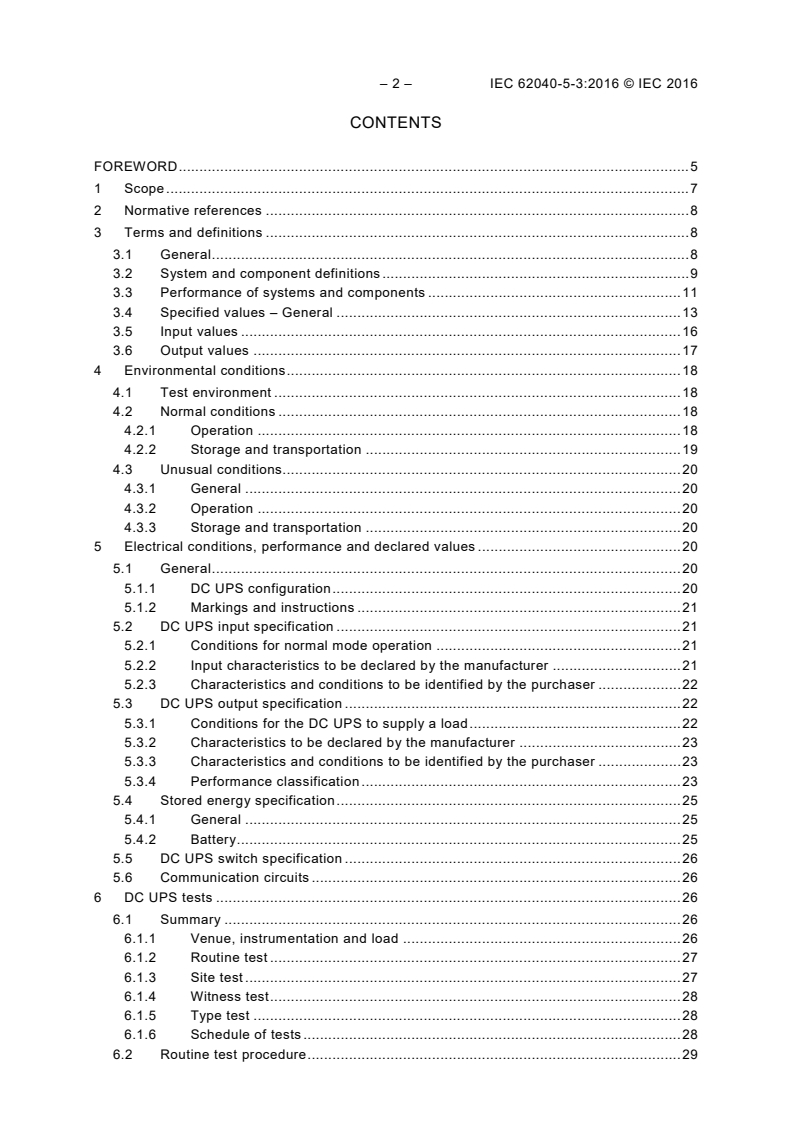
– 2 – IEC 62040-5-3:2016 © IEC 2016
CONTENTS
FOREWORD . 5
1 Scope . 7
2 Normative references . 8
3 Terms and definitions . 8
3.1 General . 8
3.2 System and component definitions . 9
3.3 Performance of systems and components . 11
3.4 Specified values ‒ General . 13
3.5 Input values . 16
3.6 Output values . 17
4 Environmental conditions . 18
4.1 Test environment . 18
4.2 Normal conditions . 18
4.2.1 Operation . 18
4.2.2 Storage and transportation . 19
4.3 Unusual conditions. 20
4.3.1 General . 20
4.3.2 Operation . 20
4.3.3 Storage and transportation . 20
5 Electrical conditions, performance and declared values . 20
5.1 General . 20
5.1.1 DC UPS configuration . 20
5.1.2 Markings and instructions . 21
5.2 DC UPS input specification . 21
5.2.1 Conditions for normal mode operation . 21
5.2.2 Input characteristics to be declared by the manufacturer . 21
5.2.3 Characteristics and conditions to be identified by the purchaser . 22
5.3 DC UPS output specification . 22
5.3.1 Conditions for the DC UPS to supply a load . 22
5.3.2 Characteristics to be declared by the manufacturer . 23
5.3.3 Characteristics and conditions to be identified by the purchaser . 23
5.3.4 Performance classification . 23
5.4 Stored energy specification . 25
5.4.1 General . 25
5.4.2 Battery . 25
5.5 DC UPS switch specification . 26
5.6 Communication circuits . 26
6 DC UPS tests . 26
6.1 Summary . 26
6.1.1 Venue, instrumentation and load . 26
6.1.2 Routine test . 27
6.1.3 Site test . 27
6.1.4 Witness test . 28
6.1.5 Type test . 28
6.1.6 Schedule of tests . 28
6.2 Routine test procedure . 29
6.2.1 Environmental . 29
6.2.2 Electrical . 29
6.3 Site test procedure . 31
6.4 Type test procedure (electrical) . 31
6.4.1 Input – AC supply compatibility . 31
6.4.2 Output characteristics – Resistive load . 33
6.4.3 Output characteristics – Constant power load . 37
6.4.4 Stored and restored energy . 37
6.5 Type test procedure (environmental) . 38
6.5.1 Environmental and transportation test methods . 38
6.5.2 Storage. 39
6.5.3 Operation . 40
6.5.4 Acoustic noise . 40
6.6 DC UPS functional unit tests (where not tested as a complete DC UPS) . 41
6.6.1 DC UPS rectifier tests . 41
6.6.2 DC UPS converter tests . 41
6.6.3 DC UPS switch tests . 41
6.6.4 Stored energy/battery tests . 41
Annex A (informative) DC UPS configurations . 43
A.1 General . 43
A.2 Single DC UPS . 43
A.2.1 Introduction . 43
A.2.2 Basic single DC UPS . 43
A.2.3 Scalable single DC UPS . 43
A.3 Parallel DC UPS . 44
A.3.1 General . 44
A.3.2 Parallel non-redundant DC UPS . 44
A.3.3 Parallel redundant DC UPS . 45
A.3.4 Enhanced parallel redundant DC UPS . 45
A.4 Dual bus . 46
A.4.1 General . 46
A.4.2 Dual bus system 2(N + r) . 46
A.4.3 Dual bus distribution (N + r) . 47
Annex B (informative) Topologies – DC UPS. 48
B.1 General . 48
B.2 Basic topologies. 48
B.2.1 General . 48
B.2.2 Direct energy storage connect . 48
B.2.3 Series converter connect . 49
B.2.4 Shunt converter connect . 49
Annex C (informative) Purchaser specification guidelines . 51
C.1 General . 51
Annex D (normative) Input mains failure – Test method . 55
Annex E (informative) Dynamic output performance – Measurement techniques . 56
E.1 General . 56
E.2 Graphical validating method . 56
Annex F (normative) DC UPS efficiency –Methods of measurement . 58
F.1 General . 58
– 4 – IEC 62040-5-3:2016 © IEC 2016
F.2 Measurement conditions . 58
F.2.1 Environmental conditions . 58
F.2.2 Operational and electrical conditions . 58
F.2.3 Instrumentation . 58
F.3 Measurement method . 59
F.4 Test report . 59
Annex G (informative) Climatic test . 61
G.1 General . 61
G.2 Testing of compliance to climatic requirements . 61
Bibliography . 63
Figure 1 – Examples of basic electronic power converters . 9
Figure 2 – Dynamic output performance . 24
Figure A.1 – Basic single DC UPS . 43
Figure A.2 – System sized for load (N DC UPS units) – No redundancy . 44
Figure A.3 – System sized for load (N DC UPS units) – N + 1 redundancy . 45
Figure A.4 – System sized for load (N DC UPS units) – N + r redundancy . 46
Figure A.5 – Dual bus DC UPS . 46
Figure A.6 – Dual bus DC UPS variant . 47
Figure B.1 – Direct energy storage connect . 49
Figure B.2 – Series converter connect . 49
Figure B.3 – Shunt converter connect . 50
Figure D.1 – Connection of test circuit . 55
Figure E.1 – Example: Narrowband validation of dynamic voltage response . 56
Figure E.2 – Example: Wideband validation of dynamic voltage response . 57
Table 1 – Example of power derating factors for use at altitudes above 1 000 m . 19
Table 2 – Compatibility levels for individual harmonic voltages in low voltage networks . 21
Table 3 – DC UPS test schedule . 28
Table 4 – Free fall testing . 39
Table C.1 – DC UPS technical data – Manufacturer’s declaration . 51
Table G.1 – Recommended tests for IEC 60721-3-3 – Class 3K2 (continuously
temperature-controlled enclosed locations; humidity not controlled) . 61
INTERNATIONAL ELECTROTECHNICAL COMMISSION
____________
UNINTERRUPTIBLE POWER SYSTEMS (UPS) –
Part 5-3: DC output UPS – Performance and test requirements
FOREWORD
1) The International Electrotechnical Commission (IEC) is a worldwide organization for standardization comprising
all national electrotechnical committees (IEC National Committees). The object of IEC is to promote
international co-operation on all questions concerning standardization in the electrical and electronic fields. To
this end and in addition to other activities, IEC publishes International Standards, Technical Specifications,
Technical Reports, Publicly Available Specifications (PAS) and Guides (hereafter referred to as “IEC
Publication(s)”). Their preparation is entrusted to technical committees; any IEC National Committee interested
in the subject dealt with may participate in this preparatory work. International, governmental and non-
governmental organizations liaising with the IEC also participate in this preparation. IEC collaborates closely
with the International Organization for Standardization (ISO) in accordance with conditions determined by
agreement between the two organizations.
2) The formal decisions or agreements of IEC on technical matters express, as nearly as possible, an international
consensus of opinion on the relevant subjects since each technical committee has representation from all
interested IEC National Committees.
3) IEC Publications have the form of recommendations for international use and are accepted by IEC National
Committees in that sense. While all reasonable efforts are made to ensure that the technical content of IEC
Publications is accurate, IEC cannot be held responsible for the way in which they are used or for any
misinterpretation by any end user.
4) In order to promote international uniformity, IEC National Committees undertake to apply IEC Publications
transparently to the maximum extent possible in their national and regional publications. Any divergence
between any IEC Publication and the corresponding national or regional publication shall be clearly indicated in
the latter.
5) IEC itself does not provide any attestation of conformity. Independent certification bodies provide conformity
assessment services and, in some areas, access to IEC marks of conformity. IEC is not responsible for any
services carried out by independent certification bodies.
6) All users should ensure that they have the latest edition of this publication.
7) No liability shall attach to IEC or its directors, employees, servants or agents including individual experts and
members of its technical committees and IEC National Committees for any personal injury, property damage or
other damage of any nature whatsoever, whether direct or indirect, or for costs (including legal fees) and
expenses arising out of the publication, use of, or reliance upon, this IEC Publication or any other IEC
Publications.
8) Attention is drawn to the Normative references cited in this publication. Use of the referenced publications is
indispensable for the correct application of this publication.
9) Attention is drawn to the possibility that some of the elements of this IEC Publication may be the subject of
patent rights. IEC shall not be held responsible for identifying any or all such patent rights.
International Standard IEC 62040-5-3 has been prepared by subcommittee 22H:
Uninterruptible power systems (UPS), of IEC technical committee 22: Power electronic
systems and equipment.
The text of this document is based on the following documents:
FDIS Report on voting
22H/208/FDIS 22H/211/RVD
Full information on the voting for the approval of this document can be found in the report on
voting indicated in the above table.
This publication has been drafted in accordance with the ISO/IEC Directives, Part 2.
In this document, the following print types are used:
– 6 – IEC 62040-5-3:2016 © IEC 2016
– requirements proper and normative annexes: in roman type;
– compliance statements and test specifications: in italic type;
– notes and other informative matter: in smaller roman type;
– normative conditions within tables: in smaller roman type;
– terms that are defined in Clause 3: bold.
A list of all parts of the IEC 62040 series, under the general title Uninterruptible power
systems (UPS), can be found on the IEC website.
The committee has decided that the contents of this publication will remain unchanged until
the stability date indicated on the IEC website under "http://webstore.iec.ch" in the data
related to the specific publication. At this date, the publication will be
• reconfirmed,
• withdrawn,
• replaced by a revised edition, or
• amended.
IMPORTANT – The 'colour inside' logo on the cover page of this publication indicates
that it contains colours which are considered to be useful for the correct
understanding of its contents. Users should therefore print this document using a
colour printer.
UNINTERRUPTIBLE POWER SYSTEMS (UPS) –
Part 5-3: DC output UPS – Performance and test requirements
1 Scope
This part of IEC 62040 establishes the performance and test requirements applied to
movable, stationary and fixed electronic DC uninterruptible power systems (DC UPS) that
– are supplied from an AC voltage source not exceeding 1 000 V,
– deliver a DC output voltage not exceeding 1 500 V,
– incorporate an energy storage device, and
– have a primary function to ensure continuity of DC power to loads.
This document specifies performance and test requirements of a complete DC UPS and not of
individual DC UPS functional units. The individual DC UPS functional units are dealt with
in IEC publications referred to in the bibliography that apply so far that they are not in
contradiction with this document.
DC UPSs have been developed over a wide range of power, from less than a hundred watts
to megawatts, to meet requirements for availability and quality of power to a variety of loads.
Refer to Annexes A and B for information on typical DC UPS configurations and topologies.
This document also includes DC UPS performance and test requirements related to
interrupters, isolating switches, and tie switches, if any, which are integral to the DC UPS.
These components interact with other functional units of the DC UPS to maintain continuity
of load power.
This document does not cover
– conventional AC input distribution boards and their associated switches,
– conventional DC distribution boards and their associated switches,
– conventional AC UPSs covered by IEC 62040-3,
– low-voltage DC power supply devices covered by a specific product standard, for example
IEC 61204, and those covered by a specific product standard, for example ITU
communication standards, and
– systems wherein the output voltage is derived from a rotating machine.
NOTE 1 This document recognises that power availability to information technology (IT) equipment represents a
major UPS application. The DC UPS output characteristics specified in this document are therefore also aimed at
ensuring compatibility with the requirements of IT equipment. This, subject to any limitation stated in the
manufacturer’s declaration, includes requirements for steady state and transient voltage variation as well as for
the supply of both resistive and constant power load characteristics of IT equipment.
NOTE 2 Test loads specified in this document simulate both resistive and constant power load characteristics.
Their use is prescribed with the objective of verifying design and performance, as declared by the manufacturer,
and also of minimising any complexity and energy consumption during the tests.
– 8 – IEC 62040-5-3:2016 © IEC 2016
2 Normative references
The following documents are referred to in the text in such a way that some or all of their
content constitutes requirements of this document. For dated references, only the edition
cited applies. For undated references, the latest edition of the referenced document (including
any amendments) applies.
IEC 60068-2-1, Environmental testing – Part 2-1: Tests – Test A: Cold
IEC 60068-2-2, Environmental testing – Part 2-2: Tests – Test B: Dry heat
IEC 60068-2-27, Environmental testing – Part 2-27: Tests – Test Ea and guidance: Shock
IEC 60068-2-31, Environmental testing – Part 2-31: Tests – Test Ec: Rough handling shocks,
primarily for equipment-type specimens
IEC 60068-2-78, Environmental testing – Part 2-78: Tests – Test Cab: Damp heat, steady
state
IEC 60146-1-1:2009, Semiconductor converters – General requirements and line commutated
converters – Part 1-1: Specification of basic requirements
IEC 60146-2:1999, Semiconductor converters – Part 2: Self-commutated semiconductor
converters including direct d.c converters
IEC 60364-1:2005, Low-voltage electrical installations – Part 1: Fundamental principles,
assessment of general characteristics, definitions
IEC TR 60721-4-3, Classification of environmental conditions - Part 4-3: Guidance for the
correlation and transformation of environmental condition classes of IEC 60721-3 to the
environmental tests of IEC 60068 - Stationary use at weatherprotected locations
IEC 61000-2-2:2002, Electromagnetic compatibility (EMC) – Part 2-2: Environment –
Compatibility levels for low-frequency conducted disturbances and signalling in public low-
voltage power supply systems
IEC 61672-1, Electroacoustics ‒ Sound level meters – Part 1: Specifications
IEC 62040-1, Uninterruptible power systems (UPS) – Part 1: General and safety requirements
for UPS
IEC 62040-2, Uninterruptible power systems (UPS) – Part 2: Electromagnetic compatibility
(EMC) requirements
ISO 7779, Acoustics – Measurement of airborne noise emitted by information technology and
telecommunications equipment
3 Terms and definitions
3.1 General
For the purposes of this document, the following terms and definitions apply.
ISO and IEC maintain terminological databases for use in standardization at the following
addresses:
• IEC Electropedia: available at http://www.electropedia.org/
• ISO Online browsing platform: available at http://www.iso.org/obp
NOTE In this document, IEC 60050 definitions are referenced wherever possible, particularly those of
IEC 60050-551.
When an existing IEC 60050 definition needs amplification or additional information, this is indicated by adding the
word “modified” after the IEC 60050 reference.
3.2 System and component definitions
3.2.1
DC uninterruptible power system
DC UPS
combination of converters, switches and energy storage devices (such as batteries),
constituting a power system for maintaining continuity of DC load power in case of AC
input power failure
Note 1 to entry: AC input power failure occurs when voltages are outside rated steady-state and transient
tolerance bands or when distortion or interruptions are outside the limits specified for the DC UPS.
3.2.2
electronic power converter
power converter
converter
operative unit for electronic power conversion, comprising one or more electronic valve
devices, transformers and filters if necessary and auxiliaries if any
Note 1 to entry: In English, the two spellings "convertor" and "converter" are in use, and both are correct. In this
document, the spelling "converter" is used in order to avoid duplications.
Note 2 to entry: Figure 1 shows examples of basic electronic power converters.
electronic power converter
AC-DC converter AC converter DC converter
voltage stiff current stiff
AC-DC converter AC-DC converter
rectifier inverter
direct indirect direct indirect direct indirect
IEC
Figure 1 – Examples of basic electronic power converters
[SOURCE: IEC 60050-551:1998, 551-12-01, modified — Note 2 to entry and the figure have
been added.]
3.2.3
functional unit
complete subassembly that performs a given function in a DC UPS
EXAMPLE Converter, rectifier.
– 10 – IEC 62040-5-3:2016 © IEC 2016
3.2.4
energy storage device
system consisting of single or multiple devices and designed to provide power to the DC UPS
for the required stored energy time
Note 1 to entry: Notwithstanding challenges with respect to recharge, examples of an energy storage device
include but are not limited to battery, double-layer capacitor (“super” or “ultra” capacitor), flywheel and fuel-cell
systems.
3.2.5
internal DC bus
integral DC power interface of the components of the DC UPS (battery, DC circuits, rectifiers,
converters, etc) including points of connection for the DC output but excluding the physical
DC output
3.2.6
battery
one or more electrochemical cells fitted with devices necessary for use, for example case,
terminals, marking and protective devices
Note 1 to entry: A typical battery consists of
– one string of a quantity of series connected cells, or
– two or more paralleled strings, each string containing the same quantity of series connected cells
[SOURCE: IEC 60050:2004, 482-01-04], modified — The word "electrochemical" has been
added to the definition, as well as the note to entry.]
3.2.7
secondary battery
battery intended to be discharged and recharged
Note 1 to entry: A valve regulated secondary battery consists of cells which are closed but have a valve which
allows the escape of gas if the internal pressure exceeds a predetermined value. Valve regulated lead-acid cells
are abbreviated "VRLA cells" (see IEC 60050-482:2004, 482-05-15).
Note 2 to entry: A vented secondary battery consists of cells having a cover provided with an opening through
which products of electrolysis and evaporation are allowed to escape freely, or through a venting system, from the
cell to the atmosphere (see IEC 60050-482:2004, 482-05-14).
3.2.8
flywheel storage system
mechanical energy storage device wherein stored kinetic energy can be converted to DC
power during stored energy mode of operation
3.2.9
battery charger
device for battery charging and maintaining the charged state of the battery
3.2.10
DC UPS switch
controllable switch used in accordance with applicable requirements for load power continuity
to interconnect or isolate power ports of DC UPS units, or load
3.2.11
DC UPS rectifier
electronic converter for rectification
3.2.12
interrupter
DC UPS switch which is capable of making, carrying and breaking currents under normal
circuit conditions, making and carrying currents for a specified time and breaking currents
under specified unusual circuit conditions
3.2.13
DC distribution network
DC system that connects sources and storage systems to distributed loads
3.2.14
AC input power
grid input power
product of instantaneous components of the alternating grid input current and voltage
averaged over a complete cycle
3.2.15
DC UPS unit
complete DC UPS consisting of at least one of each of the following functional units: DC
UPS, DC output power module, and battery or other energy storage device(s)
3.2.16
single DC UPS
DC UPS comprising only one DC UPS unit
3.2.17
parallel DC UPS
DC UPS comprising two or more DC UPS units operating in parallel
3.2.18
redundant system
system in which one or more functional units can fail without affecting continuity of load
power
3.2.19
parallel redundant DC UPS
DC UPS with a number of paralleled load sharing DC UPS units, which, upon failure of one
or more DC UPS units, can take over full load with the remaining units
3.3 Performance of systems and components
3.3.1
primary power
external electrical power source, usually the public mains supply or other equivalent source
that may be generated locally
3.3.2
stand-by power
external electrical power source intended to replace primary power in the event of primary
power failure
3.3.3
power failure
any variation in power supply which can cause unacceptable performance of the load
equipment
– 12 – IEC 62040-5-3:2016 © IEC 2016
3.3.4
continuity of load power
maintenance of power delivery within the limits specified for the DC UPS output under
abnormal utility supply conditions
3.3.5
battery ripple current
superimposed effective (RMS) alternating component of the battery current
3.3.6
normal mode
stable mode of operation that the DC UPS attains under the following conditions:
a) AC input supply is within required tolerances and supplies the DC UPS;
b) the energy storage device remains charged or is under recharge;
c) the load is within the specified rating of the DC UPS
3.3.7
stored energy mode of DC UPS operation
stable mode of operation that the DC UPS attains under the following conditions:
a) AC input power is disconnected or is out of required tolerance;
b) all power is derived from the energy storage device;
c) the load is within the specified rating of the DC UPS
3.3.8
movable DC UPS
equipment which is either 18 kg or less in mass and not fixed, or equipment with wheels,
castors or other means to facilitate movement as required to perform its intended use
Note 1 to entry: Derived from IEC 60950-1.
3.3.9
stationary DC UPS
equipment that is not movable equipment
Note 1 to entry: Derived from IEC 60950-1.
3.3.10
fixed DC UPS
stationary equipment which is fastened or otherwise secured at a specific location
Note 1 to entry: Derived from IEC 60950-1.
3.3.11
skilled person
person with relevant education and experience to enable him or her to perceive risks and to
avoid hazards which the equipment can create
[SOURCE: IEC 60050-826: 2004, 826-18-01, modified — The reference to "electricity" has
been replaced by a reference to "the equipment".]
3.3.12
type test
conformity test made on one or more items representative of the production
[SOURCE: IEC 60050-151:2001, 151-16-16]
3.3.13
routine test
conformity test made on each individual item during or after manufacture
[SOURCE: IEC 60050-151:2001, 151-16-17]
3.4 Specified values ‒ General
3.4.1
rating
set of rated values and operating conditions of a machine, device or equipment
[SOURCE: IEC 60050-151:2001, 151-16-11, modified — The words "of a machine, device or
equipment" have been added.]
3.4.2
rated value
value of a quantity used for specification purposes, generally established by a manufacturer
for a specified set of operating conditions of a component, device, equipment, or system
[SOURCE: IEC 60050-151:2001, 151-16-08, modified — The words "generally" and "by a
manufacturer" have been added.]
3.4.3
reference test load
rated DC load
load or condition in which the output of the DC UPS delivers the power (W) for which the DC
UPS is rated
Note 1 to entry: Rated load is a value of load used for specification purposes, generally established by a
manufacturer for a specified set of operating conditions of a component, device, equipment, or system.
3.4.4
resistive load
load that when supplied from a source with a variable voltage presents a resistive impedance
that for practical purposes is constant
3.4.5
constant power load
load that when supplied from a source with a variable voltage V presents a resistive
impedance R that for practical purposes varies so that the active power P consumed by the
circuit is constant, i.e. P = V /R = constant
3.4.6
step load
instantaneous addition or removal of electrical loads
3.4.7
light load
condition at which the DC UPS supplies approximately 10 % of rated output power
3.4.8
nominal value
value of a quantity used to designate and identify a component, device, equipment, or system
Note 1 to entry: The nominal value is generally a rounded value.
[SOURCE: IEC 60050-151:2001, 151-16-09]
– 14 – IEC 62040-5-3:2016 © IEC 2016
3.4.9
tolerance band
range of values of a quantity within specified limits
3.4.10
deviation
difference between the actual value and the desired value of a variable quantity at a given
instant
[SOURCE: IEC 60050-351:2013, 351-41-04, modified – The note to entry has been deleted.]
3.4.11
current limit
current limit control
function that limits a current to its prescribed maximum value
3.4.12
rated voltage
V
rated
rated value of the voltage assigned by the manufacturer to a component, device or
equipment and to which operation and performance characteristics are referred
Note 1 to entry: A DC UPS may have more than one rated voltage for its input and for its output.
Note 2 to entry: For DC UPS with three-phase input, the line-to-line voltage applies.
3.4.13
rated voltage range
input or output voltage range as declared by the manufacturer expressed by its lower and
upper rated voltages
Note 1 to entry: A DC UPS may have more than one rated voltage range for its input and for its output.
Note 2 to entry: For DC UPS with three-phase input, the line-to-line voltage applies.
3.4.14
RMS voltage variation
difference between the RMS voltage and the corresponding previously undisturbed RMS
voltage
Note 1 to entry: For the purposes of this document, the term “variation” has the following meaning: the difference
of the values of a quantity before and after a change of an influenced quantity.
3.4.15
rated current
input or output current of the equipment assigned by the manufacturer for a specified
operating condition
[SOURCE: IEC 60050-442:1998, 442-01-02 modified — The word "current" has been replaced
by "input or output current" and the words "of an accessory" have been deleted.]
3.4.16
active power
under periodic conditions, mean value, taken over one period T, of the instantaneous power p:
T
P = ⋅ p ⋅ dt
∫
T
Note 1 to entry: Under sinusoidal conditions, the active power is the real part of the complex power.
Note 2 to entry: The SI unit for active power is the watt.
Note 3 to entry: DC, fundamental and harmonic voltages contribute directly to the magnitude of the active power.
Appropriate instruments used to measure active power provide sufficient bandwidth to measure relevant non-
symmetrical and harmonic power components.
[SOURCE: IEC 60050-131:2002, 131-11-42, modified — The note 3 to entry has been added.]
3.4.17
apparent power
product of the RMS values of voltage and current at a port:
S = UI
[SOURCE: IEC
...