

IEC TS 62462:2017
(Main)Ultrasonics - Output test - Guidance for the maintenance of ultrasound physiotherapy systems
General Information
- Abstract
IEC TS 62462:2017(E) describes methods meant to assist users of ultrasound physiotherapy systems in checking the performance of such systems. It is applicable primarily to physiotherapists, general medical practitioners, chiropractors, osteopaths, beauty therapists, sports professionals, biomedical engineers, medical physicists, medical device service agents, commercial testers, test houses or manufacturers. This new edition includes the following significant technical change with respect to the previous edition: it includes a novel method for periodic testing regarding possible changes of the effective radiating area using thermochromic absorbers in a new Annex E.
- Status
- Published
- Publication Date
- 25-Jul-2017
- Technical Committee
- TC 87 - Ultrasonics
- Drafting Committee
- WG 8 - TC 87/WG 8
- Current Stage
- PPUB - Publication issued
- Start Date
- 26-Jul-2017
- Completion Date
- 10-Aug-2017
Overview
IEC TS 62462:2017 - “Ultrasonics - Output test - Guidance for the maintenance of ultrasound physiotherapy systems” - provides standardized methods to check and document the performance of therapeutic ultrasound equipment during its lifetime. The Technical Specification defines simple, repeatable checks (acceptance, weekly and annual) to verify safe and effective acoustic output for typical physiotherapy ultrasound systems operating in the 0.5 MHz to 5 MHz range (long-wave systems 30 kHz–0.5 MHz are excluded). The document also includes tester guidance and example test reports to support routine maintenance and quality assurance.
Key Topics
- Testing regimes: Defined acceptance testing, weekly testing (qualitative/relative), and annual testing (quantitative + qualitative).
- Performance checks: Visual inspection, manufacturer’s statements, ultrasonic output tests, beam uniformity, effective radiating area (ERA), pulse duty-factor accuracy and timer accuracy, with formal recording of results.
- Measurement methods: Guidance on the use of ultrasound power meters, environmental controls (room and water temperature), and measurement techniques.
- Quantitative techniques: Informative annexes describe methods using temperature rise (Annex C), calorimetry (Annex D), and a novel qualitative method using thermochromic absorbers to assess changes in ERA (Annex E).
- Test documentation: Example weekly and annual test reports (Annex F and G) and rationale for testing (Annex A).
- Intended accuracy and equipment considerations: Annex B gives recommended power meter specifications and practical advice for testers.
Applications
IEC TS 62462 is practical for professionals and organizations involved in maintenance, safety, and quality of ultrasound physiotherapy devices:
- Primary users: Physiotherapists, chiropractors, osteopaths, beauty and sports therapists.
- Technical users: Biomedical engineers, medical physicists, medical device service agents, commercial testers, test houses and manufacturers.
- Use cases: Routine clinic checks (weekly), equipment acceptance at installation, annual calibration/verification, performance troubleshooting, and documentation for regulatory or audit purposes.
Related Standards
- IEC TS 62462 references medical electrical equipment standards (see normative references) and is complementary to device safety and performance standards such as IEC 60601-2-5 (medical electrical equipment - specific requirements for ultrasonic therapy equipment). Users should consult these related standards for full conformity and safety context.
This specification supports safe, consistent maintenance and output verification of therapeutic ultrasound devices through clear procedures, practical measurement guidance, and reproducible reporting.
Relations
- Effective Date
- 05-Sep-2023
Get Certified
Connect with accredited certification bodies for this standard

BSI Group
BSI (British Standards Institution) is the business standards company that helps organizations make excellence a habit.

TÜV Rheinland
TÜV Rheinland is a leading international provider of technical services.

TÜV SÜD
TÜV SÜD is a trusted partner of choice for safety, security and sustainability solutions.
Sponsored listings
Frequently Asked Questions
IEC TS 62462:2017 is a technical specification published by the International Electrotechnical Commission (IEC). Its full title is "Ultrasonics - Output test - Guidance for the maintenance of ultrasound physiotherapy systems". This standard covers: IEC TS 62462:2017(E) describes methods meant to assist users of ultrasound physiotherapy systems in checking the performance of such systems. It is applicable primarily to physiotherapists, general medical practitioners, chiropractors, osteopaths, beauty therapists, sports professionals, biomedical engineers, medical physicists, medical device service agents, commercial testers, test houses or manufacturers. This new edition includes the following significant technical change with respect to the previous edition: it includes a novel method for periodic testing regarding possible changes of the effective radiating area using thermochromic absorbers in a new Annex E.
IEC TS 62462:2017(E) describes methods meant to assist users of ultrasound physiotherapy systems in checking the performance of such systems. It is applicable primarily to physiotherapists, general medical practitioners, chiropractors, osteopaths, beauty therapists, sports professionals, biomedical engineers, medical physicists, medical device service agents, commercial testers, test houses or manufacturers. This new edition includes the following significant technical change with respect to the previous edition: it includes a novel method for periodic testing regarding possible changes of the effective radiating area using thermochromic absorbers in a new Annex E.
IEC TS 62462:2017 is classified under the following ICS (International Classification for Standards) categories: 11.040.60 - Therapy equipment; 17.140.50 - Electroacoustics. The ICS classification helps identify the subject area and facilitates finding related standards.
IEC TS 62462:2017 has the following relationships with other standards: It is inter standard links to IEC TS 62462:2007. Understanding these relationships helps ensure you are using the most current and applicable version of the standard.
IEC TS 62462:2017 is available in PDF format for immediate download after purchase. The document can be added to your cart and obtained through the secure checkout process. Digital delivery ensures instant access to the complete standard document.
Standards Content (Sample)
IEC TS 62462 ®
Edition 2.0 2017-07
TECHNICAL
SPECIFICATION
colour
inside
Ultrasonics – Output test – Guidance for the maintenance of ultrasound
physiotherapy systems
All rights reserved. Unless otherwise specified, no part of this publication may be reproduced or utilized in any form
or by any means, electronic or mechanical, including photocopying and microfilm, without permission in writing from
either IEC or IEC's member National Committee in the country of the requester. If you have any questions about IEC
copyright or have an enquiry about obtaining additional rights to this publication, please contact the address below or
your local IEC member National Committee for further information.
IEC Central Office Tel.: +41 22 919 02 11
3, rue de Varembé Fax: +41 22 919 03 00
CH-1211 Geneva 20 info@iec.ch
Switzerland www.iec.ch
About the IEC
The International Electrotechnical Commission (IEC) is the leading global organization that prepares and publishes
International Standards for all electrical, electronic and related technologies.
About IEC publications
The technical content of IEC publications is kept under constant review by the IEC. Please make sure that you have the
latest edition, a corrigenda or an amendment might have been published.
IEC Catalogue - webstore.iec.ch/catalogue Electropedia - www.electropedia.org
The stand-alone application for consulting the entire The world's leading online dictionary of electronic and
bibliographical information on IEC International Standards, electrical terms containing 20 000 terms and definitions in
Technical Specifications, Technical Reports and other English and French, with equivalent terms in 16 additional
documents. Available for PC, Mac OS, Android Tablets and languages. Also known as the International Electrotechnical
iPad. Vocabulary (IEV) online.
IEC publications search - www.iec.ch/searchpub IEC Glossary - std.iec.ch/glossary
The advanced search enables to find IEC publications by a 65 000 electrotechnical terminology entries in English and
variety of criteria (reference number, text, technical French extracted from the Terms and Definitions clause of
committee,…). It also gives information on projects, replaced IEC publications issued since 2002. Some entries have been
and withdrawn publications. collected from earlier publications of IEC TC 37, 77, 86 and
CISPR.
IEC Just Published - webstore.iec.ch/justpublished
Stay up to date on all new IEC publications. Just Published IEC Customer Service Centre - webstore.iec.ch/csc
details all new publications released. Available online and If you wish to give us your feedback on this publication or
also once a month by email. need further assistance, please contact the Customer Service
Centre: csc@iec.ch.
IEC TS 62462 ®
Edition 2.0 2017-07
TECHNICAL
SPECIFICATION
colour
inside
Ultrasonics – Output test – Guidance for the maintenance of ultrasound
physiotherapy systems
INTERNATIONAL
ELECTROTECHNICAL
COMMISSION
ICS 11.040.60;17.140.50 ISBN 978-2-8322-4561-3
– 2 – IEC TS 62462:2017 © IEC 2017
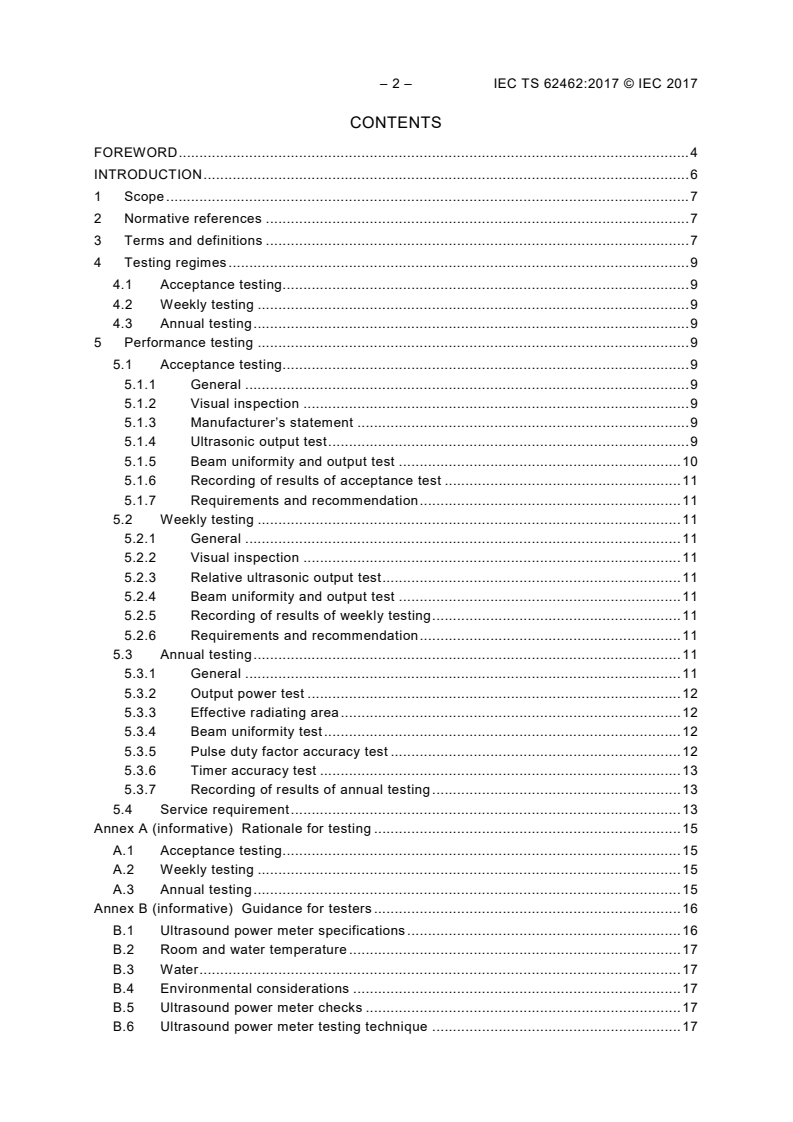
CONTENTS
FOREWORD . 4
INTRODUCTION . 6
1 Scope . 7
2 Normative references . 7
3 Terms and definitions . 7
4 Testing regimes . 9
4.1 Acceptance testing. 9
4.2 Weekly testing . 9
4.3 Annual testing . 9
5 Performance testing . 9
5.1 Acceptance testing. 9
5.1.1 General . 9
5.1.2 Visual inspection . 9
5.1.3 Manufacturer’s statement . 9
5.1.4 Ultrasonic output test . 9
5.1.5 Beam uniformity and output test . 10
5.1.6 Recording of results of acceptance test . 11
5.1.7 Requirements and recommendation . 11
5.2 Weekly testing . 11
5.2.1 General . 11
5.2.2 Visual inspection . 11
5.2.3 Relative ultrasonic output test . 11
5.2.4 Beam uniformity and output test . 11
5.2.5 Recording of results of weekly testing . 11
5.2.6 Requirements and recommendation . 11
5.3 Annual testing . 11
5.3.1 General . 11
5.3.2 Output power test . 12
5.3.3 Effective radiating area . 12
5.3.4 Beam uniformity test . 12
5.3.5 Pulse duty factor accuracy test . 12
5.3.6 Timer accuracy test . 13
5.3.7 Recording of results of annual testing . 13
5.4 Service requirement . 13
Annex A (informative) Rationale for testing . 15
A.1 Acceptance testing. 15
A.2 Weekly testing . 15
A.3 Annual testing . 15
Annex B (informative) Guidance for testers . 16
B.1 Ultrasound power meter specifications . 16
B.2 Room and water temperature . 17
B.3 Water . 17
B.4 Environmental considerations . 17
B.5 Ultrasound power meter checks . 17
B.6 Ultrasound power meter testing technique . 17
Annex C (informative) Quantitative relative ultrasonic output test using temperature
rise . 19
Annex D (informative) Quantitative relative ultrasonic output test using calorimetry . 21
Annex E (informative) Qualitative test to assess changes of effective radiating area . 23
Annex F (informative) Example of weekly test report . 25
Annex G (informative) Example of annual test report . 26
Bibliography . 30
Figure 1 – Several examples of how to prepare a set-up to check the distortion on the
water surface due to ultrasound . 14
Figure 2 – Set-up where the slight angle of the treatment head to the vertical may
improve the image . 14
Figure C.1 – Example of a measurement set-up to measure the temperature rise due
to ultrasound in absorbing material . 20
Figure D.1 – Schematic of equipment used within the calorimeter method for
monitoring power output of therapy treatment heads . 21
Figure E.1 – Assessing changes of the effective radiating area using a thermochromic
phantom . 24
Figure E.2 – Examples of different patterns observed during an experiment using a
thermochromic phantom made of silicon . 24
Figure G.1 – Example of a power calibration graph for two large applicator heads . 28
Figure G.2 – Example of a power calibration graph for two small applicator heads . 29
– 4 – IEC TS 62462:2017 © IEC 2017
INTERNATIONAL ELECTROTECHNICAL COMMISSION
____________
ULTRASONICS – OUTPUT TEST –
GUIDANCE FOR THE MAINTENANCE OF ULTRASOUND
PHYSIOTHERAPY SYSTEMS
FOREWORD
1) The International Electrotechnical Commission (IEC) is a worldwide organization for standardization comprising
all national electrotechnical committees (IEC National Committees). The object of IEC is to promote
international co-operation on all questions concerning standardization in the electrical and electronic fields. To
this end and in addition to other activities, IEC publishes International Standards, Technical Specifications,
Technical Reports, Publicly Available Specifications (PAS) and Guides (hereafter referred to as “IEC
Publication(s)”). Their preparation is entrusted to technical committees; any IEC National Committee interested
in the subject dealt with may participate in this preparatory work. International, governmental and non-
governmental organizations liaising with the IEC also participate in this preparation. IEC collaborates closely
with the International Organization for Standardization (ISO) in accordance with conditions determined by
agreement between the two organizations.
2) The formal decisions or agreements of IEC on technical matters express, as nearly as possible, an international
consensus of opinion on the relevant subjects since each technical committee has representation from all
interested IEC National Committees.
3) IEC Publications have the form of recommendations for international use and are accepted by IEC National
Committees in that sense. While all reasonable efforts are made to ensure that the technical content of IEC
Publications is accurate, IEC cannot be held responsible for the way in which they are used or for any
misinterpretation by any end user.
4) In order to promote international uniformity, IEC National Committees undertake to apply IEC Publications
transparently to the maximum extent possible in their national and regional publications. Any divergence
between any IEC Publication and the corresponding national or regional publication shall be clearly indicated in
the latter.
5) IEC itself does not provide any attestation of conformity. Independent certification bodies provide conformity
assessment services and, in some areas, access to IEC marks of conformity. IEC is not responsible for any
services carried out by independent certification bodies.
6) All users should ensure that they have the latest edition of this publication.
7) No liability shall attach to IEC or its directors, employees, servants or agents including individual experts and
members of its technical committees and IEC National Committees for any personal injury, property damage or
other damage of any nature whatsoever, whether direct or indirect, or for costs (including legal fees) and
expenses arising out of the publication, use of, or reliance upon, this IEC Publication or any other IEC
Publications.
8) Attention is drawn to the Normative references cited in this publication. Use of the referenced publications is
indispensable for the correct application of this publication.
9) Attention is drawn to the possibility that some of the elements of this IEC Publication may be the subject of
patent rights. IEC shall not be held responsible for identifying any or all such patent rights.
The main task of IEC technical committees is to prepare International Standards. In
exceptional circumstances, a technical committee may propose the publication of a technical
specification when
• the required support cannot be obtained for the publication of an International Standard,
despite repeated efforts, or
• the subject is still under technical development or where, for any other reason, there is the
future but no immediate possibility of an agreement on an International Standard.
Technical specifications are subject to review within three years of publication to decide
whether they can be transformed into International Standards.
IEC TS 62462, which is a Technical Specification, has been prepared by IEC technical
committee 87: Ultrasonics.
This second edition cancels and replaces the first edition published in 2007. This edition
constitutes a technical revision.
This edition includes the following significant technical changes with respect to the previous
edition:
• addition of a novel method for periodic testing regarding possible changes of the effective
radiating area using thermochromic absorbers in a new Annex E;
The text of this Technical Specification is based on the following documents:
Enquiry draft Report on voting
87/640/DTS 87/647A/RVDTS
Full information on the voting for the approval of this technical specification can be found in
the report on voting indicated in the above table.
This document has been drafted in accordance with the ISO/IEC Directives, Part 2.
In this document, the following print types are used:
• requirements: in roman type;
• notes: in small roman type;
• words in bold in the text are defined in Clause 3.
The committee has decided that the contents of this document will remain unchanged until the
stability date indicated on the IEC website under "http://webstore.iec.ch" in the data related to
the specific document. At this date, the document will be
• reconfirmed,
• withdrawn,
• replaced by a revised edition, or
• amended.
A bilingual version of this publication may be issued at a later date.
IMPORTANT – The 'colour inside' logo on the cover page of this publication indicates
that it contains colours which are considered to be useful for the correct
understanding of its contents. Users should therefore print this document using a
colour printer.
– 6 – IEC TS 62462:2017 © IEC 2017
INTRODUCTION
The purpose of this document is to establish standard methods for a qualitative check of the
performance of ultrasound physiotherapy devices during their lifetime, and to provide
guidance on calibration requirements and techniques.
To ensure that the ultrasound physiotherapy equipment is in an appropriate condition for
use, a regular quality check can be performed. This document defines acceptance, weekly
and annual checks. The acceptance test checks the delivery of the device and its
performance at the start of its lifetime. The weekly check is a simple qualitative check of
device operation. In the annual check, in addition to a qualitative check, a quantitative check
is defined. Examples are provided of weekly and annual test reports.
This document also gives guidance to the testers concerning the measurement of acoustic
output.
Annual testing may be performed by a skilled tester, e.g. biomedical engineer, medical
physicist, medical device service agent, commercial tester, test house, national measurement
institute or manufacturer.
ULTRASONICS – OUTPUT TEST –
GUIDANCE FOR THE MAINTENANCE OF ULTRASOUND
PHYSIOTHERAPY SYSTEMS
1 Scope
This document, which is a Technical Specification, describes methods meant to assist users
of ultrasound physiotherapy systems in checking the performance of such systems. It is
applicable primarily to physiotherapists, general medical practitioners, chiropractors,
osteopaths, beauty therapists, sports professionals, biomedical engineers, medical physicists,
medical device service agents, commercial testers, test houses or manufacturers. Typical
ultrasound physiotherapy systems operate in the range from 0,5 MHz to 5 MHz. Long-wave
ultrasound therapy machines operating in the frequency range 30 kHz to 0,5 MHz are not
covered by this document.
2 Normative references
The following documents are referred to in the text in such a way that some or all of their
content constitutes requirements of this document. For dated references, only the edition
cited applies. For undated references, the latest edition of the referenced document (including
any amendments) applies.
NOTE The titles of all publications referred to informatively in this document are listed in the Bibliography.
IEC 60601-2-5:2009, Medical electrical equipment – Part 2-5: Particular requirements for the
basic safety and essential performance of ultrasonic physiotherapy equipment
IEC 61161:2013, Ultrasonics – Power measurement – Radiation force balances and
performance requirements
IEC 61689:2013, Ultrasonics – Physiotherapy systems – Field specifications and methods of
measurement in the frequency range 0,5 MHz to 5 MHz
3 Terms and definitions
For the purposes of this document, the following terms and definitions apply.
ISO and IEC maintain terminological databases for use in standardization at the following
addresses:
• IEC Electropedia: available at http://www.electropedia.org/
• ISO Online browsing platform: available at http://www.iso.org/obp
NOTE Most of the definitions in Clause 3 are taken from existing IEC standards. They have been simplified for the
purposes of this document.
3.1
acoustic working frequency
rate at which the treatment head’s contact face is vibrating
[SOURCE: IEC 61689:2013, 3.7, modified – The definition has been simplified.]
– 8 – IEC TS 62462:2017 © IEC 2017
3.2
beam non-uniformity ratio
R
BN
measure of the range of non-uniformity in the ultrasound beam produced by the treatment
head, calculated from the ratio of the acoustic intensity measured at the most intense part of
the ultrasound beam to the spatial average acoustic intensity measured for that treatment
head
[SOURCE: IEC 61689:2013, 3.15, modified – The definition has been simplified.]
3.3
degassed water
water with a low dissolved gas content
Note 1 to entry For ultrasound physiotherapy fields it is sufficient to decrease the oxygen content below 4 mg/l.
Note 2 to entry Methods for the degassing of water are described in IEC TR 62781.
3.4
effective radiating area
A
ER
area of the front of the treatment face from which ultrasound is being emitted/radiated
[SOURCE: IEC 61689:2013, 3.23, modified – The definition has been simplified.]
3.5
effective intensity
I
eff
ratio of the ultrasonic power over the effective radiating area
3.6
hot spot
a localized peaking of the pressure distribution above values that normally can be expected
indicated by a beam non-uniformity ratio (R ) being larger than 4
BN
3.7
output power
measure of how much ultrasonic energy is flowing out of the treatment head per unit time
[SOURCE: IEC 61161:2013, 3.3, modified – The definition has been simplified.]
3.8
tester
person who does performance testing on, or calibration of, therapy machines
3.9
treatment head
assembly comprising one ultrasonic transducer and associated parts for local application of
ultrasound to the patient
[SOURCE IEC 60601-2-5:2009, 201.3.214]
3.10
ultrasound
acoustic oscillation whose frequency is above the high-frequency limit of audible sound (about
20 kHz)
[SOURCE: IEC 60050-802:2011, 802-01-01]
4 Testing regimes
4.1 Acceptance testing
After the device has been delivered to the user a first test should be performed to record the
performance at the start of the device’s lifetime. See Annex A for rationale.
4.2 Weekly testing
Weekly qualitative testing is performed by the therapy machine user, e.g. physiotherapist,
general medical practitioner, chiropractor, osteopath, beauty therapist, sports professional.
See Annex A for rationale.
4.3 Annual testing
Annual testing is performed by an accredited tester, e.g. biomedical engineer, medical
physicist, medical device service agent, commercial tester, test house, national measurement
institute, manufacturer. See Annex A for rationale.
5 Performance testing
5.1 Acceptance testing
5.1.1 General
The purpose of the test is to record the performance of a device before clinical use, or of a
device that has been repaired. The test involves a manufacturer’s statement, a visual
inspection and a quantitative relative ultrasonic output test. See Annex B for guidance for
testers.
5.1.2 Visual inspection
The first visual inspection should concentrate on the delivered items. All items should have
been delivered in accordance with the purchase specification, and they should look
undamaged.
5.1.3 Manufacturer’s statement
On delivery of a new device or after repair of an existing device, check the written system
manufacturer’s statement that the device performs in accordance with the manufacturer’s
device specifications. From this statement, it follows that the device shall be traceably
calibrated in accordance with IEC 61689 and IEC 60601-2-5.
5.1.4 Ultrasonic output test
a) To prepare a starting point for future simple quantitative output testing, either the
effective intensity or the ultrasonic output power of the device should be recorded for at
.
least one output setting, e.g. continuous wave, effective intensity: 1 W/cm
b) In cases where the manufacturer has stated the traceability of the calibration, there is no
need for an absolute output measurement. In all other cases, the ultrasonic output should
be calibrated in accordance with IEC 60601-2-5 and IEC 61161.
c) Once confidence is established in the calibration of the device, a prescribed method
should be used to relate the device output setting as recorded in 5.1.4 a) to a reading of a
related performance. This method could be a determination of temperature rise following
Annex C, or Annex D, or using an ultrasound power meter. For qualitative test to assess
changes of effective radiating area, follow Annex E. The method used should be
described in the record and should be used in the weekly test, see 5.2.3.
– 10 – IEC TS 62462:2017 © IEC 2017
5.1.5 Beam uniformity and output test
5.1.5.1 General
The test is a quick check of whether the machine is outputting any ultrasound power, and of
any ‘hot spots’ or asymmetry present in the beam produced by the treatment head. It is not
a power calibration. The technique uses the ultrasound emitted by the treatment head to
disturb the surface of water in a container. The equipment needed is as follows:
a) a small container of sufficient depth to be filled with water to a maximum of 25 mm. This
container should have a bottom thickness of < 0,3 mm: for instance, a cylinder bottom
covered with a membrane made of polyester film, polyvinylidene difluoride (PVDF), or
other similar thin plastic material. See Figure 1 for a number of examples;
b) coupling gel.
NOTE Common undesirable techniques which have been used in the past to check ultrasound output are as
follows:
• placing a few drops of water on the upturned treatment head, then timing how long it takes for the water to
boil off;
• making a small well of water about the treatment head using some tape, and observing the disturbance of the
water surface by the ultrasound.
Modern physiotherapy units have automatic cut-offs (power down) when the treatment head has insufficient
contact with the patient or is not immersed. Techniques such as those described within this note will often trigger
the automatic shutdown of the head and thus give a false indication that the ultrasound therapy machine is faulty.
Subjecting a treatment head to poor patient contact or poor water immersion will shorten the lifetime of the device.
For these reasons, using a container of water to see the effect of the ultrasound on a surface of water can avoid
this.
1)
Further valuable reading can be found in [1], [2], [3], [4] .
5.1.5.2 Procedure
The procedure is as follows:
a) Hold the treatment head so that the face is pointing upwards. Apply coupling gel to the
face of the treatment head. Place the container on the face of the treatment head and
make sure that all coupling gel is properly distributed without air bubbles. See Figure 1.
b) Fill the container with water to a depth of 5 mm to 20 mm. (Tap water is adequate for this
qualitative and quick test.)
c) A slight angle of the treatment head to the vertical may improve the image. See Figure 2.
d) Turn on the ultrasound to full power, or less if this is sufficient to observe a disturbance
of the water. (A disturbance of the water will be observed when looking from the side, and
it may be necessary to move the treatment head around a little and to also change the
angle to the surface to see the disturbance. The effect which can be seen is shown in
Figure 1.) If the treatment head is less than 5 mm below the surface and/or exactly
parallel to it, then the ultrasound may turn off due to an automatic safety sensor, as
damage to the ultrasound therapy machine may otherwise occur.
The features of the water disturbance to note are as follows:
1) the circular symmetry of the pattern;
NOTE Changes in the circular symmetry can be an indication of changes in the effective radiating area.
2) whether there are any sharp peaks (hot spots) showing (see Figure 1 c));
3) whether the appearance of the disturbance changed in height or symmetry since the
last time it was checked;
4) whether the pattern remained the same but decreased in height with reduction in
ultrasound power.
—————————
1)
Numbers in square brackets refer to the Bibliography.
5.1.6 Recording of results of acceptance test
The results of the acceptance test shall be recorded. Annex F gives an example where the
results of the acceptance test can be recorded as a start of the weekly test report.
5.1.7 Requirements and recommendation
Patterns obtained by performing 5.1.5, which are not circularly symmetric and/or have sharp
peaks, indicate that the treatment head may not be performing appropriately and could be
unsafe.
In case of non-conformance with one of the events listed in 5.1.2, 5.1.3, 5.1.4, 5.1.5, the
manufacturer should be consulted to check the device.
5.2 Weekly testing
5.2.1 General
Weekly testing involves a simple and quick procedure for testing the ultrasonic output
relatively and visual inspection of aspects such as cable damage.
5.2.2 Visual inspection
The ultrasound therapy machine should be inspected visually on aspects that could affect
proper safe functioning, such as a damaged mains or treatment head cable or connector.
5.2.3 Relative ultrasonic output test
The ultrasonic output should be measured using the same method described in 5.1.4 c) and at
the same settings as used during the acceptance test.
The result should not deviate by more than 25 % of the value determined during the
acceptance test.
5.2.4 Beam uniformity and output test
The beam uniformity should be tested using the same method described in 5.1.5.
5.2.5 Recording of results of weekly testing
The results of the weekly test should be recorded. Annex F gives an example of a weekly test
report.
5.2.6 Requirements and recommendation
Patterns obtained by performing 5.2.4, which are not circularly symmetric and/or have sharp
peaks, indicate that the treatment head may not be performing appropriately and could be
unsafe. Unexpected patterns may identify future failure.
In case of non-conformance of any of the tests listed in 5.2.2, 5.2.3, 5.2.4 the manufacturer
should be consulted to check the device.
5.3 Annual testing
5.3.1 General
The purpose of the test for evaluating beam uniformity is that it gives the healthcare
professional some guidance as to whether the treatment heads are beginning to deviate
significantly from the desired norm.
– 12 – IEC TS 62462:2017 © IEC 2017
The equipment used to perform the annual testing shall be calibrated traceably to a higher
standard; see Annex G.
5.3.2 Output power test
For each treatment head and at the intended frequencies of operation, the actual ultrasound
output power shall be measured in accordance with IEC 61161.
The ultrasound power should be measured at the indicated values (or as close as possible
for machine settings) which are 10 %, 25 %, 50 % and 100 % of the maximum. This is done at
least twice with the treatment head being removed from the ultrasound power meter and
then reattached for the second series of readings. Annex G gives an example of the annual
ultrasound power calibration test report. The results obtained are directly plotted onto the
appropriate graph of the report.
The power measured shall be within ±20 % of that indicated on the device.
Check that a power output value setting of 0 W or intensity output value setting of 0 W/cm
does not deliver any ultrasound.
5.3.3 Effective radiating area
Most therapeutic treatments are based on the effective intensity. This intensity is equal to
the ratio of the ultrasonic power over the effective radiating area. So apart from calibrating
the ultrasonic power, the size of the effective radiating area is also of importance. Possible
changes of this area can be observed using the beam uniformity test in 5.1.5.
5.3.4 Beam uniformity test
The annual beam uniformity test is performed in the same manner as the weekly test for beam
uniformity; see 5.1.5.
5.3.5 Pulse duty factor accuracy test
5.3.5.1 General
The performance of the pulse regime is not expected to change significantly from year to
year. The test can be with an ultrasound power meter or an oscilloscope using a non-
invasive current probe. For all measurements The treatment head shall be immersed in
water. For a given machine, it is sufficient to test a single treatment head and only at full
power.
NOTE The test is optional as it is not expected that the pulse duty factor will change over time.
5.3.5.2 Using an ultrasound power meter
The power at continuous wave mode operation (100 % duty) should be measured and then
compared with the power obtained for the range of pulsing regimes available on the machine.
The power measured under the pulsing regime should be within ±5 % of that calculated using
the corresponding pulse duty factor with the continuous power value.
5.3.5.3 Using an oscilloscope
Confirmation is needed that the amplitude is the same as for continuous wave mode (to within
±5 %) and that the pulse duty factor is as indicated on the machine, to within ±5 %.
NOTE A way of performing the measurement is to clamp a current probe around the cable to the treatment head
and then observe the corresponding pulse regime on the oscilloscope.
5.3.6 Timer accuracy test
The performance of the timer accuracy is not expected to change significantly from year to
year.
The test can be performed using a stopwatch. The ultrasound machine’s timer should be
accurate to within ±10 %.
NOTE The test is optional as it is not expected that this parameter will change over time. For this reason the test
is also simplified from the test described in IEC 60601-2-5.
5.3.7 Recording of results of annual testing
The results of the annual test should be recorded. Annex G gives an example of an annual
test report.
If possible, the measurement uncertainty should be estimated using ISO/IEC Guide 98-3:2008
[5].
The test report should record the following:
a) identification of the treatment head and machine tested. Serial numbers (S/N) are
important;
b) date of the maintenance test;
c) name of the accredited tester;
d) calibration date of the ultrasound power meter;
e) beam uniformity test result;
f) power calibration shown as a graph with the ±20 % limits for a pass. There are separate
graphs for large (to 15 W) and small (to 3 W) treatment heads. Although the total power
radiated for large and small heads is quite different, the intensity is often similar. The
intensity is the physical quantity which most strongly relates to the therapeutic benefit of
the treatment. It is therefore important to maintain the accuracy of calibration by using
graphs of different scales for large and small heads.
NOTE Examples of such graphs are given in Figures G.1 and G.2.
5.4 Service requirement
If any of the parameters listed in 5.3 do not function within the listed uncertainty, the device
should not be used for treating patients until the non-conformity is resolved.
– 14 – IEC TS 62462:2017 © IEC 2017
IEC IEC IEC IEC
a) b) c) d)
A clear plastic pipe A small container made The bottom of a plastic The container is made from
closed at the bottom from polyethylene coffee cup is used as a sheet used for an
using a piece of a sheet container, the black overhead projector
used for an overhead material is used to
projector transparency produce better camera
image
Figure 1 – Several examples of how to prepare a set-up
to check the distortion on the water surface due to ultrasound
IEC
IEC
A
B
Especially in image B the circular distortion can well be observed.
Figure 2 – Set-up where the slight angle of the treatment head to
the vertical may improve the image
Annex A
(informative)
Rationale for testing
A.1 Acceptance testing
The acceptance test is important because it records the performance of the device that has
not been used before or the device that has returned from a repair. The test will encourage
manufacturers to perform traceable calibrations of the device before delivery. For the user it
will form an important first step in the quality assurance programme.
A.2 Weekly testing
Treatment heads can suddenly fail entirely, or can partially fail, giving either reduced output
or hot spots of more intense ultrasound across the face of the head. For these reasons, it is
highly desirable to perform a weekly qualitative check of ultrasound output.
By testing the performance of a device the user can demonstrate good practice.
A.3 Annual testing
A quantitative test of the power calibration of the transducer is performed to ensure reliability
of the transducer.
Beam uniformity testing is performed to assess any hot spots on the transducer head and
whether the machine is outputting any ultrasound power.
Pulse duty factor and machine timer are tested for their accuracy. Output accuracy can
otherwise be affected due to inaccuracy of the pulse duty factor.
Annual testing will also record the conformance with the standard which was originally used to
state the specifications.
– 16 – IEC TS 62462:2017 © IEC 2017
Annex B
(informative)
Guidance for testers
B.1 Ultrasound power meter specifications
An introduction to the physical principles of ultrasound power measurement and the
mechanisms of the most common types of meter can be found in IEC 61161. It is valuable to
read the literature which describes the way in which the measurement set-up itself affects the
measurement result [1], [6], [7], [8]. The important features of an ultrasound power meter,
which should be considered before purchasing, are as follows:
• conformance to the principles in IEC 61161;
• a resolution of at least 0,1 W and a measurement range of up to 15 W;
• a calibration of the force measurement mechanism that can be checked by the tester,
without sending the ultrasound power meter to a service agent;
• ease of use when in the laboratory and when travelling to physiotherapy practices.
The most common ultrasound power meter style has a target consisting of a convex, 45°,
metal-skinned air-backed cone. The target sits in a water bath, the walls of which are lined
with an ultrasound absorbing rubber. The force on the cone is measured by a digital mass
balance, which can be calibrated with masses which are of the same order as the ultrasound
force (F = mg, where F is the force acting on the cone, m is the correspondent mass informed
by the balance, and g is the local gravity acceleration).
Especially in the case of diverging ultrasonic beams, it is advisable to use an absorbing target
instead of a reflecting target. See [7].
IEC 61161 gives guidance on the use of different ultrasound power meters.
Ultrasound power meters can be found using a web search engine with appropriate use of
keywords.
Ultrasound power meter styles that can often give irregular performance are as follows:
a) Targets that have a rounded tip at the apex of the cone. The tip of the cone should be
sharp so that the target geometry is constant over the full extent of the ultrasound beam;
otherwise there will be a dependence on the radiating area of the treatment head. The
cone should have an apex with an area of less than 0,1 mm .
b) Conical reflector targets or targets that consist of a 45° plate. These may cause difficulty
dealing with asymmetrical ultrasonic beam due to the radiation force measurement
mechanism.
c) Ultrasound power meter equipped with reflecting target. These always need lateral
absorber; see IEC 61161.
d) Targets with concave geometry. These targets can reflect ultrasound energy back into
the treatment head. Most modern ultrasound therapy machines will cut off (power down)
if the treatment head is subjected to high levels of reflected ultrasound. A bad acoustic
load, such as removing the treatment head from the water or the patient, will also give
the same response. Even if the machine does not cut off, the power result may be
incorrect and may differ from the free-field power, due to the reflected ultrasound arriving
at the transducer surface if the concave reflector is too close.
e) Absorbing targets whose acoustic properties do not conform to IEC 61161.
f) Targets with anti-streaming membranes. Membranes often have frequency-dependent
transmission properties in the range of interest. Their properties also tend to vary with
time and wetting. The nature and quality of the coupling between the treatment head and
the membrane may also affect the generated power.
B.2 Room and water temperature
This should generally be in the range 19 °C to 25 °C. Working beyond this range may require
attention to the specifications of the ultrasound power meter and the use of correction factors
to the measurements it makes.
B.3 Water
Detailed methods for the preparation of degassed water can be found in IEC TR 62781 and
[9]. Any method can be used that ensures that the oxygen content stays below the basic
required value listed in IEC TR 62781.
B.4 Environmental considerations
Drafts of air can affect the performance of some ultrasound power meters. Common sources
of drafts are overhead fans, open windows, doors, and people walking past and/or the close
proximity of an air-conditioning outlet. A large cardboard box over the ultrasound power
meter and the treatment head will eliminate the effect of drafts. A plastic window in the
cardboard box is necessary so that the display of the ultrasound power meter can be read.
Ultrasound power meters are also susceptible to variabilities related to environmental
vibration, due to the small forces being measured. The surface on which the ultrasound
power meter is placed should therefore be level, and situated away from sources of vibration.
B.5 Ultrasound power meter checks
The ultrasound power meter specification, including calibration and traceability, should be in
accordance with IEC 61161. Furthermore, the following should be checked:
a) The validity of the calibration, e.g. has it been done in the past year? Does the
ultrasound power meter have a standard set of masses to check for? Does the calibration
depend on the frequency and radiating area of the treatment head?
b) The water level reservoir, if present, is topped up, if necessary.
c) For those ultrasound power meters with obliquely orientated membranes in front of the
target to ensure that the membrane is flat and in good condition.
d) Whether the ultrasound power meter can be levelled, if recommended by the
manufacturer.
e) Whether an independent solid bench for mounting the treatment head has been used to
reduce the effect of vibration from equipment with fans, etc.
B.6 Ultrasound power meter testing technique
The technique is as follows:
a) Obtain a small paint brush and bend the end to a right angle. The brush can be used to
brush the face of the immersed treatment head. A small inspection mirror (like a dental
mirror or mechanic’s inspection mirror) with a small torch light is useful for checking for
bubbles on the face of the treatment head.
– 18 – IEC TS 62462:2017 © IEC 2017
b) If the ultrasound power meter’s target is open to access, it should also be brushed down
lightly once it has been immersed. Brush the upper and lower
...