

IEC TS 62882:2020
(Main)Hydraulic machines - Francis turbine pressure fluctuation transposition
General Information
- Abstract
IEC/TS 62882:2020(E) which is a Technical Specification, provides pressure fluctuation transposition methods for Francis turbines and pump-turbines operating as turbines, including:
- description of pressure fluctuations, the phenomena causing them and the related problems;
- characterization of the phenomena covered by this document, including but not limited to inter-blade vortices, draft tube vortices rope and rotor-stator interaction;
- demonstration that both operating conditions and Thoma numbers (cavitation conditions) are primary parameters influencing pressure fluctuations;
- recommendation of ways to measure and analyse pressure fluctuations;
- identification of potential resonances in test rigs and prototypes;
- identification of methods, to transpose the measurement results from model to prototype or provide ways to predict pressure fluctuations in prototypes based on statistics or experience;
- recommendation of a data acquisition system, including the type and mounting position of model and prototype transducers and to define the similitude condition between model and prototype;
- presentation of pressure fluctuation measurements comparing the model turbine and the corresponding prototype;
- discussion of parameters used for the transposition from model to prototype, for example, the peak to peak value at 97 % confidence interval, the RMS value or the standard deviation in the time domain and the relation of main frequency and the rotational frequency in the frequency domain obtained by FFT;
- discussion of the uncertainty of the pressure fluctuation transposition from model to prototype;
- discussion of factors which influence the transposition, including those which cannot be simulated on the model test rig such as waterway system and mechanical system;
- establishment of the transposition methods for different types of pressure fluctuations;
- suggestion of possible methods for mitigating pressure fluctuation;
- definition of the limitations of the specification.
This document is limited to normal operation conditions. Hydraulic stability phenomena related to von Karman vortices, transients, runaway speed and speed no load are excluded from this document.
This document provides means to identify potential resonances in model test rigs and prototype turbines. Scaling-up resonance conditions are not treated in this document. When resonance exists, the transposition methods identified in this document do not apply. Under these conditions, the relationship between model and prototype pressure fluctuations cannot be determined.
This document is concerned neither with the structural details of the machines nor the mechanical properties of their components, so long as these characteristics do not affect model pressure fluctuations or the relationship between model and prototype pressure fluctuations.
- Status
- Published
- Publication Date
- 17-Sep-2020
- Technical Committee
- TC 4 - Hydraulic turbines
- Drafting Committee
- WG 33 - TC 4/WG 33
- Current Stage
- PPUB - Publication issued
- Start Date
- 18-Sep-2020
- Completion Date
- 24-Sep-2020

Overview
IEC TS 62882:2020 defines methods for pressure fluctuation transposition in Francis turbines and pump‑turbines operating as turbines. The Technical Specification explains how to measure, analyse and transpose pressure fluctuations from model tests to full‑scale prototypes, characterizes common fluctuation phenomena (inter‑blade vortices, draft‑tube vortex rope, rotor‑stator interaction), and gives practical guidance on data acquisition, analysis (time and frequency domains) and uncertainty. The document is limited to normal operating conditions and excludes transient phenomena, von Kármán vortex shedding, runaway and speed‑no‑load cases.
Key topics and requirements
- Description and characterization of pressure fluctuation phenomena in Francis turbines, including modes across operating ranges and their hydraulic causes.
- Primary influencing parameters: operating point and Thoma number (cavitation condition) are highlighted as key drivers of pressure fluctuations; Froude number and test rig head are also relevant for scaling.
- Measurement and DAQ guidance: recommended transducer types and mounting locations (model and prototype), calibration procedures (dynamic calibration methods), and data acquisition best practices.
- Analysis methods: time‑domain metrics (peak‑to‑peak values with 97% confidence, RMS, standard deviation) and frequency‑domain analysis using FFT and non‑dimensional frequency/pressure.
- Transposition procedures: methods to transfer model results to prototype predictions, statistical evaluation of transposition accuracy, and identification of which fluctuation types are transposable.
- Resonance identification and limitations: ways to detect potential resonances in test rigs and prototypes; explicit statement that if resonance is present, the transposition methods do not apply.
- Mitigation options: practical countermeasures such as draft‑tube fins, central columns, air admission, runner/blade adaptations and control‑system tuning (AVR/PSS).
- Annexed support: example records, transducer parameters, dynamic calibration techniques, correction methods for remote pressure sensors and statistical databases.
Practical applications
- Predicting prototype pressure fluctuations from model‑scale tests to support mechanical and hydraulic design.
- Specifying instrumentation and data acquisition for model and prototype testing.
- Evaluating cavitation‑related effects (via Thoma number) on pressure fluctuation behavior.
- Identifying operating ranges with unacceptable vibrations and guiding mitigation or operational limits.
- Supporting acceptance testing, commissioning and forensic analysis of vibration/structural concerns.
Who should use this standard
- Hydro turbine OEMs and design engineers
- Model test laboratories and experimentalists
- Hydropower plant owners/operators and commissioning teams
- Vibration analysts, structural engineers and researchers working on Francis turbines
Related standards
This TS complements other IEC and industry standards on hydraulic machines, instrumentation and test methods for hydropower equipment (see IEC publications on hydraulic machine testing and measurement practice for full context).
Get Certified
Connect with accredited certification bodies for this standard

DNV
DNV is an independent assurance and risk management provider.

Lloyd's Register
Lloyd's Register is a global professional services organisation specialising in engineering and technology.
DNV Energy Systems
Energy and renewable energy certification.
Sponsored listings
Frequently Asked Questions
IEC TS 62882:2020 is a technical specification published by the International Electrotechnical Commission (IEC). Its full title is "Hydraulic machines - Francis turbine pressure fluctuation transposition". This standard covers: IEC/TS 62882:2020(E) which is a Technical Specification, provides pressure fluctuation transposition methods for Francis turbines and pump-turbines operating as turbines, including: - description of pressure fluctuations, the phenomena causing them and the related problems; - characterization of the phenomena covered by this document, including but not limited to inter-blade vortices, draft tube vortices rope and rotor-stator interaction; - demonstration that both operating conditions and Thoma numbers (cavitation conditions) are primary parameters influencing pressure fluctuations; - recommendation of ways to measure and analyse pressure fluctuations; - identification of potential resonances in test rigs and prototypes; - identification of methods, to transpose the measurement results from model to prototype or provide ways to predict pressure fluctuations in prototypes based on statistics or experience; - recommendation of a data acquisition system, including the type and mounting position of model and prototype transducers and to define the similitude condition between model and prototype; - presentation of pressure fluctuation measurements comparing the model turbine and the corresponding prototype; - discussion of parameters used for the transposition from model to prototype, for example, the peak to peak value at 97 % confidence interval, the RMS value or the standard deviation in the time domain and the relation of main frequency and the rotational frequency in the frequency domain obtained by FFT; - discussion of the uncertainty of the pressure fluctuation transposition from model to prototype; - discussion of factors which influence the transposition, including those which cannot be simulated on the model test rig such as waterway system and mechanical system; - establishment of the transposition methods for different types of pressure fluctuations; - suggestion of possible methods for mitigating pressure fluctuation; - definition of the limitations of the specification. This document is limited to normal operation conditions. Hydraulic stability phenomena related to von Karman vortices, transients, runaway speed and speed no load are excluded from this document. This document provides means to identify potential resonances in model test rigs and prototype turbines. Scaling-up resonance conditions are not treated in this document. When resonance exists, the transposition methods identified in this document do not apply. Under these conditions, the relationship between model and prototype pressure fluctuations cannot be determined. This document is concerned neither with the structural details of the machines nor the mechanical properties of their components, so long as these characteristics do not affect model pressure fluctuations or the relationship between model and prototype pressure fluctuations.
IEC/TS 62882:2020(E) which is a Technical Specification, provides pressure fluctuation transposition methods for Francis turbines and pump-turbines operating as turbines, including: - description of pressure fluctuations, the phenomena causing them and the related problems; - characterization of the phenomena covered by this document, including but not limited to inter-blade vortices, draft tube vortices rope and rotor-stator interaction; - demonstration that both operating conditions and Thoma numbers (cavitation conditions) are primary parameters influencing pressure fluctuations; - recommendation of ways to measure and analyse pressure fluctuations; - identification of potential resonances in test rigs and prototypes; - identification of methods, to transpose the measurement results from model to prototype or provide ways to predict pressure fluctuations in prototypes based on statistics or experience; - recommendation of a data acquisition system, including the type and mounting position of model and prototype transducers and to define the similitude condition between model and prototype; - presentation of pressure fluctuation measurements comparing the model turbine and the corresponding prototype; - discussion of parameters used for the transposition from model to prototype, for example, the peak to peak value at 97 % confidence interval, the RMS value or the standard deviation in the time domain and the relation of main frequency and the rotational frequency in the frequency domain obtained by FFT; - discussion of the uncertainty of the pressure fluctuation transposition from model to prototype; - discussion of factors which influence the transposition, including those which cannot be simulated on the model test rig such as waterway system and mechanical system; - establishment of the transposition methods for different types of pressure fluctuations; - suggestion of possible methods for mitigating pressure fluctuation; - definition of the limitations of the specification. This document is limited to normal operation conditions. Hydraulic stability phenomena related to von Karman vortices, transients, runaway speed and speed no load are excluded from this document. This document provides means to identify potential resonances in model test rigs and prototype turbines. Scaling-up resonance conditions are not treated in this document. When resonance exists, the transposition methods identified in this document do not apply. Under these conditions, the relationship between model and prototype pressure fluctuations cannot be determined. This document is concerned neither with the structural details of the machines nor the mechanical properties of their components, so long as these characteristics do not affect model pressure fluctuations or the relationship between model and prototype pressure fluctuations.
IEC TS 62882:2020 is classified under the following ICS (International Classification for Standards) categories: 01 - GENERALITIES. TERMINOLOGY. STANDARDIZATION. DOCUMENTATION; 27.140 - Hydraulic energy engineering. The ICS classification helps identify the subject area and facilitates finding related standards.
IEC TS 62882:2020 is available in PDF format for immediate download after purchase. The document can be added to your cart and obtained through the secure checkout process. Digital delivery ensures instant access to the complete standard document.
Standards Content (Sample)
IEC TS 62882 ®
Edition 1.0 2020-09
TECHNICAL
SPECIFICATION
colour
inside
Hydraulic machines – Francis turbine pressure fluctuation transposition
All rights reserved. Unless otherwise specified, no part of this publication may be reproduced or utilized in any form
or by any means, electronic or mechanical, including photocopying and microfilm, without permission in writing from
either IEC or IEC's member National Committee in the country of the requester. If you have any questions about IEC
copyright or have an enquiry about obtaining additional rights to this publication, please contact the address below or
your local IEC member National Committee for further information.
IEC Central Office Tel.: +41 22 919 02 11
3, rue de Varembé info@iec.ch
CH-1211 Geneva 20 www.iec.ch
Switzerland
About the IEC
The International Electrotechnical Commission (IEC) is the leading global organization that prepares and publishes
International Standards for all electrical, electronic and related technologies.
About IEC publications
The technical content of IEC publications is kept under constant review by the IEC. Please make sure that you have the
latest edition, a corrigendum or an amendment might have been published.
IEC publications search - webstore.iec.ch/advsearchform Electropedia - www.electropedia.org
The advanced search enables to find IEC publications by a The world's leading online dictionary on electrotechnology,
variety of criteria (reference number, text, technical containing more than 22 000 terminological entries in English
committee,…). It also gives information on projects, replaced and French, with equivalent terms in 16 additional languages.
and withdrawn publications. Also known as the International Electrotechnical Vocabulary
(IEV) online.
IEC Just Published - webstore.iec.ch/justpublished
Stay up to date on all new IEC publications. Just Published IEC Glossary - std.iec.ch/glossary
details all new publications released. Available online and 67 000 electrotechnical terminology entries in English and
once a month by email. French extracted from the Terms and Definitions clause of
IEC publications issued since 2002. Some entries have been
IEC Customer Service Centre - webstore.iec.ch/csc collected from earlier publications of IEC TC 37, 77, 86 and
If you wish to give us your feedback on this publication or CISPR.
need further assistance, please contact the Customer Service
Centre: sales@iec.ch.
IEC TS 62882 ®
Edition 1.0 2020-09
TECHNICAL
SPECIFICATION
colour
inside
Hydraulic machines – Francis turbine pressure fluctuation transposition
INTERNATIONAL
ELECTROTECHNICAL
COMMISSION
ICS 27.140 ISBN 978-2-8322-8786-6
– 2 – IEC TS 62882:2020 © IEC 2020
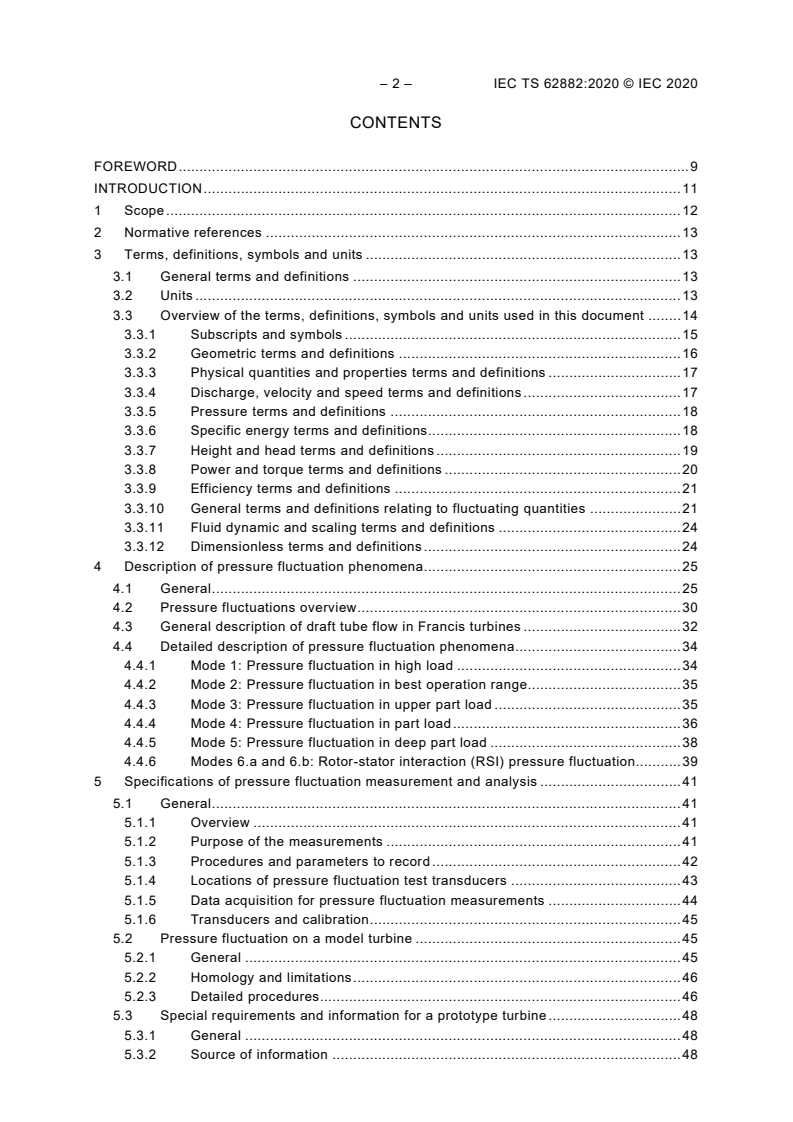
CONTENTS
FOREWORD . 9
INTRODUCTION . 11
1 Scope . 12
2 Normative references . 13
3 Terms, definitions, symbols and units . 13
3.1 General terms and definitions . 13
3.2 Units . 13
3.3 Overview of the terms, definitions, symbols and units used in this document . 14
3.3.1 Subscripts and symbols . 15
3.3.2 Geometric terms and definitions . 16
3.3.3 Physical quantities and properties terms and definitions . 17
3.3.4 Discharge, velocity and speed terms and definitions . 17
3.3.5 Pressure terms and definitions . 18
3.3.6 Specific energy terms and definitions. 18
3.3.7 Height and head terms and definitions . 19
3.3.8 Power and torque terms and definitions . 20
3.3.9 Efficiency terms and definitions . 21
3.3.10 General terms and definitions relating to fluctuating quantities . 21
3.3.11 Fluid dynamic and scaling terms and definitions . 24
3.3.12 Dimensionless terms and definitions . 24
4 Description of pressure fluctuation phenomena. 25
4.1 General . 25
4.2 Pressure fluctuations overview . 30
4.3 General description of draft tube flow in Francis turbines . 32
4.4 Detailed description of pressure fluctuation phenomena . 34
4.4.1 Mode 1: Pressure fluctuation in high load . 34
4.4.2 Mode 2: Pressure fluctuation in best operation range. 35
4.4.3 Mode 3: Pressure fluctuation in upper part load . 35
4.4.4 Mode 4: Pressure fluctuation in part load . 36
4.4.5 Mode 5: Pressure fluctuation in deep part load . 38
4.4.6 Modes 6.a and 6.b: Rotor-stator interaction (RSI) pressure fluctuation. 39
5 Specifications of pressure fluctuation measurement and analysis . 41
5.1 General . 41
5.1.1 Overview . 41
5.1.2 Purpose of the measurements . 41
5.1.3 Procedures and parameters to record . 42
5.1.4 Locations of pressure fluctuation test transducers . 43
5.1.5 Data acquisition for pressure fluctuation measurements . 44
5.1.6 Transducers and calibration . 45
5.2 Pressure fluctuation on a model turbine . 45
5.2.1 General . 45
5.2.2 Homology and limitations . 46
5.2.3 Detailed procedures. 46
5.3 Special requirements and information for a prototype turbine . 48
5.3.1 General . 48
5.3.2 Source of information . 48
5.3.3 Important aspects . 48
5.4 Analysis, presentation and interpretation of results . 49
5.4.1 General . 49
5.4.2 Time-domain analysis . 49
5.4.3 Frequency-domain analysis . 50
5.4.4 Non-dimensional frequency and pressure . 50
5.4.5 Presentation and interpretation of pressure fluctuations . 50
6 Identification of potential resonances in test rig and prototype . 51
6.1 General . 51
6.2 Identify resonance in test rig . 53
6.3 Possible resonance and self-excited pressure fluctuation in prototype . 53
6.3.1 General . 53
6.3.2 Draft tube vortex related resonances and self-excited pressure
fluctuation in prototype . 53
6.3.3 Rotor-stator interaction (RSI) related resonance . 55
6.3.4 Resonance with fluctuation modes not treated in this document . 55
7 Transposition method and procedure . 56
7.1 General . 56
7.2 Parameters influencing transposition . 56
7.2.1 Model test head . 56
7.2.2 Thoma number . 56
7.2.3 Froude number . 57
7.3 Relevant quantities for transposition . 57
7.3.1 Fluctuation frequency . 57
7.3.2 Fluctuation amplitude . 57
7.4 Transposable types of fluctuations . 57
7.5 Statistical analysis of model and prototype transposition accuracy . 58
8 Mitigations . 59
8.1 Draft tube vortex phenomena . 59
8.1.1 General . 59
8.1.2 Draft tube fins . 59
8.1.3 Draft tube with a central column . 60
8.1.4 Air admission . 61
8.1.5 AVR or PSS parameter tuning . 62
8.2 Runner inter-blade vortex. 63
8.3 Blade interaction . 63
8.4 Operation restriction . 63
Annex A (informative) Example of pressure fluctuation records . 64
Annex B (informative) Typical pressure fluctuation transducers parameters for model
test . 83
Annex C (informative) Pressure transducer dynamic calibration . 84
C.1 Fast valve opening method . 84
C.2 Rotating valve method . 84
C.3 Electrical spark method . 85
Annex D (informative) Proposed remote pressure measurement fluctuation correction . 86
D.1 General . 86
D.2 Correction method theory . 86
D.3 Measuring and estimating tube frequency response . 87
– 4 – IEC TS 62882:2020 © IEC 2020
D.4 Pressure fluctuation correction . 89
D.5 Limitations . 92
Annex E (informative) Forced response analysis for Francis turbines operating in part
load conditions. 93
E.1 General . 93
E.2 Systematic methodology based on detailed modelling of hydroelectric power
plant . 93
E.2.1 Description of the test case . 93
E.2.2 Modelling of the hydraulic power plant . 94
E.2.3 Forced response analysis of the test case . 97
E.3 Simplified approach based on the hydroacoustic properties of the hydraulic
system . 100
E.3.1 General . 100
E.3.2 Cavitating draft tube first natural frequency . 100
E.3.3 Hydraulic circuit natural frequencies . 101
E.3.4 Example of applications . 102
E.3.5 Limitations of the methodology . 107
Annex F (informative) Influence of Thoma number on pressure fluctuation . 108
Annex G (informative) Transposition of synchronous pressure fluctuations from model
to prototype for Francis turbines operating at off-design conditions . 110
G.1 General . 110
G.1.1 Overview . 110
G.1.2 Step 1: 1-D numerical modelling of both the test rig at the model scale
and the corresponding hydropower unit operating in off-design
conditions . 110
G.1.3 Step 2: Experimental identification of the parameters of interest on the
reduced scale model . 112
G.1.4 Step 3: Transposition of the hydroacoustic parameters from model to
prototype . 115
G.1.5 Step 4: Prediction of the precession frequency and eigenfrequencies at
the prototype scale . 116
G.1.6 Step 5: Prediction of pressure fluctuations at the prototype scale . 116
G.2 Concluding remark: use of the local cavitation coefficient for transposition
from model to prototype . 116
Annex H (informative) Statistical analysis of pressure fluctuation data . 119
H.1 Normalizing step for the comparison of data . 119
H.2 Collected data . 121
H.3 Draft tube zone phenomena . 121
H.4 Vaneless zone phenomena . 126
H.5 Spiral case phenomena. 130
Annex J (informative) Gathering worldwide pressure fluctuation data . 134
J.1 Chinese test cases. 134
J.2 France test case . 135
J.3 Norway test case . 137
Bibliography . 138
Figure 1 – Reference diameter of Francis turbine . 16
Figure 2 – Reference level of the Francis turbine . 19
Figure 3 – Flux diagram for power and discharge . 20
Figure 4 – Illustration of some definitions related to fluctuating quantities . 23
Figure 5 – Discharge range for the various fluctuation modes . 30
Figure 6 – Efficiency hill chart with pictures of swirling flow . 31
Figure 7 – Example of a waterfall diagram of pressure amplitudes measured in the
draft tube cone. 32
Figure 8 – Velocity triangles at inlet and outlet of the runner blade . 33
Figure 9 – Influence of the discharge on the circumferential component of the absolute
velocity . 34
Figure 10 – Elliptical vortex rope precessing in the draft tube cone at upper part load . 36
Figure 11 – Decomposition between the synchronous and asynchronous component of
part load draft tube pressure fluctuations . 37
Figure 12 – Example of inter-blade vortex . 38
Figure 13 – Modulation process between runner blade flow field and guide vanes flow
field . 39
Figure 14 – Diametrical modes shapes representation according to k values . 40
Figure 15 – Suggested locations of pressure transducers . 43
Figure 16 – Turbine hill-chart with exploration paths . 45
Figure 17 – Schematic of the axial aeration device . 47
Figure 18 – Schematic arrangement for pressure fluctuation transducers . 49
Figure 19 – Typical plot showing pressure fluctuation coefficient versus relative
discharge . 51
Figure 20 – Elementary hydroacoustic oscillator . 52
Figure 21 – Part load vortex rope in the draft tube and its fluctuation frequency range
and corresponding risk of resonance with the generator local mode of oscillation valid
for both F = 50 Hz and F = 60 Hz . 54
grid grid
Figure 22 – Waterfall diagram of the pressure fluctuations as function of the frequency
and Froude number for a given Thoma number . 57
Figure 23 – Example of fins in the draft tube and influence on the pressure
fluctuations . 60
Figure 24 – Example of the draft tube with central column extension . 61
Figure 25 – Typical runner cone extensions used for reducing draft tube pressure
fluctuations . 61
Figure 26 – Central and peripheral air admission locations for draft tube pressure
fluctuations on a radial flow turbine . 62
Figure 27 – Central air admission . 62
Figure A.1 – Example 1: a case corresponding to mode 1 (a limited high load) . 66
Figure A.2 – Example 2: a case corresponding to mode 1 (a large overload) . 68
Figure A.3 – Example 3: a case corresponding to mode 2 . 70
Figure A.4 – Example 4 : a case corresponding to mode 3 . 72
Figure A.5 – Example 5 : a case corresponding to mode 4.a and 4.b . 74
Figure A.6 – Example 6: a case corresponding to mode 4.a and 4.b . 76
Figure A.7 – Example 7: a case corresponding to mode 4.c . 78
Figure A.8 – Example 8: a case corresponding to mode 5.b . 80
Figure A.9 – Example 9: a case corresponding to mode 6.a . 82
Figure C.1 – Pressure transducer dynamic calibration schematic diagram with fast
open valve method . 84
Figure C.2 – Pressure transducer dynamic calibration with rotating valve method . 85
– 6 – IEC TS 62882:2020 © IEC 2020
Figure C.3 – Spark plug used as to generate an impulse excitation in water for
pressure transducer dynamic calibration . 85
Figure D.1 – Typical results obtained by shutting off drainage valve . 88
Figure D.2 – Signal and spectrum of four remote sensors and one local sensor . 90
Figure D.3 – Signal and spectrum of four remote sensors (corrected) and one local
sensor . 91
Figure E.1 – SIMSEN model of the test case. 94
Figure E.2 – Performance hill chart of the Francis turbine for different guide vane
openings . 94
Figure E.3 – Elementary hydraulic pipe of length dx and its equivalent circuit . 96
Figure E.4 – Forced response for a = 50 m/s (left) and a = 60 m/s (right) . 97
Figure E.5 – Forced response for a = 70 m/s (left) and a = 80 m/s (right) . 98
Figure E.6 – Forced response for a = 90 m/s (left) and a = 100 m/s (right) . 98
Figure E.7 – Damping and eigenfrequency for a = 50 m/s (left) and a = 60 m/s (right) . 98
Figure E.8 – Damping and eigenfrequency for a = 70 m/s (left) and a = 80 m/s (right) . 98
Figure E.9 – Damping and eigenfrequency for a = 90 m/s (left) and a = 100 m/s (right) . 99
Figure E.10 – Eigenmode for a = 50 m/s and eigenfrequency f = 4,18 Hz . 99
Figure E.11 – Eigenmode for a = 50 m/s and eigenfrequency f = 3,67 Hz . 99
Figure E.12 – Eigenmode for a = 100 m/s and eigenfrequency f = 2,61 Hz . 99
Figure E.13 – Draft tube modelled with cavitation compliance and draft tube inductance . 100
Figure E.14 – Simplified model of a cavitation draft tube connected to a tailrace pipe
composed by cavitation compliance of the draft tube and downstream inductance of
the tailrace pipe . 101
Figure E.15 – Hydraulic system modelled by an equivalent pipe and corresponding
modes shapes for the first and second natural frequencies . 102
Figure E.16 – Hydraulic systems 1, 2 and 3 . 103
Figure F.1 – Influence of Thoma number on pressure fluctuation . 108
Figure F.2 – Example of waterfall diagram of the pressure fluctuations as function of
the frequency and Thoma number . 109
Figure G.1 – Peak-to-peak value of pressure fluctuations as a function of the discharge
factor measured on the model and the corresponding prototype . 110
Figure G.2 – Layout of EPFL test rig PF3 1-D hydroacoustic model . 111
Figure G.3 – Electrical T-shaped representation of the cavitation vortex rope
developing in Francis turbine draft tube in part load conditions . 111
Figure G.4 – Excitation system and 3D cut-view of the rotating valve . 113
Figure G.5 – Strouhal number of the precession frequency as a function of the swirl
number computed with Formula (G.6) . 114
Figure G.6 – Strouhal number of the first eigenfrequency of the test rig as a function of
swirl number (a), the wave speed in the draft tube determined in the 1-D model (b) . 115
Figure G.7 – Predicted values of precession frequency and first eigenfrequency at the
prototype scale as a function of the output power of the generating unit . 116
Figure G.8 – Comparison between observed and predicted values of the precession
frequency f and the first eigenfrequency f of a 444 MW hydropower unit
rope 0
(HYPERBOLE project test case) . 117
Figure G.9 – Hill chart comparing the measured and the predicted resonance
conditions assuming a constant pressure value in the draft tube cone of the prototype . 118
Figure H.1 – Pressure fluctuations versus discharge factor . 120
Figure H.2 – Normalized discharge of pressure fluctuations . 120
Figure H.3 – Normalized pressure amplitude of pressure fluctuations . 120
Figure H.4 – Comparison of pressure fluctuations of model and prototype . 120
Figure H.5 – Set of pressure fluctuation of models and prototypes for draft tube
analysis . 121
Figure H.6 – Difference between pressure fluctuations between the model and the
prototype . 122
Figure H.7 – Standard deviation of difference of pressure fluctuation . 122
Figure H.8 – Transposition accuracy for draft tube cone . 123
Figure H.9 – Transposition of each power plant test case for the draft tube cone . 126
Figure H.10 – Set of pressure fluctuation of models and prototypes for vaneless zone
analysis . 127
Figure H.11 – Difference between pressure fluctuations between the model and the
prototype . 127
Figure H.12 – Standard deviation of difference of pressure fluctuation . 128
Figure H.13 – Transposition accuracy for vaneless zone . 128
Figure H.14 – Transposition of each power plant test case for vaneless zone . 129
Figure H.15 – Set of pressure fluctuation of models and prototypes for spiral case
analysis . 130
Figure H.16 – Difference between pressure fluctuations between the model and the
prototype . 131
Figure H.17 – Standard deviation of difference of pressure fluctuation . 131
Figure H.18 – Transposition accuracy for spiral case . 132
Figure H.19 – Transposition of each power plant test cases for spiral case . 133
Figure J.1 – Comparison of pressure fluctuations on the draft tube for 10 Chinese
model and prototype references . 135
Figure J.2 – Comparison of pressure fluctuations on the draft tube for one France
model and prototype reference . 136
Figure J.3 – Comparison of pressure fluctuations on the spiral case for one France
model and prototype reference . 136
Figure J.4 – Comparison of pressure fluctuations on the draft tube for one Norway
model and prototype reference . 137
Table 1 – Pressure fluctuation overview matrix . 27
Table 2 – Locations of pressure fluctuations transducers . 44
Table 3 – Accuracy for transposition of fluctuation amplitude in draft tube cone . 58
Table 4 – Accuracy for transposition of fluctuation amplitude in vaneless zone . 58
Table 5 – Accuracy for transposition of fluctuation amplitude in spiral case. 59
dec
Table D.1 – f and calculated for p to p . 88
1/4 1 4
Table D.2 – Estimated frequencies based on tubing mechanical characteristics . 89
Table D.3 – Peak-to-peak value on the raw signals . 90
Table D.4 – Wave speed and damping ratio . 90
Table D.5 – Peak-to-peak value on the corrected signals . 92
Table E.1 – Francis turbine parameters . 94
Table E.2 – Parameters of the hydraulic systems 1, 2 and 3 . 103
Table E.3 – Parameters of the equivalent pipe of the hydraulic system 1 . 104
– 8 – IEC TS 62882:2020 © IEC 2020
Table E.4 – Estimation of the natural frequencies f to f of the hydraulic system 1
0 6
based on Formulae (E.9) and (E.11) and comparison with results obtained with
eigenvalue calculation and corresponding errors . 105
Table E.5 – Parameters of the equivalent pipe of the hydraulic system 2 . 105
Table E.6 – Estimation of the natural frequencies f to f of the hydraulic system 2
0 6
based on Formulae (E.10) and (E.11) and comparison with results obtained with
eigenvalue calculation and corresponding errors . 105
Table E.7 – Parameters of the equivalent pipe of the hydraulic system 3 . 106
Table E.8 – Estimation of the natural frequencies f to f of the hydraulic system 3
0 6
based on Formulae (E.10) and (E.11) and comparison with results obtained with
eigenvalue calculation and corresponding errors . 107
Table E.9 – Pressure mode shape obtained by eigenvalue and eigenvector calculation
for the three first natural frequencies f , f and f of the hydraulic systems 1 and 2 . 107
1 2 3
Table H.1 – World hydropower plant references . 121
INTERNATIONAL ELECTROTECHNICAL COMMISSION
____________
HYDRAULIC MACHINES – FRANCIS TURBINE
PRESSURE FLUCTUATION TRANSPOSITION
FOREWORD
1) The International Electrotechnical Commission (IEC) is a worldwide organization for standardization comprising
all national electrotechnical committees (IEC National Committees). The object of IEC is to promote international
co-operation on all questions concerning standardization in the electrical and electronic fields. To this end and
in addition to other activities, IEC publishes International Standards, Technical Specifications, Technical Reports,
Publicly Available Specifications (PAS) and Guides (hereafter referred to as “IEC Publication(s)”). Their
preparation is entrusted to technical committees; any IEC National Committee interested in the subject dealt with
may participate in this preparatory work. International, governmental and non-governmental organizations liaising
with the IEC also participate in this preparation. IEC collaborates closely with the International Organization for
Standardization (ISO) in accordance with conditions determined by agreement between the two organizations.
2) The formal decisions or agreements of IEC on technical matters express, as nearly as possible, an international
consensus of opinion on the relevant subjects since each technical committee has representation from all
interested IEC National Committees.
3) IEC Publications have the form of recommendations for international use and are accepted by IEC National
Committees in that sense. While all reasonable efforts are made to ensure that the technical content of IEC
Publications is accurate, IEC cannot be held responsible for the way in which they are used or for any
misinterpretation by any end user.
4) In order to promote international uniformity, IEC National Committees undertake to apply IEC Publications
transparently to the maximum extent possible in their national and regional publications. Any divergence between
any IEC Publication and the corresponding national or regional publication shall be clearly indicated in the latter.
5) IEC itself does not provide any attestation of conformity. Independent certification bodies provide conformity
assessment services and, in some areas, access to IEC marks of conformity. IEC is not responsible for any
services carried out by independent certification bodies.
6) All users should ensure that they have the latest edition of this publication.
7) No liability shall attach to IEC or its directors, employees, servants or agents including individual experts and
members of its technical committees and IEC National Committees for any personal injury, property damage or
other damage of any nature whatsoever, whether direct or indirect, or for costs (including legal fees) and
expenses arising out of the publication, use of, or reliance upon, this IEC Publication or any other IEC Publications.
8) Attention is drawn to the Normative references cited in this publication. Use of the referenced publications is
indispensable for the correct application of this publication.
9) Attention is drawn to the possibility that some of the elements of this IEC Publication may be the subject of patent
rights. IEC shall not be held responsible for identifying any or all such patent rights.
The main task of IEC technical committees is to prepare International Standards. In exceptional
circumstances, a technical committee may propose the publication of a technical specification
when
• the required support cannot be obtained for the publication of an International Standard,
despite repeated efforts, or
• the subject is still under technical development or where, for any other reason, there is the
future but no immediate possibility of an agreement on an International Standard.
Technical specifications are subject to review within three years of publication to decide whether
they can be transformed into International Standards.
IEC TS 62882, which is a Technical Specification, has been prepared IEC technical committee
4: Hydraulic turbines.
– 10 – IEC TS 62882:2020 © IEC 2020
The text of this Technical Specification is based on the following documents:
Enquiry draft Report on voting
4/375/DTS 4/398/RVDTS
Full information on the voting for the approval of this technical specification can be found in the
report on voting indicated in the above table.
This document has been drafted in accordance with the ISO/IEC Directives, Part 2.
The committee has decided that the contents of this document will remain unchanged until the
stability date indicated on the IEC website under "http://webstore.iec.ch" in the data related to
the specific document. At this date, the document will be
• reconfirmed,
• withdrawn,
• replaced by a revised edition, or
• amended.
IMPORTANT – The 'colour inside' logo on the cover page of this publication indicates
that it contains colours which are considered to be useful for the correct understanding
of its contents. Users should therefore print this document using a colour printer.
INTRODUCTION
With the increased amount of renewable energy that is being added to the electrical grid in the
form of wind and solar, in addition to new energy in the form of nuclear, the grid needs to
integrate more hydropower generation with flexible operation to balance loads. To meet this
challenge, the hydraulic stability of the machine has become more and more important.
The current document provides a technical specification for Francis turbine pressure
fluctuations. This document aims to describe pressure fluctuations, their phenomena and
related problems, to define the relationship between model and prototype fluctuations, to
identify methods to predict pressure fluctuations in prototypes through transposition of model
measurements, and to suggest potential mitigations.
In this document, the term "turbine" refers to Francis turbines and pump-turbine operating as a
turbine.
This document excludes all matters of purely commercial interest, except those inextricably
bound within the conduct of the tests.
– 12 – IEC TS 62882:2020 © IEC 2020
HYDRAULIC MACHINES – FRANCIS TURBINE
PRESSURE FLUCTUATION TRANSPOSITION
1 Scope
IEC 62882, which is a Technical Specification, provides pressure fluctuation transposition
methods for Francis turbines and pump-turbines operating as turbines, including:
– description of pressure fluctuations, the phenomena causing them and the related problems;
– characterization of the phenomena covered by this document, including but not limited to
inter-blade vortices, draft tube vortices rope and rotor-stator interaction;
– demonstration that both operating conditions and Thoma numbers (cavitation conditions)
are primary parameters influencing pressure fluctuations;
– recommendation of ways to measure and analyse pressure fluctuations;
– identification of potential resonances in test rigs and prototypes;
– identification of methods, to transpose the measurement results from model to prototype or
provide ways to predict pressure fluctuations in prototypes based on statistics or experience;
– recommendation of a data acquisition system, including the type and mounting position of
model and prototype transducers and to define the similitude condition between model and
prototype;
– presentation of pressure fluctuation measurements comparing the model turbine and the
corresponding prototype;
– discussion of parameters used for the transposition from model to prototype, for example,
the peak to peak value at 97 % confidence interval, the RMS value or the standard deviation
in the time domain and the relation of main frequency and the rotational frequency in the
frequency domain obtained by FFT;
– discussion of the uncertainty of the pressure fluctuation transposition from model to
prototype;
– discussion of factors which influence the transposition, including those which cannot be
simulated on the model test rig such as waterway system and mechanical system;
– establishment of the transposition methods for different types of pressure fluctuations;
– suggestion of possible methods for mitigating pressure fluctuation;
– definition of the limitations of the specification.
This document is limited to normal operation conditions. Hydraulic stabil
...